

Puerto Rico’s coastal areas have reached a critical inflection point: Hurricanes buffet the island from the sea while luxury tourist developments encroach from the land. These forces converge to make the zona marítimo terrestre (ZMT), or terrestrial maritime zone, the most dynamic, ecologically diverse, heavily populated, and hotly contested part of the Puerto Rico archipelago.Footnote 1 Recent demonstrations over insufficient protections of the shoreline for local communities, both human and nonhuman, have made clunky legal terms like bien de dominio público, zona marítimo terrestre, and deslinde part of everyday conversations, protest slogans, and social media posts, as well as court cases, in contemporary Puerto Rico, as a photo of a wall in Rincón from 2022 makes clear (Figure 1).Footnote 2 While the ZMT has been examined as an object of legal dispute and an essential component of the island’s ecosystems, scholars have not yet explored its significance in Puerto Rican culture (Lugo Reference Lugo2004; Ayala Acevedo Reference Ayala Acevedo2022).
Carlos Edill Berríos Polanco, “Este muro es ilegal. Bien de dominio público,” Latino Rebels, Rincón, Puerto Rico, Monday, July 4, 2022.

The zona marítimo terrestre is a wellspring of Puerto Rican cultural identity that feeds contemporary literature and art, resisting the privatization of the coasts and the destruction of ecologically important littoral areas. An extensive yet understudied archive of cultural production featuring the zona marítimo terrestre articulates the relations between coastal peoples, colonial powers, and bodies of water. Taking the ZMT as its guiding framework, this article brings together insights from the fields of environmental justice and environmental humanities to propose that art and literature about the coastal zone be considered autogestiones acuáticas: independently imagined and managed shoreline activities in which coastal waterways inspire actions that are aesthetic, ecological, and political. In what follows, I examine a selection of literary and artistic works sited in the ZMT, offering in-depth studies of work by Norma Vila, Julia de Burgos, Nicole Cecilia Delgado, Mara Pastor, and Beatriz Santiago Muñoz; I also engage, to a lesser extent, with writings by Arcadio Díaz Quiñones, Luis Palés Matos, and Sofía Gallisá Muriente. Amid the ever-expanding corpus of cultural production about coastal waterways in Puerto Rico, I have selected for analysis works whose engagement with the push and pull of memory and oblivion mirrors the ebb and flow of the island’s shoreline.Footnote 3 Following elucidation of the key terms of zona marítimo terrestre, autogestion, and la memoria rota, the article adopts a “hydroformal” structure that follows the progression of Puerto Rico’s waters, beginning with rivers fed by mountain headwaters, descending to canals and tidal lagoons, and concluding with shorelines. This transhistorical, nonchronological flow is inspired by the Puerto Rican curator Michy Marxuach’s (Reference Marxuach2021) call for approaches based on “la sabiduría de la hidrología.”
In the past few years, a Glissantian relationality between the human and aquatic has become the focus of much Caribbeanist, ecofeminist, and posthumanist scholarship that valorizes liquidity, porosity, and tidal cycles as counterhegemonic aesthetics in art, literature, and culture.Footnote 4 Recent academic volumes have amply demonstrated how art and literature from the hemispheric Americas offer nonanthropocentric paradigms for understanding the region’s embattled waterscapes, yet Puerto Rico’s coasts remain absent from those discussions (Blackmore and Gómez Reference Blackmore and Gómez2020; Mutis and Pettinarola Reference Mutis and Pettinarola2013; Murphy and Rivero Reference Murphy and Rivero2018).Footnote 5 More recent scholarly studies involving Puerto Rico explore its archipelagic qualities and diasporic connections to other islands, often seeking commonality rather than difference between them.Footnote 6 Yet as Beatriz Llenín-Figueroa (Reference Llenín-Figueroa2022, 6) argues, “Puerto Rico’s affective archive of Caribbean relations is overwhelmingly situated on our littorals’ sands.”
This article departs from Llenín-Figueroa’s incisive observation to delineate the political and aesthetic specificities of Puerto Rico’s zona marítimo terrestre, which differ from the rest of the Caribbean in significant ways. In particular, contemporary autogestiones acuáticas insist on the right of Puerto Ricans to remain in the ZMT, to remember its history, and to reimagine its future outside of imperial control, despite the erosion of the physical shoreline and changes in coastal constructions that promote forgetting. I seek to reorient Latin American environmental humanities research toward a focus on how art and literature envision autonomy and subvert ongoing colonial dynamics, as well as the more common attention to the ramifications of the region’s colonial past. More broadly, the intricacies and richness of Puerto Rico’s cultural production constitute a paradigmatic and potentially galvanizing case study for how the arts of urbanized coastal zones in the Caribbean and Latin America can address climate change, environmental corruption, and dispossession of racialized citizens from their lands and waters.
The zona marítimo terrestre: Definition and context
The debates involving the zona marítimo terrestre stem from the systemic challenges confronting Puerto Rico in the twenty-first century: its decades-long fiscal crisis, the impacts of climate change such as rising sea levels and more powerful hurricanes, and local corruption. At the root of all these issues is the island’s status as the longest ongoing colony in the world, making Puerto Rico subject to laws not of its own making. Even the definition of the ZMT is a hodgepodge of colonial laws of both Spanish and North American origin. Within this constrained dynamic, however, the ZMT is notable among Puerto Rican geographical and hydrological features because it cannot be privatized: “Le pertenece a todos por igual y a nadie en particular por ser un bien de dominio público” (Lugo Reference Lugo2004, 17). In a biting yet instructive irony, Puerto Rican activism in the zona marítimo terrestre mobilizes a colonial juridical lexicon to advocate for the liberation of the shoreline and waterways from private interests aligned with colonial capitalism, as the calls for the defense of the bien de dominio público at coastal protests make evident. Under Puerto Rican law, the zona marítimo terrestre consists of “el espacio de las costas de Puerto Rico que baña el mar en su flujo y reflujo, en donde son sensibles las mareas y las mayores olas en los temporales en donde las mareas no son sensibles, e incluye los terrenos ganados al mar y los márgenes de los ríos hasta el sitio en que sean navegables o se hagan sensible las mareas” (Lugo Reference Lugo2004, 24). This definition of the ZMT is notable for its shifting and emotional dimensions: It includes ever-changing littoral areas, the variable reach of a storm’s waves, and navigable portions of waterways in which tides and ocean waves may be felt. Sensation and perception are inherently subjective categories, the stuff of prose, poetry, and art as much as of scientific measurement and legal classification. The perhaps accidental lyricism of this legal definition offers aesthetic as well as political forms of liberation. These affective and uncontrollable characteristics make the ZMT an elusive subject of colonial domination, a locus of enunciation for a sense of freedom that cannot be co-opted or contained.
Recent conflicts over shoreline modification, from luxury tourist developments to efforts to limit storm surge flooding, are putting the ZMT’s status as a space of liberation to the test. Indeed, we might think of the ZMT as a metonym for place-based memory in Puerto Rico: terraqueous, ever-present, yet unpredictably undulating and, most importantly, keenly contested. Mobilizing the particular strengths of each medium, these works of poetry, testimony, photography, and film refuse coastal displacement and articulate a decolonial sense of place by creating in literature and art the same qualities that characterize the ZMT: a focus on sensation and perception, a sense of belonging that is rooted in collective rather than individual experience, and an unpredictable give-and-take between the human and the aquatic that elude colonial jurisdiction.
Determining whose sensibility defines the ZMT is a highly politicized act that reveals colonial inequities and entrenched bureaucracies.Footnote 7 While the island government’s Departamento de Recursos Naturales y Ambientales is charged with demarcating the ZMT (a process known as deslinde in Spanish), some fifteen state and federal agencies have jurisdiction over it, and scientists and politicians dispute its methods of measurement (Lugo Reference Lugo2004, 102). Moreover, the island’s fiscal crisis exacerbates the difficulty of measuring and enforcing the ZMT: Since 2015, Puerto Rico’s budgets have been largely controlled by an unelected governing board, the Junta de Control Fiscal. The austerity measures instituted by the junta have eviscerated the agencies tasked with environmental protection and facilitated the imposition of a new iteration of settler colonialism across the island through what scholar Gustavo García López (Reference García López2022) calls “environmental corruption.”Footnote 8
The reduction in coastal regulation and management comes just as climate change magnifies the urgency and complexity of demarcating the ZMT. As early as 1995, the authors of the policy-oriented scientific volume Living with the Puerto Rican Shore identified coastal and riverine flooding from storm surges, sea-level rise, and even average rainfall to present the biggest environmental threat to Puerto Rico’s population (Bush et al. Reference Bush, Webb, González Liboy, Hyman and Neal1995, 7–8). The increase in the magnitude and frequency of storms since that time has accelerated the erosion and accretion of beaches, meaning that recently constructed residences and hotels now encroach upon the shifting ZMT. In 2017, Hurricane María starkly altered coastlines in many parts of the island, in some cases by up to forty-six meters; especially along the island’s hydrodynamic north coast, coastal constructions of dubious legality now regularly fall into the sea as the beaches erode. A 2021 study found that the storm had caused the beach to migrate inland in at Playa Córcega, setting off a dispute when activists founded Campamento Carey to protect nesting turtles from illegal shoreline rebuilding (Barreto et al. Reference Barreto, Cabrera, Bonano, Díaz, Pérez and Castro2021, 5). Despite official prohibitions, many private coastal constructions take place squarely within the ZMT, and local government agencies ignore, circumvent, or alter environmental regulation in their pursuit of municipal boondoggle, outside investment, and tourist dollars (García López Reference García López2022).Footnote 9
Throughout the island’s history, the United States government, colonial elites, and capitalist interests have sought to channel and control the ZMT because it is a linchpin for extractive economies, facilitating sugar exportation, cement fabrication, petrochemical refinement, pharmaceutical production, and tourist development (Anazagasty-Rodríguez Reference Anazagasty-Rodríguez2021). Colonial structures of power, from federal decision-making to the corruption of local officials, displace mixed-race, Black, and impoverished Puerto Ricans from their coastal homes and livelihoods; restrict access to clean water; and sever the long-standing relations between citizens and the island’s bodies of water (García López Reference García López2022; Lloréns et al. Reference Lloréns, Carlos García-Quijano, De Onís and Santiago2023; Lloréns and Stanchich Reference Lloréns and Stanchich2019). Rigorous scholarly work in the field of environmental justice increasingly focuses on how local community action can affect public policy and implement local self-management in matters of shoreline contamination, dispossession, and abandonment (Torres-Abreu et al. Reference Torres-Abreu and García-López2023, 24; Lloréns Reference Lloréns2021). Yet environmental justice frameworks rely on social science methodology that omits cultural production from their analysis, leaving unanswered questions of how and why communities advocate for conservation and community management of the zona marítimo terrestre beyond its utilitarian purposes.
Exciting new work in Latin American and Caribbean environmental humanities builds bridges between creative practices, academic research, and activism. Lisa Blackmore and Gisela Heffes (Reference Blackmore and Heffes2022) stake a claim for considering artistic work as a form of research in Latin America, and Lizabeth Paravisini-Gebert’s (Reference Paravisini-Gebert2020, 14) analysis of the art and literature about the Ozama River in Santo Domingo emphasizes their capacity “to help the community articulate its needs and tap into its history and the narratives through which this history can be re-envisioned.” In 2021, the public-facing culture journal The Brooklyn Rail dedicated a multidisciplinary special issue to Puerto Rican waters, signaling the importance of collaborations between academics, artists, activists, and independent cultural organizations.
Building on these recent developments, I argue that the convergence of art, literature, and the activism mentioned at the beginning of this article along Puerto Rico’s shores and waterways requires a similar convergence in scholarly approach, one that brings together the aesthetic and cultural insights of the environmental humanities with the scrutiny of legal, political, and social (in)actions at the heart of environmental justice scholarship. These fields share a focus on coloniality as a determining factor in shoreline sensibility and activity, making Puerto Rico a singular opportunity for extended study. While there are many commonalities in the histories of colonialism, urbanization, and industrialization throughout the Americas, Puerto Rico differs from the rest of Latin America and the Hispanic Caribbean because the island’s waterways remain under the jurisdiction of US agencies.Footnote 10 Since the early twentieth century, the US Army Corps of Engineers has mandated the planning, funding, and implementation of hydrological infrastructure projects from the mainland without oversight from the local elected government and only occasional collaboration with affected communities, resulting in a fundamentally undemocratic process and a deeply checkered record in Puerto Rico (Avilés Vázquez et al. Reference Avilés Vázquez, Rodríguez Mattei, Pérez Quintero, Bernard and Pérez2018).Footnote 11 Cultural production, scholarly research, and physical and virtual activism therefore come to the fore as the few options for independent expression. Puerto Rico, where public protests mobilizing art, poetry, music, and dance resulted in the 2019 resignation of the governor following Hurricane María, therefore constitutes an emblematic case for exploring the decolonization of cultures and ecosystems through what Llenín-Figueroa (Reference Llenín-Figueroa2022, 141) calls “underseen forms of Puerto Rican communitarian-artistic-bodily sovereignties.” Amid the current Caribbean discussions of sovereignty that move away from determination by political status and towards collective autonomy, my decolonial hydrological orientation is based on the work of Nelson Maldonado-Torres (Reference Maldonado-Torres2020, 117), who calls decolonization “different from obtaining independence” and “can be regarded not merely as an event, but more fundamentally, as an attitude and an unfinished project.”Footnote 12
From la memoria rota to autogestiones acuáticas
Art and literature in the ZMT share not just an ethos of protest but also a vision for coastal life that restores water-based cultural memory and creates new forms of hydrosociality inspired by Indigenous, Afro-Caribbean, and feminist practices. The term hydrosociality, first used in archaeology and geology, indicates the variety of human-water assemblages and relationships that go beyond water’s role in hydraulic industrial projects to encompass its embodied, affective, cultural, and spiritual dimensions (Brite Reference Brite2018). Hydrosociality is the driving force behind the constellation of shoreline practices and sensibilities evident in Puerto Rican literature, art, and activism that I call autogestiones acuáticas. Generally translated as “self-management,” the word autogestión in Puerto Rico has taken on a more widespread and politically inflected meaning as the state has failed to adequately serve the peoples and ecosystems on the island. Karrieann Soto Vega (Reference Soto Vega2022, 38–39) clarifies that rather than the narrow concept of management, autogestión in Puerto Rico refers to a “coalitional action” based on a “counterpraxis of survival in relation to conditions of crisis,” including neoliberal capitalism and “state violence manifest in the divestment of the land, labor, and people affected by political dependence and debt.” Environmental justice groups on the island employ autogestión to both manage ecologically important areas on their own initiative and to pressure the government to make, enforce, or alter laws, with varying degrees of success.Footnote 13
How, exactly, do art and literature recover, defend, and reimagine Puerto Rican hydrosociality in the face of rapidly changing shorelines and waterways? In his well-known 1993 essay “La memoria rota,” Arcadio Díaz Quiñones stakes a claim for “el arte de la memoria,” meaning the ability of creative practices to record places and historical moments at risk of being lost amid social, political, and economic upheaval. Referring to Luis Palés Matos’s poetic response to the changes brought by Puerto Rico’s new status as an “Estado Libre Asociado” in the 1950s, Díaz Quiñones (Reference Díaz Quiñones1993, 73) explains: “Las transformaciones del país amenazaban con destruir todos los lugares de la memoria. Frente a esa ruptura de la continuidad del habla comunitaria —la memoria rota—, Palés reinscribió las verdades del cuerpo en los viejos códigos de la poesía. Reivindicó, conservadoramente, el lugar del arte en la cultura. Su elección presuponía la rehabilitación de un modo de vida y de memoria, y una nueva espiritualización de las relaciones humanas.”
It is no accident that the lines from “El llamado” that Díaz Quiñones (Reference Díaz Quiñones1993, 70) offers as an example of Palés Matos’s “arte de la memoria” invoke the sea from the poetic voice’s position on the shore: “Estoy frente a la mar y en la lontananza/se va perdiendo el ala de una vela;/va yéndose, esfumándose,/y yo también me voy borrando en ella.” Facing death, the poetic voice looks out to sea and likens his coming erasure to the sight of a sail vanishing on the horizon. The locus of enunciation, which goes unremarked by Díaz Quiñones, is precisely the zona marítimo terrestre, the liminal space between island and ocean that serves, in this poem, as a metaphor for the swash zone between life and death. The critical and liberatory potential of art and literature in Puerto Rico lies in its capacity to remember, express, and imagine ways of being free outside of values imposed from the outside, even under the colonial yoke. As Díaz Quiñones asserts, “La memoria puede conferirle forma a una tradición, evitando que se desgaste y se muera —que sea colonizada— en la triste y ruidosa confusión de la política puertorriqueña” (86). In Puerto Rican art and literature, the waters of the ZMT repeatedly serve as the gestational medium for memory-based decolonial thought and action.
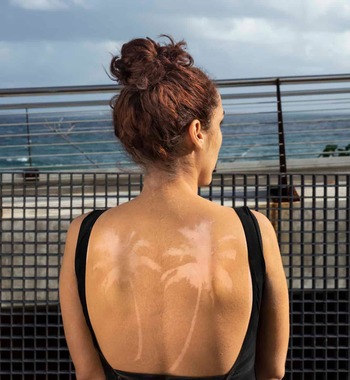
The multimedia artist Norma Vila’s (2018) photograph Rust Blocking My View in the series “Una metáfora contra el olvido” renders in artistic form Díaz Quiñones’s concern for the vulnerability of the profoundly embodied memories of Puerto Ricans amid the current coastal dispossession and gentrification (Figure 2). The artworks in the series all depart from the relationships between a member of Vila’s community and a site undergoing rapid transformation. For example, when an ill-advised walkway known as Paseo Lineal de Puerta de Tierra was built on a precipice overlooking the ocean, the artist and her community lost ready access to the ocean in a gentrifying area of San Juan, although the walkway collapsed into rubble and a series of pilings soon after its construction.Footnote 14 For “Rust,” Vila created a stencil of the lost vista, traced its outline with pancake makeup on the back of a friend who lived in the neighborhood, and had the resulting sunburn-like appearance photographed at the site.
Norma Vila, Rust Blocking My View, “Una metáfora contra el olvido,” digital photograph. :Pública. Santurce, Puerto Rico, February 8, 2019. Image courtesy of the artist.

By rendering the image on flesh, Vila underscores the profoundly somatic, personal effects of shoreline dispossession and degradation. Moreover, the image on the subject’s back is visible to the viewing community rather than the subject, indicating the shared sense of loss. The photograph does not preserve the shoreline per se but evokes how it was felt and perceived, creating a memento of coastal change through a collaborative process that involves ecological and community history. As the image on the subject’s back fades and the memory of the location ebbs away, only the photograph remains as a bulwark against forgetting. The ephemerality of the simulated sunburn is much like the ZMT itself: Human skin and the shoreline wash away in tandem. Una metáfora contra el olvido thus bears witness to loss and stakes a claim for the capacity of art and literature to memorialize the feelings and perceptions of the shoreline even as they are being lost in contemporary Puerto Rico.
In her 2023 book Observatorio de lagunas, the artist Sofía Gallisá Muriente echoes the inevitability of gradual forgetting evident in both Díaz Quiñones and Vila when she invokes the flows and sedimentation of coastal lagoons as a metaphor and physical site for the act of remembering Puerto Rican history: “La memoria, como los ecosistemas, es sedimentaria. Se forma y deforma a través del tiempo, las personas, lugares, afectos, climas y leyes que la intervienen, acumulando capas” (19). Vila, Palés Matos, and Gallisá Muriente all identify the coastal zone as the changing and contested epicenter of personal and cultural memory. In each of the cases that follow, resistance to elite and colonial water appropriation is led by a convergence of activists, artists, and writers who valorize hydrosociality, reject dispossession from shores and riverbanks, and advocate for public access to the zona marítimo terrestre. Art and literature about the ZMT not only preserve cultural memory in resistance to colonial capitalism; they also bear witness to change and imagine alternative futures.
Rivers, channels, and lagoons of the zona marítimo terrestre
In many respects, the early history of water in Puerto Rico dovetails with that of the rest of Latin America, in which, as Lisa Blackmore (Reference Blackmore2022, 249) summarizes, colonial powers sought to constrict and control water according to “the intertwined logics of colonization, urbanization, and extractivism.” Puerto Rican poetry often recalls how Taíno settlements and religious sites were located near rivers, including Caguana on the banks of the Tanamá River in the north of the island and Tibes in the south.Footnote 15 The earliest documented Spanish hydraulic mechanism for storing water in Puerto Rico dates to 1519, although it was not until the boom in sugar cultivation and export during the nineteenth century that a comprehensive series of “Leyes de Agua” was implemented to adjudicate disputes as large landowners competed for access to and control of waters. (Sepúlveda Rivera, Reference Sepúlveda Rivera2016, 5; Cabrera Salcedo Reference Cabrera Salcedo2010, 266). As colonists constructed dams and channeled flows for mining and irrigation, they forcibly displaced Indigenous and Afro-Caribbean communities from their banks; the current colonial power continues to obscure Indigenous legacies.Footnote 16
The nineteenth-century rise in colonial constrictions of waterways in the ZMT met with resistance from working-class women of color. In one remarkable harbinger of contemporary events, in 1815, a group of washerwomen presented a legal complaint to the municipality of San Juan against a landowner who blocked access to water from the San Antonio bridge, which then, as now, spanned the Caño de San Antonio and the Laguna del Condado, connecting Old San Juan to the rest of the island. The lavanderas, who were likely Afro–Puerto Rican free women, accused Santiago Hernández of putting up fences that blocked them from reaching the water, thus depriving them of the use of public space and their livelihoods.Footnote 17 The municipality found in favor of the women, reopening their access to the water based on its status as a bien público, or public good (Sepúlveda Rivera Reference Sepúlveda Rivera2016, 32–33). This important case is an early example of an autogestión acuática, in which a predominately female-identifying, racialized, low-income local community unites to safeguard public water access from elite exploitation. The early nineteenth-century collective organization of female laborers foreshadows the ongoing environmental justice activities of Afro–Puerto Rican women recently chronicled by Hilda Lloréns in Making Livable Worlds (2021). The lavanderas of the early nineteenth century were not able to leave a literary legacy expressing their hydrosociality, but the contemporary author Mayra Santos-Febres reimagines an Afro–Puerto Rican sense of place grounded in the river and the community of color that lives and works on its banks in her 2006 novel Nuestra Señora de la Noche.
Santos-Febres may have been inspired by the pathbreaking hydrosociality of Julia de Burgos’s “Río Grande de Loíza,” published in 1938.Footnote 18 As literary scholarship dating back to 1940 has noted, Burgos’s canonical “Río Grande de Loíza” makes the river an active, masculinized agent in the poetic voice’s sexual, poetic, and political coming of age (Avilés Reference Avilés2022). In evoking a sexual and spiritual union between the poetic voice and the river, the poem clearly instantiates what environmental humanities scholar Astrida Neimanis (Reference Neimanis2012, 96) calls “aqueous transcorporeality”: the conceptual and physical crossings of a “selectively permeable” membrane between human and aquatic bodies without completely effacing the boundaries of either.Footnote 19 Juan Carlos Quintero Herencia (Reference Quintero Herencia2014, 218) discusses the “hidrografía íntima” of this poem at length, focusing on the metamorphic qualities of the river and the freedom that liquid mutability offers the poetic voice: “La mutación acuática del sujeto poético es su pasaporte imaginario a la indistinción de límites corporales.” This interpretation bolsters the argument made by Blackmore (Reference Blackmore2022, 250–251) that rivers in general offer “ambient poetics and sensory attunement … as active flows that move, sound, and sculpt other material bodies.”
The poem’s final lament for its “esclavo pueblo,” however, intimates the subjugation of aqueous transcorporeality and ambient poetics by coloniality and its effects on the Puerto Rican waterscape. Indeed, while critics tend to focus on the personal waterborne poetic liberation offered in her poems, Burgos was very much writing about the rampant inequality and slow violence that plays out in and around the ZMT. For example, Burgos’s poetic sensibility understands the hydrosociality of the pueblo that lives in precarious housing along the Martín Peña channel as essential to overcoming the unjust economic conditions in her less-studied poem, “Desde el Puente Martín Peña,” also published in Poema en veinte surcos in 1938.
The Caño Martín Peña is one of nine bodies of water in the estuary connecting the Bay of San Juan to the interior Laguna de San José; its mangrove forests and brackish waters are important breeding grounds and nurseries for many species of fish and birds. The contested history of Puerto Rico’s waterways has played out in a concentrated fashion on its banks, which lie in the public domain as part of the ZMT. Bridges over the channel have been in continuous use since the early sixteenth century, making it a point of inflection for commerce and transportation between San Juan and the rest of the island. Beginning in the late eighteenth century, its banks were settled by Maroons from Puerto Rico, St. Croix, St. Thomas, and St. Eustatius whose self-emancipation was legalized by royal decree (Aponte Torres Reference Aponte Torres2023, 2). The Afro-Caribbean community first known as San Mateo de Cangrejos and later as Santurce practiced subsistence agriculture and made charcoal from the mangroves. The Caño remained a site of refuge for displaced and marginalized workers for the following two centuries.
In “Desde el Puente Martín Peña,” Julia de Burgos presents the community on the banks of the Caño Martín Peña as one that hums with the full range of human experience, from vibrant song to anguish to potential anticapitalist resistance. The poem’s focal point is the juncture of the impoverished communities of the channel and the opulence of the surrounding neighborhood. From the poetic voice’s vantage point on the bridge, the poem evokes the precarious yet potentially powerful “ejército de casas” that breaks the calm of the “mar tranquilo que arrulla.” The poem puts forth a possible liberation dependent upon hydrosociality and collective action while also recognizing the rejection of both by the colonial society:
In the midst of the urban agglomeration, the watery foam of the channel, the air, and even the moon above it briefly free the community’s song from the confinement of poverty. Artistic practice in this poem is nurtured by the ecological elements of the ZMT, while it is the human “desdén de la turba” that maintains the oppression. The poetic voice decries the “moral tan injusta” of Puerto Rican society by juxtaposing the wealth of San Juan’s urban elite on the other side of the waterway with the centuries of poverty endured by the residents of Caño Martín Peña:
The poem becomes an autogestión acuática when its conclusion calls for collective action. Burgos exhorts the workers to strike, invoking the Russian Revolution as a model for their liberation. Addressing the poor inhabiting the ZMT directly, Burgos mobilizes the land deforested by sugar plantations and waters contaminated by urbanization to inspire working-class uprisings in support of Puerto Rican independence:
Written in an era of brutal oppression of labor unrest during the Great Depression, Burgos calls upon residents of the neighborhood to resist colonial capitalism through political action inspired in their lived aquatic sensibility.
The inequalities in the ZMT have continued in Burgos’s “esclavo pueblo” in the eight decades since her poem was published. Nelson Fred Ramos details the discrimination the population of the Caño Martín Peña faced from government officials like Ernesto Juan Fonfrías, the president of the Housing Authority in the 1950s, who accused residents of CMP of “preferring” lawlessness and poor hygiene: “Los residentes del arrabal prefieren vivir en aguas estancadas y putrefactas, bajo la inclemencia de la lluvia, entre criaderos de mosquitos y otras pestes, entre la basura y desperdicios, construyen sus casuchas indeseables a lo largo de toda la laguna de San José y el Caño Martín Peña” (Ramos Reference Ramos2019, 101). This disdainful characterization glosses over the fact that the government itself contaminated the channel by dredging the San Juan Bay in 1933–1934 and 1939–1941 to open it further to large ships, which resulted in flooding of channel with mud and untreated sewage (Ramos Reference Ramos2019, 118). The accumulation of industrial waste materials in the Caño Martín Peña in the second half of the twentieth century blocked the flow of salt water and fresh water between the sea and the interior channel, flooding the surrounding neighborhoods and resulting in high levels of toxic contaminants that have devastating consequences for the estuarine wildlife and the residents of the community.Footnote 20 The daily injustice and danger of living surrounded by waters contaminated by fecal coliform and municipal waste challenges Neimanis’s concept of aqueous transcorporeality and makes Burgos’s aquatic-human union a perilous proposition in the contemporary era.
Yet autogestiones acuáticas have continued to flourish since Burgos published “Desde el Puente Martín Peña” in 1938. Recent testimonial work by a coalition of writers, scholars, and local residents cultivates a decolonial sense of place in the lagoons of San Juan that has been obscured by official histories.Footnote 21 To create En la laguna hay una historia: Recuentos de Alto del Cabro (2019), residents of Alto del Cabro, a small waterfront neighborhood in Santurce on the shores of the Condado Lagoon, collaborated with the Museo de Arte Contemporáneo and the poet Nicole Cecilia Delgado to compile and curate a series of testimonios published by her independent press La Impresora.Footnote 22 The resulting pamphlet-size publication offers a local history of hydrosociality and the transformation of a once-bustling fishing community into one of the most pavement-laden and overdeveloped stretches of San Juan. It is an aquatic testimony from below: As one community leader, Noris Gautier told Delgado (Reference Delgado2019), “La historia de un país, ¿quién la debe describir? Nosotros”: “Toda mi vida he tenido lancha. Nosotros jugábamos a esconder en el agua, rescate en el agua. Nosotros nos íbamos a bañar en la playa y nos tirábamos desde la laguna nadando, el primero que llegara. Nosotros jugábamos a esconder en el agua porque había botes, entonces cuando tú me venías a buscar, yo me zambullía y me escondía debajo de los botes. Los pulmones de nosotros resistían mucho tiempo debajo del agua. Todo lo que hacíamos, hacíamos en el agua.” Like Burgos’s poem, the testimonies memorialize an early amphibian lifestyle at risk of being obliterated from the collective imaginary amid the contaminated waters and urban commerce of contemporary Miramar. Moreover, as with the Caño Martín Peña described by Julia de Burgos, the neighborhood was infused with music from the banks and even on the surface of the lagoon: one resident recalled community members performing congas in boats in the years before the lagoon was shrunk by dredging. From “Desde el Puente Martín Peña” to En la laguna hay una historia, music and celebrations are forms of resistance to the long, ongoing history of displacement and migration. These residents, like those in the Caño Martín Peña, have organized to seek legal status for their homes and refuse to be displaced: “Los grandes intereses nos siguen arropando, pero nosotros nos vamos a quedar aquí” (n.p.). En la laguna hay una historia provides a platform for the visibilization and amplification of the voices of a community that has been pushed toward oblivion by public works and infrastructure projects undertaken in the name of modernization. In doing so, it insists upon an independent articulation of collective hydrosociality rooted in history and memory independent from the island’s ongoing colonial status.
A decolonial shoreline sensibility
Amid the vast and varied Puerto Rican cultural production about the island’s seven hundred miles of coastline, one recurrent motif is a sense of shared oceanfront hydrosociality, from Luis Palés Matos’s “El llamado” described earlier to Marigloria Palma’s poem “Canción pálida” (Reference Palma1940, 63–64): “Aquí,/a la orilla del mar tan tuyo y mío/estoy como caída. […] Aquí,/frágil y tenue;/ soy a la maravilla de un mar inexplicable.” Here Palma’s “tan tuyo y tan mío” indicates a sense of intimate belonging, whereas “soy a la maravilla de un mar inexplicable” simultaneously expresses expansive, vulnerable wonder at the sight of the sea. This shoreline sensibility encompasses the small scale of the fragile individual and the grandeur of the infinite, articulating a broad range of human connections to the waters. Yet as Norma Vila’s Una metáfora contra el olvido makes evident, the awed plenitude the coastal vista inspires is hard won and under continual threat from coastal constructions and the breakwaters designed to protect them. Coastal gentrification and climate disaster, from increasing hurricane frequency and strength to toxic pollution, have emerged as the dominant motifs in twenty-first-century literature and art about the shoreline.
The out-migration following the island government’s fiscal collapse and Hurricane María in 2017 has resulted in a boom in sales and construction of coastal properties to US and foreign citizens and corporations, a massive change reflected in the 239 percent increase in building permits granted between 2015 and 2021.Footnote 23 Rather than implementing a managed retreat to higher ground as sea levels rise, the US government and the colonial elite focus instead on attempting to control the sea. Containment walls, jetties, and breakwaters, many of which require pouring massive amounts of cement into the ZMT, have proliferated since the 1940s, when the change of Puerto Rico’s status to an Estado Libre Asociado brought about the increased construction of military installations and housing developments. These breakwater structures, or rompeolas, often installed by the US Navy or Army Corps of Engineers, complicate the local community’s access to the shore and present a threat to the long-term existence of beaches and their ecosystems: Erosion is displaced from the site of the wall to the surrounding area, leading to the eventual loss of the beach and its wildlife habitat altogether (Lugo Reference Lugo2004, 129–131). As with the nineteenth-century dispute over water access for the washerwomen, the blockages that render the beach inaccessible to ordinary citizens have the capacity to sever hydrosociality, but autogestiones acuáticas occupy and repurpose those colonial infrastructures of control.
Coastal displacement and inaccessibility are most acute on Vieques, an island off the coast of mainland Puerto Rico that was used by the US military as a practice bombing range from 1940 to 2001 and is now a tourist destination. Military debris and toxic substances contaminate the ZMT in Vieques: Unexploded ordinance lies visible on beaches and in lagoons; a submarine dock subsists lopsidedly near the ferry terminal, corroding slowly in the saltwater; and a mile-long breakwater, built by the military in the runup to World War II, juts into Mosquito Bay. From poetry to film to the local proposal of an ecological park, recent autogestiones acuáticas taking place on Vieques acknowledge the precarity of life and the proximity of death for the peoples and ecosystems of the island. Their creative works refuse the alienating effects of expropriation and contamination by forging a decolonizing hydrosociality alongside and even on top of the breakwaters and toxic shorelines in Vieques. For example, in Mara Pastor’s (Reference Pastor2020, 33) poem “El rompeolas,” women walk along the mile-long breakwater in Mosquito Bay. Much as Julia de Burgos framed “Desde el Puente Martín Peña” from the bridge overlooking the Caño Martín Peña, the poetic voice in “El rompeolas” speaks from the breakwater, a symbol of colonial intervention in the lives and landscapes of the ZMT:
Pastor situates the women in both the lifeways and death rituals of the island, likening the women’s return to the “Isla Nena” from the “Isla Grande” of mainland Puerto Rico to turtles and skeletal human remains returning to shore in a storm surge. This simile creates solidarity between the women and turtles in much the same way as Campamento Carey, named after the hawksbill turtle. The commitment to return and remember endures, despite the toxicity that damages human and nonhuman populations alike. Walking along the breakwater, the poetic voice recalls happier moments in the past, the present economic decline of the island economy for residents, and the medical crises sparked by the heavy metals in the island’s water and air. Pastor (Reference Pastor2020, 33–34) concludes with an invocation of the women’s love of place and commitment to return to the island fragmented by contamination, illness, and loss:
In this poem, the act of walking along the breakwater inspires a wonder, solidarity, and vulnerability related to but distinct from that expressed by Marigloria Palma: here, the women who return to Vieques refuse to accept the violence and neglect by the state. The periodic return of the women to the island recalls not just the intra-archipelagic and diasporic travels common to Puerto Rico but more profoundly the “flujo y reflujo” of the ZMT. The final phrase, “a detener la marejada,” inverts the expected aquatic image by positioning the women as the breakwater against the “storm surge” of environmental injustice and inequality. Much as activists mobilize the colonial definition of the ZMT to advocate for great protections for the Puerto Rican shoreline, here the rompeolas, initially installed to facilitate military operations on the island, becomes a site of enduring love. This articulation of a “counterpraxis of survival” is what makes the poem an autogestión acuática. The women’s occupation of an infrastructure of military control forms a parallel to the action of the residents of Caño Martín Peña, whom Burgos envisions leaping over economic and environmental injustice in the lagoon to unite with cane workers and the many activist groups occupying shorelines across the Puerto Rican archipelago. Much like Arcadio Díaz Quiñones’s identification of poetic resistance to “la memoria rota” in Palés Matos, the meaning of survival amid these fragments is the poem’s ability to gather and retain memories that insist on the right to remain on the shoreline despite and amid abandonment, sickness, and death.
Like Pastor, the film artist Beatriz Santiago Muñoz’s artistic practices feature autogestiones acuáticas in Vieques. In an interview, Santiago Muñoz described to me a remarkable “compromiso con la muerte” that she observed among the peoples of Vieques in 2015, in which those who choose to remain in and return to the island forge meaningful lives in a contaminated environment despite the damage to their health.Footnote 24 Rather than a form of fatalism, this “compromiso con la muerte” is a profound form of decolonization. As with Pastor’s poem, Santiago’s film-making articulates the community’s refusal to become alienated from its coastal ecologies. Santiago Muñoz’s eight-minute film Playa Negra/Caballo/Campamento/Fuerzas (2016) takes place entirely within the zona marítimo terrestre of Vieques.Footnote 25 Santiago Muñoz’s silent eight-minute film, a still of which is featured here, is shot in black-and-white with a handheld camera, a technique that defamiliarizes the crescent-shaped sandy beaches of the tourist imaginary (Figure 3). Instead, the filmmaker shoots the swash zone from above, contemplating the interplay of foaming white waves with the black sand and sea grapes on Playa Negra. This aesthetic choice seems to invite a Brathwaitian tidalectic reorientation of the human perspective toward the irregular cycles of the ocean.
Beatriz Santiago Muñoz, Playa Negra/Caballo/Campamento/Fuerzas, 16 mm black-and-white film, 8 min., 2016. Image courtesy of the artist.

Yet in the context of Vieques, any aspiration for a redemptive tidalectic flow is freighted with the knowledge that heavy metals similarly circulate throughout the coastal ecosystem, complicating the possibilities of human communion with tidal flows. On the north coast of Vieques, Santiago Muñoz’s filmic gaze lingers over the steady lap of waves on the corroding submarine dock near the ferry terminal on Playa Cofí, thus making visible the residues of imperial militarism and colonial abandonment in contemporary ecologies and cultures. The focus on the partially submerged dock implicitly raises the question of what further contaminants might lie underwater, such as the USS Killen, a decommissioned nuclear warship the US Navy scuttled off the coast of Vieques whose unexploded warheads emit carcinogenic materials and pose an existential risk to the peoples of Vieques (Withers Reference Withers2013, 8). The extended shots are a filmic refusal to forget the island’s history or to gloss over its contemporary challenges.
Santiago Muñoz refers to the necropolitical reality of life in Vieques by filming two toddlers playing with a skeleton on the beach in the town of Esperanza. More poignantly, she dedicates long takes to a local man who does not offer typical tourist services on the beach but rather traces the movements of the waves on the sand with palm fronds in a hypnotic fashion devoid of any immediately apprehensible utility. These rhythmic gestures, which form silent counterpoints to the swaying waters, repeat the flujo y reflujo of the ZMT with the human body. In filmic form, they constitute an autogestión acuática that embodies an aquatic sense of place, refusing to be displaced even amid life-threatening contaminants. Going even further, Santiago Muñoz depicts a series of reciprocal relationships between people and water, animals, and plants by juxtaposing shots of Vieques’s semi-wild horses lying down with similarly angled shots of the artist-activist Ardelle Ferrer lying in a similar position amid the roots of a three-hundred-year-old ceiba tree that lies within the ZMT not far from Mosquito Bay and its rompeolas. Ferrer, an artist, activist, and cancer survivor who has resided in Vieques for several decades, founded the Parque de la Ceiba, where she organizes regular festivals and advocates for the legal protection of the coastal area.Footnote 26 Muñoz’s cinematic techniques match the content of her work: Filming in black-and-white with long, silent shots of human, animal, and water bodies creates a documentary snapshot of the ZMT much like Vila’s “Una metáfora contra el olvido,” both artistic refusals of displacement and dispossession.
Taken together, the diverse forms of literary and visual arts considered in this article create a cultural map of the zona marítimo terrestre, an archive of terraqueous memory not unlike Díaz Quiñones’s “lugares de memoria”: Each expresses the shifting and ephemeral dimensions of the zona marítimo terrestre’s physical boundaries, its affective legacy, and its enduring cultural significance. Vila’s photographs, Burgos’s and Pastor’s poems, Delgado’s testimonial compilations, and Santiago Muñoz’s film are autogestiones acuáticas that not only document but also, and more importantly, craft Puerto Rican hydrosociality by enacting in their work the very essence of the ZMT: feeling and perceiving the changing boundary between water and land, between life and death, between colonial constriction and freedom. Each creative practice obliquely repurposes the colonial origin of the term zona marítimo terrestre in Puerto Rican culture and remakes it into a vehicle for memory as a breakwater against dispossession and forgetting. “The whole world is becoming an archipelago,” Édouard Glissant (Reference Glissant1997, 164) wrote in Traité du Tout-Monde (my translation). As sea levels rise, this late twentieth-century pronouncement is taking on a literal significance to match its conceptual import. Coastlines are already retreating and accreting, forcing littoral populations to seek higher ground. Autogestiones acuáticas will change along with the ZMT, and these works of art will form an archive of what Puerto Ricans refused to forget.



 Open access

