


Introduction
Non-governmental organisations (NGOs) rely on volunteers to carry out their projects and, therefore, need to employ good volunteer management practices to attract and retain these volunteers (Bahat, Reference Bahat2020; De Clerck et al., Reference De Clerck, Aelterman, Haerens and Willem2021; Wu et al., Reference Wu, Lin and Wang2019). These practices include providing volunteer training in 85.3% of organisations in Spain (Fundación Telefónica, 2019). This investment might explain why 87% of volunteers expressed an intention to remain in their volunteering roles (Observatorio del Voluntariado, 2020). The desire to maintain and even increase this rate, as well as reduce the number of volunteers quitting NGOs, might explain the recent interest shown by the literature on volunteering, even though the focus on this area has been weaker than the literature on management.
This paper uses theoretical and practical approaches to understand which factors influence volunteers’ decisions to remain or quit. The literature review explores empirical models that consider this decision as an output to extract the independent and mediating variables under study. This research studied volunteers’ intentions to remain in or leave an NGO, ultimately recognising that the literature has focused much more closely on the reasons for remaining as opposed to explaining why volunteers leave. Moreover, different concepts have been observed in explaining the two decisions, with remain-centred papers emphasising positive concepts (Trautwein et al., Reference Trautwein, Liberatore, Lindenmeier and von Schnurbein2020) and quitting-centred papers oriented towards negative management practices and experiences (Allen & Mueller, Reference Allen and Mueller2013; Hurst et al., Reference Hurst, Scherer and Allen2017). Our review of the two perspectives serves as a starting point for our empirical analysis.
Literature reveals a focus on just a few research concepts. Moreover, many studies have used simple bivariate approaches (e.g., logistic regression) or structural equation modelling (Trautwein et al., Reference Trautwein, Liberatore, Lindenmeier and von Schnurbein2020; Zollo et al., Reference Zollo, Faldetta, Pellegrini and Ciappei2022), with constructs built around one or two concepts in conjunction with regression analysis (Bahat, Reference Bahat2020). These methods work well in general, although imply limitations when the sample size is small, and the number of features (explanatory variables) is high. They also make assumptions about the functional form and interaction between the features of the model. In the volunteering research context, a smaller sample of volunteers who decided to leave an NGO might explain the scarcity of work focused on explaining volunteers’ intentions to quit. However, as Allen and Mueller (Reference Allen and Mueller2013) stated, the intention to quit is the immediate antecedent to volunteer turnover and is a good predictor of volunteer behaviour. Moreover, there are now machine-learning-based (ML) methods that mean a model can include more features without specifying whether some are control variables, for example. Compared to traditional approaches, the new ML methods are more flexible (they are non-parametric, handle cross-variable interactions by construction, etc.) and have extraordinary predictive capacity. However, their use in volunteer decision prediction problems is still very limited.
Given the constraints of traditional approaches, the aim of this paper is to compare results for logistic regression and neural networks to determine which method predicts volunteers’ decisions more accurately. Neural networks are considered to be robust for data – which constitutes a challenge for other methods – although interpretation is more intricate (Larose and Larose, 2019). However, new techniques based on explainable deep learning, such as the Local Interpretable Model-Agnostic Explanations (LIME) approach, provide insight into the importance of every variable in terms of predicting intentions to remain or quit (Petch et al., Reference Petch, Di and Nelson2022). This method considers 55 heterogeneous predictors for volunteers’ decisions to remain or quit, which is a volume of data that other common methods have difficulty handling.
Three research questions will be answered through the 55 predictors:
• RQ1. Which volunteer profile characteristics influence the intention to remain in or quit an NGO?
• RQ2. Which volunteer management characteristics influence the intention to remain in or quit an NGO?
• RQ3. Which volunteer experience characteristics influence the intention to remain in or quit an NGO?
The next sections set out the theoretical framework ("Theoretical framework" section), the method design ("Methodology" section), the regression analysis and neural network results ("Results" section) and discuss the findings and the study’s conclusions ("Discussion" section).
Theoretical Framework
Literature regarding volunteers’ intentions to remain or quit is highly fragmented and the characteristics used to predict volunteer decisions are extremely diverse. To draw up a comprehensive list of the least common features, we conducted a literature review in the Web of Science database which included the terms “remain”, “stay”, “continue”, “retention”, “quit”, “leave”, “cease”, “abandon”, “stop” and “turnover”, combined with “volunteer*”. Only papers including statistical analyses and outputs featuring remain or quit were selected. The initial search yielded 100 articles, although only 48 included any reference to remaining or quitting, and only 33 included statistical analyses featuring remain or quit as model outputs. Although many studies have focused on analysing intentions to remain, few studies have considered the intention of volunteers to quit an NGO.
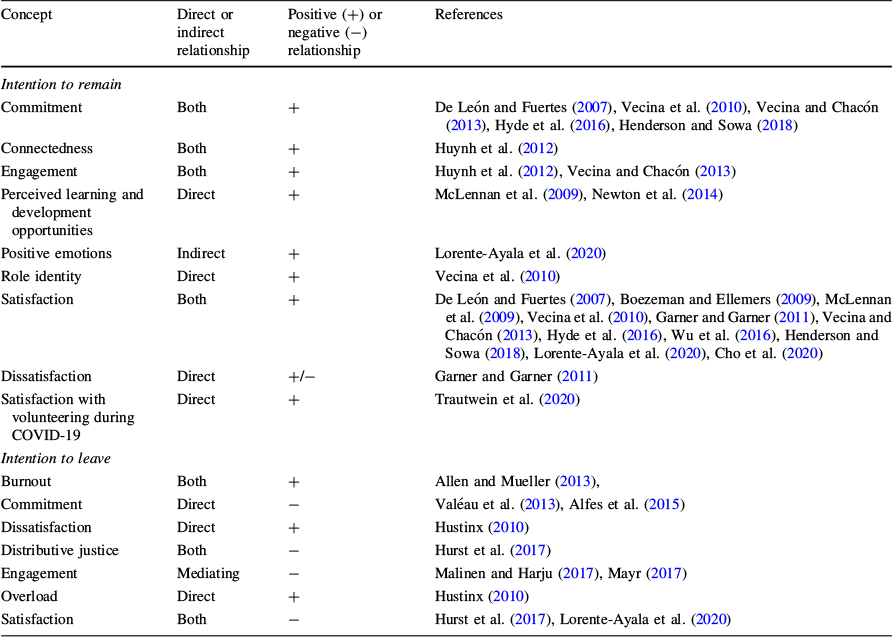
The second step of the literature review centred on identifying the concepts that appeared as independent variables expressing the outputs “intention to remain in an NGO” and “intention to leave”. Tables 1, 2 and 3 summarise the articles and concepts associated with these two outputs, which are divided into three groups: volunteer profiles, volunteer management activities and volunteer experience.
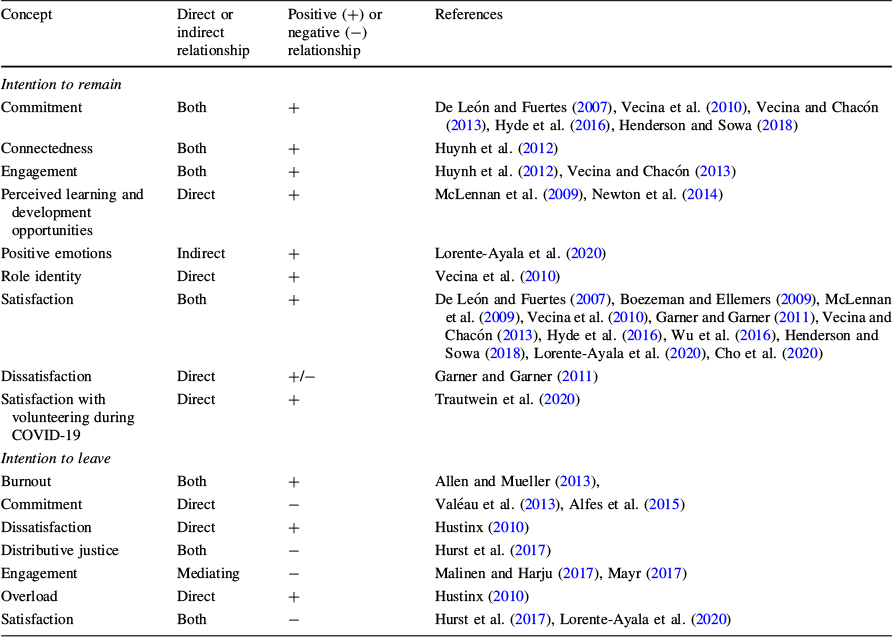
Relationship between volunteer profile and intention to remain in/leave an NGO.

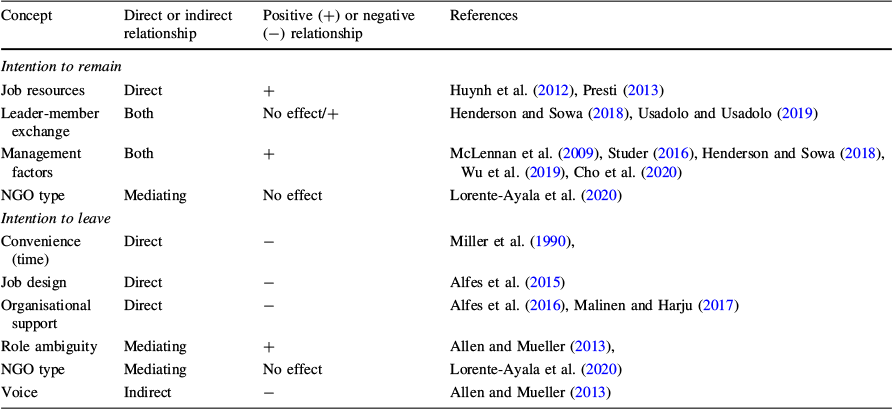
Relationship between volunteer management and intention to remain in/leave an NGO.
Concept |
Direct or indirect relationship |
Positive (+) or negative (−) relationship |
References |
|---|---|---|---|
Intention to remain |
|||
Job resources |
Direct |
+ |
Huynh et al. (Reference Huynh, Metzer and Winefield2012), Presti (Reference Presti2013) |
Leader-member exchange |
Both |
No effect/+ |
Henderson and Sowa (Reference Henderson and Sowa2018), Usadolo and Usadolo (Reference Usadolo and Usadolo2019) |
Management factors |
Both |
+ |
McLennan et al. (Reference McLennan, Birch, Cowlishaw and Hayes2009), Studer (Reference Studer2016), Henderson and Sowa (Reference Henderson and Sowa2018), Wu et al. (Reference Wu, Lin and Wang2019), Cho et al. (Reference Cho, Wong and Chiu2020) |
NGO type |
Mediating |
No effect |
Lorente-Ayala et al. (Reference Lorente-Ayala, Vila-Lopez and Kuster-Boluda2020) |
Intention to leave |
|||
Convenience (time) |
Direct |
− |
Miller et al. (Reference Miller, Powell and Seltzer1990), |
Job design |
Direct |
− |
Alfes et al. (Reference Alfes, Shantz and Saksida2015) |
Organisational support |
Direct |
− |
Alfes et al. (Reference Alfes, Shantz and Bailey2016), Malinen and Harju (Reference Malinen and Harju2017) |
Role ambiguity |
Mediating |
+ |
Allen and Mueller (Reference Allen and Mueller2013), |
NGO type |
Mediating |
No effect |
Lorente-Ayala et al. (Reference Lorente-Ayala, Vila-Lopez and Kuster-Boluda2020) |
Voice |
Indirect |
− |
Allen and Mueller (Reference Allen and Mueller2013) |
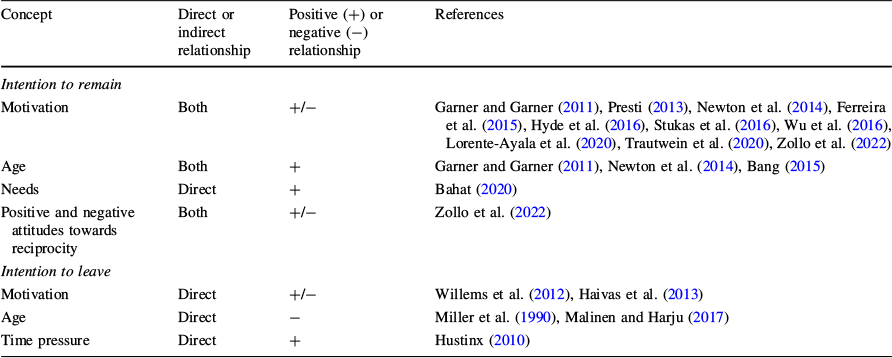
Relationship between volunteer experience and intention to remain in/leave an NGO.
Volunteer Profile and Intention to Remain in or Leave an NGO
Table 1 describes the volunteer profile reasons that explain a volunteer’s intention to remain in or to leave an NGO.
The most frequent concept variable was volunteer motivation , with both positive and negative impacts on the intention to remain (Trautwein et al., Reference Trautwein, Liberatore, Lindenmeier and von Schnurbein2020; Zollo et al., Reference Zollo, Faldetta, Pellegrini and Ciappei2022). However, fewer works have explained why volunteers quit NGOs (Haivas et al., Reference Haivas, Hofmans and Pepermans2013). Motivation is usually introduced through multivariate constructs. For example, Omoto and Snyder (Reference Omoto and Snyder1995) defined five specific motivations for volunteering: values, understanding, personal development, community concern and esteem enhancement. They recognised that understanding (learning), personal development (social) and esteem enhancement have a positive impact on volunteers’ decisions to remain, while they found no significant relationship between values or community concern. However, other authors obtained a positive relationship between intention to remain and values (Garner & Garner, Reference Garner and Garner2011; Stukas et al., Reference Stukas, Hoye, Nicholson, Brown and Aisbett2016; Trautwein et al., Reference Trautwein, Liberatore, Lindenmeier and von Schnurbein2020). Clary et al. (Reference Clary, Snyder, Ridge, Copeland, Stukas, Haugen and Miene1998) developed the Volunteer Functions Inventory (VFI), which comprises six motivation categories: values, understanding and enhancement (as in Omoto & Snyder, Reference Omoto and Snyder1995), as well as social, career and protective. Willems et al. (Reference Willems, Huybrechts, Jegers, Vantilborgh, Bidee and Pepermans2012) used the VFI model to analyse whether volunteer motivation explained people’s intention to quit, finding a correlation only for values, understanding, social and career motives. However, Stukas et al. (Reference Stukas, Hoye, Nicholson, Brown and Aisbett2016) found a negative relationship with the intention to remain for social, protective and career reasons.
The classification of motivation as being intrinsic or extrinsic, as drawn up by Ryan and Deci (Reference Ryan and Deci2000), provides a conceptualisation often used in the literature on volunteering. In this context, intrinsic motivation is described as doing something because it is interesting or enjoyable, whilst extrinsic motivation centres on doing something for its instrumental value, for example, because it will be valuable in a person’s career. Based on this classification, Wu et al. (Reference Wu, Li and Khoo2016) observed that intrinsic motivation positively influenced the remain output, whilst Newton et al. (Reference Newton, Becker and Bell2014) observed extrinsic motivation in dissuading volunteers from staying at their NGO.
Some works have focused on needs rather than motivations and have observed that needs correlate with volunteers’ intentions to quit (Haivas et al., Reference Haivas, Hofmans and Pepermans2013) and volunteer retention (Bahat’s, Reference Bahat2020).
Regarding volunteer age , the intention to stay is more common among older volunteers (Bang, Reference Bang2015; Newton et al., Reference Newton, Becker and Bell2014). When the intention to leave is the dependent variable, papers observe a negative relationship between age and volunteers’ intention to leave, indicating that older volunteers are less likely to abandon an NGO (Malinen & Harju, Reference Malinen and Harju2017; Miller et al., Reference Miller, Powell and Seltzer1990). When age is a mediating variable, Bang (Reference Bang2015) stated that although young volunteers might apparently be more satisfied with their role, this might not necessarily encourage them to remain with the NGO.
Reciprocity , both positive and negative (Perugini et al., Reference Perugini, Gallucci, Presaghi and Ercolani2003), is also a factor used to explain the intention to continue with an NGO. For example, Zollo et al. (Reference Zollo, Faldetta, Pellegrini and Ciappei2022) found that when volunteer attitudes towards reciprocity were positive, they were more likely to stay with an NGO. However, when attitudes towards reciprocity were negative, remaining at an NGO was less likely.
Time pressure, according to Hustinx (Reference Hustinx2010), describes the external constraints on volunteers that reduce the amount of time they are able to work for the non-profit. Time constraints include family duties, paid employment and studies.
Volunteer Management and Intention to Remain in or Leave an NGO
The second group of variables (Table 2) identifies the best volunteer management practices NGOs utilise to retain volunteers.
Factors related to volunteer management have been analysed both separately and as a construct of items for management factors . For example, Wisner et al. (Reference Wisner, Stringfellow, Youngdahl and Parker2005) developed a construct with six items: schedule flexibility, orientation and training, empowerment, social interaction, reflection and rewards. Items recognised in different works which impacted intentions to remain are flexibility, rewards, training and orientation (Cho et al., Reference Cho, Wong and Chiu2020; Ferreira et al., Reference Ferreira, Proença and Proença2015; Henderson & Sowa, Reference Henderson and Sowa2018; McLennan et al., Reference McLennan, Birch, Cowlishaw and Hayes2009; Studer, Reference Studer2016; Wu et al., Reference Wu, Lin and Wang2019).
Factors analysed separately include convenience , which indicates flexibility along the lines of Wisner et al. (Reference Wisner, Stringfellow, Youngdahl and Parker2005). For example, Miller et al. (Reference Miller, Powell and Seltzer1990) observed that when NGOs gave volunteers flexibility, they were less likely to leave.
The factors studied with respect to tasks that influence volunteers’ decisions to remain at an NGO included job resources, job design and role ambiguity. Presti (Reference Presti2013) found that investing in job resources , i.e., social and technical support from supervisors and other volunteers, training and clear instructions regarding tasks, and the impact of each volunteer’s work- was crucial to retaining volunteers. In terms of job design , Alfes et al. (Reference Alfes, Shantz and Saksida2015) observed that when volunteers perceived themselves to be helping others and deemed their work to be worthwhile, they were less likely to leave an NGO. Role ambiguity centres on volunteers not knowing what is expected from them, potentially indicating the absence of a job description or task assignment. Allen and Mueller (Reference Allen and Mueller2013) related this factor to burnout, which is an important reason for volunteers quitting an NGO.
Regarding organisational support , the literature differentiates between the support given to volunteers as individuals and the support given in the context of completing their tasks. Alfes et al. (Reference Alfes, Shantz and Bailey2016) studied this difference, observing lower volunteer intentions to leave an organisation when there was support for volunteers as individuals compared to when there was support for the job. Malinen and Harju (Reference Malinen and Harju2017) found that when NGOs supported volunteers, the latter were likely to feel obliged to engage and continue with the activity, reducing their intention to quit. Another factor which explains the intention to quit is voice, which refers to giving opportunities to volunteers to express their ideas and have their opinions taken into consideration before decisions are made (Allen & Mueller, Reference Allen and Mueller2013).
Leader-member exchange (LMX) describes the relationship between volunteers and supervisors. Usadolo and Usadolo (Reference Usadolo and Usadolo2019) observed that high-quality relationships increased the intention to remain, explaining 34.2% of the output variance. However, Henderson and Sowa (Reference Henderson and Sowa2018) did not find any impact of LMX on volunteers’ intentions to remain.
Finally, studies focused on NGO type (Lorente-Ayala et al., Reference Lorente-Ayala, Vila-Lopez and Kuster-Boluda2020) did not find that being a specialist or generalist NGO influenced volunteers’ intentions to remain or quit.
Volunteer Experience and Intention to Remain or Leave an NGO
This group of variables considers whether or not volunteers feel that their experience in volunteering for an NGO is positive or negative (Table 3).
The papers analysed indicate four important factors: commitment, engagement, satisfaction and dissatisfaction. Commitment describes a “volunteer’s psychological attachment to an organisation” (Heery & Noon, Reference Heery and Noon2017) and can be understood in terms of their identification with an NGO’s values and willingness to work for the organisation. Commitment has been identified as having two different meanings (Valéau et al., Reference Valéau, Mignonac, Vandenberghe and Gatignon Turnau2013). The first concerns the organisation (organisational commitment), and the second concerns volunteering (commitment to beneficiary). Organisational commitment has been found to have a positive impact on volunteer retention in the medium-term (Hyde et al., Reference Hyde, Dunn, Bax and Chambers2016; Vecina et al., Reference Vecina, Chacón and Sueiro2010), while volunteer commitment to the organisation has an influence on abandoning an NGO (Alfes et al., Reference Alfes, Shantz and Saksida2015). The commitment factor is analogous to connectedness, which refers to the sense of belonging to a non-profit and has been proven to positively influence volunteers’ intentions to remain (Huynh et al., Reference Huynh, Metzer and Winefield2012).
The term engagement describes volunteers’ dedication to their tasks (Heery & Noon, Reference Heery and Noon2017), and the positive correlation with their intention to continue volunteering was demonstrated by Vecina and Chacón (Reference Vecina and Chacón2013), while Mayr (Reference Mayr2017) found that volunteer engagement reduced the intention to quit.
Satisfaction volunteering has been analysed by McLennan et al. (Reference McLennan, Birch, Cowlishaw and Hayes2009), Ferreira et al. (Reference Ferreira, Proença and Proença2015) and Lorente-Ayala et al. (Reference Lorente-Ayala, Vila-Lopez and Kuster-Boluda2020), who found that satisfaction increased volunteers’ intentions to remain. However, Vecina et al. (Reference Vecina, Chacón and Sueiro2010) pointed out that this was only valid in the short term because after a few months, volunteers began to consider other aspects, which influenced their decision to stay or leave. Conversely, Hyde et al. (Reference Hyde, Dunn, Bax and Chambers2016) and Henderson and Sowa (Reference Henderson and Sowa2018) discovered that satisfaction positively influenced volunteer retention, irrespective of the number of years they had been at the NGO and in the long-term. Trautwein et al. (Reference Trautwein, Liberatore, Lindenmeier and von Schnurbein2020) included satisfaction volunteering during the COVID-19 pandemic as a variable that mediates between volunteer motivation and volunteers’ intentions to remain. They observed that satisfaction volunteering during the COVID-19 pandemic helped NGOs to retain volunteers when volunteer motivation was based on values and enhancement.
It is worth differentiating between satisfaction and dissatisfaction. As Hustinx (Reference Hustinx2010) demonstrated, including dissatisfaction as a variable enables observation of the absence of best volunteer management practices. Garner and Garner (Reference Garner and Garner2011) pointed out that volunteers responded to dissatisfaction and when they were able to voice their dissatisfaction, they were more likely to remain. However, dissatisfaction could arise if volunteers saw their tasks diminish and leave as a consequence.
In "Volunteer Management and Intention to Remain in or Leave an NGO" section we explain that role ambiguity and voice can influence burnout . Allen and Mueller (Reference Allen and Mueller2013) found that burnout mediates between volunteer management and volunteers’ intentions to leave an NGO. Overload is another negative factor in volunteer experience and can cause volunteers to feel that the demands of the task are excessive (Hustinx, Reference Hustinx2010).
Positive experiences can lead to the intention to remain and a lower intention to quit. For example, Newton et al. (Reference Newton, Becker and Bell2014) included perceived learning and development opportunities , suggesting that such opportunities could encourage volunteers to remain because they perceive that they are being given the training they need to perform the required tasks. Hurst et al. (Reference Hurst, Scherer and Allen2017) used the factor distributive justice to refer to volunteers’ perceptions that the time and effort they put into an NGO should be compensated by resources or training to accomplish tasks. They observed that when volunteers perceived that this justice existed, they were less likely to quit the NGO. Lorente-Ayala et al. (Reference Lorente-Ayala, Vila-Lopez and Kuster-Boluda2020) stated that positive emotions mediate between satisfaction and the intention to remain, observing a positive indirect effect. Vecina et al. (Reference Vecina, Chacón and Sueiro2010) considered that role identity can explain the long-term intention of volunteers to remain with an NGO.
Methodology
Data and Variables
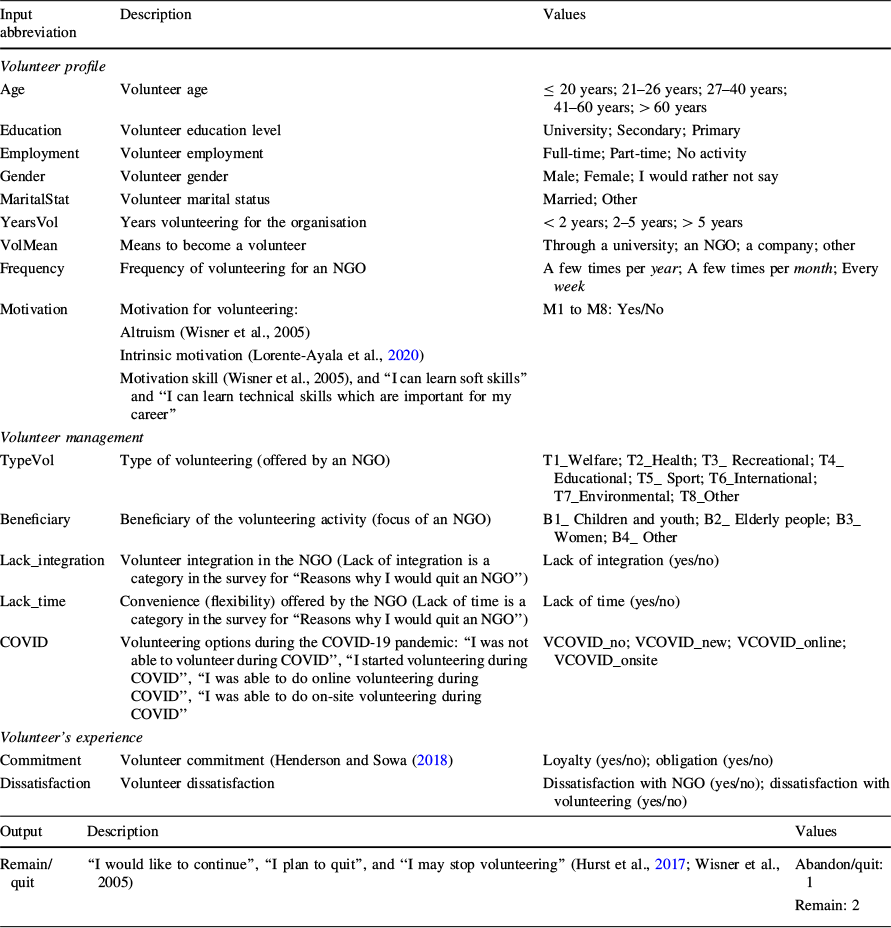
Data for the analysis were collected via an online survey distributed between March and May 2021. The questionnaire items were derived from the literature review and were organised using the Google Forms platform before being evaluated by two volunteering experts, simplifying the questionnaire. Finally, the online survey was sent to both NGOs and university volunteering services in Valencia. Although 250 responses were received, only 249 were included in the analyses because gender was undefined for one response. Table 4 shows the variables selected for the analysis and the values used to define each item. Variables selected in volunteer management and volunteer experience are those which expressed the reasons to quit and not to quit an NGO in the survey.
Input and output variables

Input abbreviation |
Description |
Values |
|---|---|---|
Volunteer profile |
||
Age |
Volunteer age |
≤ 20 years; 21–26 years; 27–40 years; 41–60 years; > 60 years |
Education |
Volunteer education level |
University; Secondary; Primary |
Employment |
Volunteer employment |
Full-time; Part-time; No activity |
Gender |
Volunteer gender |
Male; Female; I would rather not say |
MaritalStat |
Volunteer marital status |
Married; Other |
YearsVol |
Years volunteering for the organisation |
< 2 years; 2–5 years; > 5 years |
VolMean |
Means to become a volunteer |
Through a university; an NGO; a company; other |
Frequency |
Frequency of volunteering for an NGO |
A few times per year; A few times per month; Every week |
Motivation |
Motivation for volunteering: Altruism (Wisner et al., 2005) Intrinsic motivation (Lorente-Ayala et al., Reference Lorente-Ayala, Vila-Lopez and Kuster-Boluda2020) Motivation skill (Wisner et al., 2005), and “I can learn soft skills” and “I can learn technical skills which are important for my career” |
M1 to M8: Yes/No |
Volunteer management |
||
TypeVol |
Type of volunteering (offered by an NGO) |
T1_Welfare; T2_Health; T3_ Recreational; T4_ Educational; T5_ Sport; T6_International; T7_Environmental; T8_Other |
Beneficiary |
Beneficiary of the volunteering activity (focus of an NGO) |
B1_ Children and youth; B2_ Elderly people; B3_ Women; B4_ Other |
Lack_integration |
Volunteer integration in the NGO (Lack of integration is a category in the survey for “Reasons why I would quit an NGO”) |
Lack of integration (yes/no) |
Lack_time |
Convenience (flexibility) offered by the NGO (Lack of time is a category in the survey for “Reasons why I would quit an NGO”) |
Lack of time (yes/no) |
COVID |
Volunteering options during the COVID-19 pandemic: “I was not able to volunteer during COVID”, “I started volunteering during COVID”, “I was able to do online volunteering during COVID”, “I was able to do on-site volunteering during COVID” |
VCOVID_no; VCOVID_new; VCOVID_online; VCOVID_onsite |
Volunteer’s experience |
||
Commitment |
Volunteer commitment (Henderson and Sowa (Reference Henderson and Sowa2018) |
Loyalty (yes/no); obligation (yes/no) |
Dissatisfaction |
Volunteer dissatisfaction |
Dissatisfaction with NGO (yes/no); dissatisfaction with volunteering (yes/no) |
Output |
Description |
Values |
|---|---|---|
Remain/quit |
“I would like to continue”, “I plan to quit”, and “I may stop volunteering” (Hurst et al., Reference Hurst, Scherer and Allen2017; Wisner et al., 2005) |
Abandon/quit: 1 Remain: 2 |
Artificial Neural Networks
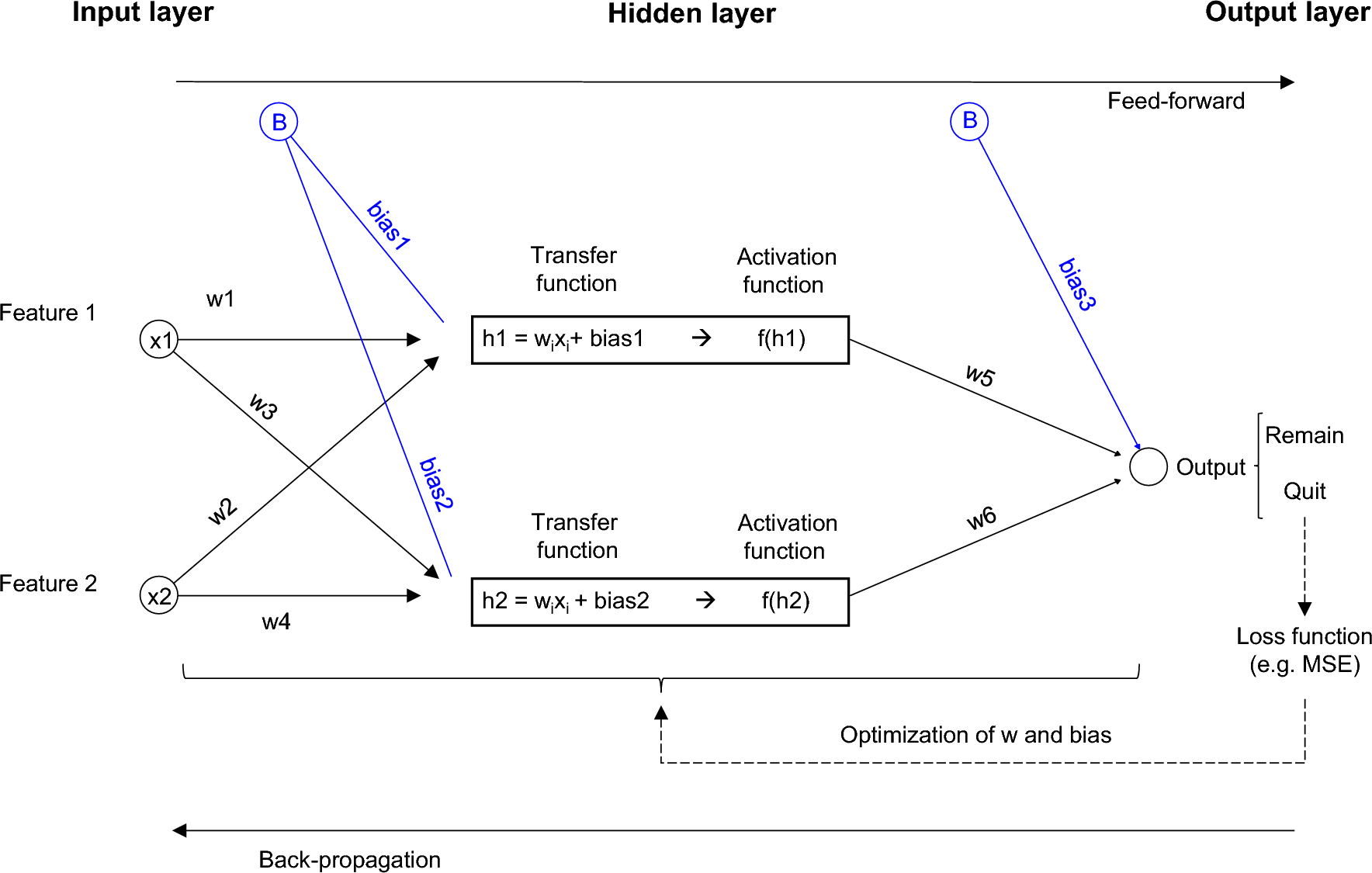
Volunteers’ decisions to remain or quit were predicted using an Artificial Neural Network (ANN). An ANN consists of an input layer made up of covariates or features, one or more intermediate layers called hidden layers made up of nodes or neurons, and an output layer. The middle layers are made up of neurons or nodes which process the information (Fig. 1). Two operations are performed in each node: first, a new variable (usually called a transfer layer) is computed as a weighted combination of the inputs from the previous layer plus a bias. Then, this variable goes through an activation function (logistic, sigmoidal, softplus, ReLU, or any other) that determines the range (e.g.: −inf + inf, 0–1, −1 −1, etc.) and shape of data variations (linear, non-linear monotonic, oscillating, etc.). The output layer is again a weighted combination of the previous hidden layer nodes plus a bias. This process is called feed-forward. Once the prediction and its error have been obtained, we can learn from this error, go back and optimise the values of the weight and bias of each layer in order to minimise the loss function. This second process is called back-propagation (Fig. 1).
Architecture of an artificial neural network

ANNs are more flexible in adapting to the structure and the data and interaction between variables and are more robust to noise in the data, compared to traditional statistical methods, such as logistic regression. In addition, ANNs have no difficulty in handling a large number of variables without the need to exclude any, even if they are correlated or collinear.
On the other hand, the optimisation process of an ANN is much more complex. Since all the features and the output variable are binary, there is no need to normalise the variables and a sigmoid (logistic) function is used as the activation function.
Cross-validation must be used to prevent the network from overfitting, randomly dividing the instances (observations) into a train sample and a test sample, in our case 75% and 25%, respectively. To prevent a particular sample partition from excessively influencing the result we repeated cross-validation 100 times and then calculated the average results (k-fold cross-validation).
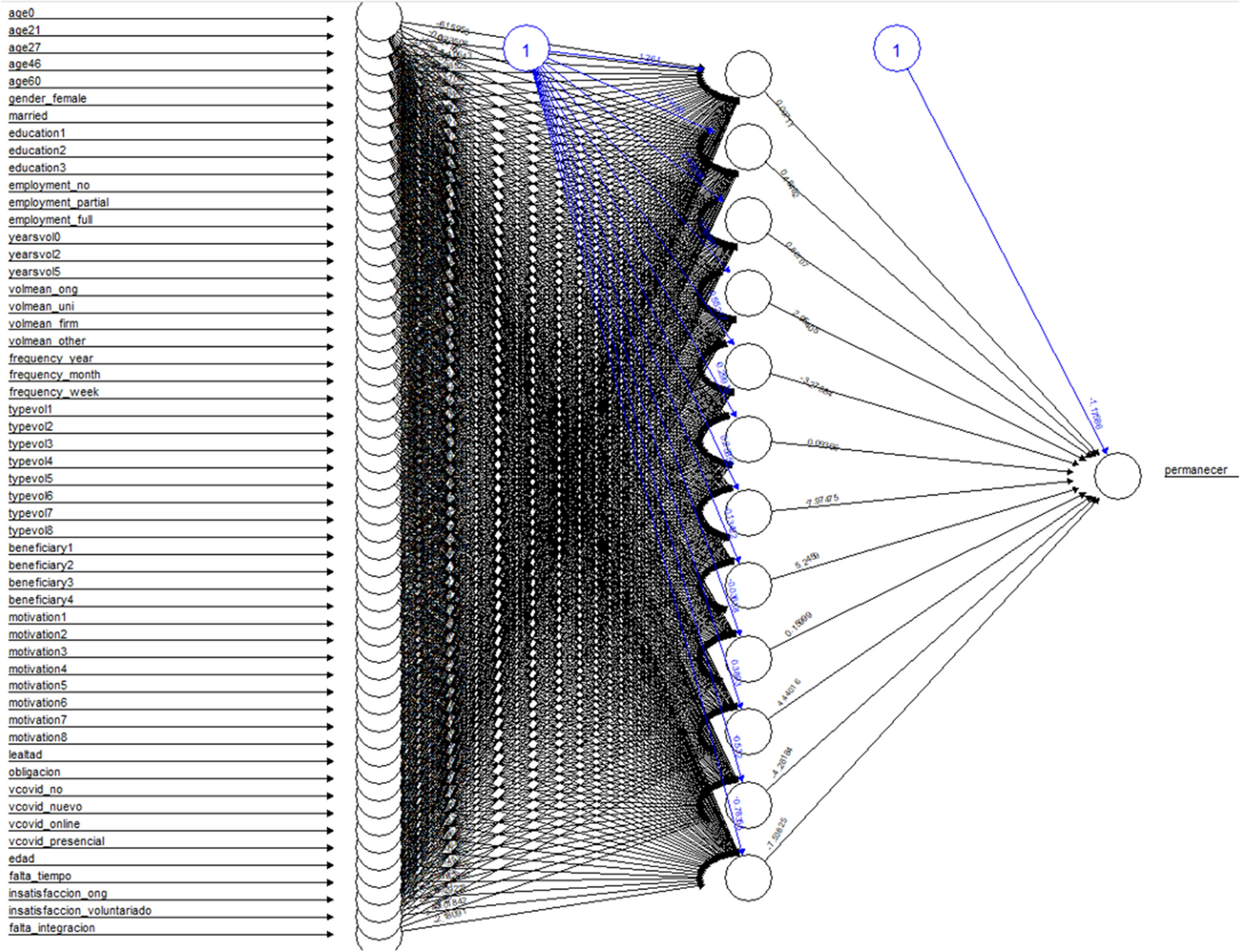
In addition, the structure of the network, that is, the number of layers and the number of nodes in each layer, must be determined. This is done through a search grid that combines the maximum and minimum number of features, and successively adds layers. Once it had been optimised, our ANN included only one single layer with 12 nodes, besides the input and output layers. Once the ANN had been computed, the features with the greatest weight in the prediction could be identified.Footnote 1
After computation of the ANN, as in most of the black box models, an "explainer" can be used to extract detailed information as to why the prediction has been generated for each of the volunteers. In this paper, we used one of the best known: LIME.
Local Models and Local Interpretable Model-Agnostic Explanations (LIME)
Local Interpretable Model-Agnostic Explanations (LIME) is “an algorithm that can explain the predictions of any classifier or regressor in a faithful way, by approximating it locally with an interpretable model” (Ribeiro et al., Reference Ribeiro, Sameer and Guestrin2016). As Molnar (Reference Molnar2022) clarified, LIME is a type of local surrogate model, which trains an interpretable model to explain the reasons why a machine-learning model makes an individual prediction. The explainer relies on the assumption that every complex model is linear on a local scale, i.e., it interprets an instance using a linear model every time.
The easiest way to understand LIME is to explain how it is calculated. As explained in Ribeiro et al. (Reference Ribeiro, Sameer and Guestrin2016) and Molnar (Reference Molnar2022), first, we selected an individual instance and replicated it many times using random perturbations around the instance (e.g., using a random normal process). Second, we computed the machine-learning model (in our case, the neural network) using the original database, and then we predicted the output using the perturbed dataset. Third, we weighted the perturbed instances using a distance function (Euclidean, Gower, etc.) to give more importance to the data that were closer to the original instance. Finally, we trained a linear model using the predicted output from step 2 on the weighted instances from step 3 and interpreted the results of the local model. In this last step, a ridge or lasso type model with a penalty is usually used, as this is especially useful in datasets with many features.
Results
ANN Prediction
Figure 2 shows the structure of the optimised ANN with the 55 features in the input layer, 12 nodes in a unique hidden layer, and the output layer. The performance of the ANN in predicting the cases of remain and quit was remarkable. In all the tests with a single split sample and cross-validation (75% train and 25% test), the ANN only predicted one instance of the test sample incorrectly. In the final prediction using k-fold cross-validation, the accuracy was practically the same, with only one error in the 62 instances of the test sample. The prediction in the test sample was excellent for both the remain cases (for which the original sample had more information) and the quit cases. A cut-off of 0.5 was used (values below 0.5 were classified as 0, and values equal to or greater than 1), and no improvements in prediction or accuracy were achieved by changing the cut-off.
Neural network with sample splitting

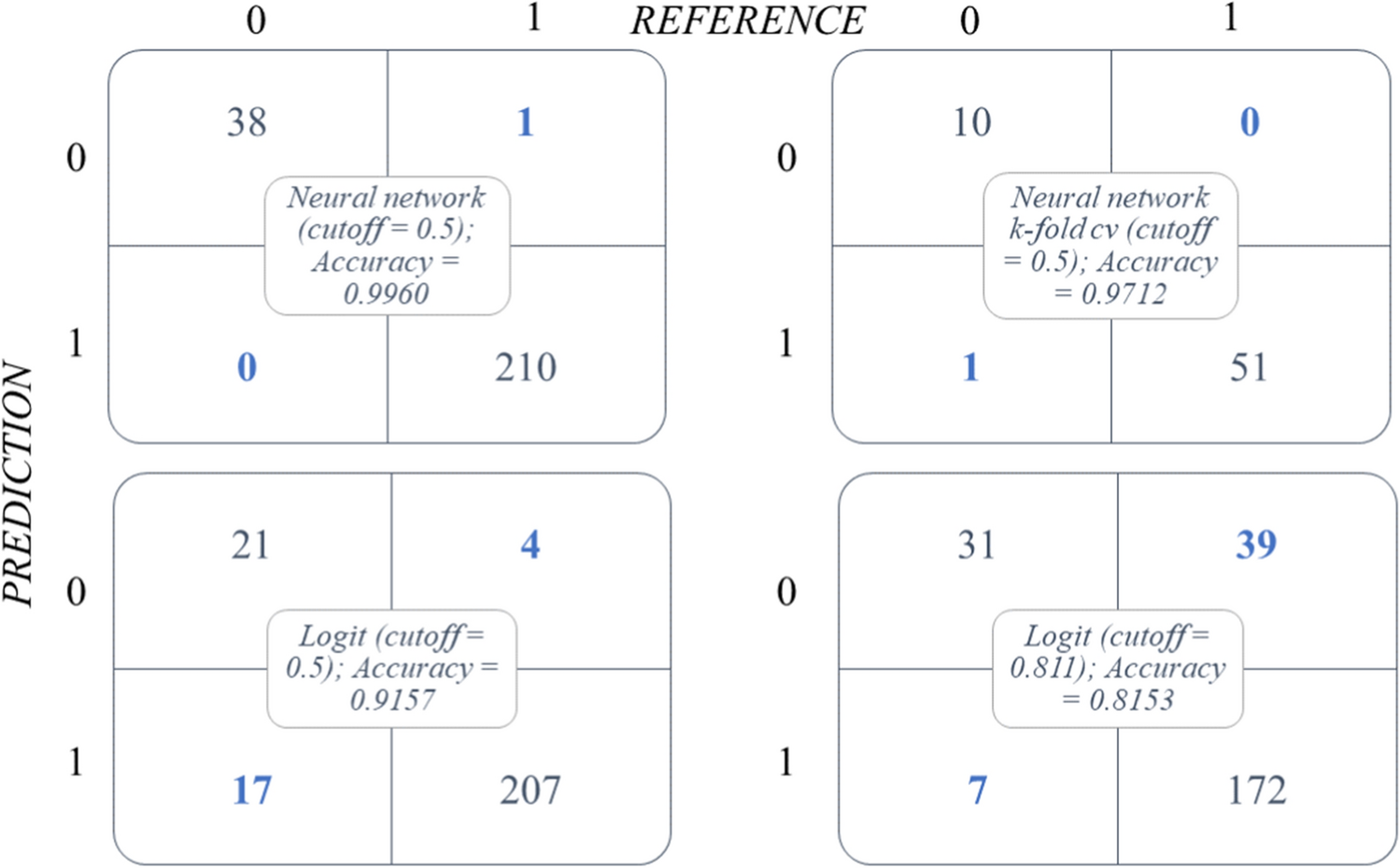
We compared the performance of the neural network with logistic regression performance, which is the most commonly applied method for prediction with dichotomous values. To estimate the logistic regression, we had to remove one variable from each set of factors to avoid collinearity, usually the first (e.g., in age, the dummy < 16). Figures 3 and 4 show the results using the usual cut-off of 0.5 and an optimised cut-off of 0.81 suggested by Youden’s index.
Confusion matrix for the logistic regression and neural network analyses

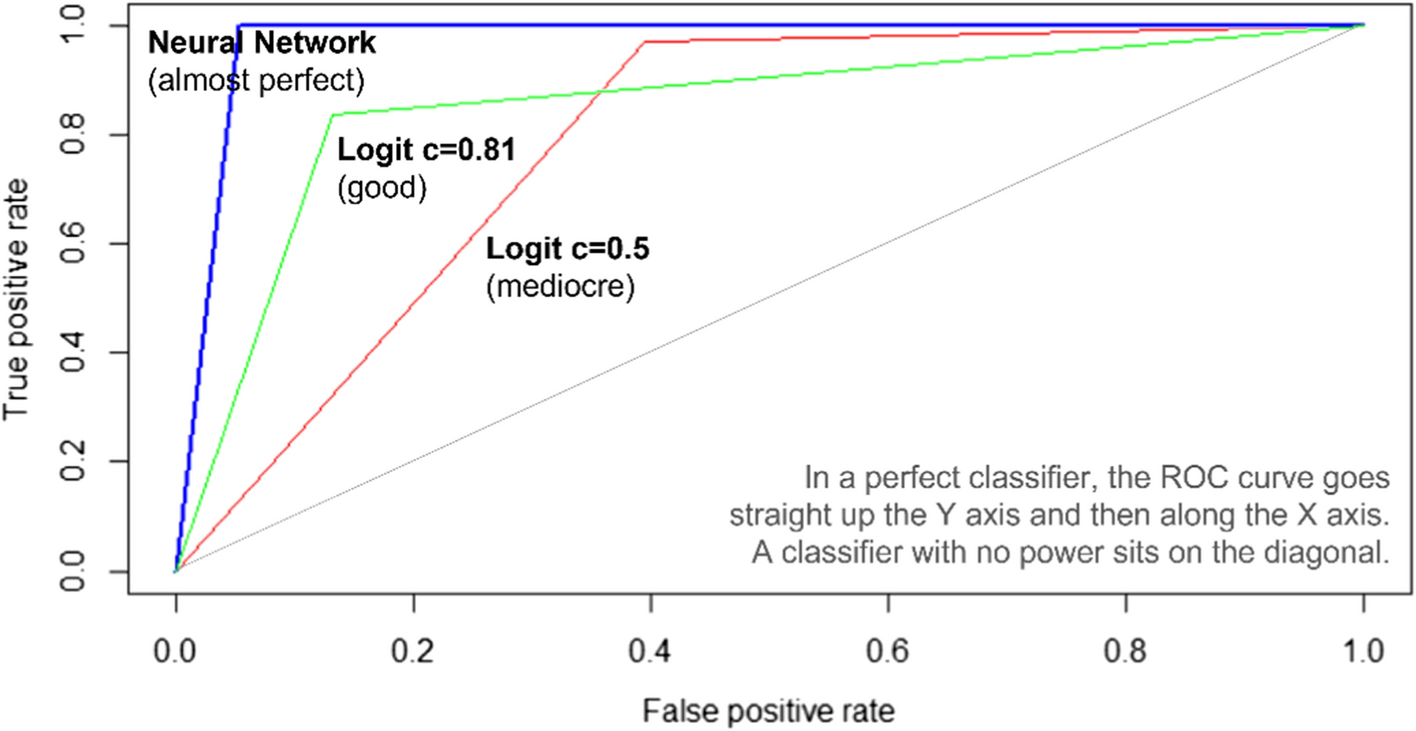
ROC curves for the ANN and the logistic regression

Logistic regression yielded good results, with an accuracy of 81.5–91.5% (Fig. 3). However, it incorrectly classified 21 instances (8.4% of the total) with the basic cut-off and 46 (18.5%) with the optimised cut-off. In this aspect, its performance was way below that of the ANN, whose prediction was almost perfect even in the test samples.
Feature Importance
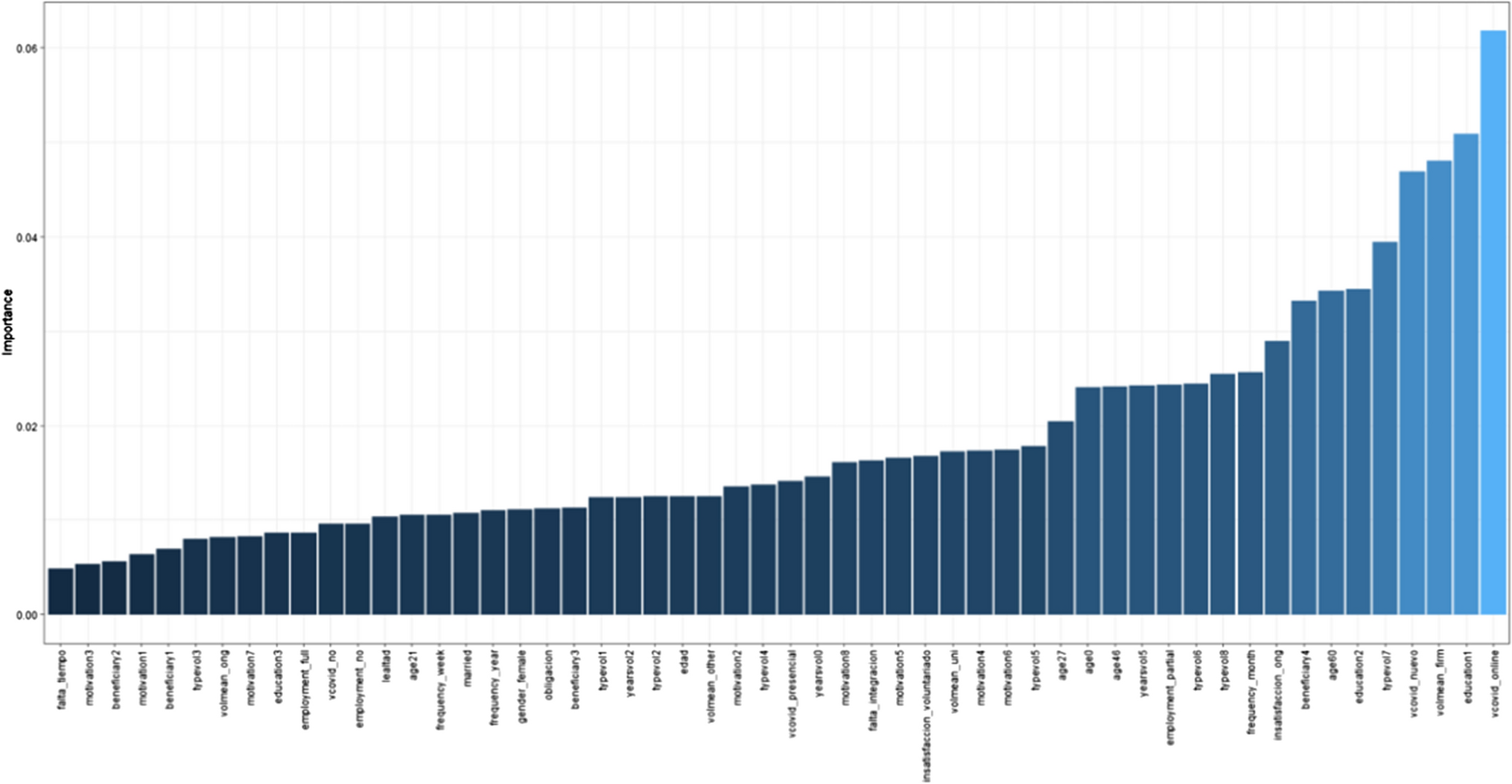
The previous results indicate that the ANN is more accurate than the logistic regression, in terms of both the confusion matrix and the ROC curve. Figure 5 shows the relative importance of each predictor using Garson’s method (Goh, Reference Goh1995) to identify which features had the greatest influence on the ANN prediction. Garson’s relative values were low for all the individual predictors (Fig. 5), meaning that the decision to stay or leave is extremely complex and depends on a combination of multiple factors. One of the reasons why ANN is a better predictor than logistic regression in this case is because it takes into account the interaction between features, which is very difficult to implement in a logistic regression with dozens of variables.
Feature importance

The figure suggests that being able to continue volunteering during the COVID-19 pandemic was the most important predictor, and primary-level education the second-most important characteristic. Other important predictors included age, type of volunteering, beneficiaries and the frequency of volunteering, dissatisfaction with the NGO, and the start of volunteering during COVID-19. These results indicate that the neural network attached greater relative importance to predictors related to volunteer management and volunteer profile.Footnote 2
Importance of the Features for Each Volunteer
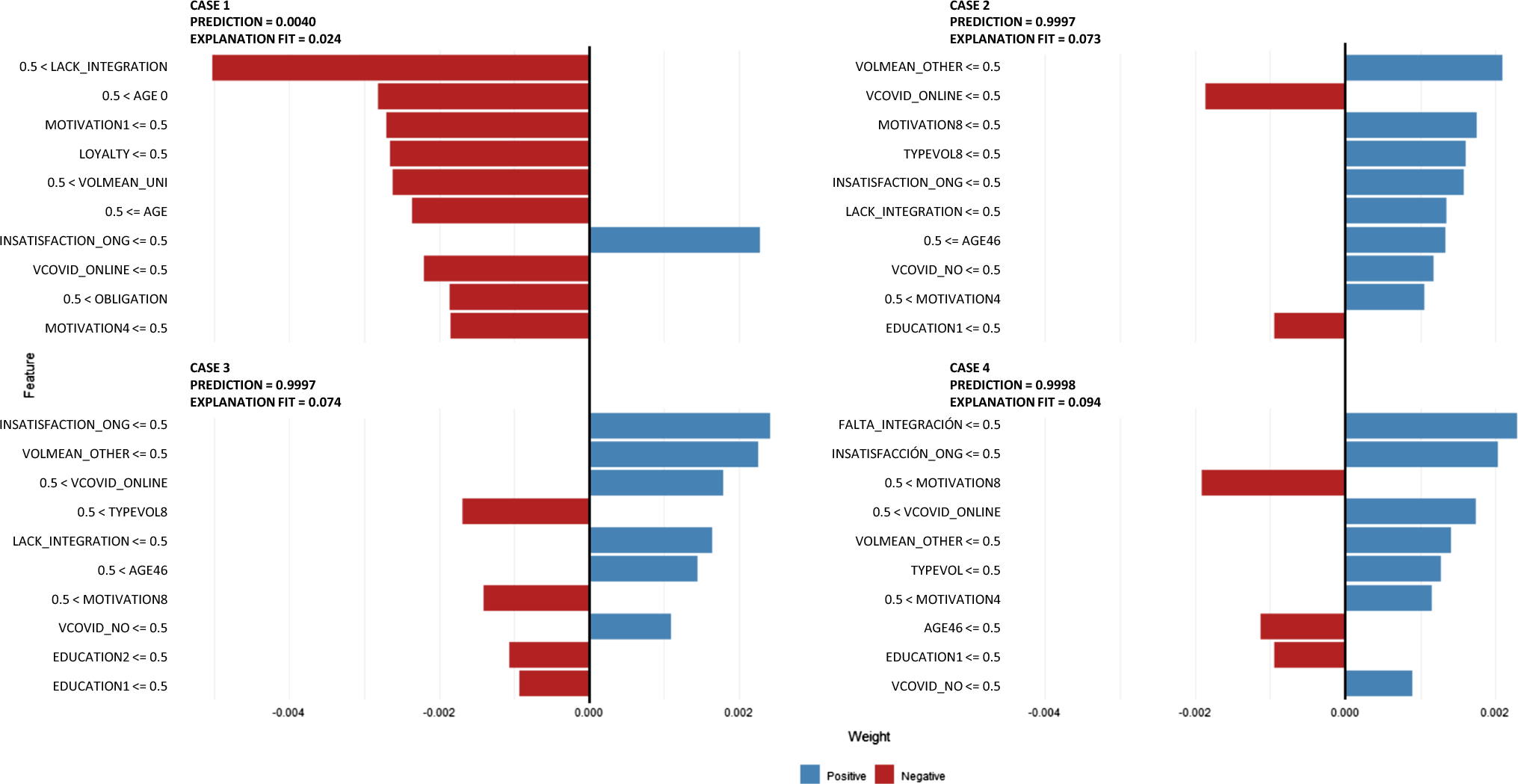
LIME provides an explanation of why each individual volunteer stays or quit. Figure 6 shows an example of how LIME works and the information it provided for the first four cases. Volunteer 1 indicated that they were going to quit the NGO, whilst the other three expressed their intention to stay. The most heavily weighted predictor for the first volunteer (intention to quit) was lack of integration. Dissatisfaction was not present. For the three volunteers who indicated their intention to remain, the figure indicates that they were not dissatisfied and that there was no lack of integration in the NGO. These results suggest that experience (satisfaction/dissatisfaction) is an important factor in intention to remain, whereas volunteer management (integration and the ability to offer online volunteering opportunities) is also an important factor in the intentions to both remain and quit. Thus, the combination of the ANN with the explainer enables us to extract individualised information on why each type of volunteer stays or leaves, which means profiles can be proactively managed. Similarly, thanks to the information generated by the ANN and the explainer, an immediate prediction can be made about whether a new volunteer is likely to stay or leave and why.
LIME plots predicting each volunteer’s intention to remain or quit

Discussion
Discussion About Results
This paper has analysed why volunteers remain in or quit a non-governmental organisation. The study has observed that volunteer age, marital status, the means to become a volunteer and motivation influence volunteers’ intention to remain. The findings suggesting that older volunteers are more likely to remain in an NGO is aligned with various results obtained in our literature review (Bang, Reference Bang2015; Newton et al., Reference Newton, Becker and Bell2014). Understandably, volunteers’ ability to help changes throughout their lifetime. Notably, the COVID- 19 pandemic has demonstrated that some volunteering tasks can be performed online, which could enable NGOs to become more flexible and retain volunteers over their lifetime by adapting tasks to match volunteers’ circumstances.
Our results also coincided with the literature review in indicating that intrinsic and skill motivations were an important factor in explaining intentions to remain and quit. However, altruism did not appear among the most important factors on the list obtained using Garson’s method. Nonetheless, our result for intrinsic motivation coincides with that of Wu et al. (Reference Wu, Li and Khoo2016), who also recognised that this type of motivation positively influences the output. However, we cannot indicate a direction in the relationship for career motivation because Garson’s method only considers relative importance. The importance of the motivation factor across our results might explain the high rate of volunteers remaining with NGOs in Spain, which is around 87% (Observatorio del Voluntariado, 2020). It could also indicate that organisations assign tasks to volunteers based on their expectations and volunteering affinity with their work.
We identified two volunteer management variables that significantly explained intentions to remain and quit: volunteering type and the ability to volunteer during the COVID-19 pandemic. Although Lorente-Ayala et al. (Reference Lorente-Ayala, Vila-Lopez and Kuster-Boluda2019) considered NGO type, they only differentiated between specialist and generalist kinds of non-profits, observing no impact on the intention to remain or quit. However, our analysis of different types of specialist organisations found that type 8 could explain a weaker intention to remain. In terms of volunteering opportunities during COVID-19, Trautwein et al. (Reference Trautwein, Liberatore, Lindenmeier and von Schnurbein2020) also considered the importance of satisfaction with volunteering during the pandemic. However, although they limited their study to specific types of motivation, we observed that this factor’s impact did not depend on motivation. That is, given the importance of intrinsic motivation on our results, the COVID-19 factor could have created differences between NGOs if the ability to do online volunteering had depended on the organisation’s resources. Our results indicate that although preventing dissatisfaction explained volunteers’ intentions to remain, the option of online volunteering explained volunteers’ intentions to both remain and quit. This paves the way to exploiting new paths for volunteers based on new information and telecommunication technologies. Therefore, NGOs’ decisions during the pandemic regarding volunteers might have increased volunteers’ intention to quit or—as Garner and Garner (Reference Garner and Garner2011) recognised—volunteers’ decisions to reduce the work they did for the NGO (neglect).
These results concerning the higher relative importance of predictors pertaining to volunteer management and volunteer profile are important because the studies analysed by the literature review focus more heavily on analysing volunteer experience, with satisfaction, commitment and motivation (Hyde et al., Reference Hyde, Dunn, Bax and Chambers2016; Lorente-Ayala et al., Reference Lorente-Ayala, Vila-Lopez and Kuster-Boluda2019; Zollo et al., Reference Zollo, Faldetta, Pellegrini and Ciappei2022) being the concepts most commonly used as variables. Our analysis has endeavoured to include management failures (lack of integration) and negative experiences (dissatisfaction), although our literature review only found two references about the importance of integration, namely, Garner and Garner (Reference Garner and Garner2011) and Henderson and Sowa (Reference Henderson and Sowa2018). Although both of these works analysed satisfaction and the intention to remain, only the first paper drew a relationship between group integration and intention to remain. Meanwhile, this paper’s LIME results indicated that significant volunteer management failures, such as lack of integration, might have been ignored as a result of an analysis method that does not consider these failures. Thus, applying other methods and variables could generate additional knowledge.
Practical Implications
Two practical implications have been gleaned from the findings. The first is that NGOs should consider the volunteer context, included in the volunteer’s profile, as an important influence in the decision to stay or leave, regardless of the method of analysis used. This is an extremely complex decision for volunteers and depends on a combination of multiple factors. NGOs need to use volunteer management practices to adapt volunteer activities to volunteers’ circumstances. For example, offering online volunteering during COVID-19 was highly appreciated by volunteers.
The second practical implication, which was only detected with a neural network, is that volunteers’ dissatisfaction and feeling of lack of integration in the NGO constitute a threat to quit the NGO. Thus, NGOs need to understand the importance of volunteer management to prevent these situations. This finding also contributes to the theoretical understanding of what factors influence volunteers’ decision to quit an NGO as these two factors have rarely been considered in previous works.
Limitations
This research is limited by its sample size, even though the results of iterative cross-validation were highly robust. Additional analyses could look into involving more volunteers and comparing results for different periods, enabling further evaluation of the impact of COVID-19 on the findings. Although a small number of volunteers considered quitting an NGO, more studies concerning this decision should be conducted.
Conclusions
This paper initially analyses the literature on volunteers’ decisions to remain and quit, enabling comprehensive identification of features and constructs used by previous works to explain why volunteers stay in or leave an NGO. One of the novelties of this paper is that an artificial neural network was used to predict the decisions of the volunteers and an explainer was included to answer why they made those decisions. These analyses led to three main conclusions.
First, it is a challenge to run models with many predictors using methods such as logistic regression. Although this method provides values for a substantial number of variables, explaining an intention to quit is more difficult to assess than an intention to remain.
Second, the use of methods such as neural networks enables models with more predictors to be defined, broadening the amount of information obtained about volunteers’ decisions. In our case, it yielded an almost perfect prediction in which, even after cross-validation, only one of the 249 observations was incorrectly assigned, greatly exceeding the performance of logistic regression techniques.
The most important predictors were volunteer management and volunteer profile. Dissatisfaction with the NGO (pertaining to experience) was also one of the major inputs. Thus, the neural networks analysis identified variables from each of the three groups as some of the most important predictors of volunteers’ intentions to remain or quit.
Third, the neural network output cannot be interpreted directly as occurs with logistic regression. Nevertheless, employing explainable learning techniques (in our case, LIME) enabled the observation of highly interpretable information, facilitating individual detection of the reasons underlying volunteers’ decisions to quit an NGO. This approach could be extremely valuable for NGOs and other organisations, given that our results indicate the substantial impact of “lack of integration” on volunteers’ decisions to quit. This result did not appear in the logistic regression analysis.
Future studies could apply neural networks with different models and additional variables. The methodology could be used in other countries and cities to find similarities and differences in results. Working with bigger samples might help to evaluate the impact of size on results.
Acknowledgements
The authors would like to thank the reviewers for their ideas, which helped improve the paper.
Funding
Open Access funding provided thanks to the CRUE-CSIC agreement with Springer Nature.
Data Availability
Data used for the analysis will be available in the repository of the Universitat Politècnica de València in Zenodo.
Declarations
Conflict of interest
The authors have no relevant financial or non-financial interests to disclose.


 Open access

