

Introduction
It is said a mine reaches profitability after three bankruptcies – a telling rule of thumb in times characterised by a tight interconnection of the resource extraction and the demands of the global market place. For localities hosting mineral deposits, the volatility of the mining business comes with implications. The realities to be borne locally can mean agreeing to auxiliary investments with insecure returns or finding environmental and social risk-taking justified. Finally, there is the challenge of remaining confident in the prospects and the returns of mining. At the same time, community acceptance has come to the fore as a means of lending legitimacy to projects (Gehman, Lefsrud, & Fast, Reference Gehman, Lefsrud and Fast2017; Lyytimäki & Peltonen, Reference Lyytimäki and Peltonen2016), also in the Barents region within the Arctic (e.g., Lesser, Suopajärvi, & Koivurova, Reference Lesser, Suopajärvi and Koivurova2017; Suopajärvi et al., Reference Suopajärvi, Poelzer, Ejdemo, Klyuchnikova, Korchak and Nygaard2016; Nysten-Haarala, Klyuchnikova, & Helenius, Reference Nysten-Haarala, Klyuchnikova and Helenius2015). Applying a wide definition of legitimacy in their study of recent mine development in Swedish Pajala, Poelzer and Ejdemo (Reference Poelzer and Ejdemo2018, p. 3) suggest that “[i]n order to achieve legitimacy, reality must match expectations”; to put it simply, the realised returns should not differ too much from the promises made. The present article engages this perception of a relationship between expectations on one side and reality on the other. It casts light on the question of mine acceptance by attending to the making of expectations, by asking how such expectations are made strong enough to bear the realities of contemporary mining business, its dependence on distant matters and inclination towards the externalisation of costs (Suopajärvi et al., Reference Suopajärvi, Ejdemo, Klyuchnikova, Korchak, Nygaard and Poelzer2017; Törmä, Kujala, & Kinnunen, Reference Törmä, Kujala and Kinnunen2015; Carrington & Pereira, Reference Carrington and Pereira2011; O’Connor, Reference O’Connor2015).
The article elaborates on this by delving into the case of mine development, the Northland project, during the decade from 2004 to 2014 in Finnish Kolari and neighbouring Swedish Pajala. Located above the Arctic Circle, the two communities are connected by a body of ores that stretches over the separating national border at the Tornio River. Here, a mining project was launched by the company Northland Resources. While mining in the Tornio River Valley has roots in the 16th century (Avango et al., Reference Avango, Kunnas, Pettersson, Pettersson, Roberts, Solbär, Warde, Wråkberg and Keskitalo2019), industrial projects have occurred only on the Finnish side, in the Kolari area. This was based on what a regional newspaper at that time described as “the country’s largest deposit of iron ore” (Pohjolan Sanomat (Kemi) 22 January 1958). Kolari became a booming mining town during the 1970s and 1980s, but mining ended in 1988 due to poor returns caused by declining prices. Ores from the open pits and other sites were milled in state-supported rescue operations until 1996 (Puustinen, Reference Puustinen2003). Not 10 years later, the Northland project was enthusiastically welcomed. The project targeted the remaining ore reserves in Kolari and previously unexploited deposits in Pajala (Northland Resources, 2007). Earlier samples of rock had been scrutinised and under prevailing high world market prices the production estimates yielded good viability. Altogether, however, it looked like “enormous plans,” according to the municipal official and the local politician interviewed in Kolari. Mining commenced as a greenfield venture on the Swedish side in 2012; after but 2 years, the company went bankrupt in 2014 (Poelzer & Ejdemo, Reference Poelzer and Ejdemo2018). Having welcomed a large-scale mining project as the last opportunity to redirect declining population and employment trends, Pajala went through a speedy boom-and-bust cycle (Nilsson, Carlsen, & van der Watt, Reference Nilsson, Carlsen and van der Watt2015; Poelzer & Ejdemo, Reference Poelzer and Ejdemo2018; Bjørgo, Reference Bjørgo, Dale, Bay-Larsen and Skorstad2018a, b). In Kolari, the unrealised plans had awoken the memories of the past blossoming as a mining town.
The present article examines the employment of discursive representations of mining in the view of a mine in spe. It aims to discuss the role of such representations in the context of envisioning the future as a mining community by attending to the discursive realm of meaning-making that accompanied the Northland mining venture. Hereto, the study utilises the notion of minescape (Ey & Sherval, Reference Ey and Sherval2016) supported by the ideas of past presence and anticipated future (DeSilvey, Reference DeSilvey2012) that enable scrutinising the depiction of futures, or as Poelzer and Ejdemo (Reference Poelzer and Ejdemo2018) put it, expectations. The notion of minescape is founded on the ideas of landscape and the social construction of resources (Ey & Sherval, Reference Ey and Sherval2016). A special case, as it were, of landscape which stands for a mooring of lived-in experiences and a sense of identity (e.g., Solbär, Reference Solbär2014, pp. 21–31, 143–149), minescape extends the purely socio-economic view on ores and the “objective” image of a mechanised landscape to encompass contestation, memories, social identity, hopes for future, and the belief in mining as a promoter of well-being, among other sociocultural meaning-makers. The “scape” suffix broadens the view to the ambiguous and heterogeneous representations of specific landscapes (Brambilla, Reference Brambilla2015) or resources such as energy (Lempinen, Reference Lempinen2017), here pertaining to mining landscapes. In the present context, minescape points at the localised hopes and fears that are being felt in the face of the realities of contemporary mining business. It signals here the discursively constructed presences, that is, the (imagined) realities, of other mining towns, and the futures anticipated to emerge as an effect of mining. DeSilvey’s (Reference DeSilvey2012) study introduces the social processes of imagining specific pasts, and futures, into the context of heritage management; DeSilvey (Reference DeSilvey2012) reveals how temporal imaginations may provide rationales for management decisions concerning a historical harbour site. The study demonstrates that historical trajectories can be sliced into numerous presences, as it were, which may be picked out as rhetorical devices to be injected in arguments concerning the anticipated futures of contemporary sites and occurrences.
The present study, with its interest in the discursive spaces accompanying the making of mines, resonates with perceptions of social memory: the flexible construction of pasts of shared importance (Wheeler, Reference Wheeler2014; Cubitt, Reference Cubitt2007). The “rhetoric” impact of the Northland project on the communities of Pajala and Kolari illustrates how shared expectations based on the representation of former or current mines elsewhere reinforce the belief in mining. The narrated lines of sense-making, however, are not identical, as I believe, with memories; rather, narration represents an act of selective remembering of past sensations and situations (Robert & Shenhav, Reference Robert and Shenhav2014; Hendon, Reference Hendon2010) and conveys an imaginative practice that reorganises the past from the viewpoint of the present (Cubitt, Reference Cubitt2007). The study will be suggesting that such imaginative practices sustain the meaningfulness of mining projects, thereby “fuelling” the strength of will to bear insecurities and risks and supporting the longevity of ambition to wait for the (re-)realisation of projects.
By discussing the meaning-making founded on perceptions of the virtues of past and other (realised) mines, as well as individual and collective mine-related identities, the article contributes to our understanding of the imaginative practices tied to the present-day role of mining heritage. The article continues with a discussion of the research approach, whereafter follows a description of the recent mining history of Kolari, essentially the Rautuvaara Mine, and the mining clusters in northern Sweden and Finland that provide the contexts within which the interviewees place the Northland project. The article proceeds to describe the mining project at hand and the expectations voiced by interviewees and then turns to reflect over the role of memory and vision work as a tool of orientation in resource-rich communities prone to booms and busts.
Studying the imaginative practices of “minescaping” in Pajala–Kolari 2004–2014
The study is explorative and interpretative and founded on the perception of the cases studied as social situations, as arenas that embrace discourse and action (Clarke, Reference Clarke, Clarke, Friese and Washburn2015; Corbin & Strauss, Reference Corbin and Strauss2008), in accordance with the idea of minescape as combining tangible and discursive dimensions. It utilises interview excerpts for conveying examples of the imaginative practices stimulated by the presence of a proposal for mine opening. The utilised excerpts were extracted from two sets of semi-structured interviews conducted in March and April 2015 with local interest groups and administrators, which were re-coded for the present study. The first set of interviews explored how local interest groups in Kolari perceived of the abrupt halting of the mining plans in 2014, while the second set of interviews conducted with administrators involved with the Finnish part of the Northland project examined the implementation of planning and permitting procedures pertaining to mine establishment. Altogether, there were eight interviews conducted by the author targeting one of the aforementioned two aspects of the Northland project.
Regarding the interviews, there was the recurring observation of mentioning of the past mining epoch and further reasoning based on past or distant mines. This observation of the use of temporal references as sense-makers sparked the present study. Re-coding focused initially on references to mining experiences in the past. During the processing of the interviews, the rhetorical similarity between the temporal and spatial lines of argument was discovered. This led to the inclusion of the geographical dimension into the study and work continued with both types of quotes.
The selection of interviewees for both sets of interviews had been theoretical and included in the first set representatives for the Municipality of Kolari and for leisure time visitors, residents and second-home owners living in the villages near to the mining site. The local government was represented by members of the municipal council, the municipal board and the business administration of the municipality. All interviewees, but the representative for the residents’ association, are natives to Kolari. The resident’s association was headed by a newcomer who had settled with the family after recurring touristic visits and leisure time stays. The second set of interviews included public administrators and consultants engaged in the pre-establishment phase: two Environmental Impact Assessment (EIA) consultants and two spatial planners, both of whom were colleagues working together and were interviewed together. Even the professionals interviewed related family or other ties to the community and village in question, despite their offices locating in distant large towns. All interviews were documented by tape-recording but for the interview with the spatial planners (notes taken over the phone).
The empirical material covering the Pajala part of the Northland project and the response of the local community to the project consists in a secondary source, the preface (Pajala Utveckling, 2014, p. 3) of a report commissioned by the local development partnership Pajala Utveckling. The partnership was a joint undertaking of the municipality and local private enterprises including the mining company that was co-funded by the EU and regional agencies (Bjørgo, Reference Bjørgo, Dale, Bay-Larsen and Skorstad2018a). In a situation in which the bankruptcy of Northland Resources had been realised, the report nevertheless aimed at developing a vision and offering facts about the potentialities of mining. The title of the report is illustrative, in translation as follows: Socio-Economic Effects of Continued Versus Concluded Mining in Kaunisvaara for Pajala and Its Neighbouring Municipalities and the Prominent Mining Cluster of Norrbotten (Pajala Utveckling, 2014). Kaunisvaara is the specific locality hosting the mine and Norrbotten stands for the northernmost county of Sweden. The preface authored by the chairman of the partnership – the then municipal commissioner in Pajala – was coded in a manner similar to the interview excerpts. All citations appearing in this article were translated by the author.
Narration in the interviews was taken to rest on what the interviewees perceived as reasonable sense-making from their viewpoint (Kvale & Brinkmann, Reference Kvale and Brinkmann2009). The interviews were conducted at the point of failure, a moment of disjuncture with broken beliefs, and offer views on the struggle for new hope. In the interviews, other mines were lending meaning to the narratives, wherefore the next research step entailed reflecting over their historical and geographical situatedness. To this end, I used statistics and supplementary materials sourced from public documents, news media and the archives of Kolari Municipality. Population statistics could be seen a rough indicator, but for the study at hand it was deemed sufficient for illustrating community development (in Finland and Sweden, workers pay tax to the municipality of their residence).
Contextualisation of a phenomenon is not a given; rather, it is created from the specific points of view applied (Alvesson & Sköldberg, Reference Alvesson and Sköldberg2017; Lehtonen, Reference Lehtonen2000). I employed contextualisation to mirror the politics of referencing that appeared as a discursive minescaping device seeking to uphold specific beliefs. When attending to the constructed links to other mining towns and the characteristics of their geographical and historical situations, discontinuities between discourse and reality emerged. They indicate tension lines between the expected future effects – the imagined presence of a grand mining town – and the realised futures of other mining towns. Due to the limited space of an article, mere indications of evidence are offered to underline discontinuities and differences.
Contextualisation of the Pajala–Kolari mining project
This section describes the recent mining history of Kolari and presents the main characteristics of the mining clusters in northern Sweden and Finland, which provide the contexts within which the interviewees place the Northland project.
Emerging minescapes in northern Fennoscandia: Kolari
In the 1960s, Kolari experienced an upswing in mining based on the long since known Äkäs River carbonate deposit and, a decade later, the iron–copper–gold deposits of Rautuvaara-Hannukainen. A railway from Kolari southwards opened in 1965, which meant an extension by c. 130 km to connect to the national rail network and is seen as decisive for the development of milling and processing, according to the municipal official. First in commercial operation, in 1968, was a privately driven concrete plant. The beginning of industrial mining of the iron–gold–copper ores was stumbling, owing to a “Crisis on Iron Ore Markets” (Pohjolan Sanomat (Kemi) 27 April 1967). Built in the beginning of the 1960s, the mineshaft filled with water according to the municipal official, before construction works at the mine facilities could be resumed. Eventually, in 1975, ore production commenced as an underground operation and later expanded to open-cast mining (Puustinen, Reference Puustinen2003). About 250 people worked at this mine and the concrete plant involved c. 110 employees (Ristioja, Reference Ristioja2005), with additional workforce at the associated carbonate and aluminium-mineral quarries. During the period from the 1960s onwards, migration to the southern urban and industrial centres had started to drain Lapland and the region went through a shift from an agrarian society to a society based on manufacturing, services, and trade (Elenius et al., Reference Elenius, Tjelmeland, Lähteenmäki, Golubev, Niemi and Salo2015) with a comparable diversification of employment sectors occurring in Kolari (Central Statistical Office of Finland, 1979). The mines’ employment effect was tangible, according to the municipal official, and included workforce return from the northern Swedish mines. While the domestic mining industry in southern Finland was very successful in the 1960s and 1970s, the extractive activities suffered a severe decline comparable to elsewhere in Europe from the 1980s onwards (Hernesniemi, Berg-Andersson, Rantala, & Suni, Reference Hernesniemi, Berg-Andersson, Rantala and Suni2011). In the wake of this, most operations in northern Finland were winded up, given a perception of resource depletion, and industrial policy shifted to take mining to belong to days gone by; the new strategy was to import ores and recycled iron from Sweden and Russia for the specialising processing industries (Hernesniemi et al., Reference Hernesniemi, Berg-Andersson, Rantala and Suni2011). Concurrently, in 1988, iron ore mining ended in Kolari, but as mentioned milling of ores continued until 1996. Carbonate mining was terminated in 1996, while the concrete plant had closed already in 1989 (Puustinen, Reference Puustinen2003). Already in 1988, a few hundred persons left, according to the municipal official; among others, employees were relocated to the mining company’s other sites of operation, as reported by the Magazine for Employees in December 1988. Population statistics convey no significant increases in the number of residents during mine operation and then, subsequent drops in 1988 and from 1993 onwards (Fig. 1; Table 1).
Number of residents in the municipalities of Kolari and Pajala, 1970–2018.
Sources: Regional Council of Lapland, 2013a; Statistics Finland, 2019; Statistics Sweden, 2019. Note: The number ofresidents of non-Swedish origin in Pajala: 739 persons in 2011, 820 in 2014, and 892 in 2016 (Statistics Sweden, 2017).

Number of residents in municipalities with mining industries and Kolari and Pajala for selected years

Sources: Regional Council of Lapland, 2013a; Statistics Sweden, 2019.
Note: Further demographic details on Pajala and Kolari are available in Jakobsson and Waara (Reference Jakobsson and Waara2008).
The establishment and operation of the mines in Kolari relied largely on state input as the owner of the iron ore mining company Rautuvaara and via investments in infrastructure and housing (Hentilä & Lindborg, Reference Hentilä, Lindborg, Hentilä and Ihatsu2009; Hernesniemi et al., Reference Hernesniemi, Berg-Andersson, Rantala and Suni2011). At that time, being state driven represented the normal condition. Furthermore, the state localised and stimulated extractive industries in the north to counteract urbanisation and emigration (Elenius et al., Reference Elenius, Tjelmeland, Lähteenmäki, Golubev, Niemi and Salo2015, pp. 335–416). The state as mine owner during the post-war period has been described as paternalistically caring for the workforce (Hentilä & Lindborg, Reference Hentilä, Lindborg, Hentilä and Ihatsu2009). In Kolari, the mining company engaged in community building actions, such as installing lighting for a skiing track and opening a multi-activity centre with facilities for handicrafts and sports, according to the municipal official, who also relates that the municipal centre was relocated by 26 km during the 1970s to its present locality closer to the mines. Here, apartment blocks for the half of the mine staff were built.
Indeed, place-based identities seem more coherent and long-lasting than the businesses themselves: The People of the Rautuvaara Company still remember the communal sense of being experienced during the time of mine employment, according to the interviews and the author’s encounters with residents. This indicates that the acceptance of mining was strong in the community due to psychological identification (cf. the Pyramid Model as cited in Gehman et al., Reference Gehman, Lefsrud and Fast2017, pp. 294–296). An experience of common destiny, from the point of the local community, between the mining company and the residents has been observed in the context of other Fennoscandian state-owned mining enterprises (Dale, Reference Dale2002), too. The mine closures did not only turn off the lights in many retailer’s shop, the postal office, bank and specialists along the village road, as the municipal official describes. They also constituted “quite a catastrophe” he maintains and caused a blackout; “the belief in the future was broken down,” the interviewee recalls. The future, as it had been depicted, suddenly vanished, implicitly shifting into another type of future.
The emergence of the mining clusters of Norrbotten and Kemi-Tornio
The establishment of major mines and the associated mining towns of Gällivare-Malmberget and Kiruna in Norrbotten during the 1880s through to the 1910s had contributed to completely transforming the Swedish mining sector (Avango et al., Reference Avango, Kunnas, Pettersson, Pettersson, Roberts, Solbär, Warde, Wråkberg and Keskitalo2019). Mine establishment had been supported by railways to the Baltic Sea (opened in 1888) and the Atlantic Ocean (opened in 1902), as well as a major hydropower plant that came in operation in 1910 (Avango et al., Reference Avango, Kunnas, Pettersson, Pettersson, Roberts, Solbär, Warde, Wråkberg and Keskitalo2019). Already in 1903, the region’s production of iron ore amounted to more than the half of the country’s total (Eilu et al., Reference Eilu, Boyd, Hallberg, Korsakova, Krasotkin, Nurmi, Ripa, Stromov and Tontti2012). In 2012, the share was 100%, which also meant that most of the iron ore produced in the EU originated in this region (Statistics Norway, 2017). This mining industry has remained in domestic ownership, and state ownership; in addition, the copper production in Gällivare starting in 1968 has developed significant proportions. Today, these northern towns have diversified into regional centres of business, commerce and administration and host major transports and leisure time facilities (cf. Table 1). While Pajala municipality is bordering to both Kiruna and Gällivare municipalities, the on-road distances between the municipal centres are considerable (Pajala-Kiruna: 184 km; Pajala-Gällivare: 144 km).
In northern Finland, the industrial development of the Kemi-Tornio coastal region, situated in the northernmost end of the Baltic Sea, displays similarities to the development of mining in northern Sweden: the mining industries of the region date back to 1917 (Kemppainen, Reference Kemppainen2017) and chromite mining and commercial production of ferrochrome speeded up development from 1967 onwards (Puustinen, Reference Puustinen2003). Today, the Kemi Chromium Mine is a leading producer of chrome in the EU and the ore reserves are estimated to allow for several decades of continued mining (Eilu et al., Reference Eilu, Boyd, Hallberg, Korsakova, Krasotkin, Nurmi, Ripa, Stromov and Tontti2012). The placement of the ferrochrome and stainless steel plants in 1976 in nearby Tornio (35 km) with direct harbour access is described as an example of the state’s regional-political interventions (Hernesniemi et al., Reference Hernesniemi, Berg-Andersson, Rantala and Suni2011). These industries have remained in domestic and state ownership; further companies mine carbonates, dolomite, and quartz (Hernesniemi et al., Reference Hernesniemi, Berg-Andersson, Rantala and Suni2011). Within the County of Lapland, the Kemi-Tornio industrial region dominates concerning jobs and enterprises within the segments mining/quarrying and manufacturing, yet its socio-economy is diversified (Regional Council of Lapland, 2013b). Both Finland and Sweden opened for foreign investment in mining during the 1990s (Hernesniemi et al., Reference Hernesniemi, Berg-Andersson, Rantala and Suni2011; Tennberg et al., Reference Tennberg, Vola, Espiritu, Fors, Ejdemo, Riabova, Korchak, Tonkova and Nosova2014, p. 57), and this in extension contributed to the emergence of the Northland project.
The mining project of Pajala–Kolari 2004–2014
At the time when Northland entered the scene…
When Northland Resources, a listed junior mining company, entered the scene in Torne River Valley in 2004, Kolari and Pajala were municipalities in decline. The number of inhabitants in Kolari had shrunk compared to the previous mining era (Fig. 1). The local economy was largely based on nature-based and winter tourism (Heikkinen, Lépy, Sarkki, & Komu, Reference Heikkinen, Lépy, Sarkki and Komu2016; Suopajärvi et al., Reference Suopajärvi, Poelzer, Ejdemo, Klyuchnikova, Korchak and Nygaard2016); tourism had been commercialised from the early 1900s onwards and more broadly promoted since the 1990s, as the municipal official described. Pajala, too, suffered from a constantly declining tax base (Fig. 1), having public administration, tourism, and manufacturing as its main economic sectors (Nilsson et al., Reference Nilsson, Carlsen and van der Watt2015).
The rise and fall of a grand mining venture
The Northland project launched around 2004 aimed to establish the largest independent European iron ore producer. The company planned a 13-million-ton annual production, perceiving of the Swedish and Finnish parts as an integrated whole, simply a promising geography happening to stretch over a national border (Northland Resources, 2007). The project firmly penetrated the minds and hearts of numerous investors, stockholders, and private savers; hence, operations could commence in 2012.
The company estimate at full production embraced 700 employees in Pajala and 400 in Kolari (Suopajärvi et al., Reference Suopajärvi, Poelzer, Ejdemo, Klyuchnikova, Korchak and Nygaard2016, p. 64). In Pajala, the project brought about, as the then municipal commissioner puts it, a turn in pessimism about the end of the region towards faith in the future. All efforts undertaken previously by the local government to scale down administration and implement supportive measures appeared all the sudden, the commissioner continues, to have occurred in service of the preparation for the establishment of a primary industry that would breathe new life into the community. According to the commissioner, everybody rolled up their sleeves in their desire to contribute to the common cause, to bringing the mine into town. Pajala began planning for a population increase (from 6,300 to up to 10,000 residents, that is, to the level of the 1970s; cf. Table 1) and for the development of corresponding services. The analyses demonstrate considerable detail: for example, 240 uninhabited farms and one-family houses were identified and roads planned accordingly to improve access to these residences (Pajala Utveckling, 2011b, p. 16).
Indeed, the mine during its few years in operation not only brought jobs and benefited small businesses, but renewed lights were switched on, too: “People are building and renovating their homes, the municipality has invested in new playgrounds and in little things such as new Christmas lights above the streets in town, after having the same old ugly lights for 30 years.” (Interview quote, Poelzer & Ejdemo, Reference Poelzer and Ejdemo2018, p. 11). While some voiced environmental concerns, the sentiments at the top in the community were those of joy and relief, and hope of future (Waara, Berglund, Soudunsaari, & Koskimäki, Reference Waara, Berglund, Soudunsaari and Koskimäki2008, pp. 9–15).
The Finnish part of the project remained in the realm of blueprints but stirred action. A local politician in Kolari recalls his sentiments, when the reopening plans were presented, relating that “everything looked fine.” The procedures of environmental impact assessment and spatial plan-making commenced. Formally required public participation events and the mining company’s voluntary initiatives contributed a formidable boom of meetings, work groups and hearings (Heikkinen et al., Reference Heikkinen, Lépy, Sarkki and Komu2016; Koivurova et al., Reference Koivurova, Buanes, Riabova, Didyk, Ejdemo, Poelzer, Taavo and Lesser2015).
Expectations and realities: Pajala
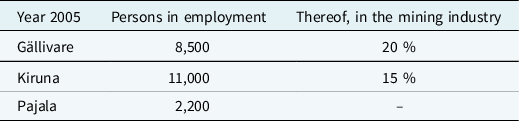
A mining company establishing itself in the Torne River Valley would surely be able to draw on the existing industrial infrastructures in the broader region. However, for a local community, the situation might be different: having a mining industry in place would not necessarily produce a mining town of scale in a different historical and geographical context (cf. Bjørgo, Reference Bjørgo2018b). Yet sheer “euphoria” appears awakened in Pajala in the face of prospects of achieving something like the prominent mining towns. The development partnership Pajala Utveckling believes into a promising future and in its reports presents prospects based on analytical comparisons with the grand neighbours (cf. Table 2).
Statistical comparison produced by the development partnership Pajala Utveckling
Source: Pajala Utveckling, 2011a.
The comparative prognosis for Pajala to develop along a similar trajectory is based on the parameters of quantity of extracted ore versus population and job offerings in the different sectors of the local economy (Pajala Utveckling, 2011a). It is difficult to find ideas about the time frame of the scenarios presented. Seemingly, it suffices to believe in the new future and its ability to brighten the communities from now and into distant times. Apparently, the reader is presented with a detailed, albeit imaginative economic geography. In hindsight, we know that the project was not solidly grounded and, symbolically speaking, the new illumination was not lasting.
The statistics convey that the upswing in mining-related jobs affected no durable changes in the overall population dynamics since 1970 (Fig. 1). Roughly two-thirds of the workforce of the mine in 2014 (298 employees) are reported to reside in Pajala (56%) and its neighbouring municipalities including Gällivare, Kiruna, and Finnish Kolari (13%) (Pajala Utveckling, 2014, p. 14). Overall decline continued in 2014. The overall demographic effect of the mine is since 2011 complicated by the co-occurring influx of immigrants, chiefly refugees (FastighetsNytt (Stockholm) 3 May 2016) (cf. Fig. 1). In fact, decline had been constant throughout the period of 2002–2016 regarding residents of Swedish origin (Statistics Sweden, 2017). This demographic situation resonates with arguments pinpointing the diversifying development trajectories of northern Fennoscandian communities (Carson, Solbär, & Stjernström, Reference Carson, Solbär, Stjernström and Keskitalo2019). It also supports findings concerning the non-straightforward relationship between resource extraction and rural communities (Bjørgo, Reference Bjørgo2018b; Dale, Bay-Larsen, & Skorstad, Reference Dale, Bay-Larsen, Skorstad, Dale, Bay-Larsen and Skorstad2018; Lawrie, Tonts, & Plummer, Reference Lawrie, Tonts and Plummer2011). During the short operational period of the mine, Pajala did not fully evade from symptoms of what could be called the common tragedy of boomtowns (cf. Carrington & Pereira, Reference Carrington and Pereira2011): well-trained public sector employees shifting to better-paid unskilled jobs (Bjørgo, Reference Bjørgo2018b, p. 50) and temporary and drive-in drive-out construction workers (Tennberg et al., Reference Tennberg, Vola, Espiritu, Fors, Ejdemo, Riabova, Korchak, Tonkova and Nosova2014, p. 60). The risk of missing “the linkages between the economic and social dimensions of the community’s future” (Bjørgo, Reference Bjørgo2018b, p. 54) may seem very real. We can note that the estimate of 700 employees in Pajala was not met.
Expectations and realities: Kolari
Similarly, in Kolari, other mines populate the discursive space accompanying the plans of mine establishment. There is the prosperous industrial town of Kemi with to-be-expected impacts, but also an ugly mine, the Talvivaara Mine with a track record in environmental mismanagement:
“If you’d visit the highest floor of Kemi Town Hall and looked out the window, what would you see, you’d see mining industry, forest industry, paper industry, there are the harbours, oil harbours, there is like anything… then, if you’d drive past Kemi, there are all kinds of impacts to see… of course it affects the environment. (…) In-between arrived this Talvivaara case, which spoiled the mining industry, I think it spoiled the fame of the proper mining industry very radically” (Local politician, Kolari)
The environmental problems of the Talvivaara Mine started propagating in media around 2011 (cf. Heikkinen et al., Reference Heikkinen, Lépy, Sarkki and Komu2016, p. 405; Lyytimäki & Peltonen, Reference Lyytimäki and Peltonen2016, p. 481) and several interviewees refer to this as the starting point of a more nuanced discussion concerning mining in Kolari. Long before this occurrence, tailings dam failures have been reckoned among the most severe environmental risks of mining, but now Finland experienced this for the first time on a large scale and in modern times (cf. Törmä et al., Reference Törmä, Kujala and Kinnunen2015; Heikkinen et al., Reference Heikkinen, Lépy, Sarkki and Komu2016). The quoted passages engage the good and the bad in a contest over the proper vision for the future of Kolari. It is not the other places per se that are being compared, but what they might mean regarding the present situation in Kolari.
The belief in the brighter future prevails, “well yes, it [the bankruptcy in 2014] was kind of a disappointment, but my faith does not end; I do believe that the ore is still there in the ground…, if a stable actor purchases the project, then very soon we’ll be facing it again,” a local politician in Kolari says. The persuasiveness of this kind conditional prospect of a brighter future seems difficult to counteract, reliant as it is made on the subsurface presence of ore, hidden from view, but calculated and estimated. What the reference made to the view from the Kemi Town Hall by this interviewee seems to be saying in extension is that Kemi represents a showcase of the benefits of mining, and Kolari, with its revival project, should be seen as positioned at a different stage along the same line of development. This interviewee certainly hopes that what has been lost in the wake of the mine closures could be gained by the new project.
Minescaping: Temporal and spatial referencing in the interviews
In the interview accounts, the relationship to the new project is constructed via arguments based on experiences of the past mine, and sometimes such “past presents” (cf. DeSilvey, Reference DeSilvey2012) are projected onto the future, hoping that the Kolari of the 1970s would re-emerge. The past as a mining town were not available in Pajala; instead, the imagery was founded on a constructed analogy of the estimated amounts of ore and a particular historical development pathway. In Kolari, the remains of mining – such as the water-filled pits, ore crushers, dressing plants, waste rock piles, and tailings dumps – are not well visible and, thus, the tangible rests of the past minescape appear to retreat into the background. These historical remnants have not contributed to commemorative practices at managed heritage sites, while there are other material remnants of the mining era that might play a role, as discussed below; rather, a “virtual” commemoration of the industrial era seems to inform individual and shared place-based identities, “embedded in forms of oral history, lived memories and the ‘everyday’ landscape” (Wheeler, Reference Wheeler2014, p. 27). The re-emerging Kolari minescape is founded on the memories of lived presences in the past that are reworked into vision-making tools. The mine(s) in town are remembered as the sources of bread and commerce. The EIA consultant with family roots in the area, described the situation: “thus, if I’ve had five uncles and five of them worked at the mine, so where did the bread come from? So, yes, people know what good it brings (…) it [the mine] was just around the corner to the village, so many residents worked at the mine.” According to the resident with roots elsewhere, the “desire for the mine” had to do with the “old mine worker families that wished to restore the past.” The positive sentiments among long-term residents towards the new plans are by the second-home owner, too, motivated by the presence of memories of living in a mining town. The new minescape is, as it were, dominated by the past presence of mining. While the past as a mining town is used to shape the expectations felt towards the new project, thus creating “anticipated futures,” we can realise that the new project actually is quite different (Table 3).
The mining projects in Kolari, now and then, as indicated by selected data

Sources: 1Ristioja, Reference Ristioja2005; 2Mining Authority of Finland, 2013; 3Pöyry Finland, 2010, p. 20; 4Mining Register Map Service, http://gtkdata.gtk.fi/mdae/index.html
However, the much larger scales of the new project appear to be ignored or of less importance. There are also differences in operational and process design, which are fading from view. Another local politician argued that due to thinking in terms of the effects of the earlier mine, people cannot imagine what the new project might mean. This interviewee maintained that “people do not even know what it looks like at the mine site, no landscaping has been done there…”, expanding along the lines that people seemed to deliberatively sideline facts and embrace an unquestioning belief in the promises made by the mining company. Issues concerning the credibility of the company and the environmental legacy of mining were there to see, this local politician went on to argue, while people simply expected jobs to rain down over them like manna from heaven. Indeed, the “rigid memorialisation of the past can inhibit conceptualisations of place that emphasise change and flux, potentially making it more difficult for people to accept and adjust to current and future change.” (Wheeler, Reference Wheeler2014, p. 31). It could appear that the historical presence of mining in Kolari comes together with a belief in the virtues of primary industry (hence, disregarding of the jobs present in tourism, which several interviewees referred to) and an attitude of passivity nurtured by state-led operations as regards the development of locally based livelihood options. Moreover, this perspective indicates forgetfulness. In 1987, desperation spread in the face of information on mine closures, which a regional newspaper called “an unbearable blow against Kolari” (Kaleva (Oulu) 24 February 1987). The shock waves sent by the downturn into the life of the community in the 1990s seem to be forgotten and excitement seems to guide the argumentation. Similar enthusiasm, and forgiveness if you like, in previous mine workers is reported concerning the reopening plans of the Sydvaranger Mine in northernmost Norway (Tennberg et al., Reference Tennberg, Vola, Espiritu, Fors, Ejdemo, Riabova, Korchak, Tonkova and Nosova2014, p. 56).
The second-home owner representative describes the local road association as divided along a line: the long-term residents in the former mine village would welcome the mine and the newcomer residents and leisure time visitors tended not to do so. This second-home owner, with childhood memories from Kolari, cultivated a rational attitude towards anticipated loss of the restful natural surroundings, planning to sell or to rent to mine workers. However, due to a prolonged period of indecision, he was now seeing the market attraction of the property completely disappearing. Moreover, the situation was strenuous due to continued unclarity regarding compensation and the extra rounds taken by the spatial plan-making. Interestingly, the more nuanced sentiments of the second-home owners and tourism entrepreneurs seem to gain in rhetorical power only by the force of spatial referencing. The spreading contestation against the mine is supported by reference to the disaster of Talvivaara and the use of spatial planning instruments by the local government in Kuusamo – an important tourist destination in north-eastern Finland hosting many second homes – to enforce land-use zones excluding mining (cf. Lyytimäki & Peltonen, Reference Lyytimäki and Peltonen2016; note: The Supreme Administrative Court of Finland in 2019 disapproved this zoning solution). Temporal referencing is employed to describe, by the resident representative and a local politician, the effect of the upcoming mine on investments in leisure time residences and recreational and touristic facilities, an issue framed by the expectation of negative environmental impacts. With the project put on ice, “people started planning for the future again,” the resident stated, in the sense of starting to buy and build again. Hence, the future is framed as closed for other activities in the prospect of mining. This interviewee characterised the atmosphere under the ongoing planning of the mine as fearful and expressed himself feeling happy about the downturn yet adding that one never knows when the issue will be on the table again. The local politician mentioned that one of the most directly affected tourism entrepreneurs quit the business before anything concrete had happened. The difficulty in handling an unclear future might interlink with the stress created by inability to frame the current situation. This might have generated an experience of, as I tentatively suggest, profound disorientation; a situation that points to the crucial role of place-based temporal elements in (social) identity (cf. Cubitt, Reference Cubitt2007).
Discussion: The belief in mining
In the context of the Northland project, the grand mines of Norrbotten and the Kemi-Tornio region are used to frame the future arriving with the mine in spe. Pajala were to turn into mining town of magnitude. Kolari were to blossom out as a mining town. However, mining in the past, albeit not that long ago, occurred in a different time as regards the preconditions of running a mining industry. The activity environment has seen changes at least concerning the demanded speed and volume of extraction, the shifts in regional development policies and state involvement, and the stock market dependency of mine financing (cf. Bjørgo, Reference Bjørgo, Dale, Bay-Larsen and Skorstad2018a, b; Suopajärvi et al., Reference Suopajärvi, Ejdemo, Klyuchnikova, Korchak, Nygaard and Poelzer2017; Tennberg et al., Reference Tennberg, Vola, Espiritu, Fors, Ejdemo, Riabova, Korchak, Tonkova and Nosova2014; Hernesniemi et al., Reference Hernesniemi, Berg-Andersson, Rantala and Suni2011; cf. Carrington & Pereira, Reference Carrington and Pereira2011). As a result, mine establishment today relies on the coordination of the goals of a range of actors within different sectors of society and levels of scale.
The literature on boomtowns sparsely deals with the play of representations as meaning-making agents within the more-than-economic minescapes that emerge in relation to prospective mining ventures. At focus are instead the actual socio-economic effects, survival strategies during boom and during bust, as well as community reactions to newcomers and social changes and the studies often convey the presence of an attitude of hoping for the best in terms of realised returns (e.g., Gehman et al., Reference Gehman, Lefsrud and Fast2017; O’Connor, Reference O’Connor2015; Carrington & Pereira, Reference Carrington and Pereira2011; Lawrie et al., Reference Lawrie, Tonts and Plummer2011). It must be stressed, though, that studies conducted within the broader region studied here, the Barents region, highlight the complexity of the effects of mining (Viinamäki, Reference Viinamäki2015; Suopajärvi et al., Reference Suopajärvi, Ejdemo, Klyuchnikova, Korchak, Nygaard and Poelzer2017; Tennberg et al., Reference Tennberg, Vola, Espiritu, Fors, Ejdemo, Riabova, Korchak, Tonkova and Nosova2014).
Among the social impacts of development projects are people’s pre-perceptions, the rumours and believes, all of which are seen to inform actions (Vanclay, Reference Vanclay2012); in the actual case, this spanned hopes and fears, and feelings of trust and insecurity, as indicated by the interviewees (cf. Waara et al., Reference Waara, Berglund, Soudunsaari and Koskimäki2008, pp. 6–21). In the face of the large investments and major impacts associated with mining, as well as the diversity of perceptions and speculations that arise in host communities and more widely, seeking to cope with insecurities by looking at guiding examples might come naturally (on the role of media in this, cf. Heikkinen et al., Reference Heikkinen, Lépy, Sarkki and Komu2016). The anxiety of facing a novel, possibly risk-filled, venture may be tempered by turning to past experiences that the long-term residents of the community experience as supportive key aspects of their shared identity (Cubitt, Reference Cubitt2007, pp. 120–121).
Localities with mines in spe are therefore likely to engage supportive narratives based on the stories of other mines and mining towns. Moreover, as I would like to argue, the imaginative practices accompanying the minescapes might play a simply crucial role, if not necessarily new, to putting in place and sustaining large-scale industrial extraction with its risks and insecurities, ups and downs, and shifts in ownership. In this way, enthusiasm can be stimulated after decades, and across generations: one of the interviewees, for example, related how he helped in his father’s business at the mine, back in the by-gone days, and against this background confessed, “it [the suspension of the project] in fact does feel bad in the sense of that I too had great trust.” In handling and coping with the (yet anticipated) presence of prospective mines, the destinies of which largely depend on initiatives and decisions taken elsewhere, the narratives focusing “past presence” and its anticipated replication in the future might represent banal yet highly plausible strategies.
The past and the anticipated gains contribute to the making of what is seen a resource at a particular moment (Ey & Sherval, Reference Ey and Sherval2016). The enhanced play of referencing carries with it, it must be stressed, quite particular expectations: bright futures or dark futures, depending on the speaker. In Kolari, the representations of the bright futures apparently rest on recalling the lively atmosphere of the past. What is remembered is the bread on the table and the security of family life. Clearly, the catastrophe of mine closure is forgotten. The mine in spe refreshes quite particular strands of remembering, namely those reinforcing the identification of the community as a mining town. Hence, picking out this slice from the past suits the arguments that are grounded in a belief in mining. Thus, it may seem to some members of the community that what is happening represents a “return to the roots.” Moreover, we may only speculate about how villagers feel about the former shop houses along the village road and the ongoing presence of the only partially utilised apartment houses along it and what the prospect of a new beginning might mean in that regard. This interpretation is underlined by the newcomers and tourism entrepreneurs rather fearful attitudes, the mine does not represent a return to the roots, but a pathway towards insecure futures. We may keep in mind that memory work is essential in processes of identity formation (Wheeler, Reference Wheeler2014) and the sociocultural construction of lived-in places (Goin & Raymond, Reference Goin and Raymond2001). Therefore, the option of returning to the social identity of the past might be seen to guarantee social coherence in the sense of knowing who we are (cf. Hendon, Reference Hendon2010, pp. 26–28). The selectivity of remembrance resonates with perceptions of memories as social acts: materials and places tied to memories should be seen as constructions that are defined as belonging to a particular past from the current viewpoint (Cubitt, Reference Cubitt2007, pp. 199–200). Memories are to a lesser degree located at a distance; rather, they are employed here and now. In this, the spatial references in the Kolari case play a supportive and, as it were, a paedagogical role: “if you’d looked out the window, you’d see,” as the interviewee explained. The enthusiasm in Pajala appears nurtured by the darkness of the presence, compared to the brightness anticipated to arrive with mining. However, here, too, the belief in mining is narrated from the viewpoint of more of the same, this time in terms of the actual presence of significant mines and the factual reality of mine work representing the key employment option in the region.
Conclusion
The study has traced how experiences with past or distant, thus with other mines, are used for narrating the futures of mining towns, translated into ciphers of meaning for present-day meaning-making. The findings of the study underline that selected memories of experiences with mining elsewhere and in other times are easily abstracted and brought into the context of the debate at hand. The study found that expectations regarding futures were largely constructed via the injection of temporal and spatial references. Furthermore, the study exposed the selectivity of imagination: not everything is remembered; pieces may be lost in the same way as material remnants erode. Thereby, the study opens a view upon a kind of contextual amnesia that ignores discontinuities and contingencies in the making of history, when an underlying, persistent belief in mining is refreshed by new prospects. I suggest that the interaction of the promises made by the mining company and the beliefs awakened by the refreshed memories and identities should not be seen as more than lucky confluence of two different streams.
The matter of forgetting can be viewed from various angles. Selective forgetting makes, as some scholars have argued, part and parcel of the social processes of memory formation and identity preservation (Hendon, Reference Hendon2010). The supportive narratives that tie mining into the ongoing sociocultural construction of places and identity formation largely rest on the foundation of the past (Cubitt, Reference Cubitt2007). The findings speak about a rhetoric mix of estimates, expectations, memories and glancing over to other places that looks like an attempt to forge the acceptance of the local community for a particular type of future. The question of whose interests are served by fading the differences pertaining to historical contexts appears interlinked with the attraction of sticking to old, known stories rather than preparing for unknown, difficult-to-anticipate futures. Even after the Northland mining venture crashed in 2014, Pajala was taken to belong to what is seen a Prominent Mining Cluster (Pajala Utveckling, 2014) and upon the reopening of the Pajala mine in 2017 under new ownership the new municipal commissioner simply “gets butterflies in her stomach,” as an evening paper reported (Aftonbladet (Stockholm) 31 August 2017), in translation.
The study for its part demonstrates the role of representations in the complex sociocultural process of creating space, discursively and materially, for a new mine. In relation to extractive potentials and prospective mining ventures, the notion of minescape extended the view to seeing the significance of issues such as the raising of families, local politics, sociocultural relations and environmental effects of extractive activities. Spatial and temporal referencing appeared a key rhetorical means and a minescaping device. The study indicates that social acceptance of mining involves, to say the least, a more-than-rational combining of imagined pasts with imagined futures in the imageries of public discussion (for a recently published study on the role dreams in mining, cf. Komu, Reference Komu2019). Given the ever-present incalculability of mines, the kinds of imaginative representation of extractive spaces that have been discussed in this article gain an enhanced role. Essentially, then, managing a mining project within a local community is about managing imaginations, not least regarding pasts and futures. The abstracted idea of a “mining town” supports this ambition by transgressing single projects and the solely economic terrain.
Epilogue
Today, in 2021, the mine in Pajala is in operation, after having secured new funding under a new ownership. The project is currently profitable, but there have been water management issues. Operations commenced based on the previously granted environmental permit, which terms are to be revaluated in the process of permitting the enlargement of the mine that is under way. In Kolari, the mine is not yet “there.” The new, domestic owner has been required to update the water and environmental permit applications and to revisit the spatial plans already prepared (to solve issues concerning the mine area and the neighbouring properties). In the meanwhile, minescaping is actively pursued not least by the mining company, who, for example, recently presented the findings of a new survey on mine acceptance among locals in Kolari – a survey ordered by them.
Acknowledgements
The author thanks the two anonymous referees for their constructive and helpful reviews of an earlier version of this paper. I most warmly thank the research participants for sharing their insights with me and the special issue editors for inviting me to contribute.


 Open access

