


Introduction
In this paper, we focus on birch-bark and conifer resins and tars, proposing that these substances may have been of interest for more than the properties that make them effective binding agents. Throughout the Mesolithic, tars appear to have been used across the domains of technology (hafting), art (present on personal ornaments and engraved objects), health (chewing) and mortuary rites (present in burials). They defy easy categorization: derived from living plants, converted to objects, they undergo a phase change, shifting from solid to liquid and back to solid; they can be liquid, yet hydrophobic. Biological properties of betulin, a naturally occurring triterpene derived from birch bark, is known to have a broad range of medicinal uses: as an antiseptic, anti-inflammatory, antiviral, antibacterial, antifungal and antitumour (Haque et al. Reference Haque, Nawrot, Alakurtti, Ghemtio, Yli-Kauhaluoma and Tammela2014; Jensen et al. Reference Jensen, Niemann and Iversen2019; Morikawa et al. Reference Morikawa, Matsuda and Yoshikawa2017). When chewed or used as a compound applied to wounds, including burns (Frew et al. Reference Frew, Rennekampff, Dziewulski, Moiemen, Zahn and Hartmann2019; see also Lehtisalo & Schütze Reference Lehtisalo and Schütze1924, 113), it is known to dull pain and accelerate healing, transforming bodily states. Considering these unusual properties, including being able to heal and reverse through multiple states of matter, we explore the possibility that Mesolithic hunter-gatherers understood and incorporated the metamorphic capabilities and symbolism of resins and tars, themselves derived from particularly important and useful tree species, within their worldview.
Archaeological investigations into tar production, especially derived from birch bark, span a vast chronology—from the Middle Palaeolithic to the medieval period (Chen et al. Reference Chen, Vahur and Teearu2021; Rageot et al. Reference Rageot, Pêche-Quilichini, Py, Filippi, Fernandez and Regert2016; Regert et al. Reference Regert, Rodet-Belarbi, Mazuy, Le Dantec, Dessì, Le Briz and Henry2019; Schenck & Groom Reference Schenck and Groom2018; Schmidt et al. Reference Schmidt, Blessing and Rageot2019; Stacey et al. Reference Stacey, Dunne and Brunning2020). Tar is a plant sub-product typically made from birch bark or pine wood, which appears within the archaeological record as an amorphous residue, either as a lump or associated with a variety of objects including lithic and osseous tools, ceramic vessels and personal ornaments. Key functional attributes of resins and tars are their adhesive, binding and waterproofing qualities (Kozowyk et al. Reference Kozowyk, Poulis and Langejans2017a), with increasing evidence for birch-bark tar ‘chewing gums’ used for both medicinal and odoriferous purposes (Aveling & Heron Reference Aveling and Heron1999; Evans & Heron Reference Evans and Heron1993; Jensen et al. Reference Jensen, Niemann and Iversen2019; Kashuba et al. Reference Kashuba, Kırdök, Damlien, Manninen, Nordqvist, Persson and Götherström2019; Lucquin et al. Reference Lucquin, March and Cassen2007; Rageot et al. Reference Rageot, Théry-Parisot and Beyries2019). Recent years have seen an increase in interest in prehistoric tar research, driven by a combination of factors including a desire to resolve technical questions about how this substance was manufactured aceramically by prehistoric hunter-gatherers (e.g. Schenck & Groom Reference Schenck and Groom2018) and (interrelated) being able to prove that the mode of production was sufficiently complex that it can be used as a marker of Neanderthal cultural and technological complexity (Kozowyk et al. Reference Kozowyk, Soressi, Pomstra and Langejans2017b; Niekus et al. Reference Niekus, Kozowyk and Langejans2019). Greater application of analytical chemistry (gas chromatography-mass spectrometry (GC-MS)), used to identify the biomolecular makeup of otherwise amorphous residues on artefacts, alongside the recent application of aDNA, which has revealed human genomic data from chewed birch-bark mastics (Jensen et al. Reference Jensen, Niemann and Iversen2019; Kashuba et al. Reference Kashuba, Kırdök, Damlien, Manninen, Nordqvist, Persson and Götherström2019), has further fuelled a ‘gold rush’ of archaeological interest in this material.
A common and notable aspect of these tar studies (genetic studies by Jensen et al. Reference Jensen, Niemann and Iversen2019; Kashuba et al. Reference Kashuba, Kırdök, Damlien, Manninen, Nordqvist, Persson and Götherström2019 being exceptions) is an emphasis on explaining the technical methods of production, focusing on temperature control, maintaining the exclusion of oxygen and ways of collecting the distilled tar (e.g. Kozowoyk et al. Reference Kozowyk, Soressi, Pomstra and Langejans2017b; Reference Kozowyk, van Gijn and Langejans2020a; Rageot et al. Reference Rageot, Théry-Parisot and Beyries2019; Schenck & Groom Reference Schenck and Groom2018). As a result, discussion has gravitated towards the technological and economic spheres, often employing a chaîne opératoire model, with birch tar and other adhesives being understood as a functional medium for solving technological problems (Fletcher et al. Reference Fletcher, Milner, Taylor, Milner, Conneller and Taylor2018; Groom et al. Reference Groom, Schenck and Pedersen2015; Osipowicz Reference Osipowicz2005; Schenck & Groom Reference Schenck and Groom2018). This is clearly necessary research; indeed, the authors of this paper have been, and still are, involved in similar studies (e.g. Fletcher et al. Reference Fletcher, Milner, Taylor, Milner, Conneller and Taylor2018 and Langley & Little Reference Langley, Little, Nilsson Stutz, Peyroteo Stjerna and Tõrvin press). Our contribution here is not intended to undermine these more technological approaches, not least because it is through technological acts of making, often using experimental archaeological approaches, that an experiential understanding of the sensory and material aspects of birch-tar production can be more fully realized. Rather, we argue that an exclusive focus on mechanical functionality risks framing production and use by prehistoric people as concerned only with material cause and effect. This is problematic in that it aligns prehistoric worldviews with a rigid Cartesian divide between objects and subjects, immaterial and material (Fausto Reference Fausto2007; Sillar Reference Sillar2009).
The Cartesian divisions which lead to the previous focus on mechanical functionality are symptomatic of a broader, ‘Western’ ontological perspective from which most archaeologists working in this field originate. The problems with projecting our own ontological positions back into the deep past are well documented, and recent developments within behavioural psychology have helped to nuance the crude distinction between ‘Western’ and ‘non-Western’ by identifying the behaviour in Western, Educated, Industrialized, Rich and Democratic (WEIRD) societies as an extreme outlier within cross-cultural comparisons (Henrich et al. Reference Henrich, Heine and Norenzayan2010). This work reveals the fundamental flaw in assuming continuity in ontological perspective between contemporary archaeologists and past peoples. In recent years, archaeologists have begun to explore relational ontologies both within and beyond Mesolithic studies, as a way of overcoming these problems (e.g. Brown & Walker Reference Brown and Walker2008; Sellers Reference Sellers2010; Taylor Reference Taylor2020). Here, in order to work across these dualisms and present a more coherent understanding of resins and tars which appear in a range of archaeological contexts, we advocate an approach which emphasizes their materiality and potential for social agency. Ethnography serves as a valuable reminder that ‘trees were not just background but a vital feature of the material world through which people spun the fabric of their lives’ (Warren Reference Warren2003, 23). It is in this context that we draw on ethnography to highlight the diverse spectrum of social and sensory experiences that tree-derived products, including resins and tars and their parent materials (bark, wood), may have held for Mesolithic peoples.
Phase changes, the ability for a material to move from a liquid to a gas, or a solid, presents a fundamental challenge to the idea that materials are fixed, immutable substances. Phase changes are determined by ‘critical points’, intrinsic material properties which determine how, and under what conditions, materials change from one phase to another (Heidemann & Khalil Reference Heidemann and Khalil1980). Mesolithic tar makers were likely familiar with how much heat should be applied to soften rather than burn the tar, how it cooled, and the different results of placing hot tar in water or snow rather than cooling slowly. One of the striking properties of birch tar is its ability to be cooled and heated several times, making possible long-term and portable storage. Examples of other substances that would have been known to Mesolithic peoples which exhibit this property include water, beeswax, saturated fats and blood (Bondetti et al. Reference Bondetti, Scott and Courel2021; Heron et al. Reference Heron, Andersen and Fischer2013; Lozovski Reference Lozovski1996; Rybråten Reference Rybråten2013). Another useful parallel is water, which can go through phase change, freezing with colder temperatures, being found in a liquid state at room temperature, changing state to steam at boiling point, but being dangerous with increasing heat.
In the remainder of this paper, we expand the discussion of resin and tar beyond the strictly technological and economic spheres through (1) a review of the evidence for birch-bark tar and pine resin within the Mesolithic, including an overview of ongoing debates surrounding aceramic manufacture methods; (2) considering ethnographic examples of the use of birch and pine products by northern-hemisphere hunter-gatherers in order to highlight the scale of diverse functions these plant-based materials served, including social and symbolic; (3) using case studies selected from the Mesolithic archaeological record to explore the material and sensory properties of birch and pine tars and resins in different cultural contexts; (4) reflecting critically on these insights as a first step towards re-evaluating the diverse role of resins and tars within everyday lived experiences during the Mesolithic period.
Background
While adhesives can be manufactured from a wide array of animal, plant and mineral sources, with bovine and potentially fish glue occasionally identified (Rigaud et al. Reference Rigaud, Vanhaeren, Queffelec, Le Bourdon and d'Errico2014; Solazzo et al. Reference Solazzo, Courel and Connan2016), their use during the Mesolithic remains debatable, probably due to the comparatively greater usage properties of birch tar, especially for hafting purposes (Kozowyk & Poulis Reference Kozowyk and Poulis2019). Another factor is their greater rate of degradation from bacterial activity compared to terpenoid adhesives—those derived from plant sources which consist of hydrophobic triterpenoid molecules (Rageot et al. Reference Rageot, Théry-Parisot and Beyries2019). Like other organic adhesive products, the preservation of terpenoid tars can be negatively impacted under particular preservation conditions, such as acidic soils (Croft et al. Reference Croft, Monnier, Radini, Little and Milner2016); or, in the right conditions, e.g. anoxic or humid conditions, preserved (Chen et al. Reference Chen, Vahur and Teearu2021, 13). Experimental work focused on understanding the rate of preservation of different adhesive substances has demonstrated that birch tar survives exceptionally well, slightly better than other adhesives (e.g. gums, pine tar, resin, resin/beeswax and ochre combinations) (Kozowyk et al. Reference Kozowyk, van Gijn and Langejans2020a). This may, in part, account for its seemingly greater frequency within the prehistoric record of Mesolithic Europe. It is, however, worth noting that, in many instances where resins and tars have been identified, this determination is without molecular characterization (Rageot et al. Reference Rageot, Lepère and Henry2021).This is significant because it has been shown that, for example, substances adhering to the surface of flint (and probably other objects) can look like tar, but when biomolecular analysis is undertaken, those substances are in fact simply only natural residues deriving from the burial environment (Croft et al. Reference Croft, Colonese, Lucquin, Craig, Conneller and Milner2018).
Defining birch bark tar, both at the molecular and human scale, is not straightforward. Parsing the difference between ‘tar’, ‘pitch’ and ‘resin’ can often lead to circular and habitual classifications, which vary across time, location, language and industry (Hayek et al. Reference Hayek, Krenmayr, Lohninger, Jordis, Moche and Sauter1990; Stacey Reference Stacey2004). For the purposes of this paper, we define ‘tar’ as a viscous, hydrophobic resin, a heated derivative primarily composed of terpenoid molecules, originating from an isoprene backbone and manufactured using a pyrolytic method (Modugno et al. Reference Modugno, Ribechini and Colombini2006; Pollard & Heron Reference Pollard and Heron2015). We further define ‘resin’ as a viscous hydrophobic exudate, primarily composed of terpenes and collected directly from a tree or plant without the need for initial thermal processing, although this does not preclude secondary processing (Modugno et al. Reference Modugno, Ribechini and Colombini2006; Pollard & Heron Reference Pollard and Heron2015). Pitch and tar are sometimes used interchangeably, with ‘pitch’ often used to describe the solid/semi-solid portion of resins and tars, but confusingly sometimes used to refer to the tapped resin from certain trees (Langejans et al. Reference Langejans, Aleo, Fajardo and Kozowyk2022), which is why it occurs frequently within archaeological and ethnographic texts. To avoid confusion, other than the appearance of ‘pitch’ within our ethnographic data tables, which respects the original published wording, we will avoid using this term. Conifers, the term for all plants in the class Pinophyta, includes yews, larches, firs and pines (Campbell Reference Campbell, Campbell and Reece2005). To the best of our knowledge, only the pine tree has been securely identified in the Pinophyta-derived adhesive record of prehistoric Europe, while conifer resins have been discovered adhered to projectiles in North America (Helwig et al. Reference Helwig, Monahan and Poulin2008; Reference Helwig, Monahan, Poulin and Andrews2014) and spruce pollen within a Mesolithic funerary context (Alciati et al. Reference Alciati, Cattani and Fontana1992). We refer to pine for the remainder of the paper, with the awareness that future research may reveal a wider exploitation of conifer products. While these definitions may seem over-fastidious and not without contestation, it is helpful to be clear and remove any ambiguity. At the empirical level, tar and resin are phenomenologically different: qualities which will be further explored in this paper. At the molecular level, there are several important compounds which have become ‘fingerprints’ or ‘signatures’ in the bioarchaeological literature for birch bark tar—namely lupane triterpenoids.
Betulin is a pentacyclic triterpenoid and constitutes up to 30 per cent of the dry weight of birch bark (Green et al. Reference Green, Bentley, Chung, Lynch and Jense2007). The presence of betulin and any derivatives has long been accepted as a biomarker for the presence of birch-bark tar within an archaeological sample (Dudd & Evershed Reference Dudd and Evershed1999; Evershed Reference Evershed1993). Alongside betulin and betulinic acid are the other members of the lupane triterpenoid group—lupenone, lupeol and betulone—which have also been identified as birch tar biomarkers through gas-chromatography mass-spectrometry (GC-MS) (Hayek et al. Reference Hayek, Krenmayr, Lohninger, Jordis, Moche and Sauter1990; Reference Hayek, Krenmayr, Lohninger, Jordis, Sauter and Moche1991; Perthuison et al. Reference Perthuison, Schaeffer, Debels, Galant and Adam2020; Regert et al. Reference Regert, Vacher, Moulherat and Decavallas2003). Together these compounds constitute a ‘standard composition’ for birch tar, despite the increasing evidence that subtle molecular changes can be induced through different manufacturing techniques (Rageot et al. Reference Rageot, Théry-Parisot and Beyries2019). The absence of these key biomarkers usually makes it impossible to be confident in identifying a substance as birch tar; unfortunately, the technology and interpretative tools for analysing adhesives have only become routine in the last few decades, meaning that many prior identifications of birch tar in the record are either presumptions at the time, or later interpretations based on the descriptive terminology used. For example, composite projectile technologies such as antler and bone points, microlith-tipped arrowheads and other hafted tools are often found with an unidentified mastic or resin (Crombé et al. Reference Crombé, Perdaen, Sergant and Caspar2001; Friis-Hansen Reference Friis-Hansen1990; Haslam et al. Reference Haslam, Robertson, Crowther, Nugent and Kirkwood2009; Malmer Reference Malmer1966; Vaughan Reference Vaughan1987)). This tempers our confidence in collating larger datasets looking at the uses of birch-bark tar in the Mesolithic, since we cannot always be sure of the identity of archaeological adhesives without molecular analysis.
The production and use of birch-bark and conifer resins and tar adhesives in Mesolithic Europe is, however, relatively well attested in the archaeological record across a diverse range of applications and contexts: though, again, this comes with the caveat of biomolecular analysis not always being undertaken or the method of identification being unreported. The preceding Palaeolithic, by contrast, is scant. Rageot et al. (Reference Rageot, Théry-Parisot and Beyries2019) cite just 15 analyses of reliable molecular characterization of birch-bark tar dating to this period (see also Grunberg et al. Reference Grünberg, Graetsch, Baumer and Koller1999; Mazza et al. Reference Mazza, Martini and Sala2006; Niekus et al. Reference Niekus, Kozowyk and Langejans2019) and Pinaceae resin on Middle Paleolithic lithic tools from southern Italy (Degano et al. Reference Degano, Soriano and Villa2019). The Holocene, in particular wetland sites in northwest Europe, is known to have more favourable preservation conditions. There is also the possibility that tars were simply more extensively used for hafting composite tools during the Mesolithic compared to the Palaeolithic. During the Holocene, in most cases where biomolecular analysis has been carried out, the tar is derived from birch bark, with comparatively less pine tar identified (Rageot et al. Reference Rageot, Lepère and Henry2021). A similar situation has been shown for the northwest Mediterranean Neolithic, whereby Pinaceae exudates appear infrequently, and only as waterproofing agents on ceramic vessels (Rageot et al. Reference Rageot, Lepère and Henry2021). That same study highlights the presence of complex procurement networks which are likely to have involved long-distance trading systems of raw materials and finished products (tar, admixtures) into areas where these resources were absent. In some cases, more locally available and functionally comparable sources, such as pine and geological bitumen, were bypassed in favour of birch-bark tar, with palaeoenvironmental studies indicating that this raw material was only available at a much greater distance (Rageot et al. Reference Rageot, Lepère and Henry2021). Similarly, a greater frequency of birch tar compared to pine tar samples for the Palaeolithic is unlikely to be a result of resource constraints, with both species of trees known to occur together during large parts of Pleistocene Europe (Bigga et al. Reference Bigga, Schoch and Urban2015).
The range of uses of resins and tars within the Mesolithic is diverse; birch-bark tar is known from a number of predominantly northern European Mesolithic sites. This includes, but is not limited to: Pulli and Ulbi, Estonia (Vahur et al. Reference Vahur, Kriiska and Leito2011; Bjørnevad et al. Reference Bjørnevad, Jonuks, Bye-Jensen, Manninen, Oras, Vahur and Riede2019), Tłokowo, Poland (Osipowicz et al. Reference Osipowicz, Orłowska, Bosiak, Manninen, Targowski and Sobieraj2020; Sulgostowska Reference Sulgostowska1993), Duvensee (Bokelmann Reference Bokelmann1991) and Friesack IV, Germany (Gramsch Reference Gramsch1987); Seedorf and Ullafelson, Austria (Aveling & Heron Reference Aveling and Heron1999; Pawlik Reference Pawlik, Walker, Wenban-Smith and Healy2004); Øvre Storvatnet, Norway (Bang-Andersen Reference Bang-Andersen and Bonsall1989, 348); Ageröd V, Ronnehölms Mosse and Kanaljorden, Sweden (Hallgren & Fornander Reference Hallgren, Fornander, Grünberg, Gramsch, Larsson, Orschiedt and Meller2016; Larsson et al. Reference Larsson, Sjöström and Heron2016); Holm Mølle and Klosterlund, Denmark (Rysgaard et al. Reference Rysgaard, Rasmussen and Riede2016; Troels-Smith Reference Troels-Smith1962); Sereteya II, Nyzhnee Veretje I and Yuzhniy Oleniy Ostrov, Russia (Oshibkina Reference Oshibkina1983; Gurina Reference Gurina and Kol'tsov1989); Thatcham III and Star Carr, UK (Clark Reference Clark1954; Roberts et al. Reference Roberts, Barton, Evans, Ashton, Healy and Pettit1998); and possible resin/tar substances from Ferriter's Cove and Clonava Island, Ireland (Woodman et al. Reference Woodman, Anderson and Finlay1999; Little Reference Little2014). Resin or tar for hafting composite tools can be cited from a broad range of Mesolithic contexts (Langley & Little Reference Langley, Little, Nilsson Stutz, Peyroteo Stjerna and Tõrvin press), in association with microliths (e.g. Clark Reference Clark1954; Gurina Reference Gurina and Kol'tsov1989, 27–310; Larsson et al. Reference Larsson, Sjöström and Heron2016; Oshibkina Reference Oshibkina1983; Vahur et al. Reference Vahur, Kriiska and Leito2011; Warren et al. Reference Warren, Fraser and Clarke2018) and other types of stone tools (e.g. Little Reference Little2014; Roberts et al. Reference Roberts, Barton, Evans, Ashton, Healy and Pettit1998; Woodman et al. Reference Woodman, Anderson and Finlay1999). Less frequently, evidence has been found for the hafting of osseous slotted bone points (e.g. Bjørnevad et al. Reference Bjørnevad, Jonuks, Bye-Jensen, Manninen, Oras, Vahur and Riede2019; Chen et al. Reference Chen, Vahur and Teearu2021; Manninen et al. Reference Manninen, Asheichyk and Jonuks2021; Sulgostowska Reference Sulgostowska1993). However, evidence is not limited to the hafting of tools.
The practice of chewing birch tar is documented from at least the Mesolithic to the Iron Age (Aveling Reference Aveling1997; Reference Aveling2016; Jensen et al. Reference Jensen, Niemann and Iversen2019; Karg et al. Reference Karg, Hansen, Walldén, Glastrup, Ærenlund Pedersen and Sonne Nielsen2014; Kashuba et al. Reference Kashuba, Kırdök, Damlien, Manninen, Nordqvist, Persson and Götherström2019). Mesolithic evidence for this practice has been identified at the sites of Huseby Klev, Sweden; Barmosen I, Denmark; and Friesack IV, Germany (Gramsch Reference Gramsch and Coles1992; Gramsch & Kloss Reference Gramsch, Kloss and Bonsall1989; Hernek & Nordqvist Reference Hernek and Nordqvist1995; Johansson Reference Johansson1990). Chewing tar has been argued to have a medicinal benefit and promote oral hygiene (Aveling & Heron Reference Aveling and Heron1999). Analysis of the tooth imprints that often survive on pieces of chewed tar offer important social insights about Mesolithic life, revealing that children, adolescents and adults engaged in this practice (Aveling & Heron Reference Aveling and Heron1999; Jensen et al. Reference Jensen, Niemann and Iversen2019; Kashuba et al. Reference Kashuba, Kırdök, Damlien, Manninen, Nordqvist, Persson and Götherström2019). Research by Jensen et al. (Reference Jensen, Niemann and Iversen2019) offers a similarly intimate insight into the life history of the individual from Syltholm, on the island of Lolland, Denmark, informed by the extraction and analysis of aDNA, which supports an interpretation of a potential medicinal application in this case.
In later periods, resin and tar appear to have been used as a decorative feature (e.g. Odriozola et al. Reference Odriozola, Garrido Cordero, Daura, Sanz, Martínez-Blanes and Avilés2019; Rageot et al. Reference Rageot, Lepère and Henry2021). It is unclear how extensive this practice was in prehistory; it is possible that with closer attention we may find a greater number of examples. Nonetheless, during the Mesolithic, there are a number of known engraved objects where some type of resinous substance (identified without bimolecular methods) was possibly used as an inlay across a range of objects, including antler shafts, a mattock head, a drilled shaft, wooden paddles, daggers, a sleeve, a harpoon head, a piece of engraved antler (Płonka Reference Płonka2003), amber pendants (Petersen Reference Petersen2016, 220–21; Reference Petersen2021, 5; Toft & Brinch Petersen Reference Toft and Brinch Petersen2016, 205) and figurines (Petersen Reference Petersen2016, 228; Reference Petersen2021). Another use has been identified at the site of Zamostje 2 where a possible resinous residue was found adhering to small, engraved stones, known as plates and polishers (Płonka Reference Płonka2003, 130, 136, 184). At Strandvägen a slightly different use was identified. Resin dating to c. 5670–5510 cal. bc (Ua-29753) was found in a bone handle with six quartz microblade inserts which might have been used intentionally to cover engravings on the dagger (Molin et al. Reference Molin, Gruber, Hagberg, Riede and Tallaavaara2014, 95–6). In some cases, the use of resins or tars may have been a method of attaching decoration to personal ornaments or fixing together component parts (Cristiani et al. Reference Cristiani and Borić2012; Reference Cristiani, Živaljević and Borić2014). In the Finnish Comb Ware culture, in which people largely followed a Mesolithic way of life, over 60 examples have been recorded of Comb Ware ceramics being repaired using birch tar (Pesonen Reference Pesonen and Huurre1999; Pesonen & Leskinen Reference Pesonen, Leskinen, Jordan and Zvelebil2009). Resin (spruce, pine) is also known from Mesolithic funerary contexts (Alciati et al. Reference Alciati, Cattani and Fontana1992).
A central question in much of prehistoric archaeology where tar has been evidenced centres around how this substance was produced, especially in aceramic contexts. The Mesolithic record provides some insights into the possible production strategies involved, though often this is indirect. For example, at the site of Star Carr, birch-bark tar was recovered alongside an accumulation of birch-bark rolls (Clark Reference Clark1954), 41 per cent of which showed evidence of charring (Fletcher et al. Reference Fletcher, Milner, Taylor, Milner, Conneller and Taylor2018, 419). It is likely that birch-bark rolls had several uses, with torches and fishing floats raised as possibilities (Fletcher et al. Reference Fletcher, Milner, Taylor, Milner, Conneller and Taylor2018, 428–9). Equally, rolling birch bark may have been a method of storing it for later use—tar production included (Fig. 1A). Accumulations of birch-bark rolls have been found at other Mesolithic sites such as Tågerup (Karsten & Knarrström Reference Karsten and Knarrström2003) and Ulkestrup Lyng (Andersen et al. Reference Andersen, Jørgensen and Richter1982; Tauber Reference Tauber1971), where similar interpretations have been posited (Andersen Reference Andersen2013). In the Netherlands, hundreds of pits of Mesolithic date, believed to have been used for pine-wood tar extraction, were found during commercial excavations (Kubiak-Martens Reference Kubiak-Martens, Kooistra, Langer, Lohof, Hamburg and Flamman2011; Reference Kubiak-Martens, Langer, Kooistra, Hamburg, Müller and Quadflieg2012). This has, however, been more recently contested by Crombé et al. (Reference Crombé, Langohr and Louwagie2015), who argue that such features are of natural origin, derived from a combination of forest fires and insect activities. Nonetheless, the main point here is that the currently available archaeological evidence provides only limited insights into the methods used to create tar and the yield. As a result, the question of how aceramic tar was produced continues to attract considerable attention.
(A) Rolled birch bark; (B) aceramic pine-tar production; (C) aceramic yield of pine tar stored in a metal container post-production—turpentine, one of the pyrolysis fractions of pine wood, displays iridescent ‘rainbow’ effect; (D) roll of birch bark still burning post-use in aceramic production of birch tar; (E) birch bark undergoing phase-change from solid to liquid; (F) reflective and glossy yield of aceramically produced birch-bark tar stored in metal tin; (G) a tar stick—useful for storing, transporting and reheating tar; (H) tar on a projectile is heated to make it malleable for moulding into desired form. (All photos © YEAR Centre.)

Experimental archaeology has been used extensively in recent years to explore the question of birch-bark tar production in aceramic contexts (e.g. Fletcher et al. Reference Fletcher, Milner, Taylor, Milner, Conneller and Taylor2018; Groom et al. Reference Groom, Schenck and Pedersen2015; Kozowyk et al. Reference Kozowyk, Soressi, Pomstra and Langejans2017b; Osipowicz Reference Osipowicz2005; Schenck & Groom Reference Schenck and Groom2018) (Fig. 1D–1F). At the time of writing, no single or definitive method has been identified. The most proposed theory is that birch tar could only be produced via anaerobic conditions by pyrolysis in reducing environments where the exclusion of oxygen prevents the tar from immediate combustion (Kozowyk et al. Reference Kozowyk, Soressi, Pomstra and Langejans2017b). Mooted techniques have included above- and below-ground methods of heating the bark and collecting the tar, though always with the assumption that anaerobic conditions were required. More recently, this assumption was proven incorrect by Schmidt et al. (Reference Schmidt, Blessing and Rageot2019), who demonstrated that tar can be produced by the ‘condensation method’. This simply involves heating birch bark adjacent to, and under, a large cobble propped on its side to create an overhang. Thus, Schmidt et al. (Reference Schmidt, Blessing and Rageot2019, 17707) argue that there was no need for the ‘cognitively demanding set up’ proposed by Kozowyk et al. (Reference Kozowyk, Soressi, Pomstra and Langejans2017b), with the latter using the making of birch tar as a marker of Neanderthal technological and cultural complexity (see Kozowyk et al. Reference Kozowyk, Langejans, Dusseldorp and Niekus2020b for a response). However, it is important to stress that, to date, no direct archaeological evidence for the Palaeolithic tar-production protocol(s) used has yet been identified, meaning that these experimental methods remain hypothetical theories, unable fully to address the question of Neanderthal behavioural complexity. Hence, the argument is ongoing.
It is interesting to note that in the Baltic region, by the Late Mesolithic/Early Neolithic when hunter-gatherer communities have access to ceramics, there is no biomolecular evidence, from hundreds of pots sampled for organic residues, to suggest that vessels were used for tar production (Courel et al. Reference Courel, Robson and Lucquin2020; Craig et al. Reference Craig, Steele and Fischer2011; Papakosta et al. Reference Papakosta, Oras and Isaksson2019; Robson et al. Reference Robson, Skipitytė, Piličiauskienė, Lucquin, Heron, Craig and Piličiauskas2019). This suggests that, even when ceramics were available for tar production during this period, pre-existing aceramic methods continued to be deployed; and/or that pots were not intended for this function (see Elliott et al. Reference Elliott, Little, Warren, Lucquin, Blinkhorn and Craig2020 for related debates). This does not appear to be the case for later periods of prehistory, at least in eastern Europe, where recent biomolecular studies of amorphous substances on pots have shown they were used either to produce birch-bark tar ceramically or to store it (Chen et al. Reference Chen, Vahur and Teearu2021). However, why Chen et al. (Reference Chen, Vahur and Teearu2021) have not also suggested use of tar as a sealant for these pots is unclear.
Throughout prehistory, it is likely that choices regarding what plant exudate to use were in part functional. For example, birch tar may have been desirable for its adhesive properties, thus used more frequently in hafting composite tools (Kozowyk & Poulis Reference Kozowyk and Poulis2019). Recent testing of the comparative strength of pine versus birch tar is helping to address functional questions surrounding why pine appears less frequently used, even when available (see Kozowyk et al. Reference Kozowyk, Poulis and Langejans2017a). It also seems likely that there were several ways to create tar, depending on the context, available resources and need. For example, experiments have demonstrated that a small number of birch-bark rolls can yield enough tar to haft a small quantity of projectiles (Fletcher et al. Reference Fletcher, Milner, Taylor, Milner, Conneller and Taylor2018). This creates the potential for on-site composite tool assembly, or the transportation of extracted tar to other sites within the landscape for re/making tools when and where they are needed (Fig. 1G, 1H). However, this is not to say that decisions regarding choice of raw material for adhesive or production strategy were purely economic or functional. To determine them as such limits our understanding of the versatility of roles (social, symbolic, etc.) that adhesives occupied in prehistoric hunter-gatherer societies.
The remainder of this paper focuses firstly on the ethnography of northern-hemisphere hunter-gatherer uses of birch- and pine-derived products as a means of expanding beyond the standard uses of these materials. With archaeologists limited to the rare examples which have been preserved, often without the benefit of knowledge regarding social context, we use ethnography here as a methodology for developing our understanding of the range of uses of pine and birch across the northern hemisphere, taking in a diverse range of cultures and ecologies, brought together in a series of tables (Tables 1–10; see also online appendix Tables A and B). The data are used to support a discussion of how material properties of different parts of the trees in different contexts can influence use and shape understanding of and attitudes towards trees and their products. This in turn encourages a different approach to trees and the products derived from them, where their material properties are given greater prominence. In this case, the material and sensory properties of resins and tars and their role within Mesolithic lifeways is explored. The sensory components of terpenoid products (smell, sight, sound, touch, taste), their medicinal properties, the relationship between trees and their distilled resins, their ‘phase change’ transformation from plant to tar (see Figure 1), alongside the social and symbolic roles of these substances, are also discussed.
Documented uses of Betula.

Documented uses of Pinus.
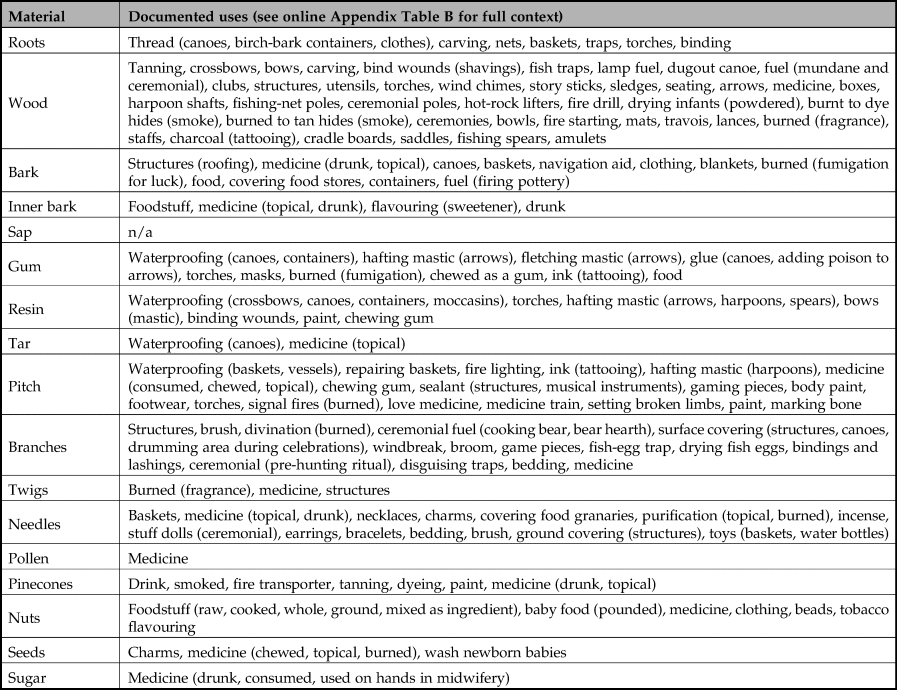
Comparison of use of Pinus and Betula.

Use of Pinus resinous substances as a glue.
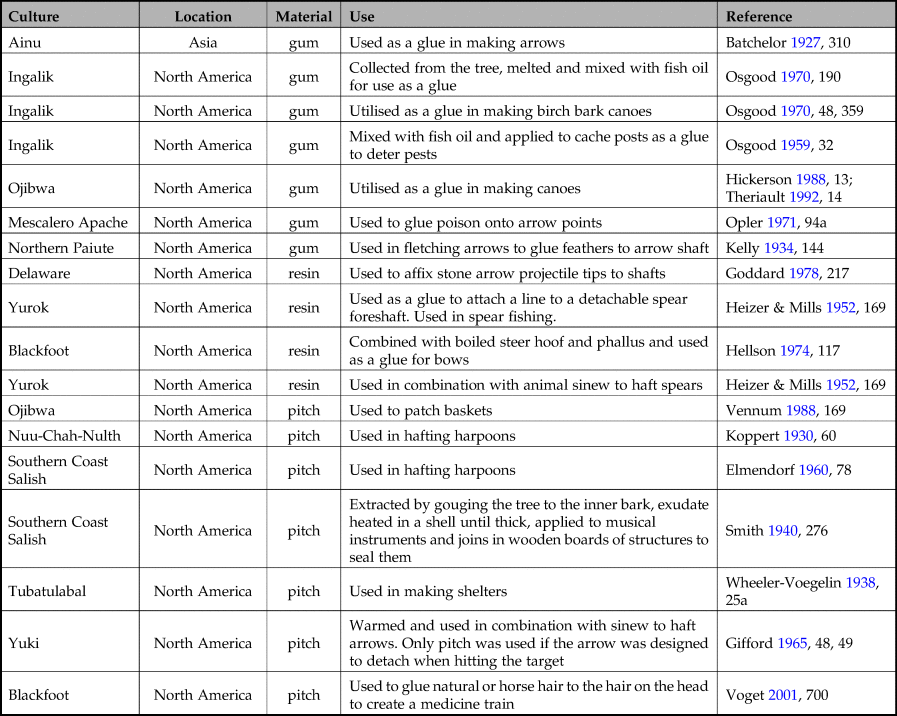
Use of Pinus resinous substances as a waterproofing agent.

Use of Pinus resinous substances as a medicine.

Use of Pinus resinous substances as a chewing gum.

Use of Pinus resinous substances to make paint, tattoo, or in art.
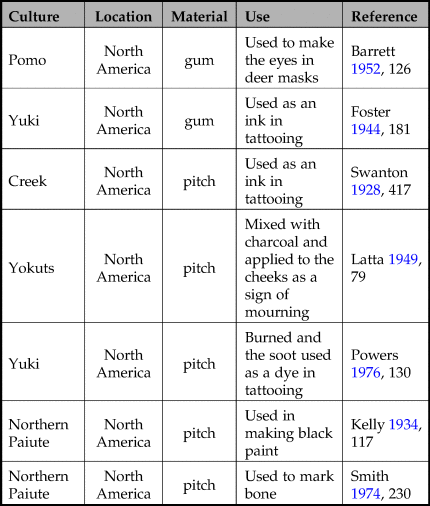
Use of Pinus resinous substances in fires, torches and candles.
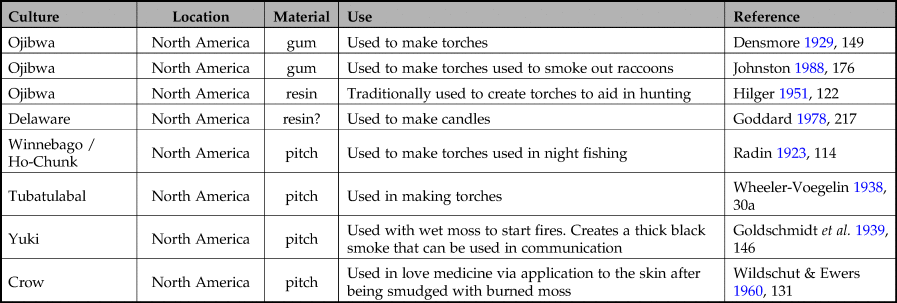
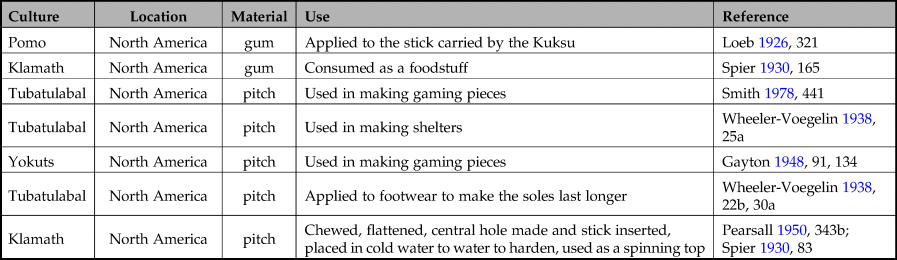
Use of Pinus resinous substances for other uses.
Ethnography of northern hemisphere hunter-gatherer uses of birch- and pine-derived products
Social significance of tars and resins and appreciation of their properties starts with an understanding of the trees from which they are derived, their potentials and the choices negotiated in bringing together the material to create the tar. To explore these ideas, data were gathered on the use of pine and birch products within a wide range of ethnographically documented northern-hemisphere hunter-gatherer societies. These datasets reveal not only the economic importance of these species to hunter-gatherers but also the depth of their social significance.
Human Relations Area Files: search methods and rationale
The Human Relations Area Files (eHRAF) database was used to document birch and pine use by contemporary northern-hemisphere hunting and gathering groups. The sample consisted of 256 published sources, comprising 3865 eHRAF entries in total. Search parameters were limited to those communities noted in the database as ‘hunter gatherer’ or ‘primarily hunter gatherer’ in the subsistence field and to those groups situated geographically in the northern hemisphere. It should be noted that the sample therefore takes in multiple species of birch and pine across different ecologies, uses and attitudes from distinct communities with distinct lifeways. However, this approach provided a compromise between overall sample size generated, tree ecological range, similarities in lifeway, alongside the overarching ability to extract information. For the latter, this included a record of diverse uses, the influence of material properties and the cultural significance of particular species or material extracted from that species. Initial searches focused exclusively on birch and pine tars, pitches, resins and gums. To limit the return, a key word was prefixed by the common name of the tree (birch, pine), followed by a keyword, focusing initially on resinous substances. Search terms included a range of combinations: ‘birch tar’, ‘birch resin’, ‘birch glue’, birch mastic’, ‘birch adhesive’, pine tar’, ‘pine resin’, ‘pine glue’, ‘pine mastic’, ‘pine adhesive’. However, initial results revealed several limitations: (1) the use of key terms varied between authors; therefore searching only by narrow key word risked missing entries where a closely related but different term was used. For example, ‘tar’ is a term commonly utilized in archaeology but provides minimal return in the eHRAF database, while ‘pitch’ yields several thousand results; (2) initial keyword searches revealed an emerging discrepancy in the frequency of use of resinous substances between Betula and Pinus, which could only be fully investigated and contextualized via a broader exploration of use for these species. This was facilitated by adopting a more basic search protocol which limited search terms to ‘birch’ and ‘pine’ and collecting all results. Although time-consuming, this had the advantage of allowing for the collection of data that any keyword combination would produce while facilitating a consideration of use alongside attitudes towards particular tree species and their products in their specific cultural contexts. This is pertinent, as while the use of resinous substances is the specific point of focus within this paper, this is couched within the material and sensory qualities of these substances, which in turn are fundamentally related to their source: the trees themselves.
Results
Recorded uses of resinous substances in northern hemisphere hunter-gatherers
Online Appendix Tables A and B present the full results of the eHRAF search for uses of pine and birch in northern-hemisphere hunter-gatherer societies. These tables reveal a multitude of uses for every part of both genus of trees, embedded within often complex attitudes and understandings, and with clear sensitivity to material properties in how parts of trees are used. Tables 1 and 2 here summarize these uses by genus, amalgamating results from all groups.
The lack of uses for resinous substances derived from birch in the sample (Table 1) is noteworthy and an important consideration, given the reverse trend seen during the Mesolithic whereby birch resinous substances appear to be favoured over those derived from pine (though, as previously noted, there may be a minor bias towards birch tar preserving slightly better than pine). Table 3 summarizes the results of the documented use of birch and pine materials, separating resinous from non-resinous, allowing for a contextual evaluation of the use of birch and pine within societies and across regions. For the purposes of Table 3, all non-resinous uses are grouped, all resinous uses are grouped, and the results are presented as a simple ‘yes’ or ‘no’ to denote presence or absence of use, allowing for the comparison of pine resinous/non-resinous uses alongside birch resinous/non-resinous uses.
Table 3 reveals a clear pattern in the use of birch and pine among northern-hemisphere hunter-gatherers. All the groups from the sample in Asia are documented using non-resinous birch and pine, but no sources report the utilization of resinous substances derived from these species. The Ainu of Japan are a solitary exception, with the reverse relationship for pine. Of the 46 communities making up the sample, there are no documented cases of the use of resinous substances from birch. In the North American sample, 15 communities are recorded to have used both the non-resinous birch and pine, but only use pine resinous substances. Four communities in the North American sample are documented using non-resinous birch and pine, but not using the resinous substances from either genus. Six communities in the North American sample are documented using non-resinous birch only, with no use of pine and no use of resinous substances from either genus. Just one community, the Winnebago/Ho-Chunk, are documented to use non-resinous birch, but not birch resinous substances, and no use of pine (resinous and non-resinous). Of the North American societies, 11 show no use of birch including its resinous substances but do use pine and its resinous substances; three societies show non-resinous use of pine only. The results therefore suggest that it is typical, but not universal, for a community to exploit pine for other products, such as its wood, roots or needles, as well as resinous substances (e.g. gum, resin, tar and pitch). However, the same cannot be said for birch: use of gum, resins, tar or pitch is lacking, despite a wide range of documented non-resinous uses for birch.
There were a number of uses recorded for Pinus resinous substances in the ethnographic database, the details of which are presented in Tables 4–10. This includes various uses as a glue (Table 4); waterproofing agent (Table 5); medicine (Table 6); chewing gum (Table 7); an ingredient in (both directly and indirectly) tattooing, paint manufacture and art (Table 8); for making fires, torches and candles (Table 9); and other less frequent applications (Table 10).
Attitudes towards Pinus and Betula and their material and sensory properties among northern hemisphere hunter-gatherers
The ethnographic literature derived from the eHRAF search suggests that trees come to be understood through the potentials or affordances that their specific material properties might facilitate.
In some contexts, trees require appropriate treatment and appeasement of a spirit master, akin to widely documented beliefs held about animals. For example, the Ojibwa of Canada consider trees to be under the control of spirit masters, other-than-human-persons that demand appropriate treatment of the species under their control (Hallowell Reference Hallowell1942, 6; Reference Hallowell and Fogelson1976, 458; Hallowell & Brown Reference Hallowell and Brown1991, 62), leading Hallowell & Brown (Reference Hallowell and Brown1991, 61) to note that success is predicated not on knowledge of the environment or of equipment, but a sensitivity to these spirit masters by treating those species under their control appropriately. In different but perhaps related conceptions that again assert the important place trees occupy in hunter-gatherer worldviews, people were known to worship trees: for example, the Ainu, with tree worship linked to success in the hunt and curing of the sick (Batchelor Reference Batchelor1927). The Nivk, Orok and Ainu are reported as considering themselves descendants of different species of tree (Black Reference Black1973, 51; Shternberg et al. Reference Shternberg, Bromwich and Ward1933, 460). Among the Nenet, sections of spruce and birch forest are considered sacred and revered (Lehtisalo & Schütze Reference Lehtisalo and Schütze1924, 62). In fact, in the Nenet creation story, the birch plays a central part and is presented as a sacred species (Lehtisalo & Schütze Reference Lehtisalo and Schütze1924, 7). This extends into daily life, with white pieces of cloth hung in branches of birch trees as offerings, with the trees linked to the heavenly spirits (Lehtisalo & Schütze Reference Lehtisalo and Schütze1924, 62). The pine, in contrast, is understood to grow in places connected to the underworld and had strong associations with underground spirits (Lehtisalo & Schütze Reference Lehtisalo and Schütze1924, 62). In other contexts, pine is regarded as a helpful and benevolent presence, such as amongst the Delaware, where its propensity to grow thicker bark on the side facing the north is used for wayfinding within dense forests (Wallis & Wallis Reference Wallis and Wallis1955, 53).
Perceptions of the material properties of trees or parts of trees can shape choices around its use. Trees and their properties are typically understood with significant nuance, such as among the Ingalik, who are reported to have 25 terms to differentiate different parts of trees, including whether it is young or old, whether it is straight or curved (which would affect the grain and so the potential uses), whether the tree was green or dead standing, driftwood, or wood that stands after a natural fire (Osgood Reference Osgood1959, 42–3). The Mi'kmaq have a similar attitude to bark, differentiating between bark peeled during the right or wrong part of the year, when stripped from a young tree or from a dead log, or bark suitable for tasks such as canoe building or roofing structures (Wallis & Wallis Reference Wallis and Wallis1955, 502). It is evident that hunter-gatherers are highly sensitive to changes in the materials they use, shaped by factors such as where the tree grew, how old it is, its condition and when material was harvested. Art involving the use of birch bark was known to be a seasonal practice, responsive to the qualities of the bark being used, which varied by season, linked in part to taboos about harvesting bark at the wrong time of year (Speck Reference Speck1937, 52). Similarly, it is not inevitable that all materials will be employed for purposes to which they might be effectively used: uses are shaped by material and sensory properties which are enmeshed within wider hunter-gatherer worldviews. For example, while the smoke generated by burning birch wood or bark has a number of recorded uses in relation to the purification of people and structures or to discourage spirits (Osgood Reference Osgood1958, 151; Reference Osgood1959, 75; 1970, 417; online Appendix Table A), despite its efficiency as a fuel it is avoided for this purpose prior to the hunt in some contexts due to the strong and lingering smell it generates, which might scare away game animals (Osgood Reference Osgood1959, 43; Reference Osgood1970, 300).
It is in the wider context of trees and understanding around them that we can begin to explore resinous substances, their properties and their uses. The Ingalik add fish oil to pine gum when making glue, which is thought to increase its strength and ability to adhere to birch bark, but also decrease stickiness, making it easier to work with and apply (Osgood Reference Osgood1970, 190). In other recipes used by the Ojibwa, finely powdered charcoal was added to create the right consistency and firmness for use, with the charcoal produced from the right type of tree for the task, in this case the cedar (Densmore Reference Densmore1929, 149; Hilger Reference Hilger1951, 116). Sensory perceptions of glue making, in terms of its properties (tack and plasticity), can therefore be regarded as crucial aspects of its functionality.
Trees and the products derived from them are embedded within complex frameworks of meaning among northern-hemisphere hunter-gatherers—whether in terms of their properties and the potential they provide, their ontological status, or the types of activities tree products are used for. When and how a material is extracted and manipulated ‘appropriately’ thereafter are important considerations. Use of materials may go beyond functional considerations and may be charged with cosmological or social significance(s). This is a theme that has begun to be explored within Mesolithic archaeology in relation to plants (Taylor Reference Taylor2020) and some of their products, including the appropriate selection and treatment of wood (Price Reference Price, McCartan, Schulting, Warren and Woodman2009). Our research suggests that such approaches can be usefully extended to other products derived from trees, in this case resinous substances, informed by an exploration of northern-hemisphere hunter-gatherer understandings and uses of birch and pine, and their products. Our approach to the archaeological record is informed by the insights that material and sensory properties matter; and while these properties inform and structure use for functional reasons, this tends to be enmeshed within wider social, cultural and cosmological understandings of materials and the contexts in which they are used.
Tar as a sensory material
Birch and pine trees represent the ultimate source of tar in the Mesolithic and imbue the material with their own forms of meaning and social context. This ‘treeness’ could, however, be argued for any form of material culture derived from a particular species of tree. Tar possesses its own unique material properties which stand it apart from other materials, and as such, it holds the capacity to take on its own affordances. These merit critical discussion within our understanding of Mesolithic materiality.
An explicit appreciation of sensoriality within archaeological discussions of materiality has become a prominent feature within recent approaches to past sensory experience (e.g. Day Reference Day2013; Day & Skeates Reference Day and Skeates2020; Fahlander & Kjellström Reference Fahlander and Kjellström2010; Hamilakis Reference Hamilakis2014). Conneller (Reference Conneller2011) provides a compelling discussion of the integration of material properties and sensory experiences across a range of materials and contexts through a consideration of material affect. Drawing from the growing body of literature concerned with the agency of affective qualities of materials (Deleuze & Guattari Reference Deleuze, Guattari and Massumi1999; Simondon Reference Simondon1964; see also Bennett Reference Bennett2010), she argues against the dominant hylomorphic model of material culture. She advocates a dissolution of the distinction between material and form, with emphasis on material affect, the better to develop understandings of material ontology within past societies. Alongside that of Conneller, Kuijpers’ (Reference Kuijpers, Stig Sørensen and Rebay-Salisbury2015; Reference Kuijpers2017) work on the sensorial components of technological know-how forms a foundational base for the methodological framework we adopt here. Kuijpers argues that sensory experience is the primary form taken by technique (Ingold Reference Ingold1990) within the construction of skill. Sensory experience lies at the core of non-discursive knowledge and is the springboard from which our understanding of archaeological actors can move from one of structured, predetermined and abstracted and universalist executors of technology to a more contextually situated conception of actors who co-realize their own worlds in collaboration with the materials around them. He further proposes that augmenting more traditional approaches with a critical understanding of sensory experience, attained through experimental work, can help to bridge the post-enlightenment dualities of technology and know-how, enabling us to develop a more holistic understanding of skilled practice in the past (Dobres Reference Dobres2010). Crucially, Kuijpers stresses that to do this critically, we need to follow the lead of anthropologists working on sensuality and distinguish between senses and sensations (Harris & Sørensen Reference Harris and Sørensen2010).
Using one's senses relates to a physical experience, while a sensation relates to the commingling of emotional response and physical experience. Sensations are acutely specific to cultural and biographical contexts. This is not the case, however, for sensory perception, which has been shown to display low levels of variation across diverse world cultures (Goody Reference Goody2002). Within our consideration of adhesives, we focus attention on the experience of the senses and their broader social contexts, rather than drawing analogies between the emotional component of contemporary sensations with those of the deep past. Drawing on four Mesolithic case studies, we demonstrate the ways in which the sensorial properties of tar helped to shape human experience in different social contexts. Each case study is developed from the currently available data. However, it should be noted that as biomolecular testing becomes more widespread and details of the chemical composition of the tars and resins at the centre of each case study are revised or confirmed, so too are aspects of each interpretation subject to revision.
Gearing up
The concept of a ‘hunting camp’ is ubiquitous within discussions of Mesolithic settlement patterns across Europe, deriving from the ethno-archaeological work of Binford (Reference Binford1978) on typologies of sites within hunter-gatherer settlement patterns. Classically associated with a predominance of microliths and microburins within lithic assemblages and minimal evidence for primary and secondary core reduction, ‘hunting camps’ are interpreted as representing the repair and reconditioning of composite equipment during hunting activities. The use of adhesives to disassemble and reassemble multi-part hunting tools at these sites is clearly implied, and in some instances explicitly discussed despite the lack of preserved resin or tar.
Pointed Stone 2 (North Yorkshire, UK) is a classic example of a Mesolithic hunting site (Jacobi Reference Jacobi and Mellars1978). This upland lithic scatter has produced an assemblage of microliths very similar in form to those of the neighbouring wetland site of Star Carr, with both sites interpreted as part of the same system of Early Mesolithic settlement (Conneller Reference Conneller2021; Donahue & Lovis Reference Donahue and Lovis2006; Jacobi Reference Jacobi and Mellars1978; Waughman Reference Waughman2017). While no hafting adhesive traces have been identified at Pointed Stone 2, this is most likely attributable to a lack of appropriate preservation conditions (Croft et al. Reference Croft, Monnier, Radini, Little and Milner2016). Given that Pointed Stone 2 and Star Carr (for the latter, see Croft et al. Reference Croft, Colonese, Lucquin, Craig, Conneller and Milner2018; Fletcher et al. Reference Fletcher, Milner, Taylor, Milner, Conneller and Taylor2018) form part of the same settlement system, it seems reasonable to assume that they also shared approaches to adhesive production and use. We might therefore draw from the Star Carr data to inform our understanding of the types of adhesives used at Pointed Stone 2 and the sensory experiences that this entailed. While the evidence from Star Carr suggests that both birch tar and possibly also pine resins were used by the people who visited Pointed Stone 2, there is little evidence for the primary production of tar on-site. Palaeoenvironmental data indicates that the upland landscapes around Pointed Stone 2 consisted of open, mixed grasslands with occasional small stands of birch (Spratt & Simmons Reference Spratt and Simmons1976), and as such, would have been unlikely to be able to provide the quantities or qualities of raw materials needed for adhesive production. This contrasts with the lower-altitude mixed birch carr and deciduous forests surrounding Star Carr, where indirect evidence for the extraction of tar comes in the form of an abundance of charred birch-bark rolls and five birch-resin cakes (Clark Reference Clark1954; Fletcher et al. Reference Fletcher, Milner, Taylor, Milner, Conneller and Taylor2018). The lack of similar finds at other Early Mesolithic sites in the surrounding areas (despite the presence of organic preservation conditions) suggests that the primary extraction of birch tar was focused at Star Carr.
The repair of composite tools occuring at the Pointed Stone 2 hints at the melting and reapplication of previously made adhesives (perhaps transported as a lump or on a tar stick; see Fig. 1G). This contextual information helps to focus our discussion of tar sensorality at Pointed Stone 2. The sticky and viscous tactility of tars and resins is fundamental to the ways in which they are experienced in use—and specifically exploited when employed as adhesives. This typically involves applying resins and tars in their warmer (sometimes dangerously hot), viscous states, with mechanical binding occurring as they cool and set. Once cooled, both resin and tar become brittle and hard, especially if not combined with a plasticizer. Control over the temperature and duration of heating and reheating adhesives is an important component in the skill-set of working with adhesives (Cnuts et al. Reference Cnuts, Tomasso and Rots2018). Ethnographic evidence of working with reusable adhesives shows that there is a limit on the number of times they can be reheated before losing their tack (Bradshaw Reference Bradshaw2013; Dickson Reference Dickson1981; Rots & Williamson Reference Rots and Williamson2004), implying that close attention to the observable behaviour was required successfully to assess the suitability of tar for re-use.
The colour of tar varies in accordance with its composition. Birch and pine resins and tars can be black, shiny, glossy, viscous, or oily in appearance (Fig. 1C & 1F). Pure birch tar is highly reflective, becoming more matt and duller if plasticizers such as charcoal or ochre are added (e.g. Fig. 1F versus Fig. 1H). Both birch and pine adhesives generate a strong odour at room temperature, and this intensifies with heating or burning. As such, working with adhesives in the repair of composite hunting tools contributed a suite of sensory experiences towards the creation of specific kinds of space at hunting sites such as Pointed Stone 2. The smell of warming birch and pine tar would have been a characteristic feature of human activity in these spaces, with the texture, colour and viscosity of adhesives consciously scrutinized when assessing whether material should be recycled or discarded.
Chewing lumps of tar
Small pieces of resin featuring human teeth marks have been recovered from Mesolithic sites across northern Europe (Gramsch Reference Gramsch and Coles1992; Gramsch & Kloss Reference Gramsch, Kloss and Bonsall1989; Hernek & Nordqvist Reference Hernek and Nordqvist1995; Johansson Reference Johansson1990). These materials have been a recurrent nexus for scientific analyses, including physical anthropological studies of the teeth marks, analysis by GC-MS to establish the composition of the resin itself, and most recently aDNA extraction to gain insights into the people who chewed them. To date, these analyses have established that the resin lumps are made from birch-bark tar and in the majority of instances were chewed by children or adolescents (Jensen et al. Reference Jensen, Niemann and Iversen2019; Kashuba et al. Reference Kashuba, Kırdök, Damlien, Manninen, Nordqvist, Persson and Götherström2019).
The Syltholm tar from southern Denmark has been subject to the most intensive analysis, and thus provides the richest source of contextual data for a discussion of the sensations associated with chewing tar (Jensen et al. Reference Jensen, Niemann and Iversen2019). Direct AMS dating indicates that this tar was made 3858–3661 cal. bc, and while this date falls within the Early Neolithic Funnel Beaker culture of Danish prehistory, the complete lack of genetic ancestry associated with farming within this individual's genome suggests a strong affinity with the Mesolithic hunter-gatherers who inhabited Denmark prior to the adoption of agriculture. The tar also preserved aDNA from the wider oral biome, allowing the health and diet of the individual to be assessed. The chewer was identified as a female; she had recently consumed a meal of mallard and hazelnuts prior to chewing the birch tar. Traces of viral DNA indicate that she had contracted the Epstein-Barr virus at some point in her life. Bacterial DNA traces indicate that she suffered from gum disease and possibly a strain of pneumonia (though see Belman et al. Reference Belman, Chaguza, Kumar, Lo and Bentley2022).
The mechanical sensations associated with chewing tar hold broad similarities to other, texturally amorphous chewable materials within the Mesolithic world (e.g. hide, cartilage, congealed blood). However, specific attributes mark it out from its contemporaries within this sphere. The taste of resins and tars is described as strong, bitter, astringent and heady (Dennis Reference Dennis and Thompson1971)—notably distinct from the greasy, muted tones of lipid-based chewables or the metallic tang of blood. Birch and pine tar contain high amounts of phenols, which are numbing to the tongue and gums (Bethard Reference Bethard2004). Chewing birch tar is often reported to result in a numb, tingly sensation in the mouth and a watering of the eyes and nose. Within the immediate context of the Syltholm chewer, we might consider the contrast in flavours between the preceding meal of duck and hazelnut and the astringency of the birch tar—and perhaps consider this as another flavour being assimilated within a culture of cuisine. However, establishing a robust chronological link between the eating of the meal and the chewing of the tar is difficult; we know that the former precedes the latter, but the length of interval is impossible to ascertain.
Another focus of interpretation might fall upon the health of the Syltholm chewer. If suffering from gum disease, the numbing of the gums caused by chewing birch tar may have offered some instant sensorial relief; while the antiseptic properties of birch tar provided a longer-term change in the chewer's embodied experience by reversing the effects of the disease itself. The rich array of sensations associated with chewing birch tar may have been associated with both ill health and healing by Holocene hunter-gatherers of southern Denmark.
Viewing portable art and personal ornaments
Resinous substances appear to have played a role within Mesolithic artistic expression. In some cases, they were used to render engraved motifs obscure or inconspicuous, such as in the case of a bone point (Płonka Reference Płonka2003, 42) and an engraved bone knife with quartzite blade inserts from Strandvägen (Molin et al. Reference Molin, Gruber, Hagberg, Riede and Tallaavaara2014). A similar interest in obscuring art can be detected in other types of artistic expression, such as the engraving of flint cortex before being knapped into tools, breaking apart the engravings (Conneller Reference Conneller2011). It is conceivable these differences reflect fluctuating cultural attitudes to the use of tars across different contexts, or appropriate treatments depending on the specific activities and objects involved. Warren (Reference Warren, O'Connor, Cooney and Chapman2009) has argued that an important aspect of Mesolithic artistic expression is the bringing together of materials and the act of making, perhaps even more so than the finished artistic product itself; a theory which appears consistent with the use of resinous substances to render obscure and momentary engraved forms made on specific materials.
Possible resinous substances found within the grooves of engraved motifs have been identified across a range of bone, antler and wooden objects recovered from sites in Poland, Germany and Denmark. They have been argued to have acted as an inlay, perhaps intended to produce vivid visual effects (Płonka Reference Płonka2003, 32). Recent research indicates that this pattern is also observable on several engraved amber pendants (Petersen Reference Petersen2016, 220–21; Reference Petersen2021; Toft & Brinch Petersen Reference Toft and Brinch Petersen2016, 205) and in some cases tar can be implicated in the repair of amber figurines (Petersen Reference Petersen2016, 228). Against this backdrop of the increasingly recognized but emerging complexity of the role of resinous substances within Mesolithic artistic expression, we can consider an amber pendant shaped to resemble an elk from the site of Egemarke, Denmark.
The Egemarke pendant, through its use and repair, may reveal a facet of the aesthetics infusing artistic choices during the Mesolithic. It features a naturalistic depiction of an elk with zig-zag engravings running along the neck. Aspects of its biography are evidently complex, having been intentionally broken at some point during its use life, possibly to prevent cracking that would disrupt engraving, only to be repaired, and sometime later, re-drilled to allow its use as a pendant (Petersen Reference Petersen2016, 228). Repair involved birch-bark tar to bond the broken fragments, along with two drilled holes perhaps allowing the pieces to be lashed together, or alternatively, linked with how the piece may have been worn. Petersen (Reference Petersen2016, 228) has raised the possibility that the tar was added as a decorative contrasting element, acting in a similar capacity to tar used as inlay on engraved objects, including other examples made in amber; however, he ultimately concludes that a functional role in repair is the more likely motivation.
In exploring the material properties of tar, it may be that different properties were harnessed in different ways. An important factor in the selection of tar was probably its efficacy in adhering broken pieces together. Function and aesthetic need not be mutually exclusive: the presence of tar on the Egemarke amulet might simultaneously represent an aesthetic consideration drawing on different material properties of this substance, with its lustrous black colour serving as a striking visual contrast to the amber, creating a visual effect. In this light, the choice of tar may have served to draw attention to the break and render the repair conspicuous—not unlike its use to highlight engravings through inlaying in other contexts. It has been observed that other amber pendants tend to show significant traces of wear, reflecting sustained use and a protracted life (Petersen Reference Petersen2016, 232). Indeed, redrilling appears frequently to have been employed to extend the life of amber pendants further where a new object might readily have been made, suggesting that visible evidence of wear reflecting a long use-life may have been a valued material property (Petersen Reference Petersen2016, 232). In this context, use of a resinous substance on the elk from Egemarke, which would share the lustrous quality of polished or heavily handled amber but provide a distinct difference in colour, could serve to emphasize and draw attention to its brokenness; similar to the intensively worn perforations, sometimes completely worn through, seen on a number of amber pendants. In both cases, a clear visual indicator about the extended life of the object feeds into an aesthetic which foregrounds the value of curated objects.
It can be argued that the repair of the elk pendant from Egemarke, while different to inlaying of engraved objects with resinous substances, nevertheless conforms to similar aesthetic principles in some respects. Resinous substances were used to render engraved surfaces conspicuous, drawing attention to engraved details. In the case of the Egemarke pendant, the resinous substance was instead used to highlight an important phase in the life of the object: its breakage and repair. By virtue of its material properties, its blackness and its stickiness, tar appears to have played a role in rendering features of interest conspicuous in some objects.
Burial rites
Mortuary practices and the spaces they create are another context within which resins and tar can be demonstrated to have an impact on sensory experience. An example of this comes from the Castelnovian site of Mondeval de Sora, northern Italy. Dating to the late seventh millennium cal. bc, this site features a single inhumation of an adult male, c. 40 years old, located under the overhang of a large erratic boulder on a terrace in a high valley (Alciati et al. Reference Alciati, Cattani and Fontana1992; Fontana et al. Reference Fontana, Guerreschi, Bertola, Grünberg, Gramsch, Larsson, Orschiedt and Meller2016; Reference Fontana, Cristiani, Bertola, Briois, Guerreschi and Ziggiotti2020). The grave itself featured specific objects placed on body parts and three distinct clusters of material culture evenly distributed along the east-facing edge of the grave cut. One of these clusters consisted of two chert artefacts and two lumps of resinous substances. Pollen analysis and unspecified chemical profiling indicate that one lump consisted of pine and spruce resin combined with a small proportion of bee propolis, whilst the other was predominantly bee propolis (Alciati et al. Reference Alciati, Cattani and Fontana1992, 363). It is believed that these resins had either been directly burnt or had hot ashes heaped over them before the grave was filled, based on the density of charcoal incorporated within the matrix of the resin lumps themselves (Alciati et al. Reference Alciati, Cattani and Fontana1992, 361).
The heating of resins within this context does not appear to be linked to the production of adhesives, as there is no evidence for the in situ production of composite tools or traces of adhesives on artefacts within the grave. However, heated resins can still contribute towards the way a space is experienced, through the smells they produce. Burning resins from different sources can create potent blends of scents which may not occur within other social contexts; the act of heating a combination of propolis, pine and spruce resin may well be linked to the creation of a distinctive and powerful olfactory experience as part of funerary rites. Other forms of direct evidence for the use of tars within Mesolithic mortuary practices are lacking; however, it is not uncommon for Mesolithic burials to involve hearths or sealing fires (e.g. Borić et al. Reference Borić, Raičević and Stefanović2009; Terberger et al. Reference Terberger, Kotula, Lorenz, Schult and Burger2015) and it may be that any terpenes used were burnt away in the process. There is no evidence from contemporary Mesolithic sites in the region that pine and spruce resins were produced alongside the burning of bee propolis in more prosaic settings. Unfortunately, the Mondeval de Sora burial is the only one known for the Castelnovian complex of northern Italy and one of just a few dating to the Late Mesolithic in Europe (Fontana et al. Reference Fontana, Cristiani, Bertola, Briois, Guerreschi and Ziggiotti2020), making it impossible to assess whether this practice was part of a broader cultural funerary tradition, or an isolated example of an aromatic funerary rite accorded to this individual.
Discussion
Our own western ontological perspective arguably has contributed to a heavy focus on technological and functional approaches to studies of resinous substances. Equally, it might be counter-argued that hypotheses about functional properties of both the production methods and the tars/resins themselves are simply more straightforward to test than those that go beyond obvious uses. To develop a new framework for accessing a fuller range of social meanings associated with resinous substance production and use, we have proposed a material and sensory approach, with a material-ontologies perspective at its core. To demonstrate how this works in practice, case studies exploring the role of tars and resins in different archaeological contexts, hunting, health, art and death, have been employed. Ethnography has been used to help highlight the diversity and depth of socially constructed meanings attributed to tree-derived products: a study which revealed surprising results, with an apparent difference in the use of birch tar in the Mesolithic compared to historical times where pine resin totally dominates. In this discussion, we consider these findings and expand on why a material ontological perspective on tar and resins is important.
Ethnographic studies are important for many reasons—not least because they serve as an important reminder that materials, even seemingly amorphous blobs, are never devoid of meaning. Birch-bark tar and pine resin are derived from trees which played a part in the hunter-gatherer material world (Warren Reference Warren2003). Direct ethnographic analogy should, however, be cautioned against in this context, given the empirically demonstrated discrepancy between the ethnographically documented choices in species for plant-based adhesive production and those observed within the archaeological record. It is recognized that biases may contribute to this pattern of documented uses. For example, not all cultures are equally well represented in the eHRAF database. Those cultures represented by a less diverse pool of literature are more likely to be limited in the range of uses reported. It is equally possible that the pattern discussed is a product of differing emphases in reporting in the ethnographic sources composing the eHRAF database, perhaps reflecting when a source was written, or different research traditions in varying regions. Another pertinent factor that may contribute to the pattern is how the category of hunter-gatherer is defined by eHRAF and which communities this includes or excludes. Equally, use of different terms to describe resinous substances (variously pitch, tar, resin, or gum) may cloud the specific material in question in any given case. However, the overall pattern is likely to be robust, being built from a large sample, reducing the impact of bias from any given source. Hence the dissonance in results between the ethnographic and archaeological record appears a genuine one, deserving of detailed consideration here.
An important factor may be that birch bark, from which birch resin and tar would be derived, is the most recorded material used in many of the ethnographic societies sampled, with an exceptionally diverse range of applications (see Appendix Table A; Table 1), especially in the North American sample. Several factors might contribute to this pattern: (1) pine ‘gums’ and ‘resins’ are easier and more predictable to extract in greater quantity, being available by picking them off the tree or slashing the tree and leaving a container in place to collect the exudate; (2) anaerobic and/or other methods of heating of birch bark to release tar reflect an opportunity cost for societies that use bark material for other essential elements of the lifeway: archaeological experimentation has revealed that creating tar can be difficult depending on the method employed, does not guarantee a return or a predictable yield, and the bark used is completely consumed and therefore cannot be repurposed (see Fletcher et al. Reference Fletcher, Milner, Taylor, Milner, Conneller and Taylor2018; Groom et al. Reference Groom, Schenck and Pedersen2015; Kozowyk et al. Reference Kozowyk, Soressi, Pomstra and Langejans2017b; Osipowicz Reference Osipowicz2005; Schenck & Groom Reference Schenck and Groom2018). Another pertinent factor may be that the sample necessarily draws together trees at genus level, but not all trees within the genus produce the same yield of tar (Krasutsky Reference Krasutsky2006; Zas et al. Reference Zas, Touza, Sampedro, Lario, Bustingorri and Lema2020). It is therefore conceivable that the availability of different tree species with varying yields is a contributing factor to the different uses observed.
The ethnographic results identified no uses of Betula resinous substances, but clear patterning in use of Pinus resinous substances. Major uses included gluing (Table 4), waterproofing (Table 5), medicine (Table 6), chewing gum (Table 7), art (Table 8), starting fires and making torches (Table 9), and other less numerous uses (Table 10). This resonates with known Mesolithic uses of Pinus resinous substances from the Mesolithic, but also expands beyond it, providing new possibilities for uses that might be detectable in the future. While Betula resinous substances are not used for these functions among contemporary hunter-gatherers documented in the sample, other parts of the tree are used for similar tasks, as well as expanding to include other novel applications. This makes the favouring of birch resinous substances during the Mesolithic record for such activities interesting. Further, it seems unlikely this pattern can be entirely attributed to preservation factors (see Kozowyk et al. Reference Kozowyk, van Gijn and Langejans2020a) as both birch and pine resinous substances are known from the Mesolithic archaeological record. Instead, the use of Betula resinous substances by Mesolithic hunter-gatherers may be linked to social and cultural choices: perhaps related to the material properties of the adhesives themselves, attitudes surrounding the trees from which they are derived, or the environmental and ecological context.
This encourages a closer consideration of hunter-gatherer attitudes towards birch and pine, informed by their wider patterns of use—not only resinous substances, but also other products. Here there is clear resonance between contemporary hunter-gatherer engagements with materials and the known yields of resinous substances that can be extracted from trees, which might be a prominent consideration in Mesolithic time-scheduling and extraction protocols. In the case of the former, the qualitative examples revealed, for example, clear sensitivity to time of year and the changing material properties of birch bark (Speck Reference Speck1937, 52; Wallis & Wallis Reference Wallis and Wallis1955, 502). In the latter, for both pine and birch it has become increasingly understood that the yield of tar that can be extracted varies by species, season and age of tree (Krasutsky Reference Krasutsky2006; Zas et al. Reference Zas, Touza, Sampedro, Lario, Bustingorri and Lema2020). Essentially, what the ethnographic and archaeological data tell us is that materials matter.
An ever-increasing interest in identifying ancient tars and resins using biomolecular characterization is transforming contemporary understandings of seemingly amorphous resinous lumps. Crucially, the new body of scientific data being generated enables a consideration of the properties of resinous substances, providing the necessary empirical framework to move beyond the mechanical and purely functional by encompassing the sensory and material aspects of tars/resins. New DNA data are providing fascinating new insights into past health and diet. They also point to the use of this material for more than ‘just’ glue. However, there is a real risk that research becomes entirely data driven, with findings devoid of theoretical underpinning; not unlike previous concerns raised about ancient DNA projects (see Crellin & Harris Reference Crellin and Harris2020 for a good overview of this debate). By contrast, chemical characterization of tars might be considered as having greater relevance and potential to advance theoretically informed perspectives on Mesolithic materiality.
Despite experimental archaeological work on tars and resins being relatively commonplace, rarely do practitioners reflect on the experiential sensory/material properties and processes that are both empirical and intrinsic to the successful production of tar. This seems like a missed opportunity. Through case studies, we have further sought to demonstrate how the archaeological contexts in which tars and resins are found, like other forms of material culture, do not occur in a vacuum but are essential to stimulating new interpretations beyond utilitarian parameters. To make the most of these data requires a suitable theoretical framework. We propose that material ontologies can play such a role. Data concerning the sourcing and composition of raw materials, production techniques, viscosity, odour, appearance, mechanical strength, engagement with human bodies, interaction with other materials within the context of composite objects, re-use, repair, medicinal properties, and social context contribute collectively towards a sophisticated understanding of the material ontologies within which plant-based adhesives, sealants, etc. existed.
The growth in application of experimental archaeological approaches using actualistic methods to replicate and test different tar production have been successful in establishing probable chaînes opératoires, helping resolve key technological questions (e.g. temperature, use of additives, pyrolysis, yields, etc). Without doubt these studies contribute towards an impressive body of knowledge concerning the technological aspects of past practice. However, as a growing body of authors argue (e.g. Conneller Reference Conneller2011; Dobres Reference Dobres2010; Kuijpers Reference Kuijpers, Stig Sørensen and Rebay-Salisbury2015), these approaches build towards an understanding of technology that inherently privileges the etic. They reproduce the Cartesian dualisms that are historically specific within WEIRD ontologies and are fundamentally unable to account for practice within past hunter-gatherer ontologies. In marrying this data with critical considerations of sensory experience and materiality, we have attempted to develop an approach that bridges this documented divide between emic and etic approaches to adhesive technologies: an approach that draws on the different types of knowledge that experimental archaeology generates and which allows for an appreciation of skill, know-how and technology within non-WEIRD societies. This brings the study of prehistoric adhesives in line with developments across archaeological materials research; critical approaches to the synthesis of sensory experience with etic knowledge are already being advanced within the study of prehistoric metallurgy (Kuijpers Reference Kuijpers2017), stonework (Jones Reference Jones2020), textiles (Harris Reference Harris, Skeates and Day2020) and glass (Duckworth Reference Duckworth2020).
Finally, we stress the need to remain mindful and avoid assumptions that Mesolithic people shared a static or uniform understanding of tars and resins. Our ethnographic study reinforces how meanings associated with materials extracted from trees can vary considerably through time and space, which is why a greater consideration of the archaeological contexts in which they are found is essential if we are to broaden current perspectives. Additionally, to date, we have no real sense of regional or diachronic variation within the Mesolithic—or other periods, for that matter. Differences, as identified through biomolecular analysis, in the composition of resinous substances (pine, birch, bitumen, etc.) might be a useful way of exploring variation in historically situated cultural traditions, sensory experiences and materiality, across time and space. Archaeological research undertaken to date indicates that temporal and regional patterns may have existed, notably between northern and southern Europe. While some distribution patterns can be partly explained by ecological factors and access to natural resources (see Rageot et al. Reference Rageot, Lepère and Henry2021 for a good overview), what we are seeing may also reflect cultural choices. Overall, current data remain scarce. As more biomolecular analyses are undertaken, trends in the sourcing, production and usage of resinous substances are likely to become more recognizable, providing an excellent opportunity to track the histories of cultural traditions relating to these materials.
Conclusion
Birch tar is arguably the earliest synthetic material manufactured by humans (Grünberg Reference Grünberg2002). Recent tautological debate regarding the scale of cognitive complexity involved in tar production, most notably for Neanderthal populations (Kozowyk et al. Reference Kozowyk, Soressi, Pomstra and Langejans2017b; Schmidt et al. Reference Schmidt, Blessing and Rageot2019), highlights how adhesives have become inextricably linked to questions of technological know-how, a perspective which is similarly evident within Mesolithic and Neolithic studies. While studies of aceramic modes of production and adhesive capabilities are raising interesting questions and aDNA analysis is proving a valuable tool for revealing insights into the health and genetic profile of the Mesolithic individuals who chewed lumps of tar, more nuanced appreciations of resinous materialities have thus far been lacking from research narratives. Moreover, a richer appreciation of this materiality broadens research scope for adhesive cognitive studies like those currently being proposed for Neanderthals.
Curiously, birch tar appears to dominate the Mesolithic archaeological record, even when pine is available. Ethnographic research has demonstrated the opposite to be true: contemporary and historically documented northern-hemisphere hunting and gathering societies rarely—if ever—use birch-derived resinous substances. The reasons for this are probably due to a complex range of factors including ecology, lifeways and beliefs, but require further dedicated work to fully understand. Nonetheless, our data strongly suggest that birch-derived resinous substances were used much more frequently during the Mesolithic, even when pine was available. We argue that birch tar may have held a historically specific significance for Mesolithic hunting and gathering societies because of its specific connection with the birch tree. Moreover, the wide-ranging evidence for diverse uses of birch and pine by historically documented and contemporary hunter-gatherer societies indicates that, to date, we have been too reductive in the traditional technological categorization of Mesolithic resins and tars. Availability and convenience were not always the driving factors guiding decision making with regard to the procurement and production of resin and tars. Preferential use of birch products may instead have been bound up in entrenched socio-cultural traditions and generational knowledge of ‘the right way to treat the world’ (Blinkhorn & Little Reference Blinkhorn and Little2018, 417).
We have proposed a novel, integrated, theoretical framework which places emphasis on material ontologies and foregrounds the biographical and sensory affects of resinous substances in order to go beyond the conventional considerations of mechanical function. This approach, with a materiality focus, helps highlight the roles of trees and tree-derived products. An attention to materiality has further helped to identify birch tar as one of a small number of phase-change substances known to Mesolithic peoples. It is possible that the transformation of birch bark from a solid to liquid, and the same again in reverse, may have imbued tar with a sense of liminal agency. Its ability to transform human bodies—from open to closed wound, from pain to pain-free, and bring new life to broken ‘dead’ objects (pendants, hafted tools, containers. etc.) may have given this substance an elevated importance within hunter-gatherer belief systems.
Conceptualizing resins and tars in this wider fashion, supported by the sensory, theoretical and ethnographic evidence, enables greater diversity and social interpretations of the uses and functions of these substances in everyday Mesolithic life. Such an approach, we propose, has potential application beyond the Mesolithic period.
Acknowledgements
Research was carried out with support from the following funding bodies: Arts and Humanities Research Council (AHRC) Standard Early Career Grant (AH/T00519X/1) Stone Dead Project, PI: Aimée Little, British Academy Early Career Research Grant (PF19\100082), Ornaments on the Edge Project, PI: Andy Needham, Invisible Technologies & the Container Revolution, Andrew Langley's White Rose College of the Arts and Humanities (WRoCAH) funded PhD Project. Previous experiments on birch and pine tar production and conversations between the authors took place at the YEAR (York Experimental Archaeological Research) Centre, Department of Archaeology, University of York. We would like further to thank Oliver Craig, Mark Edmonds, Alexandre Lucquin, Diederik Pomstra, Harry Robson and Graeme Warren for constructive comments on aspects of an earlier draft; Neil Gevaux for assisting with figures; and Tabea Koch for German/English translations. Finally, our sincere thanks to the anonymous reviewers for their constructive feedback. All errors and omissions are, however, our own.
Dedication
We dedicate this paper to our dear friend and colleague, Dr Donald Henson, who passed away during its writing after a short period of illness. Don had such a passion for the Mesolithic period and ethnobotany. Don's passing represents a significant loss to the Mesolithic research community; we will miss him dearly.
Supplementary material
Online Appendix Tables A & B may be found at https://doi.org/10.1017/S0959774322000300.


 Open access

