




It may be time to “de-territorialize historical narratives of the United States.”Footnote 1 As the premise of this special issue demonstrates, American history has long been told through a land-centered lens—one that treats water as a backdrop or boundary. Yet when we shift perspective to view the U.S. past through water or the shifting interface between land and water, familiar narratives transform. In some instances, literature and film have offered ways of reorienting our perceptions by giving water prominence over land as a driving force behind such narratives. Frank Herbert’s 1965 science-fiction classic Dune does just that (Figure 1). He centers attention on the fictional desert planet, Arrakis, as the axis of his story. This choice seems to place aridity and desolation at the heart of the book. As the only source of the highly coveted “spice”—a substance that can “bend space” to make galactic travel possible—Arrakis becomes a battleground for interstellar warfare. Below the surface of the planet, figuratively and literally, the indigenous population of desert-savvy Fremen stores untold quantities of water, contrary to the popular view that Fremen society is weak because it is environmentally vulnerable without a sufficient water supply. However, the potential of their water to remake Arrakis is their hidden power, possibly more so than the presence of spice.Footnote 2

Figure 1. Fan art of Fremen from Dune in stillsuits: Indigenous people of the planet Arrakis and surreptitious keepers of the planet’s vast water supply. March 1, 2022. Source: Creative Commons, Attribution 3.0, Unported License, Wikimedia.
A remarkable movie, Flow, won the Oscar for Best Animated Feature in 2025.Footnote 3 The film, without dialogue, tells the story of a black cat that survives a massive flood with the help of a lemur, a dog, a secretary bird, and a capybara. It draws upon an emotional attachment to the victimized animals, coaxing out rather complex ideas throughout its storyline about overcoming hardships in a rapidly changing world. While the film certainly is a statement on climate change, it also has much to say about our dependence on land and water. The massive flood clearly threatened the existence of all the animals, with some surviving and others not. Seeking dry land becomes the major obsession of the cat and its compatriots. But when the flood subsides and the cat and her friends return to dry land, the apparent last scene shows the group of saved animals viewing a beached whale-creature that is unable to return to the water. In an additional scene after the credits, we see the whale-creature returning to the sea, which leads to an even more ambiguous conclusion. The film, whatever the ending attempts to imply, leaves us with a rather confused and perhaps contradictory sense of the power of both landscape and waterscape. All the more reason to study the role of water in shaping American history to clarify what has been murky and equivocal.
Such musings bring us to these questions: How much of our relations with water, our ways of treating water as a medium for socio-economic and political development, is related to the transformation of the modern United States? How has manipulating water’s materiality structured the modern United States, and at what human and ecological cost?
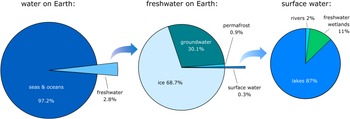
As environmental historian John McNeill observed, “Earth is the water planet, the only planet in our solar system where water exists as liquid.”Footnote 4 About 97 percent of our water is saltwater, and the rest is fresh; our hydrosphere (all the water on, under, and over the Earth’s surface) makes up about 71 percent of the Earth’s surface.Footnote 5 Yet we cannot simply think about water in quantitative terms: Water is a nonrenewable resource. It is a commodity. It is a medium. It is versatile (Figure 2).

Figure 2. Distribution of water over planet Earth: only a small amount of water is freshwater, of which only a very small portion is surface water. Woudloper, January 20, 2022. Source: Data from Robert Christopherson and Ginger Birkeland, Geosystems: An Introduction to Physical Geography (Pearson, 2017).
Environmental engineer Alice Outwater argues that “Water is the blood of the land—always in motion, from the rain to the mountaintops, through the forests and plains to the sea, and so to the clouds again.”Footnote 6 But the opposite is also true: that the land is a body that requires blood. Yet, truth be told, that history is dependent not on water alone—nor on land alone—but on the interface and interaction of both. Maybe it takes an exercise in writing history from the perspective of water to appreciate that fact.
I have argued elsewhere that “Water as a medium also serves myriad purposes—human sustenance, agricultural irrigation, sanitation, fire protection, military defense, power generation, transportation, and more—and thus contested uses must be understood and explained to obtain a proper context in which to evaluate wants and needs. Underlying water’s uses are cultural traditions, various hierarchies, and social perceptions and conditions—all influencing control and allocation.”Footnote 7 To place water at the forefront of the analysis of American history requires an understanding of its various purposes and uses.
Of course, problems and concerns regarding water arise from issues such as demand, quality, control, allocation, scarcity, excess, and jurisdiction. As archaeologists Federica Sulas and Innocent Pikirayi asserted, “The forms, availability and behavior of water influence societies at all levels: the shepherd herding his flock to pastures, the farmer tilling her crops, the ruler preoccupied with rising river flows, etc.” and, “The interaction between society and water has multiple voices and endless ramifications across time and space, which cannot be confined to the realm of a discipline or a univocal need.”Footnote 8 Historians as analysts of our past must be central players in evaluating the importance of water within society.
There is no denying that water has been a long-studied topic in American history, much of it descriptive; however, there are also studies that have brought water to the forefront as a key element of change. Histories of the American West abound. Some, such as Donald Worster’s Rivers of Empire: Water, Aridity, and the Growth of the American West (1992) and Marc Reisner’s Cadillac Desert: The American West and Its Disappearing Water (1986), treat water as a primary agent of change. Carl Smith’s City Water, City Life: Water and the Infrastructure of Ideas in Urbanizing Philadelphia, Boston, and Chicago (2014), and especially Matthew Klingle’s Emerald City: An Environmental History of Seattle (2009), do much the same in an urban setting. Several other works stand out for their innovative analysis of water. The first, Richard White’s The Organic Machine: The Remaking of the Columbia River (1996), speaks, among other things, to the changing role and function of the Columbia over time. Jack E. Davis’s Pulitzer Prize-winning The Gulf: The Making of an American Sea (2017), makes the Gulf of Mexico the star of the show. Other important studies include Erika Marie Bsumek, The Foundations of Glen Canyon Dam: Infrastructure of Dispossession on the Colorado Plateau (2023) and Bathsheba Demuth, Floating Coast: An Environmental History of the Bering Strait (2019). All of these books move in the direction of a more water-centered interpretation of American history. But there is room for more expansive studies. Only by acknowledging all the faces of water and tracing their interaction with land do new stories emerge—stories that appear once we treat movement, volume, and verticality as more than an inert backdrop of American development.
Water figures in multiple contexts that structure American history. As borders, rivers, lakes, and oceans create natural, and sometimes engineered, boundaries between peoples and nations—boundaries that prove elusive as waters change course, overflow, or dry up. The Rio Grande exemplifies how conquest and sale can transform fluid borders into hardened lines of control. As a medium of adaptation, water has shaped human settlement patterns: for example, in pre-contact years, the Hohokam in the arid American Southwest constructed extensive irrigation canals for agriculture, beginning around 850 CE, along the convergence of the Gila, Verde, and Salt rivers. This allowed the Hohokam to adapt to their surroundings and, in doing so, to increase their access to water for agricultural purposes. The irony of a successful water supply system in the arid Southwest was not lost on future societies there. Water also defines community: Philadelphia’s 1801 public water system inaugurated a new era of collective responsibility for urban water supply, established the first community-wide water supply system, and provided water to many of its citizens. This action ushered in a long period of public responsibility for urban water supplies in the United States, which challenged the largely private systems of the day.
Historians have portrayed and continue to portray water in a variety of roles, including water as a means of transportation, a source of energy, a destructive force, a political tool and in relation to issues of race, gender, and class.Footnote 9 The topic of water as a commodity/water as a right has more recently become a significant focus of inquiry.Footnote 10 A controversy over water privatization revolved, in part at least, around the concern that water was being controlled by international corporations. Water, of course, has always been commodified in one way or another; however, concerns about global conglomerates controlling the supply and access to water have become a hotly debated political issue. This controversy also raised the legal and moral issue of whether water is a public good or a private commodity (Figure 3).

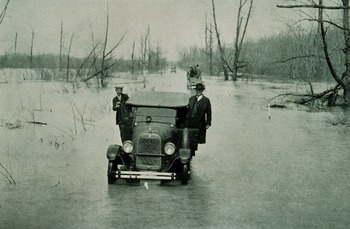
Figure 3. The Great Mississippi Flood of 1927, U.S. Route 51 between Mounds, Illinois, and Cairo, Illinois. River stage at Cairo, 52.8 feet. Source: Steve Nicklas, NOS, NGS, “The Floods of 1927 in the Mississippi Basin,” Frankenfeld, H.C., 1927 Monthly Weather Review Supplement No. 29, March 25, 1927.
The four essays in this forum illustrate how historians can highlight water’s versatile roles, and more importantly, demonstrate interaction among various water issues and to establish linkages across scales—oceanic, deltaic, littoral, and subterranean.
Joanna L. Dyl, in “Coastal Waters and Moving Sand,” directs attention to the coast and offers an empirical look at California breakwaters that forced policymakers to “read” migrating shorelines. The essay intertwines discussions of borders, water as a destructive force, and community. David Stradling, in “Empire, Dredges, and the Control of Water,” focuses on global sea lanes, highlighting dredging not only as a transportation infrastructure but as a political tool of the burgeoning U.S. empire. Sarah Hamilton’s “Water Underground: A Global History of Groundwater Development” adds a subsurface dimension that reveals aquifers as contested commodities, raising questions of water rights and justice (Figure 4). And finally, Maarten Zwiers’s “Greater Caribbean Police States: Authoritarianism in the American Mediterranean” considers Jim Crow segregation and plantation agriculture in the U.S. Gulf South as part of a broader circum-Caribbean space, connected through water and defined by authoritarian politics in the context of the Plantationocene.

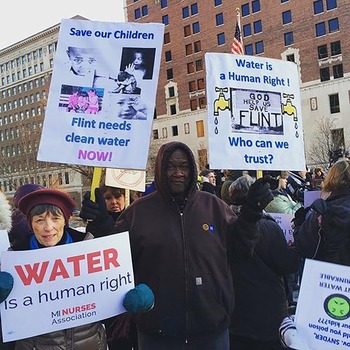
Figure 4. Flint residents protest outside the Michigan State Capital in January 2016. The Flint water crisis was a public health crisis from 2014 to 2019 that involved drinking water for the city of Flint, Michigan, being contaminated. Flint was a predominantly African American community. Source: Shannon Nobles, Instagram. Michael Martinez, “Flint, Michigan: Did Race and Poverty Factor Into Water Crisis?,” Amsterdam News (New York), January 26, 2016.
The Forum explores how water relates to U.S. imperial ascendancy, exposes the racial paradoxes of American democracy, and follows its multiscale—including vertical—projections, tracing a continuous story of power, place, and environmental consequences.
Can a focus on water challenge familiar ways of casting U.S. history? Can it help to redraw the parameters of American history? Can it lead to new narratives or revising old ones? The black cat in the film Flow never lost sight of its objective—getting back to dry land. But before that hope became a reality, coping with a new world order was unfamiliar and daunting. Did it cross the cat’s mind that the flooded world might never be the same again? Changing vantage points does more than disorient; it forces one to consider alternative outcomes and possibilities.


 Open access

