





Introduction
Clostridioides difficile infection (CDI) is one of the most significant healthcare-associated infections in the United States, with an estimated annual incidence of 450,000 cases and approximately 30,000 deaths. Reference Riddle and Dubberke1,Reference Schäffler and Breitrück2 Recipients of hematopoietic cell transplantation (HCT) are at increased risk of developing CDI, with reported CDI incidence rates of 12.5% to 30%, substantially higher than the 1–2% observed in general hospitalized patients. Reference Hu, Katchar and Kyne3–Reference Trifilio, Pi and Mehta7 Although the exact mechanism is uncertain, prolonged hospitalization, disruption of intestinal microbiota by extended-spectrum antibiotic exposure, profound immunosuppression, and compromised mucosal barrier integrity from conditioning regimens, likely all contribute. Reference Alonso, Treadway and Hanna8,Reference Shah, McClellan and Flowers9 CDI among HCT recipients is also associated with worsened outcomes, including sepsis, fulminant colitis, and toxic megacolon. Reference Huang, Marini, Frame, Aronoff and Nagel10
Previous studies have identified several risk factors for CDI in the general population, including advanced age, antibiotic exposure, proton pump inhibitor use, and prolonged hospitalization. Reference Willems, Porcher and Lafaurie6,Reference Trifilio, Pi and Mehta7 Within the HCT population specifically, studies have identified additional risk factors including myeloablative conditioning, graft-versus-host disease (GVHD), and allogeneic transplantation. Reference Willems, Porcher and Lafaurie6,Reference Trifilio, Pi and Mehta7 However, these studies have yielded inconsistent results, with small sample sizes limiting their generalizability. Also, only a few studies have comprehensively examined both primary and recurrent CDI within the same HCT cohort.
Although CDI therapy is effective, 20–30% of HCT patients develop recurrent CDI within 8 weeks of completing treatment. Reference Schäffler and Breitrück2,Reference Huang, Marini, Frame, Aronoff and Nagel11 Fewer studies have investigated risk factors for recurrent CDI in this transplant population. Recurrent CDI carries a high burden of disease, with a 20–30% rate of initial recurrence, 40% second recurrence, and 45–65% third recurrence. Reference Alonso, Treadway and Hanna8,Reference Song and Kim12 Thus, better understanding of recurrent CDI risk factors in HCT recipients is needed. Although several large studies have evaluated CDI in HCT populations, our work uniquely stratifies risk by transplant type and antibiotic class over a 14-year period, providing nuanced insights into timing and preventable exposures. The aim of this study is to (a) characterize the epidemiology and temporal trends of CDI and (b) characterize the risk factors for primary and recurrent CDI in a large cohort of patients hospitalized for HCT.
Methods
Study design and population
We conducted a retrospective cohort study of adult patients (≥18 years) who underwent HCT for hematological malignant tumor or bone marrow failure at Cleveland Clinic, Cleveland, Ohio between January 1, 2010, and March 31, 2023. We identified eligible patients from the Unified Transplant Database, a prospectively maintained institutional registry. We excluded patients with a history of CDI within 8 weeks prior to transplantation to avoid misclassification of recurrent CDI as primary CDI. The study was approved by the Cleveland Clinic Institutional Review Board with a waiver of informed consent.
Definitions and data collection
CDI was defined according to Infectious Disease Society of America/Society for Healthcare Epidemiology of America (IDSA/SHEA) guidelines as new-onset diarrhea (≥3 unformed stools/24 hours) with a positive stool test for C. difficile. Reference Cohen, Gerding and Johnson13 During the study period (2010–2023), the institutional laboratory algorithm for CDI testing evolved: before October 2010, diagnosis was based on positive toxin enzyme immunoassay (EIA); from November 2010 to May 2018, diagnosis required a positive real-time polymerase chain reaction (PCR) for toxin B; and from June 2018 onward, diagnosis required both positive PCR and positive EIA results.
To assess the impact of diagnostic testing changes, we stratified CDI incidence by testing era: EIA-only (January 1, 2010–October 31, 2010), PCR-only (November 1, 2010–May 31, 2018), and PCR + EIA (June 1, 2018–March 31, 2023). We performed logistic regression analyses with CDI status as the outcome and testing era as the primary predictor to evaluate differences in CDI detection across these periods.
We categorized CDI severity according to IDSA/SHEA guidelines: severe uncomplicated (white blood cell count >15,000 cells/mm3 and creatinine ≥1.5 mg/dL) and severe complicated (with hypotension, shock, ileus, or toxic megacolon). Reference Cohen, Gerding and Johnson13 Recurrent CDI was defined as diarrhea with a positive stool test between 2–8 weeks after treatment completion for the primary CDI case. Reinfection was defined as CDI occurring >8 weeks after the primary case.
We extracted patient-level data including demographics, comorbidities (quantified using the HCT-specific Comorbidity Index), laboratory values, transplant characteristics, and clinical outcomes. Medication exposure data were collected for all patients, categorized by class as detailed in Supplemental Table 1. For each medication class, we recorded: (1) binary exposure (receipt of ≥1 dose within 90 days prior to transplant), and (2) duration of exposure in days. Laboratory values were collected on the day of transplant, with peak white blood cell count and serum creatinine recorded from admission to transplant date.
Clinical outcomes included CDI recurrence, sepsis (defined using ICD-10 codes), ICU admission (within 1 year of transplant), and all-cause mortality at 30 days, 60 days, 90 days, and 1-year post-transplant. For patients who developed CDI, we assessed CDI-specific complications including septic shock, ileus, gastrointestinal perforation, and toxic megacolon.
Statistical analysis
We used descriptive statistics to characterize the study population. We summarized continuous variables as means with standard deviations (SD) or medians with interquartile ranges (IQR) based on data distribution. Categorical variables were presented as frequencies and percentages. We calculated annual CDI incidence rates as the percentage of new CDI cases per total HCT recipients per calendar year. To assess temporal trends in CDI incidence from 2010 to 2023, we performed linear regression with year as the independent variable and annual CDI incidence as the dependent variable.
We estimated the cumulative incidence of CDI within 1 year of transplantation using Kaplan–Meier methods, with patients censored at death, loss to follow-up, or end of the observation period. We compared cumulative incidence between transplant types using the log-rank test.
To identify risk factors for primary CDI, we constructed multivariable logistic regression models with primary CDI as the dependent variable. We included covariates based on clinical relevance and literature review, adjusting for demographic, clinical, and treatment variables. We conducted a separate analysis incorporating medication duration rather than binary exposure.
For stratified analyses by transplant type, we constructed separate logistic regression models for allogeneic and autologous HCT recipients to identify potential differences in risk factors and outcomes.
Among patients who developed primary CDI, we performed multivariable logistic regression to identify risk factors for CDI recurrence. Given the smaller sample size of recurrent cases (n = 22), we limited the number of variables in these models to avoid overfitting. We constructed two models: (1) examining pre-index CDI risk factors, and (2) examining post-index CDI medication exposures. We reported adjusted odds ratios (aOR) with 95% confidence intervals (CI) and expected wider confidence intervals resulting from the limited number of recurrent events.
Lastly, to assess associations between CDI and clinical outcomes, we performed multivariable logistic regression models for sepsis and ICU admission, adjusting for transplant type, demographic characteristics, and clinical factors. All analyses were performed using R statistical software (version 4.1.0) with the glmnet package for regression models. Statistical significance was determined using two-sided P-values <0.05.
Results
Patient characteristics and CDI incidence
Of the 2768 patients who underwent HCT during the study period, we identified 2725 who met eligibility criteria (Supplemental Figure 1). Of these, 252 (9.3%) developed CDI within 1-year post-transplant. The cumulative 1-year incidence of CDI was substantially higher in allogeneic HCT recipients (17.8%, 181/1016) compared to autologous recipients (4.1%, 71/1709). Annual CDI incidence showed a significant increasing trend from 2010 to 2023, with an average increase of 1.4% per year (95% CI: 1.24–1.53%, p < 0.001) (Figure 1).
Incidence of primary Clostridium difficile infection (CDI) from the day of transplant through 1 year, stratified by transplant type. Overall CDI incidence increased over the period (mean of 1.4% per year, 95% CI: 1.24–1.53%).

CDI incidence did not differ significantly across the defined diagnostic eras. In logistic regression models, the odds of CDI diagnosis during the PCR-only era were not significantly different compared to the EIA-only era (OR 0.70, 95% CI 0.21–2.17, p = 0.54). Similarly, the PCR plus EIA era showed no significant difference in odds of CDI compared to the EIA era (OR 0.82, 95% CI 0.24–2.52, p = 0.73). These findings are consistent with the annual CDI incidence observed over the study period (Figure 1).
The baseline characteristics of patients with and without CDI are presented in Table 1. Patients were similar regarding age, BMI, sex, and comorbidity burden as measured by HCT-CI. The timing of CDI diagnosis differed between transplant types. Autologous HCT recipients developed CDI at a median of 16.8 days post-transplant (IQR: 6.9–54.4), with 60.5% diagnosed within the first 30 days. Allogeneic recipients developed CDI at a median of 21.6 days (IQR: 5.8–120.0) (Supplemental Figure 2). The cumulative incidence of CDI over time was significantly higher in allogenic compared to autologous recipients throughout the first-year post-transplant (p < 0.0001) (Figure 2).
Demographic and clinical characteristics of HCT recipients with and without C. difficile Infection

Note: Numerical variables are displayed as mean ± standard deviation or median [IQR], as appropriate. Categorical variables are displayed as number of patients, followed by percentage. AOR = adjusted odds ratio. *Statistically significant at p < 0.05
ALL, acute lymphoblastic leukemia; AML, acute myelogenous leukemia; ALT, alanine aminotransferase; AST, aspartate aminotransferase; BMI, body mass index; BUN, blood urea nitrogen; CDI, Clostridioides difficile infection; CHF, congestive heart failure; CI, confidence interval; CKD, chronic kidney disease; GI, gastrointestinal; GvHD, graft-versus-host disease; HCT-CI, Hematopoietic Cell Transplantation-specific Comorbidity Index; IBD, inflammatory bowel disease; IQR, interquartile range; MDS, myelodysplastic syndrome; NHL, Non-Hodgkin lymphoma; SD, standard deviation; WBC, white blood cell count.
Cumulative incidence of CDI in the year following transplant, stratified by transplant type. Allogeneic HCT recipients were significantly (P < 0.0001) more likely to develop CDI within 1 year following transplantation than recipients of autologous transplants.

To further characterize the timing of CDI risk by transplant type, we performed a time-dependent Cox proportional hazards analysis, splitting follow-up at 100 days post-transplant. Compared to allogeneic recipients, autologous recipients had a significantly lower hazard of CDI in the first 100 days (HR 0.64, 95% CI 0.47–0.87, p = 0.004). Furthermore, the interaction term indicated that after 100 days, the relative hazard for autologous recipients decreased further (HR 0.20, 95% CI 0.09–0.43, p < 0.001), consistent with a plateau or decline in CDI incidence beyond this time. In contrast, allogeneic recipients maintained an elevated risk beyond 100 days, demonstrating prolonged susceptibility to CDI.
Risk factors for primary CDI
In multivariable analysis (Table 1), receipt of autologous transplant was associated with significantly lower risk of CDI compared to allogeneic transplant (aOR 0.43, 95% CI: 0.23–0.83, p = 0.01). Cord blood as a stem cell source conferred increased risk compared to bone marrow (aOR 1.95, 95% CI: 1.07–3.57, p = 0.029). Prior chemotherapy exposure was strongly associated with CDI risk, with aOR of 8.36 (95% CI: 2.95–23.69, p < 0.0001) for 1–3 previous regimens and 7.07 (95% CI: 2.30–21.73, p < 0.0001) for >3 regimens compared to no prior chemotherapy.
Among medication exposures, penicillins demonstrated the strongest association with CDI (aOR 1.51, 95% CI: 1.13–2.02, p = 0.01). Antidiarrheal agent use was also associated with increased risk (aOR 1.44, 95% CI: 1.03–2.01, p = 0.03), while immunosuppressive medication use was associated with decreased risk (AOR 0.23, 95% CI: 0.06–0.84, p = 0.03). Other antibiotic classes, including cephalosporins, quinolones, clindamycin, macrolides, sulfonamides, and tetracyclines, were not independently associated with CDI risk in the primary model.
Stratified analyses by transplant type and adjusted for the same covariates as the main model (Supplemental Tables 2 and 3) revealed some differences in risk patterns. In allogeneic recipients, penicillin use (aOR 1.59, 95% CI: 1.14–2.24) and sulfonamide use (AOR 2.15, 95% CI: 1.23–4.08) were significant risk factors, while in autologous recipients, antidiarrheal agent use (aOR 1.94, 95% CI: 1.08–3.31) was more prominent.
CDI severity and clinical outcomes
Among all HCT recipients who developed CDI, 206 (81.7%) had mild-to-moderate infection, 7 (2.8%) had severe uncomplicated infection, and 39 (15.5%) had severe complicated infection. Allogeneic recipients were significantly more likely to develop severe complicated infection compared to autologous recipients (19.3% vs. 5.6%, aOR 4.0, 95% CI: 1.4–11.8, p = 0.01).
Among all HCT recipients who contracted CDI, 72 (28.6%) patients developed sepsis, and 85 (33.7%) patients were admitted to ICU within 1 year of their transplant. After adjusting for transplant-related factors, CDI was independently associated with increased risk of sepsis (aOR 15.5, 95% CI: 10.1–24.2, p < 0.0001) and ICU admission (aOR 13.8, 95% CI: 9.3–20.5, p < 0.0001) within 1 year from transplant (Supplemental Tables 4 and 5). The impact was observed in both allogeneic recipients (sepsis: aOR 12.66, 95% CI: 8.02–20.34; ICU admission: aOR 11.6, 95% CI: 7.6–17.6) and autologous recipients (sepsis: aOR 33.4, 95% CI: 12.7–90.4; ICU admission: aOR 21.3, 95% CI: 9.3–48.8) (Supplemental Tables 2 and 3).
When evaluating the impact of medication duration (Supplemental Table 6), penicillin use remained significantly associated with CDI, with each additional day conferring a small but significant increase in risk (aOR 1.01 per day, 95% CI: 1.005–2.07, p = 0.01). Male sex became significantly associated with CDI in this model (aOR 1.37, 95% CI: 1.02–1.75, p = 0.03), while the associations with antidiarrheal agents and immunosuppressive medications were no longer significant after accounting for exposure duration.
All-cause mortality at 1 year was higher in patients with CDI compared to those without CDI (25.0% vs. 14.8%), but this difference was not statistically significant after adjusting for transplant-related factors. In stratified analysis, CDI was associated with increased 1-year mortality in autologous recipients (15.5% vs. 7.3%, aOR 2.32, 95% CI: 1.19–4.53, p = 0.01) but not in allogeneic recipients (28.7% vs. 29.3%, aOR 0.97, 95% CI: 0.68–1.38, p = 0.86).
Recurrent CDI characteristics and risk factors
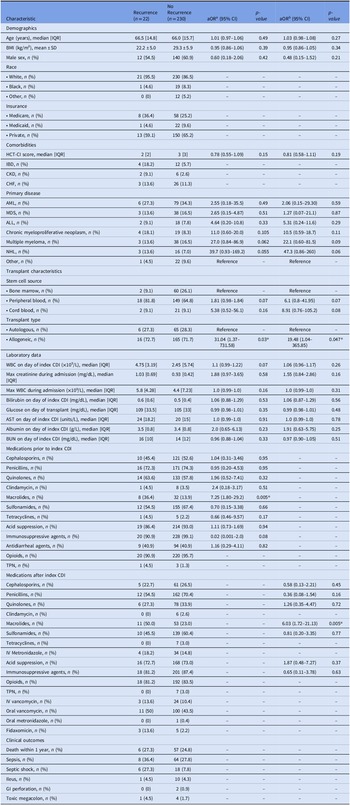
Among 252 patients with primary CDI, 22 (8.7%) developed first recurrence, 12 (4.8% of primary cases) developed second recurrence, and 8 (3.2% of primary cases) developed a third recurrence (Table 2). A total of 39 patients (15.5% of primary CDI cases) developed reinfection (>8 weeks from primary CDI) at a median of 122 days after their index CDI (Figure 3).
Risk factors for recurrent CDI in HCT recipients

Note: Medication data are reported as either receipt of medication 90 days before or 90 days after the index C. difficile infection. Numerical variables are displayed as mean ± standard deviation or median [IQR], as appropriate. Categorical variables are displayed as number of patients, followed by percentage.
a Regression analysis including medications administered within 90 days prior to index C. difficile infection.
b Regression analysis including medications administered within 90 days after index C. difficile infection.
* Statistically significant at p < 0.05
ALL, acute lymphoblastic leukemia; AML, acute myelogenous leukemia; AOR, adjusted odds ratio; AST, aspartate aminotransferase; BMI, body mass index; BUN, blood urea nitrogen; CDI, Clostridioides difficile infection; CI, confidence interval; CHF, chronic heart failure; CKD, chronic kidney disease; GI, gastrointestinal; HCT-CI, Hematopoietic Cell Transplantation-specific Comorbidity Index; IBD, inflammatory bowel disease; IQR, interquartile range; IV, intravenous; MDS, myelodysplastic syndrome; NHL, Non-Hodgkin lymphoma; SD, standard deviation; TPN, total parenteral nutrition; WBC, white blood cell count.
Cumulative incidence of C. difficile re-infection. C. difficile re-infection was defined as the presence of diarrhea and a positive stool PCR and/or EIA test at least 8 weeks after treatment for the initial C. difficile infection.

Of the 22 patients with recurrent CDI, 12 (54.5%) had mild-to-moderate disease, 1 (4.5%) had severe uncomplicated disease, and 9 (40.9%) had severe complicated disease. One-year mortality was similar between patients with recurrence (27.3%, 6/22) and those without recurrence (24.8%, 57/230).
In multivariable analysis, risk factors for CDI recurrence included receipt of macrolides before the index CDI (aOR 7.25, 95% CI: 1.80–29.2, p = 0.005) and allogeneic transplantation (aOR 31.04, 95% CI: 1.37–731.58, p = 0.03). When examining medications administered after the index CDI, macrolide use remained significantly associated with recurrence (aOR 6.03, 95% CI: 1.72–21.13, p = 0.005), as did allogeneic transplantation (aOR 19.48, 95% CI: 1.04–365.85, p = 0.047) although with wide confidence intervals, reflecting the limited number of recurrent events (n = 22) and the resulting model instability.
Discussion
This study represents one of the largest analyses of CDI epidemiology, risk factors, and outcomes in the HCT population. We found that approximately one in five allogeneic HCT recipients developed CDI, compared to 1 in 25 autologous recipients. Most infections occurred early post-transplant, with autologous recipients developing CDI earlier than allogeneic recipients. Our time-dependent survival analysis demonstrates that allogeneic HCT recipients experience a sustained elevated risk of CDI beyond 100 days post-transplant, whereas autologous recipients show a marked decline in risk after this period. This finding adds nuance to prior observations of increased CDI incidence in allogeneic recipients by identifying a prolonged window of vulnerability specific to this group. These results highlight the need for extended observation and possibly targeted preventive strategies for CDI in allogeneic transplant patients well beyond the early post-transplant period.
Use of penicillins, previous chemotherapy exposure, and receipt of umbilical cord stem cells were associated with a higher risk for infection, whereas autologous HCT recipients were associated with reduced risk for infection. Among those with CDI, approximately 1 in 12 developed recurrence, whereas 1 in 4 developed C. difficile reinfection (CDI > 8 weeks from index CDI). Macrolide use was associated with higher risk of recurrence, whereas autologous HCT recipients had a lower risk for both primary CDI and recurrent CDI.
Contrary to prior published reports, where standalone PCR adoption increased CDI case detection, we observed no significant changes in CDI incidence following transitions in diagnostic testing protocols. This likely reflects our BMT unit’s stringent clinical testing criteria, which required testing only those patients with clinically consistent symptoms of CDI (≥3 unformed stools/day). In addition, concurrent enhanced infection prevention measures implemented in the BMT unit throughout the study period may have counterbalanced any diagnostic sensitivity gains from PCR adoption.
Several factors emerged as significant predictors of primary CDI. Penicillin exposure was associated with increased CDI risk, with each additional day of therapy conferring a small but measurable increase in risk. These findings are in agreement with previous studies Reference Alonso, Treadway and Hanna8,Reference Alonso, Braun and Patel14–Reference Kinnebrew, Lee and Jenq17 but provides more precise quantification of the dose–response relationship. In our study, other antibiotic classes considered high-risk (cephalosporins, clindamycin, fluoroquinolones) were not independently associated with CDI after adjusting for treatment duration, contrary to some previous findings. Reference Weber, Scheich and Magh18,Reference Selvey, Slimings, Joske and Riley19 This highlights the importance of considering both antibiotic class and exposure duration in risk assessments. Our data suggest that penicillin-class antibiotics are independently associated with CDI in allogenic HCT recipients. These finding suggest that targeted antimicrobial stewardship strategies to minimize penicillin use when clinically appropriate within the allogeneic recipient population may be beneficial.
In our study, prior chemotherapy exposure significantly increased CDI risk, consistent with previous research in allogeneic HCT populations. Reference Alonso, Treadway and Hanna8 Our study extends this finding to both allogeneic and autologous recipients. The association between umbilical cord blood stem cell source and increased CDI risk is likely due to the more severe immunosuppression, reduced T-cell function, and hypogammaglobulinemia. Reference Alonso, Braun and Patel14
In our study, we found that CDI is relatively common complication of HCT and disproportionately affects allogeneic HCT recipients. This difference persisted in multivariable analysis after adjusting for comorbidities, medication exposures, and other clinical factors, suggesting fundamental differences in susceptibility between these patient populations. This higher incidence rate is consistent with the published literature Reference Alonso, Treadway and Hanna8,Reference Shah, McClellan and Flowers9,Reference Lavallée, Labbé and Talbot20 and may be attributed to several factors, including prolonged hospital stays, extended antibiotic exposure, and longer durations of immune suppression.
Among patients who developed primary CDI, recurrence affected approximately one in twelve cases, similar to rates reported in other studies, Reference Sanchez, Krantz and Escobar21 and almost one-quarter develop reinfection more than 8 weeks after the index CDI case. Reference Sanchez, Krantz and Escobar21 Macrolide use was a significant risk factor for recurrence, an association not previously well established in HCT recipients. This finding may relate to potential selection for macrolide-resistant C. difficile strains, particularly the hypervirulent BI/NAP1/027 strain, Reference Loo, Poirier and Miller22,Reference McDonald, Killgore and Thompson23 though strain typing was not performed in this study.
Previous studies examining clinical outcomes of CDI in HCT recipients have yielded inconsistent results. Reference Trifilio, Pi and Mehta7,Reference Alonso, Braun and Patel14,Reference Rosignoli, Petruzzellis and Radici15,Reference Weber, Scheich and Magh24 The severity distribution of CDI in our cohort is similar to findings from smaller studies. Reference Kinnebrew, Lee and Jenq17,Reference Lavallée, Labbé and Talbot20 Although we found that CDI was not significantly associated with increased all-cause mortality at 1-year post-transplant, consistent with several prior reports Reference Weber, Scheich and Magh18,Reference Alonso, Braun and Patel25,Reference Rosignoli, Petruzzellis and Radici26 we found that CDI was associated with increased risk of ICU admission and sepsis. In HCT recipients, hypotension or shock may result from various etiologies (eg, sepsis, cytokine release), which may complicate the classification of severe complicated CDI. The directionality of the relationship remains complex, as Dubberke et al. previously identified sepsis as a risk factor for developing CDI rather than a consequence. Reference Shah, McClellan and Flowers9 The high odds ratios with very wide confidence intervals we observed should be interpreted cautiously given the small number of outcomes, potential unmeasured confounding factors and the bidirectional relationship between critical illness and CDI in this population.
Our study has several limitations. As a single-institution study with a predominantly white, privately insured population, generalizability may be limited. Changes in diagnostic methods over the study period could have influenced CDI detection rates, though our analysis did not find significant associations between testing algorithm changes and incidence trends. The use of standalone NAAT for CDI diagnosis from 2010-2018 may have led to over-diagnosis. Reference Polage, Gyorke and Kennedy27 The recurrent CDI analysis was limited by small sample size, as evidenced by the wide confidence intervals for some risk factors. The IDSA severity criteria used are not validated specifically for HCT patients, and we cannot attribute severe outcomes such as ICU admission and sepsis solely to CDI. Other factors such as disease relapse and opportunistic infections could significantly affect these outcomes. Some late-onset CDI cases (>8 weeks) may represent delayed recurrences, particularly in patients receiving oral vancomycin prophylaxis. Due to data limitations, we were unable to distinguish these definitively. Future studies with larger cohorts focused on CDI-specific outcomes would provide more precise estimates of CDI impact.
In conclusion, CDI was a frequent, early complication following HCT with allogeneic recipients experiencing significantly higher rates and more severe outcomes compared to autologous recipients. Antibiotic stewardship and recognition of high-risk populations (cord blood recipients, prior chemotherapy) may help reduce the burden of CDI in these patients. The association of CDI with increased morbidity emphasizes the importance of prevention strategies in this high-risk population.
Supplementary material
To view supplementary material for this article, please visit https://doi.org/10.1017/ice.2025.10330
Acknowledgments
None.
Financial support
No funding sources were used for this research.
Competing interests
BHK reports to be a member of the (ad hoc) advisory boards for Sanofi, Incyte, Rigel, Maat Pharma; consultancy with ACI Group; data safety monitoring committee for Angiocrine; adjudication committee with CSL Behring. MAP reports funding from NIH through NHLBI K08HL141598. The other authors declare no potential competing interests.




 Open access

