


1. Introduction
Manufacturing firms operate in increasingly dynamic and competitive markets and respond by extending their offerings with innovative services tailored to evolving customer needs (Reference Garrido-Moreno and Padilla-MeléndezGarrido-Moreno & Padilla-Meléndez, 2024). This development has led to business models that integrate products and services into Product–Service Systems (PSS) (Bruhn, 2016). PSS combine physical artefacts and services across the life cycle, for example through maintenance concepts that extend usage periods and reduce warranty costs (Reference AurichAurich, 2010). Their design requires early and accurate life cycle cost estimation, as most Life Cycle Costs (LCC) are determined in the early development stages (Reference DehliDehli, 2020). Depending on their orientation product-, use-, or result-based PSS exhibit distinct value propositions but also pose specific challenges for cost estimation due to uncertain usage behavior, long operational phases, and strong interdependencies between product and service elements (Reference Ries, Beckmann and WehnertRies et al., 2023). Their successful implementation therefore requires holistic approaches that integrate technical, organizational, and economic perspectives across the life cycle (Reference Mont and TukkerMont & Tukker, 2006). Reliable LCC estimates are essential to support strategic decision-making and the development of cost-efficient solutions (Reference Schneider, Mozgova and LachmayerSchneider et al., 2022). Traditional LCC estimation relies primarily on historical data and expert knowledge, but often struggles to capture the complexity and uncertainty of industrial PSS, particularly in use- and result-oriented settings where operational behavior strongly influences costs (Reference Kádárová, Kobulnický and TeplickaKádárová et al., 2015). Recent data-based costing systems highlight the need for continuous data analysis and adaptive models to address these limitations (Reference Guzzo, Marzolla, Costa, Gebara, de Alcantara and SantosGuzzo et al., 2022). Consequently, Machine Learning (ML) based approaches have gained attention for their ability to exploit large and heterogeneous datasets and to uncover cost-relevant patterns beyond the reach of traditional methods (Reference Goudz and ErdoganGoudz & Erdogan, 2024). Despite growing research on ML-based cost estimation, the literature remains fragmented and lacks a systematic synthesis that relates estimation approaches to life cycle phases, data availability, and levels of project definition in PSS development. To address this gap, this paper presents a systematic literature review that integrates traditional and ML based cost estimation approaches into a common classification framework. By mapping methods to life cycle phases, cost types, data conditions, and estimation accuracy, the review provides structured guidance for method selection and supports informed decision-making across PSS development stages. Accordingly, the following research question is addressed:
RQ: Which machine learning approaches have been applied for life cycle cost estimation of Product-Service Systems, and what levels of accuracy do they achieve across different life cycle phases and data availability conditions?
2. Related work
2.1. Life cycle cost analysis of product-service systems
Life cycle cost analysis (LCCA) for PSS represents a critical approach for evaluating integrated product–service solutions across the entire development and operational life cycle, and has been widely addressed in existing literature. Unlike traditional product costing focused on manufacturing costs, LCCA considers all cost components across the complete system life cycle. According to the framework of Reference Bender and GerickeBender and Gericke (2021), product development must consider the entire product life cycle holistically, where every determination of product characteristics and processes influences the subsequent life cycle process (Reference Bender and GerickeBender & Gericke, 2021). This perspective is particularly crucial for PSS, where the integration of products and services creates unique and often difficult-to-predict cost dynamics across all life cycle phases (Reference Chong, Dreijer, Howard, Birkved, Kreye, Bey and McAlooneChong et al., 2014). The systematic assessment of LCC for existing products constitutes the fundamental prerequisite for reliable estimation of future product solutions. Through detailed analysis of realized PSS solutions, cost-driving factors and correlations between product and service characteristics are identified, primarily to improve cost transparency and understanding. These empirical insights from historical project data enable the development of parametric forecasting functions and statistical models, which allow for more cost-secure variant optimization in early design phases (Reference Park, Seo, Wallace and LeePark et al., 2002). Consequently, LCC assessment mainly serves as a knowledge foundation for understanding and structuring costs, while systematic and comparable assessments of estimation accuracy across life cycle phases remain limited.
2.2. Life cycle cost estimation in product development
Life Cycle Cost Estimation (LCCE) is particularly important in the early stages of product development, where decisions exert the greatest influence on later total life cycle costs. Different models and methods for cost estimation each offer specific advantages and disadvantages. As traditional cost data is not available, estimating life cycle costs in early development phases requires specialized estimating methods. Reference Niazi, Dai, Balabani and SeneviratneNiazi et al. (2006) classify cost estimation methods into three main categories, which are widely referenced in both research and industrial practice: Analogy methods use cost data from similar reference projects, adjusting for differences using factors. Parametric methods establish mathematical relationships between product parameters and historical costs to predict new projects. Bottom-up methods break products down into components, providing detailed cost estimates for each component, which are then aggregated (Reference Niazi, Dai, Balabani and SeneviratneNiazi et al., 2006).
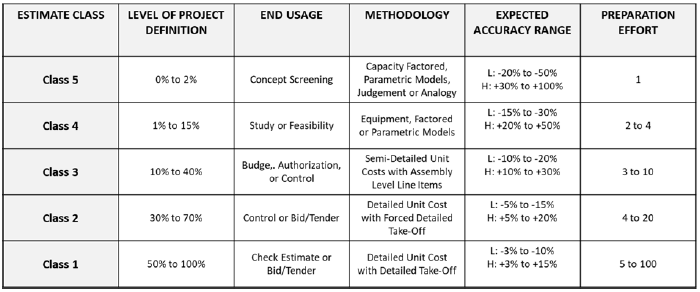
The accuracy of cost estimation techniques strongly depends on data availability and the maturity of the product definition during the development process. A classification system has been adopted to assess the general accuracy and applicability of these models and methods depending on the amount of data and information available in the development process. The AACE International Cost Estimate Classification System, depicted in Table 1, provides standardized guidelines for categorizing project cost estimates across engineering, procurement, and construction domains. The system classifies estimates into five hierarchical classes (Class 5 through Class 1), correlating project definition maturity with expected estimation accuracy ranges, but does not explicitly address data-driven or machine learning–based estimation approaches. Class 5 estimates, corresponding to 0-2% project definition maturity, achieve accuracy ranges of -50% to +100%, suitable for screening phase evaluations. Conversely, Class 1 estimates (65-100% definition) deliver -10% to +15% accuracy ranges for definitive control applications (Reference AlurraldeAlurralde, 2005).
Cost Estimation Classification System (Reference AlurraldeAlurralde, 2005)

The classification methodology prioritizes project definition maturity as the primary determinant, with accuracy ranges determined through probabilistic risk analysis rather than predetermined standards. This framework enables standardized communication between estimate preparers and decision-makers across diverse industries, establishing realistic accuracy expectations aligned with available design information.
2.3. Machine learning for cost estimation
Machine Learning, a subfield of Artificial Intelligence, enables computer systems to learn from data, identify patterns, and generate predictions without explicit rule-based programming. The ML development pipeline typically comprises data collection, preprocessing, feature engineering, model training, and evaluation. Data quality and feature selection critically influence performance, while the training phase optimizes internal parameters to minimize prediction errors and enhance generalizability through validation on unseen data (Reference Ali and MashwaniAli & Mashwani, 2023) ML paradigms are commonly categorized into supervised, unsupervised, semi-supervised, and reinforcement learning. Supervised learning employs labeled datasets to predict discrete classes (classification) or continuous values (regression). Unsupervised learning explores unlabeled data to uncover hidden structures, while semi-supervised approaches combine both labeled and unlabeled data to reduce annotation costs. Reinforcement learning, in contrast, involves agents that interact with their environment and learn optimal actions through reward-based feedback (Reference Goudz and ErdoganGoudz & Erdogan, 2024). Building on these paradigms, three main algorithmic families can be distinguished: regression models for continuous prediction, tree-based and ensemble methods for handling complex, nonlinear data, and neural networks for high-dimensional or structured inputs such as images or time series (Reference Baltrušaitis, Ahuja and MorencyBaltrušaitis et al., 2017).
ML offers strong potential in product development by identifying complex relationships between design parameters, materials, and manufacturing processes. (Reference Orimi, Saralajew, Feng, Dai, Hamlaoui, Stauss and LachmayerOrimi et al., 2025). With that fast and data-driven cost estimates despite limited information can be provided. ML can reduce uncertainty, support more informed decision-making, and improve the evaluation of design alternatives in the product development process. (Reference Ma’ruf, Nasution and LeuveanoMa’ruf et. al., 2024)
3. Research design
A comprehensive and systematic review of the existing body of research was conducted through two separate literature studies. The first focused on identifying traditional cost estimation methods and models and verifying their classification according to the Cost Estimate Classification System, with a particular emphasis on reported accuracy and project definition maturity. The second addressed the identification and categorization of machine learning approaches applied to cost estimation, with explicit consideration of data requirements, validation procedures, and reported performance metrics. The objective is to verify existing classifications, which currently include only traditional models, and to extend them by incorporating ML-based approaches. In doing so, the review aims to identify which cost types and life cycle phases are targeted by the respective estimation methods, enabling a comparative assessment of the prediction accuracy of ML and traditional approaches across the entire product life cycle.
The review procedure followed the PRISMA guidelines to ensure transparency, traceability, and reproducibility of the applied research method (Reference Moher, Liberati, Tetzlaff and AltmanMoher et al., 2009). To reflect both research objectives, two complementary search strings were defined and applied independently. One targeting the state of the art in traditional cost estimation, and a second one explicitly capturing ML-based cost estimation approaches under comparable contextual conditions. The review involved peer-reviewed publications from the last fifteen years in English or German. Qualified sources included journal articles, conference papers and reviews. Works without relevance to PSS or industrial contexts, lacking accessibility, or not providing sufficient methodological detail were excluded, as well as publications not addressing life cycle cost estimation or cost modeling tasks. In addition to topical exclusions, a clear methodological boundary was defined to ensure comparability of the included studies. In addition, purely conceptual contributions without a clearly described estimation model or without an evaluation of prediction performance were excluded. Approaches were classified as ML if they employed a trainable, data-driven model with explicit validation for a cost estimation task; studies lacking a validation step or performance assessment were excluded from the ML review. Borderline cases were coded as ML if they employed an explicit train–test protocol for prediction, and as traditional when they relied solely on fixed cost formulas without learning or validation steps. Searches were performed on the following databases: Scopus, IEEE Xplore, Scopus and Google Scholar. To capture the intersection of cost estimation, machine learning, and PSS, a Boolean search was constructed for each review using the CIMO framework. The query for the traditional methods initially produced 289 results. After screening process and applying inclusion and exclusion criteria, 42 publications remained for Full-text review, 9 final studies left for synthesis. The ML query produced 113 results. After the screening process and application of inclusion and exclusion criteria, 42 publications remained for full-text review; studies were further excluded due to insufficient methodological detail, missing validation, or lack of relevance to PSS cost estimation, resulting in 6 studies included in the final synthesis.
4. Results
4.1. Analysis
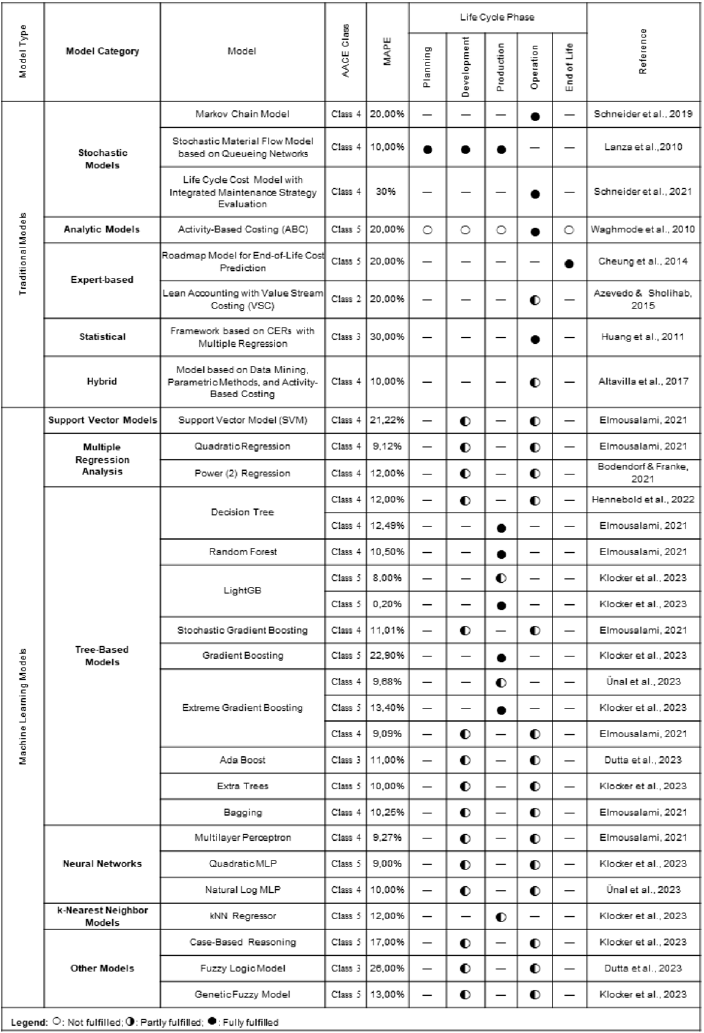
For each study, data were extracted on the applied costing or ML approach, addressed life cycle phase, dataset characteristics, and reported evaluation metrics. These variables were consolidated into a structured comparison table aligned along life cycle phase, model type, data availability, and accuracy to identify dominant patterns across studies. Life cycle coverage was classified as complete or partial based on the authors descriptions. Due to heterogeneous reporting, accuracy was harmonized using the Mean Absolute Percentage Error (MAPE) wherever possible. MAPE was selected because it is scale-independent, directly interpretable, and closely aligned with the AACE accuracy ranges, enabling comparison across cost levels, life cycle phases, and application domains. Although absolute MAPE values vary, their distribution across life cycle phases reveals consistent trends. Based on the reported level of project definition, studies were assigned to AACE estimation classes 1–5, positioning the approaches along increasing data availability and maturity. The resulting classifications were summarized in a comparison table and visualized in subsequent figures to provide a consolidated overview of traditional and ML-based life cycle cost estimation for PSS. The analysis in Table 2 is an excerpt from a comprehensive literature review, the complete table can be viewed at (Reference Rosemann and LöffelholzRosemann & Löffelholz, 2026).
4.1.1. Traditionel models
The Table 2 summarizes the traditional cost estimation approaches identified in the review and their positioning across life cycle phases and cost estimation classes. The included studies rely on a range of established methods, such as LCC models, parametric relationships, analogy models and frameworks. Most of these approaches are developed for specific product–service contexts and are embedded in spreadsheets or company-specific tools rather than generic software, reflecting their strong reliance on expert assumptions and predefined usage scenarios.
The quality of the traditional models was assessed along two dimensions. The reported accuracy and the robustness of the validation. Both of which are strongly affected by the availability and stability of usage and service-related data in PSS. Accuracy was derived from percentage error measures, error bands or qualitative statements given by the authors and then mapped to a common rating scheme. Validation quality considered whether the models were tested on real industrial cases, on multiple scenarios, or only demonstrated on a single example. Overall, traditional approaches typically provide medium accuracy for budgeting and planning in later design or operational phases, but only a few studies report quantified accuracy for the early concept phase, where service usage patterns and life cycle interactions are still highly uncertain. This pattern indicates that traditional models offer transparent and well-understood baselines, yet their predictive performance for early PSS concept evaluation remains weakly evidenced, largely due to limited insight into future service behavior and cross-phase cost interactions.
4.1.2. Machine learning models
The review identified six publications applying machine learning to cost estimation use cases, with a primary emphasis on predictive accuracy rather than practical deployment in industrial environments (Table 2). Across the PSS life cycle, regression models, artificial neural networks, support vector regression, ensemble methods, and hybrid approaches were investigated. Model suitability and performance were strongly phase- and data-dependent. In early planning and development contexts, regression models, ANN, and SVR achieved medium to high accuracy when sufficient data were available (Reference Bodendorf and FrankeBodendorf & Franke, 2021; Reference ElmousalamiElmousalami, 2021); however, their extensive preprocessing requirements and limited interpretability constrained acceptance where transparent cost drivers are required. Ensemble methods such as XGBoost, Gradient Boosting, and AdaBoost consistently delivered the highest predictive accuracy, particularly for material, personnel, energy, and maintenance-related costs (Reference Hennebold, Klöpfer, Lettenbauer and HuberHennebold et al., 2022; Reference Klocker, Bernsteiner, Ploder and NockerKlocker et al., 2023). Their effectiveness depended on large, high-quality datasets and thus presupposed mature data infrastructures and coordinated data governance across organizational units. Hybrid approaches, including SVM combined with Hidden Markov Models, showed strong performance in use-phase applications such as maintenance and spare-part forecasting (Reference Dutta, Palanisamy, Shanmugam, Subramaniam and SelvamDutta et al., 2023), but at the expense of increased model complexity and reduced transparency for decision-makers. For the end-of-life phase, no ML-based cost estimation models were identified; only roadmap-based approaches were reported, indicating a clear research gap in recycling and reverse logistics cost estimation (Reference Cheung, Marsh, Griffin, Newnes, Mileham and LanhamCheung et al., 2015). Across all studies, model quality was primarily assessed using variance-based and error-based metrics, including R2, adjusted R², MAE, RMSE, and MAPE. High R² values were interpreted as strong predictive power, though several studies highlighted the risk of overfitting when training performance was excessively high, motivating the use of adjusted R² as a more conservative measure (Reference Hennebold, Klöpfer, Lettenbauer and HuberHennebold et al., 2022). Error metrics complemented these assessments by capturing robustness and sensitivity to outliers. MAPE was frequently applied to enable comparison across cost categories and units, with values below 10 % commonly interpreted as high predictive accuracy (Reference Unal, Boyar, Pak, Yildiz, Erten and GungorÜnal et al., 2023). Most studies emphasized the importance of cross-validation to ensure generalizability (Reference Bodendorf and FrankeBodendorf & Franke, 2021; Reference ElmousalamiElmousalami, 2021), yet only few discussed how such validation practices translate into sustained use in industrial cost engineering environments. In addition, careful feature selection and preprocessing were consistently identified as critical enablers of robust performance; studies showed that deliberately reduced feature sets, often obtained through dimensionality reduction or embedded selection methods, improved model stability and efficiency (Reference Unal, Boyar, Pak, Yildiz, Erten and GungorÜnal et al., 2023).
Analysis traditional and machine learning models

4.2. Synthesis
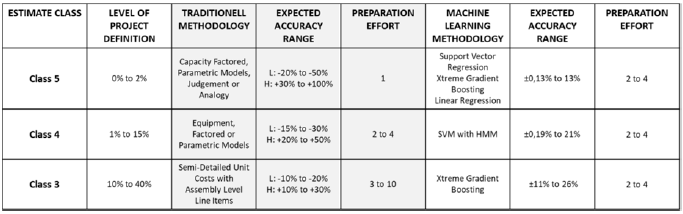
The review reveals consistent performance patterns across model categories and life cycle phases that enable phase-specific guidance for cost estimation method selection. Traditional formula-based approaches provide transparent baselines under sparse data conditions, while machine learning models improve accuracy once richer features and validated training procedures are available. Accordingly, early development stages favor simple and explainable models, whereas later stages benefit from more complex learners as data maturity increases. Across the reviewed data-driven studies, tree-based ensembles such as Gradient Boosting consistently deliver the strongest predictive performance in data-rich production settings by capturing non-linear and high-dimensional relationships (Reference Klocker, Bernsteiner, Ploder and NockerKlocker et al., 2023; Reference ElmousalamiElmousalami, 2021; Reference Hennebold, Klöpfer, Lettenbauer and HuberHennebold et al., 2022). Regression and support vector models serve as robust early-phase baselines due to their lower data requirements and higher interpretability but lose effectiveness as system complexity increases (Reference Bodendorf and FrankeBodendorf & Franke, 2021; Reference ElmousalamiElmousalami, 2021; Reference Unal, Boyar, Pak, Yildiz, Erten and GungorÜnal et al., 2023). Neural networks can reach comparable accuracy but exhibit higher variance and demand extensive preprocessing and larger datasets (Reference ElmousalamiElmousalami, 2021; Reference Unal, Boyar, Pak, Yildiz, Erten and GungorÜnal et al., 2023). No ML-based approaches were identified for the end-of-life phase, where estimation remains rule-based, highlighting a research gap in recycling and reverse logistics (Reference Cheung, Marsh, Griffin, Newnes, Mileham and LanhamCheung et al., 2015). Methodologically, model performance is driven primarily by data availability and feature quality. Studies combining feature selection, validation, and parameter tuning report more transferable results across metrics such as R², MAPE, and MAE (Reference Bodendorf and FrankeBodendorf & Franke, 2021; Reference ElmousalamiElmousalami, 2021; Reference Unal, Boyar, Pak, Yildiz, Erten and GungorÜnal et al., 2023). However, cross-study comparison is limited by heterogeneous evaluation metrics, reinforcing the need for standardized reporting. Overall, no universally superior model emerges; suitability depends on development phase, data maturity, and the required balance between accuracy and interpretability. Ensemble and hybrid approaches are recommended for accuracy-driven, data-rich applications, regression-based models for transparent early-stage estimation, and neural networks only where sufficient data infrastructure exists. The synthesis further suggests that hybridizing structured cost logic with learning-based components offers a robust path to balance transparency and accuracy, provided that datasets and metric conventions are clearly defined (Reference Altavilla, Montagna and NewnesAltavilla et al., 2017). These insights were operationalized by mapping the reviewed approaches to established cost estimation classes in Table 3.
Classification of traditional and ML –models

The classification of the review results based on the AACE estimation chart shows that previous classifications for traditional methods could not be fully verified due to the absence of required metrics, highlighting a limitation for accuracy-driven method selection in early phases. For the ML-based methods, the MAPE metric was used as a reference. The review results indicate that ML models can achieve higher accuracy, provided that model selection is aligned with development stage, data maturity, and the required balance between accuracy and interpretability. The synthesis indicates that the AACE Class 4 is the earliest development stage at which hybrid cost estimation becomes methodologically powerful enough for a reasonable use case. At this point, first structured design parameters are available, enabling learning-based models to contribute, while uncertainty still necessitates transparent baseline logic. Accordingly, an exemplary hybrid estimation logic is proposed. A parametric cost model is selected as the traditional baseline due to its low data requirements and explicit representation of cost drivers. On the learning-based side, linear regression as a regression-based model and XGB as tree-based ensemble model are combined to reflect complementary strengths under limited but emerging data maturity. The hybrid estimate is defined as (Equation 1):

where
 describes the parametric baseline estimate,
 the regression-based estimate, and
 the ensemble-based estimate. The weights express relative confidence based on data availability and model applicability rather than optimized predictive accuracy. This formulation represents an exemplary reference configuration derived from the review and illustrates how structured cost logic and learning-based models can be systematically combined in an early phase of cost estimation.
5. Discussion
Traditional approaches remain essential for interpretable cost driver identification and for structuring sparse early-phase information, particularly where data availability and governance are limited. Evidence across studies indicates a phase- and data-dependent effectiveness rather than a universally superior method. Tree-based ensembles perform best in data-rich production contexts, while simpler regression models remain preferable in early development due to transparency and lower overfitting risk. Analogy-based methods support rapid orientation under high uncertainty but lack robustness as final predictors. Overall, studies show improved accuracy when curated features and explicit validation accompany modern machine learning methods, though these practices presuppose mature data governance and consistent data management, which remain significant organizational challenges. Persistent heterogeneity in error metrics and validation protocols further limits cross-study comparability. From a knowledge perspective, this review provides a phase- and data-aware synthesis that situates machine learning–based cost estimation within an established classification framework, clarifying conditions under which different estimation logics are effective in PSS development. Practically, the findings guide cost engineers and managers in aligning method selection with data maturity, transparency requirements, and decision context, cautioning against premature use of complex models. At an organizational level, the results emphasize the need for coordinated data strategies and standardized validation practices to fully leverage data-driven cost estimation across the PSS life cycle.
6. Conclusion and outlook
This paper presents a phase- and data-aware metric table that situates machine learning within established estimate classes for LCC estimation in PSS. Across the reviewed evidence, model choice aligns with project maturity and feature availability. Transparent parametric baselines remain useful when inputs are sparse, while simple data-driven models become effective once a compact, validated feature set exists. Richer non-linear approaches gain advantage as data availability, model governance, and process maturity increase. Importantly, the findings indicate that a combination of traditional and machine learning methods can be beneficial, particularly when leveraging complementary strengths such as transparency, robustness, and predictive flexibility. However, it remains an open research task to systematically evaluate which method combinations yield meaningful synergies, under which life cycle phases, data conditions, and decision contexts. Hybrid setups already show added value for in-service planning, whereas end-of-life estimation remains underexplored. The proposed metric table serves as a deployment guide that indicates when and how ML methods can be applied, which trade-offs to expect, and where hybrid approaches may be most promising. Further progress is likely to arise from more consistent metric definitions and validation protocols, shared concept-phase datasets with agreed feature taxonomies, and increased attention to interpretability and human-in-the-loop integration alongside accuracy. Extending analyses to neglected life cycle stages and stress-testing models across domains will be essential to assess generalizability. In practice, the metric table supports more transparent planning and decision-making by aligning method selection with project definition, data readiness, and intended use, while indicating potential opportunities for combining traditional and machine learning approaches that require further empirical evaluation.

 Open access

