

Contending approaches to global power shifts
As emerging powers such as China and India rise and established powers such as the USA and the UK decline, international institutions such as the United Nations (UN), the World Trade Organization (WTO), the International Monetary Fund (IMF), and the World Bank (WB) come under pressure to adapt to shifts in the global distribution of power. When and how do they adapt?
Earlier power transition theories (PTTs) discussed whether peaceful institutional adaptations to power transitions, in which a rising challenger replaces a declining hegemon, were actually possible (Organski Reference Organski1968; Organski and Kugler Reference Organski and Kugler1980; Gilpin Reference Gilpin1981; Modelski Reference Modelski1987, Reference Modelski2005; Layne Reference Layne1993). More recent power shift theories (PSTs) have given up the traditional PTT focus on full-blown power transitions to study institutional adaptations to global power shifts instead (Schweller and Pu Reference Schweller and Pu2011; Stephen Reference Stephen2012; Kahler Reference Kahler2013; Paul Reference Paul and Paul2016). Power shifts imply that emerging powers overtake some of the established powers, but, in contrast to full-blown power transitions, are not (yet) able to challenge the incumbent hegemon. Many recent PST contributions have likewise moved their focus from studying shifts in the overall power structure towards issue-area-specific power shifts (Schirm Reference Schirm2010; Wade Reference Wade2011; Hopewell Reference Hopewell2015; Zangl et al. Reference Zangl, Heußner, Kruck and Lanzendörfer2016).Footnote 1 Instead of analyzing the global order as a whole, they study the adaptation of specific institutions to issue-area-specific global power shifts (Stephen Reference Stephen2012; Lipscy Reference Lipscy2017; Daßler, Kruck and Zangl Reference Daßler, Kruck and Zangl2018). Moreover, recent PST contributions challenge the gloomy assumption of earlier PTTs that institutional adaptations are rarely possible and major warfare is inevitable (Ikenberry Reference Ikenberry2009, Reference Ikenberry2011a, Reference Ikenberryb; Kirshner Reference Kirshner2012; Kahler Reference Kahler2013; Paul Reference Paul and Paul2016).
Even PST contributions that draw on realist theories of International Relations (IR) argue that established powers may accommodate emerging powers' demands for institutional adjustments that reflect their improved power position (Kirshner Reference Kirshner2012; Paul Reference Paul and Paul2016). To be sure, the accommodationist approach highlights that power shifts will exacerbate conflicts of interest between established and emerging powers entailing the risk of war. It is, however, precisely this risk that can provide an incentive for established powers to proactively manage the rise of emerging powers by accommodating them through institutional adjustments. After all, these institutional adjustments may prevent the need for a fundamental institutional overhaul in the future when the distribution of power shifts further in favor of the emerging powers.
Many PST contributions that draw on liberal traditions in IR argue, by contrast, that emerging powers will seek their integration into the current order and its institutions rather than asking for far-reaching institutional adjustments. These integrationist approaches assume that the current global order is easier to join and more difficult to overthrow than previous orders (Ikenberry and Wright Reference Ikenberry and Wright2008; Ikenberry Reference Ikenberry2009, Reference Ikenberry2011a, Reference Ikenberryb; Kahler Reference Kahler2013). As it was the current order that allowed them to rise, emerging powers are more interested in sustaining it and its institutions than in overthrowing them. Moreover, through their previous integration into the order and its institutions, emerging powers have gone through a process of socialization and have already internalized the order's most fundamental principles. This allows for their fairly harmonious further integration into the order and its institutions.
From our point of view, both accommodationist and integrationist approaches identify important modes of institutional adjustment to the shifts in the global distribution of power. However, insofar as they focus on either conflictual accommodation or harmonious integration, they overlook a third mode of institutional adaptation that we call strategic co-optation. To some extent, co-optation is a combination of accommodation and integration, and we find occasional references to ‘co-optation’ in both accommodationist and integrationist PST contributions (Stephen Reference Stephen2012, 296–298; Acharya Reference Acharya and Acharya2014, 154; Paul Reference Paul and Paul2016, 18; Newman and Zala Reference Newman and Zala2018, 871). However, co-optation differs from both accommodation and integration in important ways. Accommodation means that established powers adjust (unilaterally) to emerging powers' demands for institutional adaptation; integration, on the other hand, means that emerging powers adjust (unilaterally) to the existing institutions. Co-optation, by contrast, is a specific form of mutual adjustment. It implies that established and emerging powers trade institutional privileges (as in accommodation) for institutional support (as in integration). For example, in the wake of the global financial crisis (2008), China provided crucial financial support to contain the crisis and thus stabilize the IMF in exchange for increased voting rights in the IMF (Wade Reference Wade2011; Keukeleire and Hooijmaaijers Reference Keukeleire and Hooijmaaijers2014).
The aim of this paper is to develop a theory of strategic co-optation and to illustrate its empirical relevance with regard to the adaptation of international institutions to global power shifts.Footnote 2 Drawing on isolated treatments from various domains – domestic (cf. Selznick Reference Selznick1964; Hale Reference Hale2015) and international (cf. Lake Reference Lake2009; Abbott et al. Reference Abbott, Genschel, Snidal and Zangl2019), autocratic (cf. Dickson Reference Dickson2000, Reference Dickson2008; Reuter and Robertson Reference Reuter and Robertson2015) and democratic (cf. Lehmbruch Reference Lehmbruch and Goldthorp1984, Reference Lehmbruch and Windhoff-Héritier1987), past (cf. Trotha Reference Trotha1994; Wilson Reference Wilson2016) and present (cf. Gandhi and Przeworski Reference Gandhi and Przeworski2006, Geddes et al. Reference Geddes, Joseph and Frantz2018) – we develop a theory that specifies, for the specific context of institutional adaptation to shifts in the global distribution of power, the concept, the conditions, and the (unintended) consequences of strategic co-optation. We first conceptualize co-optation as a specific form of mutual adjustment – or cooperation – in which established and emerging powers trade institutional privileges for institutional support. We go on to theorize the conditions under which, in the face of a global power shift, emerging and established powers are (more or less) likely to agree on a deal of this kind. We then discuss endogenous dynamics that can stabilize co-optation, but also destabilize it rendering it precarious. In the conclusion we summarize and suggest that our theory may also improve understanding of strategic co-optation beyond the context of institutional adaptations to global power shifts (i.e. beyond this scope condition).
Conceptualizing strategic co-optation
Generally, co-optation entails that individual or collective actors are brought closer to the leadership of an institution. It is a specific process of institutional adjustment where either the exercise or the burden of power, or both, are increasingly shared between existing power holders and other power centers to stabilize an institution (Selznick Reference Selznick1964; Dickson Reference Dickson2000; Gandhi and Przeworski Reference Gandhi and Przeworski2006). Examples of co-optation from the domestic realm include the co-optation of labor unions (Lehmbruch Reference Lehmbruch and Goldthorp1984), churches (Abdullah Reference Abdullah2015), or ethnic minorities (Pettai and Hallik Reference Pettai and Hallik2002) into the institutions of democratic states, as well as the co-optation of opposition parties (Gandhi and Przeworski Reference Gandhi and Przeworski2006), regional leaders (Reuter and Robertson Reference Reuter and Robertson2015), private entrepreneurs (Dickson Reference Dickson2000, Reference Dickson2008; Gerschewski Reference Gerschewski, Abbott, Genschel, Snidal and Zangl2019), elite networks (Hale Reference Hale2015), or rebel groups (Thomas, Kiser and Casebeer Reference Thomas, Kiser and Casebeer2005, 124–125; Salehyan Reference Salehyan, Abbott, Genschel, Snidal and Zangl2019) into the institutions of autocratic regimes (Wintrobe Reference Wintrobe1998; Geddes et al. Reference Geddes, Joseph and Frantz2018). Examples from the international realm include the co-optation of local chiefs into colonial empires (Crowder Reference Crowder1964; Trotha Reference Trotha1994, 261) or of client states into hegemonic orders (Lake Reference Lake2009).
We focus on strategic co-optation, which we conceptualize as the result of strategic choices made by the co-optor and the co-optee. Independent of the specific context, their fundamental co-optation bargain is always the same: they trade institutional privileges for institutional support to stabilize the institutional order (Selznick Reference Selznick1964, 135–136). When democratic leaders engage in co-optation, they provide, in exchange for support, tax exemptions to churches, privileged representation for ethnic minorities or consultation rights for unions (Lehmbruch Reference Lehmbruch and Windhoff-Héritier1987). When autocratic leaders engage in co-optation, then, in return for support, they give opposition parties seats in parliament, include economic elites in their governing coalitions and provide ministerial posts for rebel leaders (Dickson Reference Dickson2000; Gandhi and Przeworski Reference Gandhi and Przeworski2006; Reuter and Robertson Reference Reuter and Robertson2015). When colonial states co-opted local chiefs, they gave them institutional privileges and opportunities for rent-seeking in return for their support (Trotha Reference Trotha1994). Hegemonic powers that co-opt client states typically give them security guarantees in return for their loyalty (Lake Reference Lake2009). In each of these cases, the co-optor grants institutional privileges that give co-optees a stake in stabilizing the existing order (Baur and Schmitz Reference Baur and Schmitz2012, 11; Gerschewski Reference Gerschewski2013, 22).
As these examples indicate, strategic co-optation requires cooperation. The co-optor grants privileges and the co-optee gives support in return. However, strategic co-optation is a very specific form of cooperation – and not only because the co-optor and co-optee trade institutional privileges for institutional support, but also because it is not a form of horizontal cooperation among equals, but rather of vertical cooperation among unequal actors with the co-optor having more authority than the co-optee (Selznick Reference Selznick1964; Dickson Reference Dickson2000; Gandhi and Przeworski Reference Gandhi and Przeworski2006). Ex ante, co-optors dominate the order and its underlying institutions. They are in a leadership position. They have institutional privileges and thus authority that co-optees lack. Ex post, co-optation reduces the status hierarchy between co-optor and co-optee. Through the granting of institutional privileges, co-optation typically gives co-optees more authority and brings them closer to the leadership of the order and its institutions. Yet, co-optees usually do not become equal co-leaders. In return for support, they gain privileges, but they do not gain the same privileges – and thus the same authority – as the co-optors. When autocratic governments co-opt leaders of the opposition by giving them seats in parliament (Gandhi and Przeworski Reference Gandhi and Przeworski2006) or democratic governments co-opt the leaders of the labor unions or employer associations by incorporating them into their policy making (Lehmbruch Reference Lehmbruch and Windhoff-Héritier1987), they still keep them subordinated. Co-optation preserves some status hierarchy (Dickson Reference Dickson2000; Bertocchi and Spagat Reference Bertocchi and Spagat2001; Hale Reference Hale2015).
While co-optation always entails the same vertical cooperation among unequal actors that exchange institutional privileges for institutional support, the privileges granted and the support provided may vary substantially:
• First, whether formal or informal, the institutional privileges gained by the co-optee will be either procedural or substantive. Procedural privileges entail co-optees gaining more influence in the policy-making process (Lehmbruch Reference Lehmbruch and Windhoff-Héritier1987). The 2002 opening of the Chinese Communist Party to private entrepreneurs in return for their support of the communist regime may serve as an example. In becoming party members, private entrepreneurs not only enhanced their social status, they also improved their ability to make their economic interests heard (Dickson Reference Dickson2008). Privileges can, however, also be substantive (Reuter and Robertson Reference Reuter and Robertson2015). In return for their support in the run-up to the 1996 presidential elections, President Yeltsin offered the managers of big Russian oil and gas companies the opportunity to become the owners of those companies (Shleifer and Treisman Reference Shleifer and Treisman2005).
• Second, whether ideational or material, the support co-optees provide to stabilize the existing order can be either specific or diffuse (Easton Reference Easton1975). Co-opting specific support entails the co-opted party fulfilling a specific task in exchange for the institutional privileges granted by the co-optor. The co-optation of the Russian oligarchs who supported President Yeltsin's 1996 electoral campaign in return for becoming the owners of the gas and oil companies they managed provides an example (Shleifer and Treismann Reference Shleifer and Treisman2005). Co-opting diffuse support implies, by contrast, that in return for the privileges granted, the co-optee is expected to be generally loyal to the order and its underlying institutions (Hale Reference Hale2015; Geddes et al. Reference Geddes, Joseph and Frantz2018). The communist leadership in China did not open up the party with the objective of private entrepreneurs fulfilling a specific task. Instead, private entrepreneurs were encouraged to get party membership to give them a stake in maintaining the order and thus to generally enhance their support for the communist regime (Dickson Reference Dickson2008).
Importantly, strategic co-optation – understood as vertical cooperation among unequal actors that exchange institutional privileges for institutional support – is also common when international institutions adjust to shifts in the global distribution of power. Established powers co-opt emerging powers to stabilize international institutions and the order they underpin. For example, in the aftermath of the 2008 global financial crisis, the USA and the other G7 states offered emerging powers such as Brazil, India, and China (the BICs) an institutional upgrade of the G20 from being a forum of finance ministers to being a forum of heads of government. Through this partial replacement of the G7, they granted emerging economies the privilege of membership in the exclusive club of leading economic powers that govern the global political economy. They did so in return for the BICs' institutional support. The latter pledged financial resources to help contain the financial crisis and endorsed the G20 as a crucial global economic governance forum. In the end, the upgrade of the G20 brought the BICs closer to the core leadership of global economic governance, but, as the G7 continues to exist, its members retain a privileged position in the G20 (Wade Reference Wade2011; Cooper and Thakur Reference Cooper and Thakur2013; Kirton Reference Kirton2013).
The co-optation of the BICs into the G20 is not, in fact, an exceptional case of co-optation in the wake of shifts in the global distribution of power. As we will indicate below, China's integration into the WTO, India's unofficial recognition as a nuclear power, China's increased voting rights in the IMF, Germany, Japan, India, and Brazil's (i.e. the G4's) attempt to gain permanent seats in the United Nations Security Council (UNSC), and China's inclusion in the WTO core negotiation group provide additional examples.
Conditions for strategic co-optation
While we consider co-optation an important means of adjusting international institutions to global power shifts, we also highlight the fact that emerging and established powers are not always able to agree on it (Stephen Reference Stephen2012). What, therefore, are the conditions for co-optation and thus the exchange of institutional privileges for support? To answer this question, we draw again on the treatments of co-optation cited above from other domains.
While often more implicit than explicit, the most fundamental assumption of most co-optation accounts is that co-optation is only possible if the benefits outweigh the costs for both co-optor and co-optee (Bertocchi and Spagat Reference Bertocchi and Spagat2001). For the co-optor, the gains from the co-optee's support of the order must outweigh the relative loss implied by granting institutional privileges to the co-optee. For the co-optee, the benefits of additional institutional privileges must outweigh the costs of supporting the order. But what shapes the cost–benefit assessment of co-optors and co-optees? In the following, we elaborate on three conditions. We begin by conceptualizing the existence of a fundamental institutional challenge as a necessary condition for strategic co-optation. We then discuss two probability drivers of strategic co-optation: the availability of willing and able co-optees on the one hand, and the institutional opportunities for the co-optation parties to overcome resistance from interested third parties on the other.
Fundamental challenge as a necessary condition
Many co-optation accounts regard a fundamental challenge to the order and its institutions as an important condition for strategic co-optation – some even consider it a defining feature (Selznick Reference Selznick1964; Dickson Reference Dickson2000; Gandhi and Przeworski Reference Gandhi and Przeworski2006). Following these accounts, we regard a fundamental challenge to the existing order and its institutions a necessary condition for strategic co-optation.
However, different accounts of co-optation focus on different challenges. By fusing these isolated accounts into one theory of strategic co-optation, we highlight two key distinctions:
(1) Authority vs. governance challenge: Co-optors may draw on co-optation to cope with challenges to their authority. This is the focus of the literature on co-optation in modern autocracies (Wintrobe Reference Wintrobe1998; Dickson Reference Dickson2000; Gerschewski Reference Gerschewski2013, Reference Gerschewski, Abbott, Genschel, Snidal and Zangl2019; Hale Reference Hale2015; Geddes et al. Reference Geddes, Joseph and Frantz2018). It shows, for instance, that autocratic regimes use parliamentary assemblies to tame the opposition to their authority by giving opposition leaders the institutional privilege of parliamentary membership (Gandhi and Przeworski Reference Gandhi and Przeworski2006). This gives those leaders a stake in the maintenance of the existing order and strengthens the diffuse support for it (Dickson Reference Dickson2008). Here, strategic co-optation is a technique used to maintain authority.
However, co-optors may also draw on co-optation to deal with challenges to their governance capacity. This is the focus of the literature on co-optation in modern democracies, which regards co-optation as an attempt by democratic leaders to improve their ability to govern (Buchanan and Tullock Reference Buchanan and Tullock1962; Lehmbruch Reference Lehmbruch and Goldthorp1984, Reference Lehmbruch and Windhoff-Héritier1987). Co-optors bring in co-optees because the latter have the expertise, legitimacy, credibility or operative capacities needed for governance to be successful (Abbott et al. Reference Abbott, Genschel, Snidal and Zangl2019). For instance, today's bureaucracies try to improve their administrative capacities by incorporating civil society actors with specific competencies into their administrative procedures (Buchanan and Tullock Reference Buchanan and Tullock1962; Lehmbruch Reference Lehmbruch and Windhoff-Héritier1987). Here, strategic co-optation is a governance technique.
(2) Internal vs. external challenges: Whether they are facing an authority or a governance challenge, co-optors may engage in co-optation to address internal or external challenges. If they co-opt to deal with internal challenges, they bring in the very actors that are challenging the order and the institutions they dominate. By means of co-optation, they try to turn challengers into supporters of the order and its institutions (Dickson Reference Dickson2008; Gerschewski Reference Gerschewski2013). The co-optation of German tribes – the Goths and later the Vandals – into the Roman Empire provides a good example of this. In the 4th century, the frequent invasions by these tribes posed a serious challenge to the Empire. To cope with this challenge, the Emperor decided to make their leaders Roman citizens and give them the task of policing the Empire's borders, thus turning invaders into border guards (Wilson Reference Wilson2016, 37).
If co-optors deal with external challenges, they enlist co-optees to cope with challenges that stem from third parties. In this case, co-optation often amounts to a form of coalition building against a third-party challenge (Trotha Reference Trotha1994; Lake Reference Lake2009). The Pope's co-optation of the Franks in the 8th century serves as an example of this. The Pope required military support to protect the Church against its enemies. In return for Pepin the Short's military support, Pope Zachary crowned him Frankish king in 751, thereby sanctioning his coup against the Merovingians. In 800, Pope Leo III even crowned Pepin's successor, Charlemagne, Emperor of the Holy Roman Empire to gain his support against the Church's enemies. By means of co-optation, the Pope turned the Carolingians into defenders of the Church (Wilson Reference Wilson2016, 39–40).
Crossing the two distinctions, we derive four types of challenges (see Table 1). We claim that all the four types of fundamental challenges alter the cost–benefit assessments of would-be co-optors, thereby making co-optation possible. When faced with a fundamental challenge, co-optors' demands for additional support to stabilize the order will rise. The benefits of co-optation will increase relative to its costs. Co-optors might therefore be prepared to offer institutional privileges in return for co-optee support. By contrast, without such a challenge, co-optors have little incentive to co-opt others into the order they dominate. Why should they give out privileges for support they do not need? The benefits would not outweigh the costs. Thus, while certainly not sufficient, a fundamental challenge to the order appears to be necessary for co-optation to be possible. However, each type of challenge comes with a distinct reason why the benefits of co-optation may outweigh its costs (see Table 1). All four reasons feature prominently in cases of institutional adaptation to today's global power shifts.
Types of challenges and co-optor's reasons for co-optation
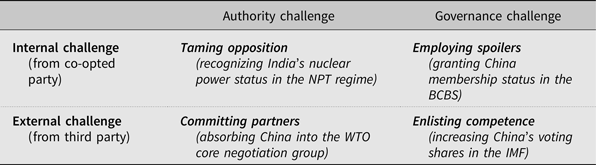
Taming opposition: In the face of an internal challenge to their authority, co-optors may engage in co-optation to tame the opposition (Dickson Reference Dickson2000; Gandhi and Przeworski Reference Gandhi and Przeworski2006; Hale Reference Hale2015; Geddes et al. Reference Geddes, Joseph and Frantz2018). India's incorporation into the nuclear non-proliferation regime (or NPT regime) through its unofficial recognition as a nuclear power provides an example. India, among others, challenged the legitimacy of the NPT regime as it strictly enforced the commitment of non-nuclear states to refrain from seeking nuclear weapons, while at the same time largely ignoring the fact that states with nuclear weapons consistently violated their commitment to reduce their nuclear weapon arsenals. As a result, the NPT regime went through a severe authority crisis in the late 1990s and early 2000s. Through India's unofficial recognition as a nuclear power – by means of the 2008 waiver of the Nuclear Suppliers Group (NSG) – the USA and other nuclear weapons states tried to tame India's opposition and contain the NPT regime's authority crisis (Mistry Reference Mistry2014; Perkovich Reference Perkovich2010).
Employing spoilers: In the face of internal governance challenges, co-optors may employ as co-optees the same actors that are spoiling their governance efforts (Salehyan Reference Salehyan, Abbott, Genschel, Snidal and Zangl2019; Tamm Reference Tamm, Abbott, Genschel, Snidal and Zangl2019). The inclusion of China in the Basel Committee on Banking Supervision (BCBS) provides an example (Knaack Reference Knaack2017). In the 1990s and 2000s, China's banking sector grew considerably. At the same time, China was not a member of the BCBS, compromising the BCBS's capacity to promulgate effective global standards for banking regulation. As a non-member, China's implementation of BCBS standards was slow and piecemeal. By offering China (and other emerging powers) BCBS membership in 2009, the USA and the EU addressed this internal governance challenge. A potential spoiler of the BCBS was incorporated into the global banking regulation order. As a result, China has turned ‘from laggard to primus inter pares’ (Knaack Reference Knaack2017, 50), introducing regulations that were even stricter than the recent Basel III standards demanded and implemented ahead of the agreed schedule.
Committing partners: In the face of an external authority challenge, co-optors may engage in co-optation to commit partners to help them stabilize the order (Bertocchi and Spagat Reference Bertocchi and Spagat2001). China's promotion as a member of the WTO core negotiation group provides an example. Soon after China became a WTO member in 2001, the USA and other established powers included China in the WTO core negotiation group – the so-called Quad. They did so with the expectation that China would help contain the authority challenge posed by India and Brazil, who had fought their way into the Quad. Established powers (erroneously) hoped that China, as a supporter of free trade, would contribute to reining in India's and Brazil's opposition and the obstructive tactics they used in the Doha Round negotiations, thus mitigating the authority challenge the latter posed to the WTO (Hopewell Reference Hopewell2015).
Enlisting competence: Co-optors may also engage in co-optation to improve their ability to cope with an external governance challenge. In this case, they enlist competence (Abbott et al. Reference Abbott, Genschel, Snidal and Zangl2019). The co-optation of China into the leadership of the IMF after the 2008 global financial crisis provides an example. The established powers, especially the USA, offered China an increase in its shares within the IMF's weighted voting system. They did so to convince China to shore up its financial support for the stabilization of a global financial system under stress (Wade Reference Wade2011; Keukeleire and Hooijmaaijers Reference Keukeleire and Hooijmaaijers2014). Similarly, the 2007/08 upgrade of the G20 from a forum of finance ministers to a forum of heads of government served to enlist emerging economies' financial competencies to contain the global financial crisis (Wade Reference Wade2011; Cooper and Thakur Reference Cooper and Thakur2013; Kirton Reference Kirton2013).
To sum up, we highlight that a fundamental challenge to the order and its institutions is a necessary condition for strategic co-optation. Absent such a challenge, the co-optor's benefits will not outweigh the costs of co-optation. By distinguishing four types of challenges, we have also specified four distinct reasons why, in the face of a specific challenge, the benefits of co-optation may outweigh its costs.
Co-optee availability as a probability driver
A fundamental challenge to an order or its underlying institutions will hardly lead to co-optation if there are no co-optees that are both able and willing to provide the support needed to stabilize the order. For both co-optors and co-optees, the costs and benefits of co-optation – and, consequently, the incentive to engage in co-optation – depend on the degree to which potential co-optees are systemically relevant and the degree to which they agree with the social purpose of the existing order and its institutions. Therefore, we argue that the availability of co-optees that are systemically relevant for and in agreement with the social purpose of the existing order is the most important probability driver of strategic co-optation.
To begin with, co-optation is more likely when there are systemically relevant actors available that can be brought closer to the order's core leadership (Schmitter Reference Schmitter and Grant1985). Systemic relevance implies that actors are not only powerful but that they have sufficient capabilities – material or ideational – to destabilize the order on their own and are, thus, critical for stabilizing the order (Viola Reference Viola2018; Zürn Reference Zürn2018). Systemically relevant actors, in other words, can use their capacities to challenge the order or help to overcome challenges to it. Therefore, co-optors have an incentive to nurture – through co-optation – systemically relevant actors' interest in contributing to the maintenance of the order. This is the reason why autocrats typically co-opt the leadership of the most powerful opposition parties rather than the leaders of smaller opposition groups (Dickson Reference Dickson2000, Reference Dickson2008; Gandhi and Przeworski Reference Gandhi and Przeworski2006). The availability of actors with systemic relevance will also enhance the incentives of these would-be co-optees to accept being co-opted. As systemically relevant actors, they have a bigger incentive to contribute to the stabilization of the order. As their support is crucial, freeriding on the contributions of others becomes impossible. With their support making a, if not the, difference to the stability of the order, their incentive to provide support in return for institutional privileges increases (Olson Reference Olson1965).
However, the availability of actors with systemic relevance is unlikely to lead to co-optation if these actors do not agree on the social purpose and the fundamental principles of the order and its institutions (Johnson Reference Johnson2016; Abbott et al. Reference Abbott, Genschel, Snidal and Zangl2019). Thus, co-optation is unlikely, if only revisionist or revolutionary actors are available. It becomes more likely, if there are reformist actors available.Footnote 3 This makes co-optation easier for the co-optor because it can trust that the co-optee will not use its institutional privileges to revise the order's fundamental principles, let alone its social purpose. Moreover, co-optors have to offer less far-reaching privileges to gain support from co-optees that are in agreement with the purpose and principles of the existing order. This is also the reason why, in multi-ethnic states, the leaders of the ruling majority try to incorporate reform-minded, moderate leaders from minorities rather than radical or even revolutionary leaders (Pettai and Hallik Reference Pettai and Hallik2002). They understand that moderates are easier and cheaper to co-opt than radicals. Likewise, co-optees who agree with the order's principles and purpose find it easier to accept being co-opted – in return for institutional privileges they ‘merely’ have to provide support for an order or an institution they basically agree with. Thus, the zone of agreement for a co-optation deal is much wider when there are co-optees available that agree with the order's social purpose and its fundamental principles (Abbott et al. Reference Abbott, Genschel, Snidal and Zangl2019).
Overall, the availability of systemically relevant actors that agree with the social purpose and principles of the order shapes the probability of co-optation (see Table 2). This can be illustrated by comparing how, after World War II, Germany, France, and Italy co-opted the labor unions into their economic regimes (Scharpf Reference Scharpf1978). Germany's governments co-opted them into their corporatist arrangements for managing the economy, because the labor unions were powerful monopoly organizations representing the bulk of laborers. This was crucial for the German governments' efforts at economic management. At the same time, they were moderate organizations that shared the governments' commitment to a coordinated market economy. In Italy and France, by contrast, the co-optation of labor unions was much more difficult, because none of the numerous competing organizations was powerful enough to help the French or Italian governments in their pursuit of managing the economy. Furthermore, significant parts of the Italian and French labor unions were more radical than their reformist German counterparts and they rejected the market economies in France and Italy.
The availability of co-optees and the probability of co-optation
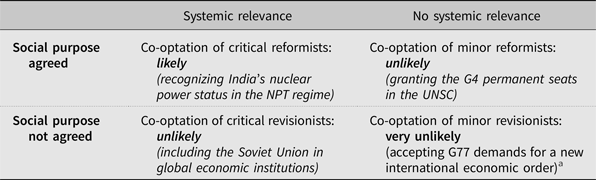
a In the 1970s, developing countries organized as Group of 77 (G77) called for a radically different New International Economic Order. But established powers largely rejected their demands for an overhaul of the Bretton Woods institutions and a substantial strengthening of the UN Conference on Trade and Development (UNCTAD), because the G77 was revisionist and not systemically relevant for global economic order.
The availability of able and willing co-optees also shapes the probability of co-optation in cases of global power shifts. Accordingly, India's rise to systemic relevance to the NPT regime and its agreement with the regime's social purpose were major conditions of its co-optation into the regime in the early 2000s. As a nuclear power with a fast-growing nuclear industry and leader of an increasingly vocal coalition of developing countries that criticized the NPT regime for being discriminatory, India became increasingly crucial – that is, systemically relevant – for the NPT regime (Perkovich Reference Perkovich2010). At the same time, India had also supported the NPT regime's most fundamental principles and its social purpose, that is, nuclear non-proliferation. To be sure, India has always been a NPT regime critic, and had even acquired a nuclear device in the 1970s outside of the NPT (Paul and Shankar Reference Paul and Shankar2011). Nevertheless, despite its status as a non-signatory of the treaty, India was an unequivocal supporter of nuclear non-proliferation. In fact, its criticism was that the NPT regime required too little, rather than too much non-proliferation (Weiss Reference Weiss2010, 260–262). Due to India's agreement with the social purpose of the regime, the USA and other established powers were able to tap into its systemically relevant capacities to stabilize the NPT regime when it was under threat (Perkovich Reference Perkovich2010).
Similarly, China's co-optation into the leadership of the IMF was facilitated by the fact that China was systemically relevant for global financial stability and also accepted the promotion of global financial stability as the IMF's social purpose (Ren Reference Ren2015). China's co-optation into the WTO and its later inclusion in the core negotiation group was facilitated by its acceptance of the WTO's free trade principle, while at the same time its huge share of global trade made it systemically relevant for the WTO (Hopewell Reference Hopewell2015). The co-optation of BIC countries into the leadership of global economic governance by means of a G20 upgrade was facilitated by the growing systemic relevance of BIC economies as well as their increasing acceptance of the global order's liberal economic principles (Kirton Reference Kirton2013).
By contrast, the co-optation of the G4 (Germany, Japan, India, and Brazil) as permanent members of the UNSC failed not only due to third party resistance, but also because the G4, while being in strong agreement with the social purpose of the UNSC, lacked systemic relevance for the UNSC. To be sure, the G4's inclusion would have helped us to mobilize additional financial and military resources especially for peacekeeping (Blum Reference Blum2005); but they were not critical for the functioning of the UNSC. This limited the amount of costs established powers were willing to bear and thus the efforts they were ready to make to bring about co-optation.
In sum, for co-optation to be likely, emerging powers need to be more than just increasingly powerful. They are increasingly powerful by definition! They should also have crossed the threshold of systemic relevance and be in agreement with the social purpose of the existing order. They should be critical reformists rather than minor revisionists.
Third-party resistance as a probability driver
So far, we have assumed that the probability of co-optation depends exclusively on whether the co-optor and co-optee can find a co-optation agreement between themselves. However, more often than not, the probability of co-optation also depends on the acceptance of, or resistance to, co-optation by third parties. After all, many co-optation accounts show that co-optation is detrimental to third parties that are not part of the co-optation deal (Schmitter Reference Schmitter and Grant1985; Lehmbruch Reference Lehmbruch and Windhoff-Héritier1987). Therefore, we conceive co-optation parties' institutional opportunities to overcome third-party resistance as an important probability driver.
More often than not, third parties resist the exchange of privileges for support, thereby increasing the costs and reducing the benefits of co-optation. Disregarded candidates for co-optation in particular try to prevent the co-optation deal envisioned by the co-optor and co-optee (Bolliger and Zürcher Reference Bolliger and Zürcher2004; Wilson Reference Wilson2016). They fear loss of status, influence and authority relative to the chosen co-optee. For instance, the co-optation of additional German princes into the electorate that selected the King of the Holy Roman Empire – that is, the prospective Emperor – was typically met with fierce resistance from the princes who had been hoping to become members of the electorate themselves (Wilson Reference Wilson2016).
The same pattern of ‘third-party resistance’ can be identified when, in the wake of global power shifts, established powers try to co-opt emerging powers into the international order and its institutions. The co-optation of the BIC countries into the core leadership group of global economic governance through an upgrade of the G20 was met with resistance from powers such as Switzerland and Singapore that had not been invited to join the club (Cooper Reference Cooper2010; Cooper and Thakur Reference Cooper and Thakur2013). The attempted co-optation of the G4 into the club of the UNSC's permanent members faced resistance from, among others, Italy, which opposed the granting of a permanent seat to Germany (Blum Reference Blum2005, 646; Schirm Reference Schirm2010). China's co-optation into the IMF leadership through an increase in its voting shares was resisted by some European powers that had to accept a decrease in their own (Wade Reference Wade2011; Keukeleire and Hooijmaaijers Reference Keukeleire and Hooijmaaijers2014). Finally, India's co-optation into the NPT regime was met with resistance from a group of like-minded states that were led by New Zealand and comprised of Austria, Ireland, the Netherlands, Norway, and Switzerland (Varadarajan Reference Varadarajan2008; Mistry Reference Mistry2014, 187).
The more resistance third parties can generate, the higher the costs of co-optation for co-optors and co-optees as they must find ways to overcome this resistance. In extreme cases, the costs of overcoming third-party resistance may prevent co-optation altogether. At any rate, third-party resistance shapes the probability of co-optation as co-optors and co-optees must consider it in their cost–benefit calculation. In our view, the ability of the co-optation parties to overcome third-party resistance primarily depends on two institutional conditions (cf. Mahoney and Thelen Reference Mahoney, Thelen, Mahoney and Thelen2010). It depends, first, on third party veto power within the relevant institution (Tsebelis Reference Tsebelis2002; Mahoney and Thelen Reference Mahoney, Thelen, Mahoney and Thelen2010). The stronger (weaker) the veto power of third parties, the more (less) costly it will be to overcome their resistance which, in turn, makes co-optation less (more) likely. Second, it depends on the co-optation parties' options for co-optation outside the institution in question (Alter and Meunier Reference Alter and Meunier2009; Helfer Reference Helfer2009; Morse and Keohane Reference Morse and Keohane2014; Lipscy Reference Lipscy2017). The broader (narrower) those options are, the less (more) costly it will be to overcome third-party resistance which, in turn, makes co-optation more (less) likely. In combination, these institutional conditions not only shape the costs of overcoming third-party resistance and thus the probability of co-optation; but they also shape co-optation parties' strategies to overcome third-party resistance (see Table 3).
Third-party resistance and the probability of strategic co-optation
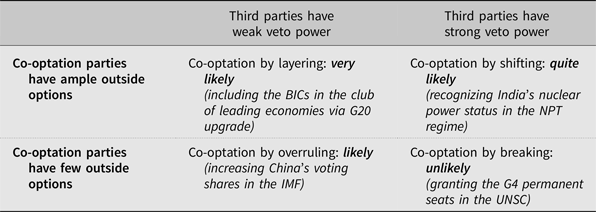
Breaking: In institutional settings where third parties have strong veto power and co-optation parties have few opportunities for co-optation outside of the institution in question, co-optation is very unlikely. Third parties are able to block any attempt at adjusting the institution in ways that give the co-optee more privileges in return for increased support, while the co-optation parties cannot simply move to another institutional venue. Locked into the institutional status quo, the only option the co-optation parties have is to break the resistance of recalcitrant third parties (Lipscy Reference Lipscy2017). Yet, breaking resistance is usually costly and, consequently, co-optation is likely to fail under such circumstances.
The failed attempt to co-opt the G4 – Brazil, India, Germany, and Japan – into permanent positions in the UNSC is illustrative. The G4's ambitions faced resistance from Italy, which opposed a permanent seat for Germany, from South Korea, which expressed opposition to a Japanese seat, from Argentina, which was opposed to a seat for Brazil, and from Pakistan, which rejected an Indian seat (Blum Reference Blum2005, 646; Schirm Reference Schirm2010). These countries organized a veto coalition to ensure that the G4's ambitions would not gain the approval it required from the UN General Assembly (UNGA). At the same time, the permanent members of the UNSC and the G4 had no outside option. In international security, especially with regard to the legitimization of peacekeeping and peace-enforcement, the UNSC has a constitutionally guaranteed monopoly (Lipscy Reference Lipscy2017). The G4 consequently tried to break resistance by offering third countries trade concessions or threatening trade sanctions to muster the necessary UNGA votes. In the end, this strategy was too costly, and the G4 had to give up their ambition of gaining permanent UNSC seats in return for their substantive support of UN peace-missions (Blum Reference Blum2005, 646; Schirm Reference Schirm2010).
Shifting: In institutional settings where reluctant third parties have strong veto power but co-optation parties enjoy broad outside options, co-optation is somewhat more likely. While recalcitrant third parties can prevent internal institutional adjustments that give co-optees additional institutional privileges, the co-optation parties may shift to another institutional venue thereby circumventing third-party resistance (Alter and Meunier Reference Alter and Meunier2009; Helfer Reference Helfer2009; Morse and Keohane Reference Morse and Keohane2014). While shifting is costly, it is typically less costly than breaking third-party resistance (Jupille, Mattli and Snidal Reference Jupille, Mattli and Snidal2013). The availability of such outside options thus reduces the costs of overcoming resistance (Lipscy Reference Lipscy2017). This renders co-optation more likely.
India's co-optation into the NPT regime provides an example. The USA – supported by the UK, France, and Russia – never really considered fully recognizing India under the NPT as a nuclear weapons state. Due to third-party resistance, the required amendment to the NPT would have had no chance of being approved, since it required the consent of 189 NPT member states. However, the wider NPT regime gave the USA and India the option to seek unofficial recognition of India as a nuclear power through an NSG waiver. The recognition of India's status as a nuclear power also met resistance in the NSG. In fact, the USA and India had to break considerable resistance from some NSG members to secure the required waiver (Varadarajan Reference Varadarajan2008). Still, by shifting from the NPT to the NSG, they were able to circumvent the bulk of the resistance to recognizing India as a nuclear weapon state. After all, the NSG had only 45 members compared with the NPT's 189. Moreover, all NSG members were developed countries with nuclear industries. These states could profit from nuclear trade with India and were thus less resistant to recognizing India as a nuclear power than the developing countries without such industries that were parties to the NPT. The latter had argued for years – as had India – that the NPT's distinction between nuclear-weapons states and non-nuclear-weapon states was discriminatory (Srivastava and Gahlaut Reference Srivastava, Gahlaut and Nayan2012, 101–102). Shifting to the NSG thus facilitated India's co-optation into the NPT regime.
Overruling: Co-optation is likely in institutional settings in which reluctant third parties have no veto power to block the co-optation parties' exchange of institutional privileges for support. This even holds when the co-optation parties have few options to engage in co-optation outside the institution in question. Overcoming third-party resistance is less costly when disregarded candidates for co-optation have no veto power that would allow them to block the co-optation agreement. Within the institution, third parties can be overruled if the co-optation parties command a constructive majority. As third parties will usually understand that, without veto power, they have little leverage, the mere threat of overruling them may be sufficient for the co-optation parties to bring them in line (Lipscy Reference Lipscy2017).
China's co-optation into the IMF leadership through an increase in its voting shares provides an example. While some European powers that stood to lose voting shares tried to prevent the required IMF reform, they did not constitute a blocking minority and thus had no veto power. Even in the absence of options outside of the IMF, the constructive majority that wanted China to be co-opted into the IMF leadership was able to push through the required reforms. The recalcitrant European powers could do little but accept the decrease in their respective voting rights. They were not in a position to stop the granting of additional voting rights in return for China's increased financial IMF support (Wade Reference Wade2011; Keukeleire and Hooijmaaijers Reference Keukeleire and Hooijmaaijers2014).
Layering: Co-optation is even more likely in an institutional setting where not only do reluctant third parties have little veto power, but co-optation parties enjoy ample options to engage in co-optation beyond the focal institution. These settings offer co-optors and co-optees very good opportunities to overcome third-party resistance. They may simply overrule recalcitrant third parties; alternatively, they may shift to another institution. However, both overruling and shifting typically create costs. Shifting creates transaction costs and undermines the original institution's authority; overruling typically alienates overruled third parties and may thus create legitimacy costs. To minimize these costs, co-optation parties may go for layering to overcome third-party resistance. Layering implies that the co-optee gains institutional privileges within the original institution, rather than in an outside institution to which the co-optation parties have shifted. However, instead of pushing through a conversion of existing institutional structures, new institutional structures are layered on top of the existing ones (Mahoney and Thelen Reference Mahoney, Thelen, Mahoney and Thelen2010). In this way, co-optees can gain institutional privileges without taking pre-existing privileges away from other actors.
Arguably, the co-optation of the BICs into the core leadership of global economic governance in 2008 was easy to achieve because candidate co-optees such as Switzerland and Singapore had no veto power to block the concomitant upgrading of the G20. Moreover, the G7 had several options available. Instead of upgrading the G20 from a forum of finance ministers to a forum of heads of government or state, they could have enlarged the membership of the existing G7. Alternatively, an entirely new group could have been created to complement both the G7 and the G20. In the end, they decided to layer an upgraded G20 on top of the pre-existing forum of finance ministers. Layering was less costly than the alternatives, as it saved the G7 from discussions about who should become a member of their exclusive club. Through the decision to upgrade the G20, the membership issue was automatically settled (Cooper Reference Cooper2010; Cooper and Thakur Reference Cooper and Thakur2013).
Overall, our co-optation theory highlights that institutional adjustments to global power shifts often do not simply require the consent of established and emerging powers. Third-party resistance may cause them to fail. Emerging and established powers' institutional opportunities to overcome their resistance, thus, have a strong impact on the probability of strategic co-optation.
Unintended consequences: dynamic instabilities of strategic co-optation
Co-optation is a strategy used to stabilize order in the face of fundamental challenges and it can remain stable over time. Bismarck's co-optation of the Catholic and Protestant churches into the German nation-state after the so-called Kulturkampf in the 1870s is still in place today. Similarly, the co-optation of labor unions and employer associations into European welfare states lasted for about five decades. The stability of these co-optation arrangements is easy to explain. Like any institution, co-optation gains endogenous stability through lock-in effects and increasing returns. From this institutionalist point of view, co-optation becomes harder and harder to overthrow and thus more and more stable over time (Pierson Reference Pierson2000).
While not denying that co-optation arrangements can remain stable over time, our theory of strategic co-optation claims that co-optation arrangements do, at times, become unstable. The exchange of institutional privileges for institutional support is not always self-stabilizing; sometimes it proves to be self-undermining. Paradoxically, the success of co-optation can lead to its failure (cf. Abbott et al. Reference Abbott, Genschel, Snidal and Zangl2019). Co-optation occasionally has unintended consequences that may, over time, contribute to its destabilization. In what follows we discuss how the support provided by the co-optee on the one hand and the privileges granted to it on the other may feed unintended consequences that undermine the stability of the initial arrangement.
Support-driven instability
Paradoxically, the support provided by the co-optee may ultimately destabilize the co-optation arrangement that initially gave rise to it. The more that support contributes to overcoming the fundamental challenge that provided the rationale for the co-optor and the co-optee to engage in co-optation, the more co-optation contributes through various feedback loops to its own demise. Depending on whether support from the co-optee is able to resolve the fundamental challenge entirely or merely contain it temporarily, different kinds of endogenous instabilities may emerge:
(1) If support from the co-optee resolves rather than simply contains the fundamental challenge, the co-optor is likely to resile from the initial arrangement. In this case, the co-optor's need for continued support from the co-optee diminishes. The less the co-optor requires support, the more it gains leverage over the co-optee and may push for the rescission of the institutional privileges that the co-optee gained through co-optation. The initial co-optation deal comes under pressure, because, thanks to its success in mobilizing support for overcoming the fundamental challenge, the co-optor can do without the co-optee. For example, the USA co-opted the Kurds in Syria to provide support in its war against the so-called Islamic State. However, once it considered this war to be won, the Trump administration was no longer prepared to protect the Kurds against the Syrian and Turkish armies (Nordland Reference Nordland2018).
This support-driven feedback, which provides the co-optor with leverage over the co-optee, is also relevant to co-optation in the wake of the current global power shifts. Among other things, the BICs were co-opted into the core leadership of global economic governance to cope with the challenges of the 2008 global financial crisis (Cooper Reference Cooper2010; Cooper and Thakur Reference Cooper and Thakur2013). However, once the BICs and other emerging economies had contributed to getting the financial crisis under control, they were no longer needed to the same extent. The G7 was unable to officially downgrade the G20 and thus rescind the BICs' privilege of membership in the leadership group of global economic governance. Nonetheless, they began re-emphasizing and upgrading the G7's status as the key forum of global economic governance. With the re-emergence of the G7, the co-optation arrangement has been at least partially undone.
(2) However, institutional support does not necessarily contribute to the restoration of the co-optor's dominance. If the support provided by the co-optee proves enough to contain, but not resolve, the fundamental challenge that motivated the initial co-optation deal, the co-optee may resile from the existing co-optation arrangement. Containing the challenge implies that the co-optor continues to need support, so the co-optee will gain leverage to push for a revised co-optation deal with additional institutional privileges. This is all the more likely if the co-optor becomes accustomed to the co-optee's support and less able or willing to mobilize support from elsewhere. The initial co-optation deal comes under pressure, because the co-optor can – and probably will – push for more and more privileges. This may lead to the point where the co-optor has no more privileges left to grant. The Holy Roman Empire provides an example. To deal with challenges to his authority, the Emperor continuously had to co-opt some of the princes by giving them control over additional territories as fiefdoms. However, not only was the amount of territory he could give out limited, but, through the increase in the territory they controlled, the princes gained greater power to contest the Emperor's authority, which in turn increased the Emperor's need for support. The more he needed support, the more the princes gained leverage to push for more privileges in return until, finally, one of the princes was powerful enough to capture the crown (Wilson Reference Wilson2016).
This support-driven feedback, which gives leverage to the co-optee, is relevant for co-optation in the wake of the current global power shifts as well. For example, the more China has been co-opted into the US-led global financial order that is bolstered by the IMF and other institutions, the more the USA and other established powers have become dependent on Chinese support in managing the global financial system – not only in times of crisis but also in ‘normal’ times. Consequently, China is positioned to gain ever more procedural and substantive privileges in the IMF and other global financial institutions. Examples of newly gained Chinese privileges include a more favorable IMF surveillance system (Zangl et al. Reference Zangl, Heußner, Kruck and Lanzendörfer2016) and IMF recognition of the legitimacy of capital controls (Chwieroth Reference Chwieroth2014), and of the Chinese currency, the Renminbi, as one of the institution's reserve currencies. This underlines how institutional support may give emerging powers leverage over established powers and thus destabilize the initial co-optation arrangement.
Privileges-driven dynamics
It is not only the institutional support provided by the co-optee, but also the institutional privileges it gains that may ultimately destabilize the co-optation arrangement that prompted the granting of these privileges. The privileges initially have a stabilizing effect as they give the co-optee a stake in maintaining the order and in providing the support the co-optor seeks. However, over time, the more the interests of the co-optor and the co-optee converge on maintaining the extant order and its underpinning institutions, the greater the risk that third parties perceive the co-optor and co-optee as an elite cartel that uses the existing order and its institutions to dominate them politically or exploit them economically (Lazar Reference Lazar and Lazar2017). Over time, this feedback may intensify third-party resistance and broaden it well beyond the initial resistance of disregarded candidates for co-optation. Co-optation may even breed (more) resistance among the constituencies of both co-optation parties (Dickson Reference Dickson2000), reducing the overlap of their ‘win-sets’ (Putnam Reference Putnam1988) and thus endangering the continuation of the original co-optation arrangement (Bolliger and Zürcher Reference Bolliger and Zürcher2004, 62–63).
(1) The institutional privileges co-optees gain through co-optation may drive a wedge between them and their own constituencies (Bolliger and Zürcher Reference Bolliger and Zürcher2004, 62–63; Lake Reference Lake2016). The more institutional privileges they gain, the more they run the risk of their own constituencies regarding them as part of a distant elite cartel (Dickson Reference Dickson2000). They may be conceived as being focused on their institutional privileges and losing touch with their constituencies. For instance, union leaders co-opted by the state are no longer seen as representing the workers (Lazar Reference Lazar and Lazar2017), while local state-builders co-opted by foreign powers are no longer considered as representing the local population (Lake Reference Lake2016). In these cases, the institutional privileges for group leaders drive a wedge between privileged co-optees and the ordinary group members they are expected to represent. This may endanger existing co-optation arrangements if radicalized constituencies become unwilling to follow their co-opted leaders or if these leaders feel the urge to reduce their support for the existing order to show loyalty to their radicalized constituencies.
This privileges-driven feedback is also relevant for co-optation in the wake of the current global power shifts. For example, China's co-optation in the mid-2000s following the inclusion of Brazil and India into the WTO core negotiation group – the so-called Quad – did not placate developing countries' criticism of illegitimate WTO procedures (Hopewell Reference Hopewell2015; Zangl et al. Reference Zangl, Heußner, Kruck and Lanzendörfer2016). Quite the opposite! Developing countries expected China to act as a genuine representative of their concerns in the WTO. When they learned that China was ready to strike deals with the USA and the EU in closed-door negotiations rather than advocate for their concerns, criticism of illegitimate WTO procedures intensified among developing countries. China, India, and Brazil were criticized for betraying their constituencies: they had relied on their role as the voice of developing countries to get into the privileged inner circle of WTO decision-making, but ceased to represent developing countries' interests once they were in the club. The emerging powers then sought to redress the alienation of their constituencies by taking a more confrontational stance towards established powers. This, in turn, put a strain on the Doha Round negotiations, thereby endangering the initial co-optation deal which was meant to overcome the blockade at the Doha Round (Hopewell Reference Hopewell2015; Zangl et al. Reference Zangl, Heußner, Kruck and Lanzendörfer2016).
(2) The institutional privileges granted to a co-optee may not only drive a wedge between it and its constituency, but they can also alienate the constituencies of the co-optor (Dickson Reference Dickson2000). The more co-optors grant institutional privileges to their co-optees, the greater the risk that their constituencies will perceive them as engaging in dodgy deals (Bolliger and Zürcher Reference Bolliger and Zürcher2004, 62–63). This risk is particularly severe when co-optors co-opt leaders of groups that are strongly opposed by their own constituencies. For example, governments in young democracies run the risk of being considered traitors by their voters if they co-opt police chiefs who collaborated with authoritarian governments in the past (Fichtelberg Reference Fichtelberg2018). In such cases, the granting of institutional privileges to leaders of groups to whom the co-optor's constituencies are in stark opposition may drive a wedge between the co-opting politicians and their constituencies. This is likely to endanger existing co-optation arrangements if radicalized constituencies are no longer willing to support them or if leaders feel that they have to reduce the institutional privileges given to co-optees or force them to increase their support to rein in their radicalized constituencies.
This privileges-driven instability is also relevant for co-optation in the wake of the ongoing global power shifts. One may argue, for instance, that the decades-long co-optation of lesser powers into the US-led world order has contributed to growing anti-internationalist sentiments in the USA (Lake Reference Lake2009; Zürn Reference Zürn2018). In this view, increasing sections of the USA electorate have become increasingly opposed to the costly granting of institutional privileges to an expanding number of allies, whom they often perceive as either contributing too little support for the US-led order or as being in opposition to American values or interests. In the wake of the current power shift, the American electorate's uneasiness with the US-led order has fed into US President Trump's allegations that, in the context of international institutions, some of his predecessors acted in the interests of America's international allies, with whom they formed an internationalist liberal elite cartel, instead of acting in America's own best interests (Toma Reference Toma2018). His ‘America First’ foreign policy can thus be seen as the attempt to retrench the co-optation arrangements that backed the US-led world order and its institutions.
In sum, while strategic co-optation is subject to endogenous stabilities, it is also exposed to endogenous instabilities. While not denying – and in fact assuming! – that co-optation is often stable over time, we highlight that both institutional support from, and institutional privileges for, emerging powers may undermine the initial co-optation arrangement. However, as of now, the conditions under which these endogenous instabilities override co-optation's endogenous stability remain subject to further research.
Strategic co-optation beyond global power shifts
Drawing on several isolated accounts of strategic co-optation from other domains – domestic and international, autocratic and democratic, past and present – we have developed a theory of strategic co-optation as a mode of institutional adaption to shifts in the global distribution of power. Our theory differs in important ways from extant PSTs of liberal (integrationist) or realist (accommodationist) origin (see Table 4):
Three approaches to institutional adjustments to global power shifts
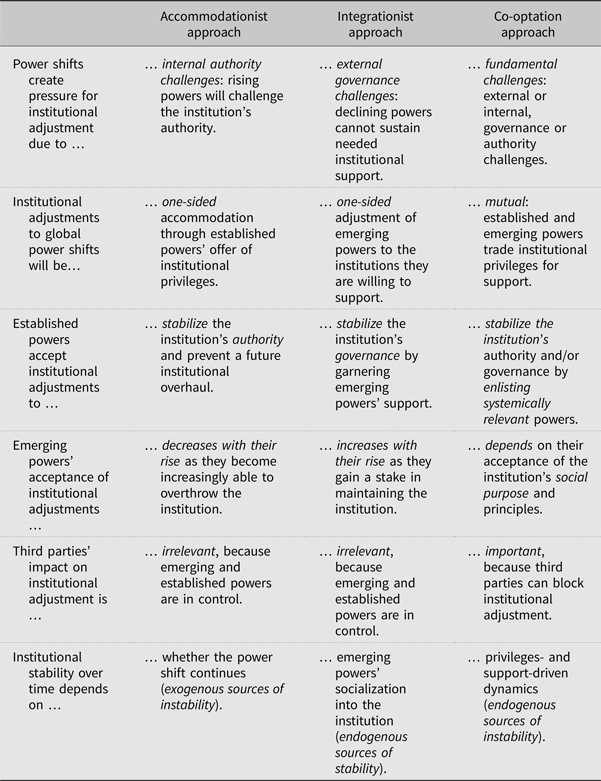
Conceptually, we have highlighted that institutional adjustments through co-optation imply that established and emerging powers trade institutional privileges for institutional support. Unlike accommodationist approaches, which focus on how established powers have to accommodate emerging powers through institutional privileges (Paul Reference Paul and Paul2016), and integrationist approaches, which underline that emerging powers adjust themselves to the existing order (Ikenberry Reference Ikenberry2009, Reference Ikenberry2011a, Reference Ikenberryb), our co-optation theory emphasizes their mutual adjustment.
Our theory highlights three conditions as causes of strategic co-optation:
• Fundamental challenge: Co-optation is only possible if there is a fundamental challenge to the existing order. Yet, in contrast to accommodationist and integrationist PSTs, our institutionalist theory grasps the broad range of challenges that an institutional order may face. While accommodationists identify internal authority challenges (Kirshner Reference Kirshner2012; Paul Reference Paul and Paul2016) but overlook both external and governance challenges, integrationists seem to assume that external governance challenges are of paramount importance (Ikenberry Reference Ikenberry2009; Reference Ikenberry2011a; Reference Ikenberryb) while ignoring both internal challenges and challenges to authority. We, on the other hand, consider the full set of relevant challenges – to authority and governance as well as internal and external.
• Co-optee availability: Co-optation is only likely if there are both willing and able co-optees. However, in contrast to many PST contributions, our co-optation theory conceives the systemic relevance of emerging powers (i.e. their ability) and their agreement with the social purpose of the existing order (i.e. their willingness) as – at least partly – independent of each other. Accommodationist PSTs assume that the more powerful, and consequently able, emerging powers are, the less willing they will be to stabilize the order (Schweller and Pu Reference Schweller and Pu2011). Integrationist PSTs presume that the more capable emerging powers become, the more of a stake they have in sustaining the order and the more willing they will be to contribute to stabilizing it (Ikenberry Reference Ikenberry2009; Reference Ikenberry2011a; Reference Ikenberryb). By contrast, we argue that emerging powers' willingness to stabilize the order cannot simply be derived from their power and thus their ability to do so. Their ability and their willingness have to be assessed empirically and independently of each other.
• Third-party resistance: Co-optation is only likely if the institutional setting allows the co-optation parties to overcome third-party resistance. Unlike existing PSTs – both accommodationist and integrationist – our theory highlights that institutional adjustments to shifts in the global distribution of power often require more than just the consent of established and emerging powers. Due to third-party resistance, such adjustments may fail even in cases where emerging and established powers agree. Therefore, we have specified the institutional conditions under which it is likely that resistance to institutional adjustments can be overcome.
Furthermore, with regard to the (unintended) consequences of strategic co-optation, our theory diverges from both accommodationist and integrationist PSTs in that it sheds light on endogenous dynamics leading to instability. Integrationist PSTs argue that, through integration, emerging powers will be progressively socialized into an existing order that was created and maintained – and is still dominated – by established powers. They thus underline endogenous sources of stability (Ikenberry Reference Ikenberry2009, Reference Ikenberry2011a, Reference Ikenberryb). Accommodationist PSTs highlight the fact that established powers' accommodation of emerging powers will likely stabilizes the order only temporarily (Kirshner Reference Kirshner2012). If the current power shift continues, today's accommodation will come under pressure tomorrow. Hence, they underline exogenous sources of instability. While we agree with both accounts, our theory also identifies endogenous sources of instability.
Strategic co-optation is neither omnipresent nor a panacea for adapting international institutions to global power shifts. But it is important enough to warrant its own approach. Theoretically coherent and conducive to empirical assessment, our co-optation theory paves the way to a systematic analysis of strategic co-optation in the wake of global power shifts.
Here we have merely tried to illustrate, through a variety of examples, that the theory is well placed to shed light on how international institutions adapt to shifts in the global distribution of power. Yet, to rigorously and comprehensively assess the theory, more comparative research is required that studies international institutions that are subject to global power shifts. One way of doing this would be to study international institutions in which, in the context of the current global power shift with the rise of China and the relative decline of the USA, one of our conditions – fundamental challenge, co-optee availability, third party resistance – varies over time and check whether this has the expected effect with regard to institutional adjustment. Another way to assess our theory would be to rely on a systematic comparison across a variety of international institutions in which China has risen and the USA has experienced relative decline. One would have to assess whether institutional adjustment is significantly more frequent in those institutions in which the conditions specified by our theory – fundamental challenge, co-optee availability, institutional opportunities to overcome third party resistance – are present.
Finally, yet another way to assess our theory would be to apply it even in political domains beyond the adjustment of international institutions to global power shifts. As the above examples ranging from authoritarian regimes to corporatist arrangements and colonial empires suggest, our theory might well be suitable to explain the adjustment of all kinds of institutionalized settings in which dominant actors are facing power shifts that favor other actors. In all these settings, granting privileges in return for rising actors' institutional support appears as a rational strategy with which dominant actors can seek to stabilize the institutional status quo. And in all these settings co-optation seems to depend on whether existing institutions face a fundamental challenge to their authority or governance, whether rising actors are both systemically relevant for the institution and in agreement with its social purpose, and whether third parties have the opportunity to block the institutional adjustments that any co-optation deal between declining and rising actors entails. Applying our theory to instances of co-optation beyond the domain of institutional adaptation to global power shifts thus promises new analytical insights on the relevant phenomena and considerably enhances the reservoir of cases that could be used to test our theory.
Acknowledgments
We thank the editors of IT, the anonymous reviewers, Martin Binder, Philipp Genschel, Tim Heinkelmann-Wild, Christian Kreuder-Sonnen, and the participants of workshops and research colloquia in Berlin, Florence, Freising, and Munich for their very helpful comments on earlier versions of this paper.


 Open access

