


1. Introduction
To combat climate change, companies are increasingly committing to absolute sustainability targets, such as those validated by the Science Based Targets Initiative (SBTi, 2024), which demand absolute (rather than relative) reductions in greenhouse gases emissions (Reference Bjørn, Tilsted, Addas and LloydBjørn et al., 2022). Achieving these “net-zero” goals often demands significant business transformation and radical innovation across product life cycles and entire value chains (Reference Kennedy, Whiteman and van den EndeKennedy et al., 2017).
However, despite companies’ well-intended efforts to design and market products and services with enhanced sustainability performance, the radical innovations required to meet absolute targets (hereafter Science-Based Targets, or SBT) are noticeably prone to rebound effects (Reference Miller and KeoleianMiller & Keoleian, 2015). Rebound effects are negative consequences of innovations triggered by behavioural and systemic changes that offset ca. 50% of potential sustainability gains (Reference Andrew and PigossoAndrew & Pigosso, 2024; Reference HertwichHertwich, 2005).
While academic and policy knowledge of rebound effects is growing (Reference Castro, Trevisan, Pigosso and MascarenhasCastro et al., 2022; Reference Font Vivanco, Freire-González, Galvin, Santarius, Walnum, Makov and SalaFont Vivanco et al., 2022; Reference Guzzo, Andrew, Loo, Sanyé-Mengual, Listorti and PigossoGuzzo et al., 2025; Reference Metic and PigossoMetic & Pigosso, 2022), companies themselves largely lack awareness and a structured process to anticipate and prevent rebound effects in practice (Reference PigossoPigosso, 2024). This creates a critical gap: without a method to integrate rebound effect anticipation into the design process, companies risk failing to meet their own SBT.
This study addresses this gap by demonstrating a structured approach for anticipating and preventing rebound effects by design within a manufacturing context. Through an action research methodology (Reference Coughlan and CoghlanCoughlan & Coghlan, 2002), the identification, modelling, and prevention of potential rebound effects are explored in an early-stage sustainability-driven product design initiative.
The research was conducted at Beiersdorf, a leading skin care company, renowned for brands like NIVEA and Eucerin (Beiersdorf, 2024). Beiersdorf has committed to ambitious SBT as part of their sustainability transition plan, aiming at a 50% emission reduction by 2032 in their consumer business segment and 90% reduction by 2045, considering Scopes 1, 2, and 3 (Beiersdorf Climate Transition Plan, 2024). A key innovation strategy to meet these targets is the development of circular product innovation, such as refillable packaging (Beiersdorf Climate Transition Plan, 2024), which is susceptible to rebound effects that could offset planned emission reductions (Reference Zink and GeyerZink & Geyer, 2017).
This paper identifies specific rebound effects associated with refillable packaging and explores design strategies to counteract them. Finally, we offer transferable insights into how rebound effect analysis can be practically integrated into the design processes of manufacturing companies to help secure absolute sustainability goals.
2. Background literature
2.1. Rebound effects, mechanisms, and dynamics
Rebound effects are driven by specific economic, behavioural, and social mechanisms, defined as the causal processes triggered by sustainability interventions that can lead to the offset of sustainability gains (e.g., increased resource consumption) (Reference Guzzo, Walrave, Videira, Oliveira and PigossoGuzzo et al., 2024; Reference Lange, Kern, Peuckert and SantariusLange et al., 2021). While initially rooted in neoclassical economics theory, the understanding of rebound effects has expanded to include behavioural science (Reference Corona, Tunn and van den BroekCorona et al., 2024) and social practice theory (Reference Niero, Jensen, Fratini, Dorland, Jørgensen and GeorgNiero et al., 2021) perspectives to explain the individual and societal mechanisms underlying rebound effects.
Identifying and understanding how to influence these mechanisms early in the design process is critical for rebound effect prevention (Reference Colmenares, Löschel and MadlenerColmenares et al., 2020; Reference Metic and PigossoMetic & Pigosso, 2022). Designers, however, struggle to anticipate these often counter-intuitive effects, as they are difficult to model with standard design for sustainability tools like Life Cycle Assessment (LCA) (Reference Font Vivanco and van der VoetFont Vivanco & van der Voet, 2014; Reference Guzzo, Walrave, Videira, Oliveira and PigossoGuzzo et al., 2024).
While tools for handling rebound effects in design are emerging (Reference Das, Konietzko, Bocken and DijkDas et al., 2023; Reference Schultz, Valentinov, Reinhardt and PiesSchultz et al., 2024), they remain inadequate for supporting the entire design process, from identifying potential causes (i.e., mechanisms) to guiding re-design initiatives for prevention of rebound effects. This gap highlights the need for more systemic and systematic methods. Among promising approaches are modelling and simulation methods, such as system dynamics, better suited to capturing the complex feedback loops inherent to production and consumption systems (Reference Guzzo and PigossoGuzzo & Pigosso, 2024; Reference Metic, Guzzo, Kopainsky, McAloone and PigossoMetic et al., 2024).
2.2. Refillable packaging, sustainability, and user behaviour
Reusable and refillable packaging represent a key circular innovation to replace single-use consumables, with the stated aim of reducing resource consumption and environmental impacts. In the skin care and cosmetics sector, companies like L’Oréal Group and Beiersdorf itself have explored refills, claiming benefits such as increased consumer convenience and 50–90% reductions in packaging materials (Beiersdorf, 2024; L’Oréal, 2025). Existing LCA studies of refill systems support these claims, showing potential reductions of around 50% in environmental impacts like greenhouse gas emissions (Reference Greenwood, Walker, Baird, Parsons, Mehl, Webb, Slark, Ryan and RothmanGreenwood et al., 2021).
These environmental benefits, however, are dependent on individual and social behaviour. The actual environmental gain from a refill system is correlated to the number of times the packaging is reused, a factor heavily influenced by consumer habits (Reference Herweyers, Du Bois and MoonsHerweyers et al., 2023). This concept, known as the Environmental Break-Even Point, varies wildly depending on the specific product, refill system, and consumer profile towards sustainability (Reference Miao, Magnier and MuggeMiao et al., 2025). As skincare and cosmetics are deeply tied to culture, habits, and perception (Reference Kazançoğlu, Köse and ArslanKazançoğlu et al., 2024), social practices and individual behaviour are key to understanding both the adoption of these innovations and potential rebound effects.
Research on rebound effects specifically for refillable packaging, however, is scarce. While a few studies have explored rebounds in other reuse contexts (e.g., textiles, electronics, furniture), they have focused primarily on economic mechanisms, such as income effects, sometimes estimating rebound magnitudes of over 100%, indicating a backfiring effect (Reference Bubinek, Knaack and CimpanBubinek et al., 2025; Reference Makov and Font VivancoMakov & Font Vivanco, 2018). Little is known about the magnitude of behavioural and social practice rebound effects, due to the heavy reliance on economic mechanisms for explaining rebound of reuse strategies in consumables.
3. Method
Beiersdorf has been investigating refill as a format shift initiative to potentially help reach climate SBT (Beiersdorf Climate Transition Plan, 2024). The motivation for this study from the company’s point of view is two-fold: (1) to ensure achievement of the full sustainability potential and avoid a backfiring effect of the planned refill format shift; and (2) to gather a deeper understanding of which consumer behaviour aspects are relevant for further studies. As a first exploration of rebound effects in the company, a refill-at-home product (in development) was chosen as a pilot case.
Action research was adopted as the main methodological framework of the study (Reference Coughlan and CoghlanCoughlan & Coghlan, 2002). Action research is well-suited in bridging theoretical insights (i.e., state-of-the-art rebound research) and practical contexts (i.e., innovation processes at Beiersdorf), as an iterative approach facilitating data access and participatory validation through collaboration with company stakeholders.
While action research follows an usual cycle (i.e., data gathering, analysis, action planning, taking action, and evaluation (Reference Coughlan and CoghlanCoughlan & Coghlan, 2002)), the study operationalises this cycle through three sequential phases adapted from the reboundless design framework proposed by (Reference PigossoPigosso, 2024): (1) Identification of rebound mechanisms, (2) Modelling the system, and (3) Prevention of rebound effects through design. The relationship between the action research cycle and the three phases are illustrated in Figure 1 and further detailed below.
-
1. Identification: the aim of the first phase of the project was to identify the mechanisms that could explain potential rebound effects triggered by the introduction of the new refill product that would substitute existing single-use packaging. Data was gathered through documental analysis (e.g., product description, consumer studies), scoping literature reviews (e.g., environmental impacts of refill, factors that drive adoption of refill systems), and interviews with Beiersdorf employees (n=14, including functions such as packaging design, supply-chain, marketing, sustainability, R&D, etc.). The data was used to identify system and behaviour changes that could be induced by the new refill product (e.g., increased cost to consumer, decreased perception of convenience). Rebound mechanisms were identified from these induced changes via a catalogue of rebound mechanisms from economics theories (Reference Guzzo and PigossoGuzzo & Pigosso, 2024), behavioural science (Reference Van der Loo and PigossoVan der Loo & Pigosso, 2024), and social practice pathways (Reference Andrew, Sonnberger and PigossoAndrew et al., 2025). The phase concluded with a workshop where these mechanisms were validated by Beiersdorf stakeholders, resulting in a prioritised list for further investigation.
-
2. Modelling: the selected mechanisms were then modelled as causal loop diagrams (CLD), a graphical representation of the production and consumption system (Reference LaneLane, 2000). With the support of large language models, the individual mechanism-focused CLDs were instantiated to the specific refill pilot case and then combined into a system-wide CLD, forming a complete causal map linking the refill innovation to system behaviour changes that ultimately lead to increased resource consumption (i.e., rebound effects). Through structural analysis of the model, key variables of the system were identified (e.g., price of the refill unit, level of effort demanded of consumers). In a second validation workshop, the model and key variables were presented to Beiersdorf stakeholders, resulting in the prioritisation of mechanisms and the identification of leverage points under the control/influence of Beiersdorf for intervening in the system and potentially preventing the occurrence of rebound effects.
-
3. Prevention: finally, moving towards the final steps of the action research framework, the prioritised mechanisms were used in combination with prevention strategies identified from literature (Reference Mckay, McAloone and PigossoMckay et al., 2026; Reference Miao, Magnier and MuggeMiao et al., 2024) to create new concepts for the refill product that are resilient to rebound effects. Through a workshop, Beiersdorf representatives were involved in the evaluation and selection of prevention strategies, contributing with their domain-specific knowledge to select the most viable solutions.
Action research framework and main activities conducted in the study for the identification, modelling, and prevention of rebound effects

4. Findings
4.1. Identification of rebound mechanisms
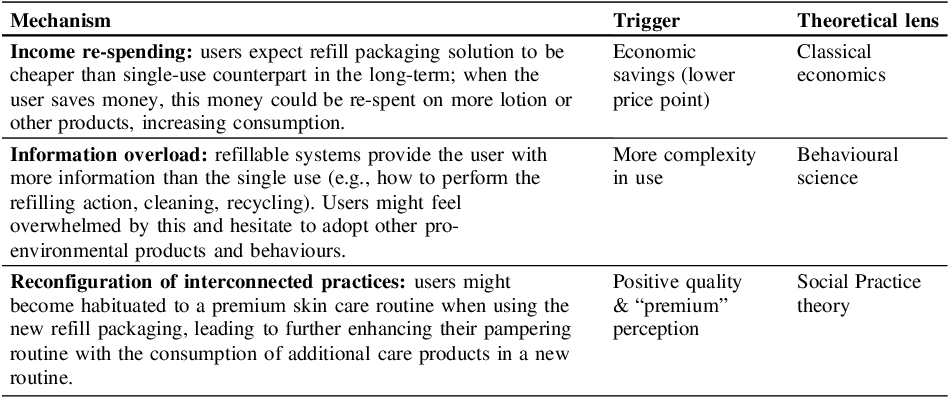
A total of 31 rebound mechanisms were identified in the first phase. Table 1 lists a sample of the mechanisms and related triggers (i.e., induced changes of the introduction of refill). Almost half of the mechanisms (n=14) stem from social practice theory, while fewer were linked to classical economics (10) and behavioural sciences (7).
A sample of identified potential rebound mechanisms and related triggers

A key insight from the validation workshop was that identifying these mechanisms during the early design phase is exceptionally challenging and dependant on assumptions. This identification process is inherently uncertain due to the future-looking nature of rebound anticipation in design and highly reliant on assumptions as it requires designers to predict complex causal chains tied to future consumer preferences and behaviours linked to a yet-to-be-launched product. While some assumptions could be supported by data (e.g., internal consumer research, published surveys) and triangulated (i.e., agreement across multiple data sources), many of the identified mechanisms were, by necessity, based on assumptions with relatively weak initial evidence. It was much easier for participants to understand and prioritise triggers, rather than mechanisms directly, as triggers are more closely connected to the intervention in the causal chain of events (Reference Guzzo and PigossoGuzzo & Pigosso, 2024).
4.2. Modelling the system through causal loop diagrams
A qualitative system dynamics model (Figure 2) was developed to understand and communicate how the mechanisms relate to, intensify, and balance each other, towards understanding potential leverage points for rebound effect prevention.
Section of the system-wide causal loop diagram, highlighting the moral licensing mechanisms and its interconnections for the case of refill packaging

One of the main insights from the system model validation workshop was the perceived ability of company stakeholders to influence key variables in the system (e.g., price, marketing strategy), highlighting potential levers for design and strategic decisions. This suggest that Beiersdorf as a company might be able to influence rebound mechanisms (and potentially prevent them) to a large extent, through design and other business decisions.
However, the analysis of the system-wide CLD also revealed clear trade-offs between actions that could potentially prevent rebound effects and the goal of driving innovation adoption. As an example, the “income re-spending” mechanism (Table 1) could be avoided if the refill were priced at the same of a similar price point as the single-use packaging. Yet, according to stakeholders, this could severely undermine refill adoption and overall sales. This and other similar trade-offs highlighted a central tension between preventing rebound effects and achieving core business goals.
4.3. Prevention of rebound effects through design
Building on the system analysis and prioritized mechanisms, the project’s final phase focused on developing new refill packaging concepts designed to prevent rebound effects. Prevention strategies were identified and combined, which formed the basis for synthesizing new, tangible packaging concepts. Finally, a co-design workshop with Beiersdorf stakeholders was conducted to evaluate the feasibility and desirability of the proposed concepts and strategies.
The following examples illustrate some of the potential strategies, each targeting rebound mechanisms representing the three theoretical lenses:
-
• Dynamic pricing. This strategy would involve launching the refill at an introductory low price before aligning it with (or slightly above) the single-use product’s price after adoption. This approach targets two mechanisms: re-spending effect (see Table 1), by eliminating long-term cost savings, the strategy prevents consumers from re-spending savings on other goods or services; and producer demand adjustment, as it creates a competitive force that discourages competitors from moving into the single-use market to exploit lower raw material prices, thereby encouraging an industry-wide shift to refill.
-
• Brand storytelling. This strategy would emphasise intrinsic motivation and a sense of belonging to a responsible skin care community. It counteracts moral licensing rebound mechanisms (see Table 1), by communicating a sense of identity and reinforcing social norms around refill, rather than marketing feelings of accomplishment, avoiding a situation in which consumers collect moral credits when purchasing or using refill packaging.
-
• Inclusion of ritual elements. This strategy integrates elements into the skin care routine that would shift social practices toward non-material forms of consumption. It tackles both mechanisms of reconfiguration of interconnected practices (see Table 1) and needs satisfaction (i.e., feeling that the new product does not satisfy consumers’ care needs as much as single use, due to increased complexity, for example), by integrating elements that reinforce the care and pampering routine, without promoting further consumption.
These strategies clearly encompass factors beyond the traditional scope of designers and engineers, which do not normally include pricing strategy, marketing, and branding. This indicates that while businesses can prevent rebound effects, success might require a combination of strategies and competencies that extend beyond technical decisions. Furthermore, the strategies could be operationalised in many ways (e.g., ritual elements could be implemented via packaging affordances, or labelling, or other marketing activities) and applied either individually or in combination. In the examples shown above, each strategy reflects a single theoretical lens; this is not mandatory, as prevention strategies can tackle many mechanisms at the same time, and that would indeed be the case if the example strategies were applied simultaneously.
5. Discussion
A central finding of this study is that manufacturing companies can identify and actively prevent rebound effects in an ex-ante manner, through strategic design choices and other business decisions. This directly challenges the prevailing consensus in the literature, which has largely emphasized policy interventions as the primary mitigation mechanism (Reference Castro, Trevisan, Pigosso and MascarenhasCastro et al., 2022). The modelling phase results substantiate this claim, demonstrating that companies often exercise direct control or influence over the key variables that trigger rebound mechanisms. This strengthens the argument that company-level actions, particularly in design, are a viable and crucial component of rebound effect prevention.
Furthermore, a key implication of this study is that effectively anticipating rebound effects requires organisational awareness and maturity that transcends traditional engineering roles, such as R&D and packaging design. Our study reveals that relevant data for identifying and modelling rebounds (e.g., consumer behaviour and market dynamics) spans multiple departments, including marketing, business strategy, and design units, highlighting the need for cross-functional collaboration. Consequently, effective prevention strategies often demand a synthesis of technical design choices with broader business model or value chain innovations. While prior research has already advocated for including diverse perspectives in anticipatory design assessment (Reference Parolin, McAloone and PigossoParolin et al., 2024), the current study highlights that this recommendation holds - and may even be more important - when analysing the system-wide effects of design, such as rebounds.
The study also indicates the value of a coupled design-systems thinking approach to tackle complex issues in design for sustainability, such as rebound effects. This synthesis proved effective by combining the tangible, engagement-focused methods of design, such as interactive workshops and the development of contextualized prevention strategies, with the analytical rigor of systems thinking. The latter provided a systematic framework for mapping mechanisms, developing models to ground complexity through CLD, and identifying leverage points for intervention. Although combining design and systems thinking is not a new concept (Reference Greene, Gonzalez, Papalambros and McGowanGreene et al., 2017), the action research showcases how effective this combination can be for both rebound effect research and practice.
5.1. Insights from the refillable skincare case
The specific product design that was analysed in this study served primarily to demonstrate the proposed rebound anticipation and prevention approach, but it also yielded insights regarding rebound effects for refill packaging. Although refillable products show clear potential for environmental impact reduction (Reference Greenwood, Walker, Baird, Parsons, Mehl, Webb, Slark, Ryan and RothmanGreenwood et al., 2021), our analysis confirms their susceptibility to rebound effects. For instance, strong consumer expectations for a lower price point compared to single use (Reference Kazançoğlu, Köse and ArslanKazançoğlu et al., 2024) create a direct trigger for income-driven rebound effects (Reference Bubinek, Knaack and CimpanBubinek et al., 2025). Similarly, the common perception of refills as a “green” option, particularly among environmentally conscious market segments (Reference Herweyers, Du Bois and MoonsHerweyers et al., 2023), is a potential trigger for moral licensing and related behavioural rebounds. As previously discussed, skin care is highly dependent on and connected to social practices, leading to potential rebound pathways when these practices are re-configured with the introduction of innovations.
5.2. Implications for practice: anticipating rebound effects in early-stage design
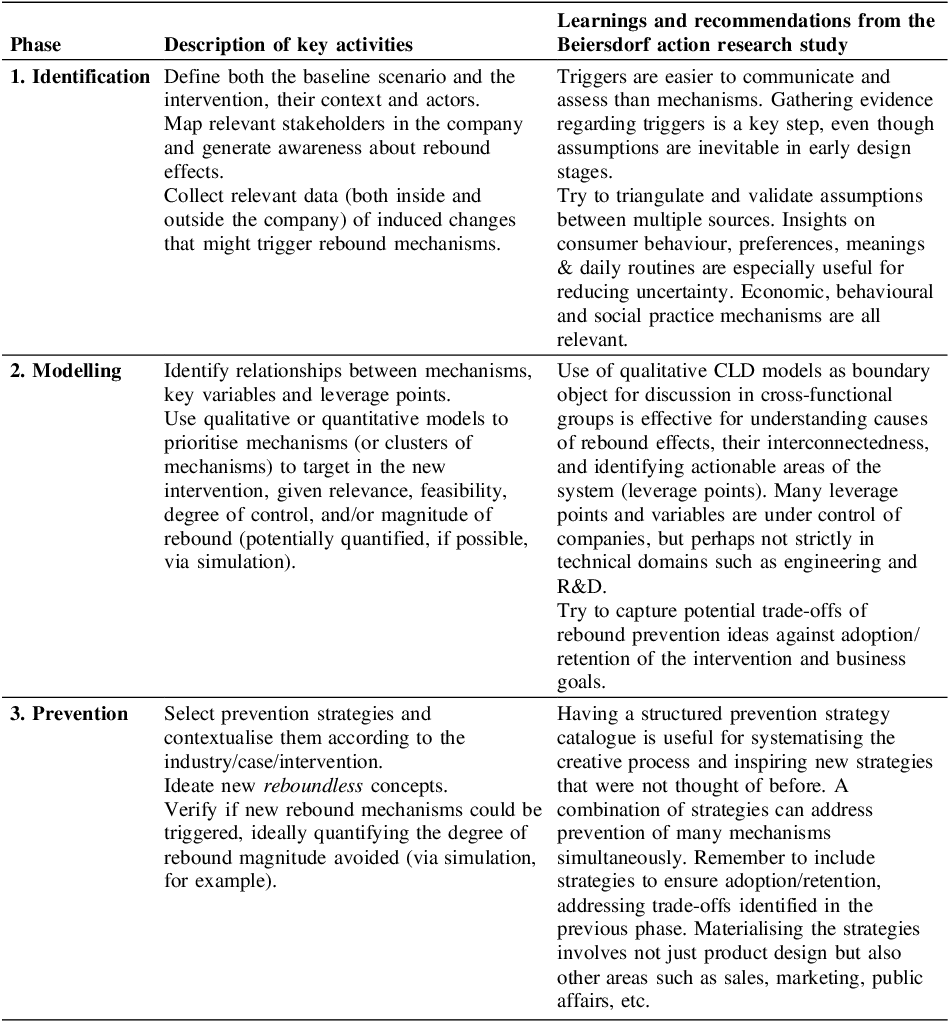
This study exemplifies how the “identify-model-prevent” framework proposed by Reference PigossoPigosso (2024) can be a practical approach for rebound effect anticipation in early design stages in manufacturing companies. The case shows that companies wishing to anticipate rebound effects should involve several functions and different kinds of expertise in the R&D process and be willing to face trade-offs between environmental and business targets. Table 2 presents main learnings from applying this framework at Beiersdorf, with the goal of offering transferable insights to other product portfolios within Beiersdorf and to other companies aiming to investigate rebound effects in their innovation initiatives.
Learnings from applying a structured approach for anticipating rebound effects in early-stage design, based on a framework by Reference PigossoPigosso (2024)

5.3. Implications for research: limitations and avenues for future research
As a first-of-its-kind study, this research project faced many challenges that have yet to be addressed by the academic community, offering some potential pathways for future research.
-
• This study’s success in identifying a wide range of mechanisms strongly reinforces the call to integrate behavioural and social theories into rebound research (Reference Corona, Tunn and van den BroekCorona et al., 2024; Reference Lowe, Bimpizas-Pinis, Zerbino and GenoveseLowe et al., 2024; Reference Niero, Jensen, Fratini, Dorland, Jørgensen and GeorgNiero et al., 2021). Our application of a multi-lens framework (i.e., economics, behaviour, social practice) proved effective for the identification of rebound effects and demonstrated the practical power of a focus on socio-technical mechanisms. Future research should not only continue this integration but also explore how other theoretical fields might identify currently unknown mechanisms.
-
• There is a critical need to better understand the relationship between rebound effects and the adoption or retention of sustainable innovations. The modelling phase of this project revealed explicit trade-offs between rebound prevention and traditional business metrics, but more research is needed to understand the extent to which this trade-off can be avoided, and how. While relevant work on paradoxes between SBT and business growth exists (Reference Villers, Howard, Pigosso, Guzzo and McAlooneVillers et al., 2026), it currently lacks an explicit rebound effects lens.
-
• For rebound anticipation to become standard practice, designers need practical, easy-to-use tools. This study demonstrated that while qualitative CLD modelling is an effective boundary object for cross-functional discussion, a significant barrier is the lack of ex-ante quantification to guide prioritization. This is important, for example, to ensure that prevention strategies do not trigger new rebound effects of their own that could negate their intended effect, or to avoid low magnitude rebounds being prioritised over high magnitude ones. Current attempts to quantify rebound magnitude using methods like system dynamics are promising, but often too slow or complex for early-stage design processes (Reference Guzzo, Walrave, Videira, Oliveira and PigossoGuzzo et al., 2024; Reference Metic, Guzzo, Kopainsky, McAloone and PigossoMetic et al., 2024). Future research should focus on developing rapid, accessible quantification and simulation tools, potentially leveraging artificial intelligence, as has been explored recently (Reference SchoenbergSchoenberg, 2025).
-
• Future research should investigate the organisational and cultural factors that enable companies to move beyond a narrow commercial scope towards a systemic view of sustainability. As shown in this study, Beiersdorf stakeholders showed openness to exploring a broad range of rebound effects and systemic effects, even those falling outside the scope of their immediate environmental impacts (e.g., water use during skin care routine). It remains unclear if this is a unique trait of Beiersdorf or to what extent other companies would be willing to explore a broader scope of rebounds effects versus a narrow scope of direct material issues.
This study’s methodological choices impose several limitations. The primary constraint is generalisability, stemming from the action research design and its reliance on a single pilot case. Investigation of other cases and industries is essential to further evaluate and refine the proposed approach and validate ideal boundary conditions for such a study. Furthermore, as previously stated, the study lacks rebound magnitude quantification, which hindered the prioritization of key mechanisms and the a-priori evaluation of new design concepts. Lastly, while our analysis was grounded in existing user research, expert knowledge, and literature studies, assumptions about future user behaviour were still necessary for carrying out the analyses. The findings would have been strengthened by new, product-specific user and behavioural studies to provide an additional layer of evidence.
6. Conclusion
To our knowledge, this is the first practical study to investigate rebound effects within a manufacturing company using a structured process of ex-ante identification, modelling, and prevention. This research challenges the prevailing notion that rebound effects are solely a matter for policy intervention. Instead, it provides evidence that manufacturing firms can, and must, take a proactive role. We demonstrate that companies like Beiersdorf can integrate rebound effect analysis directly into their innovation processes through a combination of socio-technical mechanisms analysis, qualitative systems dynamics, and the development of targeted design and business strategies.
The specific case of refillable packaging highlights the urgency of this approach. While such circular innovations are promising for achieving absolute sustainability targets, our study confirms they are vulnerable to a spectrum of economic, behavioural, and social rebound mechanisms. This underscores the need for further research, not only to investigate and quantify these mechanisms but also to develop practical, accessible tools that embed this analysis within the fast-paced design process. Therefore, we call for a dedicated research agenda focused on translating academic rebound knowledge into actionable business practice.
By moving beyond a narrow focus on product-level impacts to anticipate systemic effects, designers and engineers can actively prevent the rebounds that so often undermine progress. This ex-ante approach is essential if innovations aimed at achieving SBT are to deliver their full potential. It ensures that corporate progress genuinely contributes - without offset - to achieving absolute sustainability by operating within the safe operating space of our planet.
Acknowledgement
The authors would like to thank the numerous participants from Beiersdorf that informed the research reported here. This project has been co-funded by the European Union (ERC, REBOUNDLESS, 101043931). Views and opinions expressed are however those of the author(s) only and do not necessarily reflect those of the European Union or the European Research Council. Neither the European Union nor the granting authority can be held responsible for them.



 Open access

