


Building a Services Hub?
The services sector has been the fulcrum of Rwanda’s future growth trajectory since the publication of the government’s VISION 2020 strategy (GoR 2000). VISION 2020 highlights how the RPF government plans to position Rwanda (and its capital city, Kigali) as a hub for regional and continental economic development. As a former minister said:
In 1994, we had many challenges … Of course, our location is also a challenge. But when you say we are ‘landlocked’, you may think we are doomed. But we wanted our location to be an advantage. The only way is to become a hub for Africa. It fits with our ideology, our history … When we say self-reliance in Rwanda, Rwanda can only be self-reliant through connecting to the rest of Africa.Footnote 1
The RPF perceives regional and continental integration to be essential for a small, landlocked country like Rwanda to gain access to markets and attain external legitimacy both inside and outside the continent. To that end, President Kagame has led efforts to revive the EAC, establish and strengthen the AfCFTA and revitalise the AU. Regardless of whether these integration attempts have had as much success as hoped, Kagame has positioned himself as a leading figure representing such efforts on the continent. An important example of this was in 2016 when the Assembly of African Heads of State appointed Kagame to lead reforms of the AU. Kagame established a Pan-African Advisory Committee, comprising leading luminaries across the continent, and published a critical, reflective report on the AU’s weaknesses and how it can be strengthened. His (Kagame Reference Kagame2017) report highlighted the importance of increasing ownership of the AU by member states and ensuring financial stability. His report presented one key recommendation: the 0.2 per cent levy on imports into Africa, which was later rolled out by some AU member states. This occurred around the same time as Rwanda’s defiant ban on used clothes (which will be discussed in Chapter 9). Aligning Rwanda’s ban on used clothes with a proposed continent-wide ban fit nicely with the intention of promoting Rwanda’s continent-wide leadership role. Calling for an increase in tariffs against the West, not only cited American and European hypocrisy but also showed Rwanda to be leading attempts to defy decades of unfair Western trading practices.Footnote 2 The symbolism of this report was particularly significant because the tariff was presented as a solution to the continued dependence of the AU and subregional organisations on funds from external powers, particularly to execute peace initiatives (Kagame Reference Kagame2017).
Yet the RPF and its (continental) supporters faced resistance during initiatives to reform the AU. The contents of Kagame’s report were heavily debated among AU heads of state. Thomas Tieku (Reference Tieku2019, p. 14) argues that ‘the processes President Kagame used to submit his report undermined the logic behind the multilayered nature of AU’s formal decision-making processes and also broke the Pan-African spirit that characterized meetings of AU summits’. One of the goals of the AU reforms was to mobilise $400 million from AU states for a Peace Fund to combat dependence on external donors. Kagame’s leadership of AU reforms led to $384 million being raised. However, the fact that some of this money was raised to fund a regional force in the DRC where Kagame’s Rwanda was accused of being an aggressor showcased some of the contradictory elements of his attempts to build a Pan-African image.
The RPF’s presentation of Kagame as a Pan-African leader was in line with the party’s own ideological origins, rooted and linked to Marxian anti-colonial parties, including Julius Nyerere’s Chama Cha Mapinduzi and Meles Zenawi’s EPRDF. In reality, the RPF has departed significantly from many Marxist principles. The RPF’s portrayal of being committed to collective African unity has been consistently contradicted by Rwanda’s relationships with neighbouring countries (including with Uganda). Kagame often espoused a deep commitment to a Pan-African agenda but did not remain committed to those ideals when Rwanda’s interests did not align with them (Bareebe & Khisa Reference Bareebe and Khisa2023). However, the RPF’s attempt at portraying Kagame’s image as a Pan-African leader has reaped some dividends. The AU’s support was essential in promoting Rwanda as the headquarters for the African Medicines Agency (AMA) and the African Pharmaceutical Technology Foundation (APTF) while also convincing the European pharmaceutical firm, BioNTech, to establish their manufacturing facilities in Kigali.
The focus on services-first development is closely shaped by the evolving political settlement in Rwanda. Rwandan politics has been characterised by increased elite vulnerability, with significant rivalry among RPF elites. Rwanda’s services strategy requires increased reliance on foreign capital and external legitimacy, which is politically expedient given that the government has found it difficult to cultivate effective domestic state–business relations. Strategies like sports diplomacy have been used to position the country as a leader within the continent and central to Africa’s future development. Holding major sports events is also a way to gain support of the youth domestically, highlighting how Rwanda is not only capable of holding global events but also bringing high-profile events to Africa. Since holding events leaves the government more open to criticism (especially when individual sportspeople or musicians use those stages to criticise Rwanda), the hub-based strategy can also threaten the supposedly progressive image on which Rwanda’s hub-based strategy is based.
The RPF government’s strategy – though often highlighting multiple role models – is most often discussed by government officials as emulating Singapore (and to a lesser extent Dubai). At best, the Rwandan government’s emulation of Singapore is partial and mostly based on its market-led interpretations of how Singapore developed, ignoring the importance of manufacturing (Behuria Reference Behuria2018b).
The chapter begins by discussing the promises and pitfalls of services-based development. It then describes the contradictory tensions emerging within Rwanda’s services-based strategy, particularly because the progressive image the RPF attempts to portray is often at odds with domestic realities. This remains a significant vulnerability given that transnational political contestation over Rwanda’s ‘progressive’ image is a threat to the financing of the RPF’s political settlement. This chapter then describes the evolution of the services strategy, with a focus on the centrepiece of its strategy: tourism. The remaining sections show how finance has been mobilised in line with the macro-political settlement: initially through providing opportunities to private Rwandan capitalists but then gradually relying heavily on foreign investors and government-affiliated investors. The most worrying aspect of Rwanda’s services-based development strategy is that it has failed to provide significant employment or to create linkages between sectors.
Services-Based Development: Promise and Pitfalls
As mainstream development policy in the 1990s shifted focus to poverty alleviation, prominent developmental state scholars such as Peter Evans (Reference Evans, Kim and Kim2014) argued for the importance of incorporating human-centred approaches when considering what factors are crucial in promoting successful late development. Scholarship focused more on how the state should promote health and education to fit the services-based development needs of the twenty-first century. However, structuralists (Amsden Reference Amsden2010) have been critical of the shift to human-centred approaches, which emphasised health and education services but did little to promote the production side of development or job creation. This dispute obscures the extent to which all the East Asian developmental states employed varying forms of ‘productivist’ social policy, whereby labour was suppressed politically, but the provision of education, healthcare and welfare was targeted towards the ‘productive sectors’ of society (Mkandawire Reference Mkandawire2007). Developmentalist strategies were ‘transformational’, aiming to integrate labour into specific industrial development strategies (Mkandawire Reference Mkandawire2007). However, new human-centred approaches have been more focused on enhancing capability, narrowly targeted at individual empowerment with very little regard for the skills and employment demands of the economies in which people work.
Low-income countries are now generally experiencing much more rapid growth in services than in other economic sectors. This makes late development under contemporary globalisation fundamentally different from the challenge experienced by late developers in the past. Several scholars have expressed optimism about the developmental potential of services sectors. American sociologist Daniel Bell (Reference Bell1976) argued that the future of society would rely less on industrial production and more on the provision of services, which would lead to the creation of a knowledge class. Influential economists, like Baer and Samuelson (Reference Baer and Samuelson1981) and Bhagwati (Reference Bhagwati1984), similarly highlighted the importance of services for future economic development. Other economists have emphasised the increased potential of services to act as catalysts for innovation, productivity growth and trade (Hallward-Driemeier & Nayyar Reference Hallward-Driemeier and Nayyar2017). Numerous studies have found that not only do services comprise an increasing component of GDP as countries become richer but, in the contemporary global economy, they also create more jobs at earlier stages of development than manufacturing and demonstrate faster productivity growth (Ghani & O’Connell 2014). Some (Nayyar et al. Reference Nayyar, Hallward-Driemeier and Davies2021) argue that contemporary services growth has productivity-enhancing characteristics, although they express concern that economies may be vulnerable in the absence of a manufacturing base.
Most African countries have experienced a trend involving substantial growth in the services sector without the saturation of manufacturing demand. However, services growth has been concentrated in low-value services. Crucially, recent evidence suggests that the labour intensity of manufacturing declines more rapidly over time than that of services, indicating that manufacturing continues to be associated with higher productivity (Tregenna Reference Tregenna2018). Investments in high skill-intensive sectors such as information technology or finance cannot absorb the type of labour that exists in low- and middle-income countries (Rodrik Reference Rodrik2016). Matthess and Kunkel (Reference Matthess and Kunkel2020) find that though services growth has resulted in increasing shares of employment in services from 18 per cent in 1960 to 37 per cent in 2010, employment in low-productivity services still characterises most employment in African services sectors. Others develop similar arguments (Sumberg et al. Reference Sumberg, Fox, Flynn, Mader and Oosterom2021), highlighting that contemporary growth in Africa, which is heavily driven by services, is contributing to a ‘missing jobs’ crisis.
Positive assessments of services as a new route through which growth can be sustained in late-developing countries rely on a broad and unspecified definition of what constitutes ‘services’ sectors. Within services, there are differences between ‘first wave’ service growth at relatively low-income levels, which tends to mostly comprise ‘traditional’ services (such as lodging, meal preparation, house cleaning, beauty and barber shops), and ‘second wave’ service growth, which includes ‘modern’ services such as financial, ICT, legal, advertising and business services (Eichengreen & Gupta Reference Eichengreen and Gupta2011). Services facilitate coordination, administration and transportation of most exported products (Kaplinsky & Morris Reference Kaplinsky and Morris2016). Most firms in manufacturing sectors engage in the production and export of services, while growth in high-productivity services also depends on manufacturing, including computerised technology, transportation equipment and mechanised warehouses (Hauge Reference Hauge2023; Miroudot & Cadestin Reference Miroudot and Cadestin2017).
Rwanda’s services strategy prioritises the importance of being a ‘hub’ in the region. Rwanda’s service sectors focus on tourism, transport, logistics, finance, sports and ICTs. Rwanda’s strategy also does not purely focus on sectors. The goal of becoming a regional hub is fundamentally linked to promoting its progressive credentials externally in relation to women’s empowerment and climate initiatives, as well as being committed to leading Pan-African goals. To become a services-based hub, the RPF has prioritised developing a ‘nation brand’, which it can present externally to wipe away the negative reputation associated with the genocide. In 2010, the Rwandan government employed a London PR firm Racepoint to transform Rwanda’s image to the outside world and to attract inward investment (Voets Reference Voets2023). Several other PR firms, including BTP Advisers, Acanchi, Portland Communications and GPlus, have been employed by the government, highlighting the Rwandan government’s prioritisation of managing its external reputation. ‘Branding’ has been formally prioritised as an essential aspect of Rwanda’s strategy, with the government’s National Export Strategy (MINICOM 2011b, p. 25) highlighting its significance:
Nation branding consists of developing and communicating an image – both internally and externally – based on a country’s positive values and perceptions relevant to export development.
However, the Rwanda ‘brand’ is consistently at odds with the most urgent needs of the population, particularly in relation to underemployment. The services-based hub strategy also aims to integrate the youth – as a category – into becoming a loyal support base for RPF policies. Part of this is also linked to the RPF’s focus on controlling the internet (as already discussed in Chapter 3) and the ICT sector. Kagame, sometimes described as ‘the digital president’, has prioritised the ICT sector (Gagliardone & Golooba-Mutebi Reference Gagliardone and Golooba-Mutebi2016; GoR 2000). The RPF government aims to provide universal access to broadband connectivity. Official government statistics highlighted that by 2018, 4G mobile coverage was over 96 per cent in Rwanda, with over 47 per cent of the population able to access the internet (Caldarola et al. Reference Caldarola, Grazzi, Occelli and Sanfilippo2023). Others (Purdekova & Mwambari Reference Purdekova and Mwambari2022) argue that internet coverage is much lower and still confined to urban areas. Though internet coverage is prioritised, it remains heavy controlled. However, several YouTubers have used this space to show dissent. Two YouTubers who gained a significant following were jailed on charges of genocide denial and spreading rumours (Bucyana Reference Bucyana2024). The government has also prioritised Business Process Outsourcing (BPO), hoping that its investment in its national fibre-optic network would be a pull for investors. In line with this, Kigali Innovation City (KIC) is being developed to be a mixed-use innovation city, which will be a tech hub hosting four universities and start-up business incubators. In partnership with Carnegie Mellon University, KIC expects to have 2,600 university graduates annually, $150 million in exports and the creation of over 50,000 jobs. Despite these ambitious goals, there have been limited achievements in the BPO sector. Concerns remain that existing universities are not skilling graduates adequately to meet the demands of the job market.
The centrepiece of Rwanda’s strategy is to become a hub for Meetings, Incentives, Conferences and Events (MICE) – in particular sports, conferences and music – a part of strengthening a national identity for the youth. The focus on a unified Rwandan national identity has the effect of demobilising groups and reducing space for mobilising collectively around other politically charged categories (particularly ethnicity but also regional identities). Hosting mega-events helps develop loyalty to the RPF’s version of national identity, history and building a singular collective memory. However, through hosting public events, which link national and external audiences, the government creates new spaces of vulnerability where individual signs of resistance can receive global attention. Mwambari et al. (Reference Mwambari2021) discuss the evolution of ‘conversible spaces’ where state-building conversations occur and there is some discussion between ordinary citizens and government officials. However, in public events (with an external audience), ‘conversible spaces’ can turn into spaces where musicians and sportspeople can show outright dissent to attack the credibility of the RPF’s progressive image externally. Thus, this leads to a danger that such spaces can become fillips for rival coalitions to mobilise underlying tensions within society and attack the RPF’s credibility. In the following section, the contradictory tensions within the RPF’s services-first strategy are discussed.
The Contradictory Tensions of the RPF’s Hub-Based Strategy
This section discusses several ways contradictory tensions are evident within the RPF’s hub-based strategy. The tensions around the RPF’s presentation of Kagame as a Pan-African leader while Rwanda is actively involved in supporting rebel groups in the DRC, as well as interfering in the affairs of neighbouring countries like Burundi and Uganda, have already been mentioned. There are also several other contradictions in relation to the progressive images portrayed regarding youth and women’s empowerment, and environmental leadership, which will be discussed next.
In 1994, the RPF developed a strategy both to integrate the youth in its new development strategy and to invest in the creation of a new Rwandan national identity (Ndi Umunyarwanda). At the same time, this focus on the youth has been crucial to containing the threat they posed, particularly if they were mobilised by rival groups to threaten RPF rule. In the literature on Rwanda, several scholars have highlighted how the youth have been both integrated and demobilised through the imposition of the RPF’s version of history, memorialisation and imposition of a singular collective memory (Jessee Reference Jessee2017; Longman Reference Longman2017; Purdekova Reference Purdekova2008; Purdekova & Mwambari Reference Purdekova and Mwambari2022). Rwanda’s services-based strategy, which is central to its nation-building strategy, is also fundamental to both inculcating youth into the RPF’s national identity, as well as its economic strategy.
Chemouni (Reference Chemouni2016) argues that ‘output legitimacy’, or at least the presentation of delivering development results, also contributes to encouraging loyalty or at least containing resistance. Rwanda’s MICE strategy is key to building youth aspirations for a better future. Holding large-scale events, whether sports or cultural events, has long been ascribed a symbolic power to put a country on the global map (Koch Reference Koch2013; Maennig & Du Plessis Reference Maennig and Du Plessis2009). Holding such events also encourages youth to participate more in sport or cultural events, build aspirations of becoming sports stars or musicians and enforce a sense of national pride. Authoritarian governments often employ such strategies because they may contain any popular grievances that may otherwise be present because of broader marginalisation in society. The RPF’s services-based strategy – and particularly the holding of sports events – may achieve some of these goals, building support from the youth for the RPF’s polices and also containing resistance from youth whose aspirations have not been met. Training programmes, such as in football (in partnership with Paris Saint-Germain, Arsenal and FC Bayern), also contribute to building youth aspirations. A partnership with Agence Française de Développement has supported Rwanda’s sports policy by rehabilitating twenty-seven playgrounds in seventeen schools. The rehabilitated playgrounds aim to provide young athletes with high-quality training facilities, skilled coaches and mentorship in football, volleyball, basketball, handball, cycling and athletics.
Though holding events and investing in sports and culture may partially contribute to integrating youth and containing resistance, youth underemployment remains a significant challenge. The youth comprise a large share of the population. In 2022, 38.5 per cent of Rwanda’s population was under fifteen, 59 per cent was under twenty-five and 73 per cent was under thirty-five. In November 2024, the share of Rwandans (between sixteen and thirty years old) who were not in education, employment or training programmes was 27.3 per cent (NISR 2024). Unemployment for those under thirty-five years old was roughly 17 per cent, which was higher than those over thirty-five (which was about 12 per cent) (NISR 2024). The combined rate of unemployment and underemployment for Rwandans under thirty-five was about 46 per cent (NISR 2024).
Thus, despite the RPF’s promises of services-based development creating jobs, the strategy has not met the employment needs of the population. More broadly, as part of the RPF’s strategy, there has been a focus on health and education and the promotion of ‘entrepreneurial citizens’, with individuals encouraged to take responsibility to create their own jobs (Honeyman Reference Honeyman2016; Kamat Reference Kamat2004). In doing so, Rwanda is one of many countries globally to present financial inclusion, investments in health and education and entrepreneurship as pathways out of poverty. Ananya Roy (Reference Roy2010) calls such programmes ‘bottom billion capitalism’ and warned of their consistent failures. Investments in sports and culture may contribute to building national identity (and even national pride) but are part of a wider set of policies, focused on increasing capabilities of individuals, with little attention to the needs of the job market. Another example of this is the government’s recent plans to create over 62,000 jobs in creative and cultural sectors annually (GoR 2024b). Yet there is limited discussion of the kind of jobs that will be created (given that they are likely to be precarious) and whether they will be restricted to supporting the organisation of events. Similarly, the Kigali International Financial Centre (KIFC) was launched in 2020, with the aim of transforming Rwanda into an international financial hub, with the goal of hosting investors who aim to invest across African economies. Renowned African banker Tidjane Thiam – who held leadership roles at McKinsey, Credit Suisse and Prudential PLC – was appointed as the chairman of the board of Rwanda Finance Limited. Though the financial sector only employed roughly 1 per cent of Rwanda’s workforce, there are plans to build initiatives to enhance skills. Previously, Rwanda-based banks highlighted that there was insufficient training, showing that there was a skills lag in relation to the most ambitious aspects of Rwanda’s services strategy.Footnote 3
The RPF has also made enhancing gender equality a central focus as it attempts to position its progressive image externally. The RPF’s prioritisation of women is also a product of the significant role women played in the liberation effort. RPF leadership was influenced by the experience of Uganda’s NRM (where women’s representation was also prioritised) and also Rwandan history (where women are often portrayed as occupying a prominent role) (Burnet Reference Burnet2008; Mwambari et al. Reference Mwambari2021; Watkins & Jessee Reference Watkins and Jessee2020). Formally, the government has maintained a commitment to gender equality. Rwanda is the first country in the world with a female majority in parliament. Rwanda was also ranked sixth globally in the World Economic Forum Global Gender Gap Index 2022. Yet many continue to raise questions about the extent of gender equality. There are criticisms of whether formal political representation has led to more voice and participation for women (Burnet Reference Burnet2008). It is concerning that care work has been neglected (Debusscher & Ansoms Reference Debusscher and Ansoms2013) in government policy. Also, there are still gaps in labour workforce participation between men and women, at all age levels (NISR 2024). Gender-based violence also remains high, and there are worries about patriarchal backlash in society (Watkins & Jessee Reference Watkins and Jessee2020). There also continues to be stigma around abortion and difficulties in implementing liberalised abortion laws. Abortion can be obtained legally from a doctor under limited criteria (including rape, incest and medically dangerous pregnancies), but even then, women have often found it difficult to obtain abortions or even been jailed after having had abortions (McCammon Reference McCammon2023; Twahirwa & Jamiu Reference Twahirwa and Jamiu2025).
Despite these challenges, women’s empowerment and gender advocacy organisations retain some significance in Rwanda’s political landscape. Gender equality was a priority for several donors, including the United States, the European Union and the United Kingdom. Donors have lauded Rwanda’s focus on gender equality achievements and provided funding for their initiatives. Rwanda’s ruling coalition, including Kagame’s wife, Jeannette Kagame, has led gender equality initiatives. Jeannette Kagame established the Imbuto Foundation in 2001 to promote the rights of women and children, as well as to provide support to genocide widows. The Imbuto Foundation has invested in gender equality investments in education, contributed to efforts in addressing gender-based violence and also led other gender initiatives. Imbuto works directly with donors, including the UK government and the United Nations, as well as several philanthropists, including the IKEA Foundation, Bloomberg Philanthropies and the David and Lucile Packard Foundation. In this way, foreign entities directly finance Rwanda’s services-based hub strategy based on the RPF’s perceived commitment to gender equality. Critics, including both domestic opponents of the RPF and foreign dissidents, draw attention to the limitations of policies. This shows how the nature of transnational contestation of the RPF’s progressive commitments is key to the financing of Rwanda’s political settlement.
Rwanda has firmly established its green credentials and has invested in becoming a ‘Green State’, as well as in becoming a leading voice in global environmental policy governance. Death (Reference Death2016, p. 207) highlights that ‘there is a clear set of incentives for African countries to emphasise both their environmental vulnerability and their capacity for exemplary leadership’. The RPF has signalled its environmental leadership in several ways, including leading efforts to combat plastic pollution, its commitment to conservation, and hosting events and sustainability-focused initiatives. In 2008, Rwanda banned the import, production, sale and use of plastic carrier bags. This ban came at a time when several African countries, which had announced bans, failed to implement them (Behuria Reference Behuria2021). Rwanda’s plastic-bag ban was hailed as a success and championed as a lesson for other countries. In 2019, Rwanda intensified its commitments against plastic pollution by banning single-use plastics. Rwanda initiated a joint draft resolution (with Peru) at the Fifth Session of the UN Environment Assembly in 2022, ‘End Plastic Pollution: Towards an Internationally Legally Binding Instrument’. Rwanda and Norway then jointly launched the High Ambition Coalition to End Plastic Pollution. Sixty-eight countries have joined this initiative. Yet Rwanda’s focus on banning plastics has sometimes created disadvantages for manufacturers and thereby also inhibited the creation of employment opportunities.
The RPF has also invested in establishing its external green credentials by being a site for major sustainability initiatives and hosting key events. Kigali has hosted the SDG Centre for Africa since 2016. Rwanda was also the site for the ‘Kigali Amendment’ to the Montreal Protocol in 2016, which called for countries to reduce the consumption and production of hydrofluorocarbons (Behuria Reference Behuria2021). Rwanda has also hosted several high-profile UN events on sustainability, as well as academic conferences on climate change. Recent investments in domestic mining, particularly with the discovery of gold deposits in conservation areas, may discredit the RPF’s portrayal of its commitment to environmental initiatives.
Even domestically, the government has tried to link a focus on environmental citizenship to nation-building. Umuganda, a national service day where all citizens perform community service, including cleaning streets and their neighbourhoods, was established in 2009. There have been several other efforts that strengthen a commitment to cleanliness, linking goals of protecting national environments to development. This includes policies such as establishing two car-free days a month, a trend that has caught hold in several other African countries. This focus on ‘cleanliness’ is also associated with more repressive policies, with dispossession a feature of Kigali’s transformation into a services hub (Goodfellow Reference Goodfellow2014; Shearer Reference Shearer2020). The external portrayal of Kigali as a city, committed to environmental goals, continually showcases the government’s focus on ‘modernity’ as an internal symbol of national regeneration and an external signal of the country’s progress (Goodfellow & Smith Reference Goodfellow and Smith2013).
The RPF’s focus on environmental leadership aligns with its commitment to conservation, which also contributes to enhancing Rwanda’s luxury tourism credentials. Rwanda’s Volcanoes National Park (VNP) encompasses five of eight volcanoes in the Virunga Mountains in Northwest Rwanda. It is home to more than 600 ‘endangered’ mountain gorillas. Mountain gorillas can be found only in three countries: Uganda, DRC and Rwanda. They have historically been Rwanda’s main tourist attraction and the source of most of Rwanda’s tourism revenues. Rwanda’s commitment to conservation has been widely celebrated, with forest cover increasing from 10.7 per cent in 2010 to 30.4 per cent in 2020 (Sarmiento et al. Reference Sarmiento, Larrea, Oeschger and Jose2024). However, conservation areas are adjacent to densely populated areas, which are populated by very poor segments of Rwandan society (Maekwa et al. Reference Maekwa, Lanjouw, Rutagarama and Sharp2013).
The government has made substantial investments in ‘nation branding’ through the Kwita Izina gorilla naming ceremony. The Kwita Izina ceremony was launched in 2005, with mountain gorillas born in the previous year named during the ceremony. Every year, several celebrities, politicians, conservationists and performing artists from within Africa and outside the continent are invited to name gorillas. Visits from Ellen DeGeneres, Idris Elba, Naomi Campbell, Didier Drogba, Ne-Yo, Jason Derulo, Maria Sharapova, Burna Boy, and Arsenal and Paris Saint-Germain footballers have enhanced the global reputation of gorilla trekking in Rwanda. The government has thus found external support and financing to legitimise its focus on conservation. While a focus on conservation may yield increased revenues and foreign exchange, it does very little in terms of the most urgent need for the domestic population: creating employment.
Rwanda’s ‘hub’ strategy is closely shaped by vulnerabilities within its political settlement. As elite vulnerability within the RPF and with domestic businesspeople increased, a focus on services and on making Kigali an investible hub contributed to increasing the value of real estate in Kigali and other areas for domestic elites. The government, though otherwise effective in tax collection, has lagged in its goals of collecting substantial property tax (Goodfellow Reference Goodfellow2017; Kangave et al. Reference Kangave, Byrne and Karangwa2020). As part of Rwanda’s political settlement, RPF elites, including estranged ones, are allowed to benefit from urban growth through the real estate they own in exchange for their silence. Rents in Kigali are consistently increasing and have regularly been cited, along with rising inflation, as a reason for the high cost of living in the capital (Esiara Reference Esiara2018). Senior (and especially older) government, party and military officials have benefited from being the first owners of properties in post-1994 Kigali’s elite residential neighbourhoods. Many of them rent these properties out to the burgeoning expatriate population, with consistently increasing rents a source of easy income for RPF elites.Footnote 4
They allow you to keep your property. But if you speak, they’ll take action. And every time you speak, they will take action.Footnote 5
That’s how they silence you. Some of us – they have our passports. We cannot leave. If we want to live, this is our only option.Footnote 6
Such elite dynamics both stabilise the country’s political settlement and are sustained by services and real estate–focused growth. However, they do work against wider redistributive concerns, with capital not being used to reinvest or diversify the economy. The following section describes Rwanda’s evolving tourism strategy. Tourism has become the centrepiece of Rwanda’s development strategy and has been the economy’s largest foreign exchange in most of the last fifteen years. Tourism is closely linked to all externally facing (and progressive) priorities within the country, including environment, youth and women’s empowerment, Pan-African leadership and sports hosting. Revenues from the sector contribute to stabilising the political settlement. However, services growth does little to integrate domestic capital more broadly in economic diversification and has not met Rwanda’s employment needs.
Becoming a Luxury Tourism Hub
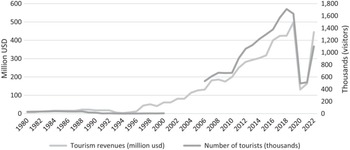
The services sector has been a significant contributor to Rwanda’s growth, outpacing growth in agriculture and industry (Behuria & Goodfellow Reference Behuria and Goodfellow2019). In 2000, tourism revenues were below 20 million USD, but by 2016, tourism revenues were 374 million USD. The NST targeted tourism revenues worth 800 million USD by 2024 (GoR 2017). As Figure 8.1 indicates, the Covid-19 pandemic resulted in a significant reduction in tourism receipts and arrivals. Several hotels and restaurants went bankrupt during the pandemic, resulting in severe job losses (Rwigema Reference Rwigema2020). However, the tourism sector has recovered strongly in 2022 and 2023 but not enough to meet NST targets. In 2023, tourism revenue was just below 500 million (and just above half of the NST’s 2024 target).
Tourist arrivals and tourism revenues: 1980–2023.

Until the early 2000s, the Rwandan government did very little to invest in the tourism sector. Gorillas were the primary attraction for tourists visiting Rwanda. By 2004, visitors to Rwanda’s then approximately 250 mountain gorillas (comprising around 30 per cent of the world’s mountain gorilla population) accounted for around 93 per cent of Rwanda’s tourism revenues (Mazimhaka Reference Mazimhaka2007). After commodity price fluctuations in the early 2000s, the Rwandan government urgently sought diversification.
We knew that our gorillas were our key comparative advantage and we were dependent on coffee exports for too long. The president wanted us to think about how we could turn our landlocked challenge into becoming land-linked. We decided to focus on tourism. The idea was to make Rwanda a hub for everything in Africa.Footnote 7
The Rwandan government sought to transform Rwanda into a luxury tourism destination. The government was significantly influenced by what were perceived as successful strategies in Botswana and Mauritius. Several respondents consistently argued for the need to reduce ‘mass tourism’ or to discourage ‘backpackers’ and argued that ‘for sustainable development, we need to move to a model of tourists who spend more money every day they spend in the country’.Footnote 8
In the mid-2000s, IFIs, conservationists and donors encouraged governments to focus on luxury and niche segments to develop tourism sectors.Footnote 9 For example, one report highlighted that governments should ‘find a niche or segment that will enable the country to attract a critical mass of tourists’ (Cattaneo Reference Cattaneo, Newfarmer, Shaw and Walkenhorst2009, p. 184). The Rwandan government’s 2006 Tourism Policy followed this advice and focused on ‘high end ecotourism’ (MINICOM 2006). Gradually, this focus was elaborated into transforming Rwanda into a high-end business and conference hub, in addition to the focus on conservation.
While the focus on business tourism and the price of tickets to visit gorillas has increased the spending per day and the price of hotels in Kigali (with the government retaining a preference for not having hotel rooms available for less than 100 USD/day), tourists still spend much less on average than in leading African luxury tourism destinations like Mauritius or Botswana.Footnote 10
The VNP, which hosts Rwanda’s mountain gorillas, continues to be Rwanda’s main tourist attraction. In 1967, renowned conservationist Dian Fossey visited Rwanda. Fossey lived in Rwanda for twenty years, advocating for conservation, anti-poaching and protecting the habitats of the mountain gorillas. Her work was depicted in the 1998 film Gorillas in the Mist, which ‘drew global attention to the plight of the mountain gorilla, and generated unprecedented interest in the gorilla tourism program’ (Booth & Briggs Reference Booth and Briggs2004, p. 178). However, this ‘interest’ never translated to many tourist arrivals, given that Rwanda had a civil war between 1990 and 1994.
During the 1990s, the invading RPA was forced to establish camps in the VNP. The experiences of RPF cadres during the civil war (1990–1994) contributed to strengthening the connection with the VNP. The time spent in the VNP during the war is often cited as a motivation for the RPF to invest heavily in the protection of the park to safeguard the mountain gorillas.Footnote 11 Park visits were prioritised as a key source of long-term tourism receipts (Sabuhoro et al. Reference Sabuhoro, Wright, Munanura, Nyakabwa and Nibigira2021). In 2022, the Ellen DeGeneres Campus, funded by Ellen DeGeneres’ foundation and other donors, was opened amid widespread international publicity, with the goal of continuing Fossey’s legacy, in partnership with the Rwandan government, to conserve the habitat of mountain gorillas. The RPF government has also invested heavily in other national parks, including the Akagera National Park. Akagera was also re-populated with lions, and visiting tourists can now see the Big Five (lions, elephants, buffaloes, rhinoceroses and leopards) as well as other animals (and birds) in the park.
The government – through the RDB – retains control of gorilla trekking. To enhance the high-end, luxury image of gorilla trekking in Rwanda, the government has raised prices regularly, with the most recent price increase made in 2017 from 750 USD to 1500 USD (for both Rwandan nationals and visitors). This was after a first price increase five years earlier (from 500 to 750 USD). The government initially claimed there was no effect on visitors to the park, stating that ‘the decision was made to make the most of our most prized asset and to preserve gorillas and wildlife towards a sustainable future’.Footnote 12 Despite the government’s claims that demand for gorilla permits was unaffected, the gorilla permits sold reduced after each price rise – first, after 2012 and then after 2017 (World Bank 2023). After 2020, gorilla trekking visitors plummeted and took time to recover.
On 1 January 2024, the government slashed gorilla trekking prices down to 500 USD for foreign residents and 200 USD for Rwandans. This was the lowest price since 2012. The government made this decision after several years of reductions in permits sold since 2020, when the Covid-19 pandemic began. The government’s luxury tourism strategy had relied on high-end lodges, mostly owned by foreigners, as well as an assortment of smaller tour operators. Given that neighbouring countries offered gorilla trekking at lower rates, tour operators complained that Rwanda was losing business to its neighbours (Kagire Reference Kagire2024). The government chose to continue to provide financial support to its high-end lodges, including large investments made by foreign companies in ecotourism lodges. Most high-end lodges are owned by foreign investors, including Singita, One&Only and Wilderness Safaris, and charge up to 15,000 USD/night.
There has been some success in ‘going beyond gorillas’ and adding to more high-end tourist attractions in Rwanda to enhance the country’s image as a luxury destination. Alongside other wildlife attractions (which receive much fewer visits than the gorillas), the government invested in making Kigali a MICE hub. In 2023, Rwanda hosted 157 summits and events, attracting more than 67,000 delegates, securing revenues of more than 91 million USD. Several high-profile global events, including international climate summits, a FIFA Congress and the Commonwealth Heads of Government Meeting, have been held in Kigali in the last few years. In 2023, Kigali hosted the Global Citizen’s Move Afrika concert, headlined by the Grammy Award–winning musician Kendrick Lamar. The RDB has also indicated a preference for hosting events, which showcase leading African voices.
In Rwanda, we are doing all this not just for us but for all of Africa. We want to have pride in our African culture, our Rwandan culture … We want the world to see it.Footnote 13
Closely linked to its goal of becoming a high-end tourist destination, the RPF has invested in sponsoring football teams (like Arsenal and Paris Saint-Germain) and hosting several high-profile sporting events, including international football tournaments, the annual Tour du Rwanda cycling event, the Basketball Africa League (BAL) and the Kigali International Peace Marathon. Hosting sports mega-events is often dismissed as sportswashing. While it may also help distract from the authoritarian aspects of RPF rule, the government primarily hosts such events to establish its credentials as a services-oriented hub, diversify tourism revenues and establish Rwanda’s brand on the continental and world stage. In 2024, Camila Cabello, Dave Chappelle, Kevin Hart and Lewis Hamilton have all visited Rwanda. Celebrity invitations to sporting events in Rwanda provide domestic and external legitimacy and support for the RPF’s hub-based strategy. In doing so, they also contribute to financing the political settlement in Rwanda. Strikingly, many opponents of the RPF government have questioned celebrity visits, highlighting how political contestation is increasingly occurring transnationally, because of Rwanda’s services-based externally oriented strategy.
Through RDB and through employing PR companies, Rwanda has invested heavily in building a Rwandan tourism brand, #VisitRwanda. In the early 2010s, RDB officials recognised that ‘when you hear Rwanda, most people only think of the genocide. We want to change that’.Footnote 14 Since then, Rwanda has been named on several travel magazines’ must-visit lists. For example, in 2019, a CNN Travel editorial listed Rwanda as fifth on the top places to visit and cited Rwanda’s national parks and mountain gorillas as the key highlights (CNN Travel 2019). Through its #VisitRwanda campaign, the Rwandan government has developed partnerships with leading European football teams, Arsenal, Paris Saint-Germain and Bayern Munich. When Rwanda’s decision to sponsor Arsenal was announced in 2018, it was heavily criticised (Reyntjens Reference Reyntjens2018). Critics argued that in a poor country, money could be better spent elsewhere.
However, the government defends its strategy by arguing that such branding is essential to building a brand and attracting tourists while also cementing Rwanda’s position on the world stage. Belise Kariza, head of the RDB’s tourism department, claimed:
Before the partnership was signed, 71% of the millions of Arsenal fans worldwide did not consider Rwanda a tourist destination, at the end of the first year of the partnership, half of them considered Rwanda a destination to visit.
Hosting several international sporting events has also provided significant support in enhancing the #VisitRwanda brand. Though the Tour du Rwanda has been held annually since 1988 (with a break from 1991 to 2001), it only received recognition as a 2.1-rated (second-tier) event in 2009. This was one of the RPF’s first significant breakthroughs in holding a major sporting event. The status of 2.1 events comes with significant international coverage and means that several global cycling teams are incentivised to participate. Previous incarnations of the Tour du Rwanda hosted participants largely from African teams or lower-ranked teams in Europe. Since then, the event has attracted increasing international attention. Rwanda also won the bid to host the 2025 World Cycling Championships, one of the flagship events of the world cycling calendar. However, the 2025 edition of the Tour du Rwanda was detrimentally affected by the ‘contradictions’ of its hub-based strategy when a leading team, Soudal Quick-Step, pulled out due to safety concerns because of ongoing conflict in the DRC.
More significantly, Rwanda hosted the first three editions of the BAL from 2021 to 2023 and will now be the regular host for play-offs and finals annually. The BAL was telecast on multiple platforms to 215 countries in fifteen languages, showcasing Rwanda’s central position in hosting and contributing to the growth of basketball within Africa. Clare Akamanzi, who led the RDB for six years and has been a key figure in the government, was appointed as CEO of NBA Africa, highlighting the government’s commitment to ensuring Rwanda is positioned as a hub for basketball initiatives on the continent. President Kagame’s personal relationships with Americans who have played a key part in NBA Africa, including the Toronto Raptors’ president Masai Ujiri and businessman Paul Hinks, are also argued to have played a part in convincing the NBA to choose Rwanda as its host nation (Goldman & Paller Reference Goldman, Paller, Chadwick, Widdop and Goldman2023). Hinks has a long association with Rwanda, having won a twenty-five-year gas concession on Lake Kivu in Rwanda in 2015.
#VisitRwanda is the official founding and host partner of the BAL. Basketball matches are held in the 10,000-seater Bank of Kigali arena. Playoffs have regularly been covered in the international press. Former and current NBA players have attended matches along with American celebrities, including Forest Whitaker and Dave Chappelle. While hosting BAL events contributes to the goals of hosting Africa-wide events and presents visions of African sporting futures to the world, hosting the BAL in Rwanda has not been without controversy. Burundian basketball club, Dynamo, withdrew from the BAL play-offs in 2024 after refusing to wear a shirt with the #VisitRwanda logo on it. Burundian president Évariste Ndayishimiye earlier claimed Rwanda’s government had supported the RED-Tabara rebel group, which had killed twenty people (BBC 2024). Such incidents show that the RPF’s progressive image is easily criticised, given its alleged involvement in the domestic affairs of its neighbours. The criticisms of the RPF’s domestic human rights violations and interventions in neighbouring countries have also been widely discussed in ESPN articles, which contributed to increasing criticism of the NBA’s continued involvement in Rwanda (Fainaru-Wada Reference Fainaru-Wada2024).
Elusive Structural Transformation and the Inequalities of Tourism Growth
As Chapters 1–7 have shown, the RPF initially used closely allied businesspeople in efforts to diversify the economy after 1994. In the mid-2000s, because of increasing distrust of domestic businesspeople, there has been a clear shift towards relying either on government-owned or party-affiliated companies or foreign investors as lead investors (Behuria Reference Behuria2018a, Reference Behuria2018b). This is also true in the case of hotels. The first five-star hotel in Kigali, Serena Hotel, was initially an RPF investment. Closely allied businesspeople pooled together funds to invest in mid-range hotels elsewhere. Some other local elites or military officials followed by investing in other hotels. Several hotels went bankrupt. Since then, most major hotels are now owned by foreign investors, with these investors often benefiting from significant tax breaks and other incentives.Footnote 15
The Rwandan government has prioritised enhancing the luxury tourism image of the country, making initial investments in luxury hotels in Kigali, providing a ‘demonstration effect’ for local investors to construct hotels. By the end of 2018, Kigali had more than 5,000 upper- and mid-range hotel rooms (more than five times the number which existed a decade before).Footnote 16 As of 2020, there were around 7,000 hospitality establishments (including hotels, restaurants and bars) across Rwanda, which employed over 84,000 workers (Rwigema Reference Rwigema2020). Marriott and Hyatt were also provided significant incentives to invest in building five-star hotels in Kigali. Marriott’s investments partnered with a local real estate company – New Century Development Ltd (owned by Kagame’s closely allied businessperson Hatari Sekoko). However, at the same time, the substantial investment that went into mid-range hotels resulted in many hotels remaining empty for large periods of time, with some hotels demolished or forced into bankruptcy (Behuria & Goodfellow Reference Behuria and Goodfellow2019).
Tourism-oriented development strategies are often criticised for their propensity to become ‘enclaves’, with limited benefits for communities residing near specific tourist destinations. Rwanda’s tourism revenue sharing programme (TRSP) has been lauded for its support of communities around national parks (although challenges remain). RDB distributes 10 per cent of total tourism revenues collected each year among four National Park regions (World Bank 2023). TRSP projects have expanded significantly since their inception. In 2005, Rwanda had five TRSP projects. This increased to sixty-five annual projects in 2019, with funding also increasing dramatically (as tourism revenues increased). However, there are criticisms that most TRSP projects are focused on infrastructure investments rather than on investing in the livelihoods of communities living near the national parks (Snyman et al. Reference Snyman, Fitzgerald, Bakteeva, Ngoga and Mugabukomeye2023). With the increasing emphasis on high-end tourism and driving up standards in hotels, there are also few possibilities for enhancing domestic linkages (Behuria & Goodfellow Reference Behuria and Goodfellow2019). There is also increased evidence of leakages, with foreign travel agencies, along with hotels owned by foreign companies, retaining most of the profits through booking all-inclusive trips for high-end tourists.
Substantial infrastructure investments have been prioritised in making Rwanda a MICE destination (including investments in the Kigali Convention Centre, a new airport and the government-owned airline, RwandAir). These investments have contributed to spiralling national debt. However, transforming Rwanda into a high-end MICE destination is perceived to be central to sustaining the RPF’s hub-oriented development strategy in the long term.Footnote 17 The immense debt that the Rwandan economy took on to invest in its hub-based strategy is at odds with the employment needs of the domestic population. Services-first development has only resulted in more precarious and low-wage employment for Rwandans. The continued persistence of informal employment in urban areas works directly against the government’s attempt to present Kigali as a pristine financial and tourism hub for the continent (Shearer Reference Shearer2020). The tourism sector barely employs more than 5 per cent of the labour force. Managers at many luxury hotels are from neighbouring countries.Footnote 18 Though tourism training institutes exist, there was a lag in ensuring these training institutes met the skills needs for the sector (Behuria & Goodfellow Reference Behuria and Goodfellow2019).
Rwanda’s tourism sector has grown considerably. However, Rwanda’s positioning of itself as a sports, tourism and environment hub has been characterised by inequality. The strategy has also not established linkages between domestic agriculture or industry and tourist consumption. The next section highlights a significant weakness in this strategy, showing how the limited attention to linkages and logistics hampers the RPF’s goals of turning its geographical landlocked vulnerabilities into a land-linked opportunity.
A Hub without Linkages
Rwanda’s ‘hub’ strategy is based on the premise of transforming its ‘landlocked’ geographical vulnerabilities into a land-linked economic opportunity. A key challenge associated with being ‘landlocked’ is high transportation costs. To surmount these challenges, the government has prioritised investment in transport infrastructure. There has been some progress in this regard. Before 1994, Rwanda had a very limited paved road network. Rwanda’s road network countrywide is 44,761 km and the paved road network has almost quadrupled since 1994 – from about 500 km in the 1990s to 1,973 km in 2020 (MININFRA 2021). The government has emphasised continually expanding its investments in paved road and tarmac development, as well as prioritising the construction of feeder roads (Heinen Reference Heinen2023). Feeder roads are highlighted as being essential to assisting rural producers selling in domestic markets and exporting agricultural products (GoR 2000). Between 2013 and 2019, over 2,500 km of feeder roads were built. European and Chinese companies initially dominated road construction and road maintenance. However, both party- and military-owned road construction firms (through Horizon and CVL) have become competitive in winning contracts and have built some high-quality roads. Horizon representatives mentioned how their engagement in the sector was crucial to bringing down costs with European and Chinese construction companies perceived to be ‘operating as a cartel and taking advantage of Rwanda’.Footnote 19
Since the 2000s, the Rwandan government has been engaged in discussions with East African neighbours to establish railways. Since then, several bilateral plans have also been discussed but have not progressed substantially. Currently, there are much-delayed plans to build railways to connect Rwanda with both the Mombasa and Dar es Salaam ports. While the first leg of the Chinese-financed standard gauge railway was opened in 2017 in Kenya, there are few signs that it may be expanded further, with challenges with financing and political difficulties within the region. In 2018, the Rwandan government instead explored an Isaka–Kigali railway, linking Rwanda’s capital to the Tanzanian town of Isaka. Goods would then travel on the existing narrow-gauge railway line between Isaka and Tanzania’s capital city and port Dar es Salaam. However, the Tanzanian and Rwandan governments have struggled to find the finances (around $2.5 billion) to fund the project. While negotiations continue to find investors to fund both railway lines, there are several delays and problems with financing.
The Rwandan government has invested heavily in its national airline. It has also invested in a new national airport, which is the government’s most significant infrastructural project. Rwanda’s national airline was originally named Air Rwanda. The Habyarimana government founded Air Rwanda in 1975, with a focus on domestic and regional travel (but also occasional flights to Belgium). In 1996, during revival efforts after the genocide, the RPF government initially rebranded the airline to Rwand Air. In November 1997, Alliance Air, the regional arm of Uganda-based SA Alliance Air (a joint venture between the Ugandan government and South African Airways) took over Rwand Air’s operations. Alliance Air operated for only three years before the Rwandan government retook control of the fleet in 2002, renaming it RwandAir Express, later shortening it to RwandAir.
For most of the 2000s, Rwanda relied mostly on foreign carriers and RwandAir wet-leased planes from other carriers, which was expensive and unreliable (Mirenge Reference Mirenge2015). In 2010, Rwanda served five destinations and owned no aircraft. By 2023, RwandAir owned fourteen aircraft and served twenty-five destinations, most of which were in Africa but also with regular flights to London, Brussels, Dubai and Doha. Between 2010 and 2020, annual passengers travelling by RwandAir had more than quadrupled – from 300,000 to over 1.2 million (Mugisha Reference Mugisha2020). RwandAir’s rapid expansion since 2010 has been funded by substantial public investment, as well as external debt. Rwanda’s $400 million Eurobond included $80 million dedicated to expanding RwandAir’s operations. Partly due to spiralling debt, John Mirenge, who served as RwandAir’s CEO from 2010 to 2015 (with prior experience as CVL chairman), was sacked in 2017. Despite Mirenge’s sacking, the government continued to prioritise investments in RwandAir. A sum of $152 million of the 2023 national budget was allocated to RwandAir as part of attempts to revive airline operations after the pandemic (Tolcha Reference Tolcha2023).
While RwandAir’s operations have expanded rapidly, it remains behind its regional competitors. Regional competitors like Ethiopian Airlines and Kenya Airways are far ahead in terms of the scale of operations and passenger load factors (the occupied seats on airplanes). RwandAir was largely reliant on employing skilled workers (including cabin staff and engineers) from foreign countries (Mirenge Reference Mirenge2015). Ethiopian Airlines, which is Africa’s most successful carrier in terms of revenues and profits, also placed significant emphasis on reducing air freight costs and operating cargo facilities. RwandAir has lagged significantly in this regard, with a major disadvantage in air freight costs compared to Kenya Airways and Ethiopian Airlines (World Bank 2020b). Though RwandAir began to transport cargo in 2018, there remains an urgent need to invest in such facilities if its disadvantages compared to its competitors are to be addressed.
Despite the growth of RwandAir and the contribution it has made to increasing tourist arrivals in Rwanda, little has been done directly to address skills deficits and personnel requirements. Crucially, there has been limited success in reducing air freight costs, which keep Rwandan-produced goods at a disadvantage within the region. Thus, RwandAir’s investments have been unable to transform Rwanda’s geographical disadvantages into a ‘land-linked’ advantage. Acknowledging this, the Rwandan government has developed partnerships with leading international airlines to scale up the technological capabilities of the airline and to position itself as a cargo hub for the continent. After initially courting European airlines, in 2020, the Rwandan government reached an agreement to sell 49 per cent of its stake in RwandAir to Qatar Airways. As part of the deal, Qatar Airways was to establish its first cargo hub in Kigali and also take a 60 per cent stake in managing the new Bugesera International Airport. However, as of July 2025, the deal had not yet been finalised. This is partly due to uncertainty over the Bugesera International Airport, which has faced substantial delays, with plans for establishing the airport beginning in 2010. Qatar Airways’ decision to take a stake in managing the airport followed a Portuguese firm pulling out of the project. The new airport is scheduled to be completed in 2026. The airport’s construction is estimated to have cost over $2 billion, with a capacity of hosting between 8 million and 14 million passengers annually. This represents an exponential expansion of the current Kigali International Airport, which hosts at most over 1 million passengers annually.
RwandAir’s expansion and plans to increase airport facilities have made some progress. However, the government’s investment in skills or in RwandAir’s technological capability acquisition has not proceeded at a similar pace. Evidence of this is the substantial delays in constructing the Bugesera Airport, which, in its early years of planning, was treated with scepticism by donors and industry experts.Footnote 20 Reflecting lagging technological capabilities, RwandAir’s initial attempts at establishing direct flights to India and China have stalled. In 2023, RwandAir ended its flights to Mumbai, India. However, the RPF government’s development strategy hinges on Kigali becoming a hub for passenger and cargo aviation. To do this, Rwandan government officials have been at the helm of discussions for a Single African Air Transport Market, which would facilitate the free movement of people, goods and services, rather than relying on bilateral air service agreements. While the Rwandan government’s diplomatic efforts at the continental level have progressed in line with national priorities, the government has been unable to invest at a similar level in its domestic firm capabilities or in skills development. There is still some way to go before Rwanda can compete with other transport hubs like Kenya or Ethiopia.
Conclusion: The Political Vulnerabilities of Services-Oriented Development
Rwanda’s evolving political settlement and geographical vulnerabilities have shaped the government’s choices to make the services sector a centrepiece of its development future. The RPF’s paradigmatic ideological goal of self-reliance is expressed through an economic strategy, which combines rhetoric of Pan-Africanism and regional integration with the desired goals of presenting Rwanda as a future ‘hub’ of African economic activity. The RPF aims to overcome the geographical disadvantages associated with being landlocked: high transport costs, lack of connectivity to ports and comparatively high air freight costs.
The RPF has mobilised an externally focused public relations apparatus involving the Office of the President, the Ministry of Foreign Affairs and foreign PR companies, as well as powerful networks of celebrities and philanthropists abroad. There are contradictions evident in the way the Rwandan government presents itself externally. While the RPF presents Rwanda as a country symbolising Pan-African ideals, Rwanda not only retains difficult relationships with its neighbours but also has been engaged in conflict in the DRC, as well as often being on difficult terms with countries like South Africa. Rwanda is also far from being a hub of economic activity.
Rwanda’s external diplomacy is also manifested in the greening of Rwanda’s development policy, which has resulted in significant positive attention for Rwanda and contributed to increased tourism. Rwanda’s sponsorship of sports teams and the hosting of large-scale events are also central goals of providing increased external legitimacy for the Rwandan government domestically and externally. Hosting sports events signals leadership among African countries and presents the country as being capable of hosting sports mega-events at the same level as much richer countries. In 2024, President Kagame announced his intention to be the first African country to host a Formula 1 race in Africa, with a track planned outside the new airport in Bugesera. Sportswashing is often conceptualised as an arrangement between those who possess cultural power and prestige (at the ‘centre’) and those who wish to have it (from the ‘periphery’) (Grix et al. Reference Grix, Dinsmore and Brannagan2025). Rwanda’s attempts at holding international sporting events are part of a signalling attempt to others on the continent that Rwanda has the cultural legitimacy and capability of holding such events, placing Africa on an equal footing with other parts of the world.
However, despite this powerful symbolism, there are important cracks that threaten the ambitious investments that have been made. Rwanda’s services strategy is based on prioritising urban-based services growth, contributing to investments in construction, real estate and infrastructure. While Rwanda’s party- and military-owned companies and some closely tied businesspeople have contributed to investing in this infrastructure and reap profits, the other most significant partners are foreign investors. There is little evidence of effectively encouraging elites (whether disgruntled or not) who gain rents from their property to diversify into investments in other sectors. Such examples are common across instances of recent infrastructure investments in African societies, which have created opportunities for speculation on increasing land values (Goodfellow Reference Goodfellow2020). As a result, capital tends to flow into urban real estate rather than into diversification or increasing productivity (Gillespie & Schindler Reference Gillespie and Schindler2022). As MINICOM officials mentioned in different ways on several occasions:
My main challenge is to talk to those who keep their money in real estate or those who keep their money in hotels. To tell them why don’t you build a factory?Footnote 21
Earlier chapters have shown how Rwanda’s agrarian reforms have contributed to increasing land differentiation, with the continued (and increased) existence of rural landless populations. Rwanda’s limited manufacturing growth has been unable to provide the required formal employment. One study (Bird et al. Reference Bird, Chabe-Ferret and Simons2022) highlights high levels of rural–urban inequality, blaming government policy for making urban employment inaccessible. While the Rwandan government provides some social protection (such as the VISION 2020 Umurenge Programme, the Minimum Graduation Package and the Girinka Programme – One Cow per Poor Family), large segments of the rural population still face severe cash constraints (Bird et al. Reference Bird, Chabe-Ferret and Simons2022). Services-based growth has faced a skills challenge. Though the government has attracted investment and built infrastructure rapidly, it has often had to resort to employing non-Rwandans in high-level management or high-skilled positions. Training to fill service-sector jobs has lagged.
Rwanda’s development strategy is characterised by ‘trying to be all things to everyone’.Footnote 22 Though there are many positive developmental results, the most significant threat is the failure to integrate domestic capital into that strategy, as well as the danger that marginalised domestic elites may mobilise segments of the population that are not reaping the benefits of Rwanda’s hub-oriented strategy. Chapter 9 examines the limited industrialisation in the Rwandan economy, highlighting how elite vulnerability shapes ineffective domestic state–business relations, constraining structural transformation.

 Open access