





1 Introduction
This paper is a continuation of our companion papers [Reference ChenChe24a; Reference ChenChe24b; Reference ChenChe24c]. In this paper, we complete the proof of our global arithmetic Siegel–Weil results using our local main theorems from [Reference ChenChe24a; Reference ChenChe24b] and the geometric local-to-global reduction procedure from [Reference ChenChe24c].
For the reader’s convenience, we recall the statements of our global arithmetic Siegel–Weil results (Section 1.3); these were also sketched in [Reference ChenChe24a, Section 1].
In the present paper, the main new ingredients are (1) precise normalizations for Eisenstein series and their relation with singular Fourier coefficients of co-rank
$1$
 , (2) classical local Siegel–Weil formulas with precise constants, and (3) a geometric Siegel–Weil formula for complex
$0$
, (2) classical local Siegel–Weil formulas with precise constants, and (3) a geometric Siegel–Weil formula for complex
$0$
 -cycles, which will be treated in Section 8 (along with an observation about complex volumes of unitary Shimura varieties, which may be of independent interest).
For introductory purposes, Section 1.2 contains some background on classical and geometric Siegel–Weil. This is included for comparison with arithmetic Siegel–Weil, and also helps fix some notation. The material in Section 1.2 is mostly expository, but some of our formulations may be new, particularly in our normalizations for Eisenstein series. The same normalization choices play an amplified role in our main arithmetic Siegel–Weil results. We also mention some results (comparison of complex volume and degrees of complex
$0$
 -cycles to Eisenstein series) which seem to be new or at least not explicit in the literature; see discussion following (1.2.6) and (1.2.10).
In Section 1.5, we outline the structure of this paper and its relation with our companion papers [Reference ChenChe24a; Reference ChenChe24b; Reference ChenChe24c].
1.1 Eisenstein series
In our work, we focus on the unitary/Hermitian case. Consider an imaginary quadratic field
$F / \mathbb {Q}$
 with ring of integers
$\mathcal {O}_F$
with ring of integers
$\mathcal {O}_F$
 and odd discriminant
$\Delta $
and odd discriminant
$\Delta $
 . Given
$m \in \mathbb {Z}_{\geq 0}$
. Given
$m \in \mathbb {Z}_{\geq 0}$
 and an even integer
$n \in \mathbb {Z}$
and an even integer
$n \in \mathbb {Z}$
 , we consider the (normalized) Siegel Eisenstein series

for the group

where
$\Lambda _m(s)^{\circ }_n$
 is the normalizing factor

In (1.1.2), the notation
$1_m$
 stands for the
$m \times m$
stands for the
$m \times m$
 identity matrix, we wrote
$SU(m,m) \subseteq U(m,m)$
identity matrix, we wrote
$SU(m,m) \subseteq U(m,m)$
 for the determinant
$1$
for the determinant
$1$
 subgroup, and we set
$P_1 {:=}q P \cap SU(m,m)$
subgroup, and we set
$P_1 {:=}q P \cap SU(m,m)$
 for the Siegel parabolic
$P \subseteq U(m,m)$
for the Siegel parabolic
$P \subseteq U(m,m)$
 (consisting of
$m \times m$
(consisting of
$m \times m$
 block upper triangular matrices). The variable
$s \in \mathbb {C}$
block upper triangular matrices). The variable
$s \in \mathbb {C}$
 is a complex parameter, we set
$s_0 = (n - m)/2$
is a complex parameter, we set
$s_0 = (n - m)/2$
 , and the element
$z = x + i y$
, and the element
$z = x + i y$
 lies in Hermitian upper half-space (i.e.,
$x \in \mathrm {Herm}_m(\mathbb {R})$
lies in Hermitian upper half-space (i.e.,
$x \in \mathrm {Herm}_m(\mathbb {R})$
 and
$y \in \mathrm {Herm}_m(\mathbb {R})_{>0}$
and
$y \in \mathrm {Herm}_m(\mathbb {R})_{>0}$
 ; the latter means that y is positive definite).Footnote
1
The symbol
$\eta $
; the latter means that y is positive definite).Footnote
1
The symbol
$\eta $
 denotes the quadratic character associated to
$F / \mathbb {Q}$
denotes the quadratic character associated to
$F / \mathbb {Q}$
 (via class field theory). The sum in (1.1.1) is convergent for
$\mathrm {Re}(s)> m / 2$
(via class field theory). The sum in (1.1.1) is convergent for
$\mathrm {Re}(s)> m / 2$
 , and admits meromorphic continuation to all
$s \in \mathbb {C}$
, and admits meromorphic continuation to all
$s \in \mathbb {C}$
 . When
$m = 1$
. When
$m = 1$
 , the expression in (1.1.1) is a classical Eisenstein series on the usual upper half-plane.
The normalized Eisenstein series has a symmetric functional equation

as in Section 6.1. Our definition of the normalizing factor
$\Lambda _m(s)^{\circ }_n$
 is motivated by symmetry of global and local functional equations, along with certain local special value formulas; see Sections 2 to 6 for further discussion. The function
$\Lambda _m(s)^{\circ }_n$
is motivated by symmetry of global and local functional equations, along with certain local special value formulas; see Sections 2 to 6 for further discussion. The function
$\Lambda _m(s)^{\circ }_n$
 should be closely related with the L-function of an Artin–Tate motive attached to the group
$U(m,m)$
should be closely related with the L-function of an Artin–Tate motive attached to the group
$U(m,m)$
 , in the sense of Gross [Reference GrossGro97] (see [Reference Hendrik Bruinier and HowardBH21, Remark 1.1.1]).
Given
$T \in \mathrm {Herm}_m(\mathbb {Q})$
 , the Eisenstein series
$E^{\ast }(z,s)^{\circ }_n$
, the Eisenstein series
$E^{\ast }(z,s)^{\circ }_n$
 has T-th Fourier coefficient

for
$z = x + i y$
 in Hermitian upper half-space, where this integral is taken with respect to the Euclidean measureFootnote
2
on
$\mathrm {Herm}_m(\mathbb {R})$
in Hermitian upper half-space, where this integral is taken with respect to the Euclidean measureFootnote
2
on
$\mathrm {Herm}_m(\mathbb {R})$
 . The integral is convergent for
$\mathrm {Re}(s)> m / 2$
. The integral is convergent for
$\mathrm {Re}(s)> m / 2$
 , and admits meromorphic continuation to all
$s \in \mathbb {C}$
, and admits meromorphic continuation to all
$s \in \mathbb {C}$
 . When
$\det T \neq 0$
. When
$\det T \neq 0$
 , there is a factorization into normalized local Whittaker functions

over all places (Part I). The preceding setup is as in [Reference ChenChe24a, Section 1.1], and is taken from loc. cit. essentially verbatim.
For example, if
$n = 2$
 and
$m = 1$
and
$m = 1$
 , we have

for any nonzero
$T \in \mathbb {Z}$
 , where the lower limit of integration is
$a = 0$
, where the lower limit of integration is
$a = 0$
 and the sign
$\pm $
and the sign
$\pm $
 is
$+$
is
$+$
 (resp.
$a = 1$
(resp.
$a = 1$
 and the sign
$\pm $
and the sign
$\pm $
 is
$-$
is
$-$
 ) if
$T> 0$
) if
$T> 0$
 (resp. if
$T < 0$
(resp. if
$T < 0$
 ).
).
1.2 Classical and geometric Siegel–Weil
Let V be an n-dimensional F-vector space, equipped with a non-degenerate Hermitian pairing
$(-,-)$
 . Set
$G = U(V)$
. Set
$G = U(V)$
 and assume
$n> 0$
and assume
$n> 0$
 . Fix a full-rank
$\mathcal {O}_F$
. Fix a full-rank
$\mathcal {O}_F$
 -lattice
$L \subseteq V$
-lattice
$L \subseteq V$
 . For simplicity, we assume in the introduction that L is self-dual.Footnote
3
Write
$K_{L,f} \subseteq G(\mathbb {A}_f)$
. For simplicity, we assume in the introduction that L is self-dual.Footnote
3
Write
$K_{L,f} \subseteq G(\mathbb {A}_f)$
 for the stabilizer of
$L \otimes _{\mathbb {Z}} \hat {\mathbb {Z}}$
for the stabilizer of
$L \otimes _{\mathbb {Z}} \hat {\mathbb {Z}}$
 , where
$\mathbb {A}_f$
, where
$\mathbb {A}_f$
 denotes the finite adèle ring of
$\mathbb {Q}$
denotes the finite adèle ring of
$\mathbb {Q}$
 .
.
First consider the case where V is positive definite. Since we assumed L is self-dual, this forces
$n \equiv 0\ \pmod {4}$
 (by the global product formula for local invariants of Hermitian spaces). Given any positive definite Hermitian
$\mathcal {O}_F$
(by the global product formula for local invariants of Hermitian spaces). Given any positive definite Hermitian
$\mathcal {O}_F$
 -lattice
$\mathcal {L}$
-lattice
$\mathcal {L}$
 , we set

where
$(\underline {x}, \underline {x})$
 denotes the Gram matrixFootnote
4
of
$\underline {x}$
denotes the Gram matrixFootnote
4
of
$\underline {x}$
 . When
$m \leq n$
. When
$m \leq n$
 , we have


where
$\kappa = 2$
 (resp.
$\kappa = 1$
(resp.
$\kappa = 1$
 ) if
$m = n$
) if
$m = n$
 (resp. if
$m < n$
(resp. if
$m < n$
 ). The sums run over isomorphism classes of positive definite rank n self-dual Hermitian
$\mathcal {O}_F$
). The sums run over isomorphism classes of positive definite rank n self-dual Hermitian
$\mathcal {O}_F$
 -lattices, the notation
$\operatorname {\mathrm {Aut}}(\mathcal {L})$
-lattices, the notation
$\operatorname {\mathrm {Aut}}(\mathcal {L})$
 means the (unitary) automorphism group of
$\mathcal {L}$
means the (unitary) automorphism group of
$\mathcal {L}$
 . The symbols
$\# [-]$
. The symbols
$\# [-]$
 and
$|-|$
and
$|-|$
 mean groupoid and set cardinality, respectively. That is, we have

which re-expresses the Eisenstein series at
$s = s_0$
 as a weighted sum of theta series for the lattices
$\mathcal {L}$
as a weighted sum of theta series for the lattices
$\mathcal {L}$
 .
.
Equations (1.2.2) and (1.2.3) are special cases of (unitary analogues of) the classical Siegel mass formula and Siegel–Weil formula respectively. For (1.2.2), see Proposition 8.2.1. Equation (1.2.3) follows from [Reference IchinoIch04, Proposition 6.2], [Reference IchinoIch07, Theorem 1.1], and [Reference YamanaYam11, Theorem 2.2] (in combination with (1.2.2)).
Next, consider the case where V has arbitrary signature
$(n - r, r)$
 . Since L was assumed self-dual, this forces
$n \equiv 2 r\ \pmod {4}$
. Since L was assumed self-dual, this forces
$n \equiv 2 r\ \pmod {4}$
 , that is, we must have
$\varepsilon (V_{\mathbb {R}}) = (-1)^{n(n-1)/2 + r} = + 1$
, that is, we must have
$\varepsilon (V_{\mathbb {R}}) = (-1)^{n(n-1)/2 + r} = + 1$
 in the notation of [Reference ChenChe24a, Section 2.2]. We will mostly be interested in the cases
$r = 1$
in the notation of [Reference ChenChe24a, Section 2.2]. We will mostly be interested in the cases
$r = 1$
 and
$r = 0$
and
$r = 0$
 . There is an associated Hermitian symmetric domain
$\mathcal {D}$
. There is an associated Hermitian symmetric domain
$\mathcal {D}$
 which parameterizes maximal negative definite subspaces of the complex Hermitian space
$V_{\mathbb {R}}$
which parameterizes maximal negative definite subspaces of the complex Hermitian space
$V_{\mathbb {R}}$
 . For sufficiently small open compact
$K_f \subseteq K_{L,f}$
. For sufficiently small open compact
$K_f \subseteq K_{L,f}$
 (so that we have manifolds instead of orbifolds, for simplicity), there is an associated complex Shimura variety

of dimension
$(n - r) r$
 (analytification suppressed from notation). In the signature
$(n, 0)$
(analytification suppressed from notation). In the signature
$(n, 0)$
 and
$(n - 1, 1)$
and
$(n - 1, 1)$
 cases respectively, we have “geometric Siegel mass formulas”

where
$\mathrm {vol}(\mathrm {Sh}_{K_{L,f},\mathbb {C}}(G))$
 is the volume with respect to the Chern form of a certain dual tautological bundle. The case of signature
$(n - 1, 1)$
is the volume with respect to the Chern form of a certain dual tautological bundle. The case of signature
$(n - 1, 1)$
 may be extracted from [Reference Hendrik Bruinier and HowardBH21, Theorem A], see Proposition 8.2.3.Footnote
5
The case of signature
$(n, 0)$
may be extracted from [Reference Hendrik Bruinier and HowardBH21, Theorem A], see Proposition 8.2.3.Footnote
5
The case of signature
$(n, 0)$
 is an equivalent reformulation of the classical Siegel mass formula (1.2.2): if we allow the (stacky) level
$K_f = K_{L,f}$
is an equivalent reformulation of the classical Siegel mass formula (1.2.2): if we allow the (stacky) level
$K_f = K_{L,f}$
 , then there is a canonical equivalence of groupoids

in that case.
In geometric Siegel–Weil formulas, the sets
$\mathcal {Z}_{T,\mathcal {L}}$
 (from classical Siegel–Weil) are replaced by special cycles
$\mathcal {Z}_{T,\mathbb {C}}$
(from classical Siegel–Weil) are replaced by special cycles
$\mathcal {Z}_{T,\mathbb {C}}$
 over the Shimura variety, and the theta series
$\Theta _{\mathcal {L}}(z)$
over the Shimura variety, and the theta series
$\Theta _{\mathcal {L}}(z)$
 become generating series of special cycles. One can define
$\mathcal {Z}_{T,\mathbb {C}}$
become generating series of special cycles. One can define
$\mathcal {Z}_{T,\mathbb {C}}$
 by the complex uniformization

where
$\mathcal {D}(\underline {x}_{\infty }) \subseteq \mathcal {D}$
 is the closed complex submanifold consisting of those complex lines perpendicular to all elements of the m-tuple
$\underline {x}$
is the closed complex submanifold consisting of those complex lines perpendicular to all elements of the m-tuple
$\underline {x}$
 , and
, and

with
$\underline {x}_{\infty }$
 and
$\underline {x}_f$
and
$\underline {x}_f$
 denoting the images of
$\underline {x}$
denoting the images of
$\underline {x}$
 in
$V(\mathbb {R})^m$
in
$V(\mathbb {R})^m$
 and
$V(\mathbb {A}_f)^m$
and
$V(\mathbb {A}_f)^m$
 , respectively. The definition in (1.2.8) is (a reformulation of) a definition due to Kudla [Reference KudlaKud04] (there for
$\mathrm {GSpin}$
, respectively. The definition in (1.2.8) is (a reformulation of) a definition due to Kudla [Reference KudlaKud04] (there for
$\mathrm {GSpin}$
 ), with unitary analogue as in [Reference LiuLiu11, §3]. We call
$\mathcal {D}(\underline {x}_{\infty })$
), with unitary analogue as in [Reference LiuLiu11, §3]. We call
$\mathcal {D}(\underline {x}_{\infty })$
 an Archimedean local special cycle and
$\mathcal {D}(\underline {x}_{f})$
an Archimedean local special cycle and
$\mathcal {D}(\underline {x}_{f})$
 an “away-from-
$\infty $
an “away-from-
$\infty $
 ” local special cycle. There is a natural map
$\mathcal {Z}_{T,\mathbb {C}} \rightarrow \mathrm {Sh}_{K_f,\mathbb {C}}$
” local special cycle. There is a natural map
$\mathcal {Z}_{T,\mathbb {C}} \rightarrow \mathrm {Sh}_{K_f,\mathbb {C}}$
 , which is a disjoint union of closed immersions of complex manifolds after possibly shrinking
$K_f$
, which is a disjoint union of closed immersions of complex manifolds after possibly shrinking
$K_f$
 .
.
A geometric Siegel–Weil formula for signature
$(n - 1, 1)$
 is an identity of the shape

for
$m \leq n - 1$
 (so
$\kappa = 1$
(so
$\kappa = 1$
 ). In the case of signature
$(n,0)$
). In the case of signature
$(n,0)$
 , the expression in (1.2.10) (without the minus sign on the left) is an equivalent reformulation of the classical Siegel–Weil formula (1.2.3): if we allow the (stacky) level
$K_f = K_{L,f}$
, the expression in (1.2.10) (without the minus sign on the left) is an equivalent reformulation of the classical Siegel–Weil formula (1.2.3): if we allow the (stacky) level
$K_f = K_{L,f}$
 , there is a canonical equivalence of groupoids

Our presentation of the geometric Siegel–Weil formula in (1.2.10) may be nonstandard. Its appearance is intended to highlight the similarity with our formulation of arithmetic Siegel–Weil in (1.3.3) below.
Strictly speaking, geometric Siegel–Weil formulas in the literature typically restrict to V satisfying Weil’s convergence condition (meaning V anisotropic or
$m < n - 1$
 in the signature
$(n - 1, 1)$
in the signature
$(n - 1, 1)$
 Hermitian setup), see remarks following [Reference KudlaKud04, Theorem 4.1] and [Reference LiLi24, Theorem 3.6.1]. It is also typical to phrase geometric Siegel–Weil formulas in terms of “coherent” Eisenstein series, while our
$E^{\ast }(z,s)^{\circ }_n$
Hermitian setup), see remarks following [Reference KudlaKud04, Theorem 4.1] and [Reference LiLi24, Theorem 3.6.1]. It is also typical to phrase geometric Siegel–Weil formulas in terms of “coherent” Eisenstein series, while our
$E^{\ast }(z,s)^{\circ }_n$
 is described in terms of an incoherent adèlic Hermitian space (positive definite at
$\infty $
is described in terms of an incoherent adèlic Hermitian space (positive definite at
$\infty $
 and self-dual at all finite places), see Part I. Outside those cases available in the literature, geometric Siegel–Weil formulas may need additional care. For example, when
$m = 1$
and self-dual at all finite places), see Part I. Outside those cases available in the literature, geometric Siegel–Weil formulas may need additional care. For example, when
$m = 1$
 and
$n = 2$
and
$n = 2$
 and
$T = 0$
and
$T = 0$
 (which is essentially about “complex volume of modular curve”), the formula in (1.2.10) is only valid up to a non-holomorphic correction term
$\frac {2 h_F}{w_F} \cdot \frac {1}{8 \pi y}$
(which is essentially about “complex volume of modular curve”), the formula in (1.2.10) is only valid up to a non-holomorphic correction term
$\frac {2 h_F}{w_F} \cdot \frac {1}{8 \pi y}$
 on the left, where
$h_F$
on the left, where
$h_F$
 (resp.
$w_F$
(resp.
$w_F$
 ) is the class number of (resp. number of roots of unity in)
$\mathcal {O}_F$
) is the class number of (resp. number of roots of unity in)
$\mathcal {O}_F$
 . In this case, the right-hand side is
$\frac {2 h_F}{w_F} \cdot \frac {\zeta (-1)}{2} = \frac {-h_F}{12 w_F}$
. In this case, the right-hand side is
$\frac {2 h_F}{w_F} \cdot \frac {\zeta (-1)}{2} = \frac {-h_F}{12 w_F}$
 . Such non-holomorphic correction terms do not appear for the compact Shimura curves considered in [Reference Kudla, Rapoport and YangKRY06, (1.0.14)].
We will need the following geometric Siegel–Weil result which does not seem to be covered by the literature discussed in the previous paragraph: we prove (1.2.10) when T is nonsingular of rank
$m = n - 1$
 , see Proposition 8.1.1 (also complex uniformization from [Reference ChenChe24c, Section 5.3], as well as (9.1.2)); in that case,
$\mathcal {Z}_{T,\mathbb {C}}$
, see Proposition 8.1.1 (also complex uniformization from [Reference ChenChe24c, Section 5.3], as well as (9.1.2)); in that case,
$\mathcal {Z}_{T,\mathbb {C}}$
 is
$0$
is
$0$
 -dimensional. For example, when
$n = 2$
-dimensional. For example, when
$n = 2$
 and
$\mathcal {O}_F^{\times } = \{ \pm 1 \}$
and
$\mathcal {O}_F^{\times } = \{ \pm 1 \}$
 , the special cycle
$\mathcal {Z}_{T,\mathbb {C}}$
, the special cycle
$\mathcal {Z}_{T,\mathbb {C}}$
 can be described in terms of Hecke translates of CM elliptic curves (Section 9.2), and (1.2.10) is then the (well-known) statement that the T-th Hecke correspondence (over the modular curve) has bidegree

for
$T \in \mathbb {Z}_{>0}$
 . The extra factor of
$h_F$
. The extra factor of
$h_F$
 accounts for multiple connected components in the Shimura variety, see Section 9.2.
We remark that our proof of (1.2.10) (for T nonsingular of rank
$m = n - 1$
 ) is inspired by [Reference Li and ZhangLZ22, Remark 4.6.2], and may be carried out using either complex or non-Archimedean (Rapoport–Zink) uniformization. We need that case of (1.2.10) as an ingredient for our main arithmetic Siegel–Weil results.
1.3 Arithmetic Siegel–Weil
Since the work of Kudla–Rapoport [Reference Kudla and RapoportKR14] (also Rapoport–Smithling–Zhang [Reference Rapoport, Smithling and ZhangRSZ21]), it has been customary to define special cycles
$\mathcal {Z}(T) \rightarrow \mathcal {M}$
 over (stacky) integral models
$\mathcal {M} \rightarrow \operatorname {\mathrm {Spec}} \mathcal {O}_F$
over (stacky) integral models
$\mathcal {M} \rightarrow \operatorname {\mathrm {Spec}} \mathcal {O}_F$
 for Shimura varieties associated to
$G' {:=}q \operatorname {\mathrm {Res}}_{F / \mathbb {Q}} \mathbb {G}_m \times G$
for Shimura varieties associated to
$G' {:=}q \operatorname {\mathrm {Res}}_{F / \mathbb {Q}} \mathbb {G}_m \times G$
 . After adding enough level
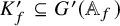
$K^{\prime }_f \subseteq G'(\mathbb {A}_f)$
. After adding enough level
$K^{\prime }_f \subseteq G'(\mathbb {A}_f)$
 to
$\mathcal {M}_{\mathbb {C}}$
to
$\mathcal {M}_{\mathbb {C}}$
 , we have a finite covering map
$\mathcal {M}_{K^{\prime }_f,\mathbb {C}} \rightarrow \mathrm {Sh}_{K_f, \mathbb {C}}(G)$
, we have a finite covering map
$\mathcal {M}_{K^{\prime }_f,\mathbb {C}} \rightarrow \mathrm {Sh}_{K_f, \mathbb {C}}(G)$
 . In this paper, we mainly take
$\mathcal {M} \rightarrow \operatorname {\mathrm {Spec}} \mathcal {O}_F$
. In this paper, we mainly take
$\mathcal {M} \rightarrow \operatorname {\mathrm {Spec}} \mathcal {O}_F$
 to be the “exotic smooth” Rapoport–Smithling–Zhang (RSZ) integral model of odd relative dimension
$n - 1$
to be the “exotic smooth” Rapoport–Smithling–Zhang (RSZ) integral model of odd relative dimension
$n - 1$
 [Reference Rapoport, Smithling and ZhangRSZ21, §6], for
$G = U(V)$
[Reference Rapoport, Smithling and ZhangRSZ21, §6], for
$G = U(V)$
 with V a Hermitian space of signature
$(n - 1, 1)$
with V a Hermitian space of signature
$(n - 1, 1)$
 which contains an everywhere self-dual lattice of full rank. These conditions imply
$n \equiv 2\ \pmod {4}$
which contains an everywhere self-dual lattice of full rank. These conditions imply
$n \equiv 2\ \pmod {4}$
 , but see also remarks after Theorem A for the case of
$n \equiv 0\ \pmod {4}$
, but see also remarks after Theorem A for the case of
$n \equiv 0\ \pmod {4}$
 , and Remark 9.1.5 for variants involving Hermitian spaces of possibly odd dimension. When
$n = 2$
, and Remark 9.1.5 for variants involving Hermitian spaces of possibly odd dimension. When
$n = 2$
 , the stack
$\mathcal {M}$
, the stack
$\mathcal {M}$
 is essentially a disjoint union of (stacky) modular curves (Section 9.2, also [Reference ChenChe24a, Example 3.2.1]).
The stack
$\mathcal {M}$
 admits a moduli description: it parameterizes tuples
$(A_0, \iota _0, \lambda _0, A, \iota , \lambda )$
admits a moduli description: it parameterizes tuples
$(A_0, \iota _0, \lambda _0, A, \iota , \lambda )$
 where
$A_0$
where
$A_0$
 and A are abelian schemes (dimensions
$1$
and A are abelian schemes (dimensions
$1$
 and n respectively) with
$\mathcal {O}_F$
and n respectively) with
$\mathcal {O}_F$
 -actions
$\iota _0$
-actions
$\iota _0$
 and
$\iota $
and
$\iota $
 , and with compatible quasi-polarizations
$\lambda _0$
, and with compatible quasi-polarizations
$\lambda _0$
 and
$\lambda $
and
$\lambda $
 . The datum
$(A_0, \iota _0, \lambda _0, A, \iota , \lambda )$
. The datum
$(A_0, \iota _0, \lambda _0, A, \iota , \lambda )$
 satisfies a few additional conditions, which we suppress in the introduction (see [Reference ChenChe24a, Section 3.1] and [Reference ChenChe24c, Section 2.1]). We are able to prove versions of our main global results for more general
$\mathcal {M}$
satisfies a few additional conditions, which we suppress in the introduction (see [Reference ChenChe24a, Section 3.1] and [Reference ChenChe24c, Section 2.1]). We are able to prove versions of our main global results for more general
$\mathcal {M}$
 (including odd arithmetic dimension n) at the price of discarding finitely many primes (particularly ramified primes for odd n); see Remark 9.1.5.
The moduli stack
$\mathcal {M}$
 carries a natural family of Hermitian
$\mathcal {O}_F$
carries a natural family of Hermitian
$\mathcal {O}_F$
 -lattices

Given any
$T \in \mathrm {Herm}_m(\mathbb {Q})$
 , the associated Kudla–Rapoport special cycle
$\mathcal {Z}(T) \rightarrow \mathcal {M}$
, the associated Kudla–Rapoport special cycle
$\mathcal {Z}(T) \rightarrow \mathcal {M}$
 is defined as the substack

consisting of m-tuples with Gram matrix T. More precisely, see [Reference ChenChe24c, Section 2.1]. This is in close analogy with classical Siegel–Weil: there we considered
$\mathcal {O}_F$
 -lattices varying in a given
adèlic
isomorphism class,Footnote
6
and here we are considering
$\mathcal {O}_F$
-lattices varying in a given
adèlic
isomorphism class,Footnote
6
and here we are considering
$\mathcal {O}_F$
 -lattices varying over the moduli stack
$\mathcal {M}$
-lattices varying over the moduli stack
$\mathcal {M}$
 . In the complex fiber, the special cycles
$\mathcal {Z}(T)_{\mathbb {C}}$
. In the complex fiber, the special cycles
$\mathcal {Z}(T)_{\mathbb {C}}$
 recover the special cycles
$\mathcal {Z}_{T,\mathbb {C}}$
recover the special cycles
$\mathcal {Z}_{T,\mathbb {C}}$
 appearing in (1.2.8), up to
$\mathcal {M}_{K^{\prime }_f,\mathbb {C}}$
appearing in (1.2.8), up to
$\mathcal {M}_{K^{\prime }_f,\mathbb {C}}$
 being a finite cover of
$\mathrm {Sh}_{K_f,\mathbb {C}}(G)$
being a finite cover of
$\mathrm {Sh}_{K_f,\mathbb {C}}(G)$
 (for suitable
$K^{\prime }_f$
(for suitable
$K^{\prime }_f$
 ); see [Reference ChenChe24c, Section 5.3]. The morphism
$\mathcal {Z}(T) \rightarrow \operatorname {\mathrm {Spec}} \mathcal {O}_F$
); see [Reference ChenChe24c, Section 5.3]. The morphism
$\mathcal {Z}(T) \rightarrow \operatorname {\mathrm {Spec}} \mathcal {O}_F$
 is smooth of relative dimension
$n - 1 - \operatorname {\mathrm {rank}}(T)$
is smooth of relative dimension
$n - 1 - \operatorname {\mathrm {rank}}(T)$
 in the generic fiber over
$\operatorname {\mathrm {Spec}} F$
in the generic fiber over
$\operatorname {\mathrm {Spec}} F$
 . If T is not positive semi-definite, then
$\mathcal {Z}(T)$
. If T is not positive semi-definite, then
$\mathcal {Z}(T)$
 is empty.
An arithmetic Siegel–Weil formula is an (in general conjectural) identity roughly of the shape

with
$\kappa $
 as in Section 1.2. The right-hand side of (1.3.3) denotes an arithmetic volume, which is a real number “defined” by an arithmetic intersection product

in an arithmetic Chow ring
$\widehat {\mathrm {Ch}}{}^{\ast }(\mathcal {M})_{\mathbb {Q}}$
 (roughly in the sense of Gillet–Soulé [Reference Gillet and SouléGS87]) for a certain dual metrized tautological bundle
$\widehat {\mathcal {E}}^{\vee }$
(roughly in the sense of Gillet–Soulé [Reference Gillet and SouléGS87]) for a certain dual metrized tautological bundle
$\widehat {\mathcal {E}}^{\vee }$
 on
$\mathcal {M}$
on
$\mathcal {M}$
 (the bundle
$\widehat {\mathcal {E}}^{\vee }$
(the bundle
$\widehat {\mathcal {E}}^{\vee }$
 is discussed in [Reference ChenChe24a, Sections 3.4 and 3.5]). The notation
$[\widehat {\mathcal {Z}}(T)]$
is discussed in [Reference ChenChe24a, Sections 3.4 and 3.5]). The notation
$[\widehat {\mathcal {Z}}(T)]$
 indicates a class in
$\widehat {\mathrm {Ch}}{}^m(\mathcal {M})_{\mathbb {Q}}$
indicates a class in
$\widehat {\mathrm {Ch}}{}^m(\mathcal {M})_{\mathbb {Q}}$
 , which is expected to involve
$\mathcal {Z}(T)$
, which is expected to involve
$\mathcal {Z}(T)$
 and some additional Archimedean data (e.g., from a Green current on the complex Shimura variety), as appearing in arithmetic intersection theory. As mentioned in [Reference ChenChe24a, Section 1.2], a precise formulation of arithmetic Siegel–Weil has not been proposed in full generality (on both the analytic and geometric sides). Our normalization on the analytic side is already nonstandard; we would like to highlight the similarity with normalizations for geometric and classical Siegel–Weil, as presented in (1.2.3) and (1.2.10). The normalization is in general delicate for arithmetic Siegel–Weil formulas, where both the derivative and special value at
$s = s_0$
and some additional Archimedean data (e.g., from a Green current on the complex Shimura variety), as appearing in arithmetic intersection theory. As mentioned in [Reference ChenChe24a, Section 1.2], a precise formulation of arithmetic Siegel–Weil has not been proposed in full generality (on both the analytic and geometric sides). Our normalization on the analytic side is already nonstandard; we would like to highlight the similarity with normalizations for geometric and classical Siegel–Weil, as presented in (1.2.3) and (1.2.10). The normalization is in general delicate for arithmetic Siegel–Weil formulas, where both the derivative and special value at
$s = s_0$
 may have meaning (we do observe this for our main theorem, see [Reference ChenChe24a, Remark 1.3.1] and discussion below).
In [Reference ChenChe24c, Section 3] and [Reference ChenChe24a, Section 3.6], we proposed a new candidate definition of arithmetic cycle classes

associated to arbitrary (possibly singular) T, where
$\widehat {\mathrm {Ch}}{}^m(\mathcal {M})_{\mathbb {Q}}$
 is an arithmetic Chow group associated to
$\mathcal {M}$
is an arithmetic Chow group associated to
$\mathcal {M}$
 . Here,
$[\widehat {\mathcal {Z}}(T)_{\mathscr {H}}]$
. Here,
$[\widehat {\mathcal {Z}}(T)_{\mathscr {H}}]$
 should describe “horizontal” contributions and
${}^{\mathbb {L}}\mathcal {Z}(T)_{\mathscr {V},p}$
should describe “horizontal” contributions and
${}^{\mathbb {L}}\mathcal {Z}(T)_{\mathscr {V},p}$
 should describe “vertical” contributions.
Due to non-properness of
$\mathcal {M} \rightarrow \operatorname {\mathrm {Spec}} \mathcal {O}_F$
 in general, one should likely modify
$[\widehat {\mathcal {Z}}(T)]$
in general, one should likely modify
$[\widehat {\mathcal {Z}}(T)]$
 on a suitable compactification of
$\mathcal {M}$
on a suitable compactification of
$\mathcal {M}$
 . If
$\mathcal {Z}(T) \rightarrow \operatorname {\mathrm {Spec}} \mathcal {O}_F$
. If
$\mathcal {Z}(T) \rightarrow \operatorname {\mathrm {Spec}} \mathcal {O}_F$
 is proper, however, we consider certain “arithmetic degrees without boundary contributions” (a real number)

conditional on convergence of the integral involving a certain current
$g_{T,y}$
 associated to
$\mathcal {Z}(T)$
associated to
$\mathcal {Z}(T)$
 , satisfying a modified Green current equation [Reference ChenChe24c, (1.1.4)]. Convergence of the integral in the settings of our arithmetic Siegel–Weil results was explained after [Reference ChenChe24c, (5.4.5)]. Here we set
$\mathcal {M}_{\mathbb {C}} {:=}q \mathcal {M} \times _{\operatorname {\mathrm {Spec}} \mathcal {O}_F} \operatorname {\mathrm {Spec}} \mathbb {C}$
, satisfying a modified Green current equation [Reference ChenChe24c, (1.1.4)]. Convergence of the integral in the settings of our arithmetic Siegel–Weil results was explained after [Reference ChenChe24c, (5.4.5)]. Here we set
$\mathcal {M}_{\mathbb {C}} {:=}q \mathcal {M} \times _{\operatorname {\mathrm {Spec}} \mathcal {O}_F} \operatorname {\mathrm {Spec}} \mathbb {C}$
 for any choice of embedding
$F \rightarrow \mathbb {C}$
for any choice of embedding
$F \rightarrow \mathbb {C}$
 . The middle term is mixed characteristic in nature: for
$\operatorname {\mathrm {rank}} T = n - 1$
. The middle term is mixed characteristic in nature: for
$\operatorname {\mathrm {rank}} T = n - 1$
 , it is (essentially) a weighted sum of Faltings heights of abelian varieties (Remark 9.1.4). For proper
$\mathcal {Z}(T) \rightarrow \mathcal {O}_F$
, it is (essentially) a weighted sum of Faltings heights of abelian varieties (Remark 9.1.4). For proper
$\mathcal {Z}(T) \rightarrow \mathcal {O}_F$
 , the quantity in (1.3.6) should coincide with the arithmetic degree (without boundary contributions) of a version of
$[\widehat {\mathcal {Z}}(T)]$
, the quantity in (1.3.6) should coincide with the arithmetic degree (without boundary contributions) of a version of
$[\widehat {\mathcal {Z}}(T)]$
 on any reasonable compactification of
$\mathcal {M}$
on any reasonable compactification of
$\mathcal {M}$
 .
.
The following is the main global theorem for our four-paper sequence.
Theorem A (Co-rank
$1$
 arithmetic Siegel–Weil)

Assume the prime
$2$
 splits in
$\mathcal {O}_F$
splits in
$\mathcal {O}_F$
 .
.
-
(1) For any $T \in \mathrm {Herm}_n(\mathbb {Q})$
with
$\operatorname {\mathrm {rank}}(T) = n - 1$
and any
$y \in \mathrm {Herm}_n(\mathbb {R})_{>0}$
, we have (1.3.7) $$ \begin{align} \frac{h_F}{w_F} \frac{d}{d s} \bigg |_{s = 0} E^{\ast}_{T}(y,s)^{\circ}_n = \widehat{\deg}([\widehat{\mathcal{Z}}(T)]). \end{align} $$
-
(2) For any $T^{\flat } \in \mathrm {Herm}_{n - 1}(\mathbb {Q})$
with
$\det T^{\flat } \neq 0$
and any
$y^{\flat } \in \mathrm {Herm}_{n-1}(\mathbb {R})_{>0}$
, we have (1.3.8) $$ \begin{align} 2 \frac{h_F}{w_F} \frac{d}{d s} \bigg|_{s = 0} \left ( \frac{\Lambda_n(s)_n^{\circ}}{\Lambda_{n - 1}(s + 1/2)^{\circ}_n} E^{\ast}_{T^{\flat}}(y^{\flat}, s + 1/2)^{\circ}_n \right ) = \widehat{\deg}([\widehat{\mathcal{Z}}(T^{\flat})] \cdot \widehat{c}_1(\widehat{\mathcal{E}}^{\vee})). \end{align} $$








This appears below as Theorem 9.1.1. Note that part (1) concerns the central derivative of a
$U(n,n)$
 Eisenstein series, while part (2) concerns a non-central derivative of a
$U(n - 1, n - 1)$
Eisenstein series, while part (2) concerns a non-central derivative of a
$U(n - 1, n - 1)$
 Eisenstein series. For
$n \equiv 0\ \pmod {4}$
Eisenstein series. For
$n \equiv 0\ \pmod {4}$
 , Theorem A(1) also holds in the sense that there is no self-dual
$\mathcal {O}_F$
, Theorem A(1) also holds in the sense that there is no self-dual
$\mathcal {O}_F$
 -lattice of signature
$(n - 1, 1)$
-lattice of signature
$(n - 1, 1)$
 and the left-hand side is
$0$
and the left-hand side is
$0$
 (Remark 9.1.3).
Remark 1.3.1. Our result in Theorem A(2) combined with our geometric Siegel–Weil result ((1.2.10) and surrounding discussion, also Proposition 8.1.1) shows that, for the relevant (normalized)
$U(n - 1, n - 1)$
 Eisenstein series, both the derivative and special value at
$s = 1/2$
Eisenstein series, both the derivative and special value at
$s = 1/2$
 simultaneously have arithmetic-geometric meaning (also mentioned in [Reference ChenChe24a, Remark 1.3.1]). This phenomenon amplifies the sensitivity of Theorem A(2) to the choice of normalization for the Eisenstein series, and is one reason for the importance of Part I in this paper (where we discuss our normalizations for Eisenstein series and local Whittaker functions).
We highlight the simplicity of the analytic side in Theorem A(1). It is expected that arithmetic Siegel–Weil for integral models with bad reduction should be corrected on the analytic side, for example, by special values of other Eisenstein series. See, for example, [Reference He, Shi and YangHSY23; Reference He, Li, Shi and YangHLSY23] for bad reduction in the nonsingular case
$\det T \neq 0$
 for the central derivative at
$s = 0$
for the central derivative at
$s = 0$
 (i.e., T is
$n \times n$
(i.e., T is
$n \times n$
 ), or [Reference Kudla, Rapoport and YangKRY06] for quaternionic Shimura curves. We do not know whether the analytic formulation [Reference He, Shi and YangHSY23; Reference He, Li, Shi and YangHLSY23] is expected to hold for singular T.
We argue that arithmetic Siegel–Weil formulas should be simplest to formulate on integral models with everywhere good reduction, as in our case. We thus propose a precise formulation of the analytic side of the central derivative arithmetic Siegel–Weil formula in our setup.
Question (Arithmetic Siegel–Weil)
Let
$T \in \mathrm {Herm}_n(\mathbb {Q})$
 be arbitrary. For a suitable current
$g_{T,y}$
be arbitrary. For a suitable current
$g_{T,y}$
 , a suitable compactification of
$\mathcal {M}$
, a suitable compactification of
$\mathcal {M}$
 , and a possibly modified class
$[\widehat {\mathcal {Z}}(T)]$
, and a possibly modified class
$[\widehat {\mathcal {Z}}(T)]$
 on the compactification, do we have

Our theorem verifies this proposed arithmetic Siegel–Weil formula for all singular
$T \in \mathrm {Herm}_n(\mathbb {Q})$
 of rank
$n - 1$
of rank
$n - 1$
 , in the sense of “arithmetic degrees without boundary contributions”. The formula also holds (in the same sense) for all nonsingular
$T \in \mathrm {Herm}_n(\mathbb {Q})$
, in the sense of “arithmetic degrees without boundary contributions”. The formula also holds (in the same sense) for all nonsingular
$T \in \mathrm {Herm}_n(\mathbb {Q})$
 . This latter case (“central derivative nonsingular arithmetic Siegel–Weil”) is possibly considered known to experts up to a volume constant by collecting the local theorems in [Reference LiuLiu11; Reference Li and ZhangLZ22; Reference Li and LiuLL22]. This particular global statement does not appear in the literature, though other variants are available (e.g., for unramified CM fields
$F / F_0$
. This latter case (“central derivative nonsingular arithmetic Siegel–Weil”) is possibly considered known to experts up to a volume constant by collecting the local theorems in [Reference LiuLiu11; Reference Li and ZhangLZ22; Reference Li and LiuLL22]. This particular global statement does not appear in the literature, though other variants are available (e.g., for unramified CM fields
$F / F_0$
 with
$F_0 \neq \mathbb {Q}$
with
$F_0 \neq \mathbb {Q}$
 [Reference Li and ZhangLZ22] or on integral models with bad reduction and correction terms by special values of other Eisenstein series [Reference He, Li, Shi and YangHLSY23]). In our setup, we will compute the volume constant and explain how to extract the
$\det T \neq 0$
[Reference Li and ZhangLZ22] or on integral models with bad reduction and correction terms by special values of other Eisenstein series [Reference He, Li, Shi and YangHLSY23]). In our setup, we will compute the volume constant and explain how to extract the
$\det T \neq 0$
 case of (1.3.9) from the literature (Remark 9.1.2).
For a discussion on difficulties in approaching arithmetic Siegel–Weil for higher-dimensional cycles (arbitrary T) from our point of view, we refer the reader to [Reference ChenChe24a, Remark 1.7.1] or the end of [Reference ChenChe24c, Section 1.2].
Remark 1.3.2. Part (2) of Theorem A is the special case of part (1) when
$T = \mathrm {diag}(0,T^{\flat })$
 and
$y = \mathrm {diag}(1, y^{\flat })$
and
$y = \mathrm {diag}(1, y^{\flat })$
 . The geometric sides agree essentially by definition (1.3.6). On the analytic side, the relation is provided by the formula

from Corollary 6.2.2, along with the functional equation
$E^{\ast }_{T^{\flat }}(y^{\flat },s)^{\circ }_n = E^{\ast }_{T^{\flat }}(y^{\flat },-s)^{\circ }_n$
 . The general case of Theorem A is proved in a similar way as the special case
$T = \mathrm {diag}(0,T^{\flat })$
. The general case of Theorem A is proved in a similar way as the special case
$T = \mathrm {diag}(0,T^{\flat })$
 , with an additional “local diagonalizability argument” (Proof of Theorem 9.1.1) where the identity is proved modulo
$\sum _{\ell \neq p} \mathbb {Q} \cdot \log \ell $
, with an additional “local diagonalizability argument” (Proof of Theorem 9.1.1) where the identity is proved modulo
$\sum _{\ell \neq p} \mathbb {Q} \cdot \log \ell $
 for any given p (varying p removes the ambiguity).
Unlike
$E^{\ast }_{T^{\flat }}(y,s)^{\circ }_n$
 , the Fourier coefficient
$E^{\ast }_T(y,s)^{\circ }_n$
, the Fourier coefficient
$E^{\ast }_T(y,s)^{\circ }_n$
 does not admit an obvious Euler product decomposition into local Whittaker functions as T is singular. Since our proof of Theorem A is local (via local Whittaker functions and local special cycles), the decomposition (1.3.10) is crucial for our method (to use local Whittaker functions to describe
$E^{\ast }_T(y,s)^{\circ }_n$
does not admit an obvious Euler product decomposition into local Whittaker functions as T is singular. Since our proof of Theorem A is local (via local Whittaker functions and local special cycles), the decomposition (1.3.10) is crucial for our method (to use local Whittaker functions to describe
$E^{\ast }_T(y,s)^{\circ }_n$
 ). This decomposition is sensitive to the normalization used to define
$E^{\ast }(z,s)^{\circ }_n$
). This decomposition is sensitive to the normalization used to define
$E^{\ast }(z,s)^{\circ }_n$
 , and is another reason for the importance of Part I in this paper, where we treat normalized Eisenstein series and local Whittaker functions.
Remark 1.3.3. An expected application of arithmetic Siegel–Weil formulas is in the theory of arithmetic theta lifting. One expects to form automorphic arithmetic theta series as generating series

with “Fourier coefficients”
$[\widehat {\mathcal {Z}}(T)]$
 valued in the arithmetic Chow group
$\widehat {\mathrm {Ch}}{}^m(\mathcal {M})_{\mathbb {Q}}$
valued in the arithmetic Chow group
$\widehat {\mathrm {Ch}}{}^m(\mathcal {M})_{\mathbb {Q}}$
 . These should be analogous to (weighted averages of) classical theta series, as in the classical Siegel–Weil formula. In analogy with classical theta lifting, one expects to use
$\widehat {\Theta }$
. These should be analogous to (weighted averages of) classical theta series, as in the classical Siegel–Weil formula. In analogy with classical theta lifting, one expects to use
$\widehat {\Theta }$
 as an integral kernel to lift
$U(m,m)$
as an integral kernel to lift
$U(m,m)$
 automorphic forms to elements of
$\widehat {\mathrm {Ch}}{}^m(\mathcal {M})_{\mathbb {Q}}$
automorphic forms to elements of
$\widehat {\mathrm {Ch}}{}^m(\mathcal {M})_{\mathbb {Q}}$
 . In analogy with the classical Rallis inner product formula, one expects to use the doubling method and arithmetic Siegel–Weil formulas to relate the derivative of an L-function with the arithmetic inner product of this arithmetic theta lift [Reference KudlaKud04, Part III]. We refer to [Reference Kudla, Rapoport and YangKRY06; Reference Bruinier, Howard, Kudla, Rapoport and YangBHKRY20II; Reference Li and LiuLL21; Reference Li and LiuLL22] for some cases where versions of this have been realized, with applications to Beilinson–Bloch. For modularity results on generating series of arithmetic divisors, see [Reference Kudla, Rapoport and YangKRY06; Reference Bruinier, Burgos Gil and KühnBBK07; Reference Bruinier, Howard, Kudla, Rapoport and YangBHKRY20; Reference QiuQiu22].
It is also possible to formulate and prove Theorem A in terms of Faltings heights (i.e., replacing the middle term in (1.3.6) with the degree of the metrized Hodge bundle). The formulation in Theorem A seems more natural to us, but the version with Faltings heights is in Remark 9.1.4.
Since our proof of Theorem A will be local in nature, we also have a version for more general moduli stacks
$\mathcal {M}$
 (including odd arithmetic dimension n) at the price of discarding finitely many primes (particularly the ramified ones). This is explained in Remark 9.1.5.
The simplest case of Theorem A is the case
$n = 2$
 . When
$\mathcal {O}_F^{\times } = \{ \pm 1 \}$
. When
$\mathcal {O}_F^{\times } = \{ \pm 1 \}$
 , the Serre tensor construction gives an open and closed embedding
$\mathscr {M}_0 \times _{\operatorname {\mathrm {Spec}} \mathcal {O}_F} \mathscr {M}_{\text {ell}} \rightarrow \mathcal {M}$
, the Serre tensor construction gives an open and closed embedding
$\mathscr {M}_0 \times _{\operatorname {\mathrm {Spec}} \mathcal {O}_F} \mathscr {M}_{\text {ell}} \rightarrow \mathcal {M}$
 , where
$\mathscr {M}_0$
, where
$\mathscr {M}_0$
 is the moduli stack of elliptic curves with signature
$(1,0)$
is the moduli stack of elliptic curves with signature
$(1,0)$
 action by
$\mathcal {O}_F$
action by
$\mathcal {O}_F$
 and
$\mathscr {M}_{\text {ell}}$
and
$\mathscr {M}_{\text {ell}}$
 is the moduli stack of all elliptic curves, base-changed to
$\mathcal {O}_F$
is the moduli stack of all elliptic curves, base-changed to
$\mathcal {O}_F$
 (Section 9.2). In this case, the special cycle
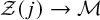
$\mathcal {Z}(j) \rightarrow \mathcal {M}$
(Section 9.2). In this case, the special cycle
$\mathcal {Z}(j) \rightarrow \mathcal {M}$
 for
$j \in \mathbb {Z}_{>0}$
for
$j \in \mathbb {Z}_{>0}$
 pulls back to the j-th Hecke correspondence. Then the proof of Theorem 9.1.1(2) gives the following corollary (appearing below as Corollary 9.2.2). One might think of this corollary as reformulating a result of Nakkajima–Taguchi [Reference Nakkajima and TaguchiNT91] (they compute Faltings heights of elliptic curves with CM by possibly non-maximal orders) by averaging over Hecke translates and expressing the result in terms of Eisenstein series Fourier coefficients.
Corollary 1.3.4. Assume
$2$
 is split in
$\mathcal {O}_F$
is split in
$\mathcal {O}_F$
 . Fix any elliptic curve
$E_0$
. Fix any elliptic curve
$E_0$
 over
$\mathbb {C}$
over
$\mathbb {C}$
 with
$\mathcal {O}_F$
with
$\mathcal {O}_F$
 -action. For any integer
$j> 0$
-action. For any integer
$j> 0$
 , we have

where the sum runs over degree j isogenies
$w \colon E \rightarrow E_0$
 of elliptic curves.
The notation
$h_{\mathrm {Fal}}(E)$
 denotes the (stable) Faltings height of the elliptic curve E after descent to any number field, and similarly for
$E_0$
denotes the (stable) Faltings height of the elliptic curve E after descent to any number field, and similarly for
$E_0$
 . The quantity
$j^{s+1/2} \sigma _{-2s}(j)$
. The quantity
$j^{s+1/2} \sigma _{-2s}(j)$
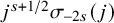 is the product of the normalized non-Archimedean local Whittaker functions in the j-th Fourier coefficient
$E^{\ast }_j(y,s)^{\circ }_2$
is the product of the normalized non-Archimedean local Whittaker functions in the j-th Fourier coefficient
$E^{\ast }_j(y,s)^{\circ }_2$
 (with
$m = 1$
(with
$m = 1$
 ) as in (1.1.7). The derivative of the Archimedean local Whittaker function
$W^{\ast }_{j,\infty }(y,s)^{\circ }_2$
) as in (1.1.7). The derivative of the Archimedean local Whittaker function
$W^{\ast }_{j,\infty }(y,s)^{\circ }_2$
 at
$s = 1/2$
at
$s = 1/2$
 was calculated explicitly and compared with its geometric counterpart (integral of Green function wedge Chern form on upper half-plane) in our companion paper [Reference ChenChe24b, Section 4.2].
In fact, Corollary 1.3.4 holds if
$E_0$
 is replaced by any elliptic curve over
$\overline {\mathbb {Q}}$
is replaced by any elliptic curve over
$\overline {\mathbb {Q}}$
 . Indeed, it is known that the quantity on the left-hand side of Corollary 1.3.4 is constant as
$E_0$
. Indeed, it is known that the quantity on the left-hand side of Corollary 1.3.4 is constant as
$E_0$
 varies over all elliptic curves over
$\overline {\mathbb {Q}}$
varies over all elliptic curves over
$\overline {\mathbb {Q}}$
 . The case of isogenies of square-free degree appears in [Reference Szpiro and UllmoSU99, Proposition 8.1], and the case of cyclic isogenies appears in [Reference AutissierAut03, Corollaire 3.3]. Our Corollary 1.3.4 may be extracted from either of those cited results via a combinatorial calculation involving the usual Hecke algebra recurrence relations. The actual proof that we give (as a byproduct of the proof of our main theorem) is different, passing through local calculations on p-divisible groups and formal groups (e.g., as appearing in the calculation of Nakkajima–Taguchi).
Our purely Archimedean result (for arbitrary n and arbitrary rank
$m^{\flat } \geq 1$
 ) is the following.
Theorem B (Archimedean arithmetic Siegel–Weil, nonsingular)
Consider any integer
$m^{\flat }$
 with
${1 \leq m^{\flat } \leq n}$
with
${1 \leq m^{\flat } \leq n}$
 , and consider any
$T^{\flat } \in \mathrm {Herm}_{m^{\flat }}(\mathbb {Q})$
, and consider any
$T^{\flat } \in \mathrm {Herm}_{m^{\flat }}(\mathbb {Q})$
 which is nonsingular and not positive definite.
-
(3) For any $y^{\flat } \in \mathrm {Herm}_{m^{\flat }}(\mathbb {R})_{>0}$
, we have an equality of real numbers (1.3.13) $$ \begin{align} \widehat{\deg}([\widehat{\mathcal{Z}}(T^{\flat})] \cdot \widehat{c}_1(\widehat{\mathcal{E}}^{\vee})^{n - m^{\flat}}) {:=}q \int_{\mathcal{M}_{\mathbb{C}}} g_{T^{\flat},y^{\flat}} \wedge c_1(\widehat{\mathcal{E}}^{\vee}_{\mathbb{C}})^{n - m^{\flat}} = (-1)^{n - m^{\flat}} C \cdot \frac{h_F}{w_F} \frac{d}{ds} \bigg|_{s = s_0^{\flat}} E^{\ast}_{T^{\flat}}(y^{\flat}, s)^{\circ}_n \end{align} $$where $s_0^{\flat } {:=}q (n - m^{\flat }) / 2$
. Here
$C \in \mathbb {Q}_{>0}$
is the volume constant from 7.4.1(1), for the Hermitian space V and
$v_0 = \infty $
in the notation of loc. cit. The constant C may depend on n and
$m^{\flat }$
(and F), but does not otherwise depend on
$T^{\flat }$
.





In Theorem B, the assumption that
$T^{\flat }$
 is not positive definite ensures that the cycle
$\mathcal {Z}(T^{\flat })$
is not positive definite ensures that the cycle
$\mathcal {Z}(T^{\flat })$
 is empty, so that the only contribution to the arithmetic degree
$\widehat {\deg }([\widehat {\mathcal {Z}}(T^{\flat })] \cdot \widehat {c}_1(\widehat {\mathcal {E}}^{\vee })^{n - m^{\flat }})$
is empty, so that the only contribution to the arithmetic degree
$\widehat {\deg }([\widehat {\mathcal {Z}}(T^{\flat })] \cdot \widehat {c}_1(\widehat {\mathcal {E}}^{\vee })^{n - m^{\flat }})$
 should be from the displayed Green current integral. Theorem B appears below (in stronger form) as Theorem 9.1.6. That version applies for all n (even or not) and arbitrary level, as it is a statement about the complex Shimura variety. We gave the weaker version here to avoid more notation in the introduction. Due to non-properness of
$\mathcal {M}_{\mathbb {C}} \rightarrow \operatorname {\mathrm {Spec}} \mathbb {C}$
should be from the displayed Green current integral. Theorem B appears below (in stronger form) as Theorem 9.1.6. That version applies for all n (even or not) and arbitrary level, as it is a statement about the complex Shimura variety. We gave the weaker version here to avoid more notation in the introduction. Due to non-properness of
$\mathcal {M}_{\mathbb {C}} \rightarrow \operatorname {\mathrm {Spec}} \mathbb {C}$
 for
$n> 2$
for
$n> 2$
 , the corresponding Archimedean result of [Reference Garcia and SankaranGS19] does not apply here if
$n> 2$
, the corresponding Archimedean result of [Reference Garcia and SankaranGS19] does not apply here if
$n> 2$
 .
.
When
$m^{\flat } = n$
 , the preceding Archimedean theorem follows from Liu’s result [Reference LiuLiu11, Theorem 4.17]. We do not have a new proof of this case. Instead, we deduce our general result from his by a certain limiting argument. This is also our method at non-Archimedean places (replacing Liu’s Archimedean results with the non-Archimedean results of Li–Zhang [Reference Li and ZhangLZ22] and Li–Liu [Reference Li and LiuLL22]). These local theorems were the main results of our companion papers [Reference ChenChe24a; Reference ChenChe24b]. In this paper, we explain how to combine our local theorems at all places to prove the (global) Theorems A and B.
Remark 1.3.5. The “global-to-local” reduction step for heights from [Reference ChenChe24c] is the main reason why we only prove an arithmetic Siegel–Weil result for imaginary quadratic
$F / \mathbb {Q}$
 , rather than a general CM field
$F / F_0$
, rather than a general CM field
$F / F_0$
 . Our local methods from [Reference ChenChe24a] carry through formally for arbitrary étale degree
$2$
. Our local methods from [Reference ChenChe24a] carry through formally for arbitrary étale degree
$2$
 extensions
$F / F_0$
extensions
$F / F_0$
 for
$F_0$
for
$F_0$
 a p-adic field, disallowing only the case
$p = 2$
a p-adic field, disallowing only the case
$p = 2$
 with
$F / F_0$
with
$F / F_0$
 nonsplit. However, it remains to show that the analogous “local geometric quantities” in fact have global geometric meaning for general
$F / F_0$
nonsplit. However, it remains to show that the analogous “local geometric quantities” in fact have global geometric meaning for general
$F / F_0$
 .
.
In the general case, an “absolute” Rapoport–Zink space appears naturally in p-adic uniformization of Shimura varieties, while our local methods seem more directly applicable on certain “relative” Rapoport–Zink spaces. There are known comparison isomorphisms between these Rapoport–Zink spaces, as in [Reference MihatschMih22, Theorem 1.4] (inert places) and [Reference Li and LiuLL22, §2.8] (ramified places, unramified over
$\mathbb {Q}_p$
 ). It remains to be understood how the height decomposition procedure of this paper behaves with respect to these comparison isomorphisms. To complete the global result, presumably one needs to also develop a similar theory at split primes, along with the related further study of ordinary Rapoport–Zink spaces, generalizing the treatment in [Reference ChenChe24a, Sections 4 to 6] and the Rapoport–Zink uniformization in ordinary situations as treated in [Reference ChenChe24c, Section 4].
1.4 Sketch
We next outline what remains for the proofs of Theorems A and B, after the previous three papers [Reference ChenChe24a; Reference ChenChe24b; Reference ChenChe24c] in this sequence.
We illustrate (a special case of) the local-to-global reduction process on the analytic side of the arithmetic Siegel–Weil formula, involving Eisenstein series and local Whittaker functions. In the special case of
$T = \mathrm {diag}(0,T^{\flat })$
 for
$T^{\flat }$
for
$T^{\flat }$
 nonsingular of rank
$n - 1$
nonsingular of rank
$n - 1$
 and
$y = \mathrm {diag}(1,y^{\flat })$
and
$y = \mathrm {diag}(1,y^{\flat })$
 , we give a local decomposition


coming from Leibniz rule and an Euler product

of local (normalized) Whittaker functions over all places (Section 6.1). More generally, one can relate the
$U(n,n)$
 Eisenstein series Fourier coefficient
$E^{\ast }_{T}(y,s)^{\circ }_n$
Eisenstein series Fourier coefficient
$E^{\ast }_{T}(y,s)^{\circ }_n$
 with the
$U(n - 1, n - 1)$
with the
$U(n - 1, n - 1)$
 Eisenstein series Fourier coefficients
$E^{\ast }_{T^{\flat }}(y^{\flat }, s + 1/2 )^{\circ }_n$
Eisenstein series Fourier coefficients
$E^{\ast }_{T^{\flat }}(y^{\flat }, s + 1/2 )^{\circ }_n$
 and
$E^{\ast }_{T^{\flat }}(y^{\flat }, s - 1/2)^{\circ }_n$
and
$E^{\ast }_{T^{\flat }}(y^{\flat }, s - 1/2)^{\circ }_n$
 (Corollary 6.2.2). Here, the work is to explicitly pin down normalizing factors, constants, intertwining operators, etc., so that the final form of Theorem A matches our explicit prediction. These tasks are carried out in Part I.
If T is not in block diagonal form but
${}^t \overline {\gamma } T \gamma $
 is block diagonal for some
$\gamma \in \operatorname {\mathrm {GL}}_n(\mathcal {O}_F)$
is block diagonal for some
$\gamma \in \operatorname {\mathrm {GL}}_n(\mathcal {O}_F)$
 , a certain “linear invariance” property for Eisenstein series (Section 2.3) gives a similar local decomposition. If no such
$\gamma $
, a certain “linear invariance” property for Eisenstein series (Section 2.3) gives a similar local decomposition. If no such
$\gamma $
 exists, we instead take
$\gamma \in \operatorname {\mathrm {GL}}_n(\mathcal {O}_F \otimes _{\mathbb {Z}} \mathbb {Z}_{(p)})$
exists, we instead take
$\gamma \in \operatorname {\mathrm {GL}}_n(\mathcal {O}_F \otimes _{\mathbb {Z}} \mathbb {Z}_{(p)})$
 (“local diagonalizability”); this introduces a discrepancy of
$\sum _{\ell \neq p} \mathbb {Q} \cdot \log \ell $
(“local diagonalizability”); this introduces a discrepancy of
$\sum _{\ell \neq p} \mathbb {Q} \cdot \log \ell $
 , but varying p removes this discrepancy by
$\mathbb {R}$
, but varying p removes this discrepancy by
$\mathbb {R}$
 -linear independence of
$\log p$
-linear independence of
$\log p$
 over all primes p (see Section 9.1). This “p-local diagonalization” argument is a new feature on the analytic side for our local-to-global reduction of arithmetic Siegel–Weil. This possible non-diagonalizability of T is the main reason why the proof of Theorem 9.1.1 is more than twice as long as this sketch.
To reduce Theorem A (for T singular of co-rank
$1$
 ) to our local main theorems from [Reference ChenChe24a, Section 9] and [Reference ChenChe24b, Section 4], we recall the geometric quantities


from [Reference ChenChe24c, (5.4.5), (4.9.7), (4.8.3)], as well as the “total non-Archimedean intersection number”
$\operatorname {Int}_{p, \mathrm {global}}(T) {:=}q \operatorname {Int}_{\mathscr {H}, p, \mathrm {global}}(T) + \operatorname {Int}_{\mathscr {V}, p, \mathrm {global}}(T)$
 . We recall that
$h^{\mathrm {CM}}_{\widehat {\mathcal {E}}^{\vee }}$
. We recall that
$h^{\mathrm {CM}}_{\widehat {\mathcal {E}}^{\vee }}$
 is a certain height constant as in [Reference ChenChe24c, (2.1.13)], coming from Faltings height of elliptic curves with CM by
$\mathcal {O}_F$
is a certain height constant as in [Reference ChenChe24c, (2.1.13)], coming from Faltings height of elliptic curves with CM by
$\mathcal {O}_F$
 .
.
We then proceed by matching (1.4.2), (1.4.3), and (1.4.4) to the geometric quantities

respectively, and the sums over primes p match term by term.
The height constant
$h^{\mathrm {CM}}_{\widehat {\mathcal {E}}^{\vee }}$
 is essentially the derivative appearing in (1.4.2) (see (9.1.2)), and the degree
$\deg _{\mathbb {Z}} \mathcal {Z}(T)_{\mathscr {H}}$
is essentially the derivative appearing in (1.4.2) (see (9.1.2)), and the degree
$\deg _{\mathbb {Z}} \mathcal {Z}(T)_{\mathscr {H}}$
 is essentially the special value
$E^{\ast }_{T^{\flat }}(y^{\flat },s)^{\circ }_n$
is essentially the special value
$E^{\ast }_{T^{\flat }}(y^{\flat },s)^{\circ }_n$
 appearing in loc. cit. (by geometric Siegel–Weil as in Remark 8.1.2 or (1.2.10)). The comparison with 1.4.2 emerges from this.
For the remaining terms, we recall the local-to-global relations


from our companion paper, as given in [Reference ChenChe24c, (5.4.6)] and (the combination of) [Reference ChenChe24c, (4.9.7), (4.8.3), (4.9.9)], with
$[K_{L_0,f} : K_{0,f}] = 1$
 in the notation of loc. cit. Here
$\operatorname {Int}_{\infty }(T,y)$
in the notation of loc. cit. Here
$\operatorname {Int}_{\infty }(T,y)$
 and
$\operatorname {Int}_p(T)$
and
$\operatorname {Int}_p(T)$
 are “local intersection numbers” (Archimedean and non-Archimedean), formulated on the Hermitian symmetric domain and Rapoport–Zink spaces respectively. Each
$\deg [ \cdots ]$
are “local intersection numbers” (Archimedean and non-Archimedean), formulated on the Hermitian symmetric domain and Rapoport–Zink spaces respectively. Each
$\deg [ \cdots ]$
 comes from some “uniformization degrees” (for complex or Rapoport–Zink uniformization) for special cycles, and are essentially theta integrals. For the reader’s convenience, we recall that
$\mathcal {D}(\underline {x}_f) \subseteq U(V)(\mathbb {A}_f) / K_{L,f}$
comes from some “uniformization degrees” (for complex or Rapoport–Zink uniformization) for special cycles, and are essentially theta integrals. For the reader’s convenience, we recall that
$\mathcal {D}(\underline {x}_f) \subseteq U(V)(\mathbb {A}_f) / K_{L,f}$
 and
$\mathcal {Z}(\underline {\mathbf {x}}^p) \subseteq U(V)(\mathbb {A}_f^p) / K_{L,f}^p$
and
$\mathcal {Z}(\underline {\mathbf {x}}^p) \subseteq U(V)(\mathbb {A}_f^p) / K_{L,f}^p$
 are certain (discrete) sets. The symbol
$\mathbf {W}$
are certain (discrete) sets. The symbol
$\mathbf {W}$
 is a certain positive definite Hermitian space depending on p (rank n if p is nonsplit, and rank
$n - 1$
is a certain positive definite Hermitian space depending on p (rank n if p is nonsplit, and rank
$n - 1$
 if p is split), with a “perpendicular complement”
$\mathbf {W}^{\perp }$
if p is split), with a “perpendicular complement”
$\mathbf {W}^{\perp }$
 (rank
$0$
(rank
$0$
 if p is nonsplit, and rank
$1$
if p is nonsplit, and rank
$1$
 if p is split) with
$I_1 {:=}q U(\mathbf {W}) \times U(\mathbf {W}^{\perp })$
if p is split) with
$I_1 {:=}q U(\mathbf {W}) \times U(\mathbf {W}^{\perp })$
 . The notation
$K_{1,\mathbf {L}^{\perp }_p} \subseteq U(\mathbf {W}_p^{\perp })$
. The notation
$K_{1,\mathbf {L}^{\perp }_p} \subseteq U(\mathbf {W}_p^{\perp })$
 means the unique maximal compact subgroup. For further discussion of these objects, we refer to the introduction [Reference ChenChe24c, Section 1].
Our main Archimedean local theorem [Reference ChenChe24b, Theorem 4.1.1] gives

By “local Siegel–Weil” (Section 7.4), we have

for any
$y^{\flat } \in \mathrm {Herm}_{n - 1}(\mathbb {R})_{>0}$
 , and the comparison with (1.4.3) now emerges.
Our local main non-Archimedean theorem from [Reference ChenChe24a, Section 1] gives

where
$e_p = 1$
 (resp.
$e_p = 2$
(resp.
$e_p = 2$
 ) if p is unramified (resp. if p is ramified). By “local Siegel–Weil” (Section 7.4), we have

and the comparison with (1.4.4) now emerges.
1.5 Outline
We briefly summarize the remaining content in this paper, and discuss the relation with our companion papers [Reference ChenChe24a; Reference ChenChe24b; Reference ChenChe24c]. Further explanations may be found at the beginning of some sections.
The remaining sections are divided into Parts I and II.
In Part I “Eisenstein series”, we study
$U(m,m)$
 Siegel–Weil Eisenstein series. To formulate and prove our main results, it is extremely important that we normalize the Eisenstein series and local Whittaker functions (e.g., by certain L-factors). As in our main local theorems from [Reference ChenChe24a; Reference ChenChe24b], it seems that these normalized versions correspond more naturally to geometric objects (e.g., global and local special cycles). We pin down explicit precise normalizations, guided by special value formulas and symmetric functional equations. We also study (normalized) Fourier coefficients for singular T (focusing on rank
$m - 1$
Siegel–Weil Eisenstein series. To formulate and prove our main results, it is extremely important that we normalize the Eisenstein series and local Whittaker functions (e.g., by certain L-factors). As in our main local theorems from [Reference ChenChe24a; Reference ChenChe24b], it seems that these normalized versions correspond more naturally to geometric objects (e.g., global and local special cycles). We pin down explicit precise normalizations, guided by special value formulas and symmetric functional equations. We also study (normalized) Fourier coefficients for singular T (focusing on rank
$m - 1$
 and size
$m \times m$
and size
$m \times m$
 ), and give formulas needed for our main results.
In Part II “Siegel–Weil”, we first give some special value formulas (local and geometric Siegel–Weil, Sections 7 and 8) which are needed to prove our arithmetic Siegel–Weil theorems. Our treatment of our geometric Siegel–Weil result is inspired by [Reference Li and ZhangLZ22, Remark 4.6.2], and the argument may be carried out using complex (Archimedean) uniformization or Rapoport–Zink (non-Archimedean) uniformization in similar fashions. We also compare complex volumes of unitary Shimura varieties with the special value of our Eisenstein series normalizing factor (“geometric Siegel mass formula”), which may be of independent interest (Section 8.2). The finale occurs in Section 9.1, where we collect our local main theorems to prove our (global) arithmetic Siegel–Weil theorems. This proof relies on results from almost all preceding sections, including our three other companion papers. The key inputs from those papers are our non-Archimedean local arithmetic Siegel–Weil theorems from [Reference ChenChe24a], our Archimedean local arithmetic Siegel–Weil theorem from [Reference ChenChe24b], and the geometric local-to-global reduction process (via Archimedean and non-Archimedean uniformization) from [Reference ChenChe24c]. Section 9.2 contains a reformulation of our arithmetic Siegel–Weil results in the special case
$n = 2$
 , via an exceptional comparison with Hecke translates of CM elliptic curves.
Part I
Eisenstein series
2 Setup
2.1 The group
$U(m,m)$

We fix notation for the unitary group
$U(m,m)$
 .
.
Let
$A \rightarrow B$
 be a finite locally free morphism of (commutative) rings, and suppose B is given an involution
$b \mapsto \overline {b}$
be a finite locally free morphism of (commutative) rings, and suppose B is given an involution
$b \mapsto \overline {b}$
 (“conjugation”) over A. We are mostly interested in the case where
$F/F^+$
(“conjugation”) over A. We are mostly interested in the case where
$F/F^+$
 is a CM extension of number fields (with
$F^+$
is a CM extension of number fields (with
$F^+$
 the index
$2$
the index
$2$
 totally real subfield) and
$B/A = \mathcal {O}_F/\mathcal {O}_{F^+}$
totally real subfield) and
$B/A = \mathcal {O}_F/\mathcal {O}_{F^+}$
 for the corresponding rings of integers (also the local analogues) etc.
Fix an integer
$m \geq 0$
 . Write
$1_m$
. Write
$1_m$
 for the
$m \times m$
for the
$m \times m$
 identity matrix (sometimes we drop the subscript m), and let
$H = U(m,m)$
identity matrix (sometimes we drop the subscript m), and let
$H = U(m,m)$
 be the unitary group

where
${}^t \overline {h}$
 denotes conjugate transpose (with H the trivial group if
$m = 0$
denotes conjugate transpose (with H the trivial group if
$m = 0$
 , by convention). Equivalently, H consists of block matrices

with
$a, b, c, d \in \mathrm {Res}_{B/A} M_{m \times m}$
 . We refer to H as the group
$U(m,m)$
. We refer to H as the group
$U(m,m)$
 (for signature reasons when
$B/A$
(for signature reasons when
$B/A$
 is
$\mathbb {C} / \mathbb {R}$
is
$\mathbb {C} / \mathbb {R}$
 ).
).
Given an integer j with
$0 \leq j \leq m$
 , we consider the injection

Consider the subgroups


of H. We have
$P(R) = M(R) N(R)$
 for all A-algebras R. We occasionally write
$P_m, M_m, N_m$
for all A-algebras R. We occasionally write
$P_m, M_m, N_m$
 to emphasize dependence on m.
Set

for j with
$0 \leq j \leq m$
 . We also write
$w = w_m$
. We also write
$w = w_m$
 when
$j = m$
when
$j = m$
 and m is understood.
Let
$F_v$
 be a finite étale algebra of degree
$2$
be a finite étale algebra of degree
$2$
 over a local field
$F^+_v$
over a local field
$F^+_v$
 . Consider
$B / A = \mathcal {O}_{F_v} / \mathcal {O}_{F^+_v}$
. Consider
$B / A = \mathcal {O}_{F_v} / \mathcal {O}_{F^+_v}$
 for the respective rings of integers (with
$\mathcal {O}_{F^+_v} {:=}q F^+_v$
for the respective rings of integers (with
$\mathcal {O}_{F^+_v} {:=}q F^+_v$
 and
$\mathcal {O}_{F_v} {:=}q F_v$
and
$\mathcal {O}_{F_v} {:=}q F_v$
 if
$F^+_v$
if
$F^+_v$
 is Archimedean).
If
$F_v/F^+_v = \mathbb {C}/\mathbb {R}$
 , we consider the standard maximal compact subgroup

We write
$U(m) \subseteq \operatorname {\mathrm {GL}}_m(\mathbb {C})$
 for (the real points of) the unitary group for the usual positive definite rank m complex Hermitian space (specified by the Gram matrix
$1_m$
for (the real points of) the unitary group for the usual positive definite rank m complex Hermitian space (specified by the Gram matrix
$1_m$
 ). There is an isomorphism
$K_{v}^{\circ } \rightarrow U(m) \times U(m)$
). There is an isomorphism
$K_{v}^{\circ } \rightarrow U(m) \times U(m)$
 sending the displayed matrix to
$(a + i b, a - i b) \in U(m) \times U(m)$
sending the displayed matrix to
$(a + i b, a - i b) \in U(m) \times U(m)$
 (see, e.g., [Reference Garcia and SankaranGS19, §2.5.1]).
If
$F^+_v$
 is non-Archimedean, we consider the standard open compact subgroup

If
$F_v/F^+_v = \mathbb {C} / \mathbb {R}$
 or if
$F^+_v$
or if
$F^+_v$
 is non-Archimedean, we have
$H(F^+_v) = P(F^+_v) K_v^{\circ }$
is non-Archimedean, we have
$H(F^+_v) = P(F^+_v) K_v^{\circ }$
 . If
$F^+_v$
. If
$F^+_v$
 is non-Archimedean, and given any
$n(b) \in N(F^+_v)$
is non-Archimedean, and given any
$n(b) \in N(F^+_v)$
 with any decomposition

with
$m(a) \in M(F^+_v)$
 and
$n(b') \in N(F^+_v)$
and
$n(b') \in N(F^+_v)$
 and
$k \in K_v^{\circ }$
and
$k \in K_v^{\circ }$
 , we may assume
$\det a \in F^+_v$
, we may assume
$\det a \in F^+_v$
 (it a priori lies in
$F_v$
(it a priori lies in
$F_v$
 ) after possibly changing k, as follows from [Reference ShimuraShi97, (13.4.1)] and the explanation at the end of [Reference ShimuraShi97, §3.6].
If
$F/F^+$
 is a CM extension of number fields and
$B/A = \mathcal {O}_F/\mathcal {O}_{F^+}$
is a CM extension of number fields and
$B/A = \mathcal {O}_F/\mathcal {O}_{F^+}$
 , we write

where the products run over places v of
$F^+$
 .
.
For places v of
$F^+$
 , we use the notation
$F_v {:=}q \prod _{w \mid v} F_w$
, we use the notation
$F_v {:=}q \prod _{w \mid v} F_w$
 where w runs over places of F, similarly
$\mathcal {O}_{F_v} {:=}q \prod _{w \mid v} \mathcal {O}_{F_w}$
where w runs over places of F, similarly
$\mathcal {O}_{F_v} {:=}q \prod _{w \mid v} \mathcal {O}_{F_w}$
 , as well as
$F^+_{\infty } = \prod _{v \mid \infty } F^+_v$
, as well as
$F^+_{\infty } = \prod _{v \mid \infty } F^+_v$
 and
$F_{\infty } = \prod _{w \mid \infty } F_w$
and
$F_{\infty } = \prod _{w \mid \infty } F_w$
 , etc.
2.2 Adèlic and classical Eisenstein series
Characters are assumed continuous and unitary unless specified otherwise. Let
$F_v$
 be a degree
$2$
be a degree
$2$
 étale algebra over a local field
$F^+_v$
étale algebra over a local field
$F^+_v$
 , and form the corresponding unitary group
$H = U(m,m)$
, and form the corresponding unitary group
$H = U(m,m)$
 as in Section 2.1. If
$F^+_v$
as in Section 2.1. If
$F^+_v$
 is Archimedean, we assume in Section 2.2 that
$F_v/F^+_v$
is Archimedean, we assume in Section 2.2 that
$F_v/F^+_v$
 is
$\mathbb {C}/\mathbb {R}$
is
$\mathbb {C}/\mathbb {R}$
 .
.
Given a character
$\chi _v \colon F_v^{\times } \rightarrow \mathbb {C}^{\times }$
 and
$s \in \mathbb {C}$
and
$s \in \mathbb {C}$
 , we may form the local degenerate principal series

This is an unnormalized induction, consisting of smooth and
$K_v^{\circ }$
 -finite functions
$\Phi _v \colon H(F^+_v) \rightarrow \mathbb {C}$
-finite functions
$\Phi _v \colon H(F^+_v) \rightarrow \mathbb {C}$
 satisfying

for all
$m(a) \in M(F^+_v)$
 and
$n(b) \in N(F^+_v)$
and
$n(b) \in N(F^+_v)$
 and
$h \in H(F^+_v)$
and
$h \in H(F^+_v)$
 . Here we wrote
$\chi _v(a) {:=}q \chi _v(\det a)$
. Here we wrote
$\chi _v(a) {:=}q \chi _v(\det a)$
 for short. A section
$\Phi _v(h,s)$
for short. A section
$\Phi _v(h,s)$
 of
$I(s, \chi _v)$
of
$I(s, \chi _v)$
 is standard if
$\Phi (k,s)$
is standard if
$\Phi (k,s)$
 is independent of s for any fixed
$k \in K_v^{\circ }$
is independent of s for any fixed
$k \in K_v^{\circ }$
 . We say
$\Phi _v$
. We say
$\Phi _v$
 is spherical if
$\Phi _v(h k,s) = \Phi _v(h, s)$
is spherical if
$\Phi _v(h k,s) = \Phi _v(h, s)$
 for any
$k \in K_v^{\circ }$
for any
$k \in K_v^{\circ }$
 . If
$F_v / F^+_v$
. If
$F_v / F^+_v$
 is non-Archimedean, then
$I(s,\chi _v)$
is non-Archimedean, then
$I(s,\chi _v)$
 contains nonzero spherical
$\Phi _v$
contains nonzero spherical
$\Phi _v$
 if and only if
$\chi _v$
if and only if
$\chi _v$
 is unramified. In this case, we write
$\Phi _v^{\circ }$
is unramified. In this case, we write
$\Phi _v^{\circ }$
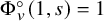
 for the unique spherical standard section satisfying
$\Phi _v^{\circ }(1,s) = 1$
for the unique spherical standard section satisfying
$\Phi _v^{\circ }(1,s) = 1$
 for all s, and call
$\Phi ^{\circ }_v$
for all s, and call
$\Phi ^{\circ }_v$
 the normalized spherical section.
Next, suppose
$F/F^+$
 is a CM extension of number fields. We write
$\mathbb {A}_F$
is a CM extension of number fields. We write
$\mathbb {A}_F$
 for the adèle ring of F and
$\mathbb {A}$
for the adèle ring of F and
$\mathbb {A}$
 for the adèle ring of
$F^+$
for the adèle ring of
$F^+$
 . Given a character
$\chi \colon F^\times \backslash \mathbb {A}_F^{\times } \rightarrow \mathbb {C}^{\times }$
. Given a character
$\chi \colon F^\times \backslash \mathbb {A}_F^{\times } \rightarrow \mathbb {C}^{\times }$
 and
$s \in \mathbb {C}$
and
$s \in \mathbb {C}$
 , we similarly form the global degenerate principal series

which is an unnormalized induction, consisting of smooth and
$K^{\circ }$
 -finite functions
$\Phi \colon H(\mathbb {A}) \rightarrow \mathbb {C}$
-finite functions
$\Phi \colon H(\mathbb {A}) \rightarrow \mathbb {C}$
 satisfying

for all
$m(a) \in M(\mathbb {A})$
 and
$n(b) \in N(\mathbb {A})$
and
$n(b) \in N(\mathbb {A})$
 and
$h \in H(\mathbb {A})$
and
$h \in H(\mathbb {A})$
 . Given characters
$\chi _f \colon \mathbb {A}_{F,f}^{\times } \rightarrow \mathbb {C}^{\times }$
. Given characters
$\chi _f \colon \mathbb {A}_{F,f}^{\times } \rightarrow \mathbb {C}^{\times }$
 and
$\chi _{\infty } \colon \mathbb {A}_{F,\infty }^{\times } \rightarrow \mathbb {C}^{\times }$
and
$\chi _{\infty } \colon \mathbb {A}_{F,\infty }^{\times } \rightarrow \mathbb {C}^{\times }$
 , we similarly form
$I(s, \chi _f)$
, we similarly form
$I(s, \chi _f)$
 and
$I(s, \chi _{\infty })$
and
$I(s, \chi _{\infty })$
 . We also speak of spherical sections and the spherical standard section, as above. We sometimes write
$I_m(s, \chi )$
. We also speak of spherical sections and the spherical standard section, as above. We sometimes write
$I_m(s, \chi )$
 etc. to indicate dependence on m.
Given a standard section
$\Phi (h,s)$
 of the global degenerate principal series
$I(s, \chi )$
of the global degenerate principal series
$I(s, \chi )$
 , we form the Siegel Eisenstein series

which is absolutely convergent for
$ (s)> m/2$
 . We also form
$E(h,\Phi ,s)$
. We also form
$E(h,\Phi ,s)$
 when
$\Phi $
when
$\Phi $
 is a finite meromorphic linear combination of standard sections by extending linearly.
Define another character
$\check {\chi } \colon F^{\times } \backslash \mathbb {A}^{\times }_F \rightarrow \mathbb {C}^{\times }$
 as
$\check {\chi }(a) {:=}q \chi (\overline {a})^{-1}$
as
$\check {\chi }(a) {:=}q \chi (\overline {a})^{-1}$
 . There is a functional equation

where
$M(\chi ,s) \colon I(s, \chi ) \rightarrow I(-s, \check {\chi })$
 is the intertwining operator

for
$ (s)> m/2$
 (see, e.g., [Reference TanTan99]). Here the Haar measure on
$N(\mathbb {A})$
(see, e.g., [Reference TanTan99]). Here the Haar measure on
$N(\mathbb {A})$
 should be the one which is self-dual with respect to any nontrivial additive character
$\psi \colon F^+ \backslash \mathbb {A} \rightarrow \mathbb {C}^{\times }$
should be the one which is self-dual with respect to any nontrivial additive character
$\psi \colon F^+ \backslash \mathbb {A} \rightarrow \mathbb {C}^{\times }$
 , and the pairing
$b,b' \mapsto \psi (\operatorname {tr}(b b'))$
, and the pairing
$b,b' \mapsto \psi (\operatorname {tr}(b b'))$
 . We occasionally write
$M_m(s, \chi )$
. We occasionally write
$M_m(s, \chi )$
 to emphasize the understood m (in
$U(m,m)$
to emphasize the understood m (in
$U(m,m)$
 ).
).
Fix an identification of
$F^+_v$
 -algebras
$F_v \cong \mathbb {C}$
-algebras
$F_v \cong \mathbb {C}$
 for each Archimedean place v of
$F^+$
for each Archimedean place v of
$F^+$
 . We consider classical Eisenstein series on the Hermitian upper half-space


where the latter expression means that x and y are
$m \times m$
 Hermitian matrices with y positive definite (at every place
$v \mid \infty $
Hermitian matrices with y positive definite (at every place
$v \mid \infty $
 of
$F^+_v$
of
$F^+_v$
 ). Given
$z = x + i y \in \mathcal {H}_m$
). Given
$z = x + i y \in \mathcal {H}_m$
 , we write
$h_z \in H(F^+_{\infty }) \subseteq H(\mathbb {A})$
, we write
$h_z \in H(F^+_{\infty }) \subseteq H(\mathbb {A})$
 for any element
$h_z = n(x) m(a)$
for any element
$h_z = n(x) m(a)$
 where
$a \in \mathrm {GL}_m(F_{\infty })$
where
$a \in \mathrm {GL}_m(F_{\infty })$
 satisfies
$a {}^t \overline {a} = y$
satisfies
$a {}^t \overline {a} = y$
 . Note
$h_z \cdot i 1_m = z$
. Note
$h_z \cdot i 1_m = z$
 .
.
We restrict to
$\Phi = \Phi _{\infty } \otimes \Phi _f$
 for standard sections
$\Phi _{\infty } \in I(s, \chi _{\infty })$
for standard sections
$\Phi _{\infty } \in I(s, \chi _{\infty })$
 and
$\Phi _f \in I(s, \chi _f)$
and
$\Phi _f \in I(s, \chi _f)$
 . Fix an integer
$n_v$
. Fix an integer
$n_v$
 for each place
$v \mid \infty $
for each place
$v \mid \infty $
 of
$F^+_v$
of
$F^+_v$
 , and assume
$\chi _v|_{F^{+ \times }_v} = \mathrm {sgn}(-)^{n_v}$
, and assume
$\chi _v|_{F^{+ \times }_v} = \mathrm {sgn}(-)^{n_v}$
 for every
$v \mid \infty $
for every
$v \mid \infty $
 . We also let
$k(\chi _v) \in \mathbb {Z}$
. We also let
$k(\chi _v) \in \mathbb {Z}$
 be the integer satisfying

for each place
$v \mid \infty $
 of
$F^+_v$
of
$F^+_v$
 . For such v, we let
$\Phi _v = \Phi _v^{(n_v)}$
. For such v, we let
$\Phi _v = \Phi _v^{(n_v)}$
 be the unique standard section of
$I(s, \chi _v)$
be the unique standard section of
$I(s, \chi _v)$
 of scalar weight

such that
$\Phi _{v}^{(n_v)}(1,s) = 1$
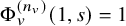 (as in [Reference Garcia and SankaranGS19, §3.2, §3.3]). The scalar weight condition means that
$\Phi _{v}^{(n_v)}(h k,s) = \det (k_1)^{n_1} \det (k_2)^{n_2} \Phi _{v}^{(n_v)}(h,s)$
(as in [Reference Garcia and SankaranGS19, §3.2, §3.3]). The scalar weight condition means that
$\Phi _{v}^{(n_v)}(h k,s) = \det (k_1)^{n_1} \det (k_2)^{n_2} \Phi _{v}^{(n_v)}(h,s)$
 for all
$h \in H(F^+_v)$
for all
$h \in H(F^+_v)$
 and
$k \in K_{v}^{\circ }$
and
$k \in K_{v}^{\circ }$
 where
where

Note that
$\Phi _v^{(n_v)}$
 does not depend on the choice of identification
$F_v \cong \mathbb {C}$
does not depend on the choice of identification
$F_v \cong \mathbb {C}$
 .
.
If
$y = a {}^t \overline {a}$
 for some
$a \in \operatorname {\mathrm {GL}}_m(F_v)$
for some
$a \in \operatorname {\mathrm {GL}}_m(F_v)$
 , a computation (omitted) shows

for any
$b \in \mathrm {Herm}_m(F^+_v)$
 , where
$s_0 = (n_v - m)/2$
, where
$s_0 = (n_v - m)/2$
 (reduce to the case
$a = 1_m$
(reduce to the case
$a = 1_m$
 and write
$w^{-1} n(b) = n(-b(1_m + b^2)^{-1}) m(b + i 1_m)^{-1} k$
and write
$w^{-1} n(b) = n(-b(1_m + b^2)^{-1}) m(b + i 1_m)^{-1} k$
 for
$k \in K_v^{\circ }$
for
$k \in K_v^{\circ }$
 ). Equation (2.2.13) may be used to translate various statements from [Reference ShimuraShi82] to statements about Archimedean Whittaker functions, etc. (see [Reference ChenChe24b, Section 4.3] for more on this).
Remark 2.2.1. Given
$g = x_g + i y_g \in M_{m,m}(\mathbb {C})$
 with
$x_g, y_g$
with
$x_g, y_g$
 Hermitian and
$x_g$
Hermitian and
$x_g$
 positive definite, we define
$\log \det (g)$
positive definite, we define
$\log \det (g)$
 by the “principal branch” (such that
$g \mapsto \log \det g$
by the “principal branch” (such that
$g \mapsto \log \det g$
 is holomorphic, and
$\log \det g \in \mathbb {R}$
is holomorphic, and
$\log \det g \in \mathbb {R}$
 if
$y_g = 0$
if
$y_g = 0$
 ) as in [Reference ShimuraShi82, (1.11)] and the surrounding discussion of loc. cit. If
$y_g$
) as in [Reference ShimuraShi82, (1.11)] and the surrounding discussion of loc. cit. If
$y_g$
 is positive definite and
$x_g$
is positive definite and
$x_g$
 is only assumed Hermitian, we also take

where
$\log i {:=}q \pi i/2$
 (as in [Reference ShimuraShi82, (1.11)]). This convention is implicit in (2.2.13).
We take
$\Phi _{\infty } = \otimes _{v \mid \infty } \Phi _v^{(n_v)}$
 . We write
$n = (n_v)_{v \mid \infty }$
. We write
$n = (n_v)_{v \mid \infty }$
 for the collection of Archimedean weights (and will eventually focus on the case where all
$n_v$
for the collection of Archimedean weights (and will eventually focus on the case where all
$n_v$
 are equal to some fixed integer n). In the above situation, we write
$E(h,s,\Phi )_n {:=}q E(h,s,\Phi )$
are equal to some fixed integer n). In the above situation, we write
$E(h,s,\Phi )_n {:=}q E(h,s,\Phi )$
 and consider an associated classical Eisenstein series

where
$z = x + i y$
 and
$h_z = n(x) m(a)$
and
$h_z = n(x) m(a)$
 with
$a {}^t \overline {a} = y$
with
$a {}^t \overline {a} = y$
 as above, and where
$\det (y)^{-n/2}$
as above, and where
$\det (y)^{-n/2}$
 stands for
$\prod _{v \mid \infty } \det (y_v)^{-n_v/2}$
stands for
$\prod _{v \mid \infty } \det (y_v)^{-n_v/2}$
 . This does not depend on the choice of
$h_z$
. This does not depend on the choice of
$h_z$
 , that is,
$E(h_z k_{\infty }, s, \Phi )_n = E(h_z, s, \Phi )_n$
, that is,
$E(h_z k_{\infty }, s, \Phi )_n = E(h_z, s, \Phi )_n$
 for any
$k_{\infty } \in K_{\infty }^{\circ }$
for any
$k_{\infty } \in K_{\infty }^{\circ }$
 .
.
When
$F^+ = \mathbb {Q}$
 and
$s_0 {:=}q (n - m)/2$
and
$s_0 {:=}q (n - m)/2$
 (setting
$n = n_{\infty }$
(setting
$n = n_{\infty }$
 and
$k(\chi ) = k(\chi _{\infty })$
and
$k(\chi ) = k(\chi _{\infty })$
 ), a computation (omitted) gives the more classical form


where

where
$SU(m,m) \subseteq U(m,m)$
 is the determinant
$1$
is the determinant
$1$
 subgroup, and
$P_1 {:=}q SU(m,m) \cap P$
subgroup, and
$P_1 {:=}q SU(m,m) \cap P$
 . We have
$P(\mathbb {Q}) \backslash H(\mathbb {Q}) = P(\mathbb {Z}) \backslash H(\mathbb {Z}) = P_1(\mathbb {Q}) \backslash H_1(\mathbb {Q}) = P_1(\mathbb {Z}) \backslash H_1(\mathbb {Z})$
. We have
$P(\mathbb {Q}) \backslash H(\mathbb {Q}) = P(\mathbb {Z}) \backslash H(\mathbb {Z}) = P_1(\mathbb {Q}) \backslash H_1(\mathbb {Q}) = P_1(\mathbb {Z}) \backslash H_1(\mathbb {Z})$
 (e.g., [Reference IkedaIke08, Proposition 12.6]). When
$m = 1$
(e.g., [Reference IkedaIke08, Proposition 12.6]). When
$m = 1$
 , the exceptional isomorphism
$\operatorname {\mathrm {SL}}_2 \rightarrow SU(1,1)$
, the exceptional isomorphism
$\operatorname {\mathrm {SL}}_2 \rightarrow SU(1,1)$
 (over
$\operatorname {\mathrm {Spec}} \mathbb {Q}$
(over
$\operatorname {\mathrm {Spec}} \mathbb {Q}$
 ) implies that the above expression is a classical Eisenstein series for
$\operatorname {\mathrm {SL}}_2$
) implies that the above expression is a classical Eisenstein series for
$\operatorname {\mathrm {SL}}_2$
 on the upper half-plane.
Our main theorem (Theorem 9.1.1) concerns Fourier coefficients of
$E(z,s,\Phi )_n$
 (normalized as in Section 6.1), but the variant

will be useful for studying Fourier coefficients of
$E(z,s,\Phi )_n$
 for singular T (see below). If
$a \in \operatorname {\mathrm {GL}}_m(F_{\infty })$
for singular T (see below). If
$a \in \operatorname {\mathrm {GL}}_m(F_{\infty })$
 is any element satisfying
$a {}^t \overline {a} = y$
is any element satisfying
$a {}^t \overline {a} = y$
 for
$y \in \mathrm {Herm}_m(F^+_{\infty })_{>0}$
for
$y \in \mathrm {Herm}_m(F^+_{\infty })_{>0}$
 , we have

2.3 Fourier expansion and local Whittaker functions
Take notation as in Section 2.2, for example,
$F/F^+$
 is a CM extension of number fields. Choose a nontrivial additive character
$\psi \colon F^+ \backslash \mathbb {A} \rightarrow \mathbb {C}^\times $
is a CM extension of number fields. Choose a nontrivial additive character
$\psi \colon F^+ \backslash \mathbb {A} \rightarrow \mathbb {C}^\times $
 . We have a Fourier expansion

where

for
$\mathrm {Re}(s)> m/2$
 , and where
$d n(b)$
, and where
$d n(b)$
 is the Haar measure on
$N(\mathbb {A})$
is the Haar measure on
$N(\mathbb {A})$
 which is self-dual with respect to the pairing
$(b, b') \mapsto \psi (\mathrm {tr}(b b'))$
which is self-dual with respect to the pairing
$(b, b') \mapsto \psi (\mathrm {tr}(b b'))$
 . We refer to
$E_T(h,s,\Phi )$
. We refer to
$E_T(h,s,\Phi )$
 as the T-th Fourier term.
For any
$a \in \operatorname {\mathrm {GL}}_m(F)$
 , a change of variables gives

We also have

with the block matrix
$T^{\flat } \in \mathrm {Herm}_{m^{\flat }}(F^+)$
 having
$\det T^{\flat } \neq 0$
having
$\det T^{\flat } \neq 0$
 (here
$m^{\flat }$
(here
$m^{\flat }$
 is arbitrary) (follows from [Reference Garcia and SankaranGS19, Lemma 5.4, (5.56)]).
Allowing arbitrary T again, assume there is a factorization
$\Phi = (\otimes _{v \mid \infty } \Phi _v) \otimes \Phi _f$
 . For each
$v \mid \infty $
. For each
$v \mid \infty $
 , assume
$\Phi _v = \Phi _v^{(n_v)}$
, assume
$\Phi _v = \Phi _v^{(n_v)}$
 is the scalar weight standard section as in Section 2.2, for some
$n_v \in \mathbb {Z}$
is the scalar weight standard section as in Section 2.2, for some
$n_v \in \mathbb {Z}$
 . Write
$n = (n_v)_{v \mid \infty }$
. Write
$n = (n_v)_{v \mid \infty }$
 for the resulting tuple of integers.
Consider
$a = a_{\infty } a_f \in \operatorname {\mathrm {GL}}_m(\mathbb {A}_F)$
 , with
$a_{\infty } \in \operatorname {\mathrm {GL}}_m(F_{\infty })$
, with
$a_{\infty } \in \operatorname {\mathrm {GL}}_m(F_{\infty })$
 and
$a_f \in \operatorname {\mathrm {GL}}_m(\mathbb {A}_{F,f})$
and
$a_f \in \operatorname {\mathrm {GL}}_m(\mathbb {A}_{F,f})$
 . Set
$y = a_{\infty } {}^t \overline {a}_{\infty }$
. Set
$y = a_{\infty } {}^t \overline {a}_{\infty }$
 (temporary). We then have T-th Fourier coefficients
$E_T(y,s,\Phi )_n$
(temporary). We then have T-th Fourier coefficients
$E_T(y,s,\Phi )_n$
 and
$\tilde {E}_T(a, s, \Phi )_n$
and
$\tilde {E}_T(a, s, \Phi )_n$
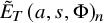 characterized by the relations


for any
$x \in \mathrm {Herm}_m(F_{\infty })$
 and
$b \in \mathrm {Herm}_m(\mathbb {A}_f)$
and
$b \in \mathrm {Herm}_m(\mathbb {A}_f)$
 , with
$z {:=}q x + i y$
, with
$z {:=}q x + i y$
 , and with
$q^T {:=}q \psi _{\infty }(\mathrm {tr}(Tz))$
, and with
$q^T {:=}q \psi _{\infty }(\mathrm {tr}(Tz))$
 . These correspond to the classical Eisenstein series and its variants in (2.2.15) and (2.2.19).
When
$\det T \neq 0$
 and
$\Phi = \otimes _v \Phi _v$
and
$\Phi = \otimes _v \Phi _v$
 is factorizable over all places, we have a factorization

into local Whittaker functions defined below (2.3.8).
We switch to local notation: let
$F_v$
 be a degree
$2$
be a degree
$2$
 étale algebra over a local field
$F^+_v$
étale algebra over a local field
$F^+_v$
 , with nontrivial involution
$a \mapsto \overline {a}$
, with nontrivial involution
$a \mapsto \overline {a}$
 . We assume
$F^+_v$
. We assume
$F^+_v$
 has characteristic
$0$
has characteristic
$0$
 (because Karel assumes this [Reference KarelKar79]). If
$F^+_v$
(because Karel assumes this [Reference KarelKar79]). If
$F^+_v$
 is Archimedean, we also assume
$F_v / F^+_v = \mathbb {C} / \mathbb {R}$
is Archimedean, we also assume
$F_v / F^+_v = \mathbb {C} / \mathbb {R}$
 .
.
Let
$\chi _v \colon F_v^{\times } \rightarrow \mathbb {C}^{\times }$
 and
$\psi _v \colon F^+_v \rightarrow \mathbb {C}^{\times }$
and
$\psi _v \colon F^+_v \rightarrow \mathbb {C}^{\times }$
 be characters with
$\psi _v$
be characters with
$\psi _v$
 nontrivial, and suppose
$\Phi _v \in I(s, \chi _v)$
nontrivial, and suppose
$\Phi _v \in I(s, \chi _v)$
 is a standard section. Given
$T \in \mathrm {Herm}_m(F^+_v)$
is a standard section. Given
$T \in \mathrm {Herm}_m(F^+_v)$
 with
$\det T \neq 0$
with
$\det T \neq 0$
 , there is a local Whittaker function defined by the absolutely convergent integral

for
$h \in H(F^+_v)$
 and
$s \in \mathbb {C}$
and
$s \in \mathbb {C}$
 with
$\mathrm {Re}(s)> m/2$
with
$\mathrm {Re}(s)> m/2$
 , where
$d n(b)$
, where
$d n(b)$
 is the Haar measure which is self-dual with respect to the pairing
$(b, b') \mapsto \psi _v(\mathrm {tr}(b b'))$
is the Haar measure which is self-dual with respect to the pairing
$(b, b') \mapsto \psi _v(\mathrm {tr}(b b'))$
 on
$\mathrm {Herm}_m(F^+_v) \cong N(F^+_v)$
on
$\mathrm {Herm}_m(F^+_v) \cong N(F^+_v)$
 . For each fixed h, the function
$W_{T,\psi _v}(h, s, \Phi _v)$
. For each fixed h, the function
$W_{T,\psi _v}(h, s, \Phi _v)$
 admits holomorphic continuation to
$s \in \mathbb {C}$
admits holomorphic continuation to
$s \in \mathbb {C}$
 [Reference KarelKar79, Corollary 3.6.1][Reference Kudla and SweetKS97][Reference IchinoIch04, §6]. Extending linearly defines
$W_{T,\psi _v}(h, s, \Phi _v)$
[Reference KarelKar79, Corollary 3.6.1][Reference Kudla and SweetKS97][Reference IchinoIch04, §6]. Extending linearly defines
$W_{T,\psi _v}(h, s, \Phi _v)$
 whenever
$\Phi _v$
whenever
$\Phi _v$
 is a finite meromorphic linear combination of standard sections. For any
$a \in \operatorname {\mathrm {GL}}_m(F_v)$
is a finite meromorphic linear combination of standard sections. For any
$a \in \operatorname {\mathrm {GL}}_m(F_v)$
 , a change of variables shows

for
$\check {\chi }_v(a) {:=}q \chi _v(\overline {a})^{-1}$
 as above. We use the shorthand
$W_{T,\psi _v}(s, \Phi _v) {:=}q W_{T,\psi _v}(1, s, \Phi _v)$
as above. We use the shorthand
$W_{T,\psi _v}(s, \Phi _v) {:=}q W_{T,\psi _v}(1, s, \Phi _v)$
 .
.
If
$F_v / F^+_v$
 is
$\mathbb {C} / \mathbb {R}$
is
$\mathbb {C} / \mathbb {R}$
 , we write
$W_{T,v}$
, we write
$W_{T,v}$
 instead of
$W_{T,\psi _v}$
instead of
$W_{T,\psi _v}$
 when
$\psi _v(x) = e^{2 \pi i x}$
when
$\psi _v(x) = e^{2 \pi i x}$
 is the standard additive character. If
$F^+_v$
is the standard additive character. If
$F^+_v$
 is non-Archimedean, we write
$W_{T,v}$
is non-Archimedean, we write
$W_{T,v}$
 instead of
$W_{T,\psi _v}$
instead of
$W_{T,\psi _v}$
 if
$\psi _v$
if
$\psi _v$
 is an understood unramified additive character (suppressed from notation).
Lemma 2.3.1. With notation as above, assume that
$F^+_v$
 is non-Archimedean with residue field of cardinality
$q_v$
is non-Archimedean with residue field of cardinality
$q_v$
 . Suppose
$\Phi _v \in I(s, \chi _v)$
. Suppose
$\Phi _v \in I(s, \chi _v)$
 is a standard section and
$h \in H(F^+_v)$
is a standard section and
$h \in H(F^+_v)$
 is a fixed element.
-
(1) We have $W_{T,\psi _v}(h, s, \Phi _v) \in \mathbb {C}[q_v^{-s}, q_v^s]$
. -
(2) If $h \in K_v^{\circ }$
, we have
$W_{T,\psi _v}(h, s, \Phi _v) \in \mathbb {C}[q_v^{-2s}]$
.-
(i) If $\chi _v|_{F^{+ \times }_v}$
is a finite order character and
$\Phi _v(k,s) \in \overline {\mathbb {Q}}$
for every
$k \in K^{\circ }_v$
, then we have
$W_{T,\psi _v}(h, s, \Phi _v) \in \overline {\mathbb {Q}}[q_v^{-2s}]$
for any
$h \in K^{\circ }_v$
. -
(ii) If $\chi _v|_{F^{+ \times }_v}$
is a finite order character and
$\Phi _v(k,s) \in \overline {\mathbb {Q}}$
for every
$k \in K^{\circ }_v$
, such that moreover every
$\Phi _v(k,s)$
is
$\ell $
-integral for some prime
$\ell $
distinct from the residue characteristic of
$F^+_v$
, then
$W_{T,\psi _v}(h, s, \Phi _v) \in \overline {\mathbb {Q}}[q_v^{-2s}]$
also has coefficients which are
$\ell $
-integral. -
(iii) Suppose $\chi _v$
is unramified and
$\Phi _v = \Phi ^{\circ }_v$
is the spherical standard section. Assume
$\psi _v(\operatorname {tr}(Tb)) = 1$
for every
$b \in \mathrm {Herm}_m(\mathcal {O}_{F^+_v})$
. If
$f(X) \in \mathbb {C}[X]$
is the polynomial satisfying
$W_{T,\psi _v}(1,s,\Phi _v) = f(q_v^{-2s})$
, then
$f(0) = \operatorname {vol}(\mathrm {Herm}_m(\mathcal {O}_{F^+_v}))$
.
-
-
(3) Suppose $\chi ^{\prime }_v \colon F_v^{\times } \rightarrow \mathbb {C}^{\times }$
is another character satisfying
$\chi ^{\prime }_v|_{F^{+ \times }_v} = \xi _v \chi _v|_{F^{+ \times }_v}$
for an unramified character
$\xi _v \colon F^{+ \times }_v \rightarrow \mathbb {C}^{\times }$
. Assume
$h \in K_v^{\circ }$
, and suppose
$\Psi _v \in I(s, \chi ^{\prime }_v)$
is a standard section satisfying
$\Psi _v(k, s) = \Phi _v(k, s)$
for any
$k \in K^{\circ }_v$
(for all s). If
$f(X) \in \mathbb {C}[X]$
is the polynomial satisfying
$f(q_v^{-2s}) = W_{T,\psi _v}(h, s, \Phi _v)$
, then we have
$f(\xi _v(\varpi _0) q_v^{-2s}) = W_{T,\psi _v}(h, s, \Psi _v)$
, where
$\varpi _0 \in F^+_v$
is any uniformizer.




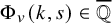




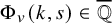





















Proof. Claim (1) follows from a general result of Karel [Reference KarelKar79, Corollary 3.6.1], which implies that
$W_{T,\psi _v}(h, s, \Phi _v) \in \mathbb {C}[q_v^{-s}, q_v^s]$
 , and that
$W_{T,\psi _v}(h, s, \Phi _v)$
, and that
$W_{T,\psi _v}(h, s, \Phi _v)$
 may be computed for all s as the integral over a sufficiently large open compact subgroup of
$N(F^+_v)$
may be computed for all s as the integral over a sufficiently large open compact subgroup of
$N(F^+_v)$
 .
.
Next, given any
$b \in N(F^+_v)$
 , write
$w^{-1} n(b) w = m(a) n(b') k$
, write
$w^{-1} n(b) w = m(a) n(b') k$
 for
$m(a) \in M(F^+_v)$
for
$m(a) \in M(F^+_v)$
 and
$n(b') \in N(F^+_v)$
and
$n(b') \in N(F^+_v)$
 and
$k \in K^{\circ }_v$
and
$k \in K^{\circ }_v$
 , as in (2.1.10). As explained in loc. cit., we can moreover assume
$\det a \in F^+_v$
, as in (2.1.10). As explained in loc. cit., we can moreover assume
$\det a \in F^+_v$
 . We then have
$\Phi _v(w^{-1} n(b) h, s) = \Phi _v(m(a) n(b') k w^{-1} h, s) = \chi _v(\det a) |\det a|_{F_v}^{s + m/2} \Phi _v(k w^{-1} h, s)$
. We then have
$\Phi _v(w^{-1} n(b) h, s) = \Phi _v(m(a) n(b') k w^{-1} h, s) = \chi _v(\det a) |\det a|_{F_v}^{s + m/2} \Phi _v(k w^{-1} h, s)$
 . Since
$\det a \in F^+_v$
. Since
$\det a \in F^+_v$
 , we must have
$|\det a|_{F_v}^s$
, we must have
$|\det a|_{F_v}^s$
 being a nonnegative power of
$q_v^{-2s}$
being a nonnegative power of
$q_v^{-2s}$
 . Substituting into (2.3.8) (and replacing the integral over
$N(F^+_v)$
. Substituting into (2.3.8) (and replacing the integral over
$N(F^+_v)$
 with an integral over a sufficiently large open compact subgroup) now proves claim (2). The claims about algebraicity and integrality in (2)(i) and (2)(ii) follow because
$\psi _v$
with an integral over a sufficiently large open compact subgroup) now proves claim (2). The claims about algebraicity and integrality in (2)(i) and (2)(ii) follow because
$\psi _v$
 and
$\chi |_{F^{+ \times }_v}$
and
$\chi |_{F^{+ \times }_v}$
 are both valued in roots of unity, under the given hypotheses. The claim in (2)(iii) follows because, in the above notation, we have
$|\det a|_{F_v} = 1$
are both valued in roots of unity, under the given hypotheses. The claim in (2)(iii) follows because, in the above notation, we have
$|\det a|_{F_v} = 1$
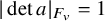 if and only if
$b \in \mathrm {Herm}_m(\mathcal {O}_{F^+_v})$
if and only if
$b \in \mathrm {Herm}_m(\mathcal {O}_{F^+_v})$
 by inspection, or see, e.g., the discussion at the end of [Reference ShimuraShi97, §3.6] or [Reference ShimuraShi97, §13.5]. The volume
$\operatorname {vol}(\mathrm {Herm}_m(\mathcal {O}_{F^+_v}))$
by inspection, or see, e.g., the discussion at the end of [Reference ShimuraShi97, §3.6] or [Reference ShimuraShi97, §13.5]. The volume
$\operatorname {vol}(\mathrm {Herm}_m(\mathcal {O}_{F^+_v}))$
 should be taken with respect to the self-dual Haar measure associated to
$\psi _v$
should be taken with respect to the self-dual Haar measure associated to
$\psi _v$
 , as above.
For (3), a similar computation gives
$\Psi _v(w^{-1} n(b) h, s) = \chi ^{\prime }_v(\det a) |\det a|^{s + m / 2}_{F_v} \Psi _v(k w^{-1} h, s)$
 , for the same
$a \in \operatorname {\mathrm {GL}}_m(F_v)$
, for the same
$a \in \operatorname {\mathrm {GL}}_m(F_v)$
 as above. If
$v_0$
as above. If
$v_0$
 is the valuation on
$F^+_v$
is the valuation on
$F^+_v$
 normalized with
$v_0(\varpi _0) = 1$
normalized with
$v_0(\varpi _0) = 1$
 , we thus have


Claim (3) of the lemma now follows upon substitution into (2.3.8) (and again replacing the integral over
$N(F^+_v)$
 with an integral over a sufficiently large open compact subgroup).
In the case where
$F^+_v$
 is non-Archimedean, consider the case where
$\chi _v$
is non-Archimedean, consider the case where
$\chi _v$
 is unramified and
$\chi _v|_{F^{+ \times }_v} = \eta _v^n$
is unramified and
$\chi _v|_{F^{+ \times }_v} = \eta _v^n$
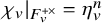 for some integer n, where
$\eta _v \colon F^{+ \times }_v \rightarrow \{ \pm 1\}$
for some integer n, where
$\eta _v \colon F^{+ \times }_v \rightarrow \{ \pm 1\}$
 is the quadratic character associated to
$F_v / F^+_v$
is the quadratic character associated to
$F_v / F^+_v$
 . Consider the normalized spherical standard section
$\Phi ^{\circ }_v \in I(s, \chi _v)$
. Consider the normalized spherical standard section
$\Phi ^{\circ }_v \in I(s, \chi _v)$
 . We temporarily write
$W_{T,\psi _v}(h, s, \Phi _v^{\circ })_n$
. We temporarily write
$W_{T,\psi _v}(h, s, \Phi _v^{\circ })_n$
 for the associated local Whittaker function, emphasizing the possible dependence on n. By Lemma 2.3.1(3), the implicit
$\chi _v$
for the associated local Whittaker function, emphasizing the possible dependence on n. By Lemma 2.3.1(3), the implicit
$\chi _v$
 -dependence of
$W_{T,\psi _v}(h, s, \Phi _v^{\circ })_n$
-dependence of
$W_{T,\psi _v}(h, s, \Phi _v^{\circ })_n$
 is only on the restriction
$\chi _v|_{F^{+ \times }_v}$
is only on the restriction
$\chi _v|_{F^{+ \times }_v}$
 . If
$F_v / F^+_v$
. If
$F_v / F^+_v$
 is not inert, then
$W_{T,\psi _v}(h, s, \Phi _v^{\circ })_n$
is not inert, then
$W_{T,\psi _v}(h, s, \Phi _v^{\circ })_n$
 does not depend on n (note n must be even if
$F_v / F^+_v$
does not depend on n (note n must be even if
$F_v / F^+_v$
 is ramified). If
$F_v / F^+_v$
is ramified). If
$F_v / F^+_v$
 is inert, then
$W_{T,\psi _v}(h, s, \Phi _v^{\circ })_n$
is inert, then
$W_{T,\psi _v}(h, s, \Phi _v^{\circ })_n$
 depends only on the parity of n. The
$\mathbb {C}$
depends only on the parity of n. The
$\mathbb {C}$
 -algebra endomorphism of
$\mathbb {C}[q_v^{-2s}]$
-algebra endomorphism of
$\mathbb {C}[q_v^{-2s}]$
 sending
$q_v^{-2s} \mapsto -q_v^{-2s}$
sending
$q_v^{-2s} \mapsto -q_v^{-2s}$
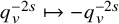 swaps
$W_{T,\psi _v}(h, s, \Phi _v^{\circ })_n$
swaps
$W_{T,\psi _v}(h, s, \Phi _v^{\circ })_n$
 and
$W_{T,\psi _v}(h, s, \Phi _v^{\circ })_{n+1}$
and
$W_{T,\psi _v}(h, s, \Phi _v^{\circ })_{n+1}$
 , by Lemma 2.3.1(3).
Remark 2.3.2 (Change of additive character)
We sometimes fix convenient choices of additive character
$\psi $
 or
$\psi _v$
or
$\psi _v$
 . This recovers the general case, as follows. Given
$\psi $
. This recovers the general case, as follows. Given
$\psi $
 , we write
$E_{T, \psi }$
, we write
$E_{T, \psi }$
 as needed to emphasize dependence on the choice of additive character, and similarly for normalized variants like
$\tilde {E}_{T,\psi }$
as needed to emphasize dependence on the choice of additive character, and similarly for normalized variants like
$\tilde {E}_{T,\psi }$
 , etc.
Given
$u \in (F^+)^{\times }$
 or
$u \in (F^+_v)^{\times }$
or
$u \in (F^+_v)^{\times }$
 , consider
$\psi '(x) {:=}q \psi (u \cdot x)$
, consider
$\psi '(x) {:=}q \psi (u \cdot x)$
 and
$\psi _{v}'(x) {:=}q \psi _v(u \cdot x)$
and
$\psi _{v}'(x) {:=}q \psi _v(u \cdot x)$
 . We have


with notation as above. The additional factor
$|u|^{m^2/2}_{F^+_v}$
 arises from the change of Haar measure on
$N(F^+_v)$
arises from the change of Haar measure on
$N(F^+_v)$
 , from the requirements of self-duality with respect to
$\psi _v$
, from the requirements of self-duality with respect to
$\psi _v$
 or
$\psi ^{\prime }_v$
or
$\psi ^{\prime }_v$
 .
.
2.4 Singular Fourier coefficients
Retain notation from Section 2.3 (switching back to global notation). The Fourier terms
$E_{T}(h,s,\Phi )$
 for singular
$T \in \mathrm {Herm}_m(F^+)$
for singular
$T \in \mathrm {Herm}_m(F^+)$
 are known to be closely related with Fourier terms of Eisenstein series on smaller groups (e.g., [Reference Garcia and SankaranGS19, §5.2]). We focus on the case where
$\operatorname {\mathrm {rank}} T = m - 1$
are known to be closely related with Fourier terms of Eisenstein series on smaller groups (e.g., [Reference Garcia and SankaranGS19, §5.2]). We focus on the case where
$\operatorname {\mathrm {rank}} T = m - 1$
 (assume this throughout Section 2.4). On account of (2.3.3), it will be enough to describe the case where T is block diagonal of the form

with
$\det T^{\flat } \neq 0$
 .
.
Assume
$m \geq 1$
 , and fix an integer
$n \in \mathbb {Z}$
, and fix an integer
$n \in \mathbb {Z}$
 . Let
$\chi \colon F^\times \backslash \mathbb {A}_F^{\times } \rightarrow \mathbb {C}^{\times }$
. Let
$\chi \colon F^\times \backslash \mathbb {A}_F^{\times } \rightarrow \mathbb {C}^{\times }$
 be a character satisfying
$\chi |_{\mathbb {A}^{\times }} = \eta ^n$
be a character satisfying
$\chi |_{\mathbb {A}^{\times }} = \eta ^n$
 , where
$\eta $
, where
$\eta $
 is the quadratic character associated with
$F / F^+$
is the quadratic character associated with
$F / F^+$
 . Note
$\check {\chi } = \chi $
. Note
$\check {\chi } = \chi $
 in this case.
Take a factorizable standard section
$\Phi = \otimes _v \Phi _v \in I(s, \chi )$
 , and assume
$\Phi _v = \Phi _v^{(n)}$
, and assume
$\Phi _v = \Phi _v^{(n)}$
 is the normalized scalar weight standard section (Section 2.2) for every Archimedean place v, with n the fixed integer from above (same for every
$v \mid \infty $
is the normalized scalar weight standard section (Section 2.2) for every Archimedean place v, with n the fixed integer from above (same for every
$v \mid \infty $
 ).
).
Take T as in (2.4.1). Given
$a \in \operatorname {\mathrm {GL}}_m(\mathbb {A}_F)$
 , we study the Fourier coefficient
$\tilde {E}_T(a, s, \Phi )_n$
, we study the Fourier coefficient
$\tilde {E}_T(a, s, \Phi )_n$
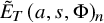 . By the Iwasawa decomposition, every
$a \in \operatorname {\mathrm {GL}}_m(\mathbb {A}_F)$
. By the Iwasawa decomposition, every
$a \in \operatorname {\mathrm {GL}}_m(\mathbb {A}_F)$
 admits a decomposition

with
$a^{\#} \in \operatorname {\mathrm {GL}}_1(\mathbb {A}_F)$
 , with
$a^{\flat } \in \operatorname {\mathrm {GL}}_{m - 1}(\mathbb {A}_F)$
, with
$a^{\flat } \in \operatorname {\mathrm {GL}}_{m - 1}(\mathbb {A}_F)$
 , and with
$k \in \prod _{v \mid \infty } U(m) \times \prod _{v < \infty } \operatorname {\mathrm {GL}}_m(\mathcal {O}_{F_v})$
, and with
$k \in \prod _{v \mid \infty } U(m) \times \prod _{v < \infty } \operatorname {\mathrm {GL}}_m(\mathcal {O}_{F_v})$
 . We will be eventually interested in the case when
$\Phi _f$
. We will be eventually interested in the case when
$\Phi _f$
 is spherical, which implies
$\tilde {E}_T(a k, s, \Phi )_n = \tilde {E}_T(a, s, \Phi )$
is spherical, which implies
$\tilde {E}_T(a k, s, \Phi )_n = \tilde {E}_T(a, s, \Phi )$
 for any
$k \in \prod _{v \mid \infty } U(m) \times \prod _{v < \infty } \operatorname {\mathrm {GL}}_m(\mathcal {O}_{F_v})$
for any
$k \in \prod _{v \mid \infty } U(m) \times \prod _{v < \infty } \operatorname {\mathrm {GL}}_m(\mathcal {O}_{F_v})$
 (also using the fact that
$\Phi _v$
(also using the fact that
$\Phi _v$
 is a scalar weight standard section for each
$v \mid \infty $
is a scalar weight standard section for each
$v \mid \infty $
 ). In light of the invariance property in (2.3.4), it is thus harmless to restrict to the case of block diagonal
$a = \mathrm {diag}(a^{\#}, a^{\flat })$
). In light of the invariance property in (2.3.4), it is thus harmless to restrict to the case of block diagonal
$a = \mathrm {diag}(a^{\#}, a^{\flat })$
 . Assume this for the rest of Section 2.4 (but we do not assume
$\Phi _f$
. Assume this for the rest of Section 2.4 (but we do not assume
$\Phi _f$
 is spherical for now).
Set
$m^{\flat } {:=}q m - 1$
 and
$s_0 {:=}q (n - m)/2$
and
$s_0 {:=}q (n - m)/2$
 . Consider the operators

(with
$\mu ^m_{m^{\flat }} \colon U(m^{\flat }, m^{\flat }) \rightarrow U(m,m)$
 as in Section 2.1), and where

for
$\mathrm {Re}(s)> m/2$
 (with meromorphic continuation to
$s \in \mathbb {C}$
(with meromorphic continuation to
$s \in \mathbb {C}$
 ). A calculation shows

compare [Reference Garcia and SankaranGS19, Lemma 5.5(iii)] (this will not be used until Section 6.2).
Lemma 2.4.1. We have

Proof. We claim that arguing as in the proof of [Reference Kudla and RallisKR88, Lemma 2.4] (see also [Reference Garcia and SankaranGS19, Lemma 5.4] and [Reference He, Shi and YangHSY21, Theorem 2.2]) gives

The formula in the lemma statement follows from this, upon using our normalization convention in (2.2.19) and using the equality
$\check {\chi } = \chi $
 .
.
The special case of (2.4.7) with
$a = 1$
 and
$F^+ = \mathbb {Q}$
and
$F^+ = \mathbb {Q}$
 is explained in [Reference He, Shi and YangHSY21, Proposition 2.4] (taking their a to equal
$1$
is explained in [Reference He, Shi and YangHSY21, Proposition 2.4] (taking their a to equal
$1$
 , with their
$w_n$
, with their
$w_n$
 being our
$w^{-1}$
being our
$w^{-1}$
 , with their g being our
$m(a)$
, with their g being our
$m(a)$
 , and noting that their
$T_a$
, and noting that their
$T_a$
 need only be nonsingular), and the case of general
$F / F^+$
need only be nonsingular), and the case of general
$F / F^+$
 is similar. In the general case (for arbitrary block diagonal
$a = \operatorname {\mathrm {diag}}(a^{\#}, a^{\flat })$
is similar. In the general case (for arbitrary block diagonal
$a = \operatorname {\mathrm {diag}}(a^{\#}, a^{\flat })$
 and arbitrary
$F / F^+$
and arbitrary
$F / F^+$
 ), we claim that the first line (resp. second line) of our (2.4.7) corresponds to
$W^{(n-1)}_{T^{\flat }}(m(a), s, \Phi )$
), we claim that the first line (resp. second line) of our (2.4.7) corresponds to
$W^{(n-1)}_{T^{\flat }}(m(a), s, \Phi )$
 and
$W^{(n)}_{T}(m(a), s, \Phi )$
and
$W^{(n)}_{T}(m(a), s, \Phi )$
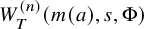 , in the notation of [Reference He, Shi and YangHSY21, Theorem 2.2]. Reformulated in our notation, we have
$W^{(r)}_T(m(a), s, \Phi ) = \int _{N_{m-1}(\mathbb {A})} \Phi (w^{-1}_{m-1} n(\operatorname {diag}(0,b)) m(a), s) \psi (-\operatorname {tr}(T^{\flat } b)) ~dn(b)$
, in the notation of [Reference He, Shi and YangHSY21, Theorem 2.2]. Reformulated in our notation, we have
$W^{(r)}_T(m(a), s, \Phi ) = \int _{N_{m-1}(\mathbb {A})} \Phi (w^{-1}_{m-1} n(\operatorname {diag}(0,b)) m(a), s) \psi (-\operatorname {tr}(T^{\flat } b)) ~dn(b)$
 . We have
$w^{-1}_{m-1} n(\operatorname {diag}(0,b)) m(a) = m(\operatorname {\mathrm {diag}}(a^{\#}, 1)) w^{-1}_{m-1} n(\operatorname {diag}(0,b)) m(\operatorname {\mathrm {diag}}(1, a^{\flat }))$
. We have
$w^{-1}_{m-1} n(\operatorname {diag}(0,b)) m(a) = m(\operatorname {\mathrm {diag}}(a^{\#}, 1)) w^{-1}_{m-1} n(\operatorname {diag}(0,b)) m(\operatorname {\mathrm {diag}}(1, a^{\flat }))$
 , so the first line of (2.4.7) now follows upon applying (2.2.2), with
$m(a)$
, so the first line of (2.4.7) now follows upon applying (2.2.2), with
$m(a)$
 of loc. cit. replaced by
$m(\operatorname {\mathrm {diag}}(a^{\#}, 1))$
of loc. cit. replaced by
$m(\operatorname {\mathrm {diag}}(a^{\#}, 1))$
 . For the second line of (2.4.7), consider the third-to-last line of the last displayed equation in the proof of [Reference He, Shi and YangHSY21, Proposition 2.4]. Taking
$a = 1$
. For the second line of (2.4.7), consider the third-to-last line of the last displayed equation in the proof of [Reference He, Shi and YangHSY21, Proposition 2.4]. Taking
$a = 1$
 in loc. cit., with their
$w_n$
in loc. cit., with their
$w_n$
 being our
$w^{-1}$
being our
$w^{-1}$
 , and taking their g to be our
$m(a)$
, and taking their g to be our
$m(a)$
 , the second line of (2.4.7) now follows from the formula


for any
$b \in N(\mathbb {A})$
 , noting that b and
$b'$
, noting that b and
$b'$
 have the same lower-right
$(m-1) \times (m-1)$
have the same lower-right
$(m-1) \times (m-1)$
 block, and again applying (2.2.2), with
$m(a)$
block, and again applying (2.2.2), with
$m(a)$
 of loc. cit. replaced by
$m(\operatorname {\mathrm {diag}}(\overline {a}^{\# -1}, 1))$
of loc. cit. replaced by
$m(\operatorname {\mathrm {diag}}(\overline {a}^{\# -1}, 1))$
 . To obtain the second line of (2.4.7), one should additionally note that the change of variables
$b' \mapsto b$
. To obtain the second line of (2.4.7), one should additionally note that the change of variables
$b' \mapsto b$
 introduces a factor of
$|\det a^{\#}|_F^{m}$
introduces a factor of
$|\det a^{\#}|_F^{m}$
 , so that we obtain
$|\det a^{\#}|_F^{-s + m/2}$
, so that we obtain
$|\det a^{\#}|_F^{-s + m/2}$
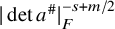 rather than
$|\det a^{\#}|_F^{-s - m/2}$
rather than
$|\det a^{\#}|_F^{-s - m/2}$
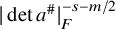 .
.
In Corollary 6.2.2, we rewrite (2.4.6) more explicitly when
$\Phi _v$
 is the normalized spherical standard section for every non-Archimedean v.
3 Weil representation
3.1 Weil index
We recall Weil indices, which are certain constants appearing in the Weil representation and other calculations below. We compute the instances which we need.
Suppose
$F^+_v$
 is a local field (arbitrary characteristic) with nontrivial additive character
$\psi _v \colon F^+_v \rightarrow \mathbb {C}^\times $
is a local field (arbitrary characteristic) with nontrivial additive character
$\psi _v \colon F^+_v \rightarrow \mathbb {C}^\times $
 , and suppose
$V_v$
, and suppose
$V_v$
 is a (finite dimensional)
$F^+_v$
is a (finite dimensional)
$F^+_v$
 vector space equipped with a non-degenerate quadratic form
$Q(-)$
vector space equipped with a non-degenerate quadratic form
$Q(-)$
 . The map
$V_v \rightarrow \mathbb {C}^{\times }$
. The map
$V_v \rightarrow \mathbb {C}^{\times }$
 given by
$x \mapsto \psi _v(Q(x))$
given by
$x \mapsto \psi _v(Q(x))$
 is a “non-degenerate character of the second degree” in the sense of [Reference WeilWei64] [Reference Ranga RaoRao93, Appendix], so there is an associated Weil index
$\gamma _{\psi _v}(V_v) \in \mathbb {C}^\times $
is a “non-degenerate character of the second degree” in the sense of [Reference WeilWei64] [Reference Ranga RaoRao93, Appendix], so there is an associated Weil index
$\gamma _{\psi _v}(V_v) \in \mathbb {C}^\times $
 (which is an eighth root of unity). The quantity
$\gamma _{\psi _v}(V_v)$
(which is an eighth root of unity). The quantity
$\gamma _{\psi _v}(V_v)$
 depends only on
$\psi _v$
depends only on
$\psi _v$
 and the isomorphism class of
$V_v$
and the isomorphism class of
$V_v$
 , and we have

for orthogonal direct sums
$V_v \oplus V^{\prime }_v$
 (follows from the definition, see [Reference Ranga RaoRao93, Theorem A.2]). The Weil index also satisfies a global product formula [Reference WeilWei64, Proposition 5].
When
$F^+_v$
 has characteristic
$\neq 2$
has characteristic
$\neq 2$
 and
$V_v$
and
$V_v$
 has a bilinear pairing
$(-,-)$
has a bilinear pairing
$(-,-)$
 , our convention is that
$x \mapsto (x,x)$
, our convention is that
$x \mapsto (x,x)$
 is the associated quadratic form (and vice-versa).
Lemma 3.1.1. Let
$F^+_v$
 be a local field of characteristic
$\neq 2$
be a local field of characteristic
$\neq 2$
 , let
$\psi _v \colon F^+_v \rightarrow \mathbb {C}^\times $
, let
$\psi _v \colon F^+_v \rightarrow \mathbb {C}^\times $
 be a nontrivial additive character, and let
$V_v$
be a nontrivial additive character, and let
$V_v$
 be a finite dimensional
$F^+_v$
be a finite dimensional
$F^+_v$
 vector space with non-degenerate bilinear pairing. Assume any of the following situations hold.
-
(1) The bilinear pairing on $V_v$
is given by (3.1.2) $$ \begin{align} \begin{pmatrix} 0 & 1_d \\ 1_d & 0 \end{pmatrix}. \end{align} $$
-
(2) The field $F^+_v$
is non-Archimedean with residue characteristic
$\neq 2$
, there exists a self-dual lattice in
$V_v$
, and
$\psi _v$
is unramified.


Then the Weil index is
$\gamma _{\psi _v}(V_v) = 1$
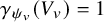 .
.
Proof. (1) By compatibility with orthogonal direct sums, we reduce to the case
$d = 1$
 . Given a nonzero element
$a \in F_v^{+ \times }$
. Given a nonzero element
$a \in F_v^{+ \times }$
 , we use the temporary notation
$\gamma _{\psi _v}(a)$
, we use the temporary notation
$\gamma _{\psi _v}(a)$
 for the Weil index of the one-dimensional quadratic space containing an element x with
$(x,x) = a$
for the Weil index of the one-dimensional quadratic space containing an element x with
$(x,x) = a$
 . We have
$\gamma _{\psi _v}(V_v) = \gamma _{\psi _v}(a) \gamma _{\psi _v}(-a^{-1})$
. We have
$\gamma _{\psi _v}(V_v) = \gamma _{\psi _v}(a) \gamma _{\psi _v}(-a^{-1})$
 for some
$a \in F_v^{+ \times }$
for some
$a \in F_v^{+ \times }$
 . We have
$\gamma _{\psi _v}(a) \gamma _{\psi _v}(-a^{-1}) = 1$
. We have
$\gamma _{\psi _v}(a) \gamma _{\psi _v}(-a^{-1}) = 1$
 (follows from [Reference Ranga RaoRao93, Theorem A.4], which relates Weil indices and the Hilbert symbol).
(2) By compatibility with orthogonal direct sums, it is enough to show
$\gamma _{\psi _v}(a) = 1$
 for
$a \in \mathcal {O}_{F^+_v}^{\times }$
for
$a \in \mathcal {O}_{F^+_v}^{\times }$
 . This follows from [Reference Ranga RaoRao93, Proposition A.11].
Remark 3.1.2. The explicit formula of [Reference Ranga RaoRao93, Proposition A.12] shows that Lemma 3.1.1(2) is false if
$F^+_v = \mathbb {Q}_2$
 (e.g., if
$V_v$
(e.g., if
$V_v$
 has rank one).
Next, let
$F_v$
 be an étale algebra of degree
$2$
be an étale algebra of degree
$2$
 over a local field
$F^+_v$
over a local field
$F^+_v$
 of characteristic
$\neq 2$
of characteristic
$\neq 2$
 (residue characteristic
$2$
(residue characteristic
$2$
 allowed). Write
$\eta _v \colon F^{+ \times }_v \rightarrow \{ \pm 1 \}$
allowed). Write
$\eta _v \colon F^{+ \times }_v \rightarrow \{ \pm 1 \}$
 for the quadratic character associated to
$F_v / F^+_v$
for the quadratic character associated to
$F_v / F^+_v$
 (trivial if
$F_v/F^+_v$
(trivial if
$F_v/F^+_v$
 is split), and write
$a \mapsto \overline {a}$
is split), and write
$a \mapsto \overline {a}$
 for the nontrivial involution of
$F_v$
for the nontrivial involution of
$F_v$
 over
$F^+_v$
over
$F^+_v$
 . If
$F^+_v$
. If
$F^+_v$
 is non-Archimedean, we write
$\mathfrak {d}$
is non-Archimedean, we write
$\mathfrak {d}$
 (resp.
$\Delta $
(resp.
$\Delta $
 ) for the different (resp. discriminant) ideal for the extension
$F_v/F^+_v$
) for the different (resp. discriminant) ideal for the extension
$F_v/F^+_v$
 (where
$\mathfrak {d} = \mathcal {O}_{F_v}$
(where
$\mathfrak {d} = \mathcal {O}_{F_v}$
 and
$\Delta = \mathcal {O}_{F^+_v}$
and
$\Delta = \mathcal {O}_{F^+_v}$
 in the split case). We sometimes abuse notation and write
$\mathfrak {d}$
in the split case). We sometimes abuse notation and write
$\mathfrak {d}$
 and
$\Delta $
and
$\Delta $
 for understood/chosen generators of these ideals. We write
$q_v$
for understood/chosen generators of these ideals. We write
$q_v$
 for the residue cardinality of
$F^+_v$
for the residue cardinality of
$F^+_v$
 if
$F^+_v$
if
$F^+_v$
 is non-Archimedean.
Any non-degenerate
$F_v/F^+_v$
 Hermitian space
$V_v$
Hermitian space
$V_v$
 with pairing
$(-,-)$
with pairing
$(-,-)$
 has an associated
$F^+_v$
has an associated
$F^+_v$
 -bilinear pairing
$\frac {1}{2} \mathrm {tr}_{F_v/F^+_v}(-,-)$
-bilinear pairing
$\frac {1}{2} \mathrm {tr}_{F_v/F^+_v}(-,-)$
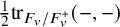 and quadratic form
$x \mapsto \frac {1}{2} \mathrm {tr}_{F_v/F^+_v}(x,x)$
and quadratic form
$x \mapsto \frac {1}{2} \mathrm {tr}_{F_v/F^+_v}(x,x)$
 . (Elsewhere, we typically normalize the trace bilinear pairing without the factor of
$\frac {1}{2}$
. (Elsewhere, we typically normalize the trace bilinear pairing without the factor of
$\frac {1}{2}$
 .) We write
$\gamma _{\psi _v}(V_v)$
.) We write
$\gamma _{\psi _v}(V_v)$
 for the Weil index of this quadratic space with respect to a nontrivial additive character
$\psi _v \colon F^+_v \rightarrow \mathbb {C}^{\times }$
for the Weil index of this quadratic space with respect to a nontrivial additive character
$\psi _v \colon F^+_v \rightarrow \mathbb {C}^{\times }$
 . We know
$\gamma _{\psi _v}(V_v)^4 = 1$
. We know
$\gamma _{\psi _v}(V_v)^4 = 1$
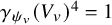 (see, e.g., [Reference Ranga RaoRao93, Corollary A.5(4)] and [Reference KudlaKud94, Theorem 3.1]).
We write
$\gamma _{\psi _v}(F_v)$
 for the Weil index associated to the one-dimensional Hermitian space
$F_v$
for the Weil index associated to the one-dimensional Hermitian space
$F_v$
 with pairing
$(x,y) = \overline {x} y$
with pairing
$(x,y) = \overline {x} y$
 . We write
$\epsilon _v(s, \xi _v, \psi _v)$
. We write
$\epsilon _v(s, \xi _v, \psi _v)$
 for the local epsilon factor associated to a quasi-character
$\xi _v \colon F^{+ \times }_v \rightarrow \mathbb {C}^{\times }$
for the local epsilon factor associated to a quasi-character
$\xi _v \colon F^{+ \times }_v \rightarrow \mathbb {C}^{\times }$
 (as in [Reference TateTat79, §3][Reference TateTat67], for the quasi-character
$\xi _v |-|^s$
(as in [Reference TateTat79, §3][Reference TateTat67], for the quasi-character
$\xi _v |-|^s$
 and the self-dual Haar measure for
$\psi _v$
and the self-dual Haar measure for
$\psi _v$
 ).
).
If
$F^+_v$
 is non-Archimedean with uniformizer
$\varpi _0$
is non-Archimedean with uniformizer
$\varpi _0$
 , we have

where

If
$F^+_v$
 is Archimedean, we have

where
$u \in F^{+ \times }_v$
 is such that

In both non-Archimedean and Archimedean cases, if
$\psi ^{\prime }_v(x) = \psi _v(ux)$
 for some
$u \in F^{+ \times }_v$
for some
$u \in F^{+ \times }_v$
 , we have

These identities follow from [Reference Jacquet and LanglandsJL70, Lemma 1.2(iii), (iv)] and properties of epsilon factors as in [Reference TateTat79, §3.2]. For the reader’s convenience, we recall
$\gamma _{\psi _v}(\mathbb {C}) = i$
 if
$F^+_v = \mathbb {R}$
if
$F^+_v = \mathbb {R}$
 and
$\psi _v(x) = e^{2 \pi i x}$
and
$\psi _v(x) = e^{2 \pi i x}$
 .
.
In all cases, we have

If
$F^+_v$
 is non-Archimedean, recall that
$\epsilon _v(s,\xi _v, \psi _v) = 1$
is non-Archimedean, recall that
$\epsilon _v(s,\xi _v, \psi _v) = 1$
 if
$\xi _v$
if
$\xi _v$
 and
$\psi _v$
and
$\psi _v$
 are unramified. If
$F^+_v = \mathbb {R}$
are unramified. If
$F^+_v = \mathbb {R}$
 and
$\psi _v(x) = e^{2 \pi i x}$
and
$\psi _v(x) = e^{2 \pi i x}$
 , recall
$\epsilon _v(s, \mathrm {sgn}^j, \overline {\psi }_v) = 1$
, recall
$\epsilon _v(s, \mathrm {sgn}^j, \overline {\psi }_v) = 1$
 (resp.
$= -i$
(resp.
$= -i$
 ) if j is even (resp. odd) where
$\mathrm {sgn} \colon \mathbb {R}^{\times } \rightarrow \{ \pm 1\}$
) if j is even (resp. odd) where
$\mathrm {sgn} \colon \mathbb {R}^{\times } \rightarrow \{ \pm 1\}$
 is the sign character (these formulas will be used implicitly in Section 5.2). Recall our convention that self-duality for Hermitian lattices is understood with respect to the trace pairing (unless otherwise specified), see [Reference ChenChe24a, Section 2.2]. If
$F_v/F^+_v$
is the sign character (these formulas will be used implicitly in Section 5.2). Recall our convention that self-duality for Hermitian lattices is understood with respect to the trace pairing (unless otherwise specified), see [Reference ChenChe24a, Section 2.2]. If
$F_v/F^+_v$
 is ramified and L is a self-dual Hermitian lattice, then L must have even rank (explained in loc. cit.).
By the standard additive character
$\psi _{\mathrm {tr},v} \colon F^+_v \rightarrow \mathbb {C}^{\times }$
 for Archimedean
$F^+_v$
for Archimedean
$F^+_v$
 , we mean the characters of (3.1.6) with
$u = 1$
, we mean the characters of (3.1.6) with
$u = 1$
 . By the standard additive character for non-Archimedean
$F^+_v$
. By the standard additive character for non-Archimedean
$F^+_v$
 , we mean
$\psi _{\mathrm {tr}}(x) {:=}q \psi _p(\operatorname {tr}_{F^+_v / \mathbb {Q}_p}(x))$
, we mean
$\psi _{\mathrm {tr}}(x) {:=}q \psi _p(\operatorname {tr}_{F^+_v / \mathbb {Q}_p}(x))$
 , where the residue characteristic is p, and where
$\psi _p \colon \mathbb {Q}_p^{\times } \rightarrow \mathbb {C}^{\times }$
, where the residue characteristic is p, and where
$\psi _p \colon \mathbb {Q}_p^{\times } \rightarrow \mathbb {C}^{\times }$
 is the unramified character satisfying
$\psi _p(x) = e^{-2 \pi i x}$
is the unramified character satisfying
$\psi _p(x) = e^{-2 \pi i x}$
 for any
$x \in \mathbb {Z}[1/p]$
for any
$x \in \mathbb {Z}[1/p]$
 . In the non-Archimedean case, we write
$\mathfrak {d}_{F^+_v / \mathbb {Q}_p}$
. In the non-Archimedean case, we write
$\mathfrak {d}_{F^+_v / \mathbb {Q}_p}$
 for the different ideal of
$F^+_v / \mathbb {Q}_p$
for the different ideal of
$F^+_v / \mathbb {Q}_p$
 . An element
$u \in F^+_v$
. An element
$u \in F^+_v$
 is a generator for
$\mathfrak {d}_{F^+_v / \mathbb {Q}_p}$
is a generator for
$\mathfrak {d}_{F^+_v / \mathbb {Q}_p}$
 if and only if the additive character
$x \mapsto \psi _{\mathrm {tr},v}(u^{-1} x)$
if and only if the additive character
$x \mapsto \psi _{\mathrm {tr},v}(u^{-1} x)$
 is unramified.
Lemma 3.1.3. Let
$F^+_v$
 be a local field of characteristic
$\neq 2$
be a local field of characteristic
$\neq 2$
 , let
$\psi _v \colon F^+_v \rightarrow \mathbb {C}^\times $
, let
$\psi _v \colon F^+_v \rightarrow \mathbb {C}^\times $
 be a nontrivial additive character, and let
$F_v/F^+_v$
be a nontrivial additive character, and let
$F_v/F^+_v$
 be a degree
$2$
be a degree
$2$
 étale algebra. Let
$V_v$
étale algebra. Let
$V_v$
 be a finite dimensional non-degenerate
$F_v/F^+_v$
be a finite dimensional non-degenerate
$F_v/F^+_v$
 Hermitian space. Assume any of the following situations hold.
-
(1) The Hermitian space $V_v$
admits a basis with Gram matrix (3.1.9) $$ \begin{align} \begin{pmatrix} 0 & 1_d \\ 1_d & 0 \end{pmatrix}. \end{align} $$
-
(2) We have $F_v \cong F^+_v \times F^+_v$
. -
(3) The extension $F_v/F^+_v$
is unramified or
$F^+_v$
has residue characteristic
$\neq 2$
. Moreover, the field
$F^+_v$
is non-Archimedean, there exists a full-rank self-dual
$\mathcal {O}_{F_v}$
-lattice in
$V_v$
, and
$V_v$
has even rank if
$F_v / F^+_v$
is unramified. -
(4) The field $F^+_v$
is non-Archimedean, the extension
$F_v/F^+_v$
is unramified, there exists a full-rank self-dual lattice in
$V_v$
, and
$\psi _v$
is unramified. -
(5) The field $F^+_v$
is non-Archimedean, we have
$\psi _v = \psi _{\mathrm {tr},v}$
being the standard additive character, and
$V_v$
contains a full-rank
$\mathcal {O}_{F_v}$
-lattice M which is self-dual for the
$\mathbb {Z}_p$
-bilinear pairing
$x,y \mapsto \operatorname {tr}_{F_v / \mathbb {Q}_p}(x,y)$
. Also assume that at least one of the following three conditions is satisfied: (i) The extension
$F_v / F^+_v$
is unramified, (ii) the residue characteristic of
$F^+_v$
is
$\neq 2$
, or (iii) for some generator u of
$\mathfrak {d}_{F^+_v / \mathbb {Q}_p}$
, the Hermitian space
$V_v$
with the modified pairing
$u \cdot (-,-)$
admits a basis with Gram matrix as in situation (1).








Then the Weil index is
$\gamma _{\psi _v}(V_v) = 1$
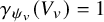 .
.
Proof. We have (3)
$\implies $
 (1) (see [Reference Li and LiuLL22, Lemma 2.12] for the ramified situation, in which case
$V_v$
(1) (see [Reference Li and LiuLL22, Lemma 2.12] for the ramified situation, in which case
$V_v$
 automatically has even rank). This implication is false if
$F_v/F^+_v$
automatically has even rank). This implication is false if
$F_v/F^+_v$
 is ramified with
$F^+_v$
is ramified with
$F^+_v$
 of residue characteristic
$2$
of residue characteristic
$2$
 .
.
In situations (1) and (2) we may pick a basis
$\{1, \alpha \}$
 for
$F_v$
for
$F_v$
 as an
$F^+_v$
as an
$F^+_v$
 vector space where
$\mathrm {tr}_{F_v/F^+_v}(\alpha ) = 0$
vector space where
$\mathrm {tr}_{F_v/F^+_v}(\alpha ) = 0$
 . Applying Lemma 3.1.1 proves the claims.
In situation (4), we may diagonalize the given self-dual lattice, hence reducing to the case where
$V_v$
 has rank one. In this case, we have
$\gamma _{\psi _v}(V_v) = \gamma _{\psi _v}(F_v) = \epsilon (1/2, \eta _v, \psi _v) = 1$
has rank one. In this case, we have
$\gamma _{\psi _v}(V_v) = \gamma _{\psi _v}(F_v) = \epsilon (1/2, \eta _v, \psi _v) = 1$
 .
.
In situation (5), let
$u \in \mathfrak {d}_{F^+_v / \mathbb {Q}_p}$
 be any generator (in situation (5)(iii), take u to be the given one). Take
$\psi ^{\prime }_v(x) {:=}q \psi _v(u^{-1} x)$
be any generator (in situation (5)(iii), take u to be the given one). Take
$\psi ^{\prime }_v(x) {:=}q \psi _v(u^{-1} x)$
 , and take
$V^{\prime }_v {:=}q V_v$
, and take
$V^{\prime }_v {:=}q V_v$
 but give
$V^{\prime }_v$
but give
$V^{\prime }_v$
 the modified pairing
$(-,-)' {:=}q u \cdot (-,-)$
the modified pairing
$(-,-)' {:=}q u \cdot (-,-)$
 . We find
$\gamma _{\psi _v}(V_v) = \gamma _{\psi ^{\prime }_v}(V^{\prime }_v)$
. We find
$\gamma _{\psi _v}(V_v) = \gamma _{\psi ^{\prime }_v}(V^{\prime }_v)$
 , so this reduces to situations (4), (3), and (1) above (note that M viewed as a lattice in
$V^{\prime }_v$
, so this reduces to situations (4), (3), and (1) above (note that M viewed as a lattice in
$V^{\prime }_v$
 is self-dual for
$(-,-)'$
is self-dual for
$(-,-)'$
 .)
.)
3.2 Weil representation
Let
$F_v/F^+_v$
 and accompanying notation be as in Section 3.1. Assume
$F_v/F^+_v = \mathbb {C} / \mathbb {R}$
and accompanying notation be as in Section 3.1. Assume
$F_v/F^+_v = \mathbb {C} / \mathbb {R}$
 if
$F^+_v$
if
$F^+_v$
 is Archimedean. We also assume
$F^+_v$
is Archimedean. We also assume
$F^+_v$
 has characteristic
$0$
has characteristic
$0$
 (because [Reference KudlaKud94] assumes this).
Let
$V_v$
 be a non-degenerate
$F_v/F^+_v$
be a non-degenerate
$F_v/F^+_v$
 Hermitian space of dimension
$n \geq 0$
Hermitian space of dimension
$n \geq 0$
 . Choose a nontrivial additive character
$\psi _v \colon F^+_v \rightarrow \mathbb {C}^\times $
. Choose a nontrivial additive character
$\psi _v \colon F^+_v \rightarrow \mathbb {C}^\times $
 , and let
$\chi _v \colon F_v^{\times } \rightarrow \mathbb {C}^{\times }$
, and let
$\chi _v \colon F_v^{\times } \rightarrow \mathbb {C}^{\times }$
 be a character such that
$\chi _v|_{F^{+ \times }_v} = \eta _v^{n}$
be a character such that
$\chi _v|_{F^{+ \times }_v} = \eta _v^{n}$
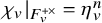 . There is a local Weil representation
$\omega _v = \omega _{\chi _v,\psi _v}$
. There is a local Weil representation
$\omega _v = \omega _{\chi _v,\psi _v}$
 of
$U(m,m)(F^+_v) \times U(V_v)(F^+_v)$
of
$U(m,m)(F^+_v) \times U(V_v)(F^+_v)$
 on the space of Schwartz functions
$\mathcal {S}(V_v^m)$
on the space of Schwartz functions
$\mathcal {S}(V_v^m)$
 (the Schrödinger model [Reference KudlaKud94, §5]),Footnote
7
which we normalize as
(the Schrödinger model [Reference KudlaKud94, §5]),Footnote
7
which we normalize as

for
$\varphi _v \in \mathcal {S}(V_v^m)$
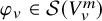 and
$\underline {x} \in V_v^m$
and
$\underline {x} \in V_v^m$
 (viewed as
$n \times m$
(viewed as
$n \times m$
 matrices), where

is the Fourier transform for the corresponding self-dual Haar measure on
$V_v^m$
 , and where we should view
$\underline {x}$
, and where we should view
$\underline {x}$
 as a length m row vector with elements in
$V_v$
as a length m row vector with elements in
$V_v$
 in the above formulas. The constant
$\gamma _{\psi _v}(V_v)$
in the above formulas. The constant
$\gamma _{\psi _v}(V_v)$
 is the Weil index from Section 3.1. The symbol
$(\underline {x}, \underline {\smash {y}})$
is the Weil index from Section 3.1. The symbol
$(\underline {x}, \underline {\smash {y}})$
 denotes the matrix of inner products with
$i,j$
denotes the matrix of inner products with
$i,j$
 -th entry
$(x_i, y_j)$
-th entry
$(x_i, y_j)$
 .
.
Remark 3.2.1 (Change of additive character)
We sometimes restrict our attention to Weil representations
$\omega _{\chi _v, \psi _v}$
 for convenient choices of
$\psi _v$
for convenient choices of
$\psi _v$
 (e.g., unramified in the non-Archimedean case, or
$\psi _v(x) = e^{2\pi i x}$
(e.g., unramified in the non-Archimedean case, or
$\psi _v(x) = e^{2\pi i x}$
 in the Archimedean case). For some purposes, this loses no generality by the following rescaling trick. If
$\psi ^{\prime }_v(x) = \psi _v(u \cdot x)$
in the Archimedean case). For some purposes, this loses no generality by the following rescaling trick. If
$\psi ^{\prime }_v(x) = \psi _v(u \cdot x)$
 for some
$u \in (F^+_v)^{\times }$
for some
$u \in (F^+_v)^{\times }$
 , and if
$V^{\prime }_v$
, and if
$V^{\prime }_v$
 is
$V_v$
is
$V_v$
 but with the Hermitian pairing
$u^{-1} (-,-)$
but with the Hermitian pairing
$u^{-1} (-,-)$
 , then the Weil representations of
$\omega _{\chi _v, \psi _v}$
, then the Weil representations of
$\omega _{\chi _v, \psi _v}$
 on
$\mathcal {S}(V_v^m)$
on
$\mathcal {S}(V_v^m)$
 and
$\omega _{\chi _v, \psi ^{\prime }_v}$
and
$\omega _{\chi _v, \psi ^{\prime }_v}$
 on
$\mathcal {S}(V_v^{\prime m})$
on
$\mathcal {S}(V_v^{\prime m})$
 are compatible for the canonical identification
$V_v \cong V_v^{\prime }$
are compatible for the canonical identification
$V_v \cong V_v^{\prime }$
 as
$F_v$
as
$F_v$
 -modules (not necessarily preserving Hermitian pairings).
With
$s_0 {:=}q (n - m)/2$
 , there is a map
$\mathcal {S}(V_v^m) \rightarrow I(\chi _v, s_0)$
, there is a map
$\mathcal {S}(V_v^m) \rightarrow I(\chi _v, s_0)$
 sending
$\varphi _v \in \mathcal {S}(V_v^m)$
sending
$\varphi _v \in \mathcal {S}(V_v^m)$
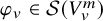 to the function
$h \mapsto (\omega _v(h) \varphi _v)(0)$
to the function
$h \mapsto (\omega _v(h) \varphi _v)(0)$
 . The associated standard section
$\Phi _{\varphi _v} \in I(\chi _v,s)$
. The associated standard section
$\Phi _{\varphi _v} \in I(\chi _v,s)$
 is the Siegel–Weil section for
$\varphi _v$
is the Siegel–Weil section for
$\varphi _v$
 [Reference Garcia and SankaranGS19, §5.1].
If
$F^+_v$
 is non-Archimedean, choose a generator
$\mathfrak {d}$
is non-Archimedean, choose a generator
$\mathfrak {d}$
 of the different ideal of
$F_v / F^+_v$
of the different ideal of
$F_v / F^+_v$
 , and let
$M^{\circ }_2$
, and let
$M^{\circ }_2$
 be the rank
$2$
be the rank
$2$
 Hermitian
$\mathcal {O}_{F_v}$
Hermitian
$\mathcal {O}_{F_v}$
 -lattice admitting a basis with Gram matrix

Note that
$M_2^{\circ } = M_2^{\circ *}$
 is self-dual (with respect to the
$F^+_v$
is self-dual (with respect to the
$F^+_v$
 -bilinear pairing
$\operatorname {tr}_{F_v/F^+_v}(-,-)$
-bilinear pairing
$\operatorname {tr}_{F_v/F^+_v}(-,-)$
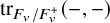 ).
).
Lemma 3.2.2. In the situation above, assume moreover that
$\chi _v$
 is unramified, and that
$F^+_v$
is unramified, and that
$F^+_v$
 is non-Archimedean. Suppose
$\varphi _v = {\pmb {1}}_{M}^{m}$
is non-Archimedean. Suppose
$\varphi _v = {\pmb {1}}_{M}^{m}$
 where
${\pmb {1}}_{M}$
where
${\pmb {1}}_{M}$
 is the characteristic function of a full rank
$\mathcal {O}_{F_v}$
is the characteristic function of a full rank
$\mathcal {O}_{F_v}$
 -lattice
$M \subseteq V_v$
-lattice
$M \subseteq V_v$
 in any of the following situations.
-
(1) The additive character $\psi _v$
is unramified, and the lattice M is self-dual. Moreover, the extension
$F_v/F^+_v$
is unramified, or
$F^+_v$
has residue characteristic
$\neq 2$
. -
(2) The additive character $\psi _v$
is unramified, and we have
$M \cong (M^{\circ }_2)^{\oplus d}$
(orthogonal direct sum) for some
$d \geq 0$
. -
(3) We have $\psi _v = \psi _{\mathrm {tr}, v}$
being the standard additive character, and M is self-dual for the
$\mathbb {Z}_p$
-bilinear pairing
$x,y \mapsto \operatorname {tr}_{F_v / \mathbb {Q}_p}(x,y)$
. Also assume that at least one of the following three conditions is satisfied: (i) The extension
$F_v / F^+_v$
is unramified, (ii) the residue characteristic of
$F^+_v$
is
$\neq 2$
, or (iii) for some generator u of
$\mathfrak {d}_{F^+_v / \mathbb {Q}_p}$
, the lattice M with the modified pairing
$u \cdot (-,-)$
is isomorphic to
$(M^{\circ }_2)^{\oplus d}$
for some
$d \geq 0$
.


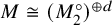





Then the associated Siegel–Weil section
$\Phi _{\varphi _v}$
 is the normalized spherical section
$\Phi _v^{\circ }$
is the normalized spherical section
$\Phi _v^{\circ }$
 , that is,
$K_v^{\circ }$
, that is,
$K_v^{\circ }$
 -fixed with
$\Phi _{\varphi _v}(1) = 1$
-fixed with
$\Phi _{\varphi _v}(1) = 1$
 .
.
Proof. If either (1) or (2) holds, the lemma follows from the explicit formulas above, since w and
$P(\mathcal {O}_{F^+_v})$
 generate
$K_v^{\circ } = U(m,m)(\mathcal {O}_{F^+_v})$
generate
$K_v^{\circ } = U(m,m)(\mathcal {O}_{F^+_v})$
 and since the Weil index
$\gamma _{\psi _v}(V_v)$
and since the Weil index
$\gamma _{\psi _v}(V_v)$
 is
$1$
is
$1$
 (Lemma 3.1.3), where we use the fact that any self-dual M must have even rank if
$F_v / F^+_v$
(Lemma 3.1.3), where we use the fact that any self-dual M must have even rank if
$F_v / F^+_v$
 is ramified with residue characteristic
$2$
is ramified with residue characteristic
$2$
 .
.
In case (3), pick any generator u of
$\mathfrak {d}_{F^+_v / \mathbb {Q}_p}$
 (in situation (3)(iii), pick the u that is given). Consider the modified pairing
$(-,-)' {:=}q u \cdot (-,-)$
(in situation (3)(iii), pick the u that is given). Consider the modified pairing
$(-,-)' {:=}q u \cdot (-,-)$
 on M. Then
$\psi ^{\prime }_v(x) {:=}q \psi _{\mathrm {tr},v}(u^{-1} x)$
on M. Then
$\psi ^{\prime }_v(x) {:=}q \psi _{\mathrm {tr},v}(u^{-1} x)$
 is unramified, and the lattice M with pairing
$(-,-)'$
is unramified, and the lattice M with pairing
$(-,-)'$
 satisfies either condition (1) or (2). The claim now follows from Remark 3.2.1.
In the statement of Lemma 3.2.2, condition (1) implies condition (2) if M has even rank (the ramified case is [Reference Li and LiuLL22, Lemma 2.12]).
Next, consider the case where
$F_v/F^+_v = \mathbb {C}/\mathbb {R}$
 . Suppose the n-dimensional Hermitian space
$V_v$
. Suppose the n-dimensional Hermitian space
$V_v$
 is positive definite, with Hermitian pairing
$(-,-)$
is positive definite, with Hermitian pairing
$(-,-)$
 . If
$\psi _v(x) = e^{2 \pi i u x}$
. If
$\psi _v(x) = e^{2 \pi i u x}$
 for some
$u> 0$
for some
$u> 0$
 , the Gaussian

for
$\underline {x} = (x_1, \ldots , x_m) \in V_v^m$
 has associated Siegel–Weil section

where
$\Phi _v^{(n)}$
 is the scalar weight standard section described surrounding (2.2.11), see [Reference Garcia and SankaranGS19, (2.68)] (there in the case
$u = 1$
is the scalar weight standard section described surrounding (2.2.11), see [Reference Garcia and SankaranGS19, (2.68)] (there in the case
$u = 1$
 , and the general case follows from Remark 3.2.1).
Remark 3.2.3. Suppose
$F / F^+$
 is a CM extension of number fields with associated quadratic character
$\eta $
is a CM extension of number fields with associated quadratic character
$\eta $
 and accompanying notation as in Section 2.2. With m and n as above, choose any character
$\chi \colon F^{\times } \backslash \mathbb {A}_F^{\times } \rightarrow \mathbb {C}^{\times }$
and accompanying notation as in Section 2.2. With m and n as above, choose any character
$\chi \colon F^{\times } \backslash \mathbb {A}_F^{\times } \rightarrow \mathbb {C}^{\times }$
 satisfying
$\chi |_{\mathbb {A}^{\times }} = \eta ^n$
satisfying
$\chi |_{\mathbb {A}^{\times }} = \eta ^n$
 . Choose nontrivial additive characters
$\psi _v \colon F^+_v \rightarrow \mathbb {C}^{\times }$
. Choose nontrivial additive characters
$\psi _v \colon F^+_v \rightarrow \mathbb {C}^{\times }$
 for each place v (the
$\psi _v$
for each place v (the
$\psi _v$
 need not come from a global character). Suppose we are given a collection of local Weil representations
$\omega _{\chi _v, \psi _v}$
need not come from a global character). Suppose we are given a collection of local Weil representations
$\omega _{\chi _v, \psi _v}$
 on some
$\mathcal {S}(V_v^m)$
on some
$\mathcal {S}(V_v^m)$
 for each place v of
$F^+_v$
for each place v of
$F^+_v$
 (where the collection
$(V_v)_v$
(where the collection
$(V_v)_v$
 of local Hermitian spaces need not come from a global Hermitian space). Choose
$\varphi _v \in \mathcal {S}(V_v^m)$
of local Hermitian spaces need not come from a global Hermitian space). Choose
$\varphi _v \in \mathcal {S}(V_v^m)$
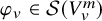 for each place v, and assume
$\varphi _v = {\pmb {1}}_{L_v}^m$
for each place v, and assume
$\varphi _v = {\pmb {1}}_{L_v}^m$
 for some full-rank self-dual lattice
$L_v \subseteq V_v$
for some full-rank self-dual lattice
$L_v \subseteq V_v$
 for all but finitely many v. Set
$\Phi {:=}q \bigotimes _v \Phi _{\varphi _v}$
for all but finitely many v. Set
$\Phi {:=}q \bigotimes _v \Phi _{\varphi _v}$
 .
.
In this situation, the Eisenstein series variant
$\tilde {E}(a, s, \Phi )_n$
 (2.2.19) does not depend on the choice of
$\chi $
(2.2.19) does not depend on the choice of
$\chi $
 . This follows upon inspecting the Weil representation, particularly the action of
$m(a)$
. This follows upon inspecting the Weil representation, particularly the action of
$m(a)$
 .
.
This remark also has a local version, that is, the Whittaker function variants
$\tilde {W}^{\ast }_{T,\psi _v}(a, s)^{\circ }_n$
 and
$\tilde {W}^{\ast }_{T,\psi _v}(a, s, \Phi _{\varphi _v})_n$
and
$\tilde {W}^{\ast }_{T,\psi _v}(a, s, \Phi _{\varphi _v})_n$
 (Sections 4.2 and 4.3) do not depend on the choice of
$\chi _v$
(Sections 4.2 and 4.3) do not depend on the choice of
$\chi _v$
 .
.
4 Local Whittaker functions
Let
$F_v/F^+_v$
 and accompanying notation be as in Section 3.2. If
$F^+_v$
and accompanying notation be as in Section 3.2. If
$F^+_v$
 has residue characteristic
$2$
has residue characteristic
$2$
 , we also assume
$F_v / F^+_v$
, we also assume
$F_v / F^+_v$
 is unramified. Let
$\chi _v \colon F_v^{\times } \rightarrow \mathbb {C}^{\times }$
is unramified. Let
$\chi _v \colon F_v^{\times } \rightarrow \mathbb {C}^{\times }$
 be a character satisfying
$\chi _v|_{F^{+ \times }_v} = \eta _v^n$
be a character satisfying
$\chi _v|_{F^{+ \times }_v} = \eta _v^n$
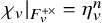 for some integer
$n \in \mathbb {Z}$
for some integer
$n \in \mathbb {Z}$
 , with n even if
$F_v / F^+_v$
, with n even if
$F_v / F^+_v$
 is ramified in the non-Archimedean case.Footnote
8
Assume
$\chi _v$
is ramified in the non-Archimedean case.Footnote
8
Assume
$\chi _v$
 is unramified if
$F^+_v$
is unramified if
$F^+_v$
 is non-Archimedean. Let
$\psi _v \colon F^+_v \rightarrow \mathbb {C}^{\times }$
is non-Archimedean. Let
$\psi _v \colon F^+_v \rightarrow \mathbb {C}^{\times }$
 be an unramified nontrivial additive character. Assume
$\psi _v(x) = e^{2 \pi i x}$
be an unramified nontrivial additive character. Assume
$\psi _v(x) = e^{2 \pi i x}$
 if
$F^+_v = \mathbb {R}$
if
$F^+_v = \mathbb {R}$
 . These are our default hypotheses, but weaker hypotheses often suffice (as will be indicated below).
Let
$\Phi ^{\circ }_v \in I(s, \chi _v)$
 be the normalized spherical standard section if
$F^{+}_v$
be the normalized spherical standard section if
$F^{+}_v$
 is non-Archimedean. Let
$\Phi ^{(n)}_v \in I(s, \chi _v)$
is non-Archimedean. Let
$\Phi ^{(n)}_v \in I(s, \chi _v)$
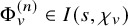 be the normalized scalar weight standard section from Section 2.2 if
$F_v / F^+_v = \mathbb {C} / \mathbb {R}$
be the normalized scalar weight standard section from Section 2.2 if
$F_v / F^+_v = \mathbb {C} / \mathbb {R}$
 .
.
Given an integer
$m \geq 0$
 (we do not assume
$m \leq n$
(we do not assume
$m \leq n$
 , unless otherwise specified) and given
$T \in \mathrm {Herm}_m(F^+_v)$
, unless otherwise specified) and given
$T \in \mathrm {Herm}_m(F^+_v)$
 with
$\det T \neq 0$
with
$\det T \neq 0$
 , we define normalized local Whittaker functions


for certain normalizing factors
$\Lambda _{T,v}(s)^{\circ }_n$
 (see (4.3.1) and (4.2.1) below).
The preceding normalization gives
$W_{T,v}^{\ast }(h, s)^{\circ }_n$
 a clean functional equation (Section 5). Moreover, the normalized function
$W^{\ast }_{T,v}(h, s)^{\circ }_n$
a clean functional equation (Section 5). Moreover, the normalized function
$W^{\ast }_{T,v}(h, s)^{\circ }_n$
 (as opposed to the unnormalized versions) seems to correspond more naturally to local information about special cycles (e.g., local contributions to arithmetic degrees) in arithmetic (and non-arithmetic) Siegel–Weil formulas. For example, our main local theorems [Reference ChenChe24a, Section 9] [Reference ChenChe24b, Section 4] are proved in terms of the derivative of
$W^{\ast }_{T,v}(1, s)^{\circ }_n$
(as opposed to the unnormalized versions) seems to correspond more naturally to local information about special cycles (e.g., local contributions to arithmetic degrees) in arithmetic (and non-arithmetic) Siegel–Weil formulas. For example, our main local theorems [Reference ChenChe24a, Section 9] [Reference ChenChe24b, Section 4] are proved in terms of the derivative of
$W^{\ast }_{T,v}(1, s)^{\circ }_n$
 and not
$W_{T,v}(1, s, \Phi ^{\circ }_v)$
and not
$W_{T,v}(1, s, \Phi ^{\circ }_v)$
 or
$W_{T,v}(1, s, \Phi ^{(n)}_v)$
or
$W_{T,v}(1, s, \Phi ^{(n)}_v)$
 .
.
The normalizing factors
$\Lambda _{T,v}(s)^{\circ }_n$
 also carry geometric information. For example, consider an imaginary quadratic field
$F / \mathbb {Q}$
also carry geometric information. For example, consider an imaginary quadratic field
$F / \mathbb {Q}$
 of odd discriminant, suppose
$m = n$
of odd discriminant, suppose
$m = n$
 is even, and form the product
$2 \prod _v \Lambda _{T,v}(s)^{\circ }_n$
is even, and form the product
$2 \prod _v \Lambda _{T,v}(s)^{\circ }_n$
 over all places v of
$\mathbb {Q}$
over all places v of
$\mathbb {Q}$
 . If
$n \equiv 0\ \pmod {4}$
. If
$n \equiv 0\ \pmod {4}$
 , evaluation at
$s = 0$
, evaluation at
$s = 0$
 returns the degree of a certain
$0$
returns the degree of a certain
$0$
 -dimensional unitary complex Shimura variety (stack), giving a case of a unitary analogue of the Siegel mass formula. If
$n \equiv 2\ \pmod {4}$
-dimensional unitary complex Shimura variety (stack), giving a case of a unitary analogue of the Siegel mass formula. If
$n \equiv 2\ \pmod {4}$
 , evaluation at
$s = 0$
, evaluation at
$s = 0$
 returns the volume of a certain
$(n - 1)$
returns the volume of a certain
$(n - 1)$
 -dimensional unitary complex Shimura variety (stack). These volume identities will be discussed in Section 8.2 (but are not needed for our main theorems on arithmetic Siegel–Weil).
4.1 Local L-factors
We use the following (standard) local factors as in [Reference TateTat79, §3].
If
$F^+_v$
 is a local field (allowing arbitrary characteristic in Section 4.1) and
$\xi _v \colon F^{+ \times }_v \rightarrow \mathbb {C}^{\times }$
is a local field (allowing arbitrary characteristic in Section 4.1) and
$\xi _v \colon F^{+ \times }_v \rightarrow \mathbb {C}^{\times }$
 is a quasi-character, we write
$L_v(s, \xi _v)$
is a quasi-character, we write
$L_v(s, \xi _v)$
 for the corresponding local L-factor (for the quasi-character
$\xi _v |-|_{F^+_v}^s$
for the corresponding local L-factor (for the quasi-character
$\xi _v |-|_{F^+_v}^s$
 ). Given any nontrivial additive character
$\psi _v \colon F^+_v \rightarrow \mathbb {C}^{\times }$
). Given any nontrivial additive character
$\psi _v \colon F^+_v \rightarrow \mathbb {C}^{\times }$
 , we write
$\epsilon _v(s, \xi _v, \psi _v)$
, we write
$\epsilon _v(s, \xi _v, \psi _v)$
 for the corresponding local epsilon factor (as appeared in Section 3.1) and
$\rho _v(s, \xi _v, \psi _v)$
for the corresponding local epsilon factor (as appeared in Section 3.1) and
$\rho _v(s, \xi _v, \psi _v)$
 for the local factor from Tate’s thesis [Reference TateTat67, Theorem 2.4.1], which satisfies

If
$F^+$
 is a global field with a quasi-character
$\xi \colon F^{+ \times } \backslash \mathbb {A}_{F^+} \rightarrow \mathbb {C}^{\times }$
is a global field with a quasi-character
$\xi \colon F^{+ \times } \backslash \mathbb {A}_{F^+} \rightarrow \mathbb {C}^{\times }$
 and nontrivial additive character
$\psi \colon F^+ \backslash \mathbb {A}_{F^+} \rightarrow \mathbb {C}^{\times }$
and nontrivial additive character
$\psi \colon F^+ \backslash \mathbb {A}_{F^+} \rightarrow \mathbb {C}^{\times }$
 , we write

and have
$\Lambda (s, \xi ) = \epsilon (s, \xi ) \Lambda (1-s, \xi ^{-1})$
 . For the reader’s convenience, we recall the formulas

4.2 Normalized Archimedean Whittaker functions
With notation as above, assume
$F_v/F^+_v$
 is
$\mathbb {C} / \mathbb {R}$
is
$\mathbb {C} / \mathbb {R}$
 . The symbol h will denote an element of
$U(m,m)(F^+_v)$
. The symbol h will denote an element of
$U(m,m)(F^+_v)$
 . Fix integers
$n,m$
. Fix integers
$n,m$
 with
$m \geq 0$
with
$m \geq 0$
 .
.
Let
$\psi _v \colon F^+_v \rightarrow \mathbb {C}^{\times }$
 be an arbitrary nontrivial additive character, which is necessarily of the form
$\psi _v(x) = e^{2\pi i u x}$
be an arbitrary nontrivial additive character, which is necessarily of the form
$\psi _v(x) = e^{2\pi i u x}$
 for some
$u \in \mathbb {R}^{\times }$
for some
$u \in \mathbb {R}^{\times }$
 . Consider
$T \in \mathrm {Herm}_m(F^+_v)$
. Consider
$T \in \mathrm {Herm}_m(F^+_v)$
 with
$\det T \neq 0$
with
$\det T \neq 0$
 . With
$s_0 {:=}q (n-m)/2$
. With
$s_0 {:=}q (n-m)/2$
 as above, we define the normalizing factor

(compare [Reference Garcia and SankaranGS19, (3.3.14)], also Shimura [Reference ShimuraShi82]) where
$\Gamma $
 is the usual gamma function. If
$\psi _v(x) = e^{2 \pi i x}$
is the usual gamma function. If
$\psi _v(x) = e^{2 \pi i x}$
 is the standard additive character, we write
$\Lambda _{T,v}(s)^{\circ }_n {:=}q \Lambda _{T,\psi _v}(s)^{\circ }_n$
is the standard additive character, we write
$\Lambda _{T,v}(s)^{\circ }_n {:=}q \Lambda _{T,\psi _v}(s)^{\circ }_n$
 . For general
$\psi _v(x) = e^{2\pi i u x}$
. For general
$\psi _v(x) = e^{2\pi i u x}$
 , we have
$\Lambda _{T,\psi _v}(s)^{\circ }_n = |u|_{F^+_v}^{-m^2/2} \Lambda _{u T,v}(s)^{\circ }_n$
, we have
$\Lambda _{T,\psi _v}(s)^{\circ }_n = |u|_{F^+_v}^{-m^2/2} \Lambda _{u T,v}(s)^{\circ }_n$
 .
.
For arbitrary
$\psi _v$
 , we define a normalized Archimedean Whittaker function

For
$a \in \operatorname {\mathrm {GL}}_m(F_v)$
 , we also consider the variant

with
$y {:=}q a {}^t \overline {a}$
 (temporary notation). This is a (normalized) local analogue of (2.3.6). When
$\psi _v(x) = e^{2 \pi i x}$
(temporary notation). This is a (normalized) local analogue of (2.3.6). When
$\psi _v(x) = e^{2 \pi i x}$
 is the standard additive character, we write
$W^{\ast }_{T,v}$
is the standard additive character, we write
$W^{\ast }_{T,v}$
 and
$\tilde {W}^{\ast }_{T,v}$
and
$\tilde {W}^{\ast }_{T,v}$
 instead of
$W^{\ast }_{T,\psi _v}$
instead of
$W^{\ast }_{T,\psi _v}$
 and
$\tilde {W}^{\ast }_{T,\psi _v}$
and
$\tilde {W}^{\ast }_{T,\psi _v}$
 . For general
$\psi _v(x) = e^{2\pi i u x}$
. For general
$\psi _v(x) = e^{2\pi i u x}$
 , we have
$W^{\ast }_{T,\psi _v} = W^{\ast }_{u T, v}$
, we have
$W^{\ast }_{T,\psi _v} = W^{\ast }_{u T, v}$
 and
$\tilde {W}^{\ast }_{T, \psi _v} = \tilde {W}^{\ast }_{u T, v}$
and
$\tilde {W}^{\ast }_{T, \psi _v} = \tilde {W}^{\ast }_{u T, v}$
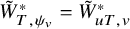 (consider Remark 2.3.2).
For any
$a \in \operatorname {\mathrm {GL}}_m(F_v)$
 and
$k \in U(m)$
and
$k \in U(m)$
 , we have the “linear invariance” properties

The first expression follows from (2.3.9), and the second expression follows from the scalar weight property of
$\Phi ^{(n)}_v$
 . Given
$y \in \mathrm {Herm}_m(\mathbb {R})_{>0}$
. Given
$y \in \mathrm {Herm}_m(\mathbb {R})_{>0}$
 , we also set
$W^{\ast }_{T,\psi _v}(y,s)^{\circ }_n {:=}q \tilde {W}^{\ast }_{T,\psi _v}(a, s)^{\circ }_n$
, we also set
$W^{\ast }_{T,\psi _v}(y,s)^{\circ }_n {:=}q \tilde {W}^{\ast }_{T,\psi _v}(a, s)^{\circ }_n$
 for any
$a \in \operatorname {\mathrm {GL}}_m(F_v)$
for any
$a \in \operatorname {\mathrm {GL}}_m(F_v)$
 satisfying
$a {}^t \overline {a} = y$
satisfying
$a {}^t \overline {a} = y$
 (does not depend on the choice of a).Footnote
9
We use the shorthand
$W_{T,\psi _v}^{\ast }(s)^{\circ }_n {:=}q \tilde {W}^{\ast }_{T,\psi _v}(1,s)^{\circ }_n$
(does not depend on the choice of a).Footnote
9
We use the shorthand
$W_{T,\psi _v}^{\ast }(s)^{\circ }_n {:=}q \tilde {W}^{\ast }_{T,\psi _v}(1,s)^{\circ }_n$
 . We continue to use our usual convention of using the subscript “v” instead of “
$\psi _v$
. We continue to use our usual convention of using the subscript “v” instead of “
$\psi _v$
 ” if
$\psi _v$
” if
$\psi _v$
 is the standard character.
To simplify exposition, assume
$\psi _v(x) = e^{2 \pi i u x}$
 with
$u> 0$
with
$u> 0$
 for the moment. For all
$n \in \mathbb {Z}$
for the moment. For all
$n \in \mathbb {Z}$
 , we have the functional equation

The case when T is positive definite follows from [Reference ShimuraShi82, Theorem 3.1] (via (2.2.13), see also [Reference Garcia and SankaranGS19, (3.54)]). The case of general T (still with
$\det T \neq 0$
 ) should follow from [Reference ShimuraShi82, Theorem 4.2, (4.34.K)], though we will give an alternative proof (Lemma 5.2.1). Here
$\eta _v$
) should follow from [Reference ShimuraShi82, Theorem 4.2, (4.34.K)], though we will give an alternative proof (Lemma 5.2.1). Here
$\eta _v$
 is the sign character
$\operatorname {sgn}(-)$
is the sign character
$\operatorname {sgn}(-)$
 .
.
Write
$(r_1,r_2)$
 for the signature of T (temporary notation). If either
$n \geq r_1$
for the signature of T (temporary notation). If either
$n \geq r_1$
 or
$r_2 = 0$
or
$r_2 = 0$
 , then the function
$W_{T,\psi _v}^{\ast }(h,s)^{\circ }_n$
, then the function
$W_{T,\psi _v}^{\ast }(h,s)^{\circ }_n$
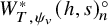 is holomorphic for all
$s \in \mathbb {C}$
is holomorphic for all
$s \in \mathbb {C}$
 , for fixed h (follows from [Reference ShimuraShi82, Theorem 4.2, (4.34.K)]). For any
$a \in \operatorname {\mathrm {GL}}_m(F_v)$
, for fixed h (follows from [Reference ShimuraShi82, Theorem 4.2, (4.34.K)]). For any
$a \in \operatorname {\mathrm {GL}}_m(F_v)$
 , we also have

For the case when T is positive definite, see [Reference ShimuraShi97, (3.15)] (also the proof of [Reference Garcia and SankaranGS19, Proposition 3.2]). The case of T not positive definite with
$m \leq n$
 follows from [Reference ShimuraShi82, Theorem 4.2, (4.34.K)] (see also [Reference Garcia and SankaranGS19, Proposition 3.3(i)]).
For the general case of
$\psi _v(x) = e^{2 \pi i u x}$
 with possibly
$u < 0$
with possibly
$u < 0$
 , the formula in (4.2.5) remains valid if “
$\eta _v(\det T)$
, the formula in (4.2.5) remains valid if “
$\eta _v(\det T)$
 ” is replaced with “
$\eta _v(\det uT)$
” is replaced with “
$\eta _v(\det uT)$
 ”, and (4.2.6) remains valid if both instances of “T” on the right are replaced by “
$uT$
”, and (4.2.6) remains valid if both instances of “T” on the right are replaced by “
$uT$
 ”.
”.
4.3 Normalized non-Archimedean Whittaker functions
With n,
$\chi _v$
 ,
$\psi _v$
,
$\psi _v$
 ,
$\eta _v$
,
$\eta _v$
 , etc. as at the beginning of Section 4, assume
$F^+_v$
, etc. as at the beginning of Section 4, assume
$F^+_v$
 is non-Archimedean. For the moment, we only assume
$F^+_v$
is non-Archimedean. For the moment, we only assume
$F^+_v$
 has characteristic
$\neq 2$
has characteristic
$\neq 2$
 , and allow both
$\chi _v$
, and allow both
$\chi _v$
 and
$\psi _v$
and
$\psi _v$
 to be possibly ramified. We can also allow
$F_v/F^+_v$
to be possibly ramified. We can also allow
$F_v/F^+_v$
 to be ramified with
$F^+_v$
to be ramified with
$F^+_v$
 of residue characteristic
$2$
of residue characteristic
$2$
 in Section 4.3. The symbol h will denote an element of
$U(m,m)(F^+_v)$
in Section 4.3. The symbol h will denote an element of
$U(m,m)(F^+_v)$
 .
.
Let
$\varpi _0$
 be any uniformizer of
$F^+_v$
be any uniformizer of
$F^+_v$
 , and let
$q_v$
, and let
$q_v$
 be the residue cardinality of
$F^+_v$
be the residue cardinality of
$F^+_v$
 . Consider
$T \in \mathrm {Herm}_m(F^+_v)$
. Consider
$T \in \mathrm {Herm}_m(F^+_v)$
 with
$\det T \neq 0$
with
$\det T \neq 0$
 . We define the local normalizing factor

where
$c(\psi _v)$
 is the conductor of
$\psi _v$
is the conductor of
$\psi _v$
 , as in (3.1.4). The local L-factors appearing in
$\Lambda _{T,\psi _v}(s)^{\circ }_n$
, as in (3.1.4). The local L-factors appearing in
$\Lambda _{T,\psi _v}(s)^{\circ }_n$
 should be compared with, for example, [Reference Harris, Kudla and SweetHKS96, §6]. If
$\psi _v$
should be compared with, for example, [Reference Harris, Kudla and SweetHKS96, §6]. If
$\psi _v$
 is any unramified nontrivial additive character (i.e.,
$c(\psi _v) = 0$
is any unramified nontrivial additive character (i.e.,
$c(\psi _v) = 0$
 ), we write
$\Lambda _{T,v}(s)^{\circ }_n {:=}q \Lambda _{T,\psi _v}(s)^{\circ }_n$
), we write
$\Lambda _{T,v}(s)^{\circ }_n {:=}q \Lambda _{T,\psi _v}(s)^{\circ }_n$
 . For general
$\psi ^{\prime }_v(x) = \psi _v(u x)$
. For general
$\psi ^{\prime }_v(x) = \psi _v(u x)$
 for some unramified
$\psi _v$
for some unramified
$\psi _v$
 and
$u \in F^{+ \times }_v$
and
$u \in F^{+ \times }_v$
 , we have
$\Lambda _{T,\psi ^{\prime }_v}(s)^{\circ }_n = |u|_{F^+_v}^{-m^2 / 2}\Lambda _{u T,v}(s)^{\circ }_n$
, we have
$\Lambda _{T,\psi ^{\prime }_v}(s)^{\circ }_n = |u|_{F^+_v}^{-m^2 / 2}\Lambda _{u T,v}(s)^{\circ }_n$
 .
.
Suppose
$n \geq 0$
 , and suppose
$V_v$
, and suppose
$V_v$
 is an n-dimensional non-degenerate
$F_v / F^+_v$
is an n-dimensional non-degenerate
$F_v / F^+_v$
 Hermitian space. Consider a full-rank lattice
$L_v \subseteq V_v$
Hermitian space. Consider a full-rank lattice
$L_v \subseteq V_v$
 , and take the Schwartz function
$\varphi _v = {\pmb {1}}_{L_v}^m \in \mathcal {S}(V_v^m)$
, and take the Schwartz function
$\varphi _v = {\pmb {1}}_{L_v}^m \in \mathcal {S}(V_v^m)$
 . Form the associated Siegel–Weil standard section
$\Phi _{\varphi _v} \in I(\chi _v, s)$
. Form the associated Siegel–Weil standard section
$\Phi _{\varphi _v} \in I(\chi _v, s)$
 , which could depend on
$\psi _v$
, which could depend on
$\psi _v$
 . Let S be the Gram matrix of any basis for
$L_v$
. Let S be the Gram matrix of any basis for
$L_v$
 .
.
We consider the normalized local Whittaker function
$W^{\ast }_{T,\psi _v}$
 and the variant
$\tilde {W}^{\ast }_{T,\psi _v}$
and the variant
$\tilde {W}^{\ast }_{T,\psi _v}$


for
$a \in \operatorname {\mathrm {GL}}_m(F_v)$
 . The volume
$\mathrm {vol}(L_v)$
. The volume
$\mathrm {vol}(L_v)$
 is taken with respect to the self-dual Haar measure with respect to the pairing
$x,y \mapsto \psi _v(\mathrm {tr}(x,y))$
is taken with respect to the self-dual Haar measure with respect to the pairing
$x,y \mapsto \psi _v(\mathrm {tr}(x,y))$
 on
$V_v$
on
$V_v$
 (compare Lemma 4.4.2). The variant
$\tilde {W}^{\ast }_{T,\psi _v}$
(compare Lemma 4.4.2). The variant
$\tilde {W}^{\ast }_{T,\psi _v}$
 is a local analogue of (2.2.19). These will depend on n in general. For any
$a \in \operatorname {\mathrm {GL}}_m(F_v)$
is a local analogue of (2.2.19). These will depend on n in general. For any
$a \in \operatorname {\mathrm {GL}}_m(F_v)$
 and
$k \in \operatorname {\mathrm {GL}}_m(\mathcal {O}_{F^+_v})$
and
$k \in \operatorname {\mathrm {GL}}_m(\mathcal {O}_{F^+_v})$
 , we have the “linear invariance” property

The left expression follows from (2.3.9). The right expression follows as
$\chi _v(k)^{-1} \omega _v(m(k)) \varphi _v = \varphi _v$
 holds for all
$k \in \operatorname {\mathrm {GL}}_m(\mathcal {O}_{F^+_v})$
holds for all
$k \in \operatorname {\mathrm {GL}}_m(\mathcal {O}_{F^+_v})$
 , where
$\omega _v$
, where
$\omega _v$
 is the local Weil representation (Section 3.2). If
$\psi ^{\prime }_v$
is the local Weil representation (Section 3.2). If
$\psi ^{\prime }_v$
 is another additive character satisfying
$\psi ^{\prime }_v(x) = \psi (u x)$
is another additive character satisfying
$\psi ^{\prime }_v(x) = \psi (u x)$
 for some
$u \in F^{+ \times }_v$
for some
$u \in F^{+ \times }_v$
 , if
$V^{\prime }_v$
, if
$V^{\prime }_v$
 is the Hermitian space obtained from
$V_v$
is the Hermitian space obtained from
$V_v$
 after rescaling by
$u^{-1}$
after rescaling by
$u^{-1}$
 (Remark 3.2.1), and if
$\varphi ^{\prime }_v \in \mathcal {S}(V_v^{\prime m})$
(Remark 3.2.1), and if
$\varphi ^{\prime }_v \in \mathcal {S}(V_v^{\prime m})$
 is identified with
$\varphi _v$
is identified with
$\varphi _v$
 using the canonical isomorphism
$V_v \cong V^{\prime }_v$
using the canonical isomorphism
$V_v \cong V^{\prime }_v$
 (generally not preserving Hermitian pairings), then we have
$W^{\ast }_{uT, \psi _v}(h, s, \Phi _{\varphi _v})_n = W^{\ast }_{T, \psi ^{\prime }_v}(h, s, \Phi _{\varphi ^{\prime }_v})_n$
(generally not preserving Hermitian pairings), then we have
$W^{\ast }_{uT, \psi _v}(h, s, \Phi _{\varphi _v})_n = W^{\ast }_{T, \psi ^{\prime }_v}(h, s, \Phi _{\varphi ^{\prime }_v})_n$
 and
$\tilde {W}^{\ast }_{uT, \psi _v}(h, s, \Phi _{\varphi _v})_n = \tilde {W}^{\ast }_{T, \psi ^{\prime }_v}(h, s, \Phi _{\varphi ^{\prime }_v})_n$
and
$\tilde {W}^{\ast }_{uT, \psi _v}(h, s, \Phi _{\varphi _v})_n = \tilde {W}^{\ast }_{T, \psi ^{\prime }_v}(h, s, \Phi _{\varphi ^{\prime }_v})_n$
 (consider Remark 2.3.2).
Drop the assumption
$n \geq 0$
 , assume
$\chi _v$
, assume
$\chi _v$
 is unramified, and recall the normalized spherical standard section
$\Phi ^{\circ }_v \in I(\chi _v, s)$
is unramified, and recall the normalized spherical standard section
$\Phi ^{\circ }_v \in I(\chi _v, s)$
 . We set

for
$h \in H(F^+_v)$
 and
$a \in \operatorname {\mathrm {GL}}_m(F_v)$
and
$a \in \operatorname {\mathrm {GL}}_m(F_v)$
 . If
$\psi ^{\prime }_v$
. If
$\psi ^{\prime }_v$
 is another additive character satisfying
$\psi ^{\prime }_v(x) = \psi (u x)$
is another additive character satisfying
$\psi ^{\prime }_v(x) = \psi (u x)$
 for some
$u \in F^{+ \times }_v$
for some
$u \in F^{+ \times }_v$
 , then we have
$W^{\ast }_{uT, \psi _v}(h,s)^{\circ }_n = W^{\ast }_{T,\psi ^{\prime }_v}(h,s)^{\circ }_n$
, then we have
$W^{\ast }_{uT, \psi _v}(h,s)^{\circ }_n = W^{\ast }_{T,\psi ^{\prime }_v}(h,s)^{\circ }_n$
 and
$\tilde {W}^{\ast }_{uT, \psi _v}(a, s)^{\circ }_n = \tilde {W}^{\ast }_{T, \psi ^{\prime }_v}(a, s)^{\circ }_n$
and
$\tilde {W}^{\ast }_{uT, \psi _v}(a, s)^{\circ }_n = \tilde {W}^{\ast }_{T, \psi ^{\prime }_v}(a, s)^{\circ }_n$
 (again consider Remark 2.3.2).
The alternative normalization

will also be useful. We use the shorthand
$W^{\ast }_{T,\psi _v}(s)^{\circ }_n {:=}q W^{\ast }_{T,\psi _v}(1,s)^{\circ }_n$
 and
$W^{(\ast )}_{T,\psi _v}(s)^{\circ }_n {:=}q W^{(\ast )}_{T,\psi _v}(1,s)^{\circ }_n$
and
$W^{(\ast )}_{T,\psi _v}(s)^{\circ }_n {:=}q W^{(\ast )}_{T,\psi _v}(1,s)^{\circ }_n$
 . We continue to use our usual convention of using the subscript “v” instead of “
$\psi _v$
. We continue to use our usual convention of using the subscript “v” instead of “
$\psi _v$
 ” if
$\psi _v$
” if
$\psi _v$
 is an understood unramified character, suppressed from notation.
Now assume
$\psi _v$
 is unramified and
$n \geq 0$
is unramified and
$n \geq 0$
 . If
$L_v$
. If
$L_v$
 is self-dual, we have
$\Phi _{\varphi _v} = \Phi ^{\circ }_v$
is self-dual, we have
$\Phi _{\varphi _v} = \Phi ^{\circ }_v$
 (Section 3.2), at least outside the case of
$F_v / F^+_v$
(Section 3.2), at least outside the case of
$F_v / F^+_v$
 ramified with residue characteristic
$2$
ramified with residue characteristic
$2$
 . If
$F_v / F^+_v$
. If
$F_v / F^+_v$
 is ramified of residue characteristic
$2$
is ramified of residue characteristic
$2$
 , this still holds if
$L_v = (M_2^{\circ })^{\oplus d}$
, this still holds if
$L_v = (M_2^{\circ })^{\oplus d}$
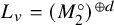 for some
$d \geq 0$
for some
$d \geq 0$
 (with
$M_2^{\circ }$
(with
$M_2^{\circ }$
 the “standard” self-dual lattice from (3.2.2)). Note that
$\gamma _{\psi _v}(V_v) = 1$
the “standard” self-dual lattice from (3.2.2)). Note that
$\gamma _{\psi _v}(V_v) = 1$
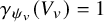 in these cases. In these situations, we have

for
$h \in H(F^+_v)$
 and
$a \in \operatorname {\mathrm {GL}}_m(F_v)$
and
$a \in \operatorname {\mathrm {GL}}_m(F_v)$
 .
.
We further describe these functions in the following sections (e.g., special values and functional equations). We are mostly interested in the spherical local Whittaker function
$W^{\ast }_{T,\psi _v}(h, s)^{\circ }_n$
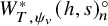 , and the case of general
$\varphi _v$
, and the case of general
$\varphi _v$
 plays a very limited role in the present work.
4.4 Local densities
We relate non-Archimedean Whittaker functions with local densities. This should be essentially known, but we restate the result for clarity (Lemma 4.4.2).Footnote
10
In Section 4.4, we do not need to assume
$\chi _v$
 is unramified (but still require
$\chi _v|_{F^{+ \times }_v} = \eta _v^n$
is unramified (but still require
$\chi _v|_{F^{+ \times }_v} = \eta _v^n$
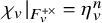 ). We do, however, assume that
$\psi _v$
). We do, however, assume that
$\psi _v$
 is unramified.
Retain notation and assumptions from Section 4.3. In Section 4.4, we now require
$F^+_v$
 to have characteristic
$0$
to have characteristic
$0$
 , exclude the case where
$F_v/F^+_v$
, exclude the case where
$F_v/F^+_v$
 is ramified with
$F^+_v$
is ramified with
$F^+_v$
 of residue characteristic
$2$
of residue characteristic
$2$
 , and take
$n \geq 0$
, and take
$n \geq 0$
 . We write

Given nonsingular Hermitian matrices
$S \in \mathrm {Herm}_n(F^+_v)$
 and
$T \in \mathrm {Herm}_m(F^+_v)$
and
$T \in \mathrm {Herm}_m(F^+_v)$
 , we consider the local representation density (or just local density)

where
$M_{n,m}(\mathcal {O}_{F_v})$
 is given the Haar measure of total volume
$1$
is given the Haar measure of total volume
$1$
 . The limit argument stabilizes for
$k \gg 0$
. The limit argument stabilizes for
$k \gg 0$
 (follows from the proof of Lemma 4.4.2).Footnote
11
The local density
$\mathrm {Den}(S,T)$
(follows from the proof of Lemma 4.4.2).Footnote
11
The local density
$\mathrm {Den}(S,T)$
 depends only on the isomorphism classes of the Hermitian lattices defined by S and T. If
$n < m$
depends only on the isomorphism classes of the Hermitian lattices defined by S and T. If
$n < m$
 , then
$\mathrm {Den}(S,T) = 0$
, then
$\mathrm {Den}(S,T) = 0$
 .
.
If
$S \in \mathrm {Herm}_n(\mathcal {O}_{F^+_v})^{\ast }$
 , we have

If
$S \in \mathrm {Herm}_n(\mathcal {O}_{F^+_v})^{\ast }$
 and
$T \not \in \mathrm {Herm}_m(\mathcal {O}_{F^+_v})^{\ast }$
and
$T \not \in \mathrm {Herm}_m(\mathcal {O}_{F^+_v})^{\ast }$
 , we have
$\mathrm {Den}(S,T) = 0$
, we have
$\mathrm {Den}(S,T) = 0$
 .
.
Remark 4.4.1. If
$S \in \mathrm {Herm}_n(\mathcal {O}_{F^+_v})^{\ast }$
 and
$T \in \mathrm {Herm}_m(\mathcal {O}_{F^+_v})^{*}$
and
$T \in \mathrm {Herm}_m(\mathcal {O}_{F^+_v})^{*}$
 with
$m \leq n$
with
$m \leq n$
 , the local density
$\mathrm {Den}(S,T)$
, the local density
$\mathrm {Den}(S,T)$
 admits the following equivalent formulation. Suppose M (resp. L) is a Hermitian
$\mathcal {O}_{F_v}$
admits the following equivalent formulation. Suppose M (resp. L) is a Hermitian
$\mathcal {O}_{F_v}$
 -lattice which admits a basis with Gram matrix S (resp. T). Write
$\mathfrak {d}$
-lattice which admits a basis with Gram matrix S (resp. T). Write
$\mathfrak {d}$
 for any trace-zero generator of the different ideal
$\mathfrak {d}$
for any trace-zero generator of the different ideal
$\mathfrak {d}$
 of
$F_v/F^+_v$
of
$F_v/F^+_v$
 , and let
$M'$
, and let
$M'$
 (resp.
$L'$
(resp.
$L'$
 ) be the skew-Hermitian lattice with pairing
$\mathfrak {d} S$
) be the skew-Hermitian lattice with pairing
$\mathfrak {d} S$
 (resp.
$\mathfrak {d} T$
(resp.
$\mathfrak {d} T$
 ). If
$\mathrm {Herm}(M', L')$
). If
$\mathrm {Herm}(M', L')$
 is the scheme of skew-Hermitian module homomorphisms given by

for
$\mathcal {O}_{F^+_v}$
 -algebras R (where the right-hand side means
$\mathcal {O}_{F_v}$
-algebras R (where the right-hand side means
$\mathcal {O}_{F_v}$
 -linear homomorphisms preserving the skew-Hermitian pairing), we have

and also
$m (2n - m) = \dim (\mathrm {Herm}(M',L') \times \operatorname {\mathrm {Spec}} F^+_v)$
 (and the right-hand side is nonempty). This recovers the formulations in [Reference Li and ZhangLZ22, §3.1] (inert), [Reference Feng, Yun and ZhangFYZ24, §2.3] (inert and split), and [Reference He, Li, Shi and YangHLSY23, §5.1] (ramified).
Return to the situation of general nonsingular S and T (and possibly
$m> n$
 ). Fix characters
$\chi _v \colon F_v^{\times } \rightarrow \mathbb {C}^\times $
). Fix characters
$\chi _v \colon F_v^{\times } \rightarrow \mathbb {C}^\times $
 and
$\psi _v \colon F^+_v \rightarrow \mathbb {C}^{\times }$
and
$\psi _v \colon F^+_v \rightarrow \mathbb {C}^{\times }$
 as above (with
$\psi _v$
as above (with
$\psi _v$
 unramified). Let M be a Hermitian
$\mathcal {O}_{F_v}$
unramified). Let M be a Hermitian
$\mathcal {O}_{F_v}$
 -lattice admitting a basis whose Gram matrix is S. Write
$V_v = M \otimes _{\mathcal {O}_{F_v}} F_v$
-lattice admitting a basis whose Gram matrix is S. Write
$V_v = M \otimes _{\mathcal {O}_{F_v}} F_v$
 for the associated
$F_v/F^+_v$
for the associated
$F_v/F^+_v$
 Hermitian space, and let
$\varphi _v \in \mathcal {S}(V_v^m)$
Hermitian space, and let
$\varphi _v \in \mathcal {S}(V_v^m)$
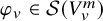 be the function
$\varphi _v = {\pmb {1}}_{M}^{m}$
be the function
$\varphi _v = {\pmb {1}}_{M}^{m}$
 , where
${\pmb {1}}_{M}$
, where
${\pmb {1}}_{M}$
 is the characteristic function of M. Let
$\Phi _{\varphi _v} \in I(s, \chi _v)$
is the characteristic function of M. Let
$\Phi _{\varphi _v} \in I(s, \chi _v)$
 be the associated Siegel–Weil section, and form the local Whittaker function
$W_{T,v}(h, s, \Phi _{\varphi _v})$
be the associated Siegel–Weil section, and form the local Whittaker function
$W_{T,v}(h, s, \Phi _{\varphi _v})$
 as in Section 2.3. Set
$W_{T,v}(s, \Phi _{\varphi _v}) {:=}q W_{T,v}(1, s, \Phi _{\varphi _v})$
as in Section 2.3. Set
$W_{T,v}(s, \Phi _{\varphi _v}) {:=}q W_{T,v}(1, s, \Phi _{\varphi _v})$
 .
.
With
$M^{\circ }_2$
 being the rank
$2$
being the rank
$2$
 self-dual Hermitian lattice from (3.2.2), let
$S_{r,r}$
self-dual Hermitian lattice from (3.2.2), let
$S_{r,r}$
 be the Gram matrix of a basis for
$L_{v,r,r} {:=}q M \oplus (M^{\circ }_2)^{\oplus r}$
be the Gram matrix of a basis for
$L_{v,r,r} {:=}q M \oplus (M^{\circ }_2)^{\oplus r}$
 (orthogonal direct sum). When
$F_v/F^+_v$
(orthogonal direct sum). When
$F_v/F^+_v$
 is not ramified, we also let
$S_r$
is not ramified, we also let
$S_r$
 be the Gram matrix of a basis for
$L_{v,r} {:=}q M \oplus \langle 1 \rangle ^{\oplus r}$
be the Gram matrix of a basis for
$L_{v,r} {:=}q M \oplus \langle 1 \rangle ^{\oplus r}$
 (orthogonal direct sum), where
$\langle 1 \rangle $
(orthogonal direct sum), where
$\langle 1 \rangle $
 is a rank one self-dual lattice. The notations
$L_{v,r,r}$
is a rank one self-dual lattice. The notations
$L_{v,r,r}$
 and
$L_{v,r}$
and
$L_{v,r}$
 will only be used in the proof of the next lemma.
Lemma 4.4.2. With notation as above, there exists
$\mathrm {Den}(S,T,X) \in \mathbb {Q}[X]$
 (necessarily unique) such that


where
$\gamma _{\psi _v}(V_v)$
 is the Weil index,
$s_0 = (n - m)/2$
is the Weil index,
$s_0 = (n - m)/2$
 , and
$e = nm/2 + m(m-1)/4$
, and
$e = nm/2 + m(m-1)/4$
 . For all
$r \in \mathbb {Z}_{\geq 0}$
. For all
$r \in \mathbb {Z}_{\geq 0}$
 , we also have


Proof. As mentioned above (Footnote 4.4), this is a restatement of a result which should be essentially known [Reference Kudla and RapoportKR14, Proposition 10.1] [Reference ShiShi22, Proposition 9.7], up to a few modifications. The modified version stated here may be proved by a similar interpolation argument, as explained below. For any
$r \in \mathbb {Z}_{\geq 0}$
 , set
$V_{v,r,r} {:=}q L_{v,r,r} \otimes _{\mathcal {O}_{F_v}} F_v$
, set
$V_{v,r,r} {:=}q L_{v,r,r} \otimes _{\mathcal {O}_{F_v}} F_v$
 , and let
$\varphi _{v,r,r} = {\pmb {1}}_{L_{v,r,r}}^m$
, and let
$\varphi _{v,r,r} = {\pmb {1}}_{L_{v,r,r}}^m$
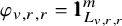 . Equip
$\mathrm {Herm}_m(\mathcal {O}_{F^+_v})$
. Equip
$\mathrm {Herm}_m(\mathcal {O}_{F^+_v})$
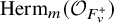 and
$V_{v,r,r}$
and
$V_{v,r,r}$
 with the self-dual Haar measures with respect to
$(b,c) \mapsto \psi _v(\mathrm {tr}(bc))$
with the self-dual Haar measures with respect to
$(b,c) \mapsto \psi _v(\mathrm {tr}(bc))$
 and
$\psi _v(\mathrm {tr}_{F_v / F^+_v}(\mathrm {tr}(-,-)))$
and
$\psi _v(\mathrm {tr}_{F_v / F^+_v}(\mathrm {tr}(-,-)))$
 respectively. Using the Weil representation, we compute

We have the volume identities

with respect to the self-dual Haar measures described above. We already know
$W_{T,v}(s, \Phi _{\varphi _v}) \in \mathbb {C}[q_v^{-2s}]$
 by Lemma 2.3.1. Since
$\mathrm {Den}(S_{r,r},T) \in \mathbb {Q}$
by Lemma 2.3.1. Since
$\mathrm {Den}(S_{r,r},T) \in \mathbb {Q}$
 for all
$r \geq 0$
for all
$r \geq 0$
 , we conclude
$W_{T,v}(s, \Phi _{\varphi _v}) \in \mathbb {Q}[q_v^{-2s}]$
, we conclude
$W_{T,v}(s, \Phi _{\varphi _v}) \in \mathbb {Q}[q_v^{-2s}]$
 . The additional claims involving
$\mathrm {Den}(S_r,T)$
. The additional claims involving
$\mathrm {Den}(S_r,T)$
 in the unramified case may be proved similarly, using
$L_{v,r}$
in the unramified case may be proved similarly, using
$L_{v,r}$
 instead of
$L_{v,r,r}$
instead of
$L_{v,r,r}$
 .
.
4.5 Local densities and spherical non-Archimedean Whittaker functions
Take
$F_v/F^+_v$
 ,
$\psi _v$
,
$\psi _v$
 , and
$\chi _v$
, and
$\chi _v$
 as in Section 4.4, and continue to assume
$n \geq 0$
as in Section 4.4, and continue to assume
$n \geq 0$
 for the moment. Set
$s_0 = (n - m) / 2$
for the moment. Set
$s_0 = (n - m) / 2$
 . We assume
$\chi _v$
. We assume
$\chi _v$
 is unramified (the character
$\psi _v$
is unramified (the character
$\psi _v$
 was already assumed unramified).
Let
$M^{\circ }$
 be a self-dual Hermitian
$\mathcal {O}_{F_v}$
be a self-dual Hermitian
$\mathcal {O}_{F_v}$
 -lattice of rank n. This characterizes
$M^{\circ }$
-lattice of rank n. This characterizes
$M^{\circ }$
 uniquely up to isomorphism, and forces n to be even if
$F_v / F^+_v$
uniquely up to isomorphism, and forces n to be even if
$F_v / F^+_v$
 is ramified. If
$F_v / F^+_v$
is ramified. If
$F_v / F^+_v$
 is ramified, then
$M^{\circ }$
is ramified, then
$M^{\circ }$
 is isomorphic to an orthogonal direct sum of
$n / 2$
is isomorphic to an orthogonal direct sum of
$n / 2$
 copies of the rank
$2$
copies of the rank
$2$
 lattice from (3.2.2). We also have
$\gamma _{\psi _v}(V_v) = 1$
lattice from (3.2.2). We also have
$\gamma _{\psi _v}(V_v) = 1$
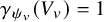 (Lemma 3.1.3).
Set
$V_v = M^{\circ } \otimes _{\mathcal {O}_{F_v}} F_v$
 , and let
$\varphi _v \in \mathcal {S}(V_v^m)$
, and let
$\varphi _v \in \mathcal {S}(V_v^m)$
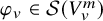 be the characteristic function of
$M^{\circ m}$
be the characteristic function of
$M^{\circ m}$
 . Then the associated Siegel–Weil section
$\Phi _{\varphi _v} \in I(s, \chi _v)$
. Then the associated Siegel–Weil section
$\Phi _{\varphi _v} \in I(s, \chi _v)$
 coincides with the normalized spherical standard section
$\Phi _v^{\circ }$
coincides with the normalized spherical standard section
$\Phi _v^{\circ }$
 (Lemma 3.2.2).
Remark 4.5.1. Even if
$\chi _v$
 is possibly ramified, we still have
$W_{T,v}(s, \Phi _{\varphi _v}) = W_{T,v}(s, \Phi ^{\circ }_v)$
is possibly ramified, we still have
$W_{T,v}(s, \Phi _{\varphi _v}) = W_{T,v}(s, \Phi ^{\circ }_v)$
 for any
$T \in \mathrm {Herm}_m(F^+_v)$
for any
$T \in \mathrm {Herm}_m(F^+_v)$
 with
$\det T \neq 0$
with
$\det T \neq 0$
 (by Lemma 2.3.1(3) or Lemma 4.4.2), where
$\Phi ^{\circ }_v \in I(s, \chi ^{\prime }_v)$
(by Lemma 2.3.1(3) or Lemma 4.4.2), where
$\Phi ^{\circ }_v \in I(s, \chi ^{\prime }_v)$
 is the standard normalized spherical section for an unramified
$\chi ^{\prime }_v$
is the standard normalized spherical section for an unramified
$\chi ^{\prime }_v$
 .
.
Suppose
$T \in \mathrm {Herm}_m(F^+_v)$
 with
$\det T \neq 0$
with
$\det T \neq 0$
 . If S is the Gram matrix of any basis for
$M^{\circ }$
. If S is the Gram matrix of any basis for
$M^{\circ }$
 , Lemma 4.4.2 gives

for all
$s \in \mathbb {C}$
 . Here, we are also using the equality
$|\det S|_{F^+_v} = |\Delta |_{F^+_v}^{- n / 2}$
. Here, we are also using the equality
$|\det S|_{F^+_v} = |\Delta |_{F^+_v}^{- n / 2}$
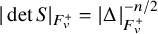 . Applying Lemma 2.3.1(2)(ii) shows that
$\mathrm {Den}(S,T,X) \in \mathbb {Z}[1/q_v][X]$
. Applying Lemma 2.3.1(2)(ii) shows that
$\mathrm {Den}(S,T,X) \in \mathbb {Z}[1/q_v][X]$
 . Note that the right-hand side of (4.5.1) manifestly has no dependence on
$\chi _v$
. Note that the right-hand side of (4.5.1) manifestly has no dependence on
$\chi _v$
 or
$\psi _v$
or
$\psi _v$
 (our convention at the moment is that
$\psi _v$
(our convention at the moment is that
$\psi _v$
 is unramified).
Suppose
$M^{\circ \prime }$
 is a rank m Hermitian
$\mathcal {O}_{F_v}$
is a rank m Hermitian
$\mathcal {O}_{F_v}$
 -lattice such that

Let
$S' \in \mathrm {Herm}(F^+_v)$
 be the Gram matrix of a basis for
$M^{\circ \prime }$
be the Gram matrix of a basis for
$M^{\circ \prime }$
 . We have

See [Reference Li and ZhangLZ22, (3.2.0.1)] (inert), [Reference Feng, Yun and ZhangFYZ24, Theorem 2.2] (split and inert), [Reference Li and LiuLL22, Lemma 2.15] (ramified).
We normalize
$\mathrm {Den}(S,T,X)$
 and define a (normalized) local density polynomial
$\mathrm {Den}(X,T)_n \in \mathbb {Z}[1/q_v][X]$
and define a (normalized) local density polynomial
$\mathrm {Den}(X,T)_n \in \mathbb {Z}[1/q_v][X]$
 , characterized by the equality

for all
$s \in \mathbb {C}$
 (with
$W^{(\ast )}_{T,v}$
(with
$W^{(\ast )}_{T,v}$
 as in Section 4.3). These local density polynomials have more explicit descriptions via “Cho–Yamauchi formulas” proved in [Reference Li and ZhangLZ22, Theorem 3.5.1] (inert), [Reference Feng, Yun and ZhangFYZ24, Theorem 2.2] (split and inert), and [Reference Li and LiuLL22, Lemma 2.15] (ramified). Note that our convention differs slightly from [Reference Li and LiuLL22] in the ramified case, where they consider polynomials in
$q_v^{-s}$
as in Section 4.3). These local density polynomials have more explicit descriptions via “Cho–Yamauchi formulas” proved in [Reference Li and ZhangLZ22, Theorem 3.5.1] (inert), [Reference Feng, Yun and ZhangFYZ24, Theorem 2.2] (split and inert), and [Reference Li and LiuLL22, Lemma 2.15] (ramified). Note that our convention differs slightly from [Reference Li and LiuLL22] in the ramified case, where they consider polynomials in
$q_v^{-s}$
 instead.
The polynomial
$\mathrm {Den}(X,T)_n$
 is nonzero if and only if
$T \in \mathrm {Herm}(\mathcal {O}_{F^+_v})^{\ast }$
is nonzero if and only if
$T \in \mathrm {Herm}(\mathcal {O}_{F^+_v})^{\ast }$
 , in which case
$\mathrm {Den}(X,T)_n$
, in which case
$\mathrm {Den}(X,T)_n$
 has constant term
$1$
has constant term
$1$
 . When
$m = n$
. When
$m = n$
 , we have
$\mathrm {Den}(X,T)_n \in \mathbb {Z}[X]$
, we have
$\mathrm {Den}(X,T)_n \in \mathbb {Z}[X]$
 for any T. More classically, see [Reference ShimuraShi97, Theorem 13.6], which implies that
$\mathrm {Den}(q_v^{n} X, T)_n \in \mathbb {Z}[X]$
for any T. More classically, see [Reference ShimuraShi97, Theorem 13.6], which implies that
$\mathrm {Den}(q_v^{n} X, T)_n \in \mathbb {Z}[X]$
 with constant term
$1$
with constant term
$1$
 .
.
We have

For
$n < 0$
 , we define
$\mathrm {Den}(X,T)_n$
, we define
$\mathrm {Den}(X,T)_n$
 using (4.5.5). Note that (4.5.4) continues to hold. For the rest of Section 4.5, we allow general
$n \in \mathbb {Z}$
using (4.5.5). Note that (4.5.4) continues to hold. For the rest of Section 4.5, we allow general
$n \in \mathbb {Z}$
 (assumed even if
$F_v/F^+_v$
(assumed even if
$F_v/F^+_v$
 is ramified).
Similarly, there is a (normalized) local density (Laurent) polynomial
$\mathrm {Den}^{\ast }(X,T)_n \in \mathbb {Z}[1/q_v][X, X^{-1/2}]$
 such that

for all
$s \in \mathbb {C}$
 (with
$W^{\ast }_{T,v}$
(with
$W^{\ast }_{T,v}$
 as in Section 4.3).
Remark 4.5.2. On the right-hand side of (4.5.6), we mean evaluating
$\mathrm {Den}^{\ast }(X,T)_n$
 at
$X^{1/2} = q_v^{-s}$
at
$X^{1/2} = q_v^{-s}$
 . We similarly abuse notation elsewhere. For example,
$\mathrm {Den}^{\ast }(q_v X, T)_n \in \mathbb {Z}[1 / q_v^{1/2}][X, X^{-1/2}]$
. We similarly abuse notation elsewhere. For example,
$\mathrm {Den}^{\ast }(q_v X, T)_n \in \mathbb {Z}[1 / q_v^{1/2}][X, X^{-1/2}]$
 is obtained from
$\mathrm {Den}^{\ast }(X, T)_n$
is obtained from
$\mathrm {Den}^{\ast }(X, T)_n$
 by replacing
$X^{1/2}$
by replacing
$X^{1/2}$
 with
$q_v^{1/2} X^{1/2}$
with
$q_v^{1/2} X^{1/2}$
 . The notation
$\frac {d}{d X} \colon \mathbb {Q}[X, X^{-1/2}] \rightarrow \mathbb {Q}[X, X^{-1/2}]$
. The notation
$\frac {d}{d X} \colon \mathbb {Q}[X, X^{-1/2}] \rightarrow \mathbb {Q}[X, X^{-1/2}]$
 means the
$\mathbb {Q}$
means the
$\mathbb {Q}$
 -linear map
$X^{j/2} \mapsto (j/2) X^{j/2 - 1}$
-linear map
$X^{j/2} \mapsto (j/2) X^{j/2 - 1}$
 .
.
If T defines a self-dual Hermitian lattice when m is even or
$F_v/F^+_v$
 is unramified (resp. almost self-dual Hermitian lattice when m is odd and
$F_v/F^+_v$
is unramified (resp. almost self-dual Hermitian lattice when m is odd and
$F_v/F^+_v$
 is ramified), we have

(follows from (4.5.3)). For such T, an application of Lemma 2.3.1(3) also shows that

if
$\Phi _v^{\circ } \in I(s, \chi ^{\prime }_v)$
 is the normalized spherical section for any unramified character
$\chi ^{\prime }_v \colon F_v^{\times } \rightarrow \mathbb {C}^{\times }$
is the normalized spherical section for any unramified character
$\chi ^{\prime }_v \colon F_v^{\times } \rightarrow \mathbb {C}^{\times }$
 (not assuming
$\chi ^{\prime }_v|_{F^{+ \times }_v} = \eta _v^n$
(not assuming
$\chi ^{\prime }_v|_{F^{+ \times }_v} = \eta _v^n$
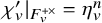 ).
).
If L is a
$\mathcal {O}_{F_v}$
 Hermitian lattice of rank m, and if L admits a basis with Gram matrix T (allowing arbitrary
$T \in \mathrm {Herm}_m(F^+_v)$
Hermitian lattice of rank m, and if L admits a basis with Gram matrix T (allowing arbitrary
$T \in \mathrm {Herm}_m(F^+_v)$
 with
$\det T \neq 0$
with
$\det T \neq 0$
 again), we write
$\mathrm {Den}(X,L)_n {:=}q \mathrm {Den}(X, T)_n$
again), we write
$\mathrm {Den}(X,L)_n {:=}q \mathrm {Den}(X, T)_n$
 and similarly
$\mathrm {Den}^{\ast }(X, L)_n {:=}q \mathrm {Den}^{\ast }(X, T)_n$
and similarly
$\mathrm {Den}^{\ast }(X, L)_n {:=}q \mathrm {Den}^{\ast }(X, T)_n$
 . We claim that we have


with
$\mathrm {val}(L)$
 as defined in [Reference ChenChe24a, Section 2.2].Footnote
12
Indeed, upon recalling (4.3.6) (and the definitions (4.5.4) and (4.5.6)), the formula in (4.5.9) follows from the computation that
$|(\det T) \Delta ^{\lfloor m / 2 \rfloor }|_{F^+_v} = q_v^{-\mathrm {val}'(L)}$
as defined in [Reference ChenChe24a, Section 2.2].Footnote
12
Indeed, upon recalling (4.3.6) (and the definitions (4.5.4) and (4.5.6)), the formula in (4.5.9) follows from the computation that
$|(\det T) \Delta ^{\lfloor m / 2 \rfloor }|_{F^+_v} = q_v^{-\mathrm {val}'(L)}$
 .
.
The local densities satisfy the following cancellation property (which we will use).
Lemma 4.5.3. If
$L^{\circ }$
 is a self-dual Hermitian lattice of rank d, then for any non-degenerate Hermitian lattice L and every integer
$r \in \mathbb {Z}$
is a self-dual Hermitian lattice of rank d, then for any non-degenerate Hermitian lattice L and every integer
$r \in \mathbb {Z}$
 (assume r is even if
$F_v/F^+_v$
(assume r is even if
$F_v/F^+_v$
 is ramified), we have

where
$L \oplus L^{\circ }$
 is the orthogonal direct sum.
Proof. This can be seen from the Cho–Yamauchi type formulas mentioned after (4.5.4), as we explain below.
First assume
$\operatorname {\mathrm {rank}}(L) = r$
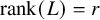 (if
$F_v / F^+_v$
(if
$F_v / F^+_v$
 is ramified, we will deal with the odd rank case separately). Then the cited Cho–Yamauchi formulas may be formulated in the following uniform way: we have


where
$\eta ^{\ast }(\varpi _0) {:=}q \eta ^{*i}(\varpi _0) {:=}q -1, 0, 1$
 if i is odd (resp.
$\eta ^{*i}(\varpi _0) {:=}q 1$
if i is odd (resp.
$\eta ^{*i}(\varpi _0) {:=}q 1$
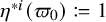 if i is even) in the inert, ramified, split cases respectively, and
$\mathrm {Den}(X,L)_r \in \mathbb {Z}[X]$
if i is even) in the inert, ramified, split cases respectively, and
$\mathrm {Den}(X,L)_r \in \mathbb {Z}[X]$
 is the local density polynomial normalized as in (4.5.4). The displayed sum runs over lattices
$M \subseteq L_{F_v} {:=}q L \otimes _{\mathcal {O}_{F_v}} F_v$
is the local density polynomial normalized as in (4.5.4). The displayed sum runs over lattices
$M \subseteq L_{F_v} {:=}q L \otimes _{\mathcal {O}_{F_v}} F_v$
 . The notations
$\ell (M / L)$
. The notations
$\ell (M / L)$
 and
$t(M)$
and
$t(M)$
 are as defined in [Reference ChenChe24a, Section 2.2]; for the reader’s convenience, we recall
$q^{\ell (M / L)} = |M/L|$
are as defined in [Reference ChenChe24a, Section 2.2]; for the reader’s convenience, we recall
$q^{\ell (M / L)} = |M/L|$
 (right-hand side means cardinality) and recall that
$t(M)$
(right-hand side means cardinality) and recall that
$t(M)$
 is the number of nonzero fundamental invariants of M (and depends only on
$M^{\ast } / M$
is the number of nonzero fundamental invariants of M (and depends only on
$M^{\ast } / M$
 ). The above formula (4.5.12) also appeared in [Reference ChenChe24a, Section 9], where it was used in a crucial way for our main local results.
In the case where
$F_v / F^+_v$
 is ramified and
$\operatorname {\mathrm {rank}}(L) = r - 1$
is ramified and
$\operatorname {\mathrm {rank}}(L) = r - 1$
 , a similar formula for
$\mathrm {Den}(X,L)_r$
, a similar formula for
$\mathrm {Den}(X,L)_r$
 is given in [Reference ChenChe24a, Section 9.2], upon taking
$L^{\flat }$
is given in [Reference ChenChe24a, Section 9.2], upon taking
$L^{\flat }$
 in loc. cit. to be our current L (the formula in loc. cit. is extracted from [Reference Li and LiuLL22, Lemma 2.15]). For our present purposes, we only need to know that the formula is also a sum over M satisfying
$L \subseteq M \subseteq M^{\ast }$
in loc. cit. to be our current L (the formula in loc. cit. is extracted from [Reference Li and LiuLL22, Lemma 2.15]). For our present purposes, we only need to know that the formula is also a sum over M satisfying
$L \subseteq M \subseteq M^{\ast }$
 as above, where the polynomials being summed depend only on
$t(M)$
as above, where the polynomials being summed depend only on
$t(M)$
 and
$\ell (M / L)$
and
$\ell (M / L)$
 .
.
In the case
$r = \operatorname {\mathrm {rank}}_{\mathcal {O}_{F_v}}(L)$
 , the left equality in (4.5.11) now follows from (4.5.12) (replacing L with
$L \oplus L^{\circ }$
, the left equality in (4.5.11) now follows from (4.5.12) (replacing L with
$L \oplus L^{\circ }$
 ) via the following linear algebra fact: every lattice
$M \subseteq (L \oplus L^{\circ }) \otimes _{\mathcal {O}_{F_v}} F_v$
) via the following linear algebra fact: every lattice
$M \subseteq (L \oplus L^{\circ }) \otimes _{\mathcal {O}_{F_v}} F_v$
 satisfying
$L^{\circ } \subseteq M \subseteq M^{\ast }$
satisfying
$L^{\circ } \subseteq M \subseteq M^{\ast }$
 admits an orthogonal direct sum decomposition
$M = L^{\circ } \oplus M'$
admits an orthogonal direct sum decomposition
$M = L^{\circ } \oplus M'$
 for some sublattice
$M'$
for some sublattice
$M'$
 . The case of
$r = \operatorname {\mathrm {rank}}_{\mathcal {O}_{F_v}}(L) + 1$
. The case of
$r = \operatorname {\mathrm {rank}}_{\mathcal {O}_{F_v}}(L) + 1$
 and
$F_v / F^+_v$
and
$F_v / F^+_v$
 ramified follows by similar reasoning. The case of general r now follows by shifting as in (4.5.5).
The right equality in (4.5.11) now follows, using (4.5.9) and the fact that
$\mathrm {val}(L \oplus L^{\circ }) = \mathrm {val}(L)$
 .
.
5 Local functional equations
Let
$F_v$
 be a degree
$2$
be a degree
$2$
 étale algebra over a local field
$F^+_v$
étale algebra over a local field
$F^+_v$
 of characteristic
$\neq 2$
of characteristic
$\neq 2$
 , with notation
$\mathfrak {d}$
, with notation
$\mathfrak {d}$
 ,
$\Delta $
,
$\Delta $
 ,
$\eta _v$
,
$\eta _v$
 , and
$a \mapsto \overline {a}$
, and
$a \mapsto \overline {a}$
 as above. If
$F^+_v$
as above. If
$F^+_v$
 is Archimedean, we also assume
$F_v / F^+_v$
is Archimedean, we also assume
$F_v / F^+_v$
 is
$\mathbb {C} / \mathbb {R}$
is
$\mathbb {C} / \mathbb {R}$
 . Fix an integer
$m \geq 0$
. Fix an integer
$m \geq 0$
 .
.
Consider a character
$\chi _v \colon F^{\times }_v \rightarrow \mathbb {C}^{\times }$
 and a nontrivial additive character
$\psi _v \colon F^+ \rightarrow \mathbb {C}^{\times }$
and a nontrivial additive character
$\psi _v \colon F^+ \rightarrow \mathbb {C}^{\times }$
 (for the moment, we do not require
$\chi _v|_{F^{+ \times }_v} = \eta _v^n$
(for the moment, we do not require
$\chi _v|_{F^{+ \times }_v} = \eta _v^n$
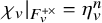 , and allow
$\chi _v$
, and allow
$\chi _v$
 and
$\psi _v$
and
$\psi _v$
 to be ramified).
Set
$\check {\chi }_v(a) {:=}q \chi _v(\overline {a})^{-1}$
 . There is a local intertwining operator

(where
$I(s, \chi _v)$
 and
$I(-s, \check {\chi }_v)$
and
$I(-s, \check {\chi }_v)$
 are degenerate local principal series for
$U(m,m)$
are degenerate local principal series for
$U(m,m)$
 ) defined by the integral

for
$\mathrm {Re}(s)> m/2$
 , with meromorphic continuation to
$\mathbb {C}$
, with meromorphic continuation to
$\mathbb {C}$
 (see, e.g., [Reference Kudla and SweetKS97] in the non-Archimedean case).
Given
$T \in \mathrm {Herm}_m(F^+_v)$
 , we define the quantity

where
$\gamma _{\psi _v}(F_v)$
 is a Weil index (Section 3.1, with conventions as explained before (3.1.3)) and
$\rho _v$
is a Weil index (Section 3.1, with conventions as explained before (3.1.3)) and
$\rho _v$
 is a local factor as in Tate’s thesis (Section 4.1). This factor is taken from [Reference Kudla and SweetKS97, §3]Footnote
13
(see also [Reference Harris, Kudla and SweetHKS96, Proposition 6.3]).
is a local factor as in Tate’s thesis (Section 4.1). This factor is taken from [Reference Kudla and SweetKS97, §3]Footnote
13
(see also [Reference Harris, Kudla and SweetHKS96, Proposition 6.3]).
5.1 Non-Archimedean
Suppose
$F^+_v$
 is non-Archimedean (with notation as above). For any
$T \in \mathrm {Herm}_m(F^+_v)$
is non-Archimedean (with notation as above). For any
$T \in \mathrm {Herm}_m(F^+_v)$
 with
$\det T \neq 0$
with
$\det T \neq 0$
 and any standard section
$\Phi _v$
and any standard section
$\Phi _v$
 of
$I(s, \chi _v)$
of
$I(s, \chi _v)$
 , there is a functional equation

as in [Reference Kudla and SweetKS97, §3, §7].
We next consider spherical Whittaker functions. Assume
$\chi _v$
 is unramified. We require
$F^+_v$
is unramified. We require
$F^+_v$
 to be characteristic
$0$
to be characteristic
$0$
 (because [Reference ShimuraShi97, §13] assumes this). With
$\Phi ^{\circ }_v$
(because [Reference ShimuraShi97, §13] assumes this). With
$\Phi ^{\circ }_v$
 denoting the normalized spherical sections of
$I(s, \chi _v)$
denoting the normalized spherical sections of
$I(s, \chi _v)$
 and
$I(s, \check {\chi }_v)$
and
$I(s, \check {\chi }_v)$
 , we have

see [Reference ShimuraShi97, Theorem 13.6].Footnote 14
Now, we further restrict to the situation where
$\chi _v|_{F^{+ \times }_v} = \eta _v^n$
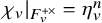 for some
$n \in \mathbb {Z}$
for some
$n \in \mathbb {Z}$
 , with n assumed even if
$F_v/F^+_v$
, with n assumed even if
$F_v/F^+_v$
 is ramified. Note
$\check {\chi }_v = \chi _v$
is ramified. Note
$\check {\chi }_v = \chi _v$
 . We also assume
$\psi _v$
. We also assume
$\psi _v$
 is unramified, to simplify exposition. Combining (5.1.2) with the identities stated above (including the relation between Weil indices and epsilon factors in (3.1.3)), a straightforward computation (omitted) yields the functional equations


with
$W^{(\ast )}_{T,v}(h,s)^{\circ }_n$
 and
$W^{\ast }_{T,v}(h,s)^{\circ }_n$
and
$W^{\ast }_{T,v}(h,s)^{\circ }_n$
 as in Section 4.3.
Remark 5.1.1. We also obtain functional equations in the case when
$\psi _v$
 is not necessarily unramified. Let
$\psi _v$
is not necessarily unramified. Let
$\psi _v$
 be an arbitrary nontrivial additive character, and pick any
$u \in F^{+ \times }_v$
be an arbitrary nontrivial additive character, and pick any
$u \in F^{+ \times }_v$
 with the property that
$x \mapsto \psi _v(u^{-1} x)$
with the property that
$x \mapsto \psi _v(u^{-1} x)$
 is unramified, that is,
$u \in \varpi _0^{c(\psi _v)} \mathcal {O}_{F^+_v}^{\times }$
is unramified, that is,
$u \in \varpi _0^{c(\psi _v)} \mathcal {O}_{F^+_v}^{\times }$
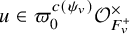 for
$\varpi _0$
for
$\varpi _0$
 a uniformizer of
$\mathcal {O}_{F^+_v}$
a uniformizer of
$\mathcal {O}_{F^+_v}$
 . Using the relation
$W^{\ast }_{T,\psi _v}(h,s)^{\circ }_n = W^{\ast }_{u T, v}(h,s)^{\circ }_n$
. Using the relation
$W^{\ast }_{T,\psi _v}(h,s)^{\circ }_n = W^{\ast }_{u T, v}(h,s)^{\circ }_n$
 (see Section 4.3), the functional equation in (5.1.4) immediately gives

Note that the sign
$\eta _v(\varpi _0)^{c(\psi _v) \cdot m(n - m - 1)}$
 always equals
$1$
always equals
$1$
 if n is even. In particular, the sign
$\eta _v(\varpi _0)^{c(\psi _v) \cdot m(n - m - 1)}$
if n is even. In particular, the sign
$\eta _v(\varpi _0)^{c(\psi _v) \cdot m(n - m - 1)}$
 does not depend on the choice of uniformizer
$\varpi _0$
does not depend on the choice of uniformizer
$\varpi _0$
 , because we are assuming n is even if
$F_v / F^+_v$
, because we are assuming n is even if
$F_v / F^+_v$
 is ramified.
Next, assume that
$F_v/F^+_v$
 is unramified or that
$F^+_v$
is unramified or that
$F^+_v$
 has residue characteristic
$\neq 2$
has residue characteristic
$\neq 2$
 . If L is a Hermitian
$\mathcal {O}_{F_v}$
. If L is a Hermitian
$\mathcal {O}_{F_v}$
 -lattice, we thus have


with
$\mathrm {val}'(L) {:=}q \lfloor \mathrm {val}(L) \rfloor $
 as in (4.5.10) (both
$\varepsilon (L)$
as in (4.5.10) (both
$\varepsilon (L)$
 and
$\mathrm {val}(L)$
and
$\mathrm {val}(L)$
 were defined in [Reference ChenChe24a, Section 2.2]).
In the case where
$\chi _v|_{F^{+\times }_v}$
 is trivial, these functional equations are essentially [Reference IkedaIke08, Corollary 3.2].
5.2 Archimedean
Suppose
$F_v / F^+_v$
 is
$\mathbb {C} / \mathbb {R}$
is
$\mathbb {C} / \mathbb {R}$
 (with notation as above). For any
$T \in \mathrm {Herm}_m(F^+_v)$
(with notation as above). For any
$T \in \mathrm {Herm}_m(F^+_v)$
 with
$\det T \neq 0$
with
$\det T \neq 0$
 and any standard section
$\Phi _v$
and any standard section
$\Phi _v$
 of
$I(s, \chi _v)$
of
$I(s, \chi _v)$
 , we have

This may be deduced, for example, by combining the non-Archimedean analogue (5.1.1) with the global functional equation (2.2.6).
In the rest of Section 5.2, we require
$\chi _v|_{F^{+ \times }_v} = \eta _v^n$
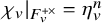 for some
$n \in \mathbb {Z}$
for some
$n \in \mathbb {Z}$
 , and let
$\psi _v(x) = e^{2\pi i x}$
, and let
$\psi _v(x) = e^{2\pi i x}$
 . Recall that we have defined a normalized Archimedean Whittaker function
$W^{\ast }_{T,v}(h,s)^{\circ }_n$
. Recall that we have defined a normalized Archimedean Whittaker function
$W^{\ast }_{T,v}(h,s)^{\circ }_n$
 (Section 4.2).
Lemma 5.2.1. For any
$T \in \mathrm {Herm}_m(F^+_v)$
 with
$\det T \neq 0$
with
$\det T \neq 0$
 , we have the functional equation

Proof. By (5.2.1), we must have
$W^{\ast }_{T,v}(h,-s)^{\circ }_n = \eta _v(\det T)^{n - m - 1} f(s) W^{\ast }_{T,v}(h,s)^{\circ }_n$
 for some meromorphic factor
$f(s)$
for some meromorphic factor
$f(s)$
 which is independent of T. When T is positive definite, we have
$f(s) = 1$
which is independent of T. When T is positive definite, we have
$f(s) = 1$
 (see Section 4.2), so we obtain the claimed functional equation for all
$T \in \mathrm {Herm}_m(F^+_v)$
(see Section 4.2), so we obtain the claimed functional equation for all
$T \in \mathrm {Herm}_m(F^+_v)$
 with
$\det T \neq 0$
with
$\det T \neq 0$
 . Note that
$\eta _v$
. Note that
$\eta _v$
 is simply the sign character
$\operatorname {sgn}(-)$
is simply the sign character
$\operatorname {sgn}(-)$
 .
.
Remark 5.2.2. We also obtain functional equations in the case when
$\psi _v$
 is not necessarily the standard additive character, as stated in (4.2.5) and the discussion at the end of Section 4.2. Indeed, if
$\psi _v(x) = e^{2 \pi i u x}$
is not necessarily the standard additive character, as stated in (4.2.5) and the discussion at the end of Section 4.2. Indeed, if
$\psi _v(x) = e^{2 \pi i u x}$
 is an arbitrary nontrivial additive character for some
$u \in \mathbb {R}^{\times }$
is an arbitrary nontrivial additive character for some
$u \in \mathbb {R}^{\times }$
 , the claimed functional equation for
$W^{\ast }_{T,\psi _v}(h,s)^{\circ }_n$
, the claimed functional equation for
$W^{\ast }_{T,\psi _v}(h,s)^{\circ }_n$
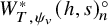 is immediately implied by (5.2.2) and the relation
$W^{\ast }_{T,\psi _v}(h,s)^{\circ }_n = W^{\ast }_{u T, v}(h,s)^{\circ }_n$
is immediately implied by (5.2.2) and the relation
$W^{\ast }_{T,\psi _v}(h,s)^{\circ }_n = W^{\ast }_{u T, v}(h,s)^{\circ }_n$
 (Section 4.2).
Recall that
$\Phi _v^{(n)} \in I(s, \chi _v)$
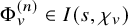 is our notation for a certain scalar weight standard section, as in Section 2.2. For verifying the next lemma, it may be helpful to recall the relation between local epsilon factors
$\epsilon _v(-)$
is our notation for a certain scalar weight standard section, as in Section 2.2. For verifying the next lemma, it may be helpful to recall the relation between local epsilon factors
$\epsilon _v(-)$
 and Weil indices
$\gamma _v(-)$
and Weil indices
$\gamma _v(-)$
 (Section 3.1).
Lemma 5.2.3. We have

with
$s_0 = (n - m)/2$
 as above.
Proof. A priori, the displayed identity holds up to some meromorphic scale factor. We may compute this scale factor by combining (5.2.1) and Lemma 5.2.1 (take
$T = 1_m$
 ).
).
Remark 5.2.4. Lemma 5.2.3 should be a reformulation (with alternative proof) of a case of [Reference ShimuraShi82, (1.31)] (translating into Shimura’s setup via (2.2.13)). Shimura’s computation in loc. cit. implies

Similarly, the functional equation in Lemma 5.2.1 should follow from [Reference ShimuraShi82, Theorem 4.2, (4.34.K)] (alternative proof) after some rearranging.
For our later calculations, we prefer to use these results as stated in Lemmas 5.2.1 and 5.2.3.
Remark 5.2.5. If instead
$\psi _v(x) = e^{2\pi i u x}$
 for some
$u \in \mathbb {R}^{\times }$
for some
$u \in \mathbb {R}^{\times }$
 , then the formula in (5.2.3) remains valid after multiplying by
$|u|_{F^+_v}^{m^2 / 2}$
, then the formula in (5.2.3) remains valid after multiplying by
$|u|_{F^+_v}^{m^2 / 2}$
 on the right, to account for the self-dual Haar measure on
$\mathrm {Herm}_m(F^+_v)$
on the right, to account for the self-dual Haar measure on
$\mathrm {Herm}_m(F^+_v)$
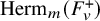 , which depends on
$\psi _v$
, which depends on
$\psi _v$
 .
.
6 Normalized Fourier coefficients
6.1 Global normalization
With notation as in Section 2.2 and Section 2.3, let
$F / F^+$
 be a CM extension of number fields. We allow
$2$
be a CM extension of number fields. We allow
$2$
 -adic places of
$F^+$
-adic places of
$F^+$
 to ramify in F. Write
$\mathfrak {d}$
to ramify in F. Write
$\mathfrak {d}$
 (resp.
$\Delta $
(resp.
$\Delta $
 ) for the different ideal (resp. discriminant ideal) of
$F / F^+$
) for the different ideal (resp. discriminant ideal) of
$F / F^+$
 . Write
$\mathfrak {d}_{F^+ / \mathbb {Q}}$
. Write
$\mathfrak {d}_{F^+ / \mathbb {Q}}$
 (resp.
$\Delta _{F^+ / \mathbb {Q}}$
(resp.
$\Delta _{F^+ / \mathbb {Q}}$
 ) for the different ideal (resp. discriminant ideal) of
$F^+ / \mathbb {Q}$
) for the different ideal (resp. discriminant ideal) of
$F^+ / \mathbb {Q}$
 . Let
$\eta \colon F^{+ \times } \backslash \mathbb {A}^{\times } \rightarrow \{ \pm 1\}$
. Let
$\eta \colon F^{+ \times } \backslash \mathbb {A}^{\times } \rightarrow \{ \pm 1\}$
 be the quadratic character associated with
$F / F^+$
be the quadratic character associated with
$F / F^+$
 .
.
Fix integers m and n with
$m \geq 0$
 , with
$s_0 {:=}q (n - m)/2$
, with
$s_0 {:=}q (n - m)/2$
 as above. Let
$\chi \colon F^{\times } \backslash \mathbb {A}_F^{\times } \rightarrow \mathbb {C}^{\times }$
as above. Let
$\chi \colon F^{\times } \backslash \mathbb {A}_F^{\times } \rightarrow \mathbb {C}^{\times }$
 be a character satisfying
$\chi |_{\mathbb {A}^{\times }} = \eta ^n$
be a character satisfying
$\chi |_{\mathbb {A}^{\times }} = \eta ^n$
 . To simplify, we assume that
$\chi $
. To simplify, we assume that
$\chi $
 is unramified at every non-Archimedean place, as the spherical standard section
$\Phi ^{\circ }_v$
is unramified at every non-Archimedean place, as the spherical standard section
$\Phi ^{\circ }_v$
 for non-Archimedean v will not exist if
$\chi _v$
for non-Archimedean v will not exist if
$\chi _v$
 is ramified (but see also Remark 4.5.1). Thus, if any non-Archimedean place of
$F^+$
is ramified (but see also Remark 4.5.1). Thus, if any non-Archimedean place of
$F^+$
 ramifies in F, these assumptions force n to be even. For arbitrary
$F / F^+$
ramifies in F, these assumptions force n to be even. For arbitrary
$F / F^+$
 , there certainly exists a character
$\chi $
, there certainly exists a character
$\chi $
 as above if n is even, in which case
$\chi $
as above if n is even, in which case
$\chi $
 could be the trivial character.
Take the standard section

(scalar weight at Archimedean places and spherical at non-Archimedean places). Form the associated Eisenstein series
$E(h,s,\Phi ^{(n) \circ })$
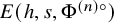 and its variants
$E(z,s,\Phi ^{(n) \circ })_n$
and its variants
$E(z,s,\Phi ^{(n) \circ })_n$
 and
$\tilde {E}(a, s, \Phi ^{(n) \circ })_n$
and
$\tilde {E}(a, s, \Phi ^{(n) \circ })_n$
 as in Section 2.2. The Eisenstein series variant
$\tilde {E}(a,s, \Phi ^{(n) \circ })_n$
as in Section 2.2. The Eisenstein series variant
$\tilde {E}(a,s, \Phi ^{(n) \circ })_n$
 does not depend on the choice of
$\chi $
does not depend on the choice of
$\chi $
 (Remark 3.2.3).
Define the global normalizing factor

We define the normalized Eisenstein series and its variants


where
$h \in U(m,m)(\mathbb {A})$
 and
$z \in \mathcal {H}_m$
and
$z \in \mathcal {H}_m$
 and
$a \in \operatorname {\mathrm {GL}}_m(\mathbb {A}_F)$
and
$a \in \operatorname {\mathrm {GL}}_m(\mathbb {A}_F)$
 . For
$T \in \mathrm {Herm}_m(F^+)$
. For
$T \in \mathrm {Herm}_m(F^+)$
 , and given any nontrivial additive character
$\psi \colon F^+ \backslash \mathbb {A} \rightarrow \mathbb {C}^{\times }$
, and given any nontrivial additive character
$\psi \colon F^+ \backslash \mathbb {A} \rightarrow \mathbb {C}^{\times }$
 , we similarly define


The latter two are normalized Fourier coefficients. We often suppress
$\psi $
 from notation.
Given any
$T \in \mathrm {Herm}_m(F^+)$
 with
$\det T \neq 0$
with
$\det T \neq 0$
 , and given any nontrivial additive character
${\psi \colon F^+ \backslash \mathbb {A} \rightarrow \mathbb {C}^{\times }}$
, and given any nontrivial additive character
${\psi \colon F^+ \backslash \mathbb {A} \rightarrow \mathbb {C}^{\times }}$
 , the local normalizing factors from Sections 4.2 and 4.3 satisfy

where the product (over all places v of
$F^+$
 ) is convergent for
$\mathrm {Re}(s)> 0$
) is convergent for
$\mathrm {Re}(s)> 0$
 . Indeed, it is enough to check the case where
$\psi = \psi _{\mathrm {tr}}$
. Indeed, it is enough to check the case where
$\psi = \psi _{\mathrm {tr}}$
 is the standard character satisfying
$\psi _v(x) = e^{2 \pi i x}$
is the standard character satisfying
$\psi _v(x) = e^{2 \pi i x}$
 for all
$v \mid \infty $
for all
$v \mid \infty $
 , and this case follows because
$q_v^{-c(\psi _v)} = |N_{F^+_v / \mathbb {Q}_p}(\mathfrak {d}_{F^+_v / \mathbb {Q}_p})|_p$
, and this case follows because
$q_v^{-c(\psi _v)} = |N_{F^+_v / \mathbb {Q}_p}(\mathfrak {d}_{F^+_v / \mathbb {Q}_p})|_p$
 for all p-adic places v, where we also use the relation
$N_{F^+ / \mathbb {Q}}(\mathfrak {d}_{F^+ / \mathbb {Q}}) = \Delta _{F^+ / \mathbb {Q}}$
for all p-adic places v, where we also use the relation
$N_{F^+ / \mathbb {Q}}(\mathfrak {d}_{F^+ / \mathbb {Q}}) = \Delta _{F^+ / \mathbb {Q}}$
 . The case of general
$\psi $
. The case of general
$\psi $
 follows by product formula. For nonsingular T as above, and for arbitrary
$\psi $
follows by product formula. For nonsingular T as above, and for arbitrary
$\psi $
 , we have factorizations into (normalized) local Whittaker functions

where all but finitely many factors are identically equal to
$1$
 (as functions of s) for fixed T, h, and n.
The next lemma involves a sign
$\eta (\mathfrak {d}_{F^+/\mathbb {Q}})^{m(n - m - 1)} \in \{ \pm 1 \}$
 which is an abuse of notation, as we now explain. We define

where the product runs over all non-Archimedean places of
$F^+$
 , and p denotes the residue characteristic of
$F^+_v$
, and p denotes the residue characteristic of
$F^+_v$
 . The notation
$\eta _v(\mathfrak {d}_{F^+_v / \mathbb {Q}_p})^{m(n - m - 1)}$
. The notation
$\eta _v(\mathfrak {d}_{F^+_v / \mathbb {Q}_p})^{m(n - m - 1)}$
 is defined to mean
$\eta _v(u)^{m(n - m - 1)}$
is defined to mean
$\eta _v(u)^{m(n - m - 1)}$
 for any generator u of
$\mathfrak {d}_{F^+_v / \mathbb {Q}_p}$
for any generator u of
$\mathfrak {d}_{F^+_v / \mathbb {Q}_p}$
 ; note that the choice of generator does not matter, since n is even if
$\eta _v$
; note that the choice of generator does not matter, since n is even if
$\eta _v$
 is ramified. We find

using (3.1.3) and (3.1.7) and Lemma 3.1.3(4), since we are assuming that
$F / F^+$
 is unramified at all non-Archimedean places if n is odd. Note also
$\eta (\mathfrak {d}_{F^+/\mathbb {Q}})^{m(n - m - 1)} = + 1$
is unramified at all non-Archimedean places if n is odd. Note also
$\eta (\mathfrak {d}_{F^+/\mathbb {Q}})^{m(n - m - 1)} = + 1$
 if
$F^+ = \mathbb {Q}$
if
$F^+ = \mathbb {Q}$
 .
.
Lemma 6.1.1. We have

where the sign “
$\pm $
 ” is
” is

Proof. Let
$\psi \colon F^+ \backslash \mathbb {A} \rightarrow \mathbb {C}^{\times }$
 be any nontrivial additive character. Given
$T \in \mathrm {Herm}_m(F^+)$
be any nontrivial additive character. Given
$T \in \mathrm {Herm}_m(F^+)$
 with
$\det T \neq 0$
with
$\det T \neq 0$
 , the local functional equations (Section 5) and the factorization from (6.1.8) imply

The global functional equation (2.2.6) implies that
$E^{\ast }(h,-s)^{\circ }_n = f(s) E^{\ast }(h,s)^{\circ }_n$
 for some meromorphic function
$f(s)$
for some meromorphic function
$f(s)$
 (temporary notation) independent of T. There exists T with
$\det T \neq 0$
(temporary notation) independent of T. There exists T with
$\det T \neq 0$
 and
$E^{\ast }_{T,\psi }(h,s)^{\circ }_n$
and
$E^{\ast }_{T,\psi }(h,s)^{\circ }_n$
 not identically zero, for example, we can take
$T = 1_m$
not identically zero, for example, we can take
$T = 1_m$
 if
$\psi $
if
$\psi $
 is the standard character, as follows from (4.2.6) and Lemma 2.3.1(2)(iii). So
$f(s)$
is the standard character, as follows from (4.2.6) and Lemma 2.3.1(2)(iii). So
$f(s)$
 is identically
$1$
is identically
$1$
 and (6.1.13) holds for all
$T \in \mathrm {Herm}_m(F^+)$
and (6.1.13) holds for all
$T \in \mathrm {Herm}_m(F^+)$
 .
.
6.2 Singular Fourier coefficients
Retain notation and assumptions from Section 6.1. In this section, the main result is Corollary 6.2.2 on singular Fourier terms of co-rank
$1$
 .
.
We use various subscripts to emphasize m-dependence (in the implicit
$U(m,m)$
 ). For example, we write
$\Phi _{m,v}^{\circ }$
). For example, we write
$\Phi _{m,v}^{\circ }$
 rather than just
$\Phi _v^{\circ }$
rather than just
$\Phi _v^{\circ }$
 for non-Archimedean v (resp.
$\Phi _{m,v}^{(n)}$
for non-Archimedean v (resp.
$\Phi _{m,v}^{(n)}$
 instead of
$\Phi _v^{(n)}$
instead of
$\Phi _v^{(n)}$
 for Archimedean v), similarly
$\Phi _m^{(n) \circ }$
for Archimedean v), similarly
$\Phi _m^{(n) \circ }$
 instead of
$\Phi ^{(n) \circ }$
instead of
$\Phi ^{(n) \circ }$
 for the global standard section from Section 6.1, also
$M_m(s, \chi )$
for the global standard section from Section 6.1, also
$M_m(s, \chi )$
 instead of
$M(s, \chi )$
instead of
$M(s, \chi )$
 for the intertwining operator, etc.
Suppose
$m \geq 1$
 and set
$m^{\flat } = m - 1$
and set
$m^{\flat } = m - 1$
 . Recall the operators
$\mu ^{m *}_{m^{\flat }}(s, \chi )$
. Recall the operators
$\mu ^{m *}_{m^{\flat }}(s, \chi )$
 ,
$M_m(s, \chi )$
,
$M_m(s, \chi )$
 ,
$M_{m^{\flat }}(s, \chi )$
,
$M_{m^{\flat }}(s, \chi )$
 and
$U^m_{m^{\flat }}(s, \chi )$
and
$U^m_{m^{\flat }}(s, \chi )$
 as in Section 2.4.
Lemma 6.2.1. We have


allowing
$m = 0$
 for
$M_m(s, \chi )$
for
$M_m(s, \chi )$
 , where
$\psi _v(x) {:=}q e^{2 \pi i x}$
, where
$\psi _v(x) {:=}q e^{2 \pi i x}$
 for
$v \mid \infty $
for
$v \mid \infty $
 , and where the sign “
$\pm $
, and where the sign “
$\pm $
 ” in (6.2.2) is

Proof. Each identity holds a priori up to a meromorphic scale factor. We may compute this scale factor by evaluating both sides at
$1 \in U(m^{\flat }, m^{\flat })$
 or
$1 \in U(m,m)$
or
$1 \in U(m,m)$
 as appropriate.
The identity for
$\mu ^{m*}_{m^{\flat }}(s, \chi )$
 is then clear. For
$M_m(s, \chi )$
is then clear. For
$M_m(s, \chi )$
 , the identity follows directly upon combining (5.1.2) and (5.2.3), for example, by considering the standard character
$\psi _{\mathrm {tr}}$
, the identity follows directly upon combining (5.1.2) and (5.2.3), for example, by considering the standard character
$\psi _{\mathrm {tr}}$
 (note that the Lemma statement does not need to mention a choice of global additive character).
Define the temporary notation
$\alpha _m(s)_n$
 for the meromorphic function (in the lemma statement) satisfying
$M_m(s, \chi ) \Phi ^{(n) \circ }_m(s) = \alpha _m(s)_n \Phi ^{(n) \circ }_m(-s)$
for the meromorphic function (in the lemma statement) satisfying
$M_m(s, \chi ) \Phi ^{(n) \circ }_m(s) = \alpha _m(s)_n \Phi ^{(n) \circ }_m(-s)$
 . By (2.4.5), proving the claimed identity for
$U^m_{m^{\flat }}(s, \chi )$
. By (2.4.5), proving the claimed identity for
$U^m_{m^{\flat }}(s, \chi )$
 is equivalent to showing

with sign
$\pm $
 as in the lemma statement. This may be computed explicitly as follows. Some rearranging yields

and

Let
$\psi = \psi _{\mathrm {tr}} \colon F^+ \backslash \mathbb {A} \rightarrow \mathbb {C}^{\times }$
 . Using the global functional equation
$\Lambda (s, \eta ^{n + m + 1}) = \epsilon (s, \eta ^{n + m + 1}) \Lambda (1 - s, \eta ^{n + m + 1})$
. Using the global functional equation
$\Lambda (s, \eta ^{n + m + 1}) = \epsilon (s, \eta ^{n + m + 1}) \Lambda (1 - s, \eta ^{n + m + 1})$
 (notation as in Section 4.1), we find

It remains to show

with sign
$\pm $
 as in the lemma statement. For studying this sign, we find it convenient to rewrite

The rest of the proof consists of casework on the parity of m and n (four cases).
First consider the case when
$n + m + 1$
 is odd. We compute


where the first equality follows from (3.1.3), the second equality follows from the global product formula for Weil indices, and the third equality follows from the formula for Archimedean Weil indices given after (3.1.6), that is,
$\gamma _{\overline {\psi }_v}(\mathbb {C}) = -i$
 .
.
Suppose n and m are both odd. Since n is odd, we must have
$|N_{F^+ / \mathbb {Q}}(\Delta )| = 1$
 (by convention). Then (6.1.10) gives

Since the above quantity (lying in
$\pm 1$
 ) is also
$i^{[F^+ : \mathbb {Q}]}$
) is also
$i^{[F^+ : \mathbb {Q}]}$
 , we conclude that
$[F^+ : \mathbb {Q}]$
, we conclude that
$[F^+ : \mathbb {Q}]$
 is even, so
$((-1)^n i^{m - 1})^{[F^+ : \mathbb {Q}]} = +1$
is even, so
$((-1)^n i^{m - 1})^{[F^+ : \mathbb {Q}]} = +1$
 . Since
$[F^+ : \mathbb {Q}]$
. Since
$[F^+ : \mathbb {Q}]$
 is even, we also find that the sign
$\pm $
is even, we also find that the sign
$\pm $
 of the lemma statement is given by (6.2.11), so (6.2.6) now follows.
Suppose n and m are both even. The previous computation shows that the left-hand side of (6.2.6) equals
$|N_{F^+ / \mathbb {Q}}(\Delta )|^{-(m-1)/2 - 2s + 1/2} (-1)^{m \cdot [F^+ : \mathbb {Q}] / 2} |\Delta _{F^+ / \mathbb {Q}}|^{1/2 - 2s}$
 . The factors of
$|N_{F^+ / \mathbb {Q}}(\Delta )|$
. The factors of
$|N_{F^+ / \mathbb {Q}}(\Delta )|$
 on both sides of (6.2.6) agree because
$-(m-1)/2 - 2s + 1/2 = \lfloor m / 2 \rfloor (- 2 s) + \lfloor m^{\flat } / 2 \rfloor (2s - 1)$
on both sides of (6.2.6) agree because
$-(m-1)/2 - 2s + 1/2 = \lfloor m / 2 \rfloor (- 2 s) + \lfloor m^{\flat } / 2 \rfloor (2s - 1)$
 . The signs also agree because
$m / 2$
. The signs also agree because
$m / 2$
 has the same parity as
$(m - 1)(- m - (- 2n + 4)) / 2$
has the same parity as
$(m - 1)(- m - (- 2n + 4)) / 2$
 , where the latter comes from (6.2.7).
Next consider the case where
$n + m + 1$
 is even. We compute

using (3.1.3) and Lemma 3.1.3(2).
Suppose n is odd and m is even. Since n is odd, we must have
$|N_{F^+ / \mathbb {Q}}(\Delta )| = 1$
 . As in the case where n and m were both odd, we find

and that
$[F^+ : \mathbb {Q}]$
 is even. To see that the signs in (6.2.6) agree, it thus suffices to note
$((-1)^n i^m)^{[F^+ : \mathbb {Q}]} = +1$
is even. To see that the signs in (6.2.6) agree, it thus suffices to note
$((-1)^n i^m)^{[F^+ : \mathbb {Q}]} = +1$
 .
.
Lastly, suppose n is even and m is odd. The factors of
$|N_{F^+ / \mathbb {Q}}(\Delta )|$
 on both sides of (6.2.6) agree since
$(m - 1)/2 = \lfloor m / 2 \rfloor = \lfloor m^{\flat } / 2 \rfloor $
on both sides of (6.2.6) agree since
$(m - 1)/2 = \lfloor m / 2 \rfloor = \lfloor m^{\flat } / 2 \rfloor $
 because m is odd. The signs also agree because
$(m - 1)/2$
because m is odd. The signs also agree because
$(m - 1)/2$
 and
$(m - 1)(- m - (- 2n + 4)) / 2$
and
$(m - 1)(- m - (- 2n + 4)) / 2$
 have the same parity, where the latter comes from (6.2.7).
Corollary 6.2.2. Consider any
$a = \mathrm {diag}(a^{\#}, a^{\flat }) \in \operatorname {\mathrm {GL}}_m(\mathbb {A}_F)$
 with
$a^{\#} \in \operatorname {\mathrm {GL}}_1(\mathbb {A}_F)$
with
$a^{\#} \in \operatorname {\mathrm {GL}}_1(\mathbb {A}_F)$
 and
$a^{\flat } \in \operatorname {\mathrm {GL}}_{m^{\flat }}(\mathbb {A}_F)$
and
$a^{\flat } \in \operatorname {\mathrm {GL}}_{m^{\flat }}(\mathbb {A}_F)$
 . Take any nontrivial additive character
$\psi \colon F^+ \backslash \mathbb {A} \rightarrow \mathbb {C}^{\times }$
. Take any nontrivial additive character
$\psi \colon F^+ \backslash \mathbb {A} \rightarrow \mathbb {C}^{\times }$
 . For any
$T \in \mathrm {Herm}_m(F^+)$
. For any
$T \in \mathrm {Herm}_m(F^+)$
 with
$\operatorname {\mathrm {rank}} T = m - 1$
with
$\operatorname {\mathrm {rank}} T = m - 1$
 and
$T = \mathrm {diag}(0, T^{\flat })$
and
$T = \mathrm {diag}(0, T^{\flat })$
 being block diagonal with
$\det T^{\flat } \neq 0$
being block diagonal with
$\det T^{\flat } \neq 0$
 , we have

with sign “
$\pm $
 ” as in Lemma 6.2.1.
Proof. This follows immediately from Lemma 6.2.1, (2.4.6), and the definition of the normalized Fourier coefficients
$\tilde {E}^{\ast }_T(a,s)^{\circ }_n$
 and
$\tilde {E}^{\ast }_{T^{\flat }}(a^{\flat }, s)^{\circ }_n$
and
$\tilde {E}^{\ast }_{T^{\flat }}(a^{\flat }, s)^{\circ }_n$
 (Section 6.1).
Remark 6.2.3. In the situation of Corollary 6.2.2, the functional equation

for the singular matrix T is a visible consequence of the functional equation

for the nonsingular matrix
$T^{\flat }$
 .
.
Part II
Siegel–Weil
Our main results (arithmetic Siegel–Weil) are in Section 9. We also give some explicit formulas for special values (local Siegel–Weil and geometric Siegel–Weil) in Sections 7 and 8. These special value formulas will be needed as ingredients in the proofs of our arithmetic Siegel–Weil results.
7 Local Siegel–Weil
7.1 Volume forms
Given a scheme X that is smooth and equidimensional over a field A, a volume form (or gauge form) on X will mean a nowhere vanishing (algebraic) differential form of top degree on X. When X is also affine and A is a local field, the set
$X(A)$
 has the natural structure of an A-analytic manifold (in the sense of [Reference SerreSer06, Part II, Chapter III]). In this case, a volume form on X defines a Borel measure on
$X(A)$
has the natural structure of an A-analytic manifold (in the sense of [Reference SerreSer06, Part II, Chapter III]). In this case, a volume form on X defines a Borel measure on
$X(A)$
 in a standard way (see [Reference WeilWei82, §2.2]).
We use volume forms to normalize various Haar measures. Let B be a degree
$2$
 étale algebra over a field A of characteristic
$\neq 2$
étale algebra over a field A of characteristic
$\neq 2$
 , and write
$b \mapsto \overline {b}$
, and write
$b \mapsto \overline {b}$
 for the nontrivial involution on B. Let V be a
$B/A$
for the nontrivial involution on B. Let V be a
$B/A$
 Hermitian space that is free of rank n, and set
$G = U(V)$
Hermitian space that is free of rank n, and set
$G = U(V)$
 . Fix a nonnegative integer
$m \leq n$
. Fix a nonnegative integer
$m \leq n$
 , and choose translation-invariant volume forms
$\alpha $
, and choose translation-invariant volume forms
$\alpha $
 and
$\beta $
and
$\beta $
 on
$V^m$
on
$V^m$
 and
$\mathrm {Herm}_m$
and
$\mathrm {Herm}_m$
 respectively (viewed as group schemes over A). The forms
$\alpha $
respectively (viewed as group schemes over A). The forms
$\alpha $
 and
$\beta $
and
$\beta $
 have degrees
$2nm$
have degrees
$2nm$
 and
$m^2$
and
$m^2$
 respectively.
Consider the moment map

We assume
$n \geq m$
 , and write
$V^m_{\mathrm {reg}} \subseteq V^m$
, and write
$V^m_{\mathrm {reg}} \subseteq V^m$
 for the open subscheme where
$\det \mathcal {T}$
for the open subscheme where
$\det \mathcal {T}$
 is invertible. A tangent space calculation shows that
$\mathcal {T}$
is invertible. A tangent space calculation shows that
$\mathcal {T}$
 is smooth when restricted to
$V^m_{\mathrm {reg}}$
is smooth when restricted to
$V^m_{\mathrm {reg}}$
 .
.
Given
$T \in \mathrm {Herm}_m(A)$
 , we write
$\Omega _T \subseteq V^m$
, we write
$\Omega _T \subseteq V^m$
 for the fiber of the moment map over T. If
$\underline {x} \in V^m(A)$
for the fiber of the moment map over T. If
$\underline {x} \in V^m(A)$
 has Gram matrix
$T = (\underline {x}, \underline {x})$
has Gram matrix
$T = (\underline {x}, \underline {x})$
 , then
$g \mapsto g^{-1} \cdot \underline {x}$
, then
$g \mapsto g^{-1} \cdot \underline {x}$
 defines a morphism
$\iota _{\underline {x}} \colon G \rightarrow \Omega _T$
defines a morphism
$\iota _{\underline {x}} \colon G \rightarrow \Omega _T$
 . If
$\det T$
. If
$\det T$
 is invertible, then a dimension count and tangent space calculation show that
$\iota _{\underline {x}}$
is invertible, then a dimension count and tangent space calculation show that
$\iota _{\underline {x}}$
 is smooth. If
$\det T$
is smooth. If
$\det T$
 is invertible, if A is a local field, and if
$G_{\underline {x}} \subseteq G$
is invertible, if A is a local field, and if
$G_{\underline {x}} \subseteq G$
 denotes the stabilizer of
$\underline {x}$
denotes the stabilizer of
$\underline {x}$
 , then the induced map
$G_{\underline {x}}(A) \backslash G(A) \rightarrow \Omega _T(A)$
, then the induced map
$G_{\underline {x}}(A) \backslash G(A) \rightarrow \Omega _T(A)$
 is a homeomorphism (surjectivity is from Witt’s theorem, and openness is from the submersivity of
$G(A) \rightarrow \Omega _T(A)$
is a homeomorphism (surjectivity is from Witt’s theorem, and openness is from the submersivity of
$G(A) \rightarrow \Omega _T(A)$
 , which in turn comes from smoothness of
$\iota _{\underline {x}}$
, which in turn comes from smoothness of
$\iota _{\underline {x}}$
 ).
).
In part (3) of the lemma below,
$x \in V^m_{\mathrm {reg}}$
 means
$x \in V^m_{\mathrm {reg}}(S)$
means
$x \in V^m_{\mathrm {reg}}(S)$
 for some suppressed A-scheme S, and we similarly abuse notation in part (2). In part (3), we also use the usual notation
$\mathbb {G}_a$
for some suppressed A-scheme S, and we similarly abuse notation in part (2). In part (3), we also use the usual notation
$\mathbb {G}_a$
 for the additive group scheme.
Lemma 7.1.1. There exists an algebraic differential form
$\nu $
 on
$V^m_{\mathrm {reg}}$
on
$V^m_{\mathrm {reg}}$
 of degree
$m(2n - m)$
of degree
$m(2n - m)$
 satisfying the following conditions.
-
(1) We have $\alpha = \mathcal {T}^{\ast }(\beta ) \wedge \nu $
. -
(2) For the $G \times \operatorname {\mathrm {Res}}_{B/A} \operatorname {\mathrm {GL}}_m$
action on
$V^m_{\mathrm {reg}}$
given by
$x \mapsto g x h^{-1}$
for
$(g,h) \in G \times \operatorname {\mathrm {Res}}_{F/F^+} \operatorname {\mathrm {GL}}_m$
, we have
$(g, h)^{\ast } \nu = \det ({}^t \overline {h} h)^{m-n} \nu $
. -
(3) For each $x \in V^m_{\mathrm {reg}}$
, the restriction of
$\nu \colon T_x(V^m) \rightarrow \mathbb {G}_a$
to
$\ker d \mathcal {T}_x$
is nonzero. -
(4) For any fixed non-degenerate subspace $V^{\flat } \subseteq V$
which is free of rank m, and for
$\underline {x} \in V^{\flat m}_{\mathrm {reg}}(A)$
, the differential form (7.1.2) $$ \begin{align} \det(\underline{x}, \underline{x})^{m - n} \iota_{\underline{x}}^{\ast} \nu \end{align} $$on G is independent of the choice of $\underline {x}$
. This form is right G-invariant.










Proof. The case
$m = n$
 is stated in [Reference Kudla and RapoportKR14, §10]. The analogue of that case for orthogonal groups is discussed in [Reference Kudla, Rapoport and YangKRY06, Lemmas 5.3.1, 5.3.2] (there stated and proved for three-dimensional quadratic spaces). The present lemma may be proved by a similar computation.
Part (4) follows from part (2) (where “non-degenerate subspace” means that the restriction of the Hermitian pairing is non-degenerate).
7.2 Special value formula
We retain notation from Section 7.1, and specialize to the case where
$B/A$
 is the extension
$F_v/F^+_v$
is the extension
$F_v/F^+_v$
 where
$F^+_v$
where
$F^+_v$
 is a local field of characteristic
$\neq 2$
is a local field of characteristic
$\neq 2$
 . If
$F^+_v$
. If
$F^+_v$
 is Archimedean, we assume
$F_v/F^+_v$
is Archimedean, we assume
$F_v/F^+_v$
 is
$\mathbb {C} / \mathbb {R}$
is
$\mathbb {C} / \mathbb {R}$
 . We often use subscripts v to emphasize
$F^+_v$
. We often use subscripts v to emphasize
$F^+_v$
 being a local field, for example, we write
$\underline {x}_v$
being a local field, for example, we write
$\underline {x}_v$
 for elements of
$V^m_{\mathrm {reg}}(F^+_v)$
for elements of
$V^m_{\mathrm {reg}}(F^+_v)$
 .
.
Fix a nontrivial additive character
$\psi _v \colon F^+_v \rightarrow \mathbb {C}^{\times }$
 . We write
$d b_v$
. We write
$d b_v$
 for the self-dual Haar measure on
$\mathrm {Herm}_m(F^+_v)$
for the self-dual Haar measure on
$\mathrm {Herm}_m(F^+_v)$
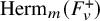 with respect to the trace pairing
$(b,c) \mapsto \psi _v(\mathrm {tr}(bc))$
with respect to the trace pairing
$(b,c) \mapsto \psi _v(\mathrm {tr}(bc))$
 . We also write
$d \underline {x}_v$
. We also write
$d \underline {x}_v$
 for the self-dual Haar measure on
$V^m(F^+_v)$
for the self-dual Haar measure on
$V^m(F^+_v)$
 with respect to the pairing
$\psi _v(\mathrm {tr}_{F_v/F^+_v}(\mathrm {tr}(-,-)))$
with respect to the pairing
$\psi _v(\mathrm {tr}_{F_v/F^+_v}(\mathrm {tr}(-,-)))$
 .
.
Fix translation-invariant volume forms
$\alpha $
 and
$\beta $
and
$\beta $
 as in Section 7.1. These determine Haar measures
$d_{\beta } b_v$
as in Section 7.1. These determine Haar measures
$d_{\beta } b_v$
 and
$d_{\alpha } \underline {x}_v$
and
$d_{\alpha } \underline {x}_v$
 on
$\mathrm {Herm}_m(F^+_v)$
on
$\mathrm {Herm}_m(F^+_v)$
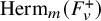 and
$V^m(F^+_v)$
and
$V^m(F^+_v)$
 respectively. Define positive real constants
$c_v(\alpha , \psi _v)$
respectively. Define positive real constants
$c_v(\alpha , \psi _v)$
 and
$c_v(\beta , \psi _v)$
and
$c_v(\beta , \psi _v)$
 such that

Suppose
$T \in \mathrm {Herm}_m(F^+_v)$
 is a matrix with
$\det T \neq 0$
is a matrix with
$\det T \neq 0$
 . For the rest of Section 7.2, fix a differential form
$\nu $
. For the rest of Section 7.2, fix a differential form
$\nu $
 as in Lemma 7.1.1. The restriction of
$\det (T)^{m - n} \nu $
as in Lemma 7.1.1. The restriction of
$\det (T)^{m - n} \nu $
 to
$\Omega _T$
to
$\Omega _T$
 is a G-invariant volume form on
$\Omega _T$
is a G-invariant volume form on
$\Omega _T$
 , and we write
$d_{T, \nu } \underline {x}_v$
, and we write
$d_{T, \nu } \underline {x}_v$
 for the resulting measure on
$\Omega _T(F^+_v)$
for the resulting measure on
$\Omega _T(F^+_v)$
 .
.
Take any character
$\chi _v \colon F^{\times }_v \rightarrow \mathbb {C}^{\times }$
 with
$\chi _v |_{F^{+ \times }_v} = \eta _v^n$
with
$\chi _v |_{F^{+ \times }_v} = \eta _v^n$
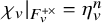 , where
$\eta _v \colon F^{+ \times }_v \rightarrow \{ \pm 1\}$
, where
$\eta _v \colon F^{+ \times }_v \rightarrow \{ \pm 1\}$
 is our usual notation for the quadratic character associated to
$F_v / F^+_v$
is our usual notation for the quadratic character associated to
$F_v / F^+_v$
 . It is known that there exists a constant
$c_{T,v}$
. It is known that there exists a constant
$c_{T,v}$
 (depending on T, the measure
$d_{T, \nu } \underline {x}_v$
(depending on T, the measure
$d_{T, \nu } \underline {x}_v$
 , and the character
$\psi _v$
, and the character
$\psi _v$
 ) such that

holds for any Schwartz function
$\varphi _v \in \mathcal {S}(V^m(F^+_v))$
 (see [Reference IchinoIch04, Lemma 5.1, Lemma 5.2]). Here we set
$s_0 {:=}q (n - m)/2$
(see [Reference IchinoIch04, Lemma 5.1, Lemma 5.2]). Here we set
$s_0 {:=}q (n - m)/2$
 as usual, and
$\Phi _{\varphi _v}$
as usual, and
$\Phi _{\varphi _v}$
 is the Siegel–Weil section associated with
$\varphi _v$
is the Siegel–Weil section associated with
$\varphi _v$
 (Section 3.2). If
$\Omega _T(F^+_v) = \emptyset $
(Section 3.2). If
$\Omega _T(F^+_v) = \emptyset $
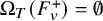 , we thus have
$W_{T,v}(s_0, \Phi _{\varphi _v}) = 0$
, we thus have
$W_{T,v}(s_0, \Phi _{\varphi _v}) = 0$
 for all
$\varphi _v$
for all
$\varphi _v$
 . The function
$W_{T,v}(s, \Phi _{\varphi _v})$
. The function
$W_{T,v}(s, \Phi _{\varphi _v})$
 indeed does not depend on the choice of
$\chi _v$
indeed does not depend on the choice of
$\chi _v$
 by Lemma 4.4.2, as the right-hand side of (4.4.6) has no
$\chi _v$
by Lemma 4.4.2, as the right-hand side of (4.4.6) has no
$\chi _v$
 dependence.Footnote
15
dependence.Footnote
15
We may compute the constant
$c_{T,v}$
 by evaluating (7.2.2) on any nonzero nonnegative Schwartz function
$\varphi _v$
by evaluating (7.2.2) on any nonzero nonnegative Schwartz function
$\varphi _v$
 . We may take
$\varphi _v$
. We may take
$\varphi _v$
 to have support which is compact and contained in
$V^m_{\mathrm {reg}}(F^+_v)$
to have support which is compact and contained in
$V^m_{\mathrm {reg}}(F^+_v)$
 . The relation
$\alpha = \mathcal {T}^{\ast }(\beta ) \wedge \nu $
. The relation
$\alpha = \mathcal {T}^{\ast }(\beta ) \wedge \nu $
 and an “integrate along the fibers of
$\mathcal {T}$
and an “integrate along the fibers of
$\mathcal {T}$
 ” computation (similar to the proof of [Reference Kudla, Rapoport and YangKRY06, Proposition 5.3.3]) gives

Here
$\gamma _{\psi _v}(V)$
 is the Weil index, as appearing in the Weil representation (Section 3.2).
Lemma 7.2.1 (Local Siegel–Weil)
Let V be an
$F_v/F^+_v$
 Hermitian space of rank n, and let
$\psi _v \colon F^+_v \rightarrow \mathbb {C}^{\times }$
Hermitian space of rank n, and let
$\psi _v \colon F^+_v \rightarrow \mathbb {C}^{\times }$
 be a nontrivial additive character. Fix a non-degenerate subspace
$V^{\flat } \subseteq V$
be a nontrivial additive character. Fix a non-degenerate subspace
$V^{\flat } \subseteq V$
 which is free of rank m, and fix a Haar measure on
$U(V^{\flat \perp })(F^+_v)$
which is free of rank m, and fix a Haar measure on
$U(V^{\flat \perp })(F^+_v)$
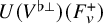 .
.
There exists a unique Haar measure
$d g_v$
 on
$G(F^+_v)$
on
$G(F^+_v)$
 such that, for any basis
$\underline {x}_v \in V^{\flat m}$
such that, for any basis
$\underline {x}_v \in V^{\flat m}$
 of
$V^{\flat }$
of
$V^{\flat }$
 and any Schwartz function
$\varphi _v \in \mathcal {S}(V^m(F^+_v))$
and any Schwartz function
$\varphi _v \in \mathcal {S}(V^m(F^+_v))$
 , we have

for the corresponding quotient measure, where
$T = (\underline {x}_v, \underline {x}_v)$
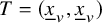 is the Gram matrix of
$\underline {x}_v$
is the Gram matrix of
$\underline {x}_v$
 (and where the Haar measure on
$G_{\underline {x}_v}(F^+_v)$
(and where the Haar measure on
$G_{\underline {x}_v}(F^+_v)$
 is induced by the canonical identification
$G_{\underline {x}_v} \cong U(V^{\flat \perp })$
is induced by the canonical identification
$G_{\underline {x}_v} \cong U(V^{\flat \perp })$
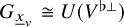 ).
).
Proof. Select any basis
$\underline {x}_v$
 of
$V^{\flat }$
of
$V^{\flat }$
 . Set
$\omega _1 = \det (\underline {x}_v, \underline {x}_v)^{m - n} \iota _{\underline {x}}^{\ast } \nu $
. Set
$\omega _1 = \det (\underline {x}_v, \underline {x}_v)^{m - n} \iota _{\underline {x}}^{\ast } \nu $
 (temporary notation). We know
$\omega _1$
(temporary notation). We know
$\omega _1$
 does not depend on the choice of
$\underline {x}_v$
does not depend on the choice of
$\underline {x}_v$
 , by Lemma 7.1.1(4). Let
$\omega _2$
, by Lemma 7.1.1(4). Let
$\omega _2$
 be a right G-invariant differential form of degree
$(n - m)^2$
be a right G-invariant differential form of degree
$(n - m)^2$
 on G such that
$\omega _1 \wedge \omega _2$
on G such that
$\omega _1 \wedge \omega _2$
 is a nowhere vanishing differential form of top degree
$n^2$
is a nowhere vanishing differential form of top degree
$n^2$
 (also right G-invariant). The volume form
$\omega _1 \wedge \omega _2$
(also right G-invariant). The volume form
$\omega _1 \wedge \omega _2$
 on G defines a Haar measure on
$G(F^+_v)$
on G defines a Haar measure on
$G(F^+_v)$
 . The restriction
$\omega _2|_{G_{\underline {x}}}$
. The restriction
$\omega _2|_{G_{\underline {x}}}$
 is a volume form on
$G_{\underline {x}}$
is a volume form on
$G_{\underline {x}}$
 (by smoothness of
$\iota _{\underline {x}}$
(by smoothness of
$\iota _{\underline {x}}$
 ), and defines a Haar measure on
$G_{\underline {x}_v}(F^+_v)$
), and defines a Haar measure on
$G_{\underline {x}_v}(F^+_v)$
 . The resulting quotient measure on
$G_{\underline {x}}(F^+_v) \backslash G(F^+_v) \cong \Omega _T(F^+_v)$
. The resulting quotient measure on
$G_{\underline {x}}(F^+_v) \backslash G(F^+_v) \cong \Omega _T(F^+_v)$
 is precisely the measure for the volume form
$(\det T)^{m - n} \nu |_{\Omega _T}$
is precisely the measure for the volume form
$(\det T)^{m - n} \nu |_{\Omega _T}$
 on
$\Omega _T$
on
$\Omega _T$
 .
.
The lemma then follows from (7.2.2) and the constant calculated in (7.2.3).
Remark 7.2.2. Consider the situation of Lemma 7.2.1, and suppose
$V^{\flat \prime } \subseteq V$
 is a subspace which is isomorphic to
$V^{\flat }$
is a subspace which is isomorphic to
$V^{\flat }$
 as a Hermitian space. Suppose
$f_v \in U(V)(F^+_v)$
as a Hermitian space. Suppose
$f_v \in U(V)(F^+_v)$
 satisfies
$f_v(V^{\flat }) = V^{\flat \prime }$
satisfies
$f_v(V^{\flat }) = V^{\flat \prime }$
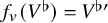 , and equip
$U(V^{\flat \prime \perp })(F^+_v)$
, and equip
$U(V^{\flat \prime \perp })(F^+_v)$
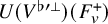 with the Haar measure induced from
$U(V^{\flat \perp })(F^+_v)$
with the Haar measure induced from
$U(V^{\flat \perp })(F^+_v)$
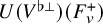 via
$f_v$
via
$f_v$
 . If
$d g_v$
. If
$d g_v$
 and
$d g^{\prime }_v$
and
$d g^{\prime }_v$
 are the induced Haar measures on
$G(F^+_v)$
are the induced Haar measures on
$G(F^+_v)$
 corresponding to
$V^{\flat }$
corresponding to
$V^{\flat }$
 and
$V^{\flat \prime }$
and
$V^{\flat \prime }$
 respectively (Lemma 7.2.1), a change of variables shows
$d g_v = d g^{\prime }_v$
respectively (Lemma 7.2.1), a change of variables shows
$d g_v = d g^{\prime }_v$
 .
.
7.3 Explicit Haar measures
For our application to uniformization of special cycles (Section 7.4), we need to explicitly compute the Haar measures from Lemma 7.2.1 in a few cases. The main result of this subsection is Lemma 7.3.6, and the other lemmas are auxiliary.
We retain notation from Section 7.2. In addition, we assume that
$F^+_v$
 is non-Archimedean and that
$\psi _v$
is non-Archimedean and that
$\psi _v$
 is unramified. Let
$\varpi _0$
is unramified. Let
$\varpi _0$
 be a uniformizer of
$F^+_v$
be a uniformizer of
$F^+_v$
 . For
$F_v/F^+_v$
. For
$F_v/F^+_v$
 ramified in Section 7.3, we assume that
$F^+_v$
ramified in Section 7.3, we assume that
$F^+_v$
 has residue characteristic
$\neq 2$
has residue characteristic
$\neq 2$
 and write
$\varpi \in F_v$
and write
$\varpi \in F_v$
 for a uniformizer satisfying
$\varpi ^{\sigma } = - \varpi $
for a uniformizer satisfying
$\varpi ^{\sigma } = - \varpi $
 , where
$\varpi ^{\sigma }$
, where
$\varpi ^{\sigma }$
 denotes the Galois conjugate of
$\varpi $
denotes the Galois conjugate of
$\varpi $
 under the Galois involution
$\sigma $
under the Galois involution
$\sigma $
 of
$F_v$
of
$F_v$
 over
$F^+_v$
over
$F^+_v$
 .
.
Let
$M^{\circ }_2$
 be the rank
$2$
be the rank
$2$
 self-dual lattice described in Section 3.2, and write
$U(M^{\circ }_2)$
self-dual lattice described in Section 3.2, and write
$U(M^{\circ }_2)$
 for the group of (unitary) automorphisms of
$M^{\circ }_2$
for the group of (unitary) automorphisms of
$M^{\circ }_2$
 . Let
$q_v$
. Let
$q_v$
 be the residue cardinality of
$F^+_v$
be the residue cardinality of
$F^+_v$
 .
.
The next lemma should be compared with Witt’s theorem for lattices with quadratic forms, as in [Reference Morin-StromMor79].
Lemma 7.3.1. For any given
$c \in \mathcal {O}_{F^+_v}^{\times }$
 , the group
$U(M^{\circ }_2)$
, the group
$U(M^{\circ }_2)$
 acts transitively on the set

If
$F_v/F^+_v$
 is inert, the same holds for any
$c \in \varpi _0 \mathcal {O}_{F^+_v}^{\times }$
is inert, the same holds for any
$c \in \varpi _0 \mathcal {O}_{F^+_v}^{\times }$
 .
.
Proof. Given
$y \in M^{\circ }_2$
 , we write
$\langle y \rangle \subseteq M^{\circ }_2$
, we write
$\langle y \rangle \subseteq M^{\circ }_2$
 for the submodule generated by y. If
$F_v/F^+_v$
for the submodule generated by y. If
$F_v/F^+_v$
 is ramified, we view
$\varpi $
is ramified, we view
$\varpi $
 as a generator of the different ideal
$\mathfrak {d}$
as a generator of the different ideal
$\mathfrak {d}$
 , and we otherwise view
$1$
, and we otherwise view
$1$
 as a generator of
$\mathfrak {d}$
as a generator of
$\mathfrak {d}$
 . Choose a basis
$e_1, e_2$
. Choose a basis
$e_1, e_2$
 of
$M^{\circ }_2$
of
$M^{\circ }_2$
 with Gram matrix given by (3.2.2). In this basis, we also consider the elements

of
$U(M^{\circ }_2)$
 (acting on column vectors), where
$a \in \mathcal {O}_{F_v}^{\times }$
(acting on column vectors), where
$a \in \mathcal {O}_{F_v}^{\times }$
 and
$b \in \mathcal {O}_{F_v}$
and
$b \in \mathcal {O}_{F_v}$
 satisfies
$\overline {b} = - \epsilon b$
satisfies
$\overline {b} = - \epsilon b$
 .
.
Case 1. Assume
$F_v / F^+_v$
 is unramified and
$c \in \mathcal {O}_{F^+_v}^{\times }$
is unramified and
$c \in \mathcal {O}_{F^+_v}^{\times }$
 . Given any
$x \in M^{\circ }_2$
. Given any
$x \in M^{\circ }_2$
 with
$(x, x) = c$
with
$(x, x) = c$
 , there exists an orthogonal direct sum decomposition
$M^{\circ }_2 = \langle x \rangle \oplus \langle y \rangle $
, there exists an orthogonal direct sum decomposition
$M^{\circ }_2 = \langle x \rangle \oplus \langle y \rangle $
 for some
$y \in M^{\circ }_2$
for some
$y \in M^{\circ }_2$
 with
$(y,y) = 1$
with
$(y,y) = 1$
 (by self-dualness). Via this decomposition, the lemma is clear in this case.
Case 2. Assume
$F_v / F^+_v$
 is ramified and
$c \in \mathcal {O}_{F^+_v}^{\times }$
is ramified and
$c \in \mathcal {O}_{F^+_v}^{\times }$
 . Suppose
$x = a_1 e_1 + a_2 e_2 \in M^{\circ }_2$
. Suppose
$x = a_1 e_1 + a_2 e_2 \in M^{\circ }_2$
 with
$(x,x) = c$
with
$(x,x) = c$
 . Without loss of generality, we may assume
$a_2 \in \mathcal {O}_{F_v}^{\times }$
. Without loss of generality, we may assume
$a_2 \in \mathcal {O}_{F_v}^{\times }$
 (replace x with
$w' x$
(replace x with
$w' x$
 if necessary), and we may further assume
$a_2 = 1$
if necessary), and we may further assume
$a_2 = 1$
 (replace x with
$m(\overline {a}_2) x$
(replace x with
$m(\overline {a}_2) x$
 ). We then have
$\mathrm {tr}_{F_v/F^+_v}(\varpi ^{-1} a_1) = - c$
). We then have
$\mathrm {tr}_{F_v/F^+_v}(\varpi ^{-1} a_1) = - c$
 . Given another
$x' = a^{\prime }_1 e_1 + e_2 \in M^{\circ }_2$
. Given another
$x' = a^{\prime }_1 e_1 + e_2 \in M^{\circ }_2$
 with
$(x', x') = c$
with
$(x', x') = c$
 , we take
$b = a^{\prime }_1 - a_1$
, we take
$b = a^{\prime }_1 - a_1$
 and have
$n(b) x = x'$
and have
$n(b) x = x'$
 .
.
Case 3. Assume
$F_v / F^+_v$
 is inert and
$c \in \varpi _0 \mathcal {O}_{F^+_v}^{\times }$
is inert and
$c \in \varpi _0 \mathcal {O}_{F^+_v}^{\times }$
 . Suppose
$x = a_1 e_1 + a_2 e_2 \in M^{\circ }_2$
. Suppose
$x = a_1 e_1 + a_2 e_2 \in M^{\circ }_2$
 with
$(x,x) = c$
with
$(x,x) = c$
 . Without loss of generality, we may assume
$a_2 = 1$
. Without loss of generality, we may assume
$a_2 = 1$
 and
$\mathrm {tr}_{F_v/F^+_v}(a_1) = c$
and
$\mathrm {tr}_{F_v/F^+_v}(a_1) = c$
 (argue as in Case 2). Given another
$x' = a^{\prime }_1 e_1 + e_2 \in M^{\circ }_2$
(argue as in Case 2). Given another
$x' = a^{\prime }_1 e_1 + e_2 \in M^{\circ }_2$
 with
$(x', x') = c$
with
$(x', x') = c$
 , we take
$b = a^{\prime }_1 - a_1$
, we take
$b = a^{\prime }_1 - a_1$
 and have
$n(b) x = x'$
and have
$n(b) x = x'$
 .
.
Remark 7.3.2. If
$F_v / F_v^+$
 is nonsplit, the proof of Lemma 7.3.1 shows that the
$U(M^{\circ }_2)$
is nonsplit, the proof of Lemma 7.3.1 shows that the
$U(M^{\circ }_2)$
 orbits in
$(M^{\circ }_2 \otimes _{\mathcal {O}_{F_v}} F_v) \setminus \{ 0 \}$
orbits in
$(M^{\circ }_2 \otimes _{\mathcal {O}_{F_v}} F_v) \setminus \{ 0 \}$
 are classified by pairs
$(c, r) \in F^+_v \times \mathbb {Z}$
are classified by pairs
$(c, r) \in F^+_v \times \mathbb {Z}$
 , in the sense that the map

is an injection (say, setting
$\varpi = \varpi _0$
 in the inert case).
Lemma 7.3.3. Let L be a self-dual Hermitian
$\mathcal {O}_{F_v}$
 -lattice of rank n. Any isomorphism between self-dual sublattices of L extends to a (unitary) automorphism of L. The same holds for rank
$n - 1$
-lattice of rank n. Any isomorphism between self-dual sublattices of L extends to a (unitary) automorphism of L. The same holds for rank
$n - 1$
 almost self-dual sublattices of L.
Proof. Any self-dual lattice
$L^{\flat } \subseteq L$
 admits a (unique) orthogonal direct sum decomposition
$L = L^{\flat } \oplus L^{\#}$
admits a (unique) orthogonal direct sum decomposition
$L = L^{\flat } \oplus L^{\#}$
 where
$L^{\#}$
where
$L^{\#}$
 is also self-dual. This immediately implies the claim for self-dual sublattices of L, as self-dual lattices are unique up to isomorphism (for a fixed rank).
Next, assume that
$F_v / F^+_v$
 is nonsplit and that
$L^{\flat } \subseteq L$
is nonsplit and that
$L^{\flat } \subseteq L$
 is almost self-dual of rank
$n - 1$
is almost self-dual of rank
$n - 1$
 . There is an orthogonal direct sum decomposition
$L^{\flat } = L^{\flat \kern -1.4pt\flat } \oplus L^{\flat \kern -1.4pt \#}$
. There is an orthogonal direct sum decomposition
$L^{\flat } = L^{\flat \kern -1.4pt\flat } \oplus L^{\flat \kern -1.4pt \#}$
 , where
$L^{\flat \kern -1.4pt\flat }$
, where
$L^{\flat \kern -1.4pt\flat }$
 is self-dual of rank
$n - 2$
is self-dual of rank
$n - 2$
 and
$L^{\flat \kern -1.4pt \#}$
and
$L^{\flat \kern -1.4pt \#}$
 is almost self-dual of rank
$1$
is almost self-dual of rank
$1$
 . We also have an orthogonal direct sum decomposition
$L = L^{\flat \kern -1.4pt\flat } \oplus L^{\#}$
. We also have an orthogonal direct sum decomposition
$L = L^{\flat \kern -1.4pt\flat } \oplus L^{\#}$
 where
$L^{\#}$
where
$L^{\#}$
 is self-dual of rank
$2$
is self-dual of rank
$2$
 .
.
Suppose
$L^{\flat \prime } \subseteq L$
 is another almost self-dual lattice of rank
$n - 1$
is another almost self-dual lattice of rank
$n - 1$
 , equipped with an isomorphism
$L^{\flat } \rightarrow L^{\flat \prime }$
, equipped with an isomorphism
$L^{\flat } \rightarrow L^{\flat \prime }$
 . Applying the result just proved above (in the case of rank
$n - 2$
. Applying the result just proved above (in the case of rank
$n - 2$
 self-dual sublattices), we may assume there is an orthogonal decomposition
$L^{\flat \prime } = L^{\flat \kern -1.4pt\flat } \oplus L^{\flat \prime \#}$
self-dual sublattices), we may assume there is an orthogonal decomposition
$L^{\flat \prime } = L^{\flat \kern -1.4pt\flat } \oplus L^{\flat \prime \#}$
 where
$L^{\flat \kern -1.4pt \#} \cong L^{\flat \prime \#}$
where
$L^{\flat \kern -1.4pt \#} \cong L^{\flat \prime \#}$
 . We thus reduce to the case
$n = 2$
. We thus reduce to the case
$n = 2$
 (the claim for
$L^{\#}$
(the claim for
$L^{\#}$
 ), which was proved in Lemma 7.3.1.
Lemma 7.3.4. Assume
$F_v/ F^+_v$
 is nonsplit, and let V be an
$F_v/F^+_v$
is nonsplit, and let V be an
$F_v/F^+_v$
 Hermitian space of rank n, and assume that V contains a full-rank self-dual lattice. Suppose
$L^{\flat } \subseteq V$
Hermitian space of rank n, and assume that V contains a full-rank self-dual lattice. Suppose
$L^{\flat } \subseteq V$
 is a non-degenerate lattice of rank
$n - 1$
is a non-degenerate lattice of rank
$n - 1$
 satisfying
$L^{\flat } \subseteq L^{\flat *}$
satisfying
$L^{\flat } \subseteq L^{\flat *}$
 and
$t(L^{\flat }) \leq 1$
and
$t(L^{\flat }) \leq 1$
 . Then
$L^{\flat }$
. Then
$L^{\flat }$
 is contained in a self-dual lattice of rank n.
Proof. Recall that
$t(L^{\flat }) {:=}q \dim _{k} ((L^{\flat *}/L^{\flat }) \otimes k)$
 where k is the residue field of
$\mathcal {O}_{F_v}$
where k is the residue field of
$\mathcal {O}_{F_v}$
 .
.
Let
$L^{\flat } \subseteq V$
 be as in the lemma statement. The existence of such
$L^{\flat }$
be as in the lemma statement. The existence of such
$L^{\flat }$
 implies
$n \geq 2$
implies
$n \geq 2$
 . There exists an orthogonal decomposition
$L^{\flat } = L^{\flat \kern -1.4pt\flat } \oplus L^{\flat \kern -1.4 pt \#}$
. There exists an orthogonal decomposition
$L^{\flat } = L^{\flat \kern -1.4pt\flat } \oplus L^{\flat \kern -1.4 pt \#}$
 where
$L^{\flat \kern -1.4pt\flat }$
where
$L^{\flat \kern -1.4pt\flat }$
 is self-dual of rank
$n - 2$
is self-dual of rank
$n - 2$
 . Replacing V with the orthogonal complement of
$L^{\flat \kern -1.4pt\flat }$
. Replacing V with the orthogonal complement of
$L^{\flat \kern -1.4pt\flat }$
 , we reduce immediately to the case
$n = 2$
, we reduce immediately to the case
$n = 2$
 , which we now assume.
Let
$\varpi $
 be a uniformizer for
$F_v$
be a uniformizer for
$F_v$
 (take
$\varpi = \varpi _0$
(take
$\varpi = \varpi _0$
 if
$F_v/F^+_v$
if
$F_v/F^+_v$
 is inert). We may take
$V = M^{\circ }_2 \otimes F_v$
is inert). We may take
$V = M^{\circ }_2 \otimes F_v$
 , where
$M^{\circ }_2$
, where
$M^{\circ }_2$
 is as in Lemma 7.3.1. We also choose a standard basis
$e_1, e_2$
is as in Lemma 7.3.1. We also choose a standard basis
$e_1, e_2$
 for
$M^{\circ }_2$
for
$M^{\circ }_2$
 and consider the elements
$w', m(a), n(b) \in U(V)$
and consider the elements
$w', m(a), n(b) \in U(V)$
 as in the proof of that lemma (now allowing
$a \in F_v^{\times }$
as in the proof of that lemma (now allowing
$a \in F_v^{\times }$
 and allowing
$b \in F_v$
and allowing
$b \in F_v$
 satisfying
$\overline {b} = - \epsilon b$
satisfying
$\overline {b} = - \epsilon b$
 ).
).
The rank one lattice
$L^{\flat }$
 is generated by an element
$x = a_1 e_1 + a_2 e_2$
is generated by an element
$x = a_1 e_1 + a_2 e_2$
 for some
$a_1, a_2 \in F_v$
for some
$a_1, a_2 \in F_v$
 (such that
$(x,x)$
(such that
$(x,x)$
 is nonzero and lies in
$\mathcal {O}_{F^+_v}$
is nonzero and lies in
$\mathcal {O}_{F^+_v}$
 ). It is enough to check that the orbit
$U(V) \cdot x$
). It is enough to check that the orbit
$U(V) \cdot x$
 intersects
$M^{\circ }_2$
intersects
$M^{\circ }_2$
 . Acting on x by
$m(a) \in U(V)$
. Acting on x by
$m(a) \in U(V)$
 for suitable a, we see that it is enough to check the case where
$a_2 = 1$
for suitable a, we see that it is enough to check the case where
$a_2 = 1$
 and
$a_1 \in F_v^{\times }$
and
$a_1 \in F_v^{\times }$
 .
.
If
$F_v/F^+_v$
 is inert, there exists
$a' \in \mathcal {O}_{F_v}$
is inert, there exists
$a' \in \mathcal {O}_{F_v}$
 such that
$\mathrm {tr}_{F_v/F^+_v}(a') = (x,x)$
such that
$\mathrm {tr}_{F_v/F^+_v}(a') = (x,x)$
 since
$\mathcal {O}_{F_v}$
since
$\mathcal {O}_{F_v}$
 is self-dual with respect to the trace pairing. If
$F_v/F^+_v$
is self-dual with respect to the trace pairing. If
$F_v/F^+_v$
 is ramified, there exists
$a' \in \mathcal {O}_{F_v}$
is ramified, there exists
$a' \in \mathcal {O}_{F_v}$
 such that
$\mathrm {tr}_{F_v/F^+_v}(-\varpi ^{-1} a') = (x,x)$
such that
$\mathrm {tr}_{F_v/F^+_v}(-\varpi ^{-1} a') = (x,x)$
 since
$\mathcal {O}_{F_v}$
since
$\mathcal {O}_{F_v}$
 and
$\varpi ^{-1} \mathcal {O}_{F_v}$
and
$\varpi ^{-1} \mathcal {O}_{F_v}$
 are dual. In either case, we can take
$b = a' - a_1$
are dual. In either case, we can take
$b = a' - a_1$
 , and have
$n(b) x \in M^{\circ }_2$
, and have
$n(b) x \in M^{\circ }_2$
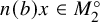 .
.
Lemma 7.3.5. In the situations of Lemma 7.3.1, choose
$x \in M^{\circ }_2$
 with
$(x,x) = c$
with
$(x,x) = c$
 and form the orthogonal complement lattice
$x^{\perp } \subseteq M^{\circ }_2$
and form the orthogonal complement lattice
$x^{\perp } \subseteq M^{\circ }_2$
 (of rank one). We view both
$U(M^{\circ }_2)$
(of rank one). We view both
$U(M^{\circ }_2)$
 and
$U(x^{\perp })$
and
$U(x^{\perp })$
 as subgroups of
$U(M^{\circ }_2 \otimes F_v)$
as subgroups of
$U(M^{\circ }_2 \otimes F_v)$
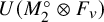 .
.
Viewing
$U(x^{\perp })$
 as the norm-one subgroup of
$\mathcal {O}_{F_v}^{\times }$
as the norm-one subgroup of
$\mathcal {O}_{F_v}^{\times }$
 , we have

The subgroup
$U(M^{\circ }_2) \cap U(x^{\perp }) \subseteq U(x^{\perp })$
 has index

Proof. We express elements of
$U(M^{\circ }_2 \otimes F_v)$
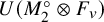 in a standard basis
$e_1, e_2$
in a standard basis
$e_1, e_2$
 of
$M^{\circ }_2$
of
$M^{\circ }_2$
 , as in the proof of Lemma 7.3.1.
Case 1. Assume
$F_v / F^+_v$
 is unramified and
$c \in \mathcal {O}_{F^+_v}^{\times }$
is unramified and
$c \in \mathcal {O}_{F^+_v}^{\times }$
 . We then have
$U(M^{\circ }_2) \cap U(x^{\perp }) = U(x^{\perp })$
. We then have
$U(M^{\circ }_2) \cap U(x^{\perp }) = U(x^{\perp })$
 , as follows immediately from an orthogonal direct sum decomposition
$M^{\circ }_2 = \langle x \rangle \oplus \langle y \rangle $
, as follows immediately from an orthogonal direct sum decomposition
$M^{\circ }_2 = \langle x \rangle \oplus \langle y \rangle $
 as in the proof of Lemma 7.3.1 Case 1.
Case 2. Assume
$F_v / F^+_v$
 is ramified and
$c \in \mathcal {O}_{F^+_v}^{\times }$
is ramified and
$c \in \mathcal {O}_{F^+_v}^{\times }$
 . By the proof of Lemma 7.3.1 Case 2, we may assume (after conjugating
$U(M^{\circ }_2 \otimes F_v)$
. By the proof of Lemma 7.3.1 Case 2, we may assume (after conjugating
$U(M^{\circ }_2 \otimes F_v)$
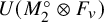 by an appropriate element of
$U(M^{\circ }_2)$
by an appropriate element of
$U(M^{\circ }_2)$
 ) that
$x = a_1 e_1 + e_2$
) that
$x = a_1 e_1 + e_2$
 for some
$a_1 \in \mathcal {O}_{F_v}$
for some
$a_1 \in \mathcal {O}_{F_v}$
 , where
$a_1 - \overline {a}_1 = - \varpi c$
, where
$a_1 - \overline {a}_1 = - \varpi c$
 . Then
$\overline {a}_1 e_1 + e_2$
. Then
$\overline {a}_1 e_1 + e_2$
 is orthogonal to x. For every
$\alpha \in \mathcal {O}_{F_v}^{\times }$
is orthogonal to x. For every
$\alpha \in \mathcal {O}_{F_v}^{\times }$
 , the matrix

lies in
$U(M^{\circ }_2)$
 if and only if
$\alpha \equiv 1\ \pmod {\varpi \mathcal {O}_{F_v}}$
if and only if
$\alpha \equiv 1\ \pmod {\varpi \mathcal {O}_{F_v}}$
 . The claim about index follows from surjectivity of the reduction modulo
$\varpi $
. The claim about index follows from surjectivity of the reduction modulo
$\varpi $
 map
map

(surjectivity is by smoothness of the corresponding unitary group over
$\operatorname {\mathrm {Spec}} \mathcal {O}_{F^+_v}$
 ).
).
Case 3. Assume
$F_v / F^+_v$
 is inert and
$c \in \varpi _0 \mathcal {O}_{F^+_v}^{\times }$
is inert and
$c \in \varpi _0 \mathcal {O}_{F^+_v}^{\times }$
 . By the proof of Lemma 7.3.1 Case 3, we may assume (after conjugating
$U(M^{\circ }_2 \otimes F_v)$
. By the proof of Lemma 7.3.1 Case 3, we may assume (after conjugating
$U(M^{\circ }_2 \otimes F_v)$
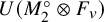 by an appropriate element of
$U(M^{\circ }_2)$
by an appropriate element of
$U(M^{\circ }_2)$
 ) that
$x = a_1 e_1 + e_2$
) that
$x = a_1 e_1 + e_2$
 for some
$a_1 \in \mathcal {O}_{F_v}$
for some
$a_1 \in \mathcal {O}_{F_v}$
 , where
$a_1 + \overline {a}_1 = c$
, where
$a_1 + \overline {a}_1 = c$
 . Then
$-\overline {a}_1 e_1 + e_2$
. Then
$-\overline {a}_1 e_1 + e_2$
 is orthogonal to x. For every
$\alpha \in \mathcal {O}_{F_v}^{\times }$
is orthogonal to x. For every
$\alpha \in \mathcal {O}_{F_v}^{\times }$
 , the matrix

lies in
$U(M^{\circ }_2)$
 if and only if
$\alpha \equiv 1\ \pmod {\varpi _0 \mathcal {O}_{F_v}}$
if and only if
$\alpha \equiv 1\ \pmod {\varpi _0 \mathcal {O}_{F_v}}$
 . The claim about index follows from surjectivity of the reduction modulo
$\varpi _0$
. The claim about index follows from surjectivity of the reduction modulo
$\varpi _0$
 map
map

(surjectivity is by smoothness of the corresponding unitary group over
$\operatorname {\mathrm {Spec}} \mathcal {O}_{F^+_v}$
 ).
).
The following lemma can be interpreted as giving an explicit description of the Haar measure from Lemma 7.2.1 in some special cases. Indeed, since
$W^{\ast }_{T,v}(s)^{\circ }_n = \Lambda _{T,v}(s)^{\circ }_n W_{T,v}(s, \Phi _{\varphi _v})$
 in the situation of Lemma 7.3.6 (using the normalizations defined in Section 4.3, and using Lemma 3.2.2), we find that the Haar measure in Lemma 7.2.1 must be

with T and e and
$d g_v$
 and
$s_0$
and
$s_0$
 as in Lemma 7.3.6 (using also Lemma 3.1.3 to compute the Weil index). The above expression does not depend on T (as expected), as can be verified upon inspecting (4.3.1).
Lemma 7.3.6. Take
$m = n - 1$
 or
$m = n$
or
$m = n$
 and
$s_0 {:=}q (n - m)/2$
and
$s_0 {:=}q (n - m)/2$
 . Assume the rank n Hermitian space V contains a full-rank self-dual lattice L. Let
$K_v \subseteq G = U(V)$
. Assume the rank n Hermitian space V contains a full-rank self-dual lattice L. Let
$K_v \subseteq G = U(V)$
 be the stabilizer of such a lattice L.
Consider any
$\underline {x}_v \in V^m(F^+_v)$
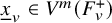 with nonsingular Gram matrix
$T = (\underline {x}_v, \underline {x}_v) \in \mathrm {Herm}_m(F^+_v)$
with nonsingular Gram matrix
$T = (\underline {x}_v, \underline {x}_v) \in \mathrm {Herm}_m(F^+_v)$
 . Let
${\pmb {1}}_{L}$
. Let
${\pmb {1}}_{L}$
 be the characteristic function of L, and set
$\varphi _v = {\pmb {1}}_{L}^{m} \in \mathcal {S}(V^m(F^+_v))$
be the characteristic function of L, and set
$\varphi _v = {\pmb {1}}_{L}^{m} \in \mathcal {S}(V^m(F^+_v))$
 .
.
Give
$G(F^+_v)$
 the Haar measure which assigns volume
$1$
the Haar measure which assigns volume
$1$
 to
$K_v$
to
$K_v$
 . Give
$G_{\underline {x}_v}(F^+_v)$
. Give
$G_{\underline {x}_v}(F^+_v)$
 the Haar measure which assigns volume
$1$
the Haar measure which assigns volume
$1$
 to the (unique) maximal open compact subgroup. We have

with respect to the associated quotient measure.
Proof. Recall that
$W_{T,v}^{\ast }(s)^{\circ }_n$
 is our notation for a certain normalized spherical Whittaker function (Section 4.3), which is a rescaled version of
$W_{T,v}(s, \Phi _{\varphi _v})$
is our notation for a certain normalized spherical Whittaker function (Section 4.3), which is a rescaled version of
$W_{T,v}(s, \Phi _{\varphi _v})$
 .
.
In the lemma statement, the stabilizer in
$G(F^+_v)$
 of any full-rank self-dual lattice in V has volume
$1$
of any full-rank self-dual lattice in V has volume
$1$
 (because any such stabilizer is conjugate to
$K_v$
(because any such stabilizer is conjugate to
$K_v$
 ), that is, the measure on
$G(F^+_v)$
), that is, the measure on
$G(F^+_v)$
 does not depend on the choice of L. To verify (7.3.11), we can (and will) replace L by another full-rank self-dual lattice in V. Lemma 7.2.1 implies that if (7.3.11) holds for
$\varphi _v = {\pmb {1}}_L^{\otimes m}$
does not depend on the choice of L. To verify (7.3.11), we can (and will) replace L by another full-rank self-dual lattice in V. Lemma 7.2.1 implies that if (7.3.11) holds for
$\varphi _v = {\pmb {1}}_L^{\otimes m}$
 for some full-rank self-dual L, then it must hold for all full-rank self-dual L.
Let
$V^{\flat } \subseteq V$
 be the rank m subspace spanned by
$\underline {x}_v$
be the rank m subspace spanned by
$\underline {x}_v$
 . Then
$V^{\flat }$
. Then
$V^{\flat }$
 is free of rank m. By Lemma 7.2.1, it is enough to show (7.3.11) holds for one choice of basis
$\underline {x}_v$
is free of rank m. By Lemma 7.2.1, it is enough to show (7.3.11) holds for one choice of basis
$\underline {x}_v$
 for
$V^{\flat }$
for
$V^{\flat }$
 . We choose
$\underline {x}_v$
. We choose
$\underline {x}_v$
 to be a basis for a full-rank lattice
$L^{\flat } \subseteq V^{\flat }$
to be a basis for a full-rank lattice
$L^{\flat } \subseteq V^{\flat }$
 which is

Note that
$V^{\flat }$
 always contains a full-rank self-dual lattice if
$F_v / F^+_v$
always contains a full-rank self-dual lattice if
$F_v / F^+_v$
 is split.
Case 1. Assume
$L^{\flat }$
 is self-dual. There exists a rank
$n-m$
is self-dual. There exists a rank
$n-m$
 self-dual lattice
$L^{\#} \subseteq V$
self-dual lattice
$L^{\#} \subseteq V$
 which is orthogonal to
$L^{\flat }$
which is orthogonal to
$L^{\flat }$
 . Form the rank n self-dual lattice
$L = L^{\flat } \oplus L^{\#}$
. Form the rank n self-dual lattice
$L = L^{\flat } \oplus L^{\#}$
 . Any isomorphism between self-dual sublattices of L lifts to an element of
$K_v = U(L)$
. Any isomorphism between self-dual sublattices of L lifts to an element of
$K_v = U(L)$
 (Lemma 7.3.3). This implies that
$g_v \mapsto \varphi _v(g_v^{-1} \underline {x}_v)$
(Lemma 7.3.3). This implies that
$g_v \mapsto \varphi _v(g_v^{-1} \underline {x}_v)$
 is the characteristic function of
$G_{\underline {x}_v}(F^+_v) \backslash ( G_{\underline {x}_v}(F^+_v) K_v)$
is the characteristic function of
$G_{\underline {x}_v}(F^+_v) \backslash ( G_{\underline {x}_v}(F^+_v) K_v)$
 .
.
We know that
$K_v \cap G_{\underline {x}_v}(F^+_v)$
 is the unique maximal open compact subgroup in
$G_{\underline {x}_v}(F^+_v)$
is the unique maximal open compact subgroup in
$G_{\underline {x}_v}(F^+_v)$
 (i.e.,
$U(L^{\#})$
(i.e.,
$U(L^{\#})$
 ). We compute

Since
$T = (\underline {x}_v, \underline {x}_v)$
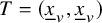 and
$\underline {x}_v$
and
$\underline {x}_v$
 is a basis for the self-dual lattice
$L^{\flat }$
is a basis for the self-dual lattice
$L^{\flat }$
 , we also know
$W_{T,v}^{\ast }(s_0)_n = 1$
, we also know
$W_{T,v}^{\ast }(s_0)_n = 1$
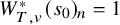 (see (4.5.7); note that
$V^{\flat }$
(see (4.5.7); note that
$V^{\flat }$
 containing a self-dual lattice means that
$F_v / F^+_v$
containing a self-dual lattice means that
$F_v / F^+_v$
 is unramified if m is odd).
Case 2. Assume that
$L^{\flat }$
 is almost self-dual and that
$F_v / F^+_v$
is almost self-dual and that
$F_v / F^+_v$
 is ramified. Then
$n \geq 2$
is ramified. Then
$n \geq 2$
 and
$m = n - 1$
and
$m = n - 1$
 . There is an orthogonal direct sum decomposition
$L^{\flat } = L^{\flat \kern -1.4pt\flat } \oplus L^{\flat \kern -1.4pt \#}$
. There is an orthogonal direct sum decomposition
$L^{\flat } = L^{\flat \kern -1.4pt\flat } \oplus L^{\flat \kern -1.4pt \#}$
 , where
$L^{\flat \kern -1.4pt\flat }$
, where
$L^{\flat \kern -1.4pt\flat }$
 is self-dual of rank
$m - 1$
is self-dual of rank
$m - 1$
 and
$L^{\flat \kern -1.4pt \#}$
and
$L^{\flat \kern -1.4pt \#}$
 is almost self-dual of rank
$1$
is almost self-dual of rank
$1$
 . There exists a rank
$2$
. There exists a rank
$2$
 self-dual lattice
$L^{\#} \subseteq V$
self-dual lattice
$L^{\#} \subseteq V$
 which is orthogonal to
$L^{\flat \kern -1.4pt\flat }$
which is orthogonal to
$L^{\flat \kern -1.4pt\flat }$
 . We can assume
$L^{\flat \kern -1.4pt \#} \subseteq L^{\#}$
. We can assume
$L^{\flat \kern -1.4pt \#} \subseteq L^{\#}$
 (Lemma 7.3.4). Form the rank n self-dual lattice
$L = L^{\flat \kern -1.4pt\flat } \oplus L^{\#}$
(Lemma 7.3.4). Form the rank n self-dual lattice
$L = L^{\flat \kern -1.4pt\flat } \oplus L^{\#}$
 . Any isomorphism between rank
$n - 1$
. Any isomorphism between rank
$n - 1$
 almost self-dual sublattices in L lifts to an element of
$K_v = U(L)$
almost self-dual sublattices in L lifts to an element of
$K_v = U(L)$
 (Lemma 7.3.3). This implies that
$g_v \mapsto \varphi _v(g_v^{-1} \underline {x}_v)$
(Lemma 7.3.3). This implies that
$g_v \mapsto \varphi _v(g_v^{-1} \underline {x}_v)$
 is the characteristic function of
$G_{\underline {x}_v}(F^+_v) \backslash ( G_{\underline {x}_v}(F^+_v) K_v)$
is the characteristic function of
$G_{\underline {x}_v}(F^+_v) \backslash ( G_{\underline {x}_v}(F^+_v) K_v)$
 .
.
We know that
$K_v \cap G_{\underline {x}_v}(F^+_v) = U(L^{\#}) \cap G_{\underline {x}_v}(F^+_v)$
 has index
$2$
has index
$2$
 inside the unique maximal open compact subgroup of
$G_{\underline {x}_v}(F^+_v)$
inside the unique maximal open compact subgroup of
$G_{\underline {x}_v}(F^+_v)$
 (reduces immediately to the case
$n = 2$
(reduces immediately to the case
$n = 2$
 , which is Lemma 7.3.5). We compute

Since
$T = (\underline {x}_v, \underline {x}_v)$
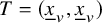 and since
$\underline {x}_v$
and since
$\underline {x}_v$
 is a basis for the almost self-dual lattice
$L^{\flat }$
is a basis for the almost self-dual lattice
$L^{\flat }$
 , we also know
$W_{T,v}^{\ast }(s_0)^{\circ }_n = 1$
, we also know
$W_{T,v}^{\ast }(s_0)^{\circ }_n = 1$
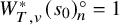 (4.5.7).
Case 3. Assume that
$L^{\flat }$
 is almost self-dual and that
$F_v / F^+_v$
is almost self-dual and that
$F_v / F^+_v$
 is inert. This implies
$n \geq 2$
is inert. This implies
$n \geq 2$
 and
$m = n - 1$
and
$m = n - 1$
 . Arguing as in Case 2 (use the same notation; the first paragraph applies verbatim), again apply Lemma 7.3.3 and Lemma 7.3.5 to compute

When
$n = 2$
 , we have
$\mathrm {Den}^{\ast }(X, L^{\flat })_n = q_v X^{-1/2} + X^{1/2}$
, we have
$\mathrm {Den}^{\ast }(X, L^{\flat })_n = q_v X^{-1/2} + X^{1/2}$
 (follows from the relevant Cho–Yamauchi type formula; see [Reference Li and ZhangLZ22, Example 3.5.2] [Reference Feng, Yun and ZhangFYZ24, Theorem 2.2]). The “cancellation” property for local densities and self-dual lattices (4.5.11) implies
$\mathrm {Den}^{\ast }(X, L^{\flat })_n = q_v X^{-1/2} + X^{1/2}$
(follows from the relevant Cho–Yamauchi type formula; see [Reference Li and ZhangLZ22, Example 3.5.2] [Reference Feng, Yun and ZhangFYZ24, Theorem 2.2]). The “cancellation” property for local densities and self-dual lattices (4.5.11) implies
$\mathrm {Den}^{\ast }(X, L^{\flat })_n = q_v X^{-1/2} + X^{1/2}$
 for
$n \geq 2$
for
$n \geq 2$
 . We thus have
$W^{\ast }_{T,v}(s_0)^{\circ }_n = \mathrm {Den}^{\ast }(1,L^{\flat })_n = q_v + 1$
. We thus have
$W^{\ast }_{T,v}(s_0)^{\circ }_n = \mathrm {Den}^{\ast }(1,L^{\flat })_n = q_v + 1$
 .
.
7.4 Uniformization degrees for special cycles
The purpose of this section is to express the groupoid cardinality of (7.4.4) in terms of special values of local Whittaker functions, with explicit constants (Lemma 7.4.1). This groupoid has already appeared as a “uniformization degree” for special cycles (see [Reference ChenChe24c, (4.5.12)], also [Reference ChenChe24c, Section 4.8 and 4.9] and [Reference ChenChe24c, Section 5.4]). This calculation will be needed for our main arithmetic Siegel–Weil results (Section 9.1).
Let
$F/F^+$
 be a CM extension of number fields, with respective adèle rings
$\mathbb {A}_F$
be a CM extension of number fields, with respective adèle rings
$\mathbb {A}_F$
 and
$\mathbb {A}$
and
$\mathbb {A}$
 and finite adèle rings
$\mathbb {A}_{F,f}$
and finite adèle rings
$\mathbb {A}_{F,f}$
 and
$\mathbb {A}_f$
and
$\mathbb {A}_f$
 , etc. As in Sections 2 to 6, we write v for places of
$F^+$
, etc. As in Sections 2 to 6, we write v for places of
$F^+$
 with completions
$F^+_v$
with completions
$F^+_v$
 , and set
$F_v {:=}q F \otimes _{F^+} F^+_v$
, and set
$F_v {:=}q F \otimes _{F^+} F^+_v$
 .
.
Let
$T \in \mathrm {Herm}_m(F^+)$
 be a Hermitian matrix (with F-coefficients) for any integer
$m \geq 0$
be a Hermitian matrix (with F-coefficients) for any integer
$m \geq 0$
 . Set
$m^{\flat } {:=}q \operatorname {\mathrm {rank}}(T)$
. Set
$m^{\flat } {:=}q \operatorname {\mathrm {rank}}(T)$
 . For each place v, select any
$a_v \in \operatorname {\mathrm {GL}}_m(F_v)$
. For each place v, select any
$a_v \in \operatorname {\mathrm {GL}}_m(F_v)$
 such that
${}^t \overline {a}_v^{-1} T a_v^{-1} = \mathrm {diag}(0,T_v^{\flat })$
such that
${}^t \overline {a}_v^{-1} T a_v^{-1} = \mathrm {diag}(0,T_v^{\flat })$
 for some
$T_v^{\flat } \in \mathrm {Herm}_{m^{\flat }}(F^+_v)$
for some
$T_v^{\flat } \in \mathrm {Herm}_{m^{\flat }}(F^+_v)$
 with
$\det T^{\flat }_v \neq 0$
with
$\det T^{\flat }_v \neq 0$
 . For each v, choose any decomposition (Iwasawa decomposition)

where
$a_v^{\#} \in \operatorname {\mathrm {GL}}_{m - m^{\flat }}(F_v)$
 ,
$a_v^{\flat } \in \operatorname {\mathrm {GL}}_{m^{\flat }}(F_v)$
,
$a_v^{\flat } \in \operatorname {\mathrm {GL}}_{m^{\flat }}(F_v)$
 , and
$U(m) \subseteq \operatorname {\mathrm {GL}}_m(\mathbb {C})$
, and
$U(m) \subseteq \operatorname {\mathrm {GL}}_m(\mathbb {C})$
 is the unitary group for the standard diagonal positive definite Hermitian pairing.
Let L be a non-degenerate Hermitian
$\mathcal {O}_F$
 -lattice of any rank n, set
$V {:=}q L \otimes _{\mathcal {O}_F} F$
-lattice of any rank n, set
$V {:=}q L \otimes _{\mathcal {O}_F} F$
 , and let
$G = U(V)$
, and let
$G = U(V)$
 be the associated unitary group. Set
$s_0^{\flat } {:=}q (n - m^{\flat }) / 2$
be the associated unitary group. Set
$s_0^{\flat } {:=}q (n - m^{\flat }) / 2$
 . For any place v of
$F^+$
. For any place v of
$F^+$
 , we set
$V_v {:=}q V \otimes _{F^+} F^+_v$
, we set
$V_v {:=}q V \otimes _{F^+} F^+_v$
 . Let
$K_{L,f} = \prod K_{L,v} \subseteq U(V)(\mathbb {A}_f)$
. Let
$K_{L,f} = \prod K_{L,v} \subseteq U(V)(\mathbb {A}_f)$
 be the adèlic stabilizer of L (i.e.
$K_{L,v}$
be the adèlic stabilizer of L (i.e.
$K_{L,v}$
 is the stabilizer of
$L_v {:=}q L \otimes _{\mathcal {O}_{F^+}} \mathcal {O}_{F^+_v}$
is the stabilizer of
$L_v {:=}q L \otimes _{\mathcal {O}_{F^+}} \mathcal {O}_{F^+_v}$
 for every place
$v < \infty $
for every place
$v < \infty $
 of
$F^+_v$
of
$F^+_v$
 ). Fix a place
$v_0$
). Fix a place
$v_0$
 of
$F^+$
of
$F^+$
 (Archimedean or non-Archimedean). Assume
$V_v$
(Archimedean or non-Archimedean). Assume
$V_v$
 is positive definite for every Archimedean
$v \neq v_0$
is positive definite for every Archimedean
$v \neq v_0$
 .
.
Given
$\underline {x}_f^{v_0} \in (V \otimes _{F^+} \mathbb {A}_f^{v_0})^m$
 , we define the “away from
$v_0$
, we define the “away from
$v_0$
 special cycle” (compare Sections [Reference ChenChe24c, Section 4.2] and [Reference ChenChe24c, Section 5.1])

where
$\underline {x}_v \in V_v^m$
 is the v-component of
$\underline {x}_f^{v_0}$
is the v-component of
$\underline {x}_f^{v_0}$
 .
.
Fix a nontrivial additive character
$\psi _v$
 for each place v. Assume
$\psi _v$
for each place v. Assume
$\psi _v$
 is unramified if
$v < \infty $
is unramified if
$v < \infty $
 , and assume
$\psi _v(x) = e^{2 \pi i x}$
, and assume
$\psi _v(x) = e^{2 \pi i x}$
 if
$F^+_v = \mathbb {R}$
if
$F^+_v = \mathbb {R}$
 . For every non-Archimedean place
$v \neq v_0$
. For every non-Archimedean place
$v \neq v_0$
 , set
$\varphi _v {:=}q {\pmb {1}}_{L_v}^{m}$
, set
$\varphi _v {:=}q {\pmb {1}}_{L_v}^{m}$
 (characteristic function of
$L_v^{m} \subseteq V_v^{m}$
(characteristic function of
$L_v^{m} \subseteq V_v^{m}$
 ) and set

Similarly set
$\varphi _v^{\flat } {:=}q {\pmb {1}}_{L_v}^{m^{\flat }} \in \mathcal {S}(V(F^+_v)^{m^{\flat }})$
 for such v.
For every place v of
$F^+_v$
 , let
$\eta _v \colon F^{+ \times }_v \rightarrow \{ \pm 1 \}$
, let
$\eta _v \colon F^{+ \times }_v \rightarrow \{ \pm 1 \}$
 be the quadratic character associated to
$F_v / F^+_v$
be the quadratic character associated to
$F_v / F^+_v$
 . Let
$\chi _v \colon F^{\times }_v \rightarrow \mathbb {C}^{\times }$
. Let
$\chi _v \colon F^{\times }_v \rightarrow \mathbb {C}^{\times }$
 be any character satisfying
$\chi _v |_{F^{+ \times }_v} = \eta _v^n$
be any character satisfying
$\chi _v |_{F^{+ \times }_v} = \eta _v^n$
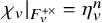 . Form the associated Siegel–Weil standard section
$\Phi _{\varphi _v} \in I(s, \chi _v)$
. Form the associated Siegel–Weil standard section
$\Phi _{\varphi _v} \in I(s, \chi _v)$
 (Section 3.2) for every place
$v < \infty $
(Section 3.2) for every place
$v < \infty $
 with
$v \neq v_0$
with
$v \neq v_0$
 . To simplify slightly, we assume that
$2$
. To simplify slightly, we assume that
$2$
 -adic places of
$F^+$
-adic places of
$F^+$
 are unramified in F for the rest of Section 7.4.
For
$v < \infty $
 with
$v \neq v_0$
with
$v \neq v_0$
 , the local Whittaker function variant
$\tilde {W}^{\ast }_{T^{\flat }_v, v}(a^{\flat }_v, s, \Phi _{\varphi _v})_n$
, the local Whittaker function variant
$\tilde {W}^{\ast }_{T^{\flat }_v, v}(a^{\flat }_v, s, \Phi _{\varphi _v})_n$
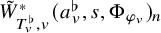 does not depend on the choice of
$a_v$
does not depend on the choice of
$a_v$
 or
$a_v^{\flat }$
or
$a_v^{\flat }$
 . Indeed, the
$\operatorname {\mathrm {GL}}_{m^{\flat }}(\mathcal {O}_{F_v})$
. Indeed, the
$\operatorname {\mathrm {GL}}_{m^{\flat }}(\mathcal {O}_{F_v})$
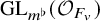 -equivalence class of the Hermitian matrix
${}^t \overline {a}^{\flat }_v T^{\flat }_v a^{\flat }_v$
-equivalence class of the Hermitian matrix
${}^t \overline {a}^{\flat }_v T^{\flat }_v a^{\flat }_v$
 does not depend on the choice of
$a_v$
does not depend on the choice of
$a_v$
 or
$a^{\flat }_v$
or
$a^{\flat }_v$
 (then apply (4.3.4)). For
$v \mid \infty $
(then apply (4.3.4)). For
$v \mid \infty $
 with
$v \neq v_0$
with
$v \neq v_0$
 , the local Whittaker function variant
$\tilde {W}^{\ast }_{T^{\flat }_v, v}(a^{\flat }_v, s)^{\circ }_n$
, the local Whittaker function variant
$\tilde {W}^{\ast }_{T^{\flat }_v, v}(a^{\flat }_v, s)^{\circ }_n$
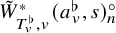 similarly does not depend on the choice of
$a_v$
similarly does not depend on the choice of
$a_v$
 or
$a^{\flat }_v$
or
$a^{\flat }_v$
 , as the
$U(m^{\flat })$
, as the
$U(m^{\flat })$
 -equivalence class of
${}^t \overline {a}^{\flat }_v T^{\flat }_v a^{\flat }_v$
-equivalence class of
${}^t \overline {a}^{\flat }_v T^{\flat }_v a^{\flat }_v$
 is similarly well-defined (then apply (4.2.4)).
Given any tuple
$\underline {x} \in V^m$
 which spans a non-degenerate Hermitian space, we write
$G_{\underline {x}} \subseteq G$
which spans a non-degenerate Hermitian space, we write
$G_{\underline {x}} \subseteq G$
 for the stabilizer of
$\underline {x}$
for the stabilizer of
$\underline {x}$
 (i.e., the unitary group of the orthogonal complement
$\mathrm {span}(\underline {x})^{\perp } \subseteq V$
(i.e., the unitary group of the orthogonal complement
$\mathrm {span}(\underline {x})^{\perp } \subseteq V$
 ). We write
$\underline {x}_f^{v_0}$
). We write
$\underline {x}_f^{v_0}$
 for the image of
$\underline {x}$
for the image of
$\underline {x}$
 in
$(V \otimes _{F^+} \mathbb {A}_f^{v_0})^m$
in
$(V \otimes _{F^+} \mathbb {A}_f^{v_0})^m$
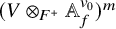 .
.
Suppose there exists
$\underline {x} \in V^m$
 with Gram matrix
$(\underline {x}, \underline {x}) = T$
with Gram matrix
$(\underline {x}, \underline {x}) = T$
 . Fix such an
$\underline {x}$
. Fix such an
$\underline {x}$
 , and assume
$\mathrm {span}(\underline {x})^{\perp }$
, and assume
$\mathrm {span}(\underline {x})^{\perp }$
 is definite at every Archimedean place. Let
$K_{\underline {x},v_0} \subseteq G_{\underline {x}}(F^+_{v_0})$
is definite at every Archimedean place. Let
$K_{\underline {x},v_0} \subseteq G_{\underline {x}}(F^+_{v_0})$
 be any open compact subgroup, and assume
$K_{\underline {x},v_0}(F^+_{v_0}) = G_{\underline {x}}(F^+_{v_0})$
be any open compact subgroup, and assume
$K_{\underline {x},v_0}(F^+_{v_0}) = G_{\underline {x}}(F^+_{v_0})$
 if
$v_0$
if
$v_0$
 is Archimedean.
We are mostly interested in applying Lemma 7.4.1 below when
$m^{\flat } \geq n - 1$
 and
$L_v$
and
$L_v$
 is self-dual for all
$v < \infty $
is self-dual for all
$v < \infty $
 with
$v \neq v_0$
with
$v \neq v_0$
 . The result and proof is simpler in that case, and the lemma may not be optimal otherwise.
Lemma 7.4.1. Consider the groupoid quotient

The displayed groupoid has finite automorphism groups and finitely many isomorphism classes. Its groupoid cardinality is

for some volume constant
$C \in \mathbb {Q}_{>0}$
 which we describe in the following three situations.
-
(1) Suppose $v_0$
is Archimedean. Assume the local characters
$(\psi _v)_v$
and
$(\chi _v)_v$
arise from global characters
$\psi \colon F^+ \backslash \mathbb {A} \rightarrow \mathbb {C}^{\times }$
and
$\chi \colon F^{\times } \backslash \mathbb {A}_F^{\times } \rightarrow \mathbb {C}^{\times }$
. The constant C may depend on V, n,
$m^{\flat }$
, F, and the isomorphism classes of the local Hermitian lattices
$\{L_v\}_{v < \infty }$
. The constant C does not otherwise depend on T or
$V^{\flat }$
or
$\underline {x}$
. -
(2) Suppose $m^{\flat } = n$
(with
$v_0$
not necessarily Archimedean). Then (7.4.6) $$ \begin{align} C = \prod_{\substack{v < \infty \\ v \neq v_0}} c_v \end{align} $$for some constants $c_v \in \mathbb {Q}_{>0}$
, all but finitely many of which are
$1$
. For any given
$v < \infty $
with
$v \neq v_0$
, the constant
$c_v$
may depend on the local Hermitian lattice
$L_v$
and the quadratic extension
$F_v / F^+_v$
, but otherwise does not depend on T or V or
$\underline {x}$
or
$v_0$
or
$F / F^+$
.
If $L_v$
is self-dual, then
$c_v = 1$
. -
(3) Suppose $m^{\flat } = n - 1$
(with
$v_0$
not necessarily Archimedean). Assume
$K_{\underline {x},v_0} \subseteq G_{\underline {x}}(F^+_v)$
is the unique maximal open compact subgroup. Then there are constants
$c^{\prime }_v \in \mathbb {Q}_{>0}$
such that (7.4.7) $$ \begin{align} C = \frac{2^{1 - o(\Delta)} h_F}{w_F h_{F^+} \cdot \# (\mathcal{O}_{F}^{\times} / (W \mathcal{O}_{F^+}^{\times}))} \prod_{\substack{v < \infty \\ v \neq v_0}} c^{\prime}_v \end{align} $$where $o(\Delta )$
is the number of prime ideals of
$\mathcal {O}_{F^+}$
which ramify in
$\mathcal {O}_{F}$
, where
$h_F$
(resp.
$h_{F^+}$
) is the class number of F (resp.
$F^+$
), where
$w_F$
(resp. W) is the number of (resp. group of) roots of unity in F. All but finitely many
$c^{\prime }_v$
are equal to
$1$
.
For each $v < \infty $
with
$v \neq v_0$
, the constant
$c^{\prime }_v$
may depend on the local Hermitian lattice
$L_v$
, the quadratic extension
$F_v / F^+_v$
, and the local invariant
$\varepsilon (V^{\flat }_v) \in \{ \pm 1\}$
. The constant
$c^{\prime }_v$
does not otherwise depend on T or V or
$V^{\flat }$
or
$\underline {x}$
or
$v_0$
or
$F / F^+$
.If $L_v$
is self-dual, then
$c^{\prime }_v = 1$
if
$F_v / F^+_v$
is unramified (resp.
$c^{\prime }_v = 2$
if
$F_v / F^+_v$
is ramified).









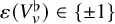


Proof. For the moment, we allow
$v_0$
 Archimedean or not. The groupoid in the lemma statement indeed has finite stabilizer groups, by discreteness of
$G_{\underline {x}}(F^+)$
Archimedean or not. The groupoid in the lemma statement indeed has finite stabilizer groups, by discreteness of
$G_{\underline {x}}(F^+)$
 . Take any factorizable open compact subgroup
$K_{\underline {x}} = \prod _v K_{\underline {x}, v} \subseteq G_{\underline {x}}(\mathbb {A})$
. Take any factorizable open compact subgroup
$K_{\underline {x}} = \prod _v K_{\underline {x}, v} \subseteq G_{\underline {x}}(\mathbb {A})$
 . Assume
$K_{\underline {x},v} = G_{\underline {x},v}(F^+_v)$
. Assume
$K_{\underline {x},v} = G_{\underline {x},v}(F^+_v)$
 for every Archimedean v, and assume
$K_{\underline {x},v} = K_{\underline {x},v_0}$
for every Archimedean v, and assume
$K_{\underline {x},v} = K_{\underline {x},v_0}$
 is the open compact subgroup fixed in the lemma statement when
$v = v_0$
is the open compact subgroup fixed in the lemma statement when
$v = v_0$
 . For each v, define
$\underline {x}_v^{\flat } = [x_{1,v}^{\flat }, \ldots , x^{\flat }_{m^{\flat },v}] \in V_v^{m^{\flat }}$
. For each v, define
$\underline {x}_v^{\flat } = [x_{1,v}^{\flat }, \ldots , x^{\flat }_{m^{\flat },v}] \in V_v^{m^{\flat }}$
 to be the tuple satisfying
$\underline {x} \cdot a_v^{-1} = [0,\ldots ,0, x_{1,v}^{\flat }, \ldots , x_{m^{\flat },v}^{\flat }]$
to be the tuple satisfying
$\underline {x} \cdot a_v^{-1} = [0,\ldots ,0, x_{1,v}^{\flat }, \ldots , x_{m^{\flat },v}^{\flat }]$
 (so
$T^{\flat }_v = (\underline {x}^{\flat }_v, \underline {x}^{\flat }_v)$
(so
$T^{\flat }_v = (\underline {x}^{\flat }_v, \underline {x}^{\flat }_v)$
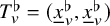 ).
).
We have
$\tilde {W}^{\ast }_{T^{\flat }_v,v}(a^{\flat }_v, s_0)^{\circ }_n = 1$
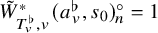 for all Archimedean
$v \neq v_0$
for all Archimedean
$v \neq v_0$
 by positive definite-ness of
$T^{\flat }_v$
by positive definite-ness of
$T^{\flat }_v$
 (Section 4.2). For all but finitely many v, the Hermitian matrix
${}^t \overline {a}^{\flat }_v T^{\flat }_v a^{\flat }_v$
(Section 4.2). For all but finitely many v, the Hermitian matrix
${}^t \overline {a}^{\flat }_v T^{\flat }_v a^{\flat }_v$
 defines a self-dual
$\mathcal {O}_{F_v}$
defines a self-dual
$\mathcal {O}_{F_v}$
 -lattice (first check the case where the collection
$(a_v)_v$
-lattice (first check the case where the collection
$(a_v)_v$
 comes from a single element
$a \in \operatorname {\mathrm {GL}}_m(F)$
comes from a single element
$a \in \operatorname {\mathrm {GL}}_m(F)$
 ; then recall that the
$\operatorname {\mathrm {GL}}_{m^{\flat }}(\mathcal {O}_{F_v})$
; then recall that the
$\operatorname {\mathrm {GL}}_{m^{\flat }}(\mathcal {O}_{F_v})$
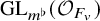 -equivalence class of
${}^t \overline {a}^{\flat }_v T^{\flat }_v a^{\flat }_v$
-equivalence class of
${}^t \overline {a}^{\flat }_v T^{\flat }_v a^{\flat }_v$
 does not depend on the choice of
$a_v$
does not depend on the choice of
$a_v$
 or
$a^{\flat }_v$
or
$a^{\flat }_v$
 ). For such non-Archimedean
$v \neq v_0$
). For such non-Archimedean
$v \neq v_0$
 , we have
$\tilde {W}^{\ast }_{T^{\flat }_v, v}(a^{\flat }_v, s, \Phi _{\varphi _v^{\flat }})_n = \tilde {W}^{\ast }_{T^{\flat }_v, v}(a^{\flat }_v, s)^{\circ }_n = 1$
, we have
$\tilde {W}^{\ast }_{T^{\flat }_v, v}(a^{\flat }_v, s, \Phi _{\varphi _v^{\flat }})_n = \tilde {W}^{\ast }_{T^{\flat }_v, v}(a^{\flat }_v, s)^{\circ }_n = 1$
 if
$L_v$
if
$L_v$
 is self-dual (see (4.5.7), Remark 4.5.1, and the invariance property in (4.3.4)). Hence
$\tilde {W}^{\ast }_{T^{\flat }_v, v}(a^{\flat }_v, s, \Phi _{\varphi _v^{\flat }})_n = 1$
is self-dual (see (4.5.7), Remark 4.5.1, and the invariance property in (4.3.4)). Hence
$\tilde {W}^{\ast }_{T^{\flat }_v, v}(a^{\flat }_v, s, \Phi _{\varphi _v^{\flat }})_n = 1$
 for all but finitely many v.
Choose Haar measures
$d g_{x,v}$
 on
$G_{\underline {x}}(F^+_v)$
on
$G_{\underline {x}}(F^+_v)$
 for each v. Assume that
$\mathrm {vol}_{d g_{x,v}}(K_{\underline {x},v}) \in \mathbb {Q}$
for each v. Assume that
$\mathrm {vol}_{d g_{x,v}}(K_{\underline {x},v}) \in \mathbb {Q}$
 for all v, that
$\mathrm {vol}_{d g_{x,v}}(K_{\underline {x},v}) = 1$
for all v, that
$\mathrm {vol}_{d g_{x,v}}(K_{\underline {x},v}) = 1$
 for all but finitely many v, and that
$\mathrm {vol}_{d g_x, v}(K_{\underline {x},v}) = 1$
for all but finitely many v, and that
$\mathrm {vol}_{d g_x, v}(K_{\underline {x},v}) = 1$
 if
$v = v_0$
if
$v = v_0$
 or if
$v \mid \infty $
or if
$v \mid \infty $
 .
.
For
$v < \infty $
 with
$v \neq v_0$
with
$v \neq v_0$
 , we give
$G(F^+_v)$
, we give
$G(F^+_v)$
 the unique Haar measure
$d g_v$
the unique Haar measure
$d g_v$
 such that

for any tuple
$\underline {x}^{\prime }_v \in V_v^m$
 (temporary notation) with nonsingular Gram matrix
$T^{\flat \prime }_v {:=} (\underline {x}^{\prime }_v, \underline {x}^{\prime }_v)$
(temporary notation) with nonsingular Gram matrix
$T^{\flat \prime }_v {:=} (\underline {x}^{\prime }_v, \underline {x}^{\prime }_v)$
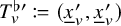 (Lemma 7.2.1). The integral is taken with respect to the quotient measure induced by
$d g_{x,v}$
(Lemma 7.2.1). The integral is taken with respect to the quotient measure induced by
$d g_{x,v}$
 . This measure
$d g_v$
. This measure
$d g_v$
 on
$G(F^+_v)$
on
$G(F^+_v)$
 may depend on n,
$m^{\flat }$
may depend on n,
$m^{\flat }$
 , the isomorphism class of
$L_v$
, the isomorphism class of
$L_v$
 (as the normalization defining
$\tilde {W}^{\ast }_{T^{\flat }, v}$
(as the normalization defining
$\tilde {W}^{\ast }_{T^{\flat }, v}$
 depended on
$L_v$
depended on
$L_v$
 ) as well as the local invariant
$\varepsilon (V^{\flat }_v)$
) as well as the local invariant
$\varepsilon (V^{\flat }_v)$
 (Remark 7.2.2). The measure
$d g_v$
(Remark 7.2.2). The measure
$d g_v$
 does not otherwise depend on
$T^{\flat }_v$
does not otherwise depend on
$T^{\flat }_v$
 . Note
$\mathrm {vol}_{d g_v}(K_{L,v}) \in \mathbb {Q}_{>0}$
. Note
$\mathrm {vol}_{d g_v}(K_{L,v}) \in \mathbb {Q}_{>0}$
 for any
$v < \infty $
for any
$v < \infty $
 with
$v \neq v_0$
with
$v \neq v_0$
 , since the left-hand side of (7.4.8) lies in
$\mathbb {Q}$
, since the left-hand side of (7.4.8) lies in
$\mathbb {Q}$
 by Lemma 4.4.2. We have
$\mathrm {vol}_{d g_v}(K_{L,v}) = 1$
by Lemma 4.4.2. We have
$\mathrm {vol}_{d g_v}(K_{L,v}) = 1$
 for all but finitely many v (cf. the proof of Lemma 7.3.6; we have
$W^{\ast }_{T^{\flat }_v, v}(s_0^{\flat })^{\circ }_n = 1$
for all but finitely many v (cf. the proof of Lemma 7.3.6; we have
$W^{\ast }_{T^{\flat }_v, v}(s_0^{\flat })^{\circ }_n = 1$
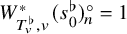 for all but finitely many v). We equip
$G(\mathbb {A}_f^{v_0})$
for all but finitely many v). We equip
$G(\mathbb {A}_f^{v_0})$
 with the product measure
$dg = \prod _{\substack {v < \infty \\ v \neq v_0}} d g_v$
with the product measure
$dg = \prod _{\substack {v < \infty \\ v \neq v_0}} d g_v$
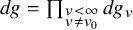 .
.
Using the Haar measures specified above, we may unfold the groupoid cardinality as


with

Note that the integrals are absolutely convergent, since the integrands are continuous and compactly supported. This unfolding also shows that the groupoid in (7.4.4) has finitely many isomorphism classes.
-
(1) Suppose $v_0$
is Archimedean. Recall that the Tamagawa number of any nontrivial unitary group is
$2$
[Reference IchinoIch04, Section 4]. After scaling one of the non-Archimedean local measures
$d g_{x,v}$
by an element of
$\mathbb {Q}_{>0}$
, we may assume
$\prod _v d g_{x, v}$
is the Tamagawa measure on
$G_{\underline {x}}(\mathbb {A})$
. If
$v \mid \infty $
, let
$d g_v$
be the Haar measure on
$G(F^+_v)$
given by Lemma 7.2.1 (induced by
$d g_{x,v}$
). For
$v \mid \infty $
, the local invariant
$\varepsilon (V^{\flat }_v)$
is already determined by V and the requirement that
$V^{\flat \perp }_v$
is definite. Hence the measures
$d g_v$
for
$v \mid \infty $
do not depend on
$V^{\flat }$
(apply Remark 7.2.2).By construction of the measures in Lemma 7.2.1 (via invariant differentials), we find that $\prod _v d g_v$
equals the Tamagawa measure on
$G(\mathbb {A})$
up to scaling by a constant which may depend on the lattices
$\{L_v\}_{v < \infty }$
as well as n and
$m^{\flat }$
(coming from our normalization of local Whittaker functions
$\tilde {W}^{\ast }_{T^{\flat },v}$
, Section 4.3). We conclude that the measure
$dg$
on
$G(\mathbb {A}_f)$
may depend on V, n,
$m^{\flat }$
, F, and the lattices
$\{L_v\}_{v < \infty }$
, but it does not otherwise depend on T or
$V^{\flat }$
or
$\underline {x}$
. -
(2) Suppose $m^{\flat } = n$
. Then
$G_{\underline {x}}$
is the trivial group. Take
$\mathrm {vol}_{d g_{x,v}}(K_{\underline {x},v}) = 1$
for all v. Consider
$v < \infty $
with
$v \neq v_0$
and set
$c_v = \mathrm {vol}_{d g_v}(K_{L,v})^{-1}$
. If
$L_v$
is self-dual, then
$c_v = 1$
by Lemma 7.3.6. In general,
$d g_v$
may depend on
$L_v$
(but not on T or
$T^{\flat }_v$
). -
(3) Suppose $m^{\flat } = n - 1$
. Then
$G_{\underline {x}}$
is isomorphic to the norm-one torus inside
$\operatorname {\mathrm {Res}}_{F/F^+} \mathbb {G}_m$
. Assume
$K_{\underline {x},v} \subseteq G_{\underline {x}}(F^+_v)$
is the unique maximal open compact subgroup for every v. Take
$\mathrm {vol}_{d g_{x,v}}(K_{\underline {x},v}) = 1$
for all v. Consider
$v < \infty $
with
$v \neq v_0$
and set
$c^{\prime }_v = \mathrm {vol}_{d g_v}(K_{L,v})^{-1}$
. If
$L_v$
is self-dual, then
$c^{\prime }_v = 1$
if
$F_v / F^+_v$
is unramified (resp.
$c^{\prime }_v = 2$
if
$F_v / F^+_v$
is ramified) by Lemma 7.3.6. In general,
$d g_v$
may depend on
$L_v$
,
$m^{\flat }$
and the local invariant
$\varepsilon (V^{\flat }_v)$
(but not on T or
$T^{\flat }_v$
).We have
$$\begin{align*} \mathrm{vol}(G_{\underline{x}}(F^+) \backslash G_{\underline{x}}(\mathbb{A})) = \deg [G_{\underline{x}}(F^+) \backslash (G_{\underline{x}}(\mathbb{A}) / K_{\underline{x}})] = \frac{\deg (G_{\underline{x}}(F^+) \backslash G_{\underline{x}}(\mathbb{A}) / K_{\underline{x}}) }{w_F} \end{align*}$$where $\deg [ - ]$
denotes groupoid cardinality and
$\deg ( - )$
denotes set cardinality. We have (7.4.15) $$ \begin{align} \deg (G_{\underline{x}}(F^+) \backslash G_{\underline{x}}(\mathbb{A}) / K_{\underline{x}}) = 2^{u - t} h_F h_{F^+}^{-1}, \end{align} $$where t is the number of prime ideals of $F^+$
which ramify in F, and where
$u \in \mathbb {Z}$
is such that
$H^1(\operatorname {\mathrm {Gal}}(F/F^+), \mathcal {O}_F^{\times }) \cong (\mathbb {Z} / 2 \mathbb {Z})^u$
[Reference OnoOno85, (9)]. A group cohomology computation (omitted) shows that
$2^{-u} = \# (\mathcal {O}_F^{\times } / (W \mathcal {O}_{F^+}^{\times }))/2$
(where
$\#$
also means cardinality).



















8 Geometric Siegel–Weil
8.1 Degrees of
$0$
-cycles

For the rest of the paper, we assume F is an imaginary quadratic extension of
$\mathbb {Q}$
 , that is,
$F^+ = \mathbb {Q}$
, that is,
$F^+ = \mathbb {Q}$
 .
.
Let L be any non-degenerate Hermitian
$\mathcal {O}_F$
 -lattice of signature
$(n - 1, 1)$
-lattice of signature
$(n - 1, 1)$
 (not assuming n is even). Let
$\mathcal {M} \rightarrow \operatorname {\mathrm {Spec}} \mathcal {O}_F[1/d_L]$
(not assuming n is even). Let
$\mathcal {M} \rightarrow \operatorname {\mathrm {Spec}} \mathcal {O}_F[1/d_L]$
 be the associated moduli stack ([Reference ChenChe24c, Section 2.1]). Recall that
$d_L \in \mathbb {Z}$
be the associated moduli stack ([Reference ChenChe24c, Section 2.1]). Recall that
$d_L \in \mathbb {Z}$
 is a certain integer associated to L, with
$d_L = 1$
is a certain integer associated to L, with
$d_L = 1$
 if L is self-dual when
$2 \nmid \Delta $
if L is self-dual when
$2 \nmid \Delta $
 . Let
$V {:=}q L \otimes _{\mathcal {O}_F} F$
. Let
$V {:=}q L \otimes _{\mathcal {O}_F} F$
 be the associated
$F / \mathbb {Q}$
be the associated
$F / \mathbb {Q}$
 Hermitian space.
Consider an integer m with
$m = n$
 or
$m = n - 1$
or
$m = n - 1$
 . Pick any embedding
$F \rightarrow \mathbb {C}$
. Pick any embedding
$F \rightarrow \mathbb {C}$
 , and set
$\mathcal {M}_{\mathbb {C}} {:=}q \mathcal {M} \times _{\operatorname {\mathrm {Spec}} \mathcal {O}_F} \operatorname {\mathrm {Spec}} \mathbb {C}$
, and set
$\mathcal {M}_{\mathbb {C}} {:=}q \mathcal {M} \times _{\operatorname {\mathrm {Spec}} \mathcal {O}_F} \operatorname {\mathrm {Spec}} \mathbb {C}$
 , etc. Given
$T \in \mathrm {Herm}_m(\mathbb {Q})$
, etc. Given
$T \in \mathrm {Herm}_m(\mathbb {Q})$
 with
$\operatorname {\mathrm {rank}} T = n - 1$
with
$\operatorname {\mathrm {rank}} T = n - 1$
 , recall that there is an associated Kudla–Rapoport special cycle
$\mathcal {Z}(T) \rightarrow \mathcal {M}$
, recall that there is an associated Kudla–Rapoport special cycle
$\mathcal {Z}(T) \rightarrow \mathcal {M}$
 [Reference ChenChe24c, Definition 2.1.4]. The base change
$\mathcal {Z}(T)_{\mathbb {C}}$
[Reference ChenChe24c, Definition 2.1.4]. The base change
$\mathcal {Z}(T)_{\mathbb {C}}$
 is smooth, proper, and quasi-finite (and of dimension zero) over
$\operatorname {\mathrm {Spec}} \mathbb {C}$
is smooth, proper, and quasi-finite (and of dimension zero) over
$\operatorname {\mathrm {Spec}} \mathbb {C}$
 [Reference ChenChe24c, Lemmas 2.3.5 and 3.3.4].
For each place v of
$\mathbb {Q}$
 , select any
$a_v \in \operatorname {\mathrm {GL}}_m(F_v)$
, select any
$a_v \in \operatorname {\mathrm {GL}}_m(F_v)$
 such that
${}^t \overline {a}_v^{-1} T a_v^{-1} = \mathrm {diag}(0,T^{\flat }_v)$
such that
${}^t \overline {a}_v^{-1} T a_v^{-1} = \mathrm {diag}(0,T^{\flat }_v)$
 for some
$T^{\flat }_v \in \mathrm {Herm}_{n - 1}(F^+_v)$
for some
$T^{\flat }_v \in \mathrm {Herm}_{n - 1}(F^+_v)$
 with
$\det T^{\flat }_v \neq 0$
with
$\det T^{\flat }_v \neq 0$
 . Choose any
$a_v^{\flat } \in \operatorname {\mathrm {GL}}_{n - 1}(F_v)$
. Choose any
$a_v^{\flat } \in \operatorname {\mathrm {GL}}_{n - 1}(F_v)$
 associated to
$a_v$
associated to
$a_v$
 via the Iwasawa decomposition, as in (7.4.1) (if
$m = n -1$
via the Iwasawa decomposition, as in (7.4.1) (if
$m = n -1$
 , we can just take
$a^{\flat }_v = a_v$
, we can just take
$a^{\flat }_v = a_v$
 ).
).
For formation of local Whittaker functions, we use the standard additive character
$\psi \colon \mathbb {Q} \backslash \mathbb {A} \rightarrow \mathbb {C}^{\times }$
 with
$\psi _{\infty }(x) = e^{2 \pi i x}$
with
$\psi _{\infty }(x) = e^{2 \pi i x}$
 . Suppose
$\chi \colon F^{\times } \backslash \mathbb {A}_F^{\times } \rightarrow \mathbb {C}^{\times }$
. Suppose
$\chi \colon F^{\times } \backslash \mathbb {A}_F^{\times } \rightarrow \mathbb {C}^{\times }$
 is a character satisfying
$\chi |_{\mathbb {A}^{\times }} = \eta ^n$
is a character satisfying
$\chi |_{\mathbb {A}^{\times }} = \eta ^n$
 , where
$\eta $
, where
$\eta $
 is the quadratic character associated to
$F / \mathbb {Q}$
is the quadratic character associated to
$F / \mathbb {Q}$
 . For each prime p, we let
$\varphi _p^{\flat } = {\pmb {1}}_{L_p}^{n - 1} \in \mathcal {S}(V(\mathbb {Q}_p)^{n - 1})$
. For each prime p, we let
$\varphi _p^{\flat } = {\pmb {1}}_{L_p}^{n - 1} \in \mathcal {S}(V(\mathbb {Q}_p)^{n - 1})$
 where
${\pmb {1}}_{L_p}$
where
${\pmb {1}}_{L_p}$
 is the characteristic function of the lattice
$L_p \subseteq V(\mathbb {Q}_p)$
is the characteristic function of the lattice
$L_p \subseteq V(\mathbb {Q}_p)$
 .
.
Proposition 8.1.1. Let
$C \in \mathbb {Q}_{>0}$
 be the volume constant from Lemma 7.4.1(3), for the Hermitian space V and with
$v_0 = \infty $
be the volume constant from Lemma 7.4.1(3), for the Hermitian space V and with
$v_0 = \infty $
 in the notation of loc. cit. In the situation above, we have

Proof. As in Section 7.1, we write
$\Omega _T(R) {:=}q \{\underline {x} \in (V \otimes _{\mathbb {Q}} R)^m : (\underline {x}, \underline {x}) = T\}$
 for
$\mathbb {Q}$
for
$\mathbb {Q}$
 -algebras R. Here
$\deg \mathcal {Z}(T)_{\mathbb {C}}$
-algebras R. Here
$\deg \mathcal {Z}(T)_{\mathbb {C}}$
 denotes the (stacky) degree of
$\mathcal {Z}(T)_{\mathbb {C}}$
denotes the (stacky) degree of
$\mathcal {Z}(T)_{\mathbb {C}}$
 over
$\operatorname {\mathrm {Spec}} \mathbb {C}$
over
$\operatorname {\mathrm {Spec}} \mathbb {C}$
 , as explained at the end of [Reference ChenChe24a, Appendix A.1].
Suppose there is no tuple
$\underline {x} \in V^m$
 such that
$(\underline {x}, \underline {x}) = T$
such that
$(\underline {x}, \underline {x}) = T$
 . By the Hasse principle, we conclude
$\Omega _T(\mathbb {Q}_{v_0}) = \emptyset $
. By the Hasse principle, we conclude
$\Omega _T(\mathbb {Q}_{v_0}) = \emptyset $
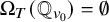 for some place
$v_0$
for some place
$v_0$
 of
$\mathbb {Q}$
of
$\mathbb {Q}$
 . Since
$\operatorname {\mathrm {rank}}(T) < n$
. Since
$\operatorname {\mathrm {rank}}(T) < n$
 , we must have
$v_0 = \infty $
, we must have
$v_0 = \infty $
 (i.e., for
$v < \infty $
(i.e., for
$v < \infty $
 , any non-degenerate Hermitian
$F_v$
, any non-degenerate Hermitian
$F_v$
 vector space of rank
$n - 1$
vector space of rank
$n - 1$
 embeds isometrically into any non-degenerate Hermitian
$F_v$
embeds isometrically into any non-degenerate Hermitian
$F_v$
 vector space of rank n). We conclude that
$T^{\flat }_{\infty }$
vector space of rank n). We conclude that
$T^{\flat }_{\infty }$
 (and
${}^t \overline {a}^{\flat }_{\infty } T^{\flat }_{\infty } a^{\flat }_{\infty }$
(and
${}^t \overline {a}^{\flat }_{\infty } T^{\flat }_{\infty } a^{\flat }_{\infty }$
 ) has signature
$(n - 1 - r, r)$
) has signature
$(n - 1 - r, r)$
 for some
$r \geq 2$
for some
$r \geq 2$
 . The proposition holds in this case because
$\tilde {W}^{\ast }_{T^{\flat }_{\infty }, \infty }(a^{\flat }_{\infty }, 1/2)^{\circ }_n = 0$
. The proposition holds in this case because
$\tilde {W}^{\ast }_{T^{\flat }_{\infty }, \infty }(a^{\flat }_{\infty }, 1/2)^{\circ }_n = 0$
 (by (4.2.6) or (7.2.2)).
Suppose there exists
$\underline {x} \in V^m$
 such that
$(\underline {x}, \underline {x}) = T$
such that
$(\underline {x}, \underline {x}) = T$
 . For such
$\underline {x}$
. For such
$\underline {x}$
 , write
$\underline {x}_{\infty } \in V_{\mathbb {R}}^m$
, write
$\underline {x}_{\infty } \in V_{\mathbb {R}}^m$
 and
$\underline {x}_f \in (V \otimes _{\mathbb {Q}} \mathbb {A}_f)^m$
and
$\underline {x}_f \in (V \otimes _{\mathbb {Q}} \mathbb {A}_f)^m$
 for the respective images. By complex uniformization of special cycles [Reference ChenChe24c, (5.3.4)],Footnote
16
we have
for the respective images. By complex uniformization of special cycles [Reference ChenChe24c, (5.3.4)],Footnote
16
we have

that is, (8.1.2) is the groupoid cardinality of [Reference ChenChe24c, (5.3.5)]. Here
$\deg \mathcal {D}(\underline {x}_{\infty })$
 is the degree of the Archimedean local special cycle
$\mathcal {D}(\underline {x}_{\infty }) \subseteq \mathcal {D}$
is the degree of the Archimedean local special cycle
$\mathcal {D}(\underline {x}_{\infty }) \subseteq \mathcal {D}$
 [Reference ChenChe24b, Section 2.2] for any
$\underline {x} \in V^m$
[Reference ChenChe24b, Section 2.2] for any
$\underline {x} \in V^m$
 with
$(\underline {x}, \underline {x}) = T$
with
$(\underline {x}, \underline {x}) = T$
 . We know
$\mathcal {D}(\underline {x}_{\infty })$
. We know
$\mathcal {D}(\underline {x}_{\infty })$
 is a single point if T is positive semidefinite, and empty otherwise. Hence
$\deg \mathcal {D}(\underline {x}_{\infty }) = \tilde {W}^{\ast }_{T^{\flat }_{\infty }, \infty }(a^{\flat }_{\infty }, 1/2)^{\circ }_n$
is a single point if T is positive semidefinite, and empty otherwise. Hence
$\deg \mathcal {D}(\underline {x}_{\infty }) = \tilde {W}^{\ast }_{T^{\flat }_{\infty }, \infty }(a^{\flat }_{\infty }, 1/2)^{\circ }_n$
 (by (4.2.6), the right-hand side is
$1$
(by (4.2.6), the right-hand side is
$1$
 if
$T^{\flat }_{\infty }$
if
$T^{\flat }_{\infty }$
 is positive definite and
$0$
is positive definite and
$0$
 otherwise).
We then use Lemma 7.4.1 to evaluate the groupoid cardinality in (8.1.2). For the reader’s convenience, we note that the present
$\mathcal {D}(\underline {x}_f)$
 is the
$\mathcal {Z}(\underline {x}_f^{v_0})$
is the
$\mathcal {Z}(\underline {x}_f^{v_0})$
 from loc. cit. (taking
$v_0$
from loc. cit. (taking
$v_0$
 to be the Archimedean place), and we are using transitivity of
$U(V)(\mathbb {Q})$
to be the Archimedean place), and we are using transitivity of
$U(V)(\mathbb {Q})$
 acting on the set of
$\underline {x} \in V^m$
acting on the set of
$\underline {x} \in V^m$
 satisfying
$(\underline {x}, \underline {x}) = T$
satisfying
$(\underline {x}, \underline {x}) = T$
 (Witt’s theorem). The latter uses the fact that
$\operatorname {\mathrm {rank}} T = n - 1$
(Witt’s theorem). The latter uses the fact that
$\operatorname {\mathrm {rank}} T = n - 1$
 , which implies that any such
$\underline {x}$
, which implies that any such
$\underline {x}$
 must span a non-degenerate subspace of V.
Remark 8.1.2. Suppose
$2 \nmid \Delta $
 and that L is self-dual (for the trace pairing, as is our running convention). We then have
$C = 2 h_F / w_F$
and that L is self-dual (for the trace pairing, as is our running convention). We then have
$C = 2 h_F / w_F$
 in Proposition 8.1.1. Take any
$a \in \operatorname {\mathrm {GL}}_m(F)$
in Proposition 8.1.1. Take any
$a \in \operatorname {\mathrm {GL}}_m(F)$
 such that
${}^t \overline {a}^{-1} T a^{-1} = \mathrm {diag}(0, T^{\flat })$
such that
${}^t \overline {a}^{-1} T a^{-1} = \mathrm {diag}(0, T^{\flat })$
 where
$T^{\flat } \in \mathrm {Herm}_{n - 1}(\mathbb {Q})$
where
$T^{\flat } \in \mathrm {Herm}_{n - 1}(\mathbb {Q})$
 with
$\det T^{\flat } \neq 0$
with
$\det T^{\flat } \neq 0$
 . For each place v of
$\mathbb {Q}$
. For each place v of
$\mathbb {Q}$
 , let
$a_v {:=}q a \in \operatorname {\mathrm {GL}}_m(F_v)$
, let
$a_v {:=}q a \in \operatorname {\mathrm {GL}}_m(F_v)$
 . Set
$a^{\flat } = (a^{\flat }_v)_v \in \operatorname {\mathrm {GL}}_m(\mathbb {A}_F)$
. Set
$a^{\flat } = (a^{\flat }_v)_v \in \operatorname {\mathrm {GL}}_m(\mathbb {A}_F)$
 (running over places v of
$\mathbb {Q}$
(running over places v of
$\mathbb {Q}$
 ) in the notation above. The proposition then states

Remark 8.1.3. As observed by Li and Zhang [Reference Li and ZhangLZ22, Remark 4.6.2], Proposition 8.1.1 may be proved using Rapoport–Zink non-Archimedean uniformization in essentially the same way. Indeed, the horizontal local special cycle
$\mathcal {Z}(T)_{\mathscr {H}} \rightarrow \operatorname {\mathrm {Spec}} \mathcal {O}_F[1/d_L]$
 is proper, quasi-finite, and flat [Reference ChenChe24c, Lemma 3.3.4], so we may calculate its degree in the fiber over any geometric point of
$\operatorname {\mathrm {Spec}} \mathcal {O}_F[1/d_L]$
is proper, quasi-finite, and flat [Reference ChenChe24c, Lemma 3.3.4], so we may calculate its degree in the fiber over any geometric point of
$\operatorname {\mathrm {Spec}} \mathcal {O}_F[1/d_L]$
 . Fix a geometric point in characteristic
$p> 0$
. Fix a geometric point in characteristic
$p> 0$
 . Assume
$p \neq 2$
. Assume
$p \neq 2$
 if
$2$
if
$2$
 is nonsplit in
$\mathcal {O}_F$
is nonsplit in
$\mathcal {O}_F$
 , assume
$L_p$
, assume
$L_p$
 is self-dual, and assume either
$p \nmid \Delta $
is self-dual, and assume either
$p \nmid \Delta $
 or that L is self-dual and
$2 \nmid \Delta $
or that L is self-dual and
$2 \nmid \Delta $
 . Consider the n-dimensional positive definite non-degenerate Hermitian space
$\mathbf {V}$
. Consider the n-dimensional positive definite non-degenerate Hermitian space
$\mathbf {V}$
 with
$\varepsilon (\mathbf {V}_p) = -1$
with
$\varepsilon (\mathbf {V}_p) = -1$
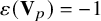 and
$\varepsilon (\mathbf {V}_{\ell }) = \varepsilon (V_{\ell })$
and
$\varepsilon (\mathbf {V}_{\ell }) = \varepsilon (V_{\ell })$
 for any
$\ell \neq p$
for any
$\ell \neq p$
 .
.
Using non-Archimedean uniformization, we may then argue as in the proof of Proposition 8.1.1 (see [Reference ChenChe24c, p. 4.9.6]), using the special value formula for degrees of local special cycles [Reference ChenChe24a, Lemma 9.1.3], and the formula for uniformization degrees (Lemma 7.4.1) for
$\mathbf {V}$
 and
$v_0 = p$
and
$v_0 = p$
 .
.
8.2 Complex volumes
Assume
$2$
 is unramified in
$\mathcal {O}_F$
is unramified in
$\mathcal {O}_F$
 . For even integers
$n \in \mathbb {Z}_{>0}$
. For even integers
$n \in \mathbb {Z}_{>0}$
 , we show that the global normalizing factors
$\Lambda _n(s)^{\circ }_n$
, we show that the global normalizing factors
$\Lambda _n(s)^{\circ }_n$
 (Section 6.1) encode complex volumes of certain unitary Shimura varieties (Propositions 8.2.1 and 8.2.3).
First consider
$n \equiv 0\ \pmod {4}$
 . Let V be the unique
$F / \mathbb {Q}$
. Let V be the unique
$F / \mathbb {Q}$
 Hermitian space of signature
$(n,0)$
Hermitian space of signature
$(n,0)$
 which satisfies
$\varepsilon (V_p) = 1$
which satisfies
$\varepsilon (V_p) = 1$
 for all primes p (with
$\varepsilon $
for all primes p (with
$\varepsilon $
 as in [Reference ChenChe24a, Section 2.2], i.e., V contains a full-rank self-dual
$\mathcal {O}_F$
as in [Reference ChenChe24a, Section 2.2], i.e., V contains a full-rank self-dual
$\mathcal {O}_F$
 -lattice). Set
$G {:=}q U(V)$
-lattice). Set
$G {:=}q U(V)$
 , let
$L \subseteq V$
, let
$L \subseteq V$
 be a full-rank self-dual lattice, and write
$K_{L,f} \subseteq G(\mathbb {A}_f)$
be a full-rank self-dual lattice, and write
$K_{L,f} \subseteq G(\mathbb {A}_f)$
 for the adèlic stabilizer of L. The following proposition should be a special case of a unitary analogue of the classical Siegel mass formula. It is included for comparison with the analogous volume identity for a signature
$(n - 1, 1)$
for the adèlic stabilizer of L. The following proposition should be a special case of a unitary analogue of the classical Siegel mass formula. It is included for comparison with the analogous volume identity for a signature
$(n - 1, 1)$
 unitary complex Shimura variety. The left-hand side counts self-dual positive definite
$\mathcal {O}_F$
unitary complex Shimura variety. The left-hand side counts self-dual positive definite
$\mathcal {O}_F$
 -lattices of rank n, weighted by the inverses of the sizes of their automorphism groups.
Proposition 8.2.1. We have

where the left-hand side denotes groupoid cardinality.
Proof. Let
$\psi \colon \mathbb {Q} \backslash \mathbb {A} \rightarrow \mathbb {C}^{\times }$
 be the standard additive character with
$\psi _{\infty }(x) = e^{2 \pi i x}$
be the standard additive character with
$\psi _{\infty }(x) = e^{2 \pi i x}$
 . Let
$\chi \colon \mathbb {A}_F^{\times } \rightarrow \mathbb {C}^{\times }$
. Let
$\chi \colon \mathbb {A}_F^{\times } \rightarrow \mathbb {C}^{\times }$
 be the trivial character.
For
$v = \infty $
 , let
$\varphi _v(\underline {x}) = e^{2 \pi i \mathrm {tr}(\underline {x},\underline {x})} \in \mathcal {S}(V(\mathbb {R})^n)$
, let
$\varphi _v(\underline {x}) = e^{2 \pi i \mathrm {tr}(\underline {x},\underline {x})} \in \mathcal {S}(V(\mathbb {R})^n)$
 and let
$T \in \mathrm {Herm}_n(\mathbb {R})$
and let
$T \in \mathrm {Herm}_n(\mathbb {R})$
 be an arbitrary positive definite matrix. For
$v < \infty $
be an arbitrary positive definite matrix. For
$v < \infty $
 corresponding to a prime p, let
$\varphi _v = {\pmb {1}}_{L_v}^n \in \mathcal {S}(V(\mathbb {Q}_p)^n)$
corresponding to a prime p, let
$\varphi _v = {\pmb {1}}_{L_v}^n \in \mathcal {S}(V(\mathbb {Q}_p)^n)$
 and let T be the Gram matrix for any basis of
$L_v$
and let T be the Gram matrix for any basis of
$L_v$
 . For such T, we have
$W^{\ast }_{T,v}(s_0)^{\circ }_n = 1$
. For such T, we have
$W^{\ast }_{T,v}(s_0)^{\circ }_n = 1$
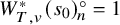 for all v (in both Archimedean and non-Archimedean cases), by (4.2.6) and (4.5.7). Recall
$W^{\ast }_{T,v}(s)^{\circ }_n = \Lambda _{T,v}(s)^{\circ }_n W_{T,v}(s, \Phi _{\varphi _v})$
for all v (in both Archimedean and non-Archimedean cases), by (4.2.6) and (4.5.7). Recall
$W^{\ast }_{T,v}(s)^{\circ }_n = \Lambda _{T,v}(s)^{\circ }_n W_{T,v}(s, \Phi _{\varphi _v})$
 if
$v < \infty $
if
$v < \infty $
 (resp.
$W^{\ast }_{T,v}(s)^{\circ }_n e^{- 2 \pi \mathrm {tr}(T)} = \Lambda _{T,v}(s)^{\circ }_n W_{T,v}(s, \Phi _{\varphi _v})$
(resp.
$W^{\ast }_{T,v}(s)^{\circ }_n e^{- 2 \pi \mathrm {tr}(T)} = \Lambda _{T,v}(s)^{\circ }_n W_{T,v}(s, \Phi _{\varphi _v})$
 if
$v = \infty $
if
$v = \infty $
 ); see Section 3.2.
Using these data, the local Siegel–Weil formula and its proof (Lemma 7.2.1) for each place v of
$\mathbb {Q}$
 shows that
$\mathrm {vol}(G(\mathbb {R}) \times K_{L,f})^{-1} = \Lambda _n(0)^{\circ }_n$
shows that
$\mathrm {vol}(G(\mathbb {R}) \times K_{L,f})^{-1} = \Lambda _n(0)^{\circ }_n$
 for the Tamagawa measure on
$G(\mathbb {A})$
for the Tamagawa measure on
$G(\mathbb {A})$
 . Since G has Tamagawa number
$2$
. Since G has Tamagawa number
$2$
 [Reference IchinoIch04, §4], the proposition follows.
Next, consider
$n \equiv 2\ \pmod {4}$
 . Let V be the unique n-dimensional
$F / \mathbb {Q}$
. Let V be the unique n-dimensional
$F / \mathbb {Q}$
 Hermitian space of signature
$(n - 1, 1)$
Hermitian space of signature
$(n - 1, 1)$
 which satisfies
$\varepsilon (V_p) = 1$
which satisfies
$\varepsilon (V_p) = 1$
 for all primes p. Again, set
$G {:=}q U(V)$
for all primes p. Again, set
$G {:=}q U(V)$
 , let
$L \subseteq V$
, let
$L \subseteq V$
 be a full-rank self-dual lattice, and write
$K_{L,f} \subseteq G(\mathbb {A}_f)$
be a full-rank self-dual lattice, and write
$K_{L,f} \subseteq G(\mathbb {A}_f)$
 for the adèlic stabilizer of L. For sufficiently small open compact
$K_f \subseteq G(\mathbb {A}_f)$
for the adèlic stabilizer of L. For sufficiently small open compact
$K_f \subseteq G(\mathbb {A}_f)$
 , there is a complex (analytic) Shimura variety

of dimension
$n - 1$
 , where
$\mathcal {D}$
, where
$\mathcal {D}$
 is the Hermitian symmetric domain from [Reference ChenChe24b, Section 2.1] (parameterizing maximal negative definite subspaces of
$V_{\mathbb {R}}$
is the Hermitian symmetric domain from [Reference ChenChe24b, Section 2.1] (parameterizing maximal negative definite subspaces of
$V_{\mathbb {R}}$
 ); the V of loc. cit. is our
$V_{\mathbb {R}}$
); the V of loc. cit. is our
$V_{\mathbb {R}}$
 , with
$\mathbb {C} = F \otimes _{\mathbb {Q}} \mathbb {R}$
, with
$\mathbb {C} = F \otimes _{\mathbb {Q}} \mathbb {R}$
 -action. The metrized tautological bundle
$\widehat {\mathcal {E}}^{\vee }$
-action. The metrized tautological bundle
$\widehat {\mathcal {E}}^{\vee }$
 of loc. cit. descends to
$\mathrm {Sh}_{K_f, \mathbb {C}}$
of loc. cit. descends to
$\mathrm {Sh}_{K_f, \mathbb {C}}$
 . For any open compact
$K^{\prime }_f \subseteq G(\mathbb {A}_f)$
. For any open compact
$K^{\prime }_f \subseteq G(\mathbb {A}_f)$
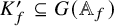 and any sufficiently small
$K_f \subseteq K^{\prime }_{f}$
and any sufficiently small
$K_f \subseteq K^{\prime }_{f}$
 , we set

If
$K_{L',f} \subseteq G(\mathbb {A}_f)$
 is the adèlic stabilizer of a full-rank lattice
$L' \subseteq V$
is the adèlic stabilizer of a full-rank lattice
$L' \subseteq V$
 which is self-dual for the Hermitian pairing, the quantity
$\mathrm {vol}(\mathrm {Sh}_{K^{\prime }_{L,f},\mathbb {C}})$
which is self-dual for the Hermitian pairing, the quantity
$\mathrm {vol}(\mathrm {Sh}_{K^{\prime }_{L,f},\mathbb {C}})$
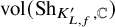 was computed explicitly in [Reference Hendrik Bruinier and HowardBH21, Theorem A]. We show that the level
$K_{L,f}$
was computed explicitly in [Reference Hendrik Bruinier and HowardBH21, Theorem A]. We show that the level
$K_{L,f}$
 (self-dual for the trace pairing) removes the additional factors at ramified primes in loc. cit., and that the resulting complex volume agrees with
$2 \Lambda _n(0)^{\circ }_n$
(self-dual for the trace pairing) removes the additional factors at ramified primes in loc. cit., and that the resulting complex volume agrees with
$2 \Lambda _n(0)^{\circ }_n$
 exactly.
The volume identity should also follow from [Reference Li and LiuLL21, Footnote 11] (or possibly other geometric Siegel–Weil results). We instead compute
$\mathrm {vol}(\mathrm {Sh}_{K_{L,f},\mathbb {C}})$
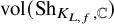 using [Reference Hendrik Bruinier and HowardBH21, Theorem A] by calculating the “change of level” via the following lemma.
Lemma 8.2.2. Let
$E^+_v$
 be a non-Archimedean local field of odd residue cardinality
$q_v$
be a non-Archimedean local field of odd residue cardinality
$q_v$
 , and let
$E_v/E^+_v$
, and let
$E_v/E^+_v$
 be a ramified quadratic extension with involution
$a \mapsto a^{\sigma }$
be a ramified quadratic extension with involution
$a \mapsto a^{\sigma }$
 .
.
Let W be a rank
$2d$
 non-degenerate
$E_v/E^+_v$
non-degenerate
$E_v/E^+_v$
 Hermitian space, and assume W contains a full-rank lattice
$M \subseteq W$
Hermitian space, and assume W contains a full-rank lattice
$M \subseteq W$
 which is self-dual (for the trace pairing). Let
$M' \subseteq W$
which is self-dual (for the trace pairing). Let
$M' \subseteq W$
 be any full-rank lattice which is self-dual for the Hermitian pairing.
If
$K, K' \subseteq U(W)$
 are the stabilizers of M and
$M'$
are the stabilizers of M and
$M'$
 respectively, we have

for any Haar measure on
$U(W)$
 .
.
Proof. We know that any two full-rank lattices in W which are self-dual (resp. self-dual for the Hermitian form) are isomorphic [Reference JacobowitzJac62, Proposition 8.1] (false if
$E^+_v$
 is allowed to have residue characteristic
$2$
is allowed to have residue characteristic
$2$
 ). Hence
$\mathrm {vol}(K)/\mathrm {vol}(K')$
). Hence
$\mathrm {vol}(K)/\mathrm {vol}(K')$
 does not depend on the choice of M and
$M'$
does not depend on the choice of M and
$M'$
 (nor the choice of Haar measure).
Let
$\varpi $
 be a uniformizer of
$E_v$
be a uniformizer of
$E_v$
 , and assume
$\varpi ^{\sigma } = - \varpi $
, and assume
$\varpi ^{\sigma } = - \varpi $
 . The lattices M and
$M'$
. The lattices M and
$M'$
 admit bases with Gram matrices

respectively. Choose a basis
$e_1, \ldots , e_{2d}$
 for M with Gram matrix as above. We may assume that
$M'$
for M with Gram matrix as above. We may assume that
$M'$
 is the lattice with basis
$e_1, \ldots , e_d, \varpi e_{d+1}, \ldots , \varpi e_{2d}$
is the lattice with basis
$e_1, \ldots , e_d, \varpi e_{d+1}, \ldots , \varpi e_{2d}$
 . Let
$\overline {W}$
. Let
$\overline {W}$
 (resp.
$\overline {W}'$
(resp.
$\overline {W}'$
 ) be the
$2d$
) be the
$2d$
 -dimensional vector space over
$\mathbb {F}_{q_v}$
-dimensional vector space over
$\mathbb {F}_{q_v}$
 with symplectic pairing (resp. bilinear pairing) given by the block matrices

If
$P_W \subseteq \mathrm {Sp}(\overline {W})$
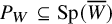 and
$P_{\overline {W}'} \subseteq \mathrm {O}(\overline {W})$
and
$P_{\overline {W}'} \subseteq \mathrm {O}(\overline {W})$
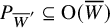 are the subgroups of upper triangular matrices (in
$d \times d$
are the subgroups of upper triangular matrices (in
$d \times d$
 blocks), we have


The lemma now follows from the formulas

We return to the global situation with
$F / \mathbb {Q}$
 as above and
$L \subseteq V$
as above and
$L \subseteq V$
 a self-dual lattice.
Proposition 8.2.3. We have

Proof. If
$K_{L',f} \subseteq G(\mathbb {A}_f)$
 is the adèlic stabilizer of a full-rank lattice
$L' \subseteq V$
is the adèlic stabilizer of a full-rank lattice
$L' \subseteq V$
 which is self-dual for the Hermitian pairing, the result [Reference Hendrik Bruinier and HowardBH21, Theorem A] (see also [Reference Hendrik Bruinier and HowardBH21, Theorem 5.5.1] to compare
$c_1(\widehat {\mathcal {E}})$
which is self-dual for the Hermitian pairing, the result [Reference Hendrik Bruinier and HowardBH21, Theorem A] (see also [Reference Hendrik Bruinier and HowardBH21, Theorem 5.5.1] to compare
$c_1(\widehat {\mathcal {E}})$
 with the Chern form of the metrized Hodge bundle; note our
$\widehat {\mathcal {E}}$
with the Chern form of the metrized Hodge bundle; note our
$\widehat {\mathcal {E}}$
 is
$\widehat {\mathcal {L}}$
is
$\widehat {\mathcal {L}}$
 in loc. cit. (up to restricting)) gives

where
$o(\Delta )$
 is the number of primes dividing
$\Delta $
is the number of primes dividing
$\Delta $
 . We assumed
$\varepsilon (V_{\ell }) = 1$
. We assumed
$\varepsilon (V_{\ell }) = 1$
 for all
$\ell $
for all
$\ell $
 , and a direct computation shows

(using even-ness of n). The claim now follows from the computation of
$\mathrm {vol}(K_{L,f})/\mathrm {vol}(K_{L',f})$
 (for any Haar measure on
$G(\mathbb {A}_f)$
(for any Haar measure on
$G(\mathbb {A}_f)$
 ) from Lemma 8.2.2. Note that the only discrepancy between
$\mathrm {vol}(K_{L,f})$
) from Lemma 8.2.2. Note that the only discrepancy between
$\mathrm {vol}(K_{L,f})$
 and
$\mathrm {vol}(K_{L',f})$
and
$\mathrm {vol}(K_{L',f})$
 is at ramified primes, since self-dual lattices for the Hermitian pairing are the same as self-dual lattices at unramified primes.
9 Arithmetic Siegel–Weil
9.1 Main theorems
This section contains the statements and proofs of our main global results (Theorem 9.1.1 and the secondary Theorem 9.1.6). Theorem 9.1.1 relies on essentially all preceding results in our four-part sequence of papers. We necessarily heavily cite our companion papers [Reference ChenChe24a; Reference ChenChe24b; Reference ChenChe24c]. In the proof, we explain how to combine our local main results (proved in [Reference ChenChe24a, Section 9] [Reference ChenChe24b, Section 4]) and a (new) “local diagonalization” argument to deal with singular T (including those which are not necessarily
$\operatorname {\mathrm {GL}}_n(\mathcal {O}_F)$
 -conjugate to a block diagonal matrix with nonsingular diagonal blocks).
Assume
$2 \nmid \Delta $
 , and let L be any non-degenerate self-dual Hermitian
$\mathcal {O}_F$
, and let L be any non-degenerate self-dual Hermitian
$\mathcal {O}_F$
 -lattice of signature
$(n - 1, 1)$
-lattice of signature
$(n - 1, 1)$
 . Set
$n {:=}q \operatorname {\mathrm {rank}} L$
. Set
$n {:=}q \operatorname {\mathrm {rank}} L$
 , and note
$n \equiv 2\ \pmod {4}$
, and note
$n \equiv 2\ \pmod {4}$
 (by the global product formula for local invariants of Hermitian spaces; note
$\varepsilon (L_p) = 1$
(by the global product formula for local invariants of Hermitian spaces; note
$\varepsilon (L_p) = 1$
 for all primes p).
Form the associated (smooth) moduli stack
$\mathcal {M} \rightarrow \operatorname {\mathrm {Spec}} \mathcal {O}_F$
 ([Reference ChenChe24c, Section 2.1] and [Reference ChenChe24a, Section 3.1]). We are imposing “no level structure” on
$\mathcal {M}$
([Reference ChenChe24c, Section 2.1] and [Reference ChenChe24a, Section 3.1]). We are imposing “no level structure” on
$\mathcal {M}$
 (i.e.,
$K_{0,f} \times K_f = K_{L_0,f} \times K_{L,f}$
(i.e.,
$K_{0,f} \times K_f = K_{L_0,f} \times K_{L,f}$
 in the notation of [Reference ChenChe24c, Section 2.2]).
For any m, given
$T \in \mathrm {Herm}_m(\mathbb {Q})$
 (with F-coefficients), and given
$y \in \mathrm {Herm}_m(\mathbb {R})_{>0}$
(with F-coefficients), and given
$y \in \mathrm {Herm}_m(\mathbb {R})_{>0}$
 (with
$\mathbb {C}$
(with
$\mathbb {C}$
 -coefficients), recall that there is an arithmetic special cycle class
$[\widehat {\mathcal {Z}}(T)] \in \widehat {\mathrm {Ch}}{}^m(\mathcal {M})_{\mathbb {Q}}$
-coefficients), recall that there is an arithmetic special cycle class
$[\widehat {\mathcal {Z}}(T)] \in \widehat {\mathrm {Ch}}{}^m(\mathcal {M})_{\mathbb {Q}}$
 [Reference ChenChe24c, Section 3] and a normalized T-th Fourier coefficient
$E^{\ast }_{T}(y,s)^{\circ }_n$
[Reference ChenChe24c, Section 3] and a normalized T-th Fourier coefficient
$E^{\ast }_{T}(y,s)^{\circ }_n$
 (Section 6.1) of a
$U(m,m)$
(Section 6.1) of a
$U(m,m)$
 Eisenstein series. Recall that the construction of
$[\widehat {\mathcal {Z}}(T)]$
Eisenstein series. Recall that the construction of
$[\widehat {\mathcal {Z}}(T)]$
 involves a choice of Green current
$g_{T,y}$
involves a choice of Green current
$g_{T,y}$
 . If
$\operatorname {\mathrm {rank}}(T) \geq n - 1$
. If
$\operatorname {\mathrm {rank}}(T) \geq n - 1$
 or if T is nonsingular and not positive definite, we are using the current
$g_{T,y}$
or if T is nonsingular and not positive definite, we are using the current
$g_{T,y}$
 from [Reference ChenChe24c, Section 5.4] (constructed from the local analogue in [Reference ChenChe24b, Section 2.4]). The class
$[\widehat {\mathcal {Z}}(T)]$
from [Reference ChenChe24c, Section 5.4] (constructed from the local analogue in [Reference ChenChe24b, Section 2.4]). The class
$[\widehat {\mathcal {Z}}(T)]$
 thus implicitly depends on y.
For special cycles
$\mathcal {Z}(T)$
 which are proper over
$\operatorname {\mathrm {Spec}} \mathcal {O}_F$
which are proper over
$\operatorname {\mathrm {Spec}} \mathcal {O}_F$
 , recall that we have defined certain arithmetic degrees without boundary contributions (1.3.6). These are the arithmetic degrees appearing in our main theorem below.
For use below, we record the expression

which follows from our formula for the normalizing factor
$\Lambda _m(s)^{\circ }_n$
 (6.1.2). We thus have

where the left expression follows from the analytic class number formula, and
$h^{\mathrm {CM}}_{\widehat {\mathcal {E}}^{\vee }}$
 is the height constant from [Reference ChenChe24c, (2.1.13)], arising from Faltings heights of elliptic curves with complex multiplication by
$\mathcal {O}_F$
is the height constant from [Reference ChenChe24c, (2.1.13)], arising from Faltings heights of elliptic curves with complex multiplication by
$\mathcal {O}_F$
 (for the purpose of the present paper, one could also take (9.1.2) as the definition of
$h^{\mathrm {CM}}_{\widehat {\mathcal {E}}^{\vee }}$
(for the purpose of the present paper, one could also take (9.1.2) as the definition of
$h^{\mathrm {CM}}_{\widehat {\mathcal {E}}^{\vee }}$
 ).
).
Theorem 9.1.1 (Co-rank
$1$
arithmetic Siegel–Weil)

Assume the prime
$2$
 splits in
$\mathcal {O}_F$
splits in
$\mathcal {O}_F$
 .
.
-
(1) For any $T \in \mathrm {Herm}_n(\mathbb {Q})$
with
$\operatorname {\mathrm {rank}}(T) = n - 1$
and any
$y \in \mathrm {Herm}_n(\mathbb {R})_{>0}$
, we have (9.1.3) $$ \begin{align} \widehat{\deg}([\widehat{\mathcal{Z}}(T)]) = \frac{h_F}{w_F} \frac{d}{d s} \bigg |_{s = 0} E^{\ast}_{T}(y,s)^{\circ}_n. \end{align} $$
-
(2) For any $T^{\flat } \in \mathrm {Herm}_{n - 1}(\mathbb {Q})$
with
$\det T^{\flat } \neq 0$
and any
$y^{\flat } \in \mathrm {Herm}_{n-1}(\mathbb {R})_{>0}$
, we have (9.1.4) $$ \begin{align} \widehat{\deg}([\widehat{\mathcal{Z}}(T^{\flat})] \cdot \widehat{c}_1(\widehat{\mathcal{E}}^{\vee})) = 2 \frac{h_F}{w_F} \frac{d}{d s} \bigg|_{s = 0} \left ( \frac{\Lambda_n(s)_n^{\circ}}{\Lambda_{n - 1}(s + 1/2)^{\circ}_n} E^{\ast}_{T^{\flat}}(y^{\flat}, s + 1/2)^{\circ}_n \right ). \end{align} $$








Proof. In the theorem statement,
$[\widehat {\mathcal {Z}}(T)]$
 and
$[\widehat {\mathcal {Z}}(T^{\flat })]$
and
$[\widehat {\mathcal {Z}}(T^{\flat })]$
 are implicitly formed with respect to y and
$y^{\flat }$
are implicitly formed with respect to y and
$y^{\flat }$
 , respectively. Note that
$E^{\ast }_T(y,s)^{\circ }_n$
, respectively. Note that
$E^{\ast }_T(y,s)^{\circ }_n$
 is a normalized Fourier coefficient for a
$U(n,n)$
is a normalized Fourier coefficient for a
$U(n,n)$
 Eisenstein series, while
$E^{\ast }_{T^{\flat }}(y^{\flat }, s)^{\circ }_n$
Eisenstein series, while
$E^{\ast }_{T^{\flat }}(y^{\flat }, s)^{\circ }_n$
 is a normalized Fourier coefficient for a
$U(n - 1, n - 1)$
is a normalized Fourier coefficient for a
$U(n - 1, n - 1)$
 Eisenstein series. In the theorem statement, note that
$\mathcal {Z}(T) \rightarrow \operatorname {\mathrm {Spec}} \mathcal {O}_F$
Eisenstein series. In the theorem statement, note that
$\mathcal {Z}(T) \rightarrow \operatorname {\mathrm {Spec}} \mathcal {O}_F$
 and
$\mathcal {Z}(T^{\flat }) \rightarrow \operatorname {\mathrm {Spec}} \mathcal {O}_F$
and
$\mathcal {Z}(T^{\flat }) \rightarrow \operatorname {\mathrm {Spec}} \mathcal {O}_F$
 are both proper [Reference ChenChe24c, Lemma 3.3.5], so we may use (1.3.6) to define arithmetic degrees without boundary contributions.
Note that Theorem 9.1.1(2) is the special case of Theorem 9.1.1(1) when
$T = \mathrm {diag}(0, T^{\flat })$
 and
$y = \mathrm {diag}(1, y^{\flat })$
and
$y = \mathrm {diag}(1, y^{\flat })$
 . This follows from the unfolding of Fourier coefficients in Corollary 6.2.2 (also the functional equation in Lemma 6.1.1) and from the definition of arithmetic degrees in (1.3.6).
Fix T and y as in the statement of part (1) (not necessarily block diagonal). Fix any prime p. It is enough to show that (9.1.3) holds modulo
$\sum _{\ell \neq p} \mathbb {Q} \cdot \log \ell $
 (i.e., as elements of the additive quotient
$\mathbb {R} / (\sum _{\ell \neq p} \mathbb {Q} \cdot \log \ell )$
(i.e., as elements of the additive quotient
$\mathbb {R} / (\sum _{\ell \neq p} \mathbb {Q} \cdot \log \ell )$
 ), where the sum runs over primes
$\ell \neq p$
), where the sum runs over primes
$\ell \neq p$
 . Varying the prime p removes this discrepancy (giving an equality as elements of
$\mathbb {R}$
. Varying the prime p removes this discrepancy (giving an equality as elements of
$\mathbb {R}$
 ) because the real numbers
$\log \ell $
) because the real numbers
$\log \ell $
 (ranging over all primes
$\ell $
(ranging over all primes
$\ell $
 in
$\mathbb {Z}$
in
$\mathbb {Z}$
 ) form a
$\mathbb {Q}$
) form a
$\mathbb {Q}$
 -linearly independent set.
(Step 1: Diagonalize) For convenience, we fix an embedding
$F \rightarrow \mathbb {C}$
 . Pick any
$b \in \operatorname {\mathrm {GL}}_m(F)$
. Pick any
$b \in \operatorname {\mathrm {GL}}_m(F)$
 such that
${}^t \overline {b}^{-1} T b^{-1} = \mathrm {diag}(0, T^{\flat })$
such that
${}^t \overline {b}^{-1} T b^{-1} = \mathrm {diag}(0, T^{\flat })$
 for some
$T^{\flat } \in \mathrm {Herm}_{n - 1}(\mathbb {Q})$
for some
$T^{\flat } \in \mathrm {Herm}_{n - 1}(\mathbb {Q})$
 with
$\det T^{\flat } \neq 0$
with
$\det T^{\flat } \neq 0$
 . We may (and do) assume
$b \in \operatorname {\mathrm {GL}}_n(\mathcal {O}_F \otimes _{\mathbb {Z}} \mathbb {Z}_{(p)})$
. We may (and do) assume
$b \in \operatorname {\mathrm {GL}}_n(\mathcal {O}_F \otimes _{\mathbb {Z}} \mathbb {Z}_{(p)})$
 as well. The proof below will show that the theorem holds modulo
$\mathbb {Q} \cdot \log \ell $
as well. The proof below will show that the theorem holds modulo
$\mathbb {Q} \cdot \log \ell $
 for primes
$\ell $
for primes
$\ell $
 such that
$b \not \in \operatorname {\mathrm {GL}}_n(\mathcal {O}_F \otimes _{\mathbb {Z}} \mathbb {Z}_{(\ell )})$
such that
$b \not \in \operatorname {\mathrm {GL}}_n(\mathcal {O}_F \otimes _{\mathbb {Z}} \mathbb {Z}_{(\ell )})$
 .
.
For each place v of
$\mathbb {Q}$
 , select any
$b_v^{\#} \in \operatorname {\mathrm {GL}}_1(F_v)$
, select any
$b_v^{\#} \in \operatorname {\mathrm {GL}}_1(F_v)$
 and
$b_v^{\flat } \in \operatorname {\mathrm {GL}}_{n - 1}(F_v)$
and
$b_v^{\flat } \in \operatorname {\mathrm {GL}}_{n - 1}(F_v)$
 associated to an Iwasawa decomposition of
$b_v \in \operatorname {\mathrm {GL}}_n(F_v)$
associated to an Iwasawa decomposition of
$b_v \in \operatorname {\mathrm {GL}}_n(F_v)$
 , as in (7.4.1) (where
$b_v$
, as in (7.4.1) (where
$b_v$
 denotes the image of b). Also consider the (unique) decomposition

as in [Reference ChenChe24b, p. 2.4.2], where
$c \in M_{1,n-1}(\mathbb {C})$
 ,
$y^{\#} \in \mathbb {R}_{>0}$
,
$y^{\#} \in \mathbb {R}_{>0}$
 , and
$y^{\flat } \in \mathrm {Herm}_{n - 1}(\mathbb {R})_{>0}$
, and
$y^{\flat } \in \mathrm {Herm}_{n - 1}(\mathbb {R})_{>0}$
 . Pick any
$a_{\infty }^{\#} \in \operatorname {\mathrm {GL}}_1(\mathbb {C})$
. Pick any
$a_{\infty }^{\#} \in \operatorname {\mathrm {GL}}_1(\mathbb {C})$
 and
$a_{\infty }^{\flat } \in \operatorname {\mathrm {GL}}_{n - 1}(\mathbb {C})$
and
$a_{\infty }^{\flat } \in \operatorname {\mathrm {GL}}_{n - 1}(\mathbb {C})$
 such that
$a_{\infty }^{\#} {}^t \overline {a}_{\infty }^{\#} = y^{\#}$
such that
$a_{\infty }^{\#} {}^t \overline {a}_{\infty }^{\#} = y^{\#}$
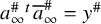 and
$ a_{\infty }^{\flat } {}^t \overline {a}_{\infty }^{\flat } = y^{\flat }$
and
$ a_{\infty }^{\flat } {}^t \overline {a}_{\infty }^{\flat } = y^{\flat }$
 .
.
Let
$a^{\#} \in \operatorname {\mathrm {GL}}_1(\mathbb {A}_F)$
 be the element with component
$a^{\#}_v {:=}q b^{\#}_v$
be the element with component
$a^{\#}_v {:=}q b^{\#}_v$
 for places
$v < \infty $
for places
$v < \infty $
 and
$a^{\#}_v {:=}q a^{\#}_{\infty }$
and
$a^{\#}_v {:=}q a^{\#}_{\infty }$
 for the place
$v = \infty $
for the place
$v = \infty $
 . Similarly define
$a^{\flat } \in \operatorname {\mathrm {GL}}_{n - 1}(\mathbb {A}_F)$
. Similarly define
$a^{\flat } \in \operatorname {\mathrm {GL}}_{n - 1}(\mathbb {A}_F)$
 , and set
$a {:=}q \mathrm {diag}(a^{\#}, a^{\flat }) \in \operatorname {\mathrm {GL}}_n(\mathbb {A}_F)$
, and set
$a {:=}q \mathrm {diag}(a^{\#}, a^{\flat }) \in \operatorname {\mathrm {GL}}_n(\mathbb {A}_F)$
 .
.
By unfolding for co-rank
$1$
 Fourier coefficients (Corollary 6.2.2) and Fourier coefficient invariance properties (see (2.3.3), (2.3.4), (4.2.4), and (4.3.4) for
$U(m)$
Fourier coefficients (Corollary 6.2.2) and Fourier coefficient invariance properties (see (2.3.3), (2.3.4), (4.2.4), and (4.3.4) for
$U(m)$
 invariance when
$v \mid \infty $
invariance when
$v \mid \infty $
 and
$\operatorname {\mathrm {GL}}_m(\mathcal {O}_{F^+_v})$
and
$\operatorname {\mathrm {GL}}_m(\mathcal {O}_{F^+_v})$
 invariance when
$v < \infty $
invariance when
$v < \infty $
 ), we find

where
$T' {:=}q \mathrm {diag}(0, T^{\flat })$
 . The sign
$\pm $
. The sign
$\pm $
 from Corollary 6.2.2 is
$-1$
from Corollary 6.2.2 is
$-1$
 , by the assumptions
$F^+ = \mathbb {Q}$
, by the assumptions
$F^+ = \mathbb {Q}$
 and
$n \equiv 2\ \pmod {4}$
and
$n \equiv 2\ \pmod {4}$
 . We remind the reader that the notation
$E^{\ast }_T(-,s)^{\circ }_n$
. We remind the reader that the notation
$E^{\ast }_T(-,s)^{\circ }_n$
 is overloaded (Section 6.1, also end of Section 2.2) and has slightly different meaning when “
$-$
is overloaded (Section 6.1, also end of Section 2.2) and has slightly different meaning when “
$-$
 ” is
$y \in \mathrm {Herm}_m(\mathbb {R})_{>0}$
” is
$y \in \mathrm {Herm}_m(\mathbb {R})_{>0}$
 versus
$h \in U(m,m)(\mathbb {A})$
versus
$h \in U(m,m)(\mathbb {A})$
 (e.g.,
$h = m(a)$
(e.g.,
$h = m(a)$
 ).
).
(Step 2: Leibniz rule) Since
$n \equiv 2\ \pmod {4}$
 , the functional equation for
$\tilde {E}^{\ast }_{T^{\flat }}(a^{\flat },s)^{\circ }_n$
, the functional equation for
$\tilde {E}^{\ast }_{T^{\flat }}(a^{\flat },s)^{\circ }_n$
 (Lemma 6.1.1, noting that the sign is
$+1$
(Lemma 6.1.1, noting that the sign is
$+1$
 ) implies

Since
$\det T^{\flat } \neq 0$
 , we may factorize
$\tilde {E}^{\ast }_{T^{\flat }}(a^{\flat }, s + 1/2)^{\circ }_n$
, we may factorize
$\tilde {E}^{\ast }_{T^{\flat }}(a^{\flat }, s + 1/2)^{\circ }_n$
 into a product of (variants of) normalized local Whittaker functions (6.1.8). Also recall the formulas in (9.1.2). We have
$|a^{\#}_{\ell }|_{\ell } = 1$
into a product of (variants of) normalized local Whittaker functions (6.1.8). Also recall the formulas in (9.1.2). We have
$|a^{\#}_{\ell }|_{\ell } = 1$
 (
$\ell $
(
$\ell $
 -adic norm of
$a^{\#}_{\ell }$
-adic norm of
$a^{\#}_{\ell }$
 ) for any prime
$\ell $
) for any prime
$\ell $
 such that
$b \in \operatorname {\mathrm {GL}}_n(\mathcal {O}_F \otimes _{\mathbb {Z}} \mathbb {Z}_{(\ell )})$
such that
$b \in \operatorname {\mathrm {GL}}_n(\mathcal {O}_F \otimes _{\mathbb {Z}} \mathbb {Z}_{(\ell )})$
 (by construction, this includes
$\ell = p$
(by construction, this includes
$\ell = p$
 ). By the Leibniz rule, we thus find


The product in (9.1.9) runs over all primes
$\ell $
 (not including the Archimedean place
$\infty $
(not including the Archimedean place
$\infty $
 ). The products in (9.1.10) and (9.1.11) run over all places v of
$\mathbb {Q}$
). The products in (9.1.10) and (9.1.11) run over all places v of
$\mathbb {Q}$
 (with
$v \neq p$
(with
$v \neq p$
 or
$v \neq \ell $
or
$v \neq \ell $
 as indicated), including
$v = \infty $
as indicated), including
$v = \infty $
 . The sum in (9.1.11) runs over all primes
$\ell \neq p$
. The sum in (9.1.11) runs over all primes
$\ell \neq p$
 . We remind the reader that
$|a^{\#}_{\infty }|_{\infty } = \overline {a}^{\#}_{\infty } a^{\#}_{\infty } \in \mathbb {R}_{>0}$
. We remind the reader that
$|a^{\#}_{\infty }|_{\infty } = \overline {a}^{\#}_{\infty } a^{\#}_{\infty } \in \mathbb {R}_{>0}$
 , by definition.
For all but finitely many primes
$\ell $
 , the Hermitian matrix
${}^t \overline {a}^{\flat }_{\ell } T^{\flat } a^{\flat }_{\ell } \in \mathrm {Herm}_{n - 1}(\mathbb {Q}_{\ell })$
, the Hermitian matrix
${}^t \overline {a}^{\flat }_{\ell } T^{\flat } a^{\flat }_{\ell } \in \mathrm {Herm}_{n - 1}(\mathbb {Q}_{\ell })$
 defines a (non-degenerate) self-dual Hermitian
$\mathcal {O}_F \otimes _{\mathbb {Z}} \mathbb {Z}_{\ell }$
defines a (non-degenerate) self-dual Hermitian
$\mathcal {O}_F \otimes _{\mathbb {Z}} \mathbb {Z}_{\ell }$
 -lattice. For such
$\ell $
-lattice. For such
$\ell $
 , we have
$\tilde {W}^{\ast }_{T^{\flat },\ell }(a^{\flat }_{\ell }, s)^{\circ }_n$
, we have
$\tilde {W}^{\ast }_{T^{\flat },\ell }(a^{\flat }_{\ell }, s)^{\circ }_n$
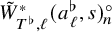 identically equal to
$1$
identically equal to
$1$
 (as a function in the s-variable). This follows from (4.5.7) and an invariance property for local Whittaker functions (4.3.4). In particular, the sums and products are finite in the right-hand side of (9.1.7).
For every prime
$\ell $
 , we have
$\tilde {W}^{\ast }_{T^{\flat },\ell }(a^{\flat }_\ell , s + 1/2)^{\circ }_n \in \mathbb {Z}[\ell ^{-1}, \ell ^{-s}, \ell ^{s}]$
, we have
$\tilde {W}^{\ast }_{T^{\flat },\ell }(a^{\flat }_\ell , s + 1/2)^{\circ }_n \in \mathbb {Z}[\ell ^{-1}, \ell ^{-s}, \ell ^{s}]$
 (see (4.5.6), and again the invariance property in (4.3.4)). We also have
$\tilde {W}^{\ast }_{T^{\flat }, v}(a^{\flat }_{v}, 1/2)^{\circ }_n \in \mathbb {Q}$
(see (4.5.6), and again the invariance property in (4.3.4)). We also have
$\tilde {W}^{\ast }_{T^{\flat }, v}(a^{\flat }_{v}, 1/2)^{\circ }_n \in \mathbb {Q}$
 for all places v of
$\mathbb {Q}$
for all places v of
$\mathbb {Q}$
 (if
$v \mid \infty $
(if
$v \mid \infty $
 , this quantity is
$1$
, this quantity is
$1$
 if
$T^{\flat }$
if
$T^{\flat }$
 is positive definite and
$0$
is positive definite and
$0$
 otherwise by (4.2.6)). The quantity in (9.1.10) thus lies in
$\mathbb {Q} \cdot \log p$
otherwise by (4.2.6)). The quantity in (9.1.10) thus lies in
$\mathbb {Q} \cdot \log p$
 , and the quantity in (9.1.11) thus lies in
$\sum _{\ell \neq p} \mathbb {Q} \cdot \log \ell $
, and the quantity in (9.1.11) thus lies in
$\sum _{\ell \neq p} \mathbb {Q} \cdot \log \ell $
 .
.
As we explain below, every quantity on the right-hand side of (9.1.7) has geometric meaning via our main local results, at least modulo
$\mathbb {Q} \cdot \log \ell $
 for primes
$\ell $
for primes
$\ell $
 such that
$b \not \in \operatorname {\mathrm {GL}}_n(\mathcal {O}_F \otimes _{\mathbb {Z}} \mathbb {Z}_{(\ell )})$
such that
$b \not \in \operatorname {\mathrm {GL}}_n(\mathcal {O}_F \otimes _{\mathbb {Z}} \mathbb {Z}_{(\ell )})$
 .
.
(Step 3a: Local geometric interpretation: complex degree) Set
$\mathcal {Z}(T)_{\mathbb {C}} = (\mathcal {Z}(T) \times _{\operatorname {\mathrm {Spec}} \mathcal {O}_F} \operatorname {\mathrm {Spec}} \mathbb {C})$
 for the embedding
$F \rightarrow \mathbb {C}$
for the embedding
$F \rightarrow \mathbb {C}$
 fixed above. We have
$\deg \mathcal {Z}(T)_{\mathbb {C}} = (\deg _{F} \mathcal {Z}(T) \times _{\operatorname {\mathrm {Spec}} \mathcal {O}_F} \operatorname {\mathrm {Spec}} F) = 2 \deg _{\mathbb {Q}} (\mathcal {Z}(T) \times _{\operatorname {\mathrm {Spec}} \mathbb {Z}} \operatorname {\mathrm {Spec}} \mathbb {Q}) {=:} \deg _{\mathbb {Z}} \mathcal {Z}(T)_{\mathscr {H}}$
fixed above. We have
$\deg \mathcal {Z}(T)_{\mathbb {C}} = (\deg _{F} \mathcal {Z}(T) \times _{\operatorname {\mathrm {Spec}} \mathcal {O}_F} \operatorname {\mathrm {Spec}} F) = 2 \deg _{\mathbb {Q}} (\mathcal {Z}(T) \times _{\operatorname {\mathrm {Spec}} \mathbb {Z}} \operatorname {\mathrm {Spec}} \mathbb {Q}) {=:} \deg _{\mathbb {Z}} \mathcal {Z}(T)_{\mathscr {H}}$
 . Here
$\deg _F$
. Here
$\deg _F$
 and
$\deg _{\mathbb {Q}}$
and
$\deg _{\mathbb {Q}}$
 denote stacky degrees over
$\operatorname {\mathrm {Spec}} F$
denote stacky degrees over
$\operatorname {\mathrm {Spec}} F$
 and
$\operatorname {\mathrm {Spec}} \mathbb {Q}$
and
$\operatorname {\mathrm {Spec}} \mathbb {Q}$
 , respectively, as defined at the end of [Reference ChenChe24a, Appendix A.1].
By the geometric Siegel–Weil formula for Kudla–Rapoport
$0$
 -cycles over
$\mathbb {C}$
-cycles over
$\mathbb {C}$
 (Proposition 8.1.1, also Remark 8.1.2), we conclude

This gives a geometric interpretation of (9.1.8).
(Step 3b: Local geometric interpretation: at
$\infty $
 ) We claim that

where
$\mathrm {Int}_{\infty }(T,y)$
 is the geometric quantity defined in [Reference ChenChe24c, (5.4.7)].
Indeed, [Reference ChenChe24b, (2.4.6)] implies


The notation
$T^{\flat }> 0$
 (resp.
$T^{\flat } \not> 0$
(resp.
$T^{\flat } \not> 0$
 ) means that
$T^{\flat }$
) means that
$T^{\flat }$
 is positive definite (resp. not positive definite). We have
$\mathrm {Int}_{\infty }(T^{\flat }, a^{\flat }_{\infty } {}^t \overline {a}^{\flat }_{\infty }) = \mathrm {Int}_{\infty }({}^t \overline {a}^{\flat }_{\infty } T^{\flat } a^{\flat }_{\infty }, 1)$
is positive definite (resp. not positive definite). We have
$\mathrm {Int}_{\infty }(T^{\flat }, a^{\flat }_{\infty } {}^t \overline {a}^{\flat }_{\infty }) = \mathrm {Int}_{\infty }({}^t \overline {a}^{\flat }_{\infty } T^{\flat } a^{\flat }_{\infty }, 1)$
 [Reference ChenChe24b, Theorem 2.4.1]. By our main Archimedean local identity [Reference ChenChe24b, Theorem 4.1.1], we have
$\mathrm {Int}_{\infty }({}^t \overline {a}^{\flat }_{\infty } T^{\flat } a^{\flat }_{\infty }, 1) = \frac {d}{ds} \big |_{s = -1/2} W^{\ast }_{{}^t \overline {a}^{\flat }_{\infty } T a^{\flat }_{\infty },\infty }(s)^{\circ }_n$
[Reference ChenChe24b, Theorem 2.4.1]. By our main Archimedean local identity [Reference ChenChe24b, Theorem 4.1.1], we have
$\mathrm {Int}_{\infty }({}^t \overline {a}^{\flat }_{\infty } T^{\flat } a^{\flat }_{\infty }, 1) = \frac {d}{ds} \big |_{s = -1/2} W^{\ast }_{{}^t \overline {a}^{\flat }_{\infty } T a^{\flat }_{\infty },\infty }(s)^{\circ }_n$
 .
.
The Whittaker function invariance property (4.2.4) implies
$W^{\ast }_{{}^t \overline {a}^{\flat }_{\infty } T^{\flat } a^{\flat }_{\infty }}(s)^{\circ }_n = \tilde {W}^{\ast }_{T^{\flat }}(a^{\flat }_{\infty }, s)^{\circ }_n$
 . By the Archimedean local functional equation (5.2.1) we have
$\frac {d}{ds} \big |_{s = -1/2} \tilde {W}^{\ast }_{T^{\flat },\infty }(a^{\flat }_{\infty }, s)^{\circ }_n = - \frac {d}{ds} \big |_{s = 1/2} \tilde {W}^{\ast }_{T^{\flat },\infty }(a^{\flat }_{\infty }, s)^{\circ }_n$
. By the Archimedean local functional equation (5.2.1) we have
$\frac {d}{ds} \big |_{s = -1/2} \tilde {W}^{\ast }_{T^{\flat },\infty }(a^{\flat }_{\infty }, s)^{\circ }_n = - \frac {d}{ds} \big |_{s = 1/2} \tilde {W}^{\ast }_{T^{\flat },\infty }(a^{\flat }_{\infty }, s)^{\circ }_n$
 . This is still true when
$T^{\flat }$
. This is still true when
$T^{\flat }$
 has signature
$(n - 1 - r, r)$
has signature
$(n - 1 - r, r)$
 for
$r \geq 2$
for
$r \geq 2$
 , as both sides are zero in this case (by definition for the geometric side, and by [Reference ChenChe24b, Theorem 4.1.4] for the local Whittaker function). As already mentioned, recall that
$\tilde {W}^{\ast }_{T^{\flat }}(a^{\flat }, 1/2)^{\circ }_n$
, as both sides are zero in this case (by definition for the geometric side, and by [Reference ChenChe24b, Theorem 4.1.4] for the local Whittaker function). As already mentioned, recall that
$\tilde {W}^{\ast }_{T^{\flat }}(a^{\flat }, 1/2)^{\circ }_n$
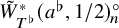 is
$1$
is
$1$
 if
$T^{\flat }$
if
$T^{\flat }$
 is positive definite, and is
$0$
is positive definite, and is
$0$
 is
$T^{\flat }$
is
$T^{\flat }$
 is not positive definite (4.2.6). Now (9.1.13) follows from what we have just discussed.
Next, recall the global Archimedean intersection number
$\mathrm {Int}_{\infty , \mathrm {global}}(T,y) = \int _{\mathcal {M}_{\mathbb {C}}} g_{T,y}$
 (where
$g_{T,y}$
(where
$g_{T,y}$
 is a current associated with T and y) as in [Reference ChenChe24c, (5.4.5)]. Recall the relation [Reference ChenChe24c, (5.4.6)]

where
$V {:=}q L \otimes _{\mathcal {O}_F} F$
 and
$\mathcal {D}(\underline {x}_f)$
and
$\mathcal {D}(\underline {x}_f)$
 is a certain “away-from-
$\infty $
is a certain “away-from-
$\infty $
 ” local special cycle (it is a discrete set), defined in [Reference ChenChe24c, Section 5.1]. The displayed groupoid cardinality
$\deg [ \cdots ]$
” local special cycle (it is a discrete set), defined in [Reference ChenChe24c, Section 5.1]. The displayed groupoid cardinality
$\deg [ \cdots ]$
 describes certain “complex uniformization degrees” [Reference ChenChe24c, (5.4.5)]. If there exists
$\underline {x} \in V^n$
describes certain “complex uniformization degrees” [Reference ChenChe24c, (5.4.5)]. If there exists
$\underline {x} \in V^n$
 with
$(\underline {x}, \underline {x}) = T$
with
$(\underline {x}, \underline {x}) = T$
 , the groupoid cardinality is

by local Siegel–Weil as in Lemma 7.4.1 (with
$v_0 = \infty $
 in the notation of loc. cit., and with C as in Remark 8.1.2). If there does not exist such
$\underline {x}$
in the notation of loc. cit., and with C as in Remark 8.1.2). If there does not exist such
$\underline {x}$
 , then the Hasse principle implies that
$T^{\flat }$
, then the Hasse principle implies that
$T^{\flat }$
 has signature
$(n - 1 - r, r)$
has signature
$(n - 1 - r, r)$
 for some
$r \geq 2$
for some
$r \geq 2$
 (compare the proof of Proposition 8.1.1). In this case, we have
$\frac {d}{ds} \big |_{s = 1/2} \tilde {W}^{\ast }_{T^{\flat }, \infty }(a^{\flat }_{\infty }, s)^{\circ }_n = 0$
(compare the proof of Proposition 8.1.1). In this case, we have
$\frac {d}{ds} \big |_{s = 1/2} \tilde {W}^{\ast }_{T^{\flat }, \infty }(a^{\flat }_{\infty }, s)^{\circ }_n = 0$
 [Reference ChenChe24b, (4.1.4)]. In all cases, we thus have

modulo
$\sum _{\ell } \mathbb {Q} \cdot \log \ell $
 for primes
$\ell $
for primes
$\ell $
 such that
$b \not \in \operatorname {\mathrm {GL}}_n(\mathcal {O}_F \otimes _{\mathbb {Z}} \mathbb {Z}_{(\ell )})$
such that
$b \not \in \operatorname {\mathrm {GL}}_n(\mathcal {O}_F \otimes _{\mathbb {Z}} \mathbb {Z}_{(\ell )})$
 . This gives a geometric interpretation of (9.1.9).
(Step 3c: Local geometric interpretation: at p) Recall
$\mathrm {Int}_p(T) {:=}q \mathrm {Int}_{\mathscr {H},p}(T) + \mathrm {Int}_{\mathscr {V},p}(T)$
 [Reference ChenChe24c, (4.9.9)], where
$\mathrm {Int}_{\mathscr {H},p}(T)$
[Reference ChenChe24c, (4.9.9)], where
$\mathrm {Int}_{\mathscr {H},p}(T)$
 is a “horizontal local intersection number” [Reference ChenChe24c, (4.9.1)] and
$\mathrm {Int}_{\mathscr {V},p}(T)$
is a “horizontal local intersection number” [Reference ChenChe24c, (4.9.1)] and
$\mathrm {Int}_{\mathscr {V},p}(T)$
 is a “vertical local intersection number” [Reference ChenChe24c, (4.8.1)] associated with T. The former describes “local change of tautological (or Faltings) height” and the latter describes degrees for “components in positive characteristic” in terms of local special cycles on Rapoport–Zink spaces.
We claim that

where
$e_p = 1$
 if p is unramified (resp.
$e_p = 2$
if p is unramified (resp.
$e_p = 2$
 if p is ramified).
First note that the functional equation (5.1.4) implies
$- \frac {d}{d s} \big |_{s = 1/2} \tilde {W}^{\ast }_{T^{\flat },p}(a^{\flat }_p, s)^{\circ }_n = \frac {d}{d s} \big |_{s = -1/2} \tilde {W}^{\ast }_{T^{\flat },p}(a^{\flat }_p, s)^{\circ }_n$
 . The invariance property for Whittaker functions (4.3.4) implies
$\tilde {W}^{\ast }_{T^{\flat },p}(a^{\flat }_p, s)^{\circ }_n = \tilde {W}^{\ast }_{{}^t \overline {a}^{\flat }_p T^{\flat } a^{\flat }_p, p}(s)^{\circ }_n$
. The invariance property for Whittaker functions (4.3.4) implies
$\tilde {W}^{\ast }_{T^{\flat },p}(a^{\flat }_p, s)^{\circ }_n = \tilde {W}^{\ast }_{{}^t \overline {a}^{\flat }_p T^{\flat } a^{\flat }_p, p}(s)^{\circ }_n$
 .
.
Form the positive definite
$F / \mathbb {Q}$
 Hermitian spaces
$\mathbf {W} \subseteq \mathbf {V}$
Hermitian spaces
$\mathbf {W} \subseteq \mathbf {V}$
 as in [Reference ChenChe24c, Section 4] (recall
$\varepsilon (\mathbf {V}_p) = - 1$
as in [Reference ChenChe24c, Section 4] (recall
$\varepsilon (\mathbf {V}_p) = - 1$
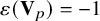 and
$\varepsilon (\mathbf {V}_{\ell }) = \varepsilon (V_{\ell })$
and
$\varepsilon (\mathbf {V}_{\ell }) = \varepsilon (V_{\ell })$
 for all
$\ell \neq p$
for all
$\ell \neq p$
 ). Set
$\mathcal {O}_{F,p} {:=}q \mathcal {O}_F \otimes _{\mathbb {Z}} \mathbb {Z}_p$
). Set
$\mathcal {O}_{F,p} {:=}q \mathcal {O}_F \otimes _{\mathbb {Z}} \mathbb {Z}_p$
 . For any
$\underline {\mathbf {x}}_p \in \mathbf {W}_p^n$
. For any
$\underline {\mathbf {x}}_p \in \mathbf {W}_p^n$
 with Gram matrix T (such
$\underline {\mathbf {x}}_p$
with Gram matrix T (such
$\underline {\mathbf {x}}_p$
 exists because
$\operatorname {\mathrm {rank}}(T) \leq n - 1$
exists because
$\operatorname {\mathrm {rank}}(T) \leq n - 1$
 ; recall
$\mathbf {W}$
; recall
$\mathbf {W}$
 has rank n if p is nonsplit and rank
$n - 1$
has rank n if p is nonsplit and rank
$n - 1$
 if p is split), there exists a basis of
$L^{\flat }_p {:=}q \mathrm {span}_{\mathcal {O}_{F,p}}(\underline {x}_p)$
if p is split), there exists a basis of
$L^{\flat }_p {:=}q \mathrm {span}_{\mathcal {O}_{F,p}}(\underline {x}_p)$
 with Gram matrix
${}^t \overline {a}^{\flat }_p T^{\flat } a^{\flat }_p$
with Gram matrix
${}^t \overline {a}^{\flat }_p T^{\flat } a^{\flat }_p$
 . Indeed, we have
$a_p \in \operatorname {\mathrm {GL}}_n(\mathcal {O}_{F_p})$
. Indeed, we have
$a_p \in \operatorname {\mathrm {GL}}_n(\mathcal {O}_{F_p})$
 and
$a^{\flat }_p \in \operatorname {\mathrm {GL}}_{n - 1}(\mathcal {O}_{F_p})$
and
$a^{\flat }_p \in \operatorname {\mathrm {GL}}_{n - 1}(\mathcal {O}_{F_p})$
 by construction (and recall
${}^t \overline {a}_p^{-1} T a_p^{-1} = \mathrm {diag}(0, T^{\flat })$
by construction (and recall
${}^t \overline {a}_p^{-1} T a_p^{-1} = \mathrm {diag}(0, T^{\flat })$
 by definition). We remind the reader that (4.5.6) may be used to pass between (normalized) local densities and local Whittaker functions. We also pass between the notation
$\mathrm {Den}^{\ast }(X,L^{\flat }_p)_n = \mathrm {Den}^{\ast }(X,{}^t \overline {a}^{\flat }_p T^{\flat } a^{\flat }_p)_n$
by definition). We remind the reader that (4.5.6) may be used to pass between (normalized) local densities and local Whittaker functions. We also pass between the notation
$\mathrm {Den}^{\ast }(X,L^{\flat }_p)_n = \mathrm {Den}^{\ast }(X,{}^t \overline {a}^{\flat }_p T^{\flat } a^{\flat }_p)_n$
 as explained in Section 4.5. Now (9.1.19) follows from our main non-Archimedean local identity [Reference ChenChe24a, Theorem 9.1.2].
Next, recall the horizontal and vertical global intersection numbers
$\mathrm {Int}_{\mathscr {H},p,\mathrm {global}}(T)$
 and
$\mathrm {Int}_{\mathscr {V},p,\mathrm {global}}(T)$
and
$\mathrm {Int}_{\mathscr {V},p,\mathrm {global}}(T)$
 at p, associated with T (see [Reference ChenChe24c, (4.9.7)] and [Reference ChenChe24c, (4.8.3)]). These are elements of
$\mathbb {Q} \cdot \log p$
at p, associated with T (see [Reference ChenChe24c, (4.9.7)] and [Reference ChenChe24c, (4.8.3)]). These are elements of
$\mathbb {Q} \cdot \log p$
 . Recall the
$F / \mathbb {Q}$
. Recall the
$F / \mathbb {Q}$
 Hermitian space
$\mathbf {W}^{\perp }$
Hermitian space
$\mathbf {W}^{\perp }$
 defined in [Reference ChenChe24c, Section 4.3], which satisfies
$\mathbf {V} = \mathbf {W} \oplus \mathbf {W}^{\perp }$
defined in [Reference ChenChe24c, Section 4.3], which satisfies
$\mathbf {V} = \mathbf {W} \oplus \mathbf {W}^{\perp }$
 (orthogonal direct sum). In particular,
$\mathbf {W}^{\perp } = 0$
(orthogonal direct sum). In particular,
$\mathbf {W}^{\perp } = 0$
 if p is nonsplit and
$\dim _F \mathbf {W}^{\perp } = 1$
if p is nonsplit and
$\dim _F \mathbf {W}^{\perp } = 1$
 if p is split.
By [Reference ChenChe24c, (4.9.7)] and [Reference ChenChe24c, (4.8.3)] (and in the notation of loc. cit.), we have

The notation
$\mathcal {Z}(\underline {\mathbf {x}}^p)$
 means a certain “away-from-p” local special cycle (a discrete set), defined in [Reference ChenChe24c, Section 4.2]. Recall that
$K_{1,\mathbf {L}^{\perp }_p} \subseteq U(\mathbf {W}^{\perp }_p)$
means a certain “away-from-p” local special cycle (a discrete set), defined in [Reference ChenChe24c, Section 4.2]. Recall that
$K_{1,\mathbf {L}^{\perp }_p} \subseteq U(\mathbf {W}^{\perp }_p)$
 is the unique maximal open compact subgroup and
$I_1 = U(\mathbf {W}) \times U(\mathbf {W}^{\perp })$
is the unique maximal open compact subgroup and
$I_1 = U(\mathbf {W}) \times U(\mathbf {W}^{\perp })$
 as algebraic groups over
$\mathbb {Q}$
as algebraic groups over
$\mathbb {Q}$
 [Reference ChenChe24c, Section 4.5]. The displayed groupoid cardinality
$\deg [ \cdots ]$
[Reference ChenChe24c, Section 4.5]. The displayed groupoid cardinality
$\deg [ \cdots ]$
 encodes certain “Rapoport–Zink non-Archimedean uniformization degrees”.
If there exists
$\underline {\mathbf {x}} \in \mathbf {W}^n$
 with Gram matrix T, then local Siegel–Weil (Lemma 7.4.1) implies

(in the notation of Lemma 7.4.1, take
$v_0 = p$
 and use the Hermitian space
$\mathbf {V}$
and use the Hermitian space
$\mathbf {V}$
 for the V in loc. cit.).
Set
$\Omega _T(R) {:=}q \{ \underline {\mathbf {x}} \in (\mathbf {W} \otimes _{\mathbb {Q}} R)^n : (\underline {\mathbf {x}}, \underline {\mathbf {x}}) = T \}$
 for
$\mathbb {Q}$
for
$\mathbb {Q}$
 -algebras R. If
$\Omega _T(\mathbb {Q}) = \emptyset $
-algebras R. If
$\Omega _T(\mathbb {Q}) = \emptyset $
 , then the Hasse principle implies
$\Omega _T(\mathbb {Q}_v) = \emptyset $
, then the Hasse principle implies
$\Omega _T(\mathbb {Q}_v) = \emptyset $
 for some place v of
$\mathbb {Q}$
for some place v of
$\mathbb {Q}$
 . We have
$\Omega _T(\mathbb {Q}_p) \neq \emptyset $
. We have
$\Omega _T(\mathbb {Q}_p) \neq \emptyset $
 (either p is nonsplit and
$\mathbf {W} = \mathbf {V}$
(either p is nonsplit and
$\mathbf {W} = \mathbf {V}$
 and the claim follows because
$\operatorname {\mathrm {rank}} T < \operatorname {\mathrm {rank}} \mathbf {W}$
and the claim follows because
$\operatorname {\mathrm {rank}} T < \operatorname {\mathrm {rank}} \mathbf {W}$
 (compare the proof of Proposition 8.1.1), or p is split and
$\Omega _T(\mathbb {Q}_p) \neq \emptyset $
(compare the proof of Proposition 8.1.1), or p is split and
$\Omega _T(\mathbb {Q}_p) \neq \emptyset $
 automatically). For all places v, we have
$\Omega _T(\mathbb {Q}_v) = \emptyset $
automatically). For all places v, we have
$\Omega _T(\mathbb {Q}_v) = \emptyset $
 if and only if
$\Omega _{{}^t \overline {a}_v^{\flat } T^{\flat } a_v^{\flat }}(\mathbb {Q}_v) = \emptyset $
if and only if
$\Omega _{{}^t \overline {a}_v^{\flat } T^{\flat } a_v^{\flat }}(\mathbb {Q}_v) = \emptyset $
 (where
$\Omega _{{}^t \overline {a}_v^{\flat } T^{\flat } a_v^{\flat }}$
(where
$\Omega _{{}^t \overline {a}_v^{\flat } T^{\flat } a_v^{\flat }}$
 is defined like
$\Omega _T$
is defined like
$\Omega _T$
 but for
$(n - 1)$
but for
$(n - 1)$
 -tuples); this follows from our diagonalization of T (e.g.,
${}^t \overline {a}_v^{-1} T a_v^{-1} = \mathrm {diag}(0,T^{\flat })$
-tuples); this follows from our diagonalization of T (e.g.,
${}^t \overline {a}_v^{-1} T a_v^{-1} = \mathrm {diag}(0,T^{\flat })$
 for all
$v < \infty $
for all
$v < \infty $
 ).
).
If
$\Omega _T(\mathbb {Q}_v) = \emptyset $
 , we thus conclude
$\tilde {W}^{\ast }_{T^{\flat },v}(a^{\flat }_v, 1/2)^{\circ }_n = \tilde {W}^{\ast }_{{}^t \overline {a}^{\flat }_v T^{\flat } a^{\flat }_v, v}(1/2)^{\circ }_n = 0$
, we thus conclude
$\tilde {W}^{\ast }_{T^{\flat },v}(a^{\flat }_v, 1/2)^{\circ }_n = \tilde {W}^{\ast }_{{}^t \overline {a}^{\flat }_v T^{\flat } a^{\flat }_v, v}(1/2)^{\circ }_n = 0$
 by the invariance property for local Whittaker functions (see (4.2.4) and (4.3.4)) and by local Siegel–Weil (7.2.2). Hence (9.1.21) holds even if there is no
$\underline {\mathbf {x}} \in \mathbf {W}^n$
by the invariance property for local Whittaker functions (see (4.2.4) and (4.3.4)) and by local Siegel–Weil (7.2.2). Hence (9.1.21) holds even if there is no
$\underline {\mathbf {x}} \in \mathbf {W}^n$
 such that
$(\underline {\mathbf {x}}, \underline {\mathbf {x}}) = T$
such that
$(\underline {\mathbf {x}}, \underline {\mathbf {x}}) = T$
 (both sides are
$0$
(both sides are
$0$
 in this case).
We have shown

This gives a geometric interpretation for (9.1.10).
(Step 4: Finish) Recall the definition of arithmetic degree without boundary contributions
$\widehat {\deg }([\widehat {\mathcal {Z}}(T)])$
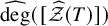 (1.3.6). In our current situation, this is

where the sum runs over all primes
$\ell $
 . By definition, we have

where
$h^{\mathrm {CM}}_{\widehat {\mathcal {E}}^{\vee }}$
 is the height constant from (9.1.2). See [Reference ChenChe24c, (5.4.5)] (Archimedean), [Reference ChenChe24c, (4.8.3)] (vertical), and [Reference ChenChe24c, (4.9.8)] (horizontal). For all primes
$\ell $
is the height constant from (9.1.2). See [Reference ChenChe24c, (5.4.5)] (Archimedean), [Reference ChenChe24c, (4.8.3)] (vertical), and [Reference ChenChe24c, (4.9.8)] (horizontal). For all primes
$\ell $
 , we have
$\mathrm {Int}_{\mathscr {V},\ell ,\mathrm {global}}(T) \in \mathbb {Q} \cdot \log \ell $
, we have
$\mathrm {Int}_{\mathscr {V},\ell ,\mathrm {global}}(T) \in \mathbb {Q} \cdot \log \ell $
 and
$\mathrm {Int}_{\mathscr {H}, \ell , \mathrm {global}}(T) \in \mathbb {Q} \cdot \log \ell $
and
$\mathrm {Int}_{\mathscr {H}, \ell , \mathrm {global}}(T) \in \mathbb {Q} \cdot \log \ell $
 . These quantities are
$0$
. These quantities are
$0$
 for all but finitely many
$\ell $
for all but finitely many
$\ell $
 .
.
After multiplying both sides of (9.1.7) by
$2 (h_F / w_F)^2$
 , we apply the results of Steps 3a, 3b, and 3c above (see (9.1.12), (9.1.18), and (9.1.22)) to find

as elements of
$\mathbb {R}/(\sum _{\ell \neq p} \mathbb {Q} \cdot \log \ell )$
 . As we already discussed, varying p shows that this identity holds as an equality of real numbers.
Remark 9.1.2 (Nonsingular central-point arithmetic Siegel–Weil)
In the setup above (in particular,
$n \equiv 2\ \pmod {4}$
 ), consider any
$T \in \mathrm {Herm}_n(\mathbb {Q})$
), consider any
$T \in \mathrm {Herm}_n(\mathbb {Q})$
 with
$\det T \neq 0$
with
$\det T \neq 0$
 and any
$y \in \mathrm {Herm}_n(\mathbb {R})_{>0}$
and any
$y \in \mathrm {Herm}_n(\mathbb {R})_{>0}$
 . Assuming the prime
$2$
. Assuming the prime
$2$
 is split in
$\mathcal {O}_F$
is split in
$\mathcal {O}_F$
 , we still have

where the Green current for
$[\widehat {\mathcal {Z}}(T)]$
 is formed with respect to y, and where
$\widehat {\deg }([\widehat {\mathcal {Z}}(T)])$
is formed with respect to y, and where
$\widehat {\deg }([\widehat {\mathcal {Z}}(T)])$
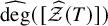 again denotes the arithmetic degree without boundary contributions as in (1.3.6). This should be compared with our preceding main theorem for singular T of co-rank
$1$
again denotes the arithmetic degree without boundary contributions as in (1.3.6). This should be compared with our preceding main theorem for singular T of co-rank
$1$
 (Theorem 9.1.1).
Using the local theorems of Liu, Li–Zhang, and Li–Liu (cited below), one can prove (9.1.25) by a local decomposition as in the proof of Theorem 9.1.1 (no diagonalization procedure is necessary here) using the volume constant calculated in Lemma 8.1.1. This is possibly considered known to experts up to a volume constant by the cited local theorems. Nevertheless, the global statement is not available in the literature (but see some closely related variants at the end of this remark), so we have stated it. A sketch is provided below.
Decomposing
$E^{\ast }_T(y,s)^{\circ }_n$
 into a product of local Whittaker functions (Section 6.1), we find


At most one of the summands is nonzero (see below), and all but finitely many
$W^{\ast }_{T,\ell }(s)^{\circ }_n$
 are identically equal to
$1$
are identically equal to
$1$
 as functions of s.
For the quantities
$\mathrm {Int}_{\infty , \mathrm {global}}(T, y)$
 from [Reference ChenChe24c, (5.4.5)] (a Green current integral) and
$\mathrm {Int}_{p, \mathrm {global}}(T)$
from [Reference ChenChe24c, (5.4.5)] (a Green current integral) and
$\mathrm {Int}_{p, \mathrm {global}}(T)$
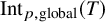 from the end of [Reference ChenChe24c, Section 4.8] (degrees of cycle classes supported in characteristic p), we also have

largely by definition. In contrast with our main theorem, these intersection numbers
$\mathrm {Int}_{p, \mathrm {global}}(T)$
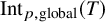 are “purely vertical”, without a mixed characteristic contribution.
In this setup, the local Archimedean theorem [Reference LiuLiu11, Theorem 4.1.7] (restated in our notation in [Reference ChenChe24b, Theorem 4.1.1]) and the local Kudla–Rapoport theorems [Reference Li and ZhangLZ22, Theorem 1.2.1] (inert) and [Reference Li and LiuLL22, Theorem 2.7] (ramified, exotic smooth, even n) take the place of our main local identities (which were for co-rank
$1$
 singular T). These local theorems may be reformulated, in our notation, as

for nonsplit p, where the left-hand sides are certain “local intersection numbers”, with
$\mathrm {Int}_{\infty }(T, y)$
 calculated on the symmetric space
$\mathcal {D}$
calculated on the symmetric space
$\mathcal {D}$
 [Reference ChenChe24c, (5.4.7)], and
$\mathrm {Int}_{p}(T)$
[Reference ChenChe24c, (5.4.7)], and
$\mathrm {Int}_{p}(T)$
 calculated on suitable Rapoport–Zink spaces [Reference ChenChe24c, (4.9.9)].
Let V be the
$F / \mathbb {Q}$
 Hermitian space of signature
$(n - 1, 1)$
Hermitian space of signature
$(n - 1, 1)$
 which is split at every prime, meaning
$\varepsilon _p(V_p) = +1$
which is split at every prime, meaning
$\varepsilon _p(V_p) = +1$
 for all primes p, with conventions as in [Reference ChenChe24a, Section 2.2] (since V has even rank, being split at every prime is equivalent to V containing a self-dual lattice of full-rank). Let
$L \subseteq V$
for all primes p, with conventions as in [Reference ChenChe24a, Section 2.2] (since V has even rank, being split at every prime is equivalent to V containing a self-dual lattice of full-rank). Let
$L \subseteq V$
 be a full-rank self-dual lattice. Given a nonsplit prime p, let
$\mathbf {V}$
be a full-rank self-dual lattice. Given a nonsplit prime p, let
$\mathbf {V}$
 be the “nearby Hermitian space” with signature
$(n,0)$
be the “nearby Hermitian space” with signature
$(n,0)$
 , with
$\varepsilon _p(V_p) = -1$
, with
$\varepsilon _p(V_p) = -1$
 , and with
$\varepsilon _{\ell }(V_{\ell }) = +1$
, and with
$\varepsilon _{\ell }(V_{\ell }) = +1$
 for all
$\ell \neq p$
for all
$\ell \neq p$
 . The space
$\mathbf {V}$
. The space
$\mathbf {V}$
 certainly depends on p, though we suppress this from notation.
By complex and Rapoport–Zink uniformization respectively, the global intersection numbers unfold into the local quantities


for nonsplit p, as explained in [Reference ChenChe24c, (5.4.6), (6.8.7)], where the notation on the right is that of Lemma 7.4.1, with
$\underline {x}_f^{v_0}$
 of loc. cit. replaced by
$\underline {x}^{\infty }$
of loc. cit. replaced by
$\underline {x}^{\infty }$
 and
$\underline {x}^p$
and
$\underline {x}^p$
 .
.
By Lemma 7.4.1(2) (we have
$C = 1$
 in the notation of loc. cit.) we have


for all nonsplit p, where the first formula is conditional on existence of
$\underline {x} \in V^n$
 with
$(\underline {x}, \underline {x}) = T$
with
$(\underline {x}, \underline {x}) = T$
 , and the second formula, for each p, is conditional on existence of
$\underline {x} \in \mathbf {V}^n$
, and the second formula, for each p, is conditional on existence of
$\underline {x} \in \mathbf {V}^n$
 with
$(\underline {x}, \underline {x}) = T$
with
$(\underline {x}, \underline {x}) = T$
 . The left-hand sides vanish, by definition, if no such
$\underline {x}$
. The left-hand sides vanish, by definition, if no such
$\underline {x}$
 exists. To handle existence/non-existence of such
$\underline {x}$
exists. To handle existence/non-existence of such
$\underline {x}$
 , we have in mind a (presumably routine) Hasse principle argument (compare [Reference Kudla and RapoportKR14, §9]) as we explain next. For any prime p, set
$\varepsilon _p(T) {:=}q \eta _p((-1)^{n(n-1)/2} \det T)$
, we have in mind a (presumably routine) Hasse principle argument (compare [Reference Kudla and RapoportKR14, §9]) as we explain next. For any prime p, set
$\varepsilon _p(T) {:=}q \eta _p((-1)^{n(n-1)/2} \det T)$
 (the usual local invariant, by our conventions in [Reference ChenChe24a, Section 2.2]), where
$\eta _p \colon \mathbb {Q}_p^{\times } \rightarrow \{ \pm 1\}$
(the usual local invariant, by our conventions in [Reference ChenChe24a, Section 2.2]), where
$\eta _p \colon \mathbb {Q}_p^{\times } \rightarrow \{ \pm 1\}$
 is the local quadratic character associated to
$F / \mathbb {Q}$
is the local quadratic character associated to
$F / \mathbb {Q}$
 .
.
We have
$\mathrm {Int}_{\infty , \mathrm {global}}(T, y) = 0$
 unless T has signature
$(n - 1, 1)$
unless T has signature
$(n - 1, 1)$
 and
$\varepsilon _p(T) = 1$
and
$\varepsilon _p(T) = 1$
 for all p, by construction (the Green current is zero otherwise). In particular, we have
$\mathrm {Int}_{\infty , \mathrm {global}}(T, y) = 0$
for all p, by construction (the Green current is zero otherwise). In particular, we have
$\mathrm {Int}_{\infty , \mathrm {global}}(T, y) = 0$
 unless there exists
$\underline {x} \in V$
unless there exists
$\underline {x} \in V$
 with
$(\underline {x}, \underline {x}) = T$
with
$(\underline {x}, \underline {x}) = T$
 . For such T, the special cycle
$\mathcal {Z}(T)$
. For such T, the special cycle
$\mathcal {Z}(T)$
 is empty (but may have a nontrivial Green current).
We have
$\mathrm {Int}_{p, \mathrm {global}}(T) = 0$
 unless T is positive definite,
$\varepsilon _p(T) = -1$
unless T is positive definite,
$\varepsilon _p(T) = -1$
 , and
$\varepsilon _{\ell }(T) = 1$
, and
$\varepsilon _{\ell }(T) = 1$
 for all primes
$\ell \neq p$
for all primes
$\ell \neq p$
 . For such T, the special cycle
$\mathcal {Z}(T)$
. For such T, the special cycle
$\mathcal {Z}(T)$
 is supported in characteristic p (or empty). For all other T, the special cycle
$\mathcal {Z}(T)$
is supported in characteristic p (or empty). For all other T, the special cycle
$\mathcal {Z}(T)$
 is empty. These claims follow, for example, from uniformization of special cycles (e.g., Sections [Reference ChenChe24c, Section 5.4] (Archimedean) and [Reference ChenChe24c, Section 4.8] (non-Archimedean)) and the Hasse principle (e.g., applied to
$\mathbf {V}$
is empty. These claims follow, for example, from uniformization of special cycles (e.g., Sections [Reference ChenChe24c, Section 5.4] (Archimedean) and [Reference ChenChe24c, Section 4.8] (non-Archimedean)) and the Hasse principle (e.g., applied to
$\mathbf {V}$
 from loc. cit. in the non-Archimedean case). In particular,
$\mathrm {Int}_{p, \mathrm {global}}(T) = 0$
from loc. cit. in the non-Archimedean case). In particular,
$\mathrm {Int}_{p, \mathrm {global}}(T) = 0$
 if p is split in
$\mathcal {O}_F$
if p is split in
$\mathcal {O}_F$
 , and
$\mathcal {Z}(T)$
, and
$\mathcal {Z}(T)$
 is empty over any split p. For nonsplit primes p, we also find that
$\mathrm {Int}_{p, \mathrm {global}}(T) = 0$
is empty over any split p. For nonsplit primes p, we also find that
$\mathrm {Int}_{p, \mathrm {global}}(T) = 0$
 unless there exists
$\underline {x} \in \mathbf {V}$
unless there exists
$\underline {x} \in \mathbf {V}$
 with
$(\underline {x}, \underline {x}) = T$
with
$(\underline {x}, \underline {x}) = T$
 (recall that
$\mathbf {V}$
(recall that
$\mathbf {V}$
 depends on p).
On the analytic side, we have
$W^{\ast }_{T,p}(0)^{\circ }_n = 0$
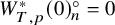 if
$\varepsilon _p(T) = - 1$
if
$\varepsilon _p(T) = - 1$
 (by local Siegel–Weil (7.2.2), or the functional equation (5.1.4)). If T has signature
$(n - r, r)$
(by local Siegel–Weil (7.2.2), or the functional equation (5.1.4)). If T has signature
$(n - r, r)$
 for
$r \geq 2$
for
$r \geq 2$
 , we have
$\frac {d}{ds} \big |_{s = 0} W^{\ast }_{T,\infty }(y,s)^{\circ }_n = 0$
, we have
$\frac {d}{ds} \big |_{s = 0} W^{\ast }_{T,\infty }(y,s)^{\circ }_n = 0$
 [Reference ChenChe24b, (4.1.4)]. In particular, if there is no
$\underline {x} \in V^n$
[Reference ChenChe24b, (4.1.4)]. In particular, if there is no
$\underline {x} \in V^n$
 with
$(\underline {x}, \underline {x}) = T$
with
$(\underline {x}, \underline {x}) = T$
 , then either the right-hand side of (9.1.32) is
$0$
, then either the right-hand side of (9.1.32) is
$0$
 , or the derivative in the left equation of (9.1.29) is
$0$
, or the derivative in the left equation of (9.1.29) is
$0$
 .
.
We also have
$W^{\ast }_{T,\infty }(y,0)^{\circ }_n = 0$
 if T is not positive definite (local Siegel–Weil again, or (4.2.6)). Thus, if there is no
$\underline {x} \in \mathbf {V}^n$
if T is not positive definite (local Siegel–Weil again, or (4.2.6)). Thus, if there is no
$\underline {x} \in \mathbf {V}^n$
 with
$(\underline {x}, \underline {x}) = T$
with
$(\underline {x}, \underline {x}) = T$
 (for some understood nonsplit p), the right-hand side of (9.1.33) is also
$0$
(for some understood nonsplit p), the right-hand side of (9.1.33) is also
$0$
 .
.
We then find


for all nonsplit p. The displayed formula also holds for split p: in this case, we have
$\mathrm {Int}_{p,\mathrm {global}}(T) = 0$
 as explained above, and we have
$W^{\ast }_{T,\infty }(y,0)^{\circ }_n = 0$
as explained above, and we have
$W^{\ast }_{T,\infty }(y,0)^{\circ }_n = 0$
 if T is not positive definite, and
$W^{\ast }_{T,\ell }(0)^{\circ }_n = 0$
if T is not positive definite, and
$W^{\ast }_{T,\ell }(0)^{\circ }_n = 0$
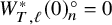 if
$\varepsilon _{\ell }(T) = -1$
if
$\varepsilon _{\ell }(T) = -1$
 (at least one of these must hold, that is, we cannot have T positive definite and
$\varepsilon _{\ell }(T) = +1$
(at least one of these must hold, that is, we cannot have T positive definite and
$\varepsilon _{\ell }(T) = +1$
 for all
$\ell $
for all
$\ell $
 , by the global product formula for local invariants). This completes the proof of (9.1.25).
For the analogous global result (still
$\det T \neq 0$
 and
$T \in \mathrm {Herm}_n$
and
$T \in \mathrm {Herm}_n$
 , central derivative) for an unramified CM extension of number fields
$F / F^+$
, central derivative) for an unramified CM extension of number fields
$F / F^+$
 where all
$2$
where all
$2$
 -adic places are split (forcing
$F^+ \neq \mathbb {Q}$
-adic places are split (forcing
$F^+ \neq \mathbb {Q}$
 ) and a lattice L which is self-dual for the Hermitian pairing, see [Reference Li and ZhangLZ22, Theorem 15.5.1] (at least up to a volume constant). For the analogous global result (still
$\det T \neq 0$
) and a lattice L which is self-dual for the Hermitian pairing, see [Reference Li and ZhangLZ22, Theorem 15.5.1] (at least up to a volume constant). For the analogous global result (still
$\det T \neq 0$
 and
$T \in \mathrm {Herm}_n$
and
$T \in \mathrm {Herm}_n$
 , central derivative) for possibly ramified
$F / F^+$
, central derivative) for possibly ramified
$F / F^+$
 where all
$2$
where all
$2$
 -adic places are split, on Krämer integral models (semistable reduction at ramified primes), and again L self-dual for the Hermitian pairing, see [Reference He, Li, Shi and YangHLSY23, Theorem 10.1] (at least up to a volume constant). For the result on Krämer models, one needs to correct the Eisenstein series derivative by special values of other Eisenstein series.
Remark 9.1.3. When
$n \equiv 0\ \pmod {4}$
 , there is no non-degenerate self-dual signature
$(n - 1, 1)$
, there is no non-degenerate self-dual signature
$(n - 1, 1)$
 Hermitian
$\mathcal {O}_F$
Hermitian
$\mathcal {O}_F$
 -lattice. In this case, Theorem 9.1.1(1) still holds in the sense that
$\frac {d}{d s} \big |_{s = 0} E^{\ast }_{T}(y,s)^{\circ }_n = 0$
-lattice. In this case, Theorem 9.1.1(1) still holds in the sense that
$\frac {d}{d s} \big |_{s = 0} E^{\ast }_{T}(y,s)^{\circ }_n = 0$
 (by the functional equation, Lemma 6.1.1).
Remark 9.1.4. We explain how Theorem 9.1.1 may be reformulated in terms of Faltings heights. Assume
$2$
 is split in
$\mathcal {O}_F$
is split in
$\mathcal {O}_F$
 . Let
$\widehat {\omega }$
. Let
$\widehat {\omega }$
 be the metrized Hodge bundle on
$\mathcal {M}$
be the metrized Hodge bundle on
$\mathcal {M}$
 as defined in [Reference ChenChe24c, Section 2.1] (also [Reference ChenChe24a, Section 3.5]). Take
$T \in \mathrm {Herm}_n(\mathbb {Q})$
as defined in [Reference ChenChe24c, Section 2.1] (also [Reference ChenChe24a, Section 3.5]). Take
$T \in \mathrm {Herm}_n(\mathbb {Q})$
 with
$\operatorname {\mathrm {rank}}(T) = n - 1$
with
$\operatorname {\mathrm {rank}}(T) = n - 1$
 . By [Reference ChenChe24c, p. 4.9.10], we have

where
$h_{\mathrm {Fal}}^{\mathrm {CM}}$
 is the Faltings height of any elliptic curve with CM by
$\mathcal {O}_F$
is the Faltings height of any elliptic curve with CM by
$\mathcal {O}_F$
 (as in [Reference ChenChe24c, (2.1.12)]). By definition of Faltings height, we have

where
$\alpha ' = (A_0, \iota _0, \lambda _0, A, \iota , \lambda ) \in \mathcal {Z}(T)(\mathbb {C})$
 (choose
$F \rightarrow \mathbb {C}$
(choose
$F \rightarrow \mathbb {C}$
 ), and where
$h_{\mathrm {Fal}}(A)$
), and where
$h_{\mathrm {Fal}}(A)$
 is the Faltings height of A (as in [Reference ChenChe24a, Section 10.1]) after descent to any number field, with metric normalized as in [Reference ChenChe24a, (3.5.1)]. Alternatively, we could consider morphisms
$\operatorname {\mathrm {Spec}} \mathbb {C} \rightarrow \mathcal {M}$
is the Faltings height of A (as in [Reference ChenChe24a, Section 10.1]) after descent to any number field, with metric normalized as in [Reference ChenChe24a, (3.5.1)]. Alternatively, we could consider morphisms
$\operatorname {\mathrm {Spec}} \mathbb {C} \rightarrow \mathcal {M}$
 over
$\operatorname {\mathrm {Spec}} \mathbb {Z}$
over
$\operatorname {\mathrm {Spec}} \mathbb {Z}$
 , which would remove the factor of
$2$
, which would remove the factor of
$2$
 in the previous formula.
Our main theorem (Theorem 9.1.1) admits the equivalent formulation

via the decomposition in (9.1.23). We remind the reader that
$\deg _{\mathbb {Z}} \mathcal {Z}(T)_{\mathscr {H}}$
 is essentially a special value of a
$U(n - 1, n - 1)$
is essentially a special value of a
$U(n - 1, n - 1)$
 Eisenstein series (9.1.12). For further discussion of the special case
$n = 2$
Eisenstein series (9.1.12). For further discussion of the special case
$n = 2$
 , see Section 9.2.
In the rest of Section 9.1, we discuss some results which are applicable even if L is not self-dual. Allow possibly
$2 \mid \Delta $
 , and let L be any non-degenerate Hermitian
$\mathcal {O}_F$
, and let L be any non-degenerate Hermitian
$\mathcal {O}_F$
 -lattice of signature
$(n - 1, 1)$
-lattice of signature
$(n - 1, 1)$
 (with n not necessarily even). Select any character
$\chi \colon F^{\times } \backslash \mathbb {A}_F^{\times } \rightarrow \mathbb {C}^{\times }$
(with n not necessarily even). Select any character
$\chi \colon F^{\times } \backslash \mathbb {A}_F^{\times } \rightarrow \mathbb {C}^{\times }$
 such that
$\chi |_{\mathbb {A}^{\times }} = \eta ^n$
such that
$\chi |_{\mathbb {A}^{\times }} = \eta ^n$
 , where
$\eta $
, where
$\eta $
 is the quadratic character associated with
$F / \mathbb {Q}$
is the quadratic character associated with
$F / \mathbb {Q}$
 . Set
$V = L \otimes _{\mathcal {O}_F} F$
. Set
$V = L \otimes _{\mathcal {O}_F} F$
 , with associated local Hermitian space
$V_v$
, with associated local Hermitian space
$V_v$
 for each place v of
$\mathbb {Q}$
for each place v of
$\mathbb {Q}$
 . Suppose
$m^{\flat } \geq 0$
. Suppose
$m^{\flat } \geq 0$
 is an integer. For each prime p, let
$\varphi _p^{\flat } = {\pmb {1}}_{L_p}^{m^{\flat }} \in \mathcal {S}(V_p^{m^{\flat }})$
is an integer. For each prime p, let
$\varphi _p^{\flat } = {\pmb {1}}_{L_p}^{m^{\flat }} \in \mathcal {S}(V_p^{m^{\flat }})$
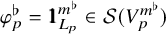 , form the local Siegel–Weil standard section
$\Phi _{\varphi _v^{\flat }} \in I(\chi _v, s)$
, form the local Siegel–Weil standard section
$\Phi _{\varphi _v^{\flat }} \in I(\chi _v, s)$
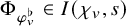 , and set

where the Archimedean component
$\Phi ^{(n)}_{\infty }$
 is the standard (normalized) scalar weight section from Section 2.2. Form the associated classical
$U(m^{\flat }, m^{\flat })$
is the standard (normalized) scalar weight section from Section 2.2. Form the associated classical
$U(m^{\flat }, m^{\flat })$
 Eisenstein series
$E(z^{\flat }, s, \Phi _L)_n$
Eisenstein series
$E(z^{\flat }, s, \Phi _L)_n$
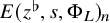 for
$z^{\flat } \in \mathcal {H}_{m^{\flat }}$
for
$z^{\flat } \in \mathcal {H}_{m^{\flat }}$
 , and consider the normalized Eisenstein series Fourier coefficients

for
$T^{\flat } \in \mathrm {Herm}_{m^{\flat }}(\mathbb {Q})$
 . We are not sure whether this is a “good” normalization if L is not self-dual, so the preceding notation appears nowhere else in this work. As in Section 4.3,
$\gamma _{\psi _p}(V_p)$
. We are not sure whether this is a “good” normalization if L is not self-dual, so the preceding notation appears nowhere else in this work. As in Section 4.3,
$\gamma _{\psi _p}(V_p)$
 is a Weil index and
$\mathrm {vol}(L_p)$
is a Weil index and
$\mathrm {vol}(L_p)$
 is the volume of
$L_p$
is the volume of
$L_p$
 with respect to a certain self-dual Haar measure on
$V_p$
with respect to a certain self-dual Haar measure on
$V_p$
 (these factors are
$1$
(these factors are
$1$
 for all but finitely many p).
Form the moduli stack
$\mathcal {M} \rightarrow \operatorname {\mathrm {Spec}} \mathcal {O}_F[1/d_L]$
 associated with L as in [Reference ChenChe24c, Section 2.1].
Remark 9.1.5. Since the proof of Theorem 9.1.1 is local in nature, it is possible to use our local main theorems to prove variants for non self-dual L, up to discarding finitely many primes. This also allows the possibility of relaxing the
$n \equiv 2\ \pmod {4}$
 assumption in Theorem 9.1.1 (at the cost of discrepancy up to
$\mathbb {Q} \cdot \log p$
assumption in Theorem 9.1.1 (at the cost of discrepancy up to
$\mathbb {Q} \cdot \log p$
 for the primes p where L is not self-dual), which was imposed to ensure the existence of an everywhere self-dual lattice.
Set
$m^{\flat } = n - 1$
 . Consider
$T^{\flat } \in \mathrm {Herm}_{n - 1}(\mathbb {Q})$
. Consider
$T^{\flat } \in \mathrm {Herm}_{n - 1}(\mathbb {Q})$
 with
$\det T^{\flat } \neq 0$
with
$\det T^{\flat } \neq 0$
 . Let
$C \in \mathbb {Q}_{>0}$
. Let
$C \in \mathbb {Q}_{>0}$
 be the volume constant from Lemma 7.4.1(3), for the Hermitian space V and with
$v_0 = \infty $
be the volume constant from Lemma 7.4.1(3), for the Hermitian space V and with
$v_0 = \infty $
 etc. in the notation of loc. cit. Consider
$y^{\flat } \in \mathrm {Herm}_{n - 1}(\mathbb {R})_{>0}$
etc. in the notation of loc. cit. Consider
$y^{\flat } \in \mathrm {Herm}_{n - 1}(\mathbb {R})_{>0}$
 . Form
$[\widehat {\mathcal {Z}}(T^{\flat })]$
. Form
$[\widehat {\mathcal {Z}}(T^{\flat })]$
 with Green current with respect to
$y^{\flat }$
with Green current with respect to
$y^{\flat }$
 . Arguing as in the proof of our main theorem (Theorem 9.1.1) gives

For proving (9.1.41), the diagonalization argument (Step 1) in the proof of Theorem 9.1.1 can be skipped. If
$2$
 is split in
$\mathcal {O}_F$
is split in
$\mathcal {O}_F$
 , the expression “
$2 d_L$
, the expression “
$2 d_L$
 ” in (9.1.41) may be replaced by “
$d_L$
” in (9.1.41) may be replaced by “
$d_L$
 ”.
”.
In the case
$n = 1$
 , recall that
$\mathcal {M}$
, recall that
$\mathcal {M}$
 extends smoothly (and nontrivially) over all of
$\operatorname {\mathrm {Spec}} \mathcal {O}_F$
extends smoothly (and nontrivially) over all of
$\operatorname {\mathrm {Spec}} \mathcal {O}_F$
 [Reference ChenChe24c, Remark 2.1.3]. In this case, we need not discard any primes in (9.1.41). As
$m^{\flat } = 0$
[Reference ChenChe24c, Remark 2.1.3]. In this case, we need not discard any primes in (9.1.41). As
$m^{\flat } = 0$
 , the normalized
$U(m^{\flat }, m^{\flat })$
, the normalized
$U(m^{\flat }, m^{\flat })$
 Eisenstein series
$E^{\ast }$
Eisenstein series
$E^{\ast }$
 is the constant function
$1$
is the constant function
$1$
 in this case.
Recall that our main Archimedean local result was valid in arbitrary “codimension” for empty local special cycles with possibly nontrivial Green current (“purely Archimedean intersection number”). This has the following global consequence.
Theorem 9.1.6. Let
$m^{\flat }$
 be any integer with
$1 \leq m^{\flat } \leq n$
be any integer with
$1 \leq m^{\flat } \leq n$
 . Consider
$T^{\flat } \in \mathrm {Herm}_{m^{\flat }}(\mathbb {Q})$
. Consider
$T^{\flat } \in \mathrm {Herm}_{m^{\flat }}(\mathbb {Q})$
 which is nonsingular and not positive definite. Let
$C \in \mathbb {Q}_{>0}$
which is nonsingular and not positive definite. Let
$C \in \mathbb {Q}_{>0}$
 be the volume constant from Lemma 7.4.1(1), for the Hermitian space V, the lattice L, and
$v_0 = \infty $
be the volume constant from Lemma 7.4.1(1), for the Hermitian space V, the lattice L, and
$v_0 = \infty $
 in the notation of loc. cit.
For any
$y^{\flat } \in \mathrm {Herm}_{m^{\flat }}(\mathbb {R})_{>0}$
 , we have an equality of real numbers

where
$s_0^{\flat } {:=}q (n - m^{\flat }) / 2$
 .
.
Proof. In the theorem statement, we set
$\mathcal {M}_{\mathbb {C}} {:=}q \mathcal {M} \times _{\operatorname {\mathrm {Spec}} \mathcal {O}_F} \operatorname {\mathrm {Spec}} \mathbb {C}$
 for either choice of embedding
$F \rightarrow \mathbb {C}$
for either choice of embedding
$F \rightarrow \mathbb {C}$
 . Recall that the special cycle
$\mathcal {Z}(T^{\flat })$
. Recall that the special cycle
$\mathcal {Z}(T^{\flat })$
 is empty by the non positive definite-ness [Reference ChenChe24c, Section 2.1]. The current
$g_{T^{\flat },y^{\flat }}$
is empty by the non positive definite-ness [Reference ChenChe24c, Section 2.1]. The current
$g_{T^{\flat },y^{\flat }}$
 associated with
$[\widehat {\mathcal {Z}}(T^{\flat })]$
associated with
$[\widehat {\mathcal {Z}}(T^{\flat })]$
 is formed with respect to
$y^{\flat }$
is formed with respect to
$y^{\flat }$
 , as usual.
Using our main Archimedean result [Reference ChenChe24b, Theorem 4.1.1] and local Siegel–Weil (Lemma 7.4.1) for uniformization degrees, the theorem follows as in the proof of Theorem 9.1.1, Step (3a). Since
$\det T^{\flat } \neq 0$
 , the proof is simpler here as the diagonalization argument of loc. cit. plays no role. Recall
$W^{\ast }_{T^{\flat }, \infty }(y^{\flat },s_0^{\flat })^{\circ }_n = 0$
, the proof is simpler here as the diagonalization argument of loc. cit. plays no role. Recall
$W^{\ast }_{T^{\flat }, \infty }(y^{\flat },s_0^{\flat })^{\circ }_n = 0$
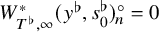 (4.2.6), so the derivatives of non-Archimedean Whittaker functions play no role. If
$T^{\flat }$
(4.2.6), so the derivatives of non-Archimedean Whittaker functions play no role. If
$T^{\flat }$
 has signature
$(m^{\flat } - r, r)$
has signature
$(m^{\flat } - r, r)$
 for
$r \geq 2$
for
$r \geq 2$
 , then both sides of (9.1.42) are zero. The sign
$(-1)^{n - m^{\flat }}$
, then both sides of (9.1.42) are zero. The sign
$(-1)^{n - m^{\flat }}$
 comes from the Archimedean local functional equation (Lemma 5.2.1), since [Reference ChenChe24b, Theorem 4.1.1] was stated at
$s = - s^{\flat }_0$
comes from the Archimedean local functional equation (Lemma 5.2.1), since [Reference ChenChe24b, Theorem 4.1.1] was stated at
$s = - s^{\flat }_0$
 .
.
When
$m^{\flat } = n$
 , the preceding result is due to Liu (see [Reference LiuLiu11, Theorem 4.17, Proof of Theorem 4.20] and also [Reference Li and ZhangLZ22, Theorem 15.3.1]). We do not have a new proof of this case (we deduced our local result for arbitrary
$m^{\flat }$
, the preceding result is due to Liu (see [Reference LiuLiu11, Theorem 4.17, Proof of Theorem 4.20] and also [Reference Li and ZhangLZ22, Theorem 15.3.1]). We do not have a new proof of this case (we deduced our local result for arbitrary
$m^{\flat }$
 from Liu’s result using our local limiting method).
9.2 Faltings heights of Hecke translates of CM elliptic curves
Using the Serre tensor construction, we restate part of the simplest case (
$n = 2$
 ) of our main theorem (Theorem 9.1.1) in more elementary terms, via Faltings heights of Hecke translates of CM elliptic curves (Corollary 9.2.2).
We assume
$2 \nmid \Delta $
 , but allow
$2$
, but allow
$2$
 inert or split in
$\mathcal {O}_F$
inert or split in
$\mathcal {O}_F$
 for the moment. When
$n = 2$
for the moment. When
$n = 2$
 and L is a self-dual Hermitian
$\mathcal {O}_F$
and L is a self-dual Hermitian
$\mathcal {O}_F$
 -lattice of signature
$(1,1)$
-lattice of signature
$(1,1)$
 , recall

in the notation of [Reference ChenChe24a, Section 3.1]. Recall that
$\mathscr {M}_0$
 is the moduli stack parameterizing
$(A_0, \iota _0, \lambda _0)$
is the moduli stack parameterizing
$(A_0, \iota _0, \lambda _0)$
 where
$A_0$
where
$A_0$
 is an elliptic curve with signature
$(1,0)$
is an elliptic curve with signature
$(1,0)$
 action
$\iota _0$
action
$\iota _0$
 by
$\mathcal {O}_F$
by
$\mathcal {O}_F$
 , and
$\lambda _0$
, and
$\lambda _0$
 the unique principal polarization. Recall that
$\mathscr {M}(1,1)^{\circ }$
the unique principal polarization. Recall that
$\mathscr {M}(1,1)^{\circ }$
 is the closure of the generic fiber in the moduli stack of signature
$(1,1)$
is the closure of the generic fiber in the moduli stack of signature
$(1,1)$
 Hermitian abelian schemes
$(A, \iota , \lambda )$
Hermitian abelian schemes
$(A, \iota , \lambda )$
 where
$|\Delta | \cdot \lambda $
where
$|\Delta | \cdot \lambda $
 is a polarization with
$\ker (|\Delta | \cdot \lambda ) = A[\sqrt {\Delta }]$
is a polarization with
$\ker (|\Delta | \cdot \lambda ) = A[\sqrt {\Delta }]$
 .
.
For integers
$j> 0$
 , we first recall how to relate the special cycles
$\mathcal {Z}(j) \rightarrow \mathcal {M}$
, we first recall how to relate the special cycles
$\mathcal {Z}(j) \rightarrow \mathcal {M}$
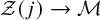 to Hecke translates of CM elliptic curves, as explained in [Reference Kudla and RapoportKR14, §14]. Our
$|\Delta | \cdot \lambda $
to Hecke translates of CM elliptic curves, as explained in [Reference Kudla and RapoportKR14, §14]. Our
$|\Delta | \cdot \lambda $
 is their
$\lambda $
is their
$\lambda $
 .
.
Write
$\mathscr {M}_{\text {ell}}$
 for the moduli stack of elliptic curves base-changed to
$\operatorname {\mathrm {Spec}} \mathcal {O}_F$
for the moduli stack of elliptic curves base-changed to
$\operatorname {\mathrm {Spec}} \mathcal {O}_F$
 . If
$\mathcal {O}_F^{\ast } {:=}q \operatorname {\mathrm {Hom}}_{\mathbb {Z}}(\mathcal {O}_F, \mathbb {Z})$
. If
$\mathcal {O}_F^{\ast } {:=}q \operatorname {\mathrm {Hom}}_{\mathbb {Z}}(\mathcal {O}_F, \mathbb {Z})$
 , we write
$\lambda _{\mathrm {tr}} \colon \mathcal {O}_F \rightarrow \mathcal {O}_F^{\ast }$
, we write
$\lambda _{\mathrm {tr}} \colon \mathcal {O}_F \rightarrow \mathcal {O}_F^{\ast }$
 for the
$\sigma $
for the
$\sigma $
 -linear map corresponding to the symmetric
$\mathbb {Z}$
-linear map corresponding to the symmetric
$\mathbb {Z}$
 -bilinear pairing
$\mathrm {tr}_{F / \mathbb {Q}}(a^{\sigma } b)$
-bilinear pairing
$\mathrm {tr}_{F / \mathbb {Q}}(a^{\sigma } b)$
 on
$\mathcal {O}_F$
on
$\mathcal {O}_F$
 . As in [Reference Kudla and RapoportKR14, §14], there is a Serre tensor morphism

where
$E \otimes _{\mathbb {Z}} \mathcal {O}_F$
 is given the polarization
$|\Delta |^{-1} (\lambda _E \otimes \lambda _{\mathrm {tr}}) \colon E \otimes _{\mathbb {Z}} \mathcal {O}_F \rightarrow E^{\vee } \otimes _{\mathbb {Z}} \mathcal {O}_F^{\ast }$
is given the polarization
$|\Delta |^{-1} (\lambda _E \otimes \lambda _{\mathrm {tr}}) \colon E \otimes _{\mathbb {Z}} \mathcal {O}_F \rightarrow E^{\vee } \otimes _{\mathbb {Z}} \mathcal {O}_F^{\ast }$
 . As we have seen previously,
$E \otimes _{\mathbb {Z}} \mathcal {O}_F$
. As we have seen previously,
$E \otimes _{\mathbb {Z}} \mathcal {O}_F$
 is (by definition) the functor given by
$(E \otimes _{\mathbb {Z}} \mathcal {O}_F)(S') = E(S') \otimes _{\mathbb {Z}} \mathcal {O}_F$
is (by definition) the functor given by
$(E \otimes _{\mathbb {Z}} \mathcal {O}_F)(S') = E(S') \otimes _{\mathbb {Z}} \mathcal {O}_F$
 for schemes
$S'$
for schemes
$S'$
 (over the understood base for E).
For the rest of Section 9.2, we now assume
$\mathcal {O}_F^{\times } = \{ \pm 1 \}$
 . In this case, the Serre tensor morphism is an open and closed immersion.Footnote
17
Indeed,
$i_{\text {Serre}}$
. In this case, the Serre tensor morphism is an open and closed immersion.Footnote
17
Indeed,
$i_{\text {Serre}}$
 is proper (valuative criterion) and a monomorphism of algebraic stacks, hence a closed immersion of algebraic stacks. Since the source and target are Deligne–Mumford, smooth, finite type, and separated over
$\operatorname {\mathrm {Spec}} \mathcal {O}_F$
is proper (valuative criterion) and a monomorphism of algebraic stacks, hence a closed immersion of algebraic stacks. Since the source and target are Deligne–Mumford, smooth, finite type, and separated over
$\operatorname {\mathrm {Spec}} \mathcal {O}_F$
 of the same relative dimension, this implies that
$i_{\text {Serre}}$
of the same relative dimension, this implies that
$i_{\text {Serre}}$
 is also an open immersion.
The class group
$\mathrm {Cl}(\mathcal {O}_F)$
 acts on
$\mathscr {M}(1,1)^{\circ }$
acts on
$\mathscr {M}(1,1)^{\circ }$
 as follows. Given any fractional ideal
$\mathfrak {a} \subseteq F$
as follows. Given any fractional ideal
$\mathfrak {a} \subseteq F$
 , set
$\mathfrak {a}^{\vee } {:=}q \operatorname {\mathrm {Hom}}_{\mathcal {O}_F}(\mathfrak {a}, \mathcal {O}_F)$
, set
$\mathfrak {a}^{\vee } {:=}q \operatorname {\mathrm {Hom}}_{\mathcal {O}_F}(\mathfrak {a}, \mathcal {O}_F)$
 , and consider the
$\sigma $
, and consider the
$\sigma $
 -linear map
$\lambda _{\mathfrak {a}} \colon \mathfrak {a} \xrightarrow {\sim } \mathfrak {a}^{\vee }$
-linear map
$\lambda _{\mathfrak {a}} \colon \mathfrak {a} \xrightarrow {\sim } \mathfrak {a}^{\vee }$
 given by the perfect positive-definite Hermitian pairing
$a, b \mapsto N(\mathfrak {a})^{-1} a^{\sigma } b$
given by the perfect positive-definite Hermitian pairing
$a, b \mapsto N(\mathfrak {a})^{-1} a^{\sigma } b$
 on
$\mathfrak {a}$
on
$\mathfrak {a}$
 . There is an induced automorphism of
$\mathscr {M}(1,1)^{\circ }$
. There is an induced automorphism of
$\mathscr {M}(1,1)^{\circ }$
 sending

The action of
$\mathrm {Cl}(\mathcal {O}_F)$
 on
$\mathscr {M}(1,1)^{\circ }$
on
$\mathscr {M}(1,1)^{\circ }$
 is simply transitive on the set of connected components (see the proof of [Reference Kudla and RapoportKR14, Proposition 14.4]). There is a similar action of
$\mathrm {Cl}(\mathcal {O}_F)$
is simply transitive on the set of connected components (see the proof of [Reference Kudla and RapoportKR14, Proposition 14.4]). There is a similar action of
$\mathrm {Cl}(\mathcal {O}_F)$
 on
$\mathscr {M}_0$
on
$\mathscr {M}_0$
 which sends
$(A_0, \iota _0, \lambda _0) \mapsto (A_0 \otimes _{\mathcal {O}_F} \mathfrak {a}, \iota _0, \lambda _0 \otimes \lambda _{\mathfrak {a}})$
which sends
$(A_0, \iota _0, \lambda _0) \mapsto (A_0 \otimes _{\mathcal {O}_F} \mathfrak {a}, \iota _0, \lambda _0 \otimes \lambda _{\mathfrak {a}})$
 . Given a fractional ideal
$\mathfrak {a} \subseteq F$
. Given a fractional ideal
$\mathfrak {a} \subseteq F$
 , we write
$f_{\mathfrak {a}} \colon \mathcal {M} \rightarrow \mathcal {M}$
, we write
$f_{\mathfrak {a}} \colon \mathcal {M} \rightarrow \mathcal {M}$
 for the induced automorphism just described.
Given any integer
$j> 0$
 , the action of
$\mathrm {Cl}(\mathcal {O}_F)$
, the action of
$\mathrm {Cl}(\mathcal {O}_F)$
 preserves
$\mathcal {Z}(j)$
preserves
$\mathcal {Z}(j)$
 , in the sense that there is a
$2$
, in the sense that there is a
$2$
 -Cartesian diagram

for any fractional ideal
$\mathfrak {a}$
 , where
$\tilde {f}_{\mathfrak {a}}$
, where
$\tilde {f}_{\mathfrak {a}}$
 sends
sends

for
$x \in \operatorname {\mathrm {Hom}}_{\mathcal {O}_F}(A_0, A)$
 satisfying
$x^{\dagger } x = j$
satisfying
$x^{\dagger } x = j$
 .
.
Consider the j-th Hecke correspondence
$\mathcal {T}_j \rightarrow \mathscr {M}_0 \times _{\operatorname {\mathrm {Spec}} \mathcal {O}_F} \mathscr {M}_{\text {ell}}$
 , where
$\mathcal {T}_j$
, where
$\mathcal {T}_j$
 is the stack parameterizing tuples
$(E_0, \iota _0, \lambda _0, E, w)$
is the stack parameterizing tuples
$(E_0, \iota _0, \lambda _0, E, w)$
 for
$(E_0, \iota _0, \lambda _0) \in \mathscr {M}_0$
for
$(E_0, \iota _0, \lambda _0) \in \mathscr {M}_0$
 , for
$E \in \mathscr {M}_{\text {ell}}$
, for
$E \in \mathscr {M}_{\text {ell}}$
 , and
$w \colon E \rightarrow E_0$
, and
$w \colon E \rightarrow E_0$
 an isogeny of degree j.
Consider the map
$\mathscr {M}_0 \times \mathscr {M}_{\text {ell}} \rightarrow \mathcal {M}$
 induced by
$i_{\text {Serre}}$
induced by
$i_{\text {Serre}}$
 (and the identity on
$\mathscr {M}_0$
(and the identity on
$\mathscr {M}_0$
 ). The Kudla–Rapoport cycle
$\mathcal {Z}(j)$
). The Kudla–Rapoport cycle
$\mathcal {Z}(j)$
 pulls back to the Hecke correspondence
$\mathcal {T}_j$
pulls back to the Hecke correspondence
$\mathcal {T}_j$
 , that is, there is a
$2$
, that is, there is a
$2$
 -Cartesian diagram

where
$\mathcal {T}_j \rightarrow \mathcal {Z}(j)$
 sends
sends

(with
$\lambda _E$
 denoting the unique principal polarization of E) and where
$x_w \colon E_0 \rightarrow E \otimes _{\mathbb {Z}} \mathcal {O}_F$
denoting the unique principal polarization of E) and where
$x_w \colon E_0 \rightarrow E \otimes _{\mathbb {Z}} \mathcal {O}_F$
 is the
$\mathcal {O}_F$
is the
$\mathcal {O}_F$
 -linear map such that
$\sqrt {\Delta } x_w^{\dagger } \in \operatorname {\mathrm {Hom}}_{\mathcal {O}_F}(E \otimes _{\mathbb {Z}} \mathcal {O}_F, E_0)$
-linear map such that
$\sqrt {\Delta } x_w^{\dagger } \in \operatorname {\mathrm {Hom}}_{\mathcal {O}_F}(E \otimes _{\mathbb {Z}} \mathcal {O}_F, E_0)$
 corresponds to w via the adjunction

Here, we are implicitly claiming
$\deg (w) = x^{\dagger }_w x_w$
 . The fact that (9.2.6) is well-defined and
$2$
. The fact that (9.2.6) is well-defined and
$2$
 -Cartesian is proved in [Reference Kudla and RapoportKR14, Proposition 14.5].
We next discuss the Eisenstein series of Theorem 9.1.1(2) in more elementary terms when
$n = 2$
 . In this case, the
$U(1,1)$
. In this case, the
$U(1,1)$
 Eisenstein series
$E^{\ast }(z, s)^{\circ }_2$
Eisenstein series
$E^{\ast }(z, s)^{\circ }_2$
 (with
$m = 1$
(with
$m = 1$
 in our usual notation, and normalized as in Section 6.1) admits the classical expression

for
$z = x + i y \in \mathcal {H}$
 , where
$\mathcal {H} \subseteq \mathbb {C}$
, where
$\mathcal {H} \subseteq \mathbb {C}$
 is the usual upper half-space (here z corresponds to
$z^{\flat }$
is the usual upper half-space (here z corresponds to
$z^{\flat }$
 in Theorem 9.1.1(2)).
For nonzero
$j \in \mathbb {Z}$
 , the (normalized) j-th Fourier coefficient of
$E^{\ast }(z,s)^{\circ }_2$
, the (normalized) j-th Fourier coefficient of
$E^{\ast }(z,s)^{\circ }_2$
 factorizes into (normalized) local Whittaker functions

as in Section 6.1. We have the formulas

where
$v_p(-)$
 means p-adic valuation and

is the classical divisor function. These formulas for local Whittaker functions are likely classical, but they also follow from [Reference ChenChe24a, (9.2.8)] on local densities (translation to local Whittaker functions via (4.5.6)). An integral expression for
$W^{\ast }_{j,\infty }(y,s)^{\circ }_2$
 may be found in [Reference ChenChe24b, Section 4.2]. For
$j> 0$
may be found in [Reference ChenChe24b, Section 4.2]. For
$j> 0$
 , recall
$W^{\ast }_{j,\infty }(y,1/2)^{\circ }_2 = 1$
, recall
$W^{\ast }_{j,\infty }(y,1/2)^{\circ }_2 = 1$
 (4.2.6).
We require
$j> 0$
 for the rest of Section 9.2. Fix an embedding
$F \rightarrow \mathbb {C}$
for the rest of Section 9.2. Fix an embedding
$F \rightarrow \mathbb {C}$
 . Given a CM elliptic curve
$(E_0, \iota _0, \lambda _0) \in \mathscr {M}_0(\mathbb {C})$
. Given a CM elliptic curve
$(E_0, \iota _0, \lambda _0) \in \mathscr {M}_0(\mathbb {C})$
 , we consider the set of j-th Hecke translates of
$E_0$
, we consider the set of j-th Hecke translates of
$E_0$
 given by

Phrased alternatively, the fiber of
$\mathcal {T}_j \rightarrow \mathscr {M}_0$
 over the point
$\operatorname {\mathrm {Spec}} \mathbb {C} \rightarrow \mathscr {M}_0$
over the point
$\operatorname {\mathrm {Spec}} \mathbb {C} \rightarrow \mathscr {M}_0$
 corresponding to
$E_0$
corresponding to
$E_0$
 is a finite scheme over
$\operatorname {\mathrm {Spec}} \mathbb {C}$
is a finite scheme over
$\operatorname {\mathrm {Spec}} \mathbb {C}$
 , and
$\mathcal {T}_j(E_0)$
, and
$\mathcal {T}_j(E_0)$
 is its set of
$\mathbb {C}$
is its set of
$\mathbb {C}$
 -points. We set

where
$|-|$
 denotes set cardinality, the sum runs over
$(E_0, \iota _0, \lambda _0, E, w) \in \mathcal {T}_j(E_0)$
denotes set cardinality, the sum runs over
$(E_0, \iota _0, \lambda _0, E, w) \in \mathcal {T}_j(E_0)$
 , and
$h_{\mathrm {Fal}}(E)$
, and
$h_{\mathrm {Fal}}(E)$
 denotes the Faltings height of E (with metric normalized as in [Reference ChenChe24a, (3.5.1)], see also [Reference ChenChe24a, Section 10.1]) after descending from
$\mathbb {C}$
denotes the Faltings height of E (with metric normalized as in [Reference ChenChe24a, (3.5.1)], see also [Reference ChenChe24a, Section 10.1]) after descending from
$\mathbb {C}$
 to any number field.
The following lemma states that the (total) Faltings height of j-th Hecke translates of a chosen elliptic curve with CM by
$\mathcal {O}_F$
 does not depend on the choice of CM elliptic curve. It should admit a general formulation in terms of Hecke correspondences over
$\mathscr {M}_0$
does not depend on the choice of CM elliptic curve. It should admit a general formulation in terms of Hecke correspondences over
$\mathscr {M}_0$
 . We give a more elementary treatment in the spirit of this section.
Lemma 9.2.1. Fix
$j \in \mathbb {Z}_{>0}$
 . For any
$(E_0, \iota _0, \lambda _0) \in \mathscr {M}_0(\mathbb {C})$
. For any
$(E_0, \iota _0, \lambda _0) \in \mathscr {M}_0(\mathbb {C})$
 and
$(E^{\prime }_0, \iota ^{\prime }_0, \lambda ^{\prime }_0) \in \mathscr {M}_0(\mathbb {C})$
and
$(E^{\prime }_0, \iota ^{\prime }_0, \lambda ^{\prime }_0) \in \mathscr {M}_0(\mathbb {C})$
 , we have

Proof. Given any
$d \in \mathbb {Z}$
 , we claim that there exists an isogeny
$\phi \colon E^{\prime }_0 \rightarrow E_0$
, we claim that there exists an isogeny
$\phi \colon E^{\prime }_0 \rightarrow E_0$
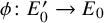 of degree prime to d. Consider

for lattices
$\Lambda _0$
 and
$\Lambda ^{\prime }_0$
and
$\Lambda ^{\prime }_0$
 . Without loss of generality, we may assume
$\Lambda _0 = \mathcal {O}_F \subseteq \mathbb {C}$
. Without loss of generality, we may assume
$\Lambda _0 = \mathcal {O}_F \subseteq \mathbb {C}$
 and that
$\Lambda ^{\prime }_0 = \mathfrak {a}^{\prime }_0$
and that
$\Lambda ^{\prime }_0 = \mathfrak {a}^{\prime }_0$
 for some fractional ideal
$\mathfrak {a}^{\prime }_0 \subseteq \mathbb {C}$
for some fractional ideal
$\mathfrak {a}^{\prime }_0 \subseteq \mathbb {C}$
 . By the Chinese remainder theorem, we can assume
$\mathfrak {a}^{\prime }_0 \subseteq \mathcal {O}_F$
. By the Chinese remainder theorem, we can assume
$\mathfrak {a}^{\prime }_0 \subseteq \mathcal {O}_F$
 and that
$\mathfrak {a}^{\prime }_0$
and that
$\mathfrak {a}^{\prime }_0$
 has norm prime to d (without changing the ideal class of
$\mathfrak {a}^{\prime }_0$
has norm prime to d (without changing the ideal class of
$\mathfrak {a}^{\prime }_0$
 ). The inclusion
$\mathfrak {a}^{\prime }_0 \subseteq \mathcal {O}_F$
). The inclusion
$\mathfrak {a}^{\prime }_0 \subseteq \mathcal {O}_F$
 gives an isogeny
$E^{\prime }_0 \rightarrow E_0$
gives an isogeny
$E^{\prime }_0 \rightarrow E_0$
 of degree prime to d.
Let p be any prime. Let
$\phi \colon E^{\prime }_0 \rightarrow E_0$
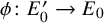 be an isogeny of degree prime to
$p j$
be an isogeny of degree prime to
$p j$
 . As above, we view
$\phi \colon E_0(\mathbb {C}) \rightarrow E^{\prime }_0(\mathbb {C})$
. As above, we view
$\phi \colon E_0(\mathbb {C}) \rightarrow E^{\prime }_0(\mathbb {C})$
 as an inclusion of lattices
$\Lambda ^{\prime }_0 \rightarrow \Lambda _0$
as an inclusion of lattices
$\Lambda ^{\prime }_0 \rightarrow \Lambda _0$
 of index prime to
$p j$
of index prime to
$p j$
 . There is an induced bijection

We are viewing
$\Lambda $
 as the element
$\mathbb {C} / \Lambda \rightarrow \mathbb {C} / \Lambda _0$
as the element
$\mathbb {C} / \Lambda \rightarrow \mathbb {C} / \Lambda _0$
 of
$\mathcal {T}_j(E_0)$
of
$\mathcal {T}_j(E_0)$
 , and similarly for
$\Lambda \cap \Lambda ^{\prime }_0$
, and similarly for
$\Lambda \cap \Lambda ^{\prime }_0$
 .
.
The isogeny
$\mathbb {C} / (\Lambda \cap \Lambda ^{\prime }_0) \rightarrow \mathbb {C} / \Lambda $
 has degree
$\deg \phi $
has degree
$\deg \phi $
 , which is prime to p. As these elliptic curves are defined over
$\overline {\mathbb {Q}}$
, which is prime to p. As these elliptic curves are defined over
$\overline {\mathbb {Q}}$
 , this isogeny also descends to
$\overline {\mathbb {Q}}$
, this isogeny also descends to
$\overline {\mathbb {Q}}$
 . By the formula for change of Faltings height along an isogeny [Reference ChenChe24a, (10.2.4)], we conclude
$h_{\mathrm {Fal}}(\mathcal {T}_j(E_0)) - h_{\mathrm {Fal}}(\mathcal {T}_j(E^{\prime }_0)) \in \sum _{\ell \mid \deg \phi } \mathbb {Q} \cdot \log \ell $
. By the formula for change of Faltings height along an isogeny [Reference ChenChe24a, (10.2.4)], we conclude
$h_{\mathrm {Fal}}(\mathcal {T}_j(E_0)) - h_{\mathrm {Fal}}(\mathcal {T}_j(E^{\prime }_0)) \in \sum _{\ell \mid \deg \phi } \mathbb {Q} \cdot \log \ell $
 . Varying p shows
$h_{\mathrm {Fal}}(\mathcal {T}_j(E_0)) = h_{\mathrm {Fal}}(\mathcal {T}_j(E^{\prime }_0))$
. Varying p shows
$h_{\mathrm {Fal}}(\mathcal {T}_j(E_0)) = h_{\mathrm {Fal}}(\mathcal {T}_j(E^{\prime }_0))$
 , as the real numbers
$\log p$
, as the real numbers
$\log p$
 are
$\mathbb {Q}$
are
$\mathbb {Q}$
 -linearly independent for varying p.
Consider any
$(E_0, \iota _0, \lambda _0) \in \mathscr {M}_0(\mathbb {C})$
 . Using (9.2.6) (Kudla–Rapoport cycle pulls back to Hecke correspondence), the geometric Siegel–Weil statement in Remark 8.1.2 implies

for any
$y \in \mathbb {R}_{>0}$
 . On the left, one factor of
$h_F$
. On the left, one factor of
$h_F$
 appears because the Serre tensor morphism
$i_{\text {Serre}} \colon \mathscr {M}_{\text {ell}} \rightarrow \mathscr {M}(1,1)^{\circ }$
appears because the Serre tensor morphism
$i_{\text {Serre}} \colon \mathscr {M}_{\text {ell}} \rightarrow \mathscr {M}(1,1)^{\circ }$
 is the inclusion of one connected component (and
$\mathscr {M}(1,1)^{\circ }$
is the inclusion of one connected component (and
$\mathscr {M}(1,1)^{\circ }$
 has
$h_F$
has
$h_F$
 connected components, by the action of
$\mathrm {Cl}(\mathcal {O}_F)$
connected components, by the action of
$\mathrm {Cl}(\mathcal {O}_F)$
 discussed above; we discussed that this action is compatible with Kudla–Rapoport cycles). On the left, the additional factor
$h_F / w_F$
discussed above; we discussed that this action is compatible with Kudla–Rapoport cycles). On the left, the additional factor
$h_F / w_F$
 appears via Lemma 9.2.1 (instead of summing over
$\mathscr {M}_0(\mathbb {C})$
appears via Lemma 9.2.1 (instead of summing over
$\mathscr {M}_0(\mathbb {C})$
 , it is enough to consider a fixed
$E_0$
, it is enough to consider a fixed
$E_0$
 and multiply by
$h_F / w_F = \deg _{\mathbb {C}} (\mathscr {M}_0 \times _{\operatorname {\mathrm {Spec}} \mathcal {O}_F} \operatorname {\mathrm {Spec}} \mathbb {C})$
and multiply by
$h_F / w_F = \deg _{\mathbb {C}} (\mathscr {M}_0 \times _{\operatorname {\mathrm {Spec}} \mathcal {O}_F} \operatorname {\mathrm {Spec}} \mathbb {C})$
 ).
).
By the formulas in (9.2.11) and surrounding discussion, this recovers the well-known identity
$\deg \mathcal {T}_j(E_0) = \sigma _1(j)$
 for degrees of Hecke correspondences (recall our running assumption
$|\mathcal {O}_F^{\times }| = \{ \pm 1 \}$
for degrees of Hecke correspondences (recall our running assumption
$|\mathcal {O}_F^{\times }| = \{ \pm 1 \}$
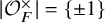 for most of Section 9.2, i.e.,
$w_F = 2$
for most of Section 9.2, i.e.,
$w_F = 2$
 ).
).
In the next lemma,
$h^{\mathrm {CM}}_{\mathrm {Fal}} = h_{\mathrm {Fal}}(E_0)$
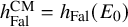 is the Faltings height of any elliptic curve with CM by
$\mathcal {O}_F$
is the Faltings height of any elliptic curve with CM by
$\mathcal {O}_F$
 , normalized as in [Reference ChenChe24c, (2.1.12)]. It is well known that this does not depend on the choice of CM elliptic curve (also follows from Lemma 9.2.1).
Corollary 9.2.2. Suppose
$2$
 is split in
$\mathcal {O}_F$
is split in
$\mathcal {O}_F$
 . For any integer
$j> 0$
. For any integer
$j> 0$
 and any CM elliptic curve
$(E_0, \iota _0, \lambda _0) \in \mathscr {M}_0(\mathbb {C})$
and any CM elliptic curve
$(E_0, \iota _0, \lambda _0) \in \mathscr {M}_0(\mathbb {C})$
 , we have

Proof. Set
$n = 2$
 and consider the
$2 \times 2$
and consider the
$2 \times 2$
 matrix
$T = \mathrm {diag}(0, j)$
matrix
$T = \mathrm {diag}(0, j)$
 . Again using (9.2.6) to pull back Kudla–Rapoport cycles to Hecke correspondences, we have

in our previous notation (Remark 9.1.4). On the left, the outer factor of
$2$
 has the same explanation as in (9.1.37) (see following discussion). The factor
$h^2_F/w_F$
has the same explanation as in (9.1.37) (see following discussion). The factor
$h^2_F/w_F$
 has the same explanation as in (9.2.18), via Lemma 9.2.1 on Faltings height. The factor of
$2$
has the same explanation as in (9.2.18), via Lemma 9.2.1 on Faltings height. The factor of
$2$
 in
$2 h_{\mathrm {Fal}}(\mathcal {T}_j(E_0))$
in
$2 h_{\mathrm {Fal}}(\mathcal {T}_j(E_0))$
 appears because
$h_{\mathrm {Fal}}(E \otimes _{\mathbb {Z}} \mathcal {O}_F) = h_{\mathrm {Fal}}(E \times E) = 2 h_{\mathrm {Fal}}(E)$
appears because
$h_{\mathrm {Fal}}(E \otimes _{\mathbb {Z}} \mathcal {O}_F) = h_{\mathrm {Fal}}(E \times E) = 2 h_{\mathrm {Fal}}(E)$
 . The factor of
$2$
. The factor of
$2$
 in
$2 (\deg \mathcal {T}_j(E_0)) \cdot h_{\mathrm {Fal}}^{\mathrm {CM}}$
in
$2 (\deg \mathcal {T}_j(E_0)) \cdot h_{\mathrm {Fal}}^{\mathrm {CM}}$
 is the n in Remark 9.1.4.
In our previous notation, we have
$\mathrm {Int}_{\mathscr {V},p,\mathrm {global}}(T) = 0$
 for all primes p as the vertical special cycle class
${}^{\mathbb {L}} \mathcal {Z}(T)_{\mathscr {V},p}$
for all primes p as the vertical special cycle class
${}^{\mathbb {L}} \mathcal {Z}(T)_{\mathscr {V},p}$
 is
$0$
is
$0$
 when
$n = 2$
when
$n = 2$
 [Reference ChenChe24c, Lemma 4.7.6]. Hence
$\mathrm {Int}_{p, \mathrm {global}}(T) = \mathrm {Int}_{\mathscr {H}, p, \mathrm {global}}(T) + \mathrm {Int}_{\mathscr {V},\ell ,\mathrm {global}}(T) = \mathrm {Int}_{\mathscr {H}, p, \mathrm {global}}(T)$
[Reference ChenChe24c, Lemma 4.7.6]. Hence
$\mathrm {Int}_{p, \mathrm {global}}(T) = \mathrm {Int}_{\mathscr {H}, p, \mathrm {global}}(T) + \mathrm {Int}_{\mathscr {V},\ell ,\mathrm {global}}(T) = \mathrm {Int}_{\mathscr {H}, p, \mathrm {global}}(T)$
 .
.
Then (9.1.22) (“horizontal local part” of our main result) implies

for all p (in the notation of loc. cit., take
$T^{\flat } = j$
 ,
$a^{\flat }_{v} = 1$
,
$a^{\flat }_{v} = 1$
 for all
$v < \infty $
for all
$v < \infty $
 , and recall our notation
$\tilde {W}^{\ast }_{T^{\flat },v}(1,s)^{\circ }_n = W^{\ast }_{T^{\flat },v}(1,s)^{\circ }_n {=:} W^{\ast }_{T^{\flat },v}(s)^{\circ }_n$
, and recall our notation
$\tilde {W}^{\ast }_{T^{\flat },v}(1,s)^{\circ }_n = W^{\ast }_{T^{\flat },v}(1,s)^{\circ }_n {=:} W^{\ast }_{T^{\flat },v}(s)^{\circ }_n$
 ). Since
$j> 0$
). Since
$j> 0$
 , we have used
$W^{\ast }_{j,\infty }(1/2)^{\circ }_2 = 1$
, we have used
$W^{\ast }_{j,\infty }(1/2)^{\circ }_2 = 1$
 (4.2.6) as recalled above.
Combining (9.2.21) and (9.2.20) along with the formula
$\deg \mathcal {T}_j(E_0) = \sigma _1(j)$
 , we obtain

where the product runs over all primes (not including the Archimedean place). The corollary now follows from the formulas in (9.2.11).
Acknowledgments
I thank my advisor Wei Zhang for suggesting this topic, for his dedicated support and constant enthusiasm, for insightful discussions throughout the entire course of this project, and for helpful comments on earlier drafts. I thank Tony Feng, Qiao He, Benjamin Howard, Ishan Levy, Chao Li, Keerthi Madapusi, Andreas Mihatsch, Bjorn Poonen, Siddarth Sankaran, Ananth Shankar, Yousheng Shi, Tonghai Yang, Shou-Wu Zhang, and Zhiyu Zhang for helpful comments or discussions. I also thank the anonymous referees for their helpful comments, line-by-line close reading, and many corrections.
Competing interests
The author has no competing interests to declare.
Financial support
This work was partly supported by the National Science Foundation Graduate Research Fellowship under Grant Nos. DGE-1745302 and DGE-2141064. Parts of this work were completed at the Mathematical Sciences Research Institute (MSRI), now becoming the Simons Laufer Mathematical Sciences Institute (SLMath), and the Hausdorff Institute for Mathematics. I thank these institutes for their support and hospitality. The former is supported by the National Science Foundation (Grant No. DMS-1928930), and the latter is funded by the Deutsche Forschungsgemeinschaft (DFG, German Research Foundation) under Germany’s Excellence Strategy – EXC-2047/1 – 390685813. This manuscript was prepared partially during the period the author served as a Clay Research Fellow.






















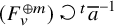



























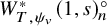
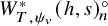
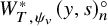


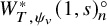







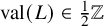














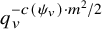





 Open access

