



Introduction
Falls are one of the most common causes of injury, loss of function, and death among the elderly population (Fried et al., Reference Fried, Ferrucci, Darer, Williamson and Anderson2004). Every year, about 30% of the population over 65 years of age are victim of falls (Todd and Skelton, Reference Todd and Skelton2004). However, since only less than half of the falls are reported to physicians or healthcare professionals, it is not easy to provide an accurate estimate of the true incidence (Stevens et al., Reference Stevens, Ballesteros, Mack, Rudd, DeCaro and Adler2012). Elderly people are more susceptible to falls and injuries due to the higher prevalence of clinical diseases, age-related physiological changes, and delayed functional recovery.
Approximately 10% of falls are reported to cause serious damages – especially head trauma or hip fracture (Goldacre et al., Reference Goldacre, Roberts and Yeates2002; Rubenstein and Josephson, Reference Rubenstein and Josephson2002). Furthermore, the psychological consequences of a fall should be taken into account, as fear of falling could lead to severe restriction in the activities of daily living, leading to depression, social isolation, and loss of muscle tone, which in turn results in a vicious circle that could lead to an additional risk of falling in the long run (Murphy and Isaacs, Reference Murphy and Isaacs1982; Zijlstra et al., Reference Zijlstra, van Haastregt, van Eijk, van Rossum, Stalenhoef and Kempen2007).
A fall is a multi-factorial event in which there is a concurrence of intrinsic factors related to the characteristics of the person – represented by age-related physiological changes, comorbidities, and drug therapy – and extrinsic factors related to the environmental risks (Lord et al., Reference Lord, Menz and Sherrington2006; Rubenstein, Reference Rubenstein, Solomon, Roth, Young, Shekelle, Chang, MacLean, Kamberg, Saliba and Wenger2006). Although the most significant factors for young people are related to the environment, the role of intrinsic risk factors becomes increasingly relevant with age. In the literature, more than 400 different risk factors related to falls are described. Of these, the most relevant ones are impaired balance, dizziness/vertigo, visual or musculoskeletal disorder, cognitive impairment, neurological diseases, cardiovascular diseases, and medications such as psychotropic drugs (Rubenstein, Reference Rubenstein, Solomon, Roth, Young, Shekelle, Chang, MacLean, Kamberg, Saliba and Wenger2006). Several studies have shown that the risk of falling increases dramatically with the increased presence of risk factors (Faulkner et al., Reference Faulkner, Cauley, Studenski, Landsittel, Cummings, Ensrud, Donaldson and Nevitt2009; Shumway-Cook et al., Reference Shumway-Cook, Ciol, Hoffman, Dudgeon, Yorkston and Chan2009; Sibley et al., Reference Sibley, Voth, Munce, Straus and Jaglal2014).
Adequate medical and environmental evaluation and treatment for the underlying medical risk factors could prevent many falls and adverse outcomes that may force an elderly person into a vicious cycle of loss of functionality and autonomy, which increases the fragility and the need for assistance. Despite the existence of guidelines, clinical pathways, and tools for falls prevention, time constraints and competing demands in the clinical environment frequently undermine fall-risk evaluation and management (Wenger et al., Reference Wenger, Solomon, Roth, MacLean, Saliba, Kamberg, Rubenstein, Young, Sloss, Louie, Adams, Chang, Venus, Schnelle and Shekelle2003; Tinetti et al., Reference Tinetti, Gordon, Sogolow, Lapin and Bradley2006). In a community setting – especially in the context of proactive primary healthcare – quick and efficient tools for a preliminary fall-risk assessment based on routine medical records could help to overcome these barriers and to develop tailored and cost-effective prevention programmes. The objective of the present study is to evaluate the possibility of determining fall predictors in the active community-dwelling elderly from the routine medical records of the general practitioners (GPs).
Methods
The study was approved by the local Ethics Committee and was conducted according to the principles described in the Declaration of Helsinki.
The study was conducted in a rural municipality of about 10 000 inhabitants located in central Italy. All the GPs (n=4) at a Community Health Center (Unità Complessa di Cure Primarie) serving the municipality were recruited for the study. According to the regulation of the National Healthcare Systems, in Italy every citizen and foreign resident above the age of 18 is entitled to be registered as a patient with a GP. The healthcare provided from GPs is free of charge for all patients.
Data were extracted from the GPs’ routine medical records of the patients through the software Millewin® – an ad hoc software developed for and used by a majority of Italian GPs. Records were extracted and reviewed between January and March 2016 and the data of patients aged 65 years and older were included in the study. In order to select an active elderly population, bedridden or non-ambulatory patients and patients with severe dementia were excluded from the study.
For each subject, the following variables were considered: history of falls in the previous year, age, gender, past medical history of diseases, and current pharmacotherapy. In patients with more than one fall event, only the first event was considered in the analysis. The Millewin software uses the ICDIX–CM classification and the anatomical therapeutic chemical (ATC) classification system to classify diseases and pharmacotherapy, respectively.
The diseases were analysed as a dichotomous variable – either individually (in terms of the presence or absence of a specific disease) or as a group (in terms of the presence or absence of at least one or more pathologies belonging to a specific group), as shown in Table 1. For the cardiovascular and musculoskeletal diseases group, the cumulative effect (0, 1, 2, >2) of more coexistent diseases was analysed. Finally, the comorbidities – that is the presence of two or more coexistent diseases – were analysed.
List of the investigated variables
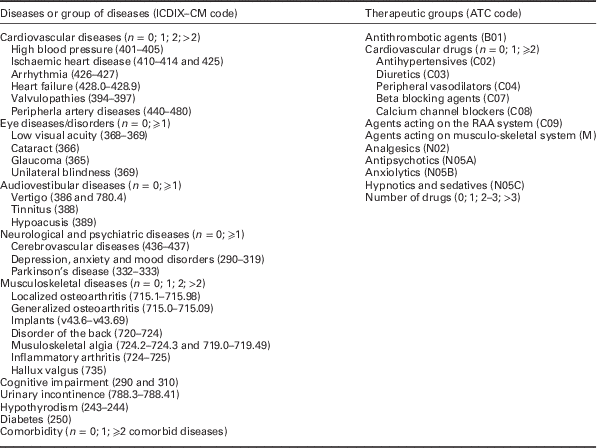
ATC=anatomical therapeutic chemical; RAA=renin–angiotensin–aldosterone.
The following medications (along with ATC code) were considered: antithrombotic agents (B01); antihypertensives (C02); diuretics (C03); peripheral vasodilators (C04); β blocking agents (C07); calcium channel blockers (C08); agents acting on the renin–angiotensin–aldosterone (RAA) system (C09); agents acting on musculoskeletal system (M) (eg, muscle relaxants, vitamin D); analgesics (N02); antipsychotics (N05A); anxiolytics (N05B); and hypnotics and sedatives (N05C). The above variables were considered as dichotomous (presence or absence in the therapy of the subject). A variable was created to consider the number of cardiovascular drugs used in the therapy of each patient (0, 1, ⩾2). To assess the role of the number of drugs, a variable was created in order to take into account monopharmacy and polypharmacy. Although there is no uniform definition of polypharmacy, we have defined it – in accordance with the literature on falls among the elderly – as the use of four or more medications (Leipzig et al., Reference Leipzig, Cumming and Tinetti1999a; Reference Leipzig, Cumming and Tinetti1999b; Ziere et al., Reference Ziere, Dieleman, Hofman, Pols, Van Der Cammen and Stricker2006; Buatois et al., Reference Buatois, Perret-Guillaume, Gueguen, Miget, Vançon, Perrin and Benetos2010).
A descriptive analysis with χ 2 test for categorical and ordinal data and unpaired t-test for continuous data were performed in order to evaluate significant associations between falls and all the variables considered. The variables statistically associated with falls were entered into a multivariable logistic regression model conducted using the backward stepwise method. For each analysis, an α level of 0.05 is considered as significant. The statistical software IBM SPSS Statistics 20 and Stata 11 were used for data analyses.
Results
The sample consisted of 1220 subjects, of whom 43.1% were women and 56.9% men. The mean age was significantly different for men and women (women: 77.8±8.7 years; men: 74.9±7.3 years; P<0.01). Of this sample, 142 subjects (11.6%) had experienced one or more falls in the previous year. No significant dependence of the prevalence of falls on gender was observed. The prevalence of falls was found to significantly increase with age (P=0.013).
The presence of coexistent risk factors for falls was found to increase with age; only 127 subjects had two or more risk factors in the age group 75 years or younger, whereas 506 subjects showed this feature in the age group 76 years or older (data not shown).
The medical conditions significantly associated with falls in the univariate analysis were: cognitive impairment; urinary incontinence; the presence of one or more audiovestibular diseases; the presence of one or more eye diseases, and the presence of one or more musculoskeletal diseases (see Table 2). Among the musculoskeletal, audiovestibular, and eye diseases, the following diseases/conditions were individually associated with falls: generalized osteoarthritis; the presence of implants, tinnitus, low visual acuity (LVA), and cataract. Furthermore, the risk of falling was found to increase significantly with the simultaneous presence of two or more of all the considered diseases (comorbid diseases).
Variables significantly associated with falls in the univariate analysis (χ2 test P<0.05)
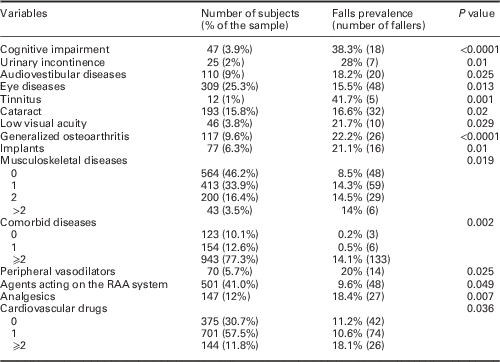
RAA=renin–angiotensin–aldosterone.
In regard to medications, the following drugs were significantly associated with falls in the univariate analysis (see Table 2): peripheral vasodilators; agents acting on the RAA system, analgesics, and the use of two or more cardiovascular drugs. The total number of drugs present in therapy (polypharmacy) was not significantly associated with falls.
The variables statistically associated with falls in the univariate analysis were included in the multivariable regression model. Since the number of cardiovascular drugs is correlated with the use of peripheral vasodilators and of agents acting on the RAA system, the number of cardiovascular drugs was dropped. In the multivariable logistic regression analysis (see Table 3), the variables that significantly remain associated with falls were found to be the following: age, generalized osteoarthritis, cognitive impairment, tinnitus, and two or more comorbid diseases. In particular, the risk of falling increases with age by about 3% annually (P=0.011) and falls occur with a frequency that is approximately doubled in the presence of generalized osteoarthritis (OR=2.01, P=0.006). The presence of tinnitus, cognitive deficits, or two or more comorbid diseases resulted in an increase in the risk of falling by more than four times (OR=4.14, P=0.02; OR=4.12, P<0.001; and OR=5.4, P=0.005, respectively).
Multivariable logistic regression analysis
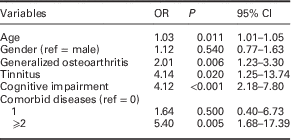
Number of observations=1220; age was analysed as a continuous variable. The odds ratio (OR) indicates the annual increase in risk.
Discussion
Our study analyses several heterogeneous fall predictors described in the literature (Graafmans et al., Reference Graafmans, Ooms, Hofstee, Bezemer, Bouter and Lips1996; Rubenstein, Reference Rubenstein, Solomon, Roth, Young, Shekelle, Chang, MacLean, Kamberg, Saliba and Wenger2006; Ambrose et al., Reference Ambrose, Paul and Hausdorff2013; Deandrea et al., Reference Deandrea, Lucenteforte, Bravi, Foschi, La Vecchia and Negri2013). According to the multivariable logistic regression analysis, the fall predictors detectable from routine medical records are the following factors: age, generalized osteoarthritis, cognitive impairment, tinnitus, and the presence of two or more comorbid diseases.
The analysis of fall predictors from routine medical records may allow us to identify which of the several known and hypothesized risk factors – often determined through prospective and ad hoc studies – may be more relevant for developing quick and efficient tools for a preliminary fall-risk assessment in the context of proactive primary healthcare. However, it should be pointed out that the analysis of the routine medical records per se entails a retrospective investigation. This kind of study design is affected by a higher rate of under-reported, under-detected, and inadequately evaluated falls (Rubenstein et al., Reference Rubenstein, Josephson and Robbins2004; Stevens et al., Reference Stevens, Ballesteros, Mack, Rudd, DeCaro and Adler2012). The capture–recapture method has been proposed as a means of improving and estimating the completeness of case ascertainment (Schootman et al., Reference Schootman, Harlan and Fuortes2000); however, due to the unavailability of other sources of information in the study area, it was not possible to adopt this approach for the present study. These issues may eventually have led to an underestimation of fall incidence and risk factors in the sample.
The main limitation of the present study is related to the choice of including only one Community Health Center located in a rural municipality and to the modality used to select it (convenience criteria instead of random selection). Considering these aspects, the results of our study cannot be considered to be representative of urban areas and their generalizability to the general population should be confirmed by other studies. Since the municipality is served only by the selected Community Health Center, the reality of a whole medium-sized municipality could be considered to be well-represented in the study, and this – together with the sample size and the consideration of various confounding factors – should be highlighted as the strength of the present study.
Some studies reported an increased risk in falls and fractures during the colder seasons due to slippage on ice and snow (Bulajic-Kopjar, Reference Bulajic-Kopjar2000; Al-Azzani et al., Reference Al-Azzani, Mak, Hodgson and Williams2016). In the present study, however, this seasonal effect was not taken into account, as the climate of the study area is characterized by mild winters. Hence, ice or snow cannot be assumed to be an extrinsic factor influencing falls incidence.
In our study, only 11.6% of the sample reported one or more falls in the previous year. This incidence is probably an underestimation, considering the retrospective nature of the study and its reliance on routine medical records. In fact, data from prospective studies indicate that each year about a third of the community-dwelling elderly population experience a fall (Hausdorff et al., Reference Hausdorff, Rios and Edelberg2001; Stalenhoef et al., Reference Stalenhoef, Diederiks, Knottnerus, Kester and Crebolder2002). This result shows that falls are still a major health issue that is hardly investigated by GPs. However, it should be taken into account that the low incidence may also be influenced by the fact that the sample of the study is limited to active elderly community dwellers, thus excluding people suffering from extremely debilitating diseases.
Among the variables investigated by the present study, some are well-established risk factors for falls (ie, age, cognitive impairment, generalized osteoarthritis, Parkinson’s disease, vertigo, LVA, and psychotropic drugs), others have an unclear association with falls (ie, gender, cardiovascular drugs, and diabetes) and others have received little attention in the literature (tinnitus and multi-morbidity).
Our study shows that in the routine medical records, some well-established risk factors for falls are found to be significantly associated with falls, while others are not. On the one hand – in line with the literature – age, cognitive impairment, and generalized osteoarthritis were found to be predictors of falls in the routine medical records. Indeed, in the literature a steadily rise of the rate of falls with age has been repeatedly described (Linattiniemi et al., Reference Linattiniemi, Jokelainen and Luukinen2009; Ambrose et al., Reference Ambrose, Paul and Hausdorff2013). Furthermore, cognitive impairment has been described as one of the most important risk factors for falls in the elderly (Muir et al., Reference Muir, Gopaul and Montero Odasso2012); even minimal decrements in the Mini-Mental State Examination have been reported to increase the rate of falls (Gleason et al., Reference Gleason, Gangnon, Fischer and Mahoney2009). Several studies have linked alterations in cognitive function to postural instability and gait disturbance (Brauer et al., Reference Brauer, Woollacott and Shumway-Cook2001; Yogev-Seligmann et al., Reference Yogev-Seligmann, Hausdorff and Giladi2008; Yarnall et al., Reference Yarnall, Rochester and Burn2011). Finally, generalized osteoarthritis is usually associated with pain, functional impairment, and adverse psychological effects and hence could lead to an increased risk of falls among elderly people (Ng and Tan, Reference Ng and Tan2013).
On the other hand, although the literature identifies Parkinson’s disease (Ambrose et al., Reference Ambrose, Levalley and Verghese2006; Yarnall et al., Reference Yarnall, Rochester and Burn2011; Jacobs et al., Reference Jacobs, Nutt, Carlson-Kuhta, Allen and Horak2014; Lubomski et al., Reference Lubomski, Rushworth and Tisch2015), LVA (Klein et al., Reference Klein, Moss, Klein, Lee and Cruickshanks2003; De Boer et al., Reference De Boer, Pluijm, Lips, Moll, Völker-Dieben, Deeg and van Rens2004), vertigo (Rubenstein et al., Reference Rubenstein1994; Tinetti et al., Reference Tinetti, Doucette, Claus and Marottoli1995; Nguyen et al., Reference Nguyen, Pongchaiyakul, Center, Eisman and Nguyen2005; Pluijm et al., Reference Pluijm, Smit, Tromp, Stel, Deeg, Bouter and Lips2006; Gaßmann et al., Reference Gaßmann, Rupprecht and Freiberger2009; Deandrea et al., Reference Deandrea, Bravi, Turati, Lucenteforte, La Vecchia and Negri2010), and psychotropic drugs (Hartikainen et al., Reference Hartikainen, Lonnroos and Louhivuori2007; Woolcott et al., Reference Woolcott, Richardson, Wiens, Patel, Marin, Khan and Marra2009) as risk factors for falls, they were not found to predict the risk of falls in the routine medical records. As for Parkinson’s disease, the community-dwelling population – along with the underestimation of the incidence of falls in the routine medical records – could explain the lack of association in the routine medical records to some extent. As far as LVA and vertigo are concerned, our findings may be influenced by the low prevalence of LVA and vertigo in the sample (3.8 and 3.2%, respectively). In the literature, LVA and vertigo have been described to be present in around 10 and 30% of the elderly, respectively (Colledge et al., Reference Colledge, Wilson, Macintyre and MacLennan1994; Vitale et al., Reference Vitale, Cotch and Sperduto2006). As symptoms may be relatively mild or may progress slowly – or there may be the simultaneous presence of another disease (such as cognitive impairment) – elderly patients with LVA or vertigo may be unaware of or may underreport their symptoms, if these are not directly investigated (Oghalai et al., Reference Oghalai, Manolidis, Barth, Stewart and Jenkins2000; Chou et al., Reference Chou, Dana and Bougatsos2009). Moreover, in the context of community and family medicine, these fall predictors tend to be inadequately assessed and recorded, even for people with a reported history of falling (Rubenstein et al., Reference Rubenstein, Josephson and Robbins2004). Finally, regarding falls and the use of psychotropic drugs, a possible explanation of our results could lie in the fact that our sample was drawn from community-dwelling population, for whom the dosages and types of drugs used are usually milder than in the hospital or residential care populations; therefore, the occurrences of side effects that lead to falls (eg, hypotension, hypoglycaemia, drowsiness, abnormal reflexes, etc.) could be less frequent, and thus, in terms of routine medical records, these drugs may be less relevant predictors. However, more specific studies that take into account the dosages and the duration of therapy are needed for assessing the real effect of each psychotropic drug on falls in an active population of elderly community dwellers.
Despite the low prevalence of tinnitus in the sample, the presence of tinnitus was found to be associated with a higher risk of falling. This association is reported in literature (Homann et al., Reference Homann, Plaschg, Grundner, Haubenhofer, Griedl, Ivanic, Hofer, Fazekas and Homann2013), although it is inadequately investigated. Tinnitus is often associated with vertigo and vestibular disorders; among patients with Meniere’s disease (a chronic vestibular disease common in the elderly), those with tinnitus are reported to be at a higher risk of falling (Kentala et al., Reference Kentala, Havia and Pyykkö2001). Tinnitus may be an indicator of increased risk of falling in patients with vestibular disorders, and it may be more accurate than vertigo in predicting the risk of falls from the routine medical records. However, more specific studies are needed to draw a more definitive conclusion about this risk factor.
In our study, multi-morbidity was found to be a significant predictor of falls. This result is in line with what has been reported in the literature (Faulkner et al., Reference Faulkner, Cauley, Studenski, Landsittel, Cummings, Ensrud, Donaldson and Nevitt2009; Shumway-Cook et al., Reference Shumway-Cook, Ciol, Hoffman, Dudgeon, Yorkston and Chan2009; Sibley et al., Reference Sibley, Voth, Munce, Straus and Jaglal2014). However, it should be noted that the association between multi-morbidity and falls has hardly been investigated to date. Since the prevalence of two of more co-existing chronic diseases in the elderly is increasing and the older population is becoming more and more complex (Marengoni et al., Reference Marengoni, Angleman, Melis, Mangialasche, Karp, Garmen, Meinow and Fratiglioni2001), further studies are needed to better identify the specific weight of each comorbid disease in causing falls, in order to provide a more systematic and effective approach.
Conclusions
Falls are an important health issue that are still inadequately investigated and detected by GPs. Several fall predictors have been reported in the literature; the role played by each one has to be weighted accurately according to the characteristics of the examined population. In the context of proactive primary healthcare, the analysis of fall predictors from routine medical records may allow the determination of which of the several known and hypothesized risk factors may be more relevant to develop quick and efficient tools for a preliminary fall-risk assessment. The present study shows that it is already possible to detect patients at a risk of falling by using only data from the GPs’ current medical records, without adding extra workload on the health personnel. A population-based retrospective analysis of falls based on the GPs’ routine medical records is more likely to be affected by the under-reporting of falls by the patients and by the under-detecting and inadequate evaluation of falls by GPs. This may, to some extent, explain the absence of significance for some well-established risk factors, which may result less suitable and appropriate for the development of a time- and cost-effective fall-risk assessment tools for the context of proactive primary healthcare.
Further larger studies are needed to better define a fall-risk assessment tool from routine medical records, and prospective studies will be necessary to evaluate and improve the reliability and validity of the so-developed screening tool.
Acknowledgements
The authors would like to thank the General Practioners of the Community Health Center “Casa della Salute Bucine” who supported this study.
Financial Support
This research received no specific grant from any funding agency, commercial or not-for-profit sectors.
Conflicts of Interest
None.
Ethical Standards
The authors assert that all procedures contributing to this work comply with the ethical standards of the relevant national and institutional guidelines on human experimentation (Local ethical committee) and with the Helsinki Declaration of 1975, as revised in 2008.



