


For decades, investigators have sought to address the rates of suicide among prisoners. Despite substantial progress, existing research has overlooked community-based offenders who may be more vulnerable to suicide than those held in prison. Reference Sattar1 Recent evidence suggests that people with a criminal history Reference Webb, Qin, Stevens, Mortensen, Appleby and Shaw2 and those in contact with the police Reference Linsley, Johnson and Martin3 are exposed to increased suicide risk. To date no studies have examined suicide risk in a representative sample of all community-based offenders. Consequently, there is no population-based evidence on the prevalence or risk of suicide across all community justice pathways in England and Wales.
Method
The Office for National Statistics (ONS) supplied general population mortality data on all adult deaths (n = 4628) in England and Wales during 2005 with an underlying cause of intentional self-harm (ICD-10X60-X84) 4 or undetermined intent (ICD-10 Y10-Y34). The UK Police Authority supplied complete criminal record data from the Police National Computer (PNC). The ONS and PNC databases were linked to identify all people who had a police record and died by suicide. Record linkage criteria were gender, date of birth, first name and surname. Cases were eligible for inclusion if an individual had been in a recent community justice pathway before death, with exposure defined as being arrested, charged, convicted or serving either a community-based sentence or licence in the 12 months before suicide. These criteria enabled the inclusion of all individuals who were in an active or recent community justice pathway and excluded prisoners. Approval to conduct this work was obtained from an NHS Ethics Committee (07/MRE09/34), the National Information Governance Board (ECC: 2-06(o)/2009) and the Ministry of Justice (RQA 591).
Using a nested case–control Reference Clayton and Hills5 design, the 596 individuals (the case group) were individually and randomly matched on gender, age, time, postcode area of residence and in an active, or recent community justice pathway to 596 living controls (the control group) selected from the PNC. These criteria enabled adjustment for strong confounders and ensured time comparability for exposure. Reference Wachoider, Silverman, McLaughlin and Mandel6 Differences in exposure prevalence between matched sets were compared formally and relative risks of suicide were estimated by conditional logistic regression analyses to calculate exposure odds ratios (ORs) and their 95% confidence intervals Reference Clayton and Hills5 using Stata version 12 for Windows.
Results
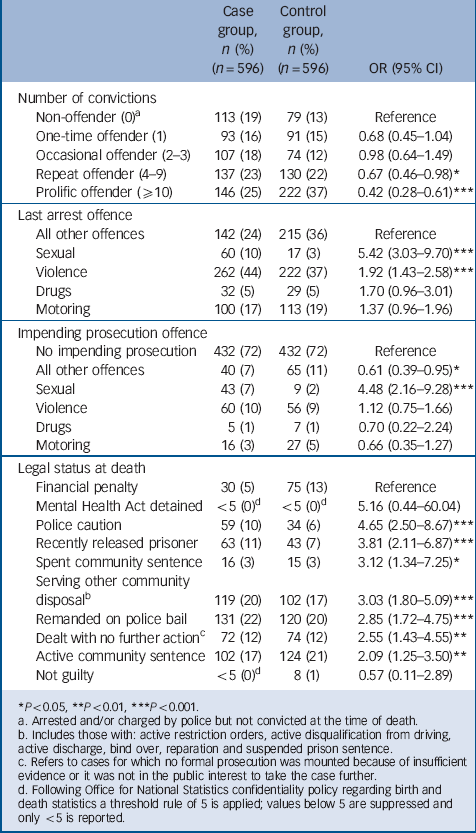
During 2005, 1658 (36% of general population suicides) had a history of lifetime justice contact and 596 (13% of general population suicides) had been in an active, or recent community justice pathway in the 12 months preceding death. Of these, the majority were male (86%, n = 513), White (92%, n = 551), aged 25–44 years (56%, n = 336) and employed (62%, n = 369). Hanging, strangulation and suffocation (50%), and self-poisoning (29%) were the most frequently used suicide methods. Table 1 reports our conditional logistic regression analyses. Risk was lower among those with previous criminal convictions and diminished as the number of previous convictions increased, with prolific offenders, having the lowest suicide risk. Sexual or violent offending at last arrest was associated with significantly elevated suicide risk, with an especially large elevation in risk seen among sexual offenders. Impending prosecutions for sexual offences was associated with a four-fold increased risk.
Conditional logistic regression: relative suicide risk among individuals in recent contact with the criminal justice system in England and Wales
| Case group, n (%) (n = 596) |
Control group, n (%) (n = 596) |
OR (95% CI) | |
|---|---|---|---|
| Number of convictions | |||
| Non-offender (0)Footnote a | 113 (19) | 79 (13) | Reference |
| One-time offender (1) | 93 (16) | 91 (15) | 0.68 (0.45–1.04) |
| Occasional offender (2–3) | 107 (18) | 74 (12) | 0.98 (0.64–1.49) |
| Repeat offender (4–9) | 137 (23) | 130 (22) | 0.67 (0.46–0.98)Footnote * |
| Prolific offender (≥10) | 146 (25) | 222 (37) | 0.42 (0.28–0.61)Footnote *** |
| Last arrest offence | |||
| All other offences | 142 (24) | 215 (36) | Reference |
| Sexual | 60 (10) | 17 (3) | 5.42 (3.03–9.70)Footnote *** |
| Violence | 262 (44) | 222 (37) | 1.92 (1.43–2.58)Footnote *** |
| Drugs | 32 (5) | 29 (5) | 1.70 (0.96–3.01) |
| Motoring | 100 (17) | 113 (19) | 1.37 (0.96–1.96) |
| Impending prosecution offence | |||
| No impending prosecution | 432 (72) | 432 (72) | Reference |
| All other offences | 40 (7) | 65 (11) | 0.61 (0.39–0.95)Footnote * |
| Sexual | 43 (7) | 9 (2) | 4.48 (2.16–9.28)Footnote *** |
| Violence | 60 (10) | 56 (9) | 1.12 (0.75–1.66) |
| Drugs | 5 (1) | 7 (1) | 0.70 (0.22–2.24) |
| Motoring | 16 (3) | 27 (5) | 0.66 (0.35–1.27) |
| Legal status at death | |||
| Financial penalty | 30 (5) | 75 (13) | Reference |
| Mental Health Act detained | <5 (0)Footnote d | <5 (0)Footnote d | 5.16 (0.44–60.04) |
| Police caution | 59 (10) | 34 (6) | 4.65 (2.50–8.67)Footnote *** |
| Recently released prisoner | 63 (11) | 43 (7) | 3.81 (2.11–6.87)Footnote *** |
| Spent community sentence | 16 (3) | 15 (3) | 3.12 (1.34–7.25)Footnote * |
| Serving other community | |||
| disposalFootnote b | 119 (20) | 102 (17) | 3.03 (1.80–5.09)Footnote *** |
| Remanded on police bail | 131 (22) | 120 (20) | 2.85 (1.72–4.75)Footnote *** |
| Dealt with no further actionFootnote c | 72 (12) | 74 (12) | 2.55 (1.43–4.55)Footnote ** |
| Active community sentence | 102 (17) | 124 (21) | 2.09 (1.25–3.50)Footnote ** |
| Not guilty | <5 (0)Footnote d | 8 (1) | 0.57 (0.11–2.89) |
* P<0.05,
** P<0.01,
*** P<0.001.
a. Arrested and/or charged by police but not convicted at the time of death.
b. Includes those with: active restriction orders, active disqualification from driving, active discharge, bind over, reparation and suspended prison sentence.
c. Refers to cases for which no formal prosecution was mounted because of insufficient evidence or it was not in the public interest to take the case further.
d. Following Office for National Statistics confidentiality policy regarding birth and death statistics a threshold rule of 5 is applied; values below 5 are suppressed and only <5 is reported.
Current legal status classification showed significantly elevated suicide risk among individuals who had: received a police caution, recently been released from prison, recently completed a supervised community sentence, served other community disposals, been remanded as a suspect on police bail and dealt with no further action. Individuals serving a community sentence under the supervision of the Probation Service had a relatively low risk. We fitted additional binary exposure classification models, which showed that receiving a police caution (OR = 1.81, 95% CI 1.16–2.80) and being recently released from prison (OR = 1.50, 95% CI 1.01–2.24) had significantly elevated risk v. all other legal status categories.
Discussion
Our findings provide new evidence highlighting elevated suicide risk among people in community justice pathways. We found that 13% of the national population dying by suicide were in contact with the criminal justice system in the year preceding death, a proportion greater than official sources suggest. 7,8
Suicide risk associated with sexual offences is higher than previously reported. This may in part be as a result of the recency of the alleged sexual violence disclosure and the fear of real, or perceived outcome of prosecution. Reference McNulty and Wardle9 The implication is that opportunities for signposting and targeting interventions for vulnerable people are being lost. It may be that appropriately tailored and validated brief screening methods are indicated for all individuals who may be at increased risk of suicide when in contact with or, passing though the justice system. This screening may be particularly helpful for individuals facing allegations or convicted of sexual or violent offences, who are exposed to the highest suicide risk.
Elevated risk among suspects on police bail represents a newly identified association and is important as the majority of people passing through police custody are bailed and directed to appear at court. Further work should examine risk in this group, to help police, and community health professionals identify and manage this elevated risk.
Previously, offenders under Probation Service supervision have been reported as having increased suicide risk. Reference Sattar1 However, we found that relative to other community subgroups they had lower risk estimates during supervision and relatively higher risk estimates post-supervision. Although this did not reach statistical significance these effects are potentially clinically important as an indication that probation supervision might offer a protective effect and may act as a crucial source of support for vulnerable offenders. Suicide risk was highest among individuals who had avoided prosecution, receiving instead police cautions. It is plausible that this seemingly minor sanction inadvertently masks factors indicative of higher suicide risk. Most were arrested for, and admitted to violence, for example 39% perpetrated an offence of violence against the person and 19% criminal damage.
Our findings have implications for developing suicide prevention strategies which universally target those in contact with the justice system and therefore affect all justice professionals, clinicians and policy makers, notably the national Criminal Justice Mental Health Liaison and Diversion (CJMHLD) programme. The CJMHLD seeks to strengthen multidisciplinary partnership working, identifying mental health needs and referring individuals to treatment and support services. Our results suggest the need for prioritising effective ways to assess suicidality among those who pass through the justice system. These contact and release periods present an opportunity to recognise, signpost and deliver interventions to vulnerable people at elevated risk of suicide. Training in identification and management of suicide risk should be improved to allow the CJMHLD programme to be effective in diminishing suicide rates among this vulnerable population.
Funding
This research was supported by grants from Offender Health at The Department of Health, England, the Wellcome Trust (097820/Z/11/A) and Manchester Mental Health and Social Care Trust (MMHSCT).


 Open access


eLetters
No eLetters have been published for this article.