

Introduction
The investigation of gender systems in the past and present is essential for understanding the complexities of human societies. Studying patterns of labour divisions in everyday life, inequality and power balances, as well as tracing the development of gender norms over time, are useful to challenge stereotypes and misconceptions of the past as well as to inform contemporary debates, promoting a more nuanced and inclusive view of gender. Gender archaeology, which investigates past concepts of the cultural classification elaboration of sexual differences, has long recognized that making a distinction between sex and gender is useful for the analysis of past gender systems (e.g. Rebay-Salisbury Reference Rebay-Salisbury, Coltofean-Arizancu, Gaydarska and Matić2021; Reference Rebay-Salisbury, Matić, Gaydarska, Coltofean and Díaz-Guardamino2024; Sofaer Derevenski Reference Sofaer Derevenski1997; Sørensen Reference Sørensen2000). This, however, is easier said than done, as an analytical comparison requires a thorough engagement both with the archaeological contexts, that goes beyond reliance on published legacy data, and with the biology and life-history of the buried persons. Sex is a biological classification based on our reproductive system which requires two kinds of gametes to create new life. Genetic or chromosomal sex is largely binary (XX, XY, with few variations such as X0, XXY and XYY), fixed at conception and leads to the morphological expression of a female or male body through a series of developmental processes influenced by hormones (Fausto-Sterling Reference Fausto-Sterling2012; Weiss Reference Weiss2024). The biology of bodies plays a significant role in the way different aspects of life are experienced, both in the past and the present. Gender, on the other hand, is a cultural classification and elaboration of sexual differences as well as an aspect of personal identity. As such, gender is both experienced, expressed and performed by the individuals themselves (Sørensen Reference Sørensen, Moen and Pedersen2024) as well as ascribed by others. Gender is fluid and subject to negotiation and change. Emerging from the relationship between the individual and the society, gender identities are shaped by the norms and rules of the communities to which the individuals belong.
Through burial archaeology (Sofaer & Sørensen Reference Sofaer, Sørensen, Tarlow and Nilsson Stutz2013), we can investigate the gender intensity of a society (Schmidt Reference Schmidt, Casella and Fowler2005): to what extent gender was more important than other, perhaps intersecting aspects of identity, if gender categories were rigid or overlapping, and if and to what extent sex aligns with gender expression in the funerary practice. Neither sex nor gender is strictly binary, and non-binary gender variation has been recognized in a wide range of past human societies (Ghisleni et al. Reference Ghisleni, Jordan and Fioccoprile2016). Particularly unusual gender roles, non-binary and trans identities, as understood from the ethic perspective of our own gender understanding, have the tendency to capture public imagination. Based on a quantitative literature review, Eleonore Pape and Nicola Ialongo (Reference Pape and Ialongo2023) have recently argued for the existence of non-binary gender models in Early Neolithic to Late Bronze Age Europe, addressing such variants as ‘minorities’ rather than ‘exceptions’.
In this study, we further investigate these minorities and use two early Bronze Age cemeteries with high gender intensity from Lower Austria south of the Danube as case studies. Franzhausen I (Neugebauer & Neugebauer Reference Neugebauer and Neugebauer1997) and Gemeinlebarn F (Neugebauer Reference Neugebauer1991) with their hundreds of systematically excavated, documented, analysed and published graves have become the backbone of research in Central Europe because of their highly gendered burial practice. In Bell Beaker tradition, women are usually buried in flexed position on the right side of the body, head south (south–north orientation), while men are buried on the left side, head north (north–south orientation); both thus face east. Objects accompanying the dead primarily comprise bone, shell and bronze costume elements, jewellery, weapons, tools and ceramic vessels as well as cuts of meat. The practice of grave reopening (Sprenger Reference Sprenger1999), during which objects may be removed, sometimes added, and skeletal remains dislocated, was widespread.
Gendered burial encompasses three key components: the deposition of the body on the relevant body side, the orientation of the body and the inclusion of gender-specific or gender-typical grave goods. The burials afford the opportunity to compare the archaeological context with an osteological sex estimation, and these align to an impressive extent of c. 98 per cent in adult individuals. The osteological sex estimation on the basis of a visual assessment of sex-typical skeletal morphological traits has been undertaken by Margit Berner and Karin Wiltschke-Schrotta for Franzhausen I and by Wolfgang Heinrich and Maria Teschler-Nicola for Gemeinlebarn at the Natural History Museum in Vienna (Berner Reference Berner1988; Heinrich & Teschler-Nicola Reference Heinrich, Teschler-Nicola and Neugebauer1991; Wiltschke-Schrotta Reference Wiltschke-Schrotta1988; Wiltschke-Schrotta & Berner Reference Wiltschke-Schrotta and Berner1988).
In this article, we analyse sex-specific amelogenin protein fragments in the dental remains of individuals for which the morphological sex estimation does not align with the archaeological context. Of the 27 possible cases from Franzhausen I and the 11 cases from Gemeinlebarn F, we subjected 34 individuals to analysis, as dental remains were not preserved in two cases of each cemetery. The recently discovered method of sex estimation via sexually dimorphic amelogenin peptides in human dental enamel (Parker et al. Reference Parker, Yip and Eerkens2019; Stewart et al. Reference Stewart, Molina and Mardegan Issa2016; Reference Stewart, Gerlach, Gowland, Gron and Montgomery2017) offers a robust tool for bioarchaeology. Tooth enamel contains sex- chromosome-linked isoforms of amelogenin, an enamel-forming protein, which are analysed by ultra-high performance liquid chromatography-high resolution mass spectrometry (UHPLC-HRMS). During tooth formation, amelogenin is digested by proteases, resulting in different peptides, some of which are sex-specific, which remain in the dental enamel and are resistant to diagenetic changes. This approach is therefore particularly useful to investigate the sex of children, whose skeletal morphology has not yet developed sexual dimorphism (Gowland et al. Reference Gowland, Stewart, Crowder, Hodson, Shaw, Gron and Montgomery2021; Lugli et al. Reference Lugli, Figus and Silvestrini2020; Rebay-Salisbury et al. Reference Rebay-Salisbury, Janker and Pany-Kucera2020; Reference Rebay-Salisbury, Bortel and Janker2022), and to individuals from hot and dry climates, in which genetic analyses have limited success (Cintas-Peña et al. Reference Cintas-Peña, Luciañez-Triviño and Montero Artús2023; García Sanjuán et al. Reference García Sanjuán, Wheatley and Lozano Rodríguez2023; Lugli et al. Reference Lugli, Di Rocco and Vazzana2019). In a comparison of proteomic, genomic and osteological methods of archaeological sex estimation (Buonasera et al. Reference Buonasera, Eerkens and de Flamingh2020), peptide-based sexing achieves the highest success rate.
The aim of this study is to test whether the burials that do not conform to the dominant binary pattern of gendered burials truly represent a minority of ‘non-binary’ burials, or whether other factors are in play. This study also explores wider implications for understanding gender in the European Bronze Age, arguing for a critical reassessment of traditional methods of sex estimation. Newer techniques such as ancient DNA analysis and proteomics offer more reliable and complementary insights into biological sex beyond the visual estimation of sex based solely on skeletal morphology. By integrating these methods, we can refine previous interpretations and address the limitations and uncertainties inherent in osteological sex estimation. Critical engagement with these techniques will be essential to ensure that potential biases and errors are taken into account, particularly when investigating atypical burial patterns. Rather than seeking absolute certainty in sex determination, this study highlights the importance of embracing complexity in order to gain a more nuanced understanding of gendered burial practices.
Materials
The sites of Franzhausen and Gemeinlebarn (Fig. 1) are located in the lower Traisen Valley, a southern tributary to the river Danube between St Pölten and Krems, in one of the best-documented archaeological landscapes of Austria, thanks to large-scale rescue excavations under the scientific direction of Johannes-Wolfgang Neugebauer (1949–2002) during the construction of the S33 expressway, gravel extraction, land consolidation and terracing.
The sites of Franzhausen and Gemeinlebarn near the Danube. (Map: E. Weissensteiner.)

Franzhausen I
The cemetery Franzhausen I, excavated between 1981 and 1983, includes 716 graves spanning the entire period of the Early Bronze Age (Gemeinlebarn I to III, Bronzezeit A1a–A2b), from about 2150 to 1700 bc (Stockhammer et al. Reference Stockhammer, Massy and Knipper2015). Individual graves are the norm at Franzhausen I, and double and multiple burials are extremely rare (Rebay-Salisbury Reference Rebay-Salisbury, Lillehammer and Murphy2018). The context and finds drawings, along with verbal descriptions and a basic age at death and sex estimation of the buried individuals have been published in the form of an annotated catalogue (Neugebauer & Neugebauer Reference Neugebauer and Neugebauer1997).Footnote 1 Aspects of the physical anthropology of the cemetery Franzhausen I were studied by Margit Berner and Karin Wiltschke-Schrotta and include detailed data on preservation, sex and age at death estimation of the highly fragmented human remains, available in unpublished PhD theses (Berner Reference Berner1988; Wiltschke-Schrotta Reference Wiltschke-Schrotta1988; Wiltschke-Schrotta & Berner Reference Wiltschke-Schrotta and Berner1988). Studies of childhood, chronology, structure and grave reopening based on the published data followed (Spatzier Reference Spatzier2007; Sprenger Reference Sprenger1999; Reference Sprenger and Kory2015; Wicke Reference Wicke2003).
Gendered burial was practised rigidly at Franzhausen I. For this study, we selected samples from the small minority of individuals whose published osteological sex estimation did not conform to the expected body side or orientation. These exceptions have been previously noted (Neugebauer & Neugebauer Reference Neugebauer and Neugebauer1997, 26). The osteological sex estimation of 737 burials assigned a female sex to 210 individuals (150 female, 28 probable female? and 32 possible female??) and 168 males (131 male, 13 probable male? and 24 possible male??), some of which are sub-adults under the age of 20 (Berner Reference Berner1988; Neugebauer & Neugebauer Reference Neugebauer and Neugebauer1997; Wiltschke-Schrotta Reference Wiltschke-Schrotta1988; Wiltschke-Schrotta & Berner Reference Wiltschke-Schrotta and Berner1988). The remaining individuals are children or poorly preserved individuals of indeterminate sex. Jörg Wicke, who based his observations on the death ritual on a selection of well-preserved graves from Franzhausen, calculates that 95.6 per cent of female individuals (n = 109) are buried head south, and 99.1 per cent (n = 113) on the right side of the body, whereas 94.8 per cent (n = 91) of males are buried head north, and 97.9 per cent (n = 94) on the left side of the body (Wicke Reference Wicke2003, 15–16).
Table 1 shows that of 177 adults buried according to male burial rites (men), 166 were published as osteological males and 11 as females. Of the 201 adults buried according to female burial rites (women), 199 were female and only two male (Rebay-Salisbury et al. Reference Rebay-Salisbury, Bortel and Janker2022, table 1). Our earlier study of 63 subadult individuals that compared peptide-based sex identification with gendered burial practices found only one 4- to 5-year-old girl buried in male position as a true exception, and four mixed-message graves, in which the gendered sidedness and orientation are not internally consistent with the dominant male or female pattern (Rebay-Salisbury et al. Reference Rebay-Salisbury, Bortel and Janker2022).
Gender versus sex: cross table comparing osteological sex estimations with gender assessment in 378 adults and peptide-predicted sex with gender assessment in 63 subadults from Franzhausen I, Austria.

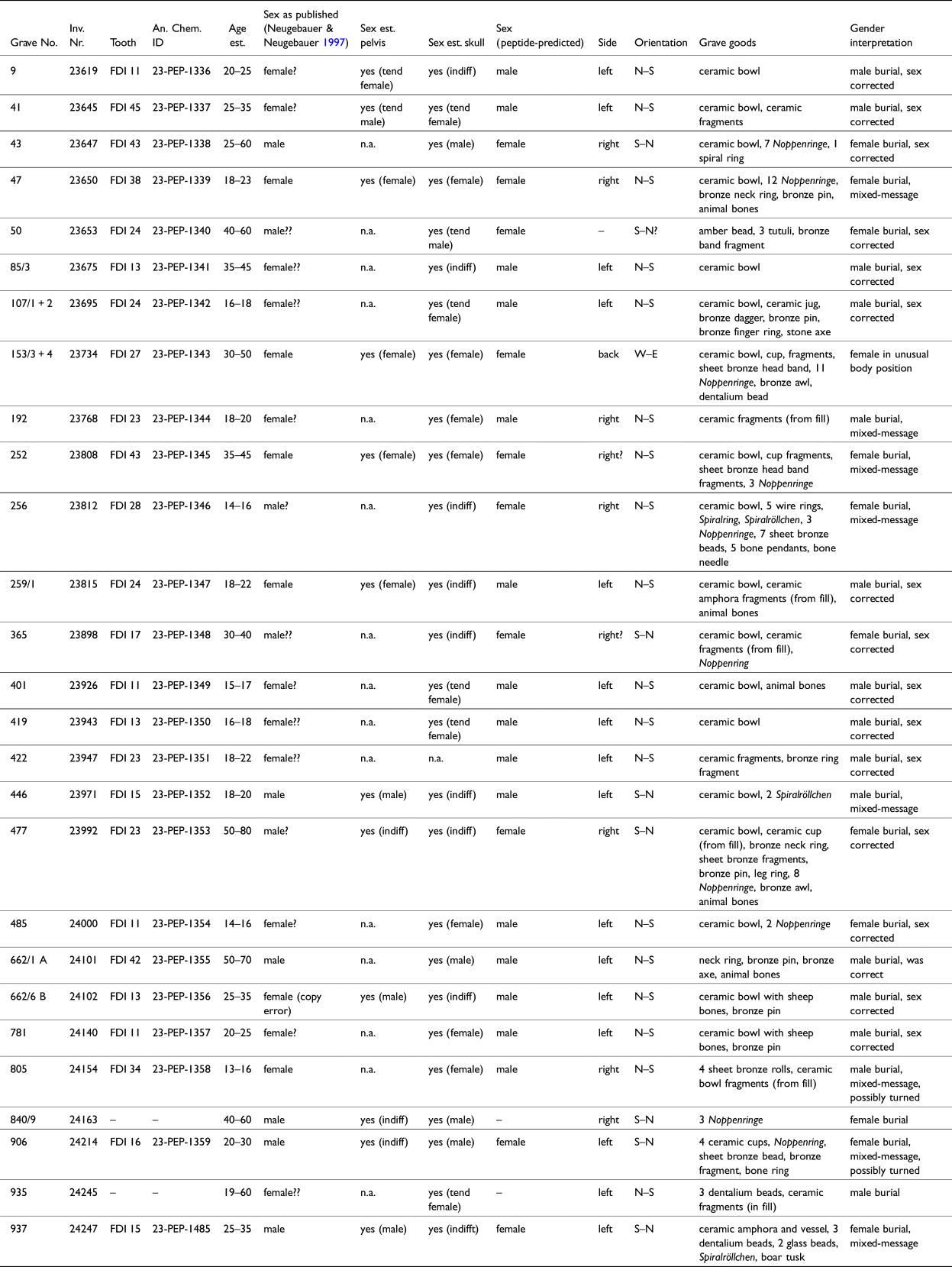
Of the 17 adolescent and adult individuals osteologically sexed as female or probably female, 16 were buried in north–south/male orientation, of which 12 were also placed on the left/male side (9, 41, 401, 419, 422, 485, 781, 935, 107/1 + 2, 259/1, 662/6 B, 85/3) and four on the right/female side (47, 252, 805, 192). Individual 153 was, unusually, found extended on the back and in west–east orientation, possibly pointing to a connection to the Wieselburg cultural area farther east. We were not able to sample Individual 935 due to the lack of preserved dental remains.
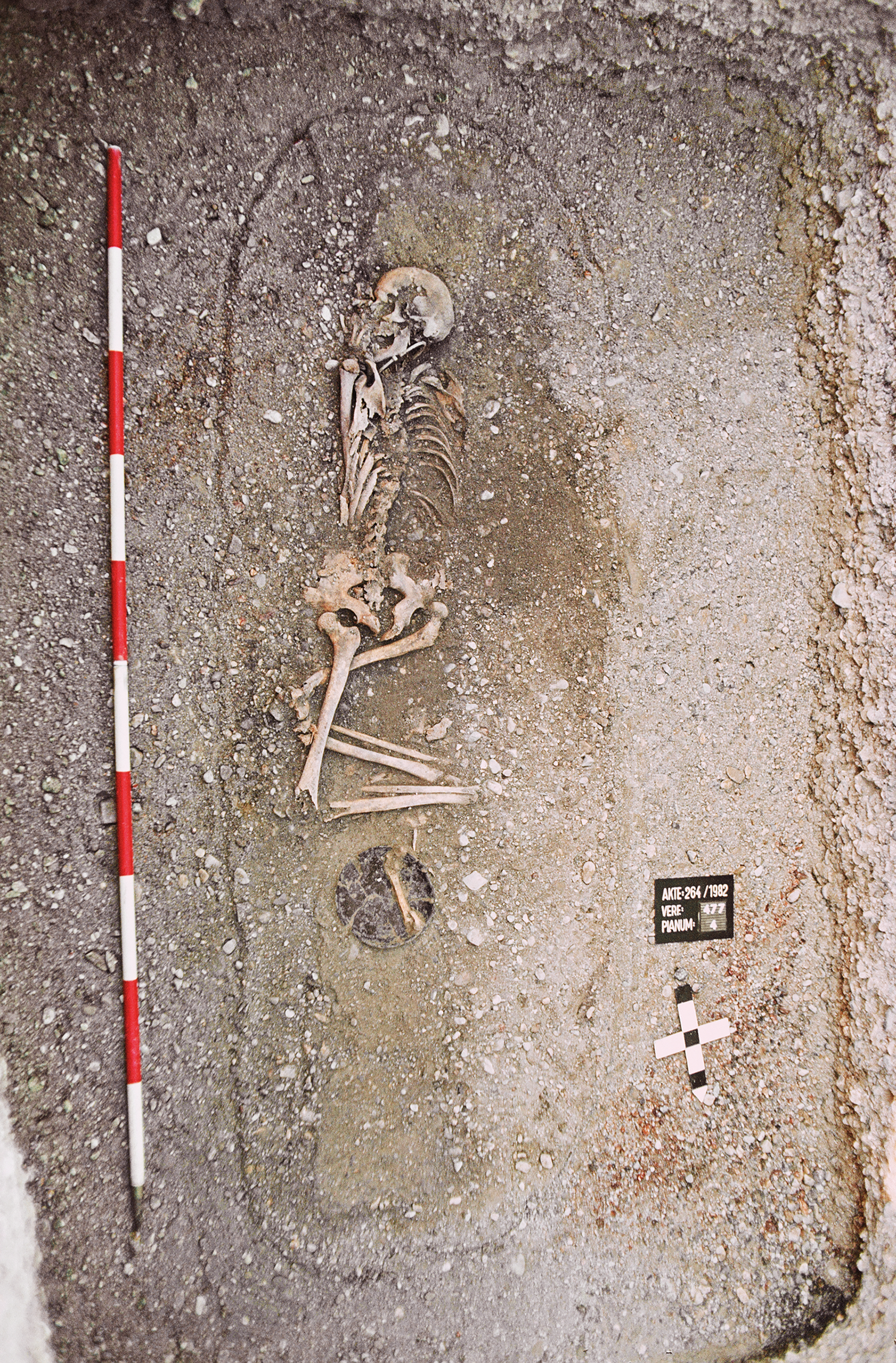
Of the 10 adolescent and adult individuals osteologically sexed as male or probably male, eight were buried in south–north/female orientation, with four bodies placed on the right/female side (43, 840/9, 477: Fig. 2, 365) and three bodies on the left/male side (446, 906, 937: Fig. 3). Individual 50 was probably south–north/female oriented but heavily disturbed. We also sampled the 14- to 16-year-old individual from Grave 256 (Fig. 4), who was placed on the right/female side of the body, but in north–south/male orientation. Individual 840/9 did not have dental remains and therefore could not be included in our study.
Female burial 477 from Franzhausen I (right/female side, south–north/female orientation, sex corrected).
Female mixed-message burial 937 from Franzhausen I (left/male side, south–north/female orientation, sex corrected).

Female mixed-message burial 256 from Franzhausen I (right/female side, north–south/male orientation, sex corrected).

The correctly placed mature male from Grave 662/1 A was also included in the study, since he is part of a rare double burial. Grave 662, however, comprises two parallel, separate wooden coffins in one grave pit, in which a 25- to 35-year-old (662/6 B) and a 50- to 70-year-old (662/6 A) were placed, both north–south/male oriented and on their left/male sides. The younger individual was published as female (Neugebauer & Neugebauer Reference Neugebauer and Neugebauer1997, 408), although osteologically sexed as male (Berner Reference Berner1988, 309)—a simple transcription error. The younger individual was buried with a dress pin, a bowl and animal bones; the older was sexed as a male and buried with an axe, a neck ring, a dress pin and some food provisioning.
Triple burial 599 in a narrow wooden coffin held the remains of a 20- to 25-year-old male placed on the left/male side of the body in north–south/male orientation. He was accompanied by two younger individuals, aged 12–14 years and 14–16 years at death, who lay towards the young adult's feet, on their left sides of the body, but with head south. We did not include these individuals in our study, as they were integrated in our genetic kinship analysis that includes a chromosomal sex identification. The sub-adult individuals are both male and therefore constitute mixed-message burials (|Furtwängler et al. Reference Furtwängler, Rebay-Salisbury and Neumannin prep.; Rebay-Salisbury et al. Reference Rebay-Salisbury, Pany-Kucera, Spannagl-Steiner, Kanz, Amory, Parson, Meller, Krause, Haak and Risch2023).
In total, we obtained 25 samples from Franzhausen I for our study of sex-specific peptides in dental enamel (Table 2).
Age at death estimation, parameters for osteological sex estimation, peptide-predicted sex, body position, orientation, grave goods and gender interpretation of individuals from Franzhausen I, Austria.
Gemeinlebarn F
The cemetery Gemeinlebarn F was excavated from 1973 to 1981 under the direction of J.-W. Neugebauer, who documented 258 graves and published them in monographic form in 1991 (Neugebauer Reference Neugebauer1991). It is one of several prehistoric burial sites around the village of Gemeinlebarn, of which A to E have been investigated since the late nineteenth century by local antiquarians and Josef Szombathy from the Natural History Museum in Vienna (e.g. Bertemes Reference Bertemes1989; Szombathy Reference Szombathy1929). The cemetery Gemeinlebarn F was primarily in use during the later phase of the early Bronze Age (Gemeinlebarn III or Langquaid, Bronzezeit A2b), currently thought to date approximately between 1900 and 1700 bc (Stockhammer et al. Reference Stockhammer, Massy and Knipper2015), and is culturally affiliated with the Vĕteřov group distributed in Lower Austria, Moravia and southwest Slovakia (Neugebauer Reference Neugebauer1991, 50–57).
Neugebauer's publication includes context drawings and descriptions, a full catalogue of finds and a chapter on physical anthropology with a table on age and sex of the buried individuals by Wolfgang Heinrich and Maria Teschler-Nicola (Reference Heinrich, Teschler-Nicola and Neugebauer1991). In the chapter on ‘deviations from the “bell beaker type” of the bipolar, sexually differentiated skeletal position’ (Abweichungen vom ‘Glockenbechertyp’ der bipolaren, sexualdifferenzierten Skelettlage), Neugebauer identified eight cases of divergence between the archaeological and osteological sex estimation, four male and four female burials (Neugebauer Reference Neugebauer1991, 86). These comprise three male graves that are oriented towards the north but face westward, lying on the right side of the body (4, 35, 95), of which 4 and 35 might have been flipped during grave reopening, and one grave with an uncertain male sex estimation (209) buried in female fashion. One female (3) was placed north–south and faced east, lying on the left side as expected for males, and three were oriented north–south and faced westwards, thus lay on the right (female) side of the body (56, 58, 207). With the exception of burials 4, 35 and 209, for which Neugebauer found the explanations sufficiently satisfactory, he notes that mainly females were buried in positions typically reserved for males. He suggests this may reflect a change in social status and legal rights (Neugebauer Reference Neugebauer1991, 86).
According to the physical anthropologists Heinrich and Teschler-Nicola in the same monograph, ‘only four out of 77 anthropologically and archaeologically determined individuals were found to be contradictory’ (liegt lediglich bei vier von 77 anthropologisch und archäologisch bestimmten Individuen ein konträres Ergebnis vor). However, it is unclear which specific burials they are referring to (Heinrich & Teschler-Nicola Reference Heinrich, Teschler-Nicola and Neugebauer1991, 223); most likely they excluded 4, 35 and 209 like Neugebauer. Individual 209 is listed as female in Teschler-Nicola's Habilitation thesis a year later (Teschler-Nicola Reference Teschler-Nicola1992, 20).
Eleonore Pape and Nicola Ialongo (Reference Pape and Ialongo2023) include Gemeinlebarn F in their analysis aimed at identifying non-binary gender in prehistoric burials in Central Europe. In contrast to the primary publication, they base their observations not on body orientation and burial position, but on what they consider to be gender-specific grave goods, listing graves 85, 99 and 210 as burials with ‘opposite’ sex–gender combinations. Pape and Ialongo classify individual 85 as of female gender on the basis of a single bronze spiral (in fact a bronze spiral bead), grave 99 as of male gender on the basis of a single sphere-headed pin, and grave 210 as of female gender on the basis of four small sheet bronze fragments (Pape & Ialongo Reference Pape and Ialongo2023, table 2).
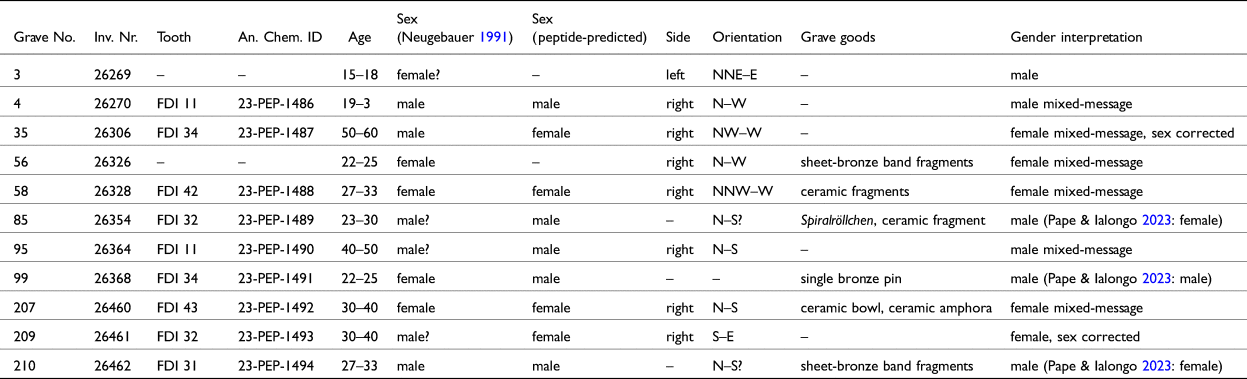
The objective of this study was to sample all individuals for whom a discrepancy between sex and sex-specific burial practices has been reported in the literature and subject them to peptide-based sex estimation. Due to the lack of preserved dental remains, individuals 3 and 56 could not be sampled. We thus obtained nine samples from Gemeinlebarn F (Table 3).
Age, osteological sex, peptide-predicted sex, body position, orientation, grave goods and gender interpretation of 11 individuals from Gemeinlebarn F, Austria.
Methods: peptide extraction from human dental enamel
The preparation of the 34 samples was conducted refining previously established protocols (Rebay-Salisbury et al. Reference Rebay-Salisbury, Janker and Pany-Kucera2020; Reference Rebay-Salisbury, Bortel and Janker2022) and applied acid etching to obtain enamel peptides from a surface area of 2×2 mm of each dental crown. Peptide standards, including Amelogenin Y1, Amelogenin Y2, Amelogenin Y3, Amelogenin X1 and Amelogenin X2, were injected into the LC-MS system at a concentration of 100 pg/μL to acquire specific retention times, peak shape abnormalities, exact m/z ratios and fragmentation patterns. The chromatography was optimized based on the elution times of these five peptides. Samples were reconstituted with 3 μL of 30 per cent aqueous formic acid containing 10 fmol/μl peptide standards (Glu1-Fibrinopeptide B, M28, HK0, and HK1) and diluted with 17 μL LC-MS grade H2O.
Analysis was conducted using a 1290 Infinity II LC System (Agilent Technologies) coupled to an Orbitrap Exploris 480 mass spectrometer (Thermo Fisher Scientific) by an Optamax NG H-ESI (Thermo Fisher Scientific) as ionization source. Of each sample, 5 μl was injected onto an XB-C18 (100×2.1mm; 1.7 μm) column using H2O with 0.2 per cent formic acid as solvent A and methanol with 0.2 per cent formic acid as solvent B and a flowrate of 500 μl/min was applied. The gradient started at 20 per cent B and increased to 40 per cent B within 1.7 minutes. Peptides were analysed in +ESI mode with a resolution of 60000 FWHM at m/z 200 in both MS1 and MS2, while scan range in MS1 was set to 420–1400 m/z and MS2 were triggered with a data-dependent top 2 approach. Peak integration was performed using the Skyline software. Peaks exceeding predefined cut-offs (Table 4) were integrated and recorded (Supplementary Table 1). Manual evaluation was not necessary in this set of samples. All 34 submitted samples met the quality control threshold and provided reliable results (Tables 2 & 3).
Transition list and characteristics of the selected sex-specific peptides, as well as cut-off values during data evaluation.
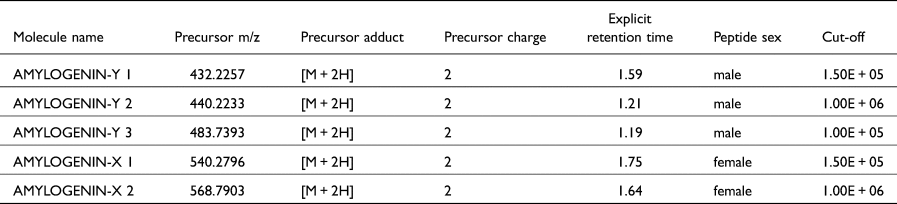
Amelogenin Y and Amelogenin X indicate male samples, while the absence of Amelogenin Y and presence of Amelogenin X indicate female samples. The area ratio of Amelogenin X1/Amelogenin Y2 in male samples should be approximately 1/1. To validate identified male sample, this ratio must not exceed 10/1, which may indicate a carryover effect causing an Amelogenin Y2 peak. The mass spectrometry proteomics data have been deposited to the ProteomeXchange Consortium (Deutsch et al. Reference Deutsch, Bandeira and Sharma2019) (http://proteomecentral.proteomexchange.org) via the PRIDE partner repository (Perez-Riverol et al. Reference Perez-Riverol, Csordas and Bai2019).
Peptide-based sex estimation and gendered burial practices
Results from Franzhausen I
Male-specific peptides were found in the dental enamel of 13 individuals originally published as females or possible females based on the skeletal morphology. Without exception, they were all north–south/male oriented; 11 male individuals were also placed on the left side of the body, according to male custom. Two of the individuals, the 13- to 16-year-old from Grave 805 and the 18- to 20-year-old from Grave 192, however, were placed on the right/female sides of their bodies and constitute mixed-message burials. The majority of these male individuals died young, with ages ranging from 14- to 16-year-old adolescents to 20- to 25-year-old early adults (9 (20-25), 41 (25-35), 107/1 + 2 (16-18), 259/1 (18-22), 401 (15-17), 419 (16-18), 422 (18-22), 485 (14-16), 781 (20-25)). Regarding grave goods, Grave 107 is notable for his exceptional collection of artefacts, which includes a bronze dagger, a bronze pin, a bronze finger ring, a stone axe, as well as a ceramic bowl and jug. The 25- to 35-year-old Individual 662 B is part of a double burial that is now known to include two males rather than a heterosexual couple; his grave goods include a bronze pin and a ceramic bowl with sheep bones. The oldest individual that had been erroneously sexed on the basis of the skeletal skull morphology is the 35- to 45-year-old from Grave 85/3. As is typical of men's graves, the only object in the grave is a simple ceramic bowl.
Peptide-based sex estimation has confirmed the osteological male sex estimation for the 18- to 20-year-old individual 446, buried on the left/male side of the body but in south–north/female orientation. The grave goods include a ceramic bowl and two bronze spiral beads, which are not particularly gender-specific. Both individuals from double burial 622 have been confirmed as male.
Female-specific peptides in dental enamel revealed the chromosomal sex of seven individuals previously classified as (possible) males based on their skeletal morphology, predominantly on available skulls. This includes a 14- to 16-year old (256, Fig. 4) placed on the right/female body side but in north–south/male orientation; the grave goods with bronze spiral beads, hair rings, pendants, an awl and a bowl are typical, if not specific, for females. Two females in mixed-message burials were placed on the left/male side, in south–north/female orientation: the 20- to 30-year-old from Grave 906 and the 25- to 35-year-old from Grave 937 (Fig. 3). Three females were buried straightforwardly according to female burial practices on the right/female side of the body, in south–north/female orientation: the 25- to 60-year-old from Grave 43, the 50- to 80-year-old from Grave 477 (Fig. 2) and the 30- to 40-year-old from Grave 365. The 40- to 60-year-old, south–north oriented female from Grave 50 was buried with female-specific material culture, including an amber bead, three bronze tutuli and a sheet bronze band fragment.
Proteomic sex assessment confirmed the female sex of three individuals found in burial positions partly deviating from the norm. This includes the 30- to 50-year-old placed on the back and oriented west–east from Grave 153, and two females buried on the right/female body side but in north–south/male orientation: the 18- to 23-year-old from Grave 47 and the 35- to 45-year-old from Grave 252. All three include female-typical and specific grave goods, such as bronze spiral hair rings and sheet bronze head bands.
In summary, we were able to correct one transcription error and the osteological sex estimation of 12 male individuals and 7 female individuals from Franzhausen I, while identifying five female and three male mixed-message burials. No instances were found where a female individual was buried according to the burial practices usually afforded to males, or vice versa.
Results from Gemeinlebarn F
Male-specific peptides were found in the dental enamel of individuals 4 and 95, osteologically sexed as males and oriented north–south/male but placed on the right/female side of the body. Neugebauer suspected that parts of the body of Individual 4 had been turned in skeletal connection during grave robbing, but the lower extremities of the individuals on the right side of the body point to a mixed-message burial. Individual 95 is likewise a mixed-message burial without any grave goods. Peptide analysis identified a chromosomal female in Grave 35, a disturbed context with a 50- to 60-year-old individual with male morphological sex estimation, placed on the right/female side in north–south/male orientation, again representing a mixed-message burial without any grave goods. The erroneous osteological sex estimation may be caused by the relatively old age of the buried individual for this community.
Peptide analysis confirmed the female sex estimation for Individual 209, published as male? (Neugebauer Reference Neugebauer1991, 82) and later corrected to female (Teschler Nicola Reference Teschler-Nicola1992, 20), matching the female side and orientation of the body. The slightly disturbed grave context did not include any artefacts.
Female-specific peptides confirmed the osteological sex estimation of the three individuals 56, 58 and 207 that were found with the head to the north/male, but on the right/female side of the body. Grave 56 included a sheet bronze band headdress typical for women, Grave 58 did not include any grave goods, and Grave 207 was fitted with a ceramic bowl and amphora. These are mixed-message graves, with female bodies, female side, but male orientation.
The male sex of individuals 85 and 210, both from extremely disturbed archaeological contexts, but originally in north–south/male orientation, was confirmed via peptide analysis. A single bronze spiral bead and four small insignificant sheet bronze fragment are not sufficient for a female gender assessment (contra Pape & Ialongo Reference Pape and Ialongo2023, table 2). Individual 99 was published as an osteological female aged between 22 and 25 years at the time of death, but the archaeological context was too disturbed to read the original burial position and orientation. However, the single sphere-headed pin led Pape and Ialongo (Reference Pape and Ialongo2023, table 2) to suspect a male individual, which was confirmed by peptide analysis. The osteological sexing error is probably due to the young adult age of the male individual.
Although there were no dental remains present, Grave 3 can most easily be explained as a straightforward male grave of an adolescent individual. The body was found in an undisturbed context on the left/male side of the body in north–south/male orientation and without any grave goods. Aged between 15 and 18 years at death, the individual probably died too young to develop distinctly male skeletal features and should not have been assigned a (female) sex.
In summary, we corrected the sex of three individuals at Gemeinlebarn (35, 99, 209) from the published osteological report, and suspect that a further individual without dental remains (3) would need to be corrected. Proteomic sex assessment confirmed the osteological sex estimation in five mixed-message graves. We did not detect a single instance where a female individual was buried according to the male burial custom, or vice versa.
Discussion
It was clear from the start that early Bronze Age cemeteries of Franzhausen I and Gemeinlebarn F in Lower Austria south of the Danube represent societies with extremely high gender intensity (Schmidt Reference Schmidt, Casella and Fowler2005), in which the differentiation between men and women and treating them differently was extremely important to the burying community. Even children, girls and boys, were treated differently from a very young age (Rebay-Salisbury et al. Reference Rebay-Salisbury, Bortel and Janker2022). It appears that early Bronze Age people conceptualized their world in terms of polar opposites of male and female.
However, it was rather unexpected to discover that, after investigating the small minority of presumed exceptions to the gendered burial rules, we did not find a single female individual buried as a typical man, or a single male individual buried as a typical woman. Consequently, there is no evidence for true trans-gender burial practices. Our analysis shows a two-gender system that more or less equates biological sex with gender in the burial practice. We can differentiate three typical explanations for the divergence between morphological sex estimation and gendered burial practices: (1) osteological sex estimation errors; (2) overestimation of the significance of gendered grave goods; and (3) mixed-message burials.
More than half of the sex/gender deviations can be explained by uncertainties of the osteological sex estimation (see Table 2). Of the 18 cases where the morphological sex was corrected, 11 (plus two with no preserved teeth?) were young males misidentified as females and three (plus one with no preserved teeth?) were older females misidentified as males. This is a systematic error, caused by the fragmentary nature of the skeletal and in particular missing pelvic remains, which cautions against sex estimations for sub-adults and young adults. The accuracy of osteological sex estimation is clearly dependent on the age of the buried individuals (Cox & Mays Reference Cox, Mays, Cox and Mays2000; Inskip et al. Reference Inskip, Scheib, Wohns, Ge, Kivisild and Robb2019). Adolescent and young adult males may not yet have developed sufficient sexual dimorphism to be identified as males. Similarly, hormonal influences on the skeletal remains of females may be in play in old age, when their skeletal morphology increasingly resembles that of older males (Waltenberger et al. Reference Waltenberger, Rebay-Salisbury and Mitteroecker2022). Furthermore, sexing methods have been developed in skeletal populations other than those of early Bronze Age Central Europe. Therefore, population-typical idiosyncrasies in the sexual dimorphism, both developmental and in causal relationship with gender-typical activities, may also be contributing factors (Grupe et al. Reference Grupe, Harbeck and McGlynn2015).
‘Grave goods do not a gender make’ (Weglian Reference Weglian, Arnold and Wicker2001) has been noted in the context of the early Bronze Age cemetery of Singen, Germany, with an equally high gender intensity and also applies to the cemeteries tested in this study. Emily Weglian noted that only awls are exclusively associated with right-lying/female individuals, whereas pins, bracelets and daggers are found with left- and right-lying individuals, albeit in different frequencies. Differentiating gender-typical from gender-specific dress elements and grave goods, which are utilized to mark gender (Hofmann Reference Hofmann, Moraw and Kieburg2014), is useful here. In addition, one and the same type of artefact can be used in different gendered combinations and compositions (Sørensen Reference Sørensen1997). Single bronze pins, for example, often indicate male individuals, whereas paired dress pins are indicative of females (albeit with the additional challenge of ascertaining the original number in the frequently disturbed grave contexts). Inclusion of objects in a grave is motivated by a number of different reasons and is not limited to deceased people's possessions (Meyer-Orlac Reference Meyer-Orlac1982; Parker Pearson Reference Parker Pearson1999); artefacts that symbolize the relationship of the gift giver and the buried person, memory pieces and heirlooms may point to a different gender than the rest of the burial context.
After correcting the sex of the individuals from Franzhausen I, we can demonstrate that bronze daggers (present in 26 graves), stone and bronze axes (present in 16 graves) are indeed male-specific, whereas bronze awls are female-specific grave goods (present in 56 graves). Female-specific are also head ornaments, namely sheet-bronze bands (27 burials), bronze tutuli (7 burials) and more elaborate head-dress (3 burials). Male-specific objects at Gemeinlebarn are the axes, but not the daggers, that may also appear in female grave contexts such as grave 72. Women typically have more, and more diverse, jewellery and dress elements, but only sheet-bronze headbands and bronze tutuli are actually female-specific objects that characterize the adolescents’ and adults’ costume (Neugebauer Reference Neugebauer1991, 91–2). Sheet-bronze band fragments, however, may be part of other objects than headbands and appear in male contexts, such as Gemeinlebarn 210 (contra Pape & Ialongo Reference Pape and Ialongo2023).
Mixed-message burials are the most intriguing in the cemeteries of Franzhausen I and Gemeinlebarn F, as they indeed represent a minority diverging from the normal gendered pattern. They are internally inconsistent, combining male and female aspects of the burial ritual. The main caveat to this interpretation is that most of the burials had been re-opened and appeared to have been disturbed after the initial body placement. Since the majority of grave-opening events are directed at the thoracic region, the position and orientation of the body is usually preserved. From an archaeothanatological point of view (Duday Reference Duday2009), it is extremely unlikely that the whole lower body, including the hips, legs and feet, can be rotated at an advanced stage of decomposition, as evidenced by dislocated bones in the upper part of the body.
In total, we identified 14 mixed-message graves in both cemeteries (Table 5), to which we added four sub-adults from our previous study. There, we had noted that body side always corresponds to the peptide-predicted sex for the placement of children in Franzhausen (Rebay-Salisbury et al. Reference Rebay-Salisbury, Bortel and Janker2022).
Mixed-message burials at Franzhausen I (FHI) and Gemeinlebarn F (GLF). Bold = post-funerary turning of the body and different cultural affiliation can be excluded.
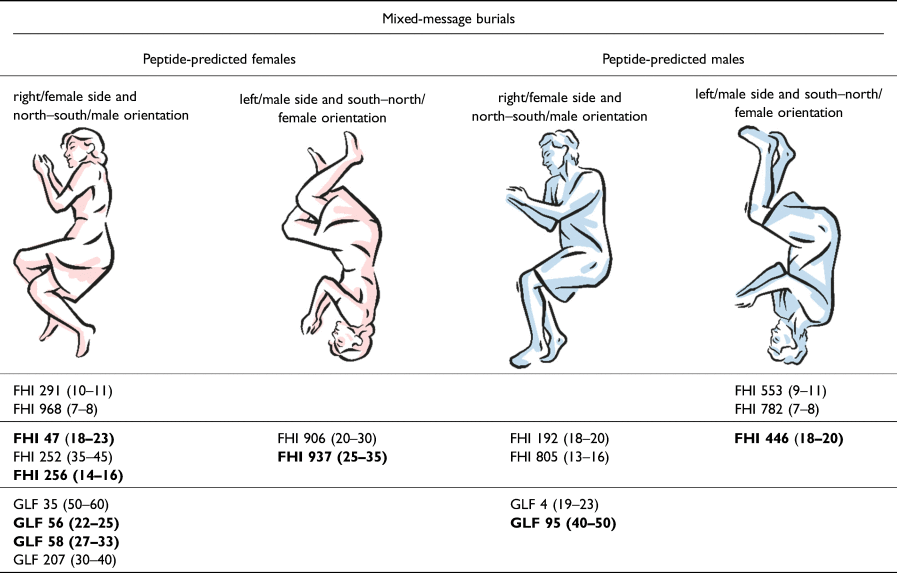
In adults from Franzhausen, there is more variability of mixed-message burials. All male burials were found disturbed, but 446's feet were in situ and the body is therefore confirmed. It is possible that 192 is a Corded Ware burial, but this would need to be confirmed by radiocarbon dating. For 805, a turning of the body in skeletal context during grave re-opening cannot be fully excluded. Among the females, secure contexts include only 47 and 937 (Fig. 3), the former equipped with a bronze neck ring, a dress pin, 12 spiral hair rings and a bowl, the latter with a necklace of glass beads and dentalium pendants, a boar tusk and two pieces of pottery. Grave 256 (Fig. 4) might have been slightly disturbed, whereas 252 and 906 are so severely disturbed that the reconstruction of the original burial position is insecure. All of the female individuals are associated with female-typical or female-specific dress elements. Only individual 47 was included in a strontium-isotope based mobility study, which revealed a local signal (Kreutz Reference Kreutz2011).
At Gemeinlebarn, there were two chromosomal males buried on the right/female side and in north–south/male orientation as well as three chromosomal females buried on the right/female side and north–south/male orientation. All graves were found disturbed, and Neugebauer (Reference Neugebauer1991) differentiates between robbing during decomposition, where a turning of the body or parts of the body in the grave is feasible (4, 35), and robbing in a completely skeletonized state, where turning can be excluded (95). The preference for the right body side may be explained by proximity to early Bronze Age Únětice communities just north of the river Danube, who place their dead of both genders this way (Lauermann Reference Lauermann2003; Pany-Kucera et al. Reference Pany-Kucera, Spannagl-Steiner and Parson2020; Rebay-Salisbury et al. Reference Rebay-Salisbury, Pany-Kucera and Spannagl-Steiner2018). Exogamous marriage patterns (Rebay-Salisbury Reference Rebay-Salisbury, Fernández-Götz, Nimura, Stockhammer and Cartwright2023), with more females than males changing residence after marriage, would further explain why there are more females among the mixed-message burials than males (even if the numbers are too low for a statistically significant comparison).
At present, the most parsimonious explanations for the mixed burials are (1) post-funeral manipulation and/or secondary burial, which may be difficult to identify archaeologically if the body was not yet skeletonized; (2) belonging to different contemporary cultural traditions and mobility from the north (Únětice culture) or west (Wieselburg culture), which may be confirmed by strontium isotope analysis; and (3) different chronological position, which may be confirmed by radiocarbon dating.
Conclusion
With this study, we aim to come closer to an emic understanding of the gender system of early Bronze Age societies in Central Europe. The expression of gender identity at Franzhausen I and Gemeinlebarn F rites was clearly a concern within the burial community, achieved by placing the body on the gendered side, in the appropriate orientation, and with gender-specific and typical objects.
A comparison between this gendered funerary treatment with the estimation of biological sex based on the buried individuals’ remains allows investigation of gender as the cultural classification and elaboration of sex-based differences. It is important to note, however, that we capture the normative social identities attributed to individuals by the community in which they were buried rather than the identities of the deceased as they were individually experienced.
The extraordinarily good alignment of morphology-based sex estimation with the gendered burial practices of about 98 per cent of buried individuals prompted an investigation into the non-aligning minority. We applied ultra-high performance liquid chromatography–high resolution mass spectrometry to identify sex-specific peptides in the 34 individuals’ dental enamel for a reliable sex estimation. The results showed that most of the individuals for which the published osteological sex estimation did not fit were errors based on insufficient sexual dimorphism of particular age groups; the chromosomal sex revealed by our analysis, however, is consistent with the burial treatment.
The occurrence of burials with internally inconsistent gendered patterns, which we term ‘mixed-message burials’, can be partially attributed to post-funerary manipulation and partially to influences from divergent burial practices in neighbouring Bronze Age cultural groups. This considerably narrows down the minority of burials that appear ‘non-binary’. We found slightly more indication for variability in the burial treatment of women than men, but no evidence for a deliberate burial of a biologically male individual as a woman or a biologically female individual as a man.
The results of this study have wider implications for the study of gender in archaeology in general, and for the way in which we understand gender in the European Bronze Age. On a methodological level, the bioarchaeological toolkit has now expanded significantly beyond the visual assessment of sex based on skeletal morphology. Ancient DNA analysis reveals the chromosomal blueprint of sex, while proteomics reveals its expression in dental peptides. Both methods provide highly reliable results, but of slightly different nature, both to each other and to sexually dimorphic variation in skeletal morphology. In the search for sex-related patterning, it may not be sufficient simply to take the findings of (past) osteologists at face value, when a critical engagement with sex estimations, their methods, biases and error ranges are required. Sex estimates remain important benchmarks for gender analysis, and their quality and margins of error need to be considered, especially when analysing individuals rather than populations.
Archaeologists do not like uncertainty in skeletal sexing, but uncertainty is better than building sand-castles on erroneous sex estimates.
The invention of a third, or ‘non-binary’, sex category for those individuals who prove complicated to sex and evade clear osteological classification is not a suitable approach, as it ignores the largely binary nature of the human reproductive system. Although intersex individuals exists and chromosomal variations have been found in the archaeological record (e.g. Anastasiadou et al. Reference Anastasiadou, Silva and Booth2024; Moilanen et al. Reference Moilanen, Kirkinen, Saari, Rohrlach, Krause, Onkamo and Salmela2021), they would not necessarily translate in a different skeletal morphology. Skeletal variation is more likely to be due to population-specific effects, human environmental interactions, individual developmental and medical variation or sex-specific workloads.
Starting from a very secure basis of sex estimation, a third, ‘non-binary’ or queer category makes more sense in the archaeological analysis, as we know from cross-cultural comparisons and ethnographic studies that a wide range of gender variants exists all over the world. While this remains a distinct possibility for all prehistoric populations, it may also be wrong to jump immediately to this conclusion. An intersectional analysis that seeks to understand the effects of age, status and other affiliations, as well as broader social contexts, may lead to a better understanding of the importance of gender, the extent of its rigidity, and points of change. For the Bronze Age in Central Europe, we can postulate that there was a binary understanding of gender, with rather rigid categories that applied to people of all ages, which gave way to a more fluid system in the Iron Age, in which status and membership of elite families were more important than gender. Gender systems and their trajectories are (pre-)historically specific, and there are increasingly better ways to unveil them, nuance fashionable explanations and move the field of gender archaeology forward.
Supplementary material
To access Supplementary Table 1, please visit https://doi.org/10.1017/S095977432500006X. Supplementary Table 1: Detected area values in the corresponding enamel sample and specific retention times of each amelogenin peptide.
Acknowledgements
We thank the staff of the Department of Anthropology at the Natural History Museum in Vienna for granting access to the human remains under their curation. All individuals can be found using the accession code NHMW-Anthro-OSTE and the inventory number (Inv. Nr.). We thank Michaela Spannagl-Steiner for her practical help with sampling. Elisabeth Weissensteiner produced the site map and infographics. The Federal Monuments Authority Austria, Department Archaeology, granted reproduction permissions for the excavation photographs. This study was undertaken in the framework of the Austrian Research Fund project ‘Investigating sex-based differences in Bronze Age childcare through peptide analysis of dental enamel’ (FWF TAI 759, PI: K. Rebay-Salisbury).
Author contributions
Conceptualization KRS; Formal analysis MB, KWS, MW, FK; Funding acquisition KRS; Investigation KRS, MB, KWS, AHC, MW, FK; Methodology KRS, MB, KWS, MW, FK; Project administration KRS; Writing, original draft KRS, MB, MW; Writing, review & editing KRS, KWS, MB, AHC, MW, FK.


 Open access

