

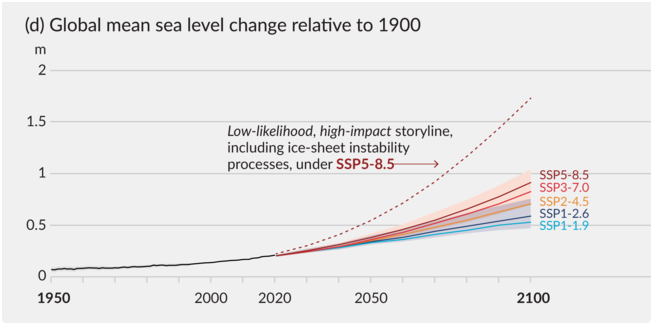
This chapter adopts an oceanic-vertical perspective to analyze human technological adaptation to water level changes. Such vertical changes include regular tides, perennial monsoon floods, and Anthropocene problems such as rising sea levels and increased storm surges due to climate change. Flooding risks are increasing important, though estimates of the number of people at risk vary depending on whether authors focus solely on coastal areas or also include inland regions, account for population changes in the next decades, and examine different sea level rise scenarios, frequencies of flood events (for example, once every 10 or 100 years), and inundation depth (for example, 15 centimeters or 1.5 meters). Hence, up to 1.8 billion people are exposed to 1-in-100-years flood events of at least 15 centimeters, most of them resident in Asia. The number can increase to nearly 1.9 billion by 2100.Footnote 1 An estimated 283–286 million people living in coastal floodplains likely will be threatened by 1-in-100-years flood events by 2030, the number potentially strongly rising during the following decades. In low-elevation coastal zones (less than 10 meters above sea level), estimates see up to 896 million people at risk in 2020, a number that by 2100 will have declined to below 500 million or risen to more than 1 billion, depending on population movements. Without adaptation, flood risks are expected to rise by two to three orders of magnitude, with catastrophic results near the end of the century, in particular for poorer segments of societies.Footnote 2 Political discussions about sea level rise often center on the twenty-first century, roughly associating the time span of interest with that of a human lifespan. The likely scenarios (with a 66 percent or higher likelihood) from the Intergovernmental Panel on Climate Change (IPCC) vary, predicting (in 2021) an average rise of 0.28–1.01 meters by 2100 (in a low- or high-emissions scenario, respectively). A low-likelihood, high-impact scenario suggests increases of up to 2 meters (see Figure 4.1). Sea levels are expected to continue rising for centuries if climate change is not reversed.Footnote 3 Water thermally expands (or increases in volume when warming), affecting increasingly deeper oceanic layers. This expansion, coupled with ice sheet melting, contributes to rising sea levels. Sea levels vary globally.Footnote 4 Some regions are less affected than others, such as certain coral islands whose coral reefs may outgrow sea level rise, or coastlines still rebounding from the last Ice Age and the massive pressure caused by glaciers. In contrast, low-lying coastal regions in storm-prone areas face severe consequences. Coastal adaptation approaches hence depend on local sea level rise rates and the increased risk of climate change–influenced disasters such as hurricanes and typhoons carrying more water and therefore causing stronger storm surges. Disasters are not natural events but result from long-term human–environment interactions, which can make or leave communities vulnerable to events “focused in time and place causing significant disruption to normal activities and incurring unacceptably high losses of property and/or life.”Footnote 5 Effective adaptation to these amplified flood risks benefits from foresight, preparation, and innovation rather than merely repeating responses developed during the Age of Coal, when controlling and removing water became feasible due to affordable energy sources.
Different IPCC projections for global mean sea level rise until 2100. The figures range from 0.28 meters to 1.01 meters. It also includes a low-likelihood scenario of 1.01 meters to 2 meters. The time frame, leading up to 2100, is particularly relevant to policymakers, as it aligns with the average human lifespan. However, it is important to note that sea levels are very likely to continue rising for centuries or millennia if global temperatures do not decrease.
Historically, humans have used floating, amphibious (based on the ground but floating during a flood), and stilted homes for millennia. Floating structures in particular are climate change-resilient through vertical mobility, rising with floods, tides, or sea levels. Social acceptance refers to the willingness among different groups, such as regulators, investors, and the public, to support and adopt floating structures as an adaptation strategy. This chapter argues that social acceptance of such adaptation practices in the West and other regions drastically declined with the Age of Coal’s affordable energy supply, which facilitated water removal and control, fostering instead a terrestrial mindset. However, following the twentieth century’s focus on terrestrial forms of urbanization and socioeconomic development, the Anthropocene framework of the twenty-first century is drawing some of the attention of intergovernmental organizations, Asian and other governments, NGOs, and transnational corporations to sea surface urbanization. This sea surface urbanization, which is part of the larger water surface urbanization that also includes lakes, rivers, and the like, represents a reemerging vector of civilization during Earth’s amphibious transformation, extending the human habitat onto liquid and unstable aquatic spaces. In terms of intellectual continuities, the ecomodernist approach currently shaping these technologically advanced forms of sea surface urbanization as an adaptation practice originated in the waters of Tokyo Bay. This approach also represents the recent increase in social acceptance, after decades of a lack of it, to which I will return at the end of the chapter.
This chapter explores Earth’s amphibious transformation through counterproposals to terra-centric urbanization in the twentieth century. It addresses how and why cybernetics-based designs for Tokyo Bay in the 1960s experienced long-lasting marginalization but shaped the present ecomodernist approach to sea surface urbanization. The focus is on Japanese star architect Tange Kenzō (1913–2005) and his university laboratory’s – Tange Lab’s – Plan for Tokyo 1960 (hereafter referred to as the Plan), released in very early 1961, and on world-renowned US designer R. Buckminster Fuller’s (1895–1983) floating design called Tetrahedronal City, first proposed in 1966. Tange and Fuller mutually inspired each other’s cybernetics-based megastructure designs during the 1960s. In July 1966, they spent substantial time together at the week-long “Delos Symposium on Human Settlements.” Understanding Tange Lab’s and Fuller’s Tokyo Bay proposals requires recognizing floating, elevated, and amphibious adaptation practices as counterproposals to the Age of Coal’s energy-intensive technologies of terrestrialization, like hydroelectric dams, seawalls, and drainage systems that removed and controlled water. Floating and elevated (stilted, pile-elevated) structures operate in aquatic spaces, whereas amphibious structures rest on the ground on land but can float during a flooding. These adaptation practices responded to Asian environmental phenomena, such as perennial monsoon floods and tropical cyclones causing surges and massive rainfall, which have few equivalents in the West and therefore contribute Asian insights into the historical relationship between the hydrosphere and the human habitat. Applying Western energy-intensive forms of urbanization and industrialization to flood-prone monsoon and typhoon areas often yields suboptimal results. This chapter reveals the connections between Tange’s and Fuller’s non-terracentric urbanization ideas, situating their Tokyo Bay designs within the global context of Earth’s amphibious transformation and evaluating their intellectual legacy in the face of climate change, environmental degradation, and the threats these pose to Asian and other coastal cities. The oceanic-vertical perspective, focused on adaptation to sea level changes, therefore broadens the view beyond the Japanese nation-state box that has usually shaped related research and disconnected it from the global context.
Sea Surface Urbanization, Cybernetics, and Ecomodernism
The amphibious transformation is progressively extending forms of urbanization onto sea surfaces. Urbanization is a term with varied meanings, since geographers and other scholars have created concepts of urbanization that, over time, were strongly affected by technological changes. Maritime history scholars might use the term “urban oceans” to describe the water’s role in connecting distant coastal towns through ships.Footnote 6 While such research is interesting, I refrain from equating it with urbanization. The traversed oceanic space underwent very limited physical changes, unlike coastal areas with port cities. I find conceptualizing large ships as temporary urban structures more insightful, yet their designs adapted to oceanic material conditions not with the goal to remain on sea surfaces but to traverse them. Coastal historians, such as Isaac Land, have enriched our understanding of urbanization by expanding its spatial scope to include “urban foreshore,” “urban offshore,” and “urban estuary.” His approach, however, intentionally maintains a terrestrial perspective centered on coastal towns from which these three extensions of urbanization emerge, which is productive for studying Euro-American contexts before the mid-twentieth century. The approach explicitly does not address other parts of the ocean, disconnecting them from understandings of urbanization.Footnote 7 Other scholars discuss the planetary reach of urbanization. They suggest that cities’ resource needs “extended” urbanization into various hinterlands, including the ocean, for resource extraction.Footnote 8 This city-centric perspective, while offering new insights, has underlying issues. It overlooks the demand for oceanic resources, such as fish, oil, or electricity, in rural areas, especially after the mid-twentieth century, due to electrification and refrigeration. It also portrays an even more terra-centric view of urbanization, evaluating marine regions as urban by relegating them to peripheral resource extraction sites for terrestrial cities. For this oceanic study, the planetary urbanization concept seems like a less revealing analytical tool than the concept of oceanic ghost acres introduced in Chapter 2, which supplied both terrestrial and oceanic energy demands. Consequently, urbanization must be understood based on criteria not rooted in terrestrial practices. This chapter thus examines both the rise of terra-centric understandings of urbanization and the opposing intellectual trajectory of floating or elevated counterproposals. I shift attention from the prior discussions on hazardous and uncomfortable places of inhabitation like offshore oil platforms to designs of unconventional built environments that explicitly served to extend the urban fabric onto sea surfaces but without subordinating them to terrestrial urbanization patterns. I therefore investigate a different aspect of the amphibious transformation that focuses on the use of artificial islands in the form of elevated houses, technologically advanced floating homes usually not located on the surface of the open ocean but on those of lagoons, protected bays, lakes, or rivers, and larger urban structures to adapt to vertical water level changes. Amphibious houses, when floating in case of a flooding, also constitute temporary forms of artificial islands.Footnote 9 For architects and designers of such artificial islands, urbanization patterns changed with the expansion of communication networks, making aquatic surfaces more viable for human habitation. This communication network growth served to operate and control corresponding transportation and energy networks, among other purposes. This network control, together with global communication networks expansion, epitomizes urbanization here, not as a concentration of an arbitrarily defined number of people in a specific land area, but as access to global urban connectivity, whether on land or on water.
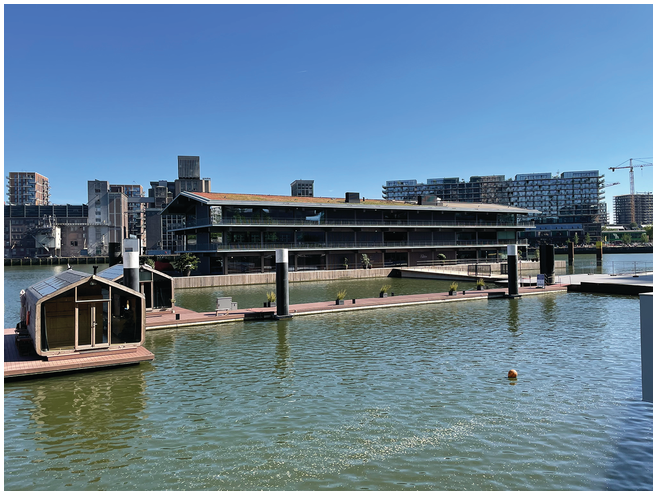
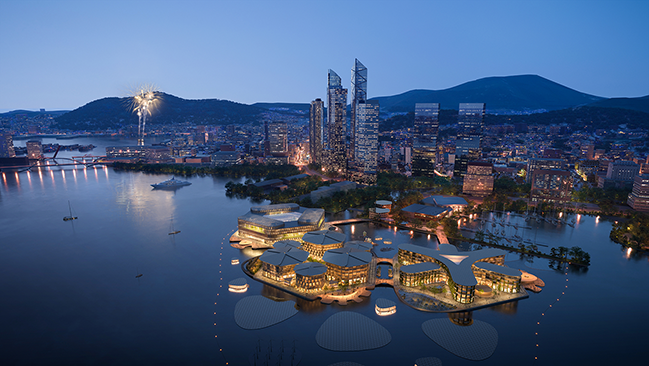
Adaptation arises from the increasing vulnerability of coastal cities, necessitating innovative solutions beyond terra-centric approaches. The IPCC’s models acknowledge the uncertainty in predicting precise local sea level changes or climate impacts over decades. However, the more general increase in risks such as storm surges and flooding is certain over the next 50 to 100 years. Adaptation to these phenomena is not new, as daily tides involve vertical changes typically measured in meters. Innovative strategies, exemplified by the floating office building of the Global Center on Adaptation in Rotterdam since 2021 (see Figure 4.2), offer alternatives to conventional methods such as higher seawalls. Interdisciplinary institutions, including the IPCC, emphasize that adaptation must complement climate change mitigation. In 2022, the IPCC began considering floating structures as experimental forms of adaptation.Footnote 10 Similarly, the floating office in Rotterdam is not merely a utopian concept but a practical solution. In the technical language of adaptation, it defines an advance of urbanization onto aquatic surfaces. Its vertical mobility, similar to Dutch houseboats dating back to at least the seventeenth century, allows it to rise and fall with the sea level. Other major initiatives, like the Floating Future project in the Netherlands, focus on large-scale floating settlements. Recognizing the potential of floating design for adaptation and ecological footprint reduction, the United Nations hosted a roundtable on “sustainable floating cities” on April 3, 2019 at their New York City headquarters, represented by Deputy Secretary-General Amina J. Mohammed (Nigeria’s former minister of the environment). In November 2021, a prototype for a “sustainable floating city” for up to 12,000 people was announced for the urban waterfront of the South Korean port city Busan (see Figure 4.3), followed by a second UN roundtable in April 2022.Footnote 11 Similarly, the Maldives government signed an agreement with Dutch architects to build a suburb of floating homes for approximately 20,000 residents in a lagoon to the north-northwest of its capital city Malé. The first prototype home was delivered in the spring of 2024.Footnote 12 In Saudi Arabia, the government also proposed the construction of a floating settlement, Oxagon.Footnote 13 Not all of these projects may be realized, but they illustrate the consideration of innovative adaptation approaches.
In this chapter, I analyze the amphibious transformation from the perspective of the cybernetics boom in urban design, which radically changed design concepts and turned Tokyo Bay into the birthplace of ecomodernist sea surface urbanization. I build on the urban studies literature that highlights Asian cities’ role in shaping regional and global urbanization trends.Footnote 14 I see Fuller and Tange as leading transnational figures in the urban design–focused branch of the global cybernetics boom, which blurred the boundaries between biological and artificial systems of communication and control. This boom, driven by the communication technology revolution since the 1940s, marks the dawn of the “information age.” MIT mathematician Norbert Wiener’s (1894–1964) eponymous book in 1948 laid the foundation of cybernetics, even though its ecological models were later overshadowed by the information-conduit model of information technology.Footnote 15 Cybernetics initially modeled early electronic digital computers or “electronic brains,” seeing artificial communication systems as replicating biological ones: operating through feedback loops such biological communication systems (including the neural networks of brains) enable and coordinate an organism’s interaction with its environment, the retrieval and processing of information, reactions based on achieving a certain task or goal, and the following renewed environmental interaction. This new approach of modeling systems – and interactions within them – rapidly proliferated across academic disciplines, resulting in ecosystem modeling in biology and in novel urban designs in architecture, centered on artificial communication systems for environmental interaction.Footnote 16
This chapter argues that Tange Lab and Fuller, by applying their cybernetics models, devised artificial communication systems that replicated biological processes. Their biomimetic approach enabled extending urban design practices onto sea surfaces by adapting to oceanic material conditions while eliminating their remoteness compared to terrestrial places. The communication technology revolution empowered Tange Lab and Fuller to incorporate communication systems that operated and controlled other communication, transportation, and energy networks. For example, both on land and on sea surfaces, human nervous systems, or biological communication systems, were extended – or linked to each other – through artificial networks such as radio (broadcasting, telegraphs, phones), wired telephones, telex, multi-user computers, TV, and CCTV, which also helped operate each other, transportation devices, and power grids. Additionally, the chapter argues that Tange’s and Fuller’s biomimetic communication and control models aimed to use artificial communication technology to replicate, in floating or elevated structures, the biological processes of growth, adaptation, mobility, and ecological autonomy (or the design’s self-sufficiency). Replication of these four processes became the central, ecology-driven design strategy for moving urbanization onto sea surfaces and reducing its ecological footprint. The cybernetic designs sought to curb Tokyo’s horizontal urban sprawl, partially shift urbanization from terrestrial spaces, and maximize the lifespan of modular elements thereby reducing pressure on ecosystems.
Current ecomodernist ideas and practices in sea surface urbanization trace back to Tange’s and Fuller’s contributions during the cybernetics boom, despite the disappearance of cybernetics’ bio-informational language. Ecomodernism advocates for technological solutions to environmental problems, a market economy, liberal democracy, and continuous economic growth to alleviate global poverty. It is one among many environmental-philosophical “schools” of thought, with oppositional ones focusing on approaches like degrowth or steady-state (no growth) economics, critiques of capitalism, or varying degrees of techno-criticism contrary to ecomodernist techno-optimism. The “Ecomodernist Manifesto” of 2015 was signed by eighteen scholars and practitioners, including Stewart Brand (b. 1938), who, beginning in the 1960s, popularized Fuller’s ideas among the US counterculture (to be covered in more detail in Chapter 6).Footnote 17 Ecomodernist ideas resonate with a broad range of politicians, designers, ecologists, and others. In their intellectual history, they align quite closely with the sustainable development “school” sparked by the UN’s Brundtland Report (1987) on Earth’s environmental degradation and the social consequences. There, sustainability as a form of intergenerational solidarity is defined as meeting the needs of the present without compromising the ability of future generation to meet their own needs, but it remained quite limited in its practical impacts until the early twenty-first century. (The definition is used in this book as well.) Ecomodernism is also close to ecological modernization theory, another “school” formed during the 1980s, arguing for socioeconomic development, characterized by market-based environmental solutions, such as carbon and pollution taxes, consumer choice, and the need for more efficient technologies to reduce resource demands and waste. These schools influence many international organizations, including the UN, which advocates for sustainable human development as a right in low- and middle-income countries.Footnote 18 The chapter revisits this UN connection near its end. Ecomodernism focuses on the controversial goal of technologically decoupling socioeconomic development from resource use and environmental degradation, both in relative terms per capita (in many cases achieved) and in absolute terms (unachieved due to population growth and other factors).Footnote 19 From a cybernetics viewpoint, technological advancements are supposed to minimize ecological pressure emerging from human-centered ecosystems onto the larger planetary ecosystem in which they are embedded. Ecomodernism uses ecologically largely autonomous systems as technological replacements to decouple socioeconomic development from ecosystem service and resource overexploitation. Decoupling strategies include high-density urbanization instead of horizontal urban sprawl, low-carbon nuclear and solar energy generation instead of fossil fuel combustion, mariculture instead of capture fisheries, and desalination instead of freshwater overuse.Footnote 20 Decoupling, therefore, operates both technologically and spatially, relying on concentrated socioeconomic development and ecological autonomy to separate environmentally strongly transformed human areas from much less altered, more natural areas. The separation approach, distinctly different from advocating for harmony with nature, is exemplified by campaigns for marine and terrestrial protected areas, like the UN’s “30 by 30” campaign (30 percent of Earth’s ocean and land area being protected by 2030) and its predecessors.
Analyzing and reevaluating Tange Lab’s and Fuller’s Tokyo Bay projects is crucial, as previous scholarship focused only on Tange and his role in mentoring the Metabolist movement. The Metabolists, a group of young designers, architects, and critics, mostly worked in Tange’s laboratory at the University of Tokyo’s division for architectural engineering and included a few others such as the rising young architect Kikutake Kiyonori (1928–2011), already briefly covered in the previous chapter. The group formed for the 1960 World Design Conference in Tokyo, gaining global recognition through the event and their “Metabolist Manifesto.”Footnote 21 The manifesto featured their utopian designs advocating for postwar Japanese architecture to promote social change (and for some of the members, the group’s name also referred to Karl Marx’s and Friedrich Engels’ writings on the metabolic rift).Footnote 22 Their designs, rooted in modern architecture and incorporating cybernetic ideas of biological – or metabolic – growth, claimed universal applicability and aimed to foster social equality and flexible adaptation of the built environment to individual needs and desires. Kikutake’s non-Marxist, libertarian proposals for floating settlements from the late 1950s, published in the manifesto, were utopian visions of technology-empowered social reform, contrasting with his later designs that were technically feasible.
Studies on Tange and his Metabolist mentees in the late 1950s and early 1960s often conflated their utopian (infeasible) and practical (in toned-down form feasible) designs. Concentrating on Tange and the Metabolists only in a Japanese context also meant that the booming scholarship almost completely overlooked the fact that Tange’s ideas were an integral part of the much broader global discourse about cybernetics and sea surface urbanization. “Metabolic” structures are cybernetic, biomimetic structures.Footnote 23 For example, a recent publication emphasized Norbert Wiener’s 1956 visit to Japan and his widely publicized lecture series.Footnote 24 This oversight also led to a neglect of Fuller’s ideas, their global legacy, and their similarities and differences with Tange’s.Footnote 25 The chapter addresses these gaps, exploring Tange’s and Fuller’s intellectual legacy in environmental thought, sea surface urbanization, and challenges to the terrestrial mindset.
Postwar Urban Sprawl and Tokyo Bay
During the late 1950s and 1960s, Tokyo Bay became the focal point of discussions addressing Tokyo’s urban sprawl, population growth, and associated transportation network congestion. One proposed solution was to halt or reverse sprawl by redesigning the city and utilizing the Bay as an urbanized, densely populated area. Tange, an esteemed architect, emerged as a key figure in the Tokyo Bay debate. Following his graduation from Tokyo Imperial University in 1938 and working in colonial Manchuria and other locations, he returned to the university, initially as a postgraduate student and, from 1948, as a faculty member, establishing Tange Lab. During the postwar period, he gained international recognition as the designer of the Hiroshima Peace Memorial Museum (1952) and later, in 1961, for the renowned yet unimplemented Plan. As the preeminent Japanese architect of the twentieth century, Tange designed more than one hundred buildings, districts, and cities worldwide.Footnote 26
Urban sprawl and population growth, which led to the Tokyo Bay debate, were results of Tokyo’s recovery from war damage, Japan’s reindustrialization, and the unfolding “economic miracle.” Migration from rural to urban areas coincided with a strong population increase. Japan’s population rose by about 50 percent from the early 1930s to the early 1960s, surpassing 90 million. By 1960, Tokyo’s population was growing by about 300,000 people annually, leading to projections that by 1970, the urban area would sprawl further to accommodate over 15 million people. Like many Western cities, the shift toward a service-based economy and consumer society, along with a massive increase in delivery trucks and private cars, radically transformed mobility patterns and overwhelmed transportation networks designed in the pre-automobile era.Footnote 27 Simultaneously, the 31-meter building height limit, imposed due to earthquake and fire concerns, exerted extra pressure on transportation networks and housing prices. Before the 1963 amendment of building height regulations, the drastic population increase caused massive horizontal urban sprawl, intensifying the commuter influx into the city’s main economic districts.
Urbanizing the Bay was seen as a means to create relatively inexpensive space for urban design projects, very challenging to realize on land due to fragmented land ownership and practical difficulties in expropriation. Tange’s interest in Tokyo Bay began early. In 1957, he proposed a reclaimed island in the middle of the Bay.Footnote 28 However, the Tokyo Bay debate ignited in April 1958 with Kanō Hisaakira (1886–1963), president of the public Japan Housing Corporation (Nihon Jūtaku Kōdan), releasing a proposal for a large land reclamation project. This proposal prompted consideration of alternatives like floating or elevated solutions. Kanō’s plan involved using nuclear blasts to level the Nokogiriyama mountain range on the Bōsō Peninsula, framing the east of Tokyo Bay, to provide material for filling the Bay’s northern part between Tokyo and Chiba. The controversial idea drew attention from architects Ōtaka Masato (1923–2010), Kikutake Kiyonori – future Metabolist movement members – and their mentor Tange.Footnote 29
Tange Lab’s “Plan,” and earlier Ōtaka’s and Kikutake’s concepts, were responses to the challenges of terrestrialization through land reclamation. Kanō’s proposal, concerned with the stability of buildings on a large space reclaimed through landfill, suggested construction on piers standing on the Bay’s solid rock, therefore combining landfill and pier construction. In 1958, Ōtaka, just completing a high-rise apartment complex in Tokyo’s Harumi district on reclaimed land, understood these issues. In a counterproposal published in February 1959, he criticized Kanō’s approach as silly and costly, advocating for an amphibious method using elevation on piers without terrestrialization through land reclamation.Footnote 30 This was important, as both Tange Lab’s and Fuller’s designs sought to circumvent large-scale land reclamation. Such land reclamation always has a substantial ecological impact, entirely eliminating habitats in coastal intertidal zones, rich in biodiversity and sometimes serving as important feeding areas for migratory birds. Depending on location, it also removed nursery grounds for marine organisms and buried coral reefs including their complex ecosystems, since a reef facilitated new land creation through landfill. Despite this, land reclamation became the preferred solution for Japanese civil servants. Currently, approximately 250 square kilometers of Tokyo Bay, mainly in Tokyo’s port area, are reclaimed. Land reclamation has a long history in Japan.Footnote 31 However, the amphibious or floating adaptations of ebune (boat people), living most of their time on boats, or communities in perennial monsoon flood areas also have a long, occasionally urban history in Japan and Asia. Terrestrial authorities nevertheless often discriminated against floating dwellings, associating them with primitive living conditions and seeking their removal.Footnote 32 Japanese civil servants’ preference for land reclamation over elevation or flotation reflects the dominant terrestrial mindset that evolved in Japan since the Age of Coal.
Urbanization in Terrestrial and Amphibious Mindsets
In the following, I argue that one of the main barriers to sea surface urbanization was the global shift toward a terrestrial mindset during the Age of Coal. This shift led to a boom in land reclamation, drainage, hydroelectric dam construction, and coastal defense upgrades. The related mindset, emerging in the nineteenth century or later depending on the region, grew with the affordable access to coal as a fuel for large-scale environmental transformations. This energy access reconceptualized water as an object to be controlled and removed. In contrast, floating, elevated, or amphibious architecture, embodying an amphibious mindset, did not rely on suppressing or barring waterflows. Instead, it aimed to reduce vulnerability and prevent significant damage by adapting to regular floods and water level changes. Unlike monsoon- and cyclone-prone Asia, European countries, despite forming a water-rich civilization, were not amphibious due to the widespread terrestrial mindset of controlling and removing water. Understanding the rise of this dominant mindset during the Age of Coal requires examining European and Asian land reclamation, hydraulic engineering, and technologies of terrestrialization in a condensed longue durée overview. Subsequently, an oceanic-vertical perspective will reassess this mindset by analyzing counterproposals like those from Tange Lab and Fuller.
Western civilization has long depicted marine regions beyond coastlines as undevelopable, judging them unsuitable for fixed capital investment. Geographer Philip Steinberg’s detailed analysis highlights this viewpoint, showing that the commitment of capital to immovable real estate and heavy production machinery was confined to land, turning the ocean into a space outside society.Footnote 33 Although fishing and whaling vessels did represent fixations of investment capital, their mobility and the ephemeral character of their activities associated them more with a continuation of nomadic hunter-gatherer practices within global commons rather than with real estate–like socioeconomic development. In other words, the ocean was seen as a global periphery, limited to the extraction of commodities for terrestrial centers, which, in contrast to marine regions, drew in productive capital. My focus, however, is different. It concerns the relationship between energy access and sedentism in shaping the historical trajectory of the terrestrial and amphibious mindsets in agricultural and subsequent industrial forms of socioeconomic development. A key factor in the globalization of the terrestrial mindset was the Western pattern of agricultural expansion and the broad acceptance of territory as a political technology of control. Dating back to John Locke’s (1632–1704) agriculturalist argument, published in 1689, which linked property rights to land cultivation and enclosure, this sedentary view underpinned both overseas and domestic colonization and enclosure efforts. Mobile (nomadic) indigenous people were pressured to settle and cultivate land to claim ownership. Typically, however, state-backed settler colonialism invoked a “standard of civilization” and productivity-based argument to justify the forceful relocation of these groups, the appropriation of “unused” or “unowned” land (terra nullius), and the suppression of mobile practices. This approach was prevalent in various historical contexts worldwide, including the Japanese empire’s formal colonization of Hokkaido in the latter half of the nineteenth century.Footnote 34 The outcome was a deeply institutionalized form of human domestication, in this case referring to the literal concept of residing in a stationary home. Land improvement by settlers in immovable dwellings was, at least theoretically, a prerequisite for the state’s recognition of their property rights to land. Physical presence at production sites was also essential for engaging in modes of production like intensive agriculture or factory work. Over decades and centuries, sedentism and terra-centrism gradually obscured and eliminated mobile, stateless geographies from most people’s historical consciousness, echoing political scientist James Scott’s provocative thesis about Southeast Asia’s anarchist uplands, where before the twentieth century the environment was unsuitable for the unquestionably more productive but also easily taxable sedentary rice agriculture typical of lowland states.Footnote 35
The Age of Coal was pivotal in fostering the terrestrial mindset, industrially transforming the removal and control of water into everyday practices. From drainage systems to transportation, and from the mass production of energy-intensive building materials to land reclamation for socioeconomic development, coal combustion for heat and motion enabled the large-scale application of technologies of terrestrialization. Land reclamation serves as a prime example. In Early Modern Europe, the Netherlands and the Republic of Venice led in land reclamation and hydraulic engineering. Between 1500 and 1800, these states reclaimed an estimated 180,000 hectares (Venice) and 280,000 hectares (Netherlands) of land. During this period, Dutch civil engineers were sought across all of Europe – from Italy to Northern Germany, France, Britain, and Russia – for their expertise in reclaiming land from the sea, lakes, and rivers. The process displaced local economies that utilized these wet spaces, among them salt production and hunting. As multiple studies have pointed out, such land reclamation projects and the related intra-European knowledge circulations were driven by the advent of capitalist agriculture and population growth. Market demands for cereal crops and dairy products spurred these efforts. European capitalist agriculture had a fully terrestrial focus, represented by the types of plants and animals cultivated. Dutch society was amphibious, characterized by a polder system delaying flooding, the elevation of buildings, a predominance of boats for transportation purposes even inland, and the farming of cattle, which, unlike crops, could be evacuated during a flood. Yet unlike the floodplain agriculture in parts of Asia, European water management focused on removing water to create terrestrial agricultural sites and dairy farms, controlling water flows for irrigation without flooding, and protecting coastlines with dikes against water intrusions. The Age of Coal caused a breakthrough in European and North American land reclamation during the early nineteenth century. Advancements in coal-powered steam pump technology made them much more efficient than windmills for drainage and water control, eventually transforming regions like the US Midwest’s wetlands into terrestrial farmland.Footnote 36 The land reclamation and drainage success also underscored the initial use of steam engines for mine drainage, highlighting another example of the terrestrial link between water management and fossil fuel industrialization during the Age of Coal.Footnote 37 However, steam engines and coal as a dense energy source did not just facilitate land reclamation and drainage. They also revolutionized land transportation through railways. Previously, animal-drawn vehicles, limited by their need for fodder as biological fuel, were drastically less capable of transporting food and goods over long distances, while wind-powered vessels were the preferred means of transportation for their fuel-free operation and potential for continuous use. Coal-fueled railways, however, opened up continental interiors far beyond the limits of coastal and river transport, contributing to a new “age of continents” and diminishing the relevance of islands and coastlines, thus reinforcing terra-centric thinking.Footnote 38 As discussed in the previous chapter, the increased speed of coal-powered steamships over sailing ships also reduced passenger interaction with aquatic environments.
During the nineteenth and early twentieth centuries, European imperial expansion promoted the global dissemination and local application of terra-centric models of regional development. In countries like Japan and China, Asian political and economic elites had long engaged in land reclamation and flood control. However, the introduction of Western technology in combination with affordable access to coal enabled an industrial-scale intensification of these projects, similar to developments in Europe and North America. For example, historian Ruth Rogaski showed the Japanese and especially the Communist Chinese struggles to reclaim and drain the vast marshes and wetlands of Manchuria’s Sanjiang Plain. The wet and unstable environmental conditions severely limited the use of tractors and harvesters, or animals, which frequently became stuck or sank. The transformative impact of land reclamation drastically upscaled from the late 1970s onward, when the import of large quantities of fossil fuel–powered US pumping and irrigation equipment enabled widespread water control and removal. Such fossil fuel–powered pumping, drainage, and irrigation led to the establishment of terrestrialized forms of industrial agriculture characterized by a sophisticated water control system and mechanized (non-floating) farming.Footnote 39
A growing body of historical and anthropological literature on Asian river deltas demonstrates how consistent flooding and related environmental conditions shaped people’s consciousness and adaptation practices before large-scale terrestrialization. For example, the perennial monsoon floods in Thailand’s Chao Phraya river delta resulted in adaptive settlement practices such as floating, stilted, or amphibious houses. A British citizen, upon entering Bangkok by ship in the first half of the nineteenth century, vividly described its floating urbanization: “[T]he whole city of Bangkok, consisting of a long double, and in some parts treble, row of neatly and tastefully-painted wooden cabins, floating on thick bamboo rafts, and linked to each other in parcels of six or seven houses by chains, (which chains were fastened to huge poles driven into the bed of the river,) rose like a magic picture to our admiring gaze.”Footnote 40 This floating urbanization hence was a direct adaptation to regular changes in water levels. In Bangkok, canals fulfilled multiple roles, including transportation, flood retention, and rice paddy irrigation, contrasting with a terrestrial street system limited to transport. Similarly, adapted Thai agriculture, such as wet rice cultivation in paddy fields, shaped food production, as was the case in other water-rich lowland regions, in contrast to upland rice cultivation in dry soil. In perennially flooded regions, deep-water (or floating) rice varieties with fast-growing stems were developed, capable of surviving water level rises of over three meters. These monsoon-related floodings complicated the city’s terrestrial transformation since the second half of the nineteenth century, when land-focused agricultural expansion, the removal of large numbers of floating homes to create port space for an increasing trade with Western countries, and governmental concerns about repeated cholera epidemics related to water pollution through waste and excrement dumping from floating buildings encouraged this process.Footnote 41 Another example of a water-based capital was Kampong Ayer (Water Town), an agglomeration of stilted villages in the Brunei River, now a part of Bandar Seri Begawan, which British colonial authorities intended but failed to remove. Additionally, historical floating villages in mainland Southeast Asia and southern China, now often are tourist attractions, underscoring that terra-centric perspectives have rendered this architectural style special, curious, eccentric, or noteworthy, diverging from its past commonality. Yet, even in the first decade of the twenty-first century, in Tonle Sap Lake in Cambodia alone, an estimated 80,000 people lived in floating or amphibious homes, adapting to the drastic water level rise of several meters during the rainy season. Older floating fishing villages and stilted or floating vernacular offshore structures in East and Southeast Asian waters, used for trapping and storing live fish, influenced the development of plastic-based floating mariculture facilities in the latter half of the twentieth century. These more recent facilities sometimes incorporated vernacular floating dwellings for mariculturists, alongside the fish cages (see Figure 8.1 in Chapter 8). Studies therefore revealed how premodern Asian civilizations’ architectural styles and food production practices were influenced by adaptation to aquatic environmental factors and the hydrological cycle, such as river deltas, oceanic coastlines, typhoon rains, and perennial monsoon flooding.Footnote 42
The Age of Coal tremendously altered architectural and engineering capabilities through the industrial production of cement (for concrete), steel, glass, and bricks as construction materials, fostering the terrestrialization of urban spaces.Footnote 43 Where affordable coal became available, the use of these construction materials increased tremendously. These coal-dependent, energy-intensive materials enabled the construction of railways and large bridges, diminishing the reliance on boats and ferries. In building construction, the weight of these materials, compared to lighter materials like wood and bamboo, necessitated solid, stable, and dry ground. They further advanced terrestrialization by reducing seasonal road muddiness. Western urbanization concepts since the late nineteenth century also promoted terrestrialization through advanced drainage works, overflow chambers, and sewer systems, rooted in growing sanitary and flooding knowledge.Footnote 44 However, nonporous, hard-surface construction materials like concrete or oil-derived asphalt accelerated water flow compared to vegetated mud and hindered water seepage. The increased weight of buildings also exacerbated ground subsidence issues, especially when large volumes of groundwater were extracted for drinking and other purposes. Events like monsoon or tropical cyclone floods in parts of Asia, previously viewed as perennial, natural occurrences requiring adaptation through a seasonal shift from roads to boats or from agriculture to fisheries, were largely mitigated or eliminated by these coal-powered technologies of terrestrialization. Conceptually, such flooding changed from periodic natural events to undesirable and potentially disastrous intrusions in the newly terrestrialized space becoming associated with civilization.
Terra-centric regional development, characterized by the construction of hydroelectric dams and barrages since the late nineteenth century, exemplifies this mental and conceptual change. These structures, iconic architectural and engineering examples of the Age of Coal’s energy-intensive built environment, became feasible due to the availability of affordable coal. Like in the case of seawalls, coal provided the massive energy footprint of such modernizing projects, including the intense heat to manufacture huge amounts of cement and steel for building such massive structures, compared to the built environments of earlier energy regimes. The power from coal also enabled the railway transport of materials to construction sites.Footnote 45 Therefore, hydroelectric dams were one of the most important manifestations of the Age of Coal’s ambitions for energy-intensive water control and terrestrialization among regional planners. Their construction not only created water reservoirs and enforced the relocation of local populations but, more relevant concerning terrestrialization, also led to land reclamation processes in far greater areas, stopping the seasonal flooding of previously amphibious environments. Urban electrification beginning in the late nineteenth century and the construction of power grids with long-distance hydroelectric power transmission lines further demanded terrestrialization through water control and removal for stable power supply.Footnote 46 Hydroelectric dams and barrages therefore facilitated land reclamation for new forms of capitalist agriculture sometimes involving radical changes in crops and cropping seasons, enabled water storage for drinking and irrigation, encouraged all-year river navigation for food exports, and provided electricity for industrialization, urbanization, and agricultural water-pumping systems, as long as water retention and release demands did not conflict.
Before hydroelectric dam–based terrestrialization, Chinese rivers like the Yangzi and Yellow River caused perennial flooding, necessitating local adaptation. In areas like the large Jianghan Plain, where the Yangzi and Han rivers converge, seasonal monsoon flooding created amphibious living conditions, fluctuating between wet, muddy, and dry throughout the year, a phenomenon only recently gaining attention in historical studies. Local adaptation practices included hydroagricultural food production through wet rice cultivation and the use of deep-water rice variants. Communities also turned to fishing during floods. After waters receded, the floodplains were naturally fertilized. Like in flood-prone regions of Thailand, Japan, and other countries, flooding often resulted in damages but not necessarily disasters. Some floods had traumatic and deadly consequences. But their perennial appearance, adaptation through the creation of social institutions, crisis management, and utilization of local biodiversity for food and construction materials enhanced resilience.Footnote 47
Hydroelectric dams promised solutions to these flooding challenges, inspired by European-style, terra-centric industrialization. In Britain, watermills played a crucial role in industrialization before the large-scale use of the coal-powered steam engine, whereas the nature of Chinese river floods precluded a similar role in industrialization. Moreover, the predominantly west–east flow of China’s rivers did not align with its more critical north–south trade routes. The Grand Canal, built in response between Beijing in the north and Hangzhou in the south, regularly silted up, and only parts of it were operational year-round, with other parts experiencing extreme seasonal water flow fluctuations, including flood retention during rainy periods or drying up during long dry spells. These fluctuations prevented the use of watermills and posed challenges for the seasonal transport of agricultural harvests and year-round transport of industrial goods. British rivers, on the other hand, as historian Terje Tvedt described, offered conditions favorable for both year-round shipping operations, including of bulky goods like coal, and watermill usage, making them an important factor for understanding the Great Divergence.Footnote 48 These riverine challenges increased Chinese interest in hydroelectric dam technology for regional development. Figures like revolutionary leader Sun Yat-sen (Sun Zhongshan; 1866–1925) in the 1910s and 1920s envisioned such socioeconomic development.Footnote 49 A few decades later, driven by communist development thought without consideration for ecological relationships, chairman Mao Zedong’s “war against nature” in the 1950s and 1960s, as historian Judith Shapiro called it based on Maoist slogans, propelled dam construction and land reclamation, with dire consequences for ecosystems and workers.Footnote 50 In both communist and capitalist developmentalisms, these technologies of terrestrialization transformed amphibious spaces like floodplains into areas for globalized European strategies of terra-centric settlement, agriculture, and industrialization. The introduction of new, energy-intensive construction materials in these terrestrialized spaces then reconceptualized amphibious or floating architectural styles using wood and bamboo, previously seen as practical adaptations, as backward, primitive, and indicative of a lower level of civilization.
Coal-fueled hydraulic engineering transformed entire regions by eliminating monsoon-driven amphibious conditions and the associated mindset. In nineteenth-century Japan, for example, in the Echigo Plain of the Niigata area, annual river flooding, inadequate drainage, and marshy terrain created conditions akin to those in China, Thailand, and other monsoon-influenced regions. In this specific case, cold winter monsoon winds, carrying moisture from the evaporating warmer waters of the Sea of Japan, caused snowfall in the Japanese mountains. This snow, upon melting in spring, led to river flooding. Therefore, farmers often had to alternate between roads and boats for transportation. In Niigata Town, waterways were a primary mode of transport. During the Tokugawa Period (1603–1868), important technical advancements in flood management were made. However, from the late nineteenth century onward, hydroelectric dam experts began reshaping Japan’s rivers, followed by projects concerning the Yalu River and others in Korea and Manchuria, which were part of its colonial empire. This terrestrialization, promising regional socioeconomic development, served to legitimize colonial rule, at least among those who were not forcefully displaced to create water reservoirs.Footnote 51 In postwar Japan, the government’s interest in regional development through Tennessee Valley Authority–like hydroelectric dam construction further increased. Contemporary studies linking the country’s military defeat to energy supply failures, coupled with the reindustrialization of the 1950s that spiked electricity demand, led to this focus. The Sakuma Dam, built between 1953 and 1956, became Japan’s largest dam at that time. Its construction catalyzed a boom in dam construction and water control, with engineers applying knowledge from dam construction during wartime and in the colonial empire.Footnote 52 In postwar Asia, prominent Japanese dam engineers like Kubota Yutaka (1890–1986) extended their careers by leveraging demands for reparations. These demands were partially paid through construction projects, such as Burma’s first dam, built between 1954 and 1960. In the 1960s, these Japanese experts also persuaded the Indonesian government to construct the Asahan River Dam in northern Sumatra and participated in construction projects in South Vietnam. Similarly, many regions in Asia, including China, India, southern Afghanistan, the Chao Phraya river delta, and others, which had previously adapted to perennial monsoon river flooding, embarked on extensive hydroelectric dam building during the latter half of the twentieth century.Footnote 53 While in the nineteenth century there were hardly any such dams globally, there are now more than 89,700, the vast majority in Asia, particularly in China.Footnote 54 I view these projects as strong contributions to and expressions of the terrestrial mindset in regional development.
Applying an oceanic-vertical perspective, Tange Lab’s Plan and Fuller’s Tetrahedronal City are interpreted as countermodels to hydroelectric dams and land reclamation. They were regional development projects with a strong emphasis on urbanization, albeit two that rejected the terrestrial mindset in favor of an amphibious one. Returning to some early examples of this amphibious mindset, since the 1920s, ocean liners served as aquatic equivalents to terrestrial, layered apartment blocks, operating as floating, mobile hotels, as discussed in Chapter 3. The ocean liner style, particularly its focus on efficiency and functionality, inspired architects like Le Corbusier to incorporate ocean liner design elements into their Modernist terrestrial buildings. Tange Lab and even more so Fuller, familiar with the ocean liner style, reimagined the concept of large, inhabitable urban structures by shifting them back onto sea surfaces, integrating functionalities from other vessels to create alternatives to the regional and urban development capabilities of large hydroelectric dams, thus without resorting to terrestrialization.
The central point is that when Tange and Fuller released their proposals, a substantial portion of humanity had already adopted a terrestrial mindset toward urbanization. As explained in earlier chapters, the ocean did not experience an Age of Coal. Depending on the location, there was a temporal gap of 50 to more than 100 years between the Age of Coal’s terrestrialization process beginning to impact mindsets and the extension of the built environment onto sea surfaces around the mid-twentieth century and later. For this duration, there were no noteworthy amphibious counterproposals to terrestrialization, leading to a long-term intellectual impact, whereby awareness of prior amphibious or aquatic environmental conditions gradually diminished. Oil platforms marked the extension of the coal-dependent, energy-intensive built environment onto sea surfaces, preceded by the unrealized seadrome proposal. Yet, neither represented a counterproposal for a larger urban structure. From an oceanic-vertical perspective, when Tange Lab and Fuller introduced their counterproposals after the mid-twentieth century, the prevailing terrestrial mindset and terra-centric conceptualization of the human habitat among Japanese bureaucrats and a growing portion of humanity led to these ideas being marginalized and mentally relegated to the realm of utopianism.
Designing a Cybernetic Megastructure: Communication Networks above and beyond Tokyo Bay
The protagonists of this chapter viewed Tokyo Bay not just as a body of water, but primarily as a future nodal point in global communication networks, which they believed would operate and guide urban expansion on land and at sea. Thus, Tange Lab’s Plan, in terms of its intellectual history, has roots not only in other Tokyo Bay proposals and Tange’s wartime projects but also in his cybernetics research at MIT, where he served as a visiting professor in Fall 1959. In essence, Tange Lab’s Tokyo Bay design moved central ideas of Modernist architecture into the cybernetics-based information age of global networks.
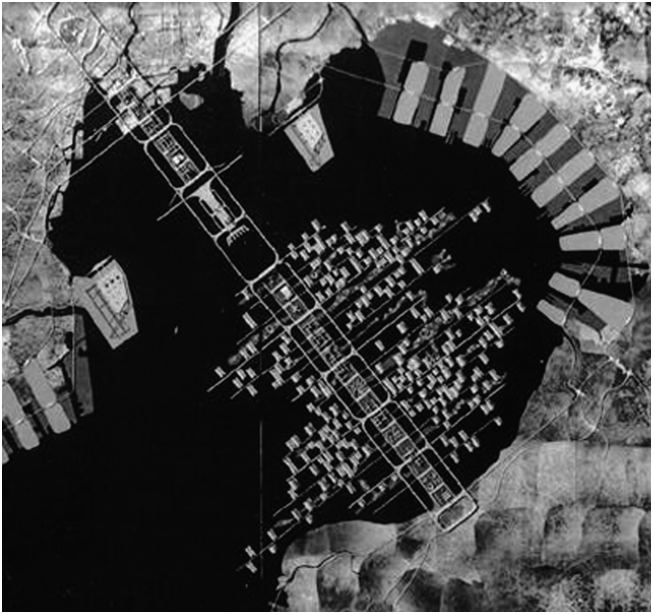
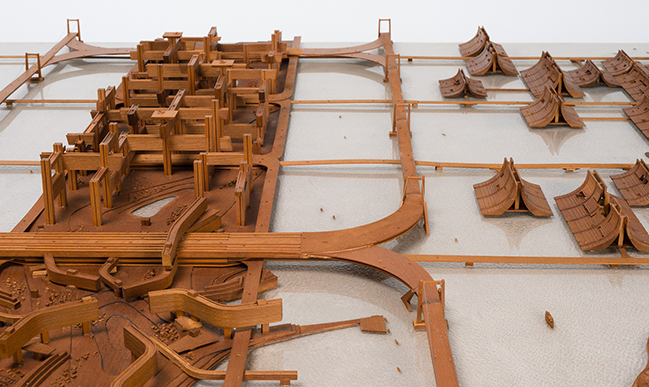
Tange Lab’s Plan focused on an elevated megastructure designed to maximize access to communication networks, in their view a key attractor for urban populations. A megastructure refers to a large structure or main body to which smaller, modular structures can be attached. During a course he taught at MIT in the autumn of 1959, Tange emphasized the “enormous [amounts of] energy” nuclear technology could provide.Footnote 55 This promise of very affordable energy to power many new, energy-intensive transportation and communication networks must be understood as a central reason why Tange even considered designing a cybernetic megastructure for urbanizing an aquatic space. As I showed in the previous chapters, oil as an energy source had encouraged the use of the Age of Coal’s energy-intensive construction materials to create built environments on sea surfaces. Now, the promise of nuclear energy as another energy source encouraged Tange Lab and Fuller to shift energy-intensive, large urban structures to the Bay. Using a linear city concept along a highway, the megastructure, elevated above water and some land, was planned to grow and eventually connect Tokyo to Chiba Prefecture across the Bay, thus preventing radial urban sprawl (see Figure 4.4). Suspended from piers, the multilane, multilevel highway network would be elevated forty to fifty meters above the terrestrial part of the coast, small reclaimed areas in the Bay, or the Bay’s surface (with piers sitting below the water on the seafloor), forming the Civic Axis. This Civic Axis was divided into one minor and eleven major cycles, many featuring three smaller highway loops (see Figure 4.5). Perpendicular and parallel to parts of the Civic Axis above the Bay, several cycles featured A-frame buildings (resembling an “A” from the side), elevated above its surface, intended for residential purposes for 3 million people. Individual dwelling units were planned to be constructed on the A-frames, though Tange Lab did not detail the execution. Many cycles also encircled huge cores, combining the functions of piers (lifting a building above ground or water) with communication and transportation infrastructures. Like the circulation cores of common buildings, these cores harbored passenger and freight elevators, water ducts, and electric wiring, emphasizing the overall structural aim of creating networks for the uninterrupted flow of information, people, and energy. Suspended between these huge cores were bridge-like structures, mostly providing office space for up to 2.5 million people, catering to the nation’s principal economic, governmental, administrative, and consumption needs.Footnote 56
Aerial view of Tange Lab’s “Plan for Tokyo 1960,” an amphibious regional development proposal. The image illustrates the cycles of the Civic Axis extending linearly across the Bay from Tokyo (northwest) to Chiba Prefecture, flanked by residential zones arranged both perpendicular and parallel to them.
Depiction of one and a half loops, within them featuring office buildings suspended between large cores, alongside a residential zone (right) characterized by elevated A-frame structures (forming an “A” shape when viewed from the side) aligned both perpendicular and parallel to the loops.
Tange’s cybernetic ideas for megastructure construction likely originated from his reflections on the analogy of leaf-bearing trees, reinforced by the authority of the “trial and error”–proven evolution of biological communication systems. These systems allow trees to sustain themselves by operating the seasonal growth and shedding of leaves. In September 1959, Tange attended the final CIAM (International Congresses of Modern Architecture) meeting in Otterlo, Netherlands, an event featuring many world-renowned architects. Alongside his projects, he showcased Kikutake’s utopian, cybernetic-metabolic designs for Tokyo Bay. He also explained Kikutake’s view that “Tokyo is expanding but there is no more land so we shall have to expand into the sea.”Footnote 57 Furthermore, Tange emphasized Kikutake’s conceptualization of a megastructure as a tree. According to Kikutake, a long-lasting, durable structural element represented the tree’s trunk, while short-lived, ephemeral elements like individual dwellings, akin to leaves, could be attached and removed as necessary, reflecting the lifecycle of tree leaves.Footnote 58 The analogy dates back to Kikutake’s “Tower-Shaped Community,” published in early 1959. In this utopian, socially critical text, Kikutake proposed the regular replacement of short-lived dwelling units on a long-lasting tower structure:
Like trees that in accordance with the cycle of the four seasons produce new buds and whose leaves eventually turn red, then die and fall down, a dwelling unit will be connected to a human family and their life. The dwelling unit will be made of steel, because steel’s lifespan, that is 50 years, is most suitable to serve a family’s life. The steel unit which has fulfilled its duty will be [taken down], scrapped, and remanufactured into a new dwelling unit to serve a new family’s life.Footnote 59
Even earlier, in 1958, Kikutake applied this idea on a smaller, technically feasible scale to the construction of his own house. “Movenette” rooms, serving different purposes over the course of a family’s life, were attachable and detachable as needed.Footnote 60 The “Tower-Shaped Community” design utilized simple, straightforward modular technology to enable flexible growth, progressively increasing population density until reaching dwelling unit capacity. This approach, which I will call sustainable mobility, allowed for the reuse or relocation of modules without needing to demolish the entire megastructure, thereby aiming to reduce urbanization’s ecological footprint.Footnote 61 Metaphorically, both the construction and demolition of a building are like carbon emission “bombs” released into the atmosphere. Tange Lab, Fuller, and colleagues then extended these rudimentary proto-ecomodernist concepts to include amphibious and floating architecture.
Tange’s important role in the global cybernetics boom stemmed from his ideas and travels, alongside inspirations from his Metabolist mentees, including Kikutake, and other sources, such as Norbert Wiener’s cybernetics studies on communication networks and democratization.Footnote 62 Tange’s visiting professorship enabled him to contribute urban design ideas merging network-based growth, mobility, ecological autonomy, and adaptation to sea surfaces at the MIT, a nexus during the cybernetics boom.Footnote 63 Following his CIAM participation, Tange started his visiting professorship in the autumn of 1959, teaching a course in architectural design titled “New Community on the Sea: 25,000 Habitants on the Boston Bay.” In the 1950s, the Boston city government regarded the declining harbor as a potential urban development site. The 1940s–1950s expansion of Logan International Airport (where Tange must have landed) through landfill exemplified this option. This period also saw an increase in leisure time and a growing interest in beach recreation, albeit not swimming in the polluted waters.Footnote 64 At the 1960 World Design Conference in Tokyo, for which the Metabolist movement was established, Tange presented a design from his MIT course. This design, based on a student group’s work, featured several cybernetic concepts crucial for the Plan and the future of ecomodernist sea surface urbanization.Footnote 65
Tange Lab’s Sea Surface Designs and Proto-Ecomodernist Thought
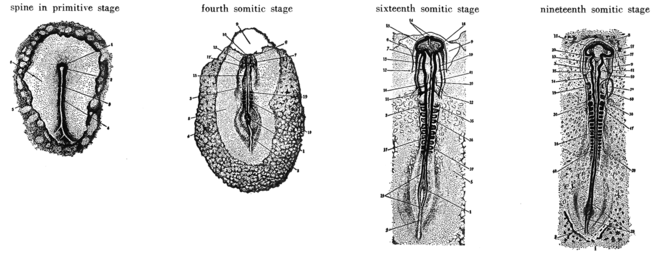
Revisiting the cybernetic analogy of biological tree growth, Tange sought to enable megastructure growth beyond merely adding short-lived elements like houses. The Boston Harbor proposal, based on the student group’s project inspired by Kikutake’s tree-and-leaves analogy, began to search for a corresponding new design paradigm:Footnote 66 “Can the major structure not have the same possibility for growth as a tree trunk?”Footnote 67 Tange Lab’s Plan became the answer, replicating the growth of a fully operational biological system, not just its short-lived organs like leaves. The flexible growth of the entire Civic Axis, functional throughout its expansion, would proceed in four or more stages to be implemented whenever economic or demographic factors demanded it.Footnote 68 Tange Lab replaced the tree trunk growth analogy with that of an embryo’s vertebral column growth to draw on the evolutionary “authority” of a more “complex” lifeform: “The system [Civic Axis] is composed of cycles, somewhat like the vertebrae in the spine. At each stage of development, the transportation system is complete. But there is no end point, at any point it is possible to develop and extend it through another unit.”Footnote 69 Even more than tree trunk growth, Tange Lab’s example of the vertebrae emphasized a linear biological structure, in city design to be replicated by a linear city. The vertebral column provides the structure for the spinal cord, meaning a vertebrate’s central, linear communication “highway” that operates its body (see also Figure 4.6):
Protozoans like amoebae and starfishes have radial centripetal forms, but vertebrates have linear bone structures with parallel radiations. When the living functions of organisms differentiate and perform the composite function of life, the centripetal pattern evolves into a system of parallel lines grouped around an axis formed of a spine and arteries.Footnote 70
Comparing the shapes and growth patterns of biological communication systems in “simple” life forms to those in more “complex” ones, thus invoking what they viewed as the authority of hundreds of million years of evolution, Tange Lab further underscored their message that urban forms should evolve like biological life, whose bodily forms were shaped by communication systems. In other words, for Tange Lab, urban forms passed through different stages over the course of human history, evolving from “simple” settlements with an urban core to complex and gigantic linear urban zones due to communication network connectivity encompassing both marine and terrestrial environments.
An example of Tange Lab’s biological analogies is the linear growth of an animal’s spine, which served as a model for the efficient growth of a linear city, as conceptualized in the “Plan for Tokyo 1960.”
Tange Lab’s amphibious transformation project strongly advanced the proto-ecomodernist idea of replicating and substituting biological communication systems with technology, intellectually expanding and advancing the concepts associated with the “Tower-Shaped Community” and the Boston Harbor designs. Reacting when demand was communicated, the flexible expansion guided high-population-density urban growth, countering the environmental degradation inherent in uncontrolled horizontal urban sprawl. In 1966, Tange reflected on his linear city-related intention to limit ecological footprints on land and sea: “If compact urban environments are constructed, then nature can be preserved, the countryside can remain a beautiful countryside, and the sea can remain a beautiful sea.”Footnote 71 The Civic Axis’s design also incorporated a basic idea of partial ecological autonomy, illustrated by the design being supposed to ensure uninterrupted functionality throughout all stages of flexible, demand-driven growth.
Tange, Fuller, and Amphibious Cybernetics at the Delos Symposiums on Human Settlements
In the years after publishing the Plan, Tange expanded his focus toward cybernetic regional planning, which brought his ideas into contact with those of Fuller. Tange envisaged a vast network of communication, transportation, and energy, designed to operate and guide the growth of a linear city, or more accurately a linear megalopolis, along Honshu’s eastern coastline, Japan’s most densely settled urban corridor.Footnote 72 The transfer of the linear city concept from Tokyo Bay to a larger terrestrial space involved ongoing governmental projects. A notable example was the construction of the Shinkansen high-speed railway line, which began in 1959, tracing the historical Tōkaidō road (Eastern Sea Road) and connecting cities between Tokyo and Osaka.Footnote 73 The Tōkaidō road and its Pacific maritime counterpart have been key trade and communication networks for centuries, owing to Japan’s geographic layout.Footnote 74 Tange had been contemplating mobility and the concept of a linear city in this region for a long time. In 1942, a young Tange won a competition for a Greater East Asia Co-Prosperity Sphere National Memorial, a testament to the design legacy of Japanese expansionism. He planned this unrealized memorial at Mount Fuji’s base, not as a secluded site but connected to a linear “Greater East Asia Highway.” This proposed highway was to extend from Tokyo’s imperial palace through Honshu’s major cities to Kyoto, shaping the trajectory of Japan’s urban development along it toward an enormous linear city.Footnote 75 By the late 1950s and early 1960s, the new Shinkansen network, together with the development of a national highway network, became integral to Tange’s cybernetic regional planning proposals.
Kikutake, preceding Tange Lab’s Plan, integrated a floating structure and a more pronounced amphibious focus into linear city designs. He conceptualized a utopian blend of a potential linear city with a floating city, inspired by offshore oil platforms. This design, reminiscent of the Tokaidō road and Tange’s wartime highway proposal, envisioned a highway stretching on land and partially at sea from south Hokkaidō to north Kyūshū along Honshu’s eastern coast, linking Japan’s major industrial zones. Although utopian and lacking in technical specifics, Kikutake’s proposal included Unabara (Ocean City), a floating city in Sagami Bay, southwest of Tokyo Bay.Footnote 76 There it was supposed to contribute to what Kikutake might have termed an amphibious linear industrial belt. Given the mentor–mentee relationship between Tange and Kikutake, the latter’s utopian combination of a linear amphibious highway for mobility purposes and a mobile, floating megastructure undoubtedly influenced Tange and, subsequently, Fuller.
Fuller, a polarizing US designer, was twice dismissed from Harvard University without a degree in the 1910s. He served in the UN Navy during World War I, followed by several years in the construction industry. His debatable behavior and sales practices led him to shift his focus. Since the 1920s, his career in design, journalism, lecturing, and authorship, characterized by a radical application of the latest scientific findings to housing and automotive designs, garnered him publicity but failed to achieve commercial success. It was only during World War II that the US military used his designs for ecologically largely autonomous housing, which could be rapidly deployed and relocated. After the war, Fuller’s promotion of geodesic domes, which are still associated with him today, brought him financial success. It also increased his international fame, especially among a part of the US counterculture or techno-optimist “hippies.” He became a major advocate for cybernetics and general systems theory in urban planning, arguing for continuous revisions of environmental data and technological possibilities to create feedback loops for improving designs and adjusting the trajectory of socioeconomic development.Footnote 77 Fuller attracted strong criticism for academic dishonesty and for appropriating ideas from others without acknowledging them, and he quite successfully created a personal myth of his enduring great personal deprivations for the sake of humanity, as historian Loretta Lorance showed.Footnote 78 These issues also appear in his materials on the Tetrahedronal City. Nonetheless, his ecological design science concepts continue to influence global environmental thought, as Chapter 6 further shows. Artist-philosopher Jonathan Keats, in his book on Fuller, highlights that in our global society confronted with drastic changes in the Earth system and where a small percentage of humanity own most of the world’s wealth, Fuller’s ecological design science slogan “to make the world work for one hundred percent of humanity, in the shortest possible time, through spontaneous cooperation, without ecological offense or the disadvantage of anyone” remains an important intellectual thread in techno-optimist environmentalist thought.Footnote 79
In 1966, Fuller developed his Tetrahedronal City design for Tokyo Bay.Footnote 80 This initiative coincided with the heyday of the Japanese economic miracle and was prompted by an inquiry in spring of that year from Shōriki Matsutarō (1885–1969) about the technical feasibility and cost of building the unrealized “Nippon TV Tower,” a structure supposed to be taller than Mount Fuji (3,776 meters). Shōriki had amassed substantial wealth as the owner of the Yomiuri newspaper company, Yomiuriland amusement park (opened in 1964), a professional baseball team, and Nippon TV, Japan’s first commercial television broadcaster. In 1961 he engaged with Fuller regarding geodesic dome licenses for his golf club. The lifting of Tokyo’s building height restriction of 31 meters in 1963 had paved the way for the construction of much taller buildings.Footnote 81 Around this time, animation film producer and amusement park owner Walt Disney (1901–1966), known for his involvement in planning the 1964 New York World’s Fair, developed the idea of building a technologically advanced prototype urban community in the United States, the “Experimental Prototype Community of Tomorrow” (EPCOT), which after his death in December 1966 was greatly modified and implemented in Walt Disney World Resort, Florida. Disney’s idea might have inspired Shōriki, also an amusement park owner. Fuller’s later photomontages of a Tetrahedronal City in Yomiuriland suggest such an influence.Footnote 82 Fuller and his team, who started work on the tower design in the summer of 1966, soon received a revised request from Shōriki. He sought a feasibility study (not a construction request) for a solution to Tokyo’s rising population by transforming the “Nippon TV Tower” into a settlement for 1 million people, alongside its function as a television broadcasting tower. On August 2, 1966, Fuller began contemplating an unrequested alternative to such a gigantic vertical settlement:Footnote 83 a floating tetrahedral settlement in Tokyo Bay, relying on buoyancy to reduce its weight and without question a result of his meeting with Tange in July.
In July 1966, Fuller and Tange met at the Fourth Delos Symposium, a prestigious annual event where Fuller was a regular invitee. The symposium’s founder, Greek urban planner Constantinos A. Doxiadis (1913–1975), invited Tange that year due to the event’s growing interest in cybernetics’ role in global urban planning. In a way, the Delos meetings succeeded the CIAM conferences. Architect Mark Wigley noted that the CIAM’s focus on transportation networks in high-income countries, such as motorways connecting functional urban zones in the burgeoning age of automobiles, which initially inspired a young Tange, shifted during the Delos meetings toward a “network fever” and the concept of inhabiting electronic communication networks. From the inaugural Delos meeting in 1963, Fuller, who had been designing ecologically largely autonomous buildings connected through radio communication networks for decades, and media theorist Marshal McLuhan (1911–1980), who had recently developed the idea of the intensely network-connected “global village,” underscored the importance of such connectivity. By the fourth meeting’s conclusion, the participants unanimously agreed that communication networks had created a single, planetary society, rendering discussions of urbanization incomplete without the inclusion of artificial communication systems.Footnote 84
Tange’s cybernetic focus at the symposium, using transportation and communication networks to guide a Japanese megalopolis’ growth, closely matched Fuller’s subsequent work. Similarly, his idea of fostering a democratic society by enhancing the mobility of information and people through network efficiency resonated with Fuller’s principles. At the symposium, Tange presented his cybernetic ideas of highly network-connected megalopolises, describing them as the artificial “brains for the body of modern society.”Footnote 85 The discussion of his linear megalopolis idea for Honshu’s eastern coast must have led Fuller to perceive Tokyo Bay as the core of a cybernetics-based urbanization process. At the symposium, Fuller appropriated elements of Tange’s and Kikutake’s approaches to urban growth, mobility, ecological autonomy, and sea surface adaptation. Fuller’s Tokyo Bay design notably echoes Tange’s, with both envisioning the bay’s urbanization through network expansion, eliminating the remoteness of sea surfaces, and prioritizing adaptation of the designs to the bay’s waters over land reclamation and the associated terrestrial mindset. In this regard, Fuller’s floating city plan also resembled Kikutake’s Unabara floating city, envisioned as an industrial hub in the proposed emerging amphibious industrial belt necessitating network connectivity. Moreover, the actual shape of Fuller’s design shared similarities with Tange’s ideas. Fuller proposed a tetrahedral design with dwelling units set up in rows on its terraced faces while the communication, transportation, and energy networks were located inside, not very different from Tange and colleagues’ A-frames – and the dwellings situated on them – in the Boston Harbor and Tokyo Bay projects.
It is difficult to say who was inspired by whom. Mark Wigley recently suggested that Fuller’s lectures in March 1958 at the Japan Architects Association (Nihon Kenchikuka Kyōkai) in Tokyo likely introduced the Metabolists, including Kikutake, to his own cybernetic ideas. Arguably, this interaction contributed to Kikutake’s tree idea, which then influenced Tange.Footnote 86 Although the Metabolists did not explicitly cite Fuller’s influence on their work, such as their famous capsule designs, his impact can be inferred.Footnote 87 Conversely, Fuller did not directly associate his Tokyo Bay proposal with Tange or Kikutake. Overall, I see Fuller’s, Tange’s, Kikutake’s, and others’ publications, presentations, and travels as elements in the global cybernetics boom, characterized by the liberal appropriation, modification, and application of ideas across various contexts.
Tokyo Bay and Proto-Ecomodernism in the Space Age
Between autumn 1966 and May 1967, Fuller unsuccessfully lobbied Shōriki and his staff to fund further work on his Tokyo Bay concept. One staff member, likely influenced by Shōriki’s terrestrial mindset, emphasized that the 1 million people settlement had to be part of the tower design, a demand Fuller misinterpreted due to the subtle Japanese manner of refusing his counterproposal. This misunderstanding persisted until Shoji Sadao (1927–2019), Fuller’s Japanese American business partner, clarified the situation in Japan.Footnote 88 While Fuller promoted the project’s urban and environmental benefits for Tokyo in interviews with US media, it remained virtually unknown in Japan, partly due to Shōriki’s request for confidentiality to avoid a potential loss of face. Without question, he was not convinced of the economic and technical feasibility of his request, whereas Fuller saw it as an opportunity for publicity. Indeed, the tower cost calculation that Fuller and Sadao later provided (US$1.5 billion) was economically infeasible. As a result of Shōriki’s media influence, the first brief article in Japanese about the Tokyo Bay design seems to have appeared only in August 1967.Footnote 89 By then, Fuller had recognized Shōriki’s disinterest, had disassociated the project from Tokyo Bay, and had redirected his attention to US coastal cities, as Chapter 6 shows.
Fuller’s focus on what he called “instant cities,” meaning mobile, ephemeral alternatives to permanent settlements, differed from Tange’s reliance on extensive physical infrastructures, such as highways, for creating transportation and communication networks. Fuller’s proto-ecomodernist approach decoupled dwellings from the need for large physical, terrestrial infrastructures, landscaping, and the ensuing environmental degradation. In his cybernetic designs, terrestrial telegraph and telephone lines were supplanted by radio waves, a technology in which Fuller had extensive experience from his US Navy service in World War I. He also believed that his naval training influenced his perception of ships as largely closed systems, later applying this concept of ecological autonomy to housing. Fuller’s design philosophy emphasized the mobility of dwelling units, enabling centralized mass production, mobile delivery, and potential relocation. His renowned geodesic domes, air-droppable by helicopters and used for US military radar stations in the Arctic Circle or to shelter US exhibitions at overseas trade fairs, exemplified this mobility.Footnote 90 These ecological benefits, which I called sustainable mobility, represented a more advanced iteration than Kikutake’s modular units, with centralized mass production, intended to reduce economic and ecological costs compared to individual on-site construction, and potential lifespan increases through relocation instead of demolition. After assembly in a shipyard, Fuller’s floating settlement design would use the inherent mobility that oceanic material conditions also provided ships and offshore platforms. In essence, Fuller drew inspiration from both military vessels and offshore platforms. As the previous and next chapters show, after World War II, additional network connections in the form of radiotelephones and helicopters proliferated, supplementing boats and ships in linking offshore platforms to terrestrial sites.
In the 1960s, largely ecologically autonomous dwelling characteristics attracted attention among designers and the public, partly due to space researchers designing structures for crewed space missions, leading to the 1969 moon landing. Historian Peder Anker points out that these US spacecraft and space station designs, termed “cabin ecologies” by astronauts, were independent of traditional physical infrastructures.Footnote 91 They operated as communication network-connected, autonomous dwellings with automated power and water systems. The period also saw the first research boom in solar photovoltaics to power satellites unconnected to any centralized power grid. Fuller’s Tokyo Bay proposal, aiming to alleviate the global shelter crisis of the 1960s due to rapid global population growth, therefore should be seen as the equivalent of a huge spacecraft, space station, military vessel, or offshore platform that was supposed to operate ecologically largely autonomously.
Fuller’s proto-ecomodernist aim was to find technological substitutes for ecosystem services to promote industrial growth while reducing environmental impacts. These technologies were supposed to reduce freshwater extraction and reliance on fossil fuels for electricity, thereby avoiding air pollution, a significant problem in Tokyo at that time. This ecological autonomy further supported the megastructure’s mobility, as it was not dependent on physical grids. Due to the liquid and unstable conditions of aquatic environments, cable infrastructures, including power lines, were much more costly and complex, as detailed in the next chapter, making energy and water autonomy much more important than in most terrestrial spaces. Fuller foresaw integrating a small nuclear reactor for power.Footnote 92 Given Japan’s nuclear energy history, this decision was not unexpected. Shōriki, sometimes called the “father” of Japanese nuclear energy, introduced nuclear reactor technology in 1956, during his term as chairman of the newly founded Atomic Energy Commission (Genshiryokuiinkai). Tange’s 1959 MIT seminar had already portrayed nuclear power as an affordable and almost limitless energy source. By 1966 and early 1967, Japan had activated its first nuclear reactor, and more were under construction. Fuller’s proposal therefore appealed to this Japanese political understanding of the peaceful use of nuclear energy, supposed to satisfy a rising share of the high-growth economy’s increasing energy demands. This trend mirrored the United States’ nuclear power expansion during the same period. Utility companies had underestimated the rate at which electricity consumption would rise during these years and therefore increased their estimates for the 1970s, resulting in the mass-ordering of nuclear plants.Footnote 93 Fuller’s idea also aligned with the use of nuclear reactors in powering aircraft carriers and submarines, lending credibility to the idea of installing one in a floating megastructure. Fuller, therefore, proposed a second benefit of the reactor, inspired by such vessels: desalinating Bay water to provide the megastructure with an autonomous freshwater service system, enabled by combining communication and energy networks.Footnote 94 His proposal also likely drew inspiration from a 1964–1966 US federal government–supported project for a nuclear and desalination plant combination on an artificial island off California, supposed to produce potable water using low-cost electricity. Although it was not realized due to earthquake risks and its proximity to a large population center, the technical concept became relevant for US development policy on exporting knowledge regarding such combined desalination and nuclear- or fossil fuel–powered plants.Footnote 95 Like the Plan, Fuller’s proposal illustrated the dynamics in architecture and engineering that resulted from merging the Age of Coal’s energy-intensive construction materials like steel and concrete, the Age of Oil’s artificial islands, and the Atomic Age’s spatially dense energy generation possibilities, leading to cybernetic ideas of partially ecologically autonomous urban forms on sea surfaces.
The presence of a nuclear reactor in a megastructure brought together two proto-ecomodernist ideas: spatially dense energy generation and dense urbanization. These ideas operated within a still positive public image of nuclear energy as a pillar of the Japanese economy and consumer society. However, the preference for rural over urban nuclear reactor sites, known as the “not in my backyard” syndrome, would have likely sparked resistance to Fuller’s Tokyo Bay proposal. During the spring and summer of 1967, Yokohama’s city administration opposed the construction of special port facilities for an experimental nuclear-powered merchant ship, the Mutsu. Among the reasons was the Bay’s very limited self-cleansing capacity. In case of an accidental leaking of radioactive cooling water, its weak tidal current would not quickly flush the pollution into the ocean.Footnote 96 By analogy, the same concerns would arise in the case of a nuclear-powered floating settlement. Still, the construction of a floating nuclear power plant in Russia and experimental nuclear-powered water desalination in Japan were eventually realized in the twenty-first century and will be addressed briefly in Chapter 7.
Autonomy and mobility related Fuller’s design to outer space and ocean crossings but also turned it into a counterproposal to technologies of terrestrialization, which increased its intellectual influence in sea surface urbanization and Earth’s amphibious transformation. Hydroelectric dams, used for freshwater storage, regulating its availability all year round instead of relying on natural fluctuations, and generating electricity, had a substantial ecological footprint. Fuller’s proposal equally included freshwater and electricity provision, offering a counterproposal to a large dam’s role in regional development and its footprint. The average large dam’s footprint included terrestrializing a space (river floodplains) much larger than the one it flooded. Concerning a river, a dam separated what was once one ecosystem. It inhibited nutrient flows and the migration of fish like salmon between feeding grounds and breeding grounds.Footnote 97 The storing of water in reservoirs altered its quality, age, and temperature. Dams furthermore reduced sediment flux from upstream that often could not compensate for coastal erosion, meaning that many affected river deltas have been sinking more rapidly than sea levels have been rising. Dams located in earthquake-prone areas could also cause huge flooding disasters if they were to fail. A large dam’s removal is extremely complicated and costly, though such projects increasingly have been undertaken.Footnote 98 Seawalls, another technology of terrestrialization, potentially had similarly large ecological footprints. They contribute to coastal erosion if coastal armoring cuts off cliff erosion’s contribution of new sand to shores. Seawalls also cause “coastal squeeze” when a rising water level slowly approaches them. The shore, unable to shift landward, becomes smaller and eventually inundated, resulting in drastic consequences for the larger ecosystem that was based on this ecotone (or transition area) between land and water.Footnote 99 Fuller’s design, unlike fixed structures like dams and dikes, offered sustainable mobility, enabling removal and relocation and therefore minimizing permanent environmental impacts.Footnote 100
Seen from an oceanic-vertical perspective, Fuller’s design was a cybernetic environmental control machine, aimed at urbanizing the Bay through multiple forms of adaptation to its unstable aquatic surface. Fuller’s floating structure not only achieved horizontal mobility; he also emphasized the importance of vertical mobility for achieving an earthquake-proof design by rising and falling with water movements. A floating structure on the Bay’s water was very resilient to the seismic waves of tremors compared to land-based structures, addressing the earthquake issue that had, for example, devastated large parts of Tokyo in 1923. Fuller even suggested that additional tetrahedral megastructures, if built on land, should float in artificial lakes to provide the same earthquake resilience through vertical mobility and water’s reduction of seismic wave impacts.Footnote 101 In contrast, Tange, utilizing reinforced concrete and numerous partially submerged piers, apparently was not concerned about the impact of major earthquakes, or at least did not discuss this issue explicitly. The potential collapse of his elevated structures conjures up the image of millions of human fatalities and begs the question of how to implement repairs. Fuller’s adaptation to the Bay’s waters was therefore more than a quest for building space to construct some kind of high-rise that could just as well be erected on land. Beyond earthquake resilience, its vertical mobility offered resilience to earthquakes-induced and other forms of flooding. Likely unbeknownst to Fuller and Tange Lab at the time, extensive groundwater withdrawal between 1873 and 1973, particularly from 1960 to 1973, combined with the weight of urban structures, caused serious land subsidence of up to 4.5 meters in eastern Tokyo’s lowland area near the bay. Today, a mega-earthquake similar to 1923 could cause seawall failures and flooding up to 4 meters deep, and 1.5 meters on average, directly affecting the now 2 million people living in these lowland areas expanded through land reclamation.Footnote 102 This scenario also highlights the vulnerability of other Asian cities like Jakarta, Manila, and Ho Chi Minh City to dangerous subsidence rates that facilitate flooding.Footnote 103 Resilience to water level changes caused by regular tides, storm surges, and (in the 1960s unknown) sea level rise is an important driving force of the amphibious transformation. Consequently, Fuller’s adaptation approach to unstable sea surfaces differed considerably from Tange Lab’s Plan, based on elevation, though it shared similarities with Kikutake’s utopian proposals.
In terms of growth and adaptation, Fuller viewed a regular tetrahedron as the most efficient shape for his floating, terraced megastructure, operating as an RV park. He underscored its capacity to replicate biological growth, described by one of Shōriki’s staff members as “symmetrically growable as are biological systems.”Footnote 104 This tetrahedral shape allowed for additions on any face without altering its form. Fuller’s design indeed offered flexibility in scaling the megastructure’s size during planning but did not detail efficient expansion methods for existing structures, except for gradual additions of individual units. For the latter form of growth, the tetrahedral shape geometrically maximized the surface space for dwelling units. Fuller envisaged mobile, technologically advanced camping trailers or RVs, challenging traditional terra-centric and sedentary living concepts. The mobility patterns of a part of the US counterculture, such as “hippie” buses and houseboats, were one of the reasons for Fuller’s dwelling choice. Camping trailers/RVs or houseboats, enabling people to leave for other places if changes in local conditions or personal interests warranted such a move, increased their freedom and individual autonomy.Footnote 105 Each dwelling unit, featuring about 186 m2 of surface space, provided sufficient room for a garden. This arrangement, offering both sky views and gardens, contrasted sharply with typical apartment block designs where dwelling units and balconies are stacked. Fuller’s proposal therefore combined relatively high population density with elements of suburban single-family homes and RV parks.Footnote 106 Inspired by molecular structures, the tetrahedral shape biomimetically transformed examples from natural structures into ecological design ideas. Triangular structures had already been the defining element of geodesic domes. For the Tetrahedronal City design, the structural efficiency of a regular tetrahedron when its size was confronted with higher wind speeds was very important for adaptation to turbulent sea surfaces. The shape’s center of gravity together with the buoyancy generated by the structure’s weight made it float securely, which was even more important.Footnote 107
Fuller claimed that his focus on individual mobility through mobile dwellings stemmed from his perception of Homo sapiens as an inherently mobile species. His point was not unique, considering that the transition to agricultural sedentism is a controversially debated period in human history.Footnote 108 Fuller viewed the mobility of dwellings as a tool to break away from the legacy of agricultural sedentism and static urbanisms. Or, as he expressed in a letter written to Doxiadis in June 1966, shortly before the Delos Symposium,
Man, though designed zoologically to go after his sustenance, found few places where the vegetation gave him the fruits and palatable foods, and so he guarded that territory and cultivated the most favorable types of vegetation. Thus, man came to confuse himself with the botanicals, and pretended that he had roots and that he owned the favorable pieces of Earth. The swift evolutionary changes taking place invisibly are about to uproot him. All concepts of urbanization will become obsolete; only the Earth and the solar system will be his temporary home.Footnote 109
The Cybernetic Legacy in Ecomodernist Sea Surface Urbanization
Tange Lab’s and Fuller’s cybernetic concepts of growth, adaptation, mobility, and autonomy served to technologically reduce urbanization’s ecological footprint by avoiding Tokyo-like terrestrial urban sprawl. This technological adaptation, rooted in replicating biological communication systems and leveraging the scientific authority they granted due to hundreds of million years of related evolution, turned artificial communication network connectivity into a cornerstone for artificial island use in urban design. Intellectually, both did not dismiss elevated or floating dwellings by perceiving them through a terrestrial mindset but used them to advance their cybernetic concepts. Tange Lab’s and Fuller’s techno-optimist ideas, influenced by vessels and offshore platforms, connect their sea surface urbanization proposals to current ecomodernist thought, shaping contemplations about and constructions of new floating urban forms since the early twenty-first century. Cybernetics and the communication technology revolution marked only the beginnings of design features that eventually led to so-called smart buildings and smart cities. Over time, the aim of reducing urbanization’s footprint merged even further with “smart” technologies of communication and control (or data collection, evaluation, and adaptation). In that regard, Tange Lab’s and Fuller’s different designs illustrate the cybernetics-inspired transition from architectural Modernism focused on automobile infrastructures, which were still visible in the Plan, to ecology-inspired, adaptive urban designs. Despite limited public appeal due to the abundance of fossil fuels, before carbon emission and sea level rise turned into a major public concern, their cybernetic concepts and network connectivity aimed at technologically reducing urbanization’s ecological footprint, adapting to unstable sea surfaces, and enhancing disaster resilience, altogether marking the beginnings of an ecomodernist approach to sea surface urbanization. Projects such as an ecomodernist “sustainable floating city” thus will have a specific ecological footprint, but it needs to be compared to that of technologies of terrestrialization, such as land reclamation through hydroelectric dams or landfill.
There is no evidence that Tange or Fuller considered their sea surface urbanization designs as utopian or technically infeasible. This distinction is important. As floating buildings architect Koen Olthuis emphasized in 2010, the proliferation of utopian amphibious or floating proposals “at the margin of architecture production” reduced the credibility of technically feasible ones.Footnote 110 Tange Lab’s and Fuller’s initial proposals were very provocative, using the gigantic size and the shift to aquatic bodies to attract public attention. Within the global cybernetics boom, they received numerous contemporary responses, some extremely critical, in Japanese and at least multiple European languages.Footnote 111 Feasibility did not necessarily imply efficiency or affordability at the contemporary level of technology, which is not unexpected, since their designs were among the first of their kind. From an aesthetic viewpoint, I find them rather unappealing. Most importantly, practical implementation would have required drastic size reductions, much more detailed planning, budget considerations, and the drafting of new construction regulations. For example, the Plan inspired the creation of Amsterdam’s expansion district IJburg (1997–present), albeit in a very scaled-down form. Fuller’s “Triton City,” a modified and strongly downsized version, passed US Navy feasibility calculations in 1968, as discussed in Chapter 6.Footnote 112
Fuller’s concepts of ecological autonomy and mobility, reminiscent of spacecrafts, eclipsed those of Tange Lab. Ironically, Tange’s work, initially drawing inspiration from the cybernetic analogy of a tree, faced strong criticism for its inflexibility and overplanned district functions, as highlighted in design theorist Christopher Alexander’s influential 1965 article, “A City Is Not a Tree.”Footnote 113 Tange Lab’s design, with separate functional zones for residential, commercial, and other purposes connected by its highway, lacked the potential for individual initiative and the livability found in mixed quarters, for example, where entertainment and shopping could be found within walking distance. In contrast, Fuller’s proposal included the mobility of the entire floating megastructure, whereas Tange Lab’s Plan still represented architectural Modernism’s emphasis on the mobility primarily of people and the unclear replaceability of modular homes. Communication network access was fundamental to the new urbanization idea of inhabiting global communication networks, which became a reality over subsequent decades for much of the world, reducing the relevance of transport networks for communication through letter delivery. Fuller’s detachment from large Modernist transportation infrastructures included a break from terra-centric cable systems, favoring radio waves instead. Similarly, disconnecting from power and water grids resulted in an ecological autonomy on a scale unattainable by Tange Lab’s Plan. For Fuller, the application of cybernetics ideas and practices hence aimed to technologically create ephemeral or “instant” forms of urbanization featuring sustainable mobility. By applying mobility to both the megastructure and its modular dwelling units like RVs, Fuller advocated for enhanced modularization, as these dwelling units could transfer between different floating megastructures and other sites. This modularization concept was further explored in subsequent decades. Later design proposals, such as those by Bjarke Ingels Group and Oceanix for the Busan project mentioned earlier, exclusively utilized floating modular units that collectively formed an urban space, making sustainable mobility an integral part.Footnote 114
Amina Mohammed’s roundtable speeches since 2019 regarding a UN-supported experimental “sustainable floating city” exemplify the purpose of ecological autonomy. Like in Fuller’s approach, this autonomy discouraged dependence on external electric grids and fossil fuels for electricity generation. In her speech, solar photovoltaics and wind power, combined with storage batteries, were key to achieving ecological autonomy for the floating urban form, thereby mitigating climate change and environmental degradation. (Although challenging to implement and somewhat commonplace to mention, minimizing the structure’s ecological footprint necessitates considering every aspect of the production chain leading to a “sustainable floating city.”) Mohammed also highlighted wastewater recycling and treatment, reinforcing ecological autonomy in water usage. Her speeches and the Bjarke Ingels Group’s design proposal hence represent ecomodernist interpretations of Tange Lab’s and Fuller’s cybernetic sea surface urbanization ideas.Footnote 115 The application of techno-optimist growth, adaptation, mobility, and autonomy concepts aims to reduce pressure on the environment without resorting to degrowth strategies. Instead, the corresponding cybernetic-ecomodernist technologies, as exemplified by the “sustainable floating city,” seek to decouple socioeconomic development from ecological footprints, creating densely developed urban spaces or largely closed artificial ecosystems within Earth’s larger ecosystem. Consequently, the technologies mentioned by Mohammed aim to lessen or eliminate greenhouse gas releases, air pollution from fossil fuel combustion, and water pollution from wastewater. In the design proposal, urbanization is dense and concentrated, featuring multi-floor buildings. Still, ecological footprints, some covered in the previous chapter, include noise pollution and light pollution, shading effects during part of the day, possible water warming from urban heat, altered water flow conditions if narrow corridors are created, and the absence of tidal conditions for flora and fauna, as the structure rises and falls with water levels. Depending on their location, these floating structures may have forms below the surface similar to or distinct from naturally grown reefs. Environmental impact assessments in the Netherlands and Japan, while still limited in scope, indicate that ecological impacts are very limited or can be significantly reduced through design changes.Footnote 116 These mild impacts also emphasize the stark difference between floating settlements and, for example, much more disruptive structures like noisy, brightly illuminated offshore oil drilling platforms capable of accidentally causing oil spills, or industrial plants on reclaimed land releasing pollution into the sea, as will be encountered in Chapter 8.
This chapter underscores the necessity to move beyond a purely terrestrial mindset not only in history writing but even more so in climate change adaptation and mitigation. The mindset, prevalent among Japanese civil servants and others, has historically focused on controlling and removing water. It strongly intensified globally during the twentieth century, sidelining and excluding floating or elevated urbanization approaches like those by Tange Lab and Fuller. The contemporary lack of concern for reducing the ecological footprints of urbanization and large hydroelectric dams rendered these counterproposals to technologies of terrestrialization socially irrelevant, unable to penetrate the terrestrial mindset. This mindset arose with affordable coal access, enabling widespread application of technologies of terrestrialization, first in Europe. Depending on location, for 50 to more than 100 years, with Japan in the latter range, no amphibious counterproposals were released, deeply entrenching the terrestrial mindset in the Age of Coal’s understandings of urban planning and regional development. Where land reclamation removed aquatic spaces, it also usually removed the need for floating or stilted homes in favor of terra-centric architecture.Footnote 117 This mindset and the changes in the physical environment mentally excluded the idea of inhabiting aquatic surfaces from many people’s everyday culture even in previously amphibious environments and reduced its social acceptance, which also manifests itself in the Orientalism-like terra-centric biases in historical studies. For example, a 2009 survey in the Netherlands demonstrated that only 30 percent of respondents considered living on water viable. Dutch geography and the prevalence of houseboats and floating homes suggest a higher acceptance rate than the global average. Yet, 50 percent of respondents stated that they did not like the idea, illustrating the depth of terra-centric biases. Further surveys involving Indonesia and the Netherlands confirmed the social acceptance problem.Footnote 118 As historian Petra J. E. M. van Dam recently stated, it is important to remind policymakers of former amphibious cultures and their ways of adapting to water level changes.Footnote 119 In many terrestrialized cultures, embracing floating architecture and sea surface inhabitation would first require deconstructing or deterrestrializing deep-seated associations of the human habitat with immovable, land-based dwellings on solid ground, socioculturally shaped over generations by sedentary life and technologies of terrestrialization. Social acceptance of floating architecture as a form of climate adaptation does not necessitate widespread adoption, but it needs recognition of its validity without legal or social barriers. While motion of floating architecture during strong wind can cause physiological reactions like sea sickness, these reactions vary among individuals, meaning that their impact on the actual inhabitants is very limited, and can be further mitigated by site selection.Footnote 120 Safety concerns, enlarged by the terrestrial mindset, are minimal in calm locations, as floating homes can be constructed with virtually unsinkable materials.Footnote 121 The growing vulnerability to floods, storm surges, sea level rise, ground subsidence, and dam or dike failure, which an exclusive focus on controlling and removing water is unable to prevent, are problems that cannot be solved within such a terrestrial mindset. This vulnerability demands a mental and behavioral shift toward stronger awareness of the terrestrial mindset’s limitations and the terra-centric path dependence that originated in the landscaping ambitions enabled by the Age of Coal. A rather problematic aspect of this mindset is the continued migration – 58 to 86 million people between 2000 and 2015 – into flood hazard zones by building disaster-prone, traditional homes and infrastructures instead of using adaptive designs, or retreating from them.Footnote 122 If climate adaptation and mitigation are evaluated exclusively within such a mindset, terrestrialization remains the default disaster prevention strategy. In this terra-centric ontology, amphibious or floating approaches are easily ignored, outright denied, marginalized, or branded utopian, even though Earth’s surface continues to experience an amphibious transformation through artificial island construction. The terrestrial mindset, therefore, is one of the reasons why transformative urban adaptation to climate change through an advance to aquatic surfaces has remained very localized or experimental, without upscaling but characterized by difficulties in collaborating with other stakeholders.Footnote 123 Creating a post-terra-centric narrative and mindset will not resolve all economic and social justice issues but will open up more adaptation options for specific locations.Footnote 124 Projects like the UN “sustainable floating city” and the Maldives government’s initiative serve as macroscale responses, legitimizing and potentially implementing these approaches. Thus, Tokyo Bay has carved an intellectual path that, I emphasize, established Tange, Fuller, and Kikutake as founding fathers of ecomodernist sea surface urbanization.Footnote 125 Moreover, Tokyo Bay emphasizes the important role of Asian cities in global discussions on urbanization’s adaptive advance to sea surfaces, influenced by social, cultural, political, and region-specific material conditions like typhoon surges and monsoon floods.
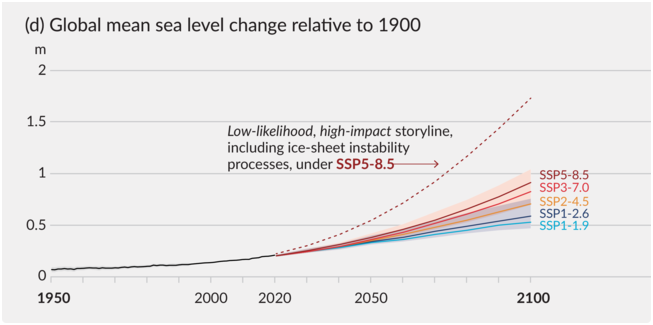
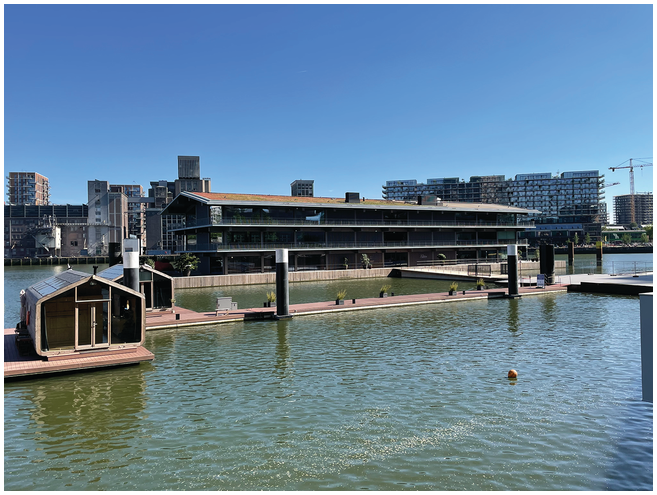
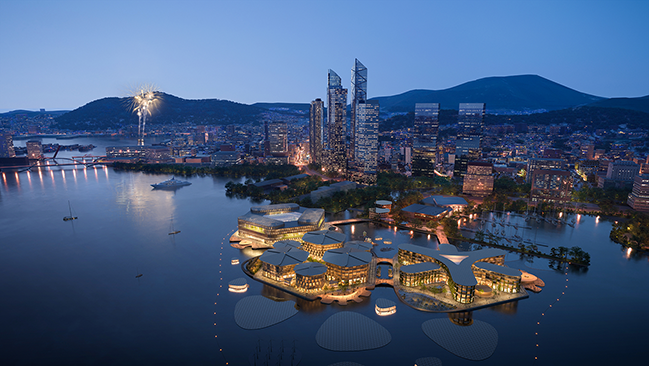
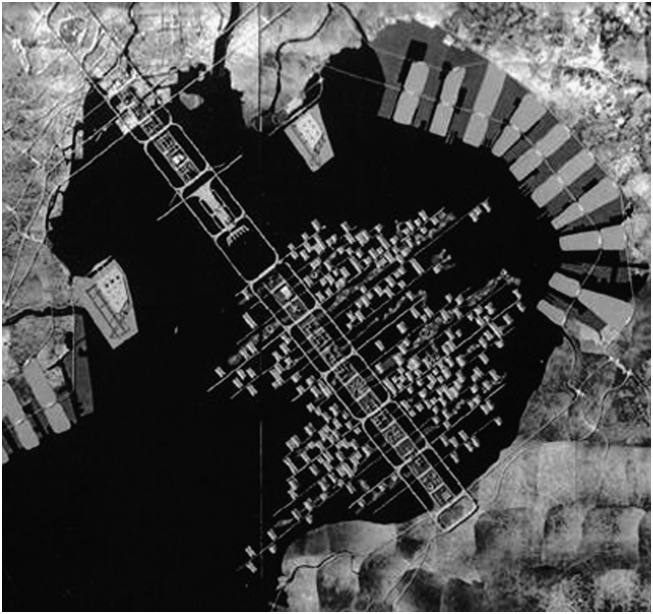
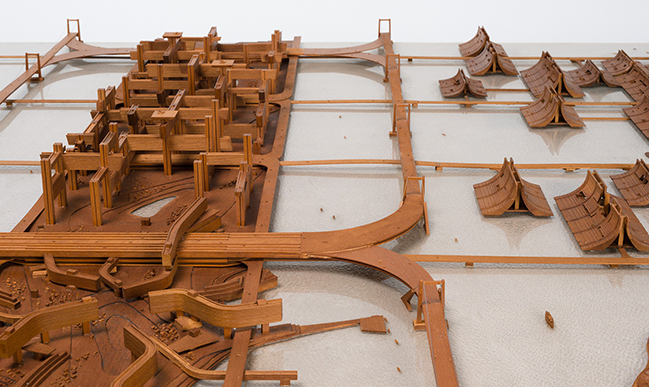
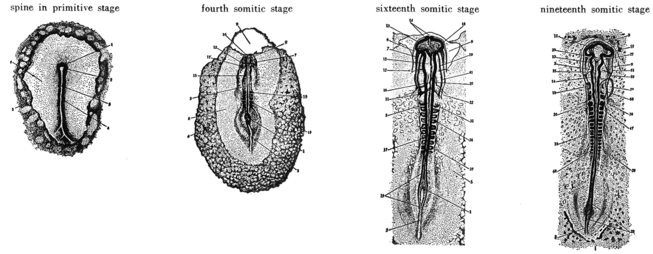

 Open access