


Introduction
Disasters can be classified as man-made or natural hazard-induced disasters; encompass events like hurricanes and earthquakes, while man-made disasters include regional conflicts, wars, chemical incidents, biological incidents, technological disruptions, and infectious diseases.Reference Srivastava1, Reference Said and Chiang2 There are various definitions of “disaster” with most addressing certain common elements, including the unexpected or sudden nature of the events, the scale or magnitude of disruption and impact resulting in unexpected deaths, injuries, illnesses, and displacement of large numbers of people. Lastly, a disaster is a disruption beyond what a population, community, or area can manage.3–5 In 2023, the Emergency Events Database (EM-DAT) recorded 399 natural disasters, with 86,473 fatalities and 93.1 million people affected.6
The impact of disasters has risen worldwide over time due to various factors, including increased population, climate change, urbanization, poverty, and escalating conflict situations. Such disasters can have a significant economic impact, resulting in the loss of employment due to injury and disability, as well as the loss of personal and public assets, such as homes, businesses, and crucial infrastructure.Reference Madu, Kuei, Madu, Madu and Kuei7, Reference Panwar and Sen8 Disaster science is a growing global science that deals with categorizing different types of disasters, enhancing the preparedness and management of disaster cycles, and understanding specific disaster events. By identifying vulnerable communities and agencies, scientists can help establish appropriate plans to deal with the most likely type of disaster that may strike a population, community, or agency. Furthermore, through planning, scientists and policymakers can increase awareness and reduce the impact of a disaster.9–Reference De Smet, Lagadec and Leysen11
To understand disaster preparedness, the common elements in public health are proactive planning, collaboration between stakeholders, and rapid response to mitigate risks.Reference Verheul and Dückers12–Reference Ortiz-Barrios, Gul, López-Meza, Yucesan and Navarro-Jiménez14 Moreover, in the context of health care professionals, disaster preparedness requires knowledge, skills, abilities, and actions to be prepared to respond efficiently.Reference Tichy, Bond, Beckstrand and Heise15–Reference Al Harthi, Al Thobaity, Al Ahmari and Almalki18 It is important to prioritize certain goals, such as maintaining operational continuity and reducing the impact of the disaster.Reference Abrams19–Reference Savoia, Preston and Biddinger21
During a disaster, there can be a rapid and significant increase in the number of patients, leading to both an acute and prolonged strain on health care systems.Reference Persoff, Ornoff and Little22, Reference Azarmi, Pishgooie, Sharififar, Khankeh and Hejrypour23 Hospitals need strategic plans to anticipate, prevent, and respond to health emergencies, and such plans are crucial for maintaining health care facilities’ resilience during disasters,Reference Tang24 According to Farah et al., the preparedness of hospitals for disasters had shortcomings in areas such as education and training for health workers. Such knowledge and training of health professionals is considered crucial for disaster preparedness.Reference Farah, Pavlova and Groot25
Therefore, it is essential to prepare for disasters by identifying potential hazards, assessing vulnerabilities, and equipping health care professionals with the necessary skills, knowledge, and competencies to respond effectively.Reference Pregoner, Josol and Lim16, Reference Alrazeeni17, Reference Glow, Colucci, Allington, Noonan and Hall26 Health care professionals must be prepared through rigorous education and training to effectively meet the diverse health demands of disaster-prone populations.Reference Bajow, Mortelmans, Maghraby, Alatef Sultan, Mani and Aloraifi27–Reference Almukhlifi, Crowfoot, Wilson and Hutton30 The roles, scope of practice, and training requirements of health care professionals vary by discipline, and to address this variability, both undiscipline training (which reinforces discipline-specific competencies) and interdisciplinary training (which fosters team-based competencies such as collaboration, mutual understanding, and coordinated decision-making) enhance communication and coordination during emergencies, which is essential for an effective response.Reference Ersöz Genç31
As defined by the US Department of Education, competency is “a combination of skills, abilities, and knowledge needed to perform a specific task”(p. Vii).Reference Jones, Voorhees, Paulson and Cranton32 The core competencies for emergency preparedness training cover a wide range of knowledge and skills.Reference Hsu, Thomas, Bass, Whyne, Kelen and Green33 Walsh et al. differentiate between knowledge (facts and figures) and skills (psychomotor or mental operations).Reference Walsh, Subbarao and Gebbie34 Regular updates and skills testing in simulated scenarios can identify gaps in preparedness and improve health care professionals’ abilities to handle a disaster.Reference Al-Qbelat, Subih and Malak35–Reference Langan, Lavin, Wolgast and Veenema37 Competency-based training programs are tailored to address the specific demands unique to a disaster situation, thereby helping to better prepare health care professionals Reference Bajow, Mortelmans, Maghraby, Alatef Sultan, Mani and Aloraifi27. Previous research suggests that disaster preparedness can be enhanced through various educational interventions, such as implementing an emergency preparedness curriculum in universities,Reference Ashcroft, Byrne, Brennan and Davies38 utilizing virtual reality (VR) and tabletop drills for practical training,Reference Chang, Lin, Huang, Hsu, Sung and Cheng39 continuous development courses and programs to keep individuals and organizations updated,Reference Sahebzadeh, Gherekhloo and Atighechian40 and leveraging technology-based methods to improve training efficacy.Reference Baetzner, Wespi and Hill41
This review builds on previous systematic reviews conducted on disaster preparedness among health care professionals that have predominantly focused on disaster preparedness among nurses without investigating other health care professional groups.Reference Said and Chiang2, Reference Labrague, Hammad and Gloe42–Reference Yousefi, Larijani, Golitaleb and Sahebi44 Our review focused on health care professionals and aimed to evaluate the impact of educational interventions on the knowledge, skills, and competencies of hospital-based health care professionals regarding disaster preparedness.
Methods
Review Questions
Q1: What educational interventions have been used to address hospital-based health care professionals’ disaster preparedness in the hospital context?
Q2: What impact do educational interventions have on the primary outcomes of hospital-based health care professionals’ knowledge, skills, and competencies in disaster preparedness?
Q3: What impact do educational interventions have on the secondary outcomes of hospital-based health care professionals’ preparedness or readiness for responding to a disaster or their actual performance in responding to a disaster?
Q4: What factors and intervention components are linked to positive and/or negative changes in the primary and secondary outcomes as reported in the included interventional studies?
Search Details
The Cochrane Collaboration Handbook of Systematic Reviews guided the review.Reference Higgins, Thomas, Chandler, Cumpston, Li, Page and Welch45 Preferred Reporting Items for Systematic Reviews and Meta-analysis (PRISMA) guidelines were used.Reference Page, McKenzie and Bossuyt46 A protocol for this systematic review was registered on PROSPERO number CRD42023488543.
Search Strategy
The review included publications in English and Arabic from January 2013 to September 2023 and searched electronic databases, including CINAHL, Medline, Embase, SCOPUS, and ERIC. Key terms are framed around Population, Intervention, Comparison, Outcomes, Timelines, and Setting (PICOTS) with search terms supplied in supporting documentation (supplementary file 1). Limiting the language to Arabic and English was necessary as the authors are competent in both English (FA, JH, SF, DA, and PC) and Arabic (FA and DA) only. While English is the primary language used in global scientific publication, the inclusion of papers published in Arabic will ensure inclusion of regional studies for the 22 Arab speaking countries and a total of 473 million people.47
Eligibility Criteria
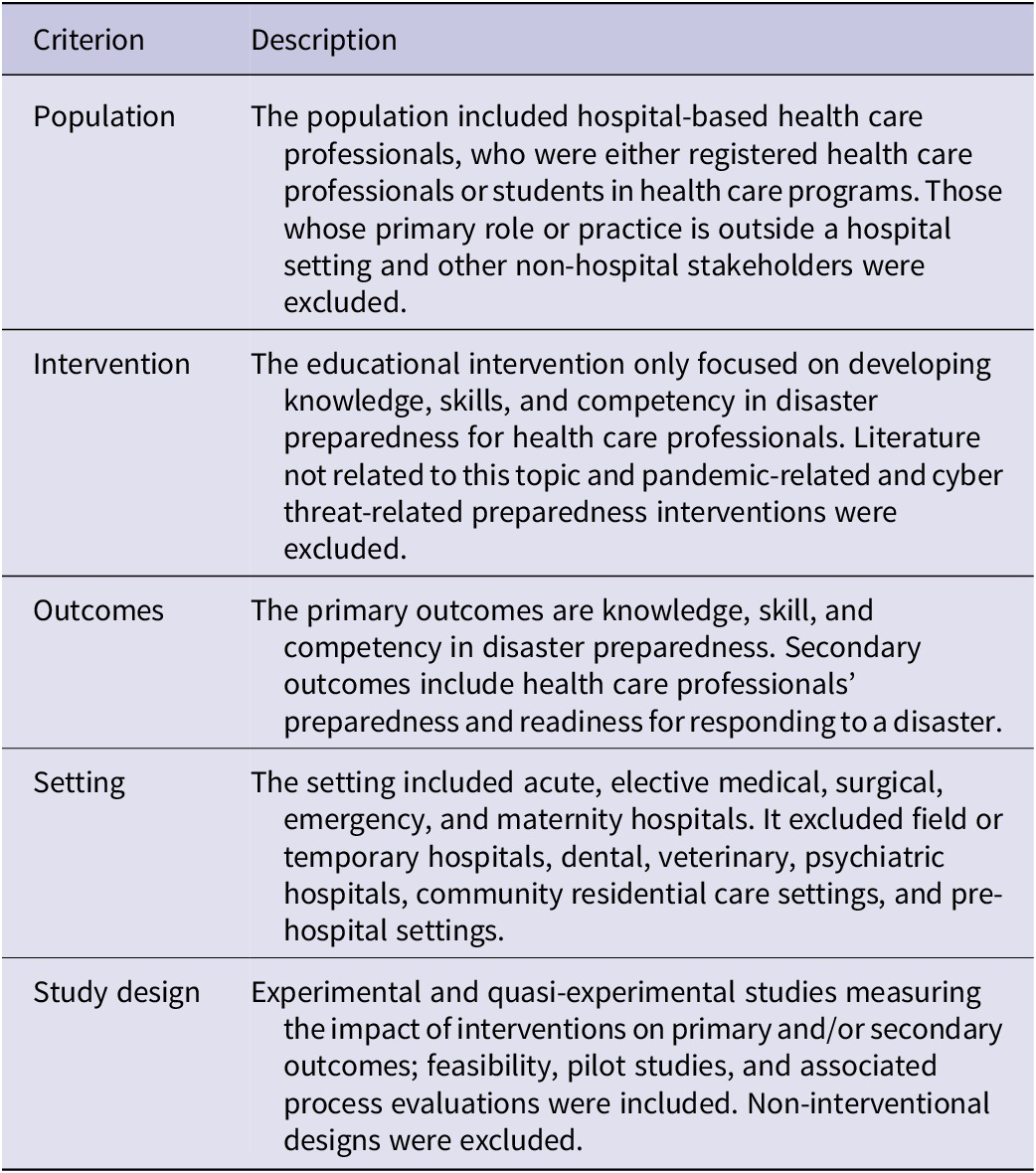
The criteria for including and excluding studies were developed using the PICOST method (Table 1).
Summary of eligibility criteria

Study Selection
One reviewer (FA) conducted the search within each database separately; search strategies were checked by review authors. All studies identified and cited were uploaded to Covidence, a web-based software platform, and duplicate citations were removed automatically. The screening process was undertaken in two stages; firstly, review authors (FA, DA, SF, PC, and JH) independently screened all study titles and abstracts against the inclusion criteria in pairs. Secondly, the potentially eligible studies identified during the title and abstract screening were screened in full text by reviewers (FA, DA, SF, PC, and JH) independently in pairs. Conflicts were resolved by discussion with a third author. The PRISMA 2020 flow diagram was used to report the screening and selection process.Reference Page, McKenzie and Bossuyt46
Study Quality Assessment
In this review, the quality of research papers was evaluated using the Mixed Methods Appraisal Tool (MMAT).Reference Hong, Pluye and Fàbregues48 For randomized studies, Cochrane’s Risk of Bias version 2 (RoB 2) was used to assess the risk of bias.Reference Flemyng, Dwan, Moore, Page and Higgins49
One reviewer (FA) performed the quality assessment and risk of bias evaluation for all studies included in the review. After that, one of the other four reviewers (DA, SF, PC, and JH) assessed the evaluation process of each study independently. Any conflicts that were identified were resolved through consensus with a third reviewer.
Data Extraction and Synthesis
The data extraction forms were designed to extract data from all included studies. Details of the characteristics of the included studies (author, year, country, setting, study design, aim, participant profession, sample size, outcomes and corresponding Kirkpatrick level of evaluation,Reference Kirkpatrick and Kirkpatrick50 and quality assessment score). The Kirkpatrick Model includes four levels for evaluating educational interventions: reaction, learning, behavior, and results.Reference Kirkpatrick and Kirkpatrick50 In this review, outcomes were assessed related to level 2 learning and level 3 behavior of the evaluation model. Data relating to each review question were extracted. Intervention details were extracted and summarized using the 12 items from the Template for Intervention Description and Replication (TIDieR) checklist.Reference Hoffmann, Glasziou and Boutron51
The interventions reflected in this review were considered complex interventions. Simulation fidelity is the degree of realism and accuracy with which a simulated system replicates the real world.Reference Ye, Backlund, Ding and Ning52, Reference Lopreiato53 Many authors have noted a lack of clarity and a degree of ambiguity in assessing the level of simulation fidelity when presenting details of interventions within systematic reviews.Reference Hamstra, Brydges, Hatala, Zendejas and Cook54–Reference Ketelaars, Flandin and Poizat56 Therefore, the authors have used the term “complexity of the intervention” in this review to encapsulate aspects that describe the level of complexity of the included interventions. Within Cochrane training relating to intervention complexity, Thomas and colleagues defined intervention complexity by (1) the quantity of components, (2) the ways the components interact, or (3) the larger system within which the intervention is implemented.Reference Thomas, Petticrew, Noyes, Higgins, Thomas, Chandler, Cumpston, Li, Page and Welch57 Noyes et al. claim that studies frequently do not precisely define the degree, type, or dimensions of intervention complexity. Intervention complexity is the way various factors affect an intervention’s outcomes, including the intervention’s characteristics, the context in which it is implemented, and the interactions among them.Reference Noyes, Gough and Lewin58
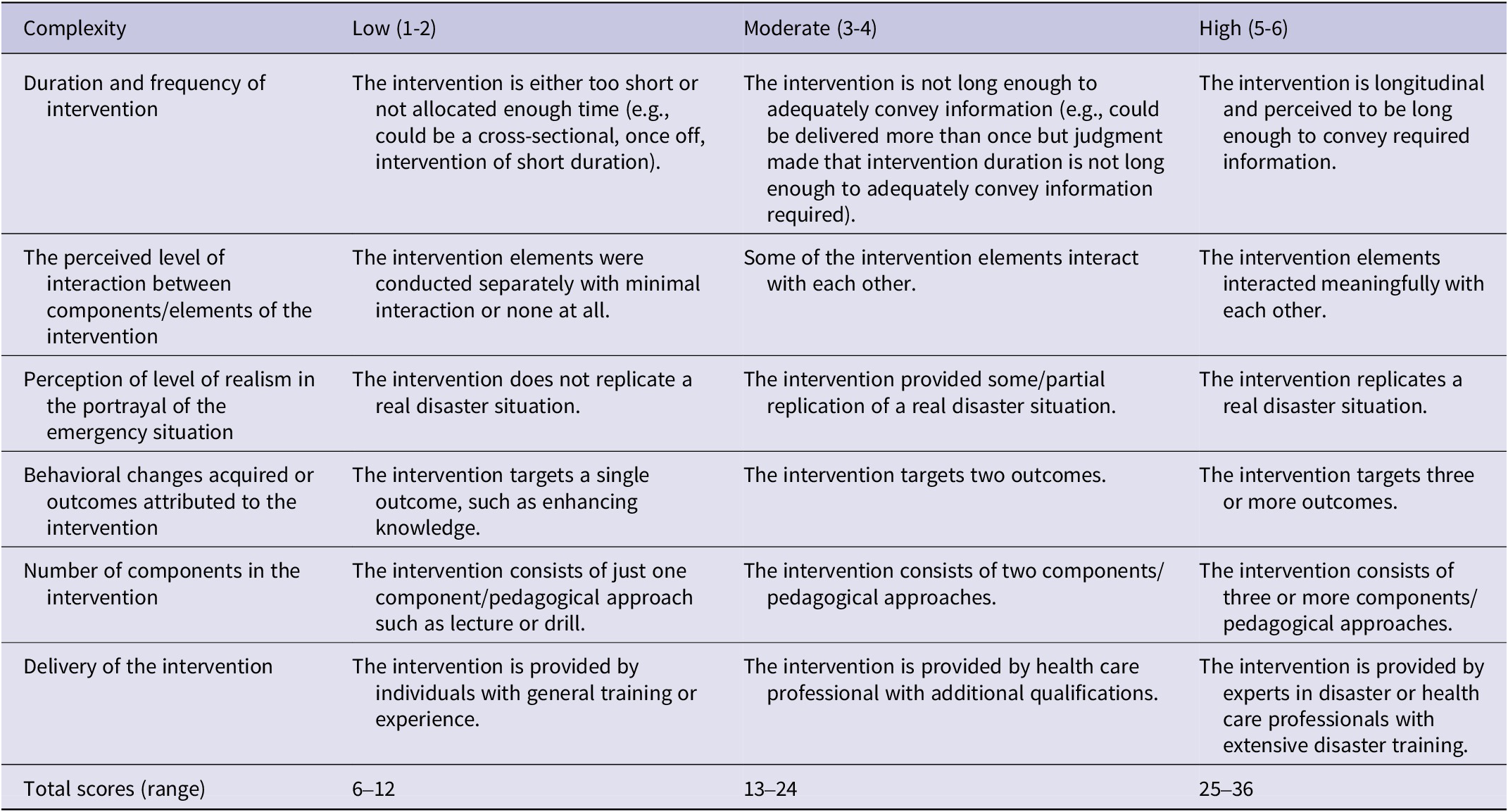
To judge the level of complexity, we adapted and used the Intervention Complexity Assessment Tool for Systematic Reviews (iCAT_SR).Reference Lewin, Hendry and Chandler59 Dimensions considered in judging are duration and frequency of intervention, the perceived level of interaction between components of the intervention, perceived level of realism in the portrayal of the emergency situation, behavioral changes acquired or outcomes attributed to the intervention, number of components in the intervention, and delivery of the intervention as described in Table 2.
Description of the level of complexity

Items used by authors to judge the level of complexity adapted from Lewin et al. (2017). Criteria not reported or not included in description; NR = 0 for those criteria was used.
Reviewers categorized the complexity level of all included interventions into three categories across six dimensions. These categories are low complexity, scored between 1 and 2; moderate complexity, with scores ranging from 3 to 4; and high complexity, scored between 5 and 6. Such judgments were made by assessing interventions across six dimensions (duration, component interaction, realism, behavioral changes, number of components, and delivery of the intervention). Based on the total scores assigned to each intervention, the scoring system provided a systematic and standardized way to classify interventions according to their perceived complexity, defined as low complexity for scores between 1 and 12, moderate complexity for scores between 13 and 24, and high complexity for scores between 25 and 36. Interventions were categorized into six potential levels based on a combination of reviewers’ judgments regarding the complexity of the intervention and the details of the modality, where single modality consists of only one type of instruction format or method, while multimodality interventions incorporate more than one type of instruction format and involve multiple modes of communication and representation of the intervention. The levels are (1) single modality, low complexity, (2) multimodality, low complexity, (3) single modality, moderate complexity, (4) multimodality, moderate complexity, (5) single modality, high complexity, and (6) multimodality, high complexity.
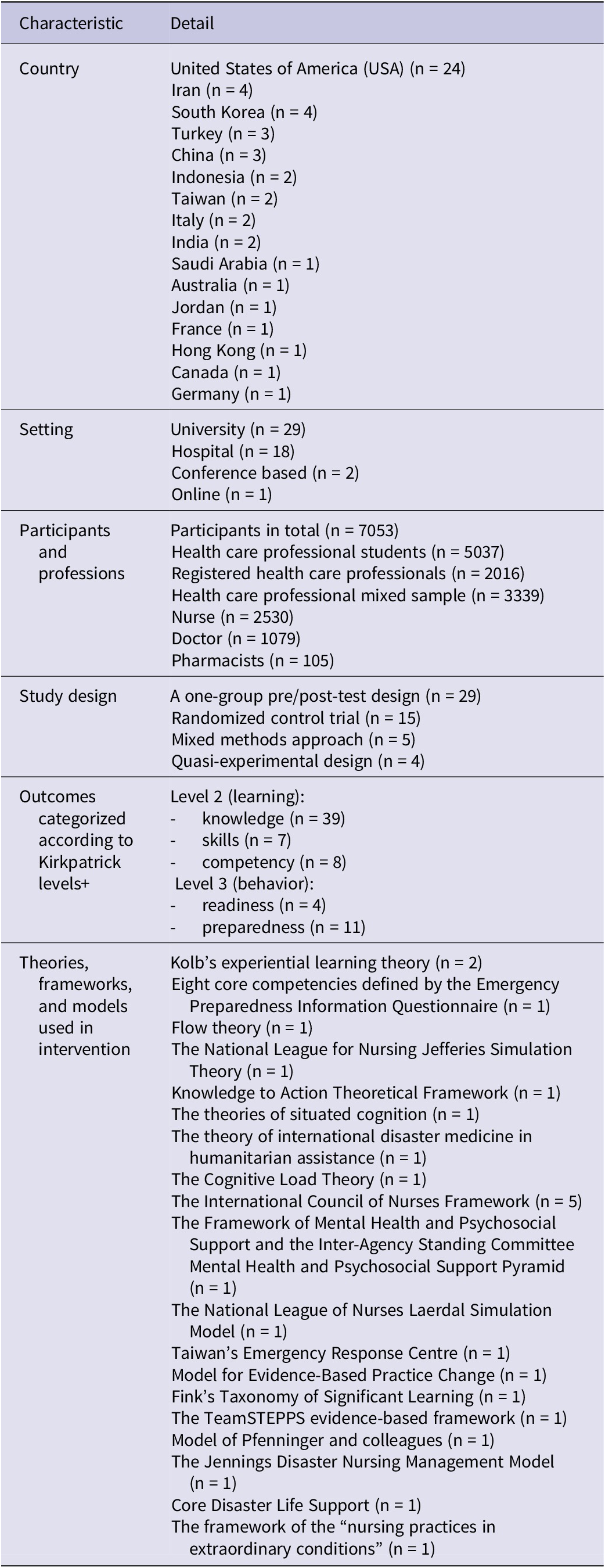
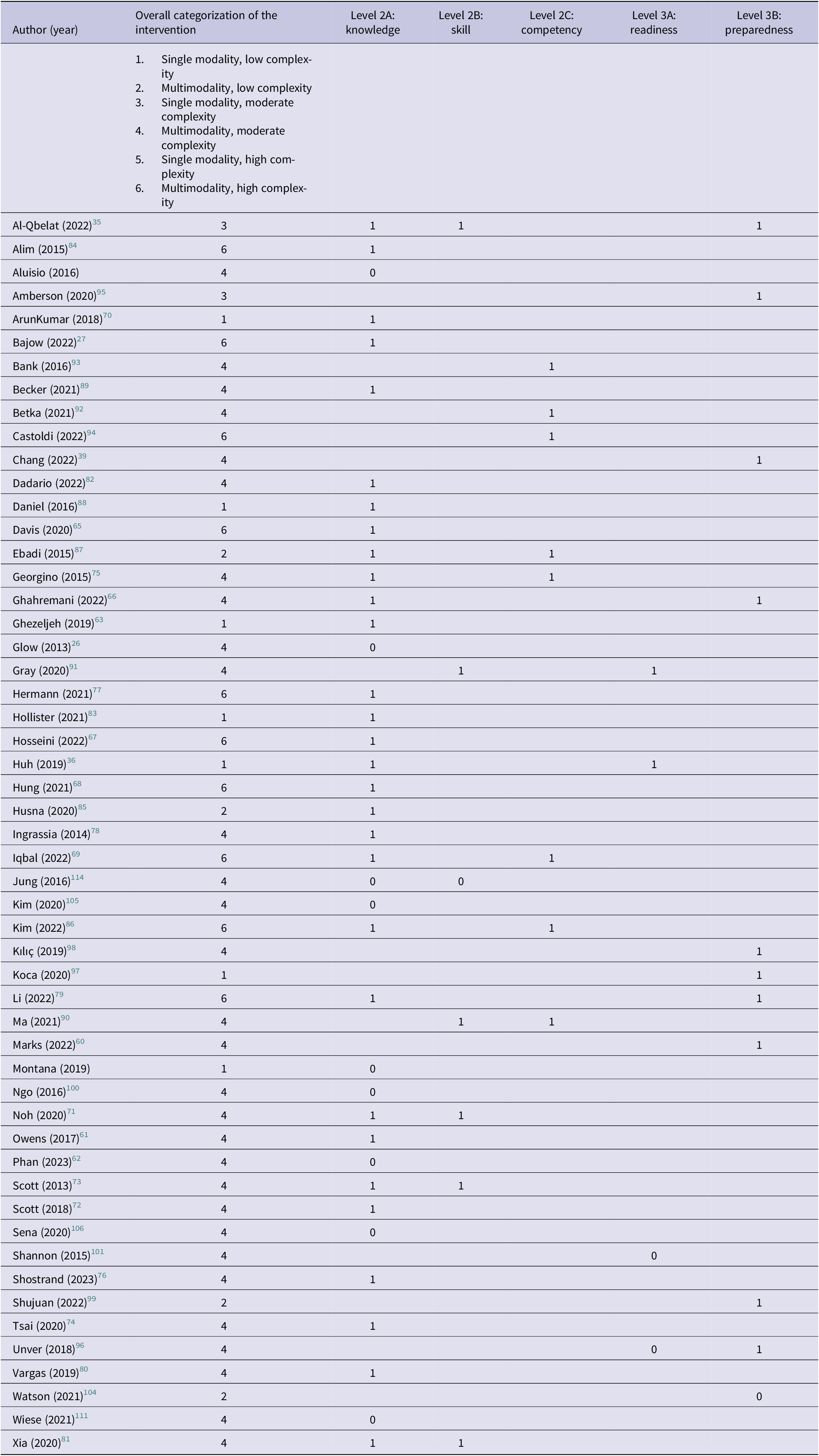
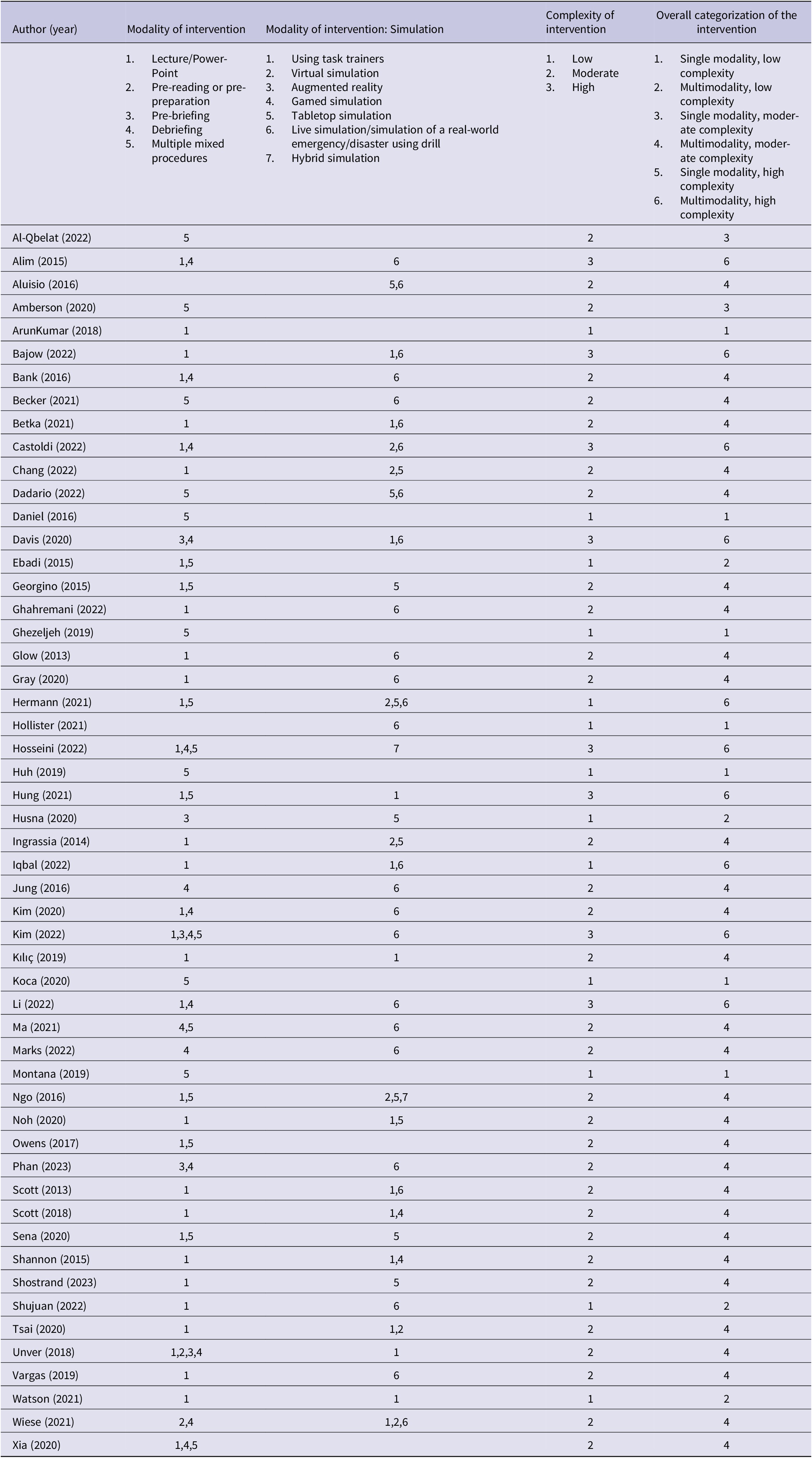
A narrative synthesis was conducted to describe the studies based on the following: (1) the study’s characteristics (Table 3 and supplementary file 2); (2) included study’s primary and secondary outcomes linked to the Kirkpatrick Model levelsReference Kirkpatrick and Kirkpatrick50 presented in a tabular format (Table 4); (3) disaster preparedness interventions, described using the TIDieR checklist,Reference Hoffmann, Glasziou and Boutron51 (supplementary file 3); and (4) the disaster preparedness educational interventions categorized based on their complexity levels and the modalities utilized in the included studies (Table 5).
Included study characteristics (n = 53 studies)

+ Adapted from Kirkpatrick and Kirkpatrick (2016). Level 2 Learning: Acquisition of health care professionals’ knowledge, skill, and competency. Level 3 Behavior: Effect of educational interventions on health care professionals’ readiness and preparedness in their workplace.
Summary of findings on the effectiveness of disaster preparedness interventions using Kirkpatrick model (N = 53)

1 indicates a statistically significant improvement in outcome (P < 0.05); 0 indicates that no statistically significant change has been observed (Kirkpatrick and Kirkpatrick, 2016). Modality refers to the approaches used in intervention, and the complexity associated with the judgment scores provided by authors.
Intervention complexity and modality of disaster preparedness educational interventions (N = 53)

One reviewer (FA) extracted and synthesized the data from the included studies. Four reviewers (DA, SF, PC, and JH) independently reviewed and checked the extraction and synthesis process. Disagreement was resolved through discussion between all reviewers.
Patient and Public Involvement
As this was a systematic review of the literature using existing publicly available information, no patients were directly involved in the review.
Results
Results of the Search
The initial database search identified 11,688 citations; after removing 4,826 duplicates, titles and abstracts of the remaining 6,862 citations were screened; 107 underwent full-text review, and 53 papers were selected for data extraction (Figure 1).
PRISMA flow diagram.

Study Characteristics
Out of the 53 studies included in the review, the majority were conducted in the United States of America (USA) (n = 24) (45%). Four studies were conducted each in South Korea (n = 4) and Iran (n = 4), three in Turkey (n = 3) and China (n = 3), and two in India (n = 2), Indonesia (n = 2), Taiwan (n = 2), and Italy (n = 2). Additionally, one study was conducted in Saudi Arabia (n = 1), Australia (n = 1), Jordan (n = 1), France (n = 1), Hong Kong (n = 1), Canada (n = 1), and Germany (n = 1). The included studies show that research was primarily conducted in continental North America (47%), Asia (38%), Europe (13%), and Australia (2%), with a notable absence of studies in Africa and South America.
The sample size ranged from a minimum of 10Reference Marks, Chung, Li, Waltzman, Manzi and Shah60 to a maximum of 2,246 participants.Reference Owens, Buffington, Frost and Waldner61 The total number of participants across the included papers was 7,053, which included registered health care professionals (n = 2,016) and student health care professionals (n = 5,037). The disciplines represented across studies included nurses (n = 2,530), doctors (n = 1,079), pharmacists (n = 105), and other mixed samples of health care professionals (n = 3,339).
All studies conducted in China, Turkey, South Korea, Iran, India, and Indonesia focused exclusively on nursing professionals or nursing students, with a total of 18 studies. Therefore, in these countries, the interventions targeted only nursing, with no studies involving other health care professions or multidisciplinary groups. Conversely, studies conducted in the United States included a broader range of health care professions, while nurses represented 29% of the 24 studies. Additionally, there are sixteen studies involved a diverse group of participants, including a range of health care professionals and students such as nurses, physicians, and pharmacists.
The included studies utilized a range of diverse study designs, including one-group pre/post-test design (n = 28), randomized control trial (n = 15), mixed methods approach (n = 5), and quasi-experimental design (n = 4). Studies were conducted in universities (n = 29), hospitals (n = 18), during conferences (n = 2), and completely online (n = 1) (Table 3).
Quality Assessment
The studies were evaluated using the MMAT,Reference Hong, Pluye and Fàbregues48 which assessed each study with targeted questions with three distinct responses: “yes,” “cannot tell,” or “no.” All studies had clearly defined research questions, ensuring a focused assessment. Among the fifteen randomized control trials, twelve successfully met all five appraisal criteria, achieving a score of 100%. In contrast, the lowest recorded score was 20%.Reference Phan, Geller, Broughton, Swan and Wells62 Furthermore, it was challenging in non-randomized studies to identify potential confounders that were accounted for in the study’s design or analysis.
The assessment of the risk of bias in the fifteen randomized studies (supplementary file 4) revealed several key findings. 53% of the trials were found to have a high overall risk of bias. In terms of the randomization process, 73% of the trials demonstrated a low risk of bias. However, 60% of the trials raised concerns about deviations from the intended interventions. 73% of the trials were considered to have a low risk of bias related to missing outcome data. In terms of the measurement of outcomes, 53% of the trials were rated as having a low risk. Finally, concerns were raised about the selection of reported results in 93% of the trials, indicating that the analyses used did not specify primary outcomes, lacked sufficient information, or had no pre-registered analysis plan referenced within the paper.
Outcomes
Each study’s primary and secondary outcomes were categorized according to the four levels of the Kirkpatrick Model for evaluating training and learning programsReference Kirkpatrick and Kirkpatrick50 (Table 4). Level 2 of the Kirkpatrick Model (learning) was reported as participant knowledge (n = 39 studies), skills (n = 7 studies), and competency (n = 8 studies). Notably, knowledge was measured in 74% of the included studies. For level 3 (behavior), change in behavior was referred to as readiness for disaster (n = 4 studies) and preparedness for disaster (n = 11 studies).
In 30 studies out of 39, statistically significant improvements in disaster preparedness knowledge were observed (77%). Disaster preparedness knowledge was operationalized in different ways measuring slightly different aspects of a concept. These included disaster preparedness knowledge in a generic context (n = 18 studies).Reference Al-Qbelat, Subih and Malak35, Reference Huh and Kang36, Reference Owens, Buffington, Frost and Waldner61, Reference Ghezeljeh, Aliha, Haghani and Javadi63–Reference Hermann, Gerstner and Weiss77 In addition, studies operationalized disaster preparedness knowledge across various fields, including disaster triage knowledge and accuracy (n = 4),Reference Ingrassia, Ragazzoni, Tengattini, Carenzo and Della Corte78–Reference Xia, Li, Chen, Jin and Zhang81 knowledge of Mass Casualty Incidents (MCI) (n = 2),Reference Dadario, Bellido and Restivo82, Reference Hollister, Zhu, Edwards, Good and Hoeppner83 disaster knowledge through drills (n = 2),Reference Alim, Kawabata and Nakazawa84, Reference Husna, Kamil, Yahya, Tahlil and Darmawati85 psychological first aid performance (n = 1),Reference H-w and Y-J86 biological incidents (n = 1),Reference Ebadi, Yousefi, Khaghanizade and Saeid87 the Disaster Olympics model (n = 1),Reference Daniel, Gist, Grock, Kohlhoff, Roblin and Arquilla88 and evacuation procedures during disasters (n = 1).Reference Becker, Majers and Moody89
Participants’ disaster preparedness skills were evaluated in seven studies, with six showing statistically significant improvement post-intervention.Reference Al-Qbelat, Subih and Malak35, Reference Noh, Oh, Kim, Jang, Chung and Lee71, Reference Scott, Swartzentruber, Davis, Maddux, Schnellman and Wahlquist73, Reference Xia, Li, Chen, Jin and Zhang81, Reference Shi, Zhang and Zhang90, Reference Gray, Thomas, Burns and Umoren91 Al-Qbelat et al. found that disaster preparedness skills had mean scores rising from 3.88 to 4.79 (p ≤ .001),Reference Al-Qbelat, Subih and Malak35 and Ma et al. reported significant improvement in disaster nursing skills for nursing students, especially in the intervention group (p = 0.008).Reference Shi, Zhang and Zhang90
Eight studies evaluated disaster preparedness competency, and results showed significant improvements in all studies across various areas. Improvements in competencies related to general disaster preparedness were reported in five studies. Reference Iqbal, Mashal and Khan69, Reference Georgino, Kress, Alexander and Beach75, Reference Shi, Zhang and Zhang90, Reference Betka, Bergren and Rowen92, Reference Khalil93 Other studies took a more focused approach and described significant improvements in psychological first aid performance competence,Reference H-w and Y-J86 competency of nurses in biological incidents,Reference Ebadi, Yousefi, Khaghanizade and Saeid87 and competencies in MCI management.Reference Castoldi, Greco, Carlucci, Lennquist Montán and Faccincani94 Disaster preparedness competencies across studies demonstrated significant improvement following targeted interventions (p < 0.001).Reference H-w and Y-J86, Reference Ebadi, Yousefi, Khaghanizade and Saeid87, Reference Betka, Bergren and Rowen92
Two out of four studies showed significant improvement in disaster readiness, with one reporting on perceived readiness for evacuating ill patients (p < 0.001)Reference Gray, Thomas, Burns and Umoren91 and the other reporting on nursing students’ readiness (p < 0.001).Reference Huh and Kang36
The preparedness of participants was evaluated in 11 studies, with 10 studies reporting significant improvements in preparedness generally (n = 8),Reference Al-Qbelat, Subih and Malak35, Reference Marks, Chung, Li, Waltzman, Manzi and Shah60, Reference Li, Kaziny, Perron, Downey, Monuteaux and Chung79, Reference Amberson, Wells and Gossman95–Reference Shujuan, Mawpin, Meichan, Weijun, Jing and Biru99 and preparedness in specific situations including chemicalReference Chang, Lin, Huang, Hsu, Sung and Cheng39 and bioterrorism incidents.Reference Ghahremani, Rooddehghan, Varaei and Haghani66 A study on nursing students’ preparedness for bioterrorism across three areas indicates significant findings in three domains: communication (p = 0.001), command system (p = 0.001), and isolation (p = 0.002).Reference Ghahremani, Rooddehghan, Varaei and Haghani66
Outcome results varied by setting, although a definitive pattern was not evident. Interventions were administered in universities in 29 studies, with significant improvements in 20 studies at level 2 and 6 at level 3, where 2 studies measured both outcome levels.Reference Huh and Kang36, Reference Ghahremani, Rooddehghan, Varaei and Haghani66 Conversely, interventions in hospitals were delivered in 16 studies, with significant improvements in 12 at level 2 and 3 at level 3, where 2 studies assessed both outcome levels. Two studies conducted in hospital and university settings reported significant improvements in level 2 outcomes.Reference Hosseini, Hosseini, Qayumi and Baeradeh67, Reference Ngo, Schertzer, Harter and Smith-Coggins100 A variety of tools were identified to measure disaster preparedness. The most frequently used is the Emergency Preparedness Information Questionnaire (EPIQ), utilized in four studies,Reference Ghahremani, Rooddehghan, Varaei and Haghani66, Reference Georgino, Kress, Alexander and Beach75, Reference Shostrand, Miller and Bowers76, Reference Amberson, Wells and Gossman95 while two studies created their tools based on EPIQ.Reference Chang, Lin, Huang, Hsu, Sung and Cheng39, Reference Shujuan, Mawpin, Meichan, Weijun, Jing and Biru99
Template for Intervention Description and Replication (TIDieR) Checklist
We aimed to answer the key questions related to the intervention components using the TIDieR (supplementary file 3). Among the 35 studies, ten studies utilized a single modality approach. In contrast, multimodality approaches were used in 43 studies. In 43 studies simulation was used. Lectures were used in 35 studies. Multiple mixed procedures interventions were employed in nineteen studies, while debriefing was utilized in 17 studies. Pre-briefing was implemented in six studies. Additionally, simulation and lectures were combined in 32 studies.
The intervention facilitators were reported as nurses (20/53), interprofessional education teams (11/53), doctors (6/53), and other professions (5/53). The information about the intervention provider in 11 studies was not explicitly reported. The researchers participated in delivering the intervention in 14 studies. A total of 21 studies employed various theories, models, and frameworks to provide a foundation for the intervention reported in Table 3. The interventions were administered in a university (n = 29), a hospital (n = 16), and other settings (n = 7). Three studies did not report the setting in which the intervention was delivered. Two studies delivered their intervention in two settings: a hospital and a university.Reference Hosseini, Hosseini, Qayumi and Baeradeh67, Reference Ngo, Schertzer, Harter and Smith-Coggins100
Complexity
The reviewers created a structured framework to analyze and compare the effectiveness of various approaches by categorizing interventions based on their modality and complexity (Tables 2 and 5). These results do not reflect effect sizes or meta-analysis.
A review of the studies reveals that out of a total of 15 studies; 3 studies were judged based on the level of complexity of their interventions; 11 (21%) are categorized as low complexity, 31 (60%) as having moderate complexity, and 10 (19%) as high complexity. The complexity scores ranged from a low of 7,Reference Arun Kumar, John and Thadathil70 to a high of 29.Reference Hermann, Gerstner and Weiss77 This range of scores illustrates the diversity in complexity of interventions across the examined studies, as summarized in Table 6.
Judgment on level of complexity of interventions (N = 53)

Score items: Not reported (0), low complexity (1-2), moderate complexity (3-4), high complexity (5-6). Interpretation of total scores: Low complexity (1-12), moderate complexity (13-24), high complexity (25-36).
For both Kirkpatrick levels (2 and 3), 82% of included studies achieved significant changes for low complexity interventions, 72% for moderate complexity, and 100% for high complexity. Regarding Kirkpatrick level 2 outcomes; 86% of low complexity interventions, 64% of moderate complexity, and 100% of high complexity interventions achieved statistically significant improvements in the outcomes measured. For Kirkpatrick level 3 outcomes, 75% of low complexity interventions, 75% of moderate complexity, and 100% of high complexity interventions achieved statistically significant improvements in outcomes.
When combining intervention modality and level of complexity into six categories, 13% were single modality low complexity interventions (7/53), 8% were multimodality low-complexity interventions (4/53), 4% were single modality-moderate complexity interventions (2/53), 56% were multimodality-moderate complexity (30/53), and 19% were multimodality-high complexity (10/53). Notably, no studies were available for single modality-high complexity. In terms of Kirkpatrick level 2 outcomes; 83% of single modality-low complexity interventions, 100% of multimodality-low complexity interventions, 100% of single modality-moderate complexity interventions, 68% of multimodality-moderate complexity, and 100% of multimodality-high complexity achieved statistically significant improvements in outcomes. Moreover, for Kirkpatrick level 3 outcomes; 67% of single modality-low complexity interventions, 50% of multimodality-low complexity interventions, 100% of single modality-moderate complexity interventions, 75% of multimodality-moderate complexity, and 100% of multimodality-high complexity interventions demonstrated statistically significant improvements in outcomes.
Discussion
This systematic review identified 53 studies, encompassing (n = 7,053) health care professionals and students, that assessed the effectiveness of educational interventions specifically designed to improve the disaster preparedness of health care professionals and students within hospital settings. Evidence shows that disaster preparedness education interventions must provide comprehensive, structured training to address the number of components and their interaction, sufficient time to cover disaster topics, and replicate real disaster events. These interventions equip participants with essential knowledge, skills, and competencies.
The details of interventions included in the review were extracted using The TIDieR,Reference Hoffmann, Glasziou and Boutron51 we found that all studies labelled their interventions according to either the descriptions of the intervention or delivery method, resulting in unique names for each intervention, with no study employing the same educational intervention or programs. The rationale behind various interventions highlights the importance of basing these interventions on robust research and expert advice, with the primary goal of establishing a strong foundation for disaster preparedness educational interventions. Furthermore, most of the interventions examined in this review are grounded in well-established theories and frameworks. One such theory used is Kolb’s experiential learning theory,Reference Shostrand, Miller and Bowers76, Reference Shannon101 which is instrumental in creating interventions that offer more impactful and engaging learning experiences. Additionally, the International Council of Nurses framework was employed to ensure the interventions were comprehensive, focused, and effective.Reference Huh and Kang36, Reference Hosseini, Hosseini, Qayumi and Baeradeh67, Reference Hung, Lam, Chow, Ng and Pau68, Reference Alim, Kawabata and Nakazawa84, Reference Shi, Zhang and Zhang90
The duration of educational interventions varied significantly across the selected studies. In this review, the implementation of training ranged from approximately 10 minutesReference Gray, Thomas, Burns and Umoren91 to over 37 hours.Reference Bajow, Alkhalil, Maghraby, Alesa, Najjar and Aloraifi64 There is a relationship between the duration and the level of intervention complexity, as the duration influences the judgment of intervention complexity. Specifically, the duration allocated to an intervention plays a crucial role, as more time ordinarily ensures that more of the key topics and components are covered. Moreover, Alim argues that challenges arise in covering disaster preparedness topics within a limited time.Reference Alim, Kawabata and Nakazawa84 Longer interventions involve simulations, workshops, and team drills that demonstrate enhanced response skills and coordination among health care workers and emergency responders.Reference Lin, Tzeng, Chiang, Lu, Lee and Chiang102 Tailoring the intervention is an essential aspect of meeting the specific needs of participants while developing education content and during implementation.Reference Al Harthi, Al Thobaity, Al Ahmari and Almalki18, Reference Brinjee, Al Thobaity, Almalki and Alahmari103 Moreover, in the included studies, the authors noted reasons for tailoring interventions, such as limited resources,Reference Amberson, Wells and Gossman95 meeting the requirements of particular settings,Reference Castoldi, Greco, Carlucci, Lennquist Montán and Faccincani94, Reference Watson, Waddell and McCourt104 and the necessity to improve implementation.Reference Shannon101 Among the modalities employed, simulation-based training has become the most implemented method, followed closely by didactic lectures, multiple mixed procedures, as well as pre-briefing and debriefing sessions.
The primary outcomes associated with level 2 outcomes of the Kirkpatrick Model, which focus on learning in this review, were the knowledge, skills, and competencies of health care professionals. Our findings indicated that knowledge pertaining to disaster preparedness emerged as the most frequently assessed outcome following the intervention, highlighting a strong focus on this topic within the included studies. Additionally, 77% of studies that measured knowledge reported significant improvements across various domains, covering both general and specific topics such as Mass Casualty Incidents (MCI) and evacuation procedures. Specifically, despite this there were noticeable knowledge deficits among nurses in triage accuracyReference Kim and Lee105 and among medicine residents in disaster knowledge.Reference Sena, Forde, Yu, Sule and Masters106 Furthermore, studies that evaluated disaster preparedness competencies reported significant enhancements across all assessed areas. Regarding tools that comprehensively measure primary outcomes, Al-Qbelat et al. utilized the Disaster Preparedness Evaluation Tool (DPET) to assess disaster preparedness knowledge, skills, and competencies.Reference Al-Qbelat, Subih and Malak35 Nonetheless, the EPIQ remains the most utilized tool across all included studies.
The preparedness and readiness of health care professionals for disasters were examined in relation to level 3 of the Kirkpatrick Model, which focuses on changes in behavior. We found that studies measuring readiness for responding to disasters indicated a 50% significant improvement in readiness, and 91% of the interventions significantly improved the preparedness of participants.
The diversity in reported outcomes across studies may partly result from differences in setting, geographic distribution, and profession. There was no clear distinction between outcomes when the setting of intervention was considered; however, pre-registration programs tended to be delivered more within university settings. Having a single institution, whether a university or a hospital, for the educational program carries certain risks. For example, university-led interventions can potentially be more theoretical or disconnected from the daily realities of the hospital context, involve only single disciplines, and may not reflect the real-world health system’s infrastructure.Reference Schilly, Huhn, Visker and Cox107 This highlights the need to embed interventions more deeply into practice by connecting both universities and hospitals in educational endeavors. Regarding the profession, nurses are the most targeted profession, with fewer interventions involving other health care professionals such as physicians, pharmacists, or allied health staff. This single-profession approach in studies may cause an inequality that could result in gaps in communication, role overlaps, and negatively affect the overall efficiency, coordination, and effectiveness of disaster response operations.Reference Goniewicz and Goniewicz108 The geographical distribution of the interventions, with 45% of the included studies taking place in the United States, may reflect that in 2024, the US faced 27 weather and climate disasters, each causing at least $1 billion in damages, totaling an estimated $182.7 billion,109 and a high number of agencies and governmental departments focused on being prepared to manage disasters within the timeframe of this review. This level of focus and educational funding is beneficial for enhancing global knowledge on the topic, but the result of such research needs to be considered in the context of the US cultural norms, structures, and potential disaster types.Reference Hanushek110
This review has also highlighted the components of educational interventions focused on disaster preparedness, which authors found led to positive or negative impacts on outcomes. The study authors noted that the impact of disaster simulation activities improved knowledge and competence in managing disasters and these had a better teaching effect compared to traditional workshops, and suggested that in-person simulations were more beneficial for students.Reference Husna, Kamil, Yahya, Tahlil and Darmawati85, Reference H-w and Y-J86, Reference Betka, Bergren and Rowen92, Reference Khalil93, Reference Unver, Basak and Tastan96, Reference Shujuan, Mawpin, Meichan, Weijun, Jing and Biru99, Reference Ngo, Schertzer, Harter and Smith-Coggins100, Reference Wiese, Love and Goodman111 Simulation-based training effectively enhances disaster knowledge and skillsReference Hawsawi, Thobaity and MSM112 and creates realistic disaster scenarios that provide valuable learning opportunities in a safe environment.Reference Farhat, Alinier and Chaabna113 In addition, the combination of simulation and lectures helped integrate theory with practice.Reference Chang, Lin, Huang, Hsu, Sung and Cheng39, Reference Bajow, Alkhalil, Maghraby, Alesa, Najjar and Aloraifi64, Reference Ghahremani, Rooddehghan, Varaei and Haghani66, Reference Li, Kaziny, Perron, Downey, Monuteaux and Chung79, Reference Castoldi, Greco, Carlucci, Lennquist Montán and Faccincani94 Moreover, the debriefing sessions emphasized the practical application of the knowledge gained from these sessions in the exercisesReference Bajow, Alkhalil, Maghraby, Alesa, Najjar and Aloraifi64 and facilitated deeper learning through reflection, feedback, and metacognition. Also, the scenario-based tabletop format yielded positive effects.Reference Husna, Kamil, Yahya, Tahlil and Darmawati85, Reference Becker, Majers and Moody89, Reference Watson, Waddell and McCourt104 On the other hand, authors noted that challenges exist in addressing all essential disaster preparedness topics within limited intervention time,Reference Alim, Kawabata and Nakazawa84 the importance of considering language preferences, such as Arabic, to ensure inclusivity and effective communication,Reference Bajow, Alkhalil, Maghraby, Alesa, Najjar and Aloraifi64 as well as communication breakdowns between participants during practical sessions.Reference Jung, Carman, Aga and Burnett114
To the best of our knowledge, this is the first review focusing on the complexity of educational interventions in the context of disaster preparedness, using the Intervention Complexity Assessment Tool for Systematic Reviews (iCAT_SR). Key dimensions included duration and frequency, interaction level, realism, behavioral changes, component count, and intervention delivery. Each of these dimensions has been adapted to provide a more in-depth understanding of the complexity of included interventions. We found that all high-complexity interventions showed significant positive outcomes at Kirkpatrick levels 2 and 3, indicating substantial improvement in participant learning and behaviors because of these interventions. Students learn more when educators appeal to different learning styles at the same time using multimodal, pedagogical approaches over time, helping to improve memory and consolidate learning.Reference Muryani and Ni’matussyahara115 Evaluating complexity in educational interventions is important because educational interventions are rarely simple or linear, thus reviews which focus solely on simple cause-effect evaluations might miss how the ingredients of the intervention and the interaction between its components may influence outcomes.Reference Skivington, Matthews and Simpson116
In a review of the dimensions of complexity of health interventions (n = 179 included papers), Trompette et al noted that the dimensions of complexity can be classified in multiple ways, with many authors choosing to create a classification of complexity dimensions within the pragmatic and realist context or the confines of their study.Reference Trompette, Kivits, Minary and Alla117 However, by attempting to describe and utilize the dimensions of complexity we chose, we had hoped to help others better understand the “how” and “why” interventions are successful in attaining positive outcomes. In analyzing the complexity dimensions, we compared the scores across all studies to identify which dimension tends to have the lowest and highest overall scores; behavioral changes have the lowest scores, and the dimension with the highest-scoring number of components is also noted. High complexity interventions in this review appeared to have positive outcomes. This may be due to such interventions addressing multiple leverage points at once thus amplifying impact through synergistic effects, fostering deeper and more sustained learning, and supporting prolonged engagement with the topic by aligning more closely with real-world contexts. However, implementing high-complexity interventions alone does not guarantee better outcomes and high complexity interventions are generally more resource intensive and costly to implement. Interventions must still be coherent, sensitive to the context, and supported by the capacity and resources within the system to respond to disasters.
We identified key areas for improvement in disaster preparedness among health care professionals. Future research should expand the scope of outcome measures to include not only knowledge but also skills, competencies, and behavioral changes. This expansion would enable a more comprehensive evaluation of interventions aimed at enhancing disaster preparedness within health care settings. Subsequent recommendations for policymakers, researchers, and educators regarding disaster preparedness interventions for health care professionals should emphasize detailed reporting of interventions. This clarity improves the evaluation of training impact, supports evidence-based improvements in disaster education, and allows for replication and adaptation across various settings and scenarios. Moreover, we recommend that future research expand to underrepresented regions, promoting international collaboration and culturally sensitive adaptation of educational programs and emphasize the importance of future research interventions being co-designed with clinicians, delivered on operational sites, and evaluated within real-world operational settings to ensure effective and sustainable disaster preparedness training. Also, further investigation into the effects of intervention complexity levels in the context of disaster preparedness, especially high-complexity interventions, is needed.
Artificial intelligence (AI) has the potential to support educators in planning and implementing strategies tailored to educational needs to improve disaster preparedness.Reference Narayanan, Ramakrishnan and Durairaj118, Reference Chumachenko, Morita, Ghaffarian and Chumachenko119 Combining AI with technologies like augmented reality (AR) and VR can produce highly realistic simulations, interactive disaster scenarios that reflect real-world complexities in decision-making under pressure, enhancing situational awareness, and refining skills in a safe yet authentic environment.Reference Albahri, Khaleel and Habeeb120 Also, AI can potentially improve health care professionals’ training experience by providing more personalized learning experiences, providing instant feedback, and adaptive learning paths, with more rapid analyses of data for continuous improvement.Reference Devagiri, Paheding, Niyaz, Yang and Smith121 Current limitations of the use of AI in the provision of automated feedback also need to be considered, including the instructor being required to pre-register the answer in the simulation system; the rigidity of feedback and lack of contextual understanding of AI systems.
Given the resource-intensive nature of disaster preparedness interventions, having national consensus on priority areas, educational content, and educational approaches could help to ensure standardized programs are developed, implemented, and evaluated on a regional basis, enhancing the preparedness of a larger number of stakeholders and health care professionals in the future. Due to the lack of consensus on educational interventions in fifty-three studies, this review found that high-complexity interventions are effective. However, high-complexity interventions may present a challenge for individuals and institutions that lack the resources to support such technologies.Reference Baniasadi, Ayyoubzadeh and Mohammadzadeh122 Also, the cost of these interventions can be considerable, often requiring a significant investment in programs and resourcesReference Idris123 and implementing high-fidelity simulations necessitates financial investment in equipment, facilities, qualified instructors, and maintenance.Reference Elendu, Amaechi and Okatta124 Together, these factors highlight barriers that must be addressed in developing high-complexity interventions for health care professionals to improve disaster preparedness education globally.
This systematic review has some limitations that need to be acknowledged. First, a meta-analysis was not performed as the studies were highly heterogeneous, differing substantially in terms of study designs, interventions, and outcomes. Second, due to eligibility restrictions on language and databases searched there is a possible language bias (English and Arabic). Third, the lack of complete or consistent descriptions of intervention components limits the accurate comparison, potentially impacting authors’ judgments on the complexity of interventions and synthesis of findings. Lastly, the lack of standardized assessment tools across studies created challenges in systematically synthesizing and comparing outcomes.
Conclusion
Disasters impact people across different communities and regions, often striking without warning. Therefore, it is essential for all health care professionals on the frontline of disaster response to be well-prepared to respond effectively. The findings indicate that disaster preparedness educational interventions had a positive impact on both primary and secondary outcomes for health care professionals and students.
Overall, high-complexity interventions are particularly effective in improving health care professionals’ disaster preparedness. Participants in these interventions demonstrated significant improvements in measured outcomes. High-complexity interventions can provide realism, appropriate interactions, and targeted behavioral changes, which enhance participant engagement and equip them with knowledge and practical skills to manage challenges during crises.
Supplementary material
The supplementary material for this article can be found at http://doi.org/10.1017/dmp.2025.10198.
Data availability statement
Not applicable.
Acknowledgments
None
Authors’ contribution
FA: Conceptualization, methodology development, screening, data extraction, quality assessment, data verification, analysis, writing, and editing. JH, PC, SF, and DA: Contributed to methodology development, screening, analysis, editing, and provided intellectual input for the paper.
Funding
This review is part of a PhD sponsored by Hail Health Cluster, Ministry of Health in Saudi Arabia.
Competing interests
None.
Ethics approval and consent to participate
This review synthesized data from publications which are publicly available. Thus, this review does not require ethical approval.
Consent for publication
Not applicable.


 Open access

