


Early intervention in psychosis has generated interest and optimism. Health service policy in the UK, Australia, Italy, Canada, and elsewhere has given early intervention a high priority. The enthusiasm, however, is not backed by satisfactory research evidence.
‘Early intervention’ refers to intervention both before and after the onset of psychosis. The problems, risks and potential benefits are quite different for each of these approaches. I will argue that the expectation of special benefits from early intervention after the onset of illness is premised on weak evidence, and that the approach presents a risk of unnecessary treatment to those who would otherwise experience a brief or mild psychotic disorder. Intervention before psychosis is fully evident is hampered by the lack of adequate screening instruments and interventions and by the danger of negative consequences to those who screen false-positive.
EARLY INTERVENTION AFTER ONSET OF PSYCHOSIS
The belief that early intervention in psychosis leads to better outcome is based on a misinterpretation of the available data. These data show that the duration of untreated psychosis (DUP) is associated with increased risk of relapse (Reference Crow, MacMillan and JohnsonCrow et al, 1986), psychosocial decline (Reference Jones, Bebbington and FoersterJones et al, 1993), prolonged morbidity (Reference Wyatt, Green and TumaWyatt et al, 1997), increased costs (Reference Moscarelli, Capri and NeriMoscarelli et al, 1991), worse course and outcome (Reference HelgasonHelgason, 1990; Reference Haas, Garrett and SweeneyHaas et al, 1998), and increased duration of the acute episode (Reference Loebel, Lieberman and AlvirLoebel et al, 1992; Reference McGorry, Edwards and MihalopoulosMcGorry et al, 1996). It is unlikely, however, that this association is a direct effect of prolonged psychosis. First episodes of schizophrenia-like conditions progress to remission of psychotic symptoms in 25–50% of cases in the developed world (World Health Organization, 1979; Reference CiompiCiompi, 1980; Reference WarnerWarner, 2004). Samples of patients with a long duration of illness will exclude such good-prognosis cases, but samples with a short duration of psychosis will include patients who recover rapidly. Early detection samples, therefore, are biased to include more good-prognosis cases and will have better overall outcome.
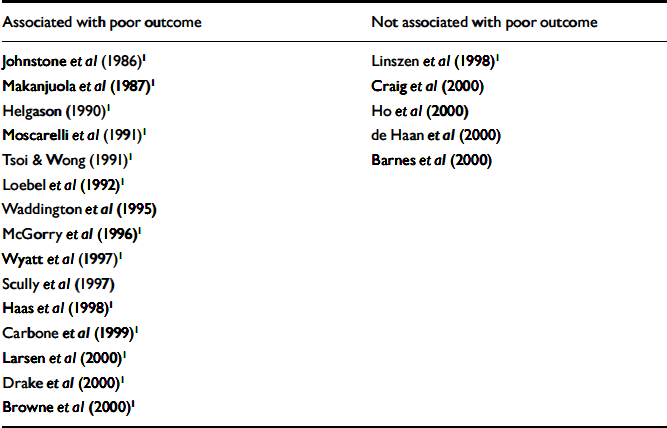
It seems likely that this selection bias explains the association between DUP and poor outcome since the association only holds true for cases of brief duration. Drake et al (Reference Drake, Haley and Akhtar2000) note that, in their study, nearly all the association between DUP and outcome is for cases with a duration of 6 months or less and, as shown in Table 1, virtually all the studies that demonstrate an association of DUP with outcome include cases of recent onset, such as schizophreniform disorder. The two exceptions (Reference Waddington, Youssef and KinsellaWaddington et al, 1995; Reference Scully, Coakley and KinsellaScully et al, 1997) are studies of the same cohort of long-stay patients admitted to an Irish asylum before the advent of antipsychotic medication in the mid 1950s. The longer the patients were institutionalised prior to the introduction of drug treatment, the worse the outcome. These two studies, then, demonstrate the effect of long-term institutional confinement rather than of untreated psychosis. All the studies that restrict the sample to DSM–IV schizophrenia (with a 6-month duration criterion; American Psychiatric Association, 1994) fail to show an association between DUP and outcome.
Studies examining the relationship between duration of untreated psychosis and outcome
Wyatt et al (Reference Wyatt, Green and Tuma1997) suggest that untreated psychosis itself may be toxic to brain function. This possibility is rendered unlikely, however, by recent studies that demonstrate a lack of association between DUP and loss of cortical mass, ventricular enlargement or decrements in cognitive functioning (Reference Fannon, Chitnis and DokuFannon et al, 2000; Reference Hoff, Sakuma and RaziHoff et al, 2000; Reference Norman, Townsend and MallaNorman et al, 2001). Only one study finds DUP to be related to cognitive decline (Reference Joyce, Hutton and MutsatsaJoyce et al, 2001).
Claims for the benefits of early intervention, it emerges, go back more than 200 years. ‘Throughout the nineteenth century’, writes Scull (Reference Scull1979), ‘it was an article of faith among those who dealt with lunatics that the deranged were more easily restored in the early stages of the disorder’ (p. 111). One private madhouse proprietor, for example, reported, in 1828, that, ‘of sixty-nine cases admitted within three months of the first attack, sixty were cured; of seventy cases admitted five months after the onset of the attack, however, only twelve were cured’ (Reference Parry-JonesParry-Jones, 1972, p. 203). The British Metropolitan Commissioners of Lunacy cited tables ‘exhibiting the large proportion of cures effected in cases where patients are admitted within three months of their attacks’ (Reference ScullScull, 1979, p. 112), and the Westminster Review endorsed ‘the very great probability of cure in the early stages of insanity’ (Reference ScullScull, 1979, p. 112). The result of this enthusiasm was the passage of the two Lunatics Acts of 1845 which led to the construction of a national network of, sometimes massive, county asylums. We look back, now, with a sense of superiority on the self-promotion of the early asylum proprietors in citing these recovery figures and on the lack of scientific rigour of the politicians in accepting them. We should note, however, that the data currently being offered in support of early intervention suffer from the same weakness as the early asylum tables.
There is danger in overenthusiastic early intervention in those fairly frequent cases of psychosis which progress to early remission without drug treatment. The World Health Organization (WHO) international outcome study demonstrated that 15% of those presenting with a schizophrenia-like illness in developed world centres recovered completely within 4 months and stayed well for 2 years (World Health Organization, 1979). The Soteria projects in California (Reference Mosher and WarnerMosher, 1995) and in Berne (Reference Ciompi, Dauwalder and MaierCiompi et al, 1992) and Lehtinen's multicentre study in Finland (Reference Lehtinen, Aaltonen and KoffertLehtinen et al, 2000) demonstrated that medication use is not essential for good outcome in the first episode of schizophrenia-like illness. Treating such patients with medication at the earliest appearance of symptoms, without thought for the expected outcome, may lock the person experiencing a brief psychosis into a long-term career as a psychiatric patient.
There is also a risk that attempts to increase community recognition of mild and early psychosis may result in people being referred for psychiatric care who would not otherwise have been treated and who may not need it. A comparison of general population incidence surveys of schizophrenia and treatment–contact-based studies suggests that many, perhaps most, people with a psychotic disorder never receive treatment. The mean annual age-corrected incidence of schizophrenia based on an analysis of available service–contact incidence studies is 0.24 per 1000 population with a range of 0.07–0.52 per 1000 (Reference Warner and De GirolamoWarner & de Girolamo, 1995). The mean incidence of schizophrenia in the five US cities of the Epidemiologic Catchment Area (ECA) community survey, however, is eight times greater, at 2.0 per 1000 (range, 1.0–7.1 per 1000) (Reference Tien and EatonTien & Eaton, 1992). Even after applying a correction for false-positive and false-negative diagnoses in the survey, based on psychiatrist interviews conducted on a portion of the Baltimore sample (Reference Anthony, Folstein and RomanoskiAnthony et al, 1985), the mean incidence of schizophrenia is still six times greater in the ECA study, at 1.5 per 1000. Similarly, the age-corrected incidence of schizophrenia in the community survey conducted in Lundby, Sweden, by Hagnell et al (Reference Hagnell, Essen-Moller and Lanke1990) is substantially higher, at 3.8 per 1000, than the mean age-corrected incidence in other Scandinavian studies – 0.16 per 1000, range 0.07–0.24 per 1000 (Reference Warner and De GirolamoWarner & de Girolamo, 1995). It is by no means clear that broadening the net of detection and treatment will bring benefits to the milder cases of psychosis that currently go unrecognised. This is especially so in the light of the concern that treatment of good-prognosis psychosis with antipsychotic medication may worsen the course of the condition due to the risk of symptom rebound on drug withdrawal (Reference WarnerWarner, 2004).
INTERVENTION BEFORE ONSET OF PSYCHOSIS
McGorry and colleagues in the Personal Assistance and Crisis Evaluation (PACE) clinic report that the most recent version of their screening instrument is capable of 80% accuracy in predicting which psychiatric clinic patients will develop schizophrenia (Reference Yung, Philips and McGorryYung et al, 2002). For a number of reasons this instrument, like others (Reference WarnerWarner, 2002), is unlikely to be successful in identifying those at imminent risk of psychosis in routine use. In the first place, the 80% positive predictive value (PPV) for the PACE instrument was achieved by means of a post hoc selection of scale items. For statistical reasons, a measure defined in this way will usually be less successful when applied to a new sample. But, even with this level of accuracy, it will be less predictive in broader populations.
In the PACE sample, 35% developed a psychosis within 1 year – a much higher rate of transition than would be encountered in most adolescent psychiatric clinics. Bayes probability theorem (Reference EverittEveritt, 1999) tells us that the predictive capacity of a screening instrument is determined by three elements: (a) its sensitivity (in the PACE trial, 0.58); (b) its specificity (0.93); and (c) the base rate of the illness (in the PACE sample, 35%) (Reference Yung, Philips and McGorryYung et al, 2002). Applying Bayes’ theorem, we find that if used to screen a general population sample with a base rate of 1%, the PACE measure would be correct only 7% of the time – clearly not a viable basis for intervention. If it were applied to a clinical population where the risk of developing psychosis in a year was, say, 5%, the instrument would be correct only 30% of the time. A false-positive rate of 70% seems unrealistic for intervening with either medication or cognitive therapy. This problem of the PPV being influenced by the base rate of illness in the tested population may explain why the PACE instrument only achieved a 9% accuracy when used in another Australian clinic (Reference Carr, Halpin and LauCarr et al, 2000).
There are other problems with the PACE screening method. The PACE measure, which selects those with quasipsychotic symptoms, transient psychotic symptoms or decline in functioning, is selecting people who are already on the brink of psychosis. In one study, an extraordinary 40% of PACE participants developed a psychosis within 6 months, many within the first month (Reference Yung, Phillips and McGorryYung et al, 1998). If the sample subjected to preventive intervention is so highly selected that many are within weeks of frank psychosis, how representative is it of the usual clinical population or the whole at-risk group? The possibility of having a significant impact on the occurrence of illness in the general population becomes diminishingly small the more select the cohort being screened.
McGorry and colleagues speculate that a variety of interventions may be effective in preventing the onset of schizophrenia in high-risk cases (Reference McGorry and JacksonMcGorry & Jackson, 1999). The suggested approaches include antipsychotic medication, social skills training, problem-solving techniques, family intervention, ‘lifestyle restructure’, and training in coping skills. Given the expected number of false-positives, the potential for harm is significant. Should we prescribe antipsychotic medication for someone with no positive symptoms? How much harm will be done to people who will never develop the illness to tell them they are at-risk for schizophrenia, need treatment and must adjust their life goals? (Reference GoodeGoode, 1999).
In a pre-illness treatment study conducted by PACE (Reference McGorry, Yung and PhillipsMcGorry et al, 2002), 31 participants were assigned to preventive treatment with low-dose risperidone and cognitive–behavioural therapy, and 28 were assigned to supportive psychotherapy. Only 3 out of 31 in the preventive treatment group developed psychosis after 6 months compared with 10 out of the 28 in the control group. Thus, the onset of psychosis may have been delayed in about 7 of the experimental group. We have to set this positive outcome against some negative aspects: (a) 3 patients took risperidone without benefit; and (b) 21 patients were told they were at-risk for schizophrenia, when they were not, and took risperidone unnecessarily. How does one decide, moreover, how long the 28 symptom-free patients taking risperidone should continue on medication? For three-quarters of the group the medication is unnecessary, but one does not know which those are.
Prevention specialists ask a series of questions to determine if a screening programme will do more harm than good (Reference JablenskyJablensky, 2000). Does the burden of disease warrant screening? Is there an effective preventive intervention? Is there a good screening test? Will the programme reach those who would benefit? Can the healthcare system handle the screening? Will the screen-positive individuals comply with the proposed intervention? In the case of schizophrenia, the answer to the first question is a resounding ‘Yes’, but to the remainder the answers are ‘No’ or, at best, ‘Doubtfully’. Looked at in this light, it does not appear likely that pre-illness screening for schizophrenia is likely to be successful.
CONCLUSION
Intervention before the onset of psychosis appears hazardous, and early intervention after the illness is evident is unlikely to yield the hoped-for benefits.




eLetters
No eLetters have been published for this article.