

Judicial independence has come under attack in recent years in democracies across the world, with judicial crises roiling the politics of countries such as Hungary, Israel, and Poland (see, e.g., Dreeben Reference Dreeben2023; Kovacs and Scheppele Reference Kovacs and Scheppele2018; Macy and Duncan Reference Macy and Duncan2021). The United States has not been immune from this trend and has also seen elected officials increasingly targeting the courts, most prominently in the form of renewed interest in court-packing. After having been relegated to the political margins for decades following the backlash that defeated Franklin Roosevelt’s attempted expansion of the Supreme Court in 1937, court-packing has in recent years regained momentum at the federal level. One of the most controversial pieces of legislation introduced in the 117th Congress was the Judiciary Act of 2021, which would have changed the size of the Supreme Court for the first time since 1869 by increasing the number of justices from 9 to 13. Introduced by a group of Democratic lawmakers that included the chair of the House Judiciary Committee and co-sponsored by more than 60 members, the bill followed extensive discussion of Supreme Court expansion on the 2020 presidential campaign trail. With several other Democratic candidates either endorsing or expressing openness to the idea, Joe Biden notably pledged to establish a presidential commission to examine Court reorganization. Although President Biden’s commission ultimately declined to recommend Court expansion and the Judiciary Act of 2021 failed to advance in either house despite Democratic control, the fact that so many Democratic party leaders have embraced court-packing, which would only a few years prior have been considered an extreme position, is illustrative of changing norms. As Braver notes, “[a]t no time since the New Deal has the possibility of court-packing been under such serious discussion” (Reference Braver2020, 2754).
This change has been driven by widespread sentiment among Democrats that the Court’s current Republican supermajority is “illegitimate” and based upon “stolen seats” due to the circumstances surrounding the appointments of Neil Gorsuch and Amy Coney Barrett (Bolton Reference Bolton2022; see also Belkin Reference Belkin2020; Weill Reference Weill2021). Donald Trump was able to appoint Gorsuch only after a Republican-controlled Senate first refused to consider any nominee put forth by Barack Obama in the last year of his presidency and then subsequently changed Senate rules to bar filibusters of Supreme Court nominations, allowing Gorsuch to be confirmed with only 54 votes. Then, despite the Republican Senate majority’s previous opposition to Supreme Court appointments during election years, that majority confirmed Trump’s nomination of Barrett mere days before the 2020 presidential election. Some Democrats have also raised broader legitimacy concerns, pointing out that five of the Court’s six Republican appointees were nominated by two presidents, Donald Trump and George W. Bush, elected despite losing the popular vote and confirmed by Republican Senate majorities that represented states comprising less than half the nation’s population (Brownstein Reference Brownstein2020; Millhiser Reference Millhiser2021; Parsons Reference Parsons2021). These concerns have been amplified by a series of momentous and controversial recent decisions that have revealed a very activist Court willing to reverse longstanding precedent. These have included not only the reversal of Roe v. Wade and constitutional protection for abortion rights in Dobbs v. Jackson Women’s Health Organization Footnote 1 but also landmark decisions in areas such as administrative rulemaking, affirmative action, gun control, religion, and voting rights.Footnote 2
However, even some who have been quite critical of the Court’s recent jurisprudence and supportive of other proposed Court reforms (such as term limits) have criticized the idea of Court expansion, fearing that it could unleash a damaging cycle of “tit-for-tat acts of repeated expansion without an institutional brake other than durable electoral dominance” (Doerfler and Moyn Reference Doerfler and Moyn2021, 1758; see also Ledewitz Reference Ledewitz2020; Siegel Reference Siegel2022). Heightening the danger of such a tit-for-tat cycle is the fact that Democrats were hardly in a position of durable electoral dominance when expanding the Court was proposed. To the contrary, the current political era has been termed the era of “unstable majorities” (Fiorina Reference Fiorina2017, 167). In the last 30 years, there have been no less than nine changes in partisan control of one or both houses of Congress and recent presidential elections have consistently been closely contested. The unprecedented volatility of congressional control has been due largely to the narrowness of the majorities parties have held when they have been in control, with the Democratic majorities in the 117th Congress in which the Judiciary Act of 2021 was proposed particularly precarious. Democrats controlled the House of Representatives with a thin 222-seat majority and controlled the evenly divided Senate only by virtue of the vice president’s tie-breaking vote. Thus, the political position that Democrats were in is one where such aggressive restructuring of the political system would have carried a significant risk of blowback.
In contrast, and perhaps in part for that very reason, Franklin Roosevelt’s court-packing plan was proposed at a time when there was very little risk of blowback had the plan been adopted. In 1937, historically large Democratic supermajorities controlled both houses of Congress, Roosevelt had just won two consecutive landslide victories, and a massive realignment of the electorate had ushered in a new era of Democratic domination of national politics that would last several decades. In the 48 years between 1933 and 1981, Democrats simultaneously controlled both houses of Congress for 44 years and held the presidency for 32 years. Had the court-packing plan passed in 1937, it would have been 16 years before a Republican Congress and president would have had any opportunity to respond in kind.
The extremely different political contexts in which these two most recent attempts to expand the Supreme Court occurred raise the question of which is more typical of the circumstances under which parties are likely to embrace court-packing. Does increased political competition make court-packing more or less likely? An extremely small and temporally compressed sample size (there have only been seven changes to the Court’s size in its history and none since 1869) makes it difficult to draw solid inferences from the history of congressional expansion and contraction of the Court. However, data is far more plentiful at the state level, where there are 52 state supreme courtsFootnote 3, and size changes have occurred with greater regularity. Thus, the article proceeds as follows: the following section discusses recent state-level court-packing efforts and how they mirror court-packing efforts at the federal level, the next section discusses the judicial independence literature and what it suggests in terms of the political conditions under which court-packing will be more and less likely, and the final two sections outline the analysis of state supreme court expansion used to test these predictions and its results and implications.
Norms of judicial independence and state and federal court-packing
Court-packing has enjoyed a resurgence not only at the federal level but also at the state level. Recent calls to expand the US Supreme Court have been paralleled by renewed interest in reorganizing state supreme courts that have garnered less attention. Between 2010 and 2020, more than 20 bills that would have increased or decreased the size of a state supreme court were proposed in 11 different states (Levy Reference Levy2020, 1133). However, the only such bills that passed were those expanding the Arizona Supreme Court from five to seven justices and the Georgia Supreme Court from seven to nine justices, both of which passed in 2016. Unlike the proposed expansion of the US Supreme Court spearheaded by Democrats, these expansions (and most of the unsuccessful recent reorganization efforts) were spearheaded by Republicans. The expansion of the Georgia Supreme Court turned a 4-3 Democratic majority into a 5-4 Republican majority while the expansion of the Arizona Supreme Court augmented a 4-1 Republican majority that was seen by some Republicans as insufficiently conservative (Levy Reference Levy2020, 1139; see also Stephenson Reference Stephenson2020). These expansions notably followed the longest lull in state supreme court expansion in the nation’s history. No state added justices to its state supreme court between 1998 and 2015 and only one had done so since 1988.
Both the Arizona and Georgia court expansions were framed by their Republican proponents as practical measures needed to keep pace with rapid population growth (DeMillo Reference DeMillo2020; Greenblatt Reference Greenblatt2016; Stephenson Reference Stephenson2020). However, this rationale was met with skepticism from Democrats and from the courts themselves, with the chief justice of the Arizona Supreme Court writing in an editorial that “our caseload and population do not mandate more justices” (Raftery Reference Raftery2016, Reference Raftery7) and the chief justice of the Georgia Supreme Court responding to initial proposals to expand her court by assuring legislators that “[w]e have the manpower we need” (Levy Reference Levy2020, 1137). Indeed, the political motivations behind many recent court reorganization proposals have often been very thinly concealed. For example, a 2011 proposal to reduce the size of the Michigan Supreme Court lost support following the accidental leak of a PowerPoint presentation entitled “Changing the rules of politics in Michigan to help Democrats” (Raftery Reference Raftery2016, 7). Other proposals to expand or contract state supreme courts have not been as overtly partisan but have often been billed as means to overturn particular decisions rather than as non-partisan cost-saving measures or measures to deal with growing caseloads. For example, a 2011 proposal to expand the Florida Supreme Court was explicitly framed as a means of overturning a decision declaring a private school voucher program unconstitutional (Raftery Reference Raftery2016, 7) while a proposal to contract the Montana Supreme Court was framed as a way to “[t]ake control of the reins of the Supreme Court” and “[s]how them who is in charge” in order to affect the Court’s jurisprudence on redistricting and tort reform (Corriher Reference Corriher2021). This politically motivated resurgence of interest in court restructuring fits into the broader pattern of politicization of state courts identified by Kritzer (Reference Kritzer2020). Kritzer’s analysis of recent state court reform efforts finds a marked increase in politically motivated reforms, one that reflects a “diminished focus on court modernization and increasing polarization” (351).
The history of changes to the size of the US Supreme Court reveals similar dynamics at work at the federal level, with a mix of political and practical considerations motivating the seven changes that have been made to the Court’s size, all of which were made between 1801 and 1869 (Blumm, Flanagan, and White Reference Blumm, Flanagan and White2021; Braver Reference Braver2020; Orth Reference Orth2002). The most important practical consideration was the periodic need to increase the number of federal judicial circuits (and thus, in an era of circuit-riding, the number of Supreme Court justices) to accommodate the admission of new states to the union. For example, the 1863 expansion of the Court from 9 to 10 justices was motivated not simply by a desire to move the Court’s jurisprudence in a direction more supportive of the Lincoln administration’s policies but also by the need to incorporate recently admitted western states into the circuit court system (Braver Reference Braver2020, 2768–73). Indeed, some current proponents of increasing the number of justices to 13 have attempted to frame this as an administrative rather than a political measure, one that primarily serves to restore parity between the number of justices and the number of federal judicial circuits and that is thus comparable to previous expansions generally accepted as legitimate (Ford Reference Ford2021). However, other previous changes to the Court’s size, such as the 1801 Federalist contraction of the Court from six to five justices to deny incoming President Thomas Jefferson an appointment, the subsequent restoration of the sixth seat by Jefferson’s Democratic Republicans in 1802, and Reconstruction era Republicans’ contraction and then expansion of the Court to first deny Andrew Johnson any appointments and then to guarantee Ulysses Grant an appointment, could properly be termed “court packing” (or unpacking) given their largely political motivations (Braver Reference Braver2020, 2773–88).
These successful changes, and the near success of Franklin Roosevelt’s 1937 attempt to expand the Supreme Court in order to move the Court’s jurisprudence in a more progressive direction, illustrate the relative recency of strong norms against court-packing. While Roosevelt’s court-packing plan has since become the “paradigmatic example of an illegitimate threat to the judiciary” to which all other threats have been compared (Grove Reference Grove2018, 465), it would not have been entirely out of place in the nineteenth century at the federal level or until more recently at the state level.
The political foundations of judicial independence
These changes in the norms surrounding court size manipulation may be traced in part to changes in political competition. Scholars who conceptualize judicial independence as a form of “political insurance” have linked differences in the respect accorded judicial independence to differences in the electoral environments that politicians inhabit. More competitive electoral environments have generally been associated with more independent courts and vice versa. By “independent courts,” the political insurance model means primarily courts that enjoy informal judicial independence rooted in norms against politically motivated manipulation of the judiciary. For example, Ramseyer (Reference Ramseyer1994) argues that the competitiveness of the two-party system in the United States, with the parties regularly alternating control of Congress and the presidency, is the key to understanding the historical strength of America’s informal norms of judicial independence. If a governing party’s hold on power is tenuous, then it is more likely to embrace strong and independent courts despite the potential for such courts to constrain the party’s ability to wield power. This is because strong and independent courts will also serve as a restraint on the opposing party when it is in power, particularly by ensuring that previously enacted legislation is enforced (see also Landes and Posner Reference Landes and Posner1975). However, if the opposition is perceived as unlikely to hold power in the near future due to a lack of political competition then the governing party will be less likely to respect judicial independence. Thus, as Ramseyer illustrates, in politically non-competitive Japan, in which the Liberal Democratic Party has held power at the national level for all but 4 years since 1955, politicians have regularly manipulated the courts in ways that federal courts in the United States theoretically could be manipulated but generally have not been due to the strength of those American norms of judicial independence. One such norm is the norm against court-packing, which undermines judicial independence and the separation of powers insofar as it retaliates against a court’s current membership by diluting their votes to engineer different case outcomes (see Bradley and Siegel Reference Bradley and Siegel2017).
Political competition has also been offered as an explanation for cross-national differences in formal judicial independence rooted in institutional design. For example, Ginsburg’s analysis of constitutional courts in new democracies finds that constitutional designers in new democracies with more competitive party systems have tended to give their constitutional court judges more independence by giving them relatively longer terms (Reference Ginsburg2003, 62). Similarly, Ginsburg also finds an association between more competitive party systems and constitutional courts with more open access (i.e., constitutional courts that are permitted to engage in abstract judicial review and that have less restrictive standing rules) (64). With the governing party’s continued hold on power less assured, judicial independence and empowerment have served as insurance against loss of power.
Political competition may explain not only cross-national differences in judicial independence but also differences over time within a nation. For example, it is noteworthy that, prior to recent Democratic court-packing proposals, the three most serious previous attempts (two successful, one unsuccessful) to change the size of the US Supreme Court occurred during periods in which one party reached unprecedented levels of political dominance. The 75th Congress (1937–39) that considered Franklin Roosevelt’s court-packing plan was organized by historic Democratic supermajorities comprising more than 75% of seats in both the House and the Senate and was elected amidst Roosevelt’s landslide victory in the 1936 presidential election, in which he carried 46 of 48 states and more than 60% of the popular vote. Similarly, the 41st Congress (1869–71) that expanded the Supreme Court to its current size of nine justices did so at close to the historical high water mark for the Republican Party, with Republican congressional supermajorities comprising 70% of House seats and more than 80% of Senate seats. The 39th Congress (1865–67), which 3 years prior had contracted the Supreme Court from 10 to 7 justices, was organized by Republican supermajorities nearly as large and comprising more than 70% of seats in both the House and Senate. In each case, the party out of power and its ideology had been so discredited by recent events (i.e., the Great Depression and the Civil War, respectively) and so routed at the polls that the governing party may no longer have considered it a credible near term threat to its hold on power, thus making it less concerned with adhering to norms of judicial independence. These cases also illustrate the pattern noted by Whittington (Reference Whittington2007), in which political attacks on judicial independence are most frequent and serious during periods of political realignment, or “reconstruction,” when the values of the courts and the elected branches of government are especially likely to be misaligned.
Given these observed dynamics at the national and international levels, it might be expected that greater political competition would decrease the likelihood of state supreme court expansion. That is, in more politically competitive states in which parties regularly alternate power, court expansion may pose a risk of triggering a “tit-for-tat downward spiral of packing, ballooning the [c]ourt’s size so large that its legitimacy pops” (Braver Reference Braver2020, 2747). However, in less politically competitive states, court expansion would not pose the same risk of blowback and thus might be an appealing option under certain circumstances. On the one hand, there would usually be less of a perceived need for court expansion in such states given that their state supreme courts would typically already be comprised overwhelmingly of members of the dominant party. However, on the other hand, dominant parties in such states could more safely add seats if they nonetheless found their courts’ jurisprudence “disappointing” in certain areas. That is, court expansion at the state level may be driven by a dynamic similar to the one that has existed for over half a century at the federal level, where the unexpectedly liberal jurisprudence of a number of Republican Supreme Court appointees has made the Court less conservative than its partisan makeup would indicate (see, e.g., Bartels Reference Bartels2018; Blasi Reference Blasi1983; Segal, Timpone, and Howard Reference Segal, Timpone and Howard2000).
Court expansion might also be more likely in less competitive states when there are politically neutral administrative reasons (such as increasing caseload pressure) for doing so. Even if such reforms are clearly needed, parties in more closely divided states might be hesitant to support them due to uncertainty over which party would benefit (i.e., uncertainty over how adding seats might change the court’s jurisprudence). With neither party firmly in control of the state’s political institutions and elections, court expansion could have unexpected consequences, particularly if the expansion is via a constitutional amendment or new constitution that would not take effect immediately due to the need for ratification by the state’s voters. In contrast, the likely jurisprudential impact of court expansion would be clearer in less competitive states, giving the dominant party less reason to hesitate in making needed reforms. Thus, the political insurance model as typically framed would predict a negative relationship between political competition and state supreme court expansion.
Some, however, have expressed skepticism about applying the political insurance model’s game theoretic argument to court-packing. As Tushnet (Reference Tushnet2018) notes, this argument assumes that both players share a common understanding of what the “game” is and where they are in the game. However, when the nature of the game might not be understood the same way by both sides and rounds of play are infrequent, these assumptions could be wrong. For example, a future Democratic expansion of the Supreme Court might be understood by Democrats as a tit-for-tat response to the norm breaches used by Republicans to secure the confirmations of Neil Gorsuch and Amy Coney Barrett, in which case the best response when Republicans regain power would be for Republicans to decline to further expand the Court in order to avoid additional Democratic reprisals. However, a future Democratic expansion of the Supreme Court may be understood by Republicans not as a tit-for-tat response but rather as the initial breach of a different norm, in which case the best Republican response would be for Republicans to respond in kind with their own Court expansion when they regain power. Also, when rounds of play are infrequent, the Democrats and Republicans engaging in repeated interactions will to a large extent be different people, people who may have shorter time horizons that make norm breaches more likely.
Furthermore, threatened or actual court expansion may in some cases be more about position-taking than about actually achieving particular substantive outcomes. As Levy illustrates, recent court restructuring proposals, such as a proposal to contract the Washington Supreme Court that would have required the justices to gather publicly to “draw straws to determine who would remain on the court and who would be terminated” (1147), have frequently been performative responses by state legislators seeking to placate or capitalize upon popular backlash against court decisions. Thus, contrary to the expectations of the political insurance model, court expansion proposals may be driven more by short-term electoral incentives, even when the results of actual court expansion would be suboptimal from a game theoretic perspective.
There are also reasons why state supreme court expansion may actually be more likely in politically competitive states. In particular, non-competitive states will generally have less reason than competitive states to promote political balance on their state supreme courts by providing for additional justices. The membership of a nine-member court is more likely to reflect a state’s partisan balance than the membership of a three-member court and such a court will be less susceptible to sudden shifts in its ideological center of gravity. Thus, in more politically competitive states in which neither party is assured of continued control of the judicial appointment process, a larger court may be appealing as it promotes fairer representation on the court and limits the opposing party’s ability to drastically remake the court when in power. This may outweigh costs associated with expansion such as additional judicial salaries, additional administrative expenses, and less efficient decision-making (Alarie, Green, and Iacobucci Reference Alarie, Green and Iacobucci2015; George and Guthrie Reference George and Guthrie2009; Hessick and Jordan Reference Hessick and Jordan2009). Thus, a dynamic similar to the one at work at the federal level, where some Democrats have argued that Supreme Court expansion is needed to bring the Court’s partisan makeup closer into line with the nation’s partisan makeup, may also operate at the state level.
Evidence of such a dynamic can be seen in patterns of cross-national variation in the size of national supreme courts. For example, Ginsburg finds that constitutional courts in democracies with less competitive party systems tend to have fewer justices (63). There is also evidence of a similar dynamic at work in the relative sizes of state supreme courts in the United States. To test this, I examined the relationship between political competitiveness and state supreme court size using each state’s average partisan lean over the two most recent presidential elections as a proxy for political competitiveness. I calculated this as the average difference between the share of the two-party vote won by the political party toward which the state leans and that party’s national share of the two-party vote. Lower scores are indicative of more politically competitive states, higher scores are indicative of less politically competitive states.
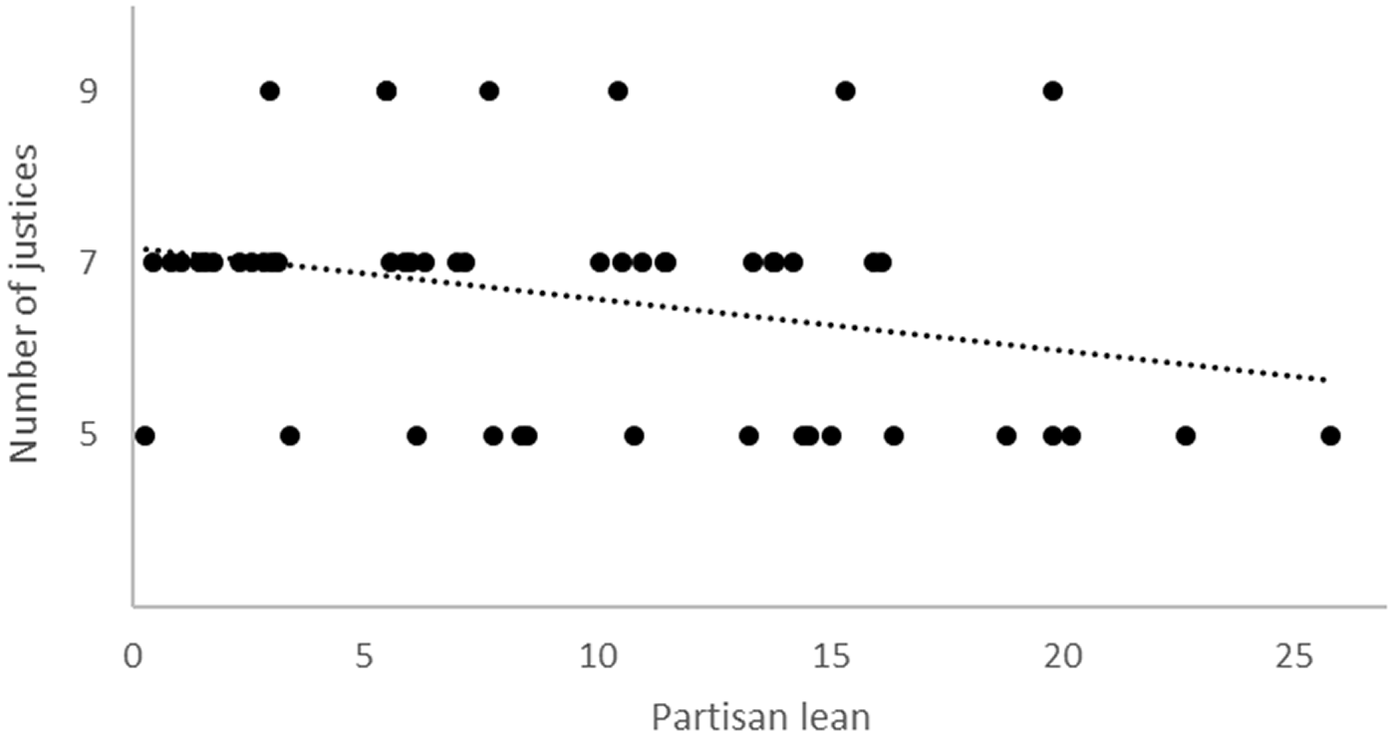
Plotting the relationship between current partisan leans based upon results from the 2016 and 2020 presidential elections and current state supreme court sizes reveals a modest negative correlation between a state’s partisan lean and the size of its state supreme court. That is, less politically competitive states with stronger partisan leans tend to have smaller state supreme courts (see Figure 1). The modesty of this correlation is not surprising given the relative infrequency of court size changes and the historical fluidity of the identities of competitive states. All of today’s non-competitive states were swing states at some point in their history and vice versa (see Johnson Reference Johnson2005). Nonetheless, the correlation coefficient of −0.3 is significant at the 0.05 level.
Political competitiveness and state supreme court size, 2023.

Previous scholarship has also revealed a significant relationship between political competition and judicial selection and retention systems, albeit one that aligns more with the expectations of the political insurance model. Specifically, less politically competitive states tend to have judicial selection and retention systems that provide for lower levels of judicial independence and have been significantly less likely to follow national trends and switch to systems that provide for greater judicial independence (Hanssen Reference Hanssen2004a, 720–26). That is, less politically competitive states were significantly less likely to join the wave of states switching to non-partisan election of judges in the early 1900s and significantly less likely to join the wave of states switching to merit selection of judges in the mid to late 1900s (Hanssen Reference Hanssen2004b, 460–61). Further underscoring the relationship between political competition and judicial selection and retention systems is the type of state that was particularly likely to join the aforementioned wave of states switching to merit selection. States that had large urban populations but whose politics were disproportionately dominated by rural interests prior to the Supreme Court’s 1962 decision in Baker v. Carr mandating fair apportionment were especially likely to join this wave, which closely followed the decision (Puro, Bergerson, and Puro Reference Puro, Bergerson and Puro1985, 96–97). Faced with a power shift that would give control of the judicial selection and retention process to urban interests, rural politicians reacted by preemptively depoliticizing the process.
A somewhat similar dynamic may also have been behind the 2016 expansions of state supreme courts in Arizona and Georgia. At the time of these expansions, both states had Republican legislative supermajorities and Republican governors and neither had been won by a Democratic presidential candidate since the 1990s. However, both were quickly trending in a more politically competitive direction due to migration and demographic change. Between 2004 and 2016, the percentage of the vote with which the Republican presidential candidate won Arizona shrank from 55% to 48% and the percentage of the vote with which the Republican presidential candidate won Georgia shrank from 58% to 51%. These trends continued after the 2016 court expansions and within 5 years Republican legislative supermajorities in both states shrank to bare majorities, Republicans went from holding all four of the states’ US Senate seats to holding none, and both states’ electoral votes were won by a Democratic presidential candidate for the first time in more than 20 years in the 2020 presidential election. State supreme court expansion may therefore have represented a sort of endgame tactic, an anticipatory attempt by Republican politicians in both states to lock in control of the judiciary while they still had the opportunity. As Martin Quezada, a Democratic member of the Arizona Senate, observed, “The state is turning blue and that is a good way to maintain a backstop through the judicial system” (Stephenson Reference Stephenson2020). This echoes Hirschl’s (Reference Hirschl2004) “hegemonic preservation” thesis, which argues that the recent global trend toward constitutional reforms transferring power from elective institutions to judiciaries has been driven in large part by the desire of historically dominant groups to preempt the growing political power of ascendant groups. Thus, in some contexts increased political competition may make court expansion more rather than less likely. These conflicting expectations illustrate the need for a more comprehensive analysis of the dynamics of court expansion that takes advantage of the diversity of the 50 states to ascertain when expansion is more likely to occur.
Assessing the determinants of state supreme court expansion
To this end, an examination of the histories of all 52 state supreme courts identified every change made to the size of a state supreme court since 1789. This examination revealed a total of 157 changes (120 increases and 37 decreases). Of the 157 changes, 97 were enacted via legislation, 31 via constitutional amendments, and 29 via the adoption of new state constitutions. The frequency of size changes peaked in the 1850s, 1870s, and 1900s, with 17 changes made in each of these decades (see Figure 2). Almost every state has changed the size of its supreme court at least once, with only one state, Hawaii, having kept the same state supreme court size for its entire history as a state. Conversely, the sizes of the Alabama Supreme Court and the Maine Supreme Judicial Court, which have both been changed nine times, have been the most unstable.
Changes to the sizes of state supreme courts, 1789–2023.

I estimated a binary logit model to analyze the timing of expansions in particular. Contractions decreasing the number of justices on a state supreme court were not included in the analysis. Although the political insurance model would predict that less politically competitive states would be more willing across the board to reorganize their state supreme courts, the political benefit of court contraction for the governing party is less obvious than the political benefit of court expansion (as contraction is typically implemented through attrition and thus denies the governing party the opportunity to fill subsequent vacancies). Thus, due to the likelihood of different dynamics, I excluded contractions.
I recorded one observation for each year that each state has been a state. However, observations for state-years in which no state appellate courts existed or in which a legislative body served as the state’s highest appellate court were excluded from the analysis. For example, despite being among the original 13 states, Georgia did not establish its first full-fledged appellate court until 1845 while the governor and upper house of the state legislature served as New Jersey’s highest appellate court until 1844. For each state-year observation, the dependent variable was whether or not the state increased the size of its state supreme court that year. Temporary additions of quasi-judicial “commissioners” to state supreme courts to assist overloaded justices with their work were not treated as increases, only permanent increases in the number of justices.
I included several independent variables in the analysis to assess the impact of various political, institutional, and other contextual factors upon the timing of state supreme court expansion. The variable of primary interest was “partisan lean,” which tested the political insurance model by measuring states’ political competitiveness. For each state-year observation, I calculated the state’s average partisan lean using the results of the two preceding presidential elections (or the preceding presidential election only if at that point the state had only participated in one presidential election).
While some scholarship has used the percentage of state legislative seats held by the majority party (see Hanssen Reference Hanssen2004a, Reference Hanssen2004b) or a combined index of competition for state offices (see Hinchliffe and Lee Reference Hinchliffe and Lee2016) as more direct measures of the dominant party’s hold on power, I used partisan leans based on presidential election data in this case to minimize the amount of missing data. This is because information on the partisan makeups of eighteenth and nineteenth century state legislatures is sometimes incomplete, unreliable, or missing altogether and some state legislatures (for example, Nebraska’s since 1937 and Minnesota’s between 1913 and 1973) have been non-partisan. In contrast, the only data missing when partisan leans were used was from states that in the eighteenth and early nineteenth centuries had no popular vote for president and wholly delegated selection of their presidential electors to their state legislatures, from the 1824 election in which all four candidates were Democratic Republicans, and from newly admitted states that had not yet participated in a presidential election. Although the percentage of seats held by the largest party in the state legislature was missing for nearly 10% of the state-year observations in the dataset, partisan leans based on presidential election results were missing for less than 5%. Consequently, a larger number of “events” (i.e., state supreme court expansions) were excluded from the analysis when state legislative data was used than when presidential election data used. However, I obtained nearly identical results regardless of which measure of political competitiveness was used and the correlation between them for state-years for which both were found is a moderately strong and statistically significant 0.51.
I also included several control variables in the analysis. One of these controlled for the current number of justices. The larger the current number of justices on a state supreme court, the less likely there will be caseload pressure necessitating additional justices and the more difficult it will be to justify expansion. Furthermore, the fact that the number of justices on the US Supreme Court has remained at nine since 1869 appears to have imposed an informal upper limit on state supreme court size. No state currently has more than nine justices on its state supreme court and only a handful have ever had more than nine justices, the largest being the New Jersey Court of Errors and Appeals, a 16-member court that was New Jersey’s court of last resort from 1844 to 1947. Thus, I recorded the current number of justices provided for by state law for each state-year observation.
Another control variable controlled for whether there was an even number of justices. The possibility of a court being deadlocked due to having an even number of justices makes such courts less optimal than courts with odd numbers of justices and may make size changes significantly more likely for such courts. Excluding temporary vacancies, no state currently has an even number of justices on its state supreme court nor has any state had an even number of justices since 1987, when the number of justices on the Connecticut Supreme Court was increased from six to seven. While 25 states have at some point provided for an even number of justices on their state supreme court, these configurations have tended not to last for very long. More than 30% lasted less than 10 years before being changed to an odd number and more than 50% lasted less than 20 years before being changed to an odd number. Thus, I controlled for whether the current number of justices on a state’s supreme court was an even or an odd number using a dummy variable.
Another factor that may affect the likelihood of changes to the size of a state supreme court is the extent to which court size is constitutionally entrenched. Some state constitutions, like the US Constitution, do not specify any particular number of justices and allow the size of their state supreme court to be set by statute. At the opposite end of the spectrum, others require that their state supreme court consist of a particular number of justices that can only be changed via constitutional amendment or a new constitution. Falling between these extremes are state constitutions that require that the number of justices fall within a certain range or that otherwise limit but do not entirely eliminate the legislature’s ability to change the number of justices. For example, Alaska’s constitution requires that any legislative expansion of the Alaska Supreme Court first be formally requested by the Court itself (Alaska Const. art. 4 sec. 2) while Colorado’s constitution goes a step further to require that any legislative expansion of the Colorado Supreme Court not only be formally requested by the Court itself but passed by a two-thirds supermajority (Colo. Const. art. 6 sec. 5 cl. 1).
Given the significant differences in the ease of reorganizing courts that these variations in court size entrenchment create, I controlled for them in the analysis using a dummy variable. State-year observations for states in which, under the state constitution in effect at the time, the size of the state supreme court could not be increased by ordinary legislation (either due to the court’s size being constitutionally specified, the court’s size already being at the top of the constitutionally permitted range, or other special limits on the legislature’s ability to change the court’s size) were coded 1. State-year observations for states in which, under the state constitution in effect at the time, there was no limit on the legislature’s ability to increase the size of the state supreme court were coded 0.
Another control variable controlled for the possibility that a state not regularly exercising its power to change the size of its state supreme court may make future change less likely. That is, it controlled for what Vermeule (Reference Vermeule2012) terms the “atrophy of constitutional powers” that are not regularly exercised, major examples including the royal veto in the United Kingdom and the “notwithstanding clause” authorizing Canada’s parliament to override the Supreme Court of Canada’s decisions. Similarly, the fact that the size of the US Supreme Court, although not constitutionally fixed, has remained at nine justices for more than 150 years has led many to perceive expansion efforts as illegitimate (see Grove Reference Grove2018). Such institutional ossification has also been evident in the relative willingness of states to change their judicial selection and retention systems. Older states were less likely than younger states (i.e., states that joined the union relatively more recently) to join the wave of states switching to partisan election in the mid to late 1800s, less likely to join the wave of states switching to non-partisan election in the early 1900s, and less likely to join the wave of states switching to merit selection in the mid to late 1900s (Hanssen Reference Hanssen2004b, 461). To test whether the same dynamic has affected state supreme court expansion, I measured “time since last size change” for each state-year observation as the number of years that had elapsed since the most recent increase or decrease in the number of state supreme court justices or, if no changes had previously been made, the number of years that had elapsed since the court’s establishment.
The manner in which state supreme court justices are selected and retained may also affect the likelihood of court expansion, particularly insofar as such expansion may be politically motivated. Politically motivated court expansion may be more appealing to policymakers in states with more politicized judicial selection and retention systems and less appealing to policymakers in states with more depoliticized, merit-based judicial selection and retention systems. This is because there would be less certainty in states with more merit-based systems that court expansion would have its intended effect of filling newly created seats with politically aligned justices. More depoliticized, merit-based systems may also be indicative of states with political cultures that prioritize judicial independence over popular accountability and which would thus generally be more averse to politically motivated restructuring.
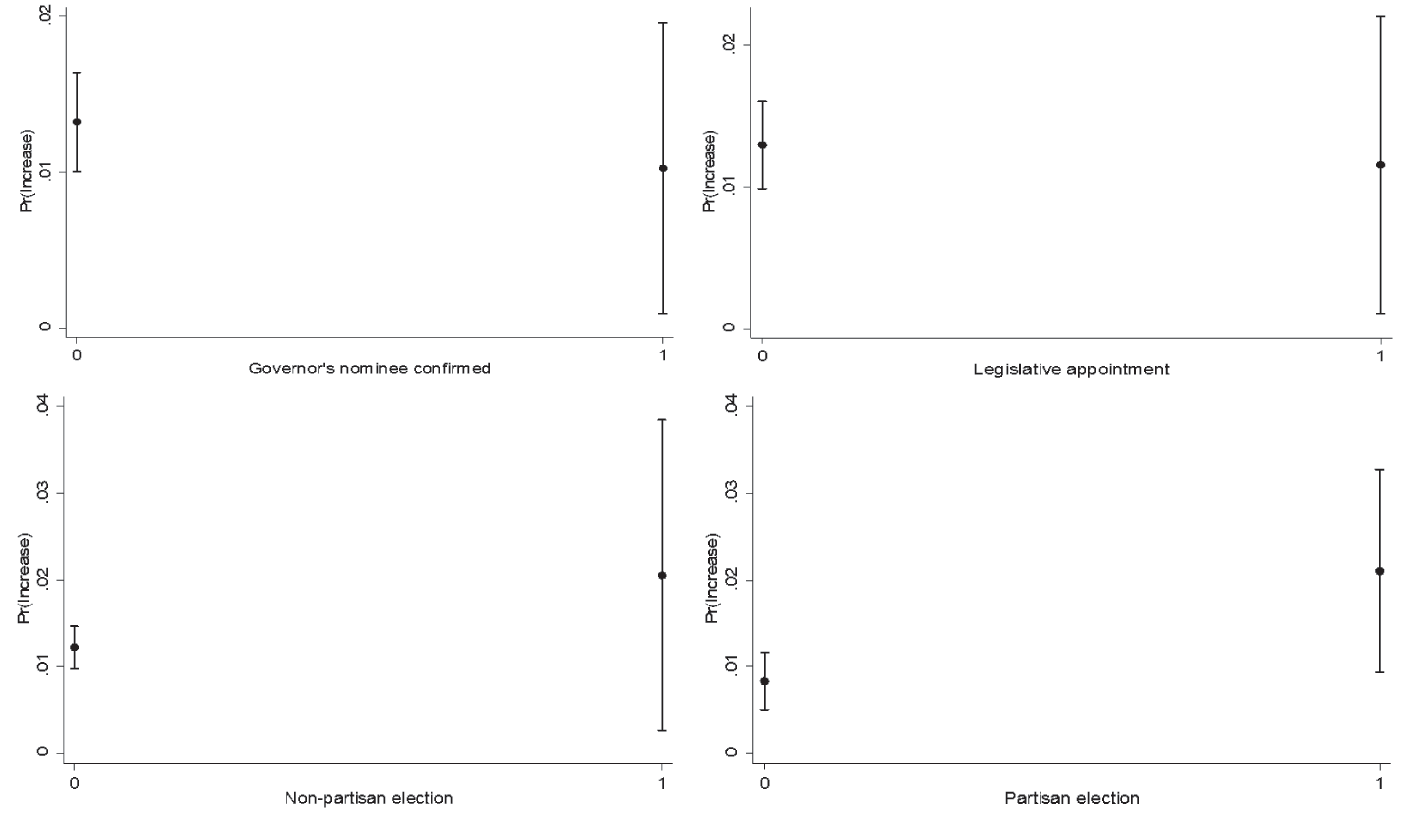
Thus, I expected that court expansion would be more likely when justices are nominated by the governor (without being screened by a non-partisan nominating commission) and confirmed, when justices are nominated by the legislature (without being screened by a non-partisan nominating commission) and confirmed, and when justices are elected in partisan elections. Conversely, I expected that court expansion would be less likely when non-partisan nominating commissions are employed to screen judicial nominees or when justices are elected in non-partisan elections. To test this, I used four dummy variables (“governor’s nominee confirmed,” “legislative appointment,” “partisan election,” and “non-partisan election”). Other systems, overwhelmingly merit selection systems in which nominees are screened by non-partisan nominating commissions, were the excluded reference category.
I also controlled for the potential effect of population growth upon court reorganization. Increased caseload pressure due to population growth has regularly been cited as a politically neutral, legitimate reason for state supreme court expansion. To test the extent to which state supreme court expansion has indeed been driven by population growth, I recorded population growth for each state-year observation as the percent increase in the state’s population that was recorded by the most recent US census.
Finally, I also controlled for potential time-related effects. As previously illustrated by Figure 2, state supreme court size changes generally and expansions in particular exhibit a strong temporal skew. Changes were far more common early in the nation’s history and have become relatively rare in recent decades, with only a handful of changes having been made since the 1980s. This decline is particularly striking when one takes into account the admission of new states increasing the number of states and thus the number of state supreme courts susceptible to reorganization. To control for the possibility that this has been due to the baseline likelihood of court expansion decreasing over time, perhaps because of the aforementioned ossification of state political institutions over time and/or Franklin Roosevelt’s court-packing plan casting court expansion into more general disrepute after 1937, I included the year of each state-year observation in the analysis as an independent variable.
Overall, as indicated by the Pseudo R 2 statistic, the model explains approximately 13% of the variance in the timing of state supreme court expansions (see Table 1). The relatively modest model strength underscores the multiplicity of factors contributing to these relatively rare events, many of which could not be controlled for in the model. Enacting policy change as significant as state supreme court expansion typically requires the convergence of several streams to create brief windows of opportunity. For example, expansion of the US Supreme Court only became a serious possibility due to the convergence of the various aforementioned Court controversies, unified Democratic control of the House of Representatives, Senate, and presidency between 2021 and 2023, and growing support for abolition of the Senate filibuster, which would likely need to precede any Court restructuring. While the “legislative increase not permitted” variable controlled for differences in the constitutional procedures for court expansion, more idiosyncratic contextual factors that may be key to opening windows of opportunity, such as, for example, unpopular court decisions, judicial scandals, and changes in legislative rules, could not be included in the model.
Logit model predicting state supreme court expansions, 1789–2023

Note: Entries in cells show logit coefficients with z-scores in parentheses.
* p < 0.05.
*** p < 0.001.
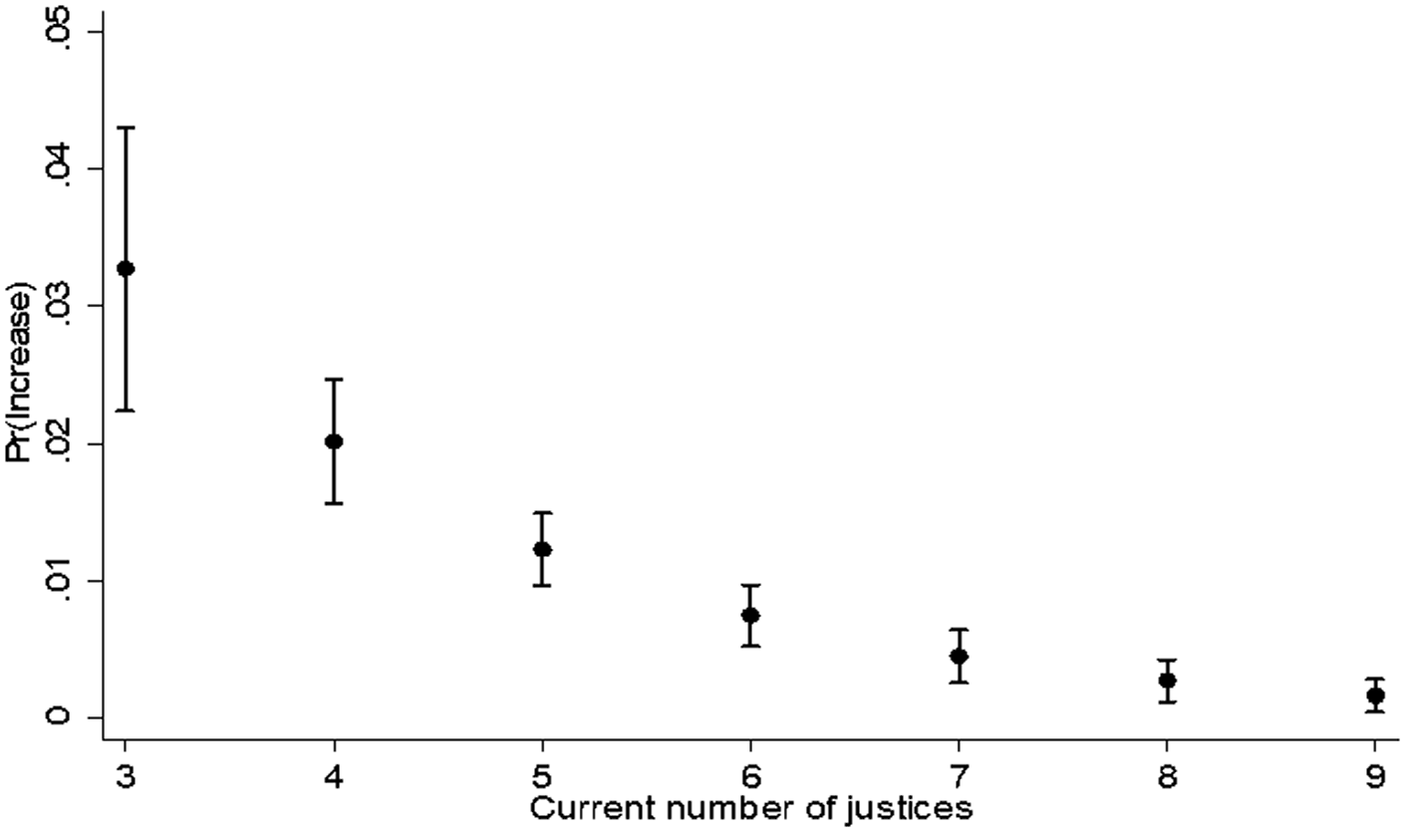
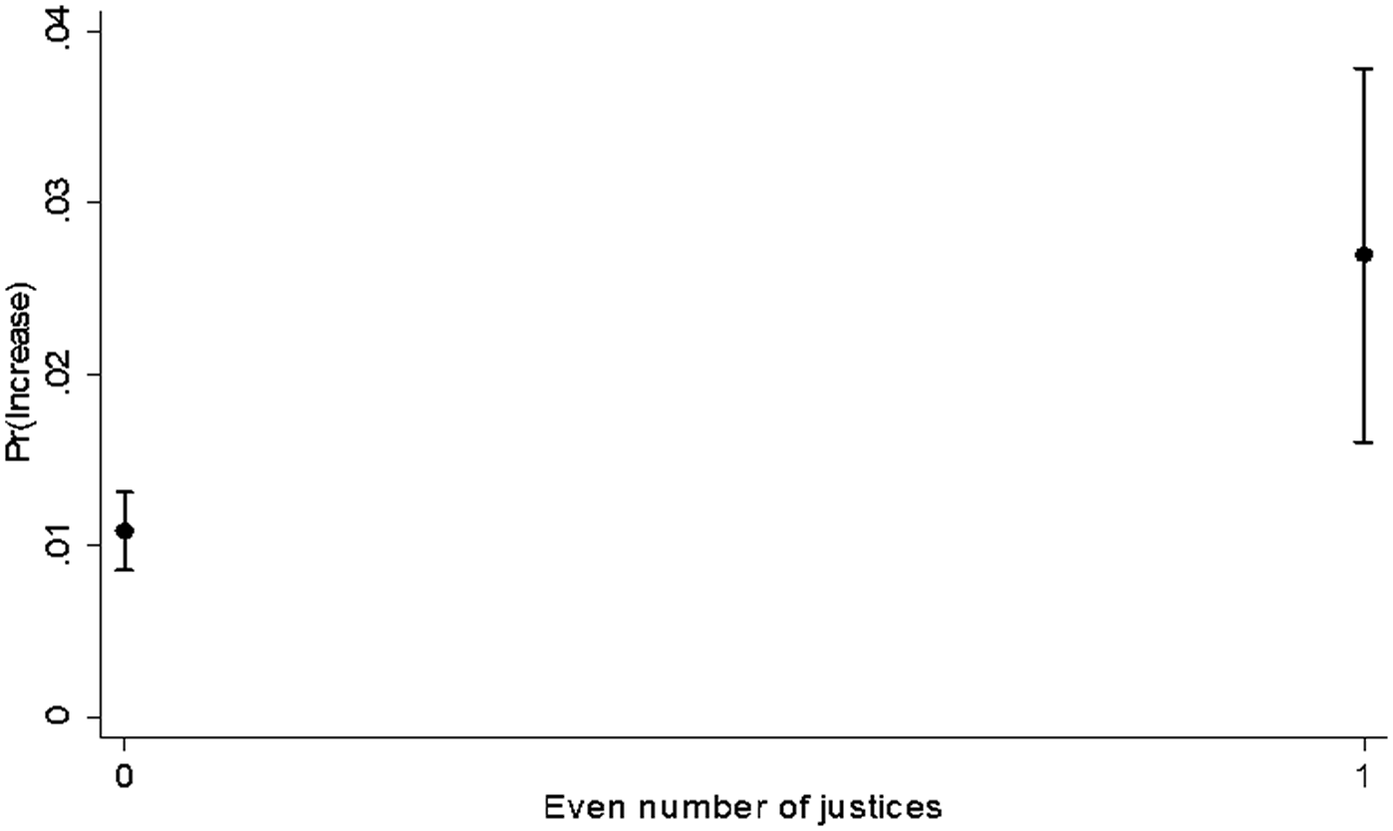
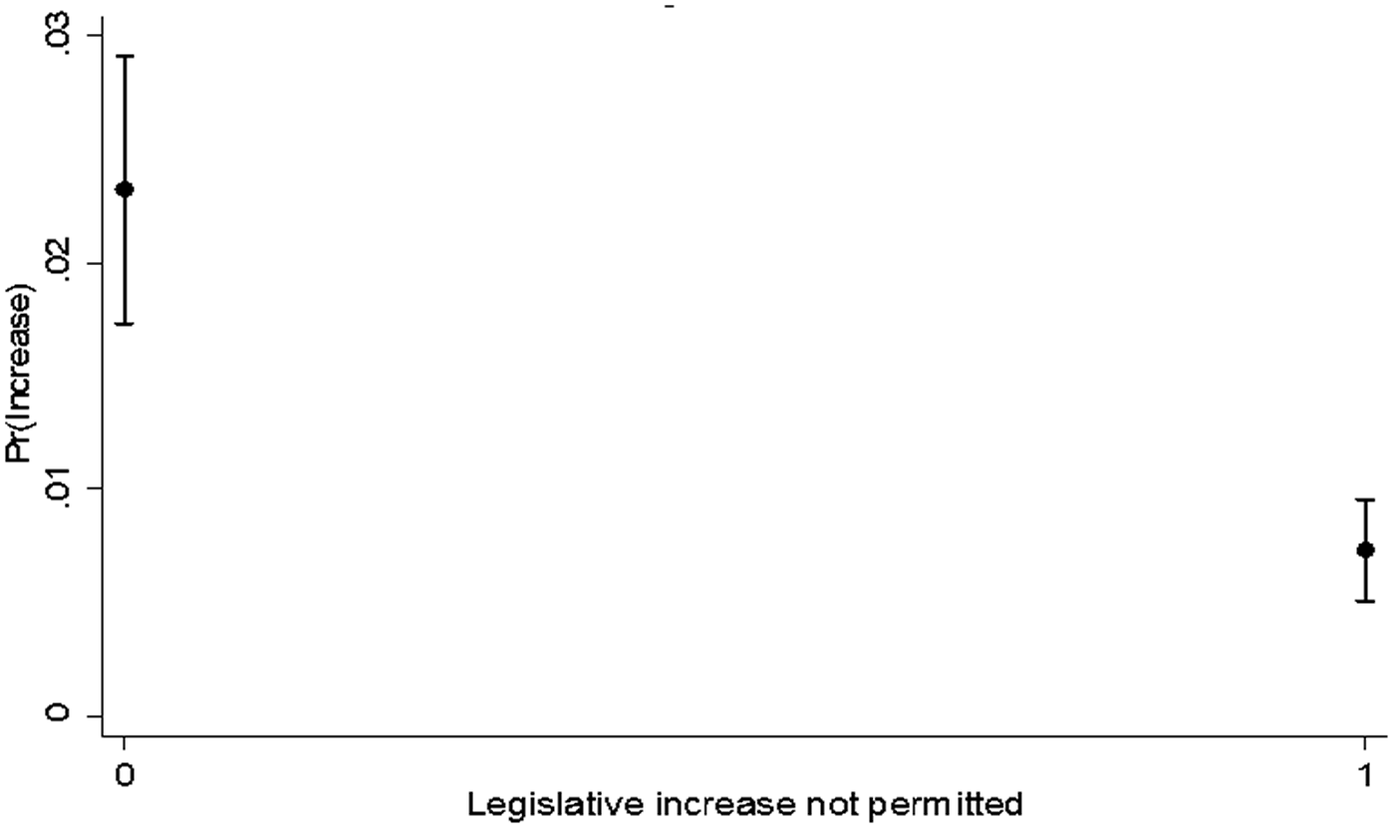
Nonetheless, the model did identify several variables as exerting significant effects on the timing of expansions in ways that largely aligned with expectations and provide support for the political insurance model (see Figures 3–6). As expected, the current number of justices sitting on a state supreme court exerted a significant effect on the likelihood of court expansion, with larger court sizes making expansion significantly less likely. Also consistent with expectations was the fact that court expansion was significantly more likely when the number of justices provided for by state law was an even number. The ease with which the size of a state’s supreme court could be changed also significantly affected the likelihood of court expansion. Court expansion was significantly less likely when state supreme court size could not be increased by ordinary legislation and instead required a new constitution, constitutional amendment, or special legislation.
Marginal Effects of current number of justices w/ 95% confidence intervals.

Marginal effects of even number of justices w/ 95% confidence intervals.

Marginal effects of legislative increase not permitted w/ 95% confidence intervals.

Marginal effects of judicial selection/retention methods w/ 95% confidence intervals.

However, one unexpected result was the fact that the passage of longer amounts of time since the last change to the number of justices on a state supreme court was not associated with a significantly lower likelihood of court expansion. While the unparalleled stability of the US Supreme Court has made expanding the Court less politically feasible than it otherwise might be, at the state level this appears to be somewhat less the case. For example, the two most recent state supreme court expansions both added seats to courts whose configurations had previously been almost as stable as that of the US Supreme Court. Prior to their 2016 expansions, the Arizona Supreme Court had remained at five justices for 67 years and the Georgia Supreme Court had remained at seven justices for 71 years (which is actually longer than the amount of time that the US Supreme Court had been at nine justices when Franklin Roosevelt proposed his court-packing plan in 1937). Another unexpected result was the fact that population growth has not been a significant driver of state supreme court expansion. This was the case regardless of whether data from the most recent census (measuring the population growth that occurred the previous decade) or from the succeeding census (measuring the population growth that was underway that decade) was used. This despite the fact that population growth-driven caseload pressure has historically been the most frequently cited rationale for court expansion and the fact that most state supreme courts enjoy less control over their dockets than does the US Supreme Court, meaning that the effects of population growth on caseloads are generally more pressing at the state level. This is not necessarily to say that caseload pressures are irrelevant to decisions to expand state supreme courts. It may simply be that expansion is a lagging and erratic indicator of population growth that does not necessarily occur during the periods in which growth is most intense.
Also contrary to expectations was the fact that states with judicial selection and retention systems allowing legislators adding state supreme court seats to then also play a role in the selection of judges to fill those seats were not significantly more likely to engage in court expansion. That is, court expansion was not significantly more likely in states with legislative appointment or confirmation of the governor’s nominee. It was, however, significantly more likely in states in which supreme court justices were selected via partisan elections. Not only do partisan elections make it more likely (particularly relative to non-partisan elections or merit selection) that the justices filling the newly created seats will be politically aligned with the dominant party, they may be indicative of state political cultures that place less value on judicial independence that is manifested both in those states’ use of partisan elections to select judges and in their greater willingness to engage in court-packing.
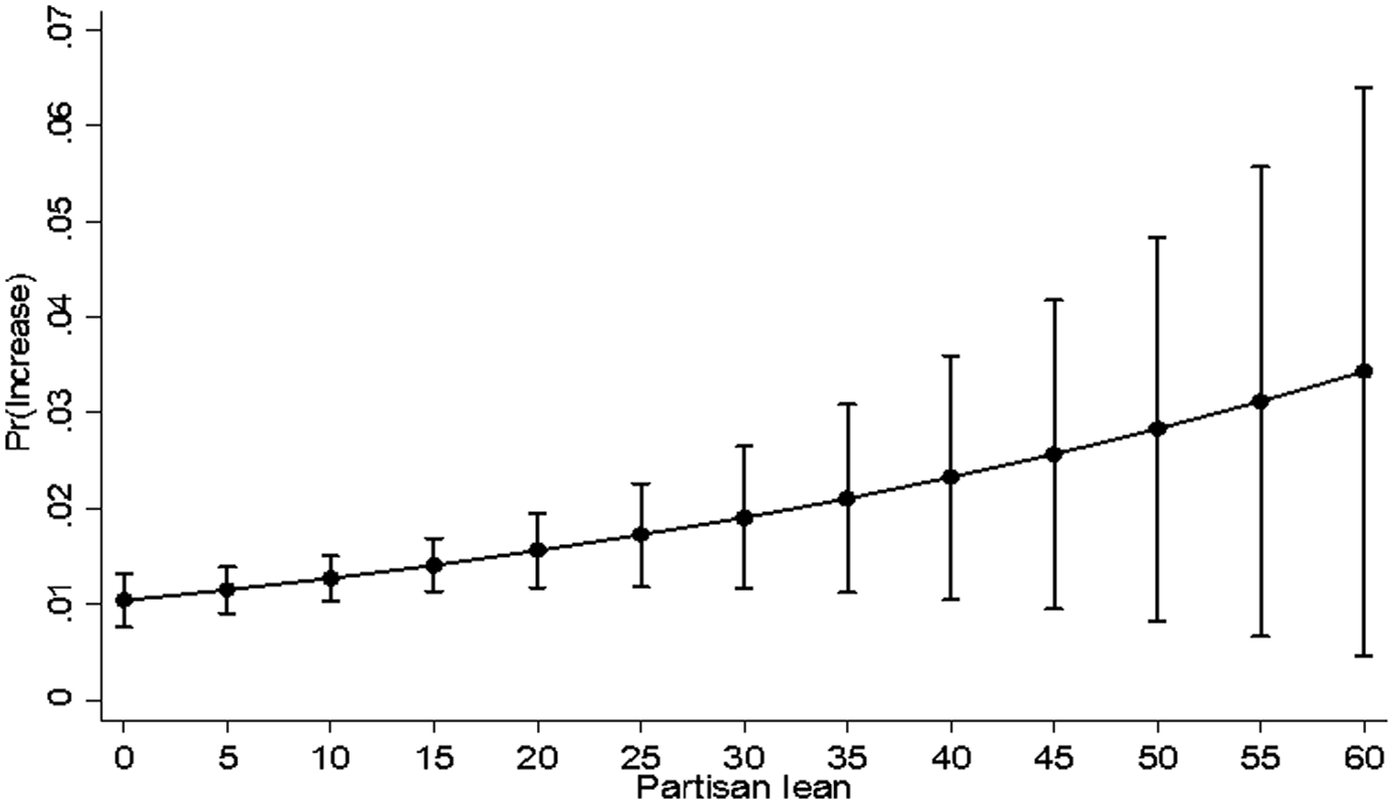
Finally and most importantly, political competition significantly affected the likelihood of state supreme court expansion in the manner predicted by political insurance model. Less politically competitive, more one-party dominant states with stronger partisan leans were significantly more likely to engage in court expansion. The average partisan lean of the state-years in which the 120 state supreme court expansions occurred was 11.02, which is relatively high. For comparison, the states that currently have comparable partisan leans (i.e., partisan leans between 10 and 12) include Indiana, Kansas, Louisiana, Mississippi, Missouri, Montana, and New York, all of which are solidly Democratic or Republican states in both state and federal elections. In contrast, only about a third (41) of the 120 state supreme court expansions occurred in what would at the time of those expansions have been considered “swing” states (i.e., states with partisan leans between 0 and 5). As illustrated by Figure 7, a perfect swing state with a partisan lean of 0 would have approximately a 1% likelihood of increasing the size of its state supreme court in a given year. Increasing that state’s partisan lean to 25 (approximately the current partisan lean of Wyoming, which is the highest of any state today) would nearly double the likelihood of state supreme court expansion in a given year while increasing it all the way to 60 (approximately the partisan lean of South Carolina between 1925 and 1928, the highest ever of any state) would more than triple the likelihood of state supreme court expansion in a given year.
Marginal effects of partisan lean w/ 95% confidence intervals.

Thus, although current political competitiveness and state supreme court size are negatively correlated, with today’s less competitive states tending to have smaller state supreme courts, less competitive states have historically been more likely to expand their state supreme courts. These apparently contradictory results can be reconciled by the fact that, as previously noted, the identities of competitive states have been highly fluid, with states regularly moving in and out of the ranks of swing states. Thus, for some less competitive states, smaller size may reflect lack of expansion due to past competitiveness. Also, due to the sharp urban–rural divide that characterizes contemporary American politics, the heavily rural, low population states that tend due to their lower populations to have smaller state supreme courts tend also to be solidly Republican states with strong partisan leans.
However, the data also indicate that this is not entirely an artifact of the urban–rural divide. Consistent with the findings of Ginsburg’s cross-national analysis of political competitiveness and constitutional court size, states with lower levels of political competition at statehood have tended to establish smaller state supreme courts. Plotting the relationship between the initial size of a state supreme court at statehood and the state’s initial partisan lean yields a correlation coefficient of −0.12, indicating a weakly negative relationship. The weakness of this overall correlation may be due in part to different court sizes being the norm when different states attained statehood. Seven justices is currently both the mean and the modal state supreme court size, with 28 state supreme courts having seven members, 17 having five members, and 7 having nine members. However, smaller courts were historically the norm, with five justices being the mean state supreme court size at the turn of both the nineteenth and twentieth centuries and the overwhelming majority of the new states that joined the union in the nineteenth and twentieth centuries initially establishing three-member courts. Attempting to avoid this comparability problem by looking only at differences in the initial sizes of supreme courts established by states admitted in close temporal proximity to each other provides some support for the idea that political competitiveness influenced initial court size. For example, among the three states admitted in quick succession between 1858 and 1861, then overwhelmingly Republican Kansas and Minnesota opted for smaller three-member courts while then closely divided Oregon opted for a larger four-member state supreme court (despite Kansas and Minnesota each having more than twice Oregon’s population at the time). Similarly, among the two states both admitted in 1959, then overwhelmingly Democratic Alaska opted for a smaller three-member court while then relatively more closely divided Hawaii opted for a larger five member court. In sum, while less politically competitive states have been marginally more likely to initially establish smaller state supreme courts, they have significantly more likely to subsequently expand those courts.
Conclusions
The results indicate that recent state supreme court expansions in Arizona and Georgia, states that were both quickly becoming more politically competitive at the time of those expansions, are atypical of the historical pattern. Also atypical were recent efforts by Democrats holding the narrowest of congressional majorities to add seats to the US Supreme Court. These efforts may reflect confidence on the part of Democrats that the cultural and demographic changes first identified by Judis and Teixeira (Reference Judis and Teixeira2002) as producing an “emerging Democratic majority” will make retaliatory court-packing by a future Republican Congress and president increasingly less likely. This line of thinking is exemplified by Epps and Sitaraman (Reference Epps and Sitaraman2019), who speculate that “[i]f Democrats engaged in court-packing and were able to hold power for long enough to implement policies to revive basic principles of democracy – such as voter access and anti-gerrymandering reforms – perhaps this polarized era would give way to a new progressive equilibrium” (177). However, such efforts are ultimately not typical of the circumstances in which parties have historically been most likely to embrace court expansion. More typical has been court expansion during periods of one-party dominance, when governing parties have less incentive to adhere to norms of judicial independence.
What are the future implications of these findings? Given that state supreme court expansions have become rare events in the twenty-first century, with no comparable previous period of court size stability in the nation’s history, it could be argued that states have largely aged out of significant court restructuring as their courts have evolved over time toward more stable and ideal configurations. No state supreme court has had an even number of justices since 1987, when the Connecticut Supreme Court expanded from six to seven justices, and no state supreme court has had less than five members since the Oklahoma Court of Criminal Appeals expanded from three to five justices, also in 1987. Consequently, there have been far fewer obvious candidates for expansion in recent decades. Thus, while the findings indicate that certain types of states will be relatively more likely to expand their supreme courts in the future (i.e., less politically competitive states, states with smaller supreme courts, states with less entrenched supreme court sizes, and states with more populist judicial selection and retention systems), their absolute likelihood of doing so will continue to be significantly lower than in past centuries.
However, one reason this might change is the fact that the current political system is becoming more like the political system of the late nineteenth and early twentieth centuries, the most active period of court restructuring. Corresponding to the Third and Fourth Party Systems, this period was distinguished by extremely high regional polarization, with most states politically non-competitive states that were either solidly Democratic or solidly Republican (see, e.g., Burnham Reference Burnham1986; Schaffner Reference Schaffner2011; Sundquist Reference Sundquist1983). The results of this study indicate that this lack of state level competition contributed to the unusual amount of court restructuring that occurred during this period and thus suggest that court expansion may become somewhat less rare (or at least draw more serious consideration) as increasing partisan polarization decreases the number of politically competitive states.
Data availability statement
Replication materials are available on SPPQ Dataverse at https://doi.org/10.15139/S3/PRDASN (Zschirnt Reference Zschirnt2024).
Funding statement
The authors received no financial support for the research, authorship, and/or publication of this article.
Competing interest
The authors declared no potential conflicts of interest with respect to the research, authorship, and/or publication of this article.
Author biography
Simon Zschirnt is an associate professor of Political Science at Texas A&M International University. His research focuses on constitutional and international law, judicial behavior, and the dynamics of judicial empowerment.




 Open access

