

In her elucidation of chapter 11 of Oscar Wilde’s The Picture of Dorian Gray (1949), Eve Sedgwick acutely observes the intricacies among (female) labouring bodies, textile manufacturing, mercantilism and imperialism in the late nineteenth century. Her potent account untangles the many layers of ‘tedious labor’, ‘atrocities’ and ‘wastage’ that are woven into Dorian Gray’s obsessively collected embroideries and textiles from the English colonies during the late Victorian period:
On the one hand, the hungrily inventive raptness of the curious or subtle perceiving eye or brain; and, on the other, the more than answering intricacy of the curious or subtle objects perceived – imported or plundered artifacts, in these typifying cases, whose astonishing density of jewels and ‘wrought’ work such as embroidery testify, more than to taste, to the overt atrocities they sometimes depict, and most of all to the ‘monstrous,’ ‘strange,’ ‘terrible’ (I use the Wildean terms) exactions of booty in precious minerals, tedious labor, and sheer wastage of (typically female) eyesight, levied on the Orient by the nations of Europe.Footnote 1
Such a reading of Wilde’s text draws attention to the exploitative practices underlying the transnational textile trade, which stretches back centuries. The gruelling labour and relentless extraction of resources, particularly from colonized regions, align with the critiques of capitalism put forth by Marx and Engels, whose foundational analyses of labour, capital and industrial production remain essential for understanding the historical and contemporary dynamics of the global textile industry. As Julia Bryan-Wilson notes in Fray: Art + Textile accounts,
Friedrich Engels and Karl Marx’s theorizations about the division of labor that governs capitalism and shapes laborers, and the urgent need for a worker’s revolution, were rooted in their observations about … textile fabrication … and many of Marx’s examples about labor power in volume 1 of Capital revolve around the spinning of thread …Footnote 2
In his correspondence with Marx, Engels frequently offered intricate analyses of Manchester’s cotton industry, a sector in which his family held business interests. Engels’s intimate knowledge of cotton capitalism – spanning textile production, labour relations and the mechanisms of value extraction – was instrumental in helping ‘Marx grasp Manchester capitalism’.Footnote 3 In her pertinent study of textile arts and labour, Bryan-Wilson evidentially illuminates a persistent trio essential to understanding textile politics: artistic representation, the material production of that representation and the pervasive use of textile metaphors in academic discourses. She asserts that ‘textiles suffuse Marx’s theories about use value and the commodity; while yarn, loom, tailor, and weaver function as paradigmatic examples of broader processes of labor, they are much more than metaphorical’; they are ‘materials and procedures’ which are ‘always contingently situated in race, gender and labor histories of material’.Footnote 4 This double of the metaphorical and the material, the symbolic and the practical, the representational and the real is, as Alice Rayner argues in her essay ‘Rude Mechanicals and the “Specters of Marx”’, intrinsic to theatre. Rayner suggests that the backstage theatrical production – its material practices, procedures and labour processes – constitute the ‘internal double’ of the stage representation.Footnote 5 In theatre, this double primarily manifests as a spatial division that is immediately self-evident: the illuminated stage on the one hand, despite its varying degrees of visibility; the concealed backstage on the other, which, even when occasionally exposed, remains largely unarticulated and overshadowed by the spotlight. Rayner emphasizes that the stagehands, who must at times make themselves visible to the audience during scene changes or props adjustment, exist in a state of simultaneous presence and absence: they are ‘here and not here, doing real things that you [an audience] see, but do not see as representational because they are actual’; they are ‘working’, not ‘signifying’.Footnote 6 Concomitantly, this spatial binary entails a division of labour: the artistic labour involved in theatrical representation and the backstage labourers that make such representation possible. These two divisions thus raise questions about the ontological status of both theatrical labour and theatrical objects, juxtaposing the representational (imaginary, phantasmic, symbolic) with the real, the ‘worldly’, or in Marxist terms, ‘a productive act’.Footnote 7 This ontological examination also brings forth a value judgement of the two categories of labour. The former, in the Brechtian framework, is seen as an abstraction of matter and reality, creating illusionary effects typical of bourgeois theatre. In contrast, the latter is described as ‘practical, necessary, and concrete’, ‘functional’ and ‘firmly entrenched in the reality’.Footnote 8 Consequently, an ‘ethic demand’ arises, particularly given that the latter form of labour is often marginalized and rendered invisible. This demand seeks to address and rectify the ‘asymmetrical power relations between the living who do the work and the phantoms of representation, of history, and of the invisible’.Footnote 9
This abstraction of matter and reality becomes even more pronounced when we consider the backstage practices that lie even further behind the scenes. Rayner observes that ‘real work [stagehands] is on the inside of the spectacle but outside the rules of public display’, but what if this ‘real’ work leaves no trace even within the spectacle itself? What if the entire process of materialization and abstraction occurs solely ‘outside’ the theatrical frame?Footnote 10 Rayner insightfully notes that ‘no matter how many stage hands might be brought on in full view to change a light or move a piece, there are always other laborers beyond, either in a space even further back … or further front’.Footnote 11 Addressing the distinctions between ‘in’ and ‘out’ and/or ‘front’ and ‘back’ necessitates a tentative shift in our perspective away from the theatrical system itself. I propose that we recontextualize backstage labour not just within the confines of theatre but as part of the broader global meshwork of labour and capital. In this sense, backstage labour is not merely situated behind the stage but extends even further back, to locations such as factories.
Dao Yin, vaginal imagery and textile theatrical objects
Positioning theatrical labour within a broader global mesh fabric of labour, commodities and migrating bodies, rather than confining it to the enclosed space of the theatre, allows us to explore the labouring processes that are ‘further’ back, further invisible and further excluded from the boundaries of the stage. It is in this expansive network of material and human flows that I situate my examination of Dao Yin (Saying Vagina) (2021).Footnote 12 Nowhere is the double – the abstraction of matter and the actuality of labour – more evident than in the textile scenery, props and costumes in Dao Yin. This production dramatizes over sixty interviews conducted by Vagina Project (VP), a feminist theatre collective based in Beijing, with female-identifying participants reflecting on their experiences and perceptions of their vaginas. Drawing on a similar methodological approach to The Vagina Monologues (2001), a radical feminist play written and performed by North American artist and activist Eve Ensler, Dao Yin taps into the bodily experiences of Chinese women, exploring themes such as vaginismus, vaginal dilation following gender confirmation surgery, pregnancy, sexual pleasure and more.Footnote 13 The play unfolds over five acts, each offering a distinct exploration of intimate and embodied experiences. Throughout, performers – including artist Qianhui Ma – intersperse the scenes, engaging with the audience in conversations about vaginas. Act I, ‘TA Died Ten Years Ago’ (‘TA shinianqian jiusile’), features a poignant dialogue between a pregnant girl and the ghost of her mother, exploring themes of pregnancy, gynaecological examinations and abortion, and revealing their complex bond through shared bodily experiences. Act II, ‘Flings in Her Sixties’ (‘60sui qingshi’), depicts a woman in her sixties pursuing pleasure and casual encounters, challenging conventional notions of ageing by exposing the often unspoken and marginalized sexual lives of elderly women. Act III, ‘A Private Conversation’ (‘Yici simi de qiatan’), presents a dialogue that intersects between a male and a female character, as well as their respective genitals. This interaction imbues the genitals, particularly the vagina, with agency as they explore themes of female desire, emotion and physicality. The performers, embodying these genitals, wear costumes layered with delicate pink, flesh-toned, silky and sheer tulle fabrics. The performer representing the vagina adds extra layers to the front of the dress, visually resembling the nuanced textures of vaginas. In Act IV, ‘At the End of the Vaginal Tunnel Stood My Girlfriend’ (‘yindao jintou shi wode nvyou’), the vagina is represented as a soft puppet crafted from tactile fabrics and filled with pliable stuffing, symbolizing the character Jessica’s bodily experiences and her struggles with her sexuality. Act V consists of two heavily intersecting monologues: ‘My Vagina Tone Mirrors That of My Abdominal Skin’ (‘Wode yindao shi wo dupi de yanse’) and ‘Who Is Ill?’ (‘shui bing le?’). It intertwines two narratives of vaginismus: one endured by a trans woman and the other by a wife diagnosed with genito-pelvic pain/penetration disorder. This act delves into the intricate relationship between the vagina as a genital and the vagina as a symbol of female identity, questioning essentialist notions of the vagina–woman myth. Two performers bring a bucket of red paint and a long white cloth onto the stage, using the paint to stain the cloth. The intersecting monologues of the trans woman and the wife culminate in a visceral onstage performance, where the labouring process of dyeing the white cloth red creates a potent symbol of menstrual blood.Footnote 14 Much like the props and costumes in Dao Yin, which make use of fabrics of various textures to evoke vaginal imagery and ma-terialize thematic elements – thereby sculpting narratives surrounding vaginas through their textile presence – the scenic design operates similarly. The scenery, characterized by a few gigantic pieces of red-tinged woven fabric, holds thematic and aesthetic importance during the 2021 performance. The creative vision of the VP members initially sought to immerse the audience in tales about vaginas through a visual representation of a ‘Vagina’.Footnote 15 During the conceptual phase, they envisioned the theatre adorned with red-dyed textile materials intricately woven and dispersed throughout the space, extending seamlessly onto the stage (Fig. 1). This installation, according to the producer, could enable spectators to immerse in a truly evocative ‘Theatre of Vagina’.Footnote 16
White card model of the ‘Theatre of Vagina’. Photograph: Osaki.

Weaving the ‘Theatre of Vagina’: handicraft, automatism and theatre-making
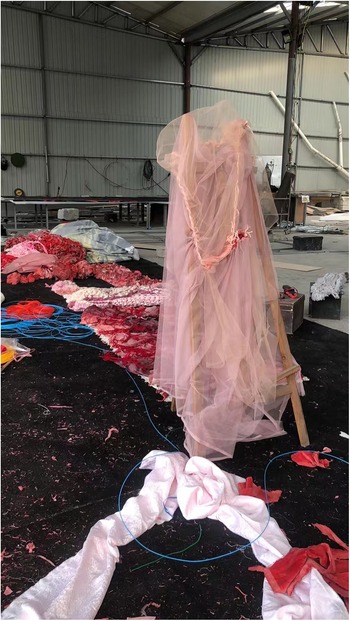
VP began by gathering a wide range of textile materials, including discarded garments, worn bedsheets and even old underwear from its members, while also sourcing re-cycled clothing from an online thrift shop. Their collection process was broad and flexible, extending to non-textile materials such as plastic film, packaging and nylon cords. After collecting a significant quantity of textile materials, the producer then collaborated with four female migrant workers at a factory located in the suburban periphery of Beijing, where they engaged in arduous processes of dyeing these fabrics and weaving them into the installation for a week. While at the factory, the producer visited a textile market in Langfang, a city situated approximately midway between Beijing and Tianjin, to source additional fabric offcuts, primarily nylon net and tulle, hoping to increase more volume of the final textile artefact (Fig. 2). Furthermore, she obtained extra fabric waste from a friend who had acquired these materials at Zhongda Textile District (Zhongda buliao shichang), China’s largest textile market, located in the southern city of Guangzhou. Following a week of meticulous textile craftsmanship, the sizable red woven fabric pieces were transported to Beijing 5 house, an art incubator that serves as a hub for arts education, community-based arts projects, exhibitions, performances and talks. There they were installed to symbolize the ‘Vagina’.
Cheap pink tulle fabric purchased at the textile market in Hebei Province. Photograph: Osaki.

The complexities of labour politics in scenic design and creation are further heightened by the recycling process, which paradoxically weaves together quotidian artisanal craftsmanship, artistic production and capitalist modes of textile manufacturing. Driven by ecological concerns and financial constraints, VP’s approach to making scenery echoes the feminist do-it-yourself (DIY) ethos of theatre-making.Footnote 17 In the months leading up to the performance, VP partnered with Dongxi Lab, an environmentally conscious online thrift shop. Dongxi Lab, whose name translates as ‘Lab of Objects/Things’, donated second-hand clothes through their Recycling Archive project, which seeks to minimize waste and carbon emissions by repurposing public donations. The second-hand clothing that VP gathered was unexpectedly high-end, featuring brands like Burberry and Polo Ralph Lauren, as well as more everyday pieces like IKEA quilts. With some garments still bearing their original tags, the producer kindly offered the textile workers the opportunity to take home some of the clothes for their daughters to wear.Footnote 18 The involvement of these well-known brands immediately complicates the process of ecological scenery making, necessitating a focus on the material traces of the textiles used in the woven vagina. Consider Burberry, which in 2006 announced plans to relocate production from its south Wales factory to China. This move marked a transition from the brand’s ‘“Made in Britain” motto’ to ‘a “Made in China” image’.Footnote 19 Since China’s neoliberal turn towards a market-oriented economy in the 1980s and its accession to the World Trade Organization in 2001, the country has become a central player in the large-scale transfer of manufacturing to Asia, particularly within the garment industry.Footnote 20 This transformation has been fuelled by China’s reliance on ‘low-cost labour’, primarily ‘supplied by millions of migrant workers’, given its position ‘at the lower end of the global production chain’.Footnote 21 The apparel industry, known for being ‘labour-intensive’, is characterized by ‘deskilled and segmented’ workers, with prevalent ‘outsourcing and subcontracting’ practices that contribute to informal labour conditions. By 2015, the Chinese garment sector employed 22 million people, predominantly migrant workers, making it one of the ‘most informalized, atomized, and vulnerable’ labour forces in the industry.Footnote 22 After 2008, exports from other Asian countries, especially Vietnam and Bangladesh, saw rapid growth.Footnote 23 Burberry, for instance, sources production from countries such as China and Vietnam, while Polo Ralph Lauren relies on a global supply chain, with much of its manufacturing in Asia due to cost and scale advantages. Similarly, IKEA produces quilts and home textiles in low-cost hubs such as China and India.
The woven vagina had undergone several transformative phases. Initially, its creation began with the recycling of mass-produced textiles, originating from automated assembly lines that produce high-end and fast-fashion garments – processes heavily reliant on the alienation of labour. However, as Bryan-Wilson notes, despite the mechanized nature of production, much of the labour, particularly in textile manufacturing, is still performed by hand, revealing the significant ‘bodily effort’ involved. Manual labour, though ‘central to the mechanisms of capitalism’, remains ‘undervalued’.Footnote 24 These garments, often labelled ‘Made in China/Vietnam/Bangladesh’, were distributed globally, consumed and eventually passed on to VP. From there, the textiles made their way to the scenic factory and warehouse, combined with fabric waste from two major textile markets in northern and southern China – remnants of mass production. The process began with the cutting of garments and textile materials using industrial cutting machines, followed by dyeing, performed by male workers. The fabric was then rolled into thread-like balls and woven into form. This labour culminated in the creation of the red woven piece symbolizing the vagina. Reflecting on the process, the producer notes, ‘People chase after all these consumer goods, but in the end, it all comes back to our bodies.’Footnote 25 Through the toil of manual labour, these consumer products are transformed, reimagined into the woven vagina, merging material and corporeal symbolism.
The material traces of these textiles, sourced from diverse regions and emerging through diverse modes of production, complicate VP’s ecological scenic-making process. This fabric trajectory not only connects the north and south spatially, but also paradoxically intertwines recycling practices with capitalist production. The creation of the vaginal installation blurs boundaries between handiwork, artistic production, mechanization and automation. In the scenic factory, both automated machinery and skilled manual labour coexist as distinct yet complementary modes of production. The manual process relies on touch and the embodied knowledge of fabric manipulation, while automation streamlines the production process, illustrating the tension and synergy between human craftsmanship and industrial processes.
Giving textures to the ‘Vagina’: interweaving fabrics, labouring bodies and air
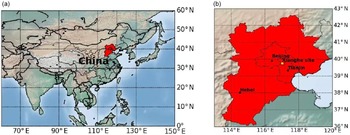
In late July and early August 2021, the producer travelled to the factory in Xianghe, a county in Hebei Province bordering Beijing. Strategically positioned between the major cities of Beijing and Tianjin, Xianghe serves as a liminal space – both geographically and politically. It is an enclave filled with displaced migrant workers, many of whom commute between affordable housing in the area and their jobs in the neighbouring metropolises. All of the female migrant workers in the Xianghe factory come from northern China, drawn to the area by the promise of job opportunities, often secured through short-term contracts. The factory specializes in services such as constructing and installing scenery and making props for theatre productions and performing-arts colleges in Beijing. Over the past decade, factories like this have gradually been relocated from Beijing as part of efforts to curb air pollution. This practice of outsourcing emissions to neighbouring provinces has become a central, yet ultimately unsustainable, pollution control strategy. It shifts the burden of production and pollution, perpetuating the cycle of environmental harm. In this way, ecological initiatives remain stalled, trapped in the broader capitalist loop that prioritizes relocating production centres over pursuing long-term sustainability. Xianghe, where the factory operates, stands as a stark example of this model – one built on mass production and labour exploitation (Fig. 3).
‘Map of China, Beijing–Tianjin–Hebei region is the red shadowed area which is also zoomed in the right panel … Xianghe site (yellow spot in the right panel) is located in Xianghe county.’ Yang Yang, Minqiang Zhou, Bavo Langerock et al., ‘A New Site: Ground-Based FTIR XCO2, XCH4 and XCO Measurements at Xianghe, China’, Earth System Science Data Discussions, November 2019, pp. 1–27, here p. 19.

Cutting and dyeing fabric pieces in the Xianghe-based factory. Photograph: Osaki.

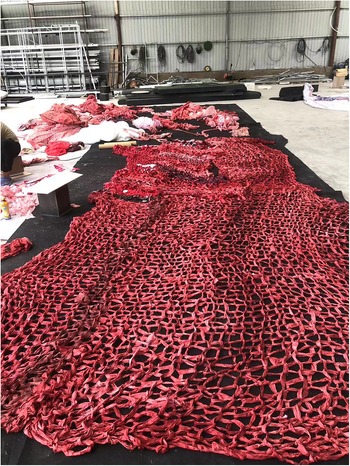
Weaving together fabrics in the Xianghe-based factory. Photograph: Osaki.

During her week-long residency at the factory, the producer collaborated closely with four female migrant workers to create the scenery for Dao Yin – ‘Theatre of Vagina’ – a striking fabric installation, dyed in shades of red and pink and crafted from recycled/purchased textile materials (Figs. 4, 5). While the dyeing process was predominantly handled by male workers and the cutting done by the machines, the producer and the female workers came together in an intimate, almost familial, setting, reminiscent of traditional domestic textile work. Together, they gathered to weave these fabrics, engaging in conversation as they worked. During these sessions, the women opened up about their concerns, particularly regarding the scarcity of temporary work contracts and the commuting restrictions imposed by the COVID-19 pandemic. Unlike their male counterparts, who are employed on contractless longer-term agreements, the female workers, as the producer noted, are often hired on shorter-term oral agreements, depending on word of mouth within the community where they seek jobs, leaving them in a more precarious position. Zhang and Fan highlight the entrenched gender division in the textile industry, where men typically ascend to roles as business owners or occupy positions requiring higher skill levels, such as tailors or mechanics, which command better pay.Footnote 26 In contrast, women are generally confined to lower-paid roles involving sewing and basic production tasks. By interweaving recycled textiles with fabric remnants sourced from local markets, VP’s feminist ecological theatre practice exposes a paradoxical intersection between sustainability and capitalist mass production. This convergence complicates the creation of an ecological conscious performance, particularly within the Chinese context, where the tension between ecological ideals and industrial practices is heightened. The textile manufacturing industry, which predominantly relies on a female workforce, is a site where global outsourced labour is racialized, feminized and devalued. As Bryan-Wilson notes, ‘Within the knotted history of textile politics, women’s labor … has been racialized, the interlocking mechanisms of patriarchy, waged and unwaged labor, racism, and global inequality are strikingly evident in the current realm of textile making (in particular the garment industry).’Footnote 27 This sector is marked by a lack of labour protections and involves highly labour-intensive work characterized by ‘minute repetitive motions and diligent attention to detail that can lead to bodily injury: eyestrain, neck problems, wrist and joint aches, shooting pains in fingers and forearms’.Footnote 28 The feminization of poverty and the impact of COVID-19 restrictions in Beijing have exacerbated the precarious conditions faced by these female migrant workers, further compounding their vulnerability.
What becomes more salient now is the intertwined trajectories of textile materials, the movements of migrant labouring bodies, and the flow of polluted air.Footnote 29 These movements – repeated, involuntary migrations of workers; the material traces of fabric remnants connecting northern and southern China; and the shifting centres of air pollution from Beijing to adjacent provinces – become metaphors for interwoven threads. Brandstetter, Egert and Hartung, in their introduction to Movements of Interweaving, describe these metaphorical threads as ‘choreographic meshworks’ that are not performed by any specific entity but are rather ‘the – relational and processual – performance of movement on the move’.Footnote 30 Conceiving of these movements as threads gives them a ‘texture of interweaving’, enabling us to better comprehend how the corporeal and material aspects were ‘intricately interwoven’ in the creation of the scenic pieces.Footnote 31 Through the collective process of weaving and knitting, an intricate, interwoven texture took shape – one that not only reflected the meshwork of objects, migrating bodies and labour practices, but also imbued the ‘Theatre of Vagina’ with distinct material and symbolic resonance. The material properties of mass-produced fabrics – cotton threads, nylon, polyester and others – were fused with embodied knowledge and sensory experience, as the dexterity of hands and fingers shaped the final form. Through this tactile engagement, a rich, nubby and layered texture was crafted, unified by the symbolic use of the colour red, which brought cohesion and thematic consistency to the overall piece. These materials also absorbed the sweat, stories and struggles of female textile workers, embedding the final craftsmanship with their lived experiences and the labour politics of the manufacturing industry. After the weaving was completed, the fabric pieces were transported to the theatre in Beijing, where they were used to represent a ‘vagina’ through which the audience would experience the performance (Figs. 6, 7).
One of the woven fabric pieces shipped to the theatre venue in Beijing. Photograph: Vagina Project.

The ‘Theatre of Vagina’ in Beijing 5 house. Photograph: Vagina Project.

The labour-intensive process of scenic design and execution raises a crucial question: how do these materials – knitted, braided and woven by the hands of female migrant workers and the producer – enter the system of theatrical representation and transform into an outsized metaphor for the vagina? Upon arrival, these fabrics were immediately translated into a textile artefact, integral to the scenic design for Dao Yin. The installation invites the audience to contemplate the resemblance between ostensibly incongruous things – manual textile work produced in the factory (with their colour, texture, weight, mechanical logic, smell …) and its effects and illusions (a representation of a vagina) in the theatre. Once incorporated into the theatrical sign system, these textile objects took on a sensuous presence, embodying the representation of female sexuality. This shift from the material to the symbolic makes the question even more pertinent, especially considering that the female migrant workers were unaware of the specific meaning behind their weaving – they were informed that it would be part of a performance installation. Similarly, the audience had no insight into the hands that had crafted the ‘vaginal’ scenery, nor the origin of the raw materials used in its creation. The red fabric pieces remained untouched in the theatre, not intermingled with either the performers or the audience. Here, myth making came into the picture when tangible, tactile textile materials and the embodied female workforce became subsumed under the symbol of the vagina. This entire process – from the labour involved in creating the scenery to its final staging – was churned up through theatre, which functions as a myth-making machinery. This parallels Ensler’s myth making in her creation of the ‘V-World’ (V for vagina) in The Vagina Monologues (TVM),Footnote 32 where materials, objects and bodies are transformed into symbols with pure signifying function.
‘The Vagina Workshop’, ‘Theatre of Vagina’ and the mythic weave of symbolism
In Hindu temples and shrines I … saw the yoni, a female genital symbol, for the first time: a flowerlike shape, triangle, or double-pointed oval. I was told that thousands of years ago, this symbol had been worshiped as more powerful than its male counterpart, a belief (of) man’s inability to reach spiritual fulfilment except through sexual and emotional union with woman’s superior spiritual energy.Footnote 33
In the forward to The Vagina Monologues, internationally renowned American feminist activist Gloria Steinem recalls her first encounter with the yoni – an icon of female genitals symbolizing the Hindu goddess Shakti – in Hindu shrines. Her retelling of the yoni mythology not only unravels the close connections between myths of femininity, myth-making and feminist belief making, but sets the tone for TVM, a play laden with vaginal myths in the making of feminist beliefs – female empowerment and liberation. Against male-dominated myth making of female sexuality, Steinem continues to propose an alternative myth making, one that goes inwards through the ‘vagina aisle’, creating spiritual words and symbols to reclaim feminine spirituality: ‘I walk down the vaginal aisle, plotting to take back the altar … to universalise the male-only myths of Creation, to multiple spiritual words and symbols, and to restore the spirit of God in all living things.’Footnote 34 TVM is a play that emerged out of this vagina aisle. Ensler aims to liberate vaginas from the pervasive patriarchal, religious, cultural and sociological myths about female sexuality while simultaneously diving into her own myth making of femininity as the play unfolds. The play disputes some of the patriarchal myths naturalized as the ‘Vagina Facts’ which Ensler quoted from The Woman’s Encyclopaedia of Myths and Secrets: clitoris as ‘the witch’s guilt’,Footnote 35 the smell of vagina as ‘unbearable’,Footnote 36 vagina as the ‘hidden mysterious part’,Footnote 37 vagina embodies shame, the brutal erasure of the shame through ‘genital mutilation’.Footnote 38 In ‘The Vagina Workshop’, Ensler dramatizes the bodily experience of a woman observing her vagina for the first time: ‘I must tell you that up until this point, everything I knew about my vagina was based on hearsay or invention … My vagina existed for me on some abstract plane.’Footnote 39 ‘Hearsay’ and ‘invention’ are aforementioned myths that define vaginas and femininity, and repeatedly naturalize those definitions as a way to exercise power over women’s bodies. In the process of myth making, vaginas are represented by abstract symbols, inscribed by naturalized narratives which appear to be alien to women themselves, and replaced with linguistic ‘tags’ as ‘toadie’, ‘dee dee’, ‘monkey box’ and other euphemisms.Footnote 40 TVM intends to unmake not only these myths, but also the myth of silence/self-silencing that surrounds them – the ‘Bermuda Triangle’ where ‘there’s so much darkness and secrecy’ and ‘nobody ever reports back from there’.Footnote 41 Ensler asks, ‘does talking about vaginas ruin the mystery, or is that just another myth that keeps vaginas in the dark, keeps them unknowing and unsatisfied?’Footnote 42 While demystifying the patriarchal myths, Ensler creates her own feminist myths of vaginas. As Christine Cooper puts it, ‘the play is deeply invested in that darkness and mystery, affirming it and dispelling it by turns, but naturalising it all the while’.Footnote 43 Ensler’s myth making is the creation of a narrative about female sexuality linked to identifiable symbols of vaginas in order to support her feminist belief system – female empowerment through vaginal pleasure. It is not just the play that is laden with vaginal myths; the process of creating it is as well. Eve Ensler claims that she has no memory of actually writing the monologues, attributing the composition to muses she calls the vagina queens. She explains, ‘When I do the interview, I take notes. But it’s more about letting the person come to me so then I can write the character.’Footnote 44 Ironically, while the play seeks to demystify and openly discuss vaginas, it frequently resorts to euphemisms for this very body part. Throughout the performance text, terms like ‘cellar’, ‘village’, ‘tulip’, ‘shell’ and ‘coochie-snorcher’ are employed.Footnote 45 As feminist theatre scholar Jill Dolan notes in The Feminist Spectator as Critic, ‘The revelation of women’s experiences and their intuitive, spiritual connection with each other and the natural world is idealized as the basis of cultural feminist knowledge.’Footnote 46 In a paradoxical reflection of cultural or second-wave feminism, Ensler’s text inadvertently constructs new vaginal myths, even as the play endeavours to dismantle the old ones.
In ‘The Vagina Workshop’, such myth making is made to its fullest. The act begins with
My vagina is a shell, a round pink tender shell, opening and closing, closing, and opening. My vagina is a flower, an eccentric tulip, the centre acute and deep, the scent delicate, the petals gentle but sturdy. I did not always know this. I learned this in the vagina workshop.
It ends with the same highly romanticized vaginal iconography: ‘my vagina is a shell, a tulip, and a destiny. I am arriving as I am beginning to leave. My vagina, me.’Footnote 47 Instead of offering a revisionist myth making that dismantles and denaturalizes the patriarchal myths/ideologies of the vagina, Ensler’s use of flower symbolism shrouds female sexuality further in mystique and naturalizes the masculine/feminine binary. Her myth making metaphorizes and aestheticizes vaginas, rendering women interviewees’ embodied experiences as mere representations, ahistorical and apolitical. It risks reducing the material, social and cultural realities of womanhood, women’s liberation and sexual violence into merely a sign of a vagina. The ‘vagina = me’ equation creates another myth – the ‘vagina–self myth’– of the vagina/clitoris being the essence of a liberated womanhood.Footnote 48 This equation appears more than once in ‘The Vagina Workshop’ where the woman was told ‘my clitoris … the essence of me. It was both the doorbell to my house and the house itself. I didn’t have to find it. I had to be it. I had to be it. Be it. Be my clitoris. Be my clitoris.’Footnote 49 This ‘vagina–self myth’ risks essentializing femininity and naturalizing ‘a newly normative, potentially disciplinary version of the “sex”’.Footnote 50 Sitting on a tall stool, with a single searing spotlight that hangs above her, Ensler’s performing/making of vaginal myths in a black-box theatre created a private and intimate space, ‘a community, a culture of vaginas’,Footnote 51 where the crowd was ‘mesmerised’, falling into an illusory scene yet leaving the room not knowing what to do next for a ‘V-World’.Footnote 52 In the post-show discussion, audience members were more interested in their personal problems than in the activist’s work,Footnote 53 and, without Brechtian devices, ‘the audience easily loses itself in the spectrum of moans, the lines, or the voices expressing them, and forgets the playwright’s (and director’s) controlling hand’.Footnote 54 Both ‘The Vagina Workshop’ and Ensler’s black-box theatre are therefore places where mesmerizing myth making takes place. If ‘The Vagina Workshop’ is where women hold mirrors, staring at their vaginas and being told they are in fact tulips with a delicate scent, the black-box theatre is where Ensler creates vaginal myths to convey her feminist message by bridging shell/tulip/water village with vagina, vaginal pleasure with women’s liberation, and vaginal pain with sexual violence. The mesmerizing effect of such myth making can be further amplified due to theatre’s inherent nature as a sign system, as objects and bodies entering the performance space are transformed into signs that acquire symbolic significance – a process that, I contend, is central to myth making.
In a manner reminiscent of the myth making in Ensler’s TVM, the ‘Theatre of Vagina’ may aestheticize the fabric pieces, potentially obscuring, through theatre-as-myth-making-machinery, their often enigmatic connections to textile labour, migrant histories, industrial production, ecological resistance and the broader forces of transnational manufacturing. The creation of the textile vagina, particularly the role of the labouring bodies involved in producing these materials, which were later incorporated as a scenic element, invites several crucial questions: what divisions of labour exist within the performance of Dao Yin, and why do certain labour processes become more visible than others? How does the theatre-as-myth-making-machinery influence the inclusion and exclusion of certain labouring bodies, leading to their presence or absence in the performance? The materiality of the textiles, intricately interwoven with the precariousness and corporeal vulnerability of migrant bodies, was reframed as a metaphor for a vagina. This reinterpretation risks obscuring the radicalness of the feminist theatre piece, leaving audiences indulged in a vaginal – embellished and mystified – sign. The abstraction of red-tinged woven fabrics, the manual labour of female textile workers, and the voluntary contributions of the producer – reflecting the dedication of urban Chinese women theatre-makers – are translated to symbolize the vagina, thereby embodying the feminist message and imagery. Such translation is realized through the theatre’s double – abstraction and actuality – and its nature as a sign system. This double becomes even more palpable when juxtaposed with the actual aesthetic labour of dyeing onstage, which was made visible in full view of the audience. In Act V of the play, two performers entered the stage, holding brushes and carrying two baskets filled with red paint.Footnote 55 They proceeded to dye a piece of white cloth, evoking the image of a bridal veil, in the midst of the unfolding performance. In the scenery, the red woven fabrics remain static and silent. It is at this point that my questions regarding the divisions of labour resurface. Act V features two interwoven monologues, ‘My Vagina Tone Mirrors That of My Abdominal Skin’ and ‘Who Is Ill?’. Unlike other acts, this one is given a distinct texture by VP activists and playwrights. While the storylines remain separate, they occasionally converge, creating a vaginal tapestry where the warp and weft of the two women’s narratives intertwine. This act deconstructs the gendered essentialism present in Ensler’s original play – namely the equation of vagina-hood with womanhood and the notion of sisterhood through vaginal unity – by blending two distinct monologues. One tells the story of a wife grappling with genito-pelvic pain/penetration disorder and vaginismus, while the other explores a post-gender-confirmation-surgery trans woman’s daily practice of vaginal dilation. As depicted in these images (Figs. 8, 9), the two performers are shown painting a piece of white fabric red, symbolizing blood and bodily pain while interrogating conventional notions of womanhood. Their aesthetic labour onstage was meticulously detailed – the wife removed her bridal veil and approached the trans woman, and they each shared their experiences related to menstruation. The wife held the veil as the trans woman dipped brushes into a basket of red paint, applying it to the fabric. Both performers focused intently on the fabric as it slowly absorbed the red paint. The wife lifted the veil higher, and together they painted the fabric until it was entirely red. They then pulled the fabric in opposite directions, causing it to split into two pieces, just as the wife’s subsequent monologue began with the words ‘It [using the tampon] hurts.’ This labouring of textile dyeing unfolds as a feminist ‘slow dramaturgy’. In her analysis of the vaginal art –Casting Off My Womb – during which the artist Casey Jenkins wove her menstrual blood into a knitted art piece, Lara Stevens rethinks the concept of ‘slow dramaturgical aesthetics’, which features slowness – the use of ‘slow labour’ and ‘the “slow” time of the body’s rhythms to bring out what Eckersall and Paterson describe, in a different context, as “the aesthetic and political potential of the everyday”’.Footnote 56 The textile labour onstage is both actual and representational in Dao Yin: the materialization of red-tinged fabric and the representation of the labouring transsexual body (everyday practices of dilation) and women’s menstrual labour took place simultaneously. The visible artistic labour onstage, albeit similarly manual, and the manual textile labour filtered through theatrical myth making and translated into the woven vagina, present a striking contrast when juxtaposed. This contrast reveals itself as a textile seam, where two pieces are joined together– one side visible and the other concealed – bringing to the light the underlying divisions of labour both within and beyond theatre.
In Act V of Dao Yin two performers dyed white cloth red. Photograph: Vagina Project.

The red-tinged white cloth on the floor formed a sharp contrast with the woven vagina in the background scene. Photograph: Vagina Project.

In a similar vein, Act III, ‘A Private Conversation’, and Act IV, ‘At the End of My Vaginal Tunnel Stood My Girlfriend’, both incorporate objects sewn from textiles as vaginal referents. In Act III, conversations surrounding sex take distinct paths – one between a man and a woman, another between their respective genitals. Two performers, embodying the genitals, wear costumes with multiple layers of delicate pink, as well as flesh-coloured, silky and sheer tulle fabrics. The performer representing the vagina wears additional fabric layers on the front of the dress, evoking a visual resemblance to the nuanced layers of vaginas. The two genitals–performers occasionally respond to the dialogue about sex between the man and woman through visceral dance movements, while at other moments they question the narratives presented by their respective ‘owners’, blurring the line between the real bodily reactions and the fictional storytelling. The performance poignantly highlights the tension between a sexually proactive woman, who ardently champions women’s sexual freedom, and a sexually conservative man. This dynamic is further underscored by the depiction of a more somatically expressive vagina. VP’s portrayal of a sexually liberated young woman resonates with their feminist mantra of sexual liberation, a theme also embedded in Act II, ‘Flings in Her Sixties’. This act cannily captures the unorthodox romantic affairs of a woman in her sixties, as she indulges in online dating and one-night stands, pursues attractive young men, and reminisces nostalgically about her youth. Like Act III, the vagina in Act IV, ‘At the End of the Vaginal Tunnel Stood My Girlfriend’, is also embodied in textile materials, emphasizing its detachment from its owner, Jessica. The vagina, affectionately named Meow Meow (miao miao), is a soft puppet, meticulously crafted from tactile fabrics and stuffed with pliable material (Fig. 10). It speaks and symbolizes Jessica’s intimate experiences. The performer, embodying Jessica, communicates through the vaginal puppet, narrating her experiences ranging from abuse and her first menstrual encounter to her journey of reconciling homosexuality.
In Act IV, the performer held the textile vagina in her hand while sharing her process of reconciling with her homosexuality. Photograph: Vagina Project.

‘A second look’ into the texture: the texxture of the woven vagina
The use of textiles to symbolize the vagina seems to be a prevalent practice in Dao Yin, as evident in the multilayered costume sewn from sheer tulle fabrics in Act III, the tactile and soft vaginal puppet featured in Act IV, the red-tinged white cloth in Act V, and lastly, the vaginal scenery. Interestingly, the distinction between the vaginal costume and props in the three acts and the scenery lies precisely in the ontological status of the textile theatrical objects: the former are ‘vibrant’ textile matters, borrowing from the New Materialist theorist Jane Bennett, whereas the latter remains static and ‘passive’. In her Vibrant Matter: A Political Ecology of Things, Bennett defies the conventional idea of matter as ‘passive stuff, as raw, brute or inert’, and aims to ‘detach materiality from the figures of passive, mechanistic, or divinely infused substance’.Footnote 57 Following Bennett, matter is not merely the raw material infused with meaning by humans or God, nor is it a ‘passive’ final object produced by human activities. Instead, matter is a radical ‘actant’; it is agential, and its materiality vibrates.Footnote 58 Aligning with Bennett’s non-anthropocentric perspective on materiality, I suggest understanding the vibrancy of matter in theatrical performance through the performative props and costumes. These theatrical elements not only symbolize, but also actively move, speak or are in the making. The making of the prop – the dyeing of the white cloth within the audience’s full view – reveals, as Amelia Jones notes, ‘the processual nature of performance’.Footnote 59 She highlights, instead of ‘subsuming the process into a final object through interpretations that focus only on the object as static and immutable’, arts that, ‘indicating previous processes of making or … having been made’, make visible the ‘material traces of the artistic labor’, the ‘performative moment of enactment’ and ‘an “authentic” body of action’.Footnote 60 Her extension of Bennett’s argument in performance studies acutely delineates the distinctions between the use of textiles in Acts III, IV and V, and that in the scenic design. In Act III, the textile costume, initially serving as a crucial referent for the vagina, is enlivened by a talking and spontaneously dancing vagina. One that expresses, not only for the woman who ‘owns’ it, but also for itself: ‘That felt great, I sweat a lot’; ‘No way, I can’t be owned. I am myself’; ‘I’ve been waiting for so long and I refuse to wait any longer!’Footnote 61 The textile vaginal puppet in Act IV, likewise, is also a performing object – a responsive and agential object that feels, moves and critically responds: ‘Each month, the flow of blood and tissues from within me is a reminder of my constrained existence. I long to open up and witness the broader world beyond. Whenever I overhear Jessica’s mom saying: “coming again? so dirty,” I can’t help but withdraw within myself.’Footnote 62 In Act V, the labouring bodies of the performers make visible not only the materialization (as opposed to the textile object as a static matter) of a red-tinged cloth, but also the materialization of gender. By materialization, I refer to the ongoing process of transition of a trans woman’s body in Dao Yin. Judith Butler in Bodies That Matter explores the discursive shaping and categorization of the matter, namely the sexed bodies: ‘what I would propose in place of these conceptions of construction is a return to the notion of matter, not as site or surface, but as a process of materialization that stabilizes over time to produce the effect of boundary, fixity, and surface we call matter’.Footnote 63 Butler emphasizes the coming into being of matter – that is, materialization – through discursive practices: ‘regulatory norms materialize “sex”’.Footnote 64 However, her discursive–material analysis is taken as inadequate as it lacks a significant material dimension, according to the New Materialist scholar Kathrin Peters. Peters proposes instead that ‘material processes and discursive processes always work together’.Footnote 65 Karen Barad argues that ‘material constraints, the material dimensions of agency, and the material dimensions of regulatory practices … make the gender interpellation of the fetus through ultrasound technology different from a situation in which “girling” begins at birth’.Footnote 66 By the same token, the material dimension – medical technological advancement – such as gender confirmation surgery facilitates the process of the material formation of transgender bodies. In Body, Migration and Reconstructive Surgeries, Shildrick and Holm poignantly point out that ‘many trans and intersex persons … speak of medical transition as an ongoing process. Routines of hormonal injections or plasters … as well as procedures needed for maintaining surgically restructured genitals over time – perhaps continual dilation … produce experiences of a less than stable genital structure.’Footnote 67 In Dao Yin, such materialization of sexed bodies – the ongoing material and labouring process of a transgender woman – goes parallel with the artistic labouring of dyeing the fabric. The red-tinged fabric is never rendered ‘inert’, but instead it reveals the unstable procedural nature of the transition by letting its materiality (soaking wet, dyeing red and tearing apart) speak for itself.
As these textiles–actants step into the spotlight, the woven vagina lingers in the background, quietly commanding attention, making it impossible to completely avert one’s gaze. Though born of the same kinds of textile material (cotton, tulle, nylon …), it rests as a still and finished form, where, to borrow from Marx, the ‘signs of having been made’ or the ‘traces of process’ have been erased.Footnote 68 The woven vaginal backdrop symbolizes the abstraction of female textile workers, whose labour was performed not only outside the spectacle of the performance, but outside the theatre itself. Their work, already distanced, is further obscured, embodying a hidden, remote form of backstage labour. To render ‘justice’ to these labourers, in Rayner’s terms, one must look beyond the surface texture of the woven vagina and explore the deeper substance that lies beneath.Footnote 69 While the texture, tactile and palpable, invites touch, it is the underlying substance that reveals the more profound implications of their manual efforts. This ‘substance’ embodies what Eve Sedgwick refers to as the ‘narrative–performative density’ and ‘ineffaceable historicity’ of the surface, a concept she calls texxture (with a double ‘x’).Footnote 70 In Touching Feeling: Affect, Pedagogy, Performativity (2003), Sedgwick revisits this notion, originally coined by her graduate student Renu Bora in the article ‘Outing Texture’.Footnote 71 Texxture refers to ‘the kind of texture that is dense with offered information about how, substantively, historically, materially, it came into being’.Footnote 72 However, texture in its more conventional sense, as Sedgwick points out, refers to ‘the surface resonance or quality of an object or material’, which often ‘defiantly or even invisibly blocks or refuses such information’, thus signalling ‘the willed erasure of its history’.Footnote 73 Sedgwick’s nuanced re-examination of texture and texxture offers a richer framework for understanding the woven vagina and its labouring historicity. The finished textile piece exhibits a hand-knotted, snagged appearance and uneven dyeing, leading to variations in moisture retention and resulting in varied textures, with some fabrics appearing crisper than others. Scattered around the theatre space, the woven vagina was rendered untouchable, blocking any physical engagement with its textures. Unlike the vaginal prop and costume, which are intended for interaction, this inanimate scenic element is immobile and meant to remain untouched. Examining the surface/texture of the woven piece prompts further questions, echoing Sedgwick’s inquiries into textural perception: ‘To perceive texture is never only to ask or know What is it like? Nor even just How does it impinge on me? Textural perception always explores two other questions as well: How did it get that way? And What could I do with it?’Footnote 74 How, then, did the texture of the woven vagina come to be as it is? Addressing this question necessitates a second look into this textile artefact; to go beneath its surface (texture) to the substance (texxture), as defined by Sedgwick; to retrace and demystify the ‘signs of process’ in Marxian terms.Footnote 75
In his essay ‘Troublesome Professionals: On the Speculative Reality of Theatrical Labour’, Theron Schmidt incisively questions,
If a Marxist critique of productive labour is that it is abstracted and alienated, becoming ‘estranged labour’ rather than ‘life activity’ or ‘productive life itself’ … then what potential does the theatre provide as a place to reassess productive labour, given that the theatre is itself long associated with dynamics of abstraction, representation and reproduction?Footnote 76
Schmidt identifies two primary approaches to exploring the intersection of theatricality and labour. The first approach focuses on ‘performativity, the presence of the action itself’ as a means to counter the ‘impurity of representation’, aiming to ‘resist the artifice of theatre, mimesis or acting’. The second approach involves ‘exploring the ways in which the performance-event is symptomatic of wider changes in economic production’.Footnote 77 The first approach, which foregrounds the materialization of objects rather than the objects themselves, is notably exemplified in Act V. In this act, the everyday materialization of the two women’s bodies is theatricalized in a slow dramaturgical manner. In contrast, the second approach was veiled by the woven scenery. The abstraction of textile materials and female labour, filtered through theatre-as-myth-making-machinery, appeared to be so naturalized that, as Schmidt suggests, contemporary artists may ‘no longer claim some vantage point outside of advanced capitalism’.Footnote 78 Transcending this capitalist-theatrical myth – what Schmidt terms ‘“the pretending” of theatricality’, which ‘taints whatever appears on stage, no matter what it is, making it an appearance of a thing as much as it is a thing itself’– requires moving beyond this initial ‘appearance’ to examine the texxture with a second look and a more refined analysis.Footnote 79 Rayner, recounting Derrida’s elaboration of theatrical transformation and commodification of objects, emphasizes how, through this ‘second look’, one is able to make visible what had previously remained invisible.Footnote 80
The textile scenery, at first glance, appears to be spun from threads of discarded garments or fabric offcuts, yet this surface view conceals an erased texxture – the hidden histories of labour and the quiet, invisible hands that shaped them. Beneath the weave lies the untold story of textile production, where the transnational garment industry leans heavily on what Sedgwick calls ‘foreign [female] hands’ and ‘many damaged foreign eyes’, far away in the global South.Footnote 81 These garments, stamped with ‘Made in China’, ‘Made in Bangladesh’ or ‘Made in Vietnam’, are born in the skilled hands of predominantly female workers across Asia. After being bought and worn, they enter a cycle of recycling and remanufacturing, handled by both voluntary labourers from VP and migrant workers. Through a process of embodied theatrical myth making, these textile items are reimagined and transformed into a symbolic object – a woven vagina – embedded within the complex processes and politics of theatrical representation. The global choreographic mesh fabric of labouring female bodies, woven together by what Sedgwick describes as ‘damaged’ eyes, and their migrating material traces, congeals into an artefact, an inanimate theatrical object. This trajectory, along with the continuous movements of textile matter, true to both commodification and theatre production, mirror the workings of global capitalism. Both systems are sustained by the flow of globalized commodities and movements of migrating bodies. The metamorphosis of objects as they gain market value and transform into commodities (or signs, in a Marxian vein) undergoes a parallel process of myth making, akin to the way objects enter the theatrical sign system to symbolize and produce meanings. Rayner brings Derrida into dialogue with Marx, particularly concerning their insights into the mythologization of material reality. As Rayner observes, ‘visible objects especially are mysterious as they turn into commodities, and the object is transformed into something more than what it empirically is’.Footnote 82 If we apply this same critical perspective to the woven vagina, we see it formed through an ongoing process of stitching together diverse things and bodies: migrating bodies, evolving centres of pollution control and heavy industry, and the yarns spun from the shared concerns and stories of female textile workers. This intricate fabric embodies their material knowledge, techniques and craftsmanship. As the fabric pieces were incorporated into the theatrical system of representation and redefined as a mystical vaginal sign, they entail the very Marxian dichotomy between ‘material production’ and ‘ideological projection’.Footnote 83 On one hand, we have the woven textiles, representing the ‘more visible’, the ‘more real’ and the more ‘pragmatic’. On the other hand, the feminist messages emerge as the ‘visible theatrical phenomena’, which obscure ‘the material conditions that produce the objects in the first place: the workers, the technicians’.Footnote 84 The vaginal myth interferes with the affective connections that the audience might have formed with the woven vagina’s texture – through both physical touch and the act of recognition (texxture). This paradoxically handmade yet mass-produced textile vagina was present in the theatre yet remained shrouded by the artifice of theatrical myth making.
Coda
This article has woven together threads of varied textures with the embodied labour of textile workers, both within and beyond the space of feminist theatre, to examine the processes and politics of representation. By probing the material and symbolic dimensions of labour and objecthood, it has foregrounded the question of agency – its presence and absence – across human and non-human actants. Dao Yin, a performance laden with vaginal imagery and textile artefacts, provoked me to reconsider my approach to thinking and writing of props, costumes, scenery and spectacle within the symbolic economy of the stage and the broader manufacturing systems that underpin theatre production.
This article emerged from an appreciation of the collaborative creation of the woven vagina –brought to life by VP members, the producer and textile factory workers – while simultaneously raising concerns about the visible divisions of labour within the industry. These divisions separate aesthetic labour onstage from the intensive manufacturing labour that sustains theatre as a whole. It questions how theatre, as a myth-making apparatus, both complicates and obscures these divisions, particularly in the context of textile objects charged with vaginal symbolism. The materialization of these objects and their metamorphosis into theatrical entities evoke comparisons with Eve Ensler’s controversial work on vaginas, unveiling how myths are constructed while leaving the labour behind them abstracted and estranged within both the theatre system and global textile manufacturing.
In Performing Objects and Theatrical Things, Schweitzer and Zerdy reminds us that, ‘Caught in the webs of late capitalism, we can no longer ignore how enmeshed our lives have become with objects and other nonhuman entities, nor can we claim autonomy from objects in our daily performances, both onstage and off.’Footnote 85 Drawing on their textile metaphor – ‘enmeshed’ – to describe theatrical objects entangled in capitalist production, this article has interwoven ‘old’ materialism – Marxist critiques of labour practices – with New Materialist understandings of actants. By tracing the historical (texxture) and material textures of onstage objects and their offstage materialization, the article has argued that the formation – or dissolution – of agency paradoxically unfolds through the process of embodied theatrical myth making.




 Open access

