


In 1980, the Serbian writer Jovan Radulović (1951–2018) penned a collection of eight short stories titled Golubnjača [Dovecote].Footnote 1 Despite the sensitive topic of the book, Radulović was awarded a literary prize, “Sedam sekretara SOKOJ-a” [Seven Secretaries of the League of Communists of the Youth of Yugoslavia] in Zagreb, Croatia. In 1981, the book was adapted as a stage play, premiering on October 10, 1981, in Novi Sad, Serbia, after the Boško Buha Theater in Belgrade, which had commissioned the play, refused to stage it. By December 13 of the same year, the play was banned in Yugoslavia for stoking nationalist and anti-Yugoslav feelings.
The story is set in Krajina (the author’s birthplace), a village in the region of Dalmatia, during the 1950s and early 1960s. Although geographically situated in Croatia, Krajina was inhabited by both Serbs and Croats who hardly ever interacted because of the region’s dark history – during the Second World War, Krajina was part of the Independent State of Croatia, governed by the Croatian fascists, Ustashe, with the support of the Axis Powers. The Ustashe’s principal aim was to create a “racially pure state,” free of Serbs, Jews, and Roma people.Footnote 2 The narrator of the story recalls the events from his childhood and the wartime stories he had heard from the elders in the village when the Ustashe came to their village and brutally killed many people, discarding their bodies in a dovecote. David Norris notes that stories like Dovecote, which involved the retelling (or fictionalization) of ethnically motivated killings during the Second World War, were taboo during Tito’s Yugoslavia.Footnote 3 Quoting historian Dejan Djokić, Norris supports that argument:
Fratricidal war between Yugoslavs, which, historians now agree, led to more victims than the armed resistance against foreign occupiers, was not to be publicly debated at best, and to be forgotten at worst. Paradoxically, numerous monuments to the “victims of fascism,” erected throughout the former Yugoslavia, presented a painful reminder to those who survived – a reminder of both the horrors of the war and of the ideologization of the past.Footnote 4
Josip Broz Tito, the Yugoslav lifetime president, governed the country from 1945 through his death on May 4, 1980. His death marked the beginning of the end of Yugoslavia – the deep cracks in Tito’s ideal vision of postwar socialist unity and brotherhood were emerging onto the surface. The rapid rise of nationalism eventually led to the conflicts of the 1990s and the subsequent disintegration of the country. Any artistic works created in Yugoslavia following Tito’s death that, like Dovecote, were considered to contain messages “contrary to the ideological leanings of the League of Communists, denying the achievements of the War of National Liberation, socialist revolution and any further developments in the Yugoslav system of Socialist Self–Management” were banned.Footnote 5 In other words, the Communist Party deemed that no work that sends a message about the destruction of brotherhood and unity could hold true artistic value.
The “beginning of the end” manifested in Yugoslavia’s cultural life. Tito’s death awoke nationalist resentments, seeds he managed to keep under the surface during his rule, and quickly contributed to a decline of socialist and communist ideology. Simultaneously, Yugoslavia was becoming more receptive to ideas and trends emerging from the West, which were now permeating the cultural and artistic spheres across the region. The degeneration of communist rule was not occurring only in Yugoslavia: on November 9, 1989, the Berlin Wall, symbol of a divided Europe, was brought down. By summer 1990, all of the previously communist regimes in Eastern Europe had ended, and by December 24, 1991, the Soviet Union had officially dissolved.
Political changes in Yugoslavia during the 1980s, combined with the rise of nationalism, directly affected the nation’s cultural life. The politics of national sovereignty were translated into a new practice, with artists asserting a national identity in their works. The concept of identity implies the existence of some individual or collective characteristic, or a feature, by which a certain person or social group is recognizable. In Yugoslavia, a multiethnic, multilingual, and multireligious country, whose regions had been under four empires over its history – Byzantine, Venetian, Ottoman, and Austro-Hungarian – and which had changed its borders and political systems several times in the twentieth century even before the country’s dissolution in 1991, the notion of national identity is an elusive and complex issue.Footnote 6
Many composers began to assert their national identity by incorporating certain folkloric elements into their music, such as folk melodies, irregular rhythmic patterns prevalent in the traditional music and dances in the region, narratives, and traditional instruments. For some Serbian composers, incorporating the Byzantine system of modes and chants – the Octoechos, which forms the basis of Orthodox Christian sacred music – was the answer. This trend is evident in the works of Ljubica Marić during the 1950s and 1960s, but also after her reemergence on the scene in the 1980s.Footnote 7 Other examples include Miloš Petrović’s ten-piece cycle, Istorija Vizantije [The history of Byzantium] (1991), and Katarina Miljković’s Sequenza 6 (1989). Other composers used folk idioms (such as melodies, rhythms, or harmonies) as a source for their music, already discussed with respect to Ludmila Frajt’s affinity toward the folk idioms in her music from the 1970s,Footnote 8 in works such as Tužbalica [Lamentation] (1973), Kres [Bonfire] (1973), and Ekloga [Eclogue] (1974), and Srđan Hofman’s source material of folk tunes from the regions of Serbia and Croatia in Uzorci [Samples] (1991).Footnote 9
However, some composers’ approach to nationalism was much more political. For example, some referred directly to the epic poetry of the fourteenth century, which celebrates Serbian heroic battles against the Ottoman Empire. The most notable of these originated with the heroes of the Battle of Kosovo (1389). The Kosovo Myth is perhaps the most crucial Serbian nationalist myth, captured in literary form in an epic poetry cycle, titled Kosovski ciklus [The Battle of Kosovo].Footnote 10 It emerged shortly after the Battle of Kosovo, in which Serbian forces, led by Prince Lazar Hrebeljanović of Serbia, fought heroically and lost against the Ottoman army, led by Sultan Murad Hüdavendigâr. The Kosovo battle is regarded as the “sacred ground” for Serbs. With the rise of nationalism in the 1980s and the escalating dispute regarding the status of Kosovo – which initially declared independence from Serbia in 1990, a step that at the time was disputed by Serbia on legal grounds – some Serbian composers chose narratives from the Kosovo Cycle for their music, asserting Kosovo as indisputably Serbian sacred land. This claim is seen in works such as Zoran Erić’s ballet Banović Strahinja (1981), which celebrates one of the noblest heroes of the Kosovo poetry cycle, and also in Rajko Maksimović’s The Passion of St. Prince Lazarus (1989) and Ivan Jevtić’s Zadužbine Kosova [The legacy of Kosovo] (1989).
However, not all composers incorporated nationalist (or folk) elements in their works of the 1980s. Those composers who were not interested in contributing to (or stoking) nationalist divisions turned to popular genres for sources and musical quotation. This new musical expression marked a new era in the arts: postmodernism. A Serbian scholar of art aesthetics, Miško Šuvaković, argues that the term “postmodern” not only reflects new expression in the arts, but refers to a general “post-Cold-War international culture, inherent to the post-technological, informational, and semiotic society.”Footnote 11 In general terms, postmodern music evokes the past through musical quotations and a renewal of tonality and traditional forms.Footnote 12 This phenomenon is evident in Vladan Radovanović’s autoquotations and quotations of Bach, Beethoven, Mozart, and Stravinsky in his radiophonic work, Small Eternal Lake (1984)Footnote 13 and Milan Mihajlović’s Eine kleine Trauermusik (1990) – one of the earliest examples of musical quotations in the Yugoslav repertoire. Postmodernist techniques also manifest in Miloš Raičković’s reimagined neoclassicism in his works since 1979, Dejan Despić’s return to traditional forms in Three Meditations for cello (1989), or references to French impressionism, Renaissance monody, minimalism, and repetition by Vlastimir Trajković (whose works are among the earliest written in postmodernist and postminimalist style).Footnote 14
In the 1980s, all these musical tendencies coexisted and formed a pluralistic approach to composition. That is the reason we can see Vuk Kulenović’s use of Serbian folk motives, such as the asymmetrical meter 3+2+2+3 in Raskovnik (1981), but also influences from jazz, blues, Indian raga, popular genres, and “Balkan” folk in his other works.Footnote 15 However, Mirjana Veselinović-Hofman suggests that in postmodernism, musical tradition is evoked in ways contrary to the principles of neoclassicism. More specifically, Veselinović-Hofman observes that the composers do not look back to the past out of affinity toward a particular historical style, but from an individual understanding and experience of particular musical styles and boundaries (whether they are archaic, geographic, or ethnic, for instance) without any notion of hierarchy.Footnote 16 Despite the plurality of postmodernist styles and sources, Veselinović-Hofman cautions that postmodern compositions are not mosaics or collages (although we do see the use of collage in Srđan Hofman’s Déjà vu [1985]), but rather new, authentic, and individual musical contexts that communicate with historical tradition via a complex “game” of resignification.Footnote 17
A handful of composers stand out with their individualistic approach to postmodernist aesthetic, separating them from “mainstream” postmodernist Yugoslav trends. Perhaps the most illustrative examples are Ivana Stefanović, with her expressive poetic essays that incorporate electronics but also traditional instruments and feature a variety of sound sources recorded during her extensive travels abroad, and a young generation of Serbian composers – Ognjen Bogdanović (b. 1965), Nataša Bogojević (b. 1966), Igor Gostuški (b. 1966), Srđan Jaćimović (1960–2006), Vladimir Jovanović (1956–2016), Ana Mihajlović (b. 1968), and Isidora Žebeljan (1967–2020) – who formed the group “The Magnificent Seven,” and whose aesthetic is marked by crossing genres and incorporating popular culture elements in their works, which have reached a wide audience.Footnote 18
Ivana Stefanović: Poetic Musical Essays
One of the most versatile, prolific, and poetically expressive composers, Ivana Stefanović (b. 1948), began her music education before she was even aware of it. Her father, Pavle Stefanović, a noted music critic, was an essential figure in Yugoslav modernism. He organized and moderated discussions on avant-garde music for the Third Program of Radio Belgrade, a station dedicated entirely to the performance and promotion of new music in Yugoslavia. His daughter recalls that she grew up listening to her father’s conversations with some of the most prominent composers, artists, theater actors, philosophers, writers, and professors. One of Ivana Stefanović’s greatest musical influences early on was one of her father’s closest friends, Ljubica Marić, a frequent visitor at their house. Stefanović reveals that while Marić never disclosed to her what it meant to her to be a composer, let alone a woman composer, she did open the door to Stefanović and her self-discovery.Footnote 19
Marić’s influence on Stefanović can be seen in works that draw on “archaic” elements – Orthodox liturgical texts – such as in Psalm for solo soprano and mixed choir (1990), composed to commemorate the 300th anniversary of the Great Serb Migrations,Footnote 20 or in I niotkudu pomošti [When cometh no succour] for ancient instruments, percussion, and strings (1989) on the same topic.Footnote 21 Stefanović developed the initial idea for the latter piece in 1974 after discovering a letter written in archaic Serbian language by Patriarch Arsenije III Čarnojević to Count Golovin (one of the closest allies of the Russian Tsar Peter the Great) on October 29, 1705. In a fragment of that letter, written quite poetically and powerfully, one phrase in particular echoed with the composer: “i niotkudu pomošti,” which translates in modern Serbian to “a pomoći ni sa jedne strane” (and no help from any side). The underlying tone of this composition is one of the hopelessness and despair that men, women, and children – migrants, going from their homeland into uncertainty – must have felt, awaiting help from many sides that never arrived “from any side.”Footnote 22
Another significant source of early inspiration in Stefanović’s life was her trips to Poland for the Warsaw Autumn music festivals, which she began attending even before she started her studies at the Music Academy in Belgrade (now the Faculty of Music). In Warsaw, she encountered the newest contemporary music trends and a music scene that “penetrated Poland with all its might, despite the heavy Iron Curtain,” as she explains.Footnote 23 Stefanović’s early works feature a variety of techniques she had heard in Poland, including dense polyphonic textures and applications of mathematical proportions.Footnote 24
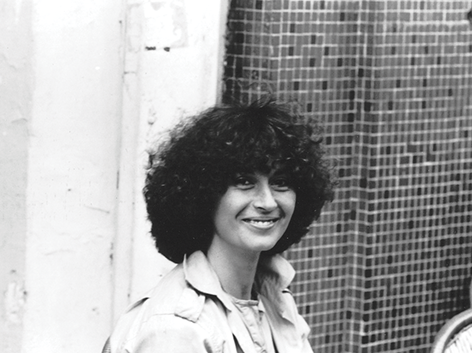
After her studies in Belgrade and subsequent work at Radio Belgrade, where she first started working in the domain of electronic music, Stefanović went to Paris (1979–1981), where she continued her research at the Institut de recherche et coordination acoustique/musique (IRCAM) (Figure 9.1). The composer reminisces about her experience in Paris:
Like many others, I, too, went abroad during the late 1970s for further training. At that time, there was no other place in the world more interesting than the Institute for Research and Coordination in Acoustics/Music in Paris. Everything was so new, from charismatic director Pierre Boulez to enormous computers for sound “production.” But I didn’t just work for 16 hours per day, although that’s what I mostly did; rather, I wandered around, absorbed, explored everything unknown and unfamiliar to me, visited museums, had conversations I will never forget, heard and saw things I liked and disliked, all of which contributed to me forming a wide perspective on the world of arts.Footnote 25
Ivana Stefanović during her studies at IRCAM in Paris, June 1981.
The work that emerged from IRCAM is Kuda sa pticom na dlanu [Wither with a bird on the palm of your hand] for percussion ensemble and tape (1979), a piece that uses sounds of water, fire, air, and earth. Stefanović attributes the title of the work to a Serbian writer and novelist, Isidora Sekulić (1877–1958). In her book about a Montenegrin prince-bishop and poet, Njegoš, Sekulić wrote that “the poet holds death in the palm of his hand as if he were holding a little bird that can’t do him any harm.”Footnote 26 Stefanović further elaborates that what impressed her about this image of death was its portrayal of “sitting meekly on the palm of the poet’s hand as he offers it a moment of rest.”Footnote 27 In her composition, Stefanović interprets this image with unexpected harmonies, a metaphor for the existence of connection and causality in all things, as well as the notion that any human, sooner or later, finds a way to reach harmony between themselves and time, the world, and, in the end, nothingness.Footnote 28
These statements are indicative of Stefanović’s curiosity for the unfamiliar and her approach to composition with a distinctive poetic way of expressing ideas, whether in music or words. Always soaking up everything in her surroundings, Stefanović hears music in every source, as she describes in her book Muzika od ma čega [Music made out of anything]:
When I say music, I think about many things. I think about an enormous, complex, comprehensive, collective phenomenon without any conceptual fragmentation into parts, groups, types, directions, styles, genres, theories, histories, forms … I think about the totality of sound and of sounding. About harmony and dissonance, equally. I think about the sound of nature, the city, machines, but also a lone frulaFootnote 29 or a large symphony orchestra. I think about something infinite and limitless, something simultaneously magnificent and ephemeral.Footnote 30
That Stefanović hears music everywhere around her is evident from her description of the cities she has lived in. Of her native Belgrade, Stefanović writes:
I love the street, the city, the noise, sirens, clanking trolleys. In the summer, I love the treetops. In the spring, I love the Linden trees on Krunska Street. In the winter, the racket of children sledding on the street. That is the language I understand.Footnote 31
During her four-year stay in Damascus, Syria (1995–1999),Footnote 32 Stefanović recorded her impressions of the city in a travelogue titled Put za Damask [The road to Damascus]. Her opening entry reveals just how she hears language as music:
Tonight, someone said: salam alaykum. Then, ahlan wa sahlan. What does it mean – I asked. Peace be with you, they responded. Peace be with you, and you are welcome. But I only heard long vowels. Water as it rolls over the rocks.Footnote 33
The notion that Stefanović hears language as music is hardly surprising, for she considers that the two ways of expression are interwoven. She explains:
I chose to use many languages – to write (words) and to compose (music and sound). Those who have read my books say that the structure of my text reveals that I am a composer … evident from the nature of my narrative and the way I structure my material. I am firmly bound to clear, spoken discourse. And I am also very bound to the abstract language of music. Thus, twofold, intertwined, connected. The more time passes, the less I can favor one over the other.Footnote 34
Stefanović recorded her visual impressions of the cities in prose and their sounds on tape, which she used in her radiophonic works, producing what musicologist Ana Kotevska calls the composer’s “sound impressions of the cities.”Footnote 35 These sounds of the environment can be heard in works like The Epistle of Bird for tape (1974), Paysage for harpsichord and tape (1980), Metropolis of Silence/Old Ras (radiophonic work, 1992), and First Eastern Dream for tape (1998). The composer described this process in her book, noting that for her, the art of sound is yet another “significant album of memories that contains the photos of sounds, sound landscapes, the horizons of the heard or the unheard.”Footnote 36 In Damascus, for instance, Stefanović records the chatter of people on the streets speaking in different languages, the sounds of children playing and singing, the clamor of the marketplace, the calls for prayers, men playing board games in the park, church bells, among many other sounds of the city and nature. But she also notes silence, which holds a prominent meaning in her oeuvre.Footnote 37
Stefanović’s earliest experimental radiophonic work is Lingua/Phonia/Patria (1988–1989), coproduced by Radionica zvuka [Sound Workshop] of Radio Belgrade and Hörspielstudio WDR in Cologne. Awestruck by the multilingualism in Yugoslavia, Klaus Schöning, director of the Hörspielstudio WDR at the time, suggested to Stefanović that she conduct acoustic research on Yugoslav multilingualism as an authentic and rare opportunity for the creation of a new radiophonic syncretism. However, while Stefanović was recording language samples from different ethnic groups and developing this project idea further, multilingual Yugoslavia was itself falling apart. Stefanović explains:
The Yugoslav community experienced a strong, brutal jolt. The collective and individual consciousness of the citizens suffered a strong, shocking blow that they could not withstand. The weak and loose ligaments of multilingualism (and multiculturalism) were revealed, but in me, it created clearer and more illuminating reasons to hurry my project.
Thus, the idea was born on the rotten ground of the disintegrating country, which you could feel in the air. … Shortly before any of this would have been even possible to do any longer, Lingua/Phonia/Patria was created, and the code for its understanding and interpretation suddenly became: farewell, parting.Footnote 38
Years later, Stefanović still reminisced:
I still wonder: since I already wanted to say goodbye to a country that was dying, why did I choose the most difficult road and use the material without any distinct emotional properties? The words I selected as the basis of this work had only vocal and semantic value. Yet, I still wanted to tell something extremely emotional, which was conveyed through the “music” of voices: children’s, women’s, choir, monastic, through timbre, color, vibrato, purity, loudness, through shouts, roars … that is, someone did “sing” after all! And while we were working inside the studio, history was rolling along outside; there were demonstrations, voices, clamor.Footnote 39
Ironically, the work she had envisioned to celebrate Yugoslavia’s unique multicultural and multiethnic state bore witness to its disintegration. Stefanović received an award for Lingua/Phonia/Patria in 1991, the year a full-blown, decade-long, brutal conflict began in Yugoslavia.
The Magnificent Seven: A Cult of Personalities
In 1988, seven young, daring, and exceptionally talented students at the Faculty of Music made a loud splash. Embracing pop, folk, MTV, musical theater, and film music, and fighting academic elitism, they brought something so new, fresh, and raw to the Yugoslav music scene. They were classical music composers with rock-star personas. They made quirky, artistic, and experimental music videos and played concerts in packed music halls. Nataša Bogojević remembers: “Our second concert was at the Student Cultural Center. The concert was sold out, and there were hundreds of people standing in the back of the hall like it was a rock concert.”Footnote 40
As Milin notes, one of the characteristic features of 1980s postmodernist expression is the composers’ desire to reach a broader audience, as music was no longer viewed to be “isolated by avant-garde ideology.”Footnote 41 Rather, music of this decade assimilated impulses from the spheres of jazz and rock music, which influenced the creation of works with elements of repetition and minimalism, with special attention devoted to sound quality. The young composers-performers – Bogdanović, Bogojević, Gostuški, Jaćimović, Jovanović, Mihajlović, and Žebeljan – calling themselves Veličanstvenih sedam [The Magnificent Seven], embodied and personified postmodernist aesthetic (Figure 9.2).Footnote 42 Not since the experimentations of Opus 4 did anyone come so close to “jolting” the art music scene in Yugoslavia with their musical, visual, and embodied expressions.
Veličanstvenih sedam [The Magnificent Seven]: (top row, left to right) Igor Gostuški and Ana Mihajlović; (center, left to right) Ognjen Bogdanović, Nataša Bogojević, and Srđan Jaćimović; (bottom, left to right) Isidora Žebeljan and Vladimir Jovanović.
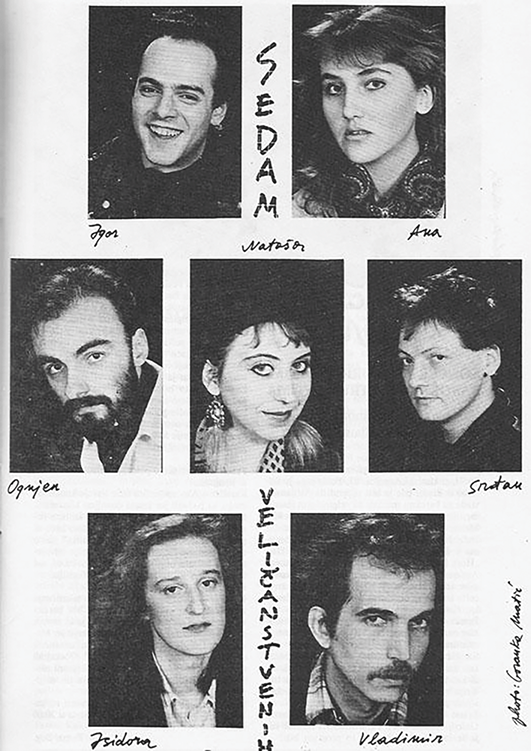
Figure 9.2 Long description
On the top are Igor Gostuški and Ana Mihajlović. In the center, left to right are Ognjen Bogdanović, Nataša Bogojević, and Srđan Jaćimović. On the bottom, left to right are Isidora Žebeljan and Vladimir Jovanović. Under each headshot is a corresponding name. Written vertically across the page is the name of the group.
Isidora Žebeljan describes how special this experience was:
The Magnificent Seven came together in the 1980s, the time when it was so wonderful to live in Belgrade and Yugoslavia because there was this new, special kind of energy bubbling everywhere …. We believed that our music was going to start a revolution against the unbearably tiresome and conservative legacy of postwar avant-garde music, whose remnants, unfortunately, still survive to this day …. We were great friends, we led a bohemian lifestyle, we had a lot of fun, but we also shared enthusiasm for minimalism, new wave, 20th-century masterworks, contemporary alternative music – for example, the Lounge Lizards, John Lurie, as well as the Cocteau Twins, Keith Jarrett, Pat Metheny, music composed by our professors Vlastimir Trajković, Zoran Erić, and Vuk Kulenović. And, of course, we wrote and played our music to each other with so much love and exhilaration.Footnote 43
Shortly after coming together, the seven composers wrote their “nonmanifesto,” which they never published, in which they outlined, in stream-of-consciousness style, their main objectives:
THIS IS NOT A MANIFESTO NOR WAS IT EVER SUPPOSED TO BE ONE
and the cultural elitism to which contemporary Yugoslav musical creation is condemned is both loathed and jealously guarded they are not avant-garde they lack sufficient intelligence and respect and they don’t want their music performed on merit for patience and endurance they are rude and pretentious they are called the magnificent seven aggressive and innovative they live think and compose and now announce it on all available media outlets the magnificent seven write music that one can listen to at home and many times over at the time marked by aggression of subcultural creativity more than ever before it senseless and pointless to ignore its influence and argue over the need for communication blah blah blahFootnote 44
The seven composers were considered the “new hope” of what was becoming a stale, academic music scene in Belgrade and Yugoslavia. Even before they formed the group, these young composers had already collected impressive accolades. Their works were performed at the Review of Yugoslav Music in Opatija (Croatia), where Ognjen Bogdanović’s compositions were included twice on the list of the most notable accomplishments (in 1986 and 1987). Bogdanović received several awards from the Composers’ Association of Serbia, as did Bogojević in 1989 for Da li da te pospem lišćem [Should I sprinkle leaves on you?] and Mihajlović in 1987 for her choral work Trag [Trace] and a piano suite Sunce [Sun]. Bogdanović also received the Faculty of Music “Stevan Hristić” Award,Footnote 45 while Bogojević was awarded the prestigious annual Josip Slavenski Prize for composition in 1987 for Formes différentes de sonneries de la Rose+Croix [Different forms of bells of Rose + Croix].Footnote 46 Igor Gostuški, in collaboration with Dragoljub Ilić, received an award from the jury, critics, and the audience at the Belgrade Spring [Beogradsko proleće] Festival. Impressively, Isidora Žebeljan had already as a student composed electronic, chamber, and vocal works, as well as incidental music for the play Life Is a Fairy Tale and a film score for Maria Like You.Footnote 47
The style of the Magnificent Seven was eclectic and distinct, not only as a group but also at a personal level. What brought them together was their love for popular music (pop, rock, and jazz, both Yugoslav and Western), a desire to shock the system, an aspiration to reach a wide (general) audience, and the audacity to stand up to the conservatism at the Faculty of Music. The Editorial Office for Classical Music of Radio Belgrade 1 also took notice:
It was not any single musical idea that brought them together, nor was it the fact that they were studying with the same professor at the Faculty of Music, where most of them are still students. They were not even united by common interest, which would be easier to achieve now in seven-fold forces.
What brought them together was their common need to write music that they love, music that those outside their circles (the audience) would believe in and accept as theirs, as music they love and listen to.Footnote 48
The Magnificent Seven was more than a group of composers; it was a phenomenon. As Žebeljan reveals in a radio interview nearly two decades later, the group was communicating with the audience not only through their music but also their clothes, makeup, costumes, concert productions, media appearances, and overall presentation:
The Magnificent Seven did wonders for the musical life of Belgrade. We organized concerts in a special way and spiced them up to break the atmosphere of grave seriousness associated with classical music concerts. Grounded in all of that was our enormous love for music and our vast enthusiasm. Those were the times when all other outstanding musicians and performers fully supported us.
We put much thought into the way we should design our concerts, how to dress and present ourselves, and what costumes to choose, not in a theatrical way but in a way that would stand out as somehow different. At one of our concerts, Slađana Milošević participated and sang in an impostor’s voice. This was the period of experimentation and incorporation of some pop elements, not in terms of pop music, but rather popular culture of that time.Footnote 49
It is telling that Slađana Milošević (1955–2024) performed with the Magnificent Seven – she was the most popular female pop star in Yugoslavia in the 1980s, known for her experimentations and genre-crossing, including pop, rock, heavy metal, new wave, synth-rock, jazz, and classical music. Nataša Bogojević succinctly explains it: “We wanted to be ‘classical’ MTV music stars so we collaborated with rock musicians.”Footnote 50 At the concert with the Magnificent Seven, held on March 19, 1989, at the Dvorana Kolarčevog Narodnog Univerziteta in Belgrade, Slađana Milošević performed with Igor Gostuški his Toccata (1988), a solo piano work that the composer had arranged for this occasion to include vocals by Milošević. Shortly after, the duo recorded an MTV-style music video, in which Gostuški plays a toccata-style work with repeating motives of constantly running notes but in irregular time, evoking both pop and jazz idioms, with Milošević vocalizing (with made-up words) in an overproduced and improvisatory manner. Underneath the piano and vocals, a synthesized sound of strings, drums, and other electronics recorded on tape amplifies the 1980s synth-pop style. The artistic video features close-ups of Milošević’s face in color with the singer’s strikingly red lipstick, superimposed against black-and-white shots of Gostuški’s hands playing the piano while sporting a notably oversized ring. The contrasting shots fade in and out and overlap to create intentionally blurry images.Footnote 51
Igor Gostuški’s musical aesthetic – with an inclination for avant-garde/postmodernist experimentation – is remarkable, considering that his father, Dragutin Gostuški – a notable Serbian composer, music historian, and aesthetician – was a staunch traditionalist in the 1950s and 1960s, who objected to all avant-garde tendencies or experimentations in music, especially the use of electronics. Deeply rooted in his traditional beliefs, which he referred to as “laws” as grounded in Ancient Greek philosophy, Dragutin Gostuški held a traditional (and outdated) view that “beauty is an absolute, irrefutable, and indestructible aesthetic fact” and that “a basic constituent of beauty for all the arts is harmony.”Footnote 52 With his son, thankfully, the apple fell far from the tree.
In a radio interview, Ognjen Bogdanović reminisces about the incredible popularity of the Magnificent Seven:
Not only were we fully embraced by all institutions – radio, concert agencies, and even the Faculty of Music – but the media was so hungry for us, they pulled us on all sides, we were invited everywhere. We played that game – that we were some sort of rock stars, not fully “classical” musicians. All doors were open to us – wherever we wanted to be and whatever we wanted to do, people accepted us with both hands, promoted us, pushed us.Footnote 53
The seven young composers were so popular that Television Belgrade (which later became Radio Television Serbia) recorded and produced their music videos. During the 1980s, Yugoslavia had an incredibly original, vibrant, and renowned new-wave music scene, which even caught the eye of the Western media – British music magazines Melody Maker and NME, as well as the Dutch Koekrand, wrote several articles in awe of the distinct flavor of Yugoslav punk, postpunk, and new wave.Footnote 54 The largest national record company in Yugoslavia, Jugoton, recorded these new alternative artists, and Television Belgrade promoted them with state-of-the-art music videos, which debuted more than a year before MTV launched in August 1981.Footnote 55
The Magnificent Seven attained a rock-star level of popularity in the country. Bogdanović reveals their dedication to the craft, originality, and the level of support they received from Television Belgrade:
In the mid-1980s, there was a new, pioneering TV program called “Videotilt,” produced by TV Beograd, which ran weekly on TVB2. It grew out of the “Odabrani trenutak” [The chosen moment] televisual intermezzo, often used to fill gaps in the continuity either with someone’s concert performance or a succession of lovely landscape images over music. Videotilt took the original idea of merging music and visuals (in the domain of classical music) but emphasized heavily the domestic music scene. As all of us, but chiefly Nata [Nataša], Isidora, and myself were already pretty well-known and established as the “young new hopes,” Videotilt took it further – the way we carried ourselves at the time and the hype from how we promoted ourselves was very media friendly (it wasn’t on purpose – it’s just how we were). Nata and I, in particular, benefited from the program, having been given the widest exposure. All of that coincided with the opening of the then-new and hi-tech television center in Košutnjak, so the stage was perfectly set as our playground to roam around.
Several video clips achieved some notoriety – one was mine; it was set to the music of my Memorabilia and, in fact, it was a short thriller-horror film, inspired by Brian De Palma’s Dressed to Kill, filmed around various Belgrade locations with a skeleton crew. The whole idea of the video – the script, the direction, even the all-important editing in the mold of MTV – was supervised by me, which today would probably be totally inconceivable, but it gives an idea as to just how involved we were. That video is unfortunately presumed lost, as TV Belgrade had a shortage of tapes, which were routinely taped over.Footnote 56 I think that one of Nataša’s videos may have survived, namely a piano piece called Kusagasuk, where she frolics around with Aleksandar Šandorov, who performed the piece.
So yeah, there was Videotilt as the new platform yearning for hot new content, and there was us yearning to provide it – a perfect (shit)storm.Footnote 57
While the above-mentioned video of Nataša Bogojević’s Kusagasuk does not seem to have survived, her video for Velika Slova [Capital letters], recorded for Videotilt in 1984 – thus, before the formation of the Magnificent Seven – illustrates the composer’s quirkiness.Footnote 58 The comical piece is one of the songs from the composer’s Putovanje po gramatici [A journey through grammar] cycle for mezzo-soprano and piano, set to the poetry of Jovan Ćirilov (1931–2014). The video features Bogojević playing the piano and singing in a musical theater style with exaggerated gestures, wearing an extravagant headdress and a matching costume with Pagliacci-inspired theatrical makeup.
In her debut with the Magnificent Seven, Bogojević presented a very different type of work, Formes différentes de sonneries de la Rose+Croix for piano, prepared piano, and harpsichord (1986), illustrating the composer’s versatility and genre-hopping, one of the group’s characteristics. Bogojević reveals that the inspiration for her piece came from Erik Satie’s chords heard in the opening of his miniature, “Air du grand Prieur” of the 1892 Sonneries de la Rose + Croix cycle. However, in a program note, Bogojević describes her novel approach to deconstructing Satie’s work, writing, “Depersonalized, in their altered context, these chords became the material out of which personal sonorities are freely formed.”Footnote 59 Shifting into a new musical time, Bogojević groups Satie’s chords “accidentally and imperceptibly,” turning them into “quasi quotations of our urban musical environment.”Footnote 60 Bogojević’s Formes différentes won the prestigious Josip Slavenski Prize for composition in Belgrade in 1987, was recognized as one of the top ten most notable compositions presented at the Review of Yugoslav Music Festival in Opatija in 1988, and the following year was awarded the third prize at the UNESCO-Rostrum of Composers in Paris (1989), a remarkable feat for the young composer.
In addition to incorporating popular culture into their music, some of the Magnificent Seven composers also infused their works with motives of their Serbian national heritage and tradition, which was especially becoming a recognizable trait for Bogojević and Žebeljan. Folk melodies, strong and asymmetrical rhythmic patterns, irregular repetitions of ostinati, and peculiar timbres, often created from the combination of eclectic instruments and ensembles, characterize a unique aesthetic of Žebeljan’s oeuvre, which eventually propelled her to become one of the most recognized and widely performed Serbian composers.Footnote 61 These traits are evident even in her earliest works. For instance, in Selište [A settlement] for string orchestra (1987), Žebeljan uses folk melodies from Vojvodina (the northern province of Serbia) as a metaphor for a settlement, now long gone; yet, as people pass through it, its memories live through the retelling of folk tales. On the other hand, Pep It Up (1988), for soprano, prepared piano, string quintet, and percussion, combines elements of Stravinsky-like strong and dissonant polychords, amplified with the drum set and other percussive instruments, and samba-like rhythms and melodic patterns, illustrating the composer’s “extraordinary rhythmic imagination.”Footnote 62 In a program note, Žebeljan reveals that the work was inspired by “replicants and androids – the perfect artificial human beings, created by the composer’s imagination,” and it represents their way of understanding and experiencing music.Footnote 63
With their unconventional concerts and provocative music videos, the Magnificent Seven were recognized with the Best Young Musician [Najbolji mladi muzičar] Award, presented by Radio Belgrade. Music critics could not get enough of the youngsters. Following their debut performance at the SKC on May 27, 1988, a columnist for the newspaper Duga, wrote:
The Grand Hall of the Student Cultural Center was too small for the [audience] who rushed to hear the debut concert of the Magnificent Seven, a group featuring the youngest composers of art music today. Unlike the composers of previous generations – the followers of modernism – this generation declares itself as postmodernist. What is the difference? The fact that, like other “post-modernists,” the magnificent seven dared to face European musical tradition without fearing the modernist, anti-European, and masochistic dogmas. Unbelievable but true: in their compositions, the European ear can once again hear the lovely sounds and consonances of the long-banished melodiousness and harmonies …. The second significant distinction of their music: it brings the audience back to the concert halls, the same audience that the neo-avant-gardes and quasi-avant-gardes once chased out of the halls.Footnote 64
Another critic for Polet noted that with their two outstanding concerts in Belgrade in 1988 – at the Gallery of the Cultural Center and the SKC – the Magnificent Seven “restored hope for classical music,” with their music making a strong mark “not only on the entire season but the entire last decade of Belgrade’s musical life.” In the publication Student, the group was described as “truly refreshing” and their music as a “new kind of listenable,” clearly demonstrating that they were composers of the modern day, aware of the history in which they were living and on which they were leaving a strong mark.Footnote 65
Tragically, shortly after their formation and just as they were gaining nationwide popularity, the political instability in Yugoslavia in 1990 brought everything to a sudden end, turning their dream into a nightmare. Milin remarks, “[The Magnificent Seven] were ambitious and impatient to get recognition for their works …. Preoccupied by their music, these young composers hardly noticed that their country was nearing some big events – not only the end of the communist era but also the break-out of secessionist wars that would dramatically change the map of their country and the fate of millions of people.”Footnote 66
All but one member of the Magnificent Seven fled Yugoslavia with the start of the brutal conflicts in the early 1990s. As Bogdanović yearningly says, “Only Isidora remained behind on the soil of our homeland, holding a light and shining it brightly for all of us until we returned.”Footnote 67 Only Igor Gostuški eventually returned, for no one could even imagine that their country would engage in decade-long bloodshed and disintegrate shortly after their departure. The country they left no longer existed.

 Open access