


Highlights
What is already known?
-
• Double-zero-event studies (DZS) are challenging for meta-analysis (MA) due to division by zero errors.
-
• Current methods to address this include continuity correction or omitting DZS.
-
• These existing methods might produce biased conclusions.
What is new?
-
• The article introduces and discusses the rationale for proposing zero-inflated bivariate generalized linear mixed model (ZIBGLMM), a novel method for handling DZS in MA.
-
• The ZIBGLMM addresses issues by using a data-driven approach to identify subpopulations with extremely low risks and model population heterogeneity.
Potential impact for Research Synthesis Methods readers
-
• The proposed ZIBGLMM can potentially provide a more accurate estimation of effect sizes, especially in MA with excess DZS.
-
• Using a data-driven approach, ZIBGLMM provides a more robust solution to handle DZS compared to existing methods, which could lead to better conclusions in research synthesis.
1 Introduction
Meta-analysis (MA) serves as an important tool for synthesizing evidence from multiple studies, providing a systematic and comprehensive understanding of the overall treatment effect. However, double-zero-event studies (DZS)—those with no events in both arms—present critical statistical challenges, leading to potential numerical instability and bias in estimating treatment effectsReference Sweeting, Sutton and Lambert 1 , Reference Bradburn, Deeks, Berlin and Russell 2 . Such studies are particularly prevalent in fields associated with rare events, such as surgical complications or adverse drug reactions.Reference Xu, Zhou and Zorzela 3 – Reference Tong, Huang, Du, Cai, Tao and Chen 5
Various strategies have been proposed for handling single-zero-event or double-zero-event studies in MA. For common effect size measures such as risk ratio (RR) and odds ratio (OR), there are divergent views on how to handle DZS. When there are zero events in one arm, the continuity correction with a fixed value of 0.5 is commonly added to each cell of a 2 $\times $
2 table for those studies.Reference Sweeting, Sutton and Lambert
1
,
Reference Cox
6
This approach allows the calculation of effect sizes such as RRs and ORs without encountering division by zero. If there are zero events in both arms, conventional practice omits these DZS from MAs of OR and RR, arguing that they contribute no information to the magnitude of the treatment effect.Reference Sweeting, Sutton and Lambert
1
Bayesian approaches have also been proposed.Reference Warn, Thompson and Spiegelhalter
7
,
Reference Vázquez, Moreno, Negrín and Martel
8
However, even with non-informative priors, selecting the right prior distribution is crucial as it can significantly impact the analysis results, particularly in cases involving rare events.Reference Stijnen, Hamza and Özdemir
9
–
Reference Senn
11
$\times $
2 table for those studies.Reference Sweeting, Sutton and Lambert
1
,
Reference Cox
6
This approach allows the calculation of effect sizes such as RRs and ORs without encountering division by zero. If there are zero events in both arms, conventional practice omits these DZS from MAs of OR and RR, arguing that they contribute no information to the magnitude of the treatment effect.Reference Sweeting, Sutton and Lambert
1
Bayesian approaches have also been proposed.Reference Warn, Thompson and Spiegelhalter
7
,
Reference Vázquez, Moreno, Negrín and Martel
8
However, even with non-informative priors, selecting the right prior distribution is crucial as it can significantly impact the analysis results, particularly in cases involving rare events.Reference Stijnen, Hamza and Özdemir
9
–
Reference Senn
11
If risk difference is of interest, Tian et al.Reference Tian, Cai, Pfeffer, Piankov, Cremieux and Wei 12 developed an exact inference procedure to synthesize evidence from DZS in an MA. Rücker et al.Reference Rücker, Schwarzer, Carpenter and Olkin 13 proposed to use the arcsine difference as a way to define treatment effects in MAs with double-zero studies. However, the limitation of the arcsine difference method is that the practical usage and interpretation of this difference in the arcsine scale is restricted.Reference Xu, Li and Lin 14
Notably, while continuity correction and omission are commonly used for handling DZS, these methods can lead to biased conclusions.Reference Rücker, Schwarzer, Carpenter and Olkin 13 Both the statistical significance and the direction of intervention effect can change after excluding DZS, as shown in both simulation studies and empirical data analyses.Reference Xu, Li and Lin 14 – Reference Cheng, Pullenayegum, Marshall, Iorio and Thabane 16 Although the continuity correction method can avoid computational errors, it usually could bias study estimates toward no difference and overestimate variances of study estimates.Reference Deeks, Higgins and Altman 4 In addition, using different continuity corrections may result in different conclusions.Reference Sweeting, Sutton and Lambert 1
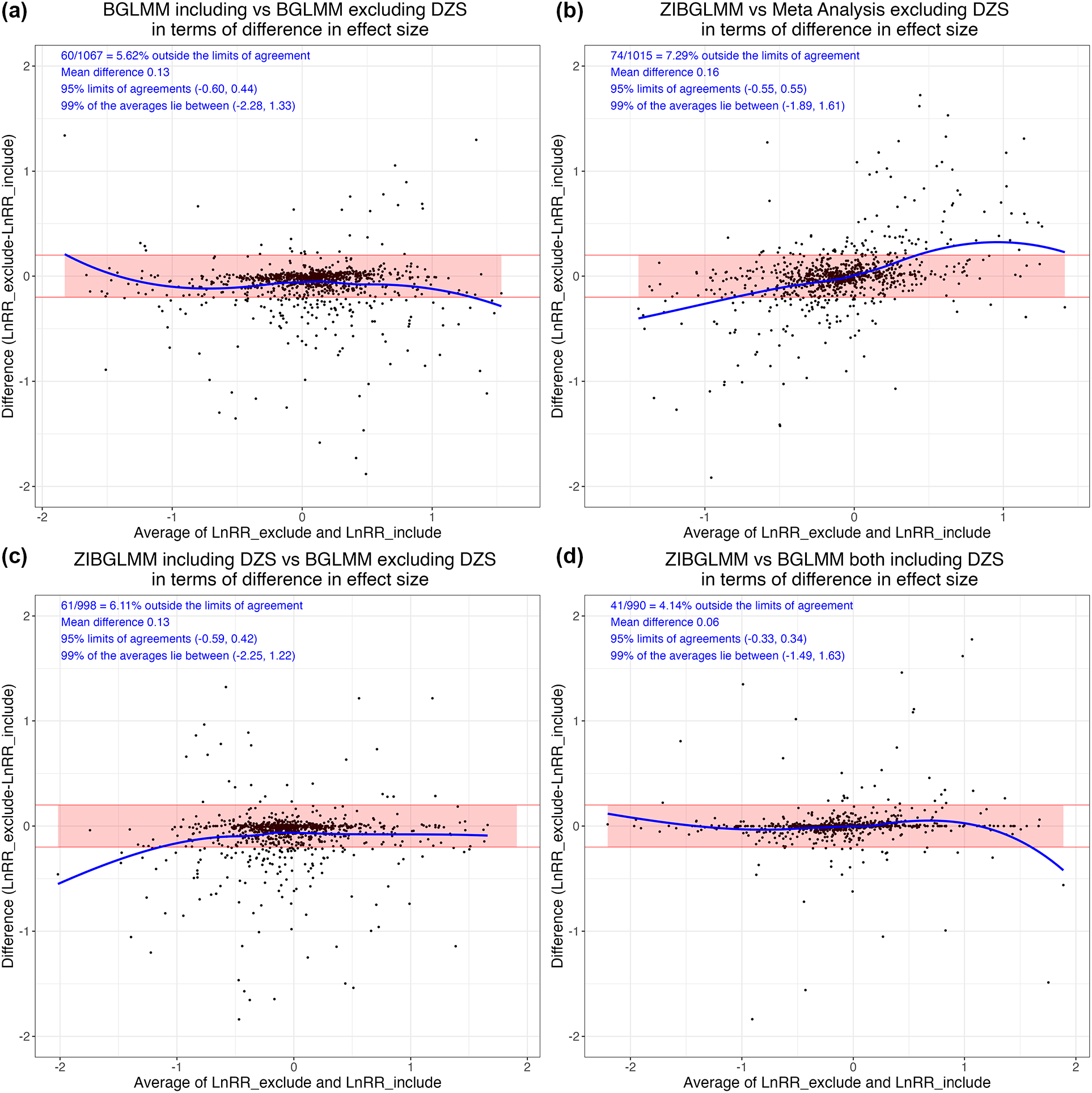
Excluding DZS is straightforward to implement but may lead to misleading inference. Böhning and SangnawakijReference Böhning and Sangnawakij 17 showed that double-zero studies do not contribute to the conditional log likelihood when using one-stage method using a Poisson regression model and a conditional binomial model to include the double-zero studies. However, as Xu et al.Reference Xu, Zhou and Zorzela 3 pointed out, this may not hold true for some other models such as the multilevel logistic regression modelReference Platt, Leroux and Breslow 18 and beta-binomial model.Reference Mathes and Kuss 19 In addition, excluding DZS does not fully utilize all the available evidence and can potentially lead to misleading inference if the excluded studies are systematically different from the included studies.Reference Xu, Zhou and Zorzela 3 , Reference Xu, Lin and Vohra 20 – Reference Kuss 22 Also, if the assumed underlying population event probabilities are not zero, DZS contain information for inference on the parameters such as the common OR in MA and can contribute to the estimation of treatment effects and thus cannot be left out in our analysis.Reference Xie, Kolassa, Liu, Liu and Liu 23 Figure 1a illustrates how the effect sizes could change significantly depending on whether we include or exclude double-zero studies based on 1,111 MAs from Cochrane Database of Systematic Reviews (CDSR) (see details in Section 0.5).
Estimated effect size differences using four methods, that is, bivariate generalized linear mixed model (BGLMM) including double-zero-event studies (DZS), BGLMM excluding DZS, conventional two-stage meta-analysis (MA) excluding DZS (MA), and zero-inflated bivariate generalized linear mixed model (ZIBGLMM) including DZS. In each subfigure, the y-axis is the difference in log risk ratios (RRs) between the two methods, and the x-axis is the average of the log RRs of the two methods being compared. Subfigure (a) contrasts the BGLMM with and without DZS. Subfigure (b) explores the difference in effect size between ZIBGLMM and MA, both excluding DZS. Subfigure (c) presents a similar comparison between ZIBGLMM including DZS and BGLMM excluding DZS. Subfigures (a–c) shed light on how the inclusion or exclusion of DZS significantly impacts effect sizes based on 1,111 Cochrane meta-analyses. Subfigure (d) provides a comparison between ZIBGLMM and BGLMM, both incorporating DZS. It illustrates a more concentrated distribution, signifying a smaller difference in log RR. Each subfigure displays the number of MAs lying outside the 95% limits of agreement, the mean difference between log RRs, 95% limits of agreements, and 99% range of the averages of log RRs at its upper left corner.
Generalized linear mixed models (GLMMs) offer a flexible approach for modeling effect sizes and can incorporate information from DZS without ad hoc continuity correction.Reference Platt, Leroux and Breslow 18 , Reference Xu, Furuya-Kanamori and Lin 24 Bivariate generalized linear mixed models (BGLMMs) have been proposed to include random effects (REs) and potential correlation between treatment groups.Reference Chu, Nie, Chen, Huang and Sun 25 – Reference Lin and Chu 28 These models can handle studies with zero events by specifying an appropriate link function and error distribution. For example, BGLMM has been applied to assess whether including DZS impacts the conclusions in a recent systematic review on prevention measures for preventing person-to-person transmission of COVID-19.Reference Xiao, Lin, Hodges, Xu and Chu 29
Despite their utility, all the models mentioned above fail to address one potential key cause of DZS, that is, non-exchangeable heterogeneity in the population. DZS may occur if the study involves subpopulations with a negligible or extremely low probability of experiencing the event of interest. For instance, healthy subjects less than 65 years old only have negligible risks of experiencing hospitalization or death due to severe symptoms from COVID-19, compared to immunocompromised, unhealthy, or older subjects. The study populations with negligible or extremely low risks are fundamentally different from the remaining populations with low or moderate risks due to intrinsic differences in patient characteristics. Since the BGLMM assumes study populations are exchangeable, the above heterogeneity cannot be modeled properly with BGLMM.
To appropriately handle DZS and account for non-exchangeable heterogeneity in study populations, we propose a zero-inflated bivariate generalized linear mixed model (ZIBGLMM). Zero-inflated models have been commonly applied in other areas to model excess zero counts. Zero-inflated Poisson models have been applied to RE MA.Reference Böhning, Mylona and Kimber 30 Beisemann et al.Reference Beisemann, Doebler and Holling 31 compared three models (RE Poisson regression, RE zero-inflated Poisson regression, and binomial regression) to the standard methods in conjunction with different continuity corrections and different versions of beta-binomial regression.
Our article is the first to apply zero-inflated models in MAs to address non-exchangeable heterogeneity across study populations. It assumes that an
MA with a proportion of zero-event studies potentially contains two subpopulations: one with a near-zero risk and another with a higher risk. The ZIBGLMM can account for non-exchangeable heterogeneity as well as the correlation among studies in a data-driven fashion. Further, it can properly estimate the overall effect size by avoiding the biases in ad hoc solutions and can accurately infer the proportion of the low-risk population in each MA study.
Our contributions in this article are twofold. First, we introduce a novel method, ZIBGLMM, to incorporate DZS into MAs. Our model takes into account potential population heterogeneity and demonstrates its utility through both real-world and simulation studies. Second, we provide both frequentist and Bayesian implementations of the model. SAS and R implementations are publicly available in the GitHub repository.Reference Li 32
The rest of the article is organized as follows. Section 0.2 provides a motivating example that involves numerous DZS with various sample sizes ranging from 22 to 144 to demonstrate the rationale behind ZIBGLMM. Section 0.3 introduces the zero-inflated models and formulates both a frequentist and a Bayesian version of the model. Section 0.4 reanalyzes the example case study in Section 0.2 to demonstrate the clinical usefulness of the proposed method. Sections 0.5 and 0.6 present 1,111 real-world MAs from CDSR and 18,000 simulated MAs to compare the performance of various methods for estimating the RRs under various scenarios. Finally, Section 0.7 summarizes our key findings and limitations.
2 A motivating example
We explain the rationale behind the ZIBGLMM method using an example MA taken from the CDSR. The study investigates whether misoprostol could help prevent or treat excessive bleeding and reduce maternal deaths among women after birth.Reference Hofmeyr, Gülmezoglu, Novikova and Lawrie
33
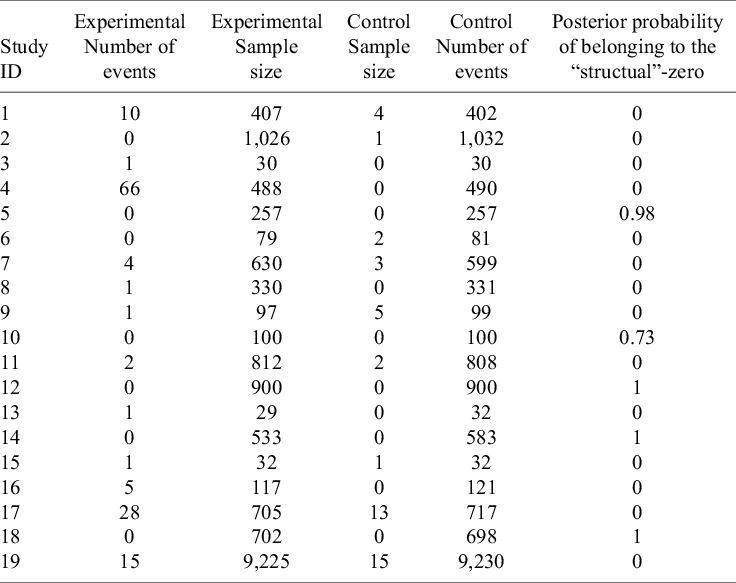
This review involves 19 studies, 5 of which are DZS. These DZS, with sample sizes ranging from 100 to 900, were excluded from the MA. Table 1 displays the specific data for these studies. The original analysis suggests that when comparing misoprostol using 600 $\mu $
g misoprostol or more versus placebo or other uterotonics, the results for “maternal death or severe morbidity” are statistically nonsignificant (RR 1.67, 95% CI 0.80–3.45). In Section 0.4, we will revisit this case study to illustrate how including these DZS could yield different clinical conclusions.
$\mu $
g misoprostol or more versus placebo or other uterotonics, the results for “maternal death or severe morbidity” are statistically nonsignificant (RR 1.67, 95% CI 0.80–3.45). In Section 0.4, we will revisit this case study to illustrate how including these DZS could yield different clinical conclusions.
Motivation example study dataReference Hofmeyr, Gülmezoglu, Novikova and Lawrie 33
The rationale of the ZIBGLMM method is based on the observation that in an MA with a low overall event probability, the probability of encountering large studies with double-zero events should be low. For instance, given an event probability of 1%, the likelihood of a DZS with a sample size of 1,000 is approximately $0.99^{1,000}\approx 4/100,000$
. Thus, it is improbable that these large DZS belong to the same population as the other studies included in the MA. This suggests that using the BGLMM method to incorporate all DZS and treating them as exchangeable with other studies may be inappropriate. Conversely, some smaller DZS may have double-zero events by chance, which means that completely excluding all DZS may not be the best approach either. The ZIBGLMM method addresses these issues by using a data-driven approach to identify the proportion of populations with extremely low risks and model population heterogeneity.
$0.99^{1,000}\approx 4/100,000$
. Thus, it is improbable that these large DZS belong to the same population as the other studies included in the MA. This suggests that using the BGLMM method to incorporate all DZS and treating them as exchangeable with other studies may be inappropriate. Conversely, some smaller DZS may have double-zero events by chance, which means that completely excluding all DZS may not be the best approach either. The ZIBGLMM method addresses these issues by using a data-driven approach to identify the proportion of populations with extremely low risks and model population heterogeneity.
The proposed method is only intended to be used for MAs with a moderate to large size ( $\geq $
10 studies). We acknowledge that most of the real-world MAs are of smaller sizes.Reference Turner, Davey, Clarke, Thompson and Higgins
34
,
Reference Vandermeer, Bialy and Hooton
35
However, the sophistication of the proposed statistical model, which includes a bivariate outcome, a 2
$\geq $
10 studies). We acknowledge that most of the real-world MAs are of smaller sizes.Reference Turner, Davey, Clarke, Thompson and Higgins
34
,
Reference Vandermeer, Bialy and Hooton
35
However, the sophistication of the proposed statistical model, which includes a bivariate outcome, a 2 $\times $
2 matrix of REs, and a mixture distribution, might lead to convergence issues in more realistic scenarios with fewer studies. Although this will potentially limit the broad impact of our method, we would like to avoid misleading conclusions when applying sophisticated models like ours to a limited number of studies.
$\times $
2 matrix of REs, and a mixture distribution, might lead to convergence issues in more realistic scenarios with fewer studies. Although this will potentially limit the broad impact of our method, we would like to avoid misleading conclusions when applying sophisticated models like ours to a limited number of studies.
3 Methods
3.1 Notation
Let $N_{ik}$
be the number of subjects, and let
$N_{ik}$
be the number of subjects, and let ${P}_{ik}$
be the probability of an event for the
${P}_{ik}$
be the probability of an event for the $i\text {th}$
study (
$i\text {th}$
study ( $i = 1,2,\ldots ,\ m$
), where
$i = 1,2,\ldots ,\ m$
), where $k = 1$
represents the treatment (or exposed) group and
$k = 1$
represents the treatment (or exposed) group and $k=0$
represents the control (or unexposed) group, respectively. Let
$k=0$
represents the control (or unexposed) group, respectively. Let $X_{ijk}$
denote a Bernoulli random variable, with a value of
$X_{ijk}$
denote a Bernoulli random variable, with a value of $1$
denoting an event and a value of
$1$
denoting an event and a value of $0$
denoting a nonevent for the
$0$
denoting a nonevent for the $j\text {th}$
subject (
$j\text {th}$
subject ( $j = 1,2,\ldots ,N_{ik} $
) of the
$j = 1,2,\ldots ,N_{ik} $
) of the $i\text {th}$
study in the
$i\text {th}$
study in the $k\text {th}$
treatment group. Let
$k\text {th}$
treatment group. Let ${Y_{ik}} = \Sigma _{j = 1}^{N_{ik}}\ X_{ijk}$
be the total number of events in the
${Y_{ik}} = \Sigma _{j = 1}^{N_{ik}}\ X_{ijk}$
be the total number of events in the $k\text {th}$
treatment group in the
$k\text {th}$
treatment group in the $i\text {th}$
study. The event counts
$i\text {th}$
study. The event counts ${Y_{ik}}$
follow a binomial distribution,
${Y_{ik}}$
follow a binomial distribution, ${Y_{ik}} \sim Bin\left ( N_{ik}, {P}_{ik} \right )$
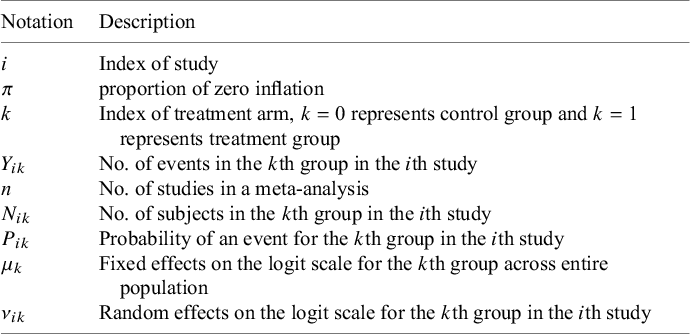
. Denote n as the total number of studies within an MA. The notations are summarized in Table 2.
${Y_{ik}} \sim Bin\left ( N_{ik}, {P}_{ik} \right )$
. Denote n as the total number of studies within an MA. The notations are summarized in Table 2.
Descriptions of notation
3.2 Zero-inflated models
The zero-inflated model proposed by LambertReference Lambert 36 has been widely applied to count data with excess zeros in various scientific fields such as industrial manufacturing,Reference Lambert 36 biomedical horticulture,Reference Hall 37 and healthcare data.Reference Mouatassim and Ezzahid 38 It is formulated as a mixture of a point mass at zero, which generates the excess zeros, and a count distribution that generates the remaining values. The zero-inflated models are particularly useful for data with a higher-than-expected number of zeros under standard count models. Besides commonly used zero-inflated Poisson models, Ghosh et al.Reference Ghosh, Mukhopadhyay and Lu 39 extend the models to include a broad class of distributions (e.g., power series distributions). Böhning et al.Reference Böhning, Mylona and Kimber 30 apply the zero-inflated Poisson to RE MA. To the best of our knowledge, this work is the first application of zero-inflated models for handling DZS in the context of MAs with two arms using BGLMM.
Zero-inflated models, by design, segregate observed zeros into two distinct categories. The first category, often referred to as “structural” zeros, represents individuals who are not susceptible to a specific event, thereby having no chance of a positive count. The second category, known as “at-risk” or “chance” zeros, corresponds to a latent group of individuals who are at risk for an event but have a recorded count of zero. The zero-inflated binomial (ZIB) model can then be formulated as follows:
 $$ \begin{align*}{Y_{ik}} \sim \begin{cases}0, & \text{ with probability } \pi,\\ \text{Binomial}(N_{ik}, {P}_{ik}), & \text{ with probability } 1-\pi, \end{cases}\end{align*} $$
where $\pi $
is the proportion of zero inflation, that is, the probability that a given subject belongs to the low-risk subpopulation.
$\pi $
is the proportion of zero inflation, that is, the probability that a given subject belongs to the low-risk subpopulation.
For instance, in our study examining the number of people experiencing adverse events for probiotics, structural zeros might be indicative of patients in good health, resulting in experiencing no adverse events. Conversely, the at-risk zeros could represent patients who are more susceptible to adverse events, due to various circumstances, and experienced no adverse events by chance. Consequently, zero-inflated models can be interpreted as latent class models, where the classes are defined by these two types of zeros.Reference Neelon 40
HallReference Hall 37 discusses classical statistical approaches that utilize the maximum likelihood estimation and the likelihood ratio (LR) test for zero-inflated Poisson regression. In the context of non-normal data, classical inference often relies on approximation theory, which is based on large sample sizes and may involve the application of nonstandard asymptotic theory.Reference Self and Liang 41 However, Ghosh et al.Reference Ghosh, Mukhopadhyay and Lu 39 showed that the classical procedure does not perform well in estimating the zero-inflation probability when the sample size is finite, and the zero-inflation probability is close to unity, but the Bayesian estimates performed very well with respect to interval width and coverage probability.
3.3 Bivariate generalized linear mixed models
To estimate the effect sizes using conventional two-stage MA, one needs to estimate the event probabilities as ${\hat {P}_{ik}} = {Y_{ik}}/ N_{ik} $
. For DZS,
${\hat {P}_{ik}} = {Y_{ik}}/ N_{ik} $
. For DZS, ${\hat {P}_{ik}}$
values are zero for both the treatment and control arms, creating numerical difficulty in estimating the effect sizes using RRs or ORs due to division by zero.
${\hat {P}_{ik}}$
values are zero for both the treatment and control arms, creating numerical difficulty in estimating the effect sizes using RRs or ORs due to division by zero.
One approach to include DZS is to use the BGLMM method to directly model the event counts ${Y_{ik}}$
with binomial likelihoods instead of estimating the effect sizes of individual studies. The BGLMM can be specified as follows: let
${Y_{ik}}$
with binomial likelihoods instead of estimating the effect sizes of individual studies. The BGLMM can be specified as follows: let $g(\cdot )$
denote the link function that transforms event probabilities into linear forms. We have
$g(\cdot )$
denote the link function that transforms event probabilities into linear forms. We have
 $$\begin{align*}Y_{ik} \sim Bin(N_{ik}, P_{ik}) \text{ (likelihood)},\end{align*}$$
 $$\begin{align*}g\left( {P}_{i0} \right) = {\mu}_0 + \nu_{i0} \text{ (link function)},\end{align*}$$
 $$\begin{align*}g\left( {P}_{i1} \right) = {\mu}_1 + \nu_{i1} \text{ (link function)},\end{align*}$$
 $$\begin{align*}\left( \nu_{i0}\ ,\nu_{i1} \right)^{\top} \sim N\left( (0,0)^{\top},\ \Sigma \right),\ \Sigma = \begin{pmatrix} \sigma_{0}^{2} & r\sigma_{0}\sigma_{1} \\ r\sigma_{0}\sigma_{2} & \sigma_{1}^{2} \\ \end{pmatrix} \text{ (REs)}.\end{align*}$$
To implement the natural constraint of $- 1 < r < 1$
, one can use Fisher’s z transformation as
$- 1 < r < 1$
, one can use Fisher’s z transformation as $r = \frac {\left \lbrack \exp (2z) - 1 \right \rbrack }{\left \lbrack \exp (2z) + 1 \right \rbrack }$
.
$r = \frac {\left \lbrack \exp (2z) - 1 \right \rbrack }{\left \lbrack \exp (2z) + 1 \right \rbrack }$
.
We consider the logit link function for $g( \cdot )$
. The parameters
$g( \cdot )$
. The parameters ${\mu }_0$
and
${\mu }_0$
and ${\mu }_1$
are fixed effects and represent the average risks in the control and treatment groups in the logit scale. Study-specific REs in the logit scale,
${\mu }_1$
are fixed effects and represent the average risks in the control and treatment groups in the logit scale. Study-specific REs in the logit scale, $\nu _{i0}$
and
$\nu _{i0}$
and $\nu _{i1}$
, are assumed to follow a bivariate normal distribution with a covariance matrix
$\nu _{i1}$
, are assumed to follow a bivariate normal distribution with a covariance matrix $\Sigma $
. The parameters
$\Sigma $
. The parameters $\sigma _{0}^{2}$
and
$\sigma _{0}^{2}$
and $\sigma _{1}^{2}$
are between-study variances for the control and treatment groups due to heterogeneity, respectively, and r is the correlation between the two groups.
$\sigma _{1}^{2}$
are between-study variances for the control and treatment groups due to heterogeneity, respectively, and r is the correlation between the two groups.
3.4 Zero-inflated bivariate generalized linear mixed models
One important limitation of the above BGLMM is its inability to account for excess DZS. This is because BGLMM ignores the intrinsic difference between DZS and the others by treating all studies as exchangeable, even if some studies may be conducted on different subpopulations.
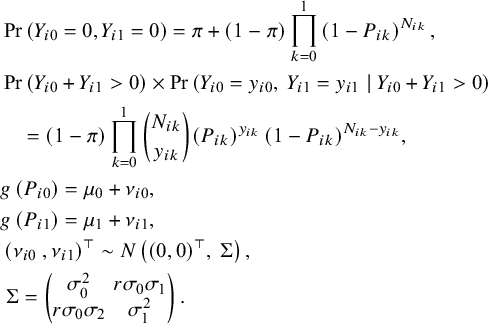
To take into account the population heterogeneity, we introduce the ZIBGLMM method, which is a two-component finite mixture model. Specifically, we assume that the event probability in a certain study subpopulation, referred to as a “healthy population,” is extremely low, approximately equal to zero. In contrast, we assume that the other subpopulation, referred to as a “sicker population,” has a relatively high event probability. We denote $\pi $
as the proportion of studies with healthy populations representing individuals who have approximately zero risk for the event of interest.
$\pi $
as the proportion of studies with healthy populations representing individuals who have approximately zero risk for the event of interest.
In the first stage, the ZIBGLMM combines two zero-generating processes for the number of events ${Y_{ik}}$
. The first process generates double zeros for both arms from extremely low-risk subpopulations. The second process is governed by a binomial distribution that generates the numbers of events, some of which may be zero by chance. The mixture is described as follows:
${Y_{ik}}$
. The first process generates double zeros for both arms from extremely low-risk subpopulations. The second process is governed by a binomial distribution that generates the numbers of events, some of which may be zero by chance. The mixture is described as follows:
 $$ \begin{align*} & \Pr\left( Y_{i0} = 0, Y_{i1} = 0 \right) = \pi + (1 - \pi)\prod_{k = 0}^{1} \left( 1 - {P}_{ik} \right)^{N_{ik}},\\ & \Pr\left( Y_{i0} + Y_{i1}> 0 \right) \times \Pr\left( Y_{i0} = y_{i0},\ Y_{i1} = y_{i1} \mid Y_{i0} + Y_{i1} > 0 \right) \\ & \quad=(1 - \pi)\prod_{k = 0}^{1} {N_{ik} \choose y_{ik}}{\left( {P}_{ik} \right)^{y_{ik}}\left( 1 - {P}_{ik} \right)^{N_{ik} - y_{ik}}},\\ &g\left( {P}_{i0} \right) = {\mu}_0 + \nu_{i0},\\ & g\left( {P}_{i1} \right) = {\mu}_1 + \nu_{i1},\\ & \left( \nu_{i0}\ ,\nu_{i1} \right)^{\top} \sim N\left( (0,0)^{\top},\ \Sigma \right),\\ & \ \Sigma = \begin{pmatrix} \sigma_{0}^{2} & r\sigma_{0}\sigma_{1} \\ r\sigma_{0}\sigma_{2} & \sigma_{1}^{2} \\ \end{pmatrix}. \end{align*} $$
Of note, Dong et al.Reference Dong, Zhao and Tiwari 42 proposed a ZIB model for MA with sparse binary outcomes. However, they allowed for different proportions of zero-inflation for different treatment arms, which might not be the case for randomized control trials (RCTs), where the proportion of zero inflation for the two treatment arms should be the same. In contrast to their approach, we restrict the proportion of the healthy subpopulation to be equal across two treatment arms, which is more realistic given the setting of RCTs.
In this article, we focus on the overall treatment effect in the at-risk population measured by the marginal RR as suggested by McCullagh,Reference McCullagh
43
,
Reference Longford, Diggle and Nelder
44
which is defined as $\text {RR} = \frac {E\left ( p_{0} \right )}{E\left ( p_{1} \right )}.$
The marginal event probabilities can be obtained through a well-established approximation formula:
$\text {RR} = \frac {E\left ( p_{0} \right )}{E\left ( p_{1} \right )}.$
The marginal event probabilities can be obtained through a well-established approximation formula: $E\left ( p_{k} \right ) \approx \operatorname {expit} \left ( \frac {{\mu }_k}{\sqrt {1 + C^{2}\sigma _{k}^{2}}} \right )$
for
$E\left ( p_{k} \right ) \approx \operatorname {expit} \left ( \frac {{\mu }_k}{\sqrt {1 + C^{2}\sigma _{k}^{2}}} \right )$
for $k = 0,\ 1$
, with
$k = 0,\ 1$
, with $C = \frac {16\sqrt {3}}{15\pi }$
for the bivariate logit RE model.Reference Zeger, Liang and Albert
45
$C = \frac {16\sqrt {3}}{15\pi }$
for the bivariate logit RE model.Reference Zeger, Liang and Albert
45
Our formulation of ZIBGLMM leverages zero-inflated models to account for subpopulations with an extremely low risk of experiencing the studied outcome. It uses a data-driven approach to capture the heterogeneity in the population, leading to improved model fitting and more reliable results in MAs.
3.5 Bayesian formulation
This section introduces a Bayesian formulation of the ZIBGLMM method. It is based on the Bayesian hierarchical model formulation of the RE MA modelReference Hoff 46 , Reference Gelman, Carlin, Stern, Dunson, Vehtari and Rubin 47 and the Bayesian zero-inflated models.Reference Neelon 40
Specifically, the Bayesian model can be formulated as follows, using the notations in Table 2:
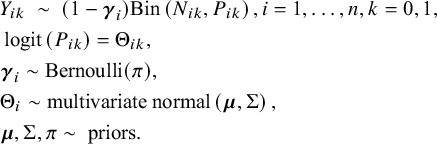 $$ \begin{align*} &{Y_{ik}}\ \sim\ (1-\boldsymbol{\gamma}_i) \text{Bin}\left( N_{ik}, {P}_{ik} \right), i = 1, \ldots, n, k = 0,1, \\ & \operatorname{logit} \left( {P}_{ik} \right) = {\Theta_{ik}},\\ &\boldsymbol{\gamma}_i \sim \text{Bernoulli}(\pi), \\ &\Theta_i \sim \text{multivariate normal}\left( \boldsymbol{\mu},\Sigma \right),\\ &\boldsymbol{\mu}, \Sigma, \pi \sim \text{ priors}. \end{align*} $$
Here, $\operatorname {logit}({P}_{i1}) - \operatorname {logit}({P}_{i0})$
is the log OR. Adopting the same approach, an equivalent model on the RR replaces the logit function with the log function. That is,
$\operatorname {logit}({P}_{i1}) - \operatorname {logit}({P}_{i0})$
is the log OR. Adopting the same approach, an equivalent model on the RR replaces the logit function with the log function. That is, $\operatorname {log}({P}_{i1}) - \operatorname {log}({P}_{i0})$
is the log RR. We employ a general procedure of data augmentation by including latent variables
$\operatorname {log}({P}_{i1}) - \operatorname {log}({P}_{i0})$
is the log RR. We employ a general procedure of data augmentation by including latent variables $\boldsymbol {\gamma }$
to the data Y such that
$\boldsymbol {\gamma }$
to the data Y such that ${Y_{ik}} = (1-\boldsymbol {\gamma }_i) V_{ik} + \gamma _i W_{ik}$
, where
${Y_{ik}} = (1-\boldsymbol {\gamma }_i) V_{ik} + \gamma _i W_{ik}$
, where $W_{ik}$
is the random variable with point mass distribution at 0,
$W_{ik}$
is the random variable with point mass distribution at 0, $V_{ik}\sim \text {Bin}(N_{ik}, {P}_{ik})$
,Reference Tanner and Wong
48
that is,
$V_{ik}\sim \text {Bin}(N_{ik}, {P}_{ik})$
,Reference Tanner and Wong
48
that is, $\boldsymbol {\gamma }_i$
is a latent variable indicating whether the study is coming from the extremely low-risk population.
$\boldsymbol {\gamma }_i$
is a latent variable indicating whether the study is coming from the extremely low-risk population.
The Bayesian approach requires specifying prior distributions for $\boldsymbol {\mu }, \Sigma $
, and
$\boldsymbol {\mu }, \Sigma $
, and $ \pi $
. Given the parametrization on logit scale, the event probabilities
$ \pi $
. Given the parametrization on logit scale, the event probabilities $P_{ik}$
are forced to be between 0 and 1, and
$P_{ik}$
are forced to be between 0 and 1, and $\theta _{ik}$
can range over the whole real line. A natural class of prior distributions for
$\theta _{ik}$
can range over the whole real line. A natural class of prior distributions for $\theta _{ik}$
is the class of multivariate normal distributions. We assign the inverse-Wishart distribution, which is a multivariate analog of the gamma distribution, as the semi-conjugate prior distribution for the covariance matrix
$\theta _{ik}$
is the class of multivariate normal distributions. We assign the inverse-Wishart distribution, which is a multivariate analog of the gamma distribution, as the semi-conjugate prior distribution for the covariance matrix $\Sigma $
and the multivariate normal distribution as the prior for
$\Sigma $
and the multivariate normal distribution as the prior for $\boldsymbol {\mu }$
. We use weakly informative priors for the parameters of
$\boldsymbol {\mu }$
. We use weakly informative priors for the parameters of $\boldsymbol {\mu }$
and
$\boldsymbol {\mu }$
and $\Sigma $
that are weakly centered around estimates derived from the observed data, that is, the population mean and covariance of
$\Sigma $
that are weakly centered around estimates derived from the observed data, that is, the population mean and covariance of ${\mu _0}$
and
${\mu _0}$
and ${\mu _1}$
. These are commonly specified in normal hierarchical models.Reference Hoff
46
We use a beta prior for
${\mu _1}$
. These are commonly specified in normal hierarchical models.Reference Hoff
46
We use a beta prior for $\pi $
, that is,
$\pi $
, that is, $\pi \sim \text {Beta} (a,b)$
. Note that
$\pi \sim \text {Beta} (a,b)$
. Note that $a=b=1$
gives the uniform prior on
$a=b=1$
gives the uniform prior on $(0,1)$
for
$(0,1)$
for $\pi $
.
$\pi $
.
The joint posterior distribution is given by
 $$ \begin{align*} p\left( \boldsymbol{\Theta},\boldsymbol{\mu},\boldsymbol{\gamma},\Sigma\mid Y \right) &\propto p\left( Y\mid\boldsymbol{\Theta},\boldsymbol{\gamma} \right) p\left( \boldsymbol{\Theta}\mid{\boldsymbol{\mu}},\Sigma \right) p\left( {\boldsymbol{\mu}} \right) p\left(\Sigma \right) p(\boldsymbol{\gamma} \mid \pi) p(\pi) \end{align*} $$
and
 $$\begin{align*}\Pr(Y_{i0} = y_{i0}, Y_{i1} = y_{i1} \mid \Theta_i, \pi ) = \pi \mathbb{I}_{ \{Y_{i0} = 0, Y_{i1} = 0\}} + (1 - \pi)\prod_{k = 0}^{1} {N_{ik} \choose y_{ik}}{\left( {P}_{ik} \right)^{y_{ik}}\left( 1 - {P}_{ik} \right)^{N_{ik} - y_{ik}}},\end{align*}$$
where ${P}_{ik} = \operatorname {expit}({\Theta _{ik}})$
.
${P}_{ik} = \operatorname {expit}({\Theta _{ik}})$
.
We use the Gibbs sampling approachReference Geman and Geman
49
for the estimation of our full posterior distribution of $\boldsymbol {\mu }, \Sigma , \boldsymbol {\gamma }, \pi $
by sampling them from their full conditional distributions:
$\boldsymbol {\mu }, \Sigma , \boldsymbol {\gamma }, \pi $
by sampling them from their full conditional distributions:
-
1. $p({\boldsymbol {\mu }}|\Sigma ,\boldsymbol {\Theta }\mathbf {,\ }\boldsymbol {\gamma },\pi ,Y) \propto \ MVN\ (\boldsymbol {\mu }_{n},\Lambda _{n})$
, where
$$ \begin{align*}\Lambda_n = (\Lambda_0^{-1}+n\Sigma^{-1})^{-1}, {\boldsymbol{\mu}}_n = (\Lambda_0^{-1}+n\Sigma^{-1})^{-1} (\Lambda_0^{-1}\boldsymbol{\mu}_0 + n\Sigma^{-1}\bar{\boldsymbol{\theta}})\end{align*} $$
$p({\boldsymbol {\mu }}|\Sigma ,\boldsymbol {\Theta }\mathbf {,\ }\boldsymbol {\gamma },\pi ,Y) \propto \ MVN\ (\boldsymbol {\mu }_{n},\Lambda _{n})$
, where
$$ \begin{align*}\Lambda_n = (\Lambda_0^{-1}+n\Sigma^{-1})^{-1}, {\boldsymbol{\mu}}_n = (\Lambda_0^{-1}+n\Sigma^{-1})^{-1} (\Lambda_0^{-1}\boldsymbol{\mu}_0 + n\Sigma^{-1}\bar{\boldsymbol{\theta}})\end{align*} $$
and
$\boldsymbol {\mu }_0$
and
$\Lambda _0$
are the prior mean and variance of
$\boldsymbol {\mu }$
, respectively, and
$\bar {\boldsymbol {\theta }}$
is the vector of treatment-arm-specific averages
$\bar {\boldsymbol {\theta }} = (\frac {1}{n} \sum _{i=1}^n \Theta _{i, 1}, \frac {1}{n}\sum _{i=1}^n \Theta _{i, 2})^\intercal $
. -
2.
$ p(\Sigma |\boldsymbol {\mu },\boldsymbol {\Theta },\boldsymbol {\gamma },\pi ,Y) \propto $
inverse-Wishart
$\left ( \eta _{0} + n,\ \left \lbrack S_{0} + S_{{\mu }} \right \rbrack ^{- 1} \right ) $
, where
$S_{{\mu }} = \sum _{i = 1}^{n}{\left ( \Theta _{i} - \boldsymbol {\mu } \right )\left ( \Theta _{i} - \boldsymbol {\mu } \right )^{T}}$
, and we take
$S_0 = \Lambda _0$
but only loosely center
$\Sigma $
around this value by taking
$\eta _0 = p+2=4$
, where p is the number of treatment arms. -
3.
$ p(\boldsymbol {\gamma }_i \mathbf {\mid }\boldsymbol {\Theta }\mathbf {,}{\boldsymbol {\mu }},\pi ,\Sigma ,{Y_{ik}})\propto Bernoulli\left ( \frac {\pi \mathbf {1}_{\{Y_{i0} = 0, Y_{i1}=0\}}}{\prod _{k=0}^1 \left ( 1 - {P}_{ik} \right )^{N_{ik} - {Y_{ik}}} (1-\pi ) + \pi \mathbf {1}_{\{Y_{i0} = 0, Y_{i1}=0\}}} \right )$
, where
${P}_{ik} = \operatorname {expit}({\Theta _{ik}})$
. -
4.
$p(\pi \mathbf {\mid }\boldsymbol {\gamma }\mathbf {,}\boldsymbol {\Theta ,}{\boldsymbol {\mu },}\Sigma ,Y) \propto Beta\left ( 1 + \sum _{i = 1}^{n}\boldsymbol {\gamma }_{i},1 + \sum _{i=1}^{n}{(1 - \boldsymbol {\gamma }_{i}}) \right )$
.


We then use a Metropolis stepReference Metropolis, Rosenbluth, Rosenbluth, Teller and Teller
50
for the estimation of the full posterior distribution of REs $\boldsymbol {\Theta }$
.Reference Hoff
46
,
Reference Gelman, Carlin, Stern, Dunson, Vehtari and Rubin
47
The complete Metropolis–Hastings approximation algorithm is:
$\boldsymbol {\Theta }$
.Reference Hoff
46
,
Reference Gelman, Carlin, Stern, Dunson, Vehtari and Rubin
47
The complete Metropolis–Hastings approximation algorithm is:
-
1. Sample
$\boldsymbol {\mu }^{(s+1)}$
from
$p({\boldsymbol {\mu }}|\Sigma ^{(s)},{\Theta ^{(s)}}, \boldsymbol {\gamma }^{(s)},\pi ^{(s)},Y)$
. -
2. Sample
$\Sigma ^{(s+1)}$
from
$p(\Sigma |{\boldsymbol {\mu }^{(s)},\Theta ^{(s)}},\boldsymbol {\gamma }^{(s)},\pi ^{(s)}, Y)$
. -
3. Sample
$\boldsymbol {\gamma }_i^{(s+1)}$
from
$p(\boldsymbol {\gamma }_{i}\mathbf {\mid }{\Theta }_{{i}}^{(s)},{\boldsymbol {\mu }}^{(s)},\pi ^{(s)},\Sigma ^{(s)},Y)$
for
$i= 1 \ldots n.$
-
4. Sample
$\pi ^{(s+1)}$
from
$p(\pi \mathbf {\mid }\boldsymbol {\gamma }^{(s)},{\Theta ^{(s)}},{\boldsymbol {\mu }^{(s)}},\Sigma ^{(s)},Y)$
. -
5. For each
$j\in {1,\ldots , n}$
,-
(a) sample
$\Theta _j^*\sim $
multivariate normal
$(\Theta _j^{(s)},\frac {1}{2}\Sigma ^{(s)})$
; -
(b) compute the acceptance rate
$$ \begin{align*}r = \frac{p(Y\mid \Theta_j^*, \pi^{(s)}, \boldsymbol{\gamma}^{(s)}, \boldsymbol{\mu}^{(s)},\Sigma^{(s)}) p(\Theta_j^*\mid \boldsymbol{\mu}^{(s)}, \Sigma^{(s)})}{p(Y\mid \Theta_j^{(s)}, \pi^{(s)}, \boldsymbol{\gamma}^{(s)}, \boldsymbol{\mu}^{(s)},\Sigma^{(s)}) p(\Theta_j^{(s)}\mid \boldsymbol{\mu}^{(s)}, \Sigma^{(s)})};\end{align*} $$
-
(c) sample
$u\sim $
uniform
$(0,1)$
. Set
$\Theta _j^{(s+1)}$
to
$\Theta _j^*$
if
$u<r$
and to
$\Theta _j^{(s)}$
if
$u>r$
.
-


We used 100,000 iterations with thinning to keep every $100\text {th}$
value and set the burn-in period to be
$100\text {th}$
value and set the burn-in period to be $10,000$
. We manually examined the trace plot and autocorrelation for a few example datasets to make sure the autocorrelation between the samples was low and the acceptance rate was around
$10,000$
. We manually examined the trace plot and autocorrelation for a few example datasets to make sure the autocorrelation between the samples was low and the acceptance rate was around $50\%$
.
$50\%$
.
3.6 Implementation
The frequentist BGLMM and ZIBGLMM were implemented using PROC NLMIXED in SAS Studio 3.81 (Enterprise Edition). The REs were approximately integrated by the default adaptive Gaussian quadrature, and likelihood maximization used the conjugate gradient optimization algorithm. The Bayesian models were implemented using R version 4.2.2. In addition to our custom Bayesian Gibbs Sampler, we have implemented a version of the model using the RStan package using R version 4.2.2. This alternative provides a flexible framework, facilitating the customization and experimentation with various prior distributions. It is worth noting that our original model utilizes an inverse Wishart distribution for the priors and adapts the scale matrix dynamically during sampling, which can be complex to replicate in Stan. Consequently, the RStan implementation uses an LKJ correlation prior to the covariance matrix instead of the inverse Wishart distribution. The source SAS and R implementation code along with simulation and Cochrane datasets can be found in the GitHub repository.Reference Li 32
4 Case study
We apply our ZIBGLMM method to the MA of 19 studies conducted by Hofmeyr et al.,Reference Hofmeyr, Gülmezoglu, Novikova and Lawrie
33
which involves 33,041 participants. This MA compares misoprostol use of greater than or equal to 600 $\mu $
g dose versus placebo in terms of reducing maternal deaths or severe morbidity.Reference Hofmeyr, Gülmezoglu, Novikova and Lawrie
33
The original analysis suggests that when comparing misoprostol use of greater than or equal to 600
$\mu $
g dose versus placebo in terms of reducing maternal deaths or severe morbidity.Reference Hofmeyr, Gülmezoglu, Novikova and Lawrie
33
The original analysis suggests that when comparing misoprostol use of greater than or equal to 600 $\mu $
g versus placebo, the results for “maternal death or severe morbidity” are statistically nonsignificant (RR 1.67, 95% CI 0.80–3.45). In the original analysis, 5 of the 19 studies were DZS, with sample sizes ranging from 100 to 900, and were excluded from the analysis.
$\mu $
g versus placebo, the results for “maternal death or severe morbidity” are statistically nonsignificant (RR 1.67, 95% CI 0.80–3.45). In the original analysis, 5 of the 19 studies were DZS, with sample sizes ranging from 100 to 900, and were excluded from the analysis.
To evaluate the impact of using different strategies for handling the DZS on the results, we applied various methods to the same data as in Hofmeyr et al. When using the Mantel–Haenszel estimateReference Mantel and Haenszel 51 of the risk difference, the estimated risk difference is 0.005 when including the DZS and changes to 0.006 when excluding the DZS. The estimated RR using the Mantel–Haenszel method is 2.84 (95% CI 2.03–3.99). Our Bayesian ZIBGLMM method yielded an RR of 2.98 (95% CI 1.97–4.62), which suggests a 198% increase in the risk of maternal death or severe morbidity associated with high dosage use of misoprostol compared with placebo. This conclusion is also consistent with the general recommendation of using the lowest effective dose of misoprostol to treat/prevent maternal bleeding after giving birth. Using the Bayesian BGLMM method yielded an RR of 2.81 (95% CI 1.78–4.37). This investigation underscores that neglecting DZS can lead to nonnegligible differences in the final estimated effects in MAs.
We note that the difference between the original analysis and the ZIBGLMM method might be due to the fact that they used conditional effects, while we focused on marginal effects.Reference Neuhaus, Kalbfleisch and Hauck 52 Nonetheless, the difference between the BGLMM and ZIBGLMM methods is 0.17, suggesting that accounting for DZS could lead to estimates that differ to a large degree.
The estimated proportion of structural zeros $\pi $
is 0.246. For every single study, the posterior probabilities of belonging to the “structural”-zero or “nonstructural”-zero study cluster are reported in Table 1. The estimated
$\pi $
is 0.246. For every single study, the posterior probabilities of belonging to the “structural”-zero or “nonstructural”-zero study cluster are reported in Table 1. The estimated $\rho $
is 0.062, which suggests a slight positive correlation between the treatment and control outcomes within studies. The estimated variances are 0.079 and 0.061 for the treatment and control groups, respectively, which provide insights into the variability of the effect sizes within each group. The Akaike information criterion (AIC) of the frequentist version of the ZIBGLMM model is 1,756.3, and the AIC of the BGLMM model is 1,761.7. The deviance information criterion (DIC) of the Bayesian ZIBGLMM model is 979.02, and the DIC of the Bayesian BGLMM is 973.84.
$\rho $
is 0.062, which suggests a slight positive correlation between the treatment and control outcomes within studies. The estimated variances are 0.079 and 0.061 for the treatment and control groups, respectively, which provide insights into the variability of the effect sizes within each group. The Akaike information criterion (AIC) of the frequentist version of the ZIBGLMM model is 1,756.3, and the AIC of the BGLMM model is 1,761.7. The deviance information criterion (DIC) of the Bayesian ZIBGLMM model is 979.02, and the DIC of the Bayesian BGLMM is 973.84.
5 Cochrane meta-analyses
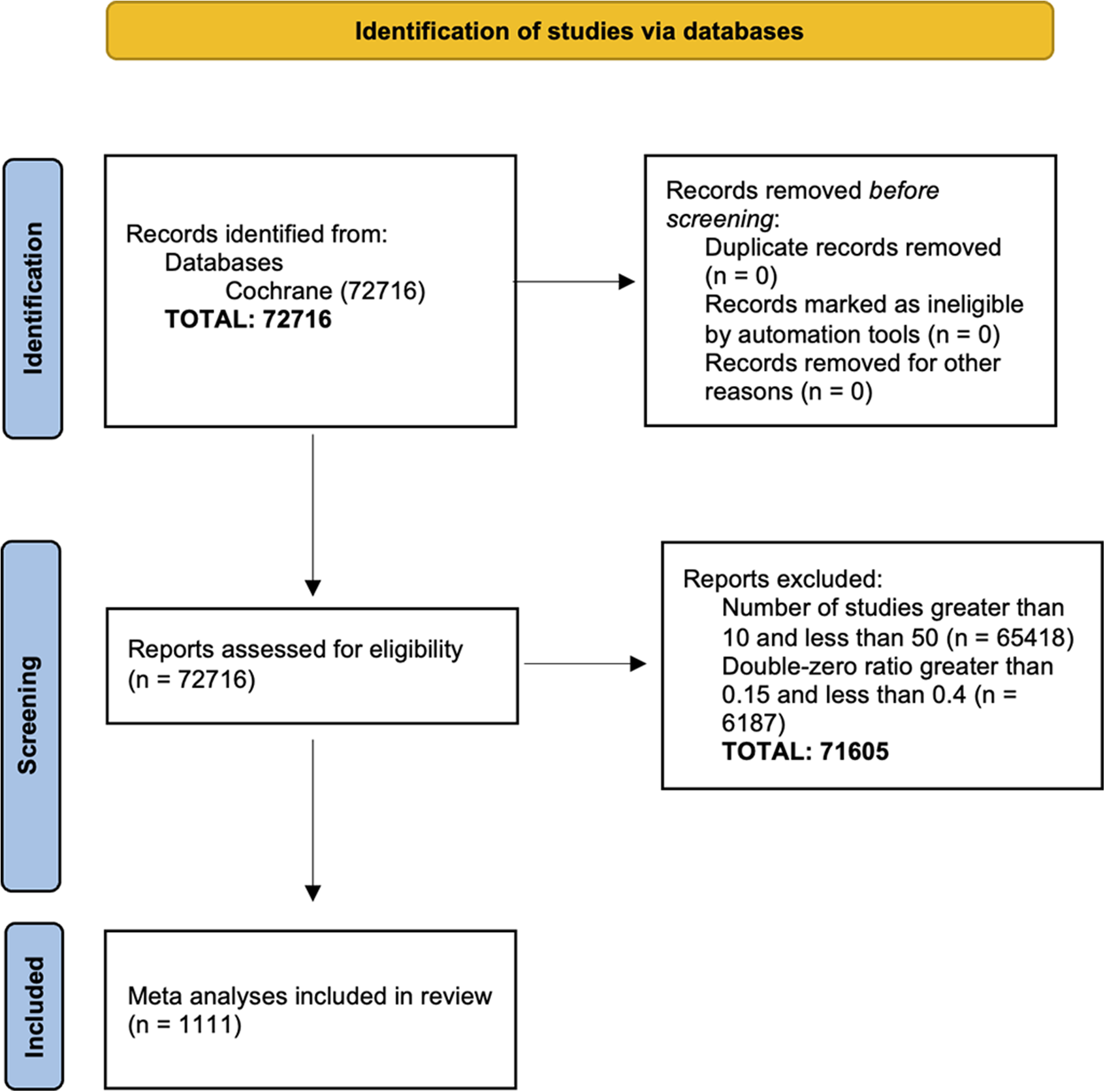
To evaluate the practical impacts of our ZIBGLMM method on a wide spectrum of MAs across different clinical domains, we conducted a meta-meta-analysis using a large number of datasets in the CDSR collected in our previous work.Reference Lin, Chu and Murad 53 We identified 1,111 MAs, each containing between 15 and 50 studies (inclusive), with proportions of double-zero studies ranging from 0.15 to 0.4. Figure 2 shows the PRISMA (preferred reporting items for systematic reviews and aeta-analyses) flowchart detailing how we selected the 1,111 studies.Reference Moher, Liberati, Tetzlaff and Altman 54 Note that we do not know the true effect sizes for these real-world studies.
PRISMA plot of the 1,111 Cochrane Database of Systematic Reviews meta-analyses included in this article. We extracted 1,111 studies with sample sizes between 10 and 50 and with double-zero ratios between 0.15 and 0.4 from a total of 72,716 studies.
We meta-analyzed each dataset using a conventional two-stage method that excludes DZS, as well as both the frequentist and Bayesian versions of BGLMM and ZIBGLMM. When using the frequentist approach, 1,015 datasets converged for ZIBGLMM, while 1,084 datasets converged for BGLMM. The Bayesian BGLMM and ZIBGLMM successfully converged and provided the estimated effect sizes for all 1,111 studies.
To explore the impact of excluding DZS versus including DZS in an MA, we contrasted four methods based on the inclusion or exclusion of DZS, focusing on estimated effect size differences. The comparisons are listed below:
-
A. BGLMM with DZS versus BGLMM without DZS: to investigate the impact of excluding DZS in one-stage method BGLMM.
-
B. ZIBGLMM with DZS versus conventional two-stage MA without DZS: to investigate the impact of excluding DZS in conventional MA.
-
C. ZIBGLMM with DZS versus BGLMM without DZS: to investigate the impact of including DZS versus not between two one-stage methods.
-
D. ZIBGLMM versus BGLMM, both incorporating DZS: to investigate the impact of using different one-stage methods to incorporate DZS.
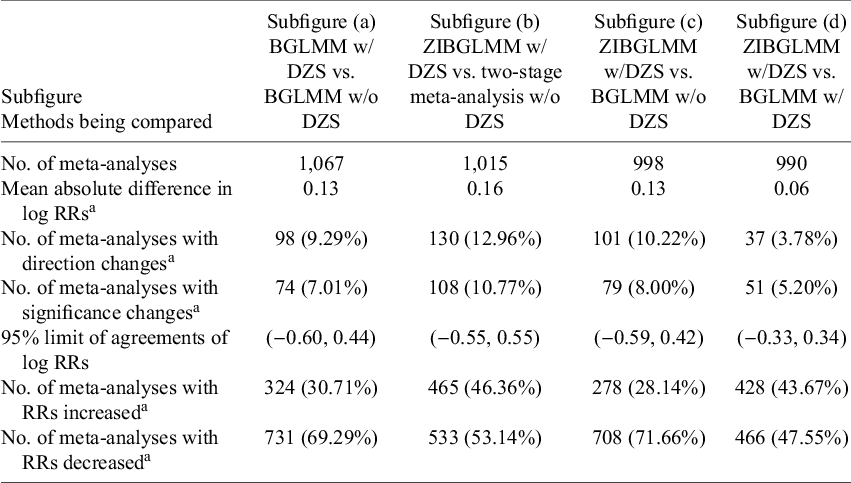
Specifically, we applied the Bland–Altman analysisReference Altman and Bland 55 to determine the difference in each comparison. The results are displayed in Figure 1. Notably, the mean effect size difference can reach up to 0.16 when comparing methods that differ in DZS inclusion (ZIBGLMM with DZS vs. MA without DZS). However, when both ZIBGLMM and BGLMM include DZS, this mean effect size difference narrowed down to 0.06. This suggests that omitting DZS can significantly alter effect size estimates.
Table 3 presents the results for further quantifying the impact of the exclusion of DZS and the methodological differences in both the magnitude and direction of log RRs. We detail the percentages of increase and decrease and document the count and proportion of pairs with different directions. The effect changed the direction if the RRs flipped, that is, log RR changing from “< 0” to “> 0.” The significance is flipped if the p-value transitioned from nonsignificant to significant, using a 0.05 threshold. We used the middle 99% of the RRs to leave out outliers.
Summary of the comparative analysis of different methods in Figure 1
 $^{a}$
Denotes using the middle 99% of data to exclude extreme values.
$^{a}$
Denotes using the middle 99% of data to exclude extreme values.
The highest percentage of direction change is observed in comparison B (ZIBGLMM with DZS vs. MA without DZS) at 12.96%, while the lowest percentage is observed in comparison D (ZIBGLMM vs. BGLMM both including DZS) at 3.78%. This indicates excluding DZS can lead to changes in effect directions. Comparison B (ZIBGLMM with DZS vs. MA without DZS) records the highest percentage of significance flip at 10.77%, with comparison D (ZIBGLMM vs. BGLMM both including DZS) having the lowest at 5.20%. The findings suggest that excluding DZS could lead to significant changes, that is, difference with a magnitude of greater than 0.1, in estimated effect sizes in MA. This finding is consistent across various methods, including conventional two-stage MA that excludes DZS, BGLMM, and ZIBGLMM.
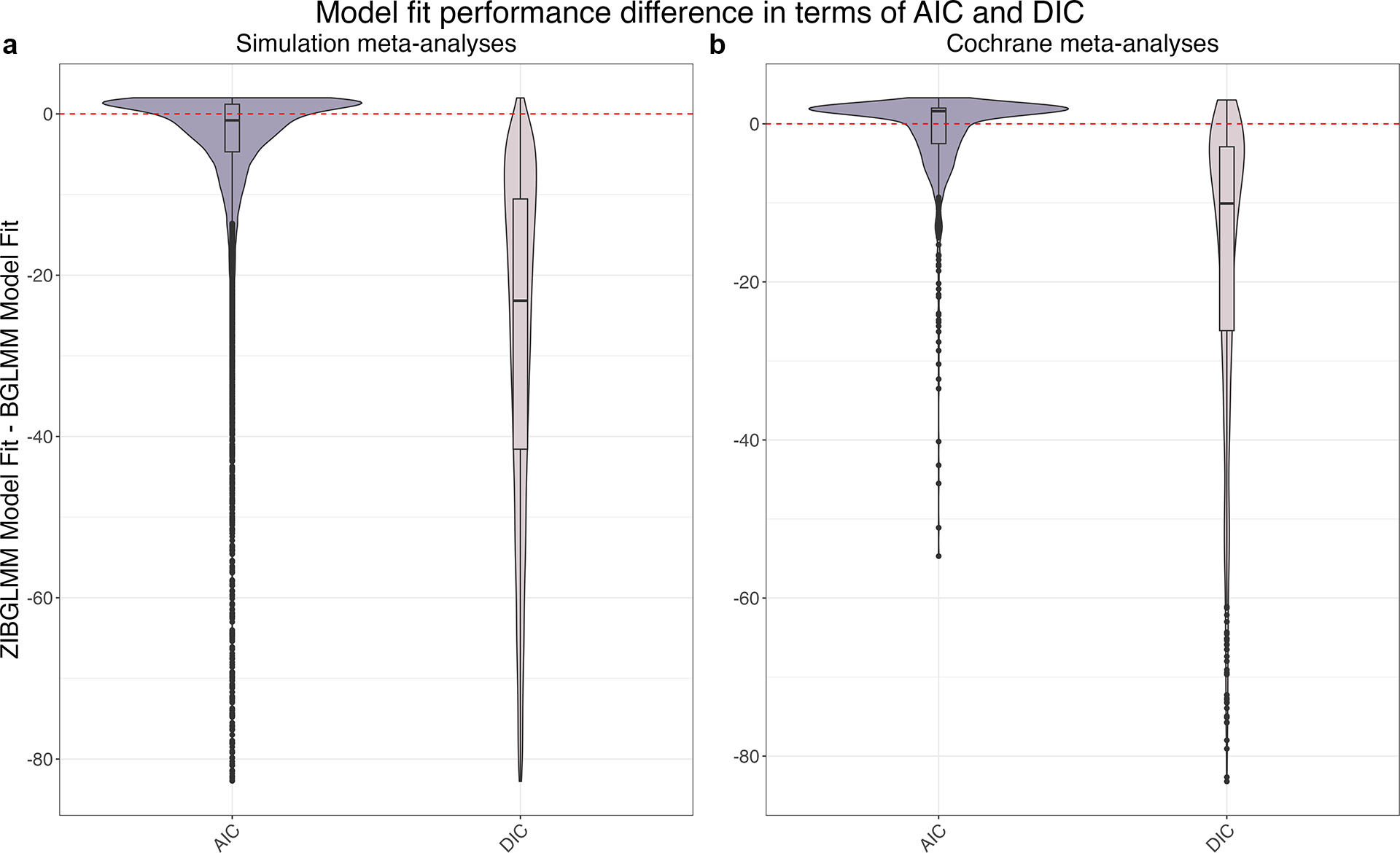
Finally, we compared the frequentist and Bayesian methods of BGLMM and ZIBGLMM in terms of their goodness of fit using AIC and DIC. Figure 3b displays the distribution of AIC and DIC differences for the Cochrane MAs, with the y-axis representing the difference in goodness of fit between ZIBGLMM and BGLMM. The violin plot included a box plot where the box limits indicated the range of the central 50% of the data (i.e., the range between the 25th and 75th percentiles), and the median value was marked by a central black line, along with a kernel smoothed density plot representing the probability distribution. ZIBGLMM outperformed BGLMM in 365 of 1,010 (36.13%) Cochrane MAs as measured by AIC, and in 986 of 1,111 (88.74%) datasets based on DIC.
Model goodness of fit in terms of Akaike information criterion (AIC) and deviance information criterion (DIC) differences between the ZIBGLMM and BGLMM methods for simulation meta-analyses (MAs) in subfigure (a) and Cochrane MAs in subfigure (b). Each violin plotReference Hintze and Nelson 66 included a box plot where the box limits indicated the range of the central 50% of the data (i.e., the range between the 25th and 75th percentiles), and the median value was marked by a central black line, along with a kernel smoothed density plot representing the probability distribution. The y-axis in each subplot represents the goodness of fit of ZIBGLMM subtracting the goodness of fit of BGLMM. The dashed line represents when the difference is 0. Subfigure (a) illustrates the distribution of AIC and DIC differences for 18,000 simulation datasets. The ZIBGLMM exhibited superior fit for 8,839 of 16,215 (54.51%) simulation studies as measured by AIC, and for 17,805 out of 18,000 (98.92%) simulation studies when measured by DIC. Subfigure (b) illustrates the distribution of AIC and DIC differences for 1,111 Cochrane MAs. The ZIBGLMM exhibited superior fit for 365 of 1,010 (36.13%) Cochrane MAs as measured by AIC and for 986 out of 1,111 (88.74%) Cochrane MAs when measured by DIC.
In summary, our meta-meta-analysis study suggests that the inclusion or exclusion of DZS in MAs can influence effect size estimates, with disparities in mean effect size differences reaching up to 0.16. Additionally, both the direction and significance of effect sizes can be altered depending on the methodologies employed. The findings underscore the importance of carefully considering methodological choices in MAs, particularly when handling datasets with double-zero studies.
6 Simulations
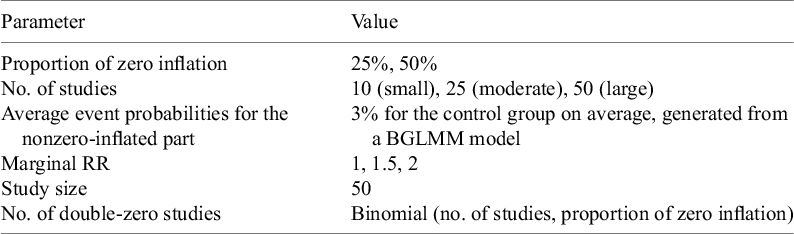
In addition to the Cochrane datasets, we conducted extensive simulation studies to evaluate our methods in various settings. We simulated MAs with small (10), moderate (25), and large (50) numbers of studies of sample size $50$
. The nonzero-inflated data were generated using the BGLMM. The number of DZS for each MA was generated from a binomial distribution with proportions of zero-inflation of 25% and 50%. The baseline event risk in the control group was set at 3%, and the average marginal RR was established at 1, 1.5, and 2. Detailed settings of the simulation studies can be found in Table 4. A total of 1,000 MAs were simulated for each of the 18 combinations of settings.
$50$
. The nonzero-inflated data were generated using the BGLMM. The number of DZS for each MA was generated from a binomial distribution with proportions of zero-inflation of 25% and 50%. The baseline event risk in the control group was set at 3%, and the average marginal RR was established at 1, 1.5, and 2. Detailed settings of the simulation studies can be found in Table 4. A total of 1,000 MAs were simulated for each of the 18 combinations of settings.
Specifications for the simulation studies
We applied both the frequentist and Bayesian versions of BGLMM and ZIBGLMM to each simulated MA, assessing their goodness of fit with AIC and DIC. The distribution of AIC and DIC differences across the 18,000 simulation datasets is depicted in Figure 3a, with the y-axis representing the goodness of fit differences between ZIBGLMM and BGLMM. The violin plot included a box plot where the box limits indicated the range of the central 50% of the data (i.e., the range between the 25th and 75th percentiles), and the median value was marked by a central black line, along with a kernel smoothed density plot representing the probability distribution. ZIBGLMM outperformed BGLMM in 8,839 of 16,215 (54.51%) simulation studies in terms of AIC and in 17,805 of 18,000 (98.92%) studies based on DIC. These findings underscore ZIBGLMM’s robustness in the simulated scenarios.
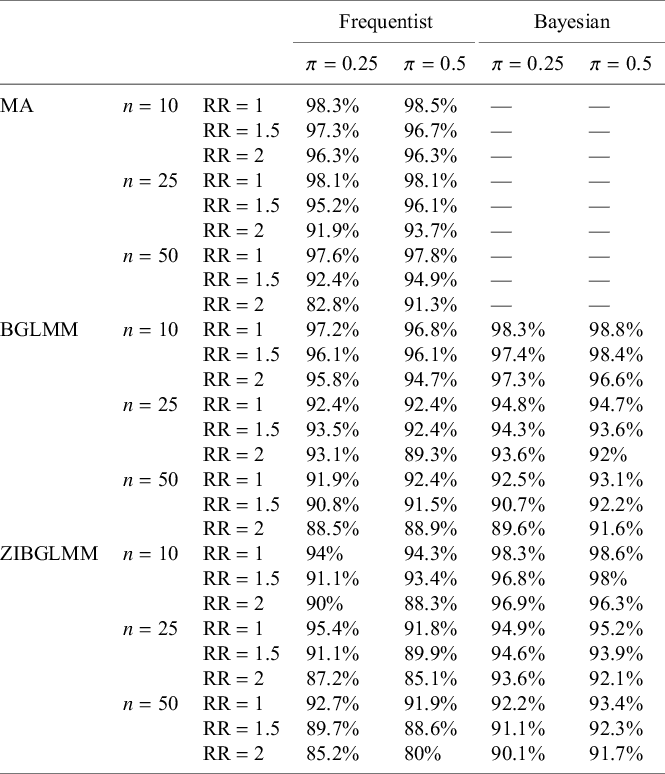
We compared the coverage properties of conventional two-stage MAs excluding DZS and both the frequentist and Bayesian versions of BGLMM and ZIBGLMM. Figure 4 shows the coverage probabilities, along with the mean lengths of confidence intervals (frequentist models) and credible intervals (Bayesian models), while detailed coverage probabilities can be found in Table 5. Remarkably, the Bayesian BGLMM and Bayesian ZIBGLMM display comparable, consistently high coverage probabilities to MA, while maintaining the shortest mean confidence interval widths across all settings among all five methods. The coverage probabilities for all methods decrease as the average marginal RRs increase and as the size of studies increases. The coverage properties of frequentist BGLMM and ZIBGLMM were calculated contingent on the number of MAs that attained convergence.
Coverage probability of the five methods: two-stage meta-analysis excluding DZS (MA), BGLMM, Bayesian BGLMM, ZIBGLMM, and Bayesian ZIBGLMM
Coverage probability and mean CI length of conventional two-stage meta-analysis (MA), bivariate generalized linear mixed models (BGLMM), Bayesian BGLMM, zero-inflated bivariate generalized linear mixed models (ZIBGLMM), and Bayesian ZIBGLMM for meta-analyses with 10 studies (a), 25 studies (b), and 50 studies (c). The y-axis displays the coverage probability, and the x-axis displays the mean 95% confidence/credible interval widths. The number of studies in an MA is denoted by n. The Bayesian BGLMM and Bayesian ZIBGLMM displayed comparable, consistently high coverage probabilities to MA, while maintaining the shortest mean credible interval widths across all settings. The coverage probabilities for all methods decreased as the average marginal risk ratio increased and as the size of studies increased.
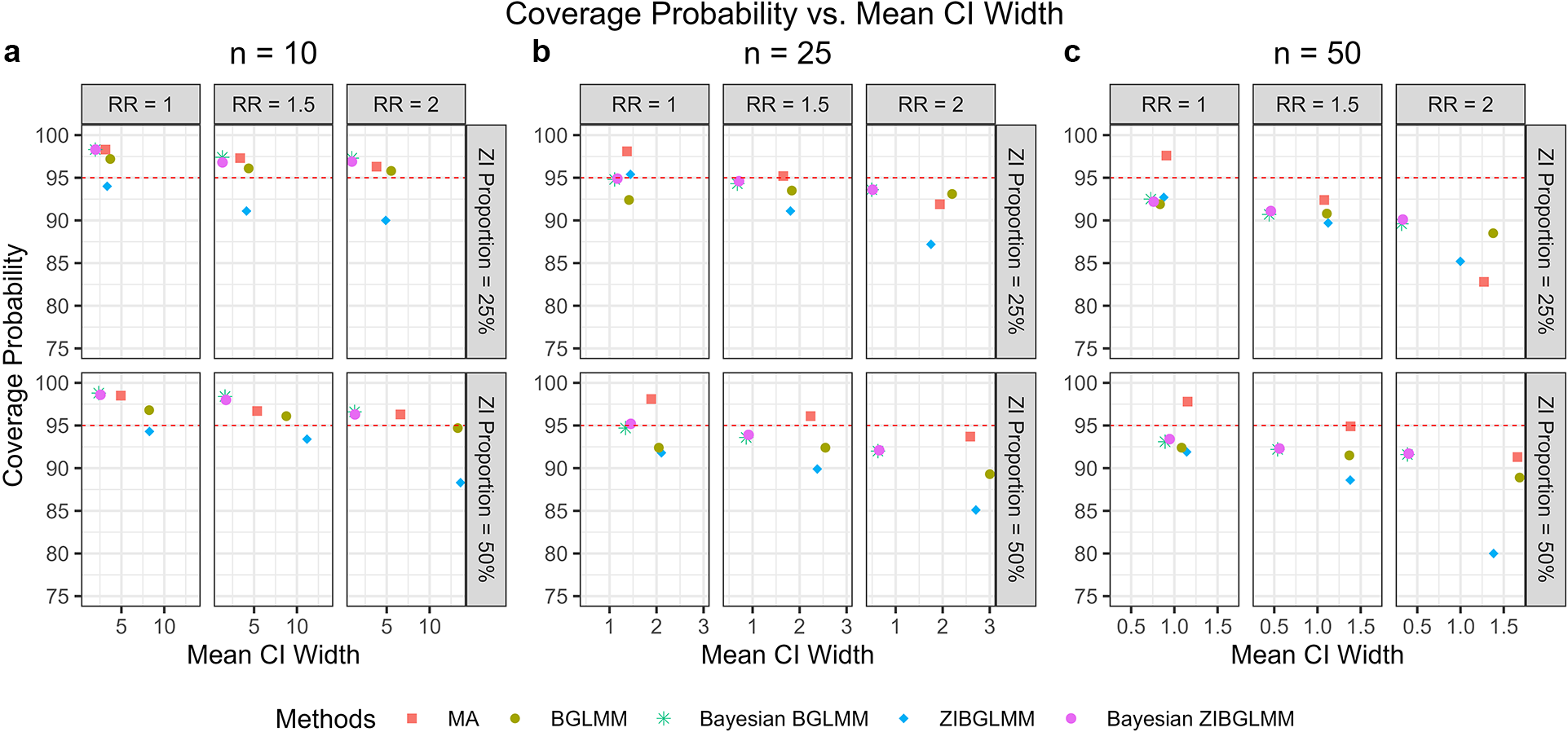
Figure 5 shows the bias in the estimation of RR obtained from conventional two-stage MA excluding DZS, along with the frequentist and Bayesian versions of BGLMM and ZIBGLMM. The frequentist ZIBGLMM obtains the least bias for MAs of small size (10 studies), while the Bayesian BGLMM manifests the least bias for MAs of moderate size (e.g., with 25 studies) among the five methods. The Bayesian BGLMM and ZIBGLMM obtain effect size estimates with a comparatively small bias for large MAs (e.g., with 50 studies).
Bias in the estimation of risk ratio from conventional two-stage meta-analysis excluding DZS (MA), alongside the frequentist and Bayesian versions of BGLMM and ZIBGLMM. For meta-analyses (MAs) with a smaller size (10 studies), the frequentist ZIBGLMM exhibits the least bias. For MAs with a moderate size (25 studies), Bayesian BGLMM manifests the least bias. The Bayesian BGLMM and ZIBGLMM archives the smallest bias for large (50 studies) MAs. Frequentist ZIBGLMM consistently demonstrates less bias than the frequentist BGLMM. For all settings, both frequentist and Bayesian BGLMM and ZIBGLMM consistently yield smaller biases compared to MA.
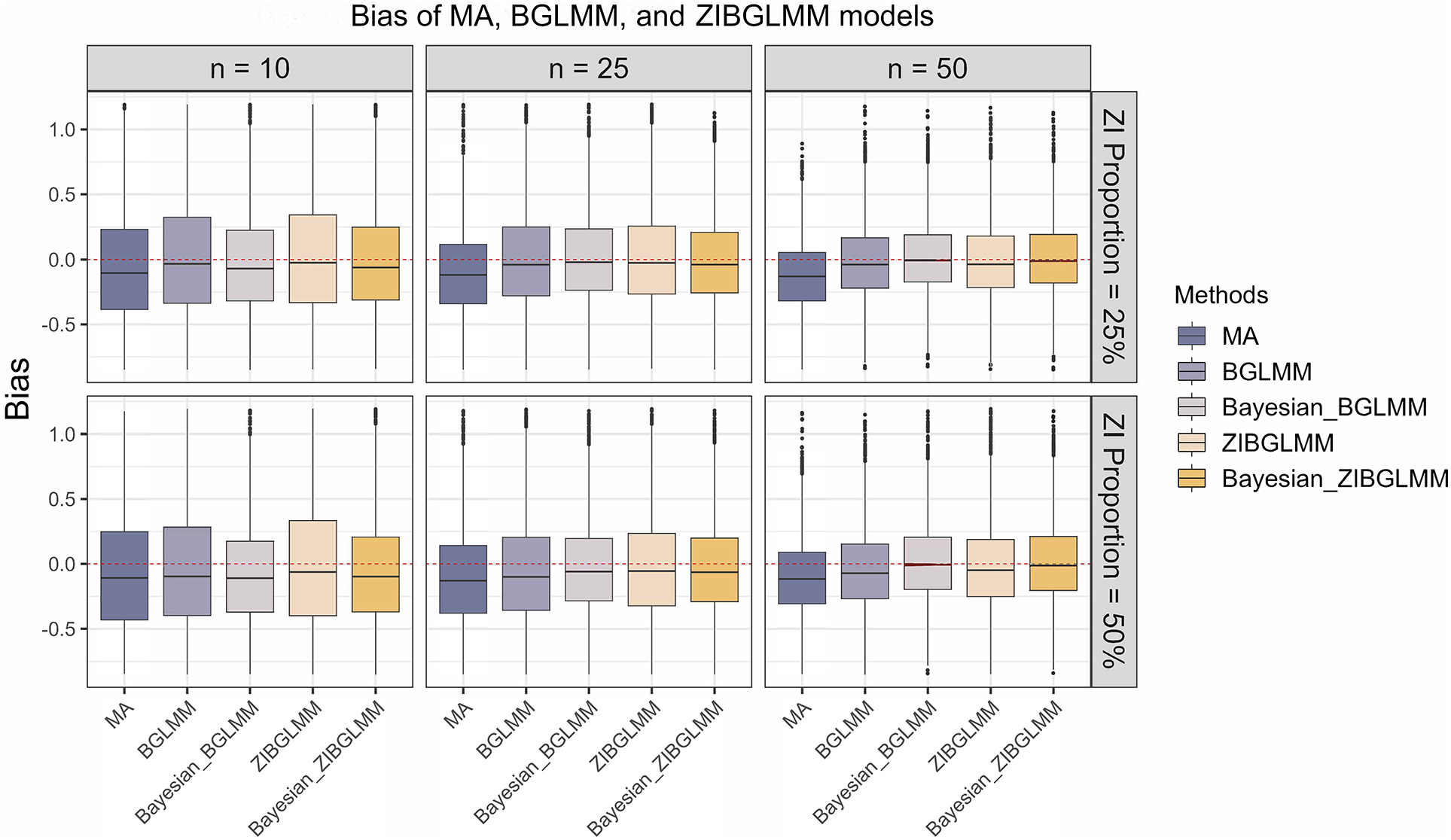
Moreover, the frequentist ZIBGLMM consistently demonstrates less bias than the frequentist BGLMM. For all settings, both frequentist and Bayesian BGLMM and ZIBGLMM consistently yielded smaller biases compared to conventional two-stage MAs that exclude DZS. We observe an increased number of convergence issues for frequentist ZIBGLMM, especially for smaller MAs with 10 studies. Possible contributing factors could be the absence of DZS or an excessive presence of DZS within an MA. Comprehensive details on the convergence issues for n = 10 can be found in Table 6 in the Supplementary Material. This convergence issue by the zero-inflated models is consistent with the observations made by Beisemann et al.Reference Beisemann, Doebler and Holling 31
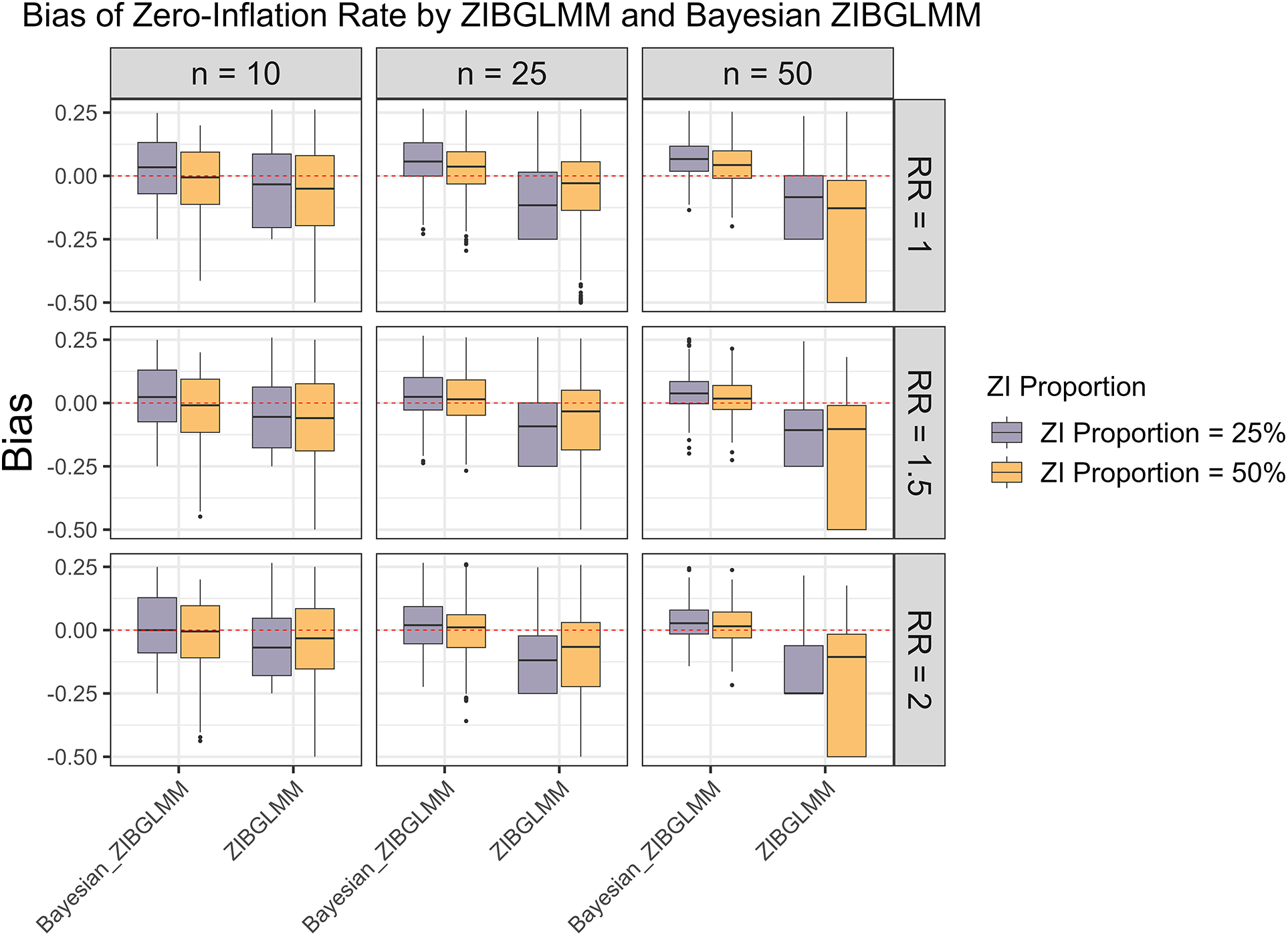
An important advantage of the proposed ZIBGLMM method is its capability of capturing population heterogeneity by estimating the proportion of zero inflation. To evaluate the empirical performance of ZIBGLMM under various settings, Figure 6 summarizes the bias of the estimated proportion of zero inflation with respect to the frequentist and Bayesian ZIBGLMM methods. We observe that Bayesian ZIBGLMM produces estimates of the proportion of zero inflation with smaller biases than the frequentist ZIBGLMM across MAs of all sizes and proportions of zero inflation. In addition, Bayesian ZIBGLMM yields more accurate estimates when the proportion of zero inflation is 50% than when the proportion of zero-inflation is 25%. In contrast, the frequentist ZIBGLMM appears to have a more substantial bias as the size of the MAs grows.
Bias in the estimation of proportion of zero inflation $\pi $
. Bayesian ZIBGLMM produces an estimate of the proportion of zero inflation with a smaller bias than the frequentist ZIBGLMM across all study sizes and proportions of zero inflation. However, it tends to overestimate the proportion of zero inflation for larger meta-analyses (MAs) (50 studies). In addition, Bayesian ZIBGLMM yields better estimates when the proportion of zero inflation is 50% than when it is 25%. The frequentist ZIBGLMM appears to have a more substantial bias as the size of the MAs grows.
$\pi $
. Bayesian ZIBGLMM produces an estimate of the proportion of zero inflation with a smaller bias than the frequentist ZIBGLMM across all study sizes and proportions of zero inflation. However, it tends to overestimate the proportion of zero inflation for larger meta-analyses (MAs) (50 studies). In addition, Bayesian ZIBGLMM yields better estimates when the proportion of zero inflation is 50% than when it is 25%. The frequentist ZIBGLMM appears to have a more substantial bias as the size of the MAs grows.
In summary, our extensive simulation studies suggest that ZIBGLMM, especially the Bayesian method, is a promising tool for MAs, particularly when dealing with datasets that have varying proportions of DZS. This method provides robust model fit, smaller bias in effect size estimation, and comparatively high coverage probabilities as conventional two-stage MA. Moreover, the capability of Bayesian ZIBGLMM to estimate the proportion of zero inflation accurately, especially in smaller and moderate-sized MAs, further emphasizes its significance in capturing the underlying population heterogeneity. However, practitioners need to be cautious while interpreting results from larger MAs, as there may be a tendency to overestimate the proportion of zero-inflation. It is also worth noting the potential convergence issues faced by the frequentist ZIBGLMM method in certain scenarios, which might be solved by using different optimization algorithms.
7 Discussion
In this article, we proposed a ZIBGLMM as a new method for handling DZS in MA. This model is motivated by the hypothesis that zeros in DZS may arise due to heterogeneity in the population, making the segregation of “structural” and “chance” zeros essential for accurate analysis.
The main estimate that we derive from our model is a marginal risk ratio (RR). Alternatively, one could use the OR as the estimate. We chose RR over OR as the estimate mainly because of the non-collapsibility issues of the OR. There has been an ongoing debate on the choice between OR and RR.Reference Xiao, Chen, Cole, MacLehose, Richardson and Chu 56 – Reference Doi, Furuya-Kanamori and Xu 59 Another option is to use a GLMM with a log link assuming a Poisson distribution within studies as Böhning et al.Reference Böhning, Mylona and Kimber 30 to report cluster-specific effects instead of marginal effects.Reference Dias and Ades 60 The choice between reporting the cluster-specific effects versus the marginal effects depends on the population we are interested in generalizing to. Marginal effects should be used if the goal is to generalize to the whole population, while cluster-specific effects should be used if we are only interested in the study-level effects. One potential issue with the bivariate approach to MA is that it may permit intertrial information to be recovered, which in theory can lead to bias.Reference Senn 61 However, as SennReference Senn 61 has pointed out, in practice, the size of this bias is likely to be small and can rarely cause an issue in real-world applications.
There are two ways of defining the treatment effects in our model setting. Let $p_{ik}$
denote the probability of success for the ith study for the kth treatment arm. Then, we could estimate the treatment effects based on the overall population (both ZI and non-ZI population), and the formula is
$p_{ik}$
denote the probability of success for the ith study for the kth treatment arm. Then, we could estimate the treatment effects based on the overall population (both ZI and non-ZI population), and the formula is $\pi + (1-\pi ) p_k$
, where
$\pi + (1-\pi ) p_k$
, where $p_k = \mathbb {E}(p_{ik})$
. The argument for this approach is that this aligns more with our model of the two mixture parts or only the non-ZI population, and the formula is
$p_k = \mathbb {E}(p_{ik})$
. The argument for this approach is that this aligns more with our model of the two mixture parts or only the non-ZI population, and the formula is $p_k = \mathbb {E}(p_{ki})$
. The argument for this is that since the population is ZI and is healthier, then there are little treatment effects for that population. We have chosen the latter way of defining the treatment effects.
$p_k = \mathbb {E}(p_{ki})$
. The argument for this is that since the population is ZI and is healthier, then there are little treatment effects for that population. We have chosen the latter way of defining the treatment effects.
Using 1,111 real-world MAs with DZS selected from the CDSR and 18,000 simulated MAs, we demonstrated the strengths and potential benefits of both the frequentist and Bayesian versions of ZIBGLMM. The Bayesian ZIBGLMM provided consistently better goodness of fit than the Bayesian BGLMM across varying scenarios. We further identified that Bayesian BGLMM and Bayesian ZIBGLMM generally accomplished comparable coverage probabilities to two-stage MAs, shorter confidence interval lengths, and less bias in estimating RR.
The ZIBGLMM method has several limitations compared with the standard bivariate generalized linear model or conventional two-stage MA excluding DZS. Notably, convergence issues might occur for the frequentist versions of ZIBGLMM and BGLMM models, especially for MAs with a smaller number of studies. This issue potentially stems from the absence of DZS or the excessive presence of DZS in an MA. The frequentist ZIBGLMM method has a higher chance of encountering convergence issues than the BGLMM method. Specifically, 1,015 datasets converged for ZIBGLMM, while 1,084 datasets converged for BGLMM for the 1,111 CDSR MAs. A potential way of avoiding convergence issues is to change the optimization algorithms used. Alternatively, using the Bayesian BGLMM and ZIBGLMM can avoid the convergence issues.
The limitation of the Bayesian BGLMM and ZIBGLMM is that they typically might take longer time to compute than the frequentist counterparts. For example, fitting a Bayesian ZIBGLMM on an MA with 25 studies takes around 4 minutes, and fitting on an MA with 50 studies takes around 9 minutes on a MacBook Pro with an Apple M1 Pro 10-core CPU and 32 GB RAM.
Our general recommendation to practitioners is to opt for Bayesian ZIBGLMM in the presence of DZS, as it provides a more accurate estimation of the RR and the proportion of zero inflation. Bayesian ZIBGLMM in general achieves better goodness of fit in terms of deviance of information (DIC) than Bayesian BGLMM. In addition, the Bayesian methods are not subject to convergence issues that the frequentist ZIBGLMM might face. The main limitation of the Bayesian methods is that the computation time might be longer for a single MA than their frequentist counterparts.
If computation time is a major limitation, we recommend using the frequentist ZIBGLMM, which can provide a more accurate estimation of the RR than the frequentist BGLMM. For MAs comprising 10 or fewer studies, we recommend using Bayesian ZIBGLMM for MAs with 10 studies or fewer since the computation time would not increase too much and the frequentist ZIBGLMM are more likely to experience convergence for the small MAs as observed in the simulation studies. We also recommend exercising caution with large MAs when using Bayesian ZIBGLMM, as there might be a tendency to overestimate the proportion of zero inflation.
We note that when the true data-generating mechanism is BGLMM rather than ZIBGLMM, using ZIBGLMM might be misspecified. In fact, the BGLMM is a submodel of the ZIBGLMM. In practice, if there are excessive numbers of zeros in the data, we recommend the investigators to fit the ZIBGLMM to avoid substantial biases due to underfitting. Further, we can also formally test between the BGLMM and ZIBGLMM models, as they are nested models. Score tests and LR tests can be developed following the work by Hall et al.Reference Hall and Berenhaut
62
and Huang et al.Reference Huang, Cai and Du
63
For the LR test, one needs to properly account for the fact that under the null hypothesis, the mixing probability parameter $\pi =0$
lies at the boundary of its parameter space [0, 1].Reference Self and Liang
41
,
Reference Chen, Ning, Ning, Liang and Bandeen-Roche
64
,
Reference Chen and Liang
65
$\pi =0$
lies at the boundary of its parameter space [0, 1].Reference Self and Liang
41
,
Reference Chen, Ning, Ning, Liang and Bandeen-Roche
64
,
Reference Chen and Liang
65
Meta-regression remains a challenging yet vital aspect of enhancing the robustness and applicability of our findings. In particular, when many zero events occur in MAs, the effect sizes tend to be more homogeneous, making it difficult to identify appropriate study-level summary covariates that could explain small between-study heterogeneity. One direction for future work is to expand the current model to incorporate covariate meta-regression, which would allow for a more detailed examination of how specific study characteristics influence the treatment effects.
In conclusion, our study proposes the ZIBGLMM as a novel approach to handling DZS, which can effectively reduce the biases in conventional MA methods by properly accounting for the between-population heterogeneity. We expect the ZIBGLMM method to be useful in pharmacoepidemiological and pharmacovigilance studies where the event probabilities are rare and DZS are prevalent.
Acknowledgments
All statements in this report, including its findings and conclusions, are solely those of the authors and do not necessarily represent the views of the Patient-Centered Outcomes Research Institute (PCORI), its Board of Governors, or Methodology Committee. We thank Tianyu Zhang and Dr. Jiajie Chen for their help on the project.
Author contributions
Conceptualization: L.L., Li.L., H.C., Y.C.; Data curation: L.L., Li.L.; Formal analysis: L.L., H.C.; Funding acquisition: Y.C.; Investigation: L.L., Li.L., H.C., Y.C.; Methodology: L.L., Li.L., H.C., Y.C.; Resources: Y.C.; Software: L.L., Li.L.; Supervision: J.C.C., Li.L., H.C., Y.C.; Validation: L.L., J.C.C., Li.L., H.C., Y.C.; Visualization: L.L.; Writing – original draft: L.L.; Writing – review and editing: L.L., J.C.C., Li.L., H.C., Y.C.
Competing interest statement
J.C.C. and H.C. are employed by Pfizer. They own stocks in their company.
Data availability statement
The datasets and code for this study can be found in the repository.Reference Li 32 DOI: https://doi.org/10.5281/zenodo.14827287.
Funding statement
This work was supported in part by National Institutes of Health (U01TR003709, U24MH136069, 1R01AG077820, R01AG073435, R56AG074604, R01LM013519, R01DK128237, R21AI167418, R21EY034179).
Supplementary material
The supplementary material for this article can be found at https://doi.org/10.1017/rsm.2024.4.


 Open access

