


Introduction
Archaeology has a strong track record of accumulating more and better theoretical and methodological tools for reconstructing the long-term history of inequality. Today, we see a move away from a focus on classification of societies into bands, tribes, chiefdoms, states, and toward a more complete picture of how political economies worked in principle and in practice (see Flannery & Marcus Reference Flannery and Marcus2012 for a summary). For many regions, domestic architecture has been used as one metric of household wealth inequality by leveraging a tool developed in economics, the Gini coefficient, an economic index of wealth inequality normally based on household income (Kohler & Smith Reference Kohler and Smith2018; Kohler et al. Reference Kohler, Smith and Bogaard2017). Applications of the Gini coefficient in archaeology have exposed hidden relationships between subsistence technology, labour and wealth (e.g. Bogaard et al. Reference Bogaard, Fochesato and Bowles2019), and broad patterns in inequality over prehistory (e.g. Borgerhoff-Mulder et al. Reference Borgerhoff-Mulder, Bowles and Herz2009). However, as noted by Kohler et al. (Reference Kohler, Smith and Bogaard2017), many parts of the world—including South America, Africa, South Asia and Oceania—remain under-sampled (see Kohler & Thompson Reference Kohler and Thompson2022 on current efforts). Indeed, in the islands of Polynesia, we are aware of only a single published study on wealth inequality using the Gini coefficient (Quintus Reference Quintus2020). In the research presented here, we work to remedy this gap and explore what this metric can tell us about Hawaiian society in the years before European contact.
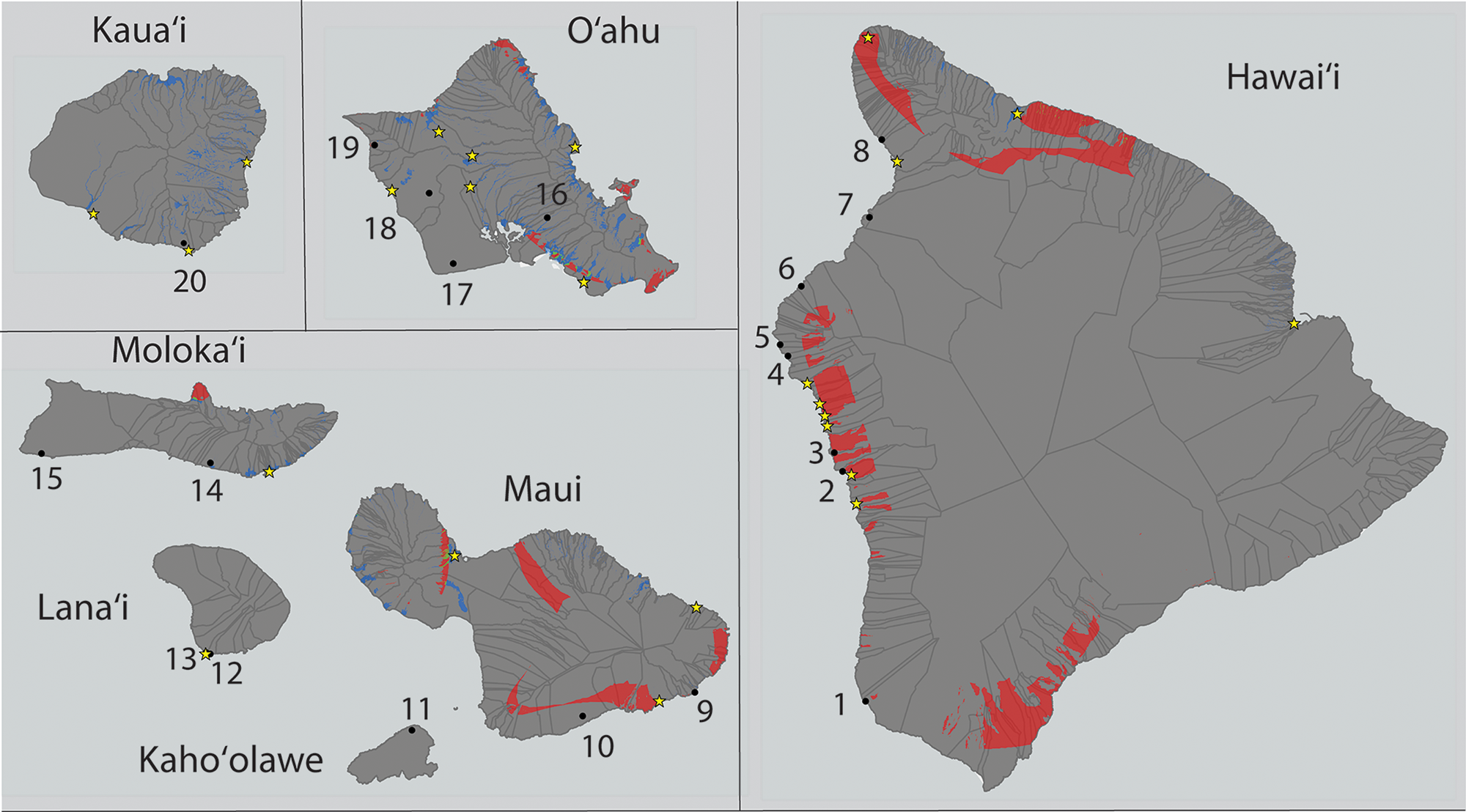
We present the first use of the Gini coefficient to evaluate wealth inequality as measured through domestic architecture in ancient Hawai‘i. It is based on an archaeological database from over 50 years of field survey, comprised of 2005 stone foundations of domestic structures, representing ~500 households, from 20 locations across the Hawaiian Islands (Fig. 1). Structures were originally created and used between ad 1400 and 1800 and served a range of purposes within traditional multi-building domestic compounds (see Kirch Reference Kirch1985, 247–83, on domestic architecture). We do not include features purpose-built for farming, ritual, or architecture dating to the historic era when domestic activities were collapsed into single buildings and large stone walls were built to control introduced livestock (Ladefoged Reference Ladefoged1991).
Database of Hawaiian domestic architecture. This study is based on 2005 structures recorded on archaeological surveys in 20 locations: (1) Manuka; (2) Kaawaloa; (3) Kanakau to Maihi; (4) Koloko; (5) Kohanaiki to Kalaoa 4; (6) Maniniowali to Kukio 1; (7) Anaehoomalu and Kalahuipuaa; (8) Waika and Kahua 2; (9) Kipahulu; (10) Kahikinui; (11) Kuheia; (12) Mamaki; (13) Kaunolu; (14) Kawela; (15) Kaluakoi; (16) North Halawa; (17) Ewa; (18) Lualualei; (19) Makua; and (20) Kaihuna. (The two diacritical markings used in Hawaiian, and glottal stop markings, were removed to avoid data transcription errors; see Supplemental Information for correct spellings.) We chose locations to represent environments that are ideal for intensive irrigated farming (blue), dryland (non-irrigated) farming (red), and areas where computer models suggest intensive farming was not viable (Ladefoged et al. Reference Ladefoged, Kirch, Gon III, Chadwick, Hartshorn and Vitousek2009). Places with known royal centres (McCoy Reference McCoy2018) are shown (stars) to illustrate where we presume the centres of political power were in island-scale polities.
We are interested in comparing wealth inequality in two ways. First, we want to know: how does this case study compare to inequality measured in other ancient societies? Accounts by Native Hawaiian historians give us a detailed profile of wealth inequality at the time of first contacts with Europeans (ad 1778) (‘Ī‘ī Reference ‘Ī‘ī1959; Kamakau Reference Kamakau1961; Malo Reference Malo1951). A multi-tiered hereditary class system was in place that was underwritten by taxation of surplus agricultural production and labour. Although these traits are uncommon in non-state societies, Hawai‘i was initially classified as a non-state hierarchical society, or ‘chiefdom’, along with other closely related groups living in the islands of Polynesia (Cordy Reference Cordy1981; Kirch Reference Kirch1984; Reference Kirch1985). Given what is known about the initial colonization of the islands around ad 1000 (Athens et al. Reference Athens, Rieth and Dye2014), we accept that it is likely that founding groups were organized in a hierarchical non-state society. However, the case has been made for the reclassification of European contact-era society as a pre-modern state. Early calls for reclassification (Allen Reference Allen1991; Hommon Reference Hommon1976) have been joined by major syntheses (Hommon Reference Hommon2013; Kirch Reference Kirch2010) as well as controlled comparisons with other early states (Earle Reference Earle2017; Jennings & Earle Reference Jennings and Earle2016). Nonetheless, there are some that suggest this is without warrant in the material record (Bayman et al. Reference Bayman, Dye and Rieth2021). To be clear, the metrics discussed here are not a classificatory tool, nor are we interested in classification per se. Our goal here is to improve our capacity for controlled comparison by quantifying inequality on the same scale as other ancient societies.
Second, what differences, if any, do we see between polities in the Hawaiian Islands reliant on irrigated versus rainfed farming? A great deal has been written describing the contrasting political economies of ‘wet’ polities, like those on the islands of Kaua‘i and O‘ahu, and ‘dry’ polities, such as Maui and Hawai‘i Island (Graves et al. Reference Graves, Cachola-Abad, Ladefoged and Kirch2011; Kirch Reference Kirch1994; Ladefoged et al. Reference Ladefoged, Kirch, Gon III, Chadwick, Hartshorn and Vitousek2009; McCoy& Graves Reference McCoy, Graves, Spriggs, Addison and Matthews2012; Spriggs Reference Spriggs and Chandra1984). In brief, rulers whose populace relied mainly on irrigated farming were less interested in expanding their territories through conflict than those whose lands were inappropriate for irrigation and instead relied on rainfall. This flips the notion that areas that are rich, in terms of natural resources, will expand to take over impoverished ones. Additionally, it is often noted that irrigation is at least twice as efficient in terms of surplus production (Ladefoged et al. Reference Ladefoged, Kirch, Gon III, Chadwick, Hartshorn and Vitousek2009). Traditional histories also support the notion that labour was different in these systems and note that both men and women farmed the land on the dry islands of Maui and Hawai‘i, but only men on the other islands (Malo Reference Malo1951). Nonetheless, in the absence of archaeological metrics on inequality, it is impossible to say what influence, if any, these contrasting political and subsistence economies had on inequality.
Wealth in ancient Hawai‘i
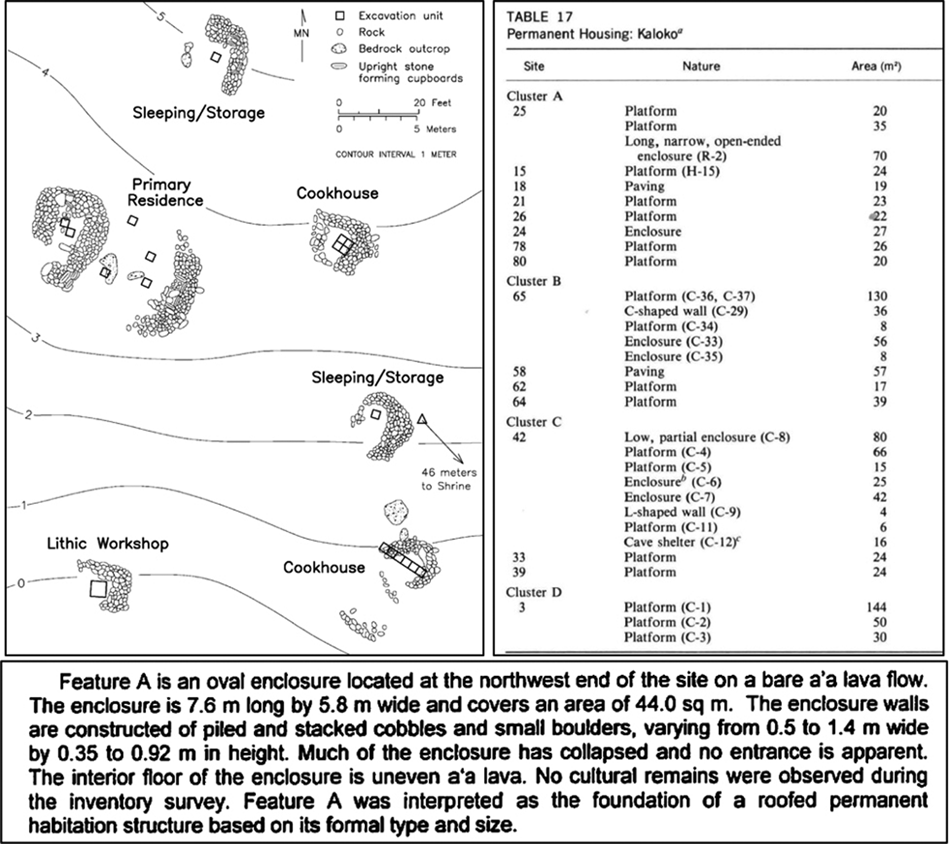
Hawaiian historians provide ample evidence to suggest that we should expect social difference to have been expressed in the form of people's houses (see also Brigham Reference Brigham1908). By the time of European contact, there was a formal class system based on birth that included a major bifurcation between elites and commoners, and middle-ranked positions based on birth and/or occupation. At that time there was a body of religious laws known today as the ‘kapu system’ that defined appropriate behaviour in domestic settings based on an intersection of rank and gender. This was formalized, and materialized, in domestic architecture. Within a single household, several types of specialized structures could be found, each made with the intent of separating some specific daily activities (e.g. work, cooking, sleep) (Fig. 2). This same system was used to bar unauthorized entry of lower-ranked people into the homes of higher-ranked people, but higher-ranked people appear to have had wide-ranging rights. To choose an extreme example, the king rarely occupied a single location for long, and as he would move the court, he would occupy any house he pleased within his kingdom, for as long as he wished.
Archaeological data on domestic structures in the Hawaiian Islands. Reports on surveys, on which this database is based, describe domestic architecture in three different ways: static ‘white paper’ maps, tables and text descriptions. As seen in this example, there is a great deal of formal variation in the cluster stone foundations of structures (e.g. platform, C- or L-shaped wall, enclosure) that formed a compound. It is thought that the reason that people built multi-structure house compounds was to facilitate the separation of people and activities according to a system of religious laws (kapu). (Sources: Cordy Reference Cordy1981; Weisler & Kirch Reference Weisler and Kirch1985.)
Historical sources suggest that while social differences in rank may have been more or less fixed by birth, wealth was something that could change depending on one's fortunes. There are accounts of elites, and others, who have lost their wealth through gambling. It was common for elites to see their wealth change with marriages, alliances and territorial warfare. For commoners, a person who was well-known for a particular skill was considered wealthy. And while there were some objects that only elites could own, there were others, like canoes, that were prized possessions of commoner and elite alike.
Contemporary readings of Hawaiian oral traditions point to a shift in the land-tenure system that would have had important knock-on effects for how wealth was distributed. It has been proposed that when the islands were first settled, with large swaths of unoccupied land, the founding land-tenure system was likely similar to elsewhere in Polynesia where people reckoned their rights, and obligations, regarding land through kinship (Kirch Reference Kirch1984; Reference Kirch1985). Centuries later, sometime around ad 1400–1600, land ownership became the exclusive right of the elite. Resident commoners found themselves in pie-shaped territories that cross-cut island ecozones (ahupua‘a) (see boundaries on Figure 1) and working in a feudal arrangement, owing a portion of the food they produced, and their labour, to the elite. By the time of European contact, there was a hierarchical system of tax and tribute collection that began at the level of residential managers who answered to community territory-level chiefs, who in turn owed a portion of what was collected to a district-level chief; and, ultimately, to the king or queen of the island.
Some aspects of the new land-tenure system were cemented into the archaeological record. Field et al. (Reference Field, Ladefoged, Sharp and Kirch2011), for example, document a shift from households eating food from only the immediate environment (marine or upland agriculture) to use of all environments in later periods, which is consistent with the new system of cross-cutting territories. McCoy et al. (Reference McCoy, Ladefoged, Graves and Stephens2011) note the progression of temples constructed in this same region is consistent with increasing sub-division of community territories, presumably representing increasingly intense top-down management of the study area. However, the picture may be more complex. Dye (Reference Dye2021, 45) has recently proposed corporate ownership by commoners continued throughout the pre-European contact era and ‘[t]he event that ended commoner organisation of land tenure in Hawai'i was the mid-nineteenth-century Great Mahele — the process of land redistribution proposed by the King Kamehameha III.’
While there is ample evidence to warrant the notion that domestic architecture should articulate with wealth—i.e. there is good evidence that there were class/rank distinctions, house form was governed by social norms (the kapu system), and house location would have been dictated by the feudal-like land-tenure system—but this is not the full picture. The strong body of non-material evidence (i.e. oral traditions, linguistics) that helps us make these necessary contextual connections to study wealth presents a classic etic–emic dilemma. As Johnson (Reference Johnson2008, 233–4) notes, Hawaiian traditions have been ‘misconstrued in non-Hawaiian hands, whether through exaggeration, truncation or neglect’. The notion of ‘wealth’ is particularly prone to these issues since it cross-cuts so many other conceptual fields. For example, the word waiwai, which refers to wealth and property, is contained within at least 25 separate other terms in Hawaiian (e.g. waiwai maloko, tribute or wealth from the uplands; waiwai ho‘oilina, inherited property), and is semantically connected to water (wai) (Pukui & Elbert Reference Pukui and Elbert1986). And so while we emphasize how archaeological studies can contribute productively to social history in Hawai‘i through the careful use of traditions and material evidence, we note that this is only one of the ways that people thought about wealth.
Database of domestic architecture in the Hawaiian Islands
Our study is based on a large database of domestic architecture recorded over 50 years of archaeological field survey (see Supplemental Information for a detailed description of the database) (Fig. 2). It is not comprehensive, but nonetheless includes 2005 stone foundations of domestic structures from 20 locations across the Hawaiian Islands.
It is widely accepted—based on oral history, early documentary evidence, and archaeology—that the idealized traditional house in the Hawaiian Islands consisted of several structures clustered together in a compound (see Kirch Reference Kirch1985; Weisler & Kirch Reference Weisler and Kirch1985). Individual compounds (also called ‘clusters’) of structures (also called ‘features’), tend to be widely dispersed across regions that archaeologist refer to as ‘habitation zones’ (Kirch Reference Kirch1985), mainly areas close to the coast. For this study, we group all domestic structures reported on a survey as a single group. We do not assign structures to compound in our database due to several complicating factors discussed below.
We can use prior studies to make broad statements about what this database likely represents. For example, the corpus of radiocarbon evidence from the region suggests that these structures were probably originally created and used between ad 1400 and 1800 (see Kirch & McCoy Reference Kirch and McCoy2023 for a recent review of the archipelago's culture history). Based on previous estimates of how many structures comprise a compound, it is reasonable to say that this conservatively represents ~500 households (see Hommon Reference Hommon2013 for a discussion of the variability in domestic compounds). We believe that with further research it is possible to improve this database with more granular temporal information and palaeodemographic estimates. However, these would require a great deal more work and are beyond the scope of the present study.
Results
Comparison with inequality in other societies
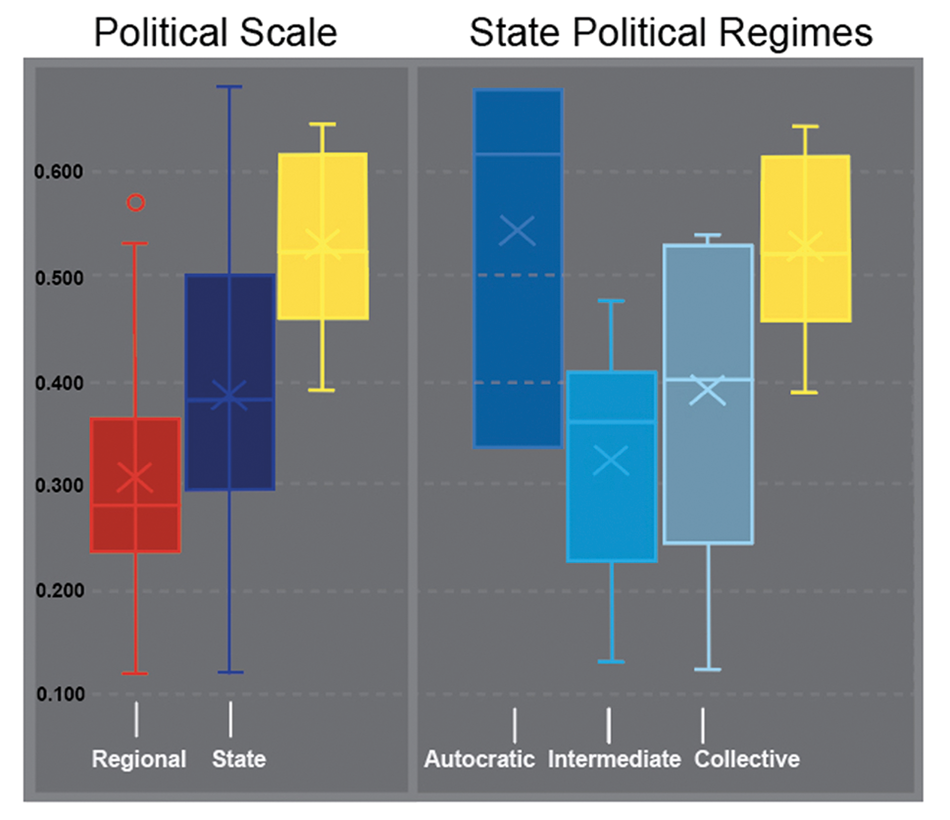
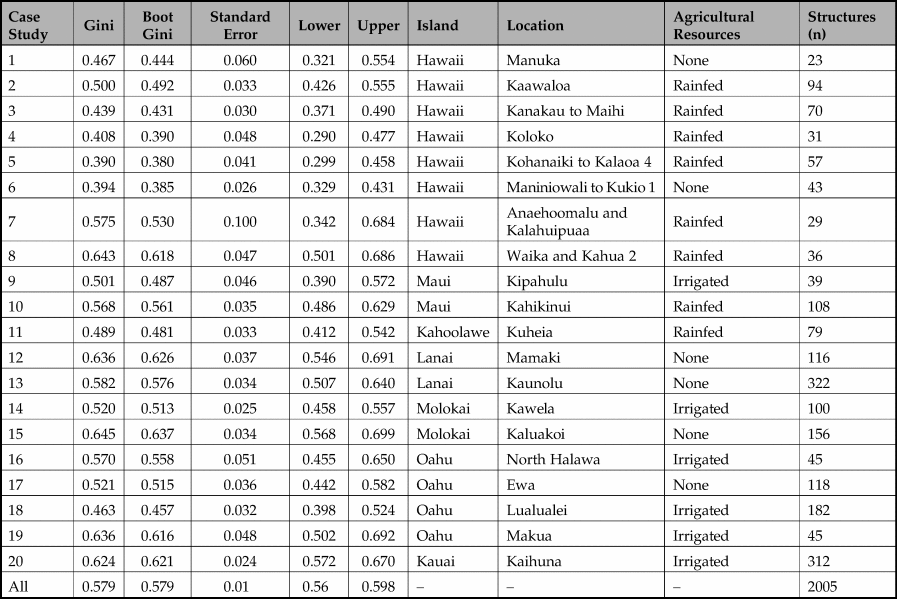
Wealth inequality on its own is not a good metric for classifying societies by their political scale. A global survey of wealth inequality in ancient societies (Kohler et al. Reference Kohler, Smith and Bogaard2017) found regional polities (i.e., chiefdoms) have an average Gini coefficient of 0.306 (sd = 0.111, min = 0.120, max = 0.570) and states only slightly higher, 0.386 (sd = 0.155, min = 0.120, max = 0.680) (Fig. 3). Thus, a Gini coefficient of between 0.120 and 0.386, while more likely to represent a non-state, could reasonably be describing inequality in a non-state or a state. However, the Gini coefficient of our total dataset (treating all structures as part of the same group) is 0.579 (se = 0.0097), well above this range, and unlikely to be found in a non-state (see Table 1 for individual study area results and confidence intervals). The Gini for the total dataset that better accounts for regional variation by averaging the 20 study areas is also remarkably high, 0.529 (s.d. 0.085, min: 0.467, max: 0.645).
Wealth inequality in ancient polities. Within the Hawaiian Islands (yellow) we see wealth inequality variability like what has been reported across pre-modern state societies (blue) and some regional scale polities (red). Comparative data are drawn from 22 regional polities, 17 state polities, 3 autocratic states, 9 intermediate states and 5 collective states. (Sources: data reported in Kohler et al. Reference Kohler, Smith and Bogaard2017; categories following Johnson & Earle Reference Johnson and Earle2000.)
Gini coefficient for domestic architecture in the Hawaiian Islands. See Supplementary Information for more about the database.
Early states likely mirrored more recent examples of states in that there would have been different regimes when it comes to the fundamental relationship between the government and the governed. Kohler et al. (Reference Kohler, Smith and Bogaard2017), based on Blanton and Fargher (Reference Blanton and Fargher2007), use a simple three-value ordinal scale from collective to autocratic to try and capture that aspect of ancient states (Fig. 3). Our results resemble most closely what is found in autocratic states (mean Gini: 0.547) rather than states where authority is collective (0.390), or an intermediate form (0.330).
We find that wealth inequality in the Hawaiian Islands is most like what has been previously reported for autocratic states, such as the Maya (Late Classic Caracol and Classic Tikal) and Egypt (Middle Kingdom Kahun). But it is more difficult to say how Hawai‘i compares with the wider Polynesian culture area since there is only one previously published study that measures wealth inequality in this fashion. Quintus (Reference Quintus2020) reports Gini coefficient values for several locations in Samoa with values around 0.260 (Tamatapu = 0.320, Tufu = 0.220, A'ofa = 0.23), consistent with regional polities (i.e., chiefdoms), and well below the lowest result from Hawai‘i, 0.431.
Geographic comparison within the Hawaiian Islands
Previous research suggested that we may find different wealth inequality in polities reliant on irrigated versus rainfed farming (Kirch Reference Kirch1994). We assigned each case study according to three categories—irrigated, rainfed and none—based on a predictive model of intensive agriculture (Ladefoged et al. Reference Ladefoged, Kirch, Gon III, Chadwick, Hartshorn and Vitousek2009) (see Figure 1). When examined at the scale of individual case studies—meaning Gini coefficient calculated based on the survey area—we do not find significant differences between locations: irrigated = 0.552, none = 0.541 and rainfed = 0.502. However, in rainfed study areas, we find, on average, less inequality. When we looked at the average size of structures there was more variation—irrigated = 37.5 m2 (660 to 0.5 m2), none = 29.2 m2 (598 to 0.5 m2) and rainfed = 49.5 m2 (572 to 0.4 m2)—and again rainfed stood out, this time for having larger structures on average.
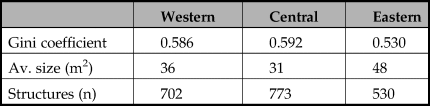
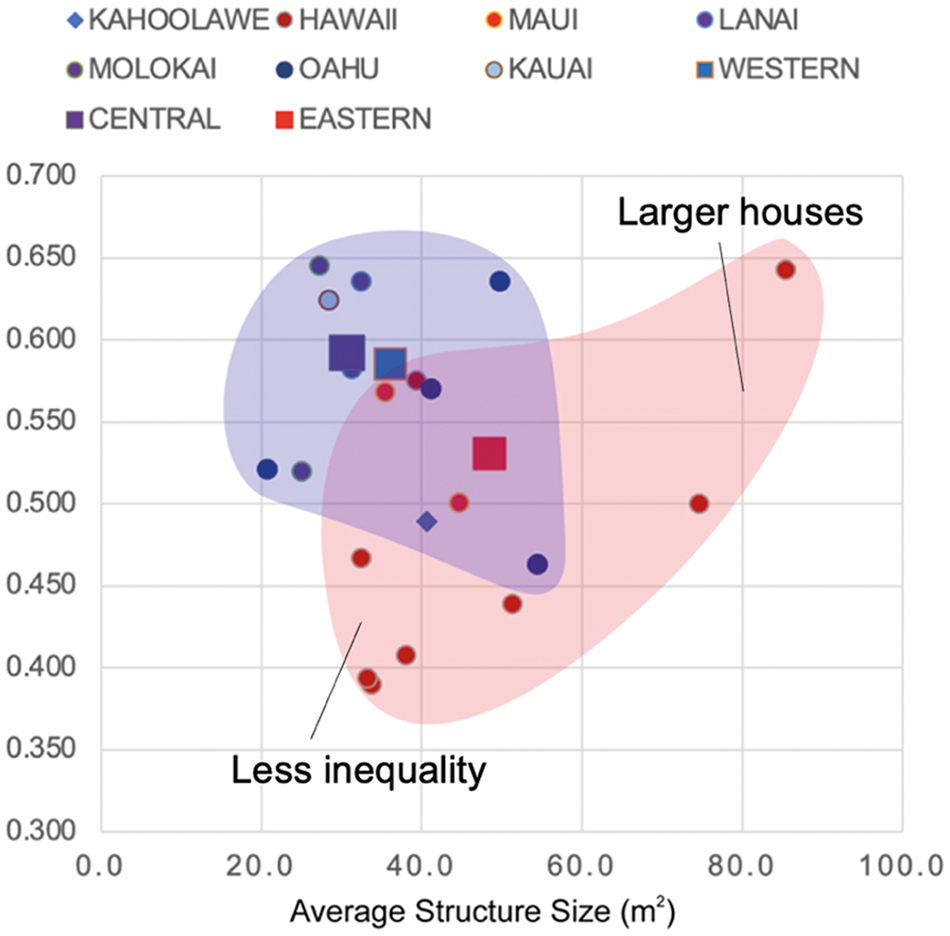
To determine if locations based on rainfed agriculture were indeed different, we looked at geographic variation at several scales. We found the most contrast when we re-calculated the Gini coefficient with all structures grouped into one of three sub-regions: a western sub-region (Kaua‘i, O‘ahu), who mostly relied on irrigated farming, a central sub-region (Moloka‘i, Lana‘i, Kaho‘olawe), who had mixed farming, and an eastern sub-region (Maui, Hawai‘i), who mostly relied on rainfed farming. We found that the eastern islands appear to have, on average, larger domestic structures and slightly less inequality (Table 2). However, what sets this sub-region apart is two apparently independent trends. Figure 4 brings together results based on the 20 individual study areas (circles) and the three sub-regions (squares). The eastern sub-region has three study areas that fall within the general variation found elsewhere, five that show lower inequality (but average house sizes within the norm for the islands) and two with larger house sizes (but not lower inequality). We explored other factors—density, distance to royal centre—which we report in the Supplemental Information. But it is the results illustrated in Figure 4 that we found potentially illuminating and discuss below.
Summary of geographic variation. We looked at geographic variation at several scales and found few differences. But, when grouped by western (Kaua‘i, O‘ahu), central (Moloka‘i, Lana‘i, Kaho‘olawe) and eastern (Maui, Hawai‘i) sub-regions, the eastern islands appear to have, on average, larger domestic structures and slightly less inequality.
Geographic variation in wealth inequality and average structure size. We find that in terms of the sizes of structures and inequality, the western islands (Kaua‘i, O‘ahu: blue) and central islands (Moloka‘i, Lana‘i, Kaho‘olawe: purple) are more like each other than those on the eastern islands (Maui, Hawai‘i: red).
Statistical tests to address data quality
We are aware of underdetermined factors that are potential sources of error in this database, such as degree of preservation, as well as how field evidence was recorded, reported, interpreted and aggregated. Below we discuss how we have tried to assess two potential issues, specifically: 1) aggregating structures into compounds, and 2) data quality of previous studies (i.e. do they represent a complete picture of a reasonably intact settlement). The latter we examined using clustering as a proxy for representativeness of settlement patterns. The goal of this part of the study is to determine, to the degree that it is possible, how much these may be influencing how we interpret the results described above.
Aggregation of features by study area or by compounds
Due to uneven preservation, and high density of compounds in some areas, as well as other factors, it is impossible to assign domestic features unambiguously to a compound except in rare circumstances. One such circumstance is Manukā (Study Area 1), a geologically young landscape with very little soil development. Archaeological visibility is extraordinarily high and the area lacks the small temporary shelters that are common among farms. We calculated a Gini coefficient based on features aggregated by study area (i.e. 23 structures), our preferred method, and by compound (i.e. the same 23 structures collapsed into 5 compounds). Our preferred method resulted in a Gini coefficient of 0.467 (Boot = 0.441, SE = 0.059, Lower = 0.321, Upper = 0.548) and aggregation by compound resulted in a Gini coefficient of 0.442 (Boot = 0.380, SE = 0.118, Lower = 0.150, Upper = 0.596). The wide margin of error is due to the small number of compounds.
The results of this test confirm that our technique of aggregating structures by study area will return a Gini coefficient that mirrors what we would find if we measured individual compounds.
Spatial clustering and representativeness
We used Ripley's K-function to test study areas for clustering since this function can detect clustering, or dispersion, at different spatial scales. Most case-study areas where this test could be applied (10 out of 16 cases) show statistically significant clustering. Specifically, nearly all show statistically significant clustering from 0 to 550-metre bands, at which point they cross over to random (see Supplemental Information). We recalculated statistics using only the 10 case studies that appear to have the best representation of the settlement pattern. The result was a mean Gini coefficient of 0.507 (SE = 0.016, Bootstrapped Upper = 0.538, Lower = 0.475), close to the overall Gini coefficient.
The results of this test confirm that our database returns a Gini coefficient that is sufficiently like a sub-sample of only those surveys that are most representative of the overall settlement pattern.
Other factors potentially impacting data quality
There are other factors impacting the quality of our dataset that centre on concerns about including buildings used for different lengths of time and in different periods. Archaeologists in the Hawaiian Islands at times classify structures as ‘temporary’ or ‘permanent’ when, ‘[r]ealistically, it is usually impossible to determine—without undertaking excavation—whether a particular structure was used only intermittently or as a permanent residence’ (Kirch & McCoy Reference Kirch and McCoy2023, 315). On a much longer timescale, there is the question of contemporaneity and the re-use of stone foundations (Dye Reference Dye and Dye2010). As of today, there are no criteria that would justify categorical exclusion from the database, and so we included all structures identified as habitation in the original study. We highlight this here because controlling for these variables is something that may be achievable in the future.
Discussion
This look at wealth inequality through domestic architecture allows us to make two claims: 1) inequality was expressed in domestic architecture in the Hawaiian Islands in a fashion that is like other hierarchical societies, specifically like autocratic archaic states, and 2) there is geographic variability in inequality that may be linked to different types of farming. Here we discuss the possible explanations for these findings as well as counter-evidence, and counter-claims, for each.
To scholars who accept the re-classification of Hawai‘i as an archaic state, our findings are unsurprising, and a confirmation that we need to think about the development of society here along the same lines as what occurred in the Maya area, Egypt and elsewhere. In contrast, Bayman et al. (2021, 47) have argued that this kind of thinking is wrongheaded and ‘based on interpretations of indigenous oral traditions and contact-period historical accounts but lacks archaeological warrant’. Without relitigating this debate (see replies to Bayman et al. Reference Bayman, Dye and Rieth2021), one of the central tenants of Bayman et al.'s argument is that there is no material evidence there were state-like societies in the Hawaiian Islands, meaning either there were no states, or it was a case of ‘states without archaeological correlates’. Here again, we want to stress that the Gini coefficient is a poor classificatory tool. Its value lies in the fact that it is a metric that does not rely on pre-ordained categories and, ideally, can reveal unknown patterns in the creation and distribution of wealth. Having said that, our findings can be read as a counter to the claim that there is no material evidence that there were states, or if there were no states, these results at least beg for explanation.
Separate from the question of if our results are consistent, or inconsistent, with the larger picture of Hawaiian society, it is possible that we have in some way misrepresented how domestic wealth was displayed through domestic architecture. After all, the stone foundations of these buildings—the parts that are accessible for us to observe today—were probably not the ‘costly’ parts of creating and/or maintaining them. Superstructures would require wood, bamboo, rope and thatching that would need to be regularly replaced (see Apple Reference Apple1971). Also, we cannot say which structures were used concurrently or how they may have been remodelled over time. To our knowledge, there is only one study that has tested to see if structures that today are found within the same cluster were occupied at the same time (Weisler et al. Reference Weisler, Collerson, Feng, Zhao and Yu2006). That study reports that two structures had high-precision uranium series dates on artefacts made in the same year. In our view, these are all good lines of future research, which may confirm or contradict our findings, but not reasons to discard our findings outright.
We claim that geographic variability in inequality may be linked to different types of farming, specifically the finding that, on the whole, we see slightly less inequality and larger average structure sizes on the islands of Maui and Hawai‘i. To be clear, as we illustrate in Figure 4, there is a great deal of overlap between what we see on Maui and Hawai‘i versus the rest of the archipelago. Indeed, in practice, it may have been beyond the capacity for people to detect the extremely slight differences in inequality. What would have been much more legible is the larger average size of structures, of the order of twice as large as anywhere else.
One possible explanation leverages the notions of the moral economy and the political economy. Political economies produce and reinforce social difference within a group (rank, status, etc.) formalized through a series of rights and obligations. Moral economies are based on a series of persistent mutual obligations and produce the opposite of a political economy. González-Ruibal (Reference González-Ruibal, Cifani and Stoddart2012, 251) put it this way:
Where moral economies are enforced, self-interested calculations of gain or efficiency are absent, secondary or camouflaged. They stress egalitarian and collective values, which are usually channeled through myth and rituals, and preclude individual gain at the expense of others. Strategies at work in moral economies include communal landholdings, mutual aid and reciprocity, risk-sharing and social welfare institutions.
Thus, all things being equal, in contexts where the political economy was strongly enforced we would expect to see clear signs of inequality materializing social difference. In domains where the moral economy has stronger influence, differences would be less emphasized or absent.
The moral and political economies, in principle, should influence how wealth is made visible. Research on contemporary people shows an inherent strong preference for equality (Nishi et al. Reference Nishi, Shirado and Rand2015) and a clear negative impact of visible signs of inequality for cooperation (Pansini et al. Reference Pansini, Campennì and Shi2020; Zhang et al. Reference Zhang, Ma, Tao, Wang, Shi and Wang2020). Therefore, while some display of wealth inequality is useful for the political economy inasmuch as it underlines social difference, it is potentially damaging to group cohesion. The reason we stress ‘visible’ wealth here is because much of the thinking around wealth is based on objects, commodities, services and capital, many of which have the potential to be hidden (i.e. made not visible), or advertised (i.e. made visible). But domestic architecture is one form of wealth that is visible and legible across groups. Thus, people's choices around house size materialize an important decision about how to display wealth, and over the long term, those decisions are cemented into the archaeological record.
We hypothesize that the greater agricultural labour demands necessary to produce surplus for rainfed agriculture had the downstream effect of more experimentation in how wealth was made visible. We see the results of these experiments in slightly more equality in communities or larger house sizes. We suggest that, for some locations, a conscious, or unconscious, effort to promote cooperation (i.e. the moral economy) resulted in slightly less inequality. In other locations, there is much larger average structure size, but the typical amount of inequality. These may reflect a conscious, or unconscious, effort to promote cooperation through allowing much larger houses across the economic spectrum. These are, of course, small sample sizes, and it will take further testing to determine if this pattern holds and if so, if our hypothesis or another explanation is the best fit.
Our interpretation of the evidence puts the emphasis on the outcome of house building rather the process. While others have used architecture to estimate labour investment (Kolb Reference Kolb1991), we make no claims here regarding the amount or type of labour invested in domestic architecture. As one of the few ethnohistorical accounts we have of house building notes, the same sized structure might be constructed over a long period by single family, or made in a few days by ‘upwards of a hundred men at a time working on one house’ when ordered by a chief (Ellis Reference Ellis1825, 317).
We see two counter-claims that would negate some, or all, of our interpretations regarding the moral and political economies. There is reason to believe that there were shifts in the distribution of wealth in the post-European contact era, and a move away from multi-structure house compounds to single-structure houses. Therefore, some, or all, of what we see geographically may be due to our failure to exclude, or account for, architecture from the historic era. We also concede that the natural availability of different raw material may have impacted house sizes, and that we have lumped together structures that each have a particular life history of construction, maintenance, abandonment and re-use. In addition, the patterns we see may be due not to an underlying environmental factor but some underdetermined historically particularity of life in the kingdoms centred on Maui and Hawai‘i. Here again, a larger sample size would help clarify things, but it is inherently difficult to parse political geography and natural resources in this case. As with any initial attempt to apply a metric, we expect future studies will help resolve these and other outstanding issues.
Conclusion
We present the first look at wealth inequality through domestic architecture found across the Hawaiian Islands. The data show inequality was expressed in a fashion that is like other hierarchical societies. It is especially similar to autocratic archaic states, like those found in the Maya area, or in Egypt (Kohler et al. Reference Kohler, Smith and Bogaard2017). For those who accept that Hawaiian society is best thought of in the category of ‘archaic state’, (Kirch Reference Kirch2010; Hommon Reference Hommon2013) our results are consistent with that notion. For those who reject that premise (Bayman et al. Reference Bayman, Dye and Rieth2021), our results represent new evidence that begs for explanation. In addition, we found geographic variability in inequality that may be linked to different types of farming. Interestingly, in some communities on islands reliant on labour-intensive dryland (non-irrigated) farming, we find communities with distinctively less inequality than elsewhere, or larger house sizes. More work is necessary to test the hypothesis presented here that this reflects divergent trajectories in the political-moral economies to encourage cooperation that is necessary for producing an agricultural surplus in environments where opportunities for intensive irrigated farming were limited or non-existent.
Acknowledgements
We wish to acknowledge the efforts of previous archaeological surveyors whose hard work made this database possible, the State of Hawai‘i's Historic Preservation Division, and all of those who care for the wahi kūpuna (cultural resources) of Hawai‘i. We also want to thank the members of JLP's honours thesis committee, K. Ann Horsburgh and David J. Meltzer, for their service and comments. This research was supported by a University Research Grant to MDM from Southern Methodist University, Dallas, USA. A version of this paper was presented at the first meeting of The Global Dynamics of Inequality Project (GINI). We would like to thank all the members of the GINI Project for their dynamic discussions around the use of this metric in archaeology. The final draft of this paper was improved by suggestions by two reviewers and we wish to thank them for their careful consideration of the particular issues raised by applying the Gini coefficient to houses in Hawai‘i.
Supplemental Information and Data
We have made Supplemental Information, including metadata on data sources, and the dataset itself available on the Digital Archaeological Record. Supplementary Information: doi:10.48512/XCV8488765 / the Digital Archaeological Record (tDAR) ID: 488765. Data: doi:10.48512/XCV8488767 / the Digital Archaeological Record (tDAR) ID: 488767.
Supplementary material for this article may be found at https://doi.org/10.1017/S0959774323000331


 Open access

