


1. Introduction
Additive manufacturing (AM) offers numerous advantages in design and production, yet many parts and products are not optimized for AM, often leading to failed or terminated design projects. To fully exploit AM, designers must simultaneously account for its opportunities and restrictions (Reference Prabhu, Simpson, Miller, Cutler and MeiselPrabhu et al., 2021). This dual perspective, known as dual Design for Additive Manufacturing (dual DfAM) (Reference Laverne, Segonds, Anwer and Le CoqLaverne et al., 2015), is critical for achieving optimized and beneficial designs.
Our studies on dual DfAM with students and industrial practitioners revealed the need for a tool that supports designers in evaluating and improving designs from both opportunistic and restrictive perspectives. This need is particularly evident during product development and consulting during, where tools are essential for a balanced decision-making, identifying when a design is suitable for AM, and optimizing feasibility and practicality.
Researchers have recognized this need and recently proposed frameworks to evaluate manufacturability and feasibility (e.g., Reference Cayley, Mathur and MeiselCayley et al., 2023). While existing frameworks address evaluation of dual DfAM based on advanced CAD models or focus solely on one perspective of DfAM, it does not resolve the need within product development. This raises the research question: How can an approach for evaluating and optimizing product designs be structured to enable an effective assessment of dual DfAM during product development - when transitioning from a detailed product concept to a CAD model?
To address this gap, we propose a dual DfAM worksheet as a practical tool for evaluating and optimizing designs by systematically considering opportunities and restrictions in AM. Building on the DfAM worksheet from Booth et al. Reference Booth, Alperovich, Chawla, Ma, Reid and Ramani(2017), our approach shall help novice and intermediate designers assess feasibility and practicality based on a detailed product concept or CAD model. We verified its use and initial effectiveness by working with students at different levels of AM expertise, gaining insights for refinement and ensuring the worksheet supports the evaluation of dual DfAM.
2. State of art
As additive manufacturing (AM) continues to advance, supporting students and designers on achieving optimal designs becomes increasingly critical. AM’s unique opportunities–such as custom and complex geometries, multi-material integration, and function-oriented designs without tooling–demand a shift from traditional Design for Manufacturability (DfM) to Design for Additive Manufacturing (DfAM) (Reference Gibson, Rosen, Stucker, Khorasani, Gibson, Rosen, Stucker and KhorasaniGibson et al., 2021). Beyond addressing restrictive limitations like build orientation and support structures, DfAM focuses on maximizing product performance (Reference Gibson, Rosen, Stucker, Khorasani, Gibson, Rosen, Stucker and KhorasaniGibson et al., 2021). Dual DfAM extends this idea by considering AM’s opportunities and restrictions simultaneously (Reference Prabhu, Simpson, Miller, Cutler and MeiselPrabhu et al., 2021), enabling strategic decision-making, reducing design iterations, and enhancing overall quality.
Several approaches guide DfAM, mainly through design principles and heuristics. Perez et al. (2015) outline fundamental DfAM principles, and Lauff et al. Reference Lauff, Perez, Camburn and Wood(2019) introduce design principle cards to support designers in leveraging AM opportunities. Blösch Paidosh & Shea Reference Blösch-Paidosh and Shea(2022) provide design heuristics to help designers integrate AM strategies early in the process, while Valjak et al. Reference Valjak, Kosorčić, Rešetar and Bojčetić(2022) emphasize function-based principles for function integration and optimization towards AM. Although these approaches aid in leveraging AM’s benefits, they lack a structured evaluation approach to balance opportunities and restrictions, a key aspect of dual DfAM. Moreover, generalized guidance may be too broad for intermediates and experts, while process-specific ones (e.g., Reference Adam and ZimmerAdam et al., 2015) can be too complex for novices.
Additionally, various assessment methods evaluate the adaptation of conventionally manufactured components for AM. These approaches typically assess geometric feasibility, process compatibility, and cost to aid in converting existing designs rather than guiding the development of AM-optimized products. Siller et al. Reference Siller, Werner, Molina and Göhlich(2023), for example, propose a potential assessment method to determine a component’s suitability for AM. While useful for adaptation, such methods are not designed for evaluating and optimizing designs in the transition from product concept to product design.
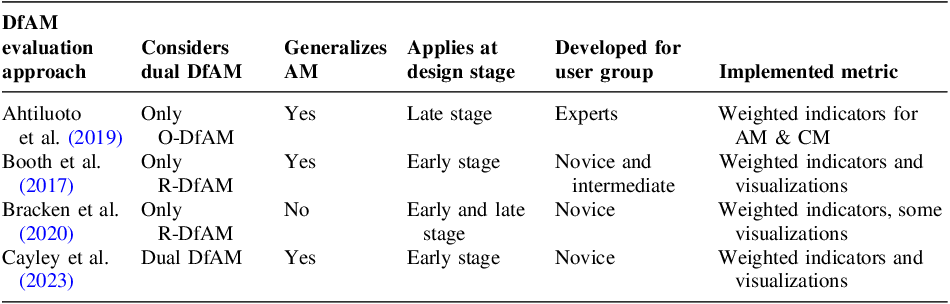
Few approaches have been proposed for evaluating DfAM, each differing in scope and application. As shown in Table 1, more approaches focus on either opportunistic DfAM (O-DfAM) or restrictive DfAM (R-DfAM) in isolation, highlighting a gap in the development of approaches that comprehensively address dual DfAM. Only one approach explicitly addresses dual DfAM considerations (Reference Cayley, Mathur and MeiselCayley et al., 2023), but limiting its utility in the transition from a detailed design concept to a CAD model. Furthermore, the generalization of AM processes varies, with some approaches (e.g., Reference Booth, Alperovich, Chawla, Ma, Reid and RamaniBooth et al., 2017) aiming for broader applicability, while others focus on specific AM technologies (e.g., Reference Bracken, Pomorski, Armstrong, Prabhu, Simpson, Jablokow, Cleary and MeiselBracken et al., 2020 for metal powder bed fusion). In Table 1 excluded were DfAM approaches that solely focus on part selection or cost estimation (e.g., Reference Jayapal, Kumaraguru and VaradarajanJayapal et al., 2023), as they do not broadly address dual DfAM.
Mapping of existing approaches for the evaluation of dual DfAM during product design

DfAM = Design for Additive Manufacturing; O-DfAM = Opportunistic DfAM;
R-DfAM = Restrictive DfAM; AM = Additive Manufacturing ; CM = Conventional Manufacturing
In addition to evaluation approaches, Medellin-Castillo and Zaragoza-Siqueiros Reference Medellin-Castillo and Zaragoza-Siqueiros(2019) developed DfAM strategies to ensure the manufacturability of parts using Fused Deposition Modeling. Tüzün et al. Reference Tüzün, Roth, Kreimeyer and Ion(2022) developed criteria applicable across various AM processes, designed to support the adaptation of designs to additive manufacturing. While their strategies and criteria effectively address restrictive DfAM, they fall short of providing a comprehensive evaluation approach. Further aspects of restrictive DfAM can also be found in ISO/ASTM 52910:2018 (DIN, 2022) or within open-source and commercial software tools. Existing open-source tools, such as slicers, evaluate designs based on restrictive criteria but fail to address opportunistic criteria that could enhance AM designs and result in an optimized dual DfAM. And commercial tools focus mainly on restrictive criteria, often require significant expertise and finalized CAD files, making them less accessible for novice designers or design evaluation based on detailed product concepts.
The analysis reveals a lack of approaches that support structured evaluation and optimization of dual DfAM during the transition from product concept to product design. Existing methods primarily focus on either manufacturability or AM potential but fail to provide a structured evaluation framework that considers both aspects simultaneously. while being broadly applicable across AM processes and usable by novices and intermediates. To address this gap, this work proposes a dual DfAM worksheet that facilitates systematic evaluation and optimization in product development. This tool shall support overall decision-making and cater to both novices and intermediates. It shall be well-structured, comprehensive, easy to understand through visualizations, intuitively applicable, reliable in its use, flexible for decision-making through weighted indicators, supportive in design improvement, and initially evaluated to ensure its effectiveness in practical application.
3. Methodology
To support the development of a dual DfAM worksheet, we employed a structured, three-phase methodology (see Figure 1). The first phase (analysis) focused on identifying requirements for the worksheet as well as the foundational criteria derived from literature and software tools, while the second phase (synthesis) focused on operationalizing the criteria and respective metrics, and the third phase (evaluation) involved empirical verification and refinement of the worksheet.
Methodology to develop and validate the dual DfAM worksheet

In the analysis phase (phase 1, see Figure 1), we began by reviewing existing evaluation approaches for both opportunistic (O-DfAM), restrictive (R-DfAM), and dual DfAM criteria (see chapter 2). This literature review provided insights into the strengths and limitations existing approaches and revealed requirements for developing a dual DfAM worksheet.
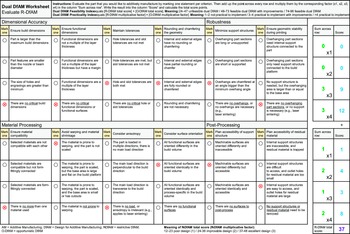
In the synthesis phase (phase 2, see Figure 1), we transitioned from gathering insights to defining and operationalizing the criteria. Here, we formulated the key categories for the dual DfAM approach. A category is composed of weighted criteria. These criteria were then operationalized by defining clear metrics and indicators for evaluation. Simultaneously, we established the basic structure of the worksheet and visualized it as the “dual DfAM worksheet” (see Figure 2 and Figure 3).
Restrictive perspective in dual DfAM worksheet of our pneumatic gripper

Opportunistic perspective in dual DfAM worksheet of our pneumatic gripper

In the validation phase (phase 3, see Figure 1) and after print testing, we conducted a workshop with students to evaluate the applicability of the worksheet, verify it according to user requirements (see end of chapter 2) and gather initial insights on the effectiveness of the dual DfAM worksheet in practice. This involved testing the worksheet with both graduate and undergraduate participants, who applied the worksheet to real-world design tasks. Data from this study was analyzed to further assess the student’s knowledge transfer to new design tasks. Insights from participants’ feedback and the outcomes of the design tasks were then used to refine the worksheet.
4. The dual DfAM worksheet
The worksheet is divided into two sections: R-DfAM (focus restrictive criteria) and O-DfAM (focus opportunistic criteria). Both sections are further divided into several categories.
R-DfAM categories. A brief overview of the R-DfAM categories is provided below, highlighting the restrictive aspects of DfAM. The corresponding criteria and their indicators are detailed in Figure 2:
-
Dimensional Accuracy. This category assesses how well a design adheres to functional and manufacturing dimensions. Criteria further include ensuring build dimensions, maintaining tolerances, and considering rounding and chamfering of geometries to ensure manufacturability and functionality.
-
Robustness. The robustness category focuses on design features that ensure stability and resilience during the additive manufacturing process. This includes criteria for minimizing support structures, ensuring geometric stability to avoid deformation or structural failure.
-
Material Processing. This category includes criteria for ensuring that material properties align with design requirements, mitigating issues like delamination or poor bonding of layers, considering material anisotropy, and surface orientation.
-
Post-Processing. Post-processing examines the accessibility of features for finishing operations like removing supports or residual material. It emphasizes minimizing the need for excessive post-processing while ensuring that designs allow for easy cleaning, polishing, or assembly after production.
O-DfAM categories. The following provides a brief overview of the O-DfAM categories, emphasizing the opportunistic aspects of DfAM. The corresponding criteria and indicators are detailed in Figure 3:
-
Use of Functional Complexity. Functional complexity evaluates the integration of added functionality into a single component, leveraging AM to embed functionality directly and exploit kinematics. This category rewards designs that enhance performance without requiring additional assembly.
-
Use of Shape Complexity. This category evaluates how effectively the design leverages geometric freedom offered by AM. It includes integrating complex geometries, reducing part counts by consolidating components, optimizing topology to increase performance, and customize geometry.
-
Use of Material Complexity. Material complexity evaluates the use of diverse materials or functionally graded material to improve performance, including designs that strategically combine properties like strength, flexibility, or conductivity to meet specific functional requirements.
-
Use of Hierarchical Complexity. This category focuses on embedding multi-scale features, such as microstructures or intricate internal geometries, to enhance the design.
-
Use of Process Potential. This category evaluates the alignment of design features with AM processes. It includes criteria for leveraging unique AM capabilities, such as minimal tooling requirements and process-specific advantages, compared to conventional manufacturing processes.
Metrics of worksheet. The described categories and criteria are integrated into a scoring system based on Booth et al. Reference Booth, Alperovich, Chawla, Ma, Reid and Ramani(2017), calculating scores for restrictive DfAM (see Figure 2) and opportunistic DfAM (see Figure 3) to guide decision making. Addressing R DfAM and O DfAM criteria, each is scored with weighted indicators (x1, x2, x3, x4). After adding up all scores on the R-DfAM worksheet, the total score reflects manufacturability, while adding up all scores on the O-DfAM worksheet reflects usefulness for additive manufacture. Total scores of 12–23 points indicate a “poor” design, while 24–36 points suggest an “improvable” design, highlighting areas for improvement, and 37–48 points represent an “excellent” design. In summary, higher scores correspond to better results on the worksheet.
Furthermore, the combined total scores for R-DfAM and O-DfAM are used to calculate the dual DfAM feasibility index, which equals the sum of the R-DfAM and O-DfAM total scores (see Equation 1):
 {\bf{Dual}}\ {\rm{ }}{\bf{DfAM}}\ {\rm{ }}{\bf{feasibility}}\ {\rm{ }}{\bf{index}} = [{\rm{R - DfAM\ score}}] + [{\rm{O - DfAM\ score}}]
The feasibility index helps to classify a design’s overall feasibility as follows: 24–47 points indicate an “unfeasible dual DfAM”, 48–73 points suggest a “feasible dual DfAM with improvements”, and 74–96 points represent a “feasible dual DfAM”.
Additionally, the dual DfAM practicality index is calculated by multiplying the multiplicative factor of the R DfAM total score and the multiplicative factor of the O DfAM total score (see Equation 2):
 {\bf{Dual}}\ {\rm{ }}{\bf{DfAM}}\ {\rm{ }}{\bf{practicality}}\ {\rm{ }}{\bf{index}} = [{\rm{R - DfAM\ multiplicative \ factor}}]\cdot[{\rm{O - DfAM \ multiplicative \ factor}}]
The multiplicative factors are the converted total scores: 12–23 points equal a multiplicative factor of 1, 24–36 points equal a multiplicative factor of 2, and 37–48 points equal a multiplicative factor of 3. The dual DfAM practicality index provides further insights: a value of 1 and 2 indicates a design that is “not practical to implement”, a value between 3 and 4 suggests a design that is “practical to implement with improvements”, and a value greater than 4 classifies the design as “practical to implement”.
For example, a design with a total R-DfAM score of 40 points (multiplicative factor of 3) and a total O DfAM score of 12 points (multiplicative factor of 1) results in 52 points for the dual DfAM feasibility index, suggesting an improvable dual DfAM. The dual DfAM practicality index equals 3, indicating that the design is not practical to implement. An example could be an additively manufactured prototype that meets restrictive criteria but does not exploit the opportunities of AM. The consideration of the dual DfAM practicality index also eliminates significant discrepancies between two seemingly similar values of the feasibility index. For instance, a comparative case could involve a design with 26 points (multiplicative factor of 2) in both R-DfAM and O-DfAM. While the same feasibility index of 52 points results, the practicality index of 4 suggests a more practical and improvable design.
The scaling of “poor” to “excellent”, “not feasible” to “feasible”, and “not practical” to “practical” is derived from empirical evaluations of AM design feasibility and effectiveness. The thresholds were set based on theoretical benchmarks from prior DfAM assessment methods (e.g., Reference Booth, Alperovich, Chawla, Ma, Reid and RamaniBooth et al., 2017) and iterative case study evaluations. By analyzing multiple designs with varying levels of a DfAM, we established score ranges that reflect key transition points in feasibility and practicality for AM. The classification ensures that designs with minimal AM optimization are distinguished from those requiring improvements and those fully leveraging AM’s capabilities.
To describe how the worksheet is applied, we use the pneumatic gripper from Figure 1 as an example. For each criterion, a single selection per column is marked (red cross). The number of marks within a row are counted and entered in the “Sum across row” column (green number), which is then multiplied by the weighting factor to calculate the individual score recorded in the “Score” column (blue number). Finally, all individual scores are added together to determine the total R-DfAM and O-DfAM scores, yielding an R-DfAM score of 37 and an O-DfAM score of 35 (purple, see Figure 2 and Figure 3). This results in a dual DfAM feasibility index of 72, classifying it as “feasible with improvements”. Hence, the multiplicative factors for R-DfAM and O-DfAM each correspond to 3. The dual DfAM practicality index of 6 suggests the design is practical to implement while still allowing for optimization. This structured evaluation highlights key areas for refinement, ensuring balanced manufacturability and functional optimization of the pneumatic gripper.
5. Evaluation of the dual DfAM worksheet
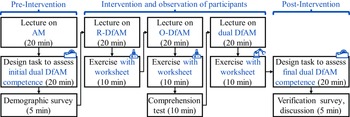
After developing the dual DfAM worksheet for assessing and optimizing detailed product concepts, we conducted a study to verify requirements (see chapter 2) and initially evaluate its effectiveness. The study was carried out as a supervised workshop, following the procedure shown in Figure 4.
Procedure of the supervised workshop

In the pre-intervention, participants were lectured on AM to establish a baseline, followed by a design task focusing on the redesign of a tape dispenser to assess their initial dual DfAM competence level in accordance with the metrics by Prabhu et al. Reference Prabhu, Simpson, Miller, Cutler and Meisel(2021). They then completed a survey to report their demographic data to ensure a random sample. It shall be noted that no information about DfAM was presented during the first lecture so that the actual initial competence level could be measured.
The intervention included three structured parts, each comprising a lecture and an evaluation task. To minimize its impact on the application of the worksheet, each lecture provided only basic information on DfAM. As recommended by Prabhu et al. Reference Prabhu, Simpson, Miller, Cutler and Meisel(2021), we started with a general on R DfAM and continued with an exercise to evaluate an additively manufactured and chemically resistant vortex mixer (by Apium Additive Technologies GmbH) using the developed worksheet. The second part introduced O-DfAM, continuing the evaluation of the mixer, while the third part covered dual DfAM with a lecture and an evaluation task involving an additively manufactured and integrated pneumatic gripper (see Figure 1), increasing task complexity. Additionally, participants solved a test of single-choice questions (SC questions) to ensure their comprehension of the presented worksheet.
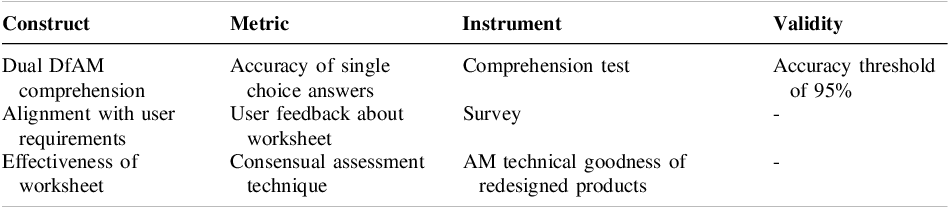
During the post-intervention, participants redesigned the tape dispenser from the pre-intervention to provide a reference for measuring changes in their dual DfAM competence level. The procedure assessed the worksheet’s impact on several constructs (see Table 2) and concluded with a survey to verify user requirements.
Summary of constructs, metrics and method of establishing validity used in this study
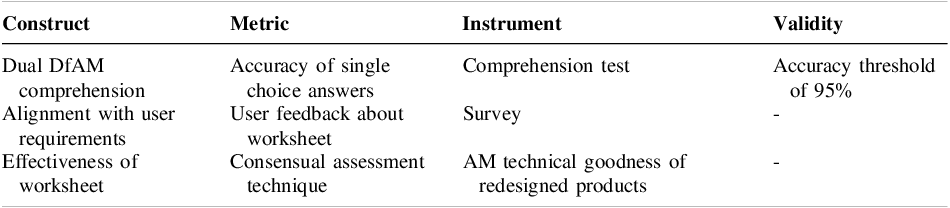
Dual DfAM comprehension evaluates how well participants understand opportunistic and restrictive criteria using single-choice questions. Each single-choice question corresponds to one category presented in chapter 4 to objectively measure comprehension. To ensure consistency and establish a shared baseline, only participants who achieved an accuracy threshold of 95% in correctly answering single-choice questions were allowed to proceed with subsequent tasks and were included in the analysis. This approach eliminates variables related to varying levels of comprehension or language barriers.
The alignment with user requirements is assessed by analyzing user feedback on its usability and impact on design decisions.
Finally, effectiveness of the worksheet evaluates the technical quality of pre- and post-intervention design outcomes, linking the impact of the intervention to tangible improvements in design performance. Additionally, although no statistical test will be performed, a comparison of the dual DfAM feasibility index and the dual DfAM practicality index between participants’ results and those of an expert, serving as the ideal reference, offers qualitative insights into the alignment of participants’ evaluations with expert-level standards.
The evaluation of the worksheet was conducted during a supervised workshop with a total of 73 students from engineering degree programs, who had varying levels of experience in DfAM. Among these participants, 38 had no experience with DfAM or only attended a lecture about AM, while 35 had informal knowledge or training in DfAM prior to our workshop. Notably, none of the participants reported having an expert level of experience in DfAM.
All participants successfully reached the accuracy threshold of 95% for the comprehension test, confirming that the presented worksheet effectively supports understanding of dual DfAM concepts and criteria. However, it is important to note that no participant achieved a perfect score, indicating that there is still room for improvement in fully grasping all aspects of the worksheet.
As shown in Figure 5, the user feedback revealed positive responses regarding the developed worksheet and its support for dual DfAM evaluation. Since capturing user perception is inherently subjective, the survey used yes/no questions to assess whether requirements were met. All 73 participants assessed the approach based on various criteria, including support in evaluation, structure, comprehensibility, applicability, intuitiveness, reliability, effectiveness, flexibility, improvement of design, and reusability. The results are given in percentages, with the number of responses in parentheses and response options “yes” and “no” analyzed. The highest approval ratings were achieved for support in evaluation (100%) as well as for effectiveness and improvement of design (both approx. 99%). The lowest approval ratings were observed for intuitiveness of application (approx. 85%) and reliability (approx. 86%). Additionally, comprehension of the worksheet (approx. 92%) and flexibility in decision making (approx. 93%) were also relatively low compared to other criteria.
Validation results of the dual DfAM worksheet (n = 73)

The effectiveness of the worksheet was further evaluated by comparing the dual DfAM feasibility index and practicality index between participants and the expert reference, focusing on the pneumatically operated gripper as a case study (see Figure 1, Figure 2, and Figure 3).While R-DfAM scores often aligned closely with the expert evaluation, O-DfAM scores showed greater variation among participants, leading to derivations from the expert’s feasibility index value in some cases.
To determine whether the evaluation by participants aligned with the evaluation by the expert, the hypothesis was tested that the average dual DfAM feasibility index matches the expert. For intermediate-level participants, the feasibility index averaged 70.74 (mean R-DfAM score of 37.66 and mean O-DfAM score of 33.09), while for novices, the feasibility index averaged 72.32 (mean R-DfAM score of 37.82 and mean O-DfAM score of 34.50). These results show that both novice and intermediate participants produced evaluations close to the expert’s, resulting in no major differences between experience levels in assessing dual DfAM designs. These findings collectively validate the dual DfAM worksheet as a practical and effective tool for both educating students and supporting comprehensive dual DfAM evaluation. However, due to the low number of participants, a statistical test was neither applicable nor advisable.
Furthermore, a comparison of pre- and post-results of a redesigned tape dispenser revealed both qualitative improvements and limitations in integrating restrictive and opportunistic criteria. Two sets of student solutions are shown in Figure 6.
Examples of a redesigned tape dispenser by students (first-angle projection)

Challenges remained in leveraging advanced AM-specific opportunities, such as multi-material integration and the use of process potentials. While novice students’ designs improved in practicality and feasibility significantly, intermediate students showed only slight improvements in practicality, such as in topology optimization, as many had already developed feasible solutions pre-intervention. All intermediate students produced feasible solutions, but some were not practical as they were constrained by the simplicity of the product and the design task. This suggests a need for a minimum level of complexity in the design to achieve higher scores. While high values in restrictive criteria are still possible, the limited design space of a tape dispenser reduces potential for significant improvements in opportunistic DfAM. Students reported that while the worksheet helped identify areas for improvement, specific design measures to address these were lacking.
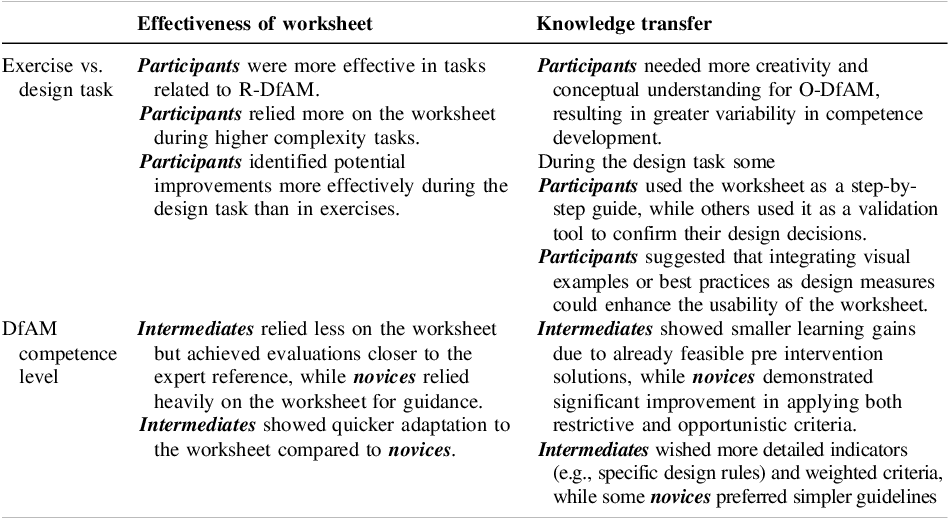
To reflect on the impact of varying levels of DfAM experience and the use cases of the dual DfAM worksheet, additional insights from observation during the workshop and the discussion at the end of the workshop are summarized in Table 3.
Summary of initial insights from observations and discussions during the workshop

6. Discussion
The dual DfAM worksheet provides a novel approach to evaluating and optimizing product designs for additive manufacturing by balancing restrictive and opportunistic criteria. Booth et al. Reference Booth, Alperovich, Chawla, Ma, Reid and Ramani(2017) use a penalization-based scoring system where higher scores indicate design issues, while the dual DfAM worksheet reverses this logic, making higher scores reflect better alignment with criteria, which can be more intuitive. Unlike Cayley et al. Reference Cayley, Mathur and Meisel(2023), which focuses on early-stage evaluations with weighted criteria, the dual DfAM worksheet is designed for applicability in product development, particularly during the transition from a detailed product concept to a product design. This allows both novice and intermediate users to apply the worksheet, although some terms and concepts, such as functional surfaces, require a baseline of engineering knowledge.
The verification of user requirements and initial evaluation, conducted through a workshop, demonstrated the worksheet’s applicability in assessing and refining AM designs. However, insights gained during evaluation highlighted opportunities for refinement. For example, introducing a weighted balance index could address disparities between subcategories, enabling a more nuanced evaluation of design consistency. Similarly, mapping lessons learned to worksheet criteria could provide actionable feedback and support balanced decision-making.
The dual DfAM worksheet could complement existing DfAM methods by providing a structured evaluation framework for during an iterative product development. For example, when starting with design principles (e.g., Reference Valjak, Kosorčić, Rešetar and BojčetićValjak et al., 2022) or design heuristics (e.g., Reference Blösch-Paidosh and SheaBlösch-Paidosh & Shea, 2022), the worksheet can be used to assess how well a concept aligns with restrictive and opportunistic DfAM criteria, even if key details like material selection or exact dimensions are not yet defined. By incorporating neutral indicators for each criterion when key details are missing, the worksheet allows for an initial evaluation, enabling designers to identify potential improvements early and refine their concept before transitioning to detailed product design and CAD modeling.
Despite its strengths, the tool has limitations. Certain O-DfAM criteria were found to be ambiguous or less relevant to some designs, leading to potential misclassification. Additionally, the tool relies partially on subjective interpretation, which can vary between users and affect the consistency of the dual DfAM feasibility and practicality indices. Future iterations could address this by incorporating real-world examples and case studies to reduce ambiguity and improve comprehensibility for novices.
To refine the structured assessment of dual DfAM, future work will focus on improving the transition from a detailed product concept to a CAD model. This includes enhancing the worksheet’s adaptability to different levels of design maturity, refining criteria interdependencies, and ensuring that the tool effectively supports AM-specific design modifications. Additionally, digitalizing the worksheet and integrating weighted category criteria could enhance CAD-integrated usability, facilitating a seamless transition from conceptual evaluation to CAD-based optimization.
7. Conclusion and future work
The dual DfAM worksheet demonstrates its applicability in product development, particularly in the transition from a detailed product concept to product design. By introducing the dual DfAM feasibility and practicality index, the tool provides a structured framework to assess the opportunistic and restrictive aspects of AM for a given design. It enables systematic evaluation and decision making, ensuring AM constraints and potentials are balanced effectively. The worksheet can be used iteratively after applying existing DfAM methods that focus on developing a product concept. It is tailored for novice to intermediate designers, suggesting structured guidance to refine product designs for AM. Future work will focus on validating the worksheet in broader applications and enhancing its ability to support AM integration by mapping design measures and best practices to advance dual DfAM.





 Open access

