





1 Introduction
The empirical spectral distribution of a non-Hermitian random matrix typically converges to a nonrandom probability distribution $\sigma $
, the limiting spectral measure, on the complex plane as its dimension tends to infinity. The most prominent instance of this phenomenon is the circular law, stating that the empirical eigenvalue distributions of a suitably normalised sequence of matrices
$\sigma $
, the limiting spectral measure, on the complex plane as its dimension tends to infinity. The most prominent instance of this phenomenon is the circular law, stating that the empirical eigenvalue distributions of a suitably normalised sequence of matrices $X_n \in \mathbb {C}^{n \times n}$
with centred i.i.d. entries converge to the uniform distribution on the complex unit disk
$X_n \in \mathbb {C}^{n \times n}$
with centred i.i.d. entries converge to the uniform distribution on the complex unit disk $\mathbb {D}_1$
in the limit
$\mathbb {D}_1$
in the limit $n \to \infty $
[Reference Girko35, Reference Bai12] (see [Reference Tao, Vu and Krishnapur57] for optimal moment conditions and [Reference Bordenave and Chafaï19] for a review).
$n \to \infty $
[Reference Girko35, Reference Bai12] (see [Reference Tao, Vu and Krishnapur57] for optimal moment conditions and [Reference Bordenave and Chafaï19] for a review).
For the purpose of identifying the limiting spectral measure and computing mixed moments of $X_n$
and
$X_n$
and $X_n^*$
as
$X_n^*$
as $n \to \infty $
, according to free probability theory the limit of the sequence
$n \to \infty $
, according to free probability theory the limit of the sequence $X_n$
is appropriately described by a circular element
$X_n$
is appropriately described by a circular element $\mathfrak {c}$
. This
$\mathfrak {c}$
. This $\mathfrak {c}$
is an infinite-dimensional operator in a
$\mathfrak {c}$
is an infinite-dimensional operator in a $W^*$
-probability space
$W^*$
-probability space $\mathcal {A}$
with faithful, tracial state
$\mathcal {A}$
with faithful, tracial state $\langle \mspace {2 mu}\cdot \mspace {2 mu} \rangle $
and satisfies
$\langle \mspace {2 mu}\cdot \mspace {2 mu} \rangle $
and satisfies $\lim _{n \to \infty } \frac {1}{n} \operatorname {\mathrm {Tr}} p(X_n, X_n^*) = \langle p(\mathfrak {c},\mathfrak {c}^*) \rangle $
for all polynomials p in two noncommutative variables. In agreement with the circular law, the uniform distribution on
$\lim _{n \to \infty } \frac {1}{n} \operatorname {\mathrm {Tr}} p(X_n, X_n^*) = \langle p(\mathfrak {c},\mathfrak {c}^*) \rangle $
for all polynomials p in two noncommutative variables. In agreement with the circular law, the uniform distribution on $\mathbb {D}_1$
is the Brown measure of
$\mathbb {D}_1$
is the Brown measure of $\mathfrak {c}$
, where the Brown measure is a generalisation of the spectral measure to non-normal operators [Reference Brown22, Reference Haagerup and Larsen36]. When a deterministic deformation matrix
$\mathfrak {c}$
, where the Brown measure is a generalisation of the spectral measure to non-normal operators [Reference Brown22, Reference Haagerup and Larsen36]. When a deterministic deformation matrix $A=A_n$
is added to
$A=A_n$
is added to $X=X_n$
, the associated spectral distribution of the random matrix
$X=X_n$
, the associated spectral distribution of the random matrix $A + X$
is asymptotically close to the Brown measure
$A + X$
is asymptotically close to the Brown measure $\sigma _{A+ \mathfrak {c}}$
of the sum of an embedding of A into the
$\sigma _{A+ \mathfrak {c}}$
of the sum of an embedding of A into the $W^*$
-probability space and a circular element
$W^*$
-probability space and a circular element $\mathfrak {c}$
that is
$\mathfrak {c}$
that is $\ast $
-free from A [Reference Śniady52]. In this case, the support of
$\ast $
-free from A [Reference Śniady52]. In this case, the support of $\sigma _{A+ \mathfrak {c}}$
coincides with the closure
$\sigma _{A+ \mathfrak {c}}$
coincides with the closure $\overline {\mathbb {S}}_{A}$
, where
$\overline {\mathbb {S}}_{A}$
, where $\mathbb {S}_a := \{ \zeta \in \mathbb {C} \, : \, \langle (a-\zeta )^{-1}(a^*-\overline {\zeta })^{-1}) \rangle> 1\}$
. This observation goes back to [Reference Khoruzhenko42].
$\mathbb {S}_a := \{ \zeta \in \mathbb {C} \, : \, \langle (a-\zeta )^{-1}(a^*-\overline {\zeta })^{-1}) \rangle> 1\}$
. This observation goes back to [Reference Khoruzhenko42].
That $\overline {\mathbb {S}}_a$
is the support of the Brown measure of
$\overline {\mathbb {S}}_a$
is the support of the Brown measure of $a + \mathfrak {c}$
for a deformation
$a + \mathfrak {c}$
for a deformation $a\in \mathcal {A}$
, which is
$a\in \mathcal {A}$
, which is $\ast $
-free from
$\ast $
-free from $\mathfrak {c}$
, was shown in [Reference Bordenave, Caputo and Chafaï18] for normal deformations and extended to general deformations in [Reference Bordenave and Capitaine17, Reference Zhong64]. Subsequently, the regularity of
$\mathfrak {c}$
, was shown in [Reference Bordenave, Caputo and Chafaï18] for normal deformations and extended to general deformations in [Reference Bordenave and Capitaine17, Reference Zhong64]. Subsequently, the regularity of $\sigma _{a+\mathfrak c}$
has been analysed. The measure is absolutely continuous with respect to the Lebesgue measure on
$\sigma _{a+\mathfrak c}$
has been analysed. The measure is absolutely continuous with respect to the Lebesgue measure on $\mathbb {C}$
[Reference Belinschi, Yin and Zhong13] and the density is strictly positive and real analytic on
$\mathbb {C}$
[Reference Belinschi, Yin and Zhong13] and the density is strictly positive and real analytic on $\mathbb {S}$
[Reference Zhong64, Reference Ho and Zhong39]. In [Reference Erdős and Ji32] it has been shown that at the edge of
$\mathbb {S}$
[Reference Zhong64, Reference Ho and Zhong39]. In [Reference Erdős and Ji32] it has been shown that at the edge of $\mathbb {S}_a$
, the density typically possesses a jump discontinuity and that around its zeros within its support
$\mathbb {S}_a$
, the density typically possesses a jump discontinuity and that around its zeros within its support $\overline {\mathbb {S}}_a$
it grows at most quadratically with a corresponding quadratic lower bound either on a two-sided cone or in a whole neighbourhood.
$\overline {\mathbb {S}}_a$
it grows at most quadratically with a corresponding quadratic lower bound either on a two-sided cone or in a whole neighbourhood.
In the present work, we refine the distinction between these three possibilities by establishing a full classification of the points of vanishing density within $\overline {\mathbb {S}}_a$
. The edge singularities, that is, the zeros of the density in
$\overline {\mathbb {S}}_a$
. The edge singularities, that is, the zeros of the density in $\partial \overline {\mathbb S}_a$
are classified in terms of the local shape of
$\partial \overline {\mathbb S}_a$
are classified in terms of the local shape of $\partial \overline {\mathbb S}_a$
, while zeros in the interior of
$\partial \overline {\mathbb S}_a$
, while zeros in the interior of $\overline { \mathbb S}_a$
are classified in terms of the local growth of the density. For both cases countably infinite singularity types are possible. Finally, we prove that each case of these possible singularity types does exist in the Brown measure
$\overline { \mathbb S}_a$
are classified in terms of the local growth of the density. For both cases countably infinite singularity types are possible. Finally, we prove that each case of these possible singularity types does exist in the Brown measure $\sigma _{a + \mathfrak c}$
for a suitable choice of a.
$\sigma _{a + \mathfrak c}$
for a suitable choice of a.
In addition to providing a clear picture of the regularity of the Brown measure this full classification of the singularity types is important because of their potential to distinguish the universality classes of the local eigenvalue point processes near these singularities. To that end, it is insightful to review some known results in the analogous Hermitian model, the deformed Wigner matrices $A+H$
, where A is a deterministic real diagonal deformation to a sequence of
$A+H$
, where A is a deterministic real diagonal deformation to a sequence of $n \times n$
-Wigner matrices H with i.i.d. entries, up to Hermitian symmetry constraints. The spectral density for such matrices is well approximated for large dimensions by the spectral measure of
$n \times n$
-Wigner matrices H with i.i.d. entries, up to Hermitian symmetry constraints. The spectral density for such matrices is well approximated for large dimensions by the spectral measure of $A +\mathfrak {s}$
, where
$A +\mathfrak {s}$
, where $\mathfrak {s}$
is a semicircular element,
$\mathfrak {s}$
is a semicircular element, $\ast $
-free of A. This follows from [Reference Voiculescu60] and [Reference Voiculescu61] if H has Gaussian entries and for a general Wigner matrix from [Reference Dykema29]. The spectral measure of
$\ast $
-free of A. This follows from [Reference Voiculescu60] and [Reference Voiculescu61] if H has Gaussian entries and for a general Wigner matrix from [Reference Dykema29]. The spectral measure of $A+ \mathfrak s$
has a density
$A+ \mathfrak s$
has a density $\rho $
with respect to the Lebesgue measure on the real line which is real analytic wherever it is positive. Under some regularity assumptions on the deformation, the singularities of
$\rho $
with respect to the Lebesgue measure on the real line which is real analytic wherever it is positive. Under some regularity assumptions on the deformation, the singularities of $\rho $
, that form when the density vanishes, can only be of algebraic degree two or three [Reference Ajanki, Erdős and Krüger2]. More precisely, they exhibit a one-sided square root growth at the spectral edge and a two-sided cubic root growth for singularities in the interior of the support of
$\rho $
, that form when the density vanishes, can only be of algebraic degree two or three [Reference Ajanki, Erdős and Krüger2]. More precisely, they exhibit a one-sided square root growth at the spectral edge and a two-sided cubic root growth for singularities in the interior of the support of $\rho $
. These singularity types determine the corresponding universality classes of the local spectral statistics that are associated with the Airy [Reference Lee and Schnelli43] and Pearcey process [Reference Erdős, Krüger and Schröder34, Reference Cipolloni, Erdős, Krüger and Schröder25], respectively. For Gaussian entries this correspondence between the singularity type of the density and the local statistics had already been established for regular square root edges without deformation in [Reference Tracy and Widom58, Reference Tracy and Widom59] and subsequently with deformation in [Reference Capitaine and Péché24], as well as for the cubic root cusp in [Reference Brézin and Hikami20, Reference Brézin and Hikami21, Reference Adler and van Moerbeke1, Reference Capitaine and Péché24].
$\rho $
. These singularity types determine the corresponding universality classes of the local spectral statistics that are associated with the Airy [Reference Lee and Schnelli43] and Pearcey process [Reference Erdős, Krüger and Schröder34, Reference Cipolloni, Erdős, Krüger and Schröder25], respectively. For Gaussian entries this correspondence between the singularity type of the density and the local statistics had already been established for regular square root edges without deformation in [Reference Tracy and Widom58, Reference Tracy and Widom59] and subsequently with deformation in [Reference Capitaine and Péché24], as well as for the cubic root cusp in [Reference Brézin and Hikami20, Reference Brézin and Hikami21, Reference Adler and van Moerbeke1, Reference Capitaine and Péché24].
Allowing the entries in the randomness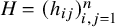 $H =(h_{ij})_{i,j=1}^n$
to have differing distributions, introduces an additional structure designed to model systems with nontrivial underlying geometry. For the deformed Wigner type matrices
$H =(h_{ij})_{i,j=1}^n$
to have differing distributions, introduces an additional structure designed to model systems with nontrivial underlying geometry. For the deformed Wigner type matrices $A+H$
the asymptotic spectral density
$A+H$
the asymptotic spectral density $\rho $
depends on the variance profile
$\rho $
depends on the variance profile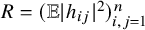 ${R=(\mathbb {E} |h_{ij}|^2)_{i,j=1}^n}$
. To define the limiting object that replaces the semicircular element from the i.i.d. case in this setting, the additional structure of a conditional expectation
${R=(\mathbb {E} |h_{ij}|^2)_{i,j=1}^n}$
. To define the limiting object that replaces the semicircular element from the i.i.d. case in this setting, the additional structure of a conditional expectation $E:\mathcal {A} \to \mathcal {B}$
with values in the commutative subalgebra
$E:\mathcal {A} \to \mathcal {B}$
with values in the commutative subalgebra $\mathcal {B}=\mathbb {C}^n \subset \mathcal {A}$
with entrywise multiplication is introduced on the
$\mathcal {B}=\mathbb {C}^n \subset \mathcal {A}$
with entrywise multiplication is introduced on the $W^*$
-probability space. This is the setup of
$W^*$
-probability space. This is the setup of $\mathcal {B}$
-valued free probability theory [Reference Voiculescu62] and the operator
$\mathcal {B}$
-valued free probability theory [Reference Voiculescu62] and the operator $\mathfrak {s}$
, for which
$\mathfrak {s}$
, for which $\rho $
is now the spectral density of
$\rho $
is now the spectral density of $A + \mathfrak {s}$
, is a
$A + \mathfrak {s}$
, is a $\mathcal {B}$
-valued circular element whose covariance encodes the variance profile R through the identity
$\mathcal {B}$
-valued circular element whose covariance encodes the variance profile R through the identity $Rb = E[ \mathfrak {s}b \mathfrak {s}]$
for
$Rb = E[ \mathfrak {s}b \mathfrak {s}]$
for $b \in \mathcal {B}$
. The classification of singularities of
$b \in \mathcal {B}$
. The classification of singularities of $\rho $
in terms of the edge - cusp - dichotomy, as well as the associated appearance of the Airy - and Pearcey - universality classes, persists in this more general model [Reference Alt, Erdős, Krüger and Schröder8, Reference Erdős, Krüger and Schröder34, Reference Cipolloni, Erdős, Krüger and Schröder25].
$\rho $
in terms of the edge - cusp - dichotomy, as well as the associated appearance of the Airy - and Pearcey - universality classes, persists in this more general model [Reference Alt, Erdős, Krüger and Schröder8, Reference Erdős, Krüger and Schröder34, Reference Cipolloni, Erdős, Krüger and Schröder25].
Introducing variance profiles in the non-Hermitian setup requires the same extension to a $\mathcal {B}$
-valued probability space
$\mathcal {B}$
-valued probability space $(\mathcal {A}, \mathcal {B},E)$
with
$(\mathcal {A}, \mathcal {B},E)$
with $\mathcal {B}=\mathbb {C}^n$
. The empirical spectral measure of a random matrix
$\mathcal {B}=\mathbb {C}^n$
. The empirical spectral measure of a random matrix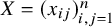 ${X =(x_{ij})_{i,j=1}^n}$
with centred independent entries of variances
${X =(x_{ij})_{i,j=1}^n}$
with centred independent entries of variances $s_{ij}:=\mathbb {E}\mspace {1 mu} \lvert x_{ij} \rvert ^2$
is well approximated by the Brown measure of a non-normal operator
$s_{ij}:=\mathbb {E}\mspace {1 mu} \lvert x_{ij} \rvert ^2$
is well approximated by the Brown measure of a non-normal operator $\mathfrak {c}$
that is a
$\mathfrak {c}$
that is a $\mathbb {C}^n$
-valued circular element and covariance
$\mathbb {C}^n$
-valued circular element and covariance $S=(s_{ij})_{i,j=1}^n$
[Reference Alt and Krüger10]. Many entries may have variance zero, which is of particular interest when studying non-Hermitian band matrices [Reference Jain, Jana, Luh and O’Rourke40, Reference Jana41]. Here the Brown measure is supported on a disk, radially symmetric and its density has a jump at the edge, but is nonconstant on its support in general [Reference Cook, Hachem, Najim and Renfrew27, Reference Alt, Erdős and Krüger5]. Adding a diagonal deformation
$S=(s_{ij})_{i,j=1}^n$
[Reference Alt and Krüger10]. Many entries may have variance zero, which is of particular interest when studying non-Hermitian band matrices [Reference Jain, Jana, Luh and O’Rourke40, Reference Jana41]. Here the Brown measure is supported on a disk, radially symmetric and its density has a jump at the edge, but is nonconstant on its support in general [Reference Cook, Hachem, Najim and Renfrew27, Reference Alt, Erdős and Krüger5]. Adding a diagonal deformation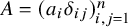 $A=(a_i\delta _{ij})_{i,j=1}^n$
to
$A=(a_i\delta _{ij})_{i,j=1}^n$
to $X_n$
breaks the asymptotic radial symmetry of the Brown measure of
$X_n$
breaks the asymptotic radial symmetry of the Brown measure of $A + \mathfrak {c}$
and the spectrum concentrates on an area in the complex plane that is contained in the asymptotic pseudospectrum, whose outer boundary was identified in [Reference Alt, Erdős, Krüger and Nemish7]. In the companion paper [Reference Alt and Krüger10] we show that the spectrum asymptotically fills the entire area enclosed by this boundary, that is, for deformed random matrices with variance profile the support of the limiting spectral measure and the asymptotic pseudospectrum coincide.
$A + \mathfrak {c}$
and the spectrum concentrates on an area in the complex plane that is contained in the asymptotic pseudospectrum, whose outer boundary was identified in [Reference Alt, Erdős, Krüger and Nemish7]. In the companion paper [Reference Alt and Krüger10] we show that the spectrum asymptotically fills the entire area enclosed by this boundary, that is, for deformed random matrices with variance profile the support of the limiting spectral measure and the asymptotic pseudospectrum coincide.
Recently, it has been shown that for non-Hermitian matrices $A + X$
, where
$A + X$
, where $X \in \mathbb {C}^{n \times n}$
has i.i.d. entries and A is deterministic, the local universality classes correspond to the local shape of the limiting spectral density
$X \in \mathbb {C}^{n \times n}$
has i.i.d. entries and A is deterministic, the local universality classes correspond to the local shape of the limiting spectral density $\sigma $
as well in two cases. In the bulk, that is when
$\sigma $
as well in two cases. In the bulk, that is when $\sigma $
is positive, the local eigenvalue statistics coincides with the Ginibre bulk statistics. For Gaussian X this was shown in [Reference Zhang63] and for non-Gaussian entries and
$\sigma $
is positive, the local eigenvalue statistics coincides with the Ginibre bulk statistics. For Gaussian X this was shown in [Reference Zhang63] and for non-Gaussian entries and $A=0$
under the four moment matching assumption in [Reference Tao and Vu56] and without this assumption in [Reference Maltsev and Osman45, Reference Osman48, Reference Dubova and Yang28]. At spectral edge points with a jump discontinuity of
$A=0$
under the four moment matching assumption in [Reference Tao and Vu56] and without this assumption in [Reference Maltsev and Osman45, Reference Osman48, Reference Dubova and Yang28]. At spectral edge points with a jump discontinuity of $\sigma $
, the Ginibre edge statistic emerges, which has been proved first for Gaussian matrices in [Reference Liu and Zhang44] and then for non-Gaussian entries in [Reference Cipolloni, Erdős and Schröder26] for
$\sigma $
, the Ginibre edge statistic emerges, which has been proved first for Gaussian matrices in [Reference Liu and Zhang44] and then for non-Gaussian entries in [Reference Cipolloni, Erdős and Schröder26] for $A=0$
and in [Reference Campbell, Cipolloni, Erdős and Ji23] for nonzero deformations. This phenomenon is expected to generalise to matrices X with variance profile. In contrast to the Hermitian setting the class of singularities that emerge as points where the limiting spectral density vanishes, or equivalently the zeros of the density of the Brown measure of
$A=0$
and in [Reference Campbell, Cipolloni, Erdős and Ji23] for nonzero deformations. This phenomenon is expected to generalise to matrices X with variance profile. In contrast to the Hermitian setting the class of singularities that emerge as points where the limiting spectral density vanishes, or equivalently the zeros of the density of the Brown measure of $A + \mathfrak {c}$
with a
$A + \mathfrak {c}$
with a $\mathbb {C}^n$
-valued circular element
$\mathbb {C}^n$
-valued circular element $\mathfrak {c}$
inside its support, is much more rich. As we show in this work, it contains an infinite family of such possible singularity types both at the spectral edge as well as in the interior of the support. We conjecture that each local singularity type corresponds to a specific universality class for the local statistics of the corresponding random matrix ensemble.
$\mathfrak {c}$
inside its support, is much more rich. As we show in this work, it contains an infinite family of such possible singularity types both at the spectral edge as well as in the interior of the support. We conjecture that each local singularity type corresponds to a specific universality class for the local statistics of the corresponding random matrix ensemble.
Generalising from the setting of finite dimensional $\mathcal {B}=\mathbb {C}^n$
, in this work we consider the general framework of deformed
$\mathcal {B}=\mathbb {C}^n$
, in this work we consider the general framework of deformed $\mathcal {B}$
-valued circular elements
$\mathcal {B}$
-valued circular elements $a+\mathfrak {c}$
, where
$a+\mathfrak {c}$
, where $a \in \mathcal {B}$
is the deformation,
$a \in \mathcal {B}$
is the deformation, $\mathfrak {c}$
the
$\mathfrak {c}$
the $\mathcal {B}$
-valued circular element,
$\mathcal {B}$
-valued circular element, $\mathcal {B} \subset \mathcal {A}$
is a commutative subalgebra of a
$\mathcal {B} \subset \mathcal {A}$
is a commutative subalgebra of a $W^*$
-probability space
$W^*$
-probability space $\mathcal A$
and
$\mathcal A$
and $E \colon \mathcal A \to \mathcal B$
is a conditional expectation. The covariance
$E \colon \mathcal A \to \mathcal B$
is a conditional expectation. The covariance $S \colon \mathcal {B} \to \mathcal {B}$
of
$S \colon \mathcal {B} \to \mathcal {B}$
of $\mathfrak c$
is defined through
$\mathfrak c$
is defined through $S[b] = E[\mathfrak c b \mathfrak c^*]$
for all
$S[b] = E[\mathfrak c b \mathfrak c^*]$
for all $b \in \mathcal B$
and
$b \in \mathcal B$
and $E[\mathfrak c b \mathfrak c]=0$
. Higher order
$E[\mathfrak c b \mathfrak c]=0$
. Higher order $\mathcal {B}$
-valued free cumulants of
$\mathcal {B}$
-valued free cumulants of $\mathfrak {c}$
and
$\mathfrak {c}$
and $\mathfrak {c}^*$
vanish, making it a generalized circular element as introduced in [Reference Śniady53].
$\mathfrak {c}^*$
vanish, making it a generalized circular element as introduced in [Reference Śniady53]. $\mathcal {B}$
-valued circular elements were previously analysed in [Reference Dykema30] under the name
$\mathcal {B}$
-valued circular elements were previously analysed in [Reference Dykema30] under the name $\mathcal {B}$
-circular elements and were introduced in [Reference Dykema and Haagerup31]. For the Brown measure
$\mathcal {B}$
-circular elements and were introduced in [Reference Dykema and Haagerup31]. For the Brown measure $\sigma $
of
$\sigma $
of $\mathfrak {c}+a$
we provide a classification in terms of the solution to a nonlinear equation on
$\mathfrak {c}+a$
we provide a classification in terms of the solution to a nonlinear equation on $\mathcal {B}$
. Furthermore, we determine the regularity properties of this measure and describe its singularities. We show that under some regularity assumptions on the variance profile the Brown measure
$\mathcal {B}$
. Furthermore, we determine the regularity properties of this measure and describe its singularities. We show that under some regularity assumptions on the variance profile the Brown measure $\sigma $
admits a bounded probability density on the complex plane, which is real analytic and strictly positive on an open domain
$\sigma $
admits a bounded probability density on the complex plane, which is real analytic and strictly positive on an open domain $\mathbb {S}:= \{ \beta < 0 \} \subset \mathbb {C}$
with boundary
$\mathbb {S}:= \{ \beta < 0 \} \subset \mathbb {C}$
with boundary $\partial \mathbb {S}= \{ \beta = 0 \}$
, where
$\partial \mathbb {S}= \{ \beta = 0 \}$
, where $\beta : \mathbb {C} \to \mathbb {R}$
is a continuous function that is real analytic in a neighbourhood of
$\beta : \mathbb {C} \to \mathbb {R}$
is a continuous function that is real analytic in a neighbourhood of $\partial \mathbb {S}$
. From this we obtain that
$\partial \mathbb {S}$
. From this we obtain that $\partial \mathbb {S}$
is a real analytic variety of dimension at most
$\partial \mathbb {S}$
is a real analytic variety of dimension at most $1$
. The density of the Brown measure, also denoted by
$1$
. The density of the Brown measure, also denoted by $\sigma $
, vanishes outside the closure of
$\sigma $
, vanishes outside the closure of $\mathbb {S}$
and typically has a jump discontinuity at the spectral edge
$\mathbb {S}$
and typically has a jump discontinuity at the spectral edge $\partial \mathbb {S}$
, except at critical points of
$\partial \mathbb {S}$
, except at critical points of $\beta $
, where it vanishes continuously. Consequently, we have generalised the previously known results [Reference Zhong64, Reference Belinschi, Yin and Zhong13, Reference Erdős and Ji32] about the density
$\beta $
, where it vanishes continuously. Consequently, we have generalised the previously known results [Reference Zhong64, Reference Belinschi, Yin and Zhong13, Reference Erdős and Ji32] about the density $\sigma _{a + \mathfrak c}$
, when
$\sigma _{a + \mathfrak c}$
, when $\mathfrak c$
is a standard circular element, that is,
$\mathfrak c$
is a standard circular element, that is, $S = \langle \mspace {2 mu}\cdot \mspace {2 mu} \rangle $
is the trace of the argument multiplied by the unit in
$S = \langle \mspace {2 mu}\cdot \mspace {2 mu} \rangle $
is the trace of the argument multiplied by the unit in $\mathcal B$
. In this case our choice of
$\mathcal B$
. In this case our choice of $\beta $
simplifies to
$\beta $
simplifies to $\beta (\zeta ) = \langle \lvert a-\zeta \rvert ^{-2} \rangle $
, which coincides with the analogous quantity in [Reference Khoruzhenko42].
$\beta (\zeta ) = \langle \lvert a-\zeta \rvert ^{-2} \rangle $
, which coincides with the analogous quantity in [Reference Khoruzhenko42].
Near the zeros or singularities of the density, we prove the following behaviour. A zero $\zeta $
lies either at the boundary of the support
$\zeta $
lies either at the boundary of the support $\overline {\mathbb S}_a$
of the Brown measure, that is, at the spectral edge, or in the interior of
$\overline {\mathbb S}_a$
of the Brown measure, that is, at the spectral edge, or in the interior of $\overline {\mathbb {S}}_a$
. In the first case we analyse the local behaviour of the level sets of
$\overline {\mathbb {S}}_a$
. In the first case we analyse the local behaviour of the level sets of $\beta $
around
$\beta $
around $\zeta $
to identify the shape of the edge
$\zeta $
to identify the shape of the edge $\partial \mathbb {S}$
in a neighbourhood of
$\partial \mathbb {S}$
in a neighbourhood of $\zeta $
. In appropriately chosen coordinates
$\zeta $
. In appropriately chosen coordinates $(x,y)$
of the plane this shape is of the form
$(x,y)$
of the plane this shape is of the form $x^2=y^{k+1}$
, forming an edge singularity of order
$x^2=y^{k+1}$
, forming an edge singularity of order $k \in \mathbb {N}$
. In the latter case we classify the singularities in terms of the local shape of the density around its zero
$k \in \mathbb {N}$
. In the latter case we classify the singularities in terms of the local shape of the density around its zero $\zeta $
. At these internal singularities the density has the form
$\zeta $
. At these internal singularities the density has the form $x^2 + y^{2k}$
with order
$x^2 + y^{2k}$
with order $k \in \mathbb {N}$
in appropriately chosen coordinates
$k \in \mathbb {N}$
in appropriately chosen coordinates $(x,y)$
.
$(x,y)$
.
Proof ideas:
All properties of the Brown measure $\sigma $
and its relationship to
$\sigma $
and its relationship to $\beta $
established in this paper in the general setup are ultimately obtained by our analysis of a
$\beta $
established in this paper in the general setup are ultimately obtained by our analysis of a $\zeta $
-dependent system of two coupled
$\zeta $
-dependent system of two coupled $\mathcal B$
-valued equations, called Dyson equation. It describes the diagonal entries
$\mathcal B$
-valued equations, called Dyson equation. It describes the diagonal entries $v_1(\zeta )$
and
$v_1(\zeta )$
and $v_2(\zeta )$
of the matrix in
$v_2(\zeta )$
of the matrix in $\mathcal B^{2\times 2}$
obtained by applying the conditional expectation E entrywise to the resolvent of the Hermitisation of
$\mathcal B^{2\times 2}$
obtained by applying the conditional expectation E entrywise to the resolvent of the Hermitisation of $a + \mathfrak c$
. In the random matrix setup, the Hermitisation idea goes back to [Reference Girko35]. See, for example, [Reference Belinschi, Śniady and Speicher14] for its use in the analysis of Brown measures. More explicitly, there are two uniqueFootnote
1
positive functions
$a + \mathfrak c$
. In the random matrix setup, the Hermitisation idea goes back to [Reference Girko35]. See, for example, [Reference Belinschi, Śniady and Speicher14] for its use in the analysis of Brown measures. More explicitly, there are two uniqueFootnote
1
positive functions $v_1,v_2: \mathbb {S} \to \mathcal {B}$
, which satisfy
$v_1,v_2: \mathbb {S} \to \mathcal {B}$
, which satisfy
 $$ \begin{align} \frac{1}{ v_1(\zeta)} = Sv_2(\zeta) + \frac{\lvert \zeta-a \rvert^2}{S^*v_1(\zeta) } \,, \qquad \frac{1}{ v_2(\zeta)} = S^*v_1(\zeta) + \frac{\lvert \zeta-a \rvert^2}{ Sv_2(\zeta)}\,, \end{align} $$
for each $\zeta \in \mathbb S$
. As
$\zeta \in \mathbb S$
. As $\zeta $
approaches
$\zeta $
approaches $ \partial \mathbb {S}$
the solution
$ \partial \mathbb {S}$
the solution $(v_1(\zeta ),v_2(\zeta ))$
vanishes. If
$(v_1(\zeta ),v_2(\zeta ))$
vanishes. If $\mathfrak c$
is a standard circular element, then the
$\mathfrak c$
is a standard circular element, then the $\mathcal B$
-valued system (1.1) simplifies to a scalar-valued equation. In either case, from
$\mathcal B$
-valued system (1.1) simplifies to a scalar-valued equation. In either case, from $v_1$
the probability density
$v_1$
the probability density $\sigma $
inside
$\sigma $
inside $\mathbb {S}$
is derived through
$\mathbb {S}$
is derived through
 $$ \begin{align} \sigma(\zeta):=-\partial_{\zeta}\bigg\langle \frac{ v_1(\zeta)(a-\zeta)}{\pi\mspace{2 mu}S^*v_1(\zeta)} \bigg\rangle\,. \end{align} $$
Taking the derivative in (1.2) yields a quadratic form of a nonsymmetric operator. The main idea for the proof of strict positivity of $\sigma $
in the bulk regime, that is, on
$\sigma $
in the bulk regime, that is, on $\mathbb {S}$
, is to transform the formula for
$\mathbb {S}$
, is to transform the formula for $\sigma $
into the quadratic form of a strictly positive operator. Near the spectral edge
$\sigma $
into the quadratic form of a strictly positive operator. Near the spectral edge $\partial \mathbb {S}$
, the behaviour of
$\partial \mathbb {S}$
, the behaviour of $\sigma $
is governed by the quantity
$\sigma $
is governed by the quantity $\beta $
from the definition of
$\beta $
from the definition of $\mathbb {S}$
. In fact,
$\mathbb {S}$
. In fact, $\beta (\zeta )$
coincides locally around the spectral edge with the isolated eigenvalue of the nonsymmetric operator
$\beta (\zeta )$
coincides locally around the spectral edge with the isolated eigenvalue of the nonsymmetric operator $B_\zeta $
that is closest to zero, where
$B_\zeta $
that is closest to zero, where $ B_\zeta : \mathcal {B}\to \mathcal {B}$
is defined through
$ B_\zeta : \mathcal {B}\to \mathcal {B}$
is defined through $B_\zeta f:= \lvert a-\zeta \rvert ^2\mspace {2 mu}f - Sf$
. A consequence that we derive from this insight is that the jump height of the edge discontinuity of
$B_\zeta f:= \lvert a-\zeta \rvert ^2\mspace {2 mu}f - Sf$
. A consequence that we derive from this insight is that the jump height of the edge discontinuity of $\sigma $
at the spectral edge is proportional to
$\sigma $
at the spectral edge is proportional to $\lvert \partial _\zeta \beta \rvert ^2$
. This requires a careful singular expansion of
$\lvert \partial _\zeta \beta \rvert ^2$
. This requires a careful singular expansion of $v_1, v_2$
at the spectral edge, where the Dyson equation (1.1) is unstable. A signature of this instability is that
$v_1, v_2$
at the spectral edge, where the Dyson equation (1.1) is unstable. A signature of this instability is that $B_\zeta $
is singular for
$B_\zeta $
is singular for $\zeta \in \partial \mathbb {S}$
and the main contributions to
$\zeta \in \partial \mathbb {S}$
and the main contributions to $v_1$
and
$v_1$
and $v_2$
near
$v_2$
near $\partial \mathbb {S}$
point into the singular eigendirections of
$\partial \mathbb {S}$
point into the singular eigendirections of $B_\zeta $
. Owing to the dependence of
$B_\zeta $
. Owing to the dependence of $v_1$
,
$v_1$
, $v_2$
and
$v_2$
and $\beta $
on S, treating nonconstant S and a is a recurring challenge for the analysis in both regimes.
$\beta $
on S, treating nonconstant S and a is a recurring challenge for the analysis in both regimes.
Finally, we employ an iterative scheme to show that for each $k \in \mathbb {N}$
a finite-dimensional commutative subalgebra
$k \in \mathbb {N}$
a finite-dimensional commutative subalgebra $\mathcal B \subset \mathcal A$
and a deformation
$\mathcal B \subset \mathcal A$
and a deformation $a \in \mathcal B$
exist, such that the Brown measure of the deformed standard circular element
$a \in \mathcal B$
exist, such that the Brown measure of the deformed standard circular element $a + \mathfrak {c}$
exhibits an edge or internal singularity of order k. To perform an iteration step within this scheme, we increase the dimension of
$a + \mathfrak {c}$
exhibits an edge or internal singularity of order k. To perform an iteration step within this scheme, we increase the dimension of $\mathcal {B}$
and add a small carefully chosen perturbation h to a deformation a within the additional dimensions, where a generated a singularity in the Brown measure of
$\mathcal {B}$
and add a small carefully chosen perturbation h to a deformation a within the additional dimensions, where a generated a singularity in the Brown measure of $a + \mathfrak {c}$
at the origin. Then by tuning the parameters that determine a and changing it to
$a + \mathfrak {c}$
at the origin. Then by tuning the parameters that determine a and changing it to $\widehat {a}\approx a$
we ensure that
$\widehat {a}\approx a$
we ensure that $\widehat {a}+h$
now generates a singularity at the origin with a higher order than the one generated by a.
$\widehat {a}+h$
now generates a singularity at the origin with a higher order than the one generated by a.
2 Main results
We consider an operator-valued probability space $(\mathcal A, E, \mathcal B)$
. That is,
$(\mathcal A, E, \mathcal B)$
. That is, $\mathcal A$
is a unital von Neumann algebra,
$\mathcal A$
is a unital von Neumann algebra, $\mathcal B \subset \mathcal A$
is a von Neumann subalgebra with the same unit and
$\mathcal B \subset \mathcal A$
is a von Neumann subalgebra with the same unit and $E \colon \mathcal A \to \mathcal B$
is a positive conditional expectation, that is,
$E \colon \mathcal A \to \mathcal B$
is a positive conditional expectation, that is, $E[b] = b$
for all
$E[b] = b$
for all $b \in \mathcal B$
,
$b \in \mathcal B$
, $E[b_1 \mathfrak a b_2] = b_1 E[\mathfrak a] b_2$
for all
$E[b_1 \mathfrak a b_2] = b_1 E[\mathfrak a] b_2$
for all $\mathfrak a \in \mathcal A$
and
$\mathfrak a \in \mathcal A$
and $b_1$
,
$b_1$
, $b_2 \in \mathcal B$
as well as
$b_2 \in \mathcal B$
as well as $E[\mathfrak a]$
is positive for all positive
$E[\mathfrak a]$
is positive for all positive $\mathfrak a \in \mathcal A$
. We also assume that
$\mathfrak a \in \mathcal A$
. We also assume that $\mathcal B$
is equipped with a faithful tracial state
$\mathcal B$
is equipped with a faithful tracial state $\langle \mspace {2 mu}\cdot \mspace {2 mu} \rangle $
such that
$\langle \mspace {2 mu}\cdot \mspace {2 mu} \rangle $
such that $(\mathcal A, \langle E[\,\cdot \,] \rangle )$
is a tracial
$(\mathcal A, \langle E[\,\cdot \,] \rangle )$
is a tracial $W^*$
-probability space. We call an element
$W^*$
-probability space. We call an element $ \mathfrak {c} \in \mathcal {A}$
a
$ \mathfrak {c} \in \mathcal {A}$
a $\mathcal {B}$
-valued circular element if it is centred, that is,
$\mathcal {B}$
-valued circular element if it is centred, that is, $E[\mathfrak {c}]=0$
, all mixed free
$E[\mathfrak {c}]=0$
, all mixed free $\mathcal {B}$
-cumulantsFootnote
2
of
$\mathcal {B}$
-cumulantsFootnote
2
of $\mathfrak {c}$
and
$\mathfrak {c}$
and $\mathfrak {c}^*$
of any order larger than
$\mathfrak {c}^*$
of any order larger than $2$
vanish and if the second order cumulants satisfy
$2$
vanish and if the second order cumulants satisfy
 $$ \begin{align} { E[\mathfrak{c}b\mathfrak{c}] =0\,, \qquad E[\mathfrak{c}^*b\mathfrak{c}^*] =0 } \end{align} $$
for all $b \in \mathcal {B}$
. Define the operators
$b \in \mathcal {B}$
. Define the operators $S \colon \mathcal B \to \mathcal B$
and
$S \colon \mathcal B \to \mathcal B$
and $S^* \colon \mathcal B \to \mathcal B$
through
$S^* \colon \mathcal B \to \mathcal B$
through
 $$ \begin{align} S b := E[\mathfrak c b \mathfrak c^*] , \qquad S^* b:= E[\mathfrak c^* b \mathfrak c] \end{align} $$
for all $b \in \mathcal B$
. Note that
$b \in \mathcal B$
. Note that $S^*b = (S(b^*))^*$
for all
$S^*b = (S(b^*))^*$
for all $b \in \mathcal B$
. We call
$b \in \mathcal B$
. We call $a+\mathfrak {c}$
with some
$a+\mathfrak {c}$
with some $a \in \mathcal {B}$
a deformed
$a \in \mathcal {B}$
a deformed $\mathcal {B}$
-valued circular element with deformation a and covariance S.
$\mathcal {B}$
-valued circular element with deformation a and covariance S.
For $\mathfrak a \in \mathcal A$
the Brown measure
$\mathfrak a \in \mathcal A$
the Brown measure $\sigma _{\mathfrak a}$
of
$\sigma _{\mathfrak a}$
of $\mathfrak a$
is the unique compactly supported probability measure on
$\mathfrak a$
is the unique compactly supported probability measure on $\mathbb {C}$
with
$\mathbb {C}$
with
 $$ \begin{align} \int_{\mathbb{C}} \log \lvert \zeta - \xi \rvert\sigma_{\mathfrak a}(\mathrm{d} \xi) = \log D(\mathfrak a - \zeta) \end{align} $$
for all $\zeta \in \mathbb {C}$
. Here,
$\zeta \in \mathbb {C}$
. Here, $D(\mathfrak a - \zeta )$
denotes the Fuglede-Kadison determinant of
$D(\mathfrak a - \zeta )$
denotes the Fuglede-Kadison determinant of $\mathfrak a - \zeta $
. The Fuglede-Kadison determinant of an arbitrary
$\mathfrak a - \zeta $
. The Fuglede-Kadison determinant of an arbitrary $\mathfrak b \in \mathcal A$
is defined by
$\mathfrak b \in \mathcal A$
is defined by
 $$ \begin{align} D(\mathfrak b) := \lim_{\varepsilon \downarrow 0} \exp( \langle E[\log (\mathfrak b^* \mathfrak b + \varepsilon)^{1/2}] \rangle ) \in [0,\infty). \end{align} $$
Originally introduced in [Reference Brown22], the Brown measure was revived in [Reference Haagerup and Larsen36]. An introduction to the Brown measure and the Fuglede-Kadison determinant can be found for example in [Reference Mingo and Speicher47, Chapter 11].
In the following we will consider the case when $\mathcal B$
is commutative. Therefore we may assume that
$\mathcal B$
is commutative. Therefore we may assume that $\mathcal B= L^\infty (\mathfrak X, \Sigma , \mu )$
is the space of
$\mathcal B= L^\infty (\mathfrak X, \Sigma , \mu )$
is the space of $\mu $
-almost everywhere bounded functions with respect to a probability measure
$\mu $
-almost everywhere bounded functions with respect to a probability measure $\mu $
on
$\mu $
on $(\mathfrak X, \Sigma )$
and
$(\mathfrak X, \Sigma )$
and $\langle b \rangle = \int _{\mathfrak X} b \mspace {2 mu}\mathrm {d}\mu $
is the trace of
$\langle b \rangle = \int _{\mathfrak X} b \mspace {2 mu}\mathrm {d}\mu $
is the trace of $b \in \mathcal {B}$
[Reference Takesaki55, Chapter III, Theorem 1.18].
$b \in \mathcal {B}$
[Reference Takesaki55, Chapter III, Theorem 1.18].
We study the Brown measure of a deformed $\mathcal {B}$
-valued circular element. To that end, fix
$\mathcal {B}$
-valued circular element. To that end, fix $a \in \mathcal {B}$
and let
$a \in \mathcal {B}$
and let $\mathfrak {c} \in \mathcal {A}$
be a
$\mathfrak {c} \in \mathcal {A}$
be a $\mathcal {B}$
-valued circular element that satisfies (2.1) and (2.2). Throughout this work we will assume that S and
$\mathcal {B}$
-valued circular element that satisfies (2.1) and (2.2). Throughout this work we will assume that S and $S^*$
from (2.2) are represented by an integral kernel, that is, that there is a measurable function
$S^*$
from (2.2) are represented by an integral kernel, that is, that there is a measurable function $s \colon \mathfrak X \times \mathfrak X \to [0,\infty )$
such that
$s \colon \mathfrak X \times \mathfrak X \to [0,\infty )$
such that
 $$ \begin{align} (S u)(x) = \int_{\mathfrak X} s(x,y) u(y) \mu(\mathrm{d} y), \qquad (S^* u)(x) = \int_{\mathfrak X} s(y,x) u(y) \mu(\mathrm{d} y) \end{align} $$
for $x \in \mathfrak X$
and
$x \in \mathfrak X$
and $u \in \mathcal {B}$
. Since S and
$u \in \mathcal {B}$
. Since S and $S^*$
are positive operators and therefore, bounded, after possibly changing s on a
$S^*$
are positive operators and therefore, bounded, after possibly changing s on a $\mu \otimes \mu $
-nullset, we assume
$\mu \otimes \mu $
-nullset, we assume
 $$ \begin{align} \sup_{x \in \mathfrak X} \int_{\mathfrak X} s(x,y) \mu(\mathrm{d} y) < \infty, \qquad \qquad \sup_{y \in \mathfrak X} \int_{\mathfrak X} s(x,y) \mu(\mathrm{d} x) < \infty. \end{align} $$
Under the following regularity assumptions on a and s, we prove detailed information about the Brown measure $\sigma = \sigma _{a + \mathfrak c}$
of the deformed
$\sigma = \sigma _{a + \mathfrak c}$
of the deformed $\mathcal B$
-valued circular operator
$\mathcal B$
-valued circular operator $a + \mathfrak c$
. From here on and throughout the paper, we will impose some of the following assumptions.
$a + \mathfrak c$
. From here on and throughout the paper, we will impose some of the following assumptions.
A1
Block-primitivity of S: There is a constant $C>0$
, a primitive matrix
$C>0$
, a primitive matrix $Z=(z_{ij})_{i,j=1}^K \in \{0,1\}^{K \times K}$
with
$Z=(z_{ij})_{i,j=1}^K \in \{0,1\}^{K \times K}$
with $z_{ii}=1$
for each i and a measurable partition
$z_{ii}=1$
for each i and a measurable partition $(I_i)_{i=1}^K$
of
$(I_i)_{i=1}^K$
of $\mathfrak X$
with
$\mathfrak X$
with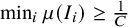 $\min _i\mu (I_i)\ge \frac {1}{C}$
, such that
$\min _i\mu (I_i)\ge \frac {1}{C}$
, such that

for all x, $y \in \mathfrak X$
.
$y \in \mathfrak X$
.
We recall that a matrix $Z \in [0,\infty )^{K\times K}$
with nonnegative entries is called primitive if there is an
$Z \in [0,\infty )^{K\times K}$
with nonnegative entries is called primitive if there is an $L \in \mathbb {N}$
such that all entries of the power
$L \in \mathbb {N}$
such that all entries of the power $Z^L$
are strictly positive. For a and s as above, we define the function
$Z^L$
are strictly positive. For a and s as above, we define the function $\Gamma _{a,s} \colon (0,\infty ) \to (0,\infty )$
similarly to [Reference Alt, Erdős and Krüger6, Section 9] as
$\Gamma _{a,s} \colon (0,\infty ) \to (0,\infty )$
similarly to [Reference Alt, Erdős and Krüger6, Section 9] as
 $$ \begin{align} \Gamma_{a,s}(\tau) := \bigg({\operatorname{\mbox{ess inf}}_{x \in \mathfrak X} \int_{\mathfrak X} \frac{1}{(\tau^{-1} + \lvert a(x) - a(y) \rvert + d_s(x,y))^2} \mu(\mathrm{d} y)}\bigg)^{1/2}, \end{align} $$
where $d_s(x,y) := \big ({\int _{\mathfrak X} ( \lvert s(x,q) - s(y,q) \rvert ^2 + \lvert s(q,x) - s(q,y) \rvert ^2 )\mu (\mathrm {d} q)}\big )^{1/2}$
. Note that
$d_s(x,y) := \big ({\int _{\mathfrak X} ( \lvert s(x,q) - s(y,q) \rvert ^2 + \lvert s(q,x) - s(q,y) \rvert ^2 )\mu (\mathrm {d} q)}\big )^{1/2}$
. Note that $\Gamma _{a,s}$
is strictly monotonically increasing.
$\Gamma _{a,s}$
is strictly monotonically increasing.
A2
Data regularity: The data a and s satisfy the regularity assumption
 $$\begin{align*}\lim_{\tau \to \infty} \Gamma_{a,s}(\tau) = \infty \,.\end{align*}$$
Remark 2.1. The following list provides simple conditions that imply our assumptions A1 or A2.
-
(i) The condition A1 is for example satisfied if S is bounded from below, that is, when
for some constant $$\begin{align*}\frac{1}{C} \leq s(x,y) \leq C \end{align*}$$
$C>0$
and for all x,
$y \in \mathfrak X$
.
$$\begin{align*}\frac{1}{C} \leq s(x,y) \leq C \end{align*}$$
$C>0$
and for all x,
$y \in \mathfrak X$
.
-
(ii) If
$\mathfrak X$
is a finite set then A2 holds for any a and s. -
(iii) In the case
$\mathfrak X=[0,1]$
and
$\mu $
the Lebesgue-measure on
$[0,1]$
, Assumption A2 holds, for example, when s and a are Hölder-continuous with Hölder-exponent
$\frac {1}{2}$
. -
(iv) In fact it suffices that Hölder-continuity of a and s holds piecewise. Let
$I_1$
, …,
$I_K$
be disjoint intervals in
$[0,1]$
such that
$I_1 \cup \ldots \cup I_K = [0,1]$
. If
$s \colon [0,1] \times [0,1] \to [0,\infty )$
,
$a\colon [0,1] \to \mathbb {C}$
are such that
$s|_{I_l \times I_k}$
and
$a|_{I_l}$
are
$\frac {1}{2}$
-Hölder-continuous for every l,
$k \in \{1, 2, \ldots , K\}$
then A2 is satisfied. In particular, if s satisfies A1 in addition, then A1 and A2 both hold.





To classify the support of $\sigma $
we introduce the operator
$\sigma $
we introduce the operator $B\equiv B_\zeta : \mathcal {B} \to \mathcal {B}$
given by
$B\equiv B_\zeta : \mathcal {B} \to \mathcal {B}$
given by
 $$ \begin{align} B_\zeta:= D_{\lvert a-\zeta \rvert^2}-S\,, \end{align} $$
where $D_u \colon \mathcal {B} \to \mathcal {B}, x \mapsto ux$
denotes the multiplication operator on
$D_u \colon \mathcal {B} \to \mathcal {B}, x \mapsto ux$
denotes the multiplication operator on $\mathcal {B}$
with
$\mathcal {B}$
with $u \in \mathcal B$
. Since B maps real-valued functions to real-valued functions, we obtain a function
$u \in \mathcal B$
. Since B maps real-valued functions to real-valued functions, we obtain a function $\beta \colon \mathbb {C} \to \mathbb {R}$
defined through
$\beta \colon \mathbb {C} \to \mathbb {R}$
defined through
 $$ \begin{align} \beta(\zeta) := \inf_{x \in \mathcal B_+} \sup_{y \in \mathcal B_+} \frac{\langle{x} \mspace{2mu}, {B_\zeta \mspace{2 mu}y}\rangle}{\langle{x} \mspace{2mu}, {y}\rangle}\end{align} $$
for $\zeta \in \mathbb {C}$
, where the infimum and supremum are taken over
$\zeta \in \mathbb {C}$
, where the infimum and supremum are taken over $\mathcal B_+:=\{x \in \mathcal {B}: x>0\}$
and
$\mathcal B_+:=\{x \in \mathcal {B}: x>0\}$
and $ \langle {u_1} \mspace {2mu}, {u_2}\rangle := \langle \overline {u}_1 u_2 \rangle $
for all
$ \langle {u_1} \mspace {2mu}, {u_2}\rangle := \langle \overline {u}_1 u_2 \rangle $
for all $u_1$
,
$u_1$
, $u_2 \in \mathcal B$
. The definition of
$u_2 \in \mathcal B$
. The definition of $\beta $
is motivated by the Birkhoff-Varga formula for the spectral radius of a matrix with positive entries [Reference Birkhoff and Varga16]. In terms of
$\beta $
is motivated by the Birkhoff-Varga formula for the spectral radius of a matrix with positive entries [Reference Birkhoff and Varga16]. In terms of $\beta $
we define the set
$\beta $
we define the set
 $$ \begin{align} \mathbb S := \{ \zeta \in \mathbb{C} \colon \beta(\zeta ) < 0 \}\,, \end{align} $$
whose closure coincides with $\operatorname {\mathrm {supp}} \sigma $
, as stated in the next theorem. We will see in Proposition 5.16 (i) that
$\operatorname {\mathrm {supp}} \sigma $
, as stated in the next theorem. We will see in Proposition 5.16 (i) that $\beta $
is a continuous function and therefore
$\beta $
is a continuous function and therefore $\mathbb {S}$
is an open set. Moreover,
$\mathbb {S}$
is an open set. Moreover, $\beta $
is real analytic in a neighbourhood of
$\beta $
is real analytic in a neighbourhood of $\partial \mathbb {S}$
, see Corollary 5.20 below.
$\partial \mathbb {S}$
, see Corollary 5.20 below.
Theorem 2.2 (Properties of
$\sigma $
).

Let $a \in \mathcal B=L^\infty (\mathfrak X, \Sigma , \mu )$
and
$a \in \mathcal B=L^\infty (\mathfrak X, \Sigma , \mu )$
and $\mathfrak c$
be a
$\mathfrak c$
be a $\mathcal B$
-valued circular element such that S and
$\mathcal B$
-valued circular element such that S and $S^*$
from (2.2) satisfy (2.5) with s fulfilling A1 and A2.
$S^*$
from (2.2) satisfy (2.5) with s fulfilling A1 and A2.
-
(i) With respect to the Lebesgue measure, the Brown measure
$\sigma $
of
$a + \mathfrak c$
has a bounded density on
$\mathbb {C}$
, which we also denote by
$\sigma $
, that is,
$\sigma (\mathrm {d} \zeta ) = \sigma (\zeta ) \mathrm {d}^2 \zeta $
. -
(ii) The density
$\zeta \mapsto \sigma (\zeta )$
is strictly positive on
$\mathbb {S}$
and admits a real analytic extension to an open neighbourhood of
$\overline {\mathbb {S}}$
. -
(iii)
$\operatorname {\mathrm {supp}} \sigma = \overline {\mathbb {S}}$
and this set is bounded. Furthermore
$\operatorname {\mathrm {Spec}}(D_a) \subset \mathbb {S}$
. -
(iv)
$\partial \mathbb {S}=\{ \zeta \in \mathbb {C} \colon \beta (\zeta ) = 0\}$
and it is a real analytic variety of (real) dimension at most
$1$
. -
(v) The unique continuous extension
$\sigma \colon \overline {\mathbb {S}} \to [0,\infty )$
of the density
$\sigma |_{\mathbb S}$
to
$\overline {\mathbb {S}}$
satisfies
$\sigma (\zeta ) = g(\zeta )\lvert \partial _{\zeta } \beta (\zeta ) \rvert ^2$
for all
$\zeta \in \partial \mathbb {S}$
, where
$g :\partial \mathbb {S} \to (0,\infty )$
is a strictly positive function that can be extended to a real analytic function on a neighbourhood of
$\partial \mathbb {S}$
.






The proof of Theorem 2.2 is given at the end of Section 6 below.
Our next results describe in detail the edge behaviour of $\sigma $
at points
$\sigma $
at points $\zeta _0 \in \partial \mathbb {S}$
. Typically we observe a sharp drop of the density
$\zeta _0 \in \partial \mathbb {S}$
. Typically we observe a sharp drop of the density $\sigma $
at the edge
$\sigma $
at the edge $\partial \overline {\mathbb {S}}$
. In fact, by Theorem 2.2 (v) this is the case if and only if
$\partial \overline {\mathbb {S}}$
. In fact, by Theorem 2.2 (v) this is the case if and only if $\partial _\zeta \beta (\zeta _0)$
does not vanish.
$\partial _\zeta \beta (\zeta _0)$
does not vanish.
Definition 2.3 (Regular edge and singular points).
Let $\zeta _0 \in \partial \mathbb {S}$
such that
$\zeta _0 \in \partial \mathbb {S}$
such that $\partial _\zeta \beta (\zeta _0) \ne 0$
. Then we say that
$\partial _\zeta \beta (\zeta _0) \ne 0$
. Then we say that $\zeta _0$
is a regular edge point. We denote the set of these points by
$\zeta _0$
is a regular edge point. We denote the set of these points by $\mathrm {Reg}$
and its complement by
$\mathrm {Reg}$
and its complement by $\mathrm {Sing}:= \partial \mathbb {S} \setminus \mathrm {Reg}$
, which is called the set of singular points for
$\mathrm {Sing}:= \partial \mathbb {S} \setminus \mathrm {Reg}$
, which is called the set of singular points for $\sigma $
.
$\sigma $
.
To give a short statement of the classification of the singular points for $\sigma $
we introduce the following notion.
$\sigma $
we introduce the following notion.
Definition 2.4 (Singularity types).
Let $\alpha : U \to \mathbb {C}$
be a real analytic function on an open set
$\alpha : U \to \mathbb {C}$
be a real analytic function on an open set $U \subset \mathbb {C}$
and
$U \subset \mathbb {C}$
and $\zeta _0 \in U$
. We say that
$\zeta _0 \in U$
. We say that $\alpha $
is of singularity type
$\alpha $
is of singularity type $p(x,y)$
at
$p(x,y)$
at $\zeta _0$
for a polynomial
$\zeta _0$
for a polynomial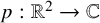 $p: \mathbb {R}^2 \to \mathbb {C}$
if there is a real analytic diffeomorphism
$p: \mathbb {R}^2 \to \mathbb {C}$
if there is a real analytic diffeomorphism $\Phi : V \to U_0$
from an open neighbourhood V of
$\Phi : V \to U_0$
from an open neighbourhood V of $0 \in \mathbb {C}$
to an open neighbourhood
$0 \in \mathbb {C}$
to an open neighbourhood $U_0$
of
$U_0$
of $\zeta _0 =\Phi (0)$
, such that
$\zeta _0 =\Phi (0)$
, such that
 $$\begin{align*}\alpha(\Phi(x + \mathrm{i} y)) = p(x,y) \,, \qquad x + \mathrm{i} y \in V\,. \end{align*}$$
In the sense above $\beta $
is of singularity type x at any regular edge point. By Theorem 2.2 the edge
$\beta $
is of singularity type x at any regular edge point. By Theorem 2.2 the edge $\partial \operatorname {\mathrm {supp}} \sigma $
is locally analytically diffeomorphic to a line and
$\partial \operatorname {\mathrm {supp}} \sigma $
is locally analytically diffeomorphic to a line and $\sigma $
has a jump discontinuity along this line.
$\sigma $
has a jump discontinuity along this line.
Theorem 2.5 (Classification of edge and internal singularities).
Let $a \in \mathcal B$
and s satisfy A1 and A2. The set of singular points for
$a \in \mathcal B$
and s satisfy A1 and A2. The set of singular points for $\sigma $
admits a partition
$\sigma $
admits a partition
 $$ \begin{align} { \mathrm{Sing}= \bigcup_{k=1}^\infty\big({\mathrm{Sing}_{k}^{\mathrm{int}}\cup \mathrm{Sing}_{k}^{\mathrm{edge}}}\big)\cup \mathrm{Sing}^{\mathrm{int}}_{\infty}\,. } \end{align} $$
Here $\mathrm {Sing}\setminus \mathrm {Sing}_{\infty }$
is a finite set, while
$\mathrm {Sing}\setminus \mathrm {Sing}_{\infty }$
is a finite set, while $\mathrm {Sing}_{\infty }$
is either empty or a finite disjoint union of closed real analytic paths without self-intersections. The different singularity types are characterised by the following properties:
$\mathrm {Sing}_{\infty }$
is either empty or a finite disjoint union of closed real analytic paths without self-intersections. The different singularity types are characterised by the following properties:
-
1) Internal singularities of order k: Any
$\zeta \in \mathrm {Sing}_{k}^{\mathrm {int}}$
is an isolated point of
$\mathbb {C} \setminus \mathbb S$
and
$\sigma $
is of singularity type
$x^2 + y^{2k}$
at
$\zeta $
. -
2) Edge singularities of order k: Any
$\zeta \in \mathrm {Sing}_{k}^{\mathrm {edge}}$
lies in
$\partial \overline {\mathbb S}$
and
$\beta $
is of singularity type
$ y^{1+k}-x^2$
at
$\zeta $
. -
3) Internal singularities of order
$\infty $
: Any
$\zeta \in \mathrm {Sing}^{\mathrm {int}}_{\infty }$
lies in the interior of
$\overline {\mathbb S}$
and
$\sigma $
is of singularity type
$x^2$
at
$\zeta $
.


The proof of Theorem 2.5 is presented at the end of Section 6 below.
Remark 2.6. The internal singularities $\mathrm {Sing}_{k}^{\mathrm {int}}\cup \mathrm {Sing}^{\mathrm {int}}_{\infty }$
are classified by their local behaviour of the density
$\mathrm {Sing}_{k}^{\mathrm {int}}\cup \mathrm {Sing}^{\mathrm {int}}_{\infty }$
are classified by their local behaviour of the density $\sigma $
. The edge singularities
$\sigma $
. The edge singularities $\mathrm {Sing}_{k}^{\mathrm {edge}} $
are equivalently characterised by the local shape of the spectral edge
$\mathrm {Sing}_{k}^{\mathrm {edge}} $
are equivalently characterised by the local shape of the spectral edge $\partial \operatorname {\mathrm {supp}} \sigma $
, namely for
$\partial \operatorname {\mathrm {supp}} \sigma $
, namely for $\zeta \in \mathrm {Sing}_{k}^{\mathrm {edge}}$
there is a local analytic diffeomorphism
$\zeta \in \mathrm {Sing}_{k}^{\mathrm {edge}}$
there is a local analytic diffeomorphism $\Psi \colon U \to V$
from an open neighbourhood V of
$\Psi \colon U \to V$
from an open neighbourhood V of $\zeta _0$
to an open
$\zeta _0$
to an open $U \subset \mathbb {C}$
with
$U \subset \mathbb {C}$
with $\Psi (\zeta _0)= 0$
such that
$\Psi (\zeta _0)= 0$
such that
 $$\begin{align*}\Psi( \operatorname{\mathrm{supp}} \sigma \cap U) = \{x+\mathrm{i} y \in \mathbb{C}: x^2 -y^{1+k}\ge 0\}\cap V \end{align*}$$
Finally we show that all singularities allowed by the classification in Theorem 2.5 do occur in the simple case when $\mathfrak {c}$
is a standard circular element and
$\mathfrak {c}$
is a standard circular element and $\mathfrak {X}=[0,1]$
with the Lebesgue measure. A standard circular element satisfies
$\mathfrak {X}=[0,1]$
with the Lebesgue measure. A standard circular element satisfies $E[\mathfrak {c}^* b \mathfrak {c}]=E[\mathfrak {c} b \mathfrak {c}^*] = \langle b \rangle $
for all
$E[\mathfrak {c}^* b \mathfrak {c}]=E[\mathfrak {c} b \mathfrak {c}^*] = \langle b \rangle $
for all $b \in \mathcal B$
.
$b \in \mathcal B$
.
Theorem 2.7 (Existence of all singularity types).
For each of the sets $\mathrm {Sing}_{k}^{\mathrm {int}}$
,
$\mathrm {Sing}_{k}^{\mathrm {int}}$
, $\mathrm {Sing}_{k}^{\mathrm {edge}}$
with
$\mathrm {Sing}_{k}^{\mathrm {edge}}$
with $k \in \mathbb {N}$
and
$k \in \mathbb {N}$
and $\mathrm {Sing}^{\mathrm {int}}_{\infty }$
, there is a choice
$\mathrm {Sing}^{\mathrm {int}}_{\infty }$
, there is a choice $a \in L^\infty [0,1]$
such that for the Brown measure of
$a \in L^\infty [0,1]$
such that for the Brown measure of $a + \mathfrak {c}$
, with
$a + \mathfrak {c}$
, with $\mathfrak {c}$
a standard circular element, this set is not empty. With the exception of
$\mathfrak {c}$
a standard circular element, this set is not empty. With the exception of $\mathrm {Sing}^{\mathrm {int}}_{\infty }$
, the deformation a can be chosen to have finite image.
$\mathrm {Sing}^{\mathrm {int}}_{\infty }$
, the deformation a can be chosen to have finite image.
The proof of Theorem 2.7 can be found just before Section 7.1.
Remark 2.8 (Circular element with general deformation).
Although not directly covered by our results stated above, the classification of singularities from Theorem 2.5 also holds for the Brown measure of $a + \mathfrak c$
, where a is a general operator in a tracial von Neumann algebra and
$a + \mathfrak c$
, where a is a general operator in a tracial von Neumann algebra and $\mathfrak c$
is a standard circular element, which is
$\mathfrak c$
is a standard circular element, which is $\ast $
-free from a. We note that a can be non-normal in general. We define
$\ast $
-free from a. We note that a can be non-normal in general. We define $\mathbb {S} = \{ \zeta \in \mathbb {C} \colon f(\zeta )> 1\}$
with
$\mathbb {S} = \{ \zeta \in \mathbb {C} \colon f(\zeta )> 1\}$
with
 $$\begin{align*}f(\zeta):= \lim_{\eta \downarrow 0} \bigg\langle \frac{1}{(a-\zeta)(a-\zeta)^* + \eta^2} \bigg\rangle\, \end{align*}$$
for $\zeta \in \mathbb {C}$
. Then the support of the Brown measure
$\zeta \in \mathbb {C}$
. Then the support of the Brown measure $\sigma $
is
$\sigma $
is $\overline {\mathbb S}$
[Reference Zhong64] and the measure has a density on
$\overline {\mathbb S}$
[Reference Zhong64] and the measure has a density on $\mathbb {C}$
[Reference Belinschi, Yin and Zhong13], which is real analytic and strictly positive inside
$\mathbb {C}$
[Reference Belinschi, Yin and Zhong13], which is real analytic and strictly positive inside $\mathbb {S}$
[Reference Zhong64]. Under the additional assumption
$\mathbb {S}$
[Reference Zhong64]. Under the additional assumption
 $$ \begin{align} \operatorname{\mathrm{Spec}}(a) \subset \mathbb{S}, \end{align} $$
the dichotomy between regular edge points, at which the density has a jump discontinuity, and singular points of $\sigma $
was established in [Reference Erdős and Ji32]. The singular points
$\sigma $
was established in [Reference Erdős and Ji32]. The singular points $\zeta \in \mathrm {Sing}$
are called quadratic edges in [Reference Erdős and Ji32] and are classified by satisfying
$\zeta \in \mathrm {Sing}$
are called quadratic edges in [Reference Erdős and Ji32] and are classified by satisfying $f(\zeta )=1$
and
$f(\zeta )=1$
and $\partial _\zeta f(\zeta )=0$
, while regular edge points
$\partial _\zeta f(\zeta )=0$
, while regular edge points $\zeta \in \mathrm {Reg}$
satisfy
$\zeta \in \mathrm {Reg}$
satisfy $f(\zeta )=1$
and
$f(\zeta )=1$
and $\partial _\zeta f(\zeta )\ne 0$
. Here we provide a classification of the singular points
$\partial _\zeta f(\zeta )\ne 0$
. Here we provide a classification of the singular points $\zeta \in \mathrm {Sing}$
by showing that
$\zeta \in \mathrm {Sing}$
by showing that $\mathrm {Sing}$
is a disjoint union of the sets
$\mathrm {Sing}$
is a disjoint union of the sets $ \mathrm {Sing}_{k}^{\mathrm {int}}$
,
$ \mathrm {Sing}_{k}^{\mathrm {int}}$
, $ \mathrm {Sing}_{k}^{\mathrm {edge}}$
with
$ \mathrm {Sing}_{k}^{\mathrm {edge}}$
with $k \in \mathbb {N}$
and
$k \in \mathbb {N}$
and $ \mathrm {Sing}^{\mathrm {int}}_{\infty }$
as in (2.11), where these sets are defined as in Theorem 2.5 with
$ \mathrm {Sing}^{\mathrm {int}}_{\infty }$
as in (2.11), where these sets are defined as in Theorem 2.5 with $\beta := 1 - f$
. We provide the proof for this classification in Section 8 below.
$\beta := 1 - f$
. We provide the proof for this classification in Section 8 below.
2.1 Notations
We now introduce some notations used throughout. We write  for
for $n \in \mathbb {N}$
. For
$n \in \mathbb {N}$
. For $r>0$
, we denote by
$r>0$
, we denote by $\mathbb {D}_r := \{ z \in \mathbb {C} \colon \lvert z \rvert < r \}$
the disk of radius r around the origin in
$\mathbb {D}_r := \{ z \in \mathbb {C} \colon \lvert z \rvert < r \}$
the disk of radius r around the origin in $\mathbb {C}$
and by
$\mathbb {C}$
and by $\mathrm{dist} (x,A) :=\inf \{ \lvert x-y \rvert \colon y \in A \}$
the Euclidean distance of a point
$\mathrm{dist} (x,A) :=\inf \{ \lvert x-y \rvert \colon y \in A \}$
the Euclidean distance of a point $x \in \mathbb {C}$
from a set
$x \in \mathbb {C}$
from a set $A \subset \mathbb {C}$
.
$A \subset \mathbb {C}$
.
We use the convention that c and C denote generic constants that may depend on the model parameters, but are otherwise uniform in all other parameters, for example, n, $\zeta $
, etc.. For two real scalars f and g we write
$\zeta $
, etc.. For two real scalars f and g we write $f \lesssim g$
and
$f \lesssim g$
and $g \gtrsim f$
if
$g \gtrsim f$
if $f \leq C g$
for such a constant
$f \leq C g$
for such a constant $C>0$
. In case
$C>0$
. In case $f \lesssim g$
and
$f \lesssim g$
and $f \gtrsim g$
both hold, we write
$f \gtrsim g$
both hold, we write $f \sim g$
. If the constant C depends on a parameter
$f \sim g$
. If the constant C depends on a parameter $\delta $
that is not a model parameter, we write
$\delta $
that is not a model parameter, we write $\lesssim _\delta $
,
$\lesssim _\delta $
, $\gtrsim _\delta $
and
$\gtrsim _\delta $
and $\sim _\delta $
, respectively. The notation for inequality up to constant is also used for self-adjoint matrices/operators f and g, where
$\sim _\delta $
, respectively. The notation for inequality up to constant is also used for self-adjoint matrices/operators f and g, where $f \leq C g$
is interpreted in the sense of quadratic forms. For complex f and
$f \leq C g$
is interpreted in the sense of quadratic forms. For complex f and $g \geq 0$
we write
$g \geq 0$
we write $f = O(g)$
in case
$f = O(g)$
in case $\lvert f \rvert \lesssim g$
. Analogously
$\lvert f \rvert \lesssim g$
. Analogously $f = O_\delta (g)$
expresses the fact
$f = O_\delta (g)$
expresses the fact $\lvert f \rvert \lesssim _\delta g$
.
$\lvert f \rvert \lesssim _\delta g$
.
In addition to $L^\infty $
, we introduce the usual
$L^\infty $
, we introduce the usual $L^p$
spaces on
$L^p$
spaces on $(\mathfrak X, \mathcal A, \mu )$
. We denote them by
$(\mathfrak X, \mathcal A, \mu )$
. We denote them by $L^p:=L^p(\mathfrak X, \mathcal {A}, \mu )$
and the corresponding norms by
$L^p:=L^p(\mathfrak X, \mathcal {A}, \mu )$
and the corresponding norms by $\lVert \mspace {2 mu}\cdot \mspace {2 mu} \rVert _p$
. For functions
$\lVert \mspace {2 mu}\cdot \mspace {2 mu} \rVert _p$
. For functions $u_1$
,
$u_1$
, $u_2 \in L^2$
, we define their scalar product as
$u_2 \in L^2$
, we define their scalar product as
 $$\begin{align*}\langle{u_1} \mspace{2mu}, {u_2}\rangle := \langle \overline{u}_1 u_2 \rangle\,. \end{align*}$$
3 Examples
In this section, we present several examples that illustrate some of the different singularity types appearing in Theorem 2.5. Throughout this section, we choose $\mathfrak X = [0,1]$
,
$\mathfrak X = [0,1]$
, $\mu $
the Lebesgue-measure on
$\mu $
the Lebesgue-measure on $[0,1]$
and s constant on
$[0,1]$
and s constant on $[0,1]^2$
. If
$[0,1]^2$
. If $s \equiv t$
is constant on
$s \equiv t$
is constant on $[0,1]^2$
then it is easy to see that
$[0,1]^2$
then it is easy to see that $\beta (\zeta ) = \frac {1}{t} - \int _0^1 \frac {\mathrm {d} x}{\lvert a(x) - \zeta \rvert ^2}$
for all
$\beta (\zeta ) = \frac {1}{t} - \int _0^1 \frac {\mathrm {d} x}{\lvert a(x) - \zeta \rvert ^2}$
for all $\zeta \in \mathbb {C}$
and therefore, as has already been derived in [Reference Khoruzhenko42, Reference Tao, Vu and Krishnapur57, Reference Bordenave, Caputo and Chafaï18],
$\zeta \in \mathbb {C}$
and therefore, as has already been derived in [Reference Khoruzhenko42, Reference Tao, Vu and Krishnapur57, Reference Bordenave, Caputo and Chafaï18],
 $$ \begin{align} \mathbb{S} = \bigg\{ \zeta \in \mathbb{C} \colon \int_0^1 \frac{\mathrm{d} x}{\lvert a(x)-\zeta \rvert^2}> \frac{1}{t} \bigg\}. \end{align} $$
Example 3.1 (Simplest edge singularity of
$\partial \mathbb {S}$
).

We choose $s \equiv 1$
and
$s \equiv 1$
and $a \colon [0,1] \to \mathbb {C}$
with
$a \colon [0,1] \to \mathbb {C}$
with $a(x_1) =1$
and
$a(x_1) =1$
and $a(x_2) = -1$
for all
$a(x_2) = -1$
for all $x_1 \in [0,1/2)$
and
$x_1 \in [0,1/2)$
and $x_2 \in [1/2,1]$
. In that case, we obtain from (3.1) that
$x_2 \in [1/2,1]$
. In that case, we obtain from (3.1) that
 $$\begin{align*}\mathbb{S} = \{ \zeta \in \mathbb{C} \colon \lvert 1-\zeta \rvert^{-2} + \lvert 1+ \zeta \rvert^{-2}>1 \}. \end{align*}$$
As we will see in Lemma 7.3 (a) below, this yields an edge singularity of order $1$
, that is, in
$1$
, that is, in $\mathrm {Sing}_1^{\mathrm {edge}}$
at zero. The boundary of
$\mathrm {Sing}_1^{\mathrm {edge}}$
at zero. The boundary of $\mathbb {S}$
and the eigenvalues of a sampled corresponding random matrix model are depicted in Figure 1a. This example also appeared in [Reference Biane and Lehner15, Example 5.2].
$\mathbb {S}$
and the eigenvalues of a sampled corresponding random matrix model are depicted in Figure 1a. This example also appeared in [Reference Biane and Lehner15, Example 5.2].
The solid black lines in subfigures (1a) and (1b) show the boundary of $\mathbb {S}$
from Examples 3.1 and 3.2, respectively. The black dots are the eigenvalues of a sample of
$\mathbb {S}$
from Examples 3.1 and 3.2, respectively. The black dots are the eigenvalues of a sample of $A + X/\sqrt {n}$
, where X is an
$A + X/\sqrt {n}$
, where X is an $n\times n$
matrix with i.i.d.
$n\times n$
matrix with i.i.d. $N(0,1)$
standard real normal distributed entries,
$N(0,1)$
standard real normal distributed entries, $n=10000$
and
$n=10000$
and $A=(\operatorname {\mathrm {diag}}(a(i/n))\delta _{ij})_{i,j=1}^n$
is a diagonal matrix and a is chosen as in Examples 3.1 and 3.2, respectively.
$A=(\operatorname {\mathrm {diag}}(a(i/n))\delta _{ij})_{i,j=1}^n$
is a diagonal matrix and a is chosen as in Examples 3.1 and 3.2, respectively.

Example 3.2 (Simplest internal singularity of
$\sigma $
).

With the choices $s \equiv 1/4$
and
$s \equiv 1/4$
and $a \colon [0,1] \to \mathbb {C}$
with
$a \colon [0,1] \to \mathbb {C}$
with $a(x_1) = (1 + \mathrm {i})/\sqrt {2}$
,
$a(x_1) = (1 + \mathrm {i})/\sqrt {2}$
, $a(x_2) = (1 - \mathrm {i})/\sqrt {2}$
,
$a(x_2) = (1 - \mathrm {i})/\sqrt {2}$
, $a(x_3) = (-1 + \mathrm {i})/\sqrt {2}$
and
$a(x_3) = (-1 + \mathrm {i})/\sqrt {2}$
and $a(x_4) = -(1 + \mathrm {i})/\sqrt {2}$
for all
$a(x_4) = -(1 + \mathrm {i})/\sqrt {2}$
for all $x_1 \in [0,1/4)$
,
$x_1 \in [0,1/4)$
, $x_2 \in [1/4,1/2)$
,
$x_2 \in [1/4,1/2)$
, $x_3 \in [1/2,3/4)$
and
$x_3 \in [1/2,3/4)$
and $x_4 \in [3/4,1]$
, (3.1) yields
$x_4 \in [3/4,1]$
, (3.1) yields
 $$\begin{align*}\mathbb{S} = \{ \zeta \in \mathbb{C} \colon \lvert \zeta -(1 + \mathrm{i})/\sqrt{2} \rvert^{-2} + \lvert \zeta -(1 - \mathrm{i})/\sqrt{2} \rvert^{-2} + \lvert \zeta +(1 - \mathrm{i})/\sqrt{2} \rvert^{-2} + \lvert \zeta +(1 + \mathrm{i})/\sqrt{2} \rvert^{-2}> 1 \}.\end{align*}$$
Lemma 7.3 (a) below will demonstrate that this gives rise to an internal singularity of order $1$
, that is, in
$1$
, that is, in $\mathrm {Sing}_2^{\mathrm {int}}$
at zero. Figure 1b shows the boundary of
$\mathrm {Sing}_2^{\mathrm {int}}$
at zero. Figure 1b shows the boundary of $\mathbb {S}$
and the eigenvalues of a sampled corresponding random matrix model. We note that a similar example was given in [Reference Erdős and Ji32, Example 3.1(d)].
$\mathbb {S}$
and the eigenvalues of a sampled corresponding random matrix model. We note that a similar example was given in [Reference Erdős and Ji32, Example 3.1(d)].
Example 3.3 (One-sided edge cusp of
$\partial \mathbb {S}$
).

Let $s \equiv t:= \frac {2}{3}(20-7\sqrt {7})$
be constant on
$s \equiv t:= \frac {2}{3}(20-7\sqrt {7})$
be constant on $[0,1]^2$
,
$[0,1]^2$
, $\delta = (-17 + 7\sqrt {7})/8$
and
$\delta = (-17 + 7\sqrt {7})/8$
and $a \colon [0,1] \to \mathbb {C}$
with
$a \colon [0,1] \to \mathbb {C}$
with $a(x_1) = 1$
,
$a(x_1) = 1$
, $a(x_2) = -1$
and
$a(x_2) = -1$
and $a(x_3) = \mathrm {i}$
for all
$a(x_3) = \mathrm {i}$
for all $x_1 \in [0,1/(2+ \delta ))$
,
$x_1 \in [0,1/(2+ \delta ))$
, $x_2 \in [1/(2 + \delta ),2/(2+\delta ))$
and
$x_2 \in [1/(2 + \delta ),2/(2+\delta ))$
and $x_3 \in [2/(2+\delta ),1]$
. We note that (3.1) yields
$x_3 \in [2/(2+\delta ),1]$
. We note that (3.1) yields
 $$\begin{align*}\mathbb{S} = \bigg\{ \zeta \in \mathbb{C} \colon \frac{1}{\lvert 1-\zeta \rvert^2} + \frac{1}{\lvert 1+ \zeta \rvert^2} + \frac{\delta}{\lvert \zeta- \mathrm{i} \rvert^2}> \frac{2 + \delta}{t} \bigg\}. \end{align*}$$
With $y_0 = (\sqrt {7} - 2)/3$
, a simple calculation shows that
$y_0 = (\sqrt {7} - 2)/3$
, a simple calculation shows that $\beta $
is of singularity type
$\beta $
is of singularity type $x^2 + y^3$
at
$x^2 + y^3$
at $\mathrm {i} y_0$
and, thus,
$\mathrm {i} y_0$
and, thus, $\mathrm {i} y_0$
is an edge singularity of order
$\mathrm {i} y_0$
is an edge singularity of order $2$
. For this example, a plot analogous to the previous examples is presented in Figure 2a.
$2$
. For this example, a plot analogous to the previous examples is presented in Figure 2a.
The solid black lines in subfigures (2a) and (2b) show the boundary of $\mathbb {S}$
from Examples 3.3 and 3.4, respectively. The black dots are the eigenvalues of a sample of
$\mathbb {S}$
from Examples 3.3 and 3.4, respectively. The black dots are the eigenvalues of a sample of $A + X/\sqrt {n}$
, where X is an
$A + X/\sqrt {n}$
, where X is an $n\times n$
matrix with i.i.d.
$n\times n$
matrix with i.i.d. $N(0,1)$
standard real normal distributed entries,
$N(0,1)$
standard real normal distributed entries, $n=10000$
and
$n=10000$
and $A=(\operatorname {\mathrm {diag}}(a(i/n))\delta _{ij})_{i,j=1}^n$
is a diagonal matrix and a is chosen as in Examples 3.3 and 3.4, respectively.
$A=(\operatorname {\mathrm {diag}}(a(i/n))\delta _{ij})_{i,j=1}^n$
is a diagonal matrix and a is chosen as in Examples 3.3 and 3.4, respectively.

Example 3.4 (Two-sided edge cusp).
We set $s \equiv t := 4$
to be constant on
$s \equiv t := 4$
to be constant on $[0,1]^2$
and
$[0,1]^2$
and $a\colon [0,1] \to \mathbb {C}$
, with
$a\colon [0,1] \to \mathbb {C}$
, with $a(x_1) = \sqrt {3} + \mathrm {i}$
,
$a(x_1) = \sqrt {3} + \mathrm {i}$
, $a(x_2) = \sqrt {3} - \mathrm {i}$
,
$a(x_2) = \sqrt {3} - \mathrm {i}$
, $a(x_3) = - \sqrt {3} + \mathrm {i}$
and
$a(x_3) = - \sqrt {3} + \mathrm {i}$
and $a(x_4) = - \sqrt {3} - \mathrm {i}$
for all
$a(x_4) = - \sqrt {3} - \mathrm {i}$
for all $x_1 \in [0,1/4)$
,
$x_1 \in [0,1/4)$
, $x_2 \in [1/4,1/2)$
,
$x_2 \in [1/4,1/2)$
, $x_3 \in [1/2,3/4)$
and
$x_3 \in [1/2,3/4)$
and $x_4 \in [3/4,1]$
. We conclude from (3.1) that
$x_4 \in [3/4,1]$
. We conclude from (3.1) that
 $$\begin{align*}\mathbb{S} = \bigg\{ \zeta \in \mathbb{C} \colon \frac{1}{\lvert \sqrt{3} + \mathrm{i}-\zeta \rvert^2} + \frac{1}{\lvert \sqrt{3} - \mathrm{i}-\zeta \rvert^2} + \frac{1}{\lvert - \sqrt{3} + \mathrm{i}-\zeta \rvert^2} + \frac{1}{\lvert - \sqrt{3} - \mathrm{i}-\zeta \rvert^2}> 1 \bigg\}. \end{align*}$$
Using Lemma 7.2 below, $-\beta $
and hence the boundary of
$-\beta $
and hence the boundary of $ \mathbb {S}$
has a singularity of type
$ \mathbb {S}$
has a singularity of type $x^2 - y^4$
at zero, making this an edge singularity of order
$x^2 - y^4$
at zero, making this an edge singularity of order $2$
. Figure 2b shows a plot of this example analogous to the previous figures.
$2$
. Figure 2b shows a plot of this example analogous to the previous figures.
We refer to [Reference Alt, Erdős, Krüger and Nemish7, Example 2.6 and Figure 1] for more examples in the spirit of the previous examples.
Example 3.5 (Internal singularity of type
$\mathrm {Sing}^{\mathrm {int}}_{\infty }$
).

We choose $s \equiv 1$
on
$s \equiv 1$
on $[0,1]^2$
and
$[0,1]^2$
and
 $$\begin{align*}a \colon [0,1] \to \mathbb{C}, \qquad x \mapsto \begin{cases} \sqrt{2} \mathrm{e}^{4\pi \mathrm{i} x} & \text{ if } x \in [0,1/2], \\ 0 & \text{ if } x \in (1/2,1]. \end{cases} \end{align*}$$
As will be proved in Section 7.3 below, in this setup
 $$ \begin{align} \mathbb S = \big\{ \zeta \in \mathbb{C} \colon 0 \leq \lvert \zeta \rvert^2 < 1 \text{ or } 1 < \lvert \zeta \rvert^2 < {(3 + \sqrt{5})/2} \big\} \end{align} $$
and each point of $\partial \mathbb {D}_1$
belongs to
$\partial \mathbb {D}_1$
belongs to $\mathrm {Sing}_\infty ^{\mathrm {int}}$
. Moreover, it is shown in Section 7.3 that, for each
$\mathrm {Sing}_\infty ^{\mathrm {int}}$
. Moreover, it is shown in Section 7.3 that, for each $\zeta \in \mathbb {C}$
,
$\zeta \in \mathbb {C}$
,
 $$ \begin{align} \sigma(\zeta) = \frac{1}{\pi} \bigg( 1 - \frac{2}{2+x + \frac{x}{(2x-1)^3}} \bigg( 1 + \frac{1}{x^2} \bigg) \bigg) \mathbf{1} (\zeta \in \mathbb{S}), \end{align} $$
where $x =x(\lvert \zeta \rvert ^2) \in (0,\infty )$
is the unique positive solution of
$x =x(\lvert \zeta \rvert ^2) \in (0,\infty )$
is the unique positive solution of $\frac {1}{x} + \frac {1}{\sqrt {1 + 4x+x^2-8\lvert \zeta \rvert ^2 + 3}}=2$
. The boundary of
$\frac {1}{x} + \frac {1}{\sqrt {1 + 4x+x^2-8\lvert \zeta \rvert ^2 + 3}}=2$
. The boundary of $\mathbb {S}$
and the sampled eigenvalues are depicted in Figure 3.
$\mathbb {S}$
and the sampled eigenvalues are depicted in Figure 3.
The solid lines in this figure show the boundary of $\mathbb {S}$
from Example 3.5. The black dots show the eigenvalues of a sample of
$\mathbb {S}$
from Example 3.5. The black dots show the eigenvalues of a sample of $A + X/\sqrt {n}$
, where X is an
$A + X/\sqrt {n}$
, where X is an $n\times n$
matrix with i.i.d.
$n\times n$
matrix with i.i.d. $N(0,1)$
standard real normal distributed entries,
$N(0,1)$
standard real normal distributed entries, $n=10000$
and
$n=10000$
and $A=(\operatorname {\mathrm {diag}}(a(i/n))\delta _{ij})_{i,j=1}^n$
is a diagonal matrix and a is chosen as in Example 3.5.
$A=(\operatorname {\mathrm {diag}}(a(i/n))\delta _{ij})_{i,j=1}^n$
is a diagonal matrix and a is chosen as in Example 3.5.

4 Brown measure, Hermitisation and Dyson equation
In this section, we derive the Dyson equation for the Cauchy transform of the Hermitisation of the deformed operator-valued circular element $a + \mathfrak c$
. This Hermitisation itself is a family of operator-valued semicircular elements indexed by the spectral parameter
$a + \mathfrak c$
. This Hermitisation itself is a family of operator-valued semicircular elements indexed by the spectral parameter $\zeta \in \mathbb {C}$
and the associated Dyson equation is our main tool for analysing the Brown measure of
$\zeta \in \mathbb {C}$
and the associated Dyson equation is our main tool for analysing the Brown measure of $a + \mathfrak c$
.
$a + \mathfrak c$
.
Throughout the following, let $(\mathcal A, E, \mathcal B)$
be an operator-valued probability space with positive conditional expectation
$(\mathcal A, E, \mathcal B)$
be an operator-valued probability space with positive conditional expectation $E \colon \mathcal A \to \mathcal B$
such that
$E \colon \mathcal A \to \mathcal B$
such that $(\mathcal A, \langle E[\,\cdot \,] \rangle )$
is a tracial
$(\mathcal A, \langle E[\,\cdot \,] \rangle )$
is a tracial $W^*$
-probability space. We assume that
$W^*$
-probability space. We assume that $\mathcal B \subset \mathcal A$
is a commutative von Neumann subalgebra with trace
$\mathcal B \subset \mathcal A$
is a commutative von Neumann subalgebra with trace $\langle \mspace {2 mu}\cdot \mspace {2 mu} \rangle $
containing the unit of
$\langle \mspace {2 mu}\cdot \mspace {2 mu} \rangle $
containing the unit of $\mathcal A$
. We will also work on the operator-valued probability space
$\mathcal A$
. We will also work on the operator-valued probability space $(\mathcal A^{2\times 2}, \mathrm {id} \otimes E, \mathcal B^{2\times 2})$
, for which we employ the identifications
$(\mathcal A^{2\times 2}, \mathrm {id} \otimes E, \mathcal B^{2\times 2})$
, for which we employ the identifications $\mathcal A^{2\times 2}= \mathbb {C}^{2 \times 2} \otimes \mathcal A$
and
$\mathcal A^{2\times 2}= \mathbb {C}^{2 \times 2} \otimes \mathcal A$
and $\mathcal B^{2\times 2}= \mathbb {C}^{2 \times 2} \otimes \mathcal B$
.
$\mathcal B^{2\times 2}= \mathbb {C}^{2 \times 2} \otimes \mathcal B$
.
For any $\mathfrak c \in \mathcal A$
,
$\mathfrak c \in \mathcal A$
, $a \in \mathcal B$
and
$a \in \mathcal B$
and $\zeta \in \mathbb {C}$
, we hermitise
$\zeta \in \mathbb {C}$
, we hermitise $\mathfrak c + a - \zeta $
and apply
$\mathfrak c + a - \zeta $
and apply $\mathrm {id} \otimes E$
to the resolvent of the Hermitisation at
$\mathrm {id} \otimes E$
to the resolvent of the Hermitisation at $w \in \mathbb {C}$
with
$w \in \mathbb {C}$
with $\mathrm {Im}\, w>0$
. We define
$\mathrm {Im}\, w>0$
. We define
 $$ \begin{align} M(\zeta,w ) = \mathrm{id} \otimes E \bigg[\begin{pmatrix} - w & \mathfrak c + a - \zeta \\ (\mathfrak c +a - \zeta)^* & - w \end{pmatrix}^{-1} \bigg]. \end{align} $$
Here, w and $\zeta $
are interpreted as the constant functions on
$\zeta $
are interpreted as the constant functions on $\mathfrak X$
with the respective value. Note that the inverse is well defined as
$\mathfrak X$
with the respective value. Note that the inverse is well defined as $\mathrm {Im}\, w>0$
and the operator whose inverse is taken in (4.1) is self-adjoint for
$\mathrm {Im}\, w>0$
and the operator whose inverse is taken in (4.1) is self-adjoint for $w = 0$
. Furthermore, the imaginary part
$w = 0$
. Furthermore, the imaginary part $\mathrm {Im}\, M(\zeta ,w) =\frac {1}{2\mathrm {i}} ( M(\zeta ,w) - M(\zeta ,w)^*)$
is positive definite.
$\mathrm {Im}\, M(\zeta ,w) =\frac {1}{2\mathrm {i}} ( M(\zeta ,w) - M(\zeta ,w)^*)$
is positive definite.
For the next lemma, we define $\Sigma \colon \mathcal B^{2\times 2} \to \mathcal B^{2\times 2}$
through
$\Sigma \colon \mathcal B^{2\times 2} \to \mathcal B^{2\times 2}$
through
 $$ \begin{align} \Sigma \bigg[ \begin{pmatrix} r_{11} & r_{12} \\ r_{21} & r_{22} \end{pmatrix} \bigg] = \begin{pmatrix} S r_{22} & 0 \\ 0 & S^* r_{11} \end{pmatrix} \end{align} $$
for all $r_{11}$
,
$r_{11}$
, $r_{12}$
,
$r_{12}$
, $r_{21}$
,
$r_{21}$
, $r_{22} \in \mathcal B$
, where S and
$r_{22} \in \mathcal B$
, where S and $S^*$
are as in (2.2).
$S^*$
are as in (2.2).
Lemma 4.1. Let $\mathfrak c \in \mathcal A$
be a
$\mathfrak c \in \mathcal A$
be a $\mathcal {B}$
-valued circular element satisfying (2.1) and (2.2). Then
$\mathcal {B}$
-valued circular element satisfying (2.1) and (2.2). Then $\begin {pmatrix} 0 & \mathfrak {c} \\ \mathfrak {c}^* &0 \end {pmatrix}$
is an operator-valued semicircular element in
$\begin {pmatrix} 0 & \mathfrak {c} \\ \mathfrak {c}^* &0 \end {pmatrix}$
is an operator-valued semicircular element in $(\mathcal A^{2\times 2}, \mathrm {id} \otimes E, \mathcal B^{2\times 2})$
with covariance
$(\mathcal A^{2\times 2}, \mathrm {id} \otimes E, \mathcal B^{2\times 2})$
with covariance $\Sigma $
from (4.2). Moreover,
$\Sigma $
from (4.2). Moreover, $M(\zeta ,w)$
from (4.1) with such
$M(\zeta ,w)$
from (4.1) with such $\mathfrak c$
satisfies
$\mathfrak c$
satisfies
 $$ \begin{align} - M(\zeta,w)^{-1} = \begin{pmatrix} w & \zeta - a \\ \overline{\zeta - a} & w \end{pmatrix} + \Sigma[M(\zeta,w)] \end{align} $$
for any $a \in \mathcal B$
,
$a \in \mathcal B$
, $w \in \mathbb {C}$
with
$w \in \mathbb {C}$
with $\mathrm {Im}\, w>0$
and
$\mathrm {Im}\, w>0$
and $\zeta \in \mathbb {C}$
.
$\zeta \in \mathbb {C}$
.
The identity (4.3) is called Dyson equation. Under the constraint that $\mathrm {Im}\, M(\zeta , w) $
is positive definite, the Dyson equation has a unique solution [Reference Helton, Rashidi Far and Speicher38, Theorem 2.1]. In particular,
$\mathrm {Im}\, M(\zeta , w) $
is positive definite, the Dyson equation has a unique solution [Reference Helton, Rashidi Far and Speicher38, Theorem 2.1]. In particular, $M(\zeta ,w)$
from (4.1) coincides with this solution. For constant function s the identity (4.3) has appeared in [Reference Bordenave, Caputo and Chafaï18] and its analog for elliptic operators in [Reference Zhong64].
$M(\zeta ,w)$
from (4.1) coincides with this solution. For constant function s the identity (4.3) has appeared in [Reference Bordenave, Caputo and Chafaï18] and its analog for elliptic operators in [Reference Zhong64].
Proof. An easy computation using the properties of the operator-valued circular element $\mathfrak c$
, in particular, (2.1) and (2.2), yields the required
$\mathfrak c$
, in particular, (2.1) and (2.2), yields the required $\mathcal B^{2\times 2}$
-valued free cumulants of
$\mathcal B^{2\times 2}$
-valued free cumulants of $\mathfrak s = \begin {pmatrix} 0 & \mathfrak c \\ \mathfrak c^* &0 \end {pmatrix}$
and shows that
$\mathfrak s = \begin {pmatrix} 0 & \mathfrak c \\ \mathfrak c^* &0 \end {pmatrix}$
and shows that $\mathfrak s$
is an
$\mathfrak s$
is an $\mathcal B^{2\times 2}$
-valued semicircular element, see, for example, [Reference Mingo and Speicher47, Definition 10 2) in Chapter 9].
$\mathcal B^{2\times 2}$
-valued semicircular element, see, for example, [Reference Mingo and Speicher47, Definition 10 2) in Chapter 9].
Owing to (2.1) and (2.2), the covariance of $\mathfrak s$
satisfies
$\mathfrak s$
satisfies $E[\mathfrak s b \mathfrak s] = \Sigma [b]$
for all
$E[\mathfrak s b \mathfrak s] = \Sigma [b]$
for all $b \in \mathcal B^{2\times 2}$
with
$b \in \mathcal B^{2\times 2}$
with $\Sigma $
from (4.2). Since the R-transform of an operator-valued semicircular element coincides with its covariance, see, for example, [Reference Mingo and Speicher47, Theorem 11. 4) in Chapter 9],
$\Sigma $
from (4.2). Since the R-transform of an operator-valued semicircular element coincides with its covariance, see, for example, [Reference Mingo and Speicher47, Theorem 11. 4) in Chapter 9], $M(\zeta ,w)$
as defined in (4.1) satisfies (4.3) with
$M(\zeta ,w)$
as defined in (4.1) satisfies (4.3) with $\Sigma $
from (4.2) by [Reference Mingo and Speicher47, Theorem 11. 1) in Chapter 9].
$\Sigma $
from (4.2) by [Reference Mingo and Speicher47, Theorem 11. 1) in Chapter 9].
We now express the Brown measure of $\mathfrak c + a$
through M from (4.1) or, equivalently, the solution to (4.3). To that end, it suffices to consider
$\mathfrak c + a$
through M from (4.1) or, equivalently, the solution to (4.3). To that end, it suffices to consider $w = \mathrm {i} \eta $
with
$w = \mathrm {i} \eta $
with $\eta \in (0,\infty )$
and we see that the Dyson equation can be simplified in this case. We consider two coupled equations for functions
$\eta \in (0,\infty )$
and we see that the Dyson equation can be simplified in this case. We consider two coupled equations for functions $v_1, v_2 \in \mathcal {B}$
with
$v_1, v_2 \in \mathcal {B}$
with $v_1>0$
and
$v_1>0$
and $v_2>0$
, namely
$v_2>0$
, namely
 $$ \begin{align} \frac{1}{ v_1} & = \eta +Sv_2+ \frac{\lvert \zeta-a \rvert^2}{\eta +S^*v_1} \,, \end{align} $$
 $$ \begin{align} \frac{1}{ v_2} & = \eta +S^*v_1+ \frac{\lvert \zeta-a \rvert^2}{\eta +Sv_2}\,, \end{align} $$
for all $\eta>0$
and
$\eta>0$
and $\zeta \in \mathbb {C}$
. We also call (4.4) Dyson equation. Given
$\zeta \in \mathbb {C}$
. We also call (4.4) Dyson equation. Given $v_1$
and
$v_1$
and $v_2$
from (4.4), we introduce y defined by
$v_2$
from (4.4), we introduce y defined by
 $$ \begin{align} y:=\frac{v_1\mspace{2 mu}( \bar a-\bar \zeta)}{\eta + S^*v_1}=\frac{v_2\mspace{2 mu}(\bar a-\bar \zeta)}{\eta + Sv_2}\,, \end{align} $$
where the second step follows from
 $$ \begin{align} v_2(\eta + S^*v_1)=v_1(\eta + Sv_2)\,. \end{align} $$
Indeed, for the proof of the last identity, we multiply (4.4a) by $v_1 v_2 (\eta + S^*v_1)$
and (4.4b) by
$v_1 v_2 (\eta + S^*v_1)$
and (4.4b) by $v_1 v_2(\eta + Sv_2)$
and conclude (4.6) from the resulting relations.
$v_1 v_2(\eta + Sv_2)$
and conclude (4.6) from the resulting relations.
The next lemma relates the solutions to (4.4) and (4.3) and implies existence and uniqueness to the one of (4.4).
Lemma 4.2. For any $\zeta \in \mathbb {C}$
and
$\zeta \in \mathbb {C}$
and $\eta>0$
, the following holds.
$\eta>0$
, the following holds.
-
(i) Let
$(v_1,v_2) \in \mathcal B^2$
be a solution of (4.4) with
$v_1>0$
and
$v_2>0$
. Set (4.7)with y as in (4.5). Then M solves (4.3) with
$$ \begin{align} M := \begin{pmatrix} \mathrm{i} v_1 & \overline{y} \\ y & \mathrm{i} v_2 \end{pmatrix}\in \mathcal B^{2\times 2} \end{align} $$
$w = \mathrm {i} \eta $
and
$\mathrm {Im}\, M$
is positive definite.
-
(ii) Let
$M = M(\zeta ,\mathrm {i} \eta )$
be the solution of (4.3) such that
$\mathrm {Im}\, M$
is positive definite. Then there are
$v_1$
,
$v_2 \in \mathcal B$
such that
$v_1>0$
,
$v_2>0$
, M satisfies (4.7) with y as in (4.5) and
$(v_1,v_2)$
satisfy (4.4).
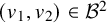





In particular, there are unique $v_1$
,
$v_1$
, $v_2 \in \mathcal B$
such that
$v_2 \in \mathcal B$
such that $v_1>0$
and
$v_1>0$
and $v_2>0$
and (4.4) holds.
$v_2>0$
and (4.4) holds.
Proof. The proofs of (i) and (ii) are easy computations. Therefore, the existence and uniqueness of the solution to (4.4) follows from the existence and uniqueness of the solution to (4.3), which is a special case of the general existence and uniqueness result [Reference Helton, Rashidi Far and Speicher38, Theorem 2.1].
When evaluated on the imaginary axis at $w=\mathrm {i} \eta $
with
$w=\mathrm {i} \eta $
with $\eta>0$
, the representation (4.1) of the solution to the Dyson equation (4.3) with positive definite imaginary part implies the trivial bound
$\eta>0$
, the representation (4.1) of the solution to the Dyson equation (4.3) with positive definite imaginary part implies the trivial bound
 $$ \begin{align} \lVert M(\zeta,\mathrm{i} \eta) \rVert \leq \eta^{-1}. \end{align} $$
Indeed, we note that the argument of $ \mathrm {id} \otimes E$
in (4.1) with
$ \mathrm {id} \otimes E$
in (4.1) with $w = \mathrm {i} \eta $
is bounded in norm by
$w = \mathrm {i} \eta $
is bounded in norm by $\eta ^{-1}$
as the resolvent of a self-adjoint operator. Therefore,
$\eta ^{-1}$
as the resolvent of a self-adjoint operator. Therefore, $\lVert M(\zeta ,\mathrm {i}\eta ) \rVert \leq \eta ^{-1}$
follows from
$\lVert M(\zeta ,\mathrm {i}\eta ) \rVert \leq \eta ^{-1}$
follows from $\lVert E \rVert = \lVert E(1) \rVert = 1$
due to the positivity of E and
$\lVert E \rVert = \lVert E(1) \rVert = 1$
due to the positivity of E and $E(1) =1$
. This completes the proof of (4.8).
$E(1) =1$
. This completes the proof of (4.8).
Using the solution to (4.4) we characterise the Brown measure in the following proposition as the Laplacian on $\mathbb {C}$
of the function
$\mathbb {C}$
of the function $-\frac {1}{2\pi } W$
defined through
$-\frac {1}{2\pi } W$
defined through
 $$ \begin{align} W (\zeta) := \int_0^\infty \bigg(\langle v_1(\zeta, \eta) \rangle - \frac{1}{1 + \eta} \bigg) \mathrm{d} \eta \end{align} $$
for each $\zeta \in \mathbb {C}$
, where
$\zeta \in \mathbb {C}$
, where $v_1$
is the first function in the solution pair
$v_1$
is the first function in the solution pair $(v_1,v_2)$
of the Dyson equation (4.4). If A1 holds then the integral in (4.9) exists in the Lebesgue sense, which follows from Lemma 6.1 below. The proposition below therefore connects the Brown measure of
$(v_1,v_2)$
of the Dyson equation (4.4). If A1 holds then the integral in (4.9) exists in the Lebesgue sense, which follows from Lemma 6.1 below. The proposition below therefore connects the Brown measure of $a+ \mathfrak c$
to
$a+ \mathfrak c$
to $v_1$
.
$v_1$
.
Proposition 4.3 (Characterisation of Brown measure).
Let $\sigma $
be the Brown measure of the deformed
$\sigma $
be the Brown measure of the deformed $\mathcal {B}$
-valued circular element
$\mathcal {B}$
-valued circular element $a + \mathfrak {c}$
with
$a + \mathfrak {c}$
with $a \in \mathcal B$
, (2.1) and (2.2). Furthermore, let
$a \in \mathcal B$
, (2.1) and (2.2). Furthermore, let $v_1,v_2>0$
be the solutions of (4.4). If S and s satisfy (2.5) and A1, respectively, then the following holds.
$v_1,v_2>0$
be the solutions of (4.4). If S and s satisfy (2.5) and A1, respectively, then the following holds.
-
(i) The Brown measure
$\sigma $
is the unique probability measure on
$\mathbb {C}$
such that (4.10)for all
$$ \begin{align} \int_{\mathbb{C}} f(\zeta ) \sigma(\mathrm{d} \zeta) = -\frac{1}{2\pi} \int_{\mathbb{C}} \Delta f(\zeta) W (\zeta ) \mathrm{d}^2 \zeta \end{align} $$
$f \in C_0^2 (\mathbb {C})$
, where
$\mathrm {d}^2 \zeta $
denotes the Lebesgue measure on
$\mathbb {C}$
.
-
(ii) The measure
$\sigma $
is also uniquely defined by the identity (4.11)for all
$$ \begin{align}{ \int_{\mathbb{C}} f(\zeta ) \sigma(\mathrm{d} \zeta) = \lim_{\eta \downarrow 0}\frac{1}{ \pi} \int_{\mathbb{C}} \partial_{{\zeta}}f(\zeta)\bigg\langle \frac{v_1(\zeta, \eta)\mspace{2 mu}(a- \zeta)}{\eta + S^*v_1(\zeta, \eta)} \bigg\rangle \mathrm{d}^2 \zeta } \end{align} $$
$f \in C_0^1 (\mathbb {C})$
.


The proof of Proposition 4.3 is presented at the end of Section 6.1 below. We conclude this section with a short overview of the contents of the remaining paper. The next section provides a detailed analysis of the solution $(v_1,v_2)$
of the Dyson equation as well as a characterisation of
$(v_1,v_2)$
of the Dyson equation as well as a characterisation of $\mathbb {S}$
from (2.10). Section 6 is devoted to the translation of these insights to the analysis of the Brown measure. We establish the existence of all singularity types in Section 7.
$\mathbb {S}$
from (2.10). Section 6 is devoted to the translation of these insights to the analysis of the Brown measure. We establish the existence of all singularity types in Section 7.
5 The Dyson equation and its solution
In this section we analyse the solution $v_1, v_2$
to the Dyson equation (4.4). We begin by establishing bounds on the solution. Then we determine stability and regularity properties. Finally we use these insights to characterise the set
$v_1, v_2$
to the Dyson equation (4.4). We begin by establishing bounds on the solution. Then we determine stability and regularity properties. Finally we use these insights to characterise the set $\mathbb {S}$
from (2.10) and expand
$\mathbb {S}$
from (2.10) and expand $v_1$
and
$v_1$
and $v_2$
around edge points
$v_2$
around edge points $\zeta _0 \in \partial \mathbb {S}$
. We start with some useful identities and a priori estimates.
$\zeta _0 \in \partial \mathbb {S}$
. We start with some useful identities and a priori estimates.
As S and $S^*$
both act on
$S^*$
both act on $\mathcal B = L^\infty (\mathfrak X,\mu )$
as integral operators in the form (2.5), the identity (4.6) implies
$\mathcal B = L^\infty (\mathfrak X,\mu )$
as integral operators in the form (2.5), the identity (4.6) implies $\langle v_2 S^* v_1 \rangle = \langle v_1 Sv_2 \rangle $
and thus
$\langle v_2 S^* v_1 \rangle = \langle v_1 Sv_2 \rangle $
and thus
 $$ \begin{align} \langle v_1 \rangle =\langle v_2 \rangle\,. \end{align} $$
We conclude from (4.4) and (4.5) that
 $$ \begin{align} v_1 \leq \eta^{-1}, \qquad v_2 \leq \eta^{-1}, \qquad \lvert y \rvert \leq \lvert a - \zeta \rvert \eta^{-2} \end{align} $$
for all $\zeta \in \mathbb {C}$
and
$\zeta \in \mathbb {C}$
and $\eta>0$
. Furthermore, we have the identity
$\eta>0$
. Furthermore, we have the identity
 $$ \begin{align} y= \frac{v_1(\bar a-\bar \zeta)}{\eta +S^*v_1} = \frac{1}{a-\zeta}(1- v_1( \eta +Sv_2)) =\frac{1}{a-\zeta}- \frac{v_1v_2}{\overline{y}} \end{align} $$
for any $\zeta \in \mathbb {C}\setminus \operatorname {\mathrm {Spec}}(D_a)$
. Here,
$\zeta \in \mathbb {C}\setminus \operatorname {\mathrm {Spec}}(D_a)$
. Here, $\operatorname {\mathrm {Spec}}(D_a)$
denotes the spectrum of
$\operatorname {\mathrm {Spec}}(D_a)$
denotes the spectrum of $D_a$
considered as multiplication operator
$D_a$
considered as multiplication operator $\mathcal B \to \mathcal B$
, which coincides with the essential range of a.
$\mathcal B \to \mathcal B$
, which coincides with the essential range of a.
Throughout the remainder of this section, we assume that s satisfies A1. This implies

for all $w \in \mathcal B$
with
$w \in \mathcal B$
with $w \geq 0$
and all
$w \geq 0$
and all  .
.
5.1 Bounds on the solution
This subsection contains bounds on $v_1$
and
$v_1$
and $v_2$
under varying assumptions on s and a.
$v_2$
under varying assumptions on s and a.
Lower bound on
$v_1$
and
$v_2$


We start with some preliminary bounds that require $a \in \mathcal B$
and the boundedness of the function s.
$a \in \mathcal B$
and the boundedness of the function s.
Lemma 5.1 (Preliminary bounds on
$v_1$
and
$v_2$
).


If for some constant $C>0$
,
$C>0$
, $s(x,y) \leq C$
for all x,
$s(x,y) \leq C$
for all x, $y \in \mathfrak X$
then
$y \in \mathfrak X$
then
 $$ \begin{align} \frac{\eta}{\eta^2 + 1 +\lvert \zeta \rvert^2} \lesssim_C v_i \leq \frac{1}{\eta} \end{align} $$
uniformly for all $i=1$
, 2,
$i=1$
, 2, $\zeta \in \mathbb {C}$
and
$\zeta \in \mathbb {C}$
and $\eta>0$
.
$\eta>0$
.
Proof. The positivity of $v_i$
and
$v_i$
and $\eta $
in (4.4) imply
$\eta $
in (4.4) imply $1/v_i \geq \eta $
. Hence, the upper bounds in (5.5) follow.
$1/v_i \geq \eta $
. Hence, the upper bounds in (5.5) follow.
As $s(x,y) \leq C$
for all x,
$s(x,y) \leq C$
for all x, $y \in \mathfrak X$
, we conclude from (4.4) and the upper bound
$y \in \mathfrak X$
, we conclude from (4.4) and the upper bound $v_2 \leq \eta ^{-1}$
that
$v_2 \leq \eta ^{-1}$
that
 $$\begin{align*}\frac{1}{v_1} \leq \eta + C\eta^{-1} + \eta^{-1} 2 ( \lVert a \rVert_\infty^2 + \lvert \zeta \rvert^2), \end{align*}$$
which implies the missing lower bound in (5.5).
We continue by showing that $v_1$
and
$v_1$
and $v_2$
are bounded from below by their average.
$v_2$
are bounded from below by their average.
Lemma 5.2. If s satisfies A1 then
 $$ \begin{align} v_1 \gtrsim \langle v_1 \rangle \,, \qquad v_2 \gtrsim \langle v_2 \rangle \end{align} $$
uniformly for all $\zeta \in \mathbb {C}$
and
$\zeta \in \mathbb {C}$
and $\eta>0$
. As a consequence
$\eta>0$
. As a consequence $S^*$
and S act averaging on
$S^*$
and S act averaging on $v_1$
and
$v_1$
and $v_2$
, respectively, that is,
$v_2$
, respectively, that is,
 $$ \begin{align} S^*v_1 \sim \langle v_1 \rangle \,, \qquad Sv_2 \sim \langle v_2 \rangle \,. \end{align} $$
The following proof is based on identifying $(v_1,v_2)$
as solution to a variational problem. In a similar context, such a strategy was also used in [Reference Ajanki, Erdős and Krüger2, Section 6.2 and Appendix A.4] and [Reference Alt, Erdős and Krüger4, Lemmas 3.11 and 3.17].
$(v_1,v_2)$
as solution to a variational problem. In a similar context, such a strategy was also used in [Reference Ajanki, Erdős and Krüger2, Section 6.2 and Appendix A.4] and [Reference Alt, Erdős and Krüger4, Lemmas 3.11 and 3.17].
Proof. For the proof we rephrase (4.4) as a variational problem. This will help us to make use of the assumption A1. For $\eta>0$
, we define
$\eta>0$
, we define $J_{\eta }\colon \mathcal {B}_+ \times \mathcal {B}_+ \to \mathbb {R} \cup \{ + \infty \}$
, a functional which is minimised by
$J_{\eta }\colon \mathcal {B}_+ \times \mathcal {B}_+ \to \mathbb {R} \cup \{ + \infty \}$
, a functional which is minimised by $(v_1,v_2)$
, by
$(v_1,v_2)$
, by
 $$\begin{align*}J_\eta(x_1,x_2):= \langle x_1 {S}x_2 \rangle +\eta \langle x_1+x_2 \rangle- \big\langle ({1-u_\eta})\log x_1 \big\rangle -\big\langle ({1-u_\eta})\log x_2 \big\rangle \,, \end{align*}$$
where
 $$\begin{align*}u_\eta:= \frac{|a-\zeta|^2\mspace{1 mu}v_1}{\eta+S^* v_1} =\frac{|a-\zeta|^2\mspace{1 mu}v_2}{\eta +S v_2}\, \end{align*}$$
by (4.6). Note that $1-u_\eta = v_1(\eta + Sv_2) \in \mathcal {B}_+$
by (4.4).
$1-u_\eta = v_1(\eta + Sv_2) \in \mathcal {B}_+$
by (4.4).
Next, we prove that $(x_1,x_2)=(v_1(\eta ),v_2(\eta ))$
is a minimiser for
$(x_1,x_2)=(v_1(\eta ),v_2(\eta ))$
is a minimiser for $J_\eta $
. Indeed, the functional
$J_\eta $
. Indeed, the functional $J_\eta $
satisfies the lower bounds
$J_\eta $
satisfies the lower bounds

with  and
and  . Here, in the second step, we applied Jensen’s inequality with the expectation
  , that is,
  . Since $\langle \log x_i \rangle \le \log \langle x_i \rangle $
by Jensen’s inequality, the functional
$\langle \log x_i \rangle \le \log \langle x_i \rangle $
by Jensen’s inequality, the functional $J_\eta $
is bounded from below for any
$J_\eta $
is bounded from below for any $\eta>0$
. Therefore,
$\eta>0$
. Therefore, $\iota _\eta = \inf _{(x_1,x_2) \in \mathcal B_+ \times \mathcal B_+} J_\eta (x_1,x_2)> -\infty $
. Moreover,
$\iota _\eta = \inf _{(x_1,x_2) \in \mathcal B_+ \times \mathcal B_+} J_\eta (x_1,x_2)> -\infty $
. Moreover, $(v_1,v_2)$
satisfies the corresponding Euler-Lagrange equations and
$(v_1,v_2)$
satisfies the corresponding Euler-Lagrange equations and $J_\eta $
is strictly convex due to
$J_\eta $
is strictly convex due to $1-u_\eta = v_1(\eta + Sv_2)$
and (5.5). Hence,
$1-u_\eta = v_1(\eta + Sv_2)$
and (5.5). Hence, $J_\eta (v_1,v_2) = \iota _\eta $
.
$J_\eta (v_1,v_2) = \iota _\eta $
.
In the regime $\eta \gg 1$
, that is, there is a constant
$\eta \gg 1$
, that is, there is a constant $\eta _0>0$
depending only on the model parameters such that for all
$\eta _0>0$
depending only on the model parameters such that for all $\eta \geq \eta _0$
, we deduce from (4.4) and the bound
$\eta \geq \eta _0$
, we deduce from (4.4) and the bound $v_i \leq 1/\eta $
in Lemma 5.1 that
$v_i \leq 1/\eta $
in Lemma 5.1 that
 $$\begin{align*}v_i \sim \frac{\eta}{|\zeta|^2 + \eta^2}, \end{align*}$$
which implies $v_i \sim \langle v_i \rangle $
. Thus, we restrict to
$v_i \sim \langle v_i \rangle $
. Thus, we restrict to $\eta \lesssim 1$
. In case
$\eta \lesssim 1$
. In case $\eta \lesssim 1$
and
$\eta \lesssim 1$
and $|\zeta |\gg 1 $
we get
$|\zeta |\gg 1 $
we get
 $$\begin{align*}v_i \sim \frac{\eta}{|\zeta|^2}, \end{align*}$$
and therefore $v_i \sim \langle v_i \rangle $
. Hence, we restrict to
$v_i \sim \langle v_i \rangle $
. Hence, we restrict to $\eta \lesssim 1$
and
$\eta \lesssim 1$
and $|\zeta |\lesssim 1$
in the following. As
$|\zeta |\lesssim 1$
in the following. As $(v_1,v_2)$
is a minimiser of
$(v_1,v_2)$
is a minimiser of $J_\eta $
, the value
$J_\eta $
, the value $J_\eta (v_1,v_2)$
is bounded by
$J_\eta (v_1,v_2)$
is bounded by
 $$\begin{align*}J_\eta(v_1,v_2)\le J_\eta(1,1) = 2\eta +\langle {S}1 \rangle\,. \end{align*}$$
With the notations $c_i:= \mu (I_i)$
,
$c_i:= \mu (I_i)$
, 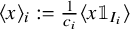 and
and  , we see by Jensen’s inequality that
 $$ \begin{align*} 1 &\gtrsim J_{\eta}(v_1,v_2) \\ &= \langle v_1 {S}v_2 \rangle - \sum_{j}c_j\big\langle ({1-u})\log v_1 \big\rangle_j -\sum_{j}c_j\big\langle ({1-u})\log v_2 \big\rangle_j+ \eta \langle v_1 + v_2 \rangle \\ &\ge c\mspace{1 mu}\sum_{i,j} z_{ij}\langle v_1 \rangle_i\langle v_2 \rangle_j - \sum_{j}c_j\langle 1-u \rangle_j\log\frac{ \langle (1-u)v_1 \rangle_j\langle (1-u)v_2 \rangle_j}{\langle 1-u \rangle_j^2} \\ &\ge c\mspace{1 mu}\sum_{i,j} z_{ij}\langle v_1 \rangle_i\langle v_2 \rangle_j - \sum_{j}c_j\langle 1-u \rangle_j\log \big({\langle v_1 \rangle_j \langle v_2 \rangle_j}\big)+2\sum_{j}c_j\langle 1-u \rangle_j\log\langle 1-u \rangle_j \\ &\ge \sum_{j} \varphi_j(\chi_j)-\frac{2}{\mathrm{e}}\sum_{j}c_j\,, \end{align*} $$
where in the last step we used $z_{jj} = 1$
for all
$z_{jj} = 1$
for all  and defined

for all  and
and $\chi \in (0,\infty )$
. For all
$\chi \in (0,\infty )$
. For all  , we infer $\chi _j \lesssim 1$
and
$\chi _j \lesssim 1$
and
 $$ \begin{align}{ \chi_j \ge \exp\bigg({-\frac{C}{1- \langle u \rangle_j}}\bigg) =\exp\bigg({-\frac{C}{\langle v_1(\eta+Sv_2) \rangle_j}}\bigg) } \end{align} $$
for some positive constant $C \sim 1$
. We rewrite the Dyson equation (4.4) in the form
$C \sim 1$
. We rewrite the Dyson equation (4.4) in the form
 $$ \begin{align} { v_1 = \frac{\eta +S^*v_1}{|a-\zeta|^2+(\eta +S^*v_1)(\eta+Sv_2)}\,, \qquad v_2 = \frac{\eta +Sv_2}{|a-\zeta|^2+(\eta+S^*v_1)(\eta+Sv_2)}\,. } \end{align} $$
Now we set $x:=(\eta +S^*v_1)(\eta +Sv_2)$
. In particular, we have
$x:=(\eta +S^*v_1)(\eta +Sv_2)$
. In particular, we have

due to (5.4). Suppose now that $\langle x \rangle _i \gg 1$
for an
$\langle x \rangle _i \gg 1$
for an  . Then by taking the $\langle \mspace {2 mu}\cdot \mspace {2 mu} \rangle _i$
-average of (5.9), multiplying the two equations and using (5.4) and (5.10) as well as
$\langle \mspace {2 mu}\cdot \mspace {2 mu} \rangle _i$
-average of (5.9), multiplying the two equations and using (5.4) and (5.10) as well as $\langle x \rangle _i \gg 1$
we get
$\langle x \rangle _i \gg 1$
we get
 $$\begin{align*}\chi_i \sim \frac{1}{\langle x \rangle_i}\ll 1\,. \end{align*}$$
On the other hand by multiplying the first equation in (5.9) with $\eta +Sv_2$
we find
$\eta +Sv_2$
we find
 $$\begin{align*}\langle v_1(\eta +Sv_2) \rangle_i \sim 1\, \end{align*}$$
as $\langle x \rangle _i \gg 1$
. This contradicts (5.8) and
$\langle x \rangle _i \gg 1$
. This contradicts (5.8) and $\chi _i \ll 1$
and we conclude
$\chi _i \ll 1$
and we conclude $\langle x \rangle _i \lesssim 1$
for all
$\langle x \rangle _i \lesssim 1$
for all  . With (5.9) and (5.10), this implies
 $$\begin{align*}v_1 \gtrsim S^*v_1\,, \qquad v_2 \gtrsim Sv_2\,. \end{align*}$$
Iterating these inequalities yields $v_1 \gtrsim \langle v_1 \rangle $
and
$v_1 \gtrsim \langle v_1 \rangle $
and $v_2 \gtrsim \langle v_2 \rangle $
, that is, (5.6), since
$v_2 \gtrsim \langle v_2 \rangle $
, that is, (5.6), since $(z_{ij})_{i,j}$
is primitive by A1. Since
$(z_{ij})_{i,j}$
is primitive by A1. Since $z_{ii}=1$
for all
$z_{ii}=1$
for all  , we have $S1 \gtrsim 1$
and
$S1 \gtrsim 1$
and $S^* 1 \gtrsim 1$
. This implies
$S^* 1 \gtrsim 1$
. This implies $Sv_2 \gtrsim \langle v_2 \rangle $
and
$Sv_2 \gtrsim \langle v_2 \rangle $
and $S^* v_1 \gtrsim \langle v_1 \rangle $
, respectively. The upper bounds on
$S^* v_1 \gtrsim \langle v_1 \rangle $
, respectively. The upper bounds on $Sv_2$
and
$Sv_2$
and $S^*v_1$
in (5.7) follow from the upper bound on s in A1.
$S^*v_1$
in (5.7) follow from the upper bound on s in A1.
Bound in
$L^2$
-norm:

Now we show a bound with respect to the norm on $L^2$
.
$L^2$
.
Lemma 5.3. If s satisfies A1 then
 $$ \begin{align} \langle v_1^2 \rangle + \langle v_2^2 \rangle + \langle \lvert y \rvert^2 \rangle \lesssim 1 \end{align} $$
uniformly for all $\zeta \in \mathbb {C}$
and
$\zeta \in \mathbb {C}$
and $\eta>0$
.
$\eta>0$
.
Proof. We multiply the first relation in (4.4a) by $v_1^2$
and estimate
$v_1^2$
and estimate $v_1 \geq v_1^2 S v_2 \gtrsim v_1^2 \langle v_2 \rangle = v_1^2 \langle v_1 \rangle $
due to (5.7) and (5.1). Averaging this estimate and using
$v_1 \geq v_1^2 S v_2 \gtrsim v_1^2 \langle v_2 \rangle = v_1^2 \langle v_1 \rangle $
due to (5.7) and (5.1). Averaging this estimate and using $\langle v_1 \rangle>0$
yields
$\langle v_1 \rangle>0$
yields $\langle v_1^2 \rangle \lesssim 1$
. The bound
$\langle v_1^2 \rangle \lesssim 1$
. The bound $\langle v_2^2 \rangle \lesssim 1$
is proved analogously. From (4.5), we conclude
$\langle v_2^2 \rangle \lesssim 1$
is proved analogously. From (4.5), we conclude
 $$ \begin{align} \lvert y \rvert^2 = \frac{v_1^2 \lvert a - \zeta \rvert^2}{(\eta + S^* v_1)^2} \leq \frac{v_1^2 \lvert a - \zeta \rvert^2}{(\eta + S^* v_1)^2} + \frac{v_1^2(\eta + S v_2)}{\eta + S^* v_1} = \frac{v_1}{\eta + S^* v_1}, \end{align} $$
where we used (4.4) in the last step. Hence, (5.7) implies
 $$\begin{align*}\langle \lvert y \rvert^2 \rangle \lesssim \frac{\langle v_1 \rangle}{\eta + \langle v_1 \rangle} \leq 1.\\[-43pt]\end{align*}$$
Corollary 5.4. Let $a \in \mathcal B$
and s satisfy A1. Then
$a \in \mathcal B$
and s satisfy A1. Then
 $$\begin{align*}\frac{\eta + \langle v_i \rangle}{1+\eta^2 + \lvert \zeta \rvert^2 } \lesssim v_i \lesssim \frac{1}{\eta + \langle v_i \rangle}\,, \qquad i=1,2\,. \end{align*}$$
Proof. We only consider the case $i = 1$
. The case
$i = 1$
. The case $i=2$
follows analogously. For the lower bound, we start from (4.4) and get
$i=2$
follows analogously. For the lower bound, we start from (4.4) and get
 $$\begin{align*}v_1 =\frac{\eta + S^*v_1}{(\eta + S^*v_1)(\eta + Sv_2) + \lvert \zeta -a \rvert^2} \gtrsim \frac{\eta + \langle v_1 \rangle}{\eta^2 + \langle v_1 \rangle^2 + \lvert \zeta \rvert^2 + \lVert a \rVert_\infty^2} \gtrsim \frac{\eta + \langle v_1 \rangle}{1+\eta^2 + \lvert \zeta \rvert^2 }\,, \end{align*}$$
using $\langle v_1 \rangle =\langle v_2 \rangle $
by (5.1), (5.11) and (5.7). For the upper bound, (4.4),
$\langle v_1 \rangle =\langle v_2 \rangle $
by (5.1), (5.11) and (5.7). For the upper bound, (4.4), $\langle v_1 \rangle =\langle v_2 \rangle $
and (5.7) imply
$\langle v_1 \rangle =\langle v_2 \rangle $
and (5.7) imply
 $$\begin{align*}v_1 \le \frac{1}{\eta +Sv_2} \sim \frac{1}{\eta +\langle v_1 \rangle}\,.\\[-43pt] \end{align*}$$
Bound in supremum norm:
Under stronger assumptions on s and a, we can also get a bound on $v_i$
in the
$v_i$
in the $L^\infty $
-norm. Let
$L^\infty $
-norm. Let $\Gamma _{a,s}$
be as defined in (2.7).
$\Gamma _{a,s}$
be as defined in (2.7).
Lemma 5.5. Assuming the upper bound $\max \big \{{\lVert v_1 \rVert _2,\lVert v_2 \rVert _2}\big \} \le \Lambda $
for some
$\max \big \{{\lVert v_1 \rVert _2,\lVert v_2 \rVert _2}\big \} \le \Lambda $
for some $\Lambda \ge 1$
and
$\Lambda \ge 1$
and $4\Lambda ^2 < \lim _{\tau \to \infty }\Gamma _{a,s}(\tau )$
, then we have the bound
$4\Lambda ^2 < \lim _{\tau \to \infty }\Gamma _{a,s}(\tau )$
, then we have the bound
 $$\begin{align*}\max\big\{{\lVert v_1 \rVert_\infty,\lVert v_2 \rVert_\infty}\big\} \le \frac{\Gamma_{a,s}^{-1}(4\Lambda^2)}{\Lambda}\,. \end{align*}$$
We remark that if s satisfies A1, then by Lemma 5.3 a $\Lambda \ge 1$
with
$\Lambda \ge 1$
with $\Lambda \sim 1$
exists such that
$\Lambda \sim 1$
exists such that $\max \big \{{\lVert v_1 \rVert _2,\lVert v_2 \rVert _2}\big \} \le \Lambda $
holds uniformly for all
$\max \big \{{\lVert v_1 \rVert _2,\lVert v_2 \rVert _2}\big \} \le \Lambda $
holds uniformly for all $\eta>0$
and
$\eta>0$
and $\zeta \in \mathbb {C}$
.
$\zeta \in \mathbb {C}$
.
Proof. We specialise the proof of [Reference Alt, Erdős and Krüger6, Lemma 9.1] to our setting.


Scaling relations
Lemma 5.7. Let $a \in \mathcal B$
and s satisfy A1 and A2. Then the following holds.
$a \in \mathcal B$
and s satisfy A1 and A2. Then the following holds.
-
(i) Uniformly for all
$\zeta \in \mathbb {C}$
and
$\eta>0$
, we have
$$\begin{align*}v_1 \sim \langle v_1 \rangle = \langle v_2 \rangle \sim v_2, \qquad \lvert y \rvert \lesssim 1. \end{align*}$$
-
(ii) For any sufficiently small positive constant
$c\sim 1$
the inequalities
$\eta + \langle v_1(\zeta ,\eta ) \rangle \leq c$
and
$\lvert \zeta \rvert \le 1/c$
imply
$\lvert \zeta - a \rvert \sim 1$
and
$\lvert y \rvert \sim 1$
.


Before going into the proof of Lemma 5.7, we remark that if $a \in \mathcal B$
and s satisfies A1 then
$a \in \mathcal B$
and s satisfies A1 then
 $$ \begin{align} \lVert v_1(\zeta, \eta) - (1 + \eta)^{-1} \rVert \lesssim (1 + \lvert \zeta \rvert)\eta^{-2} \end{align} $$
uniformly for $\eta>0$
and
$\eta>0$
and $\zeta \in \mathbb {C}$
. Indeed, for
$\zeta \in \mathbb {C}$
. Indeed, for $\eta \in (0,1]$
, (5.13) is a trivial consequence of (5.2). For
$\eta \in (0,1]$
, (5.13) is a trivial consequence of (5.2). For $\eta \geq 1$
, (5.13) follows by inverting (4.4a), subtracting
$\eta \geq 1$
, (5.13) follows by inverting (4.4a), subtracting $(1 + \eta )^{-1}$
on both sides and estimating the right hand side using (5.7) and Lemma 5.3.
$(1 + \eta )^{-1}$
on both sides and estimating the right hand side using (5.7) and Lemma 5.3.
Proof. We first prove that $v_1 \sim \langle v_1 \rangle = \langle v_2 \rangle \sim v_2$
. As s satisfies A1, equation (4.4),
$v_1 \sim \langle v_1 \rangle = \langle v_2 \rangle \sim v_2$
. As s satisfies A1, equation (4.4), $v_1$
,
$v_1$
, $v_2> 0$
and (5.7) imply
$v_2> 0$
and (5.7) imply
 $$ \begin{align} v_1 \sim v_2 \,. \end{align} $$
Hence, it suffices to show $v_1 \sim \langle v_1 \rangle $
due to (5.1).
$v_1 \sim \langle v_1 \rangle $
due to (5.1).
From (5.13), we conclude that $v_1 \sim (1+ \eta )^{-1}$
and
$v_1 \sim (1+ \eta )^{-1}$
and $\langle v_1 \rangle \sim (1 + \eta )^{-1}$
uniformly for
$\langle v_1 \rangle \sim (1 + \eta )^{-1}$
uniformly for $\eta \gtrsim 1$
and
$\eta \gtrsim 1$
and $\lvert \zeta \rvert \lesssim 1$
. This proves Lemma 5.7 in that regime. If, on the other hand,
$\lvert \zeta \rvert \lesssim 1$
. This proves Lemma 5.7 in that regime. If, on the other hand, $\lvert \zeta \rvert \geq \lVert a \rVert _\infty + 1$
then
$\lvert \zeta \rvert \geq \lVert a \rVert _\infty + 1$
then $\lvert \zeta - a \rvert \sim \lvert \zeta \rvert $
. Hence, for such
$\lvert \zeta - a \rvert \sim \lvert \zeta \rvert $
. Hence, for such $\zeta $
, we conclude from (4.4a) and (5.7) that
$\zeta $
, we conclude from (4.4a) and (5.7) that
 $$\begin{align*}\frac{1}{v_1} \sim \eta + \langle v_2 \rangle + \frac{\lvert \zeta \rvert^2}{\eta + \langle v_1 \rangle}. \end{align*}$$
As the right hand side is a constant function on $\mathfrak X$
, we obtain
$\mathfrak X$
, we obtain $v_1 \sim \langle v_1 \rangle $
if
$v_1 \sim \langle v_1 \rangle $
if $\lvert \zeta \rvert \geq \lVert a \rVert _\infty + 1$
.
$\lvert \zeta \rvert \geq \lVert a \rVert _\infty + 1$
.
Hence, it remains to consider $\lvert \zeta \rvert \lesssim 1$
and
$\lvert \zeta \rvert \lesssim 1$
and $\eta \lesssim 1$
. In particular,
$\eta \lesssim 1$
. In particular, $\lvert \zeta - a \rvert \lesssim 1$
as
$\lvert \zeta - a \rvert \lesssim 1$
as $a \in \mathcal B$
. Thus, (4.4a), (5.7) and (5.1) imply
$a \in \mathcal B$
. Thus, (4.4a), (5.7) and (5.1) imply
 $$ \begin{align} \eta + \langle v_1 \rangle \sim v_1 ((\eta + \langle v_1 \rangle)^2 + \lvert \zeta - a \rvert^2). \end{align} $$
Together with Lemma 5.3, this yields $\eta + \langle v_1 \rangle \lesssim v_1$
. We conclude
$\eta + \langle v_1 \rangle \lesssim v_1$
. We conclude $v_1 \gtrsim \langle v_1 \rangle $
and
$v_1 \gtrsim \langle v_1 \rangle $
and $v_1 \gtrsim \eta $
as well as
$v_1 \gtrsim \eta $
as well as $\langle v_1 \rangle \gtrsim \eta $
. If
$\langle v_1 \rangle \gtrsim \eta $
. If $\lvert \zeta - a \rvert \geq c$
for any
$\lvert \zeta - a \rvert \geq c$
for any $c \sim 1$
then
$c \sim 1$
then $v_1 \lesssim \eta + \langle v_1 \rangle \sim \langle v_1 \rangle $
by (5.15). Therefore we conclude
$v_1 \lesssim \eta + \langle v_1 \rangle \sim \langle v_1 \rangle $
by (5.15). Therefore we conclude $v_1 \sim \langle v_1 \rangle $
if
$v_1 \sim \langle v_1 \rangle $
if $\lvert \zeta - a \rvert \geq c$
. What remains is the case
$\lvert \zeta - a \rvert \geq c$
. What remains is the case $\lvert \zeta - a \rvert \leq c$
and
$\lvert \zeta - a \rvert \leq c$
and $\eta \leq c$
for some constant
$\eta \leq c$
for some constant $c \sim 1$
. As
$c \sim 1$
. As $v_1\lesssim 1$
by A2 and Lemma 5.5, we conclude from (5.15) that
$v_1\lesssim 1$
by A2 and Lemma 5.5, we conclude from (5.15) that $1 \gtrsim \eta + \langle v_1 \rangle $
or
$1 \gtrsim \eta + \langle v_1 \rangle $
or $1 \gtrsim \frac { \lvert \zeta - a \rvert ^2}{\eta + \langle v_1 \rangle }$
. In the second case, (5.15) implies
$1 \gtrsim \frac { \lvert \zeta - a \rvert ^2}{\eta + \langle v_1 \rangle }$
. In the second case, (5.15) implies $ \langle v_1 \rangle \lesssim \eta + \langle v_1 \rangle \sim v_1 ( \lvert \zeta - a \rvert ^4 + \lvert \zeta - a \rvert ^2)$
. Using
$ \langle v_1 \rangle \lesssim \eta + \langle v_1 \rangle \sim v_1 ( \lvert \zeta - a \rvert ^4 + \lvert \zeta - a \rvert ^2)$
. Using $\lvert \zeta - a \rvert \leq c$
, choosing
$\lvert \zeta - a \rvert \leq c$
, choosing $c \sim 1$
sufficiently small and averaging
$c \sim 1$
sufficiently small and averaging $\langle v_1 \rangle \lesssim v_1 ( \lvert \zeta - a \rvert ^4 + \lvert \zeta - a \rvert ^2)$
yield a contradiction as
$\langle v_1 \rangle \lesssim v_1 ( \lvert \zeta - a \rvert ^4 + \lvert \zeta - a \rvert ^2)$
yield a contradiction as $\langle v_1 \rangle> 0$
. Hence,
$\langle v_1 \rangle> 0$
. Hence, $\langle v_1 \rangle \gtrsim 1$
and, thus,
$\langle v_1 \rangle \gtrsim 1$
and, thus, $\langle v_1 \rangle \sim 1$
by Lemma 5.3 as well as
$\langle v_1 \rangle \sim 1$
by Lemma 5.3 as well as $1 \gtrsim v_1$
by (5.15) as
$1 \gtrsim v_1$
by (5.15) as $\eta \leq c$
for some small enough
$\eta \leq c$
for some small enough $c \sim 1$
. Since
$c \sim 1$
. Since $v_1 \lesssim 1$
by Lemma 5.5, this completes the proof of
$v_1 \lesssim 1$
by Lemma 5.5, this completes the proof of $v_1 \sim \langle v_1 \rangle $
uniformly for
$v_1 \sim \langle v_1 \rangle $
uniformly for $\zeta \in \mathbb {C}$
and
$\zeta \in \mathbb {C}$
and $\eta>0$
. This completes the proof of (i).
$\eta>0$
. This completes the proof of (i).
For the proof of (ii), from $v_1 \sim \langle v_1 \rangle $
, (5.7) and (5.12), we conclude
$v_1 \sim \langle v_1 \rangle $
, (5.7) and (5.12), we conclude $\lvert y \rvert \lesssim 1$
uniformly for
$\lvert y \rvert \lesssim 1$
uniformly for $\zeta \in \mathbb {C}$
and
$\zeta \in \mathbb {C}$
and $\eta>0$
. Owing to (5.15) and
$\eta>0$
. Owing to (5.15) and $v_1 \sim \langle v_1 \rangle $
, we have
$v_1 \sim \langle v_1 \rangle $
, we have $\eta + \langle v_1 \rangle \sim \langle v_1 \rangle (\eta + \langle v_1 \rangle )^2 + \langle v_1 \rangle \lvert \zeta - a \rvert ^2 $
. As
$\eta + \langle v_1 \rangle \sim \langle v_1 \rangle (\eta + \langle v_1 \rangle )^2 + \langle v_1 \rangle \lvert \zeta - a \rvert ^2 $
. As $\eta + \langle v_1 \rangle \leq c$
, by choosing
$\eta + \langle v_1 \rangle \leq c$
, by choosing $c\sim 1$
sufficiently small, we can incorporate
$c\sim 1$
sufficiently small, we can incorporate $\langle v_1 \rangle (\eta + \langle v_1 \rangle )^2$
into the left-hand side and obtain
$\langle v_1 \rangle (\eta + \langle v_1 \rangle )^2$
into the left-hand side and obtain $\langle v_1 \rangle \lesssim \lvert \zeta - a \rvert ^2 \langle v_1 \rangle $
. Hence,
$\langle v_1 \rangle \lesssim \lvert \zeta - a \rvert ^2 \langle v_1 \rangle $
. Hence, $1 \lesssim \lvert \zeta - a \rvert $
as
$1 \lesssim \lvert \zeta - a \rvert $
as $\langle v_1 \rangle>0$
for
$\langle v_1 \rangle>0$
for $\eta>0$
. The bound
$\eta>0$
. The bound $\lvert y \rvert \sim 1$
follows from (5.3). This proves the additional statement and completes the proof of Lemma 5.7.
$\lvert y \rvert \sim 1$
follows from (5.3). This proves the additional statement and completes the proof of Lemma 5.7.
5.2 A relation between the derivatives of M
In this subsection, we restrict the Dyson equation (4.3) to the imaginary axis $w=\mathrm {i} \eta $
for
$w=\mathrm {i} \eta $
for $\eta>0$
, that is, we consider the solution
$\eta>0$
, that is, we consider the solution $M=M(\zeta , \mathrm {i} \eta )$
of
$M=M(\zeta , \mathrm {i} \eta )$
of
 $$ \begin{align} - M^{-1} = \begin{pmatrix} \mathrm{i} \eta & \zeta - a \\ \overline{\zeta- a} & \mathrm{i} \eta \end{pmatrix} + \Sigma[M]. \end{align} $$
We take derivatives of M with respect to $\eta $
,
$\eta $
, $\zeta $
and
$\zeta $
and $\bar \zeta $
. We establish a useful relation between these derivatives in the next lemma. Here, we use the notation
$\bar \zeta $
. We establish a useful relation between these derivatives in the next lemma. Here, we use the notation
 $$\begin{align*}\begin{aligned} \langle R \rangle: = \frac{1}{2}(\langle r_{11} \rangle + \langle r_{22} \rangle) \,, \qquad R= \begin{pmatrix} r_{11} & r_{12}\\ r_{21} & r_{22} \end{pmatrix} \in \mathcal{B}^{2 \times 2}\,. \end{aligned} \end{align*}$$
Lemma 5.8. In the setup of Lemma 4.1 we have
 $$ \begin{align} \langle \partial_\eta M_{21}(\zeta, \mathrm{i} \eta) \rangle= 2\mathrm{i} \langle \partial_\zeta M(\zeta, \mathrm{i}\eta) \rangle, \qquad \langle \partial_\eta M_{12}(\zeta, \mathrm{i}\eta) \rangle = 2 \mathrm{i} \langle \partial_{\bar \zeta} M(\zeta, \mathrm{i}\eta) \rangle \end{align} $$
for every $\zeta \in \mathbb {C}$
and
$\zeta \in \mathbb {C}$
and $\eta>0$
, where we decomposed
$\eta>0$
, where we decomposed
 $$\begin{align*}M(\zeta,\mathrm{i}\eta) = \begin{pmatrix} M_{11}(\zeta,\mathrm{i}\eta) & M_{12}(\zeta,\mathrm{i}\eta) \\ M_{21}(\zeta,\mathrm{i}\eta) & M_{22}(\zeta,\mathrm{i}\eta) \end{pmatrix}. \end{align*}$$
Here, the derivatives of M are taken entrywise. Before proving Lemma 5.8, we note that the Schur complement formula implies
 $$ \begin{align} \begin{pmatrix} - w & \mathfrak d \\ \mathfrak d^* & - w\end{pmatrix} ^{-1} = \begin{pmatrix} w (\mathfrak d\mathfrak d^* - w^2)^{-1} & \mathfrak d (\mathfrak d^* \mathfrak d - w^2)^{-1} \\ (\mathfrak d^* \mathfrak d -w^2)^{-1} \mathfrak d^* & w (\mathfrak d^* \mathfrak d -w^2)^{-1} \end{pmatrix} \end{align} $$
for any $\mathfrak d \in \mathcal A$
and any
$\mathfrak d \in \mathcal A$
and any $w \in \mathbb {C}$
with
$w \in \mathbb {C}$
with $\mathrm {Im}\, w>0$
.
$\mathrm {Im}\, w>0$
.
Proof of Lemma 5.8.
Throughout the following, we set $\lvert \mathfrak d \rvert = \sqrt {\mathfrak d^* \mathfrak d}$
for any
$\lvert \mathfrak d \rvert = \sqrt {\mathfrak d^* \mathfrak d}$
for any $\mathfrak d \in \mathcal A$
. Let
$\mathfrak d \in \mathcal A$
. Let $\eta \in (0,\infty )$
and
$\eta \in (0,\infty )$
and $\zeta \in \mathbb {C}$
. Owing to (2.4) and the invertibility of
$\zeta \in \mathbb {C}$
. Owing to (2.4) and the invertibility of $\lvert a + \mathfrak c -\zeta \rvert ^2 + \eta ^2$
, we have
$\lvert a + \mathfrak c -\zeta \rvert ^2 + \eta ^2$
, we have
 $$ \begin{align*} \log D( \lvert a+ \mathfrak c - \zeta \rvert^2 + \eta^2) = \langle E[ \log ( \lvert a + \mathfrak c -\zeta \rvert^2 + \eta^2)] \rangle. \end{align*} $$
In particular, the right-hand side is infinitely often differentiable with respect to $\zeta $
,
$\zeta $
, $\overline {\zeta }$
and
$\overline {\zeta }$
and $\eta $
if
$\eta $
if $\eta>0$
. Differentiating with respect to
$\eta>0$
. Differentiating with respect to $\zeta $
,
$\zeta $
, $\overline {\zeta }$
and
$\overline {\zeta }$
and $\eta $
yield
$\eta $
yield
 $$ \begin{align} \partial_\zeta \log D( \lvert a+ \mathfrak c - \zeta \rvert^2 + \eta^2) & = - \langle E[ ( \lvert a + \mathfrak c - \zeta \rvert^2 + \eta^2)^{-1} (a + \mathfrak c - \zeta)^*] \rangle = - \langle M_{21}(\zeta,\eta) \rangle , \end{align} $$
 $$ \begin{align} \partial_{\bar \zeta} \log D( \lvert a+ \mathfrak c - \zeta \rvert^2 + \eta^2) & = - \langle E[ ( \lvert a + \mathfrak c - \zeta \rvert^2 + \eta^2)^{-1} (a + \mathfrak c - \zeta)] \rangle = - \langle M_{12}(\zeta,\eta) \rangle, \end{align} $$
 $$ \begin{align} \partial_\eta \log D( \lvert a+ \mathfrak c - \zeta \rvert^2 + \eta^2) & = 2 \eta \langle E[(\lvert a + \mathfrak c - \zeta \rvert^2 + \eta^2)^{-1}] \rangle = - 2 \mathrm{i} \langle M_{22}(\zeta,\eta) \rangle. \end{align} $$
Here, we used in the third steps that, for all $\eta>0$
and
$\eta>0$
and $\zeta \in \mathbb {C}$
, (4.1) and (5.18) imply
$\zeta \in \mathbb {C}$
, (4.1) and (5.18) imply
 $$\begin{align*}M(\zeta,\mathrm{i}\eta) = \begin{pmatrix} M_{11}(\zeta,\mathrm{i}\eta) & M_{12}(\zeta,\mathrm{i}\eta) \\ M_{21}(\zeta,\mathrm{i}\eta) & M_{22}(\zeta,\mathrm{i}\eta) \end{pmatrix} = \begin{pmatrix} \mathrm{i} \eta E[(\mathfrak d\mathfrak d^* + \eta^2)^{-1}] & E[\mathfrak d (\mathfrak d^* \mathfrak d + \eta^2)^{-1}] \\ E[(\mathfrak d^* \mathfrak d + \eta^2)^{-1} \mathfrak d^*] & \mathrm{i} \eta E[(\mathfrak d^* \mathfrak d + \eta^2)^{-1}] \end{pmatrix} \end{align*}$$
with $\mathfrak d = a + \mathfrak c - \zeta $
. As
$\mathfrak d = a + \mathfrak c - \zeta $
. As $\langle M_{22} \rangle = \langle v_2 \rangle = \langle v_1 \rangle = \langle M_{11} \rangle $
by (5.1), Lemma 5.8 follows from (5.19) due to the exchangebility of the derivatives.
$\langle M_{22} \rangle = \langle v_2 \rangle = \langle v_1 \rangle = \langle M_{11} \rangle $
by (5.1), Lemma 5.8 follows from (5.19) due to the exchangebility of the derivatives.
Let $\mathcal L$
be the stability operator of (5.16), defined as
$\mathcal L$
be the stability operator of (5.16), defined as
 $$ \begin{align} \mathcal L \colon \mathcal B^{2\times 2} \to \mathcal B^{2\times 2}, \quad R \mapsto \mathcal L[R] := M^{-1} R M^{-1} - \Sigma[R]. \end{align} $$
This operator is invertible for any $\zeta \in \mathbb {C}$
and
$\zeta \in \mathbb {C}$
and $\eta>0$
due to Lemma B.1 below. Therefore, the implicit function theorem applied to (5.16) and simple computations show that
$\eta>0$
due to Lemma B.1 below. Therefore, the implicit function theorem applied to (5.16) and simple computations show that
 $$ \begin{align} \partial_\zeta M = \mathcal L^{-1} [E_{12}], \qquad \partial_{\bar \zeta} M = \mathcal L^{-1} [E_{21}], \qquad \partial_{\eta} M = \mathrm{i} \mathcal L^{-1} [E_+] \end{align} $$
for all $\eta>0$
and
$\eta>0$
and $\zeta \in \mathbb {C}$
, where we used the notations
$\zeta \in \mathbb {C}$
, where we used the notations $E_{12}$
,
$E_{12}$
, $E_{21}$
and
$E_{21}$
and $E_+$
for the elements of
$E_+$
for the elements of $\mathcal B^{2\times 2}$
defined through
$\mathcal B^{2\times 2}$
defined through
 $$ \begin{align} E_{12} := \begin{pmatrix} 0 & 1 \\ 0 & 0 \end{pmatrix}, \qquad E_{21} := \begin{pmatrix} 0 & 0 \\ 1 & 0 \end{pmatrix}, \qquad E_+ := \begin{pmatrix} 1 & 0 \\ 0 & 1 \end{pmatrix}. \end{align} $$
5.3 Stability of Dyson equation and analyticity of its solution
In this section we show how the solution $v_1, v_2$
of (4.4) can be extended to
$v_1, v_2$
of (4.4) can be extended to $\eta =0$
. The characterisation of the Brown measure in Proposition 4.3 in combination with Lemma 4.2 shows how the Brown measure
$\eta =0$
. The characterisation of the Brown measure in Proposition 4.3 in combination with Lemma 4.2 shows how the Brown measure $\sigma $
relates to the solution of (4.4) at the origin, that is, at
$\sigma $
relates to the solution of (4.4) at the origin, that is, at $\eta =0$
. Now we introduce a deterministic analog of the
$\eta =0$
. Now we introduce a deterministic analog of the $\varepsilon $
-pseudospectrum. For this purpose we note that the map
$\varepsilon $
-pseudospectrum. For this purpose we note that the map $w \mapsto \langle M(\zeta , w) \rangle $
is the Stieltjes transform of a probability measure on
$w \mapsto \langle M(\zeta , w) \rangle $
is the Stieltjes transform of a probability measure on $\mathbb {R}$
. Indeed, [Reference Alt, Erdős and Krüger6, Proposition 2.1 and Definition 2.2] show that
$\mathbb {R}$
. Indeed, [Reference Alt, Erdős and Krüger6, Proposition 2.1 and Definition 2.2] show that
 $$ \begin{align} \langle M(\zeta, w) \rangle = \int_{\mathbb{R}}\frac{\rho_\zeta(\mathrm{d} \tau )}{\tau-w} \end{align} $$
holds for all $w \in \mathbb {C}$
with
$w \in \mathbb {C}$
with $\operatorname {\mathrm {Im}} w>0$
and a unique probability measure
$\operatorname {\mathrm {Im}} w>0$
and a unique probability measure $\rho _\zeta $
whose support satisfies
$\rho _\zeta $
whose support satisfies $\operatorname {\mathrm {supp}} \rho _\zeta \subset \big ( \operatorname {\mathrm {Spec}}(D_{|a-\zeta |})\cup \operatorname {\mathrm {Spec}}(-D_{|a-\zeta |}) \big ) + [-2 \lVert S \rVert _\infty ^{1/2},2 \lVert S \rVert _\infty ^{1/2}]$
.
$\operatorname {\mathrm {supp}} \rho _\zeta \subset \big ( \operatorname {\mathrm {Spec}}(D_{|a-\zeta |})\cup \operatorname {\mathrm {Spec}}(-D_{|a-\zeta |}) \big ) + [-2 \lVert S \rVert _\infty ^{1/2},2 \lVert S \rVert _\infty ^{1/2}]$
.
Definition 5.9. Let $\rho _\zeta $
be the unique probability measure on
$\rho _\zeta $
be the unique probability measure on $\mathbb {R}$
for which (5.23) holds. Through
$\mathbb {R}$
for which (5.23) holds. Through $\rho _\zeta $
we define
$\rho _\zeta $
we define
 $$ \begin{align} { \mathbb S_\varepsilon:= \{\zeta \in \mathbb{C}: \mathrm{dist}(0, \operatorname{\mathrm{supp}} \rho_\zeta)\le \varepsilon\} } \end{align} $$
for any $\varepsilon \geq 0$
.
$\varepsilon \geq 0$
.
Remark 5.10. The sets $\mathbb S_\varepsilon $
defined in (5.24) are monotonously nondecreasing in
$\mathbb S_\varepsilon $
defined in (5.24) are monotonously nondecreasing in $\varepsilon \geq 0$
, that is,
$\varepsilon \geq 0$
, that is, $\mathbb S_{\varepsilon _1} \subset \mathbb S_{\varepsilon _2}$
if
$\mathbb S_{\varepsilon _1} \subset \mathbb S_{\varepsilon _2}$
if $\varepsilon _1 \le \varepsilon _2$
. Moreover, they are bounded, in fact,
$\varepsilon _1 \le \varepsilon _2$
. Moreover, they are bounded, in fact, $\mathbb S_{\varepsilon } \subset \{\zeta \in \mathbb {C}: \lvert \zeta \rvert \le \varepsilon + \lVert a \rVert _\infty + 2 (\lVert S \rVert _{\infty })^{1/2}\}$
for all
$\mathbb S_{\varepsilon } \subset \{\zeta \in \mathbb {C}: \lvert \zeta \rvert \le \varepsilon + \lVert a \rVert _\infty + 2 (\lVert S \rVert _{\infty })^{1/2}\}$
for all $\varepsilon \geq 0$
as a consequence of [Reference Alt, Erdős and Krüger6, Proposition 2.1]. Here,
$\varepsilon \geq 0$
as a consequence of [Reference Alt, Erdős and Krüger6, Proposition 2.1]. Here, $\lVert S \rVert _\infty $
denotes the operator norm of S viewed as an operator from
$\lVert S \rVert _\infty $
denotes the operator norm of S viewed as an operator from $\mathcal B$
to
$\mathcal B$
to $\mathcal B$
.
$\mathcal B$
.
If we stay away from $\mathbb S_\varepsilon $
, then the solution is extended to
$\mathbb S_\varepsilon $
, then the solution is extended to $\eta =0$
by setting
$\eta =0$
by setting $v_i=0$
by the following lemma.
$v_i=0$
by the following lemma.
Lemma 5.11. Let $\varepsilon>0$
. Let
$\varepsilon>0$
. Let $\zeta \in (\mathbb {C} \setminus \mathbb S_\varepsilon )\cap \mathbb {D}_{1/\varepsilon }$
. Then
$\zeta \in (\mathbb {C} \setminus \mathbb S_\varepsilon )\cap \mathbb {D}_{1/\varepsilon }$
. Then $v_i(\zeta , \eta )\sim _\varepsilon \eta $
for all
$v_i(\zeta , \eta )\sim _\varepsilon \eta $
for all $\eta \in (0,1]$
and
$\eta \in (0,1]$
and $i=1,2$
. In particular,
$i=1,2$
. In particular, $v_i$
is continuously extended to
$v_i$
is continuously extended to $ \zeta \in \mathbb {C}\setminus \mathbb S_0$
and
$ \zeta \in \mathbb {C}\setminus \mathbb S_0$
and $\eta =0$
by setting
$\eta =0$
by setting $v_i(\zeta , 0):=0$
.
$v_i(\zeta , 0):=0$
.
Proof. From (4.4a), we conclude $v_1 (\lvert \zeta - a \rvert ^2 + (\eta + S v_2)(\eta + S^*v_1)) = \eta + S^* v_1 \geq \eta $
. Thus,
$v_1 (\lvert \zeta - a \rvert ^2 + (\eta + S v_2)(\eta + S^*v_1)) = \eta + S^* v_1 \geq \eta $
. Thus, $\lvert \zeta \rvert \leq \varepsilon ^{-1}$
,
$\lvert \zeta \rvert \leq \varepsilon ^{-1}$
, $a \in \mathcal B$
,
$a \in \mathcal B$
, $\eta \leq 1$
, (5.7) and Lemma 5.3 imply
$\eta \leq 1$
, (5.7) and Lemma 5.3 imply $v_1 \gtrsim _\varepsilon \eta $
for all
$v_1 \gtrsim _\varepsilon \eta $
for all $\eta \in (0,1]$
. Similarly,
$\eta \in (0,1]$
. Similarly, $v_2 \gtrsim _\varepsilon \eta $
for all
$v_2 \gtrsim _\varepsilon \eta $
for all $\eta \in (0,1]$
. On the other hand, as
$\eta \in (0,1]$
. On the other hand, as $\zeta \in \mathbb {C}\setminus \mathbb S_\varepsilon $
, the statement (v) of [Reference Alt, Erdős and Krüger6, Lemma D.1] holds for
$\zeta \in \mathbb {C}\setminus \mathbb S_\varepsilon $
, the statement (v) of [Reference Alt, Erdős and Krüger6, Lemma D.1] holds for $\tau = 0$
. Hence, [Reference Alt, Erdős and Krüger6, Lemma D.1 (i)] implies
$\tau = 0$
. Hence, [Reference Alt, Erdős and Krüger6, Lemma D.1 (i)] implies $\max \{v_1(\zeta , \eta ), v_2(\zeta , \eta )\} \leq \lVert \mathrm {Im}\, M(\zeta ,\mathrm {i} \eta )) \rVert \lesssim \eta $
for all
$\max \{v_1(\zeta , \eta ), v_2(\zeta , \eta )\} \leq \lVert \mathrm {Im}\, M(\zeta ,\mathrm {i} \eta )) \rVert \lesssim \eta $
for all $\eta \in (0,c]$
for some sufficiently small
$\eta \in (0,c]$
for some sufficiently small $c \sim _\varepsilon 1$
. If
$c \sim _\varepsilon 1$
. If $\eta \in (c,1]$
then the upper bound in Corollary 5.4 yields
$\eta \in (c,1]$
then the upper bound in Corollary 5.4 yields $v_i \lesssim \eta ^{-1} \sim \eta $
for all
$v_i \lesssim \eta ^{-1} \sim \eta $
for all $\eta \in (c,1]$
. This completes the proof.
$\eta \in (c,1]$
. This completes the proof.
The next proposition states that if $\langle v_1 \rangle =\langle v_2 \rangle $
remains bounded away from zero as
$\langle v_1 \rangle =\langle v_2 \rangle $
remains bounded away from zero as $\eta \downarrow 0$
, then the solution has an analytic extension to
$\eta \downarrow 0$
, then the solution has an analytic extension to $\eta =0$
.
$\eta =0$
.
Proposition 5.12 (Analyticity in the bulk).
Let s satisfy A1 and $\zeta \in \mathbb {C}$
with
$\zeta \in \mathbb {C}$
with $\limsup _{\eta \downarrow 0}\langle v_1(\zeta , \eta ) \rangle> 0$
. Then
$\limsup _{\eta \downarrow 0}\langle v_1(\zeta , \eta ) \rangle> 0$
. Then $v_1,v_2: \mathbb {C} \times (0,\infty ) \to (0,\infty )$
has an extension to a neighbourhood of
$v_1,v_2: \mathbb {C} \times (0,\infty ) \to (0,\infty )$
has an extension to a neighbourhood of $(\zeta ,0)$
in
$(\zeta ,0)$
in $\mathbb {C}\times \mathbb {R}$
which is real analytic in all variables.
$\mathbb {C}\times \mathbb {R}$
which is real analytic in all variables.
To prove this proposition, we show that the Dyson equation (4.4) is stable even for $\eta =0$
. However, the equation does not have a unique solution on
$\eta =0$
. However, the equation does not have a unique solution on $\mathcal {B}_+^2$
for
$\mathcal {B}_+^2$
for $\eta =0$
without the additional constraint
$\eta =0$
without the additional constraint $\langle v_1 \rangle =\langle v_2 \rangle $
. Therefore, we have to reformulate the equation to incorporate this constraint. Proposition 5.12 is proved at the end of this subsection.
$\langle v_1 \rangle =\langle v_2 \rangle $
. Therefore, we have to reformulate the equation to incorporate this constraint. Proposition 5.12 is proved at the end of this subsection.
We recall that $\mathcal B_+:=\{w \in \mathcal B:w> 0\}$
and set
$\mathcal B_+:=\{w \in \mathcal B:w> 0\}$
and set
 $$\begin{align*}e_- = (1, - 1) \in {\mathcal B}^2 := \mathcal B \oplus \mathcal B\,, \qquad e_-^\perp:= \{h=(h_1,h_2) \in\mathcal B^2: \langle h_1 \rangle = \langle h_2 \rangle \}. \end{align*}$$
For $\eta>0$
and
$\eta>0$
and $\zeta \in \mathbb {C}$
, we define
$\zeta \in \mathbb {C}$
, we define $J\equiv J_{\zeta , \eta }\colon e_-^\perp \cap \mathcal B_+^2 \to e_-^\perp , (w_1,w_2) \mapsto (J_1(w_1,w_2),J_2(w_1,w_2))$
through
$J\equiv J_{\zeta , \eta }\colon e_-^\perp \cap \mathcal B_+^2 \to e_-^\perp , (w_1,w_2) \mapsto (J_1(w_1,w_2),J_2(w_1,w_2))$
through
 $$ \begin{align*} J_1(w_1,w_2)&:=(\eta + Sw_2)\bigg({w_1- \frac{\eta + S^*w_1}{(\eta + S^*w_1)(\eta + Sw_2)+ \lvert a-\zeta \rvert^2}}\bigg)\,, \\ J_2(w_1,w_2)&:=(\eta + S^*w_1)\bigg({w_2- \frac{\eta + Sw_2}{(\eta + S^*w_1)(\eta + Sw_2)+ \lvert a-\zeta \rvert^2}}\bigg)\,. \end{align*} $$
Then (4.4) takes the form $J(v)=0$
with
$J(v)=0$
with $v=(v_1,v_2) \in \mathcal {B}_+^2$
.
$v=(v_1,v_2) \in \mathcal {B}_+^2$
.
On $\mathcal B^2$
, we introduce a tracial state and a scalar product defined through
$\mathcal B^2$
, we introduce a tracial state and a scalar product defined through
 $$ \begin{align} { \bigg\langle \begin{pmatrix} x_1 \\ x_2 \end{pmatrix} \bigg\rangle := \frac{1}{2} \big( \langle x_1 \rangle + \langle x_2 \rangle \big), \qquad \qquad \bigg\langle{\begin{pmatrix} x_{1} \\ x_{2} \end{pmatrix} } \,\mspace{2mu},\, {\begin{pmatrix} y_1 \\ y_2 \end{pmatrix} }\bigg\rangle:= \frac{1}{2}\big({\langle \overline{x}_1y_1 \rangle+\langle \overline{x}_2y_2 \rangle}\big) } \end{align} $$
for $x_1$
,
$x_1$
, $x_2$
,
$x_2$
, $y_1$
,
$y_1$
, $y_2 \in \mathcal B$
. For
$y_2 \in \mathcal B$
. For $x \in \mathcal B^2$
, we write
$x \in \mathcal B^2$
, we write $\lVert x \rVert _2 := \sqrt {\langle {x} \mspace {2mu}, {x}\rangle }$
. We also interpret
$\lVert x \rVert _2 := \sqrt {\langle {x} \mspace {2mu}, {x}\rangle }$
. We also interpret $\mathcal B^2$
as an algebra equipped with the componentwise multiplication
$\mathcal B^2$
as an algebra equipped with the componentwise multiplication $(x_1x_2)(y_1,y_2):=(x_1y_1, x_2y_2)$
.
$(x_1x_2)(y_1,y_2):=(x_1y_1, x_2y_2)$
.
For the rest of this section we will assume that s satisfies A1. Until the proof of Proposition 5.12, we fix $\zeta \in \mathbb {C}$
such that
$\zeta \in \mathbb {C}$
such that $\limsup _{\eta \downarrow 0}\langle v_1(\zeta , \eta ) \rangle \ge \delta $
for some
$\limsup _{\eta \downarrow 0}\langle v_1(\zeta , \eta ) \rangle \ge \delta $
for some $\delta>0$
. Under these conditions, J remains well defined on
$\delta>0$
. Under these conditions, J remains well defined on $e_-^\perp \cap \mathcal B_+^2$
even for
$e_-^\perp \cap \mathcal B_+^2$
even for $\eta =0$
and we set
$\eta =0$
and we set $J_0:= J_{\zeta ,\eta =0}$
. We now pick candidates for
$J_0:= J_{\zeta ,\eta =0}$
. We now pick candidates for $v_1(\zeta ,0)$
and
$v_1(\zeta ,0)$
and $v_2(\zeta ,0)$
by choosing weakly convergent subsequences in the limit
$v_2(\zeta ,0)$
by choosing weakly convergent subsequences in the limit $\eta \downarrow 0$
. By Lemma 5.3, there are
$\eta \downarrow 0$
. By Lemma 5.3, there are $v_0 \in (L^2)^2 := L^2 \oplus L^2$
and a monotonically decreasing sequence
$v_0 \in (L^2)^2 := L^2 \oplus L^2$
and a monotonically decreasing sequence $\eta _n \downarrow 0$
in
$\eta _n \downarrow 0$
in $(0,1]$
such that
$(0,1]$
such that $v^{(n)} = v(\zeta , \eta _n)$
is weakly convergent to
$v^{(n)} = v(\zeta , \eta _n)$
is weakly convergent to $v_0$
in
$v_0$
in $(L^2)^2 $
, that is, for any
$(L^2)^2 $
, that is, for any $h \in (L^2)^2$
,
$h \in (L^2)^2$
, $\langle {h} \mspace {2mu}, {v^{(n)} - v_0}\rangle \to 0$
in the limit
$\langle {h} \mspace {2mu}, {v^{(n)} - v_0}\rangle \to 0$
in the limit $n \to \infty $
. We recall that
$n \to \infty $
. We recall that $L^2 = L^2(\mathfrak X, \mathcal A, \mu )$
.
$L^2 = L^2(\mathfrak X, \mathcal A, \mu )$
.
Lemma 5.13. Let $v_0=\lim _{n \to \infty }v^{(n)}$
be a weak limit as above. Then
$v_0=\lim _{n \to \infty }v^{(n)}$
be a weak limit as above. Then $v_0 \in \mathcal {B}_+^2 \cap e_-^\perp $
and
$v_0 \in \mathcal {B}_+^2 \cap e_-^\perp $
and $\delta \lesssim v_0 \lesssim \frac {1}{\delta }$
. Furthermore,
$\delta \lesssim v_0 \lesssim \frac {1}{\delta }$
. Furthermore, $v_0$
satisfies (4.4) for
$v_0$
satisfies (4.4) for $\eta =0$
, that is,
$\eta =0$
, that is, $J_0(v_0)=0$
.
$J_0(v_0)=0$
.
For the following arguments, we introduce the operators $S_o$
and
$S_o$
and $S_d$
on
$S_d$
on $\mathcal B^2$
defined through
$\mathcal B^2$
defined through
 $$ \begin{align} S_o:= \left( \begin{array}{cc} 0 & S\\ S^* & 0 \end{array}\right)\,, \quad S_d := \left( \begin{array}{cc} S^* & 0\\ 0 & S\end{array} \right)\,. \end{align} $$
Owing to the upper bound in A1, $S_o$
and
$S_o$
and $S_d$
can be extended naturally to operators on
$S_d$
can be extended naturally to operators on $(L^2)^2$
.
$(L^2)^2$
.
Proof. Since $v^{(n)} \to v_0$
weakly and
$v^{(n)} \to v_0$
weakly and $\langle e_- v^{(n)} \rangle =0$
, we conclude
$\langle e_- v^{(n)} \rangle =0$
, we conclude $v_0 \perp e_-$
. Furthermore, for any
$v_0 \perp e_-$
. Furthermore, for any $h \in \mathcal {B}_+^2$
we get
$h \in \mathcal {B}_+^2$
we get $\langle h v_0 \rangle = \lim _{n \to \infty } \langle hv^{(n)} \rangle \gtrsim \delta \langle h \rangle $
because of Corollary 5.4 and
$\langle h v_0 \rangle = \lim _{n \to \infty } \langle hv^{(n)} \rangle \gtrsim \delta \langle h \rangle $
because of Corollary 5.4 and $\limsup _{n \to \infty }\langle v^{(n)} \rangle \ge \delta $
. From this we conclude
$\limsup _{n \to \infty }\langle v^{(n)} \rangle \ge \delta $
. From this we conclude $ v_0 \gtrsim \delta $
. Similarly, Corollary 5.4 implies
$ v_0 \gtrsim \delta $
. Similarly, Corollary 5.4 implies $v_0 \lesssim \frac {1}{\delta }$
and thus
$v_0 \lesssim \frac {1}{\delta }$
and thus $v_0 \in \mathcal B_+^2$
.
$v_0 \in \mathcal B_+^2$
.
The natural extensions of S and $S^*$
to operators on
$S^*$
to operators on $L^2$
are Hilbert-Schmidt operators because
$L^2$
are Hilbert-Schmidt operators because ${s \in L^2(\mathfrak X \times \mathfrak X, \mu \otimes \mu )}$
due to the upper bound in A1. In particular, S and
${s \in L^2(\mathfrak X \times \mathfrak X, \mu \otimes \mu )}$
due to the upper bound in A1. In particular, S and $S^*$
are compact operators on
$S^*$
are compact operators on $L^2$
and, thus,
$L^2$
and, thus, $S_ov^{(n)} \to S_ov_0$
and
$S_ov^{(n)} \to S_ov_0$
and $S_d v^{(n)} \to S_d v_0$
in
$S_d v^{(n)} \to S_d v_0$
in $(L^2)^2$
. The bounds
$(L^2)^2$
. The bounds $\delta \lesssim v^{(n)} \lesssim \delta ^{-1}$
then imply that
$\delta \lesssim v^{(n)} \lesssim \delta ^{-1}$
then imply that $J_{\zeta , \eta _n}(v^{(n)}) \to J_{0}(v_0)$
weakly in
$J_{\zeta , \eta _n}(v^{(n)}) \to J_{0}(v_0)$
weakly in $(L^2)^2$
. Consequently,
$(L^2)^2$
. Consequently, $J_{0}(v_0)=0$
.
$J_{0}(v_0)=0$
.
For the formulation of the next lemma, we note that $\lVert T \rVert _\infty $
denotes the operator norm of an operator
$\lVert T \rVert _\infty $
denotes the operator norm of an operator $T \colon \mathcal B^2 \to \mathcal B^2$
and, analogously,
$T \colon \mathcal B^2 \to \mathcal B^2$
and, analogously, $\lVert T \rVert _2$
is the operator norm if
$\lVert T \rVert _2$
is the operator norm if $T \colon (L^2)^2 \to (L^2)^2$
.
$T \colon (L^2)^2 \to (L^2)^2$
.
Lemma 5.14. Let $v_0$
be a weak limit of a sequence
$v_0$
be a weak limit of a sequence $v^{(n)}=v(\zeta ,\eta _n)$
as above. Then
$v^{(n)}=v(\zeta ,\eta _n)$
as above. Then
 $$\begin{align*}\lVert (\nabla J_0|_{w =v_0})^{-1} \rVert_2+\lVert (\nabla J_0|_{w =v_0})^{-1} \rVert_\infty \lesssim_\delta 1. \end{align*}$$
Proof of Lemma 5.14.
Within this proof we will make use of the auxiliary Lemma 5.15 below whose proof relies on ideas from [Reference Alt, Erdős and Krüger5]. Therefore we introduce notations that match the ones from [Reference Alt, Erdős and Krüger5], namely
 $$ \begin{align} { \tau := (\lvert \zeta-a \rvert^2,\lvert \zeta-a \rvert^2)\, } \end{align} $$
and recall the definitions of $S_o$
and
$S_o$
and $S_d$
from (5.26). Using the notations (5.26) and (5.27), we write J in the form
$S_d$
from (5.26). Using the notations (5.26) and (5.27), we write J in the form
 $$\begin{align*}J(w) = (\eta + S_o w)\bigg({w-\frac{1}{\eta + S_o w + \frac{\tau}{\eta + S_d w}}}\bigg)\,. \end{align*}$$
Now we take the directional derivative $\nabla _h J$
of J in the direction
$\nabla _h J$
of J in the direction $h \in \mathcal B^2$
with
$h \in \mathcal B^2$
with $h \perp e_-$
, that is,
$h \perp e_-$
, that is, $\langle h e_- \rangle =0$
, and evaluate at the solution
$\langle h e_- \rangle =0$
, and evaluate at the solution $v=(v_1,v_2)$
. Thus, we find
$v=(v_1,v_2)$
. Thus, we find
 $$ \begin{align} \nabla_h J |_{w=v} = (\eta + S_o v)\bigg({h +v^2S_o h - \frac{v^2\tau}{(\eta + S_d v)^2}S_d h}\bigg) =(\eta + S_o v)\mathscr L h\,, \end{align} $$
where we used $J(v)=0$
and introduced the linear operator
$J(v)=0$
and introduced the linear operator $\mathscr L\equiv \mathscr L_{\zeta ,\eta }(v) \colon \mathcal B^2 \to \mathcal B^2$
as
$\mathscr L\equiv \mathscr L_{\zeta ,\eta }(v) \colon \mathcal B^2 \to \mathcal B^2$
as
 $$ \begin{align} { \mathscr Lh:=h +v^2S_o h - \frac{v^2\tau}{(\eta + S_d v)^2}S_d h } \end{align} $$
to guarantee the last equality. Here, $v^2 =(v_1^2, v_2^2)$
since the algebra
$v^2 =(v_1^2, v_2^2)$
since the algebra $\mathcal B^2$
is naturally equipped with entrywise multiplication. We now restrict our analysis to
$\mathcal B^2$
is naturally equipped with entrywise multiplication. We now restrict our analysis to $\eta =0$
and use the following lemma that provides a resolvent estimate for
$\eta =0$
and use the following lemma that provides a resolvent estimate for $\mathscr L_0=\mathscr L_{\zeta ,0}(v_0)$
, the operator evaluated on the weak limit
$\mathscr L_0=\mathscr L_{\zeta ,0}(v_0)$
, the operator evaluated on the weak limit $v_0$
.
$v_0$
.
Lemma 5.15. There is $\varepsilon _\ast \sim _\delta 1$
such that for any
$\varepsilon _\ast \sim _\delta 1$
such that for any $\varepsilon \in (0,\varepsilon _\ast )$
we have the bound
$\varepsilon \in (0,\varepsilon _\ast )$
we have the bound
 $$ \begin{align} { \sup\Big\{{\lVert (\mathscr L_0-\omega)^{-1} \rVert_\#: \omega \not \in \mathbb{D}_\varepsilon \cup ((1 + \mathbb{D}_{1+\varepsilon}) \setminus \mathbb{D}_{2\varepsilon}) }\Big\} \lesssim_{\delta, \varepsilon} 1 } \end{align} $$
for $\#=2, \infty $
. Here,
$\#=2, \infty $
. Here, $\mathbb {D}_\varepsilon $
contains the single isolated eigenvalue
$\mathbb {D}_\varepsilon $
contains the single isolated eigenvalue $0$
of
$0$
of $\mathscr L_0$
with corresponding right and left eigenvectors
$\mathscr L_0$
with corresponding right and left eigenvectors $v_-:=e_- v_0$
and
$v_-:=e_- v_0$
and $S_ov_-$
, that is,
$S_ov_-$
, that is,
 $$\begin{align*}\mathbb{D}_\varepsilon\cap \operatorname{\mathrm{Spec}}(\mathscr L_0) =\{0\}\,, \qquad \ker \mathscr L_0^2 =\mathrm{Span}(v_-) \,, \qquad \mathscr L_0v_-=0\,, \qquad \mathscr L_0^* S_ov_- =0\,. \end{align*}$$
Here, $\mathscr L_0^*$
is the adjoint of
$\mathscr L_0^*$
is the adjoint of $\mathscr L$
with respect to the
$\mathscr L$
with respect to the $L^2$
-scalar product introduced in (5.25).
$L^2$
-scalar product introduced in (5.25).
The proof of Lemma 5.15 follows a strategy similar to the one used to prove stability of the Dyson equation in [Reference Alt, Erdős and Krüger5], where the case $a=0$
was treated. For completeness we present the proof, adjusted to our setup with nontrivial a, in Appendix B below. Using Lemma 5.15 we now show that
$a=0$
was treated. For completeness we present the proof, adjusted to our setup with nontrivial a, in Appendix B below. Using Lemma 5.15 we now show that
 $$ \begin{align} { \lVert \mathscr L_0^{-1}|_{(S_o v_-)^\perp } \rVert_\#\lesssim_{\delta} 1\,, \qquad \#=2, \infty\,, } \end{align} $$
from which the claim of Lemma 5.14 immediately follows due to (5.28), A1 and $v_0 \gtrsim \delta $
. To see (5.31), we apply Lemma B.4 to
$v_0 \gtrsim \delta $
. To see (5.31), we apply Lemma B.4 to $A:=C\mspace {1 mu}\mathscr L_0$
for some appropriately large positive constant
$A:=C\mspace {1 mu}\mathscr L_0$
for some appropriately large positive constant $C\sim _\delta 1$
. We now check the assumptions of the lemma. Note that
$C\sim _\delta 1$
. We now check the assumptions of the lemma. Note that $\mathscr L_0$
maps
$\mathscr L_0$
maps $e_-^\perp $
to
$e_-^\perp $
to $(S_o v_-)^\perp $
. By Lemma 5.15 the right and left eigenvectors of
$(S_o v_-)^\perp $
. By Lemma 5.15 the right and left eigenvectors of $\mathscr L_0$
corresponding to the eigenvalue
$\mathscr L_0$
corresponding to the eigenvalue $0$
are
$0$
are $v_-$
and
$v_-$
and $S_ov_-$
, respectively. Moreover,
$S_ov_-$
, respectively. Moreover, $\langle {v_-} \mspace {2mu}, {e_-}\rangle \gtrsim _\delta 1$
as
$\langle {v_-} \mspace {2mu}, {e_-}\rangle \gtrsim _\delta 1$
as $v_0 \gtrsim \delta $
,
$v_0 \gtrsim \delta $
, $\lvert \langle {e_-} \mspace {2mu}, {w}\rangle \rvert \le \lVert w \rVert _\#$
and that
$\lvert \langle {e_-} \mspace {2mu}, {w}\rangle \rvert \le \lVert w \rVert _\#$
and that $\lVert \mathscr L_0w \rVert _\# \gtrsim _\delta \lVert w \rVert _\#$
for any
$\lVert \mathscr L_0w \rVert _\# \gtrsim _\delta \lVert w \rVert _\#$
for any $w \perp S_ov_-$
due to Lemma 5.15. By Lemma B.4 with the choices
$w \perp S_ov_-$
due to Lemma 5.15. By Lemma B.4 with the choices $\alpha :=0$
,
$\alpha :=0$
, $x:= v_-$
and
$x:= v_-$
and $y:= \frac {1}{2}e_-$
we get
$y:= \frac {1}{2}e_-$
we get $\lVert \mathscr L_0w \rVert _\# \gtrsim _\delta \lVert w \rVert _\#$
for any
$\lVert \mathscr L_0w \rVert _\# \gtrsim _\delta \lVert w \rVert _\#$
for any $w \perp e_-$
. Thus, (5.31) is shown.
$w \perp e_-$
. Thus, (5.31) is shown.
Now we use the stability at $\eta =0$
to finish the proof of the main result of this subsection.
$\eta =0$
to finish the proof of the main result of this subsection.
Proof of Proposition 5.12.
Let $\zeta _0 \in \mathbb {C}$
be such that
$\zeta _0 \in \mathbb {C}$
be such that $\limsup _{\eta \downarrow 0}\langle v_1(\zeta _0, \eta ) \rangle> 0$
. Let
$\limsup _{\eta \downarrow 0}\langle v_1(\zeta _0, \eta ) \rangle> 0$
. Let $\eta _n \downarrow 0$
such that
$\eta _n \downarrow 0$
such that $v^{(n)}=v(\zeta _0, \eta _n)$
is weakly convergent in
$v^{(n)}=v(\zeta _0, \eta _n)$
is weakly convergent in $(L^2)^2$
. This is possible, because the family
$(L^2)^2$
. This is possible, because the family $v(\zeta _0, \eta )$
with
$v(\zeta _0, \eta )$
with $\eta \in (0,1]$
is bounded in
$\eta \in (0,1]$
is bounded in $(L^2)^2$
due to Lemma 5.3. By Lemma 5.13 the weak limit
$(L^2)^2$
due to Lemma 5.3. By Lemma 5.13 the weak limit $v_0=\lim _{n \to \infty }v^{(n)} $
satisfies the Dyson equation,
$v_0=\lim _{n \to \infty }v^{(n)} $
satisfies the Dyson equation, $J_{\zeta ,0}(v_0) = 0$
, and by Lemma 5.14 the Dyson equation is stable at
$J_{\zeta ,0}(v_0) = 0$
, and by Lemma 5.14 the Dyson equation is stable at $v=v_0$
and
$v=v_0$
and $\eta =0$
. By the implicit function theorem we find a real analytic function
$\eta =0$
. By the implicit function theorem we find a real analytic function $\widetilde {v}$
, defined on a neighbourhood U of
$\widetilde {v}$
, defined on a neighbourhood U of $(\zeta _0,0)$
in
$(\zeta _0,0)$
in $\mathbb {C}\times \mathbb {R}$
, such that
$\mathbb {C}\times \mathbb {R}$
, such that $\widetilde {v}(\zeta ,\eta )$
solves (4.4) and
$\widetilde {v}(\zeta ,\eta )$
solves (4.4) and $\widetilde {v}(\zeta _0,0)=v_0$
. Since
$\widetilde {v}(\zeta _0,0)=v_0$
. Since $v_0 \gtrsim \delta $
according to Lemma 5.13,
$v_0 \gtrsim \delta $
according to Lemma 5.13, $\widetilde {v}(\zeta ,\eta )>0$
on U if the neighbourhood U is chosen sufficiently small. By uniqueness of the solution to the Dyson equation we conclude
$\widetilde {v}(\zeta ,\eta )>0$
on U if the neighbourhood U is chosen sufficiently small. By uniqueness of the solution to the Dyson equation we conclude $\widetilde {v}(\zeta ,\eta )= v(\zeta , \eta )$
for all
$\widetilde {v}(\zeta ,\eta )= v(\zeta , \eta )$
for all $(\zeta , \eta ) \in U$
.
$(\zeta , \eta ) \in U$
.
5.4 Characterisation of
$\mathbb {S}$

Throughout this section we assume that $a \in \mathcal B$
and s satisfies A1 and A2. To generalize (2.8), (2.9) and (2.10) to the setup introduced in Section 5, we define an operator
$a \in \mathcal B$
and s satisfies A1 and A2. To generalize (2.8), (2.9) and (2.10) to the setup introduced in Section 5, we define an operator $B_\zeta \colon \mathcal {B} \to \mathcal {B}$
, a function
$B_\zeta \colon \mathcal {B} \to \mathcal {B}$
, a function $\beta \colon \mathbb {C} \to \mathbb {R}$
and a subset
$\beta \colon \mathbb {C} \to \mathbb {R}$
and a subset $\mathbb {S} \subset \mathbb {C}$
through
$\mathbb {S} \subset \mathbb {C}$
through
 $$ \begin{align} { \beta(\zeta) := \inf_{x \in \mathcal B_+} \sup_{y \in \mathcal B_+} \frac{\langle{x} \mspace{2mu}, {B_\zeta \mspace{2 mu}y}\rangle}{\langle{x} \mspace{2mu}, {y}\rangle}\,, \qquad B_\zeta:= D_{\lvert a-\zeta \rvert^2}-S\,, \qquad \mathbb{S}:=\{\zeta \in \mathbb{C}: \beta(\zeta) <0\}\,. } \end{align} $$
We also set
 $$ \begin{align} \rho_\zeta(0):=\frac{1}{\pi} \lim_{\eta \downarrow 0}\langle v_1(\zeta, \eta) \rangle\,. \end{align} $$
This limit exists, because either $\limsup _{\eta \to 0}\langle v_1(\zeta , \eta ) \rangle>0$
, in which case
$\limsup _{\eta \to 0}\langle v_1(\zeta , \eta ) \rangle>0$
, in which case $v_1$
can be analytically extended to
$v_1$
can be analytically extended to $\eta =0$
by Proposition 5.12, or
$\eta =0$
by Proposition 5.12, or $\limsup _{\eta \to 0}\langle v_1(\zeta , \eta ) \rangle =0$
in which case the limit equals zero as well. The definition in (5.33) is motivated by the fact that the measure
$\limsup _{\eta \to 0}\langle v_1(\zeta , \eta ) \rangle =0$
in which case the limit equals zero as well. The definition in (5.33) is motivated by the fact that the measure $\rho _\zeta $
from Definition 5.9 can be shown to have a density on
$\rho _\zeta $
from Definition 5.9 can be shown to have a density on $\mathbb {R}$
and the value of this density at zero would be given by the right hand side in (5.33).
$\mathbb {R}$
and the value of this density at zero would be given by the right hand side in (5.33).
In the following we will denote by $\lambda _{\mathrm {PF}}(T)$
the spectral radius of a compact and positivity preserving operator T. By the Krein-Rutman theorem
$\lambda _{\mathrm {PF}}(T)$
the spectral radius of a compact and positivity preserving operator T. By the Krein-Rutman theorem $\lambda _{\mathrm {PF}}(T)$
is an eigenvalue of T with a positive eigenvector. We also refer to this eigenvalue as the Perron-Frobenius eigenvalue of T. In particular the operators S and
$\lambda _{\mathrm {PF}}(T)$
is an eigenvalue of T with a positive eigenvector. We also refer to this eigenvalue as the Perron-Frobenius eigenvalue of T. In particular the operators S and $S^*$
are compact as mentioned in the proof of Lemma 5.13 and therefore so are
$S^*$
are compact as mentioned in the proof of Lemma 5.13 and therefore so are $D_x S D_y$
and
$D_x S D_y$
and $D_x S^* D_y$
for
$D_x S^* D_y$
for $x,y \in \mathcal {B}$
. We use this fact in the statement of the following proposition.
$x,y \in \mathcal {B}$
. We use this fact in the statement of the following proposition.
Proposition 5.16. Let $a \in \mathcal B$
and s satisfy A1 and A2. The following relations between
$a \in \mathcal B$
and s satisfy A1 and A2. The following relations between $\beta $
,
$\beta $
, $\mathbb {S}$
,
$\mathbb {S}$
, $\mathbb {S}_\varepsilon $
and
$\mathbb {S}_\varepsilon $
and $\rho _\zeta $
apply.
$\rho _\zeta $
apply.
-
(i) The function
$\mathbb {C} \ni \zeta \mapsto \beta (\zeta )$
is continuous and satisfies
$\lim _{\zeta \to \infty } \beta (\zeta ) = + \infty $
. In particular,
$\mathbb {S}$
is bounded. -
(ii) The spectrum of
$D_a$
lies inside
$\mathbb {S}$
, that is, (5.34)
$$ \begin{align} { \operatorname{\mathrm{Spec}} (D_a) \subset {\mathbb{S}}\,. } \end{align} $$
-
(iii) The sign of
$\beta $
satisfies (5.35)
$$ \begin{align} { \operatorname{\mathrm{sign}}{\beta(\zeta)} = \mathrm{sign} \Big(1-\lambda_{\mathrm{PF}} \Big(SD_{\lvert a-\zeta \rvert}^{-2}\Big)\Big) \,, \qquad \zeta \in \mathbb{C}\,. } \end{align} $$
-
(iv) For any
$\zeta \in \mathbb {C}$
with
$\beta (\zeta )>0$
the operator
$B_\zeta $
is invertible. Furthermore, all such
$\zeta $
are characterised by (5.36)
$$ \begin{align} { \{\zeta \in \mathbb{C}: \beta(\zeta)>0\} = \{\zeta \in \mathbb{C}: \mathrm{dist}(0, \operatorname{\mathrm{supp}} \rho_\zeta)>0\}=\mathbb{C} \setminus \mathbb S_0\,. } \end{align} $$
-
(v) The set
$\mathbb {S}$
is characterised by having a positive singular value density at the origin, that is, (5.37)
$$ \begin{align} { \mathbb{S}= \{\zeta \in \mathbb{C} : \rho_\zeta(0)>0\}\,. } \end{align} $$


Before proving Proposition 5.16, we state a corollary, which follows directly from Proposition 5.12 and Proposition 5.16 (v).
Corollary 5.17 (Existence and uniqueness for (1.1)).
Let $a \in \mathcal B$
and s satisfy A1 and A2. Then for each
$a \in \mathcal B$
and s satisfy A1 and A2. Then for each $\zeta \in \mathbb S$
, the relations (1.1) have a unique solution
$\zeta \in \mathbb S$
, the relations (1.1) have a unique solution $(v_1, v_2) \in \mathcal B_+ \times \mathcal B_+$
.
$(v_1, v_2) \in \mathcal B_+ \times \mathcal B_+$
.
Proof. Proof of (i): The continuity of $\zeta \mapsto \beta (\zeta )=\beta $
with
$\zeta \mapsto \beta (\zeta )=\beta $
with $B = B_\zeta $
is a consequence of the bound
$B = B_\zeta $
is a consequence of the bound
 $$\begin{align*}\bigg\lvert \inf_{x \in \mathcal B_+} \sup_{y \in \mathcal B_+}\frac{\langle{x} \mspace{2mu}, {(B+D_w)y}\rangle}{\langle{x} \mspace{2mu}, {y}\rangle} - \beta \bigg\rvert \le \sup_{x \in \mathcal B_+} \sup_{y \in \mathcal B_+}\frac{\langle{x} \mspace{2mu}, {D_{\lvert w \rvert}y}\rangle}{\langle{x} \mspace{2mu}, {y}\rangle} \le \lVert w \rVert_\infty \end{align*}$$
for any real valued $w \in \mathcal B$
since
$w \in \mathcal B$
since $B-B_{\zeta + \omega } = D_w$
with
$B-B_{\zeta + \omega } = D_w$
with $w = a-\zeta |^2-|a-\zeta + \omega |^2$
and
$w = a-\zeta |^2-|a-\zeta + \omega |^2$
and $\lVert w \rVert _\infty \to 0$
for
$\lVert w \rVert _\infty \to 0$
for $\omega \in \mathbb {C}$
with
$\omega \in \mathbb {C}$
with $|\omega | \to 0$
. This bound follows from
$|\omega | \to 0$
. This bound follows from
 $$\begin{align*}\frac{\langle{x} \mspace{2mu}, {(B+D_w)y}\rangle}{\langle{x} \mspace{2mu}, {y}\rangle} \le \frac{\langle{x} \mspace{2mu}, {By}\rangle}{\langle{x} \mspace{2mu}, {y}\rangle} +\sup_{\widetilde x \in \mathcal B_+} \sup_{\widetilde y \in \mathcal B_+}\frac{\langle{\widetilde x} \mspace{2mu}, {D_{|w|}\widetilde y}\rangle}{\langle{\widetilde x} \mspace{2mu}, {\widetilde y}\rangle} \le \frac{\langle{x} \mspace{2mu}, {By}\rangle}{\langle{x} \mspace{2mu}, {y}\rangle} + \lVert w \rVert_\infty \end{align*}$$
for every $x,y \in \mathcal B_+$
, as well as
$x,y \in \mathcal B_+$
, as well as
 $$\begin{align*}\frac{\langle{x} \mspace{2mu}, {(B+D_w)y}\rangle}{\langle{x} \mspace{2mu}, {y}\rangle} \ge \frac{\langle{x} \mspace{2mu}, {By}\rangle}{\langle{x} \mspace{2mu}, {y}\rangle} - \sup_{\widetilde x \in \mathcal B_+} \sup_{\widetilde y \in \mathcal B_+}\frac{\langle{\widetilde x} \mspace{2mu}, {D_{|w|}\widetilde y}\rangle}{\langle{\widetilde x} \mspace{2mu}, {\widetilde y}\rangle} \ge \frac{\langle{x} \mspace{2mu}, {By}\rangle}{\langle{x} \mspace{2mu}, {y}\rangle} - \lVert w \rVert_\infty, \end{align*}$$
and then taking the supremum over $y \in \mathcal B_+$
and the infimum over
$y \in \mathcal B_+$
and the infimum over $x \in \mathcal B_+$
in both inequalities. The statement
$x \in \mathcal B_+$
in both inequalities. The statement $\beta (\zeta ) \to + \infty $
as
$\beta (\zeta ) \to + \infty $
as $\zeta \to \infty $
is obvious.
$\zeta \to \infty $
is obvious.
Before we start with the proof of other individual statements of the proposition, we show that $\mathbb {S}$
can be classified in terms of the Perron-Frobenius eigenvalue of
$\mathbb {S}$
can be classified in terms of the Perron-Frobenius eigenvalue of $SD_{\lvert a-\zeta \rvert }^{-2}$
in the sense that
$SD_{\lvert a-\zeta \rvert }^{-2}$
in the sense that
 $$ \begin{align} { \mathbb{S} = \{\zeta \in \mathbb{C} :\lambda(\zeta)>1\} \,, } \end{align} $$
where we introduced $\lambda : \mathbb {C} \to [0,\infty ]$
as the limit of a strictly increasing sequence via
$\lambda : \mathbb {C} \to [0,\infty ]$
as the limit of a strictly increasing sequence via
 $$\begin{align*}\lambda(\zeta):= \lim_{\varepsilon\downarrow 0} \lambda_\varepsilon(\zeta)\,, \qquad \lambda_\varepsilon(\zeta):= \lambda_{\mathrm{PF}} \big({S(\varepsilon+D_{ \lvert a-\zeta \rvert^2})^{-1}}\big). \end{align*}$$
We recall that $\lambda _{\mathrm {PF}}(T)$
denotes the Perron-Frobenius eigenvalue of T and refer to the comments before the statement of the proposition for its definition.
$\lambda _{\mathrm {PF}}(T)$
denotes the Perron-Frobenius eigenvalue of T and refer to the comments before the statement of the proposition for its definition.
To show (5.38) let $\varepsilon \in (0,1)$
,
$\varepsilon \in (0,1)$
, $D:=D_{\lvert \zeta -a \rvert ^2 } $
,
$D:=D_{\lvert \zeta -a \rvert ^2 } $
, $\lambda _\varepsilon =\lambda _\varepsilon (\zeta )$
and
$\lambda _\varepsilon =\lambda _\varepsilon (\zeta )$
and $C>0$
such that
$C>0$
such that $1+\lvert \zeta -a \rvert ^2 \le C$
. For
$1+\lvert \zeta -a \rvert ^2 \le C$
. For $\zeta \in \mathbb {C}$
with
$\zeta \in \mathbb {C}$
with $\beta (\zeta ) \ge 0$
we get
$\beta (\zeta ) \ge 0$
we get
 $$ \begin{align*} \beta + \varepsilon \le C\inf_{x\in \mathcal B_+}\sup_{y\in \mathcal B_+} \frac{\langle{x} \mspace{2mu}, {(\varepsilon+B) y}\rangle}{\langle{x} \mspace{2mu}, {(\varepsilon+D) y}\rangle} = C\bigg({1- \sup_{x\in \mathcal B_+}\inf_{y\in \mathcal B_+}\frac{\langle{x} \mspace{2mu}, {S(\varepsilon+D)^{-1}y}\rangle}{\langle{x} \mspace{2mu}, {y}\rangle}}\bigg)=C\big({1-\lambda_\varepsilon}\big) , \end{align*} $$
where we used $\varepsilon + \lvert \zeta -a \rvert ^2 \le C$
in the first inequality, and conclude
$\varepsilon + \lvert \zeta -a \rvert ^2 \le C$
in the first inequality, and conclude
 $$ \begin{align} { \beta \le C(1-\lambda) \qquad \text{ if } \beta \ge 0\,. } \end{align} $$
For $\zeta \in \mathbb {C}$
with
$\zeta \in \mathbb {C}$
with $\beta (\zeta ) < 0$
we use
$\beta (\zeta ) < 0$
we use
 $$\begin{align*}-\beta-\varepsilon = \sup_{x\in \mathcal B_+}\inf_{y\in \mathcal B_+} \frac{-\langle{x} \mspace{2mu}, {(\varepsilon +B) y}\rangle}{\langle{x} \mspace{2mu}, { y}\rangle} \end{align*}$$
for sufficiently small $\varepsilon>0$
and find analogously that
$\varepsilon>0$
and find analogously that
 $$ \begin{align} { \beta\ge C\big({1-\lambda}\big) \qquad \text{ if } \beta < 0\,. } \end{align} $$
From (5.39) and (5.40) we conclude (5.38).
We also show that
 $$ \begin{align} { \operatorname{\mathrm{Spec}} (D_a) \subset \{\zeta \in \mathbb{C}: \beta(\zeta) \le 0\}. } \end{align} $$
We will improve this to (5.34) below. Let $\zeta \in \operatorname {\mathrm {Spec}} (D_a)$
. Then
$\zeta \in \operatorname {\mathrm {Spec}} (D_a)$
. Then $\operatorname {\mbox {ess inf}} \lvert \zeta -a \rvert =0$
. Thus, for any
$\operatorname {\mbox {ess inf}} \lvert \zeta -a \rvert =0$
. Thus, for any $\varepsilon>0$
we find
$\varepsilon>0$
we find $x \in \mathcal B\setminus \{ 0\}$
with
$x \in \mathcal B\setminus \{ 0\}$
with $x \geq 0$
such that
$x \geq 0$
such that $ \lvert \zeta -a \rvert ^2 x \le \varepsilon x$
. In the definition of
$ \lvert \zeta -a \rvert ^2 x \le \varepsilon x$
. In the definition of $\beta $
from (5.32) we can take the supremum over all
$\beta $
from (5.32) we can take the supremum over all $x \in \overline {\mathcal B}_+$
, Thus, we get
$x \in \overline {\mathcal B}_+$
, Thus, we get
 $$\begin{align*}\beta \le \varepsilon- \inf_{y\in \mathcal B_+} \frac{\langle{x} \mspace{2mu}, {Sy}\rangle}{\langle{x} \mspace{2mu}, {y}\rangle} \le \varepsilon\,. \end{align*}$$
Since $\varepsilon>0$
was arbitrarily small, we conclude
$\varepsilon>0$
was arbitrarily small, we conclude $\beta \le 0$
.
$\beta \le 0$
.
Proof of (iv): Let $\zeta \in \mathbb {C}$
such that
$\zeta \in \mathbb {C}$
such that $\beta (\zeta )=\beta>0$
. Then (5.39) implies
$\beta (\zeta )=\beta>0$
. Then (5.39) implies $\lambda _{\mathrm {PF}} (SD^{-1}) <1$
with
$\lambda _{\mathrm {PF}} (SD^{-1}) <1$
with $D=D_{\lvert \zeta -a \rvert ^2 }$
. Here, D is invertible because
$D=D_{\lvert \zeta -a \rvert ^2 }$
. Here, D is invertible because $\operatorname {\mbox {ess inf}} \lvert \zeta -a \rvert>0$
due to (5.41). In particular,
$\operatorname {\mbox {ess inf}} \lvert \zeta -a \rvert>0$
due to (5.41). In particular, $B= (1- SD^{-1})D$
is invertible.
$B= (1- SD^{-1})D$
is invertible.
Now we show $\mathrm{dist} (0, \operatorname {\mathrm {supp}} \rho _\zeta )>0$
to see one inclusion in the characterisation (5.36). The Dyson equation in the matrix representation, (4.3) is solved by
$\mathrm{dist} (0, \operatorname {\mathrm {supp}} \rho _\zeta )>0$
to see one inclusion in the characterisation (5.36). The Dyson equation in the matrix representation, (4.3) is solved by
 $$ \begin{align} { M_0:= \left( \begin{array}{cc} 0 & (\overline{a - \zeta})^{-1}\\ (a-\zeta)^{-1} &0 \end{array}\right) } \end{align} $$
at $w=0$
. Furthermore, the associated stability operator (cf. (5.20))
$w=0$
. Furthermore, the associated stability operator (cf. (5.20))
 $$ \begin{align} { \mathcal{L}_0\colon \mathcal B^{2\times 2} \to \mathcal B^{2\times 2}, \quad R \mapsto M_0^{-1}RM_0^{-1} - \Sigma R = \left( \begin{array}{cc} \lvert a-\zeta \rvert^2r_{22}- Sr_{22} & (a-\zeta)^2r_{21}\\ (\overline{a-\zeta})^{2}r_{12} & \lvert a-\zeta \rvert^2r_{11}- S^{ *}r_{11} \end{array} \right) } \end{align} $$
is invertible because $B_\zeta $
is invertible and
$B_\zeta $
is invertible and $\operatorname {\mbox {ess inf}} \lvert a-\zeta \rvert>0$
. Therefore (4.3) can be uniquely solved for sufficiently small w as an analytic function
$\operatorname {\mbox {ess inf}} \lvert a-\zeta \rvert>0$
. Therefore (4.3) can be uniquely solved for sufficiently small w as an analytic function $w \mapsto M(\zeta , w)$
with
$w \mapsto M(\zeta , w)$
with $M(\zeta ,0)=M_0$
and we get
$M(\zeta ,0)=M_0$
and we get
 $$\begin{align*}\mathcal{L}_0[\partial_w M(\zeta,w)|_{w=0} ]= 1\quad \text{and} \quad \partial_\eta M(\zeta, \mathrm{i} \eta) |_{\eta =0} = \mathrm{i}\mspace{1 mu}\mathcal{L}_0^{-1} [1] \end{align*}$$
In particular, $\operatorname {\mathrm {Im}} M(\zeta , \mathrm {i} \eta )$
is positive definite for sufficiently small
$\operatorname {\mathrm {Im}} M(\zeta , \mathrm {i} \eta )$
is positive definite for sufficiently small $\eta>0$
because
$\eta>0$
because $\mathcal {L}_0^{-1}$
is positivity preserving, as can be seen from a Neumann series expansion using that
$\mathcal {L}_0^{-1}$
is positivity preserving, as can be seen from a Neumann series expansion using that $\lambda _{\mathrm {PF}}(SD^{-1}) < 1$
. Therefore
$\lambda _{\mathrm {PF}}(SD^{-1}) < 1$
. Therefore $M(\zeta , \mathrm {i} \eta )$
is the unique solution of (4.3) with
$M(\zeta , \mathrm {i} \eta )$
is the unique solution of (4.3) with $m_{11}(\zeta ,\mathrm {i} \eta ) =\mathrm {i} v_1(\zeta , \eta )$
and
$m_{11}(\zeta ,\mathrm {i} \eta ) =\mathrm {i} v_1(\zeta , \eta )$
and $m_{22}(\zeta ,\mathrm {i} \eta )=\mathrm {i} v_2(\zeta , \eta )$
. Since
$m_{22}(\zeta ,\mathrm {i} \eta )=\mathrm {i} v_2(\zeta , \eta )$
. Since $m_{11}|_{\eta =0} =m_{22}|_{\eta =0}=0$
we conclude that
$m_{11}|_{\eta =0} =m_{22}|_{\eta =0}=0$
we conclude that $\rho _\zeta (0) = \langle v_1(\zeta ,0) \rangle =0$
. The invertibility of
$\rho _\zeta (0) = \langle v_1(\zeta ,0) \rangle =0$
. The invertibility of $\mathcal {L}_0$
also implies analyticity of
$\mathcal {L}_0$
also implies analyticity of $M(\zeta , w)$
in w in a small neighbourhood of zero. Thus,
$M(\zeta , w)$
in w in a small neighbourhood of zero. Thus, $\rho _\zeta ( [-\varepsilon ,\varepsilon ])=0$
for
$\rho _\zeta ( [-\varepsilon ,\varepsilon ])=0$
for $\varepsilon>0$
sufficiently small and
$\varepsilon>0$
sufficiently small and $\mathrm{dist} (0, \operatorname {\mathrm {supp}} \rho _\zeta )>0$
.
$\mathrm{dist} (0, \operatorname {\mathrm {supp}} \rho _\zeta )>0$
.
To see the other inclusion in (5.36), let $\zeta \in \mathbb {C}$
be such that
$\zeta \in \mathbb {C}$
be such that $\mathrm{dist} (0, \operatorname {\mathrm {supp}} \rho _\zeta )\ge \delta $
for some
$\mathrm{dist} (0, \operatorname {\mathrm {supp}} \rho _\zeta )\ge \delta $
for some $\delta>0$
. From [Reference Alt, Erdős and Krüger6, Lemma D.1 (iv)] we know that
$\delta>0$
. From [Reference Alt, Erdős and Krüger6, Lemma D.1 (iv)] we know that $M=M(\zeta , \mathrm {i} \eta )$
is locally a real analytic function of
$M=M(\zeta , \mathrm {i} \eta )$
is locally a real analytic function of $\eta $
with an expansion
$\eta $
with an expansion $M= M_0 + \mathrm {i}\mspace {1 mu}\eta \mspace {2 mu}M_1 + O(\eta ^2)$
, where
$M= M_0 + \mathrm {i}\mspace {1 mu}\eta \mspace {2 mu}M_1 + O(\eta ^2)$
, where $M_0=M_0^*$
. Taking the imaginary part of (4.3) at
$M_0=M_0^*$
. Taking the imaginary part of (4.3) at $w=\mathrm {i} \eta $
, dividing both sides by
$w=\mathrm {i} \eta $
, dividing both sides by $\eta $
shows that
$\eta $
shows that
 $$ \begin{align} { (M^*)^{-1}K_\eta M^{-1} = 1 + \Sigma[K_\eta]\,, } \end{align} $$
where $K_\eta = \frac {1}{\eta } \operatorname {\mathrm {Im}} M= \operatorname {\mathrm {Re}} M_1 + O(\eta )$
. In particular,
$K_\eta = \frac {1}{\eta } \operatorname {\mathrm {Im}} M= \operatorname {\mathrm {Re}} M_1 + O(\eta )$
. In particular, $K_0:= \lim _{\eta \downarrow 0}K_\eta $
exists and since
$K_0:= \lim _{\eta \downarrow 0}K_\eta $
exists and since $\operatorname {\mathrm {Im}} M(\zeta , \mathrm {i} \eta ) \sim _\delta \eta $
by Lemma 5.11 we get
$\operatorname {\mathrm {Im}} M(\zeta , \mathrm {i} \eta ) \sim _\delta \eta $
by Lemma 5.11 we get $K_0 \sim _\delta 1$
. Evaluating (5.44) at
$K_0 \sim _\delta 1$
. Evaluating (5.44) at $\eta =0$
yields
$\eta =0$
yields
 $$ \begin{align} { M_0(\Sigma K_0) M_0 = K_0 -1\,. } \end{align} $$
Taking the scalar product of (5.45) with the left Perron-Frobenius eigenvector of $R \mapsto M_0 (\Sigma R ) M_0$
and using
$R \mapsto M_0 (\Sigma R ) M_0$
and using $K_0 \sim _\delta 1$
we see that
$K_0 \sim _\delta 1$
we see that $\lambda _{\mathrm {PF}}(R \mapsto M_0 (\Sigma R ) M_0) <1$
. This is equivalent to
$\lambda _{\mathrm {PF}}(R \mapsto M_0 (\Sigma R ) M_0) <1$
. This is equivalent to $\lambda :=\lambda _{\mathrm {PF}}(SD^{-1})<1$
with
$\lambda :=\lambda _{\mathrm {PF}}(SD^{-1})<1$
with $D:=D_{\lvert a-\zeta \rvert ^2}$
. Now let
$D:=D_{\lvert a-\zeta \rvert ^2}$
. Now let $u \in \mathcal B_+$
be the Perron-Frobenius eigenvector of
$u \in \mathcal B_+$
be the Perron-Frobenius eigenvector of $SD^{-1}$
. Since
$SD^{-1}$
. Since $\varepsilon :=\operatorname {\mbox {ess inf}} \lvert a-\zeta \rvert>0$
we get with
$\varepsilon :=\operatorname {\mbox {ess inf}} \lvert a-\zeta \rvert>0$
we get with $y_0:=D^{-1}u$
that
$y_0:=D^{-1}u$
that
 $$\begin{align*}(D -S)y_0=(1-\lambda)Dy_0>0\,. \end{align*}$$
Thus,
 $$\begin{align*}\beta = \inf_{x>0} \sup_{y >0} \frac{\langle{x} \mspace{2mu}, {B y}\rangle}{\langle{x} \mspace{2mu}, {y}\rangle} \ge \inf_{x >0} \frac{\langle{x} \mspace{2mu}, {B y_0}\rangle}{\langle{x} \mspace{2mu}, {y_0}\rangle} \ge (1-\lambda)\mspace{1 mu}\varepsilon^2>0\,. \end{align*}$$
This finishes the proof of (5.36), that is, of (iv).
Proof of (iii): We have now collected enough information to improve (5.38) to (5.35). Indeed, by (5.39) and (5.40) it remains to show that $\lambda <1$
implies
$\lambda <1$
implies $\beta>0$
. Due to (5.38) we already know
$\beta>0$
. Due to (5.38) we already know $\beta \ge 0$
in case
$\beta \ge 0$
in case $\lambda <1$
. Now let
$\lambda <1$
. Now let $\beta =0$
and
$\beta =0$
and $\lambda \le 1$
. Then we show that
$\lambda \le 1$
. Then we show that $\lambda =1$
. Indeed by the characterisation (5.36) we have
$\lambda =1$
. Indeed by the characterisation (5.36) we have $0 \in \operatorname {\mathrm {supp}} \rho _\zeta $
. Now we consider the identity
$0 \in \operatorname {\mathrm {supp}} \rho _\zeta $
. Now we consider the identity
 $$\begin{align*}B_\zeta v_2 = \eta-v_2(\eta + S^*v_1)(\eta +Sv_2) \end{align*}$$
which follows from (4.4b). For some $\varepsilon>0$
we add
$\varepsilon>0$
we add $\varepsilon \mspace {1 mu} v_2$
to both sides and apply the inverse of
$\varepsilon \mspace {1 mu} v_2$
to both sides and apply the inverse of $\varepsilon +D$
with
$\varepsilon +D$
with $D=D_{\lvert a-\zeta \rvert ^2}$
. Then we take the scalar product with the right Perron-Frobenius eigenvector
$D=D_{\lvert a-\zeta \rvert ^2}$
. Then we take the scalar product with the right Perron-Frobenius eigenvector $x_\varepsilon \in \mathcal B_+$
of
$x_\varepsilon \in \mathcal B_+$
of $S^*(\varepsilon +D)^{-1}$
corresponding to its Perron-Frobenius eigenvalue
$S^*(\varepsilon +D)^{-1}$
corresponding to its Perron-Frobenius eigenvalue $\lambda _\varepsilon>0$
. Note that the Perron-Frobenius eigenvalues of
$\lambda _\varepsilon>0$
. Note that the Perron-Frobenius eigenvalues of $S^*(\varepsilon +D)^{-1}$
,
$S^*(\varepsilon +D)^{-1}$
, $(\varepsilon +D)^{-1}S$
and
$(\varepsilon +D)^{-1}S$
and $S(\varepsilon +D)^{-1}$
all coincide. Thus we get
$S(\varepsilon +D)^{-1}$
all coincide. Thus we get
 $$ \begin{align} { (1-\lambda_\varepsilon) \langle x_\varepsilon v_2 \rangle = \eta \mspace{1 mu} \langle (\varepsilon + D)^{-1}x_\varepsilon \rangle -\langle x_\varepsilon (\varepsilon+D)^{-1}(v_2(\eta + S^*v_1)(\eta +Sv_2)-\varepsilon\mspace{1 mu} v_2) \rangle\,. } \end{align} $$
From [Reference Alt, Erdős and Krüger6, Corollary D.2] and $\langle v_i \rangle \sim v_i$
by Lemma 5.7 (i) we see that
$\langle v_i \rangle \sim v_i$
by Lemma 5.7 (i) we see that $\eta /\langle v_i \rangle \to 0$
for
$\eta /\langle v_i \rangle \to 0$
for $\eta \downarrow 0$
. Thus, dividing (5.46) by
$\eta \downarrow 0$
. Thus, dividing (5.46) by $\langle v_2 \rangle $
, taking the limit
$\langle v_2 \rangle $
, taking the limit $\eta \downarrow 0$
and using (5.7) reveals
$\eta \downarrow 0$
and using (5.7) reveals
 $$\begin{align*}( 1-\lambda_\varepsilon)\langle x_\varepsilon \rangle\sim ( 1-\lambda_\varepsilon)\langle x_\varepsilon k \rangle = \varepsilon \langle x_\varepsilon(\varepsilon+D)^{-1}k \rangle\sim \varepsilon \langle x_\varepsilon(\varepsilon+D)^{-1}S1 \rangle= \varepsilon \langle S^*(\varepsilon+D)^{-1}x_\varepsilon \rangle=\varepsilon \mspace{1 mu} \lambda_\varepsilon\langle x_\varepsilon \rangle\,, \end{align*}$$
where $k:= \limsup _{\eta \downarrow 0} \frac {v_2}{\langle v_2 \rangle }\sim 1$
. Letting
$k:= \limsup _{\eta \downarrow 0} \frac {v_2}{\langle v_2 \rangle }\sim 1$
. Letting $\varepsilon \downarrow 0$
shows
$\varepsilon \downarrow 0$
shows $\lambda =1$
. Thus, (5.35) is proven.
$\lambda =1$
. Thus, (5.35) is proven.
Proof of (v): By (5.36) we know that $\rho _\zeta (0)>0$
implies
$\rho _\zeta (0)>0$
implies $\beta (\zeta ) \le 0 $
. Thus, it suffices to show that for
$\beta (\zeta ) \le 0 $
. Thus, it suffices to show that for $\zeta \in \mathbb {C}$
with
$\zeta \in \mathbb {C}$
with $\beta (\zeta ) \le 0$
we get
$\beta (\zeta ) \le 0$
we get $\beta (\zeta ) =0$
if and only if
$\beta (\zeta ) =0$
if and only if $ \rho _\zeta (0)=0$
. Now let
$ \rho _\zeta (0)=0$
. Now let $\beta =\beta (\zeta ) \le 0$
. As above, we consider the identity (5.46). First, suppose
$\beta =\beta (\zeta ) \le 0$
. As above, we consider the identity (5.46). First, suppose $\rho _\zeta (0)>0$
, that is, we can analytically extend v to
$\rho _\zeta (0)>0$
, that is, we can analytically extend v to $\eta =0$
by Proposition 5.12 and have
$\eta =0$
by Proposition 5.12 and have $v|_{\eta =0}>0$
. Then in the limit
$v|_{\eta =0}>0$
. Then in the limit $\eta \downarrow 0$
we find
$\eta \downarrow 0$
we find
 $$\begin{align*}(\lambda_\varepsilon-1) \langle x_\varepsilon v_2 \rangle = \langle x_\varepsilon (\varepsilon+D)^{-1}(v_2 (S^*v_1Sv_2-\varepsilon)) \rangle \end{align*}$$
Using $v_2 \sim \langle v_2 \rangle \sim \rho _\zeta (0)$
for small enough
$v_2 \sim \langle v_2 \rangle \sim \rho _\zeta (0)$
for small enough $\varepsilon>0$
the right hand side satisfies
$\varepsilon>0$
the right hand side satisfies
 $$\begin{align*}\langle x_\varepsilon (\varepsilon+D)^{-1}(v_2 (S^*v_1Sv_2-\varepsilon)) \rangle\sim \rho_\zeta(0)^3 \langle x_\varepsilon (\varepsilon+D)^{-1}S1 \rangle \sim \lambda_\varepsilon\rho_\zeta(0)^3 \langle x_\varepsilon \rangle. \end{align*}$$
Since $\langle x_\varepsilon v_2 \rangle \sim \rho _\zeta (0) \langle x_\varepsilon \rangle $
we infer
$\langle x_\varepsilon v_2 \rangle \sim \rho _\zeta (0) \langle x_\varepsilon \rangle $
we infer $\lambda _\varepsilon -1 \sim \lambda _\varepsilon \mspace {2 mu}\rho _\zeta (0)^2$
. Thus,
$\lambda _\varepsilon -1 \sim \lambda _\varepsilon \mspace {2 mu}\rho _\zeta (0)^2$
. Thus, $\lambda>1$
and by (5.35) therefore
$\lambda>1$
and by (5.35) therefore $\beta < 0$
.
$\beta < 0$
.
Conversely, let $v|_{\eta =0}=0$
. Then we know from Lemma 5.7 (ii) that
$v|_{\eta =0}=0$
. Then we know from Lemma 5.7 (ii) that $\delta :=\operatorname {\mbox {ess inf}} \lvert a-\zeta \rvert>0$
. Since
$\delta :=\operatorname {\mbox {ess inf}} \lvert a-\zeta \rvert>0$
. Since $\beta (\zeta )\le 0$
the characterisation (5.36) implies
$\beta (\zeta )\le 0$
the characterisation (5.36) implies $0 \in \operatorname {\mathrm {supp}} \rho _\zeta $
and by (5.35) we have
$0 \in \operatorname {\mathrm {supp}} \rho _\zeta $
and by (5.35) we have $\lambda \ge 1$
. Since
$\lambda \ge 1$
. Since $\eta /\langle v \rangle \to 0$
for
$\eta /\langle v \rangle \to 0$
for $\eta \downarrow 0$
by [Reference Alt, Erdős and Krüger6, Corollary D.2] we get, dividing (5.46) by
$\eta \downarrow 0$
by [Reference Alt, Erdős and Krüger6, Corollary D.2] we get, dividing (5.46) by $\langle v_2 \rangle $
and taking the limit
$\langle v_2 \rangle $
and taking the limit $\eta \downarrow 0$
, the scaling behaviour
$\eta \downarrow 0$
, the scaling behaviour
 $$\begin{align*}1-\lambda_\varepsilon \sim \varepsilon \mspace{1 mu} \lambda_\varepsilon\,. \end{align*}$$
This implies $\lambda _\varepsilon \le 1 $
, thus
$\lambda _\varepsilon \le 1 $
, thus $\lambda =1$
, and completes the proof of (v).
$\lambda =1$
, and completes the proof of (v).
Proof of (ii): Let $\zeta \in \operatorname {\mathrm {Spec}}(D_a)$
. By (5.41) we know
$\zeta \in \operatorname {\mathrm {Spec}}(D_a)$
. By (5.41) we know $\beta (\zeta ) \le 0$
. Suppose
$\beta (\zeta ) \le 0$
. Suppose $\beta (\zeta )=0$
. Then (5.37) would imply
$\beta (\zeta )=0$
. Then (5.37) would imply $\rho _\zeta (0)=0$
. However, this contradicts
$\rho _\zeta (0)=0$
. However, this contradicts $\zeta \in \operatorname {\mathrm {Spec}}(D_a)$
because of Lemma 5.7 (ii) and the definition of
$\zeta \in \operatorname {\mathrm {Spec}}(D_a)$
because of Lemma 5.7 (ii) and the definition of $\rho _\zeta (0)$
in (5.33). This finishes the proof of the proposition.
$\rho _\zeta (0)$
in (5.33). This finishes the proof of the proposition.
5.5 Edge expansion of
$v_1$
and
$v_2$


In this section we expand the solution $(v_1,v_2)$
of (4.4) around any
$(v_1,v_2)$
of (4.4) around any $\zeta _0 \in \mathbb {C}$
with
$\zeta _0 \in \mathbb {C}$
with $\beta (\zeta _0) =0$
. We will see later in Lemma 6.6 below that the set of these points coincides with
$\beta (\zeta _0) =0$
. We will see later in Lemma 6.6 below that the set of these points coincides with $\partial \mathbb {S}$
, which will turn out to be the regular edge and singular points of the Brown measure
$\partial \mathbb {S}$
, which will turn out to be the regular edge and singular points of the Brown measure $\sigma $
. Therefore we consider in this section a fixed
$\sigma $
. Therefore we consider in this section a fixed $\zeta _0 \in \mathbb {C}$
with
$\zeta _0 \in \mathbb {C}$
with $\beta (\zeta _0)=0$
. The expansion of
$\beta (\zeta _0)=0$
. The expansion of $v_1,v_2$
around
$v_1,v_2$
around $\zeta _0$
is based on analytic perturbation theory for
$\zeta _0$
is based on analytic perturbation theory for $\beta $
. Throughout this section we will always assume
$\beta $
. Throughout this section we will always assume $\lvert \zeta -\zeta _0 \rvert + \eta \le c$
for some sufficiently small positive constant
$\lvert \zeta -\zeta _0 \rvert + \eta \le c$
for some sufficiently small positive constant $c\sim 1$
, that is, we assume that
$c\sim 1$
, that is, we assume that $(\zeta ,\eta )$
lies within a small neighbourhood of
$(\zeta ,\eta )$
lies within a small neighbourhood of $(\zeta _0,0)$
. We assume A1 and A2 throughout the remainder of this section.
$(\zeta _0,0)$
. We assume A1 and A2 throughout the remainder of this section.
To shorten notation, we denote $v_i =v_i(\zeta ,\eta )$
. The identities
$v_i =v_i(\zeta ,\eta )$
. The identities
 $$ \begin{align} { B_\zeta \mspace{1 mu}v_2 = \eta-v_2(\eta + S^*v_1)(\eta +Sv_2), \qquad B_\zeta^* \mspace{1 mu}v_1 = \eta-v_1(\eta + S^*v_1)(\eta +Sv_2), } \end{align} $$
which follow from (4.4a) and (4.4b), respectively, are used to expand $v_1$
and
$v_1$
and $v_2$
in a neighbourhood of
$v_2$
in a neighbourhood of $\zeta _0$
. We will see in Corollary 5.20 below that the function
$\zeta _0$
. We will see in Corollary 5.20 below that the function $\zeta \mapsto \beta (\zeta )$
, used to define
$\zeta \mapsto \beta (\zeta )$
, used to define $\mathbb {S}$
in (5.32), coincides locally around
$\mathbb {S}$
in (5.32), coincides locally around $\zeta _0 $
with the isolated nondegenerate eigenvalue of
$\zeta _0 $
with the isolated nondegenerate eigenvalue of $B_\zeta $
closest to zero. We denote by
$B_\zeta $
closest to zero. We denote by $b=b_\zeta \in \mathcal B_+$
and
$b=b_\zeta \in \mathcal B_+$
and $\ell =\ell _\zeta \in \mathcal B_+$
the right and left eigenvectors of
$\ell =\ell _\zeta \in \mathcal B_+$
the right and left eigenvectors of $B=B_\zeta $
, corresponding to the eigenvalue
$B=B_\zeta $
, corresponding to the eigenvalue $\beta =\beta (\zeta )$
with normalisation
$\beta =\beta (\zeta )$
with normalisation $\langle b \rangle = \langle \ell \rangle =1$
, that is,
$\langle b \rangle = \langle \ell \rangle =1$
, that is,
 $$ \begin{align} { B b = \beta \mspace{2 mu}b, \qquad B^* \ell = \beta \mspace{1 mu}\ell\,. } \end{align} $$
The existence and uniqueness of b and $\ell $
is a consequence of analytic perturbation theory and Lemma 5.19 below. This lemma also implies that
$\ell $
is a consequence of analytic perturbation theory and Lemma 5.19 below. This lemma also implies that $\zeta \mapsto b_\zeta $
and
$\zeta \mapsto b_\zeta $
and $\zeta \mapsto \ell _\zeta $
are real analytic functions. The main result of this section is the following proposition.
$\zeta \mapsto \ell _\zeta $
are real analytic functions. The main result of this section is the following proposition.
Proposition 5.18. Let s and a satisfy A1 and A2. Furthermore, let $\zeta _0 \in \mathbb {C}$
such that
$\zeta _0 \in \mathbb {C}$
such that $\beta (\zeta _0) = 0$
. Then there is an open neighbourhood
$\beta (\zeta _0) = 0$
. Then there is an open neighbourhood $U\subset \mathbb {C}\times \mathbb {R}^2$
of
$U\subset \mathbb {C}\times \mathbb {R}^2$
of $( \zeta _0,0,0)$
, an open neighbourhood
$( \zeta _0,0,0)$
, an open neighbourhood $V\subset \mathbb {C}\times \mathbb {R}$
of
$V\subset \mathbb {C}\times \mathbb {R}$
of $(\zeta _0,0)$
and real analytic functions
$(\zeta _0,0)$
and real analytic functions $\widetilde {w}_1,\widetilde {w}_2\colon U \to \mathcal {B}$
such that
$\widetilde {w}_1,\widetilde {w}_2\colon U \to \mathcal {B}$
such that
 $$\begin{align*}v_1(\zeta,\eta) = \vartheta(\zeta,\eta)\ell_\zeta+ \widetilde{w}_i(\zeta, \eta, \vartheta(\zeta,\eta))\,, \qquad v_2(\zeta,\eta) = \vartheta(\zeta,\eta)b_\zeta+ \widetilde{w}_i(\zeta, \eta, \vartheta(\zeta,\eta)) \end{align*}$$
for $(\zeta ,\eta ) \in V$
and
$(\zeta ,\eta ) \in V$
and $\eta>0$
. Furthermore,
$\eta>0$
. Furthermore, $\vartheta =\vartheta (\zeta ,\eta )$
satisfies
$\vartheta =\vartheta (\zeta ,\eta )$
satisfies
 $$ \begin{align} { \vartheta^3\big\langle \ell b (S^*\ell)(Sb) \big\rangle+\beta\mspace{1 mu}\vartheta\mspace{1 mu} \langle \ell \mspace{1 mu}b \rangle-\eta= g(\zeta, \eta,\vartheta)\,, } \end{align} $$
for all $(\zeta ,\eta ) \in V$
where
$(\zeta ,\eta ) \in V$
where $\ell =\ell _\zeta $
,
$\ell =\ell _\zeta $
, $b=b_\zeta , \beta =\beta (\zeta )$
and
$b=b_\zeta , \beta =\beta (\zeta )$
and $g\colon U \to \mathbb {R}$
is a real analytic function, such that
$g\colon U \to \mathbb {R}$
is a real analytic function, such that
 $$\begin{align*}g(\zeta, \eta,x)=O( \lvert \eta \mspace{1 mu}x \rvert^2 +\lvert x \rvert^5 )\,, \qquad (\zeta, \eta,x) \in U\,. \end{align*}$$
The proof of Proposition 5.18 is the content of the remainder of this section and will be summarised at its end. We remark that as a solution to the cubic equation (5.49) the quantity $\vartheta $
and with it
$\vartheta $
and with it $v_1,v_2$
are not analytic at
$v_1,v_2$
are not analytic at $\zeta =\zeta _0$
and
$\zeta =\zeta _0$
and $\eta =0$
.
$\eta =0$
.
The following lemma collects spectral properties of $B_{\zeta _0}$
. These properties yield corresponding properties of
$B_{\zeta _0}$
. These properties yield corresponding properties of $B_\zeta $
for sufficiently small
$B_\zeta $
for sufficiently small $\lvert \zeta -\zeta _0 \rvert $
, using analytic perturbation theory. We will use this idea throughout the remainder of this section after the statement of Lemma 5.19.
$\lvert \zeta -\zeta _0 \rvert $
, using analytic perturbation theory. We will use this idea throughout the remainder of this section after the statement of Lemma 5.19.
Lemma 5.19 (Properties of B).
Let $\zeta _0 \in \mathbb {C}$
with
$\zeta _0 \in \mathbb {C}$
with $\beta (\zeta _0)=0$
and
$\beta (\zeta _0)=0$
and $B_0:=B_{\zeta _0}$
. Then there is a constant
$B_0:=B_{\zeta _0}$
. Then there is a constant $\varepsilon>0$
with
$\varepsilon>0$
with $\varepsilon \sim 1$
such that
$\varepsilon \sim 1$
such that
 $$ \begin{align} { \sup\Big\{{\lVert (B_0-\omega)^{-1} \rVert_{\#}+\lVert (B_0^*-\omega)^{-1} \rVert_{\#}: \omega \in \mathbb{D}_{2\varepsilon}\setminus \mathbb{D}_{\varepsilon}}\Big\} \lesssim 1 } \end{align} $$
for $\#=2,\infty $
. Here
$\#=2,\infty $
. Here $\mathbb {D}_{\varepsilon }$
contains a single isolated nondegenerate eigenvalue
$\mathbb {D}_{\varepsilon }$
contains a single isolated nondegenerate eigenvalue $0$
of
$0$
of $B_0$
, that is,
$B_0$
, that is,
 $$ \begin{align} { \mathbb{D}_\varepsilon \cap \operatorname{\mathrm{Spec}}(B_0) =\{0\}\,, \qquad \dim \mathrm{ker}B_0^2 =1\,. } \end{align} $$
Moreover, the right and left eigenvectors, $b_0 \in \mathcal {B_+}$
and
$b_0 \in \mathcal {B_+}$
and $\ell _0 \in \mathcal {B_+}$
, corresponding to this eigenvalue with normalisation
$\ell _0 \in \mathcal {B_+}$
, corresponding to this eigenvalue with normalisation $\langle b_0 \rangle =\langle \ell _0 \rangle =1$
satisfy the bounds
$\langle b_0 \rangle =\langle \ell _0 \rangle =1$
satisfy the bounds $\ell _0\sim b_0 \sim 1$
. Furthermore, if
$\ell _0\sim b_0 \sim 1$
. Furthermore, if
 $$\begin{align*}P_0:= \frac{\langle \ell_0\,\cdot \, \rangle}{\langle \ell_0\mspace{1 mu} b_0 \rangle}b_0\,, \qquad Q_0:=1-P_0 \end{align*}$$
denote the associated spectral projections then
 $$ \begin{align} { \lVert B_0^{-1}Q_0 \rVert_\#+\lVert (B_0^{*})^{-1}Q_0^* \rVert_\# \lesssim 1\,. } \end{align} $$
Proof. Here we present the proofs of the bounds (5.50) and (5.52) for $B_0$
. The corresponding bounds for
$B_0$
. The corresponding bounds for $B_0^*$
follow analogously. From Proposition 5.16 (ii) and since
$B_0^*$
follow analogously. From Proposition 5.16 (ii) and since $\mathbb {S}$
is bounded we know that
$\mathbb {S}$
is bounded we know that $\lvert a-\zeta _0 \rvert \sim 1$
. Thus,
$\lvert a-\zeta _0 \rvert \sim 1$
. Thus, $b_0$
is the right eigenvector of
$b_0$
is the right eigenvector of $D^{-1}S$
with eigenvalue
$D^{-1}S$
with eigenvalue $1$
and
$1$
and $\ell _0$
is the right eigenvector of
$\ell _0$
is the right eigenvector of $D^{-1}S^*$
with eigenvalue
$D^{-1}S^*$
with eigenvalue $1$
, where
$1$
, where $D:=D_{\lvert a-\zeta _0 \rvert ^2}$
. In particular,
$D:=D_{\lvert a-\zeta _0 \rvert ^2}$
. In particular, $b_0,\ell _0 \in \mathcal {B}_+$
by the Krein-Rutman theorem and the geometric multiplicity of the eigenvalue
$b_0,\ell _0 \in \mathcal {B}_+$
by the Krein-Rutman theorem and the geometric multiplicity of the eigenvalue $0$
of
$0$
of $B_0$
is
$B_0$
is $1$
. Furthermore, the nondegeneracy of the eigenvalue
$1$
. Furthermore, the nondegeneracy of the eigenvalue $0$
is a consequence of
$0$
is a consequence of $b_0,\ell _0 \in \mathcal {B}_+$
. Indeed, suppose we had
$b_0,\ell _0 \in \mathcal {B}_+$
. Indeed, suppose we had $\dim \mathrm {ker}B^2>1$
. Then there would be a generalised eigenvector x with
$\dim \mathrm {ker}B^2>1$
. Then there would be a generalised eigenvector x with $Bx=b_0$
and
$Bx=b_0$
and $ \langle \ell _0\mspace {1 mu} b_0 \rangle = \langle \ell _0 \mspace {1 mu} B_0x \rangle =0 $
which contradicts
$ \langle \ell _0\mspace {1 mu} b_0 \rangle = \langle \ell _0 \mspace {1 mu} B_0x \rangle =0 $
which contradicts $\ell _0>0$
and
$\ell _0>0$
and $b_0>0$
. This proves (5.51), which together with (5.50) implies (5.52). The relation
$b_0>0$
. This proves (5.51), which together with (5.50) implies (5.52). The relation $b_0 \sim \ell _0 \sim 1$
is a direct consequence of
$b_0 \sim \ell _0 \sim 1$
is a direct consequence of $\lvert a-\zeta _0 \rvert \sim 1$
and Assumption A1.
$\lvert a-\zeta _0 \rvert \sim 1$
and Assumption A1.
We are left with proving (5.50). Instead of controlling the resolvent of $B_0$
, it suffices to bound the inverse of
$B_0$
, it suffices to bound the inverse of $ 1- SD^{-1} - \omega D^{-1}$
because
$ 1- SD^{-1} - \omega D^{-1}$
because
 $$ \begin{align} { \frac{1}{B_0-\omega} =\frac{1}{D}\bigg({\frac{1}{1-SD^{-1}-\omega \mspace{1 mu}D^{-1}}\widetilde{Q}_\omega +\frac{1}{1-SD^{-1}-\omega \mspace{1 mu}D^{-1}}\widetilde{P}_\omega}\bigg)\,, } \end{align} $$
where $\widetilde {P}_\omega $
and
$\widetilde {P}_\omega $
and $\widetilde {Q}_\omega :=1-\widetilde {P}_\omega $
are the analytic spectral projections associated with
$\widetilde {Q}_\omega :=1-\widetilde {P}_\omega $
are the analytic spectral projections associated with $SD^{-1}-\omega D^{-1}$
such that
$SD^{-1}-\omega D^{-1}$
such that
 $$\begin{align*}\widetilde{P}_0 = \frac{\langle \ell_0\,\cdot \, \rangle}{\langle \ell_0 D b_0 \rangle}Db_0\,. \end{align*}$$
Analytic perturbation theory can be applied to $SD^{-1}$
because of Lemma C.2, which shows that the resolvent of the operator
$SD^{-1}$
because of Lemma C.2, which shows that the resolvent of the operator $SD^{-1}$
is bounded in annulus around its isolated eigenvalue
$SD^{-1}$
is bounded in annulus around its isolated eigenvalue $1$
. Consequently, the first summand in (5.53) is bounded for sufficiently small
$1$
. Consequently, the first summand in (5.53) is bounded for sufficiently small $\lvert \omega \rvert $
. The second summand admits the expansion
$\lvert \omega \rvert $
. The second summand admits the expansion
 $$\begin{align*}\frac{1}{1-SD^{-1}-\omega \mspace{1 mu}D^{-1}}\widetilde{P}_\omega = \frac{1}{\widetilde{\beta}(\omega)}\widetilde{P}_\omega\,, \qquad \widetilde{\beta}(\omega) = -\omega\mspace{2 mu}\frac{\langle \ell_0\mspace{1 mu}b_0 \rangle}{\langle \ell_0\mspace{1 mu} Db_0 \rangle} + O(\lvert \omega \rvert^2) \end{align*}$$
by standard analytic perturbation formulas, see, for example, [Reference Alt, Erdős and Krüger6, Lemma C.1]. Therefore the second summand is bounded for $\omega \in \mathbb {C} \setminus \mathbb {D}_\varepsilon $
for sufficiently small
$\omega \in \mathbb {C} \setminus \mathbb {D}_\varepsilon $
for sufficiently small $\varepsilon $
.
$\varepsilon $
.
Corollary 5.20. Let $\zeta _0 \in \mathbb {C}$
with
$\zeta _0 \in \mathbb {C}$
with $\beta (\zeta _0)=0$
. Then
$\beta (\zeta _0)=0$
. Then $0 \in \operatorname {\mathrm {Spec}}(B_{\zeta _0})$
,
$0 \in \operatorname {\mathrm {Spec}}(B_{\zeta _0})$
, $\operatorname {\mbox {ess inf}}\lvert a-\zeta _0 \rvert>0$
and
$\operatorname {\mbox {ess inf}}\lvert a-\zeta _0 \rvert>0$
and $\lambda _{\mathrm {PF}} (SD_{\lvert a-\zeta _0 \rvert ^2}^{-1}) =1$
. Furthermore, there is
$\lambda _{\mathrm {PF}} (SD_{\lvert a-\zeta _0 \rvert ^2}^{-1}) =1$
. Furthermore, there is $\varepsilon>0$
such that
$\varepsilon>0$
such that $ \beta (\zeta )$
is an isolated nondegenerate eigenvalue of
$ \beta (\zeta )$
is an isolated nondegenerate eigenvalue of $B_{\zeta }$
for all
$B_{\zeta }$
for all $\zeta \in \zeta _0+\mathbb {D}_\varepsilon $
. In particular
$\zeta \in \zeta _0+\mathbb {D}_\varepsilon $
. In particular $\zeta _0 + \mathbb {D}_\varepsilon \ni \zeta \mapsto \beta (\zeta )$
is real analytic and has the expansion
$\zeta _0 + \mathbb {D}_\varepsilon \ni \zeta \mapsto \beta (\zeta )$
is real analytic and has the expansion
 $$ \begin{align} \beta(\zeta) &= -2 \mathrm{Re} \bigg[{\frac{\langle \ell_0\mspace{1 mu}b_0\mspace{1 mu} (a-\zeta_0) \rangle}{\langle \ell_0\mspace{1 mu}b_0 \rangle}\overline{(\zeta -\zeta_0)}}\bigg] +\bigg({1- 2 \operatorname{\mathrm{Re}} \bigg[{\frac{\langle \ell_0 \overline{(a-\zeta_0)} B_0^{-1}Q_0[b_0 (a-\zeta_0)] \rangle}{\langle \ell_0\mspace{2 mu}b_0 \rangle}}\bigg] }\bigg) \lvert \zeta-\zeta_0 \rvert^2 \nonumber\\ &\quad \qquad - 2 \operatorname{\mathrm{Re}} \bigg[{\frac{\langle \ell_0 (a-\zeta_0)B_0^{-1}Q_0[b_{0} (a-\zeta_0)] \rangle}{\langle \ell_0\mspace{2 mu}b_0 \rangle}\overline{(\zeta-\zeta_0)}^2}\bigg]+ O(\lvert \zeta-\zeta_0 \rvert^3)\,, \end{align} $$
which implies the formulas
 $$ \begin{align} { \partial_\zeta\beta(\zeta_0)=-\frac{\langle \ell_0\mspace{1 mu}b_0\mspace{1 mu} \overline{(a-\zeta_0)} \rangle}{\langle \ell_0\mspace{1 mu}b_0 \rangle} \,, \qquad \partial_\zeta \partial_{\overline{\zeta}}\beta(\zeta_0)= 1- 2 \operatorname{\mathrm{Re}} \bigg[{\frac{\langle \ell_0 \overline{(a-\zeta_0)} B_0^{-1}Q_0[b_0 (a-\zeta_0)] \rangle}{\langle \ell_0\mspace{2 mu}b_0 \rangle}}\bigg] } \end{align} $$
for the derivatives of $\beta $
at
$\beta $
at $\zeta =\zeta _0$
.
$\zeta =\zeta _0$
.
Proof. Let $\zeta _0\in \mathbb {C}$
be such that
$\zeta _0\in \mathbb {C}$
be such that $\beta (\zeta _0)=0$
. By Lemma 5.19 we have
$\beta (\zeta _0)=0$
. By Lemma 5.19 we have $0 \in \operatorname {\mathrm {Spec}}(B_{\zeta _0})$
and by Proposition 5.16 (ii) we get
$0 \in \operatorname {\mathrm {Spec}}(B_{\zeta _0})$
and by Proposition 5.16 (ii) we get $\operatorname {\mbox {ess inf}} \lvert a-\zeta _0 \rvert>0$
. The fact that
$\operatorname {\mbox {ess inf}} \lvert a-\zeta _0 \rvert>0$
. The fact that $\lambda _{\mathrm {PF}} (SD_{\lvert \zeta _0-a \rvert ^2}^{-1})=1$
was shown in (5.35).
$\lambda _{\mathrm {PF}} (SD_{\lvert \zeta _0-a \rvert ^2}^{-1})=1$
was shown in (5.35).
Now we show that $\beta (\zeta )$
is an eigenvalue of
$\beta (\zeta )$
is an eigenvalue of $ B_{\zeta }$
for sufficiently small
$ B_{\zeta }$
for sufficiently small $\lvert \zeta -\zeta _0 \rvert $
. Using analytic perturbation theory, let
$\lvert \zeta -\zeta _0 \rvert $
. Using analytic perturbation theory, let $b(\zeta )$
and
$b(\zeta )$
and $\ell (\zeta )$
be the right and left eigenvectors of
$\ell (\zeta )$
be the right and left eigenvectors of $B_{\zeta }$
corresponding to the isolated nondegenerate eigenvalue
$B_{\zeta }$
corresponding to the isolated nondegenerate eigenvalue $\widetilde {\beta }(\zeta )$
with
$\widetilde {\beta }(\zeta )$
with $\widetilde {\beta }(\zeta _0)=0$
that depends real analytically on
$\widetilde {\beta }(\zeta _0)=0$
that depends real analytically on $\zeta $
. As
$\zeta $
. As $\widetilde {\beta }(\zeta _0)$
is a real isolated eigenvalue and
$\widetilde {\beta }(\zeta _0)$
is a real isolated eigenvalue and $B_{\zeta _0}$
as well as
$B_{\zeta _0}$
as well as $B_{\zeta } - B_{\zeta _0}$
are invariant under complex conjugation,
$B_{\zeta } - B_{\zeta _0}$
are invariant under complex conjugation, $\widetilde {\beta }(\zeta )$
,
$\widetilde {\beta }(\zeta )$
, $b(\zeta )$
and
$b(\zeta )$
and $\ell (\zeta )$
are also real. Since
$\ell (\zeta )$
are also real. Since $\ell (\zeta _0) \sim b(\zeta _0) \sim 1$
we have
$\ell (\zeta _0) \sim b(\zeta _0) \sim 1$
we have $b(\zeta )$
,
$b(\zeta )$
, $\ell (\zeta )\in \mathcal {B}_+$
for sufficiently small
$\ell (\zeta )\in \mathcal {B}_+$
for sufficiently small $\lvert \zeta -\zeta _0 \rvert $
. Therefore
$\lvert \zeta -\zeta _0 \rvert $
. Therefore
 $$\begin{align*}\widetilde{\beta}(\zeta)=\inf_{x>0} \frac{\langle{x} \mspace{2mu}, {B_{\zeta }b(\zeta)}\rangle}{\langle{x} \mspace{2mu}, {b(\zeta)}\rangle}\le \beta(\zeta) \le \sup_{y >0} \frac{\langle{\ell(\zeta)} \mspace{2mu}, {B_{\zeta }y}\rangle}{\langle{\ell(\zeta)} \mspace{2mu}, {y}\rangle}=\widetilde{\beta}(\zeta)\,, \end{align*}$$
which proves $\widetilde {\beta }=\beta $
.
$\widetilde {\beta }=\beta $
.
The expansion (5.54) is now a direct consequence of analytic perturbation theory, as we see for example, by using [Reference Alt, Erdős and Krüger6, Lemma C.1] with $B = B_0 + E$
and
$B = B_0 + E$
and $E = D_{\lvert a-\zeta \rvert ^2} - D_{\lvert a-\zeta _0 \rvert ^2} = D_{\lvert \zeta - \zeta _0 \rvert ^2 - 2 \mathrm {Re}\,( \overline {(a - \zeta _0)} ( \zeta - \zeta _0))}$
.
$E = D_{\lvert a-\zeta \rvert ^2} - D_{\lvert a-\zeta _0 \rvert ^2} = D_{\lvert \zeta - \zeta _0 \rvert ^2 - 2 \mathrm {Re}\,( \overline {(a - \zeta _0)} ( \zeta - \zeta _0))}$
.
Due to analytic perturbation theory with $\zeta $
in a small neighbourhood of
$\zeta $
in a small neighbourhood of $\zeta _0$
and by Lemma 5.19 we have
$\zeta _0$
and by Lemma 5.19 we have $b \sim \ell \sim 1$
. We split
$b \sim \ell \sim 1$
. We split $v_1$
and
$v_1$
and $v_2$
according to the spectral decompositions of
$v_2$
according to the spectral decompositions of $B^*$
and B, namely
$B^*$
and B, namely
 $$ \begin{align} { v_1 = \vartheta_1 \mspace{1 mu}\ell + \widetilde{v}_1, \qquad v_2 = \vartheta_2 \mspace{1 mu}b + \widetilde{v}_2 } \end{align} $$
with the contributions $\vartheta _i =\vartheta _i(\zeta ,\eta )$
to the eigendirections
$\vartheta _i =\vartheta _i(\zeta ,\eta )$
to the eigendirections $\ell $
and b of
$\ell $
and b of $B^*$
and B as well as their complements
$B^*$
and B as well as their complements $\widetilde {v}_i =\widetilde {v}_i(\zeta ,\eta )$
given as
$\widetilde {v}_i =\widetilde {v}_i(\zeta ,\eta )$
given as
 $$ \begin{align} { \vartheta_1 :=\frac{ \langle b\mspace{1 mu}v_1 \rangle}{\langle \ell\mspace{1 mu} b \rangle}\,, \qquad \vartheta_2 :=\frac{ \langle \ell\mspace{1 mu}v_2 \rangle}{\langle \ell\mspace{1 mu} b \rangle}\,, \qquad \widetilde{v}_1:=Q^*v_1\,, \qquad \widetilde{v}_2:=Qv_2\,,\qquad Q:=1-\frac{\langle \ell\,\cdot \, \rangle}{\langle \ell\mspace{1 mu} b \rangle}b\,. } \end{align} $$
To quantify the error terms we introduce
 $$\begin{align*}\alpha:= \lVert v_1 \rVert_\infty + \lVert v_2 \rVert_\infty\,. \end{align*}$$
Projecting the identities (5.47) with Q and $Q^*$
, respectively, leads to
$Q^*$
, respectively, leads to
 $$ \begin{align} { B_\zeta \mspace{1 mu}\widetilde{v}_2 = O(\eta + \alpha^3), \qquad B_\zeta^* \mspace{1 mu}\widetilde{v}_1 = O(\eta + \alpha^3)\,. } \end{align} $$
Using $\lVert B^{-1}Q \rVert _\infty \lesssim 1$
, a consequence of (5.52) and analytic perturbation theory, we find
$\lVert B^{-1}Q \rVert _\infty \lesssim 1$
, a consequence of (5.52) and analytic perturbation theory, we find
 $$ \begin{align} { \lVert \widetilde{v}_1 \rVert_\infty+\lVert \widetilde{v}_2 \rVert_\infty =O(\eta +\alpha^3)\,. } \end{align} $$
Because of $\langle v_1 \rangle =\langle v_2 \rangle $
, that is, by (5.1), (5.56) and the normalisation
$\langle v_1 \rangle =\langle v_2 \rangle $
, that is, by (5.1), (5.56) and the normalisation $\langle b \rangle =\langle \ell \rangle =1$
, (5.59) implies
$\langle b \rangle =\langle \ell \rangle =1$
, (5.59) implies
 $$ \begin{align} { \vartheta_1 =\vartheta_2+O(\eta +\alpha^3)\,. } \end{align} $$
Inserting the decomposition (5.56) into (5.47) and using (5.59), as well as (5.60), leads to
 $$ \begin{align*} &\beta\mspace{1 mu}\vartheta_2\mspace{1 mu} b+B\widetilde{v}_2= \eta -\vartheta^3b (Sb)(S^*\ell) + O(\eta \alpha^2 +\alpha^5 )\,, \\ &\beta\mspace{1 mu}\vartheta_1\mspace{1 mu} \ell+B^*\widetilde{v}_1= \eta -\vartheta^3\ell (Sb)(S^*\ell) + O(\eta \alpha^2 +\alpha^5 )\,, \end{align*} $$
where we set $\vartheta :=\frac {1}{2}(\vartheta _1 + \vartheta _2)$
. Now we average the first equation against
$\vartheta :=\frac {1}{2}(\vartheta _1 + \vartheta _2)$
. Now we average the first equation against $\ell $
and the second equation against b, use
$\ell $
and the second equation against b, use $\langle b \rangle =\langle \ell \rangle =1$
and then take the arithmetic mean of the resulting equations to find
$\langle b \rangle =\langle \ell \rangle =1$
and then take the arithmetic mean of the resulting equations to find
 $$ \begin{align} { \vartheta^3\big\langle \ell b (S^*\ell)(Sb) \big\rangle+\beta\mspace{1 mu}\vartheta\mspace{1 mu} \langle \ell \mspace{1 mu}b \rangle-\eta= O(\eta \mspace{1 mu}\alpha^2 +\alpha^5 )\,. } \end{align} $$
From this approximate cubic equation we conclude the scaling behaviours
 $$ \begin{align} \alpha \sim \vartheta \sim \sqrt{\max\{0, -\beta\}}+\frac{\eta}{\eta^{2/3} + \lvert \beta \rvert} \,, \qquad \lVert \widetilde{v}_1 \rVert_\infty+\lVert \widetilde{v}_2 \rVert_\infty\sim \eta + \max\{0, -\beta\}^{3/2}, \end{align} $$
in the regime of sufficiently small $\alpha $
, where we used
$\alpha $
, where we used $\vartheta \ge 0$
and
$\vartheta \ge 0$
and $\vartheta> 0$
for
$\vartheta> 0$
for $\eta>0$
to choose the correct branch of the solution. The corresponding argument is summarised in Lemma C.1 in the appendix.
$\eta>0$
to choose the correct branch of the solution. The corresponding argument is summarised in Lemma C.1 in the appendix.
To apply this lemma we absorb the $O(\alpha ^5)$
-term on the right hand side of (5.61) into the cubic term in
$O(\alpha ^5)$
-term on the right hand side of (5.61) into the cubic term in $\vartheta $
on the left hand side, that is, we write
$\vartheta $
on the left hand side, that is, we write $O(\alpha ^5)= \gamma \mspace {2 mu} \vartheta ^3 $
for some
$O(\alpha ^5)= \gamma \mspace {2 mu} \vartheta ^3 $
for some $\gamma = O(\alpha ^2)$
, which we absorb into the coefficient of the
$\gamma = O(\alpha ^2)$
, which we absorb into the coefficient of the $\vartheta ^3$
-term. Such rewriting is possible since
$\vartheta ^3$
-term. Such rewriting is possible since $\alpha = O(\vartheta )$
in the regime where
$\alpha = O(\vartheta )$
in the regime where $\alpha $
is sufficiently small. This holds because
$\alpha $
is sufficiently small. This holds because $\vartheta \gtrsim \eta $
and
$\vartheta \gtrsim \eta $
and $\alpha = O(\vartheta + \eta + \alpha ^3)$
by (5.56), (5.60) and (5.59). Now we see that
$\alpha = O(\vartheta + \eta + \alpha ^3)$
by (5.56), (5.60) and (5.59). Now we see that $\alpha $
is indeed small for
$\alpha $
is indeed small for $(\zeta , \eta )$
in a neighbourhood of
$(\zeta , \eta )$
in a neighbourhood of $(\zeta _0,0)$
. Due to the characterisation of
$(\zeta _0,0)$
. Due to the characterisation of $\mathbb {S}$
in (5.37) we have
$\mathbb {S}$
in (5.37) we have $\lim _{\eta \downarrow 0} \alpha |_{\zeta = \zeta _0}=0$
. With
$\lim _{\eta \downarrow 0} \alpha |_{\zeta = \zeta _0}=0$
. With $\beta (\zeta _0)=0$
and because
$\beta (\zeta _0)=0$
and because $ \alpha $
is a continuous function of
$ \alpha $
is a continuous function of $\eta $
when
$\eta $
when $\eta>0$
, the scaling (5.62) implies
$\eta>0$
, the scaling (5.62) implies $\alpha |_{\zeta = \zeta _0} \sim \eta ^{1/3}$
. Since
$\alpha |_{\zeta = \zeta _0} \sim \eta ^{1/3}$
. Since $\zeta \mapsto \beta (\zeta )$
is continuous by Proposition 5.16 (i) and
$\zeta \mapsto \beta (\zeta )$
is continuous by Proposition 5.16 (i) and $\alpha $
is a continuous function of
$\alpha $
is a continuous function of $\zeta $
for any
$\zeta $
for any $\eta>0$
the behaviour (5.62) holds as long as
$\eta>0$
the behaviour (5.62) holds as long as $\eta + \lvert \zeta -\zeta _0 \rvert $
is sufficiently small.
$\eta + \lvert \zeta -\zeta _0 \rvert $
is sufficiently small.
We now summarise our insights by finishing the proof of Proposition 5.18.
Proof of Proposition 5.18.
By following the computation leading to (5.58) we easily see that the right hand side of these equations are real analytic functions of $\vartheta $
,
$\vartheta $
, $\eta $
,
$\eta $
, $\zeta $
and
$\zeta $
and $\widetilde {v}_i$
. By the implicit function theorem and the invertibility of B on the range of
$\widetilde {v}_i$
. By the implicit function theorem and the invertibility of B on the range of $ Q$
the
$ Q$
the $\widetilde {v}_i$
are real analytic functions of
$\widetilde {v}_i$
are real analytic functions of $\vartheta , \eta $
and
$\vartheta , \eta $
and $\zeta $
. Similarly, the right hand side of (5.61) is a real analytic function of
$\zeta $
. Similarly, the right hand side of (5.61) is a real analytic function of $\vartheta , \eta $
and
$\vartheta , \eta $
and $\zeta $
. Together, we have proved Proposition 5.18 with
$\zeta $
. Together, we have proved Proposition 5.18 with
 $$\begin{align*}\widetilde{v}_i(\zeta,\eta) = \widetilde{w}_i(\vartheta(\zeta,\eta), \eta, \zeta)\,. \\[-43pt] \end{align*}$$
6 Properties of the Brown measure
$\sigma $

In this section, we show our main results about the existence and properties of the Brown measure $\sigma $
, Proposition 4.3, Theorem 2.2 and Theorem 2.5. We start by proving that the Brown measure has an explicit construction as a distributional derivative of the function L defined in (4.9) through the solution of the Dyson equation as stated in Proposition 4.3. The proof of Proposition 4.3 is presented in Subsection 6.1, and the proofs of Theorem 2.2 and Theorem 2.5 are given at the end of this section.
$\sigma $
, Proposition 4.3, Theorem 2.2 and Theorem 2.5. We start by proving that the Brown measure has an explicit construction as a distributional derivative of the function L defined in (4.9) through the solution of the Dyson equation as stated in Proposition 4.3. The proof of Proposition 4.3 is presented in Subsection 6.1, and the proofs of Theorem 2.2 and Theorem 2.5 are given at the end of this section.
6.1 Characterisation of the Brown measure
$\sigma $

Here, we present the proof of Proposition 4.3. The main idea of this proof is to show that $-L$
from (4.9) is subharmonic and, therefore, the distribution
$-L$
from (4.9) is subharmonic and, therefore, the distribution $- \frac {1}{2\pi } \Delta L$
is induced by a measure. Before we present this proof, we establish a few necessary ingredients. The next lemma, in particular, implies that L is well-defined.
$- \frac {1}{2\pi } \Delta L$
is induced by a measure. Before we present this proof, we establish a few necessary ingredients. The next lemma, in particular, implies that L is well-defined.
Lemma 6.1 (Integrating
$\langle v_1 \rangle $
with respect to
$\eta $
).


Let $a \in \mathcal B$
and s satisfy A1. Then, uniformly for
$a \in \mathcal B$
and s satisfy A1. Then, uniformly for $\zeta \in \mathbb {C}$
and
$\zeta \in \mathbb {C}$
and $\eta>0$
, we have
$\eta>0$
, we have
 $$ \begin{align} 0 \leq \langle v_1(\zeta,\eta) \rangle \lesssim \frac{1}{1 + \eta}. \end{align} $$
Furthermore, uniformly for any $T>0 $
and
$T>0 $
and $\zeta \in \mathbb {C}$
, we have
$\zeta \in \mathbb {C}$
, we have
 $$ \begin{align} \int_0^T \bigg\lvert \langle v_1 (\zeta, \eta) \rangle - \frac{1}{1 + \eta} \bigg\rvert \mathrm{d} \eta \lesssim \min \Big\{ T , \sqrt{1 + \lvert \zeta \rvert} \Big\}, \qquad \int_T^\infty \bigg\lvert \langle v_1(\zeta,\eta) \rangle - \frac{1}{1 + \eta} \bigg\rvert \mathrm{d} \eta \lesssim \frac{1+\lvert \zeta \rvert}{T}. \end{align} $$
Proof. From (5.2) and Lemma 5.3, we immediately conclude (6.1). The bounds in (6.2) follow directly from (6.1) and (5.13).
Proof of Proposition 4.3.
We first note that each of the identities (4.10) and (4.11) uniquely characterises a probability measure on $\mathbb {C}$
. We now show that (4.10) and (4.11) characterise the same probability measure on
$\mathbb {C}$
. We now show that (4.10) and (4.11) characterise the same probability measure on $\mathbb {C}$
. Let
$\mathbb {C}$
. Let $f \in C_0^2(\mathbb {C})$
. By dominated convergence and (6.2), we obtain
$f \in C_0^2(\mathbb {C})$
. By dominated convergence and (6.2), we obtain
 $$ \begin{align*} \int_{\mathbb{C}} \Delta f(\zeta) W (\zeta) \mathrm{d}^2 \zeta & = \lim_{\varepsilon \downarrow 0} \int_{\mathbb{C}} \Delta f(\zeta) \int_\varepsilon^\infty \bigg( \langle v_1(\zeta, \eta) \rangle - \frac{1}{1 + \eta} \bigg) \mathrm{d} \eta \mathrm{d}^2 \zeta \\ & = 2 \lim_{\varepsilon \downarrow 0} \int_{\mathbb{C}} \partial_{\zeta} f(\zeta) \int_\varepsilon^\infty \partial_\eta \langle \overline{y(\zeta,\eta)} \rangle\mathrm{d} \eta \mathrm{d}^2 \zeta \\ & = - 2 \lim_{\varepsilon\downarrow 0} \int_{\mathbb{C}} \partial_{\zeta} f(\zeta) \langle \overline{y(\zeta,\varepsilon)} \rangle \mathrm{d}^2 \zeta. \end{align*} $$
Here, in the second step, we integrated by parts, exchanged differentiation and integration and used $\partial _{\bar \zeta } \langle v_1 \rangle = - \partial _\eta \langle \overline {y} \rangle /2$
due to (5.17), (5.1) and (4.7). To see that the
$\partial _{\bar \zeta } \langle v_1 \rangle = - \partial _\eta \langle \overline {y} \rangle /2$
due to (5.17), (5.1) and (4.7). To see that the $\partial _\zeta $
-derivative and the integral in the second step can be exchanged we use the bound
$\partial _\zeta $
-derivative and the integral in the second step can be exchanged we use the bound $\lvert \partial _{\bar \zeta } \langle v_1 \rangle \rvert \lesssim \eta ^{-2}$
that follows from (5.21) and Lemma B.1. The third step is a consequence of
$\lvert \partial _{\bar \zeta } \langle v_1 \rangle \rvert \lesssim \eta ^{-2}$
that follows from (5.21) and Lemma B.1. The third step is a consequence of $\lim _{\eta \to \infty } \langle y(\zeta , \eta ) \rangle = 0$
for all
$\lim _{\eta \to \infty } \langle y(\zeta , \eta ) \rangle = 0$
for all $\zeta \in \mathbb {C}$
, which follows from the definition of y in (4.5) and the upper bound in (5.5). Owing to (4.5), this shows that the right-hand sides of (4.10) and (4.11) coincide.
$\zeta \in \mathbb {C}$
, which follows from the definition of y in (4.5) and the upper bound in (5.5). Owing to (4.5), this shows that the right-hand sides of (4.10) and (4.11) coincide.
What remains is to prove that (4.11) characterises the Brown measure of $a + \mathfrak c$
. From (2.3), we see that the Brown measure
$a + \mathfrak c$
. From (2.3), we see that the Brown measure $\sigma =\sigma _{a + \mathfrak c}$
of
$\sigma =\sigma _{a + \mathfrak c}$
of $a + \mathfrak c$
coincides with
$a + \mathfrak c$
coincides with $\frac {1}{2\pi } \Delta \log D(a + \mathfrak c - \zeta )$
, where
$\frac {1}{2\pi } \Delta \log D(a + \mathfrak c - \zeta )$
, where $\Delta $
denotes the distributional Laplacian with respect to
$\Delta $
denotes the distributional Laplacian with respect to $\zeta $
. On the other hand, the properties of the Fuglede-Kadison determinant from (2.4) imply
$\zeta $
. On the other hand, the properties of the Fuglede-Kadison determinant from (2.4) imply
 $$\begin{align*}D(a + \mathfrak c -\zeta) = D(\lvert a + \mathfrak c - \zeta \rvert) = \lim_{\eta \downarrow 0} (D( \lvert a + \mathfrak c - \zeta \rvert^2 + \eta^2))^{1/2}. \end{align*}$$
Hence, integration by parts, (5.19a) and (4.7) yield
 $$ \begin{align*} \int_{\mathbb{C}} \Delta f(\zeta) \sigma(\mathrm{d}^2 \zeta) = \lim_{\eta \downarrow 0} \frac{1}{4\pi} \int_{\mathbb{C}} \Delta f (\zeta) \log D( \lvert a + \mathfrak c - \zeta \rvert^2 + \eta^2) \mathrm{d}^2 \zeta = \lim_{\eta \downarrow 0} \frac{1}{\pi} \int_{\mathbb{C}} (\partial_{\bar \zeta} f(\zeta)) \langle y(\zeta,\eta) \rangle \mathrm{d}^2\zeta. \end{align*} $$
Note that the Fuglede-Kadison determinant here is monotone in $\eta $
, justifying the exchange of limit and integration. Thus, owing to (4.5), (4.11) characterises the Brown measure
$\eta $
, justifying the exchange of limit and integration. Thus, owing to (4.5), (4.11) characterises the Brown measure $\sigma _{a + \mathfrak c}$
, which completes the proof of Proposition 4.3.
$\sigma _{a + \mathfrak c}$
, which completes the proof of Proposition 4.3.
6.2 Strict positivity in the bulk
In this subsection we show that the Brown measure has strictly positive density in the bulk, that is, inside $\mathbb S$
as defined in (5.32).
$\mathbb S$
as defined in (5.32).
Proposition 6.2. Let $a \in \mathcal B$
and s satisfy A1. Then there is
$a \in \mathcal B$
and s satisfy A1. Then there is $C \sim 1$
such that
$C \sim 1$
such that $- \partial _{\bar \zeta } \langle y(\zeta , \eta ) \rangle \in (0,C]$
for all
$- \partial _{\bar \zeta } \langle y(\zeta , \eta ) \rangle \in (0,C]$
for all $\zeta \in \mathbb {C}$
and
$\zeta \in \mathbb {C}$
and $\eta>0$
.
$\eta>0$
.
Differentiating the last identity in (5.19a) and a straightforward computation using (4.7) and ${Y(Y^*Y +\eta ^{2})^{-1} Y^* = 1 - \eta ^2 ( YY^* + \eta ^2)^{-1}}$
with
${Y(Y^*Y +\eta ^{2})^{-1} Y^* = 1 - \eta ^2 ( YY^* + \eta ^2)^{-1}}$
with $Y = a + \mathfrak c - \zeta $
yield
$Y = a + \mathfrak c - \zeta $
yield
 $$ \begin{align*} - \partial_{\overline{\zeta}} \langle y(\zeta,\eta) \rangle & = \eta^2 \langle E[ ( \lvert a + \mathfrak c - \zeta \rvert^2 + \eta^2)^{-1} (\lvert a + \mathfrak c - \zeta \rvert_*^2 + \eta^2)^{-1}] \rangle \\ & = \eta^2 \langle E[ ( \lvert a + \mathfrak c - \zeta \rvert^2 + \eta^2)^{-1/2}( \lvert a + \mathfrak c - \zeta \rvert_*^2 + \eta^2)^{-1} ( \lvert a + \mathfrak c - \zeta \rvert^2 + \eta^2)^{-1/2}] \rangle , \end{align*} $$
where we used the abbreviations $\lvert Y \rvert ^2 = Y^*Y$
and
$\lvert Y \rvert ^2 = Y^*Y$
and $\lvert Y \rvert ^2_* = Y Y^*$
. This implies
$\lvert Y \rvert ^2_* = Y Y^*$
. This implies
 $$ \begin{align} 0 < - \partial_{\overline{\zeta}} \langle y(\zeta,\eta) \rangle \leq \eta^{-2}. \end{align} $$
The lower bound $- \partial _{\overline {\zeta }}\langle y(\zeta ,\eta ) \rangle \ge 0$
is equivalent to
$- \partial _{\overline {\zeta }}\langle y(\zeta ,\eta ) \rangle \ge 0$
is equivalent to $\zeta \mapsto \log D( \lvert a + \mathfrak c - \zeta \rvert ^2 + \eta ^2) $
being subharmonic, which was observed in [Reference Haagerup and Schultz37, Lemma 2.8].
$\zeta \mapsto \log D( \lvert a + \mathfrak c - \zeta \rvert ^2 + \eta ^2) $
being subharmonic, which was observed in [Reference Haagerup and Schultz37, Lemma 2.8].
Proof of Proposition 6.2.
The main work in this proof is to represent $-\partial _{\overline {\zeta }} \langle y(\zeta ,\eta ) \rangle $
as the quadratic form of a self-adjoint operator, which we show to be positive and bounded. For
$-\partial _{\overline {\zeta }} \langle y(\zeta ,\eta ) \rangle $
as the quadratic form of a self-adjoint operator, which we show to be positive and bounded. For $\eta>0$
and
$\eta>0$
and $\zeta \in \mathbb {C}$
, we start from the second identity in (5.21) and compute
$\zeta \in \mathbb {C}$
, we start from the second identity in (5.21) and compute
 $$ \begin{align*}{ \partial_{\overline{\zeta}} \langle{E_{21}} \mspace{2mu}, {M}\rangle =\Big\langle{E_{21}} \,\mspace{2mu},\, { }{\mathcal{L}^{-1}E_{21}}\Big\rangle =\Big\langle{\mathcal{C}_{M}^*E_{21}} \,\mspace{2mu},\, { }{E_{21}}\Big\rangle+\Big\langle{\mathcal{C}_{M}^*E_{21}} \,\mspace{2mu},\, { }{(1-\Sigma\mathcal{C}_M)^{-1}\Sigma\mathcal{C}_ME_{21}}\,\Big\rangle, }\end{align*} $$
where $\mathcal {C}_{M}R:= MRM $
and
$\mathcal {C}_{M}R:= MRM $
and $\mathcal {C}_{M}^* = \mathcal {C}_{M^*}$
. Note that
$\mathcal {C}_{M}^* = \mathcal {C}_{M^*}$
. Note that $1-\Sigma \mathcal {C}_M$
is invertible since
$1-\Sigma \mathcal {C}_M$
is invertible since $1-\Sigma \mathcal {C}_M=\mathcal L\mathcal {C}_M$
,
$1-\Sigma \mathcal {C}_M=\mathcal L\mathcal {C}_M$
, $\mathcal {C}_M$
is invertible and
$\mathcal {C}_M$
is invertible and $\mathcal L$
is invertible by Lemma B.1. With
$\mathcal L$
is invertible by Lemma B.1. With
 $$\begin{align*}\Sigma\mathcal{C}_ME_{21} = \left( \begin{array}{cc} \mathrm{i} S( v_2\overline{y})& 0\\ 0 &\mathrm{i} S^*( v_1\overline{y}) \end{array}\right)\,, \qquad \mathcal{C}_{M^*}E_{21} = \left( \begin{array}{cc} -\mathrm{i} v_1\overline{y}& \overline{y}^2\\ -v_1v_2 & -\mathrm{i} v_2\overline{y} \end{array}\right)\,, \end{align*}$$
and the action of $\Sigma \mathcal {C}_M$
on diagonal matrices in
$\Sigma \mathcal {C}_M$
on diagonal matrices in $\mathcal {B}^{2 \times 2}$
given by
$\mathcal {B}^{2 \times 2}$
given by
 $$\begin{align*}\Sigma \mathcal{C}_M\left( \begin{array}{cc} r_1 & 0\\ 0& r_2\end{array}\right) = \left( \begin{array}{cc} S(\lvert y \rvert^2 r_{1} -v_2^2r_{2}) &0\\ 0&S^*(- v_1^2 r_{1} + \lvert y \rvert^2r_{2})\end{array}\right) \end{align*}$$
this simplifies to
 $$ \begin{align} { - \partial_{\overline{\zeta}} \langle{E_{21}} \mspace{2mu}, {M}\rangle = \frac{1}{2}\langle v_1v_2 \rangle+\bigg\langle{\left( \begin{array}{c}{v_1\overline{y}}\\{v_2\overline{y}}\end{array}\right)} \,\mspace{2mu},\, {(1-Y)^{-1} \left( \begin{array}{c}{S(v_2\overline{y})}\\ {S^*(v_1\overline{y})}\end{array}\right)}\bigg\rangle\,, } \end{align} $$
where the scalar product on $\mathcal {B}^2$
is the one from (5.25) and
$\mathcal {B}^2$
is the one from (5.25) and $Y \colon \mathcal {B}^2 \to \mathcal {B}^2$
is defined as
$Y \colon \mathcal {B}^2 \to \mathcal {B}^2$
is defined as
 $$\begin{align*}Y \begin{pmatrix} r_1 \\ r_2 \end{pmatrix} = \begin{pmatrix} S(\lvert y \rvert^2 r_{1} -v_2^2r_{2})\\ S^*(- v_1^2 r_{1} + \lvert y \rvert^2r_{2}) \end{pmatrix} =\left( \begin{array}{cc} SD_{\lvert y \rvert}^2& -SD_{v_2}^2\\ -S^*D_{v_1}^2 & S^* D_{\lvert y \rvert}^2 \end{array} \right) \begin{pmatrix} r_1 \\ r_2 \end{pmatrix} \,.\end{align*}$$
Now we introduce a symmetrisation of Y. For this purpose we define $\widehat {v} \in \mathcal {B}$
via
$\widehat {v} \in \mathcal {B}$
via
 $$ \begin{align} { \widehat{v}:= \sqrt{v_1 (\eta +Sv_2)} = \sqrt{v_2 (\eta +S^{*}v_1)}\,, } \end{align} $$
where the second identity is due to (4.6), and $V, F,T \in \mathcal {B}^{2 \times 2}$
as
$V, F,T \in \mathcal {B}^{2 \times 2}$
as
 $$ \begin{align} { T:= \left( \begin{array}{cc} -\hat{v}^2 & \lvert a-\zeta \rvert^2 \frac{v_1v_2}{\hat{v}^2}\\ \lvert a-\zeta \rvert^2 \frac{v_1v_2}{\hat{v}^2} & -\hat{v}^2 \end{array}\right)\,,\quad V:= \left( \begin{array}{cc} \frac{\hat{v}}{v_1}& 0\\ 0 & \frac{\hat{v}}{v_2} \end{array}\right)\,, \quad F := V^{-1}S_oV^{-1} } \end{align} $$
analogous to [Reference Alt, Erdős and Krüger5, (3.27)]. Note that $ |a-\zeta |^2\frac {v_1 v_2}{\hat {v}^2}=\frac {|y|^{2}}{v_1v_2}$
by the definition of y in (4.5). Then
$ |a-\zeta |^2\frac {v_1 v_2}{\hat {v}^2}=\frac {|y|^{2}}{v_1v_2}$
by the definition of y in (4.5). Then $VF TV^{-1} = Y$
and represented in terms of F and T the formula (6.4) reads
$VF TV^{-1} = Y$
and represented in terms of F and T the formula (6.4) reads
 $$ \begin{align} { -2\partial_{\overline{\zeta}} \langle{E_{21}} \mspace{2mu}, {M}\rangle = \bigg\langle{\left( \begin{array}{c}{\widehat{v}\mspace{2 mu}\overline{y}}\\{\widehat{v}\mspace{2 mu}\overline{y}}\end{array}\right)} \,\mspace{2mu},\, {\bigg({\frac{1}{{X}}+\frac{2}{1-{F}{T}}\mspace{2 mu}{F}}\bigg)\left( \begin{array}{c}{ \widehat{v}\mspace{2 mu}\overline{y}}\\{\widehat{v}\mspace{2 mu}\overline{y}}\end{array}\right)}\bigg\rangle\,, } \end{align} $$
where we introduced
 $$ \begin{align} { {X}:=\left( \begin{array}{cc} D\big({\frac{\hat{v}^{2}}{v_1v_2}\lvert y \rvert^2}\big) & 0\\ 0 & D\big({ \frac{\hat{v}^{2}}{v_1v_2}\lvert y \rvert^2}\big)\end{array}\right)\,. } \end{align} $$
In particular, (6.4) is the quadratic form of a self-adjoint operator, evaluated on a vector in the subspace of $\mathcal {B}^2$
with identical entries in the first and second component. With the orthogonal projection onto this subspace represented by
$\mathcal {B}^2$
with identical entries in the first and second component. With the orthogonal projection onto this subspace represented by
 $$\begin{align*}{E}:= \frac{1}{2}\left( \begin{array}{cc} 1 & 1\\ 1 & 1\end{array}\right) \in \mathcal{B}^{2 \times 2}\,, \end{align*}$$
we have ${T}{E} = {E} {T} $
,
${T}{E} = {E} {T} $
, ${X}{E} = {E} {X} $
and
${X}{E} = {E} {X} $
and
 $$ \begin{align} { {T} = -1 + 2{X}{E}\,. } \end{align} $$
The representation (6.9) of T holds because of
 $$ \begin{align} { 1 = \widehat{v}^2+ \frac{\widehat{v}^2}{v_1v_2}\lvert y \rvert^2\,, } \end{align} $$
which follows directly from (4.4), (4.5) and the definition of $\widehat {v}$
in (6.5).
$\widehat {v}$
in (6.5).
Inserting (6.9) into (6.7), we see that proving positivity of the right hand side of (6.7) reduces to proving that the operator
 $$ \begin{align} \begin{aligned} {E}\bigg({\frac{1}{{X}}+\frac{2}{1+{F}-2{F}{X}{E}}\mspace{2 mu}{F}}\bigg){E} &= {E}\frac{1}{\sqrt{{X}}} \bigg({1+\frac{2}{1+\widetilde{{F}}\frac{1}{{X}}-2\widetilde{{F}}{E}}\widetilde{{F}}E}\bigg) \frac{1}{\sqrt{{X}}}{E} \\ &= {E}\frac{1}{\sqrt{{X}}} \bigg({1+ \frac{1}{1- \frac{2}{1+ \widetilde F\frac{1}{X} } \widetilde FE}\frac{2}{1+ \widetilde F\frac{1}{X} }\widetilde FE}\bigg) \frac{1}{\sqrt{{X}}}{E} \\ &= {E}\frac{1}{\sqrt{{X}}} \bigg({1-\frac{2}{1+ \widetilde{{F}}\frac{1}{{X}}}\widetilde{{F}}{E}}\bigg)^{-1} \frac{1}{\sqrt{{X}}}{E} = {E}\frac{1}{\sqrt{{X}}} \frac{1}{1-{K}} \frac{1}{\sqrt{{X}}}{E} \end{aligned} \end{align} $$
on $\mathcal {B}^2$
is positive definite on the image of E, where we introduced
$\mathcal {B}^2$
is positive definite on the image of E, where we introduced
 $$ \begin{align} { \widetilde{{F}}:= \sqrt{{X}}\mspace{2 mu} {F} \sqrt{{X}}\qquad \text{ and } \qquad {K}:= {E}\frac{2}{1+ \widetilde{{F}}\frac{1}{{X}}}\widetilde{{F}}{E} ={E}\sqrt{{X}} \frac{2{F}}{1+ {F}}\sqrt{{X}}{E} } \end{align} $$
in the calculation and used $E^2=E$
as well as
$E^2=E$
as well as $EX=XE$
. Combining (6.7), (6.9), (6.8) and (6.11) yields
$EX=XE$
. Combining (6.7), (6.9), (6.8) and (6.11) yields
 $$ \begin{align} -2\partial_{\overline{\zeta}} \langle{E_{21}} \mspace{2mu}, {M}\rangle = \bigg\langle{\left( \begin{array}{c} { \overline{e}_y\sqrt{v_1v_2}}\\ {\overline{e}_y\sqrt{v_1v_2}}\end{array}\right)} \,\mspace{2mu},\, { \frac{1}{1-{K}} \left( \begin{array}{c}{\overline{e}_y\sqrt{v_1v_2}}\\ {\overline{e}_y\sqrt{v_1v_2}}\end{array}\right)}\bigg\rangle, \end{align} $$
where $e_y := \frac {y}{\lvert y \rvert } \in \mathcal {B}$
. We now split the self-adjoint operator
$e_y := \frac {y}{\lvert y \rvert } \in \mathcal {B}$
. We now split the self-adjoint operator ${F} = {F}_+- {F}_-$
into its positive and negative parts and estimate
${F} = {F}_+- {F}_-$
into its positive and negative parts and estimate
 $$ \begin{align} { \sqrt{{X}}\bigg({\frac{2{F}_+}{1+ {F}_+}-\frac{2{F}_-}{1- {F}_-}}\bigg) \sqrt{{X}} \le \sqrt{{X}}\bigg({\frac{2{F}_+}{1+ {F}_+}}\bigg) \sqrt{{X}} \leq 1 - D_{\widehat{v}}^2 \,, } \end{align} $$
where we used $\lVert {F} \rVert < 1$
for the first inequality. To see this, from the definitions of F in (6.6) and
$\lVert {F} \rVert < 1$
for the first inequality. To see this, from the definitions of F in (6.6) and $\widehat v$
in (6.5) we read off
$\widehat v$
in (6.5) we read off
 $$\begin{align*}F\left( \begin{array}{c}{\widehat v}\\{\widehat v}\end{array}\right) =\left( \begin{array}{c}{\widehat v}\\{\widehat v}\end{array}\right) -\eta \left( \begin{array}{c}{{v_1}/{\hat{v}}}\\{{v_2}/{\hat{v}}}\end{array}\right) \,. \end{align*}$$
Since F is a positivity preserving compact operator, there is a positive eigenvector $f = (f_1, f_2)$
with
$f = (f_1, f_2)$
with $Ff = \lVert F \rVert f$
. Taking the scalar product with f yields
$Ff = \lVert F \rVert f$
. Taking the scalar product with f yields
 $$\begin{align*}\lVert F \rVert =1 -\eta \frac{\langle f_1 v_1 /\widehat v \rangle+\langle f_2 v_2 /\widehat v \rangle}{\langle f_1 \widehat v \rangle+\langle f_2 \widehat v \rangle} <1\,. \end{align*}$$
The final inequality in (6.14) follows from $\frac {2{F}_+}{1+ {F}_+} < 1$
because
$\frac {2{F}_+}{1+ {F}_+} < 1$
because $0 \leq F_+ \leq \lVert F \rVert < 1$
and (6.10). Hence,
$0 \leq F_+ \leq \lVert F \rVert < 1$
and (6.10). Hence, $1 - K>0$
, which implies
$1 - K>0$
, which implies $- \partial _{\bar \zeta } \langle y(\zeta , \eta ) \rangle>0$
. Moreover, we plug (6.14) into (6.13) and use (6.5) as well as (5.7) to obtain
$- \partial _{\bar \zeta } \langle y(\zeta , \eta ) \rangle>0$
. Moreover, we plug (6.14) into (6.13) and use (6.5) as well as (5.7) to obtain
 $$\begin{align*}-2\partial_{\overline{\zeta}} \langle{E_{21}} \mspace{2mu}, {M}\rangle \leq \bigg\langle \frac{v_2}{\eta + S v_2} \bigg\rangle \lesssim 1, \end{align*}$$
which proves the upper bound on $- \partial _{\bar \zeta } \langle y(\zeta , \eta ) \rangle $
. This completes the proof of Proposition 6.2.
$- \partial _{\bar \zeta } \langle y(\zeta , \eta ) \rangle $
. This completes the proof of Proposition 6.2.
The next corollary follows from Proposition 4.3 and the upper bound in Proposition 6.2. We recall the definition of $\mathbb S_\varepsilon $
from (5.24).
$\mathbb S_\varepsilon $
from (5.24).
Corollary 6.3. Let $a \in \mathcal B$
, s satisfy A1 and
$a \in \mathcal B$
, s satisfy A1 and $\sigma $
be the measure from Proposition 4.3. Then
$\sigma $
be the measure from Proposition 4.3. Then $\operatorname {\mathrm {supp}} \sigma \subset \mathbb {S}_0$
and the measure
$\operatorname {\mathrm {supp}} \sigma \subset \mathbb {S}_0$
and the measure $\sigma $
satisfies the identity
$\sigma $
satisfies the identity
 $$ \begin{align} { \sigma(\zeta) = -\lim_{\eta \downarrow 0}\frac{1}{ \pi} \partial_{\overline{\zeta}}\langle y(\zeta, \eta) \rangle } \end{align} $$
in the sense of distributions on $\mathbb {C}$
, where
$\mathbb {C}$
, where $y $
is the
$y $
is the $(2,1)$
component of M from (4.7). Moreover,
$(2,1)$
component of M from (4.7). Moreover, $\sigma $
is absolutely continuous with respect to the Lebesgue measure on
$\sigma $
is absolutely continuous with respect to the Lebesgue measure on $\mathbb {C}$
and its density is bounded.
$\mathbb {C}$
and its density is bounded.
Owing to (6.13) and (6.15), we see that the Brown measure admits the representation
 $$ \begin{align} { \pi\mspace{1 mu} \sigma = \lim_{ \eta \downarrow 0} \bigg\langle{\left( \begin{array}{c}{ \overline{e}_y\sqrt{v_1v_2}}\\{\overline{e}_y\sqrt{v_1v_2}}\end{array}\right)} \,\mspace{2mu},\, { \frac{1}{1-{K}} \left( \begin{array}{c}{ \overline{e}_y\sqrt{v_1v_2}}\\{\overline{e}_y\sqrt{v_1v_2}}\end{array}\right)}\bigg\rangle } \end{align} $$
in a distributional sense, where K is defined in (6.12).
Proposition 6.4 (Strict positivity of Brown measure on
$\mathbb S$
).

Let $a \in \mathcal B$
and s satisfy A1 and A2. Then the density of the Brown measure
$a \in \mathcal B$
and s satisfy A1 and A2. Then the density of the Brown measure $\sigma $
(cf. Corollary 6.3) is strictly positive and real analytic on
$\sigma $
(cf. Corollary 6.3) is strictly positive and real analytic on $\mathbb S$
.
$\mathbb S$
.
For the proof of Proposition 6.4 we compute the Brown measure through the formula (6.15), that is, the distributional identity $\pi \sigma =-2\lim _{\eta \downarrow 0}\overline {\partial }_{\zeta } \langle {E_{21}} \mspace {2mu}, {M}\rangle $
. First we will see that the right hand side in (6.15) is nonnegative and is in fact positive when evaluated at
$\pi \sigma =-2\lim _{\eta \downarrow 0}\overline {\partial }_{\zeta } \langle {E_{21}} \mspace {2mu}, {M}\rangle $
. First we will see that the right hand side in (6.15) is nonnegative and is in fact positive when evaluated at $\eta>0$
, that is, we prove Proposition 6.2. After that we will see that under assumption A2 the right hand side can be continuously extended to
$\eta>0$
, that is, we prove Proposition 6.2. After that we will see that under assumption A2 the right hand side can be continuously extended to $\eta =0$
away from
$\eta =0$
away from $\partial \mathbb {S}$
and remains a bounded function of
$\partial \mathbb {S}$
and remains a bounded function of $\zeta $
, that is,
$\zeta $
, that is, $\sigma $
has a density.
$\sigma $
has a density.
Proof of Proposition 6.4.
For the proof of analyticity of $\sigma $
, we recall the definition of y from (4.5). We conclude from Proposition 5.16 (v), (5.33) and Proposition 5.12 that
$\sigma $
, we recall the definition of y from (4.5). We conclude from Proposition 5.16 (v), (5.33) and Proposition 5.12 that $\mathbb {S} \to \mathbb {C}$
,
$\mathbb {S} \to \mathbb {C}$
, $\zeta \mapsto y(\zeta ,0)$
is real analytic. Therefore, (6.15) implies that
$\zeta \mapsto y(\zeta ,0)$
is real analytic. Therefore, (6.15) implies that $\sigma $
is real analytic on
$\sigma $
is real analytic on $\mathbb {S}$
.
$\mathbb {S}$
.
To prove a lower bound on $\sigma $
, we use (6.16) and see that
$\sigma $
, we use (6.16) and see that $1-K$
remains bounded on the image of E as
$1-K$
remains bounded on the image of E as $\eta \downarrow 0$
. Indeed by the identity in (6.14) the only contribution to K that may potentially be unbounded is the one associated with
$\eta \downarrow 0$
. Indeed by the identity in (6.14) the only contribution to K that may potentially be unbounded is the one associated with $F_-$
. However,
$F_-$
. However, $EF_- E |_{\eta =0}\le 1-\varepsilon $
for some
$EF_- E |_{\eta =0}\le 1-\varepsilon $
for some $\varepsilon>0$
because of the spectral gap of F above
$\varepsilon>0$
because of the spectral gap of F above $-1$
in Lemma B.2 and the fact that
$-1$
in Lemma B.2 and the fact that $(\widehat {v},-\widehat {v})$
, the eigenvector corresponding to eigenvalue
$(\widehat {v},-\widehat {v})$
, the eigenvector corresponding to eigenvalue $-1$
, is mapped to zero by E.
$-1$
, is mapped to zero by E.
6.3 Edge behaviour of the Brown measure
Here we show that $\sigma $
can be continuously extended to the boundary of
$\sigma $
can be continuously extended to the boundary of $\mathbb {S}$
and compute its boundary values. Throughout this subsection we assume A1 and A2.
$\mathbb {S}$
and compute its boundary values. Throughout this subsection we assume A1 and A2.
Proposition 6.5 (Boundary values of
$\sigma $
).

There exists a real analytic extension of $\sigma |_{\mathbb {S}}$
to a neighbourhood of
$\sigma |_{\mathbb {S}}$
to a neighbourhood of $\overline {\mathbb {S}}$
. The extension satisfies
$\overline {\mathbb {S}}$
. The extension satisfies
 $$ \begin{align} { \sigma(\zeta_0) =\frac{1}{\pi} \frac{\lvert \langle (a-\zeta_0)\ell_0\mspace{1 mu} b_0 \rangle \rvert^2}{\langle \lvert a-\zeta_0 \rvert^4 \ell_0^2\mspace{1 mu}b_0^2 \rangle} = \frac{\langle \ell_0\mspace{1 mu}b_0 \rangle^2\lvert \partial_{{\zeta}}\mspace{2 mu}\beta(\zeta_0) \rvert^2}{\pi\mspace{1 mu}\langle \lvert a-\zeta_0 \rvert^4 \ell_0^2\mspace{1 mu}b_0^2 \rangle} } \end{align} $$
for any $\zeta _0\in \partial \mathbb {S}$
, where
$\zeta _0\in \partial \mathbb {S}$
, where $\ell _0:=\ell |_{\zeta =\zeta _0}$
and
$\ell _0:=\ell |_{\zeta =\zeta _0}$
and $b_0:=b|_{\zeta =\zeta _0}$
. Furthermore, for
$b_0:=b|_{\zeta =\zeta _0}$
. Furthermore, for $\zeta _0 \in \mathrm {Sing}$
a singular boundary point the extension satisfies
$\zeta _0 \in \mathrm {Sing}$
a singular boundary point the extension satisfies $\partial _\zeta \sigma (\zeta _0)=0$
and
$\partial _\zeta \sigma (\zeta _0)=0$
and
 $$ \begin{align} { \Delta \sigma (\zeta_0) = \frac{ 32|\langle \ell_0 (a-\zeta_0) B_0^{-1}[b_0 (a-\zeta_0)] \rangle|^2+\langle \ell_0 b_0 \rangle^2(\Delta\beta(\zeta_0))^2}{2\mspace{1 mu}\pi\mspace{1 mu}\langle |a-\zeta_0|^4\ell_0^2 b_0^2 \rangle}\,. } \end{align} $$
Proof. We use the identity (6.15) to compute $\sigma $
at some
$\sigma $
at some $\zeta $
in a sufficiently small neighbourhood of
$\zeta $
in a sufficiently small neighbourhood of $\zeta _0 \in \partial \mathbb {S}$
in terms of y. We expand y in terms of
$\zeta _0 \in \partial \mathbb {S}$
in terms of y. We expand y in terms of $v_1,v_2$
with the help of (5.3) and expand
$v_1,v_2$
with the help of (5.3) and expand $v_1,v_2$
in terms of
$v_1,v_2$
in terms of $\beta $
. In this proof we set
$\beta $
. In this proof we set $\eta =0$
and by shifting the spectrum we assume without loss of generality that
$\eta =0$
and by shifting the spectrum we assume without loss of generality that $\zeta _0=0$
. In this case, instead of the decomposition (5.56), it is more convenient to write
$\zeta _0=0$
. In this case, instead of the decomposition (5.56), it is more convenient to write
 $$ \begin{align} { v_1 = \vartheta_1 \mspace{1 mu}(\ell -\theta w_1), \qquad v_2 = \vartheta_2 \mspace{1 mu}(b -\theta w_2 ) } \end{align} $$
where we introduced $\theta := \vartheta _1 \vartheta _2$
and where due to (5.59) the vectors
$\theta := \vartheta _1 \vartheta _2$
and where due to (5.59) the vectors $w_1$
and
$w_1$
and $w_2$
remain bounded, that is,
$w_2$
remain bounded, that is, $\lVert w_1 \rVert _\infty +\lVert w_2 \rVert _\infty \lesssim 1$
. We already know
$\lVert w_1 \rVert _\infty +\lVert w_2 \rVert _\infty \lesssim 1$
. We already know $\alpha \sim \vartheta _1 \sim \vartheta _2$
due to (5.62) and (5.60) and that
$\alpha \sim \vartheta _1 \sim \vartheta _2$
due to (5.62) and (5.60) and that $\vartheta _i$
are real analytic functions of
$\vartheta _i$
are real analytic functions of $\zeta $
for
$\zeta $
for $\zeta \in \mathbb {S}$
by Proposition 5.18 even for
$\zeta \in \mathbb {S}$
by Proposition 5.18 even for $\eta =0$
. Furthermore,
$\eta =0$
. Furthermore, $\vartheta =0$
at
$\vartheta =0$
at $\eta =0$
for
$\eta =0$
for $\zeta \in \mathbb {C} \setminus \overline {\mathbb {S}}$
. For
$\zeta \in \mathbb {C} \setminus \overline {\mathbb {S}}$
. For $\zeta \in \overline {\mathbb {S}}$
and
$\zeta \in \overline {\mathbb {S}}$
and $\eta =0$
, the first equation in (5.47) becomes
$\eta =0$
, the first equation in (5.47) becomes
 $$ \begin{align} { \beta \mspace{1 mu} \langle \ell b \rangle+\theta\langle \ell (b-\theta w_2) S^*(\ell -\theta w_1)S(b-\theta w_2) \rangle=0, } \end{align} $$
after projecting onto the left eigenvector $\ell =\ell _\zeta $
of
$\ell =\ell _\zeta $
of $B=B_\zeta $
and
$B=B_\zeta $
and
 $$ \begin{align} \begin{aligned} w_1&= (B^{-1})^*Q^*[(\ell -\theta w_1) S^*(\ell -\theta w_1)S(b-\theta w_2)], \\ w_2 &= B^{-1}Q[(b-\theta w_2) S^*(\ell -\theta w_1)S(b-\theta w_2)], \end{aligned} \end{align} $$
after projecting (5.47) onto the complement of the left and right eigendirections, where we recall the projection Q from (5.57). Owing to the implicit function theorem, we see from the structure of the equations (6.20) and (6.21) that $\beta $
,
$\beta $
, $w_1$
and
$w_1$
and $w_2$
are locally analytic function of
$w_2$
are locally analytic function of $\theta $
for fixed B, and therefore fixed
$\theta $
for fixed B, and therefore fixed $b, \ell , Q$
. Furthermore, as
$b, \ell , Q$
. Furthermore, as $\lVert w_1 \rVert _\infty + \lVert w_2 \rVert _\infty \lesssim 1$
, (6.20) shows
$\lVert w_1 \rVert _\infty + \lVert w_2 \rVert _\infty \lesssim 1$
, (6.20) shows
 $$ \begin{align} { \beta \mspace{1 mu} \langle \ell b \rangle+\theta\langle \ell b (S^*\ell) (Sb) \rangle = O(\theta^2)\,. } \end{align} $$
Combining (5.3) with (6.15) we get the formula
 $$ \begin{align} { \pi\mspace{1 mu} \sigma = \bigg\langle \frac{1}{a-\zeta} \partial_{\overline{\zeta}} (v_1Sv_2) \bigg\rangle \,. } \end{align} $$
Since $v_1Sv_2 = \theta \ell S b + O(\theta ^2)$
is an analytic function of
$v_1Sv_2 = \theta \ell S b + O(\theta ^2)$
is an analytic function of $\theta $
for fixed B, by the relation (6.22) between
$\theta $
for fixed B, by the relation (6.22) between $\theta $
and
$\theta $
and $\beta $
, as well as the fact that
$\beta $
, as well as the fact that $\beta $
is locally real analytic around
$\beta $
is locally real analytic around $\zeta _0=0$
due to Corollary 5.20, we see that
$\zeta _0=0$
due to Corollary 5.20, we see that $\sigma $
is the
$\sigma $
is the $\overline {\zeta }$
-derivative of an analytic function of
$\overline {\zeta }$
-derivative of an analytic function of $\beta $
for fixed B. Since B also analytically depends on
$\beta $
for fixed B. Since B also analytically depends on $\zeta $
, we conclude that the right hand side of (6.23) can be analytically extended to
$\zeta $
, we conclude that the right hand side of (6.23) can be analytically extended to $\zeta $
in a neighbourhood of
$\zeta $
in a neighbourhood of $0$
. We denote this extension again by
$0$
. We denote this extension again by $\sigma $
. Furthermore, we have
$\sigma $
. Furthermore, we have
 $$ \begin{align} \partial_{\overline{\zeta}}(v_1Sv_2 ) = (\ell S b)\mspace{1 mu} \partial_{\overline{\zeta}}\theta + \theta \mspace{1 mu}\partial_{\overline{\zeta}}(\ell S b) +O( | \partial_{\overline{\zeta}}\theta|\theta+ \theta^2)\,. \end{align} $$
Evaluating at $\zeta =0$
yields
$\zeta =0$
yields
 $$\begin{align*}\pi\mspace{1 mu} \sigma |_{\zeta=0} = \bigg\langle \frac{1}{a}(\ell_0 S b_0)\mspace{1 mu} \partial_{\overline{\zeta}}\theta |_{\zeta=0} \bigg\rangle =-\langle \overline{a}\ell_0 b_0 \rangle\frac{\langle \ell_0 b_0 \rangle}{\langle \ell_0^2b_0^2 |a|^4 \rangle}\partial_{\overline{\zeta}}\beta |_{\zeta=0} \end{align*}$$
where we used (6.22) and $B_0^* \ell _0=0= B_0b_0$
. With (5.55) the claim (6.17) follows.
$B_0^* \ell _0=0= B_0b_0$
. With (5.55) the claim (6.17) follows.
Now we assume $\zeta _0=0 \in \mathrm {Sing}$
is a singular boundary point. Since
$\zeta _0=0 \in \mathrm {Sing}$
is a singular boundary point. Since $\beta $
is locally analytic in a neighbourhood of
$\beta $
is locally analytic in a neighbourhood of $0$
and
$0$
and $\partial _{\overline {\zeta }}\beta (0)=0 $
, we have
$\partial _{\overline {\zeta }}\beta (0)=0 $
, we have $\beta =O(|\zeta |^2)$
and
$\beta =O(|\zeta |^2)$
and $\partial _{\overline {\zeta }}\beta = O(|\zeta |)$
. Thus, using (6.24), (6.22) and
$\partial _{\overline {\zeta }}\beta = O(|\zeta |)$
. Thus, using (6.24), (6.22) and $Bb =\beta b$
we get
$Bb =\beta b$
we get
 $$ \begin{align} { \partial_{\overline{\zeta}}(v_1Sv_2 ) = |\zeta-a|^2 \ell b\mspace{2 mu} \partial_{\overline{\zeta}}\theta + \theta \partial_{\overline{\zeta}}(\ell S b) +O( |\zeta|^3)\,. } \end{align} $$
Since $\partial _{\overline {\zeta }}B = D_{\zeta -a}$
,
$\partial _{\overline {\zeta }}B = D_{\zeta -a}$
, $\beta (\zeta ) =0$
,
$\beta (\zeta ) =0$
, $\partial _\zeta \beta (\zeta ) = 0$
and
$\partial _\zeta \beta (\zeta ) = 0$
and $\ell $
,
$\ell $
, $b \in \mathcal B_+$
, we have
$b \in \mathcal B_+$
, we have
 $$ \begin{align} \partial_{\overline{\zeta}} b|_{\zeta=0} =\overline{\partial_{{\zeta}} b}|_{\zeta=0}= B_0^{-1}[a b_0]\,, \qquad \partial_{\overline{\zeta}}\ell |_{\zeta=0}=\overline{\partial_{{\zeta}}\ell} |_{\zeta=0}= (B_0^*)^{-1}[{a} \ell_0]\,, \end{align} $$
where all quantities with index $0$
are evaluated at
$0$
are evaluated at $\zeta =\zeta _0=0$
and we used
$\zeta =\zeta _0=0$
and we used $ \langle a \ell _0b_0 \rangle =0$
because
$ \langle a \ell _0b_0 \rangle =0$
because $\partial _\zeta \beta (0)=0$
(cf. (5.55)) to guarantee the inverses of
$\partial _\zeta \beta (0)=0$
(cf. (5.55)) to guarantee the inverses of $B_0$
and
$B_0$
and $B_0^*$
can be applied. Furthermore,
$B_0^*$
can be applied. Furthermore,
 $$ \begin{align} \begin{aligned} \big\langle \overline{(a-\zeta)}\ell b \big\rangle&=-\overline{\zeta}\langle \ell_0b_0 \rangle +2 \langle \overline{a} \operatorname{\mathrm{Re}} [\zeta\partial_\zeta (\ell b)|_{\zeta=0}] \rangle +O(|\zeta|^2) \\ &=-\overline{\zeta}\langle \ell_0b_0 \rangle +2 \langle \overline{a} \operatorname{\mathrm{Re}} [\zeta\ell_0 B_0^{-1}[\overline{a} b_0]+\zeta b_0 (B_0^*)^{-1}[\overline{a} \ell_0]] \rangle +O(|\zeta|^2) \end{aligned} \end{align} $$
where we used $ \langle a \ell _0b_0 \rangle =0$
again. Inserting (6.25) into (6.23) and using (6.26), (6.22) and (6.27) we find
$ \langle a \ell _0b_0 \rangle =0$
again. Inserting (6.25) into (6.23) and using (6.26), (6.22) and (6.27) we find
 $$ \begin{align} \begin{aligned} \pi\mspace{1 mu} \sigma &= \big\langle \overline{(a-\zeta)}\ell b \big\rangle \partial_{\overline{\zeta}}\theta + \bigg\langle \frac{1}{a-\zeta} \partial_{\overline{\zeta}}(\ell S b) \bigg\rangle\theta+O( |\zeta|^3) \\ &= \frac{ \langle \ell_0 b_0 \rangle}{\langle \ell_0^2 b_0^2 |a|^4 \rangle}\bigg( \big({\overline{\zeta}\langle \ell_0b_0 \rangle -2 \langle \overline{a} \operatorname{\mathrm{Re}} [\zeta\ell_0\ B_0^{-1}[\overline{a} b_0]+\zeta b_0 (B_0^*)^{-1}[\overline{a}\ell_0]] \rangle }\big) \partial_{\overline{\zeta}}\beta \\ & \qquad - \bigg\langle \frac{1}{a} \big({(S b_0) (B_0^*)^{-1}[a \ell_0] + \ell_0 S B_0^{-1}[a b_0]}\big) \bigg\rangle \beta\bigg)+O( |\zeta|^3) \end{aligned} \end{align} $$
In particular, $\partial _\zeta \sigma |_{\zeta =0}=0$
. By (5.54) the derivative of
$\partial _\zeta \sigma |_{\zeta =0}=0$
. By (5.54) the derivative of $\beta $
satisfies
$\beta $
satisfies
 $$\begin{align*}\partial_{\overline{\zeta}}\beta = \bigg({1- 2 \operatorname{\mathrm{Re}} \bigg[{\frac{\langle \ell_0 \overline{a} B_0^{-1}[b_0 a] \rangle}{\langle \ell_0\mspace{2 mu}b_0 \rangle}}\bigg] }\bigg)\zeta - 2 \frac{\langle \ell_0 aB_0^{-1}[b_{0} a] \rangle}{\langle \ell_0\mspace{2 mu}b_0 \rangle} \overline{\zeta} +O(|\zeta|^2)\,. \end{align*}$$
Using this, $B_0b_0 = 0$
and the expansion of
$B_0b_0 = 0$
and the expansion of $\beta $
from (5.54) in (6.28), we conclude
$\beta $
from (5.54) in (6.28), we conclude
 $$ \begin{align*} \frac{\pi\mspace{1 mu}\langle \ell_0^2 b_0^2 |a|^4 \rangle}{ 8\langle \ell_0 b_0 \rangle^2}\Delta \sigma|_{\zeta=0} &= 2|R[a,a]|^2+(1-R[a,\overline{a}]- R[\overline{a},a])^2= 2|R[a,a]|^2+(\partial_\zeta \partial_{\overline{\zeta}}\beta(0))^2, \end{align*} $$
where we introduced
 $$\begin{align*}R[x,y]:= \frac{\langle \ell_0 x B_0^{-1}[b_0 y] \rangle}{\langle \ell_0\mspace{2 mu}b_0 \rangle}\,, \qquad x,y \in \{a,\overline{a}\}\,. \end{align*}$$
Lemma 6.6. Let $\zeta \in \mathbb {C}$
such that
$\zeta \in \mathbb {C}$
such that $\beta (\zeta )=0$
and
$\beta (\zeta )=0$
and $\partial _\zeta \beta (\zeta )=0$
. Then
$\partial _\zeta \beta (\zeta )=0$
. Then $\Delta \beta (\zeta ) < 0$
. In particular,
$\Delta \beta (\zeta ) < 0$
. In particular,
 $$ \begin{align} { \partial\mathbb{S}=\{\zeta \in \mathbb{C}: \beta(\zeta)=0\}. } \end{align} $$
Proof. Let $\zeta \in \mathbb {C}$
with
$\zeta \in \mathbb {C}$
with $\beta (\zeta )=0$
and
$\beta (\zeta )=0$
and $\partial _\zeta \beta (\zeta )=0$
. From (5.55) we read off
$\partial _\zeta \beta (\zeta )=0$
. From (5.55) we read off
 $$ \begin{align} { \langle \ell\mspace{1 mu}b\mspace{1 mu} (a-\zeta) \rangle = 0\,, \qquad \partial_\zeta \partial_{\overline{\zeta}}\beta= 1- 2 \operatorname{\mathrm{Re}} \bigg[{\frac{\langle \ell \overline{(a-\zeta)} B^{-1}b (a-\zeta) \rangle}{\langle \ell\mspace{2 mu}b \rangle}}\bigg] \,, } \end{align} $$
where we evaluated the expressions in (5.55) at $\zeta _0=\zeta $
and omitted the projection
$\zeta _0=\zeta $
and omitted the projection $Q_0$
in the formula for
$Q_0$
in the formula for $\partial _\zeta \partial _{\overline {\zeta }}\beta $
since
$\partial _\zeta \partial _{\overline {\zeta }}\beta $
since $\langle \ell \mspace {1 mu}b (a-\zeta ) \rangle =0$
implies
$\langle \ell \mspace {1 mu}b (a-\zeta ) \rangle =0$
implies $Q_0[b (a-\zeta ) ] =b (a-\zeta )$
.
$Q_0[b (a-\zeta ) ] =b (a-\zeta )$
.
We write $\partial _\zeta \partial _{\overline {\zeta }}\beta $
in terms of
$\partial _\zeta \partial _{\overline {\zeta }}\beta $
in terms of
 $$\begin{align*}K:=D\bigg({\frac{\sqrt{\ell}}{\lvert a-\zeta \rvert\sqrt{b}}}\bigg)SD\bigg({\frac{\sqrt{b}}{\lvert a-\zeta \rvert\sqrt{\ell}}}\bigg)\,, \qquad x := \sqrt{\ell \mspace{1 mu}b} \frac{a-\zeta}{\lvert a-\zeta \rvert} \end{align*}$$
and arrive at
 $$\begin{align*}\partial_\zeta \partial_{\overline{\zeta}}\beta=1- 2 \operatorname{\mathrm{Re}} \bigg[{\frac{\langle \overline{x} (1-K)^{-1}x \rangle}{\langle \lvert x \rvert^2 \rangle}}\bigg] = -\frac{1}{\langle \lvert x \rvert^2 \rangle}\bigg\langle{\frac{1}{1-K}x } \,\mspace{2mu},\, {(1-K^*K)\frac{1}{1-K}x}\bigg\rangle\,. \end{align*}$$
Here we used that $(1- K)^{-1}x$
is well-defined since
$(1- K)^{-1}x$
is well-defined since $x \perp k$
due to (6.30), where
$x \perp k$
due to (6.30), where $k:= \lvert a-\zeta \rvert \sqrt {\ell \mspace {1 mu} b}$
is the right and left Perron-Frobenius eigenvector of K, that is,
$k:= \lvert a-\zeta \rvert \sqrt {\ell \mspace {1 mu} b}$
is the right and left Perron-Frobenius eigenvector of K, that is, $(1-K)k=0=(1-K^*)k$
due to (5.48) with
$(1-K)k=0=(1-K^*)k$
due to (5.48) with $\beta =0$
. Furthermore,
$\beta =0$
. Furthermore, $(1-K^*K)k =0$
implies that k is the Perron-Frobenius eigenvector of
$(1-K^*K)k =0$
implies that k is the Perron-Frobenius eigenvector of $K^*K$
and thus
$K^*K$
and thus $1-K^* K$
is strictly positive definite on
$1-K^* K$
is strictly positive definite on $k^\perp $
, implying
$k^\perp $
, implying $\Delta \beta < 0$
. Since
$\Delta \beta < 0$
. Since $\beta $
is real analytic in a neighbourhood of
$\beta $
is real analytic in a neighbourhood of $\zeta $
with
$\zeta $
with $\beta (\zeta ) = \partial _\zeta \beta (\zeta )=0$
according to Corollary 5.20 and such
$\beta (\zeta ) = \partial _\zeta \beta (\zeta )=0$
according to Corollary 5.20 and such $\zeta $
cannot be a local minimum of
$\zeta $
cannot be a local minimum of $\beta $
due to
$\beta $
due to $\Delta \beta (\zeta ) <0$
we infer (6.29).
$\Delta \beta (\zeta ) <0$
we infer (6.29).
As a consequence of Lemma 6.6, the definition of $\mathbb {S}$
in (5.32) and Proposition 5.16 (iv) yield
$\mathbb {S}$
in (5.32) and Proposition 5.16 (iv) yield
 $$ \begin{align} \mathbb S_0= \overline{\mathbb S}. \end{align} $$
We now have all ingredients to prove Theorems 2.2 and 2.5.
Proof of Theorem 2.2.
Items (i) and (ii) are proved in Propositions 6.4 and 6.5. For the proof of (iii), we conclude $\operatorname {\mathrm {supp}} \sigma \subset \mathbb {S}_0 = \overline {\mathbb {S}}$
from Corollary 6.3 and (6.31). Moreover,
$\operatorname {\mathrm {supp}} \sigma \subset \mathbb {S}_0 = \overline {\mathbb {S}}$
from Corollary 6.3 and (6.31). Moreover, $\mathbb {S} \subset \operatorname {\mathrm {supp}} \sigma $
follows from (ii), which completes the proof of (iii) due to Proposition 5.16 (ii). Note that
$\mathbb {S} \subset \operatorname {\mathrm {supp}} \sigma $
follows from (ii), which completes the proof of (iii) due to Proposition 5.16 (ii). Note that $\partial \mathbb {S}$
is a real analytic variety due to (6.29) and Corollary 5.20. The dimension of
$\partial \mathbb {S}$
is a real analytic variety due to (6.29) and Corollary 5.20. The dimension of $\partial \mathbb {S}$
is at most one as
$\partial \mathbb {S}$
is at most one as $\Delta \beta (\zeta ) \neq 0 $
if
$\Delta \beta (\zeta ) \neq 0 $
if $\partial _\zeta \beta (\zeta ) =0$
by Lemma 6.6. This shows (iv). Part (v) follows from Proposition 6.5 and the fact that
$\partial _\zeta \beta (\zeta ) =0$
by Lemma 6.6. This shows (iv). Part (v) follows from Proposition 6.5 and the fact that $\ell _0$
and
$\ell _0$
and $b_0$
and, thus, g are real analytic by Corollary 5.20.
$b_0$
and, thus, g are real analytic by Corollary 5.20.
Proof of Theorem 2.5.
Let $\zeta \in \mathrm {Sing}$
be a singular point of
$\zeta \in \mathrm {Sing}$
be a singular point of $\sigma $
, that is,
$\sigma $
, that is, $\beta (\zeta ) =0$
and
$\beta (\zeta ) =0$
and $\partial _\zeta \beta (\zeta ) = 0$
. By Lemma 6.6 we have
$\partial _\zeta \beta (\zeta ) = 0$
. By Lemma 6.6 we have $\Delta \beta (\zeta ) < 0 $
and by (6.18) also
$\Delta \beta (\zeta ) < 0 $
and by (6.18) also $\Delta \sigma (\zeta )>0 $
. Now we apply the following lemma about critical points of real analytic functions in two dimensions with positive Laplacian, which simplifies to the well-known Morse lemma (see, for example, [Reference Milnor46, Lemma 2.2]) if the critical point is nondegenerate.
$\Delta \sigma (\zeta )>0 $
. Now we apply the following lemma about critical points of real analytic functions in two dimensions with positive Laplacian, which simplifies to the well-known Morse lemma (see, for example, [Reference Milnor46, Lemma 2.2]) if the critical point is nondegenerate.
Lemma 6.7 (Higher order Morse lemma).
Let $f: U \to \mathbb {R}$
be a real analytic function on an open set
$f: U \to \mathbb {R}$
be a real analytic function on an open set $U \subset \mathbb {C}$
and
$U \subset \mathbb {C}$
and $\zeta _0 \in U$
. Suppose that
$\zeta _0 \in U$
. Suppose that $\partial _\zeta f (\zeta _0)=0$
and
$\partial _\zeta f (\zeta _0)=0$
and $\Delta f (\zeta _0)>0 $
. Then there is a real analytic diffeomorphism
$\Delta f (\zeta _0)>0 $
. Then there is a real analytic diffeomorphism $\Phi : V \to U_0$
from an open neighbourhood
$\Phi : V \to U_0$
from an open neighbourhood $V\subset \mathbb {C}$
of zero to an open neighbourhood
$V\subset \mathbb {C}$
of zero to an open neighbourhood $U_0 \subset U$
of
$U_0 \subset U$
of $\zeta _0=\Phi (0)$
, a natural number
$\zeta _0=\Phi (0)$
, a natural number $K \ge 2$
and
$K \ge 2$
and $\tau \in \{0,\pm 1\}$
, such that
$\tau \in \{0,\pm 1\}$
, such that
 $$\begin{align*}f \circ \Phi(z) = f(\zeta_0) + (\mathrm{Re}\, z)^2 + \tau (\mathrm{Im}\, z)^K , \qquad \text{ for all }z \in V. \end{align*}$$
The proof of Lemma 6.7 is given in Appendix A. Since $-\beta $
satisfies the assumptions of Lemma 6.7 at
$-\beta $
satisfies the assumptions of Lemma 6.7 at $\zeta $
and
$\zeta $
and $\beta (\zeta )=0$
we conclude that
$\beta (\zeta )=0$
we conclude that $-\beta $
is of singularity type
$-\beta $
is of singularity type $x^2 +\tau y^K$
at
$x^2 +\tau y^K$
at $\zeta $
, where we used the terminology from Definition 2.4. If
$\zeta $
, where we used the terminology from Definition 2.4. If $\tau =-1$
or
$\tau =-1$
or $\tau = 1$
and odd K, then
$\tau = 1$
and odd K, then $\zeta \in \partial \overline { \mathbb {S}} = \partial \operatorname {\mathrm {supp}} \sigma $
. In this case
$\zeta \in \partial \overline { \mathbb {S}} = \partial \operatorname {\mathrm {supp}} \sigma $
. In this case $\zeta \in \mathrm {Sing}_{K-1}^{\mathrm {edge}}$
.
$\zeta \in \mathrm {Sing}_{K-1}^{\mathrm {edge}}$
.
Otherwise, that is, if $\tau = 0$
or
$\tau = 0$
or $\tau = 1$
and even K,
$\tau = 1$
and even K, $\zeta $
lies in the interior of
$\zeta $
lies in the interior of $\overline {\mathbb {S}}$
. In this case
$\overline {\mathbb {S}}$
. In this case $\sigma $
satisfies the conditions of Lemma 6.7 at
$\sigma $
satisfies the conditions of Lemma 6.7 at $\zeta $
with
$\zeta $
with $\sigma (\zeta )=0$
, as
$\sigma (\zeta )=0$
, as $\partial _\zeta \sigma (\zeta ) = 0$
because of Proposition 6.5. Thus,
$\partial _\zeta \sigma (\zeta ) = 0$
because of Proposition 6.5. Thus, $\sigma $
is either of singularity type
$\sigma $
is either of singularity type $x^2 + y^{2n}$
for some
$x^2 + y^{2n}$
for some $n \in \mathbb {N}$
or of singularity type
$n \in \mathbb {N}$
or of singularity type $x^2$
at
$x^2$
at $\zeta $
. We note that the singularity types
$\zeta $
. We note that the singularity types $x^2 - y^{n}$
and
$x^2 - y^{n}$
and $x^2 + y^{2n+1}$
are not possible since
$x^2 + y^{2n+1}$
are not possible since $\sigma $
is a real analytic function in a neighbourhood of
$\sigma $
is a real analytic function in a neighbourhood of $\zeta $
by Proposition 6.5, which is nonnegative at
$\zeta $
by Proposition 6.5, which is nonnegative at $\zeta $
as
$\zeta $
as $\zeta $
lies in the interior of
$\zeta $
lies in the interior of $\overline {\mathbb {S}}$
. In case
$\overline {\mathbb {S}}$
. In case $\sigma $
is of singularity type
$\sigma $
is of singularity type $x^2 + y^{2n}$
, we have
$x^2 + y^{2n}$
, we have $\zeta \in \mathrm {Sing}^{\mathrm {int}}_{2n}$
and
$\zeta \in \mathrm {Sing}^{\mathrm {int}}_{2n}$
and $\zeta $
is an isolated point of
$\zeta $
is an isolated point of $\mathbb {C}\setminus \mathbb {S}$
. If
$\mathbb {C}\setminus \mathbb {S}$
. If $\sigma $
is of singularity type
$\sigma $
is of singularity type $x^2$
, then
$x^2$
, then $\zeta \in \mathrm {Sing}^{\mathrm {int}}_{\infty }$
. In this case the fact that
$\zeta \in \mathrm {Sing}^{\mathrm {int}}_{\infty }$
. In this case the fact that $\sigma $
is a restriction of a real analytic function on an open neighbourhood of
$\sigma $
is a restriction of a real analytic function on an open neighbourhood of $\overline {\mathbb {S}}$
by Theorem 2.2 (ii) implies that the connected component of
$\overline {\mathbb {S}}$
by Theorem 2.2 (ii) implies that the connected component of $\mathrm {Sing}^{\mathrm {int}}_{\infty }$
containing
$\mathrm {Sing}^{\mathrm {int}}_{\infty }$
containing $\zeta $
is a closed analytic path without self-intersections.
$\zeta $
is a closed analytic path without self-intersections.
7 Existence of singularity types
In this section we provide examples that show that all possible singularity types that are allowed by Theorem 2.5 appear in the Brown measures of suitably chosen deformations of standard circular elements, that is, we prove Theorem 2.7. The proof of the theorem is summarised before Subsection 7.1. We work with the case $\mathcal {B} = L^\infty [0,1]$
and such that
$\mathcal {B} = L^\infty [0,1]$
and such that $\mathfrak {c}$
is a standard circular element, that is,
$\mathfrak {c}$
is a standard circular element, that is, $E[\mathfrak {c}^* x \mathfrak {c}] = E[\mathfrak {c} x \mathfrak {c}^*] = \langle x \rangle $
for
$E[\mathfrak {c}^* x \mathfrak {c}] = E[\mathfrak {c} x \mathfrak {c}^*] = \langle x \rangle $
for $x \in \mathcal {B}$
. We fix
$x \in \mathcal {B}$
. We fix $a \in \mathcal B$
. Hence, a and
$a \in \mathcal B$
. Hence, a and $\mathfrak {c}$
are ordinary
$\mathfrak {c}$
are ordinary $*$
-free in
$*$
-free in $(\mathcal A, \langle \cdot \rangle )$
and a is automatically normal. In this setup
$(\mathcal A, \langle \cdot \rangle )$
and a is automatically normal. In this setup $B_\zeta x= |a-\zeta |^2 x - \langle x \rangle $
for all
$B_\zeta x= |a-\zeta |^2 x - \langle x \rangle $
for all $x \in \mathcal B$
and the Dyson equation (4.4) simplifies to
$x \in \mathcal B$
and the Dyson equation (4.4) simplifies to
 $$ \begin{align} \kappa= \eta+ \bigg\langle \frac{\kappa} {\kappa^2 + |\zeta-a|^2} \bigg\rangle\,, \qquad v_1 =v_2 = \frac{\kappa} {\kappa^2 + |\zeta-a|^2}\,, \end{align} $$
where $\kappa =\kappa (\zeta ,\eta )= \eta + \langle v_1(\zeta ,\eta ) \rangle \ge 0$
. To apply our theory, we will choose
$\kappa =\kappa (\zeta ,\eta )= \eta + \langle v_1(\zeta ,\eta ) \rangle \ge 0$
. To apply our theory, we will choose $a \colon [0,1] \to \mathbb {C}$
such that
$a \colon [0,1] \to \mathbb {C}$
such that
 $$\begin{align*}\operatorname{\mbox{ess inf}}_{x \in \mathfrak [0,1]} \int_{[0,1]} \frac{\mathrm{d} y}{ \lvert a(x) - a(y) \rvert^2 } =\infty \,. \end{align*}$$
For $\zeta \in \mathbb {S}$
we have
$\zeta \in \mathbb {S}$
we have $\kappa _0=\kappa (\zeta ,0)>0$
and get
$\kappa _0=\kappa (\zeta ,0)>0$
and get
 $$\begin{align*}\beta(\zeta)=\inf_{x \in \mathcal B_+} \sup_{y \in \mathcal B_+}\frac{\langle{x} \mspace{2mu}, {(B_\zeta+\kappa_0^2)y}\rangle}{\langle{x} \mspace{2mu}, {y}\rangle} -\kappa_0^2\ge -\kappa_0^2 \end{align*}$$
for $\beta $
from (2.9), by choosing for y the function
$\beta $
from (2.9), by choosing for y the function $b := (|a-\zeta |^2 + \kappa _0^2)^{-1}$
, for which
$b := (|a-\zeta |^2 + \kappa _0^2)^{-1}$
, for which $(B_\zeta +\kappa _0^2)b=0$
due to (7.1) and
$(B_\zeta +\kappa _0^2)b=0$
due to (7.1) and $\eta =0$
. Similarly, we get
$\eta =0$
. Similarly, we get $\beta (\zeta ) \le -\kappa _0^2$
by choosing
$\beta (\zeta ) \le -\kappa _0^2$
by choosing $x=b$
. Thus,
$x=b$
. Thus, $\beta (\zeta ) = -\kappa (\zeta ,0)^2$
for
$\beta (\zeta ) = -\kappa (\zeta ,0)^2$
for $\zeta \in \mathbb {S}$
and
$\zeta \in \mathbb {S}$
and
 $$ \begin{align} { \bigg\langle \frac{1}{|a-\zeta|^2-\beta(\zeta)} \bigg\rangle=1\,. } \end{align} $$
In particular,
 $$ \begin{align} { \bigg\langle \frac{1}{(|a-\zeta|^2-\beta)^2} \bigg\rangle\partial_{\overline{\zeta}}\beta = \bigg\langle \frac{\zeta-a}{(|a-\zeta|^2-\beta)^2} \bigg\rangle \,. } \end{align} $$
Thus, we express the Brown measure $\sigma $
on
$\sigma $
on $\mathbb {S}$
in terms of
$\mathbb {S}$
in terms of $\beta $
, using (6.23), (7.2) and (7.3), through
$\beta $
, using (6.23), (7.2) and (7.3), through
 $$ \begin{align} \begin{aligned} \pi\mspace{1 mu}\sigma &=-\bigg\langle \frac{1}{a-\zeta} \partial_{\overline{\zeta}} \frac{\beta} {|a-\zeta|^2-\beta} \bigg\rangle \\ &= \bigg\langle \frac{-\beta}{({|a-\zeta|^2-\beta})^2} \bigg\rangle- \bigg\langle \frac{1}{a-\zeta}\bigg({ \frac{1} {|a-\zeta|^2-\beta} + \frac{\beta} {(|a-\zeta|^2-\beta)^2} }\bigg) \bigg\rangle\partial_{\overline{\zeta}}\beta \\ &= \bigg\langle \frac{1}{({|a-\zeta|^2-\beta})^2} \bigg\rangle\big({-\beta + |\partial_{\overline{\zeta}}\beta|^2}\big)\,. \end{aligned} \end{align} $$
The previous formulas have been derived earlier, see, for example, [Reference Belinschi, Yin and Zhong13, Reference Bordenave, Caputo and Chafaï18, Reference Khoruzhenko42, Reference Zhong64]. From (7.2) and (2.10), we see that $\mathbb {S}$
is given by the equation
$\mathbb {S}$
is given by the equation $\mathbb {S}=\{\zeta \in \mathbb {C}: f(\zeta )>1\}$
, where
$\mathbb {S}=\{\zeta \in \mathbb {C}: f(\zeta )>1\}$
, where
 $$ \begin{align} { f(\zeta):= \int \frac{\nu(\mathrm{d} \omega)}{ \lvert \zeta-\omega \rvert^2} =\bigg\langle \frac{1}{|\zeta-a|^2} \bigg\rangle } \end{align} $$
and $\nu $
is the spectral measure of a, that is,
$\nu $
is the spectral measure of a, that is, $\nu $
is the unique measure on
$\nu $
is the unique measure on $\mathbb {C}$
for which
$\mathbb {C}$
for which $\int \zeta ^k\overline {\zeta }^l \nu (\mathrm {d} \zeta ) = \langle a^k\overline {a}^l \rangle $
. We interpret
$\int \zeta ^k\overline {\zeta }^l \nu (\mathrm {d} \zeta ) = \langle a^k\overline {a}^l \rangle $
. We interpret $f(\zeta )=\infty $
for
$f(\zeta )=\infty $
for $\zeta \in \operatorname {\mathrm {supp}} \nu $
. We note that
$\zeta \in \operatorname {\mathrm {supp}} \nu $
. We note that
 $$\begin{align*}\Delta f(\zeta) = \bigg\langle \frac{4}{|a-\zeta|^4} \bigg\rangle>0 \end{align*}$$
for all $\zeta \not \in \operatorname {\mathrm {supp}} \nu $
.
$\zeta \not \in \operatorname {\mathrm {supp}} \nu $
.
In the following we consider deformations a such that $\nu $
is symmetric with respect to the imaginary axis. In this case f,
$\nu $
is symmetric with respect to the imaginary axis. In this case f, $\beta $
and
$\beta $
and $\sigma $
inherit this symmetry from
$\sigma $
inherit this symmetry from $\nu $
. In particular,
$\nu $
. In particular, $f(\zeta ) = f(- \overline {\zeta })$
for all
$f(\zeta ) = f(- \overline {\zeta })$
for all $\zeta \in \mathbb {C}$
. We will make use of the following corollary of Lemma 6.7, which is proven at the end of Appendix A.
$\zeta \in \mathbb {C}$
. We will make use of the following corollary of Lemma 6.7, which is proven at the end of Appendix A.
Corollary 7.1 (Higher order Morse lemma with symmetry).
Let $f: U \to \mathbb {R}$
be a real analytic function on an open set
$f: U \to \mathbb {R}$
be a real analytic function on an open set $U \subset \mathbb {C}$
with
$U \subset \mathbb {C}$
with $0 \in U$
. Suppose that
$0 \in U$
. Suppose that $\partial _\zeta f (0)=0$
and
$\partial _\zeta f (0)=0$
and $\Delta f (0)>0 $
. Assume furthermore, that f is symmetric with respect to the imaginary axis, that is,
$\Delta f (0)>0 $
. Assume furthermore, that f is symmetric with respect to the imaginary axis, that is,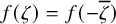 $f(\zeta ) = f(-\overline {\zeta })$
for all
$f(\zeta ) = f(-\overline {\zeta })$
for all $\zeta \in U$
such that
$\zeta \in U$
such that $-\overline {\zeta } \in U$
. If
$-\overline {\zeta } \in U$
. If $\partial _{\operatorname {\mathrm {Re}} \zeta }^2 f(0)>0$
, then the diffeomorphism
$\partial _{\operatorname {\mathrm {Re}} \zeta }^2 f(0)>0$
, then the diffeomorphism $\Phi $
from Lemma 6.7 with
$\Phi $
from Lemma 6.7 with $\Phi (0) = 0$
can be chosen such that
$\Phi (0) = 0$
can be chosen such that $D\Phi (0)$
is positive definite and diagonal. Furthermore, the exponent
$D\Phi (0)$
is positive definite and diagonal. Furthermore, the exponent $K\ge 2$
and the sign
$K\ge 2$
and the sign $\tau $
in the statement of Lemma 6.7 are
$\tau $
in the statement of Lemma 6.7 are
 $$\begin{align*}K := 1+\sup\{k \in \mathbb{N}: \partial_{\operatorname{\mathrm{Im}} \zeta}^l f(0) =0\quad \text{for all } l \le k \}\,, \qquad \tau = \begin{cases} \operatorname{\mathrm{sign}} \partial_{\operatorname{\mathrm{Im}} \zeta}^K f(0) & \text{ if } \; K< \infty\,, \\ 0 & \text{ if } \; K= \infty\,. \end{cases} \end{align*}$$
The following lemma connects the singularity types of f, $\beta $
and
$\beta $
and $\sigma $
in this case. It shows that in order to prove Theorem 2.7, it suffices to show that
$\sigma $
in this case. It shows that in order to prove Theorem 2.7, it suffices to show that $\nu $
from (7.5) can be chosen such that
$\nu $
from (7.5) can be chosen such that $f-1$
has a given singularity type of the form
$f-1$
has a given singularity type of the form $x^2 + \tau \mspace {1 mu} y^K$
with
$x^2 + \tau \mspace {1 mu} y^K$
with $\tau \in \{0,\pm 1\}$
and
$\tau \in \{0,\pm 1\}$
and $K \in \mathbb {N}$
with
$K \in \mathbb {N}$
with $K \ge 2$
at
$K \ge 2$
at $0$
.
$0$
.
Lemma 7.2. Let f be defined as in (7.5), assume that $f(\zeta ) = f(- \overline {\zeta })$
for all
$f(\zeta ) = f(- \overline {\zeta })$
for all $\zeta \in \mathbb {C}$
, that
$\zeta \in \mathbb {C}$
, that $\partial _{\operatorname {\mathrm {Re}} \zeta }^2 f(0)>0$
and that
$\partial _{\operatorname {\mathrm {Re}} \zeta }^2 f(0)>0$
and that $f(0)=1$
. Then
$f(0)=1$
. Then $0 \in \partial \mathbb {S}$
and the singularity types of
$0 \in \partial \mathbb {S}$
and the singularity types of $f-1$
and
$f-1$
and $-\beta $
agree at
$-\beta $
agree at $0$
. If
$0$
. If $0 \in \mathrm {Sing}$
and
$0 \in \mathrm {Sing}$
and $-\beta $
is of singularity type
$-\beta $
is of singularity type $x^2 + y^{2n}$
at
$x^2 + y^{2n}$
at $0$
for some
$0$
for some $n \in \mathbb {N}$
, then
$n \in \mathbb {N}$
, then $\sigma $
is also of singularity type
$\sigma $
is also of singularity type $x^2 + y^{2n}$
.
$x^2 + y^{2n}$
.
Proof. For $f(0)=1$
we have
$f(0)=1$
we have $0 \in \partial \mathbb {S}$
by definition of
$0 \in \partial \mathbb {S}$
by definition of $\mathbb {S}$
. Then (7.3) implies
$\mathbb {S}$
. Then (7.3) implies
 $$ \begin{align} { \bigg\langle \frac{1}{|a-\zeta|^4} \bigg\rangle\partial_\zeta \beta = - \partial_\zeta f\,. } \end{align} $$
Evaluating at $\zeta =0$
shows that
$\zeta =0$
shows that $\partial _\zeta \beta =0$
if and only if
$\partial _\zeta \beta =0$
if and only if $\partial _\zeta f =0$
, proving that the singularity types of
$\partial _\zeta f =0$
, proving that the singularity types of $f-1$
and
$f-1$
and $-\beta $
agree for a regular edge point
$-\beta $
agree for a regular edge point $0 \in \mathrm {Reg}$
. We now denote
$0 \in \mathrm {Reg}$
. We now denote $x=\operatorname {\mathrm {Re}} \zeta $
and
$x=\operatorname {\mathrm {Re}} \zeta $
and $y=\operatorname {\mathrm {Im}} \zeta $
and assume
$y=\operatorname {\mathrm {Im}} \zeta $
and assume $0 \in \mathrm {Sing}$
. Then f and
$0 \in \mathrm {Sing}$
. Then f and $-\beta $
satisfy the assumptions in Corollary 7.1. By applying the derivative
$-\beta $
satisfy the assumptions in Corollary 7.1. By applying the derivative $\partial _y$
repeatedly to (7.3) and evaluating at
$\partial _y$
repeatedly to (7.3) and evaluating at $\zeta =0$
, we see that the exponent K and the sign
$\zeta =0$
, we see that the exponent K and the sign $\tau $
from Corollary 7.1 for f and
$\tau $
from Corollary 7.1 for f and $-\beta $
agree.
$-\beta $
agree.
Finally, we show that the singularity types of $\sigma $
and
$\sigma $
and $-\beta $
at
$-\beta $
at $0$
agree. From (7.4) we see that
$0$
agree. From (7.4) we see that
 $$ \begin{align} { \partial_\zeta \sigma(0) =0 \,, \qquad \partial_w^2 \sigma(0)=\frac{1}{\pi}\bigg({- \partial_w^2 \beta(0)+\frac{1}{4}(\partial_w^2 \beta(0))^2}\bigg)\,, } \end{align} $$
where $w=x,y$
since
$w=x,y$
since $\beta $
is an even function of x and
$\beta $
is an even function of x and $f(0)=1$
. In particular
$f(0)=1$
. In particular $\Delta \sigma (0)>0$
and
$\Delta \sigma (0)>0$
and $\partial _x^2 \sigma (0)>0$
because
$\partial _x^2 \sigma (0)>0$
because $-\partial _x^2 \beta (0)= \partial _x^2 f(0)>0$
by (7.3). We conclude that
$-\partial _x^2 \beta (0)= \partial _x^2 f(0)>0$
by (7.3). We conclude that $\sigma $
also satisfies the assumptions of Corollary 7.1. Suppose
$\sigma $
also satisfies the assumptions of Corollary 7.1. Suppose $-\beta $
has singularity type
$-\beta $
has singularity type $x^2 + y^2$
at
$x^2 + y^2$
at $0$
, then
$0$
, then $\partial _y^2 \sigma (0)>0$
by (7.7). Now suppose
$\partial _y^2 \sigma (0)>0$
by (7.7). Now suppose $-\beta $
has singularity type
$-\beta $
has singularity type $x^2 + y^{2n}$
at
$x^2 + y^{2n}$
at $0$
for some
$0$
for some $n \ge 2$
. By repeated application of the derivative
$n \ge 2$
. By repeated application of the derivative $\partial _y$
on (7.4) and evaluating at
$\partial _y$
on (7.4) and evaluating at $\zeta =0$
we see that
$\zeta =0$
we see that
 $$\begin{align*}\partial_y^k \sigma (0) =- \frac{1}{\pi} \partial_y^k \beta (0)\,, \qquad k =3, \dots, 2n\,, \end{align*}$$
which implies that $\sigma $
is of singularity type
$\sigma $
is of singularity type $x^2 + y^{2n}$
at
$x^2 + y^{2n}$
at $0$
.
$0$
.
To construct singularity types of f at $0$
of the form
$0$
of the form $x^2 \pm y^K$
with a finite
$x^2 \pm y^K$
with a finite $K \ge 2$
, we will choose
$K \ge 2$
, we will choose $\nu $
with finite support, that is,
$\nu $
with finite support, that is, $\operatorname {\mathrm {supp}} \nu = \{a_1, \ldots , a_N \}$
with distinct nonzero
$\operatorname {\mathrm {supp}} \nu = \{a_1, \ldots , a_N \}$
with distinct nonzero $a_i \in \mathbb {C}$
and
$a_i \in \mathbb {C}$
and $\nu _i=\nu (\{a_i\})$
. In this case
$\nu _i=\nu (\{a_i\})$
. In this case
 $$ \begin{align} { f(\zeta) = \sum_{i = 1}^N \frac{\nu_i}{\lvert \zeta- a_i \rvert^2}\,. } \end{align} $$
To guarantee symmetry of f with respect to the imaginary axis we write f as a sum of functions of the form
 $$ \begin{align} g_a(\zeta) := \frac{1}{2 }\bigg({\frac{1}{\lvert \zeta+1/a \rvert^2}+\frac{1}{\lvert \zeta-1/\overline{a} \rvert^2}}\bigg)\,, \end{align} $$
with $a\in \mathbb {C}_{>}:=\{z \in \mathbb {C}: \operatorname {\mathrm {Re}} z>0, \operatorname {\mathrm {Im}} z >0\}$
a complex number in the first quadrant. For even K we can even restrict to f being a sum of functions of the form
$a\in \mathbb {C}_{>}:=\{z \in \mathbb {C}: \operatorname {\mathrm {Re}} z>0, \operatorname {\mathrm {Im}} z >0\}$
a complex number in the first quadrant. For even K we can even restrict to f being a sum of functions of the form
 $$ \begin{align} { f_a(\zeta) :=\frac{1}{2}\big({g_a(\zeta)+g_{\overline{a}}(\zeta)}\big) } \end{align} $$
with $a \in \mathbb {C}_{>}$
. With these definitions any convex combination of functions of the form
$a \in \mathbb {C}_{>}$
. With these definitions any convex combination of functions of the form $g_a$
and
$g_a$
and $f_a$
are of the form (7.8).
$f_a$
are of the form (7.8).
In the following subsections we construct an example for each singularity type that is allowed by Theorem 2.5. The result of these constructions is summarised in the following lemma.
Lemma 7.3. The following examples exist.
-
(a) Quadratic singularity types: With the choice
$\nu = \frac {1}{2}(\delta _1+\delta _{-1})$
the function
$f-1$
, where f is from (7.5), has singularity type
$x^2-y^2$
at
$0$
. The function
$f-1$
with
$f(\zeta ) :=f_a(\zeta )$
and
$a:=\frac {1}{\sqrt {2}}(1+\mathrm {i})$
has singularity type
$x^2+y^2$
at
$0$
. -
(b) Singularity types of even y-power: Let
$n \in \mathbb {N}$
with
$n \ge 2$
and
$\tau \in \{\pm 1\}$
. There are
$c_1, \dots , c_n>0$
with
$\sum _{i=1}^n c_i=1$
and distinct
$a_1, \dots , a_n \in \mathbb {C}_>$
, such that the function
$f-1$
with has singularity type
$$\begin{align*}f(\zeta):= \sum_{i=1}^n c_i f_{a_i}(\zeta) \end{align*}$$
$x^2 +\tau \mspace {1 mu}y^{2n}$
at
$0$
.
-
(c) Singularity types of odd y-power: Let
$n \in \mathbb {N}$
. There are
$c_1, \dots , c_{2n+2}>0$
with
$\sum _{i=1}^{2n+2} c_i=1$
and distinct
$a_1, \dots , a_{2n+2} \in \mathbb {C}_>$
, such that the function
$f-1$
with has singularity type
$$\begin{align*}f(\zeta):= \sum_{i=1}^{2n+2} c_i g_{a_i}(\zeta) \end{align*}$$
$x^2 +y^{2n+1}$
at
$0$
.
-
(d) Singularity types of infinite order: There is a choice
$r>0$
and
$\alpha>0$
such that for
$\nu =\frac {1}{2} \nu _{\mathrm {c}} + \frac {1}{2} \delta _{\mathrm {i} \alpha }$
, where
$\nu _{\mathrm {c}}$
is the uniform distribution on the circle
$\mathrm {i}\mspace {1 mu}\alpha + r \mspace {2 mu}S^1$
, and f from (7.5) the function
$f-1$
has singularity type
$x^2$
at
$0$
.





Lemma 7.3 (a) is easily verified by a simple calculation. The other parts of Lemma 7.3 are proven in each of the following subsections, that is, we prove Part (b) in Subsection 7.1, Part (c) in Subsection 7.2 and Part (d) in Subsection 7.3. With these ingredients we now prove our main result about the existence of all singularity types.
Proof of Theorem 2.7.
Since all examples from Lemma 7.3 have $\nu $
which is symmetric with respect to the imaginary axis, we can apply Lemma 7.2 in each of these examples. To see the existence of a singularity of the type
$\nu $
which is symmetric with respect to the imaginary axis, we can apply Lemma 7.2 in each of these examples. To see the existence of a singularity of the type $\mathrm {Sing}_{1}^{\mathrm {int}}$
, we take the example with
$\mathrm {Sing}_{1}^{\mathrm {int}}$
, we take the example with $f(\zeta ) :=f_a(\zeta )$
and
$f(\zeta ) :=f_a(\zeta )$
and $a:=\frac {1}{\sqrt {2}}(1+\mathrm {i})$
from Lemma 7.3 (a). By Lemma 7.2 the singularity type of
$a:=\frac {1}{\sqrt {2}}(1+\mathrm {i})$
from Lemma 7.3 (a). By Lemma 7.2 the singularity type of $f-1$
coincides with the singularity type of
$f-1$
coincides with the singularity type of $-\beta $
and also with the singularity type of
$-\beta $
and also with the singularity type of $\sigma $
, showing
$\sigma $
, showing $0 \in \mathrm {Sing}_{1}^{\mathrm {int}}$
. To see an example with
$0 \in \mathrm {Sing}_{1}^{\mathrm {int}}$
. To see an example with $ 0 \in \mathrm {Sing}_{k}^{\mathrm {int}}$
and order
$ 0 \in \mathrm {Sing}_{k}^{\mathrm {int}}$
and order $k \ge 2$
, we consider Lemma 7.3 (b) with
$k \ge 2$
, we consider Lemma 7.3 (b) with $\tau =+1$
. Again by Lemma 7.2 the singularity type of
$\tau =+1$
. Again by Lemma 7.2 the singularity type of $f-1$
coincides with the singularity type of
$f-1$
coincides with the singularity type of $\sigma $
.
$\sigma $
.
Now we show that $\mathrm {Sing}_{k}^{\mathrm {edge}}$
with order
$\mathrm {Sing}_{k}^{\mathrm {edge}}$
with order $k \in \mathbb {N}$
is not empty for some example. For the case
$k \in \mathbb {N}$
is not empty for some example. For the case $k=1$
the example is taken from Lemma 7.3 (a) with the choice
$k=1$
the example is taken from Lemma 7.3 (a) with the choice $\nu = \frac {1}{2}(\delta _1+\delta _{-1})$
, for odd
$\nu = \frac {1}{2}(\delta _1+\delta _{-1})$
, for odd $k>1$
from Lemma 7.3 (b) with
$k>1$
from Lemma 7.3 (b) with $\tau =-1$
and for even
$\tau =-1$
and for even $k>1$
from Lemma 7.3 (c). In each case the singularity types of
$k>1$
from Lemma 7.3 (c). In each case the singularity types of $f-1$
and
$f-1$
and $-\beta $
at
$-\beta $
at $0$
coincide due to Lemma 7.2.
$0$
coincide due to Lemma 7.2.
Finally $0 \in \mathrm {Sing}_{\infty }^{\mathrm {int}}$
for the example from Lemma 7.3 (d) since here the singularity types of
$0 \in \mathrm {Sing}_{\infty }^{\mathrm {int}}$
for the example from Lemma 7.3 (d) since here the singularity types of $f-1$
and
$f-1$
and $\sigma $
coincide by Lemma 7.2.
$\sigma $
coincide by Lemma 7.2.
7.1 Singularity types of even y-power
Here we prove Lemma 7.3 (b). Since $f_{c\mspace {1 mu} a}(0) = c^2 f_{a}(0)$
for
$f_{c\mspace {1 mu} a}(0) = c^2 f_{a}(0)$
for $f_{a}$
defined as in (7.10) and
$f_{a}$
defined as in (7.10) and $c>0$
, it suffices to show that
$c>0$
, it suffices to show that $f-f(0)$
has singularity type
$f-f(0)$
has singularity type $x^2+\tau \mspace {1 mu} y^{2n}$
at
$x^2+\tau \mspace {1 mu} y^{2n}$
at $0$
, that is, we can drop the condition
$0$
, that is, we can drop the condition $f(0)=1$
. Furthermore, we can consider f of the form
$f(0)=1$
. Furthermore, we can consider f of the form
 $$\begin{align*}f (\zeta):= \sum_{i=1}^n c_i \frac{\operatorname{\mathrm{Re}} a_i}{|a_i|^2}f_{a_i}(\zeta)\,, \end{align*}$$
with $a_i \in \mathbb {C}_{>}$
,
$a_i \in \mathbb {C}_{>}$
, $c_i>0$
and show that this f has singularity type
$c_i>0$
and show that this f has singularity type $x^2 + \tau \mspace {1 mu}y^{2n}$
at
$x^2 + \tau \mspace {1 mu}y^{2n}$
at $0$
. This is sufficient since such f can be transformed into a convex combination of the
$0$
. This is sufficient since such f can be transformed into a convex combination of the $f_{a_i}$
by dividing by
$f_{a_i}$
by dividing by $\sum _{i=1}^n c_i \frac {\operatorname {\mathrm {Re}} a_i}{|a_i|^2}$
and without changing the singularity type. Properties of the function
$\sum _{i=1}^n c_i \frac {\operatorname {\mathrm {Re}} a_i}{|a_i|^2}$
and without changing the singularity type. Properties of the function $f_a$
are summarised in Lemma C.3. The symmetries of
$f_a$
are summarised in Lemma C.3. The symmetries of $f_a$
(see (C.2)) in particular imply that its Hessian at
$f_a$
(see (C.2)) in particular imply that its Hessian at $\zeta =0$
is diagonal. Furthermore, f satisfies
$\zeta =0$
is diagonal. Furthermore, f satisfies $\partial _y^{2k+1} f (0) =0$
for all
$\partial _y^{2k+1} f (0) =0$
for all $k \in \mathbb {N}_0$
due to (C.1), where
$k \in \mathbb {N}_0$
due to (C.1), where $\zeta =x+\mathrm {i} \mspace {1 mu}y$
. It remains to show that
$\zeta =x+\mathrm {i} \mspace {1 mu}y$
. It remains to show that $a_i$
and
$a_i$
and $c_i$
can be chosen such that
$c_i$
can be chosen such that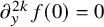 $\partial _y^{2k}f(0)=0$
for all
$\partial _y^{2k}f(0)=0$
for all $k=1, \dots , n-1$
and
$k=1, \dots , n-1$
and $\operatorname {\mathrm {sign}} \partial _y^{2n}f(0)=\tau $
for a given
$\operatorname {\mathrm {sign}} \partial _y^{2n}f(0)=\tau $
for a given $\tau \in \{\pm 1\}$
. Together with the symmetry of
$\tau \in \{\pm 1\}$
. Together with the symmetry of $f(\zeta ) = f(-\overline {\zeta })$
around the imaginary axis and since
$f(\zeta ) = f(-\overline {\zeta })$
around the imaginary axis and since $\Delta f(0)>0$
this is enough to guarantee the local behaviour because of Corollary 7.1. By the formula (C.1) for
$\Delta f(0)>0$
this is enough to guarantee the local behaviour because of Corollary 7.1. By the formula (C.1) for $\partial _y^{2k}f_a(0)$
the choices
$\partial _y^{2k}f_a(0)$
the choices $a_i$
and
$a_i$
and $c_i$
defining f have to be made such that
$c_i$
defining f have to be made such that
 $$\begin{align*}\operatorname{\mathrm{sign}} \bigg({(-1)^n\operatorname{\mathrm{Re}} \sum_{i=1}^n c_i a_i^{2n+1}}\bigg) =\tau\,, \qquad \operatorname{\mathrm{Re}}\sum_{i=1}^n c_i a_i^{2k+1} =0 \,, \qquad k=1, \dots, n-1\,. \end{align*}$$
That such a choice exists is ensured by the following lemma, where we replaced $\tau $
by
$\tau $
by $(-1)^n\tau $
to avoid tracking the additional sign.
$(-1)^n\tau $
to avoid tracking the additional sign.
Lemma 7.4 (Discrete truncated moment problem for even case).
For each $n \in \mathbb {N}$
and
$n \in \mathbb {N}$
and $\tau \in \{\pm 1\}$
there are positive numbers
$\tau \in \{\pm 1\}$
there are positive numbers $c_1, \dots , c_n>0$
and distinct complex numbers
$c_1, \dots , c_n>0$
and distinct complex numbers $z_1, \dots , z_n \in \mathbb {C}_{>}$
such that
$z_1, \dots , z_n \in \mathbb {C}_{>}$
such that
 $$\begin{align*}\operatorname{\mathrm{Re}} \sum_{i=1}^n c_i z_i^{2n+1} = \tau\,, \qquad \operatorname{\mathrm{Re}} \sum_{i=1}^n c_i z_i^{2k+1} =0 \,, \qquad \text{ for all } \; k=1, \dots, n-1\,. \end{align*}$$
Proof. We perform the proof by induction over n. For $n=1$
we choose
$n=1$
we choose $z_1 \in \mathbb {C}$
with
$z_1 \in \mathbb {C}$
with $\operatorname {\mathrm {Im}} z_1>0$
,
$\operatorname {\mathrm {Im}} z_1>0$
, $\operatorname {\mathrm {Re}} z_1>0$
and
$\operatorname {\mathrm {Re}} z_1>0$
and $ \operatorname {\mathrm {Re}} z_1^3 =\tau $
. Then we set
$ \operatorname {\mathrm {Re}} z_1^3 =\tau $
. Then we set $c_1:=1$
. Now suppose for
$c_1:=1$
. Now suppose for $n\in \mathbb {N}$
with
$n\in \mathbb {N}$
with $n \ge 2$
we have positive numbers
$n \ge 2$
we have positive numbers $c_1, \ldots , c_n \in (0,\infty )$
and distinct complex numbers
$c_1, \ldots , c_n \in (0,\infty )$
and distinct complex numbers $\widehat {z}_1, \ldots , \widehat {z}_{n-1} \in \mathbb {C}_{>}$
such that
$\widehat {z}_1, \ldots , \widehat {z}_{n-1} \in \mathbb {C}_{>}$
such that
 $$ \begin{align} { \operatorname{\mathrm{Re}} \sum_{i=1}^{n-1} {c}_i \widehat{z}_i^{2n-1} = \pm 1\,, \qquad \operatorname{\mathrm{Re}} \sum_{i=1}^{n-1} {c}_i \widehat{z}_i^{2k+1} =0 \,, \qquad k=1, \dots, n-2\,. } \end{align} $$
The construction works for either choice of sign in the induction hypothesis. We will cover both choices simultaneously. Since we can always normalise the coefficients, it suffices to show that there are $c_n>0$
and
$c_n>0$
and $z_i \in \mathbb {C}_{>}$
in the first quadrant such that
$z_i \in \mathbb {C}_{>}$
in the first quadrant such that
 $$ \begin{align} { \operatorname{\mathrm{sign}} \operatorname{\mathrm{Re}} \sum_{i=1}^n c_i z_i^{2n+1} = \tau\,, \qquad \operatorname{\mathrm{Re}} \sum_{i=1}^n c_i z_i^{2k+1} =0 \,, \qquad k=1, \dots, n-1\,. } \end{align} $$
To see that this is possible we pick $\omega \in \mathbb {C}$
with
$\omega \in \mathbb {C}$
with $\lvert \omega \rvert =1$
,
$\lvert \omega \rvert =1$
, $\operatorname {\mathrm {Re}} \omega>0$
and
$\operatorname {\mathrm {Re}} \omega>0$
and $\operatorname {\mathrm {Im}} \omega>0$
such that
$\operatorname {\mathrm {Im}} \omega>0$
such that $\operatorname {\mathrm {sign}} \operatorname {\mathrm {Re}} \omega ^{2n-1} =\mp 1 $
and
$\operatorname {\mathrm {sign}} \operatorname {\mathrm {Re}} \omega ^{2n-1} =\mp 1 $
and $\operatorname {\mathrm {sign}} \operatorname {\mathrm {Re}} \omega ^{2n+1} =\tau $
. Then we set
$\operatorname {\mathrm {sign}} \operatorname {\mathrm {Re}} \omega ^{2n+1} =\tau $
. Then we set
 $$\begin{align*}z_n(r) := \frac{ \omega}{r}\,, \qquad c_n(r):=\frac{r^{2n -1}}{ \lvert \operatorname{\mathrm{Re}} \omega^{2n-1} \rvert} \end{align*}$$
for $r>0$
, as well as
$r>0$
, as well as
 $$\begin{align*}F_k(w):= \sum_{i=1}^{n-1} c_i w_i^{2k+1} \,, \qquad G_k(w,r):= F_k(w)+r^{2n-2k-2}\frac{\omega^{2k+1}}{\lvert \operatorname{\mathrm{Re}} \omega^{2n-1} \rvert} \end{align*}$$
for $w=(w_1, \dots , w_{n-1})$
,
$w=(w_1, \dots , w_{n-1})$
,  and
and $r\ge 0$
. In particular,
$r\ge 0$
. In particular, $G_k(w,r):= F_k(w)+ c_n(r)z_n(r)^{2k+1}$
for
$G_k(w,r):= F_k(w)+ c_n(r)z_n(r)^{2k+1}$
for $r>0$
. For small enough
$r>0$
. For small enough $r>0$
we now solve the system
$r>0$
we now solve the system

for $w=z(r)$
. Since
$w=z(r)$
. Since $\partial _{w_i} G_k(w) = \partial _{w_i} F_k(w)$
this system is locally uniquely solvable by the implicit function theorem due to
$\partial _{w_i} G_k(w) = \partial _{w_i} F_k(w)$
this system is locally uniquely solvable by the implicit function theorem due to
 $$\begin{align*}\det (\partial_{w_i} F_k(w))_{i,k=1}^{n-1}= \det( (2k+1)c_i w_i^{2k})_{i,k=1}^{n-1} = \prod_{k=1}^{n-1}(2k+1) \prod_{i=1}^{n-1}c_i w_i^2 \prod_{i<j}(w_j^2-w_i^2), \end{align*}$$
which does not vanish for $w=\widehat {z}$
, because by assumption the
$w=\widehat {z}$
, because by assumption the $\widehat {z}_i$
are distinct. With
$\widehat {z}_i$
are distinct. With $z_i =z_i(r)$
the system of equations (7.12) is now satisfied. Indeed,
$z_i =z_i(r)$
the system of equations (7.12) is now satisfied. Indeed, $\operatorname {\mathrm {Re}} G_k(w,r) = \operatorname {\mathrm {Re}} F_k(\widehat {z},0)=0$
for
$\operatorname {\mathrm {Re}} G_k(w,r) = \operatorname {\mathrm {Re}} F_k(\widehat {z},0)=0$
for  by (7.11), as well as $\operatorname {\mathrm {Re}} G_{n-1}(w,r) = \operatorname {\mathrm {Re}} G_{n-1}(\widehat {z},0)=0$
by (7.11) and the choice of the sign of
$\operatorname {\mathrm {Re}} G_{n-1}(w,r) = \operatorname {\mathrm {Re}} G_{n-1}(\widehat {z},0)=0$
by (7.11) and the choice of the sign of $\operatorname {\mathrm {Re}} \omega ^{2n-1}$
. Finally
$\operatorname {\mathrm {Re}} \omega ^{2n-1}$
. Finally
 $$\begin{align*}\operatorname{\mathrm{sign}} \operatorname{\mathrm{Re}} \sum_{i=1}^{n} c_i z_i(r)^{2n+1} = \operatorname{\mathrm{sign}} \operatorname{\mathrm{Re}} \bigg({O(1) + \frac{1}{r^2}\frac{\operatorname{\mathrm{Re}} \omega^{2n+1}}{\lvert \operatorname{\mathrm{Re}} \omega^{2n-1} \rvert} }\bigg) =\tau \end{align*}$$
by the choice of the sign of $\operatorname {\mathrm {Re}} \omega ^{2n+1}$
and for sufficiently small
$\operatorname {\mathrm {Re}} \omega ^{2n+1}$
and for sufficiently small $r>0$
. For small
$r>0$
. For small $r>0$
the
$r>0$
the $z_i(r)$
with
$z_i(r)$
with  are also distinct.
7.2 Singularity types of odd y-power
Now we prove prove Lemma 7.3 (c). As in the treatment of singularity types of even order, it suffices to show that $f-f(0)$
with f of the form
$f-f(0)$
with f of the form
 $$ \begin{align} { f(\zeta) := \sum_{i=1}^{2n+2} c_i \frac{\operatorname{\mathrm{Re}} a_i}{|a_i|^2} g_{a_i}(\zeta) + \frac{1}{\lvert \zeta+ \mathrm{i} \rvert^2} } \end{align} $$
where $a_1, \dots , a_{2n+2} \in \mathbb {C}_{>}$
and
$a_1, \dots , a_{2n+2} \in \mathbb {C}_{>}$
and $c_1, \dots , c_{2n+2}>0$
has singularity type
$c_1, \dots , c_{2n+2}>0$
has singularity type $x^2 -y^{2n+1}$
at
$x^2 -y^{2n+1}$
at $0$
. The function
$0$
. The function $g_a$
is defined in (7.9) and its properties are summarised in Lemma C.3.
$g_a$
is defined in (7.9) and its properties are summarised in Lemma C.3.
To construct such singularity type we choose f such that it satisfies
 $$ \begin{align} { \partial_y^{2n+1} f(0) < 0\,, \qquad \partial_y^{k} f(0) = 0\,, \qquad k=1, \dots, 2n } \end{align} $$
and apply Corollary 7.1. The symmetry $f(\zeta ) = f(-\overline {\zeta })$
follows from our ansatz (7.13) and
$f(\zeta ) = f(-\overline {\zeta })$
follows from our ansatz (7.13) and $\Delta f(0)>0$
because
$\Delta f(0)>0$
because $\Delta g_a(0) = 4 \lvert a \rvert ^4 $
by Lemma C.3 and
$\Delta g_a(0) = 4 \lvert a \rvert ^4 $
by Lemma C.3 and $\Delta \lvert z+\mathrm {i} \rvert ^{-2}|_{z = 0} = 4$
. With
$\Delta \lvert z+\mathrm {i} \rvert ^{-2}|_{z = 0} = 4$
. With
 $$\begin{align*}\partial_y^{2k-1} \frac{1}{\lvert z+ \mathrm{i} \rvert^2}\bigg|_{z=0}=- (2k)!\,, \qquad \partial_y^{2k} \frac{1}{\lvert z+ \mathrm{i} \rvert^2}\bigg|_{z=0}= (2k+1)!\,, \end{align*}$$
as well as the formulas for the derivatives of $g_a$
from (C.3) the conditions (7.14) on our ansatz (7.13) translate to
$g_a$
from (C.3) the conditions (7.14) on our ansatz (7.13) translate to
 $$\begin{align*}(-1)^{n}\operatorname{\mathrm{Im}} \sum_{i=1}^n c_i a_i^{2(n+1)} < 2(n +1)\,, \quad(-1)^{k+1}\operatorname{\mathrm{Im}} \sum_{i=1}^n c_i a_i^{2k} = 2\mspace{1 mu}k \,, \quad(-1)^{k+1} \operatorname{\mathrm{Re}} \sum_{i=1}^n c_i a_i^{2k+1} =2k+1 \end{align*}$$
for all  . Such a choice of $c_i$
and
$c_i$
and $a_i$
exists due to the following lemma.
$a_i$
exists due to the following lemma.
Lemma 7.5 (Discrete truncated moment problem for odd case).
For each $n \in \mathbb {N}$
there are positive numbers
$n \in \mathbb {N}$
there are positive numbers $c_1, \dots , c_{2n+2}>0$
and distinct complex numbers
$c_1, \dots , c_{2n+2}>0$
and distinct complex numbers $z_1, \dots , z_{2n+2} \in \mathbb {C}_{>}$
such that
$z_1, \dots , z_{2n+2} \in \mathbb {C}_{>}$
such that
 $$ \begin{align} { (-1)^{k+1}\operatorname{\mathrm{Im}} \sum_{i=1}^{2n+2} c_i z_i^{2k} = 2\mspace{1 mu}k \,, \qquad(-1)^{k+1} \operatorname{\mathrm{Re}} \sum_{i=1}^{2n+2} c_i z_i^{2k+1} =2k+1 \,, \qquad k=1, \dots, n\,, } \end{align} $$
as well as
 $$ \begin{align} { (-1)^{n}\operatorname{\mathrm{Im}} \sum_{i=1}^{2n+2} c_i z_i^{2(n+1)} < 2(n +1)\,. } \end{align} $$
Proof. We perform an induction over n. For the case $n=1$
we first find
$n=1$
we first find $z \in \mathbb {C}_{>}$
and
$z \in \mathbb {C}_{>}$
and $c>0$
such that
$c>0$
such that
 $$\begin{align*}c\mspace{1 mu} \operatorname{\mathrm{Im}} z^2 = 2\,, \qquad c\mspace{1 mu}\operatorname{\mathrm{Re}} z^3 = 3\,, \qquad -c\mspace{1 mu} \operatorname{\mathrm{Im}} z^4 < 4\,. \end{align*}$$
The choice $z = \frac {3}{4}\sqrt {2} \mathrm {e}^{\mathrm {i} \pi /12}$
and
$z = \frac {3}{4}\sqrt {2} \mathrm {e}^{\mathrm {i} \pi /12}$
and $c = \frac {32}{9}$
satisfies these conditions. Now we set
$c = \frac {32}{9}$
satisfies these conditions. Now we set $c_1:=c$
and fix three additional complex numbers
$c_1:=c$
and fix three additional complex numbers $z_2,z_3,z_4 \in \mathbb {C}_{>}$
in the first quadrant that are all distinct and distinct from
$z_2,z_3,z_4 \in \mathbb {C}_{>}$
in the first quadrant that are all distinct and distinct from $z_1$
. We also set
$z_1$
. We also set $c_i:=\delta $
for
$c_i:=\delta $
for $i=2,3,4$
, where
$i=2,3,4$
, where $\delta>0$
is chosen sufficiently small. Then the relations
$\delta>0$
is chosen sufficiently small. Then the relations
 $$\begin{align*}\operatorname{\mathrm{Im}} \sum_{i=1}^{4} c_iz_i^{2} = 2 \,, \qquad \operatorname{\mathrm{Re}} \sum_{i=1}^{4} c_iz_i^{3} =3 \,, \qquad -\operatorname{\mathrm{Im}} \sum_{i=1}^{4}c_i z_i^{4} <4 \end{align*}$$
with $z_1=z_1(\delta )$
are satisfied for
$z_1=z_1(\delta )$
are satisfied for $\delta =0$
with
$\delta =0$
with $z_1(0)=z$
and by the implicit function theorem can also be satisfied for small
$z_1(0)=z$
and by the implicit function theorem can also be satisfied for small $\delta>0$
. In fact the two identities have the form
$\delta>0$
. In fact the two identities have the form $c\operatorname {\mathrm {Im}} z_1^2 =2 +O(\delta )$
and
$c\operatorname {\mathrm {Im}} z_1^2 =2 +O(\delta )$
and $c\operatorname {\mathrm {Re}} z_1^3 =3 +O(\delta )$
and the map
$c\operatorname {\mathrm {Re}} z_1^3 =3 +O(\delta )$
and the map $z \mapsto (\operatorname {\mathrm {Im}} z^2, \operatorname {\mathrm {Re}} z^3)=(2xy, x^3 - xy^2)$
with
$z \mapsto (\operatorname {\mathrm {Im}} z^2, \operatorname {\mathrm {Re}} z^3)=(2xy, x^3 - xy^2)$
with $z=x +\mathrm {i}\mspace {1 mu} y$
has the nonvanishing Jacobian
$z=x +\mathrm {i}\mspace {1 mu} y$
has the nonvanishing Jacobian
 $$\begin{align*}\det \begin{pmatrix} 2y & 2x \\ 3x^2 - 3y^2 & - 6xy\end{pmatrix} = -6x(x^2 + y^2) \,. \end{align*}$$
For the induction step we assume that $c_1, \ldots , c_{2n}>0$
and
$c_1, \ldots , c_{2n}>0$
and $\widehat {z}_1, \ldots , \widehat {z}_{2n} \in \mathbb {C}_{>}$
are given such that
$\widehat {z}_1, \ldots , \widehat {z}_{2n} \in \mathbb {C}_{>}$
are given such that
 $$ \begin{align} { (-1)^{k+1}\operatorname{\mathrm{Im}} \sum_{i=1}^{2n}c_i\mspace{1 mu}\widehat{z}_i^{2k} =2 k\,, \quad (-1)^{k+1}\operatorname{\mathrm{Re}} \sum_{i=1}^{2n}c_i\mspace{1 mu}\widehat{z}_i^{2k+1} = 2k+1\,, \quad (-1)^{n-1}\operatorname{\mathrm{Im}} \sum_{i=1}^{2n}c_i \widehat{z}_i^{2n}<2n } \end{align} $$
for all $k= 2, \dots , n-1$
. With the short hand notation
$k= 2, \dots , n-1$
. With the short hand notation $w=(w_1, \dots , w_{2n})$
we define
$w=(w_1, \dots , w_{2n})$
we define
 $$\begin{align*}F_k(w):= \sum_{i=1}^{2n} c_i w_i^{k} \,,\qquad k=2, \dots, 2n+2\,. \end{align*}$$
We now construct an additional $c_{2n+1}(r)= \alpha (r)\mspace {1 mu} r^{2n}>0$
and
$c_{2n+1}(r)= \alpha (r)\mspace {1 mu} r^{2n}>0$
and $z_{2n+1}(r) = \frac {1}{r} \mathrm {e}^{\mathrm {i} \varphi (r)}$
with functions
$z_{2n+1}(r) = \frac {1}{r} \mathrm {e}^{\mathrm {i} \varphi (r)}$
with functions $\varphi =\varphi (r) \in (0,\pi /2)$
and
$\varphi =\varphi (r) \in (0,\pi /2)$
and $\alpha =\alpha (r)>0$
for
$\alpha =\alpha (r)>0$
for $r>0$
that we choose appropriately such that
$r>0$
that we choose appropriately such that
 $$ \begin{align} { {(-1)^{n+1}\big({\operatorname{\mathrm{Im}} F_{2n}(\widehat{z}) + \alpha\mspace{1 mu} \sin(2n\mspace{1 mu}\varphi)}\big)}\!=\!2 n\,, \quad {(-1)^{n+1}\Big({\operatorname{\mathrm{Re}} F_{2n+1}(\widehat{z}) + \frac{\alpha}{r} \cos((2n+1)\varphi)}\Big)}\!=\!2 n+1 \,, } \end{align} $$
as well as
 $$ \begin{align} { {(-1)^{n}\Big({\operatorname{\mathrm{Im}} F_{2n+2}(\widehat{z}) + \frac{\alpha}{r^2} \sin((2n+2)\mspace{1 mu}\varphi)}\Big)}<2 n+1 } \end{align} $$
are satisfied for sufficiently small $r>0$
. To do so we define
$r>0$
. To do so we define $\varphi _\ast :=\frac {\pi }{2} - \frac {1}{2n+1}\pi $
. Then
$\varphi _\ast :=\frac {\pi }{2} - \frac {1}{2n+1}\pi $
. Then $\cos ((2n+1)\varphi _*)=0 $
and
$\cos ((2n+1)\varphi _*)=0 $
and $\sin (2n \varphi _*) =\sin ((2n+2) \varphi _*)$
because
$\sin (2n \varphi _*) =\sin ((2n+2) \varphi _*)$
because $2n \varphi _* + (2n+2) \varphi _* = \pi (2n-1) $
is an odd multiple of
$2n \varphi _* + (2n+2) \varphi _* = \pi (2n-1) $
is an odd multiple of $\pi $
. Furthermore, we have the inequality
$\pi $
. Furthermore, we have the inequality $(-1)^{n+1}\sin (2n \varphi _*)=\sin \big ({ \frac {2n}{2n+1}\pi }\big )>0$
. Now let
$(-1)^{n+1}\sin (2n \varphi _*)=\sin \big ({ \frac {2n}{2n+1}\pi }\big )>0$
. Now let
 $$\begin{align*}\sigma:= \operatorname{\mathrm{sign}} \big({(-1)^{n+1}{\operatorname{\mathrm{Re}} F_{2n+1}(\widehat{z}) }-(2 n+1)}\big)\,. \end{align*}$$
We set $\varphi (r):= \varphi _\ast + \sigma \mspace {1 mu} \beta (r)\mspace {1 mu} r$
for some appropriately chosen
$\varphi (r):= \varphi _\ast + \sigma \mspace {1 mu} \beta (r)\mspace {1 mu} r$
for some appropriately chosen $\beta (r)>0$
that is bounded and bounded away from zero. In particular, we have the expansion
$\beta (r)>0$
that is bounded and bounded away from zero. In particular, we have the expansion $(-1)^{n+1}\cos ((2n+1)\varphi (r)) =- \sigma (2n+1) r + O(r^2)$
. The identities (7.18) become
$(-1)^{n+1}\cos ((2n+1)\varphi (r)) =- \sigma (2n+1) r + O(r^2)$
. The identities (7.18) become
 $$ \begin{align} { \alpha(r)= \frac{2n - (-1)^{n-1}\operatorname{\mathrm{Im}} F_{2n}(\widehat{z}) }{(-1)^{n+1}\sin(2n\mspace{1 mu}\varphi(r))} } \end{align} $$
and
 $$ \begin{align} { (-1)^{n+1}\operatorname{\mathrm{Re}} F_{2n+1}(\widehat{z})-(2 n+1) - \sigma (2n+1) \beta(r) \alpha(r)= \begin{cases} 0 & \text{ if } \sigma=0\,, \\ O(r)& \text{ if } \sigma \ne 0\,. \end{cases} } \end{align} $$
For $\sigma =0$
there is no need to choose
$\sigma =0$
there is no need to choose $\beta $
since
$\beta $
since $\varphi (r)= \varphi _*$
and we set
$\varphi (r)= \varphi _*$
and we set $\alpha (r):= \alpha _*>0$
, satisfying
$\alpha (r):= \alpha _*>0$
, satisfying
 $$ \begin{align} { \alpha_*= \frac{2n - (-1)^{n-1}\operatorname{\mathrm{Im}} F_{2n}(\widehat{z}) }{(-1)^{n+1}\sin(2n\mspace{1 mu}\varphi_*)}\,, } \end{align} $$
in this case. That $\alpha _*$
is positive follows from the choice of
$\alpha _*$
is positive follows from the choice of $\varphi _*$
and (7.17). For
$\varphi _*$
and (7.17). For $\sigma \ne 0$
we solve the system (7.20) and (7.21). By the definition of
$\sigma \ne 0$
we solve the system (7.20) and (7.21). By the definition of $\sigma $
,
$\sigma $
, $\varphi _*$
and (7.17) there is a solution
$\varphi _*$
and (7.17) there is a solution $\alpha (0) = \alpha _*>0$
and
$\alpha (0) = \alpha _*>0$
and $\beta (0) = \beta _*>0$
for
$\beta (0) = \beta _*>0$
for $r=0$
. In fact,
$r=0$
. In fact, $\alpha _*$
is determined by (7.22) and
$\alpha _*$
is determined by (7.22) and $\beta _*$
then by evaluating (7.21) on
$\beta _*$
then by evaluating (7.21) on $r=0$
. By the implicit function theorem this solution can be extended to sufficiently small
$r=0$
. By the implicit function theorem this solution can be extended to sufficiently small $r>0$
. Thus, (7.18) is satisfied for our choice of
$r>0$
. Thus, (7.18) is satisfied for our choice of $\alpha (r)$
and
$\alpha (r)$
and $\varphi (r)$
. Since
$\varphi (r)$
. Since $\alpha (0)=\alpha _*>0$
and
$\alpha (0)=\alpha _*>0$
and $(-1)^n\sin ((2n+2)\varphi (0)) = (-1)^n\sin (2n\varphi _*)<0$
, by the choice of
$(-1)^n\sin ((2n+2)\varphi (0)) = (-1)^n\sin (2n\varphi _*)<0$
, by the choice of $\varphi _*$
, the inequality (7.19) is also satisfied for sufficiently small
$\varphi _*$
, the inequality (7.19) is also satisfied for sufficiently small $r>0$
.
$r>0$
.
Now we define
 $$\begin{align*}G_k(w,r):= F_k(w) +c_{2n+1}(r) z_{2n+1}(r)^k\,,\qquad k=2, \dots, 2n+2 \end{align*}$$
for sufficiently small $r>0$
. By the choices of the functions
$r>0$
. By the choices of the functions $\varphi $
and
$\varphi $
and $\alpha $
above, we can analytically extend
$\alpha $
above, we can analytically extend $G_k(w,r)$
to a neighbourhood of
$G_k(w,r)$
to a neighbourhood of $r=0$
for
$r=0$
for $k =2, \dots , 2n+1$
. By construction we have
$k =2, \dots , 2n+1$
. By construction we have
 $$\begin{align*}(-1)^{n+1}\operatorname{\mathrm{Im}} G_{2n}(\widehat{z},r) =2n \,, \qquad (-1)^{n+1}\operatorname{\mathrm{Re}} G_{2n+1}(\widehat{z},r) = 2n+1\,, \qquad (-1)^n\operatorname{\mathrm{Im}} G_{2n+2}(\widehat{z},r)< 2n+1 \end{align*}$$
and $G_{k+1}(w,0)= F_{k+1}(w)$
for
$G_{k+1}(w,0)= F_{k+1}(w)$
for  . Now we solve the system of equations $G_{k+1}({z}(r),r)= F_{k+1}(\widehat {z})$
for
$G_{k+1}({z}(r),r)= F_{k+1}(\widehat {z})$
for  together with $G_{2n}({z}(r),r)= G_{2n}(\widehat {z},0)$
and
$G_{2n}({z}(r),r)= G_{2n}(\widehat {z},0)$
and $G_{2n+1}({z}(r),r)= G_{2n+1}(\widehat {z},0)$
for a solution
$G_{2n+1}({z}(r),r)= G_{2n+1}(\widehat {z},0)$
for a solution ${z}=({z}_1, \dots , {z}_{2n})$
with
${z}=({z}_1, \dots , {z}_{2n})$
with ${z}(0)=\widehat {z}$
. This is possible in a neighbourhood of
${z}(0)=\widehat {z}$
. This is possible in a neighbourhood of $r=0$
by the implicit function theorem since
$r=0$
by the implicit function theorem since
 $$ \begin{align} { \det (\partial_{w_i} F_{k+1}(w))_{i,k=1}^{2n}= \det( (k+1)c_i w_i^{k})_{i,k=1}^{2n} = \prod_{k=1}^{2n}(k+1) \prod_{i=1}^{2n}c_i w_i \prod_{i<j}(w_j-w_i)\,, } \end{align} $$
which does not vanish when evaluated at $w = \widehat {z}$
.
$w = \widehat {z}$
.
Altogether we have found distinct ${z}_1, \dots , z_{2n+1} \in \mathbb {C}_{>}$
and
${z}_1, \dots , z_{2n+1} \in \mathbb {C}_{>}$
and $c_{2n+1}>0$
such that (7.15) and (7.16) are satisfied with
$c_{2n+1}>0$
such that (7.15) and (7.16) are satisfied with $c_{2n+2}=0$
. Finally we add
$c_{2n+2}=0$
. Finally we add $z_{2n+2} \in \mathbb {C}_{>}$
distinct from all
$z_{2n+2} \in \mathbb {C}_{>}$
distinct from all ${z}_1, \dots , z_{2n+1}$
. We set
${z}_1, \dots , z_{2n+1}$
. We set $z_*:=({z}_1, \dots , z_{2n})$
and
$z_*:=({z}_1, \dots , z_{2n})$
and $c_{2n+2}=\delta $
and find a choice
$c_{2n+2}=\delta $
and find a choice $z(\delta ) \in \mathbb {C}_{>}^{2n}$
for
$z(\delta ) \in \mathbb {C}_{>}^{2n}$
for $\delta \ge 0$
with
$\delta \ge 0$
with $z(0)= z_*$
such that this choice also satisfies (7.15) and (7.16). The choice of
$z(0)= z_*$
such that this choice also satisfies (7.15) and (7.16). The choice of $c_{2n+1} $
and
$c_{2n+1} $
and $z_{2n +1}$
remains independent of
$z_{2n +1}$
remains independent of $\delta $
. That such choice exists follows again from (7.23) and the implicit function theorem.
$\delta $
. That such choice exists follows again from (7.23) and the implicit function theorem.
7.3 Singularity types of infinite order
In this subsection we prove Lemma 7.3 (d). As before it suffices to show that $f-f(0)$
is of singularity type
$f-f(0)$
is of singularity type $x^2$
, that is, we drop the condition
$x^2$
, that is, we drop the condition $f(0)=1$
. Furthermore, by shifting
$f(0)=1$
. Furthermore, by shifting $\nu $
we can place the singularity at
$\nu $
we can place the singularity at $\mathrm {i} \in \mathrm {Sing}_\infty ^{\mathrm {int}}$
. We follow Example 3.5 and choose a as in that example. A short computation using (7.2) reveals that
$\mathrm {i} \in \mathrm {Sing}_\infty ^{\mathrm {int}}$
. We follow Example 3.5 and choose a as in that example. A short computation using (7.2) reveals that $\mathbb {S}$
satisfies (3.2). Thus, since
$\mathbb {S}$
satisfies (3.2). Thus, since $\partial \mathbb {D}_1 \cap \mathbb {S} = \emptyset $
while points on both sides of
$\partial \mathbb {D}_1 \cap \mathbb {S} = \emptyset $
while points on both sides of $\partial \mathbb {D}_1$
belong to
$\partial \mathbb {D}_1$
belong to $\mathbb {S}$
, we conclude from the analyticity of
$\mathbb {S}$
, we conclude from the analyticity of $\beta $
that
$\beta $
that $\partial _\zeta \beta (\zeta ) = \partial _{\bar \zeta } \beta (\zeta ) = 0$
for all
$\partial _\zeta \beta (\zeta ) = \partial _{\bar \zeta } \beta (\zeta ) = 0$
for all $\zeta \in \partial \mathbb {D}_1$
. Hence,
$\zeta \in \partial \mathbb {D}_1$
. Hence, $\partial \mathbb {D}_1 \subset \mathrm {Sing}_\infty ^{\mathrm {int}}$
. Furthermore, using (4.4) and (6.15), we find that
$\partial \mathbb {D}_1 \subset \mathrm {Sing}_\infty ^{\mathrm {int}}$
. Furthermore, using (4.4) and (6.15), we find that $\sigma $
is given by (3.3) in this example. We refer to Example 3.5 for more explanations and to Figure 3 for a plot of the boundary of
$\sigma $
is given by (3.3) in this example. We refer to Example 3.5 for more explanations and to Figure 3 for a plot of the boundary of $\mathbb {S}$
and some sampled eigenvalues.
$\mathbb {S}$
and some sampled eigenvalues.
8 Circular element with general deformation
In this section, we consider the Brown measure $\sigma $
of
$\sigma $
of $a + \mathfrak c$
, where
$a + \mathfrak c$
, where $\mathfrak c$
is a standard circular element and a is a general operator in a tracial von Neumann algebra that is
$\mathfrak c$
is a standard circular element and a is a general operator in a tracial von Neumann algebra that is $\ast $
-free from
$\ast $
-free from $\mathfrak c$
. We prove the classification of singular points stated in Remark 2.8. Here we use the notation
$\mathfrak c$
. We prove the classification of singular points stated in Remark 2.8. Here we use the notation $|x|$
and
$|x|$
and $|x|_*$
for the positive semidefinite self-adjoint elements defined by
$|x|_*$
for the positive semidefinite self-adjoint elements defined by $|x|^2 =xx^*$
and
$|x|^2 =xx^*$
and $|x|_*^2 = x^*x$
, where x is a general operator. The Brown measure in this setup has a density which satisfies the identity
$|x|_*^2 = x^*x$
, where x is a general operator. The Brown measure in this setup has a density which satisfies the identity
 $$ \begin{align} { \pi\mspace{2 mu}\sigma(\zeta)=\bigg\langle \frac{1}{|a-\zeta|^2+\kappa^2}\frac{\kappa^2}{|a-\zeta|_*^2+\kappa^2} \bigg\rangle+ \bigg\langle \frac{1}{(|a-\zeta|^2+\kappa^2)^2} \bigg\rangle^{-1}\bigg\lvert \bigg\langle \frac{1}{(|a-\zeta|^2+\kappa^2)^2}(a-\zeta) \bigg\rangle \bigg\rvert^2, } \end{align} $$
for all $\zeta \in \mathbb {S}$
, which was derived earlier, see, for example, [Reference Khoruzhenko42, equation (16)], [Reference Bordenave, Caputo and Chafaï18, Section 4.4], [Reference Belinschi, Yin and Zhong13, Theorem 7.10] and [Reference Erdős and Ji32, equation (4.25)]. Here
$\zeta \in \mathbb {S}$
, which was derived earlier, see, for example, [Reference Khoruzhenko42, equation (16)], [Reference Bordenave, Caputo and Chafaï18, Section 4.4], [Reference Belinschi, Yin and Zhong13, Theorem 7.10] and [Reference Erdős and Ji32, equation (4.25)]. Here $\kappa =\kappa (\zeta )\ge 0$
is determined by the well-known equation
$\kappa =\kappa (\zeta )\ge 0$
is determined by the well-known equation
 $$ \begin{align} { \bigg\langle \frac{1}{|a-\zeta|^2+\kappa^2} \bigg\rangle=1 } \end{align} $$
for $\zeta \in \mathbb {S}$
, see, for example, [Reference Khoruzhenko42, equation (17)], [Reference Zhong64, Lemma 3.6] and [Reference Erdős and Ji32, equation (4.19)]. We note that
$\zeta \in \mathbb {S}$
, see, for example, [Reference Khoruzhenko42, equation (17)], [Reference Zhong64, Lemma 3.6] and [Reference Erdős and Ji32, equation (4.19)]. We note that $|\zeta - a|^2 \geq \lVert (a-\zeta )^{-1} \rVert ^{-2}$
in the sense of quadratic forms for all
$|\zeta - a|^2 \geq \lVert (a-\zeta )^{-1} \rVert ^{-2}$
in the sense of quadratic forms for all $\zeta \in \mathbb {C} \setminus \operatorname {\mathrm {Spec}} (a)$
.
$\zeta \in \mathbb {C} \setminus \operatorname {\mathrm {Spec}} (a)$
.
The boundary of $\operatorname {\mathrm {supp}} \sigma $
is contained in
$\operatorname {\mathrm {supp}} \sigma $
is contained in $\partial \mathbb {S} = \{ \zeta \in \mathbb {C} \colon f(\zeta ) = 1\}$
with
$\partial \mathbb {S} = \{ \zeta \in \mathbb {C} \colon f(\zeta ) = 1\}$
with $f(\zeta ) =\langle |a - \zeta |^{-2} \rangle $
, that is, in this setup
$f(\zeta ) =\langle |a - \zeta |^{-2} \rangle $
, that is, in this setup $f(\zeta )-1$
plays the same role as
$f(\zeta )-1$
plays the same role as $-\beta (\zeta )$
in our setup above. Since
$-\beta (\zeta )$
in our setup above. Since $\Delta f(\zeta )>0$
for any
$\Delta f(\zeta )>0$
for any $\zeta \not \in \operatorname {\mathrm {Spec}}(a)$
, the classification of edge points
$\zeta \not \in \operatorname {\mathrm {Spec}}(a)$
, the classification of edge points $\zeta _0 \in \partial \overline {\mathbb {S}}\cap \mathrm {Sing} = \bigcup _{n=2}^\infty \mathrm {Sing}^{\mathrm {edge}}_n$
from Remark 2.8 follows from Lemma 6.7. In particular, for such
$\zeta _0 \in \partial \overline {\mathbb {S}}\cap \mathrm {Sing} = \bigcup _{n=2}^\infty \mathrm {Sing}^{\mathrm {edge}}_n$
from Remark 2.8 follows from Lemma 6.7. In particular, for such $\zeta _0$
the function
$\zeta _0$
the function $f-1$
is of singularity type
$f-1$
is of singularity type $x^2 - y^n $
at
$x^2 - y^n $
at $\zeta _0$
.
$\zeta _0$
.
To see that a point $\zeta _0 \in \partial \mathbb {S}$
in the interior of
$\zeta _0 \in \partial \mathbb {S}$
in the interior of $\overline {\mathbb {S}}$
satisfies
$\overline {\mathbb {S}}$
satisfies $\zeta _0 \in \mathrm {Sing}_{k}^{\mathrm {int}} \cup \mathrm {Sing}_{\infty }^{\mathrm {int}}$
, that is,
$\zeta _0 \in \mathrm {Sing}_{k}^{\mathrm {int}} \cup \mathrm {Sing}_{\infty }^{\mathrm {int}}$
, that is, $\sigma $
is of singularity type
$\sigma $
is of singularity type $x^2 +y^{2k}$
or
$x^2 +y^{2k}$
or $x^2$
at
$x^2$
at $\zeta _0$
, we realise that
$\zeta _0$
, we realise that $\Delta \sigma (\zeta _0)>0$
at such
$\Delta \sigma (\zeta _0)>0$
at such $\zeta _0$
and use Lemma 6.7 again. Indeed, as
$\zeta _0$
and use Lemma 6.7 again. Indeed, as $\zeta \mapsto \kappa (\zeta )$
is real analytic on
$\zeta \mapsto \kappa (\zeta )$
is real analytic on $\mathbb {S}$
by [Reference Zhong64, Lemma 3.6], differentiating (8.2) shows
$\mathbb {S}$
by [Reference Zhong64, Lemma 3.6], differentiating (8.2) shows
 $$ \begin{align} { \bigg\langle \frac{1}{(|a-\zeta|^2+\kappa^2)^2} \bigg\rangle\partial_\zeta \kappa^2=\bigg\langle \frac{1}{(|a-\zeta|^2+\kappa^2)^2}(a-\zeta)^* \bigg\rangle\, } \end{align} $$
for $\zeta \in \mathbb {S}$
.
$\zeta \in \mathbb {S}$
.
By the implicit function theorem, we conclude from (8.2) and (2.12) that $\zeta \mapsto \kappa (\zeta )^2$
can be extended to a real analytic function in a neighbourhood of
$\zeta \mapsto \kappa (\zeta )^2$
can be extended to a real analytic function in a neighbourhood of $\overline {\mathbb S}$
. The nonnegativity of
$\overline {\mathbb S}$
. The nonnegativity of $\kappa ^2$
on
$\kappa ^2$
on $\overline {\mathbb S}$
and
$\overline {\mathbb S}$
and $\kappa (\zeta _0) = 0$
imply that
$\kappa (\zeta _0) = 0$
imply that $\kappa ^2$
has a local minimum at
$\kappa ^2$
has a local minimum at $\zeta _0$
and, thus,
$\zeta _0$
and, thus,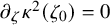 $\partial _\zeta \kappa ^2(\zeta _0) = 0$
. Hence, evaluating (8.3) at
$\partial _\zeta \kappa ^2(\zeta _0) = 0$
. Hence, evaluating (8.3) at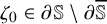 $\zeta _0 \in \partial \mathbb {S}\setminus \partial \overline {\mathbb {S}}$
yields that the right hand side of (8.3) vanishes. Therefore, differentiating (8.3) with respect to
$\zeta _0 \in \partial \mathbb {S}\setminus \partial \overline {\mathbb {S}}$
yields that the right hand side of (8.3) vanishes. Therefore, differentiating (8.3) with respect to $\overline {\zeta }$
shows
$\overline {\zeta }$
shows
 $$ \begin{align*}{ \bigg\langle \frac{1}{|a-\zeta_0|^4} \bigg\rangle\partial_\zeta \partial_{\overline{\zeta}}\kappa^2(\zeta_0)=\bigg\langle \frac{1}{|a-\zeta_0|^2}\frac{1}{|a-\zeta_0|_*^2} \bigg\rangle }\end{align*} $$
and, thus, $\Delta \kappa ^2(\zeta _0)>0$
. Moreover, differentiating (8.1) with respect to
$\Delta \kappa ^2(\zeta _0)>0$
. Moreover, differentiating (8.1) with respect to $\zeta $
and
$\zeta $
and $\overline {\zeta }$
and using
$\overline {\zeta }$
and using $\partial _\zeta \kappa ^2(\zeta _0)=0=\kappa ^2(\zeta _0)$
, as well as (8.3) shows
$\partial _\zeta \kappa ^2(\zeta _0)=0=\kappa ^2(\zeta _0)$
, as well as (8.3) shows
 $$\begin{align*}\pi\partial_\zeta \partial_{\overline{\zeta}}\sigma (\zeta_0) =\bigg\langle \frac{1}{|a-\zeta_0|^2}\frac{1}{|a-\zeta_0|_*^2} \bigg\rangle\partial_\zeta \partial_{\overline{\zeta}}\kappa^2 (\zeta_0) +\bigg\langle \frac{1}{|a-\zeta|^4} \bigg\rangle^{-1}\bigg\lvert \partial_\zeta\bigg\langle \frac{1}{(|a-\zeta|^2+\kappa^2)^2}(a-\zeta) \bigg\rangle \bigg\rvert^2_{\zeta=\zeta_0}. \end{align*}$$
Hence, $\Delta \sigma (\zeta _0) = 4 \partial _\zeta \partial _{\bar \zeta } \sigma (\zeta _0)> 0$
as
$\Delta \sigma (\zeta _0) = 4 \partial _\zeta \partial _{\bar \zeta } \sigma (\zeta _0)> 0$
as $\Delta \kappa ^2(\zeta _0)>0$
.
$\Delta \kappa ^2(\zeta _0)>0$
.
A Proof of higher order Morse lemma
Proof of Lemma 6.7.
Without loss of generality we assume $\zeta _0=0$
and
$\zeta _0=0$
and $f(0)=0$
. We denote
$f(0)=0$
. We denote $x=\operatorname {\mathrm {Re}} \zeta $
and
$x=\operatorname {\mathrm {Re}} \zeta $
and $y =\operatorname {\mathrm {Im}} \zeta $
. Furthermore, by rotating the coordinates
$y =\operatorname {\mathrm {Im}} \zeta $
. Furthermore, by rotating the coordinates $(x,y)$
so that they coincide with the eigendirections of the Hessian
$(x,y)$
so that they coincide with the eigendirections of the Hessian $\mathrm {Hess}(f)$
of f, we may assume
$\mathrm {Hess}(f)$
of f, we may assume $f(x,y) = \alpha \mspace {1 mu}x^2+ \beta \mspace {1 mu} y^2 + O(\lvert x \rvert ^3 + \lvert y \rvert ^3) $
, where
$f(x,y) = \alpha \mspace {1 mu}x^2+ \beta \mspace {1 mu} y^2 + O(\lvert x \rvert ^3 + \lvert y \rvert ^3) $
, where $2\alpha $
and
$2\alpha $
and $2\beta $
are the eigenvalues of
$2\beta $
are the eigenvalues of $\mathrm {Hess}(f)$
. Here we used
$\mathrm {Hess}(f)$
. Here we used $f(0)=0$
,
$f(0)=0$
, $\partial f (0)=0$
. Since
$\partial f (0)=0$
. Since $\Delta f(0)>0$
, we may assume
$\Delta f(0)>0$
, we may assume $\alpha>0$
by potentially exchanging the roles of x and y. By rescaling we can also assume
$\alpha>0$
by potentially exchanging the roles of x and y. By rescaling we can also assume $\alpha =1$
. In case
$\alpha =1$
. In case $\beta \ne 0$
we use the Morse lemma (see, for example, [Reference Milnor46, Lemma 2.2]) to bring
$\beta \ne 0$
we use the Morse lemma (see, for example, [Reference Milnor46, Lemma 2.2]) to bring $\widetilde {f}:= f \circ \Phi $
into the form
$\widetilde {f}:= f \circ \Phi $
into the form $\widetilde {f} = x^2 \pm y^2$
.
$\widetilde {f} = x^2 \pm y^2$
.
For the remainder of the proof, we assume $\beta = 0$
and tacitly shrink the neighbourhood of
$\beta = 0$
and tacitly shrink the neighbourhood of $0$
whenever necessary. In the case when
$0$
whenever necessary. In the case when $\beta =0$
we see that
$\beta =0$
we see that
 $$ \begin{align} { f(x,y) = x^2(1 +x g(x,y) + y h(y)) + x \mspace{1 mu}y^2 j(y) + y^3 k(y)\,, } \end{align} $$
where $g,h,j,k$
are real analytic functions. Now we define a local real analytic diffeomorphism through the ansatz
$g,h,j,k$
are real analytic functions. Now we define a local real analytic diffeomorphism through the ansatz $\Phi _1(x,y):=(x + y^2 \psi _1(y),y )$
, where the real analytic function
$\Phi _1(x,y):=(x + y^2 \psi _1(y),y )$
, where the real analytic function $\psi _1$
will be chosen appropriately below. Then
$\psi _1$
will be chosen appropriately below. Then $f_1:= f \circ \Phi _1$
has the form
$f_1:= f \circ \Phi _1$
has the form
 $$\begin{align*}f_1(x,y) = x^2(1 +x g_1(x,y) + y h_1(y)) + x \mspace{1 mu}y^2 j_1(y) + y^3 k_1(y) \end{align*}$$
with
 $$ \begin{align*} g_1(x,y) & = g(x+y^2 \psi_1(y),y) + 3y^2 \psi_1(y) (\partial_1 g)(y^2 \psi_1(y),y) + 3y^2( \psi_1(y) x + y^2 \psi_1(y)^2)(\partial_1^2g)(y^2 \psi_1(y),y) /2 \\ & \phantom{=} + ( 3y^2 \psi_1(y) x^2 + 3y^4 \psi_1(y)^2 x + y^6 \psi_1(y)^3 ) \widetilde{g}(x,y), \\ h_1(y) & = h(y) + 3y \psi_1(y) g(y^2 \psi_1(y),y) + 3y^3 \psi_1(y)^2 (\partial_1 g)(y^2 \psi_1(y),y) + y^5\psi_1(y)^3 (\partial_1^2g)(y^2 \psi_1(y),y)/2, \\ j_1(y)&= j(y) +\psi_1(y) (2 + 2 y h(y) + 3 y^2 g(y^2 \psi_1(y),y)\psi_1(y)+ y^4 \psi_1(y)^2\partial_1 g(y^2 \psi_1(y),y))\,, \\ k_1(y)&=k(y)+ y\psi_1(y)(j(y)+\psi_1(y)(1+yh(y)+y^2g(y^2\psi_1(y),y)\psi_1(y)))\,, \end{align*} $$
where $\partial _1 $
denotes the partial derivative with respect to the first argument and
$\partial _1 $
denotes the partial derivative with respect to the first argument and $\widetilde {g}$
is defined through the expansion
$\widetilde {g}$
is defined through the expansion
 $$\begin{align*}g(x+y^2\psi_1(y),y) = g(y^2\psi_1(y),y) + x (\partial_1 g)(y^2\psi_1(y),y) + x^2 (\partial_1^2g)(y^2 \psi_1(y),y)/2 + x^3 \widetilde{g}(x,y). \end{align*}$$
By the implicit function theorem, we find a real analytic function $\psi _1(y)$
such that
$\psi _1(y)$
such that $j_1(y) = 0$
for all small enough y. In particular,
$j_1(y) = 0$
for all small enough y. In particular, $\psi _1(y) = (-\frac {1}{2}+O(y))j(y)$
.
$\psi _1(y) = (-\frac {1}{2}+O(y))j(y)$
.
Hence, $f_1$
simplifies to
$f_1$
simplifies to
 $$\begin{align*}f_1(x,y) = x^2(1 +x g_1(x,y) + y h_1(y)) + y^3 k_1(y)\,, \end{align*}$$
where $k_1(y)= \tau y^{K-3}\psi _2(y)$
for some
$k_1(y)= \tau y^{K-3}\psi _2(y)$
for some $\tau \in \{0, \pm 1\}$
,
$\tau \in \{0, \pm 1\}$
, $K \ge 3$
and a real analytic function
$K \ge 3$
and a real analytic function $\psi _2$
with
$\psi _2$
with $\psi _2(0)>0$
. We define the local real analytic diffeomorphism
$\psi _2(0)>0$
. We define the local real analytic diffeomorphism $\Phi _2(x,y ):=(x, y\psi _2(y)^{1/K})$
. Then
$\Phi _2(x,y ):=(x, y\psi _2(y)^{1/K})$
. Then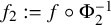 $f_2:= f \circ \Phi _2^{-1}$
is of the form
$f_2:= f \circ \Phi _2^{-1}$
is of the form
 $$\begin{align*}f_2(x,y) = x^2(1 +x g_2(x,y) + y h_2(y)) + \tau \mspace{1 mu} y^K \end{align*}$$
for some real analytic functions $g_2$
and
$g_2$
and $h_2$
. Finally, we choose the local real analytic diffeomorphism
$h_2$
. Finally, we choose the local real analytic diffeomorphism $\Phi _3(x,y ):=(x(1 +x g_2(x,y) + y h_2(y))^{1/2} , y)$
such that
$\Phi _3(x,y ):=(x(1 +x g_2(x,y) + y h_2(y))^{1/2} , y)$
such that $\widetilde {f}:= f_2 \circ \Phi _3^{-1}$
is of the form claimed in the lemma. The diffeomorphism from the statement of the lemma is
$\widetilde {f}:= f_2 \circ \Phi _3^{-1}$
is of the form claimed in the lemma. The diffeomorphism from the statement of the lemma is $\Phi := \Phi _1 \circ \Phi _2^{-1} \circ \Phi _3^{-1}$
.
$\Phi := \Phi _1 \circ \Phi _2^{-1} \circ \Phi _3^{-1}$
.
Proof of Corollary 7.1.
As in the proof of Lemma 6.7 the case $\beta \ne 0$
and
$\beta \ne 0$
and $\alpha \ne 0$
is clear, where
$\alpha \ne 0$
is clear, where $2\alpha $
and
$2\alpha $
and $2\beta $
are the two eigenvalues of
$2\beta $
are the two eigenvalues of $\mathrm {Hess}(f)$
. Thus, by rescaling it suffices to consider
$\mathrm {Hess}(f)$
. Thus, by rescaling it suffices to consider $\beta = 0$
and
$\beta = 0$
and $\alpha = 1$
. As f is symmetric with respect to the imaginary axis, we have the representation
$\alpha = 1$
. As f is symmetric with respect to the imaginary axis, we have the representation
 $$\begin{align*}f(x,y) = f(0)+x^2 p(x^2,y) + y^3k(y)\,, \end{align*}$$
for real analytic functions p and k with $p(0,0)=1$
. In particular,
$p(0,0)=1$
. In particular, $j(y)=0$
in the representation (A.1). Hence, from the proof of Lemma 6.7 we know that
$j(y)=0$
in the representation (A.1). Hence, from the proof of Lemma 6.7 we know that $\psi _1 \equiv 0$
and
$\psi _1 \equiv 0$
and $k(y)=k_1(y) =\tau y^{K-3}\psi _2(y)$
with some real analytic
$k(y)=k_1(y) =\tau y^{K-3}\psi _2(y)$
with some real analytic $\psi _2$
such that
$\psi _2$
such that $\psi _2(0)>0$
. Choosing the diffeomorphism
$\psi _2(0)>0$
. Choosing the diffeomorphism $ \Phi ^{-1}(x,y):= (x \sqrt {p(x^2,y)}, y \mspace {2 mu}\psi _2(y)^{1/K}) $
shows the claim.
$ \Phi ^{-1}(x,y):= (x \sqrt {p(x^2,y)}, y \mspace {2 mu}\psi _2(y)^{1/K}) $
shows the claim.
B Stability of Dyson equation
Let M be the solution of (5.16). The stability operator of (5.16) is given by (5.20).
Lemma B.1. Let $a\in \mathcal B$
,
$a\in \mathcal B$
, $s \colon \mathfrak X \times \mathfrak X \to [0,\infty )$
a bounded measurable function and
$s \colon \mathfrak X \times \mathfrak X \to [0,\infty )$
a bounded measurable function and $\mathcal L$
defined as in (5.20). Then
$\mathcal L$
defined as in (5.20). Then $\mathcal L$
is invertible for any
$\mathcal L$
is invertible for any $\eta>0$
and satisfies
$\eta>0$
and satisfies
 $$ \begin{align} \lVert \mathcal L^{-1} \rVert_{\infty}\le \frac{1}{\eta^2}\,. \end{align} $$
Proof. We write $\mathcal L$
as a directional derivative of
$\mathcal L$
as a directional derivative of $M:=M_R(\zeta ,\mathrm {i} \eta )$
, where
$M:=M_R(\zeta ,\mathrm {i} \eta )$
, where
 $$\begin{align*}M_R(\zeta,\mathrm{i} \eta):= E\bigg[ \bigg(\left( \begin{array}{cc} -\mathrm{i} \eta & Y\\ Y^* & -\mathrm{i} \eta\end{array}\right)-R\bigg)^{-1} \bigg], \qquad Y:= a + \mathfrak c -\zeta\,. \end{align*}$$
We note that for $\eta>0$
the map
$\eta>0$
the map $R \mapsto M_R(\zeta ,\mathrm {i} \eta )$
is differentiable in a neighbourhood of
$R \mapsto M_R(\zeta ,\mathrm {i} \eta )$
is differentiable in a neighbourhood of $R=0$
. Let
$R=0$
. Let $\widetilde {R} \in \mathcal B^{2\times 2}$
be arbitrary. Taking the directional derivative
$\widetilde {R} \in \mathcal B^{2\times 2}$
be arbitrary. Taking the directional derivative $\nabla _{\widetilde R}$
with respect to R in the direction
$\nabla _{\widetilde R}$
with respect to R in the direction $\widetilde R$
yields
$\widetilde R$
yields
 $$ \begin{align} \nabla_{\widetilde R} M = E \bigg[ \left( \begin{array}{cc}-\mathrm{i} \eta & Y\\ Y^* & -\mathrm{i} \eta \end{array}\right)^{-1}\widetilde R \left( \begin{array}{cc} -\mathrm{i} \eta & Y\\ Y^* & -\mathrm{i} \eta\end{array}\right)^{-1}\bigg]\,. \end{align} $$
On the other hand M satisfies a modified version of the Dyson equation (4.3), namely
 $$\begin{align*}-\frac{1}{M} = R+\begin{pmatrix} \mathrm{i} \eta & \zeta - a \\ \overline{\zeta - a} & \mathrm{i} \eta \end{pmatrix} + \Sigma[M ]\,. \end{align*}$$
Taking the directional derivative $\nabla _{\widetilde R}$
of this equation shows
$\nabla _{\widetilde R}$
of this equation shows $\mathcal L \nabla _{\widetilde R} M =\widetilde R$
. Since
$\mathcal L \nabla _{\widetilde R} M =\widetilde R$
. Since $\widetilde {R}$
was arbitrary, we conclude that
$\widetilde {R}$
was arbitrary, we conclude that $\mathcal L$
is invertible and
$\mathcal L$
is invertible and $\mathcal L^{-1}\widetilde R = \nabla _{\widetilde R} M$
. The bound (B.1) now follows from the representation (B.2).
$\mathcal L^{-1}\widetilde R = \nabla _{\widetilde R} M$
. The bound (B.1) now follows from the representation (B.2).
Proof of Lemma 5.15.
We recall that $\zeta \in \mathbb {C}$
is fixed such that
$\zeta \in \mathbb {C}$
is fixed such that $\limsup _{\eta \downarrow 0} \langle v_1(\zeta ,\eta ) \rangle \ge \delta $
for some
$\limsup _{\eta \downarrow 0} \langle v_1(\zeta ,\eta ) \rangle \ge \delta $
for some $\delta>0$
and that
$\delta>0$
and that $v^{(n)}=v(\zeta , \eta _n) \to v_0$
weakly in
$v^{(n)}=v(\zeta , \eta _n) \to v_0$
weakly in $(L^2)^2$
, where
$(L^2)^2$
, where $v_0 \sim _\delta 1$
. First we use the identities
$v_0 \sim _\delta 1$
. First we use the identities
 $$\begin{align*}\mathscr Lv_- = -\eta \frac{\tau\mspace{2 mu}v^2}{(\eta + S_d v)^2}\,, \qquad \mathscr L^*(e_-(\eta + S_ov)) = \eta \mspace{1 mu} e_- \end{align*}$$
with $v_-=v e_-$
and
$v_-=v e_-$
and $v=v^{(n)}$
. In the limit
$v=v^{(n)}$
. In the limit $\eta \downarrow 0$
we see
$\eta \downarrow 0$
we see $\mathscr L_0v_-=0$
and
$\mathscr L_0v_-=0$
and $\mathscr L_0^*S_ov_-=0$
. Here we used that
$\mathscr L_0^*S_ov_-=0$
. Here we used that $v = v_0$
satisfies the Dyson equation, (4.4) at
$v = v_0$
satisfies the Dyson equation, (4.4) at $\eta =0$
. For the rest of this proof we drop the
$\eta =0$
. For the rest of this proof we drop the $0$
-index from our notation. We introduce T, V,
$0$
-index from our notation. We introduce T, V, $F: \mathcal B^2 \to \mathcal B^2$
as in (6.6), evaluated at
$F: \mathcal B^2 \to \mathcal B^2$
as in (6.6), evaluated at $v=v_0$
and
$v=v_0$
and $\eta =0$
. In terms of
$\eta =0$
. In terms of $T,F$
and V we obtain
$T,F$
and V we obtain
 $$ \begin{align} \mathscr L = V^{-1}(1-TF)V\,. \end{align} $$
We consider the natural extensions $F\colon (L^2)^2 \to (L^2)^2$
and
$F\colon (L^2)^2 \to (L^2)^2$
and $T\colon (L^2)^2 \to (L^2)^2$
. These operators are self-adjoint and we use their spectral properties presented in Lemma B.2 below. The proof of this lemma is postponed to after the proof of Lemma 5.15.
$T\colon (L^2)^2 \to (L^2)^2$
. These operators are self-adjoint and we use their spectral properties presented in Lemma B.2 below. The proof of this lemma is postponed to after the proof of Lemma 5.15.
Lemma B.2 (Spectral properties of F and T).
The Hermitian operator $F\colon (L^2)^2 \to (L^2)^2$
satisfies the following properties:
$F\colon (L^2)^2 \to (L^2)^2$
satisfies the following properties:
-
(i) F has nondegenerate isolated eigenvalues at
$\pm 1$
and a spectral gap
$\varepsilon \sim _\delta 1$
, that is, (B.4)
$$ \begin{align} \operatorname{\mathrm{Spec}}(F) \subset \{-1\} \cup [-1+\varepsilon, 1-\varepsilon]\cup \{1\}\,. \end{align} $$
-
(ii) The eigenvectors corresponding to the eigenvalues
$\pm 1$
are (B.5)where
$$ \begin{align} F Vv = Vv \,, \qquad F Vv_- = -V v_-\,, \end{align} $$
$v=(v_1, v_2)$
and
$v_- =(v_1, -v_2)$
.


The Hermitian operator $T\colon (L^2)^2 \to (L^2)^2$
satisfies the following properties:
$T\colon (L^2)^2 \to (L^2)^2$
satisfies the following properties:
-
(iii) The spectrum is bounded away from
$1$
by a gap of size
$\varepsilon \sim _\delta 1$
, that is,
$$\begin{align*}\operatorname{\mathrm{Spec}}(T) \subset [-1,1-\varepsilon]\,. \end{align*}$$
-
(iv) For
$x \in \{(y,-y): y \in L^2\} $
we have
$Tx=-x$
.


We now prove Lemma 5.15 by tacitly using the properties of F and T from Lemma B.2. Since $f_-:=Vv_- \in \{(y,-y): y \in \mathcal B\}$
we see that F and T both leave the subspace
$f_-:=Vv_- \in \{(y,-y): y \in \mathcal B\}$
we see that F and T both leave the subspace $(f_-)^\perp $
invariant. Now, using (B.3), we rewrite the resolvent of
$(f_-)^\perp $
invariant. Now, using (B.3), we rewrite the resolvent of $\mathscr L$
as
$\mathscr L$
as
 $$\begin{align*}\frac{1}{\mathscr L-\omega} = V^{-1}\frac{1}{1 - TF-\omega} V\,. \end{align*}$$
The operator V and its inverse satisfy the bound $\lVert V \rVert _\#+\lVert V^{-1} \rVert _\# \lesssim _\delta 1$
for
$\lVert V \rVert _\#+\lVert V^{-1} \rVert _\# \lesssim _\delta 1$
for $\# = 2, \infty $
, where we used
$\# = 2, \infty $
, where we used $\delta \lesssim v \lesssim \frac {1}{\delta }$
from Lemma 5.13. Thus, it suffices to show (5.30) with
$\delta \lesssim v \lesssim \frac {1}{\delta }$
from Lemma 5.13. Thus, it suffices to show (5.30) with $\mathscr L$
replaced by
$\mathscr L$
replaced by $1-TF$
. Furthermore, we can restrict to the case
$1-TF$
. Furthermore, we can restrict to the case $\# =2$
, since [Reference Alt and Krüger9, Lemma 4.5] is applicable because
$\# =2$
, since [Reference Alt and Krüger9, Lemma 4.5] is applicable because
 $$\begin{align*}\lVert TF \rVert_\infty + \lVert TF \rVert_{\infty \to 2} \lVert TF \rVert_{2 \to \infty} \lesssim_\delta 1\,. \end{align*}$$
Here, $\lVert TF \rVert _{\infty \to 2}$
and
$\lVert TF \rVert _{\infty \to 2}$
and $\lVert TF \rVert _{2\to \infty }$
denote the operator norms of
$\lVert TF \rVert _{2\to \infty }$
denote the operator norms of $TF$
viewed as operator
$TF$
viewed as operator $\mathcal B^2 \to (L^2)^2$
and
$\mathcal B^2 \to (L^2)^2$
and $(L^2)^2 \to \mathcal B^2$
, respectively.
$(L^2)^2 \to \mathcal B^2$
, respectively.
Since $\lVert TF \rVert _2 \le 1$
we have the bound
$\lVert TF \rVert _2 \le 1$
we have the bound $\lVert (1-TF-\omega )^{-1} \rVert _2\lesssim _{\varepsilon , \delta } 1$
for any
$\lVert (1-TF-\omega )^{-1} \rVert _2\lesssim _{\varepsilon , \delta } 1$
for any $\omega \not \in 1+\mathbb {D}_{1+\varepsilon }$
and any
$\omega \not \in 1+\mathbb {D}_{1+\varepsilon }$
and any $\varepsilon>0$
. Now we can decompose
$\varepsilon>0$
. Now we can decompose
 $$ \begin{align} { \frac{1}{1-TF-\omega} = (1-P)\frac{1}{1-TF-\omega}(1-P) - \frac{1}{\omega}P\,, } \end{align} $$
where P is the orthogonal projection onto the span of $f_-$
. Provided
$f_-$
. Provided $\varepsilon>0$
is chosen sufficiently small, the first summand in (B.6) is bounded for
$\varepsilon>0$
is chosen sufficiently small, the first summand in (B.6) is bounded for $\omega \in \mathbb {D}_{2\varepsilon }$
. Indeed
$\omega \in \mathbb {D}_{2\varepsilon }$
. Indeed $1-TF$
has a bounded inverse on
$1-TF$
has a bounded inverse on $f_-^\perp $
by applying Lemma B.3 with
$f_-^\perp $
by applying Lemma B.3 with $H = (L^2)^2$
. Finally, the second summand in (B.6) is bounded on
$H = (L^2)^2$
. Finally, the second summand in (B.6) is bounded on $\mathbb {C}\setminus \mathbb {D}_\varepsilon $
. Altogether the bound (5.30) is proven. The nondegeneracy of the eigenvector
$\mathbb {C}\setminus \mathbb {D}_\varepsilon $
. Altogether the bound (5.30) is proven. The nondegeneracy of the eigenvector $v_-$
of
$v_-$
of $\mathscr L$
also follows from the decomposition (B.6).
$\mathscr L$
also follows from the decomposition (B.6).
Proof of Lemma B.2.
The identities (B.5) are verified by using the definitions of V and F from (6.6). That the eigenvalues $\pm 1$
are nondegenerate and the existence of the spectral gap in (B.4) are seen by studying
$\pm 1$
are nondegenerate and the existence of the spectral gap in (B.4) are seen by studying
 $$\begin{align*}F^2 = \left( \begin{array}{cc} RR^*& 0\\ 0 & R^*R\end{array}\right)\,, \qquad R:= D_{\frac{v_1}{\hat{v}}}SD_{\frac{v_2}{\hat{v}}} \,. \end{align*}$$
As we now show, both $RR^*$
and
$RR^*$
and $R^*R$
have spectrum contained in
$R^*R$
have spectrum contained in $[0,1-\varepsilon ]\cup \{1\}$
for some
$[0,1-\varepsilon ]\cup \{1\}$
for some $\varepsilon \sim _\delta 1$
, where
$\varepsilon \sim _\delta 1$
, where $1$
is a nondegenerate eigenvalue. We show this for
$1$
is a nondegenerate eigenvalue. We show this for $RR^*$
. The argument for
$RR^*$
. The argument for $R^*R$
is analogous. The operator
$R^*R$
is analogous. The operator $RR^*: \mathcal {B}\to \mathcal {B}$
has a kernel representation
$RR^*: \mathcal {B}\to \mathcal {B}$
has a kernel representation
 $$\begin{align*}(RR^*u)(x)= \int_{\mathfrak X} t_1(x,y) u(y) \mu(\mathrm{d} y) \end{align*}$$
with a symmetric non-negative kernel
 $$\begin{align*}t_1(x,y) = \frac{v_1(x)}{\widehat v (x)}\int_{\mathfrak X} s(x,q)\frac{v_2(q)^2}{\widehat v (q)^2}s(y,q)\mu (\mathrm{d} q)\frac{v_1(y)}{\widehat v (y)} \end{align*}$$
because of (2.5). Since $v = v_0 \sim _\delta 1$
in our regime due to Lemma 5.13, assumption A1 implies
$v = v_0 \sim _\delta 1$
in our regime due to Lemma 5.13, assumption A1 implies

Now let $t_k$
be the kernel of
$t_k$
be the kernel of $(RR^*)^k$
for any
$(RR^*)^k$
for any $k \in \mathbb {N}$
. Since the matrix
$k \in \mathbb {N}$
. Since the matrix $Z=(z_{ij})_{i,j=1}^K$
is primitive with positive diagonal there is a
$Z=(z_{ij})_{i,j=1}^K$
is primitive with positive diagonal there is a $k \in \mathbb {N}$
such that
$k \in \mathbb {N}$
such that $t_k (x,y)\sim _\delta 1$
for
$t_k (x,y)\sim _\delta 1$
for $\mu $
-almost all x,
$\mu $
-almost all x, $y \in \mathfrak X$
. Indeed, by (B.7) we have
$y \in \mathfrak X$
. Indeed, by (B.7) we have

where the entries of $(ZZ^*)^k$
are all positive for large enough
$(ZZ^*)^k$
are all positive for large enough $k \in \mathbb {N}$
due to the primitivity of Z and its positive diagonal. By [Reference Ajanki, Erdős and Krüger2, Lemma 5.7] with the necessary eigenfunction from (B.5), we conclude that
$k \in \mathbb {N}$
due to the primitivity of Z and its positive diagonal. By [Reference Ajanki, Erdős and Krüger2, Lemma 5.7] with the necessary eigenfunction from (B.5), we conclude that $(RR^*)^k$
has a spectral gap
$(RR^*)^k$
has a spectral gap $\sim _\delta 1$
and therefore so does
$\sim _\delta 1$
and therefore so does $RR^*$
. A similar argument to the one presented here has been used in [Reference Alt, Erdős and Krüger4, Lemma 3.3].
$RR^*$
. A similar argument to the one presented here has been used in [Reference Alt, Erdős and Krüger4, Lemma 3.3].
Now we show the spectral properties of T. The proof follows the strategy from [Reference Alt, Erdős and Krüger5, Lemma 3.6]. Since the argument is short we present it here for the convenience of the reader. The property (iv) is obvious from the definition of T in (6.6). It remains to see that $\operatorname {\mathrm {Spec}}(T)\subset [-1,1-\varepsilon ]$
. Since restricted to vectors
$\operatorname {\mathrm {Spec}}(T)\subset [-1,1-\varepsilon ]$
. Since restricted to vectors $(y,-y)$
, the operator T is
$(y,-y)$
, the operator T is $-1$
it suffices to consider the restriction of T to vectors
$-1$
it suffices to consider the restriction of T to vectors $(y,y)$
. Here we find
$(y,y)$
. Here we find $T(y,y)=(D_p y,D_py)$
with
$T(y,y)=(D_p y,D_py)$
with $p:=|a-\zeta |^2 \frac {v_1v_2}{\widehat {v}^2}-\widehat {v}^2$
. Recalling the definition of
$p:=|a-\zeta |^2 \frac {v_1v_2}{\widehat {v}^2}-\widehat {v}^2$
. Recalling the definition of $\widehat {v}$
in (6.5) we see that
$\widehat {v}$
in (6.5) we see that
 $$\begin{align*}2\frac{|a-\zeta|^2v_2}{Sv_2}-1=p = 1- 2v_2S^{*}v_1 , \end{align*}$$
where we used the Dyson equation (4.4) at $\eta =0$
. Since
$\eta =0$
. Since $v_i \sim _\delta 1 $
this shows the claim about the spectrum of T.
$v_i \sim _\delta 1 $
this shows the claim about the spectrum of T.
Lemma B.3 (Contraction-Inversion Lemma).
Let $\varepsilon>0$
and
$\varepsilon>0$
and $T, F $
be two bounded self-adjoint operators on a Hilbert space H such that
$T, F $
be two bounded self-adjoint operators on a Hilbert space H such that $ \lVert T \rVert \leq 1$
and
$ \lVert T \rVert \leq 1$
and $ \lVert F \rVert \leq 1$
. Suppose that there are normalized vectors
$ \lVert F \rVert \leq 1$
. Suppose that there are normalized vectors $f_\pm \in H$
satisfying
$f_\pm \in H$
satisfying
 $$ \begin{align} F f_+ = \lVert F \rVert f_+, \quad F f_- = - \lVert F \rVert f_-, \quad \lVert F x \rVert \leq (1 - \varepsilon) \lVert x \rVert \end{align} $$
for all $x \in H$
such that
$x \in H$
such that $x \perp \operatorname {\mathrm {span}}\{f_+, f_-\}$
.
$x \perp \operatorname {\mathrm {span}}\{f_+, f_-\}$
.
Furthermore, assume that
 $$ \begin{align} \langle{f_+} \mspace{2mu}, {T f_+}\rangle \leq 1-\varepsilon, \quad Tf_-=-f_-. \end{align} $$
Then $1-TF$
maps
$1-TF$
maps $f_-^\perp $
into itself and its restriction to
$f_-^\perp $
into itself and its restriction to $f_-^\perp $
is invertible such that there is a constant
$f_-^\perp $
is invertible such that there is a constant $c>0$
, depending only on
$c>0$
, depending only on $\varepsilon $
, with
$\varepsilon $
, with
 $$ \begin{align} \lVert (1-TF)x \rVert \ge c \lVert x \rVert. \end{align} $$
for all $x \perp f_-$
.
$x \perp f_-$
.
Proof. First we see that $TF$
maps
$TF$
maps $f_-^\perp $
into itself. Indeed, let
$f_-^\perp $
into itself. Indeed, let $h \in H$
with
$h \in H$
with $\lVert h \rVert =1$
and
$\lVert h \rVert =1$
and $h \perp f_-$
. Then
$h \perp f_-$
. Then $\langle {f_-} \mspace {2mu}, {TF h}\rangle =-\langle {f_-} \mspace {2mu}, {F h}\rangle =0$
because of (B.9). Now we write
$\langle {f_-} \mspace {2mu}, {TF h}\rangle =-\langle {f_-} \mspace {2mu}, {F h}\rangle =0$
because of (B.9). Now we write $h= \beta f_+ + \gamma x $
for some normalized
$h= \beta f_+ + \gamma x $
for some normalized $x \perp \operatorname {\mathrm {span}}\{f_+, f_-\}$
and
$x \perp \operatorname {\mathrm {span}}\{f_+, f_-\}$
and $ \beta , \gamma \in \mathbb {C}$
with
$ \beta , \gamma \in \mathbb {C}$
with $ |\beta |^2 +|\gamma |^2 =1$
. From here on we follow the proof of [Reference Alt, Erdős and Krüger5, Lemma 3.7] with the notational identifications
$ |\beta |^2 +|\gamma |^2 =1$
. From here on we follow the proof of [Reference Alt, Erdős and Krüger5, Lemma 3.7] with the notational identifications $\mathbf {A} \leftrightarrow T$
and
$\mathbf {A} \leftrightarrow T$
and $\mathbf { B} \leftrightarrow F$
.
$\mathbf { B} \leftrightarrow F$
.
Lemma B.4 (Twist lemma).
Let H be a Hilbert space with a scalar product $\langle {\mspace {2 mu}\cdot \mspace {2 mu}} \mspace {2mu}, {\mspace {2 mu}\cdot \mspace {2 mu}}\rangle $
and equipped with a norm
$\langle {\mspace {2 mu}\cdot \mspace {2 mu}} \mspace {2mu}, {\mspace {2 mu}\cdot \mspace {2 mu}}\rangle $
and equipped with a norm $\lVert \mspace {2 mu}\cdot \mspace {2 mu} \rVert _{\#}$
(not necessarily induced by the scalar product),
$\lVert \mspace {2 mu}\cdot \mspace {2 mu} \rVert _{\#}$
(not necessarily induced by the scalar product), $\varepsilon \in (0,1)$
and
$\varepsilon \in (0,1)$
and $A $
a bounded linear operator on
$A $
a bounded linear operator on $(H,\langle {\mspace {2 mu}\cdot \mspace {2 mu}} \mspace {2mu}, {\mspace {2 mu}\cdot \mspace {2 mu}}\rangle )$
such that
$(H,\langle {\mspace {2 mu}\cdot \mspace {2 mu}} \mspace {2mu}, {\mspace {2 mu}\cdot \mspace {2 mu}}\rangle )$
such that $\overline {\mathbb {D}}_\varepsilon \cap \operatorname {\mathrm {Spec}} A = \{ \alpha \}$
. We assume that
$\overline {\mathbb {D}}_\varepsilon \cap \operatorname {\mathrm {Spec}} A = \{ \alpha \}$
. We assume that $\alpha $
is a nondegenerate eigenvalue of A and
$\alpha $
is a nondegenerate eigenvalue of A and $A x = \alpha x$
for some
$A x = \alpha x$
for some $x \in H$
with
$x \in H$
with $\lVert x \rVert _\# = 1$
. Let
$\lVert x \rVert _\# = 1$
. Let
 $$ \begin{align} { P\,:=\,- \frac{1}{2\pi \mathrm{i}}\oint_{\partial \mathbb{D}_{\varepsilon}} \frac{\mathrm{d} \zeta}{A-\zeta}\,=\, \langle{p} \mspace{2mu}, {\mspace{2 mu}\cdot\mspace{2 mu}}\rangle\mspace{2 mu}x\,, } \end{align} $$
with some $p \in H$
be the corresponding spectral projection and
$p \in H$
be the corresponding spectral projection and $y \in H$
a vector such that
$y \in H$
a vector such that
 $$ \begin{align} { \lvert \langle{x} \mspace{2mu}, {y}\rangle \rvert\,\ge\, 2\mspace{2 mu} \varepsilon\,,\qquad \lvert \langle{y} \mspace{2mu}, {w}\rangle \rvert\,\le\, \lVert w \rVert_{\#}\,,\qquad \forall\;w \in H\,. } \end{align} $$
Suppose that A has a bounded inverse on the range of $1-P$
with respect to the norm
$1-P$
with respect to the norm $\lVert \mspace {2 mu}\cdot \mspace {2 mu} \rVert _{\#}$
, that is,
$\lVert \mspace {2 mu}\cdot \mspace {2 mu} \rVert _{\#}$
, that is,
 $$ \begin{align} { \lVert Aw \rVert_{\#}\,\ge\, \lVert w \rVert_{\#}\,,\qquad \forall\; w \perp p\,. } \end{align} $$
Then A has a bounded inverse when restricted to $y^\perp $
, namely
$y^\perp $
, namely
 $$ \begin{align} { \lVert Aw \rVert_{\#}\,\ge\, \frac{\varepsilon}{3}\mspace{2 mu}\lVert w \rVert_{\#}\,,\qquad \forall\; w \perp y\,. } \end{align} $$
Proof. The proof follows the one of [Reference Alt and Krüger9, Lemma 4.6] line by line, replacing $\mathbb {C}^d$
by H.
$\mathbb {C}^d$
by H.
C Auxiliary results
Lemma C.1. Let $y> 0$
be the unique solution to the equation
$y> 0$
be the unique solution to the equation $y^3 + \beta \mspace {1 mu} y = x$
for
$y^3 + \beta \mspace {1 mu} y = x$
for $x> 0$
and
$x> 0$
and $\beta \in \mathbb {R}$
. Then
$\beta \in \mathbb {R}$
. Then
 $$\begin{align*}y \sim \sqrt{\max\{0,-\beta\}} + \frac{x}{x^{2/3}+ \lvert \beta \rvert}\,. \end{align*}$$
Proof. First we consider the case $\beta \ge 0$
. Then clearly
$\beta \ge 0$
. Then clearly
 $$\begin{align*}y \sim \frac{x}{x^{2/3} + \lvert \beta \rvert}\,. \end{align*}$$
Now let $\beta <0 $
, then we must have
$\beta <0 $
, then we must have $y = \sqrt {-\beta }(1 + \varepsilon )$
for some
$y = \sqrt {-\beta }(1 + \varepsilon )$
for some $\varepsilon> 0$
since
$\varepsilon> 0$
since $y^2 + \beta \mspace {1 mu} y>0$
. For this
$y^2 + \beta \mspace {1 mu} y>0$
. For this $\varepsilon $
we get the equation
$\varepsilon $
we get the equation $ \varepsilon ^3 + 3 \varepsilon ^2 + 2 \varepsilon = x\mspace {1 mu} \lvert \beta \rvert ^{-3/2}\,. $
Thus, we have the scaling
$ \varepsilon ^3 + 3 \varepsilon ^2 + 2 \varepsilon = x\mspace {1 mu} \lvert \beta \rvert ^{-3/2}\,. $
Thus, we have the scaling
 $$\begin{align*}\varepsilon \sim \min\bigg\{{\frac{x}{\lvert \beta \rvert^{3/2}}, \frac{x^{1/3}}{\lvert \beta \rvert^{1/2}}}\bigg\}\,. \end{align*}$$
Therefore we conclude
 $$\begin{align*}y = \sqrt{\lvert \beta \rvert} + \min\bigg\{{\frac{x}{\lvert \beta \rvert}, x^{1/3}}\bigg\} \sim \sqrt{\lvert \beta \rvert}+\frac{x}{x^{2/3} + \lvert \beta \rvert}\,, \end{align*}$$
which is the claim of the lemma.
Lemma C.2. Let $S\colon \mathcal {B} \to \mathcal {B}$
be an integral operator as in (2.5) with a kernel
$S\colon \mathcal {B} \to \mathcal {B}$
be an integral operator as in (2.5) with a kernel $s: \mathfrak X^2 \to (0,\infty )$
that satisfies the bounds
$s: \mathfrak X^2 \to (0,\infty )$
that satisfies the bounds $\varepsilon \le s(x,y)\le \frac {1}{\varepsilon }$
for all x,
$\varepsilon \le s(x,y)\le \frac {1}{\varepsilon }$
for all x, $y \in \mathfrak {X}$
and some constant
$y \in \mathfrak {X}$
and some constant $\varepsilon>0$
and such that the spectral radius of S is normalised to
$\varepsilon>0$
and such that the spectral radius of S is normalised to $\varrho (S)=1$
. Then there are constants
$\varrho (S)=1$
. Then there are constants $\delta ,C>0$
, depending only on
$\delta ,C>0$
, depending only on $\varepsilon $
, such that
$\varepsilon $
, such that
 $$\begin{align*}\sup \Big\{ \lVert (S-z)^{-1} \rVert_2 \colon z \not \in D_{1-\delta}(0) \cup D_\delta(1)\Big\} \le C \end{align*}$$
and $\operatorname {\mathrm {Spec}}(S) \cap D_\delta (1) =\{1\} $
is nondegenerate.
$\operatorname {\mathrm {Spec}}(S) \cap D_\delta (1) =\{1\} $
is nondegenerate.
Proof. We follow line by line the arguments from the proof of [Reference Erdős, Krüger and Renfrew33, Lemma A.1], where the finite dimensional case with $\lvert \mathfrak {X} \rvert < \infty $
and
$\lvert \mathfrak {X} \rvert < \infty $
and $\mu $
the counting measure is carried out.
$\mu $
the counting measure is carried out.
Lemma C.3 (Properties of
$f_a$
and
$g_a$
).


Let $a \in \mathbb {C}_{>}$
, as well as
$a \in \mathbb {C}_{>}$
, as well as $f_a \colon \mathbb {C} \setminus \{ 1/a, 1/\overline {a}, -1/a, -1/\overline {a} \} \to \mathbb {R}$
and
$f_a \colon \mathbb {C} \setminus \{ 1/a, 1/\overline {a}, -1/a, -1/\overline {a} \} \to \mathbb {R}$
and $g_a\colon \mathbb {C} \setminus \{ -1/a, 1/\overline {a} \} \to \mathbb {R}$
be defined as in (7.10) and (7.9), respectively. Then
$g_a\colon \mathbb {C} \setminus \{ -1/a, 1/\overline {a} \} \to \mathbb {R}$
be defined as in (7.10) and (7.9), respectively. Then $f_a$
and
$f_a$
and $g_a$
are real analytic. Moreover, the Laplacian and derivatives of
$g_a$
are real analytic. Moreover, the Laplacian and derivatives of $f_a$
along the imaginary axis are
$f_a$
along the imaginary axis are
 $$ \begin{align} { \Delta f_a(0) = 4 \lvert a \rvert^4, \qquad \partial_y^{2k+1} f_a(0) = 0, \qquad \partial_y^{2k}f_a(0)=(-1)^k(2k)! |a|^2\frac{\operatorname{\mathrm{Re}} a^{2k+1} }{\operatorname{\mathrm{Re}} a} } \end{align} $$
for all $k \in \mathbb {N}_0$
, where
$k \in \mathbb {N}_0$
, where $\zeta =x+\mathrm {i}\mspace {1 mu} y$
. Furthermore,
$\zeta =x+\mathrm {i}\mspace {1 mu} y$
. Furthermore, $f_a$
has the symmetries
$f_a$
has the symmetries
 $$ \begin{align} { f_a(\zeta) = f_a(-\zeta)= f_a(\overline{\zeta}) = f_a(-\overline{\zeta}) \,. } \end{align} $$
The Laplacian and derivatives of $g_a$
along the imaginary axis are
$g_a$
along the imaginary axis are
 $$ \begin{align} { \Delta g_a(0) \!=\! 4 \lvert a \rvert^4, \; \partial_y^{2k-1} g_a(0) \!=\! (-1)^{k+1}(2k-1)! |a|^2\frac{\operatorname{\mathrm{Im}} a^{2k}}{\operatorname{\mathrm{Re}} a}\,, \; \partial_y^{2k} g_a(0) \!=\!(-1)^k(2k)! |a|^2\frac{\operatorname{\mathrm{Re}} a^{2k+1}}{\operatorname{\mathrm{Re}} a} } \end{align} $$
and $g_a$
has the symmetry
$g_a$
has the symmetry $g_a(\zeta ) = g_a(-\overline {\zeta })$
.
$g_a(\zeta ) = g_a(-\overline {\zeta })$
.
Proof. To verify the formulas for the derivatives of $f_a$
and
$f_a$
and $g_a$
we first compute
$g_a$
we first compute
 $$\begin{align*}\partial_\zeta^k \frac{1}{\lvert \zeta \rvert^2} = \frac{(-1)^k k! }{\overline{\zeta} \zeta^{k+1}} \,. \end{align*}$$
From this we conclude
 $$ \begin{align*} \partial_y^k \frac{1}{\lvert \zeta \rvert^2} &= \big({\mathrm{i} (\partial_\zeta-\partial_{\overline{\zeta}})}\big)^k \frac{1}{\lvert \zeta \rvert^2} = \mathrm{i}^k\sum_{l=0}^k \binom{k}{l}(-1)^l\partial_\zeta^{k-l}\partial_{\overline{\zeta}}^l\frac{1}{\lvert \zeta \rvert^2} \\ &= (-\mathrm{i})^kk!\sum_{l=0}^k\frac{(-1)^l}{\overline{\zeta}^{l+1}\zeta^{k-l+1}} = \frac{(-\mathrm{i})^kk!}{\lvert \zeta \rvert^2\zeta^k}\frac{1-(-\frac{\zeta}{\overline{\zeta}})^{k+1}}{1+\frac{\zeta}{\overline{\zeta}}} = \frac{(-\mathrm{i})^kk!}{\lvert \zeta \rvert^{2k+2}}\frac{\overline{\zeta}^{k+1}+(-1)^k \zeta^{k+1}}{\zeta+\overline{\zeta}}\,, \end{align*} $$
where $\zeta = x+\mathrm {i} y$
. For the cases of odd and even numbers of derivatives we get
$\zeta = x+\mathrm {i} y$
. For the cases of odd and even numbers of derivatives we get
 $$ \begin{align*}{ \partial_y^{2k+1} \frac{1}{\lvert \zeta \rvert^2} = (-1)^{k+1}\frac{(2k+1)!}{\lvert \zeta \rvert^{4k+4}}\frac{\operatorname{\mathrm{Im}} \zeta^{2k+2}}{\operatorname{\mathrm{Re}} \zeta}\,, \qquad \partial_y^{2k} \frac{1}{\lvert \zeta \rvert^2} = \frac{(-1)^k(2k)!}{\lvert \zeta \rvert^{4k+2}}\frac{ \operatorname{\mathrm{Re}} \zeta^{2k+1}}{\operatorname{\mathrm{Re}} \zeta} }\end{align*} $$
for $k \in \mathbb {N}_0$
. Now we use the definition of
$k \in \mathbb {N}_0$
. Now we use the definition of $f_a$
in (7.10) and of
$f_a$
in (7.10) and of $g_a$
in (7.9), take the derivative and evaluate at
$g_a$
in (7.9), take the derivative and evaluate at $\zeta =0$
to get (C.1) and (C.3), respectively.
$\zeta =0$
to get (C.1) and (C.3), respectively.
Acknowledgments
We thank the anonymous referee for additional references and many helpful comments that simplified several proofs.
Competing interests
The authors have no competing interests to declare.
Financial support
J. A. gratefully acknowledges funding from the Deutsche Forschungsgemeinschaft (DFG, German Research Foundation) under Germany’s Excellence Strategy - GZ 2047/1, project-id 390685813. T. K. gratefully acknowledges financial support from VILLUM FONDEN Young Investigator Award (Grant No. 29369).


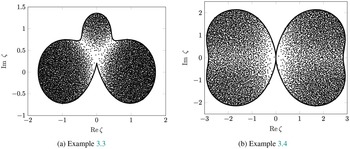


 Open access

