





Introduction
Galanter’s (Reference Galanter1974) foundational account of the “haves” and “have-nots” remains one of the most influential explanations for inequality in legal outcomes. His key insight was not simply that powerful litigants possess greater resources or sophistication, but that they operate across portfolios of similar cases. This portfolio structure enables repeat players to pursue long-term strategies, shape legal rules, and selectively litigate in favorable forums to play for broader structural gains. One-shot litigants, even when represented by skilled attorneys, confront high-stakes conflicts in isolation, limiting their ability to engage in strategic settlement, forum selection, or rule-shaping. A large empirical literature documents consistent differences in judicial success between repeat players and their opponents (Boyd Reference Boyd2015a; Songer et al. Reference Songer, Sheehan and Haire1999; Sheehan and Randazzo Reference Sheehan and Randazzo2012; Widner and Gunderson Reference Widner and Gunderson2024). Yet this research has often operationalized repeat-player advantage through proxies for resources and experience while paying less attention to the strategic, portfolio-based mechanisms central to Galanter’s original argument. These mechanisms underscore that repeat-player advantages are not only material but structural and institutional.
A key implication of a portfolio-based theory of litigant advantage is that legal forums matter. Repeat players can anticipate the legal and ideological environments in which decisions are made and can leverage these environments across cases. The ability to select the forum is therefore a structural advantage distinct from resources or expertise. While prior work highlights the benefits repeat players derive from superior legal capacity, less attention has been given to how these structural advantages relate to the ideology of the presiding judge or how litigants strategically navigate ideological contexts in trial-level adjudication.
Research on judicial ideology offers insight into why forums may differ in their receptiveness to litigants’ claims. A large body of scholarship shows that judges’ ideological commitments shape how they interpret legal standards, evaluate competing expert claims, and assess the credibility of institutional versus individual actors (Epstein et al. Reference Epstein, Landes and Posner2011; Segal and Spaeth Reference Segal and Spaeth2002). Although institutional constraints moderate these effects (Bergara et al. Reference Bergara, Richman and Spiller2003; Randazzo Reference Randazzo2008), researchers consistently find that judicial ideology is linked to trial-level decision-making. These ideological differences are not based solely on policy. They also reflect broader interpretive orientations that may either temper or reinforce the structural advantages of higher status litigants. For repeat players, such ideological variation is a predictable feature of the legal environment, which can be anticipated and leveraged across cases. Yet relatively little empirical research examines how litigant status and judicial ideology operate together in the routine decision-making of trial courts, where discretionary rulings may reinforce or mitigate broader patterns of inequality.
These dynamics are especially relevant to the judicial gatekeeping of expert evidence. Expert testimony is central to modern courts, and federal trial judges exercise wide discretion in determining its admissibility under the Daubert standard (Gianelli Reference Gianelli1993). Evidentiary rulings are low-visibility, high-stakes decisions that shape the factual terrain on which cases proceed and influence the development of legal rules. Litigants’ resources, strategic capacities, and access to specialized expertise all affect how they build evidentiary records. At the same time, the ideological orientation of the judge shapes how receptive the forum will be to particular claims. The judicial gatekeeping of expert evidence therefore provides a valuable setting for examining how repeat-player advantages intersect with ideological contexts in trial courts.
In this article, we investigate how litigant status and judicial ideology shape the admissibility of expert evidence in U.S. District Courts. We argue that higher-status litigants are generally more successful both in excluding opposing experts and in defending their own experts from exclusion. However, the portfolio-based logic of repeat-player theory suggests that these advantages are shaped by the ideological context of the courtroom. Past research finds that conservative judges are often more receptive to institutional authority and organizational litigants (Dotan Reference Dotan1999; Gunderson Reference Gunderson2021; Sheehan et al. Reference Sheehan, Mishler and Songer1992) while liberal judges are more receptive to individual litigants (Epstein et al. Reference Epstein, Landes and Posner2011; Sunstein et al. Reference Sunstein, Schkade, Ellman and Sawicki2006). This may mean that conservative judges provide comparatively favorable forums for higher-status litigants whereas liberal judges may be less responsive to these structural advantages. Of course, not all high-status litigants are conservative, nor are all lower-status litigants liberal (Gibson and Nelson Reference Gibson and Michael J.2021). Nevertheless, if repeat players strategically leverage forum selection, then status-based advantages may be more pronounced in the courtrooms of conservative judges.
To evaluate these claims, we analyze a probability sample of 811 Daubert rulings drawn from a comprehensive database of federal trial court admissibility decisions. Our multinomial logistic regression models show that, on average, higher-status litigants are more successful in securing favorable evidentiary rulings. Yet, this aggregate pattern masks a stark ideological divide in how litigant status relates to judges’ rulings. Whereas higher status parties are more likely to prevail in the most conservative courts, lower status parties are more likely to prevail in the most liberal courts. These findings suggest that repeat-player advantages extend beyond resource disparities and are rooted in structural features of the legal system, especially the interaction between litigant portfolios and ideological variation across judicial forums. Ultimately, our results show how trial-level judicial discretion can amplify or dampen structural inequalities in litigation and highlight the strategic challenges litigants face in increasingly polarized judicial environments.
Background
Litigant status theory
A long tradition of sociolegal scholarship has examined the ways that inequalities shape legal outcomes, especially through disparities in the resources litigants bring to court. Litigant status theory, rooted in Galanter’s (Reference Galanter1974) seminal analysis, holds that well-resourced parties such as corporations and government agencies have a structural edge over less powerful adversaries. Among other advantages, these repeat players benefit from economies of scale, familiarity with legal processes, and access to superior legal and technical expertise. Beyond these resource advantages, repeat players operate across portfolios of similar cases, allowing them to select which cases to litigate, settle, or use to influence broader legal rules. This strategic capacity is largely unavailable to one-shot litigants.
Scholars have extended Galanter’s (Reference Galanter1974) basic insight across a range of legal settings and found that powerful litigants tend to come out ahead in appellate courts, state supreme courts, and international courts (Brace and Hall Reference Brace and Hall2001; Haynie et al. Reference Haynie, Randazzo and Sheehan2024; Sheehan et al. Reference Sheehan, Mishler and Songer1992; Smyth Reference Smyth2000; Songer and Sheehan Reference Songer and Sheehan1992; Szmer et al. Reference Szmer, Songer and Bowie2016; Wheeler et al. Reference Wheeler, Cartwright, Kagan and Friedman1987; Widner and Gunderson Reference Widner and Gunderson2024). Well-resourced litigants are also more likely to secure favorable rulings in trial courts and to appeal unfavorable rulings, illustrating how resources shape appellate court dockets as well as trial outcomes (Boyd Reference Boyd2015a; Levy Reference Levy2018). These studies typically classify litigants based on presumed access to legal resources and experience. Some analyses simply distinguish repeat players from one shotters (e.g., Dioso-Villa Reference Dioso-Villa2016), while others provide more nuanced categories, distinguishing between governments, corporations, and individuals (e.g., Boyd Reference Boyd2015a). Key to these studies is the recognition that litigant status is relational and that status disparities between litigants may be more important to judicial success than the sum of a party’s resources to litigate.
This relational approach is especially important when parties have vastly different capacities for litigation. For example, a large corporation is likely to have far more resources to hire lawyers, conduct discovery, and retain experts compared to an individual employee suing for discrimination or injury. Even within the category of corporate litigants there are important distinctions that are relevant to parties’ odds of judicial success. Public companies, for example, typically invest more heavily in legal services, face greater regulatory scrutiny, and have more in-house legal expertise compared to private firms, suggesting that public companies may have an advantage in litigation even compared to well-resourced private companies (Boot et al. Reference Boot, Gopalan and Thakor2006; Brav Reference Brav2009; Poulsen and Stegemoller Reference Poulsen and Stegemoller2008). These distinctions illustrate how portfolio-based strategies, not just raw resources, can matter for judicial success.
While there is clear evidence that litigant status influences judicial outcomes, comparative research illustrates that its effects depend on institutional context. For example, in legal systems where judges exercise more procedural discretion, the advantages of status may be either reinforced or attenuated (Haynie et al. Reference Haynie, Randazzo and Sheehan2024). This insight is especially relevant for United States trial courts where judges wield considerable discretion over dispositive motions, such as those involving evidence. Such contexts provide an opportunity for personal characteristics of judges, such as their ideologies, to interact with litigant status in shaping legal outcomes (Basabe-Serrano et al. Reference Basabe-Serrano, Epstein, Weinshall, Epstein and Weinshall2024). Crucially, these structural advantages stem from the ability to litigate across multiple cases rather than simply from superior financial or technical resources. Nevertheless, there has been relatively little empirical scrutiny of how structural advantages intersect with judicial discretion in trial courts.
Overall, existing studies underscore two related dimensions of litigant advantage. First, well-resourced litigants benefit from immediate, tangible assets, such as access to expert witnesses and experienced attorneys. Second, they benefit from the ability to pursue strategic, long-term litigation across a portfolio of cases, selectively engaging in disputes to maximize favorable outcomes and influence legal rules. Repeat-players’ advantages are therefore structural and relational, and they extend beyond access to resources or legal sophistication. In the next section, we consider how the ideological context of cases may also impact litigants’ odds of judicial success.
Judicial ideology and legal interpretation
In addition to the research on litigant status, there is a large body of scholarship on the role of judicial ideology in legal decision-making. While Galanter’s (Reference Galanter1974) framework tends to depict judges as passive institutional actors within a system tilted toward powerful litigants, research on judicial ideology treats judges as active political agents whose personal worldviews shape their interpretations of law. In this view, judges are not simply neutral bureaucrats but strategic players whose decisions reflect underlying ideological commitments and policy preferences (Segal and Spaeth Reference Segal and Spaeth2002).
Empirical research on judicial ideology typically operationalizes it along a left-right continuum, linking ideological positions to judicial voting on specific issues. At the appellate level, these studies find that civil rights plaintiffs, criminal defendants, and organized labor tend to be more successful before liberal judges while business interests, law enforcement, and parties supporting limited regulation tend to be more successful before conservative judges (Epstein et al. Reference Epstein, Landes and Posner2011; Segal and Cover Reference Segal and Cover1989; Sunstein et al. Reference Sunstein, Schkade, Ellman and Sawicki2006). Notably, ideological differences in judicial behavior remain even after adjusting for variation in legal doctrine, case facts, and panel composition, which underscores the unique importance of ideology as a predictor of court outcomes.
The influence of judicial ideology also extends to trial courts. For example, studies have found that appellate court ideology shapes trial court decision-making, accentuating the ideological context of trial-level adjudication (Haire et al. Reference Haire, Lindquist and Songer2003; Olson and Rivero Reference Olson and Rivero2022). While the effects of judicial ideology may be especially pronounced on rulings related to social and economic issues, ideology also affects routine trial court decision-making. For example, judges’ ideological preferences predict their rulings in administrative, corporate, and small claims cases (Chen Reference Chen2023; Randazzo Reference Randazzo2008; Tracy and Caron Reference Tracy and Caron2017). Even in ostensibly procedural or technical decisions related to sentencing and evidence, judges’ values and policy preferences are reflected in their rulings (Anderson et al. Reference Anderson, Kling and Stith2019; Buchman Reference Buchman2007; Helland Reference Helland2019; Schanzenbach and Tiller Reference Schanzenbach and Tiller2007).
Yet, the effects of ideology on judicial behavior are not immutable. For example, the effects of ideology may be weakened by institutional features like caseload pressures and strong judicial norms and by exogenous forces like public opinion and the political environment (Baum Reference Baum2006; Brace et al. Reference Brace, Yates and Boyea2012; Epstein and Knight Reference Epstein and Knight2013; Giles et al. Reference Giles, Hettinger and Peppers2001). Other research suggests that judicial ideologies may interact with institutional and contextual variables. For example, liberal judges may be more deferential to government claims in the context of national security while conservative judges may be more sympathetic to individual plaintiffs in religious liberties cases. This ideological variation across judges creates differential forums that repeat players may anticipate and exploit, making ideology an important dimension of the legal environment that may moderate portfolio-based advantages.
A smaller but growing body of research examines how judicial ideology interacts with litigant characteristics. These studies find that the structural advantages of institutional litigants, such as corporations and state agencies, are often magnified in conservative judicial forums (Dotan Reference Dotan1999; Gunderson Reference Gunderson2021; Sheehan et al. Reference Sheehan, Mishler and Songer1992). This pattern may reflect systematic differences in procedural discretion associated with judges’ cognitive and cultural orientations, which affect how credibility, risk, and evidentiary judgments are applied across litigants.
In discretionary domains such as evidentiary gatekeeping, ideological variation in judicial forums can therefore shape how structural advantages are expressed. Specifically, repeat players can leverage favorable forums to maximize strategic gains across their portfolios of cases, making ideology a key factor in understanding how structural advantages operate. Nevertheless, relatively little empirical work has examined how ideology interacts with the effects of litigant status in trial courts, where most adjudication occurs and judges exercise broad discretion over substantively important but often under-theorized decisions. Next, we discuss the judicial gatekeeping of expert evidence, which provides a useful context to study how structural inequality and ideological variation interactively shape legal outcomes.
The judicial gatekeeping of expert evidence
Expert testimony is central to many lawsuits, from routine torts to complex regulatory enforcement and intellectual property litigation. Judges’ decisions to admit or exclude expert evidence can substantially shape both the trajectory and outcome of a case by determining what information juries receive and which claims are endowed with the cultural authority of science (Woody et al. Reference Woody, Stewart, Forrest, Camacho, Woestehoff, Provenza, Walker and Powner2018). In some areas of law, such as medical malpractice, expert evidence is not only helpful, but required, making gatekeeping a potentially decisive phase of litigation (Reference Kastellec2013).
Since the U.S. Supreme Court’s Daubert v. Merrell Dow Pharmaceuticals decision in 1993, federal trial judges have been the “gatekeepers” of scientific evidence, responsible for ensuring the credibility of experts before they are presented in court (Gianelli Reference Gianelli1993). The Daubert standard, later extended by decisions in General Electric Co. v. Joiner (1997) and Kumho Tire Co. v. Carmichael (1999) significantly changed the evidentiary landscape by replacing more permissive standards with ones meant to ensure methodological rigor, empirical testability, and peer review (Dixon and Gill Reference Dixon and Gill2002; Lesciotto Reference Lesciotto2015; Merlino et al. Reference Merlino, Murray and Richardson2008; Schauer and Spellman Reference Schauer and Spellman2013). Altogether, these changes have made it easier to exclude opposing evidence and highlight the strategic importance of gatekeeping decisions.
Expert witnesses come from a wide range of professional backgrounds, including academics, consultants, and practitioners whose expertise often derives from professional work rather than peer-reviewed scholarship. As O’Brien (Reference O’Brien2017) shows, an expert’s professional affiliation shapes how judges perceive their authority, and experts from different professional backgrounds are ascribed different degrees of credibility in court. This heterogeneity of expert witnesses underscores that the Daubert standard applies broadly to technical and specialized knowledge, not just traditional scientific credentials.
Empirical research on expert admissibility has largely focused on doctrinal changes and judicial evaluations of reliability while paying less attention to the broader social and institutional contexts where gatekeeping occurs. From a sociolegal perspective, however, expert admissibility is not simply a technical decision. It is also a site where litigant resources, legal strategy, and judicial discretion intersect. Higher status litigants are more likely to be able to retain more credible and persuasive experts and are better equipped to challenge opposing experts. However, the extent to which such advantages translate into legal victories may depend on the ideological context of the legal forum. For example, corporate and government interests may be more likely to pursue cases assigned to conservative judges and more likely to settle cases assigned to liberals.
It is important to reiterate that litigant status does not always align predictably with ideological positions. As Gibson and Nelson (Reference Gibson and Michael J.2021) show, powerful actors, including corporations and government agencies, may advance either conservative or liberal claims depending on context. Nevertheless, if judges’ ideological orientation is associated with systematic differences in how procedural discretion is applied, then there may be an observable interaction between ideology and litigant status at the aggregate level in discretionary decisions about expert gatekeeping.
Empirical expectations
Building on sociolegal scholarship about inequality in legal systems, judicial behavior, and expert admissibility, we examine how disparities in litigant status shape the judicial gatekeeping of expert evidence and whether that relationship depends on judges’ ideologies. Our research is motivated by the core sociolegal insights that litigant resources shape their chances of judicial success, that the ideological context of the legal forum matters for how litigation unfolds, and that judges have significant discretion over evidentiary rulings, which can have subtle but powerful effects on case outcomes (Galanter Reference Galanter1974; Gianelli Reference Gianelli1993; Gennaioli and Shleifer Reference Gennaioli and Shleifer2008; Segal and Spaeth Reference Segal and Spaeth2002). Taken together, this suggests that judicial gatekeeping occurs in institutional contexts where judges’ ideologies interact with systemic power differentials associated with litigant position.
Sociolegal research on litigant status suggests that high-status parties, especially large corporations and government agencies, are typically better positioned to secure favorable gatekeeping rulings. These parties have more financial and organizational resources to invest in credible experts, challenge opposing testimony, and deploy sophisticated legal strategies. Beyond these immediate resource advantages, repeat players also benefit from the ability to litigate strategically across cases, selecting forums and cases to maximize favorable outcomes and influence rules. As a result, these parties are more likely to succeed in evidentiary rulings (Boot et al. Reference Boot, Gopalan and Thakor2006; Boyd Reference Boyd2015a; Haynie et al. Reference Haynie, Randazzo and Sheehan2024; Sheehan and Randazzo Reference Sheehan and Randazzo2012).
However, the impact of litigant status on judicial gatekeeping may depend on the ideological orientation of the presiding judge. Research shows that liberal and conservative judges differ systematically in how they interpret legal standards and apply procedural discretion (Randazzo Reference Randazzo2008; Segal and Cover Reference Segal and Cover1989; Sunstein et al. Reference Sunstein, Schkade, Ellman and Sawicki2006). In evidentiary contexts, these differences may affect assessments of credibility, risk, and procedural fairness leading to systematic variation in how structural advantages of litigants manifest in different ideological contexts. In combination with portfolio-based advantages, the ideological setting of the court therefore creates differential forums that repeat players can anticipate and exploit, making ideology a key part of the strategic environment in which high-status litigants operate.
Based on these observations, we propose two empirical expectations. First, consistent with litigant status theory, we expect that higher-status litigants will be more successful in motions to exclude opposing expert evidence and more likely to successfully defend against challenges to their own evidence. These advantages may reflect higher-status litigants’ superior resources as well as the cumulative benefits of greater legal experience and sophistication (Boyd Reference Boyd2015a; Galanter Reference Galanter1974; Widner and Gunderson Reference Widner and Gunderson2024). Crucially, these advantages also arise from the ability of repeat players to select cases and forums strategically, allowing them to maximize favorable outcomes across a portfolio of litigation.
Second, consistent with scholarship on judicial ideology, we expect that the effects of litigant status will depend on the ideological context of the legal forum. Specifically, we anticipate that the structural advantages experienced by high-status litigants will be stronger in cases assigned to conservative judges and weaker in cases assigned to liberal judges. This expectation reflects research that suggests that well-resourced institutional litigants are more successful in conservative forums than liberal ones (Epstein and Knight Reference Epstein and Knight2013; Sunstein et al. Reference Sunstein, Schkade, Ellman and Sawicki2006). This suggests that repeat players can reinforce their structural advantage by selectively litigating in favorable ideological contexts.
In summary, this literature highlights two complementary mechanisms that shape trial court outcomes. First, repeat players enjoy structural advantages not only from superior resources and experience but from the ability to litigate strategically across cases and to select forums and disputes to maximize favorable outcomes. Second, judges’ ideological orientations create variation in the receptiveness of courts to litigants’ claims, shaping the institutional environment in which these strategies are deployed. The intersection of structural position and ideological context therefore provides a valuable research site for understanding how expert evidence is admitted or excluded in U.S. District Courts. Building on these insights, we examine whether and how higher-status litigants leverage their portfolio-based advantages alongside variation in judicial ideology to secure favorable evidentiary rulings.
Data
To examine how litigant status and judicial ideology intersect in the judicial gatekeeping of expert evidence, we analyzed data from a probability sample of trial court rulings contained in DaubertTracker, the most comprehensive database of expert admissibility decisions available in the United States.Footnote 1 Conventional legal databases like Westlaw and LexisNexis primarily contain published opinions. In contrast, DaubertTracker includes both reported and unreported opinions, capturing a broader cross-section of evidentiary rulings across federal and state courts. The database compiles judicial decisions from docket sheets, court websites, litigation reports, and jury verdict records, providing a richer, more complete sample of trial-level decision-making. When the data were collected, DaubertTracker contained more than 219,000 opinions. More than 130,000 of these opinions were not reported to LexisNexis or Westlaw.
In this study, we focused on U.S. District Courts, where admissibility decisions are initially made. We restricted the analysis to federal courts to avoid the confounding effects of state-level variation in evidentiary rules. We chose district courts because admissibility decisions are first made at the trial stage. Expert admissibility cases are especially useful for our purposes because they provide a standardized procedural context to observe variation in discretionary rulings that can play a decisive role in shaping case outcomes. Examining motions to exclude expert evidence therefore allows us to test how structural advantages, such as litigant status, interact with individual judge ideology in shaping procedural gatekeeping.
The sampling frame included 11,095 admissibility decisions from District Courts between 2015 through 2018. We selected this time period because it is recent enough to reflect contemporary trial-court practices and because DaubertTracker provided comprehensive coverage for these years. From this frame, we drew a random probability sample of 892 rulings, balancing feasibility for detailed hand coding with sufficient statistical power for our regression models. After excluding cases where the admissibility decision was deferred (n = 36) and cases missing information on variables of interest (n = 45), our final analytical sample contains 811 rulings.
Because DaubertTracker records rulings at the level of the individual admissibility decision, the unit of analysis is the ruling itself. Rulings are nested within written opinions, which are nested within cases. Most opinions in our sample address a single contested expert or motion. In instances where an opinion contains multiple rulings, these observations are not statistically independent. To account for this, our regression models cluster standard errors at the opinion level, which adjusts for within-opinion correlation in judicial decision-making. Although rulings within the same case could theoretically influence one another, the rarity of multi-motion opinions and the fact that judges issue written decisions at the motion level suggest that clustering at the opinion level is the best strategy for capturing the data’s structure. Analyses that clustered opinions at the level of judge, Federal District, and Appellate Circuit led to similar results.
All rulings were hand-coded by trained research assistants using a structured codebook developed for this project. The codebook specifies rules for all key variables, including litigant status, type of expert, evidentiary ruling (denied, granted, partially granted), and judge characteristics (ideology, gender). During project training, the researchers refined the codebook and practiced applying it until interrater reliability reached 90% and Cohen’s Kappa of 0.8. To ensure the data’s accuracy, coders discussed borderline or ambiguous entities during weekly meetings. Law firms were not coded due to limited availability of consistent firm-level data. Our analysis instead focuses on litigant position as a proxy for structural status.
Although DaubertTracker is not exhaustive of all admissibility rulings, its broad scope and inclusion of unreported decisions offer a marked improvement over conventional sources of data. Most importantly, its scale supports probability sampling, which enables us to generalize our results to the population of federal trial court decisions about expert evidence. While some concerns about selection bias cannot be eliminated, especially those related to the public availability of rulings, published opinions are especially significant from a doctrinal and precedential standpoint because they signal courts’ normative commitments and provide a framework for future litigation.
It is worthwhile considering the potential direction of sample bias. High-status litigants may disproportionately resolve disputes through settlement, arbitration, or other private mechanisms, meaning that the cases that reach district court would represent a conservative test of status advantages. In other words, if advantages are observed in this trial-level sample, where the “easiest” wins for repeat players may already have been settled, then it suggests that the effects of litigant status are robust and evident even under conditions where they might be expected to be weaker. This, combined with DaubertTracker’s inclusion of both reported and unreported decisions, the probability-based sampling design, and rigorous hand coding, supports our confidence in the validity of our data.
Methods
Our primary aim was to assess whether disparities in litigant status affect the outcome of expert admissibility decisions, and whether this relationship is moderated by judicial ideology. We proceeded in two steps. First, we examined descriptive, bivariate relationships to establish baseline patterns in how courts rule on exclusionary motions given different combinations of litigants. Second, we estimated multinomial logistic regression models to evaluate whether these patterns remain after adjusting for relevant judicial, legal, and contextual variables.
We used multinomial logistic regression models because our dependent variable consists of mutually exclusive, unordered categories for judges’ rulings (Long Reference Long1997). We included fixed effects for judicial circuits to account for regional variation in judicial culture and legal precedent. We clustered standard errors by opinion to adjust for repeated observations from individual opinions. To interpret regression results, we calculated predicted probabilities and average marginal effects (AMEs) (Mize Reference Mize2019).
Measures
Dependent variable
The dependent variable measured judicial rulings on motions to exclude expert evidence, which we categorized as granted (52%), partially granted (24%), and denied (24%). A granted motion is favorable to the moving party because it indicates full exclusion of the contested evidence. A denied motion is favorable to the non-moving party because it means that their evidence is admissible. Partially granted motions indicate mixed success because they mean that some, but not all, of the contested evidence is admissible. It is important to note these categories capture procedural gatekeeping rulings rather than the ultimate persuasiveness of evidence. Nevertheless, these distinctions are analytically useful because they reflect degrees of judicial receptivity to parties’ exclusionary efforts. Table 1 summarizes the dependent variable and other measures used in the analysis.
Descriptive statistics

Source: DaubertTracker; n = 811.
Independent variables
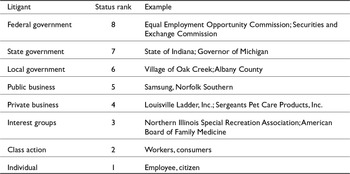
Consistent with sociolegal research on structural inequality in litigation, we operationalize litigant status as an ordinal measure of parties’ relative institutional capacity for litigation (Galanter Reference Galanter1974; Boyd (Reference Boyd2015a); Collins Reference Collins2004). Each party is classified into one of eight categories: (1) individuals, (2) class actions, (3) unions and interest groups, (4) privately held businesses, (5) publicly held businesses, (6) municipal and county governments, (7) state governments, (8) the federal government. When multiple parties appeared on one side, we assigned status based on the most institutionally advantaged party. Unlike prior studies that collapse all business entities into a single category, we distinguish private from public firms because publicly held companies typically possess more routinized infrastructures, greater access to capital, and more formalized compliance systems, which are organizational features linked to litigation capacity (Boot et al. Reference Boot, Gopalan and Thakor2006; Brav Reference Brav2009; Poulsen and Stegemoller Reference Poulsen and Stegemoller2008).
To measure status differences between litigants, we subtracted the non-moving party’s status ranking from the movant’s status ranking, creating a numeric scale ranging from −7 to +7. Positive values indicate that the moving party has higher status than the non-moving party. Negative values indicate that the moving party has lower status than the non-moving party. A value of zero indicates that litigants are of equal status. In our data, the modal status differential is zero (18%). Roughly one third of movants (32%) had a status disadvantage and roughly one half of movants (50%) had a status advantage. Table 2 shows litigant status rankings as well as representative examples of each type of litigant. Sensitivity checks using alternate specifications, such excluding and combining state and local governments, ranking businesses ahead of state and local governments, and excluding unions and other organizations yielded similar substantive results.
Litigant status rankings

Although categories such as “state government” or “local government” contain internal heterogeneity, such as variation in agency size and the use of outside counsel, we classify them as relatively institutionally advantaged because they possess stable legal capacity, recurring access to counsel, and repeat exposure to similar litigation, which together generate the portfolio-style advantages articulated by Galanter. The same logic applies to other categories. While civic organizations like unions and interest groups vary widely in resources, most maintain organizational continuity, mission-driven litigation strategies, and participate repeatedly in relevant issue areas. Likewise, multinational corporations and smaller national or regional firms differ in scale yet often share routine access to counsel, the ability to absorb litigation risk, and recurrent involvement in similar disputes. Our ordinal scale therefore captures structural and institutionalized litigation capacity, rather than financial size alone.
Judicial ideology is measured using Judicial Common Space (JCS) scores, which range from −1 (most liberal) to +1 (most conservative) (Boyd Reference Boyd2015b). JCS scores are derived from the ideology of the appointing president and, when applicable, the home-state senators involved in the confirmation process (Epstein et al. Reference Epstein, Martin, Segal and Westerland2007; Giles et al. Reference Giles, Hettinger and Peppers2001). District court JCS scores do not incorporate voting behavior, as trial judges do not generate the type of roll‐call-style votes used to measure the ideology of appellate judges and Supreme Court Justices. Nevertheless, JCS scores provide a standardized, institutionalized estimate of the ideological environment of judicial selection.
Because magistrate judges do not have JCS scores, we assign these judges the mean score of district judges in the same district, which is common in empirical studies of trial courts. JCS scores are widely used in research on federal judicial behavior, including district courts (e.g., Boyd Reference Boyd2015b; Kastellec (Reference Kastellec2013) Bonica and Sen (Reference Bonica2017)) because they offer a comparable, continuous measure of ideological orientation across judges who otherwise differ substantially in visibility, caseload, and opinion publication practices. Their value in this study lies in connecting ideological orientation to trial-level discretion in evidentiary decision–making, an arena in which judges exercise broad latitude and where ideological effects have been theorized but rarely measured systematically.
Control variables
Our regression models include several control variables. We control for area of law using categories based on the case’s nature of suit (NOS) code. Because there were more than 40 NOS codes in the data, we collapsed cases into six domains: public law, private law, business/corporate law, intellectual property, criminal law, and other specialized areas.Footnote 2 The most frequently observed kinds of cases within each category were civil rights and constitutional law (public), negligence and product liability (private), insurance and antitrust (corporate/business), and patent, trademark, and copyright (intellectual property). Cases in the specialized areas of law focused on a broad range of issues including maritime and admiralty law, federal railroad employees, and other specific topics. DaubertTracker assigns a single NOS code to each case. Although this simplifies the underlying legal complexity of some cases, the primary NOS generally captures the dominant legal issue motivating the Daubert motion. Additional analyses excluding NOS codes lead to similar conclusions.
To account for potential differences in how expert evidence is handled across circuits, our regression models included binary variables for judicial circuits. This addresses both doctrinal differences and circuit-level norms in the handling of expert testimony. Because women and men judges may rule differently on the admissibility of expert evidence (O’Brien Reference O’Brien2018), the regression models included a binary control for judges’ gender. Gender is one of the few demographic characteristics reliably available for district judges and incorporating it helps ensure that ideological effects are not inadvertently capturing gender-related variation. Finally, because gatekeeping decisions may differ depending on the party introducing the evidence (Buchman (Reference Buchman2007); Dioso-Villa Reference Dioso-Villa2016), we included a binary control variable to indicate the side represented by the expert. This ensures that observed status effects are not confounded by systematic differences in the roles parties play in evidentiary challenges. Together, these controls help to verify that the estimated effects of litigant status and judicial ideology are not attributable to variation in legal domain, regional judicial practice, judge characteristics, or asymmetries in which side introduces expert evidence.
Results
Descriptive analysis
To investigate whether higher-status litigants are more successful in disputes over the admissibility of expert evidence, we began with a visual inspection of the relationship between judges’ admissibility decisions and the relative status of the parties in the case. Table 3 contains a heat-map matrix of the average ruling associated with each observed litigant pairing. Row entries represent the moving party and column entries represent the non-moving party. For visualization purposes, rulings were placed on a three-point scale (1 = denied, 2 = limited, 3 = granted) where higher values are indicated by darker shading and reflect more judicial success for the moving party. Cells with fewer than eight observations are suppressed to due to sparse combinations. Full frequencies of litigant combinations are shown in Appendix Table A1.
Average judicial ruling, by litigant pairing

Notes: Cells contain the mean outcome for each combination of moving party (rows) and non-moving party (columns), coded on a three-point scale (1 = denied, 2 = limited, 3 = granted). Higher values and darker shading indicate greater success for the moving party. Cells with fewer than eight observations are suppressed. Full frequencies appear in Appendix Table A1.
Source: DaubertTracker.
Although many combinations are rare, common litigant pairings in Table 3 show a consistent pattern related to relative status and judicial success. Specifically, litigants tended to be more successful against lower status litigants than against equal or higher status litigants. For example, individuals fared better when moving to exclude evidence from other individuals than from local, state, or federal governmental opponents. Likewise, businesses and federal agencies were each more successful, on average, against individuals than against businesses.
These results are consistent with our claim that parties with greater structural capacity for litigation are more effective at shaping evidentiary records. They also provide descriptive support for the idea that status hierarchies shape the trial-level gatekeeping of expert evidence. At the same time, however, the association is not perfectly linear. For example, private businesses were, on average, more successful against other private businesses than against public corporations. And, local or state governments tend to be less successful than businesses against individuals. These irregularities likely reflect heterogeneity within status categories, especially among state and local governmental units. Nevertheless, the overarching pattern in Table 3 is that judicial success tends to increase with the movant’s relative status advantage, a pattern we investigate more carefully below.
Multinomial logistic regression
To determine whether these descriptive patterns remain after adjusting for additional legal and institutional factors and to test whether they are moderated by ideological context, we estimated a set of multinomial logistic regression models. Judges’ ruling on Daubert motions to exclude evidence was the dependent variable. The primary independent variables were litigants’ relative status and judges’ ideology. The model included control variables for legal domain, appellate circuit, judges’ gender, and experts’ side. Regression estimates are presented in Table 4.Footnote 3
Multinomial logistic regressions of judges’ gatekeeping decision

Notes: Table contains unstandardized logit coefficients. Robust standard errors in parentheses. Reference groups are female judge, defense expert, public law, First Appellate Circuit.
*** p < 0.001,
* p < 0.05,
+ p < 0.10.
Source: DaubertTracker, n = 811.
Model 1 examines the overall association between litigant status and judges’ gatekeeping decisions, net of control variables. Results indicate that relative status has a positive, statistically significant association with the odds of a decision to grant rather than deny (b = 0.106, p < 0.001). In other words, higher status litigants tend to be more successful in securing favorable evidentiary rulings, even after adjusting for judicial ideology and case characteristics.
To illustrate this relationship, Figure 1 shows the predicted probability of each ruling across the range of the status differential variable. The probabilities are computed based on the observed values of the covariates, averaged across cases. They can therefore be thought of as the probability of judicial rulings for the typical litigant at each level of status advantage and disadvantage.Footnote 4
Adjusted judicial decisions by litigant status.

Consistent with the descriptive results, the regression model suggests that differences in litigant status are associated with systematic differences in judges’ evidentiary rulings. For example, the probability of the most favorable ruling (i.e., motion granted) is nearly three times higher for the most advantaged litigants (35%) compared to the most disadvantaged litigants (13%). Alternatively, the probability of the least favorable ruling (i.e., motion denied) is more than 50% higher for the most disadvantaged litigants than for the most advantaged ones (65% vs. 40%). Tests of second difference indicate that both these differences in probabilities are statistically significant (d = 0.21, p < 0.01; d = 0.25, p < 0.01).
The figure also illustrates that these effects are not symmetric across outcome categories. For the most status-disadvantaged litigants, the probability of a denial is substantially and significantly higher than the probability of decisions to grant (d = 0.52, p < 0.01) or partly grant (d = 0.44, p < 0.01). Even among litigants of equal status, the probability of denial is significantly higher than the probability of decisions to grant (d = 0.31, p < 0.01) or partly grant (d = 0.29, p < 0.01). Yet for the most advantaged litigants, there is no statistically significant difference in the probabilities of decisions to deny and to grant (d = 0.06, p = 0.40).
Altogether, these results suggest that the most disadvantaged litigants are roughly twice as likely to receive the least favorable ruling as they are to receive a more favorable one, whereas the most advantaged litigants face roughly equal odds of the best and worst outcomes. In short, litigant status is a strong and robust predictor of evidentiary success, even after controlling for legal domain, judicial circuit, judicial gender, and the side offering the expert. Next, we consider whether these effects are uniform across the judiciary, or whether the ideological context of the courtroom moderates the link between litigant status and judicial behavior.
The moderating effect of judicial ideology
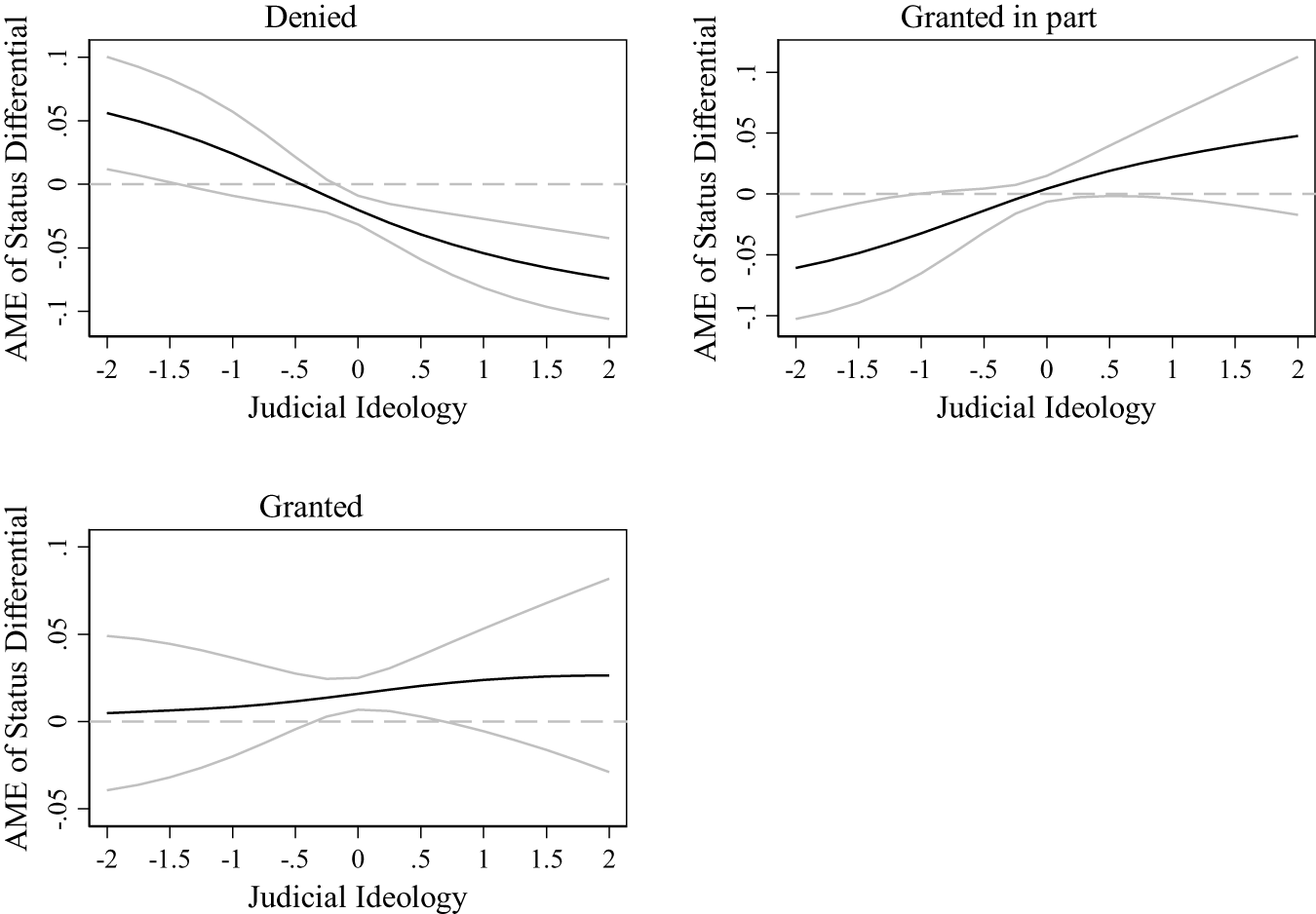
Although litigant status exerts a considerable influence on gatekeeping outcomes, we hypothesized that the effects of status hierarchies are more pronounced in conservative legal forums than liberal ones. To evaluate this possibility, Model 2 included an interaction between litigants’ relative status and the ideology of the presiding judge, estimated as the product of the two variables. Because interactions in multinomial logit models cannot be interpreted directly from coefficients, we follow best practice (Mize Reference Mize2019) and rely on predicted probabilities and AMEs. AMEs quantify how much the probability of each outcome is expected to change, on average, for a one-unit increase in relative status across the range of judicial ideology. Effects are statistically significant (p < 0.05) when the confidence interval does not cross zero.
Figure 2 plots the AMEs of litigant status across judicial ideology, with all other covariates held at their observed values. The figure shows that there are substantial ideological differences in the effects of litigant status on gatekeeping outcomes. Specifically, a status advantage increases litigants’ chances of success in conservative courts and decreases litigants’ chances of success in liberal courts. For example, a one-unit increase in litigant’s relative status increases the likelihood of a denial by roughly 6 percentage points in cases assigned to the most liberal judges. This effect weakens as the ideological context becomes more conservative, crosses zero in the mid-range of the JCS scale, and becomes negative among cases assigned to the most conservative judges. At that end of the scale, a one-unit increase in relative status is associated with a 7-percentage point decrease in the chances of a denial. In other words, status-advantaged litigants fared better in conservative forums and worse in liberals ones.
Average marginal effects of judicial ideology and litigant status on judges’ gatekeeping decisions.

The pattern for decisions to partially grant is the inverse. A one-unit increase in status advantage is associated with a 6-percentage point reduction in the chances of a decision to partially grant in the most liberal forums. However, the effects of ideology once again are diminished and are statistically insignificant in more moderate ideological contexts. In the most conservative contexts, the AME becomes positive although it does not reach statistical significance at conventional levels (p < 0.10).
For decisions to grant, the moderating effect of ideological context is more modest. AMEs for these decisions are small and statistically indistinguishable from zero across most of the ideological spectrum. However, in moderate and slightly conservative judicial contexts, the AMEs become positive and statistically significant, suggesting that higher-status litigants are more likely to succeed in cases assigned to centrist and right-of-center judges, after adjusting for other factors.
Altogether, the AMEs reveal notable ideological differences in how litigant status relates to evidentiary outcomes. The status advantages often associated with judicial success are only advantages in conservative forums. In liberal forums, status advantages are actually associated with longer odds of judicial success. These findings are consistent with the broader claim that structural advantages are amplified in conservative legal forums and reduced in liberal ones.
In sum, the regression results extend the descriptive findings in two important ways. First, they demonstrate that the overall association between litigant status advantage and judicial gatekeeping outcomes is robust to controls for case characteristics, jurisdiction, and judge-specific factors. However, the results reveal that the effect of status is conditional on the ideological context of the legal forum. In the most conservative and liberal judicial contexts, status hierarchies have clear, opposing effects on gatekeeping outcomes. In more ideologically moderate settings, status differentials have limited influence. These patterns support Galanter’s (Reference Galanter1974) classic claim that the “haves” come out ahead, while also highlighting that in evidentiary contexts, these advantages are contingent on the ideological orientation of the legal forum. Thus, these findings underscore the dual importance of litigant status and judicial ideology in shaping legal outcomes and point to a stage of the judicial process where structural inequalities may be either mitigated or amplified, depending on the ideological context.
Discussion
This article examined how disparities in litigant status shape the judicial gatekeeping of expert evidence and how this relationship varies depending on the ideological context of the legal forum. Consistent with Galanter’s (Reference Galanter1974) classic theory, we find that higher-status repeat players, such as corporations and government actors, are more likely to secure favorable evidentiary rulings. Across both descriptive and regression analyses, status-disadvantaged parties had lower odds of success, while status-advantaged parties had higher odds. However, these effects are conditional on judges’ ideological orientations. Specifically, status advantages are strengthened in cases assigned to conservative judges and weakened in cases assigned to liberal judges. Altogether, these findings suggest that the courtroom functions not only as a setting where resources matter but also as a forum in which ideological context shapes how those resources translate into legal outcomes.
Our results are consistent with the possibility that repeat players may respond to ideological variation through post-assignment decisions to settle or pursue cases, especially when expert evidence is central. That is, in cases where expertise will play a large role, repeat players may settle lawsuits assigned to liberal judges while forging ahead with those assigned to conservatives. Because our data come from adjudicated Daubert rulings, we cannot assess these post-assignment dynamics directly. However, future research into how parties respond to case-assignment would shed additional light on the relationships we identified and help to clarify our understanding of forum shopping more generally.
Beyond their significance for research on litigant status, our findings contribute to the literature on judicial ideology by suggesting that ideology shapes the exercise of procedural discretion. While prior work has often examined how ideological orientation influences substantive legal outcomes, we extend this scholarship by showing that ideological context also moderates the effect of litigant status on evidentiary rulings. Specifically, conservative forums provide a more favorable context for higher-status litigants while liberal legal forums are more favorable for lower-status litigants. These findings provide evidence that ideology is associated with systematic variation in how procedural discretion is applied. This insight helps explain how ideological contexts can either reinforce or undermine structural inequalities in the courtroom and points to a mechanism through which ideology interacts with litigant characteristics to shape trial-level decisions.
Robustness checks confirm that these findings are not sensitive to alternative codings of litigant status. This strengthens our confidence that the results reflect genuine differences in parties’ institutional capacity to litigate rather than artifacts of measurement choices. By focusing on expert admissibility, a discretionary, high-stakes procedural domain, this study highlights a critical point at which litigation inequalities are reproduced or attenuated. Status advantages at this stage can influence settlement, trial outcomes, and broader legal norms. Overall, these results extend Galanter’s framework by showing that structural power interacts with judicial ideology to shape procedural outcomes.
In addition to their theoretical implications, these findings speak to broader questions of legal mobilization and access to justice. Lower-status litigants may experience relatively favorable procedural outcomes in cases assigned to liberal judges while higher-status litigants may be more successful in cases assigned to conservative judges. These decisions about expert evidence thus reflect the interplay of litigant resources, procedural discretion, and broader institutional patterns associated with judicial ideology. As litigation increasingly involves complex scientific and technical claims, equitable application of evidentiary standards is crucial to maintaining public trust in the legal system.
Despite these contributions, there are several notable limitations to our study. First, our analysis is limited to federal district court decisions involving Daubert challenges. These dynamics may not generalize to other types of procedural rulings or to state courts, which operate under different evidentiary frameworks. Second, although our status-differential measure captures theoretically meaningful asymmetries between litigants, it does not capture within-category variation, such as differences among corporate or government entities, which may also shape judicial outcomes. While our strategy aligns with established quantitative approaches to studying litigant resources, within-category analyses could provide additional insight into the broader patterns we observe. Third, although we identify a moderating role for judicial ideology, we do not examine the specific cognitive or institutional mechanisms through which ideology operates. Qualitative or mixed-method studies could clarify how judges rely on status cues and ideological commitments in real time. Expanding this inquiry to other procedural domains would also help clarify how inequality manifests at various stages of litigation. Finally, because our analysis is observational, we cannot definitively establish causality. Although our regression models adjust for numerous legal, social, and political factors, unobserved variables may still influence the relationships we observe between litigant status, judicial ideology, and evidentiary outcomes. Accordingly, the results should be interpreted as evidence of systematic patterns rather than as proof that status or ideology directly causes particular judicial decisions. Future research using experimental or quasi-experimental designs could help clarify the causal mechanisms through which structural advantages translate into procedural outcomes.
Although our data cover an earlier period of federal district court decisions, the dynamics we identify remain relevant for understanding contemporary litigation. While judicial appointments under the Biden and second Trump administrations may have shifted the ideological composition of the federal bench, it is not clear whether a compositional change would impact the interplay between litigant status and judicial ideology in shaping procedural outcomes. Future work could examine how these patterns have evolved in light of more recent changes to court compositions and in response to ongoing changes in the types of cases reaching district courts.
This article shows that litigant status significantly influences the judicial gatekeeping of expert evidence, and that the direction of this influence depends on the ideological context of the legal forum. These findings highlight the discretionary nature of evidentiary rulings and illustrate how status hierarchies become embedded in legal institutions. As evidentiary standards continue to evolve, particularly in technically complex litigation, attention to how power operates through procedural decision-making is essential. By bringing status and ideology to the forefront of evidentiary rulings, this study underscores that inequality in courts involves not only who wins and loses but also whose knowledge is permitted to shape legal outcomes in the first place.
Acknowledgements
An earlier version of this paper was presented at the 2022 American Sociological Association meetings. We thank Myles Levin for access to data from DaubertTracker and members of the University of Wisconsin-Milwaukee’s sociology department’s writing workshop for helpful feedback on this research.
Conflict of interest
The authors declare no conflict of interest.
Ethical Standards
This research was approved by the University of Wisconsin-Milwaukee Institutional Review Board. Support for this research comes from the National Science Foundation (award# 1946236) and the University of Wisconsin-Milwaukee (Advancing Research and Creativity Award, Project ID AAJ1551).
Appendix
Frequency of litigant pairings






 Open access

