


Introduction
Suicidality is a term that covers suicidal ideation (serious thoughts about taking one's own life), suicide plans and suicide attempts. Suicidality is a prevalent public health problem. Investigations among different countries revealed a lifetime prevalence estimate for suicidal ideation ranging from 2.1% to 18.5%, as well as a lifetime prevalence estimate for suicide attempts ranging from 0.7% to 6.0% (Weissman et al., Reference Weissman, Bland, Canino, Greenwald, Hwu, Joyce, Karam, Lee, lellouch, Lepine, Newman, Rubio-Stipec, Wells, Wickramaratne, Wittchen and Yeh1999). A recent meta-analysis in worldwide college student samples reported that pooled prevalence estimates of lifetime suicidal ideation, plans and attempts were 22.3%, 6.1% and 3.2%, respectively, and for 12-month prevalence, these were 10.6%, 3.0% and 1.2%, respectively (Mortier et al., Reference Mortier, Cuijpers, Kiekens, Auerbach, Demyttenaere, Green, Kessler, Nock and Bruffaerts2018). The risk of suicidality tends to be even higher in disaster-exposed populations. For example, a study on communities affected by Hurricane Katrina revealed a 78.6-times higher rate of post-disaster suicide attempts than the area's baseline rate (Acierno et al., Reference Acierno, Ruggiero, Galea, Resnick, Koenen, Roitzsch, Arellano, Boyle and Kilpatrick2007). In a sample of Chinese adolescents exposed to the 2008 Wenchuan earthquake, the rates of suicidal ideation were found as high as 35.6%, 35.6% and 30.7% at 6, 12 and 18-month post-disaster, respectively (Ran et al., Reference Ran, Zhang, Fan, Li, Li, Ou, Jiang, Tong and Fang2015). It has also been noted that suicidal thoughts and behaviours might continue for years after the disaster (Kõlves et al., Reference Kõlves, Kõlves and De Leo2013). Research into factors related to suicidality, especially in disaster-exposed samples, is of great clinical and practical implications.
Depression and other psychiatric disorders have been shown to be highly comorbid with or notably increase the risk of suicidality (Hawton et al., Reference Hawton, Casanas, Haw and Saunders2013; Ran et al., Reference Ran, Zhang, Fan, Li, Li, Ou, Jiang, Tong and Fang2015). In community populations, the close links between depressive symptoms and suicidality have been cross-sectionally and longitudinally established (Kessler et al., Reference Kessler, Berglund, Borges, Nock and Wang2005; Nock et al., Reference Nock, Hwang, Sampson and Kessler2010; Economou et al., Reference Economou, Angelopoulos, Peppou, Souliotis, Tzavara, Kontoangelos, Madianos and Stefanis2016). However, previous studies have usually employed a variable-centred approach, without considering the individual variance in time-varying changes of depressive symptoms. To our knowledge, only a few studies have investigated whether individuals with different trajectories of depressive symptoms during a prior time would have different suicidality outcomes in a later time. For example, a 12-year follow-up study of offspring of parents with mood disorders found that the trajectory of depressive symptoms with the highest mean scores and variability over time significantly predicted suicide attempt (Melhem et al., Reference Melhem, Porta, Oquendo, Zelazny, Keilp, Iyengar, Burke, Birmaher, Stanley, Mann and Brent2019). Another study followed 361 5th-grade students into their young adulthood and found that the lifetime history of suicide attempts assessed at age 25 could be attributed to a higher intercept (at grade 5) and slope (increases from grades 5 to 10) of depressive symptoms (Kerr et al., Reference Kerr, Reinke and Eddy2013). These studies provided some initial evidence for the impacts of depressive symptoms trajectory membership on future suicidality.
Previous studies have also indicated depressive symptoms as critical factors for suicidality in diverse samples exposed to natural or human-related disasters (Warheit et al., Reference Warheit, Zimmerman, Khoury, Vega and Gil1996; Pietrzak et al., Reference Pietrzak, Goldstein, Malley, Rivers, Johnson and Southwick2010; Bryan and Corso, Reference Bryan and Corso2011; Lemaire and Graham, Reference Lemaire and Graham2011). For example, Lee et al. (Reference Lee, Kearns, Wisco, Green, Gradus, Sloan, Nock, Rosen, Keane and Marx2018) found that depression is associated with suicide attempts among Operations Enduring Freedom (OEF) and Iraqi Freedom (OIF) veterans during the 2-year follow-up period. Likewise, Wagenaar et al. (Reference Wagenaar, Hagaman, Kaiser, McLean and Kohrt2012) conducted a cross-sectional survey of 408 adults in Haiti's Central Plateau, they found that depression is related to endorsing suicidal ideation. In Chinese samples of Wenchuan earthquake survivors, depressive symptoms have been cross-sectionally (Guo et al., Reference Guo, He, Fu, Han, Qu, Wang and Guan2017; Tang et al., Reference Tang, Zhao, Lu, Zha, Liu, Sun, Zhang, Yang and Xu2018) and longitudinally (Ran et al., Reference Ran, Zhang, Fan, Li, Li, Ou, Jiang, Tong and Fang2015) identified to be significantly associated with suicidality. However, above mentioned longitudinal studies are usually limited by a short follow-up duration. It is unclear whether there is a long-lasting effect of depressive symptoms in the early phases post-disaster on suicidality after several years post-disaster. Moreover, no study to date has employed a person-centred approach to examine in disaster-exposed samples the associations between depressive symptoms trajectory membership and suicidality.
Further, the impacts of depressive symptoms on suicidality might differ across survivors’ genders, therefore, some authors proposed that it is of great importance to conduct in-depth study separately by gender (Kerr et al., Reference Kerr, Reinke and Eddy2013). While some studies showed that females were more likely to commit suicidality in the aftermath of natural disasters (Hyodo et al., Reference Hyodo, Nakamura, Oyama, Yamazaki, Nakagawa, Ishigami, Tsuchiya and Yamamoto2010; Fujiwara et al., Reference Fujiwara, Yagi, Homma, Mashiko, Nagao and Okuyama2017), other studies reported increased suicidality among males (Yang et al., Reference Yang, Xirasagar, Chung, Huang and Lin2005; Liaw et al., Reference Liaw, Wang, Huang, Chang and Lee2008). As for the impacts of depressive symptoms on suicidality stratified by gender, it is commonly considered that depressive symptoms are more strongly associated with high suicide risk in females than males (Bergen et al., Reference Bergen, Martin, Richardso, Allison and Roeger2003; Tang et al., Reference Tang, Yen, Cheng, Yang, Chen, Yang, Huang, Jong and Yu2010). However, Lewinsohn et al. (Reference Lewinsohn, Rohde, Seeley and Baldwin2001) found in a sample of 1709 adolescents that major depression could predict suicidal attempts for both females and males. Other studies showed that lifetime suicide risk in major depression is predominantly a male problem (Blair-West et al., Reference Blair-West, Cantor, Mellsop and Eyeson-Annan1999; Oliffe et al., Reference Oliffe, Ogrodniczuk, Bottorff, Johnson and Hoyak2012). Assumably, these contrasting findings may be compounded by heterogeneity of depression trajectories. To our knowledge, however, no longitudinal studies have addressed this importance issue.
In addition, the transition from adolescence to young adulthood referred to as ‘emerging adulthood’, represents a key developmental period (Arnett, Reference Arnett2000). Emerging adulthood is characterised with less stable living situations, an unestablished sense of life purpose, various interpersonal matters and stress of entering college or workforce (Arnett, Reference Arnett2000; Horwitz et al., Reference Horwitz, Czyz and King2015; Lanctot and Poulin, Reference Lanctot and Poulin2018). Meanwhile, it has been shown that individuals in the emerging adulthood have a high risk of suicidal behaviours (Horwitz et al., Reference Horwitz, Czyz and King2015; Thompson and Swartout, Reference Thompson and Swartout2018). Given the importance and distinction of this period, it is of great necessity to identify the risk factors to help those young survivors transit to the next developmental stage smoothly.
In our Wenchuan Earthquake Adolescent Health Cohort (WEAHC) study (see a description of the cohort profile in Fan et al., Reference Fan, Zhou, Mo, Zhang, Xie, Liu and Group2017), We longitudinally investigated in a large cohort of adolescent earthquake survivors their depressive symptoms during 2.5 years post-earthquake. In 2018, we conducted a 10-year follow-up of this cohort and investigated their suicidality in young adulthood. This provided an opportunity to delineate whether individual variance in depressive symptoms during the early phases post-earthquake could generate different suicidality outcomes in a long-term. A major aim of the current study was to address such an issue. According to previous findings in disaster-exposed samples (e.g. Schubert et al., Reference Schubert, Clark, Van, Collinson and Baune2017; Lenferink et al., Reference Lenferink, Nickerson, de Keijser, Smid and Boelen2018; Karstoft et al., Reference Karstoft, Nielsen, Armour, Vedtofte and Andersen2020), common trajectories of depressive symptoms include ‘resistance’ (no or minimal symptoms over time), ‘chronic’ (severe symptoms over time), ‘delayed dysfunction’ (initially minimal/no symptoms followed by elevated symptoms), ‘recovery’ (initially severe symptoms followed by a relief) and ‘relapsing/remitting’ (a cyclical pattern of symptoms). We hypothesised that the chronic, delayed or relapsing/remitting trajectories would predict increased likelihoods of suicidal ideation, plans and attempts than the resistance or recovery trajectories did. Given that the risk of depressive symptoms and suicidality might differ across genders (Liaw et al., Reference Liaw, Wang, Huang, Chang and Lee2008; Hyodo et al., Reference Hyodo, Nakamura, Oyama, Yamazaki, Nakagawa, Ishigami, Tsuchiya and Yamamoto2010; Fujiwara et al., Reference Fujiwara, Yagi, Homma, Mashiko, Nagao and Okuyama2017), the current study also aimed to examine whether there were gender disparities in associations between adolescents’ post-earthquake depressive symptoms trajectory membership and their adulthood suicidality.
Methods
Wenchuan earthquake adolescent health cohort study
The Wenchuan Earthquake Adolescent Health Cohort Study (WEAHC) began in November 2008 (e.g. 6 months post-earthquake) and conducted five waves of surveys at 6, 12, 18, 24 and 30 months post-earthquake in a cohort of 1573 earthquake-exposed adolescents, with the aim of investigating adolescents’ mental health sequela of earthquake exposure (Fan et al., Reference Fan, Zhou, Mo, Zhang, Xie, Liu and Group2017). To understand adulthood outcomes associated with adolescent earthquake exposure, our team conducted a 10-year follow-up after the earthquake (November 2018).
Participants and procedure
Participants of the WEAHC study were 1573 adolescents including all 7th graders (n = 216) from a junior high school and 10th graders (n = 1357) from a senior high school in Dujiangyan city, one of the cities most affected by the earthquake. At the 10-year follow-up, 799 participants responded (response rate was 58.9%) and took part in our survey. This study included for analysis 744 participants who completed questionnaires at 6 months (T6m), 18 months (T18m), 30 months (T30m) and 10 years (T10y) after the earthquake.
For the original WEAHC study, ethical approval was obtained from the Human Research Ethics Committee of South China Normal University, and informed consent was obtained from adolescent participants and their parents before collecting data. Permission was also obtained for the participating schools. Participants completed a number of questionnaires in classroom settings under the supervision of local teachers and psychological professionals from South China Normal University. For the 10-year follow-up, ethical approval was also obtained from the Human Research Ethics Committee of South China Normal University, and informed consent was obtained from all responders. Their data were collected through an online survey.
Measures
Demographic information
Demographic information collected at T6m included age, gender, number of children in the family, residence and parents’ education. Demographic information collected at T10y were BMI, education, personal income, marriage, current drinking and smoking.
Depressive symptoms
The Depression Self-Rating Scale for children (DSRSC) was used to assess adolescents’ depressive symptoms (Su et al., Reference Su, Wang, Zhu, Luo and Yang2003). This scale includes 18 items with 3-point Likert scale ranging from 0 (never) to 2 (most of the time), with higher scores indicating higher levels of depressive symptoms. It has presented excellent reliability and validity among Chinese children (Ye et al., Reference Ye, Fan, Li and Han2014). Probable depression was indicated by a cut-off score of 15 (Su et al., Reference Su, Wang, Zhu, Luo and Yang2003). In this study, the Cronbach's α for DSRSC was 0.79 at T6m, 0.82 at T18m and 0.85 at T30m.
Three aspects of suicidality
Suicidal ideation, plans and attempts in the past year were measured by three questions at 10 years after the earthquake, e.g. ‘In the past year, have you thought seriously about suicide?’, ‘In the past year, have you ever made plans to commit suicide?’, ‘In the past year, have you ever attempted suicide?’. Responses were recorded as a dichotomous variable: no (0), yes (1). These questions have been widely used for assessing suicidality in China (Liu et al., Reference Liu, Chen, Chan, Lee, Law, Conwell and Yip2006).
Earthquake exposure
The exposure to the earthquake was assessed at T6m with four self-rated items: (1) family members’ death, missing and/or injury; (2) house damage; (3) property loss; and (4) direct witness of tragic scenes. The assessment was rated on a 5-point scale, with 1 representing the highest level of exposure and 5 representing the lowest. In this study, the total scores (ranging from 4 to 20) were inversely recorded, thus, a higher total score indicates higher earthquake exposure.
Post-earthquake negative life events
The Adolescent Self-Rating Life Events Checklist (ASLEC) (Liu et al., Reference Liu, Liu, Yang and Zhao1997) was selected to assess the severity of negative life events at T6m. It contains 26 items with six domains of negative life events including interpersonal conflicts; academic pressure; being punished; personal loss; physical health problems; and others. Each item was rated on 5-point scale ranging from 1 (not at all) to 5 (extremely severe). In this study, the Cronbach's α for ASLEC was 0.88 at T6m.
Negative life events at T10y with ten items were devised based on the Adolescent Self-Rating Life Events Checklist (ASLEC) (Liu et al., Reference Liu, Liu, Yang and Zhao1997). Based on the ASLEC, we added some items relating to common negative life events (including the death of a close family member, relative, or a friend, subject of a serious accident, victim of physical assault, victim of sexual assault or other unwanted sexual experiences, subject of serious injury or illness, or guardian's divorce, etc.) in emerging adulthood. Responses were recorded as a dichotomous variable: ‘happened’ (1) and ‘not happened/didn't know’ (0). In the current study, the Cronbach's α for Negative life events at T10y was 0.67.
Statistical analysis
Of the 744 analytical samples, 0.7%, 12.4% and 25.3% had missing data on depressive symptoms at T6m, T18m and T30m, respectively. Of the total, 6.9% had missing data on earthquake exposure, 0.1% on income and 0.4% on negative life events at T6m. Little's Missing Completely at Random (MCAR) test was used to analyse the missing values in all variables and it showed that the missings were at random χ 2 (56) = 61.41, p = 0.29. Expectation-maximisation (EM) algorithm was employed to impute missing data for those variables.
The primary analyses in this study included three steps. In the first step, to depict the change patterns of depressive symptoms at T6m, T18m and T30m, subjects were classified into the probable depressive symptoms and no depressive symptoms according to the cut off 15 for probable depressive symptoms. According to the previous research method (Fan et al., Reference Fan, Long, Zhou, Zheng and Liu2015), five trajectories were expected: those consistently had no probable depressive symptoms at three waves (Resistance); those maintained probable depressive symptoms at three waves (Chronic); those had depressive symptoms at 6 and/or 18 months but no depressive symptoms at 30 months (Recovery); those had no depressive symptoms at 6 and/or 18 months followed by probable depressive symptoms at 30 months (Delayed dysfunction); those showed a cyclical pattern of depressive symptoms across the follow-up periods (Relapsing/remitting). Then, binary logistic regression analyses were performed to examine the predictive effects of adolescents’ depressive symptoms trajectory membership on their suicidality 10 years after the earthquake. We tested crude models and adjusted models. The crude models only involved the trajectory membership as the independent variable and the adjusted models further included covariates including gender, education, marriage, income, earthquake exposure and negative life events at T6m and T10y. The crude models and adjusted models were further tested separately in two genders.
Results
Sample characteristics
Table 1 presents the analytical sample's demographic characteristics and prevalence of suicidality in different groups of demographic variables. Of the total, 40.9% of the sample were male and the mean age was 15.44 (s.d. = 0.66) at T6m. At T10y, 80 (10.8%) participants had suicide ideation, 54 (7.3%) planned to commit suicide and 22 (3.0%) committed suicide attempts in the past year.
Prevalence of suicidality among survivors (N = 744)

M, mean; s.d., standard deviation; BMI, body mass index; T6m, data collected at 6 months after the earthquake; T10y, data collected at 10 years after the earthquake.
Trajectories of depressive symptoms
As shown in Figs 1 and 2, five trajectories of depressive symptoms were identified: resistant, chronic, recovery, delayed dysfunction and relapsing/remitting. The resistant group (n = 405, 54.43%) comprised the majority of the sample, characterising by depressive symptoms being below the cut-off of 15 at all three waves. In the chronic dysfunction group (n = 99, 13.31%) depressive symptoms were equal to or above the cut-off value at all waves. The recovery group (n = 77, 10.35%) was characterised by participants’ depressive symptoms being equal to above the cut-off value at T6m and/or T18m but below the cut-off at T30m. The delayed dysfunction group (n = 89, 11.96%) was characterised by depressive symptoms being below the cut-off at T6m and/or T18m but equal to or above the cut-off at T30m. The relapsing/remitting (n = 74, 9.95%) was characterised by depressive symptoms fluctuating and showing a cyclical course across three waves.
Change patterns of depressive symptoms after the Wenchuan earthquake. Values represent numbers and percentage of survivors screened as having depressive symptoms at each wave.

Mean scores of depression symptoms at three follow-ups after the earthquake.

Trajectory membership of depressive symptoms predicting suicidality
Logistic regression analyses were employed to examine the prediction of depressive symptoms trajectories on suicidality. We set the resistant group as the referent group and compared it with other trajectories. As shown in Tables 2 and 3, the adjusted model was controlled for the effects of gender, education, marriage, income, earthquake exposure and negative life event (T6m & T10y). In the whole sample, compared to the resistant group, the relapsing/remitting group had higher odds of suicidal ideation (OR = 3.69, 95% CI = 1.82–7.47, p < 0.001), suicide plans (OR = 4.22, 95% CI = 1.83–9.77, p = 0.001) and suicide attempts (OR = 7.67, 95% CI = 1.66–35.40, p = 0.009). Meanwhile, the chronic group had higher odds of suicide attempts (OR = 5.77, 95% CI = 1.33–24.97, p = 0.019). As for different genders, males in the relapsing/remitting group had higher odds of suicide ideation (OR = 5.89, 95% CI 1.94–17.84, p = 0.002) and plans (OR = 9.50, 95% CI 2.37–38.10, p = 0.001) than males in the resistant group did, and females in the relapsing/remitting group had higher odds of suicide ideation (OR = 2.77, 95% CI 1.09–7.03, p = 0.032) and plans (OR = 2.97, 95% CI 1.003–8.78, p = 0.049) than females in the resistant group did. Besides, males in the chronic group also had higher odds of suicide plans (OR = 7.46, 95% CI 1.59–35.05, p = 0.011) than males in the resistant group, but there was no such difference in females.
Depressive symptoms trajectory membership predicts suicidal ideation after 10 years earthquake
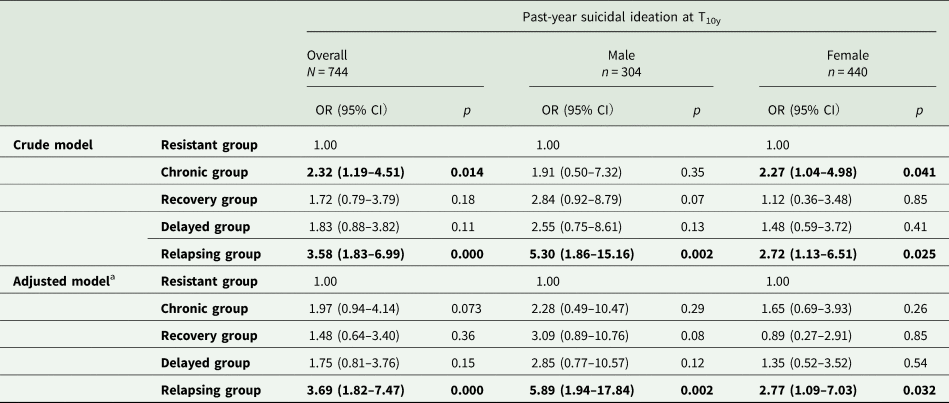
p < 0.05 is significant.
a Adjusting for gender, education (T10y), marriage (T10y), income (T10y), negative life events (T6m & T10y), earthquake exposure.
Depressive symptoms trajectory membership predict suicidal plans and attempts after 10 years earthquake
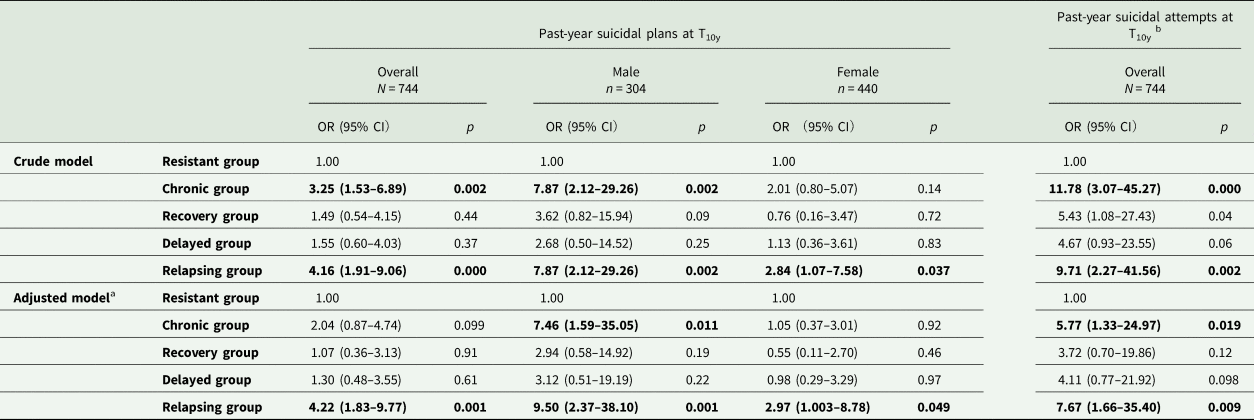
p < 0.05 is significant.
a Adjusting for gender, education (T10y), marriage (T10y), income (T10y), negative life events (T6m & T10y), earthquake exposure.
b We did not separate genders when considered suicide attempts as the dependent variable because suicide attempts are a rare event. Hence, there were limited numbers in the depressive symptoms trajectories.
Discussion
This study is the first to follow-up a large cohort of Chinese adolescents exposed to the Wenchuan earthquake from their adolescence into young adulthood. Prevalence estimates of past-year suicidal ideation, suicide plans and suicide attempts measured at 10 years post-earthquake were found to be 10.8%, 7.3% and 3.0%, respectively. This is in line with existing evidence that suicidal thoughts and behaviours might continue for years after the disaster (Kõlves et al., Reference Kõlves, Kõlves and De Leo2013). Compared with the non-exposure population (e.g., 12-month prevalence of suicidal ideation, plans and attempts, these were 10.6%, 3.0% and 1.2%, respectively, Mortier et al., Reference Mortier, Cuijpers, Kiekens, Auerbach, Demyttenaere, Green, Kessler, Nock and Bruffaerts2018), the suicide risk among earthquake-exposed population revealed a higher rate. Therefore, we suggest that it is necessary to identify the survivor who has suicide risk after disasters. Further, employing a person-centred approach, we examined the associations between adolescents’ depressive symptoms trajectory membership during the early phases post-earthquake and their suicidality in young adulthood. We also examined whether there were gender disparities in such associations.
In our study, five groups of depressive symptoms trajectories were identified during 2.5 years post-earthquake, namely, chronicity (13.3% of the whole sample), recovery (10.4%), delayed dysfunction (12.0%), relapsing/remitting group (10.0%) and resistance (54.4%). Previous studies on Wenchuan earthquake survivors have cross-sectionally (Guo et al., Reference Guo, He, Fu, Han, Qu, Wang and Guan2017; Tang et al., Reference Tang, Zhao, Lu, Zha, Liu, Sun, Zhang, Yang and Xu2018) and longitudinally (Ran et al., Reference Ran, Zhang, Fan, Li, Li, Ou, Jiang, Tong and Fang2015) demonstrated the associations between depressive symptoms and suicidality. Extending previous findings, our whole-sample regressions without covariates revealed that adolescent survivors with chronic or relapsing/remitting depressive symptoms compared with those in the resistant group were more likely to have suicidal ideation, plans and attempts in young adulthood. However, after controlling for covariates including demographic variables, negative life events and earthquake exposure, only the relapsing/remitting depressive trajectory remained significantly predictive of suicidal ideation, plans and attempts. A possible explanation for these results is that survivors in the relapsing/remitting group experienced ups and downs of depressive symptoms and they might feel hopeless about their mental status, which might, in turn, heighten the risk of suicidality (David et al., Reference David Klonsky, Kotov, Bakst, Rabinowitz and Bromet2012). Research regarding different depressive trajectory memberships shows that trauma survivors with a chronicity or delayed-onset pattern should be considered as the high-risk earthquake survivors compared with those showing a resistance or recovery pattern (e.g. Zhou et al., Reference Zhou, Han and Fan2016). In our study, however, we find delayed group have no effect on the suicidality of the survivors 10 years later. One possible explanation is that individuals in the delayed group did not suffer from depressive symptoms in the early period after the earthquake and they might have more energy to seek help, thus, these might reduce the risk for later suicidality. Identifying the targeted change patterns of depressive symptoms may be necessary to reduce suicidality after the earthquake.
Previous cross-sectional studies have suggested that associations between depressive symptoms and suicidality might differ across genders in the community or disaster-exposed samples (Blair-West et al., Reference Blair-West, Cantor, Mellsop and Eyeson-Annan1999; Lewinsohn et al., Reference Lewinsohn, Rohde, Seeley and Baldwin2001; Bergen et al., Reference Bergen, Martin, Richardso, Allison and Roeger2003; Tang et al., Reference Tang, Yen, Cheng, Yang, Chen, Yang, Huang, Jong and Yu2010). In a longitudinal study, Melhem et al. (Reference Melhem, Porta, Oquendo, Zelazny, Keilp, Iyengar, Burke, Birmaher, Stanley, Mann and Brent2019) found that a trajectory of depressive symptoms with the highest mean scores and variability over time significantly predicted suicide attempt among offspring of parents with mood disorders, however, this study did not take into account the different genders. Furthermore, gender-specific analyses in our study indicated that males not females in the chronic group were more likely to have suicide plans. There are several possible explanations for the associations between chronic depressive symptoms and suicide plans among males. First, females are usually more likely to express their distress and seek external help, and they are more likely to receive mental health service for depressive symptoms (Blair-West et al., Reference Blair-West, Cantor, Mellsop and Eyeson-Annan1999). Contrarily, males usually tend to withhold their feelings and utilise maladaptive behaviours such as substance abuse and self-injure to deal with their emotional distress (Wilhelm, Reference Wilhelm2009; Martin et al., Reference Martin, Neighbors and Griffith2013), which might cause the higher risk for males to have suicide plans. Second, chronic depressive symptoms might cause unemployment and impairments in other aspects of social functioning. In Chinese culture, males are generally considered as breadwinners of the family and females are more likely to be expected as secondary workers. In this sense, unemployment and associated consequences (such as financial problems, diminished social status) might adversely influence males’ mental status to a larger extend (Chuang and Huang, Reference Chuang and Huang2006). It should be noted that these explanations are tentative. Future research is needed to clarify the mechanisms underlying the gender-specific associations between disaster survivors’ depressive symptoms trajectory membership and their future suicidality.
Strengths and limitations
Methodologically, this study has some merits, such as a large sample size, a 10-year follow-up from participants’ adolescence into young adulthood and multi-wave data collection that allows the examination of heterogeneous depressive symptoms trajectories. There are also some limitations to this study. For example, the original WEAHC study did not collect data on participants’ suicidality in adolescence, as such, it is impossible for us to control the suicidality at baseline. In addition, all measures relied on self-report questionnaires, may cause reporting bias. Further, the negative life events at T10y were a self-devised questionnaire.
Clinical implications
This study contributed to the literature through examining in a large cohort of natural disaster survivors the associations between adolescents’ depressive symptoms trajectory membership in the early phases post-disaster and their suicidality in young adulthood. The impact of the earthquake may last for many years; thus, psychological interventions should be offered in the early stage and continue for a relatively long term. In our current study, we found that within the whole sample, the relapsing/remitting trajectory was found to significantly predict a higher risk of suicidality, even after controlling for potential confounding variables, suggesting that more clinical attention should be paid to those in this group.
Regarding the gender disparity, males but not females with the chronic depressive symptoms trajectory were found more likely to have suicidal plans. These findings highlight the importance of detecting disaster survivors with different trajectories of mental status and providing them individualised and effective mental health services, to decrease their risk of suicidality in the future. A comprehensive approach including programs provide supportive and warm mental health service centres, to help those survivors to express emotional distress and encourage survivors to take part in some recovery and support communities activities.
Availability of data and materials
Research data are not shared, as the data belongs to a longitudinal project, which most data have not been published.
Acknowledgements
The authors want to express their sincere gratitude to all participants for participating in the study and Women's Federation of Chengdu, Sichuan Province, for their support.
Financial support
The present study was funded by National Natural Science Foundation of China (Grant No.31271096, 31900789, 31871129); Research on the Processes and Repair of Psychological Trauma in Youth, Project of Key Institute of Humanities and Social Sciences, MOE (Grant No.16JJD190001); Guangdong Province Universities and Colleges Pearl River Scholar Funded Scheme (GDUPS 2016); China Postdoctoral Science Foundation (Grant No.2016 M590793, 2017 T100638).
Conflicts of interest
None.
Ethical standards
The authors assert that all procedures contributing to this work comply with the ethical standards of the relevant national and institutional committees on human experimentation and with the Helsinki Declaration of 1975, as revised in 2008.


 Open access

