On May 18, 1918, fourteen thousand high school students from St. Louis, Missouri, public schools, accompanied by fourteen drum corps and seven professional bands, paraded through the city’s Forest Park. Each school marched behind the US flag and its banners. Boys were dressed like soldiers and girls like nurses, in white uniforms bearing a tiny red cross. Battalions of young drummers, followed by legions of adult nurses, closed the parade.Footnote 1 As the young people passed by, spectators applauded the inspiring sight. They could “feel their hearts burn with new patriotism and new reverence.”Footnote 2 As the parade ended at Art Hill, eight thousand children in red caps and capes stood at attention on the slope, saluted the onlookers, and began to form a living cross. Below them, the remaining six thousand young people fell into place to form the word Red Cross. For the occasion – the Inaugural Junior Red Cross Parade – the youth had been rallied to demonstrate their patriotism and participation in the war effort. One journalist noted that “the present generation of children are learning that Service means sympathy as well as sacrifice, a desire and willingness to help others as well as a feeling that it is one’s duty and obligation to do so.”Footnote 3
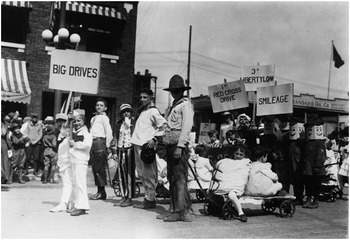
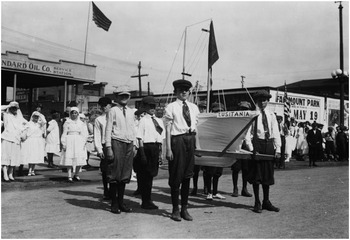
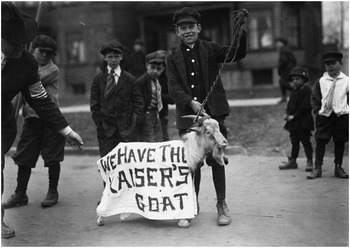
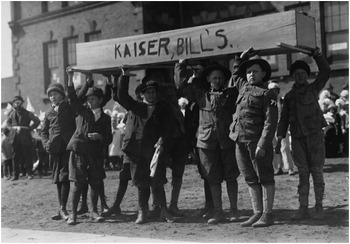
Across the nation that day, children paraded through their cities and towns, singing the national anthem, and saluting the Stars and Stripes. Two thousand such parades took place – an unprecedented public celebration of youthful patriotism organized by the American Red Cross. Large numbers of residents from surrounding towns assembled in Fairmont, West Virginia, to witness “children of tender years” march down the streets.Footnote 4 Fifty thousand spectators gathered during two hours in Harrisburg, Pennsylvania, to watch three thousand children parade. “Mothers marched side by side with their daughters,” a journalist reported, “and grandchildren marched beside the faltering steps of aged grandmothers.” An eight-year-old girl carrying the American Red Cross banner led the way.Footnote 5 Children as young as five led the parade in St. Paul, Minnesota, holding small American flags in their tiny hands.Footnote 6 Six young girls dressed in white rode along in a decorated automobile in Norwich, Connecticut, knitting all along the route.Footnote 7 Children rode with their teachers in decorated automobiles in Lakeland, Florida.Footnote 8 A large wagon festooned in red, white, and blue was filled with baskets of eggs, fruits, and vegetables for the parade in Chattanooga, Tennessee.Footnote 9 In Willmar, Minnesota, a two-mile-long procession (preceded “in regular metropolitan style by the mounted police”) included school children dressed as sailors, soldiers, and vegetables; marching in sections, they carried large boards reading “Answering the Call,” “Hoover’s Aids,” and “We are All Americans.”Footnote 10 Two little boys dressed as sailors led a group of children on a street lined with onlookers in Kansas City, Missouri. Behind them, one boy dressed as Uncle Sam and two uniformed lads pulled wagons with toddlers dressed as money bags. In the background, more children in costumes and uniforms followed, carrying signs reading “Red Cross Drives” and “Smileage.” Not far away, several boys stood at attention, carrying a miniature ship made of wood.Footnote 11 In Detroit, Michigan, children drilled, imitating soldiers.Footnote 12 A boy led a goat wrapped in a banner proclaiming: “We Have the Kaiser’s Goat.”Footnote 13 Nearby, ten young boys stood in the city center, bearing a wooden coffin labeled “Kaiser Bill.” Behind them, American Red Cross nurses looked on (see Figures I.1–I.4).Footnote 14 May 18, 1918, witnessed extraordinary displays of juvenile patriotism nationwide.Footnote 15 Never before had American youth been mobilized on such a scale.
American Red Cross Parade, Kansas City, Missouri, May 18, 1918. Courtesy of the National Archives at College Park, Maryland.
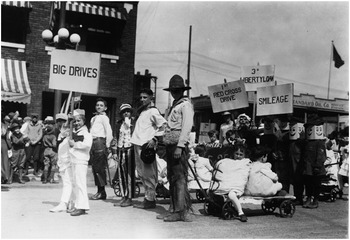
Figure I.1 Long description
Several boys stand at attention in the middle of the street, carrying a miniature wooden ship. The name Lusitania is visible on the replica, commemorating the ship torpedoed and sunk by German U-boats on May 7, 1915. Behind the boys, American Red Cross nurses in white uniforms also stand at attention. A crowd watches the scene from the back, on the right.
American Red Cross Parade, Kansas City, Missouri, May 18, 1918. Courtesy of the National Archives at College Park, Maryland.
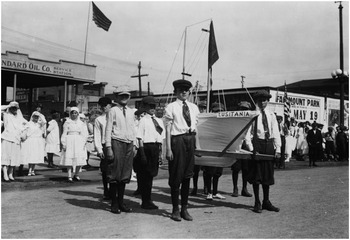
Figure I.2 Long description
Two little boys dressed as the U S Navy sailors lead a group of children on a city street lined with onlookers, one carrying a sign reading Big Drives. In the next row, one dressed as Uncle Sam and two lads in the U S army-type uniforms pull wagons with children dressed as money bags. They are followed by children in costumes and uniforms carrying signs reading, Red Cross Drives and Smileage. Others carry signs for war bonds Thrift and Liberty. In the background, more children follow.
American Red Cross Parade, Nunas School, Detroit, Michigan, May 18, 1918. Courtesy of the National Archives at College Park, Maryland.
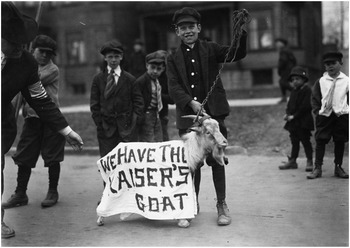
Figure I.3 Long description
A boy is leading a goat in Detroit, Michigan, during an American Red Cross Parade. The boy is smiling and looks pleased to be the center of attention. Behind him, several other boys with hats and ties are looking at the photographer with happy expressions. They are all students of the Nunas School. A white sheet wrapped around the goat reads, We have the Kaiser's goat.
American Red Cross Parade, Beaumont School, Detroit, Michigan, May 18, 1918. Courtesy of the National Archives at College Park, Maryland.
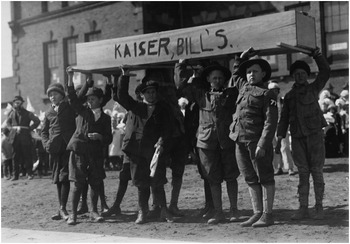
Figure I.4 Long description
In a very militaristic scene, ten boys are standing at attention in the middle of the street, each helping to bear a wooden coffin in the air with one hand. On the coffin is written, Kaiser Bill. They look directly at the photographer. Behind them, dressed in white, American Red Cross nurses are looking on. They are all dressed in white.
Mobilizing Children
Months before Congress declared war on the Central Powers, patriotic leagues, women’s societies, and humanitarian organizations had already mobilized children. From August 1914 to April 1917, initiatives across the United States were engaging American youth in humanitarian aid. Children were invited to support European soldiers and civilians. In 1914, when Lillian Bell organized a Christmas ship for Europe’s children, American youth provided it with gifts, food, and clothing.Footnote 16 When Paris-based American women established the American Fund for French Wounded in New York City in 1915, children raised funds to collect blankets, pillows, and clothes for hospitalized French soldiers.Footnote 17 Through the American Red Cross, they knit, sewed, and collected money to help beleaguered civilian populations abroad.Footnote 18 American youth supported French orphans whose fathers had been killed while in service, sending a stipend of $36.50 a year, along with parcels of books, and toys to the Fatherless Children of France Society.Footnote 19 Children became part of the financial and humanitarian force that sent aid to Europe. They even petitioned for peace: on February 23, 1915, six schoolgirls presented a petition to Secretary of State William J. Bryan.Footnote 20 They had gathered the signatures from 350,000 school children across the United States.Footnote 21 It arrived at the White House “in a monster trunk.”Footnote 22 In December 1916, eight “junior cops” from the New York City’s Junior Police Force stopped at the White House, asking to be received by President Woodrow Wilson.Footnote 23 The squad’s leader presented a petition that had been signed by all the members of the New York City’s Junior Police Force urging Wilson to enforce peace in Europe and mediate between the Allies and Central Powers. Months before the Department of Labor founded the United States Boys’ Working Reserve in May 1917, America’s youth were already engaged in gardening activities to increase food production and meet national and international demands.Footnote 24 In short, efforts to engage American youth into the war effort began long before the United States officially entered the war.
Once the United States entered the war, national organizations formed junior branches. For instance, the War Work Council of the Young Women’s Christian Association created the Junior Patriotic League, specifically dedicated to mobilizing schoolgirls.Footnote 25 However, all the initiatives that had sought to engage American youth were rapidly eclipsed by the two largest junior organizations that emerged following US intervention. Both the American Junior Red Cross and the United States School Garden Army, established in September 1917 and February 1918, respectively, surpassed all the local and state initiatives that had developed. Both national organizations exceled in mobilizing children. Working through the infrastructure of the nation’s schools, the American Junior Red Cross led children in humanitarian activities, instilling the idea that they belonged to an exceptionally altruistic nation.Footnote 26 Rather than playing with toys after school, children crafted wooden toys for European orphans. Rather than enjoying their spare time, they sewed clothes, made items for hospitals, and collected books for European civilians. Similarly, the United States School Garden taught children to produce food and help adults feed the nation. Armed with spades and pitchforks, children “hooverized” and canned food as part of the war effort when the United States could not simultaneously feed Europe and its own population.Footnote 27 Through these two national entities and similar local ones, American children learned they had a role to play and the duty to serve the nation. For many, the experience of American youth during World War I blurred the line between childhood and adulthood, fostering the sense that those lucky enough to live far away from war-torn Europe had a responsibility to aid those in distress.
Mobilizing children in wartime did not revolve around altruist concerns only. Instilling values, loyalty, and trust through the schools helped ensure large reservoirs of human capital that the military and labor market could tap in the future. Children would one day become adults. Boys might join the military. Federal agencies modernized secondary-school education to match more long-term goals. They devised new means of cooperation between institutions of learning and the military (paving the way for what would become the “associational state”Footnote 28). On May 3, 1917, the first conference of the Colleges and Universities Division of the Education Section of the Advisory Commission of the Council of National Defense was held in Washington, DC. Universities and colleges entered into a historic partnership with the US Army, a collaboration that is still in force today and through which college and university undergraduates enter the military and receive an education.Footnote 29 Similarly, through the United States School Garden Army children learned how to garden, grow vegetables, and can food. They, too, one day would become part of the labor force.
Mobilization of American youth spoke to deferring intentions. American leaders diverged on what youth mobilization entailed. Children could serve great humanitarian causes and be organized to participate in civic-related and even defense activities. But it would be historically inaccurate to argue that the mobilization of American youth in wartime necessarily met the goals of the preparedness movement. Jingoistic rhetoric and military preparedness campaigns sought to turn schools into patriotic hives that could be mobilized for war. Individual initiatives paralleled larger enterprises to militarize youth. Young people were actively engaged in militaristic activities such as drilling and parading – preparing for war. Such endeavors undeniably leaned toward a militaristic culture and positioned children not only as future agents of change but as potential soldiers. Galvanized by the sinking of the Lusitania, “preparedness-minded politicians, department officials, and military personnel” began to advocate defense policies and military training for civilians.Footnote 30 Many believed that children needed to be included in preparedness: hence the organization of youth-focused societies to instill patriotism and loyalty in the nation’s youth. Conversely, others sought to foster in children humanitarian and universalist ideals. Pacifists, women’s organizations, and internationalists advocated a “new preparedness”: “a preparedness for peace.”Footnote 31 Europe’s large-scale catastrophe triggered a massive interest in how American children should apprehend the conflict. In short, Americans (rightly) discussed whether childhood should be a sacred realm or whether children should be engaged in society’s concerns.
Consequently, a distinction must be drawn between local organizations and the two national entities. Both the American Junior Red Cross and the United States Garden Army reveal to a certain extent how the federal government positioned itself when it came to the place and role American children should play in wartime. Arguably, pacifists, humanitarians, educationalists, teachers, and parents could not find grounds to oppose American Junior Red Cross activities. Such activities were educational and humanitarian. Similarly, the United States Garden Army was formed for good: the survival of the nation. Producing food introduced children not only to the skills of gardening but to the economics of food production. It proved to be a necessity that quieted protesting parents and placated those who would welcome the return of nineteenth-century child labor practices.Footnote 32
War in the Classroom
The nation’s leaders hoped to “keep children out of war, but take war into schools.”Footnote 33 They called on teachers, public institutions, and local authorities to engage youth. Through “Four Minute Speeches,” as they were termed, children mimicked the “Four Minute Men”: they researched the origins of the European war, wrote speeches, and competed to know who would give the best talk. They collected information, learned about the conflict, and developed “a desire to be of assistance in solving war problems.”Footnote 34 They learned about orphans in Belgium, why they had to send parcels to Uncle Sam’s troops in France, and how to plant, harvest, and conserve to help feed their families and communities.
Inevitably, a wartime narrative worked its way into the classroom, and that narrative demanded complete loyalty. Children were exposed to propaganda. At the federal level, the Committee on Public Information and agencies such as the National Education Association, the Committee on Patriotism through Education of the National Security League, and the National Board for Historical Service tried to monitor what American children read, attempting to weed out material that might foment disloyalty.Footnote 35 In an effort to control what ideas and information children were exposed to, the US Bureau of Education monitored classroom materials. Schools became conduits for public propaganda as state and federal authorities deployed financial resources to control any seditious narrative that might sabotage the American effort.Footnote 36 Instead of fighting the disruptive rebellious working-class, pacifist unions, suffragists’ clubs, and progressive liberals, federal authorities opted to instill patriotic sentiments in children.Footnote 37 Public schools were spaces where loyalty could be inculcated – and adults could be monitored by the children in the classrooms and households.
To reach that goal, however, teachers needed to adhere to the political line of the government. A special unit, the Division of Civic and Education Publications, operated within the Committee on Public Information. Professor Guy Stanton Ford at the University of Minnesota, its director, supervised the production of circulars that were sent out to teachers.Footnote 38 On a regular basis, the Division of Civic and Education Publications issued Teachers’ National Service bulletins that functioned as methodological (and political) guidelines. Given the influence they could exert on young minds, it was vital for the Committee on Public Information to make sure teachers would comply. Through both the US Bureau of Education and the Committee on Public Information, teachers were constantly reminded of their wartime obligations regardless of their personal political opinions. Teachers navigated between the official recommendations issued from Washington, DC, and the complicated task of educating children in wartime.
Consequently, although American boys and girls did not experience what European children lived through, adults exposed children to unprecedented psychological pressure to contribute to the war effort: to labor for the state, give material and financial support to soldiers and civilians in war-torn countries, and “adopt” (that is, financially sponsor) foreign orphans. Much of their everyday life revolved around the war: they learned about the conflict in the classroom, participated in humanitarian missions under the guidance of schoolteachers, knocked on neighbors’ doors to raise money, and knit socks to be shipped to Europe. When Anna Hedges Talbot, director of Junior Membership and School Activities, Atlantic Division of the American Red Cross, talked about children’s “boundless enthusiasm and energy,” and asserted that American youth needed to “fulfill their obligation as young citizens” and “help carry the burden,” she publicly revealed the demand adults were making.Footnote 39 Children would not be spared the national effort. And that entailed sacrifices such as “turning up their noses at lollypops and ice-cream cones.”Footnote 40 Even the simple act of treating themselves with a candy could be clouded by a feeling of guilt knowing that European orphans were starving. They were made aware of the need to sacrifice. In truth, federal authorities may have underestimated the heavy burden that was being put on little shoulders.
Uncle Sam Wants (White American) Children (Only)
Beyond their intention to mobilize children as extra hands and hearts during a time of war, the leadership of youth-focused organizations and federal authorities sought another outcome: to Americanize the nation’s many European ethnic groups and thus homogenize what they regarded as a heterogenous society.
In August 1914, the United States must have seemed like a Tower of Babel, where multiple foreign languages could be heard on the streets of large cities like Chicago, New York City, and San Francisco. Immigrants had crossed the threshold of Ellis Island searching for a better life, but many still clung to their customs, traditions, and languages. With each successive wave of foreign-born arrivals, more and more adults and children were navigating between foreign values and American ideals. Some voices thought it necessary for the United States to “Americanize all.” On June 14, 1915, in Carnegie Hall, Henry Stimson, former secretary of state for war, explained that the European war was an opportunity to blend away citizens’ cultural differences and reinforce their American identity. According to Stimson, military preparedness could foster a stronger sense of national unity.Footnote 41 Like many, Stimson wished the United States to intervene in the global conflict in order for it to be legally entitled (and morally legitimate) to bring to light that disloyal elements endangered the nation. Across centuries, wars had unified peoples, ethnic groups, and linguistic communities on the European continent. Some academics, politicians, and educationalists wanted the United States to enter the war precisely because it provided a means to unify the nation.Footnote 42 World War I was therefore envisioned by some as an opportunity to enforce educational strategies that would support assimilation.Footnote 43 In September 1918, in “Foreign Born in Camps Become Real Americans,” the California-based San Pedro News reported that in a division at Fort Riley, Kansas, men from thirty countries prepared to be sent abroad to fight as Americans.Footnote 44 Whether born in Spain, Norway, Serbia, Sweden, Turkey, Armenia, Germany, Hungary, or Italy, “the result of the Americanization process applied to all alien soldiers.”Footnote 45 Fighting together under the Stars and Stripes would solidify an identity and create a modern America. A Kansas-based journalist even suggested that the “recreation of Americans will probably be one of the great blessings that America is to gain winning the war.”Footnote 46 What is most notable, however, is that the groups being invited to Americanize were of European heritage.
Just as foreign-born adults needed to be assimilated, so, too, did their children. Schools could be for children what military barracks were for soldiers: incubators of Americanism. Academics and educationalists joined the call. They consistently endorsed politicians’ and federal authorities’ programs of Americanization. US commissioner for National Education, Philander P. Claxton, capitalized on national emergency to turn the US Bureau of Education into an Americanizing agency. Similarly, through the United States School Garden Army, children cooperated and developed a stronger sense of belonging to the American nation. Both federal organizations simultaneously answered to defensive and educational goals. Both entities attempted to unite an heterogenous society. They sought to Americanize youth, teach them American ideals, and turn them into modern American citizens. World War I became an unhoped-for opportunity for the federal government to tackle identity problems that had been brewing for decades. What the French Revolution had achieved in France – turning “peasants into Frenchmen” – World War I would achieve for the United States: mobilizing the country behind the effort in the defense of America could effectively lead to the creation of a national identity.Footnote 47
American Childhood and World War I
Uncle Sam’s Little Soldiers is not a catalogue of the youth-focused clubs that operated across the United States during World War I. My focus is on the organizations that reached out to a large audience of youth. Similarly, I do not chronicle all the local chapters of national societies such as the Boy Scouts, Camp Fire Girls, Young Men’s Christian Association, and Young Women’s Christian Association.Footnote 48 But I do integrate accounts of their efforts into the overall story. In examining several youth-focused organizations that emerged during World War I, my intention is to piece together the relatively large body material available and describe American mobilization (and society) around the war from children’s perspective.Footnote 49 For this reason, the book is not limited to the period 1917–18, as this would have narrowed discussion to children’s involvement in wartime activities and the reasons why federal authorities felt the need to form the two large youth-focused organizations at that moment.
In giving a voice to children and analyzing how local, state, and federal authorities mobilized America’s youth during World War I to meet various needs, my goal is to bring to light how and, most importantly, why children became vital actors in the war effort. In each chapter, I chart the mobilization of American children from a different angle and focus on the specific objectives of various local and national initiatives. Each chapter is therefore both thematic and chronological. In Chapter 1, I examine how local initiatives sought to address both chronic social problems and contribute to the preparedness movement from August 1914 onward. In New York City, both the Junior Patriots’ League and the Junior Police Force capitalized on the war effervescence to tackle juvenile delinquency and Americanize children. Individuals such as Captain John F. Sweeney engaged immigrant neighborhoods in New York City by giving civic responsibilities to young boys. In Chapter 2, I follow the implementation of health policies across the nation as educationalists and epidemiologists sought to instill habits of good hygiene among children, promoting the understanding that children’s health, well-being, and welfare were essential to the survival of the nation. Epidemiologists such as Charles M. DeForest promoted the idea of children as knights fighting invisible foes – germs. He drew upon chivalric terminology – battles, enemies, foes, knights – to describe the fight against microbes. Chapters 3 and 4 chart the creation of the two national youth-focused organizations that emerged in 1917 and 1918, respectively: the American Junior Red Cross and the United States School Garden Army. Chapter 3 focuses on the American Junior Red Cross. With the ostensible goal of turning children into better world citizens, the organization sought to Americanize them. Among the national youth-focused organizations that engaged children in the war effort, the American Junior Red Cross was the only one whose agenda was to encourage children to adhere, promote, and contribute to a new international order that would spearhead American ideals worldwide. Chapter 4 explains why the United States School Garden Army answered both defensive and economic wartime demands. Through the organization, children learned to work the soil to be part of a national effort to feed their families and communities. Finally, in Chapter 5, I explore the way the idea of Americanization shifted from a progressive social concern at the beginning of the century to a politically led choice in wartime. Americanization became a security issue as the global war propelled identity matters at the forefront of domestic politics.
Uncle Sam’s Little Soldiers interweaves the histories of childhood, World War I, and American history. It blends social, cultural, medical, and political history and draws from a vast array of primary sources found in local libraries, secondary schools, state depositories, university special collections, and, most importantly, federal records. Few of these sources, however, give voice to Blacks and Native Americans. At the time, wartime public relations and propaganda targeted mainly whites. Whites statistically represented a bigger percentage of the population, and segregation excluded Blacks and Native Americans at many levels. According to the United States Immigration Commission, headed by William Paul Dillingham, in 1907, children of native-born Black fathers formed 2.5 percent of the total number of public-school pupils. Even fewer Native American children participated in public education: of 304,950 Native Americans across the United States in 1908,Footnote 50 less than 0.05 percent attended public schools.Footnote 51 Most attended reservation schools, a practice that educationalists fought for between 1914 and 1918 in an effort to “Americanize” Native Americans. That did not mean that Blacks and Native Americans did not participate in the war effort. Though marginalized, either by racial segregation or by what Richard H. Pratt termed “segregated tribalism,” both communities answered the call.Footnote 52 Their children, too, mobilized on the home front. They knit socks and other items for French and Belgian orphans, made hospital garments, collected books for US troops stationed in France, and aided in food conservation.
To integrate those two communities in the picture, I turned to school magazines. Magazines such as the Carlisle Arrow and Red Man, Carlisle Indian Industrial School’s newspaper, yielded valuable information that enlarged the scope of my research. Native Americans were visible minorities at the dawn of the twentieth century. And incorporating them in the narrative opened new perspectives to better understand American society during World War I. Blacks, too, were at the margin of US society when the war broke out.Footnote 53 When pondering the experiences of Black and Native American children, the reader must keep in mind the deep racial divide at the time. Similarly, readers need to acknowledge that a specific United States commissioner for Indian Affairs existed, testifying of the nation’s strong interest in Native Americans’ integration (or, as some might say, their obliteration), while no such entity existed for Blacks. Uncle’s Sam Little Soldiers is thus more than a study of American childhood in wartime. It opens a window onto American society at the beginning of the twentieth century.