


8.1 Introduction
The global nature of online platforms makes their regulation very complex and challenging. Such complexity arises from the difficulty of regulation to capture the cross-border effects of online platform’s activities.Footnote 1 The asymmetry between the national reach of law versus the global scope of the market is not a problem unique to internet platforms. As we saw in the other contributions in this book, global health governance and corporate tax suffer from similar challenges.Footnote 2 Other examples include competition policy, international trade regulation, and climate regulation, just to name a few. When problems are global, only international cooperation can address them in a satisfactory way.Footnote 3 In many of those areas, political, social, or economic barriers stand in the way of global Pareto optimal solutions. Yet, there are examples in international regulation that show that under certain conditions, global cooperation is indeed feasible and can bring a long-lasting positive regulatory equilibrium. International banking regulation is one such example.Footnote 4
In this chapter, I will draw a parallel between international financial regulation and platform regulation. In many ways, banks and platforms share similar issues. They both operate in a global market and tend to produce harmful effects from their activities: systemic risks and harmful content, respectively. When banks started to expand significantly in global markets in the 1980s, bank supervisors were confronted with very similar challenges to what platform regulators are facing right now. Their answer was to entrust one organization, the Basel Committee on Banking Supervision, with the task of hosting the regulatory dialogue that eventually led to a common regulatory framework – the Basel Capital Accord, also known as Basel I, II, and III.Footnote 5 While not all the conditions that underpinned the success of the Basel Accord can be replicated for internet platforms, it is nonetheless helpful to rely on this experience as a potential guide for platform regulators across the globe.
8.2 The Rationale for Regulatory Action
Before we venture into the complex discussion on the international regulation of global banks and internet platforms, which will occupy a large part of this chapter, we need to explain what these two regimes have in common from a regulatory perspective. Banks and platforms share two critical regulatory problems. First, they both exist and operate in a network. Second, they both generate harmful effects from their activities. In this section, I will explain how financial regulation has tackled the negative externalities of banks’ activities and draw a parallel with the regulation of platforms.
8.2.1 Understanding Banking and Platform Networks
Banks and platforms operate in an ecosystem – the financial system and the internet, respectively – where they are forced to interact with third parties to provide their services. Both organizations are structurally connected to a broad network of users, suppliers, clients, and other entities without which they cannot function.
Bank balance sheets give an excellent idea of how interconnectedness operates in banking.Footnote 6 On the liability side, banks borrow in many ways from various parties. They take deposits from retail customers. They issue multiple forms of debt securities such as secured or loss-absorbing bonds from institutional and retail investors. They borrow short-term from repo lenders (a service sometimes offered by other banks) and money market funds. They assume potential derivatives liabilities with various traders. In addition, they receive financing in the form of equity from their shareholders, which take the enterprise risks of investing in the bank and the rewards if the bank makes profits. On the asset side, banks invest their money (which originates from the various sources described above) in many ways. They lend to retail and commercial customers by issuing loans and mortgages. They pledge debt securities as collateral for other operations (including short-term financing for other financial institutions). They also invest in markets by purchasing various financial instruments or gold and hold some deposits at the central bank. This very quick snapshot of banks’ activities shows that banks are legally and financially intertwined with a myriad of different actors – mostly, other financial institutions – in a way that make each of them inherently co-dependent. Yet, operating into the financial system is fundamental for banks, as it reduces transaction costs and expands the pool of capital available.Footnote 7
Internet platforms also operate in a network – the internet – and rely on interconnectedness, albeit very differently.Footnote 8 Indeed, platforms rely on third-party app developers or influencers to create the content that is, in turn, offered to end users. In most cases, including Twitter, Instagram, or Facebook, end users are at the same time active generators of content as well as passive consumers of content. More importantly, platforms are often connected to maximize their users’ network effects. For instance, Instagram feeds can be shared through WhatsApp, Twitter, Pinterest, and other platforms. The same is true with most other apps like TikTok or YouTube – thus expanding further the network effects that the platform can rely on. This particular business model is facilitated by a specific regulatory approach that favors interconnectivity and interoperability as the dominant norms.Footnote 9 Finally, like banks are linked to their depositors, also apps are linked to the final users who provide indirect inputs into the functioning of the platform.
8.2.2 Externalities
Being part of a network would not be a problem if it wasn’t because both banks and platforms are structurally prone to generate harmful effects through their activities. This creates a regulatory problem as these harmful effects negatively impact the entire network where the firm operates. In other words, without regulation, the business models of banks and platforms would make them inherently unable to perform their functions in a socially efficient way. In economics, this problem is described as an externality. This concept defines the indirect costs (negative externalities) or benefits (positive externalities) that a third party receives due to another party’s particular activity.Footnote 10
When it comes to banking, the main problem has always been to tame the excessive proclivity of banks to take risks and, on a broader level, to ensure that financial losses are not transferred across the financial system.Footnote 11 Unfortunately, banks cannot avoid taking risks. Indeed, their funding and operational model is based on borrowing short term and investing long term. While banks try to minimize financial losses by adopting internal models that calculate their various credit, market, and operational risks, they cannot eliminate them. Risk is a necessary part of finance that banks have to live with.Footnote 12
Crucially, despite taking risks, banks do not fully internalize the financial costs of their activities. Indeed, the accounting mechanics of bank balance sheets means that a financial loss on the asset side (the bank’s investments) is inevitably met by a loss from the liabilities side. In other words, the loss would be taken by one of the bank’s various creditors. When financial losses are too high, the insolvency of a bank would create a cascade of negative spillovers to all the bank’s creditors and, progressively, to the entire financial system. We define this as “systemic risk.”Footnote 13
Platforms’ activities can also produce externalities, both positive and negative.Footnote 14 Depending on whether they are open access or on subscription, platforms’ network effects enhance the platform’s value for every additional user they attract. This means that platforms are provided incentives to attract users and content producers to expand their networks. Yet, the more a platform successfully expands its usership and increases the audience, the higher the chance that harmful content will be drawn due to the platform’s increased ability to disseminate content. Sometimes, the same content can become viral thanks to particular algorithms and recommendation systems. Harmful content can be considered a negative externality of platforms’ activities as it negatively affects some users.
Ultimately, much like banks have an incentive to take on more significant risks to improve profitability, platforms have an incentive not to police content to protect their network. Harmful content for platforms is much like market or credit risk for banks. It is a by-product of the firm’s activities and business model that cannot be easily eliminated. In the case of platforms, harmful content is a structural element of the platforms’ business model, which relies on network effects as its primary driver of profit. Given platforms’ inherent need to attract users and producers, policing content is arguably a barrier to growth. It would limit the potential expansion of the platform to new users and producers.
8.2.3 Regulating Externalities
Regulating externalities requires striking a trade-off between the need to guarantee the maximum profitability for the firm, on the one hand, and the protection of third parties’ interests, on the other.
In banking, regulating negative externalities has been achieved through various policies. First, banks are screened before being given a licence to operate – thus, before being admitted into the financial system – and monitored by supervisory agencies through various means. Second, banks must finance their operations through loss-absorbing instruments, including capital and subordinated bonds that can be converted into equity if the bank’s losses pass a certain threshold. In addition, they must keep a portion of their funds liquid to meet a sudden surge in creditors’ withdrawals. Third, banks must restrict their investment choices by not concentrating on a few assets. All these tools reduce the freedom of maneuver of banks and, with that, their profitability to a certain extent.Footnote 15
Regulating platforms’ externalities is perhaps more challenging as the regulation of internet platforms has been historically based on two fundamental pillars: openness and freedom. Notwithstanding this, if demand for a more interventionist approach arises, liability rules could be used to restrain the harmful effects of free speech. According to Lefouili and Madio, liability rules may be socially desirable when the interests of the platform to police itself and the interests of the society are not aligned.Footnote 16 This could be because of externalities and excessive market power arising from the quasi-monopolistic nature of some platforms.Footnote 17
The decision is not straightforward, as liability rules might also reduce platforms’ profitability and innovation. This largely depends on how they are designed. The rules on platform liability can be intended as a spectrum from lenient (no liability) to strict (strict liability). Each choice will have a cost on the firm and the consumers. From a regulatory perspective, a strict liability regime might reduce the attractiveness of platforms – very much like adopting very high capital adequacy standards for banks might reduce the bank’s profitability. There are different potential explanations for this. First, a strict liability regime would inevitably lead to higher litigation costs and increased fines. The threat of litigation would then translate into over-policing by platforms eager to avoid penalties and prolonged court battles. Second, the increased need for platforms to divert financial and human resources to police content would increase firms’ operating costs and reduce their profitability. This will then increase the costs of using the platform for consumers.Footnote 18
8.3 The Challenges of Regulating Firms in Global Markets
The regulation of externalities in banks and platforms is made astonishingly more complicated by the global nature of their networks. Regulating firms operating in a global market presents unique challenges. Regulators need to factor in two additional elements when designing rules: the presence of foreign firms and users and the challenge of foreign regulators with different regulatory objectives.
8.3.1 Global Markets in Banking and Internet Platforms
Since the 1970s, banks and capital markets have progressively internationalized.Footnote 19 Many Western and Asian banks now operate regionally or, in some cases, globally through branches and subsidiaries. Those local entities are themselves very connected with the local market. They raise debt and, sometimes, capital locally and invest in the local economy. Capital markets also operate globally. Corporations can list in foreign stock exchanges and issue foreign-denominated debt. Investment funds and global banks also sell various instruments to clients abroad with minimal regulatory barriers.Footnote 20
Global financial interconnectedness brings many benefits, but it also means that a problem in one part of the global financial system can quickly spill out beyond national boundaries. We define it as “global systemic risk.”Footnote 21 The first manifestation of global systemic risk was during the string of banking crises in the 1980s and early 1990s. Still, it was during the 2008 global financial crisis – at the very height of financial globalization – that we witnessed how global systemic risk truly operates. The collapse of several financial institutions in the US triggered a chain reaction that immediately impacted European banking and capital markets.Footnote 22
The structure of the internet is somehow very similar, as it developed over the years as a fundamentally global network. Interconnectivity brings substantial benefits as it allows platforms to reach economies of scale, increase network effects, and spur innovation. Platforms or apps developed in one country can be immediately launched and made accessible to users across the globe. This is possible due to the inherently stateless nature of the internet, where the technical specifications in systems like iOS or Android are often more important than the local regulatory requirements. While firewalls and other barriers to access specific platforms exist and are often applied to censor content, these barriers are an exception to the norm. Yet global interconnectivity dramatically increases the reach of negative externalities sometimes produced by platforms as many more users – often with different cultural and political sensitivities to content – can be impacted.
8.3.2 Regulatory Trilemma
The next question is how to approach regulating globally active and interconnected firms. This section discusses the main theoretical approaches in the financial regulation literature.
Much like the internet, the global financial system is built upon a dangerous asymmetry between the global scope of financial markets and the national scope of economic policies.Footnote 23 Unlike other areas of international economic policy that rely on an international organization to set binding rules and solve interstate disputes,Footnote 24 international finance has historically operated through nonbinding agreements. Without an international organization competent to develop a common rulebook, each country is free to regulate and police firms operating in its jurisdiction. In an interconnected market, national control over financial policies creates two main challenges.
First, globally active firms can practice regulatory arbitrage and force national regulators to compete in designing rules that appeal to firms as opposed to regulations tailored to the need of the local market. If the cross-border provision of services is possible, firms would exploit regulatory loopholes and relocate to jurisdictions with minimal regulatory or business constraints. This would place regulators between a rock and a hard place, as they have to strike a delicate balance between the need to design rules that respond to local economic needs or attitudes – be these stringent prudential rules or very lenient free speech laws – and the need to maintain the competitiveness of national firms against foreign firms.
If regulations are too rigid, regulators risk that firms relocate to a different jurisdiction where the regulatory compliance costs are lower, thus putting the remaining firms at a competitive disadvantage. Conversely, if regulations are too lenient, regulators might not respond to the local regulatory needs. As I will explain in Section 8.4, this was the main problem that banks faced with regard to capital adequacy regulation in the 1980s. The regulatory dichotomy between competitiveness and national interest is made more complicated by the option of a third choice: autarchy. In other words, if regulators are unwilling to tailor their rules to the demand of the global market, they adopt a protectionist stance and close their market to foreign-based firms.
Second, when foreign firms conduct business on a cross-border basis while regulated by their home rules,Footnote 25 host regulators cannot address the negative externalities those firms produce in the host regulator’s market.Footnote 26 For example, imagine a bank headquartered in Country A (subject to Country A’s rulebook) with substantial operations in Country B through a network of branches. Country B’s supervisor (the host) will not be able to control the bank’s solvency and risk position, which might create risks for local creditors. The same example could be easily used for an internet platform subject to its home country’s rule. If the home rules allow for harmful speech that has a detrimental impact on host users, there is little the host regulator can do other than adopt a protectionist stance that blocks the platform. In both cases, the only option for the host regulator is to prevent the foreign firm from operating in the host territory.
Several political science, economics, and legal scholars have successfully analyzed the challenges of global regulation. The most important contributions are regulatory race theories, transnational regulatory network theories, and dominance theories.Footnote 27 Schoenmaker’s Financial Trilemma illustrates very well the complexity of international regulatory design in international banking (Figure 8.1).Footnote 28 The trilemma posits that an interconnected financial system cannot achieve at the same time: (1) national sovereignty over financial policies, (2) an optimum level of global financial stability (essentially, the absence of cross-border externalities), and (3) meaningful financial integration. States have to give up one of them.
Dirk Schoenmaker’s Financial Trilemma.
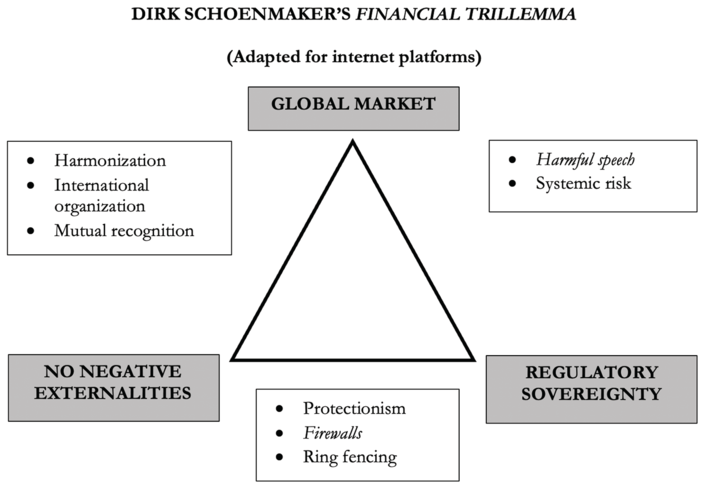
According to Schoenmaker’s theory, if countries maintain financial integration and national control over financial policies, they will inevitably suffer instability as foreign regulators refuse to cooperate. Alternatively, if they want to achieve a globally stable financial system, they have two options. One option is to relinquish the power to set financial policies. This can be done in many ways, from regulatory harmonization to mutual recognition or even creating a global institution tasked with setting international rules. The opposite option is the reduction of financial integration. This alternative can also take many shapes and forms. The easiest option is to ask foreign banks to incorporate locally through subsidiaries, thus giving up their freedom to move assets across the consolidated global banking group. The most drastic option is a return to Bretton Woods–like financial system in which there is no capital mobility and financial systems operate only within national lines.
The problem of cross-border negative externalities plays out slightly differently with internet platforms. The policing of platforms allows for a higher margin of control and flexibility by national regulators compared to what we see with banking. For instance, a national regulator might opt to restrict speech that is destabilizing internally but to allow speech that is destabilizing externally. Notwithstanding this, it is helpful to use the trilemma analogy as it gives a sense of the broader cooperation trade-offs with which internet regulators have to grapple.
Regulators unwilling to sacrifice their regulatory freedom and eager to protect local users against harmful speech originating from foreign-based internet platforms will have no option but to react. They can do so in many ways. One drastic option would be to erect firewalls or other protectionist measures that reduce local access to foreign platforms. This, however, would hurt consumers not affected by harmful content. A milder option would entail the regulation of foreign platforms according to the local liability regime. Thus, foreign platforms would be required to comply with local platform content rules requiring the takedown of harmful content or the imposition of penalties for breaches of content policy. Foreign platforms would face the choice of either adapting to the host country’s regulatory and legal requirements or else renouncing to enter the host country’s market if the cost of compliance is deemed too high. At the same time, regulators must assess the risks of harmful speech from foreign platforms if they want to maintain an open internet and regulatory sovereignty. The best solution is to agree on a common global framework, which reduces regulatory competition and, at the same time, maintains the benefits of interconnectivity and openness.
After illustrating the choice regulators need to confront, the next step is to assess how cooperation can be achieved. International cooperation in financial regulation has been through various ups and downs in the last four decades. While cooperation in certain areas of financial regulation was successful, for instance, in the prudential regulation of banks, in others, it failed dramatically. In Section 8.4, I will look at the most successful experience in regulatory cooperation in finance: the harmonization of bank prudential rules in the Basel Accord.
8.4 Regulatory Harmonization
When banking integration took off in the 1980s, regulators in the UK and the US were confronted with the problem of how to maintain the competitiveness of their local banks against Japanese banks, which were subject to more lenient prudential rules. The critical issue was the application of capital adequacy requirements.
8.4.1 The Basel Accord
Bank regulators in the United Kingdom and the United States, the two most globally active banking systems in the 1980s, adopted capital adequacy rules as part of their prudential rulebook.Footnote 29 They required locally supervised banks to fund their assets with a minimum amount of 3 percent to 5 percent of capital.Footnote 30 The rules were eventually harmonized between the two jurisdictions through a bilateral supervisory agreement. When global bank activity took off in the 1980s, US and UK banks found themselves at a disadvantage against foreign competitors – especially Japanese banks – which did not apply the same prudential standard. In a few years, cheaper funding costs allowed Japanese banks to acquire a substantial market share in the US.
The issue for Western regulators was how to strike a balance between the need to protect the stability of their financial systems while at the same time maintaining the competitiveness of local firms. Regulators were caught between a rock and a hard place as they were confronted with a choice between the risks and the benefits of financial globalization. The option of withdrawing licences to foreign banks was not feasible, as the economy was booming, and local industries needed fresh cash from foreign banks. US and UK regulators had a binary option: either to lower their capital requirements to align them with Japanese banks or convince the Japanese regulator to accept a common regulatory standard. Negotiations took place within the Basel Committee on Banking Supervision (BCBS), a regulatory network for bank regulators from G10 countries.Footnote 31 Ultimately, under the peer pressure from BCBS members and the open threats by the US to withdraw the licence to Japanese banks, Japanese regulators caved in.
The agreement to implement a common capital adequacy standard for banks was finalized in 1988 and adopted not long after that. It was enshrined in a supervisory agreement, the Basel Accord – also known as Basel I. The Basel Accord went through substantial iterations, especially after the 2008 global financial crisis, and it is now in its third version.Footnote 32 Unlike international treaties, the Basel Accord is a soft agreement. Thus, the agreement is voluntary, and it only offers a template, albeit a very detailed one, that national regulators are free to adapt and tweak to the specificities of their financial system. The agreement sets a minimum standard that national regulators can improve, as some did.Footnote 33 While there were problems in implementing Basel I and II, the latest version has been widely adopted by BCBS members with a reasonable degree of uniformity. At present, Basel III is the industry standard for bank prudential regulation.Footnote 34
8.4.2 Explaining Cooperation
The Basel Accord has been widely studied in the legal, political science, and economics literature.Footnote 35 Two questions, in particular, are essential for the comparative analysis of the international regulation of platform responsibility: why was harmonization obtained? And how was compliance with the agreement achieved?
The binary option between harmonization and regulatory competition has been subject to extensive scholarly analysis.Footnote 36 In the earlier literature on international finance, a debate ensued about whether regulatory differences would lead to a race to the bottom or the top in financial regulation. Political scientists such as Cerny argued that the push from the financial sector to maintain competitiveness would lead to a dangerous de-regulatory drive.Footnote 37 Conversely, Romano argues that regulatory harmonization forces firms to adopt similar strategies, which might increase systemic risk if they do not work.Footnote 38 Regulatory diversity would boost innovation and force regulators to compete for the best regulatory framework. Ultimately, the Basel Accord showed that harmonization could be achieved, although only in Basel III the regulatory playing field was leveled up to a stringent standard.
As a subordinate question, it is interesting to see why an agreement was reached on the prudential standards adopted by Western regulators and not on the Japanese prudential rules. Political economy scholars such as Keohane and Kapstein argued that cooperation could be achieved because all national regulators agreed that low capital requirements would put their financial systems at risk of instability.Footnote 39 In his analysis of the Basel Accord, Singer similarly argues that national regulators had little choice but to strike an international deal due to the severe risks of financial instability that lax capital requirements would bring.Footnote 40
Hence, cooperation was the easiest choice. Other scholars, including Simmons and Drezner, have tried to explain this outcome as a result of market dominance by the United States and the United Kingdom.Footnote 41 According to their theories, the dominance of big financial centers would act as a magnet for smaller centers, which are compelled to align their rules if they want to access foreign markets. While dominance theories cannot be extended to the entire set of financial regulations, they help explain the Basel Accord.Footnote 42 Indeed, Japan was practically coerced into agreeing to the standard under the threat of its banks being denied market access in the US – back then, the most lucrative market for international banks.
A more recent stream of scholarship looks at why cooperation is maintained given the non-binding nature of the Basel Accord. Transnational Regulatory Network (TRN) theories explain cooperation by examining the institutional structures underpinning the design and implementation of financial standards.Footnote 43 According to these theories, regulators participating in the network are compelled to comply with the standards due to pressure from different sources, including fellow regulators, the industry, and international organizations. In this regard, it is interesting to see how the IMF and the World Bank have consistently monitored compliance with the Basel Accord in their periodical financial sector assessment reports.
8.5 Lessons for Platform Responsibility from the Basel Accord
The experience with negotiating the Basel Accord and its subsequent implementation can offer some insights into what is needed to achieve an international agreement that is sustainable in the long term.
8.5.1 The Importance of Regulatory Networks
Firstly, the Basel Accord benefited from an already existing and well-functioning Transnational Regulatory Network, the BCBS, which was set up precisely to discuss and address common regulatory issues. Banking regulators from G10 countries had already cooperated successfully within that network to address the supervision of cross-border banks, an issue that caused various banking crises in the 1970s and early 1980s.Footnote 44 It is without a doubt that the positive experience in successful cooperation with the Basel Concordat and the familiarity between national regulators helped to get another agreement on the ground.
Moreover, as correctly argued by network and institutional theories, national regulators faced heavy peer pressure to find a common standard that would work for the global banking industry. Putting up a fight to resist an agreement that most members saw as a positive advancement to safeguard financial stability would have put Japanese regulators in a very awkward position within the BCBS. Given the widespread consensus among regulators that capital adequacy rules were fundamental for guaranteeing financial stability, national regulators were under heavy pressure to adopt the standard as they did not want their banking system to be perceived as risky and unstable.Footnote 45
Internet platforms, unfortunately, do not benefit from the presence of an established regulatory network like the BCBS. Internet governance is split across a few different organizations, such as the Internet Governance Forum or the Internet & Jurisdiction Policy Network, and a few other private sector organizations, such as the Internet Corporation for Assigned Names and Numbers (ICANN) or the Internet Society. The absence of a single catalyst of regulatory debate could make cooperation more difficult, as regulators might not feel the institutional and peer pressure they would otherwise experience if all regulatory actions on internet governance converged into one single regulatory network.
8.5.2 Dominant Markets
Secondly, there was an apparent power asymmetry between those financial regulators that wanted an agreement, the US and the UK (eventually followed by European G10 regulators), and those who resisted it, Japan.Footnote 46 In the 1980s, the US was the most significant banking market in size and business opportunities. The UK was not as big, but its capital market was well developed, and its banks were active globally. On the other hand, the Japanese market was very attractive but difficult to penetrate for foreign banks. Japanese banks needed market access to Europe and the US more than European and US banks needed access to the Japanese market. Thus, the threat by the United States to suspend the licence of Japanese banks that were not subjected to adequate prudential standards was seen as a clear danger by the burgeoning Japanese banking industry.
In this light, a global deal on the regulation of harmful speech could probably be pushed if enough pressure was coming from US regulators and the European Commission, as they oversee the two biggest markets for platforms. Both jurisdictions, in different ways, play a prominent role in regulating the digital economy. The United States, as a host of the biggest internet companies in the world and a massive market in itself, is centrally placed to regulate digital platforms. The European Union, while less central in developing successful startups, has nonetheless acquired a major role as a global regulator due to its uncompromising stance in leveling up the regulatory playing field in data privacy and hate speech.Footnote 47 Following Simmons and Drezner’s theories of regulatory dominance, once the two regulatory powers agree to a common standard, it would be difficult for smaller markets not to adjust to it.Footnote 48
On the contrary, a division between US and EU regulators would probably make harmonization impossible. Unfortunately, this outcome might be inconceivable given the different interests at stake. One player, the US, has a clear incentive to promote innovation and guaranteeing a fertile ground for the development of new start-ups. This might lead to a softer stance on platform responsibility. On the other hand, the EU is historically more sensitive to the protection of consumers, which might push it toward a stricter approach to harmful content. Predicting whether such divisions can be healed as they were in banking regulation is challenging. Much depends on the economic development of the two markets over time and the degree of global integration achieved by platforms. Yet, as I show in Section 8.5.3, adopting a more flexible approach in the initial regulatory standard might help to get the two regulators progressively closer.
8.5.3 The Flexibility of Soft Law
Thirdly, the history of the Basel Accord clearly shows that regulatory standards have become increasingly stringent and more detailed. Basel I was only 30 pages long and was very basic in its approach. If we compare it with the latest version, Basel III, which extends to hundreds of pages if we also include the annexes, we can see an apparent trajectory toward increased precision and detail. The initial vagueness and flexibility of the standard allowed national regulators to accommodate the agreement to the specificities of their banking system. It also helped regulators sell the deal to local politicians and the local banking industry.
Notwithstanding this, it is essential to remember that Basel I, and especially Basel II, were considered one of the reasons for the regulatory failures that led to the global financial crisis in 2008. The excessive flexibility in calculating banks’ risk-weighted assets allowed banks to bypass the capital ratio set as the agreement’s primary objective, enabling them to increase their leverage. This element is widely recognized as the key reason for banks’ excessive risk appetite and fragility during the 2008 financial crisis.
In this light, it would be recommendable to work on a platform responsibility framework that is flexible enough to entice reluctant regulators to join in while progressively working to strengthen it once regulators and the industry have become used to it. For instance, the EU, US, and other national regulators could agree to work on an outcome-based framework that simply sets the basic principles and the final regulatory targets while maintaining flexibility in achieving them. This would allow national regulators to tweak the standards to the local needs and legal framework. It would arguably make the negotiation easier and faster. Over time, the framework could be improved and more detailed in its prescriptions.
8.5.4 Compliance
From a cooperation perspective, complying with international regulatory standards is much easier than in other areas of regulation, like cross-border banking resolution, where the incentives to defect are very high. Thus, the main hurdle is to reach a common position. Regulatory convergence confronts regulators with a very challenging initial task of accommodating different regulatory preferences and goals. Sometimes states want to achieve regulatory coordination with other states because they know this will bring more significant individual benefits than unilateralism. Still, they might fight over which alternative is best. Yet, states have few incentives to change once a common position is reached.Footnote 49 This explains why there has been no public attempt by national regulatory authorities to exit the Basel Accord. Two reasons explain why compliance with the Basel Accord worked.
First, the Basel Accord was immediately perceived as a fundamental regulatory tool by international financial organizations and the broader regulatory community. Backed by a widespread consensus among economists, no regulator raised doubt as to the effectiveness of capital adequacy measures in preventing financial instability. The IMF, the World Bank, and the OECD list the Basel Accord as one of the essential elements in the prudential regulatory framework and look for its adoption as part of their engagement with their members. The institutional pressure coming from international organizations helped to extend its adoption beyond G10 countries.
Secondly, it is essential to highlight that once the agreement was reached, there was pressure from the broader financial industry to implement the standards. Hedge funds, banks, investment funds, rating agencies, and other market players shared the common belief that capital adequacy rules were necessary to guarantee financial stability. Therefore, regulators faced much market pressure to adopt the standards as part of their prudential toolbox if they wanted to attract foreign capital.
8.6 When Cooperation Is More Difficult
The experience with the Basel Accord is somehow an unmatched success in international financial cooperation. As I explained earlier, various factors conspired to make cooperation easier. However, many other critical regulatory problems in international finance did not lead to optimal cooperation solutions, despite causing substantial negative externalities. Historically, cooperation has been challenging in many areas, including money laundering, securities regulation, over-the-counter (OTC) derivatives, central counterparties, and resolution and insolvency of cross-border financial institutions. More recently, national regulators are struggling to cooperate on cryptocurrencies and sustainable finance, the two key regulatory areas of contemporary finance.
Despite its allure and simplicity, harmonization is perhaps the most challenging cooperation solution. However, there are other regulatory options besides harmonization. In Section 8.6.1, I will briefly discuss two of them, extraterritoriality, and mutual recognition. I will do so by looking at the regulation and clearing of OTC derivatives.
8.6.1 OTC Derivatives
Markets, like banks, are also very susceptible to creating negative externalities. One problem, for instance, is the use of non-centrally cleared OTC derivatives. Without proper regulation, OTC derivatives can expose traders to substantial losses.Footnote 50 Without central clearing, traders cannot gauge the actual trading position of their counterparty, thus taking excessive risks. In a global market where derivatives trading often has a cross-border dimension, achieving a regulatory playing field is fundamental. Managing derivatives risks would prevent globally active foreign firms from creating global systemic spillovers. Not surprisingly, given OTC derivatives’ havoc created during the 2008 global financial crisis, the 2009 Pittsburgh G20 put their regulation at the forefront of the regulatory agenda.Footnote 51
The regulation of OTC derivatives is quite complex. Derivatives markets involve multiple actors other than the trading parties involved in the bilateral deal, including trade repositories, clearing agencies, and trading platforms. It also requires a vast array of regulatory interventions, from margin requirements to trade reporting requirements or the supervision of central counterparties, just to mention a few. Despite the push from national regulators, the Financial Stability Board (FSB), the International Organization of Securities Commissions (IOSCO), and other organi–ations, regulatory coordination has not been achieved on many critical regulatory issues. This does not mean that cooperation did not work at all. In many areas, there have been substantial improvements compared to 2008. Yet we are far from seeing the same regulatory playing field we achieved with capital adequacy regulation, where rules were substantially harmonized.Footnote 52 Instead, regulatory cooperation takes place through bilateral agreement on mutual recognition and the extraterritorial application of local laws.
8.6.2 Mutual Recognition
Mutual recognition is a possible solution to coordination problems that cannot be solved through harmonization. In a Mutual Recognition Agreement (MRA), two national regulators agree to determine each other’s regulatory frameworks as substantially similar. Through the MRA, each national authority permits the partner’s firms to access the domestic market without complying with local regulatory requirements. Firms must only comply with their home regulatory framework and can operate in a foreign market subject to home rules. In securities regulation, a mutual recognition agreement allows firms authorized and supervised in a foreign country to operate or transact in the host-country jurisdiction without the host country’s approval, provided that the home country does the same with the host country’s firms.Footnote 53 Some regulatory challenges with OTC derivatives were solved through MRAs, including the regulatory spat between the US Commodity Futures Trading Commission (CFTC) and the European Securities and Markets Authority (ESMA) over the recognition of foreign derivatives clearing regimes.Footnote 54
Mutual Recognition was one of the driving forces behind the creation of the European Single Financial Market in the 1980s/1990s through its ability to promote financial integration without intruding on states’ regulatory sovereignty.Footnote 55 This quality explains why recognition is considered an excellent approach to solving regulatory cooperation problems. In a world where policy coordination can only be achieved through lengthy multilateral negotiations, assigning the burden of regulating a financial institution or individual transaction to a single authority is the easiest way to promote efficient financial integration. The simple fact that countries do not need to engage in lengthy negotiations to agree on an identical regulatory regime, as is the case with harmonization, speeds up negotiations and arguably favors the signing of new agreements.
In this light, mutual recognition could be a useful tool for international cooperation on platform regulation if the main regulatory objective is to integrate the market. First, mutual recognition agreements can be structured as bilateral deals but later expanded to plurilateral agreements. This would allow two regulators with similar, but not identical, approaches to free speech or data sharing to mutually allow the partner’s platforms to access their market without changing domestic law. Platforms would also be provided incentives to expand across borders as they would not be subject to two regulatory compliance requirements.
Yet, if not properly arranged, mutual recognition might entail substantial risks if the home regime is not up to the host country’s standards, does not share the same regulatory goals, or has the incentive to externalize risks to the host country. This is why TRNs such as the FSB or the BCBS exert a vital role in setting minimum regulatory standards. In securities regulation, regulators are often more wary of the risks of giving access to firms authorized under a weak regulatory regime. In a mutual recognition agreement, regulators provide recognition to a foreign regime only after having conducted a compatibility test that ensures the similarity of regulations. Thus, in cross-border securities regulation, recognition usually levels up the regulatory playing field and operates only between partners with similar regimes. This ensures that no “firm can escape regulation” and no “dangerous” transactions can occur in a shared market.
The main risk associated with a mutual recognition solution in platform regulation is lowering consumer protection standards. If the host country’s laws on free speech and harmful content were more rigid than the home’s, the host country’s users would be less protected against harmful content originating from the foreign platform as rules on content would follow the platform’s home country’s standards. Given that the regulation of harmful content is much closer to consumer protection than listing rules, it is more difficult to imagine that mutual recognition could be a solution for the regulation of harmful content. Very rarely do countries regulate consumer protection standards through mutual recognition. In conflict of laws, the law applicable to consumer protection issues is typically the laws of the consumer’s jurisdiction, not the company’s. This is because, in many jurisdictions, the European Union, above all, consumer protection is given primacy over other objectives.
8.6.3 Extraterritorial Regulation
The last possible option, albeit the most disruptive, is to extend local laws’ reach to activities in another jurisdiction. This protects the jurisdiction that adopts this approach against the negative externalities from foreign firms. Extraterritoriality is a well-known regulatory instrument in finance, which has been used by US, UK, and EU regulators to address the risks in capital markets.Footnote 56 It is also used extensively by many jurisdictions for financial crime – such as corruption and money laundering – as it tackles actions that are often committed abroad but impact the local market.
Extraterritoriality is not a single clear-cut approach as it can be tailored according to the specific conditions of the market. The most common use of extraterritorial jurisdiction in finance is linking domestic law to local contact points. These contact points could be local firms or individuals affected by the foreign action or firms and national citizens operating abroad. The US Dodd-Frank Act, for instance, puts under the reach of US law any financial entity that (1) has transacted with a US counterparty, (2) enjoyed a financial guarantee provided by a US entity, or (3) has entered into a derivatives transaction with a counterparty that was guaranteed by a US entity. In the European Union, the European Market Infrastructure Regulation (EMIR) requires that clearinghouses authorized in a third country “comply with legally binding requirements which are equivalent to the requirements set out in EU law to be used by European firms.Footnote 57 Sometimes, the jurisdiction of securities regulators is extended to all activities that “have a direct and significant connection with activities in, or effect on, commerce in the United States,” as in the Dodd-Frank Act.Footnote 58
If protecting content users is the main regulatory objective, extraterritoriality is, undoubtedly, the best option. The extraterritorial reach of local content rules would protect local users against harmful content disseminated by a foreign platform. This would be the case if “users” were the contact point for applying local laws. Thus, in this case, it would be sufficient for specific content to reach users for the foreign platform to be subject to the final users’ laws. This approach would be much closer to current regulatory practice when the main objective is to protect consumers.
Yet, the regulatory trade-offs associated with extraterritoriality are opposite to those related to mutual recognition. While extraterritoriality is better for protecting local consumers, it is much worse for market integration. Indeed, platforms located in countries with more liberal harmful content rules might be deterred from entering a market whose content rules would subject the platform to substantial litigation costs. Ultimately, firms are the primary victims of this situation as extraterritoriality increases market fragmentation. Indeed, firms must comply with multiple regulatory requirements for every jurisdiction they are linked to. We saw this with the regulation of OTC derivatives, which is still subject to numerous national regulatory requirements.Footnote 59 Moreover, extraterritoriality is perceived as an undiplomatic way to regulate commercial affairs. While it protects the jurisdiction that adopts it, it also reduces the regulatory sovereignty in the jurisdiction whose firms are targeted.
8.7 Conclusion
This chapter looked at the experience in regulating international banks and capital markets to draw lessons that could be applied to the regulation of online platforms. The history of the Basel Accord shows that regulating cross-border externalities is not impossible, notwithstanding the obvious political challenges. A few elements make cooperation easier: establishing a forum where national regulators and industry can discuss a common regulatory approach would make negotiations easier. Coordination between two dominant markets could pull the rest of the world toward the agreed regulatory standard. Finally, a light and flexible regulatory standard would make its adoption easier politically and enable the regulatory framework to develop organically.
When regulatory harmonization is not possible, other approaches can be considered. But they would come with substantial political and social costs. Mutual recognition of regulation between two or more countries would permit platforms to provide services to another country’s consumers while subjecting them to their home country’s rules. However, local consumers/users would not be protected under this model. Indeed, they would be subject to the regulatory approach of the country where the platform is headquartered. This makes this solution unlikely unless all countries share a common interest in pushing for the internationalization of their own domestic online platforms.
When the protection of local users is the main objective, the extraterritorial application of national laws to regulate the activities of foreign online platforms is the best solution. If a platform promotes harmful content, it could be subject to regulatory or civil action by the consumers of the country where its action was considered harmful. Yet, extraterritoriality comes with substantial costs, as it could block the international growth of online platforms, reduce cross-border data flows, and lead to tit-for-tat retaliatory action.


 Open access