




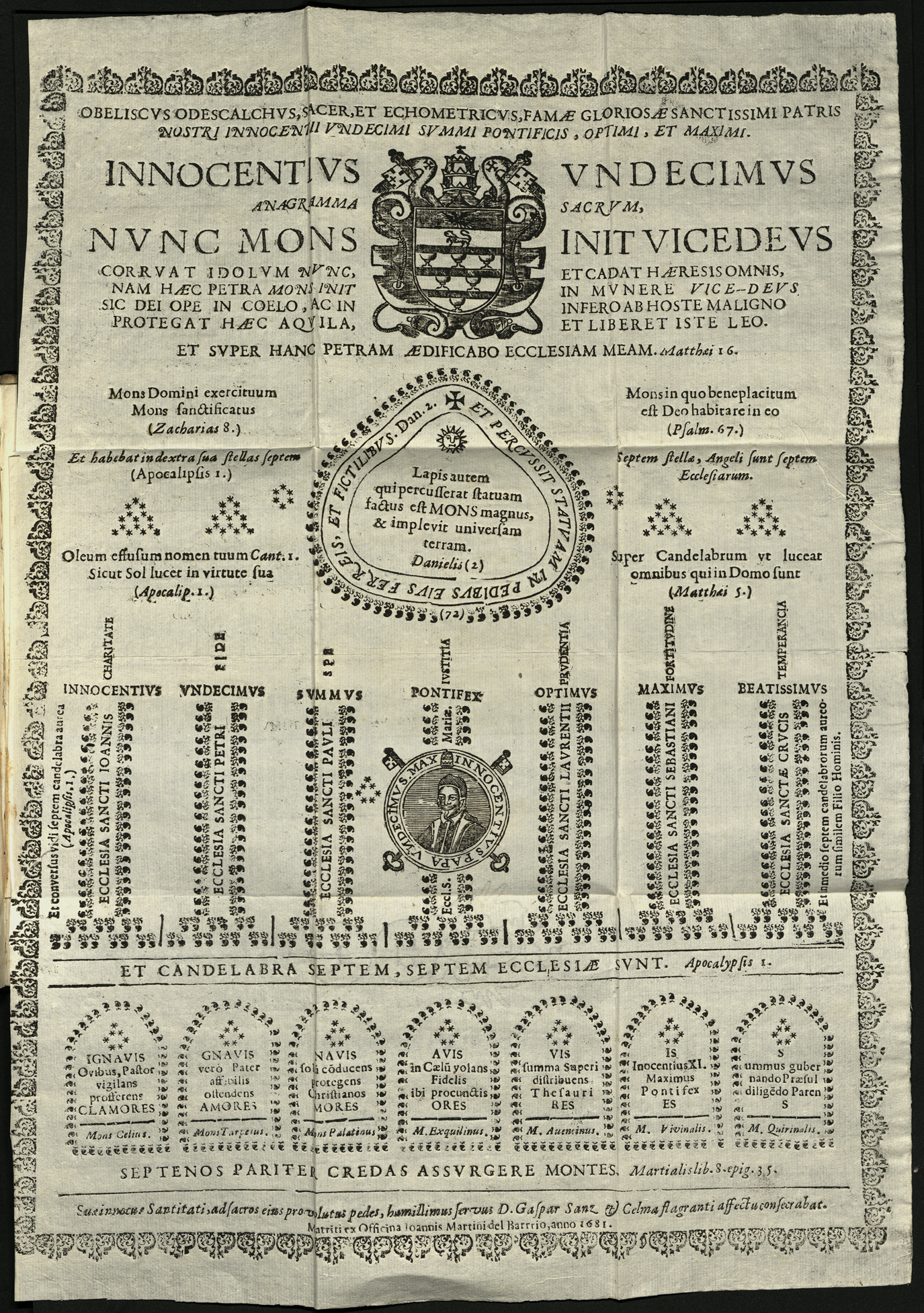
This essay concerns an obscure book published in Madrid in high summer 1681.Footnote 1 Its author and subject are well-known: Gaspar de Sanz y Celma (1640–c. 1710), the most celebrated composer of classical guitar music in Spain; Pope Innocent xi (Benedetto Odescalchi, r. 1676–89), scourge of Louis xiv, papal nepotism and the Ottoman Turks. Just six copies survive, and they have hardly been studied.Footnote 2 Yet the Ecos sagrados de la fama gloriosa de Innocencio XI [Sacred echoes of the glorious fame of Innocent xi] ought to interest a much broader audience than just papal historians. The work is a panegyric constructed around the verses of a single ‘echo’ poem – that is, a poem in which the first and last words of each line drop a letter to generate an echo-like acoustic effect (see Figure 1). However, the author also maps his poem's verses onto a topography of Rome, each verse resounding between one of the city's seven hills and one of her seven pilgrim churches to generate an exchange that sings out the pope's praises. A broad apparatus of other visual and literary devices supplements these two acoustic curiosities: dozens of Latin epigrams, anagrams, riddles and visual and arithmetical puzzles, including a quintuple acrostic poem (‘Carmina achrostichide quina constructa’ [see Figure 2]) and a so-called ‘Obeliscus Odescalchi’ (see Figure 3), a cryptic diagram which folds out full folio. The overall effect is a riot of lexical ingenuity and musical-mathematical inventiveness which, at nearly 150 pages, makes the Ecos sagrados an unusually substantial example of any textual genre into which it might be placed.
‘Poema ecometrica’: Gaspar Sanz, Ecos sagrados de la fama gloriosa de Innocencio XI, Madrid 1681, Bayerische Staatsbibliothek München, 4 H.eccl. 697 m, p. 4 (0044).

‘Carmina achrostichide quina constructa’: Sanz, Ecos sagrados, Bayerische Staatsbibliothek München, 4 H.eccl. 697 m, p. xxix (0037).

‘Obeliscus Odescalchus’: Sanz, Ecos sagrados, Bayerische Staatsbibliothek München, 4 H.eccl. 697 m (0153).
And yet the Ecos sagrados has inherent interest because, as a text, it has no obvious parallel. Many elements interlace its pages: neo-Latin poetry, Spanish prose, pattern poems, discussion of the pope's role in the Catholic Church, theories of sound, Christian Kabbalah, even ‘virtual pilgrimage’. Myriad compositions from early modernity exhibit every one of these elements, of course. But Sanz's particular effort at combining them is very much sui generis: there is simply no second text that approximates a recreation. The medievalist Claire Fanger has written of the difficulty of locating and contextualising such a text within a field of knowledge. How can scholars know where or how it joins to existing schema when they have nothing comparable to relate it to – indeed, when they cannot know for certain if such comparators ever even existed?Footnote 3 The Ecos sagrados intrigues, therefore, as a document that invites explanation. What were the influences on it? Where did they come from? How did Sanz gain access to them? How did he use them? Answers to these questions can advance understandings of the Hispanic Baroque and the intellectual cultures that flourished within its clergy, in particular as they concerned tastes and values, and the intersection of informal social networks with Spain's ubiquitous processes of censorship. What follows traces some of the ideas fashionable within Baroque intellectual cultures, showing how they flowed through the Spanish Church. Sanz's text, in such an analysis, thus becomes an unusually rich exemplar that bears witness to what Peter Davidson calls the Baroque's pluralising and hybridising tendencies.Footnote 4 And the fact that it represents a branch in intellectual history that has patently not flourished in the generations since Sanz lived is no reason to disregard it. Indeed, such ‘dead ends’ absolutely have to be probed if the mindscapes of the past are to be fully appreciated.
Much of this article is written in the analytic mode set out above. But it is also written in a second, participatory mode which the Ecos sagrados manifestly invites. To put it simply, one cannot analyse Sanz's text without solving its puzzles and, in doing so, one is inevitably drawn deep into Sanz's thought-world to share in its intellectual and emotional experiences. That thought-world, once constructed in dialogue with various other Spanish and non-Spanish clerics, is now largely forgotten. Yet it was once complex and intricate and playful: a world in which games had meaning, resonances, aesthetics and associations, and in which the ludic could be a culture- and community-building practice. One need not sign up fully to Johan Huizinga's view that culture is constructed through play to see that Sanz clearly derived a great deal of fulfilment from his jouissance.Footnote 5 But it is possible to share in that fulfilment because, in unravelling the mysteries of Sanz's text, a reader inevitably reconnects with his feelings and those of his earlier readers: joy at his quick conceits, perhaps also elation (or frustration) at his cryptographic fiendishness. In short, the reader joins what Barbara Rosenwein terms an ‘emotional community’, albeit one whose previous members all superannuated to the sky centuries ago.Footnote 6 Giacinta Spinosa has recently reminded us that the pleasure of knowing is itself a form of emotion, which means scholars certainly ought to consider Sanz's readership as a community in the Rosenwein model, especially once shown the intellectual pathways through which it was constituted.Footnote 7
The following sections offer the first interpretation of Sanz's text and the first attempt to situate it in various social and cultural milieux. They set out the information currently available about the Ecos sagrados, including its precise contents and the intellectual influences on them; the literary techniques applied; and the conceits behind its puzzles and their solutions. They also set out what can be established about the particular Baroque clerical (sub)culture it drew upon and about how this (sub)culture influenced practical workings of censorship. Micro-historical techniques are also used to throw light on the circumstances of both the text's composition and reception. Three contexts prove especially important: the Colegio Imperial in Madrid, which was the Jesuits’ premier institute in Castile; intellectual networks across the wider Society of Jesus, through which new forms of knowledge were disseminated, and of which the Colegio's padres were themselves a part; and, finally, communities of other clergy, in Spain and elsewhere, whose members also partook of some of the lexical games in which Sanz so obviously delighted. Yasmin Haskell, who has studied the role of didactic poetry and epic in community-building within the pre-suppression Society, has offered a model to build on when thinking about the sorts of community Sanz's text generated.Footnote 8 However, a study of the Ecos sagrados enhances Haskell's findings, both by broadening the categories of text that served this function and by showing how communities propagated within the Society spilled out into the wider Church.
II
For a man whose music is still so renowned, scholars know surprisingly little about Gaspar Sanz.Footnote 9 A baptismal record in Calanda, a village in Aragon, attests his parents’ names and his birth, just before 4 April 1640.Footnote 10 The frontispieces of his books proclaim him to have been a Bachelor of Theology of the University of Salamanca, although there is no definitive record of him having studied there. Sanz may have been the eponymous candidate who applied, unsuccessfully, for the chair of music at Salamanca in 1669, but who was nevertheless praised for his skill with Latin.Footnote 11 He himself claimed to have travelled to Italy to study with the greatest maestros in Rome and Naples.Footnote 12 But little else about Sanz can be known for sure, and what is known comes mostly from incidental detail drawn from his own publications. Sanz published the first edition of his now famous Instrucción de musica sobre la guitarra Española in 1674, dedicating it to Juan of Austria (1629–79), at whose court in Zaragoza he may for a time have lived. By 1678 Sanz was active in Madrid's literary scene, now styling himself as ‘priest’ and, sometimes, as ‘chaplain’. The bulk of his surviving literary production comes from the few years that followed: a Spanish translation of the Jesuit Daniello Bartoli's L'huomo di lettere (El hombre de letras, 1678), the Ecos sagrados (1681) and at least half a dozen pamphlets containing panegyric, Kabbalah puzzles and ludic Latin. Yet Sanz's status at this time, like his source of income, is a mystery. All that can be said is that he was probably never inducted into the Jesuits or there would be some record. A further edition of the Instrucción de música appeared in Zaragoza in 1697 with no indication of its author having predeceased it. At this point, however, information about Sanz's life ends. Félix de Latassa y Ortín in his Biblioteca nueva de los escritores aragoneses (1798–1802) records that Sanz died in 1710 but provides no corroborating evidence.Footnote 13
Sanz's story invites reflection on the limits of what is recoverable about the early modern world: he is one of its many figures whose fame endures but whose basic personal data is frustratingly opaque. Scholars are thus compelled to rely on his texts to gain some understanding of him, even though these are not richly biographical. The Ecos sagrados, by far the most substantial of his non-musical texts, contains almost no personal details whatsoever. Rather, it is shaped by the seven-line echo poem that inspires its title (see Figure 1 above). Sanz sets out the principle behind the echoes and his decision to structure a panegyric in praise of Innocent around them:
Some subjects are just so holy and above it all that they can only be explored through the most supreme ingenuities. Because of this, knowing that His Holiness enjoyed such heavenly fame, and that my pen could scarcely soar to so high a sphere, I judged it safer and more assured to write only the echoes which I could hear coming from within that sphere, [echoes which are] commensurate with the inconsequentiality of my own efforts, [and] leave the creation of voices more in proportion to a more erudite tongue.Footnote 14
On the conceit of plotting the echoes around Rome, Sanz has this to say:
Echoes are accustomed to form in the springs [fuentes] and caves of mountains. Rejoicing in God in the springs and caves and mountains. Concerning this, to form these seven echoes in my mind I could think of no other inspirations [fuentes] more holy or fast-flowing than Rome's seven holy churches … and her seven famous and exalted hills.Footnote 15
The echoes he invokes resound from San Giovanni to the Caelian; from St Peter's to the Capitoline; from San Paolo to the Palatine; from Santa Maria Maggiore to the Esquiline; from San Lorenzo to the Aventine; from San Sebastiano to the Viminal; and from Santa Croce to the Quirinal. The discourse that accompanies each echo lauds Innocent through disquisition of some aspect of his name, qualities or providence: the virtuousness of his character, the timeliness of his election etc. At length, a grand trumpet call (clarín), ‘born of the last echo’, swallows up all the others to proclaim the exceptional symmetry between Innocent's holy name and the first five years of his pontificate. A small selection of poems and anagrams, including the ‘Carmina acrostichide quina constructa’, at the start of the work, is supplemented by a larger appendix of the various further puzzles and word games, including chronograms, palindromes, a ‘monosyllabic epigram’, in which two initial monosyllables are fused together into a new word later in each line, two ‘riddles’ (aenigmata) and the ‘Obeliscus Odescalchus’.
How Sanz intended the Ecos sagrados to be read is not straightforward to deduce, not least because the text can be interpreted to operate on several levels simultaneously. On one level, it is just what it purports to be: a panegyric that sets out a catalogue of qualities hoped for in a pope regnant. Sanz lists these in one of the pattern poems (see Figure 4): righteousness, prudence, temperance, fortitude, faith, hope, charity, chastity, sobriety, diligence, liberality, benevolence, patience and humility.Footnote 16 This might not seem an entirely astonishing list of desirables for a pontiff but it shifted markedly from the qualities praised in Renaissance panegyrics to popes such as Julius ii (r. 1503–13) or Leo x (r. 1513–21), and, indeed, in the near contemporary Panegirico per l'esaltazione di Clemente X [Panegyric for the exaltation of Clement x (r. 1670–6)] by Francesco Miloni, published under the auspices of the cardinal nephew Paluzzo Paluzzi Altieri (1623–98) at the start of his uncle's pontificate.Footnote 17 A joyous sense of inspiration may have motivated Sanz to write what he did. Or he may have been seeking patronage from the papal nuncio, Savo Mellini (1644–1701), to whom the Ecos sagrados is dedicated and to whom Sanz had already dedicated two earlier pieces of writing.Footnote 18 Sanz may even have met Innocent xi during his own time in Rome. However, this is unlikely as he makes no mention of such a meeting. An alternative interpretation could read what Sanz writes as political commentary. Consider some allegorical passages in Echo vii in which the lion and eagle on the Odescalchi familial arms are used to describe the partnership between the pope and king of Spain:
Our unconquered Catholic King of Spain, Don Carlos ii of Austria (may God protect him) [is] a lion as noble as he is Catholic. And for the defence of the Holy Roman Church and the spreading of the gospel's law, he offers his entire and expansive empire, and he is willing to sacrifice himself as a victim to conserve the true Catholic faith!Footnote 19
And
Not even St Peter's keys can have a higher, more honoured, or more enduring exaltation than to be placed on the back of a generous lion.Footnote 20
This statement about the relationship between Church and State was certainly more Madrid than Rome. Elsewhere, in Echo vi, Sanz establishes a list of properties characteristic of the Lion, one of which is ‘Only the lion corrects and frightens the rooster's cry (el canto del gallo)’.Footnote 21 Is ‘rooster’ a covert reference to the gallic Louis xiv? Louis was, after all, the great rival of both Carlos ii and Innocent xi, and had already vetoed the then Cardinal Odescalchi in the 1669–70 conclave.Footnote 22
‘Programmata et anagrammata ecometrica’: Sanz, Ecos sagrados, Bayerische Staatsbibliothek München, 4 H.eccl. 697 m, p. 98 (0138).

The Ecos sagrados also seems to operate on a second level as a form of ‘virtual pilgrimage’.Footnote 23 This was already a well-established genre by the seventeenth century and Sanz's premise that the reader should imagine himself in Rome, a witness to the repeating echoes, fits its strictures. Sanz also seems to invoke a certain mysticism in the text, such that some of its elements, in a slightly different context, could certainly look like building blocks for transmitting secret or revealed knowledge. Take the ‘Obeliscus Odescalchus’ (see Figure 3 above), which is stuffed with allusive quotations from the Apocalypse and references the symbolism of the number seven: seven stars, seven lampstands, seven hills, seven sacraments, seven churches. The layout of this image is itself clearly purposeful. The Odescalchi arms, sited at its top, are embraced by a ‘sacred anagram’ of Innocent's name. Beneath this are clusters of stars that constitute the flames of an object resembling a menorah. Along the length of each of the menorah's candles is inscribed the name one of Rome's pilgrim churches. Below the candles are seven rounded shapes that look like candlestands and are identified as Rome's seven hills. The ‘flame’ of the central candle, shaped like an orb and larger than the others, is decorated with seventy-two individual tongues of flame and adorned with a cross at its head and a sun in its centre. A small woodcut image of the pope and the crossed keys, embossed on the central candle, completes the visual effect. What a reader is to make of this is not specified. However, the various biblical verses would seem to offer clues.
The ‘Obeliscus Odescalchus’ certainly lets us place Sanz's text within the field of the mystical and mediative. And yet, it is hard to avoid the impression that Sanz's prime objective was not so much to arouse spiritual joy as simply to showcase his skill with allegories of meaning. Nothing about the rest of the text recalls the meditative ‘spiritual exercises’ promoted by, say, Sanz's Jesuit near-contemporary Juan Eusebio Niremberg (1595–1658).Footnote 24 However, that observation still leaves open the possibility that Sanz might have expected his reader to think imaginatively in particular ways that might not now be so obvious. It also begs the question of why, if Sanz conceived of his work as ‘virtual pilgrimage’, he created a topography of Rome in the Ecos sagrados so at odds with the city's actual topography, which he must have known from his visit there in the 1670s. How exactly was a reader to imagine all this? Overall, the playfulness everywhere across Sanz's text tends to support a somewhat different interpretation: that this is a book of clever word games created to be admired. Below are set out examples from the fifty-six anagrams in Echo v which seek to establish Innocent's merits by showing the words that can be formed from the letters of his names:
INIVIT MVNVS CONCEDENS,[he entered granting a gift,
CONCEDENS IVIT IN MVNVS.in conceding it he entered into a duty.]
And
HIC LVCE DABIT SE DOCENS, [teaching himself he will give here with light
SEDENS HAC DICO LVCEBIT, sitting with this I say he will give light
LVCENS HAC DICO SEDEBIT, lighting with this, I say he will sit
HIS SEDEBIT, DO, AC LVCENS, he will sit with these, I give, and lighting
HIC LVCEBIT DO, AC SEDENS, here he will light, I give and sitting
SIC HAC LVCENDO SEDEBIT, thus shining by this he will sit
SIC HAC SEDENDO LVCEBIT. thus sitting by this he will shine.]
All these anagrams constitute phrases of intelligible Latin. Others are even constructed to reflect facets of Innocent's personality and identity:
EN DE SINV COMI INVNCTVS [behold in the bosom of Como, anointed]
EN TV NVNC DESINV COMI, IS. [behold you now are from the bosom of Como]Footnote 25
And
EN NVNC IVDICAS SANCTA VT SIMON PETRVS [behold, now you judge holy things as Simon Peter]
NVNC VT SIMON PETRVS VIDENS SANCTA, VINCE [now, as Simon Peter, seeing holy things, he is victorious]
The epigrams and other poetic forms are equally adept: chronograms add up correctly, palindromes are real sentences, elegiac couplets (mostly) scan. Even the ‘Carmina acrostichide quina constructa’ (see Figure 2 above) reads as a meaningful text horizontally. Sanz plays with the echo poem itself, forging an anagrammatic inversion of it that associates Innocent with the four known continents to imply that his fame reaches all corners of the earth (see Figure 5).
Programmata:
[Innocent active as far as Africa, in love guiding the way over the snake's rock
The eleventh, a ship as far as America,
by character leading the way of the ship in the middle of the sea
A father, a bird as far as Asia, with his beak taking the way of the eagle in heaven
The most holy power in Europe, you [have] look[ed] over the way in fact from youth.]
Anagrammata:
[Guiding the way of the snake across the rock, as a serpent, Innocent from Rome as far as Africa
Travelling as you guide the way of the ship in the middle of the sea,
the eleventh on the oar, as far as America
Advancing the way of the eagle seen in heaven, I shall be a father as far as Asia
Surveying the way of a man as a man since youth, you are the most holy in Europe.]
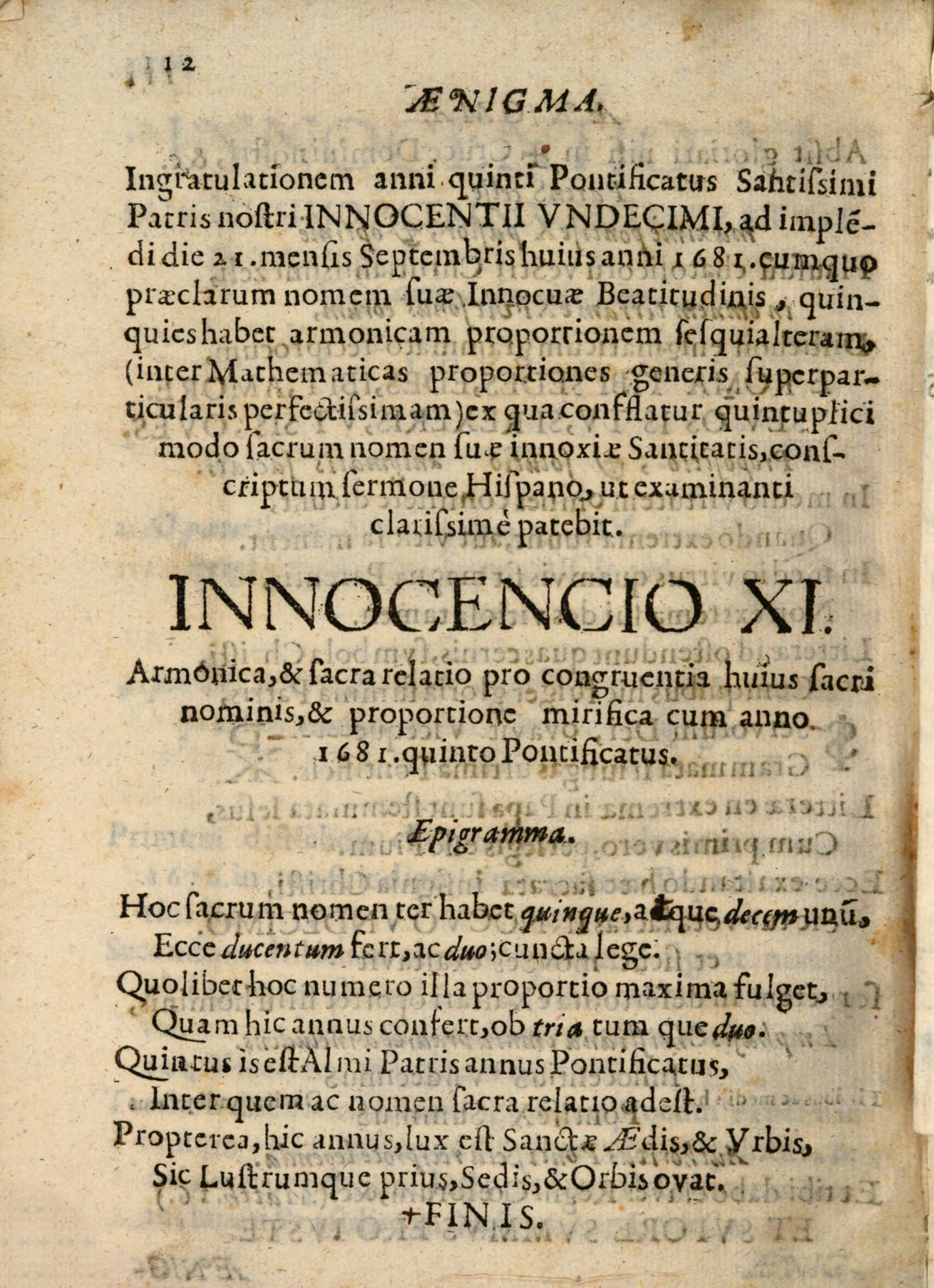
Both ‘riddles’ have solutions, as follows. The first (see Figure 6) is solved by extracting the first, middle, and last letters of the words ‘InnocEntiuS UndecimuS’ and ‘PonTIfeX SummUS’ to reveal ‘Iesus’ and ‘Christus’ (reversing and substituting the ‘PX’ of ‘pontifex’ for Greek chi-rho [XP]). The first letters of the four words can also be extracted to form an anagram of ‘Pius’.Footnote 26 The second (see Figure 7) involves identifying the three ‘fives’ in Innocent's name: the five vowels, five consonants and five syllables; then the ‘ten’, which is the ten letters of ‘Innocencio’; and, finally, the ‘two hundred and two’, the two ‘C's and two ‘I's in that word (Roman numerals). The riddle also asks how Innocent's name forms a perfect proportional sesquialtera ratio, which can be explained because the number ‘five’ is made up of three and two (which Innocencio has thrice over) and the number ‘ten’ is six plus four, two numbers which also form the sesquialtera twice over.Footnote 27
‘Programmata et anagrammata’: Sanz, Ecos sagrados, Bayerische Staatsbibliothek München, 4 H.eccl. 697 m, p. 88 (0128).

‘Aenigma i’: Sanz, Ecos sagrados, Bayerische Staatsbibliothek München, 4 H.eccl. 697 m, p. 111 (0151).

‘Aenigma ii’: Sanz, Ecos sagrados, Bayerische Staatsbibliothek München, 4 H.eccl. 697 m, p. 112 (0152).
III
Just as there is no single way to read the Ecos sagrados, there is also no individual text, or category of text, with which Sanz's effort in writing it can be compared satisfactorily. It is not much like Francesco Miloni's classicising Panegirico per l'esaltazione di Clemente X. Sanz himself suggests a different model for his work: De partu Virginis, a sacred epic about the Virgin Mary, which Iacopo Sannazaro (1458–1530) dedicated to Clement vii (r. 1523–34).Footnote 28 Yet Sanz's text differs from Sannazaro's in pretty much every meaningful aspect and the comparison seems largely rhetorical: it facilitates a claim Sanz wishes to make to aspire to place his work at the pope's feet, as Sannazaro once did. Latin puzzle books and also a range of mystical-mathematical texts from Valencia, which John Slater has studied, would seem to offer more promising avenues for comparison.Footnote 29 André de Solré, a Dominican in Brussels, wrote a work containing one hundred anagrams of the name ‘Alexander Septimus’ [Alexander vii, r. 1655–67], each with its own epigram, in 1666.Footnote 30 Two books by the Italian Piarist Carlo Mazzei (1621–95), the Liber anagrammaton multis epigrammatis ornatus, inter quae anagrammata aliquot inscriptiones sive elogia novae inventionis, eminentissimo principi Flavio Card. Chisio S.R.E. Bibliothecario Apostolico dicatus (1674) and the Musae Anconitanae sive Epigrammaton libri IV (1674), also anagrammatise papal names alongside those of saints and historical persons. Moreover, Mazzei's books contain acrostics, multi-line anagrams and a series of forty anagrams and riddles devised by his brother Marcello. By contrast, the Valencian mystical-mathematical texts seek hidden mathematical harmonies and symmetries in names – a clear feature of the Ecos sagrados – usually via a form of numerical Kabbalah known as Gematria in which letters are substituted for numbers which are added up together to ‘reveal’ hidden meanings.Footnote 31 Sanz does not employ Gematria in the Ecos sagrados, but he does in several other works. And, as is shown below, there are social connections between Sanz and the Valencian mathematicians which make some cross-influence highly probable.
Yet, neither the Valencian texts nor the books of papal anagrams in the end make fully adequate comparators for Sanz's work because they simply lack its length, intellectual range, thematic vision or organisational complexity. There is no overarching theme to unify them beyond their exploitation of specific forms of puzzling. And they do not boast the range of intellectual influences that Sanz stuffs into the Ecos sagrados, which thus remains a category apart in significant terms. Scholars can learn something of Sanz's interests, and a lot about his priorities, however, by identifying where those inspirations for his content came from. As implied above, Sanz references various texts in the Ecos sagrados and these citations permit partial reconstruction of his intellectual biography. Naturally, many biblical books are present in it; so too are early Church Fathers, including Eusebius, Augustine, Maximus of Turin and Gregory the Great; pagan authors from Ovid, Virgil and Martial to Pliny;Footnote 32 modern poets, including the Italian Renaissance poets Giovanni Aurelio Augurelli (1441–1524) and Sannazaro; and a broad swathe of recent non-fiction writers, including the German Jesuit Athanasius Kircher (1602–80), the Italian symbolist Pierio Valeriano Bolzani (1477–1558), the Polish-Scottish Calvinist Jan Jonston (1603–75), the French Jesuit astronomer Claude Francois Milliet Dechales (1621–78), Gabriel Díaz Vara Calderón (1621–76), sometime bishop of Santiago de Cuba, and the Italian Jesuit theorist of language Emanuele Tesauro (1592–1675). This selection may not seem impressive, numerically, but that is surely hard to judge in this context. It is certainly an eclectic selection, especially when compared to the more limited intertextualities of other apparently similar works like Miloni's Panegirico or any of the other examples of ludic Latin discussed above.
In fact, how Sanz uses some of the texts he cites in the Ecos sagrados is at least as interesting as his choice of what to cite. Not all texts are equal within Sanz's scheme. To co-opt a musicological analogy, appropriate for Sanz, most of his engagement with other works is mere ornamentation that showcases erudition. Occasionally, for instance when he mentions Jonston and Pliny's theories about the natural world in Echoes vi and vii, he runs with an intellectual motif and develops it thematically. But only in one case, Kircher, does Sanz draw on an author to provide a formal structure for what he himself has to say. Sanz proudly proclaims that Kircher has given him the idea for the echoes, noting the precise passage of Kircher's Musurgia universalis (1650) which inspired them.Footnote 33 In book ix ‘Magia Phonocamptica’, chapter ii ‘Phonurgia Echonica’ or ‘De Echonibus artificiose constituendis, fabricandisque’, Kircher expounds a theory that echoes form through reflections of sound that bounce repeatedly off surfaces and, each time they do so, drop the first part of their form. Kircher illustrates this with a diagram of a man shouting along a wall with towers (see Figure 8), which, perhaps tellingly, uses the exact same word as Sanz's: clamore, which thus resounds amore, more, ore and re after each of them.Footnote 34 With its seven letters, it was certainly a convenient choice for Sanz's own septuple echo.
‘Iconismus xv’: Athanasius Kircher, Musurgia universalis, Rome 1650, Bayerische Staatsbibliothek München, 2 Mus.th. 264–2 (0279).

Perhaps the most significant thing about Sanz's engagement with Kircher is that, in constructing his echoes, he does not use Kircher's theory unadulterated. Kircher states specifically in the Musurgia that Rome's walls have so many towers that the reflections of sound off them are unpredictable.Footnote 35 Sanz does not accept this but quotes, instead, from Calderón's recent Roman guidebook Grandezas y maravillas: the seven hills are ‘placed almost as if in a single line, so they appear to touch one upon the other’.Footnote 36 In Sanz's view this justifies modifying Kircher's assessment of Rome's sonic properties: hills not towers matter and therefore the echo can be heard precisely seven times. The Kircherian material in the Ecos sagrados in fact provides further examples of this modification technique. The very title of the ‘Obeliscus Odescalchus’ itself rather obviously genuflects to Kircher's Obeliscus Pamphilius (1659), a text about the hieroglyphs on the obelisk now in Rome's Piazza Navona erected by Innocent xi's eponymous predecessor (r. 1644–55). But the central orb in the ‘Obeliscus’ with its seventy-two tongues of flame is also appropriated from the kabbalistic diagram of the seventy-two names of God in Kircher's Oedipus Aegyptiacus (1652), which Daniel Stolzenberg reads as a sort of Jesuit emblem.Footnote 37 Can anything be read into the fact that Sanz printed the number ‘72’ to draw attention to exactly how many tongues of flame there were? Was that there to help a reader see the parallel? In any case, Sanz alters Kircher's Jesuit emblem for a papal purpose, replacing the IHS monogram with quotations from the Book of Daniel that allude to the nature of papal authority: ‘It struck the statue on its feet of iron and clay and smashed them’ (Daniel ii. 34) and ‘the rock that struck the statue became a huge mountain and filled the whole earth’ (Dan. ii. 35).
Beyond these observations of influences and their manipulation, it can also be said that Sanz would seem to have had better access to some of the authors he cites than others, which may be suggestive of the order in which he encountered them. Kircher may, in fact, be a late addition to his intellectual formation: the Ecos sagrados is the only one of Sanz's texts to mention him. By contrast, no fewer than three of Sanz's works cite Emanuele Tesauro. Indeed, Tesauro's Il cannocchiale aristotelico (1654) may have been Sanz's gateway to Kircher as it includes a rudimentary exposition of the echo theory set out in Kircher's Musurgia universalis.Footnote 38 There is reason, however, to think that Sanz's engagement with Tesauro was still more extensive and varied than this. An undated pamphlet by Sanz (see Figure 9) introduces Tesauro as the source of his knowledge of Kabbalah Gematria. Sanz seems to have been particularly taken with this conceit, which goes on to feature throughout his oeuvre. Here Sanz explains how he has adapted Tesauro's original approach by dropping the value assigned to the letter ‘K’ because ‘the K does not count as it is not needed in the Spanish tongue, and also because it has already been excluded from this attribution and count, even in Latin works, by geniuses who have more than enough authority to say so’.Footnote 39
Epitalamio numérico en parabien de las ilustres bodas que se han celebrado en Madrid [1676?], 1, Biblioteca Histórica de la Universidad Complutense de Madrid, BH FLL 10975 (12).
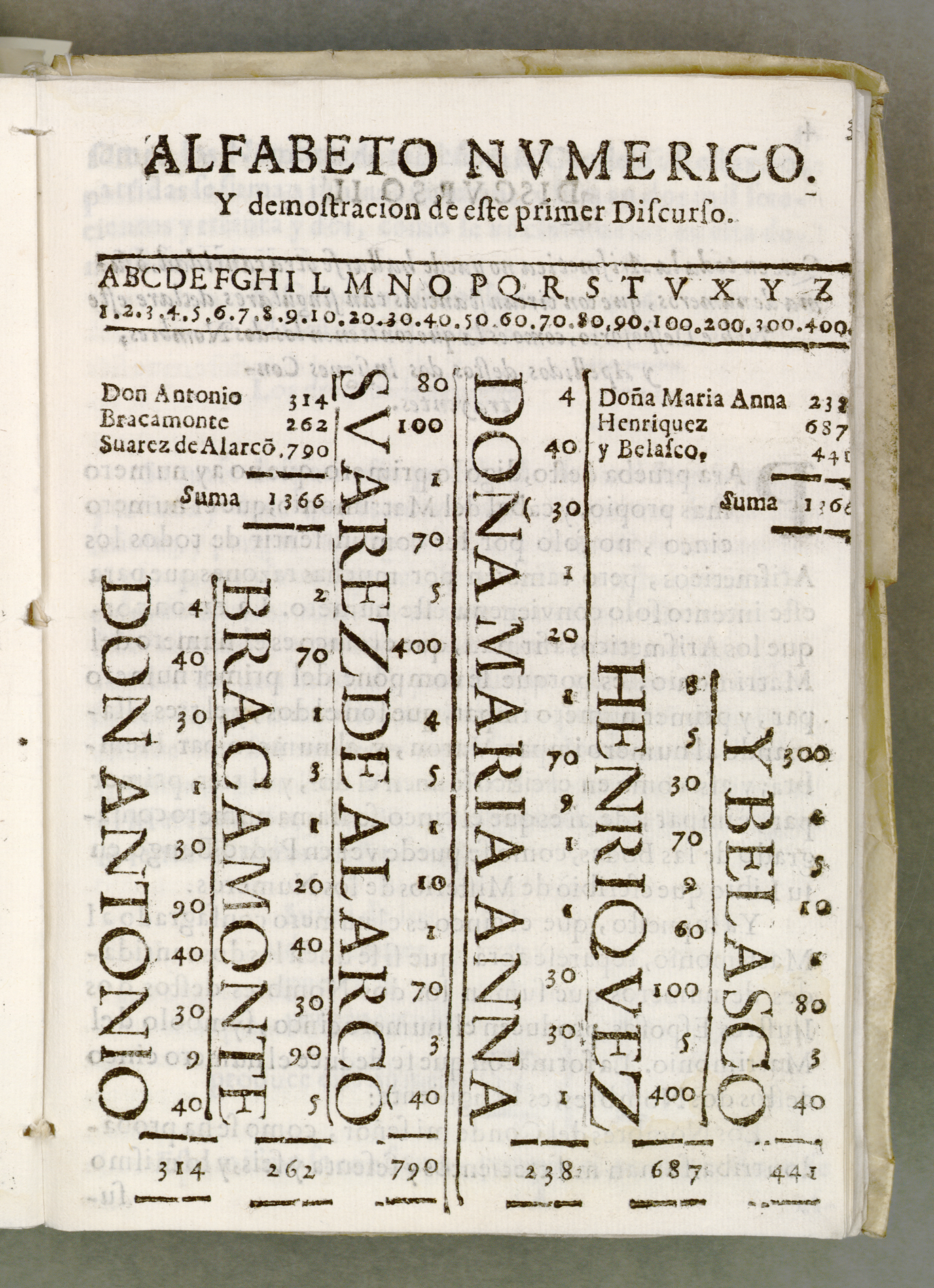
This information is very useful for solving some of Sanz's later riddles, for instance this one (see Figure 10) in the preface to El hombre de letras (p. xv):
361 = Savus (80+1+100+100+80)
254 = Melinus (20+5+10+9+30+100 +80)
210 = Sanctae (80+1+30+3+90+1+5)
167 = Romanae (70+40+20+1+30+1+5)
121 = Ecclesiae (5+3+3+10+5+9+1+5)
217 = Cardinalis (3+1+70+4+9+30+1+10+9+80)
349 = Creatus (3+70+5+1+90+100+80)
---
1679 (sum of above numbers)
Were ‘K’ to be included in the numerical alphabet, this puzzle would be unsolvable.Footnote 40 Sanz, presumably, had a good expectation that his readers would already know to drop it.
‘Aenigma’: Daniello Bartoli, El hombre de letras, Madrid 1678, p. xv, Biblioteca Histórica de la Universidad Complutense de Madrid, BH FOA 28407.

IV
In fact, Tesauro rather than Kircher may be the most important influence on Sanz's conception of the Ecos sagrados for quite another reason. Amongst the major points that Tesauro makes in Il cannochiale aristotelico is one which others have cited as significant in the propagation of early modern ideas about genius and ingenuity: to play with rules of form and genre to generate pleasure by demonstrating mastery over them.Footnote 41 As Tesauro puts it:
It is a secret and an innate delight of the human intellect to find that it has been sportively deceived; because the transition from illusion to disillusion is a kind of learning by an unexpected way; and therefore most pleasing.Footnote 42
This seems as good a description as any of the philosophy underlying the Ecos sagrados. In that sense, Tesauro could be said to have provided Sanz with more than just an organising principle for the work, in the manner of Kircher: he suggested to him a technique of composition itself. Sanz may, thus, offer a valuable example of how a particular individual, connected only distantly to Tesauro, put his ideas into practice. Only two things limit development of this argument: first, Sanz's lack of explicit theoretical engagement with Tesauro on this point and, second, the possibility of other important influences on Sanz that are not cited in any of his texts. It seems, for instance, scarcely conceivable that Sanz could have known Tesauro and Kircher and lacked familiarity with other contemporary literary Jesuits of similar status. Sanz certainly read Daniello Bartoli (1608–85) because he translated his most famous work. And, if he read Tesauro, Kircher and Bartoli, how could he have failed to have encountered Baltasar Gracián (1601–58)? Bartoli's L'huomo di lettere is one of the seventeenth century's most important works on rhetoric, so it would be surprising if it did not leave some imprint on Sanz's mental make-up. And Gracián's ideas on agudeza (wit) and ingenio (genius) are not only the equal of Tesauro's in the development of the broader cultural-semantic field but were local to where Sanz lived.Footnote 43 Gracián, from Catalayud, was Sanz's Aragonese compatriot. Both men evolved a line of thought which ultimately apes Augustine.Footnote 44 Why then would Sanz have preferred to read and cite Tesauro over him? And how much can really be said about Tesauro's or Kircher's influence on Sanz if the influence on him of these equally significant contemporary intellects cannot be established?
A linguistic analysis of Sanz's writing might take us further in identifying stylistic influences on it and is certainly worth pursuing. But this article presents a social as well as intellectual history so its proximate question is different: where might Sanz have gained access to all this Jesuit material given what is known about him? Paula Findlen has already demonstrated the value of investigating how Kircher acquired and used information, and such a line of inquiry has also always seemed as if it ought to bear fruit with respect to Sanz.Footnote 45 Sanz may have encountered Kircher in Juan of Austria's private library, because Elvira González Asenjo has recently identified a cache of twenty-seven books by Kircher from there in the collections of the Complutense. They include the Oedipus Aegypticus, Obeliscus Pamphilius and Musurgia universalis.Footnote 46 Yet the only real link between Sanz and Juan is the former's dedication of the Instrucción de musica (1674) to the latter. It may therefore be a stretch to say that Sanz read Kircher in Zaragoza. It just as likely that he came to know both Tesauro and Kircher in Madrid later in the 1670s. And John Fletcher, investigating the distribution of Kircher's works in Spain, has discovered Kircher's fellow Jesuit Hugo Semple to have offloaded eighteen copies of the Musurgia universalis there in the 1650s.Footnote 47 Yet, unfortunately, there is no straightforward way to reconstruct Sanz's Madrileño social world. Indeed, there is no definitive proof that he ever formally resided in the city. Few documents link Sanz to specific individuals in Madrid's intellectual scene either. The only one identifiable outside Sanz's own corpus is a valedictory epigram in the second part of Francisco de la Torre y Sevil's translation of the Welsh Protestant John Owen's epigrams (1682). De la Torre (1625–81) had died the year before, so this volume was posthumous, but the epigram was dedicated to him by Sanz as his ‘amicus’.Footnote 48 The association is intriguing, for two reasons: first because of de la Torre's close connection with Gracián and other important writers of the Siglo de oro, and also because he links Sanz to the Valencian mathematicians that John Slater studied. De la Torre, who was certainly in Madrid throughout the 1670s, moreover himself wrote a short tract in 1675, Armonía feliz y numerosa de los sietes, which celebrates Carlos ii's fourteenth birthday through playful exploration of the many hidden ‘sevens’ in the king's life and in the universe.Footnote 49
Arguably the most rewarding source of information about Sanz's social milieu during the years in which the Ecos sagrados was conceived and executed may in fact be the aprobaciones of the work's ecclesiastical censors – the only two men known for certain to have ever actually read it. The first censor, José de Madrid, is obscure: a Capuchin from the convent of San Antonio del Prado, he was imprisoned for a sermon he gave in 1678 but was later rehabilitated.Footnote 50 Bartolomé Alcázar, the second censor, is, however, much better attested.Footnote 51 A professor of Latin at the Colegio Imperial, he was the author of such texts as Panegyris in nuptias Caroli II (1679) and, apparently, of two saints’ vitae written in the form of successive anagrams of an original phrase pertaining to them.Footnote 52 Given their overlapping interests, it would hardly surprise that Sanz and Alcázar were acquainted. But Alcázar's aprobación goes further than merely confirming that they were: it proclaims its author's long-standing ‘friendship’ (amistad) with Sanz and also reveals that he had read the text even before his commission to give it official approval. Two other, albeit more tenuous, pieces of evidence connect Sanz to the Colegio. First, Sanz's printer for the Ecos sagrados, Juan Martín del Barrio, is known to have printed just one other work: the Esphera en comun celeste y terraqua (1675), a treatise on geometry and astronomy by another of the Colegio's Fathers, José de Zaragoza (1627–?). Second, two chapters of a Latin grammar by a different Latin professor of the Colegio, Juan García de Vargas (1652–1717), set out in precise detail all the forms of poetry and word games contained in the Ecos sagrados, with careful instruction for how they should be executed.Footnote 53
The question is, what to make of these connections? That Sanz knew at least one of his censors for the Ecos sagrados was probably no accident. The Consejo de Castilla, likely the body that authorised publication in this instance, did not assign such censors to texts at random: selection criteria were ‘expertise’ but also willingness. Alcázar is known to have approved just three texts during his career, of which the Ecos sagrados was the first.Footnote 54 The Ecos sagrados was also Fray José's first known commission in such a role.Footnote 55 Sanz also certainly knew other censors of his work, for instance the historian Félix de Lucio Espinosa y Malo (1646–91) who approved the translation of Daniello Bartoli. One of Sanz's surviving pamphlets is a panegyric letter congratulating Espinosa y Malo on his appointment as ‘Chronista de su Magestad’ and addressed to him as ‘friend’.Footnote 56 Espinosa y Malo, like Francisco de la Torre, moreover, was a knight of the Order of Calatrava, one of Castile's oldest and most prestigious military orders. And both men also connect Sanz to the royal court. Sanz's association with them may even explain his decision to publish at least two of his pamphlets of ludic Latin: Carolo austriaco secundo hispaniarum regi: Sanzius hos Caspar sacrat tibi Carole versus (1677) and A la reyna madre doña Mariana de Austria: anagramas (1679). It may also be worth pointing out that one of the surviving copies of the Ecos sagrados bears the ensign of the old Biblioteca Real, suggesting it was presented to the king or queen mother. Nevertheless, there is no evidence that Sanz profited from any friends he made at court.
V
Unfortunately, almost nothing is known about who read the Ecos sagrados after it was published, nor about how they did so. Of the six surviving copies, three are now in Madrid, one in Munich, one in Pamplona and one in Huesca. Four can probably be associated with institutional ownership. The Huesca (Biblioteca Pública del Estado) copy almost certainly comes from the collection of the Universidad Sertoriana, suppressed in 1845. The copy in the law faculty of the Complutense previously belonged to the Colegio de Malaga, a colegio menor of the old university at Alcalá, founded in 1611 but which had disappeared by the end of the century due to lack of funds. The Biblioteca Nacional de España copy is the one from the old Biblioteca Real. The Complutense philology faculty copy ought to have come from the Reales Estudios de San Isidro, successor to the Colegio Imperial which was suppressed 1767.Footnote 57 Only three of these copies contain meaningful marginalia. Those in the Biblioteca de Navarra (Pamplona) and the Bayerische Staatsbibliothek hold the names of individual owners: Buenaventura Arebalo (fl. 1736–59), a Carmelite friar from the convent in Tudela (near Zaragoza), and Franz Anton von Heugel, privy counsellor to the bishops of Eichstätt and Augsburg, and father to Maria Walburga von Heugel (1707–68), a Benedictine abbess.Footnote 58 These two owners’ names are in some ways surprising, for both men lived at least a full generation after Sanz – and, in von Heugel's case, some geographical distance from him as well. The Huesca holding is the only copy with noteworthy annotations: calculations of ‘2×134’, ‘3×089’, ‘5×206’ and a single number ‘7’ inside its front cover.Footnote 59 The multipliers here are a sequence of primes and the sums of the second and third calculations are multiples of each other, features which are unlikely to be incidental – and at least hint at one reader's engagement with the mathematical dimension to Sanz's text.
The best resource for thinking about how the Ecos sagrados was received therefore probably still comes from its censors’ aprobaciones. Scholars are conditioned to think of such censors as authoritarian figures who combed through the text to excise problematic parts.Footnote 60 Yet Bartolomé Alcázar refers to Sanz as his ‘friend’. And both censors seem to have understood their duty to assess Sanz's work in the spirit of its inventive entertainment. Their aprobaciones stand out as, above all, critiques of Sanz's skill rather than verdicts on his orthodoxy. Fray José gushes over the cleverness of Sanz's original intellectual conceit and how remarkably he has managed to execute it. He finds the epigrams particularly impressive: ‘una perfectissima poesia’ [a most perfect poetics].Footnote 61 Alcázar is, if anything, more mellifluous in his appreciation. ‘On increasing the number of anagrams, which are enough to torment a genius, in so many variations, the author has fulfilled his purpose, for the sweetness with which these ingenious works [empresas] succeed’, he declares.Footnote 62 Later: ‘I conclude by saying that this panegyric is a work of such perfection that even the most pedantic Aristarchian could hardly fail to notice it.’Footnote 63 Alcázar and Fray José's aprobaciones fit a trend that José Simón Díaz identified, whereby such texts grew longer and more verbose over the course of the seventeenth century.Footnote 64 However, importantly, in this instance, both censors went further than mere praise: they got in on the act by using their aprobación to show off their own erudition. Fray José quotes extensively from the classics (Scripture, Aristotle and Cicero), but Alcázar matches Sanz anagram for anagram: three on Innocent's name, one of which cleverly introduces ‘Gaspar’ as its subject. Alcázar even shows off his knowledge of Greek and critiques Sanz's Latin, explaining how he could have had even more anagrams if he had used the word numus, which is an acceptable abbreviation of nummus and also derives either from king Numa or from the Greek νόμου (money). In both censors’ cases, the reader had clearly become participant.
Evidence such as this suggests that the censors themselves were constituent to the community of those who played Sanz's lexical games. Institutions such as the Colegio Imperial therefore offer a productive focus for further investigation of both ludic Latin texts and the clerical culture that produced them. The Colegio already enjoys a substantial historiography, including a two-volume official history which has established its pre-eminence as a centre of Latin scholarship in Spain at this time.Footnote 65 However, that historiography tends to privilege formal education aspects – for example, Alcázar's serious instructional texts on rhetoric – over the informal cultures of learning and sociability that must have accompanied them.Footnote 66 The Colegio's Fathers were responsible for the production and propagation of Alcázar's ludic Latin as well – something attested not least by the locations in which they survive. And other published works also hint at wider ludic production within the Colegio. Fernando de Monforte y Herrera's account of celebrations for the canonisations of Ignatius Loyola and Francis Xavier in 1622, for example, refers to an altar decorated with puzzles and picture poems that sound a lot like those in Sanz's text.Footnote 67 Of course, recovering the Colegio's informal culture, and the various kinds of connections of its Fathers with other clergy in Madrid and beyond, is hampered by the destruction of records following the Spanish Jesuit suppression in 1767. But scholars need to try to overcome this difficulty and put it back into accounts of communities like the Colegio, if they are to recover the forgotten cultural world to which the opening section of this article alluded. Analysis of surviving library catalogues of Madrid's Jesuit institutions, still maintained in the Complutense University, might well yield both further titles of interest and evidence of their dissemination. Bernabé Bartolomé Martínez, who has explored production and circulation of Jesuit books in Spain, has also shown that one in four of all Jesuit books about the liberal arts published in seventeenth-century Spain was produced in Madrid, largely through the Colegio's influence.Footnote 68 This is potentially another felicitous line of research.
Beyond Spain, many questions also remain, such as about the wider international context to Sanz's work and how to reconstruct a more precise history of the craze for ludic Latin amongst Catholic clergy. Certainly, this clerical culture of (word)play has yet to be studied widely beyond its more technical aspects – in part because it is hard to comprehend and in part because its outputs are easily dismissed as ephemeral. It nevertheless remains a valuable resource for understanding shifting tastes and values amongst Sanz's clerical friends and collaborators. What dictated their choice of texts to pursue? Was it a question of skill or access or aesthetic? How widely were their texts disseminated? The decision to anagrammatise popes' names in such works may have stemmed less from special devotion than from the need to use suitably solemn phrases in this sort of exercise to justify it as a pastime. However, it does also attest to what John O'Malley terms the ‘papalisation’ of Catholicism in these centuries.Footnote 69 A broader comparative study might, equally, inch towards stronger answers about uses and circulation. Mazzei's Musae Anconitanae survives in copies in Augsburg, Rome (two copies), Lyon, Madrid, Luzern, Budapest and Paris; his Liber anagrammaton in Columbia, Budapest, Rome, Aarau and Lugano; Solré's Musae brabantinae in Harvard, the Bibliothèque nationale de France, and the Biblioteca nazionale centrale di Roma. Three-to-eight surviving and widely distributed copies of what were probably quite marginal and cheaply produced books is quite a few for works that did not naturally gravitate towards survival via institutional ownership and may indicate a considerable hidden history of these texts to be uncovered.Footnote 70 In short, there are many more mysteries to extract from Sanz's Weltanschauung and further puzzles to be solved.


 Open access

