1 Introduction
Ephrem the Syrian (ca. 306–373) is best known today as a distinguished theological poet, whose paradoxical symbolism and disciplined wonder form a stream irrigating much of subsequent Syriac tradition. He is among the most significant early authors of the language, a dialect of Aramaic expressing a form of Christianity that prevailed in Late Antiquity from east of Antioch through Mesopotamia, and which came to stretch as far as India and China. In recognition of his inspired eloquence, this same tradition named him the Harp of the Spirit. He wrote for Christians of his native Nisibis and (after 363) of Edessa, both in Mesopotamia. Apart from a few prose commentaries and treatises, much of his extant corpus consists of about 400 madrāšê, a type of didactic stanzaic poem, which has been called “the most Aramaean of literary genres.”Footnote 1 To contemporary readers, Ephrem’s preference for poetry over prose as a theological and argumentative medium is especially striking.Footnote 2 In his symbolic theology, many discover a fresh and profound approach to exegesis eschewing what Ephrem himself regarded as impious attempts to probe and contain divine mystery. Especially in that sense, his works starkly oppose the various anti-Nicene theologies of the day that have traditionally been termed “Arian.” Accordingly, Ephrem, when he appears in the histories of the period, is usually placed alongside other pro-Nicene theologians as a distinctive Syriac voice in that controversy of the age.
Eschatology too, is a key part of his vision, and Ephrem’s poetry abounds with vivid scenes and images describing the last things and the end of salvation history. His views on these topics frequently ground his exegesis, his spiritual exhortation, his meditative wonder, his prayer, and his polemics. Buchan put it best: “Ephrem’s thought is suffused with eschatological concerns from first to last.”Footnote 3 Perhaps best known in English are Ephrem’s Hymns on Paradise, a detailed meditation on the shared patristic tradition of the restoration of humanity to Eden.Footnote 4 This theme has prompted much commentary to elucidate its ramifications for topics such as sin, human freedom, the Church, and divinization, not to mention erudite study of its sources and subsequent influence.Footnote 5 And since Christ restores Adam from Sheol to Paradise, in Ephrem’s poetic vision, many have naturally turned to study his richly developed descensus ad inferos motif, his keen interest in the doctrine of universal corporeal resurrection, and the question of whether all are saved in the end.Footnote 6 On the resurrection, Ephrem represents the distinctive view of the early Syriac tradition that held that final blessedness is impossible without the body, with the result that the souls of the righteous and unrighteous alike must sleep in Sheol until the final resurrection. Due to this sleep of the soul, Ephrem and other thinkers in his tradition only envisioned the intercession of the saints, or supplication to them for assistance, as occurring in the future at the last judgment, when they would be awake.Footnote 7
Ephrem moves freely and routinely between protology and eschatology. In the scholarly conversation just briefly described, several of his interpreters have done the same, taking many themes and images in an eschatological sense. Amid such abundance, can one discern the coherence of Ephrem’s vision of these last things? This question is important for at least two reasons. First, Ilaria Ramelli has claimed Ephrem as an implicit supporter of universalismFootnote 8 and thus incorporated him into her broader revisionist narrative about the prevalence and acceptance of universal salvation in the early Church, a tradition she traces to the New Testament itself and to Origen. And this leads (second) to a broader question implicitly raised by that project: to what extent may one discover in Ephrem a distinctive vision amid early Christian eschatologies? Knowing how Ephrem’s eschatology fits together makes its distinctive features available for contemporary theological questions about the universality of salvation and the implications of that position for how we view the human person.
To answer such questions, one must engage Ephrem’s view that symbols are the necessary medium for ascending to God and knowing of his plans. These types and images derive from Scripture, from the natural world, and from the liturgical and sacramental life of the Church. On the one hand, we have access to God through the symbols he gives to us, by which he “translates” (mtargem) and “explains himself” (napšeh npaššeq),Footnote 9 and yet Ephrem also insists on their limitations:
Ephrem admonishes his audience to discern the images that God uses for our benefit, while recognizing their inadequacy. Such inadequacy does not consist in leaving us uncertain about what God has done or will do; rather, the point is that only by relying on God can we know him, and only by recognizing that the symbols he gives us do not contain him can we avoid diminishing him, to our own detriment.
Thus our own attempt to discover the coherence of Ephrem’s eschatological vision must turn a discerning eye to the key images in which Ephrem couches it. In order to bring clarity to the discussion of universalism, it is also necessary to distinguish among the various eschatological themes those that are most ultimate, beyond resurrection, supplication, intercession, and judgment: namely, the beatitude of the righteous and the condemnation of the wicked. Universalism ultimately concerns itself with these conditions. Moreover, if this end state, whether of blessedness alone or of blessedness and damnation, represents the final goal to which all things tend under God’s providential care, then it is reasonable to suppose that the whole drama of the end finds its meaning there. And it is also in such a vision in the “mirror of the Gospel”Footnote 11 that one can expect to find Ephrem’s understanding of what it means to live eternally.
1.1 Organizing the End
Treatments of eschatology in Ephrem and in the Syriac tradition more broadly have tended to approach the matter by dividing it into particular and universal: that is, the account of the fate of the individual after death as distinct from the conclusion of salvation history as a whole. Thus, Murray regularly laments that the early Syriac fathers’ accounts of the Kingdom and the Church tend to be individualistic rather than corporate.Footnote 12 Witakowski, in his recent treatment, explicitly distinguishes between particular and general eschatology.Footnote 13 The debate over universalism, as the name suggests, implies the same frame of reference. Asking questions in this way, with due caution, is not fruitless. But given that the early Syriac tradition’s teaching on soul sleep obviates the particular judgment and that Ephrem prefers to move fluidly between individual and corporate perspectives,Footnote 14 one might reasonably ask whether a different approach could be more congenial to Ephrem’s own thought patterns.
Indeed, Ephrem’s angle of vision on the last things seems to take two forms: one can look at them from the point of view of God’s descent to humanity, and from the point of view of humanity’s ascent to God.Footnote 15 Both ascent and descent take place via symbols, and both are predicated on the sharp distinction between creator and creature that is so programmatic for Ephrem.Footnote 16 This means that rather than distinguishing between individual and collective accounts, Ephrem’s idiom expresses eschatology in terms of the polarity between creator and creation, and the movement between these poles.
1.2 Organizing the Argument
Given this approach, another question naturally arises: what view of humanity (the human pole, so to speak) does Ephrem both presuppose and elaborate in his account of the final things? What sort of thing is a human person, viewed from the perspective of the beatitude for which that person is created? As will become clear in Section 2, Ephrem’s vision of the end foregrounds human freedom and its inherent uncertainty. Section 3 argues that Ephrem’s account of such freedom is epektatic. That is, as for Gregory of Nyssa,Footnote 17 transformative growth, specifically in knowing God, remains a feature of human life both now and in blessedness. And Section 4 argues that this remains true for Ephrem even as a possibility for the damned. He never confidently asserts that all will be saved or that one must hope for such an outcome. Yet he is remarkably consistent in allowing the possibility that human freedom, after body and soul reunite post-resurrection, has the opportunity to accept, though not to deserve, the grace of escape even from Gehenna, whose permanence is a function of our own interior impenitence. Ultimately, I argue, it is Ephrem’s view of human freedom as capable of transformative growth in relation to God that grounds the coherence of his eschatological vision.
In making this case, this study limits itself to the Syriac works of Ephrem generally accepted as authentic.Footnote 18 It operates both by a careful descriptive-analytic reading of the grammar of Ephrem’s symbols (Section 2) and by analyzing his poetic technique to draw out the fundamental symbol pairs that function as the principles of his thought (Sections 3 and 4). Gregory of Nyssa’s view that blessedness consists in perpetual progress into divine goodness occasionally punctuates the analysis, as an illuminating comparison and contrast with Ephrem’s position. Gregory relied on the principle that divine goodness is infinite.Footnote 19 Ephrem bases his view of progress on a different but related perspective, as will become clear.
When quoted, Ephrem’s madrāšê are presented according to the layout in their respective critical editions listed in the bibliography, but without any attempt to convey in English the meter of the original. Ellipses indicate intentional omissions on the author’s part for brevity or clarity rather than lacunae in the original. All translations from the Syriac are, except where noted, the author’s own. Occasionally, words that can be contextually inferred have been inserted, within square brackets, for the sake of clarity.
2 Discerning the Kingdom and Gehenna
Given Ephrem’s symbolic idiom, it makes sense to ask which symbols he prefers to use specifically for the future end of salvation history and for how the end relates to the whole. To what extent do they make that future end knowable? There is no doubt that Ephrem’s repertoire of symbols is broad and deep, including some whose polysemous depth can bewilder a person, as the poet himself admits.Footnote 20 Yet when he seeks to refer specifically to the final state of blessedness or torment, he usually speaks of the Kingdom (malkûtâ)Footnote 21 and Gehenna (gêhannâ).Footnote 22 Clarifying what Ephrem means by Kingdom and Gehenna thus forms an essential prelude to seeing how his eschatological vision coheres around the polarity between creator and creature.
Beyond coherence, two other related issues are at stake in our task of discerning the two. As noted earlier, some have rightly focused on Ephrem’s keen interest in corporeal resurrection and Christ’s victory over death, a teaching whose defense and elaboration is perhaps the most salient theme in his Carmina Nisibena. Can we then take the universality of resurrection as indicating something about the universality of salvation? If the answer is that Ephrem himself consistently depicts the Kingdom and Gehenna as phenomena that take place beyond the horizon of resurrection and judgment, then the answer seems to be no. Establishing this narrative distinction thus paves the way for the discussion of universalism in Section 4.
The second issue is the question of how to interpret Paradise as an eschatological symbol. Is the ultimate end a return to the state of primordial blessedness, and if so, in what way? What is the relationship between Kingdom and Paradise?Footnote 23 In any case, there seems little debate among scholars about the eschatological valence of the Kingdom image.Footnote 24
The business of this section, accordingly, is to unfold in turn the logic inherent in the symbolism of Ephrem’s two portraits: of the Kingdom and of Gehenna, and to show their future reference. He construes the former in terms of divine wealth and nourishment, and the latter in terms of fire and the second death. In so doing, Ephrem’s overall vision of salvation history also comes to light, as a pattern of return to Paradise for which Ephrem’s principal concern is not so much the divine providence that orchestrates the return as the human freedom that strives for it.
2.1 The Wealth of the Kingdom
Ephrem consistently elaborates the inner logic of the Kingdom image as expressing divine wealth made human wealth. Eccl. 49 opens with such an image:
Throughout this poem, Ephrem explores how Christ ultimately reverses Adam’s fall. Here in the poem’s first stanza, the language of returning to the Kingdom expresses that reversal in a compact form. To return to the Kingdom is, in other words, to have one’s debt of sin repaid and to have a share thereby in divine wealth.Footnote 26 In Eccl. 50, Ephrem explores the reversal at length; he views it as the work of divine mercy toward Adam, conceived as cooperating with human effort, though in an unequal partnership. The imagery of wealth and debt affords him a convenient way to establish the inequality of God’s graciousness with humanity, which is like that between a king and a pauper.Footnote 27 “Whose effort,” says Ephrem, “suffices for the price of the Kingdom (dmāyyāh d-malkûtâ), / to receive it by justice without inheriting it for free?”Footnote 28 Christ sought, in fact, to “enrich our neediness (ṣrîkûtan) with heavenly treasures”Footnote 29 so that his wealth becomes ours. Ephrem sees this wealth anticipated in Enoch’s return to Paradise (hinted at in Gen 5.24).Footnote 30 Enoch and Elijah, says Ephrem, “lived by his symbols in advance (b-râzaw[hy] ḥyaw lûqdam). / For they were both snatched up and translated (eštānnîw) to Paradise itself.”Footnote 31 Anticipated in them, Christ’s purpose is fulfilled in the Kingdom, which appears here synonymous with Paradise. The relationship between Adam and Enoch illustrates some of the complexities of Ephrem’s thought about the last things. The Kingdom is a future reality, at least from Adam’s point of view in the poem’s implied narrative. Yet the verbs in the first stanza are perfect tense: Christ “has led” (dbartā[hy]) Adam to the Kingdom. Enoch’s example shows that he at least could enjoy this wealth in advance. What of its present status for us? Are we or are we not already in the future Kingdom?
The argument will return to Enoch’s example in Section 3.4 to consider the role of human effort. For the moment, another financial image, also used to sum up Christ’s saving work, clarifies how one may enjoy the Kingdom even now. Christ, says Ephrem,
departed from Sheol and dwelt in the Kingdom in order to tread the way from Sheol, which cheats all (ṭālmat kol), to the Kingdom which rewards all (pārʿat kol). For our Lord gave his own resurrection as a pledge (rahbônâ) to mortals that he would transfer (da-nšannê) them from Sheol which receives the departed without discrimination to the Kingdom which admits those invited with discrimination.Footnote 32
Death contrasts with the Kingdom in financial terms, but Ephrem here refines the image of the reward by which they differ. For the Kingdom does pay back all, but unlike death it discriminates on the basis of people’s labors.Footnote 33 Thus the Kingdom is marked by a mysterious paradox of equality and discrimination. And Christ’s pledge or down payment shows that Ephrem sees the reality of the Kingdom as present in Christ, but that the account is not, as it were, “settled” yet. That awaits the future resurrection of the body, foreshadowed in Christ’s own.Footnote 34
Since, as the examples already quoted have shown, the treasure image is closely connected to the exercise of our free will and effort, it is no surprise that Ephrem uses the wealth of the future Kingdom for exhortation. For instance, in Repr. 3.292ff, the Kingdom is the basis for encouraging endurance of poverty.Footnote 35 And more positively, when Ephrem describes wisdom in opposition to investigation, he frames that wisdom in terms of the eschatological Kingdom as a treasure possessed even now:
The Kingdom is the good end of all our striving, and Ephrem’s example of the wisdom that seeks it is Joseph’s purity, the treasure he preserved in spite of Potiphar’s wife’s attempt to seduce him (Gen 39.11–12), but Joseph claims his treasure even now precisely by preparing for that treasure that is to come. The image also serves as a warning. In the immediately preceding stanza, Ephrem had emphasized that Christ “established [the blessings] as a matter unforced, / and every person chooses according to his will.”Footnote 37 In Virg. 40, dedicated to the parable of the talents (Matt 25.14–30), Ephrem also castigates those who freely squander the “gemstones and treasures of the Kingdom.”Footnote 38 Throughout Ephrem’s references to the Kingdom as the eschatological goal the logic of the talents applies. For it is a case of divine wealth becoming human: lent to us by God and on God’s initiative, it becomes something we grow through striving, as an investment of effort.
2.2 Nourishment in the Kingdom to Come
Ephrem elaborates the image of the eschatological Kingdom further by focusing on what he takes to be its central feature: namely, its table (pātôr malkûtâ; see Luke 22.30). Divine blessing becomes human nourishment in some mysterious sense, even of our bodies. The Kingdom’s table in fact nourishes all things:
In this final stanza of Par. 11, Ephrem sums up an argument he has been pursuing throughout that madrāšâ: that Adam had been nourished by Paradise in the beginning and that Paradise has never ceased to have this nourishing role in the world even after his expulsion. Indeed, the passage from Eccl. 49 quoted earlier suggested that the treasures of the Kingdom could be conceived as “blessed delicacies”Footnote 40 for us to consume. But this passage also puts the imagery of the table of the Kingdom into a cosmological frame of reference. Elsewhere, echoing Isaiah 65.17, Ephrem will speak of God renewing heaven and earth at our resurrection.Footnote 41 Here, Ephrem shows that the primordial blessing of Paradise remains clearly a future goal, for which the poet hopes.
Such hope is also that of the righteous in the face of present effort and suffering. The “righteous” (zaddīqē), he says`
The image of awakening is consistent with Ephrem’s doctrine of soul sleep, described in the introduction. Here too, this awakening is a future event.
Though it references the future, the symbol of the Kingdom is rooted in our origin – at least as God originally conceived it: “If [Adam] had stayed with the commandment, he would have reigned as king (mamlek [h]wâ).”Footnote 43 Ephrem explains this kingship in the subsequent lines:
Ephrem clearly associates the kingly status with Adam’s freedom, which in its full flowering took, or was to have takenFootnote 45 the form of divinization. In Christ, it becomes once more the goal of ascetic striving:
Ephrem presents the ascetic in terms that reverse the error of our first parents who “look” (Gen 3.6) upon the fruit of the tree before succumbing.Footnote 47 The Kingdom lost is to be regained in the future. In this way, the Kingdom as an image sums up and points to the reward of ascetic effort, the gratuitous blessing of divine goodness, and the restoration of human dignity.
2.3 Heading toward the Kingdom
Several of the examples of kingdom language illustrate how Ephrem thinks we know about it: namely as part of the narrative arc of salvation history: from Paradise to the Church to the Kingdom. In short we know the Kingdom through its types, above all, in the Church. Many have studied this progression toward the Kingdom. Scholars typically point to two key passages, the first of which comes from Ephrem’s discussion of the Passover lamb in relation to Christ:
In the second passage, Ephrem describes the progression in greater detail, calling it a way, the name of Christ himself (John 14.6):
In commenting on this passage, Murray emphasized the role symbols play on the journey:
The symbolic force of [Ephrem’s] typology is progressive: the ‘time of the Church’ is fulfillment or reality (šrara) in relation to the Old Testament Types, but the Church itself is only the type of the eschatological kingdom. This progressive typology naturally suggests a journey.Footnote 50
Yousif also saw the stages progressing from creation through the fall, incarnation, and redemption, based on Comm. Diat. 19.17. He took this as the basis for optimism that creation would be restored at the end of the “cours temporel” of both humanity and the universe.Footnote 51 He too finds the source of eschatological images in those of the present: “One knows,” he says, “that Ephrem, as symbolist as he is in the order of the present time … attempts to make clear that our images and expressions do not apply completely to the realities of the hereafter.”Footnote 52 He adds, “For Ephrem … what matters is not knowing the hour of the world’s end, nor its unfolding, but rather preparing the destiny of humanity…. The theology of the future of humanity develops with an eye on the present time, which should itself be oriented toward the hereafter.”Footnote 53
This indeed is the answer to the question about how the Kingdom still to come is known: namely, in Christ and in the present, through its Old Testament figures and through the sacramental life of the Church that anticipates even now the life of that Kingdom. Baptism, for instance, gives birth to “sons of the Kingdom.”Footnote 54 Thus, as Beck suggests, it is not a matter of images simply as means of knowledge. Christ himself is an image, the image of his Father and revealed in the mirror of the Gospel:
This image contains the whole Christ in his divinity and humanity, not only the model of his moral perfection, but even his whole saving work of healing, above all the re-creative [healing] in his sacraments.Footnote 55
The insights of Yousif and Beck show first that for Ephrem Christ’s types and sacraments manifest the Kingdom by anticipating the experience of its life. And second, they reveal something of the context in which Ephrem meditated on eschatological topics: namely, with a practical eye. Though the knowledge of the end state of salvation is limited, the symbols of the Lord permit one to know enough of it to strive for it in freedom.
2.4 Freedom and the Way Back to the Kingdom
A closer look at what the symbols tell us about the progression from Paradise to the Kingdom reveals a striking feature. As for many early Christian thinkers,Footnote 56 so too for Ephrem the beginning and end correspond. Yet the way Ephrem describes that correspondence suggests that he is less interested in a grand overview of salvation history than in the role of human freedom itself. The end, in fact, affords the same risk that we might again pervert our freedom as in the beginning:
In other words, the errant desire by which contemporary investigators want to dominate God in their knowledge is a direct descendant of the sin of Adam.Footnote 58 Ephrem goes beyond simply accusing his contemporary opponents of falling for the original and perennial temptation. He associates it with the eschatological return of Christ in judgment. It fits an Edenic paradigm.
Ephrem also makes the same point in more general terms: beginning and end correspond as a trial of freedom:
Ephrem clearly sees the correspondence between Church and Paradise as renewing the test of freedom that was to have granted humanity the Kingdom (cf. Nis. 43.14). But what of the Church in relation to the Kingdom itself? For that one must turn to Serm. Fid. 6 where Ephrem discusses the Kingdom as the Church’s fulfillment:
This text offers a clear example of Ephrem’s eschatology undergirding his views on theological polemic and debate in the midst of the controversies over the divinity of the Son. Beginning and end do correspond, and Ephrem takes interest in the correspondence because it is possible for the individual to jeopardize it, at least for himself or herself. A composite image emerges from the passages quoted: namely, that Paradise, Church, and Kingdom, are and should be alike, but at every stage along the way toward the Kingdom, the drama of free will remains. Indeed, Ephrem speaks in Serm. Fid. 6 of the Kingdom as not accepting the disturbed, just as Paradise refused to accept the fallen Adam: “That sea of life saw the corpse in its bosom / and did not permit it within itself. It cast it out.”Footnote 61 Neither Paradise nor the Kingdom can maintain within themselves one who separates from God by choice.
In Ephrem’s idiom are Paradise and the Kingdom, beginning and end, synonymous? The answer seems to be yes,Footnote 62 at least as symbols. When discussing the body and soul’s joint entrance into blessedness, he uses the terms Paradise, Eden, and Kingdom synonymously: “it is just that the one should be in Eden and the other in Paradise,” and he affirms that it is “wicked … that a portion of the human being (pelgeh d-bar nāšâ) should live in the Kingdom” while the body should be in torment.Footnote 63 We have already seen that he describes Paradise as the “table of the Kingdom.”Footnote 64 Elsewhere, Ephrem says that the table of the Kingdom feeds those who attain it with the very fragrance of Paradise. This is at once an ecclesial experience – the apostles in the upper room experienced “the fragrance of Paradise” – and an eschatological one: “It is,” he says, “the table of the Kingdom. Praiseworthy is He who established it in Eden.”Footnote 65 Eden is the Kingdom. The symbol of perfume or incense flows through Paradise, Church, and Kingdom as through a single reality, mysteriously experienced.Footnote 66
2.5 Gehenna as Fiery Torment
Ephrem speaks less often of Gehenna, and he develops the portrait in detail only in his Letter to Publius. But when he does speak of it, it serves as a place of fiery torment after the general resurrection and judgment. Ephrem, it seems, preferred to express his understanding of Gehenna by contrast with the Kingdom as two possibilities seen in the same mirror of divine beauty:
Just like this natural mirror is a shadow of the Gospel, so also the Gospel is the shadow of that supernal beauty which fades not, by which are rebuked all the sins of creation…. Everyone who examines this mirror finds his sins visible in it and everyone who discerns thereby sees in it the portion reserved for him, whether good or evil.Footnote 67
Both Kingdom and Gehenna are discerned in the mirror of the divine beauty, contained in the Gospel, but the vision is received according to the disposition of the one who looks into it. Gehenna itself is “aflame for those who are worthy to dwell there.”Footnote 68 Their punishment, moreover, corresponds to their deeds. Its “force is increased for them, according to their wickedness (l-bîšûthôn),” and thus accords with justice (kênāʾît).Footnote 69
Ephrem’s general account of Gehenna does not greatly differ from that of his contemporaries,Footnote 70 yet he does reflect explicitly on its place as part of the way of salvation. Gehenna would have been the destination for all, were it not for Christ’s saving work:
At the same time, Ephrem regards Gehenna as an expression of divine goodness. He develops this idea at length when considering the destruction of Pharaoh in the Red Sea, and he concludes by defending divine providence:
Clearly Ephrem seeks to defend the notion of just punishment; he argues that it fits a biblical pattern in which all such punishment is therapeutic and a reflection of the goodness of the divine physician.Footnote 73 Presumably Gehenna too would fit this pattern, but Ephrem leaves that implicit. His primary concern is to defend God’s goodness on the basis of the opportunities he has given to the People of the Old Covenant.
Like the blessing of Paradise, the threat of Gehenna is also foreshadowed in the Old Covenant:
In this case, the fence around Paradise after the expulsion of our first parents, and the boundary around Sinai at the giving of the Law foreshadow the ultimate exile of Gehenna. This image is consistent with Ephrem’s views in Serm. Fid. 6, quoted earlier: the contentious disposition of the debater and investigator is incompatible with the eschatological Kingdom.
2.6 Gehenna in the Future, Sheol for Now
As many scholars have noticed,Footnote 75 The doctrine of soul sleep means that Ephrem almost always distinguishes between Sheol, the place where the dead await resurrection, and Gehenna itself, which waits until the end of salvation history to receive those who deserve its torments.Footnote 76 In one particularly clear instance, Ephrem prays for mercy for himself at the judgment, describing how Sheol is no refuge for the sinner, since a person is resurrected either by mercy (ḥnānâ), or if he is unwilling, by force (qṭîrâ).Footnote 77 Thus, it is no surprise that in various places throughout his writings, Ephrem’s references to Gehenna assume its futurity.Footnote 78 It is, like the bridal chamber, a reality promised (mlak), and thus not yet.Footnote 79 In one interesting case, Ephrem speaks of Satan’s torment at the good deeds of the righteous as if he were in “Gehenna before (qdām) Gehenna.”Footnote 80
Yet, as Ramelli and Buchan noticed, Ephrem twice calls Gehenna by the name of Sheol,Footnote 81 which raises an important problem: Does this conflation allow for us to suggest that Ephrem’s clearly held view about the universal resurrection from Sheol also implies universal salvation from Gehenna? Buchan expresses puzzlementFootnote 82 and Ramelli optimism.Footnote 83 Beck simply holds that, given the poetic context of a clear contrast with Paradise, Ephrem has spoken by way of exception (“ausnahmsweise”) to his usual idiom.Footnote 84 The problem will receive its own thorough treatment in Section 4, which takes up the question of universalism in Ephrem directly. For the moment, it suffices to observe that descriptions of eschatological resurrection do not, for Ephrem, automatically imply blessedness.
2.7 The Ante-chamber of Paradise
Throughout his Hymns on Paradise,Footnote 85 Ephrem also speculates about the possibility of a place in between eschatological Paradise and Gehenna. In one passage, he calls it settārâ d-pardaysâ, that is: the shelter of Paradise.Footnote 86 Beck discusses this Vorparadies, as he calls it, extensively. Ephrem generally depicts it as a place for the repentant whose sins flow from ignorance. For Beck, it has “nothing to do” with the doctrine of Purgatory because it is eternal, rather than temporary. To the extent that it belongs to our current time, it is only a place of waiting for the souls to be reunited to their bodies, rather than a place of punishment. Beck allows that Ephrem appears to allude to a kind of penitent suffering prior to dwelling in the Vorparadies. He argues that such suffering occurs at the last judgment itself.Footnote 87 Commonly quoted and most interesting in this regard is the end of Par. 10:
This is a typical personal epilogue in which Ephrem imagines himself among those who, as it were, barely reach beatitude. This place for which he hopes is clearly a liminal experience between the Garden and Gehenna. Thus there are in fact two ways the mercy of God is encountered: one by those who are chastised and forgiven, between the fire and the garden, and another by those who are “embittered” in the fire itself.Footnote 89 Ephrem even seems to argue that because God abandons none of his possessions and is merciful even to those in the fire, that it is not unreasonable to hope for a place in between. But it is only those in-between whom Ephrem calls “blessed.” Beck argues that collectively the evidence of the Par. shows Ephrem thinks it possible that God has the freedom to lessen even the torment of the damned, though he stops short, in this passage at least, of holding that it ever comes to an end.
Other treatments offer less detail. They typically follow Beck’s view of the location of the Vorparadies in relation to Paradise itself.Footnote 90 Brock adds that in the eschaton, being “outside” paradise, as Ephrem puts it in this passage, should probably be interpreted in light of the idea that the barrier or fence has been removed by the cross of Christ (Eph 2.14). Thus, “the boundary on the lower slopes of Paradise can be understood as having been extended downwards to include the ‘low ground’ allocated to the ‘penitent’ immediately below.”Footnote 91 Buchan stops short of claiming that this passage points to Gehenna as a place of purgation from sin, though he thinks other works of Ephrem suggest that.Footnote 92
2.8 The Second Death: Jewish Traditions as Context
Like many other aspects of his art and his thought, Ephrem’s views on Gehenna appear to reflect a Jewish Mesopotamian context. This appears both in Ephrem’s occasional use of the phrase “second death” for Gehenna, as well as his view that the damned and the blessed will be able to see one another’s condition.
In reflecting on the corporeal resurrection, Ephrem turns to God’s judgment on Jerusalem in Ezek 9.4. He sees in the saving mark the angel places upon the faithful an image of the cross that saves Christians from the second death, after the resurrection:
One of the watchers received the command and he made the mark of salvation upon the forehead of the righteous. Circumcision was ashamed because she saw the hidden seal which triumphed. Mark your dead with the [sign of the] cross that they might have victory over the second death (mawtâ tenyānâ).Footnote 93
As Brock notes, this rare phrase “second death” (cf. Rev 20.14) is attested in the Targums, but not in the canonical scriptures available to Ephrem, since Revelation was not received into the canon of the Syriac churches until much later.Footnote 94 That Ephrem uses “second death” as a term for Gehenna or “the fire” is strongly suggested by the parallel earlier in the same madrāšâ:
The fire of Gehenna, in other words, appears to be a second death, post-resurrection. Elsewhere, he says that although natural death is a friend, like sleep, to one who has run the course of fasting and vigil, “it is from the second death that there is no escape (l-mawtâ [h]w tenyānâ d-lâ ît leh pûrsâ).”Footnote 96
Study of this phrase in the Targums confirms that the second death was in some Jewish circles interpreted in precisely this way: Namely, that after the first death has itself died, the wicked suffer in Gehenna another death from which there is no escape.Footnote 97 Houtman notes, in fact, that the very name of the concept likely developed in concert with the teaching on resurrection: The fact that all will live again is precisely what makes this death a “second” one.Footnote 98 It makes sense that Ephrem, like the tradition of the Targums, finds the image useful precisely in the poems where his main theme is the universal resurrection.
One detail, perhaps surprising to the contemporary reader, is the way in which, for Ephrem, Gehenna and those tormented in it are visible to the blessed in the Kingdom and vice versa.Footnote 99 It is of course, implied in the parable of the Rich Man and Lazarus (Luke 16.19–31), in which the rich man “lifts up his eyes” (Luke 16.23) to see Lazarus, but Ephrem dwells on the experience of vision as a means of increasing the blessedness or the torment, respectively. This very feature also appears in the Targums that deal with the second death, as Houtman notices.Footnote 100 Vision, both as an experience of blessedness and of loss is, in fact, central to Ephrem’s notion of the afterlife, as we will discuss in Section 3.
2.9 Summary: Two Icons of the End
Ephrem offers his audience two mutually illuminating portraits for the ultimate conclusion of salvation history: its goal in the Kingdom and its freely chosen rejection in Gehenna. Each one transcends the normal course of earthly experience, but each, as a symbol in its own right, comes to be known via illuminating and life-giving types and symbols available even now in ecclesial experience and in the mirror of the Gospel. Likewise, each one may be possessed by way of anticipation even now. Mysteriously, this is true even for Gehenna in the case of the Evil One and in the case of the contentious debater, each of whom experience in themselves the disturbance they freely embrace. Hell, for Ephrem, may not be other people so much as oneself.
Ephrem’s account for each thus emphasizes the extraordinary power of human freedom. When that freedom succeeds, it is because it has successfully borrowed and invested God’s own wealth that Christ has granted to us via his self-impoverishment. The result is a god-like share, beyond the horizon of resurrection and judgment, in the table of the Kingdom, which is what Paradise was meant to have been, and thus in a way a return to it and to the opportunity like Adam to set our desire aright. When it fails, Ephrem leans on a shared tradition that the fiery torment of Gehenna is a second death, which remains nevertheless mysteriously within the reach of God’s mercy, and within sight of the blessed.
In this life the vision of these final things must rely on these same types and symbols. By them one may perceive, Ephrem thinks, natural death as expectant sleep, resurrection as a debt God owes in justice, divine judgment as the allotment of what each has freely chosen, either the Kingdom or Gehenna. What one knows of these realities, Ephrem also thinks, suffices to see with a clear eye the path forward and to know the assistance God has provided for the journey.
The presentation given so far remains mostly on the level of a synthetic description, bringing together the various details of Ephrem’s imagery, their sources in scripture or tradition, and their logical implications and interactions. Den Biesen terms this approach “descriptive-analytical.”Footnote 101 It also means, as den Biesen’s study implies, that there is more to Ephrem’s symbolic thought than merely cataloging his idioms accurately. One might ask: How indeed does freedom operate within the symbolic environment in which it journeys, and in the Kingdom at which it arrives? Does it persist in Gehenna such that repentance might be possible even there, at least by divine mercy? Answering these questions takes us into the dynamic process of ascent and transformation that structures Ephrem’s account of humanity on its way to the end. This will be the business of Sections 3 and 4.
3 Growing into the Kingdom: An Eschatological Anthropology
For Ephrem, the symbol of the Kingdom sums up salvation history. It is both known and effectively anticipated in the symbols and mysteries of scripture and the Church, and the path to the Kingdom forms God’s plan for the world’s salvation and return to Paradise. These same symbols are what make it possible for us to strive in freedomFootnote 102 for the Kingdom.
Such striving is the subject of the present section, which takes up the question raised at the end of the introduction: What vision of humanity does Ephrem’s eschatology both presuppose and elaborate? More precisely does Ephrem’s view of striving have anything in common with Gregory of Nyssa’s epektatic account of blessedness, in which the human being’s ultimate condition is one of perpetual progress into divine goodness, even post mortem? It does, I argue, though Ephrem grounds his view of that progress on a quasi-limitless capacity of the human person rather than, as Gregory did, on the infinity of divine perfection.Footnote 103 Ephrem accentuates the person’s freely embraced transformation within the creator–creature relationship. Thus, at the heart of Ephrem’s eschatological vision is the notion of transformative growth through freedom.
Since, as noted in Section 2.4, Ephrem regarded the end time of salvation as a trial of freedom that makes possible once more the perfection to which Adam was called, it makes sense first to discuss Ephrem’s protological framing of progress in Section 3.1 before turning in Section 3.2 to consider his eschatological framing. From the beginning of the way to the Kingdom up to its end, Ephrem dwells especially on the means of transformation: namely perception, prayer, and praise. Blessedness for Ephrem, it turns out, consists in experiencing God’s majesty, an experience that causes growth.
3.1 Majesty and Progress in the Beginning
In his Commentary on Genesis, Ephrem summarizes the formation of Adam and Eve, and in so doing explains why we were made.
[God] honored (yaqqreh) Adam in many respects…. He gave him authority to rule (ašlṭeh) in Paradise and over all that was outside Paradise. He clothed him with glory (âʿṭep šûbḥâ). He gave to him his word (mellteh) and thought (ḥûššābâ), and put him in a state of perceiving the majesty [of God] (margeš b-rabbûtâ).Footnote 104
Two features of this account are common in several of the fathers: Adam’s royal free will or authority, and his rationality.Footnote 105 Being clothed in divine glory-light is a major theme in Jewish tradition and the Syriac fathers especially.Footnote 106 But Ephrem adds an aspect of Adam’s honor otherwise unattested (to my knowledge) in the patristic literature of the fourth century: the state of perceiving the majesty. This word for majesty (rabbûtâ) in Syriac literally means “greatness” or “magnitude,” and is etymologically related to the Syriac word for growth: îreb, literally, getting bigger. Ephrem returns to both words often throughout his protological writings.
Yet the Commentary’s phrasing margeš b-rabbûtâ is ambiguous. Ephrem leaves the word for majesty unqualified. It has no possessive, so it is unclear whose majesty it is. Most of the existing translations, including the 1955 Latin translation,Footnote 107 as well as two later English ones,Footnote 108 take it in the sense my translation adopted previously: perception of God’s majesty. However, Kronholm, in his monograph on Ephrem’s exegesis of Genesis, offers an alternative: “God gave him his own word/mind and advised [him] to perceive [his] dignity.”Footnote 109 Kronholm finds support for his interpretation both in Jewish tradition, extensively footnoted, and in no less than seven other passages across Ephrem’s corpus which describe God as making Adam great or magnifying him, including the following from Par. 13.3:Footnote 110
Like the gist of the passage from Comm. Gen., Ephrem affirms, in the last line of the stanza, that God – we could reasonably translate – “bestowed upon Adam a majesty greater than everything.” In this respect, Kronholm is right. That is, the passage from the Comm. Gen. clearly regards human majesty. Such majesty is meant to bear fruit in praise of God’s own majesty, which is, naturally, set in parallel to Adam’s. Ephrem explicitly links Adam’s majesty to the power of freedom, by which Adam’s majesty surpasses that of Paradise.Footnote 112 But the key point for our present purpose is that God, according to Ephrem, intended that this majesty should grow, depending on the outcome of Adam’s free choice:
Elsewhere, Ephrem characterizes this growth as, in part, a growth in or by means of Adam’s “discernment.”Footnote 114 Here, in lines 3–4, Ephrem formulates a close parallel between God’s earnest desire and Adam’s desire. Such a parallel accords with the three preceding stanzas of Par. 12. In them Ephrem emphasizes God’s graciousness in giving both trees to Adam as “a pair of blessed wellsprings of every good thing” that make it possible “for a person to become the likeness (dmûtêh) of God.”Footnote 115 Such a likeness, Ephrem suggests here, must find expression in an alignment of divine and human wills, and if that were to happen, it would bear fruit in wisdom and immortality.Footnote 116
So the contest that God graciously gives to Adam is an opportunity for growth and not a trap. Part of the evidence for this is how easy and delightful God made Adam’s situation, a point that is explicitly affirmed in Comm. Gen.,Footnote 117 and suggested by the phrasing “without labor” in Par. 12. But what exactly was it that was without labor? Ephrem says that God ya(h)b leh d-netbassam, which can be translated, as I did earlier, by saying that God granted him to become like a sweet fragrance. Such a translation accords with how Ephrem described keeping the commandment to refrain from eating the fruit of the tree of knowledge. He speaks of how Adam was meant to “prove pleasing by his service (tešmeštâ) of that outer tabernacle / and like a priest with fragrant incense (ayk kāhnâ b-ʿeṭrâ mbassmâ).”Footnote 118 But the phrase from Par. 12.18 could just as reasonably be translated (as Brock does) “to enjoy … without toil.”Footnote 119 This fits the subsequent context very well, where Ephrem emphasizes the difference between Adam and the lower animals in ascetical terms. The animals can enjoy pleasures without shame. In stanza 20, he describes animal-like behavior as “serving (nšammeš) its lusts without judgment.”Footnote 120 In short, one does not expect self-control of an irrational animal. Thus Ephrem seems to have construed Adam’s contest as one of ascetical effort in the midst of enjoying all else without effort. Ephrem has combined two images: The effort of fasting from the tree of knowledge is also a priestly offering of praise to God. Through it Adam’s majesty (rabbûtâ) grows.
Yet the majesty in question is also that of God, whom Ephrem represents as the “summit of majesty (rawmāh d-rabbûtâ).”Footnote 121 Thus Ephrem construes Adam’s growth as progress up the mountain of divine transcendence:
For Ephrem, the summit forms an “inner circle (ḥûdreh d-gawwāyâ),”Footnote 123 an “inner tabernacle (mašknâ da-l-gaw),”Footnote 124 and “holy of holies” (qdôš qûdšê)Footnote 125 veiled by the tree of knowledge.Footnote 126 The veil conceals the rays of the majesty. The purpose of Adam’s priestly service through his fast was precisely that he might come eventually to the tree of life, which is the same thing as approaching God: “that he might enter,” as Ephrem puts it, “into that hidden tabernacle before the Hidden One.”Footnote 127
Thus when Ephrem depicts the righteous as ascending into the various levels of Paradise at the eschaton,Footnote 128 he is appealing to the same image: the climb up the mountain of divine transcendence. And this means that Adam was not simply expected in the beginning to cultivate self-knowledge and restraint, to know his own majesty, but above all to perceive the divine majesty.
In one case, Ephrem speaks of this majesty in the same terms as he often describes the Kingdom: that is, as a treasury of abundance for those who dwell in it:
Ephrem associates the divine majesty with several attributes: hiddenness and transcendence, as well as measured accessibility. He holds that the beauty of the divine majesty is available to all, but in a manner dependent upon the person who receives it. It is available even to the senses:
Ephrem makes clear that this vocation is both Adam’s and our own. When things go as intended, the result is transformative knowledge “for everyone who is perceptive (rāgôšâ).”Footnote 131 Ephrem’s choice of words shows that the knowledge he has in mind is perceptual experience beyond and quite different from the grasping investigation he so often decries.Footnote 132 It elevates a person to become like that which is perceived.
Ephrem thus associates discernment (expressed in a few different closely related terms all implying attentive perception, discrimination, and wisdom) with human majesty’s growth into divine majesty. The reason behind his emphasis emerges from his interpretation of the sin of Adam:
This commandment was an easy one, for God gave to Adam all of Paradise and withheld from him only one tree…. But if God gave Adam many trees instead of a single one which would have been sufficient for him, any transgression would be due not to any constraint (ûlṣānâ), but to negligent disdain (besyānâ).Footnote 133
For Ephrem, it would indeed have been easy to perceive the majesty of God, to keep the commandment of fasting and prayer, and thus at the appropriate time to enter into “immortal life and unerring wisdom.”Footnote 134 He sees instead an active disregard for God. And he repeats this exact word in connection with the two priestly offerings of Cain and Abel: Cain’s offering was rejected because of besyānâ, whereas Abel’s was accepted because of pûršānâ: Abel offered the first-fruits of his flock.Footnote 135 Thus, Adam’s sin, like that of his firstborn, was a failure to regard the majesty of God with discernment, a failure, that is, to worship and to grow.
3.2 The Poet’s Progress
Before addressing the question of whether such growth continues in the Kingdom, it is worth turning aside briefly to note a few places in which Ephrem discusses his own poetic praxis. For he frames it as a means of perceptive spiritual growth modeled on Adam’s original vocation. Though the bare idea of spiritual growth in this life is hardly unique to him, these passages show he views his poetry in a protological and eschatological light. It was, he suggests, essential to striving for the Kingdom and to living the paradisiacal vocation:
Notice that Ephrem puts it precisely in the same terms as we have seen Adam’s vocation: a hidden majesty, a nourishing treasury, the longing of desire, and the transformative experience of perception. Ephrem grows through praise, just as the blessed do.Footnote 137 Here Ephrem exercises a triple discernment: acknowledging both the prompting of desire and the hesitation of fear, as well as the recognition that to fail to progress toward God constitutes a double defeat. The dynamic of this polarity between fear and love is well known in Ephrem’s poetry.Footnote 138 It will reappear in a key image for continued progress in the Kingdom. For now we can simply note that there is a kind of asceticism at work: Poetic self-restraint of the desire for God leads to measured praise and growth.
A similar dynamic of self-forgetful transformative growth occurs in the poet’s meditative experience of the glorious waves of Paradise, which, he says:
Ephrem places himself, the poet, in polar contrast to Adam. That is, he experiences the environment of Paradise as a transformative furnace, as Adam did, but in the way he should have experienced it, if his desire were aligned with God’s will. Paradoxically, discerning perception yields a state of spiritual intoxication. Ephrem closes the poem on the same note, expressing his hope of “growing” (yāreb) worthy to perceive (argeš beh) and enter (eʿʿôl) in the future into Paradise by “meditat[ing] with discernment (b-pûršānâ) on the treasury of God’s hidden mysteries.”Footnote 140 As before, Ephrem associates God’s majesty with his hiddenness, but it is paradoxically open to us through knowledge, provided we can exercise it with discrimination.
And Ephrem applies a similar transformative logic when reflecting on ascetic fasting. Adam’s priestly service had entailed a fast: The patient renunciation of the knowledge of him that God intended him to have in due time (l-zabneh).Footnote 141 Thus he encourages his flock as follows:
Adam’s vocation remains operative within the contemporary Christian’s ascetic praxis. Ephrem’s language synthesizes the wording of several of the madrāšê on Paradise already seen: human growth toward divine majesty through perceiving it. As in other cases, discernment characterizes successful freedom. It takes, in other words, some discrimination to perceive the real value of fasting from knowing God and to recognize the glory of the divine majesty behind that spiritual exercise. Ephrem’s own poetry follows the ascetic paradigm he has described.
3.3 Progress within the Kingdom?
Thus, Ephrem’s account of progress follows the original pattern established for Adam: Through the exercise of freedom, it is possible to grow by perceiving the divine majesty. Beatitude, at least as originally intended, appears in part as a transformative intoxicating experience of this majesty. Does this progression continue in the eschatological Kingdom? That is, once a person has reached the harborFootnote 143 does that person remain at a fixed level or continue to grow in blessedness?
Ephrem, it turns out, presents the blessedness of the righteous in essentially the same symbols of perceptive transformation and growth with which he described Adam’s vocation and his own poetic and ascetic praxis. His imagery and symbols point, that is, toward an epektatic eschatology like Gregory of Nyssa’s. Ephrem develops the theme of eschatological perception most extensively in Par. 9. This text especially emphasizes transformation depending on the unity of the human being and continuing in the Kingdom.
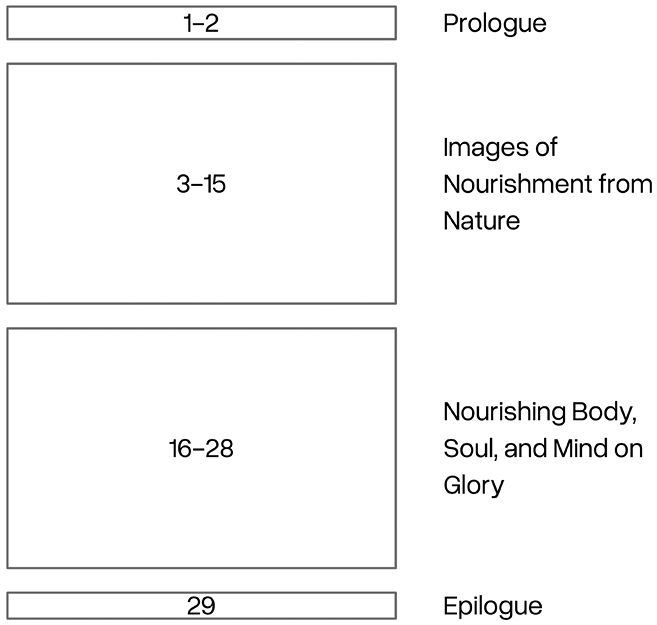
Taken as a whole, Par. 9 elaborates the image of feasting in the Kingdom – and the notion that such feasting should be understood in spiritual terms. Thus, having introduced the imagery of feasting at the beginning of the poem, he leads his audience through a progressive spiritualization, drawing on images from Scripture and from the natural world. Ultimately, the purpose of this ascent is to provide an analogy: At the table of the Kingdom, we eat by vision. Ephrem presents the vision of the divine glory light as both nourishment and treasure, consistent with the presentation discovered in Section 2 (see Figure 1).
Par. 9 Stanza Overview
Viewed at a high level, the poem consists of a typical prologue (two stanzas) and a typical prayerful personal epilogue (one stanza), with two evenly sized groups of body stanzas in-between. These body stanzas form pairs each dedicated to a given image: for example, a flame and its dependence on air for its nourishment.
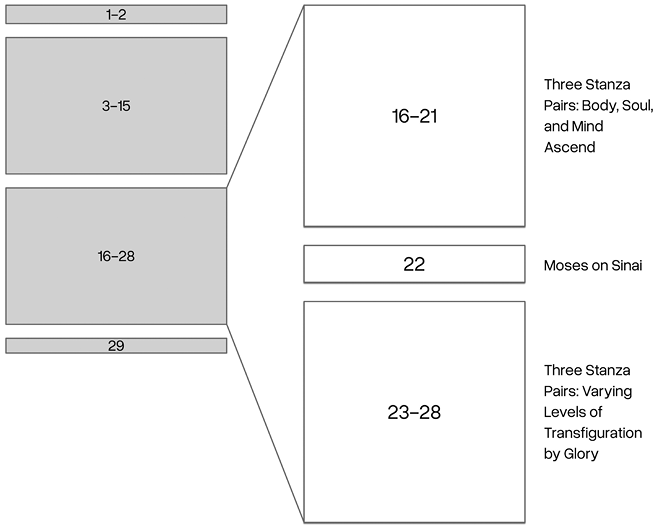
Halfway through the body stanzas, at stanza 16, a new section begins, divided like the first into pairs of stanzas that revolve around a central image in stanza 22 (see Figure 2).
Par. 9 Second Half in Detail
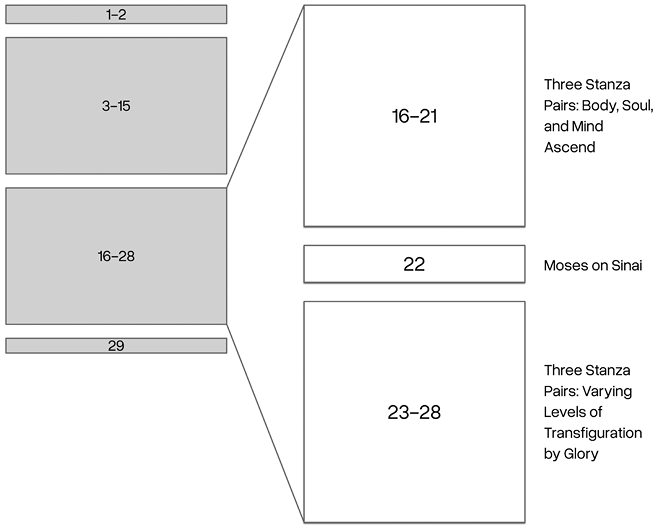
In this part of the poem, the first six stanzas (16–21) discuss the relationship between soul and body and how the relationship between them is transformed through the divine nourishment the blessed receive. For example, Ephrem speaks in stanzas 18 and 19 of how
Ephrem frames the contrast between this life and the next with the aid of the contrast between the body and the soul, but he does so in a remarkable way. For one thing, the soul herself is described as like the food she receives. That food is God himself and his beauties. Thus Ephrem compares the soul to God. Yet the body is not left behind, for each level of the person: body, soul, and thought, ascends through likeness to the level of the one above it. The whole schema closely resembles the graded character of Paradise itself, at whose summit God dwells.Footnote 146
The fact that Ephrem is discussing the renewal of body and soul together makes clear that their respective transformations are eschatological: They follow the universal corporeal resurrection. The resulting reintegration takes the form of an ascent into the transcendent hiddenness of divinity.Footnote 147 At this point in the poem, one could read Ephrem’s description merely as suggesting a progression that stops once each component of the person, body, soul, and mind (here, consistently tarʿîtâ) has reached its new level. He has not yet characterized this transformation as ongoing.
Bou Mansour, following Beck’s commentary on this text, argues that although such transformation affects every aspect of the person, the vision of the divine glory itself is partial. According to him, the result is “une faim éternelle de l’âme.”Footnote 148 Beck argues that Ephrem’s whole account of the soul’s feeding on the glory of God in Paradise should be interpreted in the light of stanza 21 in which the redeemed person approaches divine glory but holds back. The result is a self-imposed “tension” (Spannung) that leads to eternal hunger in the beatific vision. For Beck, Ephrem sacrifices an Augustinian-style eternal peace as the price of avoiding pantheism.Footnote 149
Beck is clearly right that stanza 21 is a crucial text. In it Ephrem’s thought reaches a certain climax. Yet Beck seems not to have noticed that this conclusion to the first six stanzas suggests, paradoxically, striving without conclusion:
The passage recalls the image of winged ascent earlier in stanza 19, with which it forms an extended metaphor. The circling flight of a bird describes the ascent of the faculties, level by level, toward the summit of the divine Majesty. The divine rabbûtâ itself nourishes and sustains the flight of self-transcendence; unlike earthly food, it does not weigh us down. Here at the climax of the soul’s ascent we find that God is not quite attained. The image Ephrem has chosen is explicitly not one of rest, for the mind does not alight on any resting place but remains in flight, balancing the polarity of fear and love. Beck and Bou Mansour are surely right to notice the dynamism: God is not ever completely attained. But they seem to have missed the point of the image itself, which suggests movement rather than stasis. Much like the image describing fasting as tranquil and luminous wings permitting us to fly to the vision of GodFootnote 152 Ephrem suggests an ever higher spiraling flight that approaches but never reaches the summit of God’s transcendence.
Ephrem then points to the very image that was so important for Gregory’s doctrine of epektasis:Footnote 153 Moses in the divine presence on Sinai.Footnote 154 He describes it as follows:
Ephrem sees in the image of Moses fasting and subsequently transfigured on SinaiFootnote 156 a type of the feasting in the Kingdom. And he infers, following Jewish tradition, that Moses became beautiful by feasting on the beauty of the divine glory-light. Thus his earlier reference to the divine beauty turns now to its reflection in the human being. The likeness between the soul and God exists, the image of Moses suggests, because the divine glory transforms the soul, a point he explains a short while later by saying that “that radiance makes them all radiant (zîwâ [h]w mzahhê kôl).”Footnote 157
The next six stanzas describe the transfigured life of beatitude for which Moses’ experience forms the exemplar. Since, as before, the stanzas seem to occur in thematic pairs, the pair formed by nos. 25 and 26 can serve as a partial illustration:
The blessed resemble Moses in that they too experience transfiguration, and in different degrees. Even as he unfolds how God’s glory becomes accessible to the blessed, Ephrem insists that God remains transcendent and hidden. This makes it especially striking that, in the final stanza before his epilogue, Ephrem concludes his description of the blessed by claiming that they investigate the divinity:
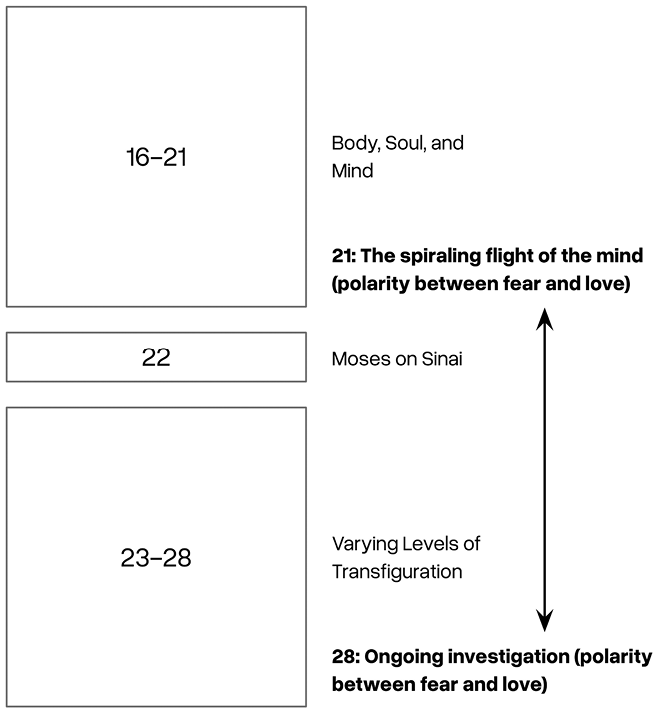
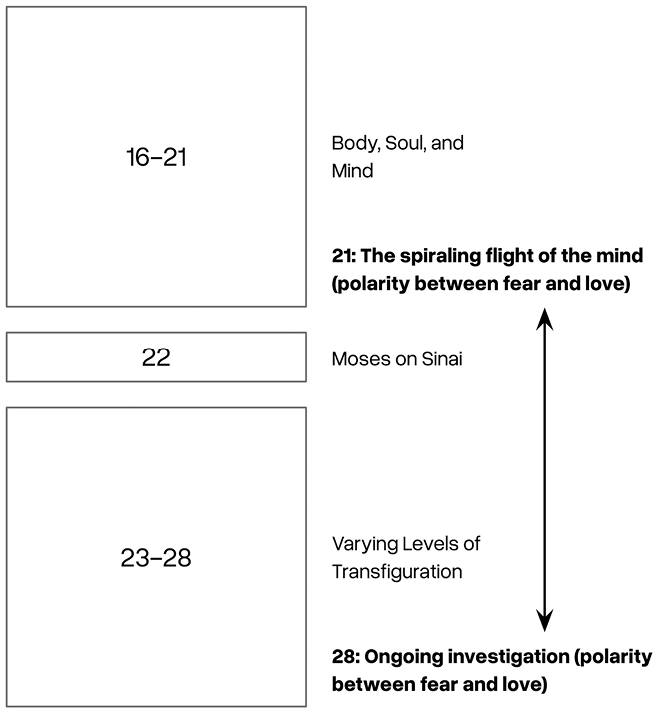
In this passage Ephrem describes the activity of the blessed as praise and investigation. Like the spiraling flight of the bird approaching the summit of divine transcendence, here too the polarity between fear and love operates. Ephrem’s imagery is highly paradoxical. The transcendent God is now investigated, something Ephrem vociferously excoriates in this life, and the imagery of ruminating, like investigation of the limitless God, suggests an ongoing process. The blessed, Ephrem holds, grow in their knowledge of God. Yet they experience satiety (sabʿâ) in so doing, such that their seeking ever more for God cannot be thought of as unsatisfying to them. Indeed, their thought is not anxious, but at peace (šaynâ). And above all, this transfigured seeking for God is motivated by both fear and love, and granted by the divine gift. Stanzas 21 and 28 are thus parallel in position and in thought (see Figure 3), and they mutually illuminate one another.Footnote 160 Hence, an epektatic interpretation is more faithful to Ephrem’s images than one of a static hunger without rest. Consistent with this reading is that, though Ephrem often speaks of the divine essence, what the blessed see is not the divine essence itself, but its beauty, light, or glory.
Par. 9 Second Half Showing Parallels
3.4 Death in the Light of Grace: Enoch and Perpetual Progress
Further evidence that Ephrem holds that endless eschatological progress is possible appears when he reflects on death in the light of grace (ṭaybûtâ). Whereas Ephrem describes the blessed as progressing in transformative knowledge, when he reflects on death, he considers a different aspect of progress: How human desire and divine graciousness relate.
At the beginning of a long alphabetical acrostic uniting Eccl. 2–5, Ephrem ponders the possibility of limitless sinning, cut short, paradoxically by God’s gracious gift of death. The separation of soul and body puts a stop to the potentially endless accumulation of debts:
In contrast to our own tendency to merciless persecution of one another, God’s mercy, by way of death, puts an end to the possibility of incurring further debts. Ephrem does not at first describe the possibility of sinning as a limitless progression. But a few stanzas later that is precisely how he concludes the image:
Ephrem contrasts the risk of measureless sinning with the possibility of limitless perfection. The former is precisely why God has set a measure to our lifespan. The latter is the work of God, implicitly, of grace (ṭaybûtâ) or mercy. Is this a case of preacher’s hyperbole or does Ephrem really regard these opposing movements toward sin or toward perfection as stretching on without end?
That this is not mere hyperbole, but rather a consequence of how Ephrem views the functioning of human desire appears when he considers the relationship between Enoch and Adam. This relationship occasions another discussion about death and the length of human life. In Eccl. 49–50, Ephrem returns to an exegetical question: Why Adam did not die immediately after eating from the tree of knowledge, as the literal prohibition in Gen 2.7 suggests: “on the day that you eat of it, you will certainly die.” Following a Jewish tradition,Footnote 163 Ephrem holds that God granted Adam a reprieve so that he might live long enough to see his descendant Enoch return to Paradise.Footnote 164 This was an act of mercy on God’s part, and the return of Enoch was an occasion for Adam both to suffer through contrition and to be consoled through hope.Footnote 165 Ephrem sees divine justice and divine graciousness operative here,Footnote 166 just as in the case of Eccl. 2–5.
For our purposes, it matters that Ephrem views Enoch and Elijah explicitly as types of the eschatological return:
As noted already in Section 2, Ephrem sees Enoch and Elijah as experiencing in advance the return to Paradise that Christ makes possible. But they are not alone. Rather they depict future persons who will eventually enter.
Since Enoch and Elijah are types pointing to this return, what Ephrem says about them is instructive for his view on the perfectibility of human nature. It would be fair to characterize his view as maximalist:
Ephrem explicitly parallels the victory of Christ and the victory of Enoch and Elijah, and insists on a victory of his own: The truth that spiritual victory is a real possibility for human agency. Divinity does not simply override it. The departure from Paradise is deserved,Footnote 169 but so too is the return. Ephrem sees an important symmetry here: It is possible to deserve exile and to deserve coming back. Ephrem makes this point in Eccl. 49.22, which he then applies to Adam in Eccl. 50.1–3. Ephrem nevertheless carefully insists that the relationship between divine and human agency is asymmetric, a point he supports with financial imagery as we will see.
In fact, Ephrem finds in the discussion of Enoch’s return an occasion to reflect on the possibility of infinite perfectibility in cooperation with grace:
Enoch attains the very center of Paradise, which Adam was to have had. The harmony of human striving and divine operation appears in that both justice and graciousness bring Enoch to the tree. But justice provides a kind of base level. Enoch’s eschatological growth takes place through graciousness. Both are rooted in Christ, the fruit of the tree of life.Footnote 171
Ephrem does not, in the stanza just quoted, clearly affirm that Enoch’s possibility of growth is unlimited. He develops that idea, however, across the second half of the poem and applies it to the eschatological Kingdom.
Ephrem employs the same wording: without limit and without measure, as he did in Eccl. 2. But now he explains the mechanism he had in mind when he said that God has perfected us in this way. That perfection is the response of God’s grace to the quasi-limitless capacity of the human desire for God. On the one hand, Ephrem is clear that a strict meriting of all that the Kingdom entails is impossible. Why? Because, among other reasons, it seems to include growth without limit. But there is a kind of measureless striving in the will, to which God’s graciousness responds. Given that the Kingdom entails life without end, it also suggests the limitless continuation of the will, paused by death, but operative in the life of the universal resurrection, prefigured by Enoch. Ephrem describes this measurelessness three times: stanzas 14, 16, and 17. Stanza 14 adds the point that the amount of human growth is measured precisely by the will,Footnote 176 which, it turns out, is without measure. Ephrem’s notion of limitless spiritual growth appears principally as a function of his intuition about the limitless capacity of human freedom, which evokes the divine grace that actually makes us to grow.
Elsewhere when describing our spiritual struggle in this life, Ephrem applies his ideas about the importance of the will’s rightly ordered desire as contrasted with our actual abilities. He applies it specifically with an eye toward the final judgment:
Here, Ephrem shows how he imagines the final judgment. The accusations of the devil can be just only if we are free. We may be weak, but our will remains capable of moving either toward good or evil. Ephrem thus offers a theology of prayer in light of the will’s weakness. So long as there is even a modicum of desire, divine grace responds to it and gathers together the prayers that express it. The result, as in the other examples, is growth. Ephrem’s account of prayer and the final judgment follows the same principle as does his exegesis of Enoch: The will remains free to transform itself and be taken up into the transformation God’s graciousness provides.
3.5 Problems of Interpretation
Nevertheless, one passage of the Par. (2.11) appears to contradict the claim that Ephrem holds to the infinite perfectibility of the human person and endless eschatological growth. Brock translates it as follows:
The references to “the just” and to “inheritance,” clearly show that Ephrem is speaking of Paradise as the eschatological reward. In so doing, he seems to say that each person goes only so far up the mountain of Paradise and then stops. Rather than limitless ascent, it would appear that there is instead a limit of justice to each person’s achievement. Given that Ephrem often speaks of the various levels of Paradise,Footnote 180 it may be that the same idea of stopping is implied in those passages as well.
The key lines are 2–3, which read:
Ephrem speaks clearly of growth. Yet he holds that “each person is constrained to the level that befits him,” based on his labor or effort. Is Ephrem perhaps inconsistent, sometimes speaking of endless growth and other times of reaching some limit? Ephrem has embraced, I think, the polysemy of the image of the veiled mountain. Here it conveys the idea of a degree of meritorious effort, and he regards it from the point of view of comparing the various achievements of the blessed. But Ephrem is careful to say that these levels accord with justice based on effort. By contrast, Ephrem’s account of limitless growth explicitly argues that such growth does not take place according to effort. Rather, it corresponds, as a matter of grace, to human desire. Viewed in strict justice, human achievements in relation to one another and to God are finite. It is only from the perspective of divine grace that they take on an infinite aspect.Footnote 181
Realizing this also gives some additional color to the many places in the Par. where Ephrem acknowledges his own inadequacy and yet begs that grace will at least recognize his desire or will and respond accordingly.Footnote 182
3.6 Summary: Growth through Vision
For Ephrem, beatitude flows from perceptive vision of the divine beauty and majesty by the complete human person, body, and soul. This vision of God is a gift of divine grace granting both spiritual nourishment and growth in knowledge, which Ephrem compares to the spiraling flight of a bird approaching the summit of a veiled mountain – the mountain, that is, of divine transcendence.
Ephrem’s account of this nourishing vision is consistent from beginning to end. In the beginning, Adam was granted perception of the divine majesty and made to progress in such knowledge through discernment, through aligning his will with God’s, and through restraining his desire, which three acts together should have formed an offering of worship, or a state of prayer. Adam, in short, was meant to grow through praise. In the life of the Church, Ephrem presents his own poetic and ascetic praxis in the same terms: spiritual growth through discerning praise and self-restraint. Adam’s perception of the majesty and the growth that it occasions is now available to all in Christ. Whether anticipated in Enoch or Elijah, or realized in the blessed after the resurrection, the same dynamic continues to operate within the Kingdom. The blessed progress up the mountain of divine majesty through a perceptual knowledge and limitless desire. Death pauses this relationship, but it is not the end. Once body and soul are together once more, this limitless desire can take flight, though the creator–creature distinction is never overcome. Ephrem’s perpetually progressing view of beatitude has less to do, therefore, with God’s infinite goodness than with humanity’s infinite desire for God.
Beatitude is attainable by the human will, but it is not, Ephrem thinks, strictly merited in proportion to effort. Rather divine grace responds to the transformative power of human freedom and elevates it beyond what can be merited in the strict sense. The quasi-infinite desire of the human person evokes the infinite riches of merciful grace. Since knowing God is the food of the blessed, and they progress in knowing him, their feasting on the beauty “of that fair essence” knows no lack and no end.
Thus, a pair of concepts in polar relationship underlies Ephrem’s imagery of the Kingdom’s table and God’s abundant treasury, for which it forms a principle of coherence. One could put it this way: Transformative growth unfolds in the polarity between divine beauty and human longing. Ephrem’s eschatological doctrines all refer to this idea in some way: Soul-sleep is the temporary cessation of progress, and corporeal resurrection is its new beginning. The Kingdom itself, both as anticipated in the life of the Church and as experienced in the eschaton, presents a renewed opportunity for striving in freedom toward that beauty.
Several others of Ephrem’s favorite polarities connect in some way to this idea. The relationship between creator and creatures grounds the creature’s spiraling ascent to the creator’s height. The relationship between divine graciousness and divine justice forms a single impetus of providential assistance moving that progress forward, and the polarity between love and fear interiorizes the dynamic of growth within the human person.
4 Growing and Repenting in Gehenna
Just as it is central to perpetual growth, vision is also central to Ephrem’s conception of damnation in Gehenna. And it makes sense to ask whether those in Gehenna might also experience growth. If so, would that bring Gehenna to an end for some or for all? To put it in Ephremian terms, does the “second death” also have its resurrection?
Ephrem thinks it is possible, but uncertain. At the foundation of his position on the question lie his poetics of reversal, often expressed via the image of the furnace. This dynamic grounds Ephrem’s account of repentance in relation to the graciousness and justice of God. Ephrem does in at least three or four places in his corpus mention the possibility of salvation from Gehenna, one of which explicitly describes the repentance of the damned. A close look at these and several other key texts in their poetic context shows that the uncertainty associated with the salvation of the damned arises from their freedom to repent and the cooperating power of divine mercy that can heal such freedom. As with growth in the Kingdom, it is a matter of how Ephrem thinks of the human person.
4.1 Explaining Repentance via the Poetics of Reversal
One of Ephrem’s images for the poetics of reversal appeared already in his description of the poet’s spiritual progress: namely, Paradise as a smelting furnace (kûrâ). Ephrem imagines Paradise as a vessel filled with a blessed and fiery experience, whose effect depends on what has been put in it: It exposes the failure of Adam’s freedom, but transforms the poet’s praise.Footnote 183 It accepts what is living and casts out what is spiritually dead.Footnote 184 Yet in Eccl. 1 Ephrem also interiorizes the furnace image, so that it expresses the paradox of the sinful human heart. The problem is that it can lose the capacity to taste things as they really are:
Ephrem develops the image of feeding when he subsequently prays that we may be delivered from bad taste: that is the inability to experience things in accord with their reality. Precisely to the extent that we are sinful, we experience things in reverse. The furnace of discrimination fails. Hence, Ephrem turns, in the end, to a prayer for healing:
As a furnace, the vessel of the heart tries perceptions or “tastes.” Ephrem prays that divine love might serve as the fire to purify the heart, whose real food should be, as the first stanza suggests and the madrāšê on Paradise confirm, the glory of God. The alternative, Ephrem implies, is that the heart should experience what is good as evil. Our freedom needs healing by the furnace of divine love before our freedom and our discrimination can become furnace-like themselves. This discrimination is precisely what failed in Eve, in the beginningFootnote 187 and what Mary, at the annunciation, reversed.Footnote 188
In Eccl. 2–5, Ephrem interiorizes the furnace in another way. It becomes an image for human freedom, particularly insofar as it proves that a person is capable of change and is not evil by nature:
Ephrem refers to the beauty of remorse or repentance hidden in freedom. Like the fire of a furnace, it always teaches us about itself if we draw close to it. But this same freedom also reveals the possibility of living as a fraud. The freedom of others around us has the same revelatory power, as the successful completion of the contest against vice by the innocent person (šapyâ) shows.Footnote 191 Whether in us or in others, there is a paradox in the interior furnace. On the one hand, even in the sinner, it reveals the true nature of things. On the other, it must be healed by the divine fire in order to function correctly.
Inner corruption reverses the experience of reality. Even Scripture, just like the book of nature, can be experienced in reverse because of the disturbed interior life of those who encounter it, even though its natural effect is to transform those who receive it into the clarity of its own tranquil light.Footnote 192 Like Adam’s experience, because of sin, the “vision that gives joy to the heart turns [instead] to grief of heart.”Footnote 193 Such a reversal can be, as it was for Saul on the road to Damascus – whom Ephrem contrasts with Moses on Sinai – a foundation for repentance and the elevation of our natural abilities.Footnote 194
In the Letter to Publius, Ephrem describes the torments of those in Gehenna according to the same pattern. They behold “the Paradise of God” and the “tables of the Kingdom.” But the result of that vision depends on the beholder:
The vision of the eyes also has the power there to come and to go, and to either of the two sides it gives either pain or joy (taḥḥeš w-taḥdê), according to how the lot of the blessed increases in their eyes when they see the wicked, and they take joy in it, and the souls of the wicked succumb further in their own eyes and their pain is increased.Footnote 195
Indeed, as has often been remarked,Footnote 196 Ephrem interiorizes the torment. It is an affliction within the damned themselves rather than a literal fire:
Perhaps their sight is the Gehenna of the wicked, their discernment is their burning, and their mind is their flame. And that hidden judge speaks, seated within the discerning mind, become for them the just judge. It torments them without mercy (d-lâ raḥmîn) with the tortures of regret (twāt napšâ).Footnote 197
The wicked see precisely the same thing as the blessed, but they experience it in precisely the opposite way because of their own interior disposition. Notice too that in the logic of Ephrem’s Letter, this same vision of God’s own “supernal unfading beauty”Footnote 198 rebukes sins in this life also, within the mirror of the Gospel. Gehenna intensifies a process already begun here.
God, in fact, consciously uses the poetics of reversal himself. Throughout the Serm. Dom., Ephrem periodically refers to divine justice and graciousness as his twin motives in reversing things for our benefit.Footnote 199 But he offers a fuller explanation in Eccl. 5, where the polarity between justice and graciousness is explicit. Ephrem uses the imagery of the merchant’s balance to describe how they relate:
A closer look reveals a more complex picture. On the one hand, Ephrem argues for the importance of the reciprocity of the golden rule: To seek mercy for oneself, one must seek it equally for one’s neighbor.Footnote 201 And yet a deliberate imbalance is at work.Footnote 202 Graciousness far surpasses the power of justice. After praising justice that is “perfect in everything because it does not overlook anything (lâ ṭāʿyâ meddem),”Footnote 203 he explains that the perfection of graciousness differs from that of justice:
Ephrem repeats in the next stanza that “not even the abundance of our iniquity grows great enough to overpower her (yāreb w-zākê lāh).”Footnote 205 Note that Ephrem’s favorite language of growth reappears. In the end the scales favor graciousness. Her ability to have compassion upon all is the mark of her perfection. Thus, graciousness and justice work in unequal partnership. God’s mingling of the two in his relationship with us is an expression of his wisdom.Footnote 206 But both of them, Ephrem argues, serve as a form of assistance leading to the “gate of mercy” and “place of refuge.”Footnote 207
Ephrem presents God’s graciousness and justice not so much as static divine attributes but as two expressions of God’s single assistance. God uses both as components of his wisely chosen strategy to foster our repentance and salvation.
And indeed Ephrem makes clear that this salvific process trains humanity to taste things as they truly are at the last judgment. This leads to a remarkable paradox that the most discerning follower of Christ behaves as if he has no hope:
Once more, spiritual growth is at issue. One who has not grown up presumes upon the mercy of God. But the mature and discerning person does not take for granted the availability of repentance. Ephrem insists in fact that repentance is available to all sins, which coheres with his view that divine mercy is omnipotent in the face of human wickedness. All this would seem to point quite strongly to the possibility of future repentance, perhaps especially for the spiritually immature, but Ephrem argues that the last judgment remains uncertain:
The discerning one, sharing in God’s glory, does not treat the omnipotence of graciousness as an excuse to sin, but transforms his perspective according to God’s methods. Such a one perceives the risk of not repenting. Such is the result of the collaboration of justice and graciousness, at least as far as the day of judgment. On the one hand, repentance seems to remain available even after death and the universal resurrection, at the final judgment. This makes sense, given that soul and body have been reunited. The passage also implies that the intercession of others may be effective at the last judgment. But by the same token Ephrem is clear that such mercy on the part of our fellow human beings is not guaranteed without repentance. The risk then is that a life spent without repentance may be unable to repent in the end.
Ultimately, for Ephrem the poetics of reversal work in two complementary ways. In one way they operate within the human being. Human freedom is capable of interior transformation either in the fiery experience of its own operation or by contact with that same experience in the freedom of our fellow human beings or God himself. One of the consequences of this free capacity is also the ability of the person to taste or experience reality as other than it is. This extends to our experience of one another when we behave hypocritically toward others. In another way, the poetics of reversal apply to God himself. In an effort to heal our freedom and interior discernment and secure our repentance, God cleverly reverses how we experience him, either as gracious or as just. Even though graciousness is ultimately unbeaten by our wickedness, God adjusts, we might say, the ratio of these two experiences of justice and graciousness in order to draw us back to himself, even, in the case of Paul, withdrawing his assistance for the sake of mercy and healing. God’s glory is thus rightly painful to those who cannot experience it as good. It does not cease to be good, but it takes the form of punishment to those whose taste for reality is self-perverted. Escaping from Gehenna will require, therefore, reversing this reversal.
4.2 The Evidence for Escape from Gehenna
As one might expect, Ephrem usually focuses on the success of healing freedom in the present life. Even Eccl. 2–5, which consider the end of life and the day of judgment, eschew any explicit discussion of Kingdom or Gehenna.Footnote 211 The Letter to Publius makes clear that the poetics of reversal apply in Gehenna, but remains silent about whether the experience is permanent. What, then, does Ephrem say about it elsewhere?
One of his most hopeful accounts appears, surprisingly, upon reexamining a passage already studied in Section 2, in which he condemns the interior disposition of dispute, which blocks the vision, doxology, and concord that characterize blessedness in the Kingdom:
Given Ephrem’s poetics of reversal, his description of the debater’s risk is illuminating. The Kingdom can be experienced as torment, a vision opposite to its real character. And Ephrem suggests that the hope for ascent from Gehenna consists precisely in a hope for an interior reset. At the same time, Ephrem also asserts the permanence of the condition, unless the sinner himself changes. The uncertainty attached to it, expressed by the particle kbar, arises from this relation of dependence. Ephrem does not here describe this process of interior transformation as repentance, but it’s hard to know by what other name it should be called. One infers, therefore, that Ephrem thinks repentance is possible, but dependent on the human person freely letting go of his or her own torment.
In Repr. 3, when discussing the parable of the Rich Man and Lazarus, Ephrem takes the same line:
Ephrem’s words are highly charged. On the one hand, the best place to repent is “here,” rather than in the afterlife. Should the word “repentance” be read ironically, with scare quotes, as it were? In the context of this passage, Ephrem does speak in a way that can be construed as teaching the perpetuity of Gehenna, as will subsequently become clear. Even if the failure to repent is due to ignorance (lâ yādaʿ), this ignorance is clearly blameworthy, in Ephrem’s view, because it is deliberate: “The one who stops his ears when he listens here–his petition is stopped by the One who answers all (ʿānê kol) / He even proclaims the One who has mercy on all (ḥāʾen kol), and the One who hears all does not answer him (lâ ʿānê leh).”Footnote 214 Indeed, Ephrem argues that on the day of judgment, “The Avenger is without mercies. It is not permitted to him to show mercy.”Footnote 215 This day, personified, is “deprived of pity (ḥawsānâ)” and “estranged from compassion (ḥnānâ).”Footnote 216 The poetics of reversal are at work. At least on the day of judgment, God becomes deaf and merciless to the one who was merciless and deaf to the cries of Lazarus.
Thus, whatever repentance might be in Gehenna Ephrem does not encourage us to rely on it compared with the relative ease of repenting in this life, which is in fact the principal theme of the first part of this discourse. God’s reversal from merciful to just, however, does not contradict the possibility of repentance in Gehenna. In this poem at least, Ephrem does not even disallow the possibility that one might repent at the last judgment, only that, at least for those sinners who have lived hypocritically, it will not have the desired effect. Gehenna, for such merciless hypocrites, is inevitable.
Such repentance, if effective in Gehenna, would be a kind of growth. And, in fact, that very image appears at the beginning of Repr. 3. Here, Ephrem addresses repentance in the context of God’s dual character as gracious and just. These work together to bring about a person’s growth:
Given that Ephrem explicitly symbolizes repentance as growth in this life, his talk of repentance in Gehenna suggests an analogous growth in the afterlife.
Though Ephrem seems to regard the human act of repentance as the sine qua non of spiritual growth, he also frames the question of escape from Gehenna in terms of God’s action. One may recognize in this regard the polarity between creator and creature. In one of the dispute poems between Death and Satan, Death says:
As in the case of the passage from Serm. Fid. 6, Ephrem is tentative, though more ambiguous. Like the word kbar, the Syriac word ṭāk (borrowed from Gk. τάχα) could also mean “soon,” but the parallel between this passage and Serm. Fid. 6, whose context makes the tentative nature of the expression clear, suggests that here too Ephrem hesitates deliberately. Ephrem now applies the poetics of reversal to Satan himself. As Martikainen recognized,Footnote 219 this passage appears in a particular part of the long-running dispute between Death and Satan, a part that reflects a turn in Death’s relationship to Satan in salvation history. Martikainen characterizes this as a “conversion” (Bekehrung) of Death and an attendant “transformation” (Umwandlung) of Sheol, his dominion. It is crucial to Ephrem’s understanding of the history of salvation that death is no longer an ally of Satan but has been converted and subjected to the lordship of Christ. Thus in Nis. 57–59, Death spends three madrāšê cursing Satan to express his dissociation from him. Death’s speculation about the emptying of Gehenna through mercy is but one of many such imprecations. One may draw from this two conclusions. On the one hand, it shows the sharp distinction between physical death and the “hidden death” of sin, for which Satan alone is responsible. The hidden death is the only one that truly remains effective in any sense. On the other hand, it shows the larger context of the reversal that Satan experiences. He persists in his impenitent rebellion against God, contrary to the reality of the situation. Death seems to intuit that Christ’s emptying of Sheol via his death and resurrection – which occasioned Death’s conversion to faith in Christ in the first place – may foreshadow not only the universal corporeal resurrection but even the emptying of Gehenna of its human inhabitants at the end.
The stark separation between Death and the Devil as a result of Christ’s saving work highlights, as Martikainen realized, the impenitence of the Devil,Footnote 220 whose impenitent hardness thus appears as the only thing that could keep a free creature in Gehenna. At the same time, it also, like the passages from Serm. Fid. and Repr., suggests at least the real possibility of escape from Gehenna. But importantly, it adds the mechanism of this escape: namely, God’s mercy (ḥnānâ). Repentance per se is not mentioned, only implied by contrast to the Devil’s lack of it.
Should we take Death’s curse against the Devil as Ephrem’s own view of what is possible? At least one writer has appealed to the fact that this is a taunt in character to argue that we should not.Footnote 221 Yet the poetic context seems to me to suggest otherwise. Ephrem’s view in Nis. 59 is consistent with his other passages suggesting the real possibility of escape from Gehenna. It employs the same poetics of reversal that animate his other considerations of Gehenna and repentance. And, as Martikainen has shown, Death’s curse is an expression of his newfound submission to Christ, which, along with the restoration of Paradise, seems to be Ephrem’s principal soteriological theme.
The curse also suggests that the emptying of Gehenna, to the extent that it occurs, is an effect of divine graciousness rather than justice. Par. 10.15,Footnote 222 quoted already in Section 2, envisions the same idea: that any relief, if not full rescue, for those in Gehenna is a work of divine graciousness and in fact some small sharing in the Kingdom’s nourishment. Even the damned remain creatures of God and are thus not out of the reach of his refreshment.
Thus in Ephrem’s speculations about the possibility of escaping from Gehenna, two factors are at play: the interior repentance of the damned and the explicit operation of mercy beyond the strict requirements of justice. In his undisputedly genuine writings that remain to us, Ephrem never confidently asserts that the damned will emerge from Gehenna. But his understanding of how God and humanity relate does encourage him to consider it possible.
4.3 Ephrem a Universalist?
Ephrem’s hesitant hope for salvation even from Gehenna has attracted notice before and raised the question of whether he held to some form of universalism. As early as the nineteenth century, Braun noticed two of the passages quoted earlier. He called them “alarming” yet argued that “however one would like to explain such passages, they cannot prove anything against the eternity of Hell compared to the number and exactness of other passages.”Footnote 223 Beck, presumably because of his work establishing a more reliable textual foundation than Braun had, took a rather different view. This view emerges both in his early commentary on the Hymns on Paradise and from one of his latest works, an article on the Syriac Diatessaron Commentary’s pericope on the unforgivable sin. According to him, a careful reading of all these passages showed on the one hand that Ephrem did hold out “the possibility of salvation”Footnote 224 from Gehenna and also hinted at a purgative punishment taking place at the time of the last judgment, which Beck distinguishes both from the later doctrine of Purgatory and from Gehenna itself. Those who experience the purgative punishment manage to settle in the Vorparadies or antechamber of Paradise. Yet, on the other hand, Beck argues that Ephrem’s ground for holding his view is “purely human” and not “philosophical” as in the case of Origen and Gregory of Nyssa.Footnote 225 Finally, he also notes that in his certainly genuine writings, Ephrem always views salvation from Gehenna as a work of divine mercy, a point whose significance will soon become clear. In between the time that Beck wrote his commentary on the Hymns on Paradise and his study of the pericope on the unforgivable sin in the Syriac Diatessaron Commentary, Martikainen situated the question of Ephrem’s views on the eternity of Gehenna in the larger context of his account of salvation history. He agrees with Beck that Ephrem was not an origenist,Footnote 226 in part because he never envisions the possibility that the Devil might be saved. But mostly he argues that Ephrem’s views remain uncertain at the current state of research. Buchan largely agrees with Martikainen about scholars’ uncertainty regarding Ephrem’s views on Gehenna, though he rightly takes issueFootnote 227 with Martikainen’s strong assertion that Gehenna and Sheol have nothing to do with one another, given that Ephrem occasionally conflates them, as already discussed in Section 2. Thus in scholarship up to 2004, the consensus has been that Ephrem’s view on the permanence of Gehenna’s torments is hopeful, motivated by a natural human compassion, and not party to origenistic speculation.
Ramelli disagrees, first in an article in 2009,Footnote 228 and then later as part of her larger revisionist study in 2013.Footnote 229 She argues that Ephrem implicitly endorses universalism. She claims that he, like other universalists in the tradition of Origen, holds this view as a solution to the problem of evil, in which God’s ultimate victory over sin and evil appears precisely in sinners’ complete restoration, including their final rescue from damnation. As she reads Ephrem, it is not that no one enters Gehenna, but rather that all humans eventually escape it via repentance and Christ’s mercy. On this account, the punishment of Gehenna would be real but not permanent, and hell is better characterized as Purgatory.Footnote 230 She argues the point in a number of ways, but above all she emphasizes the totality of Christ’s victory “not only over death, but also over hell, not only over sheol, but also over the devil, [views which] come very close to a universalistic perspective and constitute at least important premises to the doctrine of apokatastasis.”Footnote 231
Her overall goal is to rehabilitate the final salvation and restoration of all (known as apokatastasis) as a mainstream patristic doctrine. On this account, Christ’s final victory over evil requires that hell’s punishments, though real, be temporary and therapeutic. Accordingly she spends much of her effort searching for evidence for the temporary character of such punishments. She thinks that Ephrem’s views implicitly tend toward and align with this position. Among her arguments is that for Ephrem the descensus ad inferos has “universally salvific import.”Footnote 232 She returns to the idea in a few forms: that the resurrection of Adam and his return to Paradise implies return to Paradise for all human beings,Footnote 233 and that Christ rescues all the peoples from the clutches of the devil.Footnote 234
Already in Section 2 a reason to doubt her interpretation of Ephrem on the resurrection appears: namely that when looking to the future universal resurrection, Ephrem consistently distinguishes it from blessedness, a point further born out by his consistent distinction between the hidden death of sin and corporeal death, as Martikainen demonstrated.Footnote 235 Adam and indeed the good thief has, for Ephrem, returned to Paradise “in the company of many (b-saggîʾê),”Footnote 236 but perhaps tellingly, not “all,” as Eccl. 49.19 (quoted in Section 3) also hints. Whether Ephrem’s position that Satan and sin have been conquered necessarily entails the ultimate emptying of Gehenna is hardly clear since even she admits that Satan, who is of course, defeated, remains in Gehenna, as far as Ephrem is concerned.Footnote 237 One key deficit in Ramelli’s reading of Ephrem on this particular point is that she fails to recognize that the narrative sequence of salvation history shapes Ephrem’s imagery. His references to the harrowing of Sheol do indeed foreshadow the final resurrection,Footnote 238 but they are not eschatological in the sense of definitively describing the end of salvation history. Rather, Satan’s defeat has already happened and does not await some future action of Christ. Returning to Paradise does entail for humanity a new creation, but does not abolish the risk arising from free will, as Ephrem explicitly points out.Footnote 239
On the other hand, when she turns to the question of post mortem repentance, her argument is on firmer ground. In addition to the passage from Nis. 59Footnote 240 she relies heavilyFootnote 241 on the Diatessaron Commentary attributed to Ephrem and very widely accepted as authentic.Footnote 242 She quotes it as follows:
Our Lord has freely forgiven many persons for their sins […] but of the most serious sin [cf. Matt 12:32] retribution in Gehenna will be demanded […] no sin will resist repentance, apart from this. But not even this sin will be able to prevent a person from being justified. God, after giving retribution in Gehenna, will reward this person in the Kingdom.Footnote 243
The commentary seeks to explain our Lord’s teaching that blasphemy against the Spirit is an unforgivable sin. If it represents Ephrem’s thought, then it is perhaps the most direct testimony to his view that post mortem salvation from Gehenna is possible. The passage Ramelli quotes, taken by itself, is a bit cryptic, but as Beck’s thorough study of the passage has shown, it is the first of two interpretations the commentary offers. This first interpretation depends on the distinction between forgiving a debt for free and paying it back as a matter of justice (b-ḥelpâ). The commentary argues that our Lord’s statement that the sin cannot be forgiven means that it cannot be freely forgiven and must be paid back. In short, the debt must be paid by suffering. It cannot be simply released by mercy.Footnote 244 And repentance seems precluded as a means of escape, according to this interpretation, since such a sin does resist repentance and justification happens by other means.
Closer examination of the wording in Syriac makes this clear: lâ dên kālê (h)û hānâ ḥṭāhâ d-nāš nezdaddaq b-ḥrānyātâ.Footnote 245 As preserved in the manuscript and attested by the Armenian translation, this would literally mean: “But this sin does not prevent that a person should be justified by means of other things.” Leloir, the text’s editor would like to emend b-ḥrānyātâ to b-ḥrāyātâ: “in the final things,”Footnote 246 which McCarthy translates as “eventually.”Footnote 247 Beck argues that the emendation does not follow Syriac idiom, and is superfluous since the context makes clear that the setting is eschatological.Footnote 248
Ramelli, for her part, interprets Ephrem as saying such repentance is possible, and makes that possibility the basis of her reading:
This passage comes really close to the doctrine of apokatastasis, of course provided that Ephrem assumed that people will really repent in Gehenna. Indeed, he seems to have assumed so. One cannot repent before the resurrection, in sheol (Carm. Nis. 3,16), but everyone can after the resurrection, in Gehenna (Comm. in Diat. 8,10). For in Gehenna all human beings keep their free will, which is a gift from God, and will thus be able to repent.Footnote 249
Given what Ephrem says elsewhere, especially in Repr. 3, it is clear that Ephrem does think repentance is possible in Gehenna, but this particular text of Comm Diat. 10.4 does not unambiguously suggest it. Rather it suggests that precisely because this sin resists repentance, such a sinner must be justified in some other way. Ramelli’s intuition about Ephrem is right, therefore, but it is at odds with the text of Comm. Diat. 10.4. The appeal to Comm. Diat. 8.10 does not help, because that passage says nothing about the ability to repent, but only that neither body nor soul is completely destroyed in Gehenna or else Gehenna itself would cease to exist once that destruction has run its course.Footnote 250
In fact this interpretation in Comm. Diat. 10.4 differs in a key way from the other places where Ephrem speculates on post mortem salvation. It ascribes the rescue from Gehenna to payment of the debt through punishment, rather than to God’s graciousness. This led Beck to conclude that this portion of the Comm. Diat. is inauthentic.Footnote 251 He admits that the Comm. Diat.’s idea of sinners being freed from Gehenna is not foreign to Ephrem’s thought, but that in the various places where Ephrem considers it or hints at it, it is the work of divine graciousness.Footnote 252 Thus he argues: “In the praʿ b-ḥelfâ of the Commentary, graciousness appears to be ruled out and justice only (allein) to prevail on the basis of the opposition to šbaq magân.” He finds support for linking such an expression to justice elsewhere in the Comm. Diat.Footnote 253 In any case, this particular portion of the Comm. Diat. seems to place a restriction on the power of God’s mercy to forgive.
Such a restriction differs significantly from the second interpretation of the unforgivable sin offered by the Comm. Diat. Not only does the second limit the scope of application of the Lord’s teaching on the matter to the Lord’s contemporaries personally acquainted with him, such as Judas or the pharisees, it also argues that for all people sin against the Spirit can be forgiven through repentance after all. Though repentance is possible for all, in some cases Satan prevents it. As the Comm. Diat. says: “It is not the case that he does not forgive them if they repent (en tāybîn), but that in this blasphemy, Satan does not permit them (lâ šābeq l-hôn) to repent (da-ntûbûn).”Footnote 254 Thus, in the second interpretation, it is repentance that brings about forgiveness.Footnote 255 This view more clearly aligns with the position Ephrem adopts in Eccl. 5. But this argument, as Beck notes, depends on a distinction between being shown mercy and receiving forgiveness, which completely reverses the substance and wording of the previous interpretation.Footnote 256
The fact that the Comm. Diat. offers two interpretations in substantial tension with one another leads to the conclusion that even if one were to accept these passages as Ephrem’s work, his position on the possibility of rescue from Gehenna remains uncertain. One source of uncertainty is whether the human person will in fact repent. The other uncertainty is which of the two interpretations is true. And even the first interpretation, which is the more hopeful, only goes so far as to say that even the sin against the Holy Spirit “does not prevent” justification, a justification that is contingent on paying back the debt in Gehenna. When (mâ d-) that takes place, the Kingdom is the reward.
In the end, it is doubtful that Ephrem implicitly supports universalism, as Ramelli defines it. She over-interprets what evidence for such universalism does appear in his undoubtedly genuine writings. One would have to show that Ephrem thought his views about Christ’s universal victory over sin necessarily entail confidence in universal salvation from Gehenna. But Martikainen’s work casts doubt on that: They actually suggest that one can respond in opposing ways: with conversion (like personified Death), or with impenitence (like Satan). Since such universal defeat of evil is the basis for what she sees as the broad origenistic tradition of universalism, one must conclude that Ephrem, even the (possibly pseudo-) Ephrem of the Comm. Diat., is not such a universalist. Moreover, her reading of the Comm. Diat. (her best evidence) is mistaken. Yet what a close reading of the evidence does show is that Ephrem consistently leaves open the possibility of post-mortem salvation from Gehenna for human beings through repentance, to which God’s graciousness responds and at which it aims. Some might call that universalism, but difficulties remain.
4.4 Difficulties for Freedom and Repentance after Death
In fact, there is some direct evidence against universalism in Ephrem, which calls for a closer examination of how he views freedom in relation to Gehenna. Anyone who wants to claim that Ephrem envisions post-mortem repentance as possible has to contend with his rather stark assertions about Gehenna’s permanence and freedom’s capacity for self-harm. When he describes the damned in Par. 2, for example, using his favored imagery from the parable of the Rich Man and Lazarus, he says this:
The poetics of reversal are once again at work, and Ephrem’s wording in the stanza’s last line, marked as a present participle, clearly suggests Gehenna is a permanent, certainly an ongoing, condition, in which the real state of affairs finally dawns upon the damned. In Repr. 3, using the same dream imagery, Ephrem also describes Lazarus escaping “eternal evils (ʿraq men hālên da-l-ʿālam)” by means of present (tnān) ones.Footnote 258 Ephrem’s assertion that the torment of Gehenna is unending fits his teaching about the second death in its Jewish context discussed in Section 2, for in the Targums one finds the same idea. Indeed, for Ephrem, the “life” of the damned, because divine omnipotence is capable of reversing its effect, is effectively death:
Here the poetics of reversal function on the basis of the infinite treasury of the divine will. The life that is death in Gehenna ironically inverts the wealth of the Kingdom. So the damned are alive, but effectively dead. How then can they be free? And would it matter even if they were, since according to Par. 2 their punishment is interminable?
The passage just quoted forms part of a larger cycle (Nis. 43–49) dedicated to defending the doctrine of the universal resurrection of the dead. In that cycle, Ephrem also discusses the problem of the sinner’s death in Gehenna as self-inflicted because it is a death of sin:
To argue for universal corporeal resurrection, Ephrem distinguishes natural death from the second death, in which freedom dies by its own hand.Footnote 262 From this point of view, physical death is an epiphenomenon of spiritual death. In short, for Ephrem, the second death is self-inflicted, such that God transforms the character of eschatological life into an inescapable death.
Yet Ephrem himself raises the question of whether resurrection from spiritual death is possible by describing such resurrection as difficult (ʿṭel) rather than impossible. The difficulty arises not because of God’s weakness, but rather due to the authority of free will that God granted humanity for the sake of its own growth. The next two stanzas suggest Ephrem’s answer. Even though, as he says, “freely chosen death cuts off its hope with its own hands,”Footnote 263 he adds the following:
Our will can give life to our own spirit. It is possible that Ephrem refers only to repentance in this life, since he does not explicitly mention Gehenna or the second death in this stanza, but given that the second death forms part of the theme of self-inflicted death, it is difficult not to see this passage as suggesting repentance even within the second death.
Ephrem’s wording about what God’s graciousness bestows in this regard is ambiguous. Does he mean to say that the power whereby it is easy for us to give life to the spirit by our own will is the very thing he has given us in graciousness? One could understand such a gift either as freedom itself, or as divine healing for it.
But the force of the particle kad could also be concessive rather than circumstantial and thus yield a contrast to the preceding clause: “He has given by his graciousness what is, so to speak, difficult for his justice, / even though it is easy for our will / to give life to the spirit and for him to raise the body.” On this reading, Ephrem would be drawing a paradoxical contrast between what is difficult for God and what is easy for us. That would also mean that God’s graciousness overcomes the difficulty posed by his own justice, a reading consistent with Eccl. 5.14, quoted earlier. But however it is read, Ephrem’s point is that resurrection from the spiritual death is possible. Such are dead before they die, and they will be in Gehenna.Footnote 265 Thus it seems that, in this poetic cycle at least, either by divine graciousness or through repentance or a combination of both, resurrection from the second death is possible even if difficult. Ephrem’s assertion that it cannot be escaped would, on this reading, mean that Gehenna is inevitable for those who deserve it, but not that it is necessarily unending.
What about Ephrem’s view that the punishment of the damned is unending in Par. 2? If one takes this statement as direct and absolute,Footnote 266 it is impossible to reconcile this view with the perspective in Serm. Fid. 6 that there is hope for coming out of Gehenna. Yet when read in terms of the poetics of reversal, Ephrem’s claim that the torments of the damned are perpetual might be more nuanced than it first appears. Ephrem frames his reflection as a contrast between the perspective of the damned (stanza 4) and the perspective of the blessed (stanza 5), quite similar to the contrast in Repr. 3, where repentance in Gehenna is mentioned, as discussed earlier. Ephrem narrates this stanza from the perspective of the damned who have, too late, realized the reversal of their situation. This means that the view that the torments of the damned are unending is how the damned themselves perceive it. As far as they can tell, and perhaps as far as it is in their power in their current condition, their torment is indeed endless, or even eternal, as Repr. 3 would have it. But the perspective of the damned is not necessarily the final word on the matter, for it may be that though they see no way out of their situation, graciousness by which God rules over all creation – even the damned – sees further than they.
The difficulty remains, however, because Ephrem also appears to insist in Eccl. 13 that there is no freedom after death. Since repentance is freedom’s most important manifestation, for Ephrem,Footnote 267 strictly denying freedom after death appears to close the door on post mortem repentance. Eccl. 13 is a complete alphabetical acrostic considering the problem of willful blindness and the mysterious possibility of its healing. Ephrem’s discussion of interior blindness is, in fact, much like his account of Paul’s blindness on the road to Damascus in the Serm. Dom. cited earlier. And taken as a whole the poem’s perspective points toward the eschatological Kingdom foreshadowed in the Eucharistic celebration.
Ephrem begins the poem by framing its composition as the ascent of his prayer to God’s gate. He seeks the ability to praise God: “Make me worthy to sing to you, if my debts allow.”Footnote 268 Consistent with Eccl. 50, Ephrem sees the desire of the will as the key to entering before the Lord:
Via the imagery of heavenly treasure associated with praise (as in Section 2), Ephrem recalls the eschatological Kingdom. In this world or age, the furnace of freedom forges the key to open it, and that key is the will. Ephrem’s image suggests that using our freedom with the correct discrimination leads to obtaining the key, or if misused, to melting it out of shape. Indeed, it had to be healed to perform its proper function. There is a paradox here. Ephrem is explicit that such freedom belongs to us only in this life and not in the next. Yet his imagery of the treasury is eschatological. How can we enter into the Kingdom in this life? The eucharistic imagery in the middle of the poem suggests what Ephrem has in mind:
The treasury of the Kingdom is available to us now through liturgical petition, praise, and eucharistic communion, the “cup filled with the light” of divine glory. His language of free approach (maggān) to the tree of life recalls how graciousness brings Enoch to the same tree, above and beyond what he merited by his will.Footnote 271
Situated in between his discussion of freedom’s healing and his eucharistic meditation, Ephrem discusses the problem of blindness and the episode of the man born blind (John 9.1–41). Ephrem sees in the divine light contained in the eucharistic cup the opportunity for the faithful to receive the very light that the man born blind received: a healing of blindness both exterior and interior:
Ephrem compares the natural sun to two forms of blindness. Despite its light, it is incapable of overcoming willful blindness, whether of the person who shuts his eyes himself or the spiritual blindness of false worship.Footnote 273 Nor can it overcome the unwilling blindness of the man born blind. Christ’s light, which unlike the sun’s, is divine, heals both. It cures the unwilling blindness via the clay and the waters of Siloam. And it heals willful blindness. Ephrem cryptically speaks of illuminating spiritual darkness by the splitting of veils within which a fragrant spice dwells. The fragrant spice, seemingly cardamom (šûšmānîtâ) may be a poetic license for the sweetness of incense within the Temple (compare Exod 30.34ff.), an image also suggested by the split veils. That Ephrem sees this as a symbol for willful blindness is suggested by Eccl. 41, which is dedicated to exegesis of the split temple veil at the moment of Christ’s death on the cross. There, he uses a slightly different metaphor: namely, deliberate deafness. For Ephrem the split veils “split open the ears which had been closed.”Footnote 274 Here, Ephrem interprets the same splitting in reference to the story of the man born blind. Those who refuse to recognize Jesus are afflicted with a spiritual, inner blindness, such as he ascribes to Paul and Simon the Pharisee in Serm. Dom. Ephrem implicitly compares the healing of it to a resurrection, since enlightening such darkness occurs via the same cry from the cross that opens the tombs. Ephrem’s point is that the key of Christ’s light is able to open both forms of blindness.
How then to interpret the conundrum that the freedom to open the heavenly treasury is no longer available beyond “this world”? A passage in the Pub. using the same image suggests that Ephrem has something specific in mind:
I saw there many throngs calling out at the gate with no one answering them. And I was afraid because I had none of those habits (dûbbārê) which were able to open the gate of the Kingdom.Footnote 275
The key to the gate of the Kingdom seems to be the good habits or practices that freedom cultivates: deeds, that is, rather than desire. By them it has the power to open the gate. But as the Pub.’s exhortation to repentance suggests, for those who do not have the capacity to develop these habits, repentance, or at least regret, remains.
But Christ’s light has a further power: It too is a key, according to Eccl. 13. By representing it via this symbol, Ephrem affirms that divine light can heal freedom even from willful blindness, at least in this life. One might read this key-like power as the healing of freedom mentioned in stanza 4 and for which Ephrem prays for himself in stanzas 7 and 8. In short, where freedom can no longer act in a meritorious way, the assistance of this key of light may supply the deficit. Ephrem adopts the same contrast between unwilling and willing blindness in another poem where he deals with the story of the man born blind:
The light of Christ can open even deliberate interior blindness. If it can do so now, without regard to our deserving it, then it seems reasonable to suppose that it can do so even for those who suffer the interior blindness of Gehenna, provided they repent. In any case, Ephrem’s descriptions of rescue from Gehenna are compatible with his descriptions of healing interior blindness. Beck notes that whenever Ephrem raises the possibility of the rescue of people from Gehenna, it is always an act of divine graciousness and not a matter of freedom’s own worthiness via deeds. And that is precisely how he describes the healing of interior blindness in Ieiun. 6 and Eccl. 13.
Eccl. 13 ends, in fact, on an eschatological note by describing a resurrection of the poet’s praiseFootnote 277 in terms like the resurrection of the body anticipated in the resurrection that followed Christ’s cry of death on the cross. And this suggests that Ephrem’s reflections on light that can heal both forms of blindness, could apply even in the end:
Ephrem writes from the perspective of a penitent in this life, and yet he employs the same language of the dew of mercy that he uses to describe the extension of God’s relief even to those in Gehenna.Footnote 279
Taken as a whole, this poem reveals Ephrem’s thinking about a key piece of the puzzle of post-mortem repentance. If the blessedness of the blessed is to feast upon the glory of the Lord as a vision, then willful blindness, like that of idolatry, of the pharisees, or of the investigator is the most fundamental obstacle to beatitude. Such an interpretation is consistent with Ephrem’s speculation that the torments of Gehenna are self-inflicted vision: a vision that wounds when it should heal, pains when it should delight. Ephrem encourages us to take advantage in this life of the key of freedom and the eucharist that provides as nourishment, like the future Kingdom, God’s own light. And he wants to cultivate in his hearers a resurrection of praise like the anticipated resurrection of the body. But Eccl. 13 also suggests that the light of Christ can have a healing effect even on the stubbornness of deliberately willed blindness. Christ has “opened two blockages.” For our part, we have freedom to transform ourselves in this life only. God, Ephrem at least suggests, is not so limited, and his healing light may yet have its effect.
From a variety of angles, it is clear then that Ephrem regards repentance as possible in Gehenna, after corporeal resurrection, even for those for whom it may not have been possible at the last judgment due to their own mercilessness. Whether a person remains impenitent or eventually embraces mercy is, as far as the genuine texts of Ephrem permit us to see, fundamentally uncertain.
Throughout his reflections on Gehenna, the contours of Ephrem’s thought are shaped not by the question of universal and particular, but by the relationship between Creator and creature, which appears as a relationship between human freedom to experience reality in reverse and divine graciousness to heal that experience. God’s graciousness extends even to those in Gehenna, precisely insofar as he remains the creator of all things. His nourishing light remains capable of healing even willing blindness. But so long as willing blindness persists the very goodness of divine beauty that draws the blessed is also torment to the damned.
5 Conclusion
Ephrem’s portrait of the afterlife is remarkably detailed. He speaks confidently about the purpose of human existence, and he describes the future Kingdom on the strength of its primordial and ecclesial anticipation. His imagery is biblical, as interpreted via traditions also attested in Judaism. He finds in his eschatological vision a ground for the praxis of poetic theology and also a resource and opportunity to address present concerns. One of these concerns is defending the fundamental goodness of God and creation even with reference to punishment, which he interprets in therapeutic terms. Another is the risk posed by disdain of God’s majesty manifested in dispute and investigation.
Ephrem’s eschatological vision is, on its own terms, also coherent. The business of this argument has been to unfold that coherence both by describing the symbols and idioms in which he expresses it and the underlying polarities that structure it. His account of beatitude is epektatic. It rests above all upon a quasi-limitless human capacity for free self-transformation that of its nature also risks self-perdition through impenitence. But Ephrem’s perspective on this freedom is hopeful. He tells the story of a healed human freedom maturing into an infinitely soaring gaze into the hidden light of divine majesty. The underlying dynamism of the way from Paradise to the Kingdom is the polarity between creator and creature: a counterpoint of ever maturing human longing and knowing with an ever adaptive divine mercy that heals, prods, and entices it.
Ephrem meditates especially on the human dimension of that counterpoint. The human person is created to feast somehow, in soul and even in body, upon the glorious light of God. As it heals it can mature through discernment, restraint, and praise. Yet freedom remains capable of a deliberate blindness to the light for which it is made. And God alone knows how to heal it and whether it will be healed.
This uncertainty is important to Ephrem. He rejects the presumption that God’s mercy will inevitably heal the one who does not repent. Indeed to presume in this way would be, he suggests, to fail at repenting. In practical terms, his eschatology creates a spirituality of repentance that takes impenitence seriously. His poetry enacts and performs this spirituality via a dynamic of repenting and glorifying in which our freedom reaches its true fulfillment.
Human freedom may thus be taken as the central point of coherence in Ephrem’s eschatology. Yet the coherence of his vision appears also in the symbols that inhabit the environment in which freedom operates. Ephrem depicts the symbols of Paradise, Church, Kingdom, and Gehenna as a single consistent path to the Father. And one symbol especially: that of the Kingdom’s wealth, naturally expresses the order of this narrative arc. For just as wealth admits of advance payment, it is possible to experience the Kingdom in advance even now. Christ, for Ephrem, gives life to all through his symbols and liturgical mysteries such as the eucharist. Yet it remains a life that is yet to come, which freedom has the room to reject or to embrace. Wealth may also be unequally divided. For Ephrem this characteristic expresses our finitude in the face of God’s gifts to us. The doctrine of soul-sleep, which Ephrem inherited and developed, makes this narrative arc consistent for all. Body and soul are judged together and receive their reward together. All experience death, all experience resurrection, and all experience judgment. Indeed every creature experiences only one and the same thing in the end: the beauty and glory of its creator, which is always good and healing, yet which each creature experiences either as delight or as disappointment. In the latter case, Gehenna is oneself.
Freedom, for Ephrem, entails the responsibility to mature. It progresses within, without ever overcoming, the polarity between creator and creature. And one can discern other polarities at work to form and structure freedom’s symbolic environment. On the human side, the polarity between fear and love operates. Within God himself the polarity of justice and graciousness operates. And between God and humanity, a polarity forms between divine beauty and human longing for it.
These polarities help make sense of some of the paradoxes and puzzles appearing in Ephrem’s account. If Gehenna’s punishment is permanent, how could effective repentance be possible there? As far as the creature’s perspective can see, it is indeed permanent. It represents the condition of the creature unto itself, in self-destruction. But it is never utterly sundered from the creator, whose mercy sees farther and can, in principle, overcome even that self-inflicted death. Are we free to grow in the afterlife or do our freedom and growth come to an end according to what our deeds have deserved? From the point of view of what we can strictly merit by our own will as a kind of justice, our created will is indeed finite. But from the viewpoint of the creator’s graciousness, our growth in knowing him can have no end. Is the second death inescapable or not? Humans may inevitably deserve it by their own mercilessness or impenitence. Still, God’s mercy may yet resurrect the will unto repentance. Ephrem refuses to collapse definitively the polarity between creator and creature, either by insisting with certitude upon what God’s freedom will do or how human freedom will respond. And thus he adopts a kind of eschatological apophaticism in the face of this mystery of our uncertain freedom and God’s hidden power to heal it.
I have argued that Ephrem is not strictly a universalist, thus confirming the judgments of Martikainen and Beck. Yet Ephrem’s position stresses hope and holds that in some way repentance is always possible. For him, divine graciousness is omnipotent in comparison to divine justice. Does Ephrem’s view then translate to something like universalism, perhaps like von Balthasar’s position that we may not only dare to hope for the salvation of all but could even be obligated to do so?Footnote 280 Ramelli indeed thinks that Ephrem’s hope points in this direction. I think, rather, that von Balthasar provides a clarifying contrast to Ephrem. Both insist that future salvation is uncertain, but each for completely different reasons. For Ephrem the uncertainty comes from being unable to know what freedom will do, rather than, as in von Balthasar, an inability to reconcile two series of biblical texts.Footnote 281 Moreover, Ephrem does not approach the last things with von Balthasar’s questions. He never asks whether everyone attains beatitude. He never asks whether the number of the damned or the blessed is small or large,Footnote 282 and he does not ponder whether for God to be what he is in himself the salvation of all must be possible. Above all, he never frames the Kingdom and Gehenna, those mysteries that are explicitly final, in terms that oppose the universal and the particular. For Ephrem justice and graciousness are always mysteriously one, and even God’s punishments are good. Ephrem’s view agrees with some contemporary universalists only to this extent, that both they and he think rescue from Gehenna may be possible. Yet Ephrem also explicitly insists that in the paradox of repentance a mature freedom will behave in regard to its own effort as if it has no hope. Just as the creator–creature polarity persists, so too fear and love ever remain – and both are good. The polarity between them is resolved, if it is resolved anywhere, in the creature’s praise, a praise that is repentance insofar as it is praise.
It is perhaps especially as a contribution to contemporary debatesFootnote 283 over universal salvation that Ephrem’s voice deserves to be heard. With the exception of Ramelli, that debate has tended to overlook him in favor of his contemporary, Gregory of Nyssa, and his spiritual successor, Isaac the Syrian. The effect of including Ephrem is, I think, to raise the prospect of an alternative tradition of eschatology, one differing from that of Origen as outlined in the scholarship of Ramelli and others, but differing too from that of Augustine. In exploring it I have focused principally on blessedness and damnation in Ephrem’s thought, deliberately leaving aside other aspects of his eschatology. What is especially of interest in Ephrem is that he does not ground his eschatological vision on the question of what eternity means, or even (perhaps surprisingly) on speculation about the nature of God or the character of evil. Instead he takes interest in what it means to be human before God. Along those lines, he seeks to develop a humane spirituality, if one may use the term. Some readers will doubtless take my argument as pointing to universalism in the end anyway. They might suppose that since salvation is possible, God will surely do it. Yet I think that is precisely the question that deserves to be taken up next. Is it entirely a matter of what God will do? Is there in fact room for an eschatological imagination that balances the divine and the human, one that embraces eschatological apophaticism as an intrinsic consequence of freedom? As participants on opposite sides of the debate have rightly realized,Footnote 284 how we answer a question like this is determinative for the meaning of Christian belief as a whole.
Abbreviations of Ephrem’s Works
- Comm. Diat.
Commentary on the Diatessaron
- Nis.
Nisibene Hymns (Carmina Nisibena)
- Comm. Gen.
Commentary on Genesis
- Pub.
Letter to Publius
- CH
Hymns against Heresies
- Azym.
Hymns on Unleavened Bread (Hymni de Azymis)
- Eccl.
Hymns on the Church (Hymni de Ecclesia)
- Fid.
Hymns on Faith (Hymni de Fide)
- Ieiun.
Hymns on the Fast (Hymni de Jejunio)
- Par.
Hymns on Paradise (Hymni de Paradiso)
- Virg.
Hymns on Virginity (Hymni de Virginitate)
- Serm. Dom.
Homily on Our Lord (Sermo de Domino Nostro)
- Serm. Fid.
Metrical Discourses on Faith (Sermones de Fide)
- Repr.
Metrical Discourses on Reproof (Sermones de Reprehensione), edited by Beck as Sermones I, CSCO 305–306
For Fr. Sidney Griffith and for Katherine
Garrick V. Allen
University of Glasgow
Garrick V. Allen (PhD St Andrews, 2015) is Professor of Divinity and Biblical Criticism at the University of Glasgow. He is the author of multiple articles and books on the New Testament, early Jewish and Christian literature, and ancient and medieval manuscript traditions, including Manuscripts of the Book of Revelation: New Philology, Paratexts, Reception (Oxford University Press, 2020) and Words are Not Enough: Paratexts,Manuscripts, and the Real New Tesatament (Eerdmans, 2024). He is the winner of the Manfred Lautenschlaeger Award for Theological Promise and the Paul J. Achetemeier Award for New Testament Scholarship.
About the Series
This series sets new research agendas for understanding early Christian literature, exploring the diversity of Christian literary practices through the contexts of ancient literary production, the forms of literature composed by early Christians, themes related to particular authors, and the languages in which these works were written.