




Introduction
Sustainable agricultural systems aim to maximise productivity while preserving soil health (Bieluczyk et al., Reference Bieluczyk, Cherubin, Cerri, Siqueira-Neto, Abdalla Filho, Castro and de Camargo2024). Globally, intercropped systems have been identified as one of the most promising strategies to introduce more diversity into the system and then improve soil biology (Kim et al., Reference Kim, Zabaloy, Guan and Villamil2020) carbon sequestration (Jian et al., Reference Jian, Du, Reiter and Stewart2020), soil health (Wood and Bowman, Reference Wood and Bowman2021), and also benefit crop yields (Garland et al., 2021; Souza et al., Reference Souza, de Castro Santos, Ferreira, de Souza, Gonçalo, de Sousa, Cruvinel and Vilela2024b). In the Brazilian savannah (Cerrado), the dominant system was soybean-maize succession. This system contributes to low biomass inputs and reduced crop diversity, accelerating soil degradation, and reducing the resilience of agroecosystems. To address these challenges, adopting intercropping systems that integrate cash crops with grasses is a promising strategy to enhance soil health, resource efficiency, and climate adaptability (Cherubin et al., Reference Cherubin, Vanolli, Souza, Canisares, Pinheiro Junior, Schiebelbein and Marostica2024; Della Chiesa et al., Reference Della Chiesa, Del Grosso, Hartman, Parton, Echarte, Yahdjian and Piñeiro2022; Souza et al., 2024). However, for intercropping to be a viable alternative, it must ensure that total financial returns, crop quality, and labour efficiency are at least comparable to those of monoculture systems. Grasses used as cover crops have demonstrated effective weed suppression in cash crop systems (Osipitan et al., Reference Osipitan, Dille, Assefa, Radicetti, Ayeni and Knezevic2019), while intercropping has been associated with greater yield stability and improved overall productivity (Souza et al., Reference Souza, Canisares, Schiebelbein, Santos, Menillo, Junior and Cherubin2025). However, the success of intercropping depends on properly managing spatial arrangement, plant density, maturity periods, and canopy architecture to optimise cooperation between species while minimising competition. Selecting compatible and disease-resistant cultivars is critical for maintaining system balance and long-term sustainability. When well-designed, diversified cropping systems can enhance soil fertility (Souza et al., Reference Souza, de Castro Santos, Ferreira, de Souza, Gonçalo, de Sousa, Cruvinel and Vilela2024b), reduce pest and disease pressure (Beillouin et al., Reference Beillouin, Ben-Ari, Malézieux, Seufert and Makowski2021), and improve climate resilience (Souza et al., Reference Souza, Canisares, Schiebelbein, Santos, Menillo, Junior and Cherubin2025), making them a valuable alternative to conventional monoculture practices.
The inclusion of forage grasses in intercropping systems with cash crops is relevant due to their high biomass production and soil protection benefits. In maize-forage intercropping, species such as Urochloa brizantha and U. ruziziensis play a crucial role in maintaining soil cover and enhancing carbon inputs, which in turn support nutrient cycling (Souza et al., 2024), microbial activity (Momesso et al., Reference Momesso, Crusciol, Leite, Bossolani and Kuramae2022), and long-term soil health (Bertollo et al., Reference Bertollo, de Moraes, Franchini, Soltangheisi, Junior, Levien and Debiasi2021; Sharma et al., 2018).
These benefits contribute to improved soil structure, erosion control, and greater resilience to climate variability. Despite these advantages, farmers remain hesitant to adopt intercropping systems, primarily due to concerns about potential trade-offs in cash crop yield, particularly maize (Souza et al., Reference Souza, Ciampitti, Fernandez, Favarin and de Oliveira2024a). The choice of forage species in intercropping systems is significantly influenced by their agronomic performance, soil health enhancement, and compatibility with main crops. Souza et al. (Reference Souza, Ciampitti, Fernandez, Favarin and de Oliveira2024a) note that Urochloa grass emerges as a viable option when intercropped with maize, although intercropping can reduce productivity – by −5.6% for maize and −63% for Urochloa. However, these penalties can be mitigated through effective management practices and favourable climatic conditions. For example, low nitrogen fertiliser application rates (under 50 kg N ha-1) can impair intercropping yield, while medium-to-high N rates reinforce maize dominance over Urochloa (Costa et al., Reference Costa, Crusciol, Soratto and Ferrari Neto2016; Maciel de Oliveira et al., Reference Maciel de Oliveira, de Almeida, Ciampitti, Pierozan Junior, Lago, Trivelin and Favarin2018). In addition, maize has strong competitive advantages over smaller species such as Urochloa brizantha. Maize has rapid early growth, a high rate of dry matter accumulation, and a superior ability to capture photosynthetically active radiation (Sawyer et al., Reference Sawyer, Pedersen, Barker, Ruiz Diaz and Albrecht2010; Silva et al., Reference Silva, Ferreira, Silva, Paiva and Sediyama2004). This ability suggests that, in many cases, intercropping does not significantly reduce maize yields (Barducci et al., 2009; Baributsa et al., Reference Baributsa, Foster, Thelen, Kravchenko, Mutch and Ngouajio2008).
These differences in forage species selection and their interactions with maize highlight the need for a comprehensive evaluation of intercropping efficiency. One of the most effective ways to assess the impact of forage grasses on cash crops in intercropping systems is through the land equivalent ratio (LER), a widely used metric for quantifying intercropping performance. LER represents the relative land area required under monoculture to achieve the same yield as an intercropped system, providing a direct measure of land-use efficiency. A LER value greater than 1.0 indicates that intercropping is more land-efficient than monocropping, whereas values below 1.0 suggest that monoculture is more productive per unit area (Dunea and Dincă, Reference Dunea and Dincă2014). Beyond its role as a yield efficiency metric, LER is also an important indicator of soil health and resource utilisation. Higher LER values are often associated with greater biomass/yield production, which contributes to soil organic matter accumulation, microbial diversity, and improved nutrient cycling (Crusciol et al., Reference Crusciol, Nascente, Borghi, Soratto and Martins2015; Wang et al., Reference Wang, Huang, Wang, Khan, Guo, Liu and Yu2021). Lal (2014) emphasises that maintaining adequate levels of soil organic carbon improves soil structure, water retention, and drought tolerance, while reducing pollution and greenhouse gas emissions. By increasing SOC, these practices address key soil constraints – such as poor structure, water management, and environmental factors – promoting soil health and long-term agricultural sustainability. Moreover, higher LER values reflect a more efficient use of soil resources, reducing nutrient depletion, and the need for external inputs such as fertilisers, ultimately contributing to more sustainable and resilient farming systems. By analysing LER and crop yield as good indicators of soil health, a more holistic understanding of the benefits and trade-offs of maize-forage intercropping can be achieved. The aim of this study was to evaluate cash crop (maize and soybeans) yield, and LER in maize intercropped with Urochloa ruziziensis, Urochloa brizantha cv. Marandu, and U. brizantha cv. BRS Paiaguás over a three-year management period. We tested the following hypotheses: (1) Urochloa brizantha cv. Marandu intercropped with maize does not reduce maize yield due to competition; (2) In sandy soils, where water and nutrient retention are limited, maize-forage intercropping systems will be more sensitive to biomass inputs, accelerating the expression of LER and soybean yield. The higher decomposition rates and faster organic matter cycling in these environments will enhance soil structure, moisture retention, and nutrient availability, leading to an earlier improvement in crop yield compared to clay soils.
Material and methods
Study area
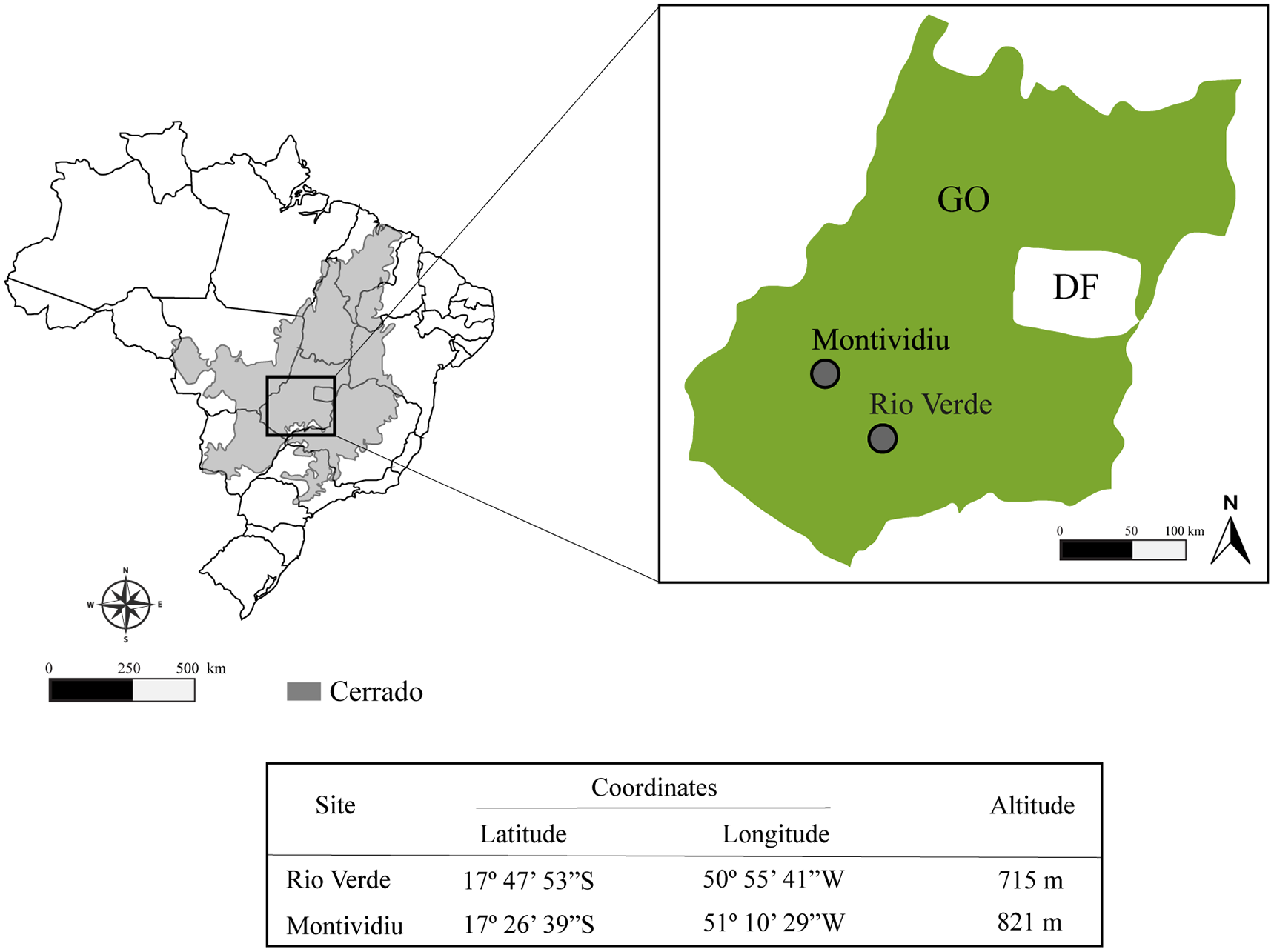
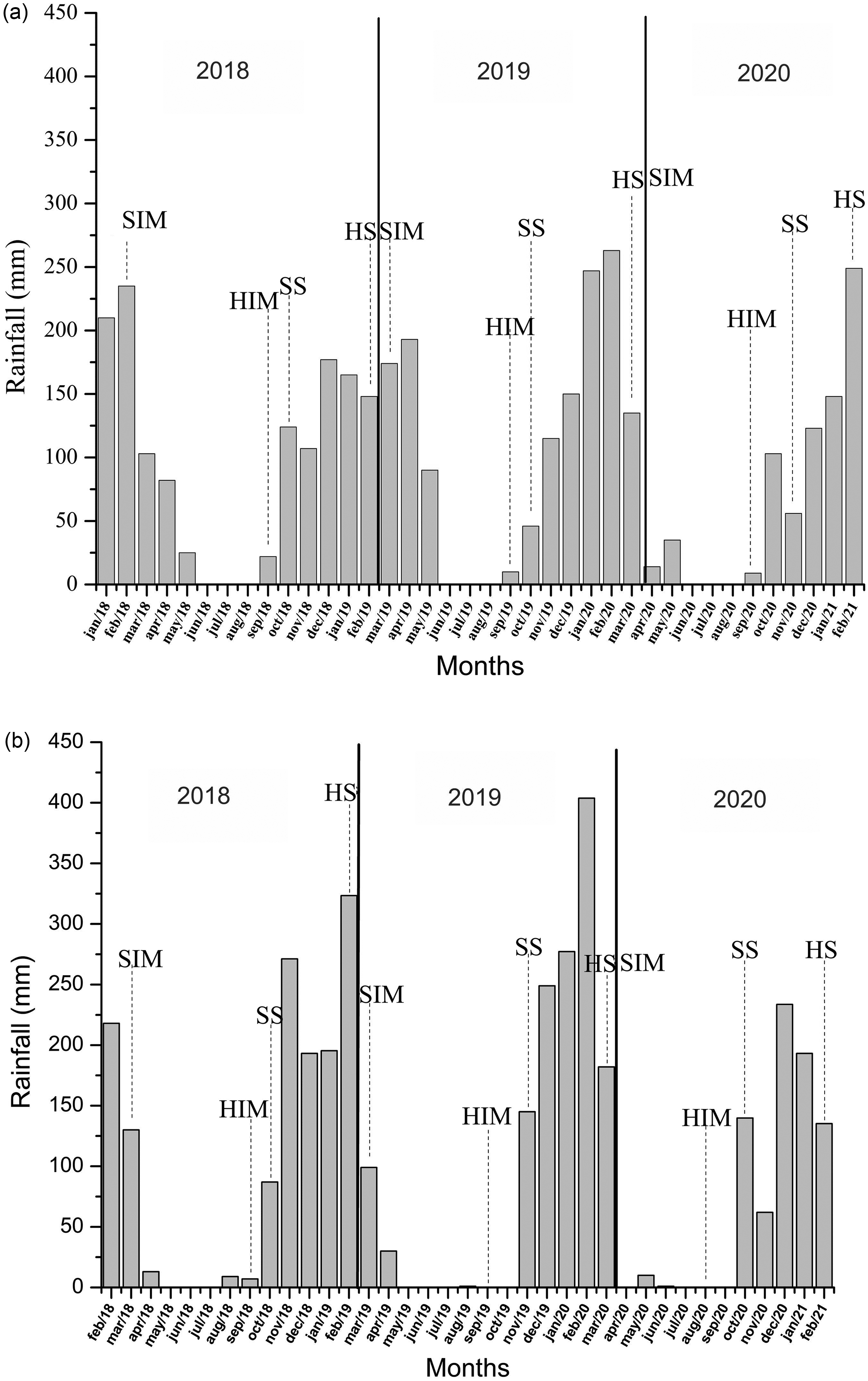
The study was conducted for three years (2018, 2019, and 2020) in two sites, Rio Verde (altitude 715 m) and Montividiu (altitude 821 m), both within the Cerrado biome in the state of Goiás, Brazil (Figure 1). The soils of the experimental sites are classified as Rhodic Hapludox (Soil Survey Staff, 2014). These sites are located in regions that are representative of highly intensified and technologically advanced agriculture within the Cerrado biome. Prior to the initial planting of the cover crops, the topsoil (0–20 cm) was sampled, with the samples comprising eight subsamples from each experimental site collected for soil characterisation (Table S1). Lime application was carried out in accordance with local guidelines for the crops. According to Alvares et al. (Reference Alvares, Stape, Sentelhas, Gonçalves and Sparovek2013), the climate is classified as tropical savannah with dry winters and rainy summers (Aw) and an average annual rainfall of more than 1,600 mm. In 2018, 2019, and 2020, precipitation in Rio Verde and Montividiu reached 87%, 88%, and 54.5% of the historical average, respectively (Figure 2). In Rio Verde and Montividiu, the temperatures varied between 18°C and 31°C.
Experimental areas located in the Brazilian savannah.
Monthly climatic data of precipitation during the study. SIM: seeding maize and intercrops; HIM: harvest maize and intercrops; SS: soybean seeding; HS: soybean harvest. A: Rio Verde and B: Montividiu.
Study design
The field trial was designed using a randomised strip design measuring 30 m × 50 m in Montividiu, covering an area of 1,500 m2, and 12 m × 80 m in Rio Verde, covering an area of 960 m² with 12 replications for each treatment. Each treatment consisted in the central 2 rows of soybean of the strips, and the measurements were performed in a 10 m long and 12 m wide area. The field trial consisted of four different treatments: (1) Maize, (2) Maize/Urochloa ruziziensis (M_Brz), (3) Maize/Urochloa brizantha cv. Marandu (M_Bmr), and (4) Maize/Urochloa brizantha cv. BRS Paiaguás (M_Bpg). In addition, in the Brazilian savannah, it is important to find an intercropping of cover crops with maize that does not reduce yields and makes the system more sustainable.
Treatments were planted yearly in the fall-winter season prior to the soybean harvest season. The treatments were planted on March 13th, 9th, and 17th of 2018, 2019, and 2020 in Rio Verde, and on March 22nd, 8th, and 11th of 2018, 2019, and 2020 in Montividiu. Cover crops were terminated on September 29th, 2018; September 5th, 2019; and August 14th, 2020, in Rio Verde and September 26th, 2018; September 9th, 2019; and September 30th, 2020, using 2.5 L ha-1 of glyphosate [360 g a.i. L-1]. Soybean was planted on October 18th, 2018; November 4th, 2019; and October 17th, 2020, in Rio Verde, and October 27th, 2018; 25th, 2019; and November 5th, 2020, in Montividiu. Soybean grains were harvested on February 07th, 2019; March 12th, 2020; and February 19th, 2021, in Rio Verde, and March 07, 05, and 16; 2019, 2020, and 2021 in Montividiu. In all years and locations, pest, disease, and weed management were carried out in accordance with technical recommendations for soybean cultivation. For more details, see Souza et al. Reference Souza, de Castro Santos, Ferreira, de Souza, Gonçalo, de Sousa, Cruvinel and Vilela(2024b).
Crop management
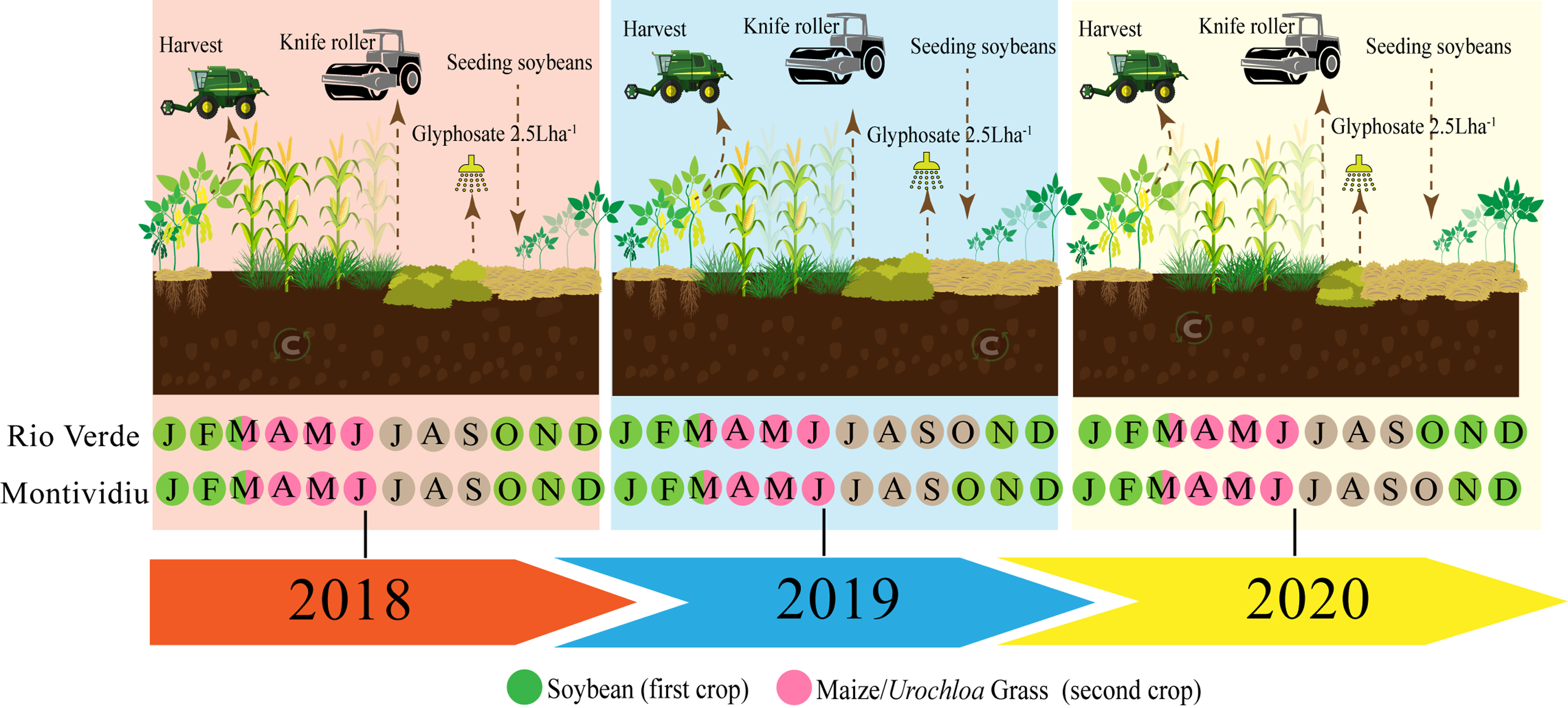
The maize was planted by row seeding and cover crops were planted by broadcast seeding in the experimental plots. The maize is a hybrid material P3898, the plant population consisted of 50,000 plants per hectare with 0.50 m row spacing. Sowing density in the Urochloa species single crop was 8 kg ha-1. The intercropped grasses were sown with 5 kg of pure viable seed per hectare. In Rio Verde, mowing occurred in July of both 2018 and 2019, and rolling crimping was utilised for the management of the cover crops in July of 2020. The fertilisation was carried out yearly at the treatments planting with 96 kg ha-1 of N, 40 kg ha-1 of P2O5, and 40 kg ha-1 of K2O. In addition, a broadcast fertilisation was carried out with 8 kg ha-1 of N, 80 kg ha-1 of P2O5, and 80 kg ha-1 of K2O prior to the soybean planting during the dry season. In Montividiu, mowing occurred in July 2018, and rolling crimpers were employed for cover crop management in July 2019 and 2020. The fertilisation was carried out yearly at treatments planting with 108 kg ha-1 of N; in addition, a broadcast fertilisation was carried out with 100 kg ha-1 of P2O5 and 120 kg ha-1 of K2O before soybean planting (Fig. 3).
Crop/management schedule of study areas.
Aboveground biomass sampling
At the time of maize harvest, the plants were cut 3 cm from the ground with a mechanical mower in a 1 m² area, with 12 replications per treatment. The sampling points were randomly distributed within each plot to ensure representative coverage of field variability while avoiding border effects. This approach aimed to capture the spatial heterogeneity of biomass production and ensure that the samples accurately reflected the treatment effects. The cut was performed at the same location as the soybean and maize harvest.
The biomass was weighed to obtain the fresh weight. A sub-sample was then taken, placed in a paper bag, weighed and placed in a forced-air oven (55 °C) for 72 hours. The dried material was weighed to obtain the proportion of dry matter to later obtain the amount of biomass in kg of dry mass ha-1. For each of the 12 replicates, three random locations were selected with a graduated rod, and the height of the forage plant was measured from the ground to the ends of the fully expanded apical leaves.
Analyses performed for maize
The insertion height of the first maize ear was measured from the base of the plant to the ear insertion using a tape measure. This procedure was carried out in 12 replicates per treatment and five plants were measured in each replicate. Then, the number of plants was counted, grain yield (kg ha-1), and thousand-grain weight (TGW) (g), each sample consisted of two rows of maize, each 3 metres long. The samples were weighed to obtain the total weight, then 1,000 grains were counted, and weighed, and the moisture content of the samples was measured to adjust the data to 13% moisture.
Land equivalent ratio (LER)
Estimated each crop’s participation in the combined intercropping yield. This index is the relative land area under monoculture conditions required to provide the yields achieved in intercropping. In order to obtain this calculation, plots of the forage crops were kept in monoculture for later use regarding the biomass in intercropping (Urochloa ruziziensis (Brz_Mn), U. brizantha cv. Marandu (Bmr_Mn), and U. brizantha cv. BRS Paiaguás (Bpg_Mn)) (Fig. S1). LER_grass was calculated based on the above-ground biomass of the forage species (Equation 2).
The LER is widely considered to be a robust and useful indicator of intercrop yield relative to single crops (Bedoussac and Justes, Reference Bedoussac and Justes2011). A total LER value >1.0 indicates that the intercrop was more productive than the single crop. The partial LER values for each species in an intercrop were also used to compare the relative contribution or competitive ability of each species (Bedoussac and Justes, Reference Bedoussac and Justes2011). The LER was estimated according to the methodology (Mead and Willey, Reference Mead and Willey1980; Dunea and Dincă, Reference Dunea and Dincă2014), using the following equations:
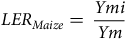 $${LE{R_{Maize}} = \;{{Ymi} \over {Ym}}}$$
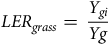 $${LE{R_{grass}} = \;{{{Y_{gi}}} \over {Yg}}}$$
 $${LE{R_{total}} = \;LE{R_m} + LE{R_{grass}}}$$
Where $LER$
is the land equivalent ratio,
$LER$
is the land equivalent ratio, $LE{R_{Maize}}$
represents the maize yield ratio, and
$LE{R_{Maize}}$
represents the maize yield ratio, and $LE{R_{grass}}\;$
represents the brachiaria yield ratio.
$LE{R_{grass}}\;$
represents the brachiaria yield ratio. ${Y_{mi}}$
is the maize yield in intercropping (M_Brz, M_Bmr, M_Bpg), and
${Y_{mi}}$
is the maize yield in intercropping (M_Brz, M_Bmr, M_Bpg), and $Ym$
is the maize yield in monoculture (M_Mn). Similarly,
$Ym$
is the maize yield in monoculture (M_Mn). Similarly, $\;{Y_{gi}}$
is the grass (above-ground biomass of forage) yield in intercropping (M_Brz, M_Bmr, M_Bpg) and
$\;{Y_{gi}}$
is the grass (above-ground biomass of forage) yield in intercropping (M_Brz, M_Bmr, M_Bpg) and $Yg$
is the grass (above-ground biomass) yield in monoculture (Brz_Mn, Bmr_Mn, Bpg_Mn). The total land equivalent ratio
$Yg$
is the grass (above-ground biomass) yield in monoculture (Brz_Mn, Bmr_Mn, Bpg_Mn). The total land equivalent ratio $LE{R_{total}}$
is combining the yield ratios of both crops.
$LE{R_{total}}$
is combining the yield ratios of both crops.
Soybean performance evaluation
The impact of cover crops on soybean performance was made by measuring the plant stand-by-stand counting 3 m long areas of the 2 central rows of the 12 replicated of each treatment. The soybean plant population and the number of pods per plant were measured by counting the plants at harvest time. The grain yield of soybean was determined by hand-harvesting the same area where the stand count was done. A sample of grains was air dried, and yield data were adjusted to a moisture content of 13%.
Data analysis
The Rstudio software version 3.5.1 (R Core Team, 2023) was used for the analyses with the car , emmeans (Lenth, Reference Lenth2020), multcomp (Hothorn et al., Reference Hothorn, Bretz and Westfall2008), and dplyr packages (Wickham et al., Reference Wickham, François, Henry and Müller2021). Outliers were identified with the outlierTest function of the car package. Normality and homogeneity of variance were verified with the Shapiro–Wilk and Bartlett tests, respectively. The data were analysed in a linear model (function lm of R software) considering the treatment and site and the interaction between them as fixed effect. The effects were analysed by the Anova function of the car package, considering the type III error. When any effect was considered significant (p < 0.05), the means were obtained using the least squares method and compared using Tukey’s test at 5% probability.
Correlation analysis was performed between the variables related to the maize crop with the cor function, and the correlation graph was obtained using the corrplot package (Wei and Simko, Reference Wei and Simko2017). A multivariate principal component analysis (PCA) was performed using the FactoMineR (Le et al., Reference Le, Josse and Husson2008) and factoextra packages (Kassambara and Mundt, Reference Kassambara and Mundt2020). The PCA aimed to understand the behaviour of each variable as a function of treatments and other measured covariates, such as planting date and accumulated precipitation in the evaluated crop cycle. The variable ‘Days’ was calculated as the number of days between January 1st of each year and the sowing date.
Results
Maize yield and LER
Maize grain yield was significantly influenced by the management system (Fig. 4). In Montividiu (2018), there was no significant difference in yield between maize single crop and maize intercropped with Urochloa grass (p < 0.05). However, in 2019, significant differences were observed, with M_Mn (4771 kg ha¹) and M_Bpg (4734 kg ha¹) yielding more than M_Brz (3874 kg ha¹). M_Bmr (4624 kg ha¹) presented no differences in maize yield between all the treatments evaluated. In 2020, M_Mn had a higher yield (2497 kg ha¹) than all the intercropping (Maize/Urochloa) evaluated. Maize yields decreased in 2020 due to the water deficit in the Montividiu experimental area (Fig. 1).
Maize yield (kg ha−1) over three cropping years in the Montividiu and Rio Verde study areas. M_Mn: Single crop (Maize); M_Bmr: Maize/U.brizantha (Marandu); M_Brz: Maize/U. ruziziensis; M_Bpg: Maize/U.brizantha (Paiaguás).
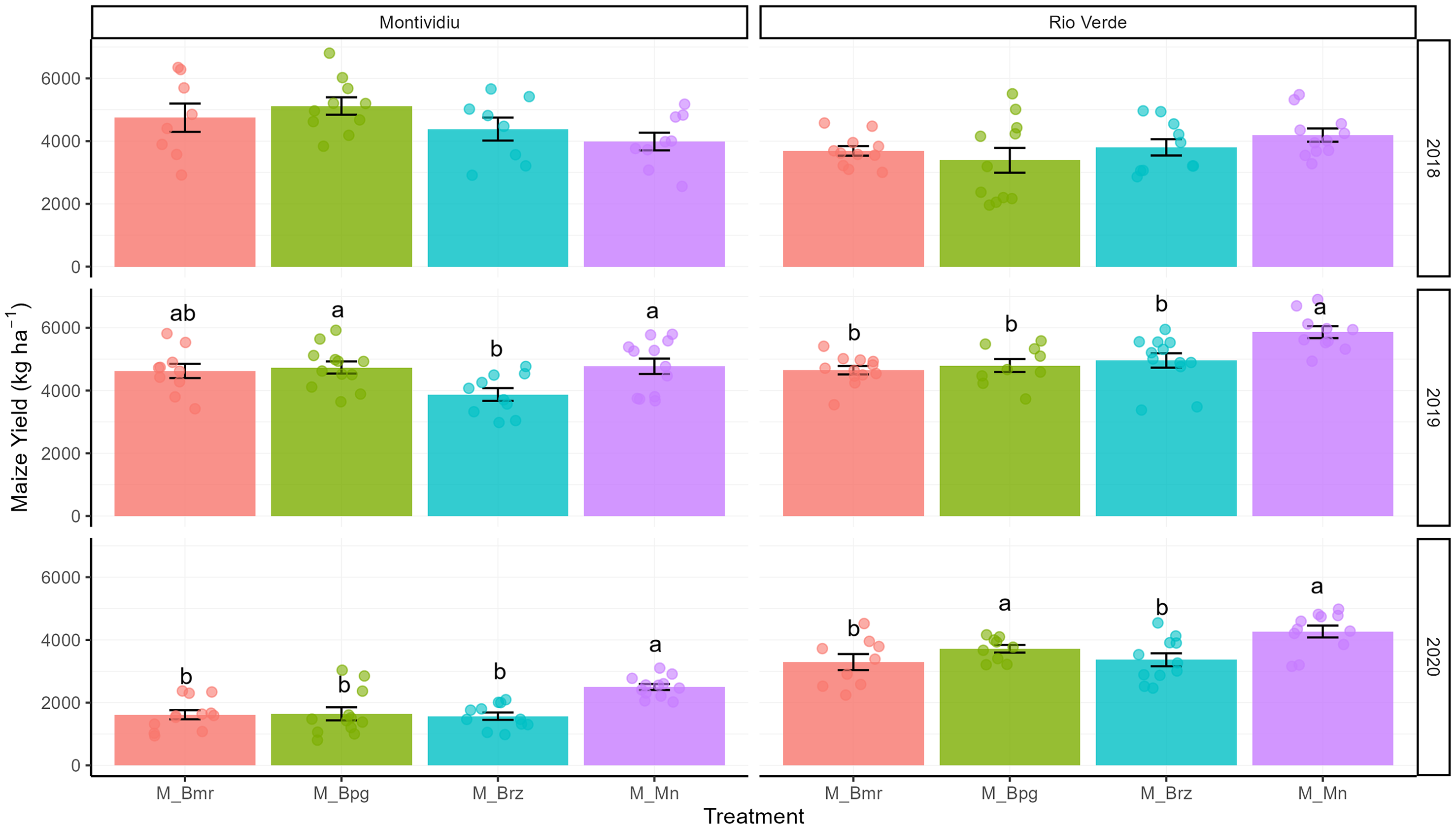
In Rio Verde (2018), single crop maize had no statistically significant differences from all intercropping (Maize/Urochloa) treatments. In 2019, the M_Mn (5860 kg ha¹) had a 20 % higher yield than all the intercropping evaluated. In 2020, overall yields decreased in all treatments. However, M_Bpg (3718 kg ha¹) and M_Mn (4267 kg ha¹) produced similar grain yields, suggesting that M_Bpg (U. brizantha cv. BRS Paiaguás) may be less competitive with maize than other forage species. M_Brz (3366 kg ha¹) and M_Bmr (3292 kg ha¹) showed lower yields for maize in the Rio Verde.
In Rio Verde, LER_total remained below 1 in all years, indicating that intercropping was consistently less efficient than monoculture (Table 1). In 2018, values ranged from 0.90 to 0.96, meaning intercropping was 4% to 10% less efficient. In 2019, LER dropped further (0.84–0.91), showing an even greater disadvantage (9% to 16% lower efficiency). In 2020, the LER improved slightly (0.86–0.95), but still indicating a 5–14% lower efficiency than monoculture. These results suggest that, unlike in Montividiu, intercropping in Rio Verde did not exceed the efficiency of monoculture (LER>1).
Land equivalent ratio (LER) in different intercropping systems in Rio Verde and Montividiu
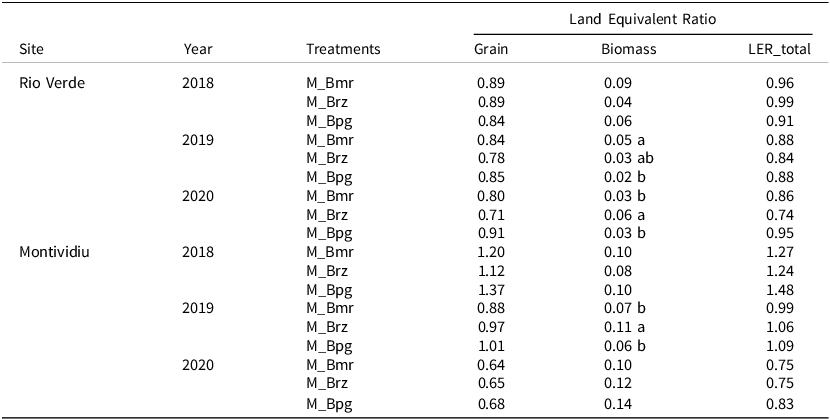
Means followed by the same lowercase letter do not differ from each other using the Tukey’s test (p < 0.05); the comparison was performed between treatments within each year. M_Brz: Maize/Urochloa ruziziensis; M_Bmr: Maize/ Urochloa brizantha cv. Marandu; M_Bpg: Maize/ Urochloa brizantha cv. BRS Paiaguás.
In Montividiu, intercropping showed a clear advantage in 2018, with LER values between 1.27 and 1.48, meaning it was 27% to 48% more efficient than monoculture. In 2019, the LER decreased for M_Bmr (0.99), while M_Bpg and M_Brz remained up to 6% more efficient than monoculture. By 2020, LER decreased further (0.75–0.83), indicating that intercropping became 17% to 25% less efficient.
Soybean crop yield
In Rio Verde, significant differences between treatments were observed only in 2020, with M_Brz (6000 kg ha¹) and M_Bpg (5900 kg ha¹) treatments achieving 17% higher soybean yield than the other treatments (Fig. 5).
Soybean yield (kg ha-1) in Rio Verde and Montividiu from 2018 to 2020. Means followed by the same lowercase letter do not differ from each other using the Tukey’s test (p < 0.05); the comparison was performed between treatments within each year. The error bar represents the standard deviation. M_Brz: Maize/Urochloa ruziziensis; M_Bmr: Maize/ Urochloa brizantha cv. Marandu; M_Bpg: Maize/Urochloa brizantha cv. BRS Paiaguás.
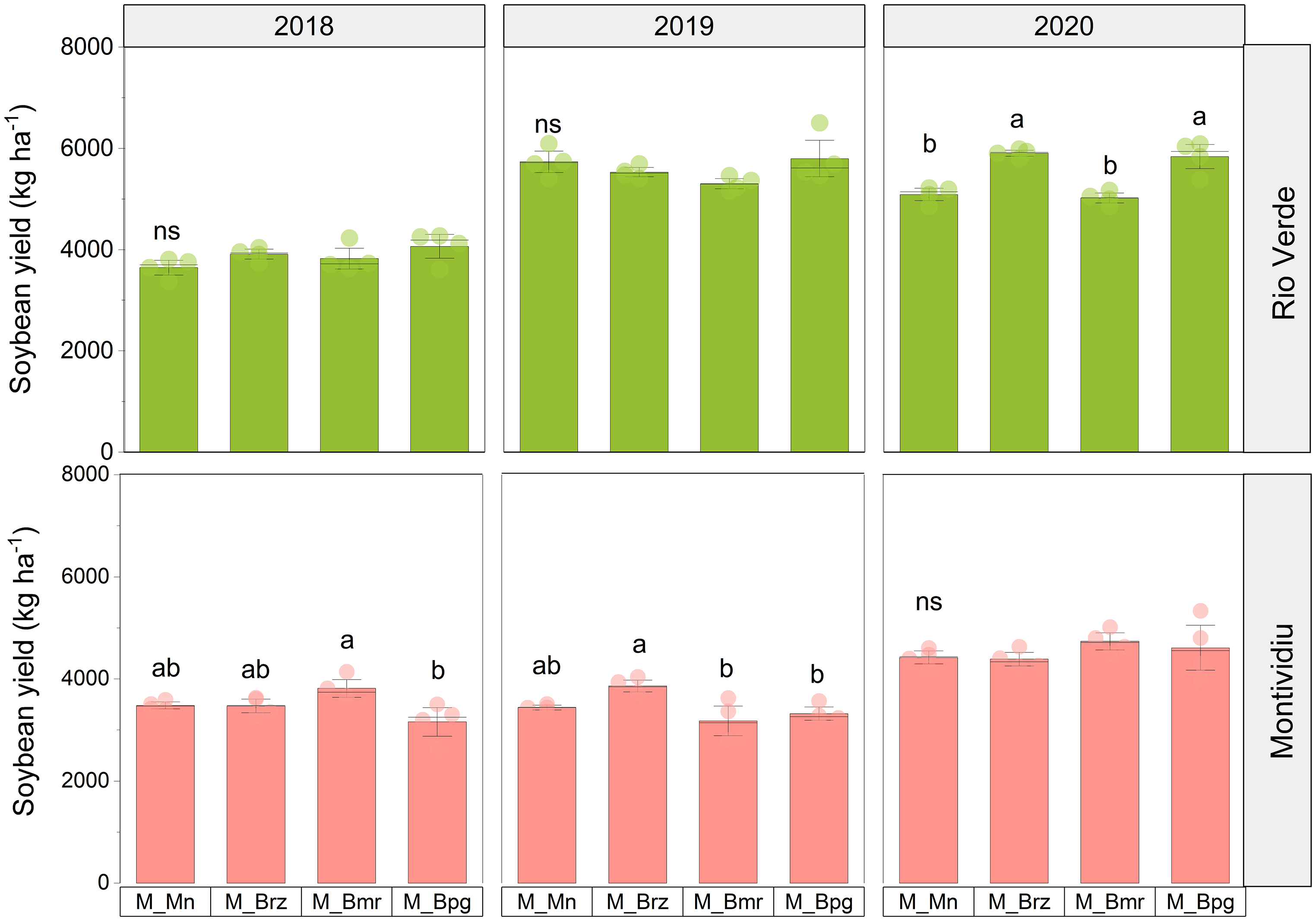
In Montividiu, significant differences were observed in 2018 and 2019 (p < 0.05). M_Bmr had the highest soybean yield (3950 kg ha¹) in 2018, producing 20% more than M_Bpg (3160 kg ha¹). In 2019, the soybean yield was 8% higher in the M_Brz (4400 kg ha¹) treatment compared to maize single crop (M_Mn) (3500 kg ha¹). In 2020, there were no significant differences in soybean yield between the treatments evaluated (Fig. 5).
Correlation and principal component analysis
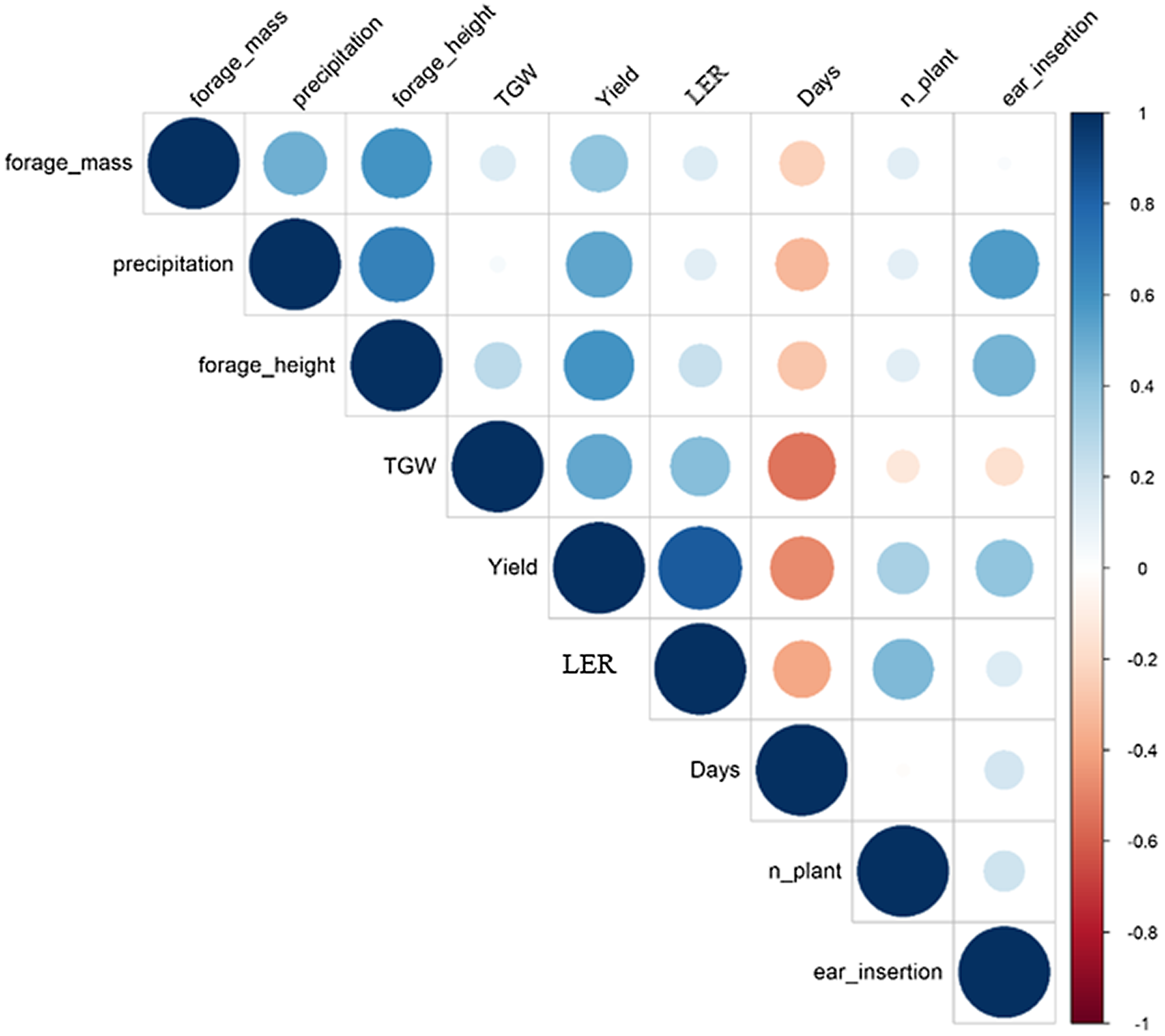
The correlation analysis showed that maize yield had a positive correlation with forage mass (r 0.40) and precipitation (r 0.55), indicating that increased biomass accumulation and favourable moisture conditions significantly enhanced maize yield (Fig. 6). In addition, LER showed a high correlation with maize yield (r 0.80) and TGW (r 0.40), suggesting that intercropping efficiency is strongly linked to grain production and seed weight. The negative correlation between sowing days and most maize variables (e.g. yield: r −0.50, TGW: r −0.60) suggests that delayed sowing has a negative effect on grain development and final yield. Late sowing increases the uncertainty of environmental conditions during critical growth stages.
Correlation among the variables observed in intercrop maize: forage mass, precipitation, forage height, thousand-grain mass (TGM), yield, land equivalency ratio (LER), number of days from January 1st, number of plants per metre, and ear insertion height. The size of the circles represents the significance of the correlation, with larger circles between two variables indicating a more significant correlation. The absence of a circle indicates that the correlation between the variables was not significant. The colour of the circles corresponds to the correlation values indicated on the adjacent scale, with dark blue indicating a correlation closer to 1 and dark red indicating a correlation closer to -1.
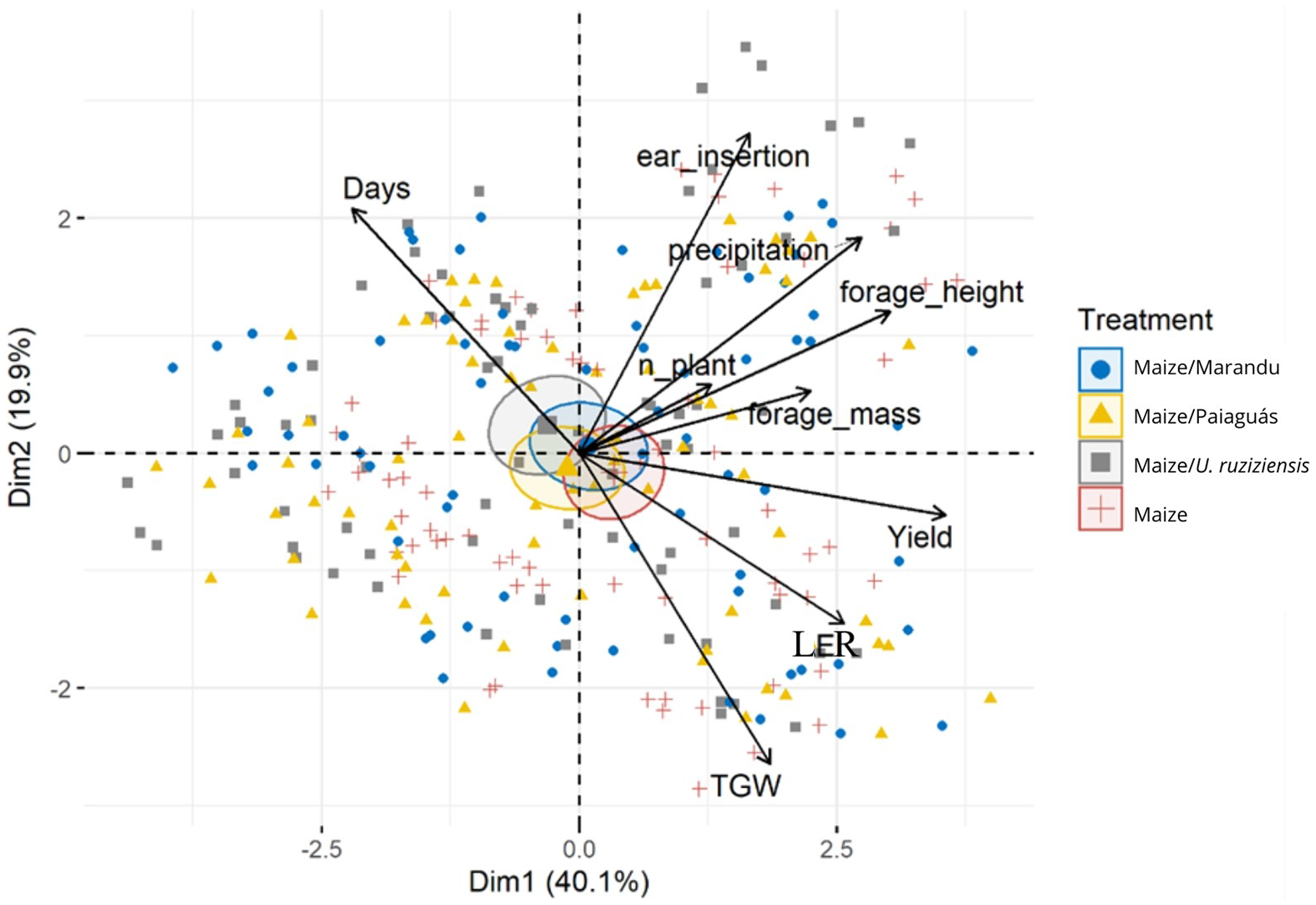
The principal component analysis (PCA) shows that two dimensions explain 60% of the variance in the dataset, with Dim1 contributing 40.1% and Dim2 contributing 19.9% (Fig. 7). The variable ‘number of days’ is positioned in the opposite quadrant to yield, LER, and TGW, indicating a negative association. Late-season planting tends to be linked with lower yield, LER, and TGW. Factors such as reduced precipitation, shorter crop cycles, and increased stress during critical growth stages can contribute. The forage mass, precipitation, and forage height strongly contribute to Dim1, while yield, LER, and TGW are key variables in Dim2. These relationships indicate that both climatic and management factors play a role in intercropping performance.
Principal component analysis of the observed variables in intercrop maize: forage mass, precipitation, forage height, thousand-grain mass, yield, area equivalency index, number of days from January 1st, number of plants per metre, and ear insertion height.
Discussion
Impact of sowing date and climate conditions on maize and forage intercropping systems
This study sought to evaluate the yield performance of maize in intercropping systems with different grass species. In Montividiu, maize intercropped with Urochloa brizantha cv. Marandu and Urochloa brizantha cv. BRS Paiaguás produced yields statistically equivalent to those of monoculture maize (Fig. 4). Demonstrating that these forage species do not compromise maize yield under higher rainfall in the first two years (2018 and 2019). The timing and spatial arrangement of intercropping significantly influence competition dynamics with maize. In early-season sowing, favourable environmental conditions, such as adequate temperature and water availability, promote stronger maize growth (Fig. 1), which helps maintain its competitive advantage over Urochloa spp. This allowed maize to benefit from higher precipitation levels throughout its growth cycle, promoting better establishment and development. As a result, maize gained a competitive advantage over the intercropped grass, reducing interspecific competition, and ultimately leading to higher yield. However, in late-season sowing, limited precipitation and lower solar radiation can delay maize development, reducing its ability to suppress intercropped grasses (Andrea et al., Reference Andrea, Boote, Sentelhas and Romanelli2018). This shift in competitive balance may lead to greater resource sharing, but also increases the risk of yield penalties for maize due to heightened competition for water and nutrients (Brooker et al., Reference Brooker, Bennett, Cong, Daniell, George, Hallett, Hawes, Iannetta, Jones, Karley, Li, McKenzie, Pakeman, Paterson, Schob, Shen, Squire, Watson, Zhang, Zhang, Zhang and White2015). One strategy to mitigate this issue is post-emergence herbicide management (Souza et al., Reference Souza, Ciampitti, Fernandez, Favarin and de Oliveira2024a), which is commonly recommended in such scenarios to control excessive grass growth and minimise competition with maize.
The performance of intercropping is also influenced by soil properties. The clay content in Montividiu was almost half (19.5%) that of Rio Verde (40.5%) (Table S1), which has significant agronomic implications. Low clay soils generally have reduced water holding capacity, lower cation exchange capacity (CEC), and increased susceptibility to erosion and nutrient leaching. Under such conditions, maintaining adequate soil cover is essential to minimise moisture loss, improve soil structure, and sustain crop development. These results demonstrate the importance of intercropping for maintaining soil conservation and resilience, particularly in environments with low natural fertility and limited water retention capacity.
As reported by Morais et al. (Reference Morais, Ratke, Bortolon, Lacerda, Edvan, Zuffo and Pacheco2020), maize intercropped with palisade grass (Urochloa brizantha) has been associated with higher potassium accumulation in dry matter. Although intercropping with cover crops may limit maize grain yield and nutrient export, it also enhances crop residue accumulation on the soil surface, improving nutrient cycling and soil structure. Several studies have shown that maize-forage intercropping does not negatively impact grain yield, particularly under favourable growing conditions (Mateus et al., Reference Mateus, Crusciol, Pariz, Costa, Borghi, Costa, Martello, Castilhos, Franzluebbers and Cantarella2020; Crusciol et al., Reference Crusciol, Nascente, Mateus, Borghi, Leles and Santos2013; Modesto et al., Reference Modesto, Andreotti, Nakao, Soares, Froio, Dickmann, Paschoaloto and Fernandes2021). However, most of these studies were conducted in clayey soils during the main growing season (summer), where climatic conditions are more favourable. In contrast, our study focused on maize intercropped with forage grasses in the second season (autumn/winter), a period associated with greater climatic variability and higher risk of crop losses. Under these conditions, achieving high cash crop yields and biomass production requires proper sowing timing and efficient resource management to minimise interspecific competition and maximise the benefits of intercropping systems. As in Sarto et al. (Reference Sarto, Borges, Bassegio, Rice and Rosolem2021), where changing the sowing date from December to February changed the yield of maize intercropped with U. brizantha from 10.1 t ha-1 to 3.7 t ha-1, and from 7.8 t ha-1 to 4.4 t ha-1 for maize intercropped with U. ruziziensis. According to the Safety and Quality Manual for maize cultivation (Embrapa, 2004), the species requires at least 350 to 500 mm of water for production. However, to reach maximum yield, the consumption during the cycle should be around 800 mm. In this study, average rainfall did not reach the minimum required for maize production, intensifying interspecific competition and significantly limiting yield potential. This challenge is further highlighted by the negative correlation between sowing days and key maize variables such as yield (r = −0.50) and TGW (r = −0.60) (Fig. 6), indicating that late sowing date exposes the crop to greater environmental uncertainty during critical growth stages, further exacerbating yield losses.
Even with the challenges associated with intercropping in the second season, maize intercropped with Urochloa brizantha cv. BRS Paiaguás (M_Bpg) and U. brizantha cv. Marandu (M_Bmr) maintained yields equivalent to monoculture maize in 2019 in Montividiu and in 2020 in Rio Verde.
Optimising land use: the benefits and challenges of maize-forage intercropping
The LER in intercropping systems is influenced by several factors, including seeding density, water availability, soil texture, and species interactions. Silva et al. (Reference Silva, Júnior, Cardoso and Neto2020) showed that increasing the seeding density of Urochloa ruziziensis from 2 to 8 kg ha-1 progressively reduced the LER, with values decreasing from 1.23 to 1.03. As a result, the yield advantage of intercropping over monoculture decreased from 23% to 3%. The higher LER values observed in Montividiu (Table 1) suggest that on soils with lower clay content, cash crop yields respond more quickly to management interventions. The benefits of sustainable practices can be seen earlier. In environments where soil and climatic factors place greater constraints on crop development, intercropping may help to compensate for these constraints, leading to higher initial efficiency. This compensatory effect may explain why LER values in Montividiu exceeded those of monoculture, especially in the early years of the study.
Under the conditions of the Brazilian Savannah, intercropping maize with Urochloa brizantha cv. BRS Paiaguás resulted in higher maize grain yield (LER = 48% and 9% in 2018 and 2020). This promotes substantial fresh and dry matter production, enhancing biomass input to the soil, and contributing to long-term soil health. The increase in light interception due to greater leaf area enhances net photosynthesis, leading to higher carbon fixation and greater biomass accumulation (Pimentel, Reference Pimentel1998). In contrast, in Rio Verde, LER_total remained consistently below 1 across all years. The higher clay content in the soil may require a long-term period to optimise interactions between maize and forage species. In particular, in the last year of the study (2020), maize/Urochloa brizantha cv. BRS Paiaguás (M_Bpg) achieved a grain yield statistically similar to that of monoculture maize (M_Mn) (Fig. 4). With appropriate management adjustments, intercropping could become a viable alternative on these soils over time. This confirms the importance of selecting appropriate forage species to optimise intercropping systems, ensuring a better balance between competition and resource efficiency.
The impact of intercropping systems during the soybean season is key to assessing the long-term sustainability of combining maize with forage species in the Brazilian savannah. Intercropping systems affect soybean yield differently depending on the site and the maize/grass species used (Fig. 5). In Rio Verde, the greatest effect of intercropping systems on soybean was only seen in the 2020. When soybean in the M_Brz and M_Bpg treatments produced 17% more than maize single and M_Bmr. These findings are in line with Ceccon et al. (Reference Ceccon, Staut, Sagrilo, Machado, Nunes and Alves2012), who reported that soybean yields were higher when these crops were intercropped with forage grasses, rather than following single maize. This effect was particularly evident in the first year of the experimental plots in Montividiu, where intercropping systems showed an increase in soybean yield. In this region, the sandy soils, with lower nutrient retention capacity and greater susceptibility to drought stress, quickly offset the effect of increasing the quantity and quality of biomass input. The greater biomass input from intercropping systems increases soil organic matter and nutrient availability, which are critical for maintaining productivity in tropical environments. In addition, the ability of forage grasses to increase surface residue cover reduces weed competition (Teasdale, Reference Teasdale1993; Silva et al., Reference Silva, Ferreira, Silva, Paiva and Sediyama2004; Severino et al., 2005). This suggests that intercropping maize with forage species can create more favourable conditions for the next crops, reinforcing its role as a sustainable strategy for savannah (Cerrado biome) agriculture.
Benefits of intercropping with Urochloa for soil health
Intercropping maize with Urochloa species provides substantial benefits for soil health in the Brazilian savanna (Souza et al., Reference Souza, Canisares, Schiebelbein, Santos, Menillo, Junior and Cherubin2025). This system significantly improves soil cover, reducing the risk of erosion while mitigating water loss during drought periods (Bertollo et al., Reference Bertollo, de Moraes, Franchini, Soltangheisi, Junior, Levien and Debiasi2021). The deep-rooted of Urochloa enhances soil aggregation, a key indicator of soil health and cash crop yield (Bronick and Lal, Reference Bronick and Lal2005; Peng et al., Reference Peng, Horn and Hallett2015; Rabot et al., Reference Rabot, Wiesmeier, Schlüter and Vogel2018). Paschoal et al. (Reference Paschoal, Cagna, Guedes Filho and Mazzini-Guedes2020) assessed the impact of intercropping maize with forage grasses on soil structural quality through Visual Evaluation of Soil Structure. Such improvements in soil physical properties are essential for maintaining soil resilience and optimising crop performance under variable climatic conditions. Despite these benefits, intercropping presents agronomic trade-offs.
The competition between maize and Urochloa for water, nutrients, and light can negatively affect maize grain yield, particularly under water-limited conditions or when planting is delayed (Fig. 4). In the third crop season (2020), competition between maize and forage species was observed in Montividiu, coinciding with the year of lowest precipitation (Barducci et al., 2009). Similar findings have been reported in other studies, where high competition between forage grasses and grain crops, such as maize, sorghum, and rice, has been documented in intercropping systems (Crusciol et al., Reference Crusciol, Momesso, Portugal, Costa, Bossolani, Costa, Pariz, Castilhos, Rodrigues, Costa, Franzluebbers and Cantarella2021; Garbelini et al., Reference Garbelini, Franchini, Debiasi, Balbinot Júnior, Betioli Júnior and Telles2020). However, the reduction in maize grain yield due to intercropping with forage grasses does not necessarily render the system unfeasible. This yield penalty can be offset by additional benefits, particularly the establishment of high-quality pasture for fall and winter grazing, which enhances overall land use efficiency (Portes et al., Reference Portes, Carvalho, Oliveira and Kluthcouski2000). In our study, the observed low biomass production at the time of maize harvest (Fig. S1) was primarily due to the timing of biomass collection. Since biomass was measured at maize harvest, the forage had not yet reached its full growth potential. Pacheco et al. (Reference Pacheco, Monteiro, Petter, Nóbrega and Santos2017) reported a significant increase in Urochloa ruziziensis biomass 156 days after maize harvest, demonstrating the capacity of forage species to continue developing post-harvest. Despite the competition between forage and cereal crops, intercropping systems provide long-term agronomic benefits, including improved soil health and enhanced yield potential in subsequent cropping seasons.
In sandy soils, such as those found in Montividiu, soybean grain yield was higher in the initial years when intercropped with Urochloa, reinforcing the benefits of maintaining soil cover in regions with lower clay content. This finding aligns with Garbelini et al. (Reference Garbelini, Franchini, Debiasi, Balbinot Júnior, Betioli Júnior and Telles2020), who evaluated soybean production systems in southern Brazil and observed a 6% increase in soybean yield when Urochloa ruziziensis was used as a cover crop compared to the conventional soybean-maize rotation system. Similarly, our study suggests that intercropping systems contribute to improved soil conditions, particularly in sandy soils, where the presence of Urochloa may enhance moisture retention and nutrient cycling, benefiting subsequent soybean yields. Further supporting this, (Silva et al. Reference Silva, Júnior, Cardoso and Neto2020) reported that in sandy loam soils, intercropping maize with Urochloa ruziziensis enhances soil water extraction, particularly in the 0.0–0.3 m layer, which coincides with critical maize growth stages such as flowering and grain filling. In addition, this system promotes deeper soil water uptake compared to single maize, which can be advantageous in regions where soil moisture availability varies throughout the growing season. The extent of soil water retention improvements in intercropping systems is highly dependent on the biomass production of Urochloa and the inherent soil properties. The most critical soil water compartment for plant growth is the available water storage, as plant roots have limited access to moisture from deeper compartments. Enhanced soil water availability in intercropped systems is largely attributed to increases in SOC, which improves soil structure and porosity, thereby enhancing water retention capacity. The decomposition of root biomass, stems, and the release of organic exudates further contribute to SOC accumulation, ultimately fostering a more resilient soil environment (Carneiro et al., Reference Carneiro, Mendes, Lovato, Carvalho and Vivaldi2004).
These findings underscore the multifunctionality of intercropping systems in tropical agroecosystems. Resistance to adverse conditions is particularly crucial in regions with dry winters, such as the Brazilian Cerrado, the African savanna, and Australia, where forage sowing after maize harvest is unfeasible due to the lack of rainfall (Crusciol et al., Reference Crusciol, Nascente, Borghi, Soratto and Martins2015). In such environments, maintaining soil cover through intercropping systems becomes essential for preserving soil moisture and preventing degradation. By improving soil structure, enhancing water retention, and sustaining crop productivity, maize-Urochloa intercropping emerges as a strategic approach for climate adaptation and sustainable intensification in the Brazilian savanna. However, future studies should focus on a deeper understanding of soil processes in these systems, particularly regarding soil organic matter dynamics, nutrient cycling, and water retention mechanisms. Moreover, an integrated evaluation of soil physical, chemical, and biological properties is essential to fully assess the long-term sustainability and productivity of intercropping systems under different environmental conditions. Such research will provide valuable insights for optimising management strategies and ensuring the resilience of tropical agroecosystems in the face of climate variability.
Conclusions
The findings of our study confirm that intercropping maize with Urochloa brizantha cv. Marandu and U. brizantha cv. BRS Paiaguás enhances land-use efficiency without compromising maize yield. In Montividiu, maize intercropped with U. brizantha cv. Paiaguás (M_Bpg) achieved grain yields similar to monoculture maize (M_Mn), demonstrating that this forage species exerts lower competition with maize compared to other grasses. As a result, intercropping led to a higher LER, averaging 1.13 over three years in Montividiu, reinforcing its advantage in optimising land use and maintaining yield in integrated systems.
The results also support the hypothesis that intercropping systems respond more rapidly in sandy soils, where water and nutrient retention are limited. In Montividiu, the increased biomass input from forage grasses accelerated improvements in soil structure, moisture retention, and nutrient availability, enhancing crop yield more quickly than in clay soils. Soybeans had the highest yield in both 2018 and 2019 when maize was intercropped with grasses. This highlights the importance of intercropping in environments with lower natural fertility, where maintaining soil organic matter is essential for long-term sustainability. Overall, maize-forage intercropping has proven to be an effective strategy for improving land-use efficiency and soil health in tropical agroecosystems. However, site-specific management remains critical to optimising species selection and mitigating potential trade-offs. Future research should focus on refining management practices and evaluating long-term soil health dynamics to further enhance the sustainability of intercropping systems in different environmental conditions.
Supplementary material
The supplementary material for this article can be found at https://doi.org/10.1017/S0014479725100070.
Acknowledgements
We thank the Center for Carbon Research in Tropical Agriculture/University of São Paulo (CCARBON/USP), supported by the São Paulo Research Foundation (FAPESP - process # 2021/10573-4), and Bayer S/A (project – ‘Balanço de carbono em sistemas agrícolas: revelando o impacto da adoção de práticas de manejo sustentáveis nos estoques de carbono do solo e nas emissões de gases de efeito estufa’). V.S.S., L.T.G., and B.E.S. were funded by FAPESP (processes #2022/16368-6 and 2024/06095-8 ; 2023/11337-8; 2023/00438-8; 2024/07837-8; and 2023/10897-0; 2024/08419-5). To Coordination for the Improvement of Higher Education Personnel (CAPES) for the scholarships. To National Council for Scientific and Technological Development (CNPq) for supporting the research. M.R.C. thanks the CNPq for his Research Productivity Fellowship (311787/2021-5). Finally, we are grateful to GAPES (Grupo Associado de Pesquisa do Sudoeste Goiano) and Grupo Kompier for their full technical support in carrying out the experiment.


 Open access

