

1. Introduction
The study of individual inequality -whether of income, human capital, socio-economic status, or biological well-being- requires looking into the past. It has been said that “the past tends to devour the future,” since there are mechanisms that tend to give “lasting, disproportionate importance to inequalities created in the past, and therefore to inheritance” (Piketty, Reference Piketty2014, p. 378). This paper focuses on analyzing the factors influencing individual biological well-being (proxied by height) and the mechanisms through which these factors are transmitted across generations. Given that special emphasis is placed on examining families' choices to restrict the size of their offspring, the article fits within the literature examining the link between the “quality” and quantity of children, initiated in the seminal article by Becker and Lewis (Reference Becker and Lewis1973).Footnote 1 In fact, the paper does not only assess the “quality” of offspring through biological well-being but also through the attained socioeconomic status and whether there is social mobility concerning their parents. Our hypothesis is that the widespread adoption of contraceptive practices during the fertility transition in rural Spain opened a window of opportunity to escape the inter-generational perpetuation mechanisms of inequality in biological well-being and socioeconomic status. In the methodology section, we explain our choice of the indicator related to fertility control and justify the specification of different models to mitigate endogeneity problems, including the selection of dependent variables constructed as differences relative to previous generations or the inclusion of control variables such as the socioeconomic status of the father.
We believe this study is groundbreaking for several reasons. First, it is the first study to examine the relationship between birth control and biological well-being over three generations at the family level. Second, it is based on a database that contains observations of 3,853 individuals over a very long period of time (1835–1959), which is unusual for studies going back to the nineteenth century. This is a long-term perspective that has implications for living generations. Third, the existing studies on fertility control and its implications do not usually focus on southern European individuals (let alone those who lived in rural areas). Finally, the use of longitudinal data allows us to incorporate some family variables that are not usually available in historical studies on social mobility.
The paper is structured as follows. The next section reviews the literature on the determinants of biological well-being and social mobility, with a particular focus on studies that have delved into examining intergenerational transmission mechanisms. We also review the literature on fertility control and its impact on the “quality” of offspring, although most of these studies have focused on measures of quality other than biological well-being (e.g., education or human capital). Section 3 describes in detail the area, data and methods applied in this study. Sections 4 and 5 provide an econometric analysis on the determinants of height and social mobility respectively (paying special attention to fertility control as an independent variable). The article ends with a discussion of the main results and a set of conclusions.
2. Literature review
2.1 The determinants of biological well-being
In recent decades, an expanding body of literature has shown that height can serve as a reliable indicator of the biological well-being of human populations (Craig, Reference Craig, Diebolt and Haupert2014; Komlos, Reference Komlos2009; Komlos & Baten, Reference Komlos and Baten2004; Komlos & Kelly, Reference Komlos and Kelly2016; Schoch et al., Reference Schoch, Staub and Pfister2012; Steckel, Reference Steckel2008, Reference Steckel, Diebolt and Haupert2019). The proportions and measurements of the human body, particularly height, are outcomes influenced by a combination of genetic, environmental, and socio-economic factors (Candela-Martínez et al., Reference Candela-Martínez, Salvador Ramallo-Ros, Cañabate and Martínez- Carrión2022; Eveleth & Tanner, Reference Eveleth and Tanner1990; Grasgruber et al., Reference Grasgruber, Cacek, Kalina and Sebera2014; Grasgruber & Hrazdíra, Reference Grasgruber and Hrazdíra2020; Hatton, Reference Hatton2014; McEvoy & Visscher, Reference McEvoy and Visscher2009; Silventoinen, Reference Silventoinen2003).Footnote 2 Height, serving as an indicator of net nutritional status, reflects the balance between energy intake from food consumption and energy expenditure due to illness, labor, and environmental conditions starting from pregnancy. The analyses demonstrate that factors related to development during childhood and adolescence play a pivotal role in determining biological well-being (Akachi & Canning, Reference Akachi and Canning2007; Ayuda & Puche-Gil, Reference Ayuda and Puche-Gil2014; Bogin, Reference Bogin2020; Hatton, Reference Hatton2014; López-Alonso, Reference López-Alonso2007; Silventoinen, Reference Silventoinen2003; Steckel, Reference Steckel2008; Tanner, Reference Tanner1978). This is why most empirical studies have concentrated on examining the significance of variables like parental socio-economic status or the quantity of siblings.
There is a well-known historical relationship between social class and statures (Alter et al., Reference Alter, Neven and Oris2004; Ayuda & Puche-Gil, Reference Ayuda and Puche-Gil2014; Bogin & MacVean, Reference Bogin and MacVean1978; Goldstein, Reference Goldstein1971; Kues, Reference Kues2010; López-Alonso, Reference López-Alonso2012; Schoch et al., Reference Schoch, Staub and Pfister2012). Due to, among other things, parental care, exposure to illness and other processes experienced during childhood and adolescence, higher socio-economic status has commonly been associated with greater heights of children when they reached adulthood (Crimmins & Finch, Reference Crimmins and Finch2006; Hatton & Martin, Reference Hatton and Martin2010; Peck & Lundberg, Reference Peck and Lundberg1995; Webb et al., Reference Webb, Kuh, Pajak, Kubinova, Malyutina and Bobak2008). Short and poor individuals experienced contexts of higher morbidity and mortality and were exposed to less hygienic home environments (Davey et al., Reference Davey Smith, Hart, Hole, MacKinnon, Gillis, Watt, Blane and Hawthorne1998; Drever et al., Reference Drever, Whitehead and Roden1996; Marco-Gracia & González-Esteban, Reference Marco-Gracia and González-Esteban2021). This created a mechanism for perpetuating inequalities in biological well-being, as the children of the poor and short were more likely to be poor and short. Prior to the fertility transition, the main way for breaking this mechanism was social mobility. Many studies have concluded that individuals who experienced upward social mobility or social upgrading relative to their parents were taller than those who did not (Bielicki & Szklarska, Reference Bielicki and Szklarska2000; Cernerud, Reference Cernerud1995; Hart et al., Reference Hart, McConnachie, Upton and Watt2008; Krzyżanowska & Mascie-Taylor, Reference Krzyżanowska and Mascie-Taylor2011; Mascie-Taylor, Reference Mascie-Taylor and Boyce1984; Peck, Reference Peck1992; Schumacher & Knußmann, Reference Schumacher and Knußmann1979; Thomson, Reference Thomson1959). Some studies also suggest that individuals whose parents improved their occupation over their lifetime – or experience upward occupational mobility relative to grandparents – were taller than those whose parents did not experience occupational progresses. These studies suggest that the improvement in the living conditions of the parents spilled over to their children during the period of physical growth (Bras et al., Reference Bras, Kok and Mandemakers2010; Van Bavel, Reference Van Bavel2005; Van Bavel et al., Reference Van Bavel, Moreels, Van de Putte and Matthijs2011). Nevertheless, there are lingering questions that remain subjects of debate, such as whether it's the upward mobility (the change itself) that has a positive effect on biological well-being, or if it's simply holding a higher status (regardless of whether one has moved up or already possessed it) that matters. The positive impact of upward social mobility on height is primarily observed during the initial seven years of a child's life (Lasker & Mascie-Taylor, Reference Lasker and Mascie-Taylor1989) with the first two years being critical (Schmidt et al., Reference Schmidt, Jørgensen and Michaelsen1995; Victora et al., Reference Victora, Onis, Hallal, Blössner and Shrimpton2010).
As mentioned before, in addition to socio-economic status, studies on the historical determinants of biological well-being and its intergenerational transmission mechanisms have focused on another significant variable for individual development during childhood and adolescence: the number of siblings. On the one hand, families with a high number of children have been associated with a greater dilution of scarce family resources, conditioning their biological well-being (Blake, Reference Blake2022; Öberg, Reference Öberg2017). On the other hand, however, families who had few children as so many died in infancy, are associated with poor hygienic contexts that negatively affected the biological well-being of the offspring (Marco-Gracia & González-Esteban, Reference Marco-Gracia and González-Esteban2021; Marco-Gracia & Puche, Reference Marco-Gracia and Puche2021). Thus, the relationship between sibship size and body height remains ambiguous and subject to debate as it has not provided universal results for all periods and regions (Czapla et al., Reference Czapla, Liczbińska and Piontek2017). There is still much debate as to whether the existence of a large number of siblings (especially older siblings) had positive, negative or neutral impacts on the well-being of new siblings (Brody, Reference Brody2004; Riswick & Engelen, Reference Riswick and Engelen2018; Sear & Coall, Reference Sear and Coall2011; Sear & Mace, Reference Sear and Mace2008; White & Hughes, Reference White and Hughes2017). When the variable under study is not the number of children but the use of birth control techniques, some studies have pointed to a relationship between the application of fertility control strategies during the demographic transition and improvements in the biological levels of the offspring (Hatton & Martin, Reference Hatton and Martin2010; Marco-Gracia & López-Antón, Reference Marco-Gracia and López-Antón2021). Some authors suggest that there may be a strong connection between the fertility transition and the improvements in living standards experienced since the nineteenth century at the household level (Galor, Reference Galor2022). The question arises, therefore, as to whether the demographic transition could have served the most disadvantaged to escape from an intergenerational mechanism of perpetuating inequalities.
2.2 The determinants of social mobility
Although there is much debate about Kuznets' hypothesis that inequality tends to grow in the early stages of structural transformation (Baymul & Sen, Reference Baymul and Sen2020; Kuznets, Reference Kuznets1955) there is strong evidence that the persistence of high levels of inequality in modern societies has much to do with low levels of multigenerational social mobility and thus with a great persistence of occupational and socioeconomic status across time and generations (Corak, Reference Corak2013). In spite of the social modernization that has characterized the last two centuries in the industrialized countries, there has always been a strong tendency for socio-economic status to persist from parents to children (Bjorklund & Jantti, Reference Bjorklund and Jantti2000; Zimmerman, Reference Zimmerman1992), and even from grandparents to grandchildren (Bjorklund & Jantti, Reference Bjorklund and Jantti2000; Hällsten, Reference Hällsten2014; Modin & Fritzell, Reference Modin and Fritzell2009; Warren & Hauser, Reference Warren and Hauser1997). The historical tendency towards social immobility has commonly relied on difficulties for the working classes to increase their labor and socioeconomic status.
The benchmark element of studies on intergenerational transmission of socio-economic status is considered to be the model proposed by Becker and Tomes (Reference Becker and Tomes1986). The basic idea is that parent's investments in their children's human capital positively affect the socio-economic status of children. Solon (Reference Solon2014) developed an extended model and included the grandparent's generation. In recent years there has been a proliferation of empirical studies that delve deeper into the study of transmission mechanisms, such as Mare (Reference Mare2011) and Helgertz and Dribe (Reference Helgertz and Dribe2022). Many of these studies have analyzed the relationship between grandparents' and grandchildren's outcomes, also considering the intermediate generation (Braun & Stuhler, Reference Braun and Stuhler2018; Chan & Boliver, Reference Chan and Boliver2013; Dribe & Helgertz, Reference Dribe and Helgertz2016; Helgertz & Dribe, Reference Helgertz and Dribe2022; Hertel & Groh-Samberg, Reference Hertel and Groh-Samberg2014; Lindahl et al., Reference Lindahl, Palme, Massih and Sjögren2015; Long & Ferrie, Reference Long and Ferrie2013; Zeng & Xie, Reference Zeng and Xie2014). These analyses have suggested different ideas on how this intergenerational transmission occurs. For instance, Zeng and Xie (Reference Zeng and Xie2014) propose three different pathways by which grandparents may influence the outcomes of their grandchildren, including their socio-economic status. The mechanisms of transmission may be: (1) Biological, since the genetic load profoundly affects development (Beenstock, Reference Beenstock2012; Bjorklund et al., Reference Bjorklund, Jantti and Solon2007); (2) Economic, since inheritances are a key source of capital accumulation and grandchildren also inherit knowledge, human capital and social networks (Mare, Reference Mare2011; Pfeffer & Hällsten, Reference Pfeffer and Hällsten2012; Piketty, Reference Piketty2014; Zimmerman, Reference Zimmerman1992); and (3) Socio-emotional, through grandchildren's upbringing and the transmission of cultural and educational values (Solon, Reference Solon2014). However, the studies carried out to date do not capture all the variables that affect intergenerational transmission, partly because many of them are very difficult to measure (Clark, Reference Clark2014; Clark & Cummins, Reference Clark and Cummins2015). Moreover, some studies do not find any significant relationship between grandfathers' and grandchildren's outcomes in some Western countries (Bol & Kalmijn, Reference Bol and Kalmijn2016; Hodge, Reference Hodge1966; Jaeger, Reference Jaeger2012; Warren & Hauser, Reference Warren and Hauser1997; Wolbers & Ultee, Reference Wolbers and Ultee2013).
Some studies have also linked the demographic transition to social mobility. A lower number of living children could have favored a lower division of inheritancesFootnote 3 (thus reducing the risk of occupational downgrading, especially for small and medium-sized landowners), a greater investment in the biological well-being of children (Becker & Tomes, Reference Becker and Tomes1986) and even greater time availability (which in turn may have enhanced children's education). Hence, with the spread of fertility control strategies, a new way of increasing the per capita budget of families arose: the reduction of family size. Numerous studies have explored the correlation between the “quality” and quantity of children since the influential work of Becker and Lewis (Reference Becker and Lewis1973), although most of them have focused on human capital as a proxy for “quality.” While earlier research (Hanushek, Reference Hanushek1992; Parish & Willis, Reference Parish and Willis1993; Rosenzweig & Wolpin, Reference Rosenzweig and Wolpin1980) largely supports Becker and Lewis's theory of a quality–quantity (Q–Q) trade-off, recent studies present more mixed findings. Conley and Glauber (Reference Conley and Glauber2006) discover that children with more siblings are less likely to attend private schools. Li et al. (Reference Li, Zhang and Zhu2008) and Rosenzweig and Zhang (Reference Rosenzweig and Zhang2009) demonstrate a negative impact of family size on children's education, particularly in areas with inadequate public education systems. Angrist and Schlosser (Reference Angrist and Schlosser2010) do not identify any adverse consequences of having more siblings. Black et al. (Reference Black, Devereux and Salvanes2005) indicate that family size has a negligible result on child quality when controlling for the birth order impact. Although there are not many Q–Q papers related to historical contexts,Footnote 4 recent studies such as Klemp and Weisdorf (Reference Klemp and Weisdorf2018) suggests there was a child Q–Q trade-off in England during the industrial revolution. On the other hand, some Q–Q articles have indeed focused on social mobility rather than on human capital, with diverse results (Bras et al., Reference Bras, Kok and Mandemakers2010; Van Bavel, Reference Van Bavel2005; Van Bavel et al., Reference Van Bavel, Moreels, Van de Putte and Matthijs2011).
The idea of conducting a Q–Q paper that incorporates three generations and uses both biological well-being and social mobility as proxies for the “quality” of offspring is, however, innovative. We will investigate (1) whether the long-term changes observed in biological well-being were partly a consequence of fertility control decisions, (2) whether those changes remained differential in the third generation, and (3) whether they were accompanied by changes in the occupational status in the very long term.
3. Area, data and methods
3.1 Study area
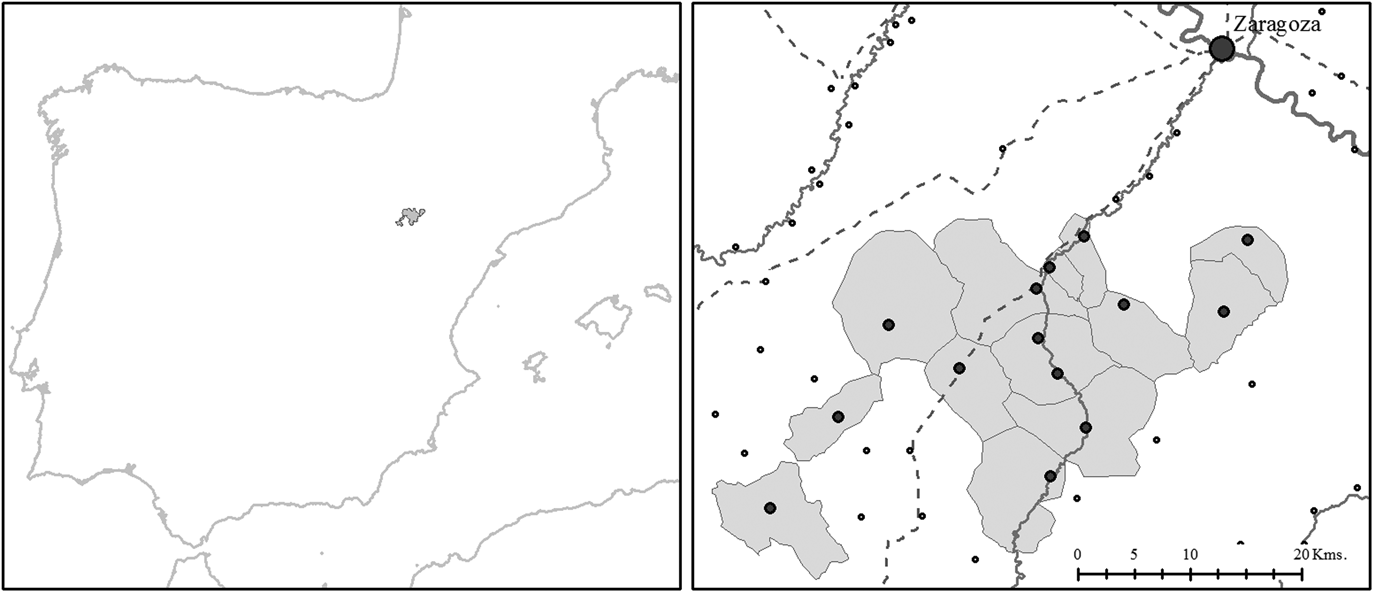
This study is focused on a rural area in Aragon, in north-east Spain. This area is formed by a combination of foothills and plains near the Huerva river, and comprises 14 villages: Alfamén, Aylés, Botorrita, Codos, Cosuenda, Jaulín, Longares, Mezalocha, Mozota, Muel, Torrecilla de Valmadrid, Tosos, Valmadrid and Villanueva de Huerva (see Fig. 1). The area had a population of approximately 8,000 inhabitants in 1860 (10,700 in 1940) who lived in nuclear households and were mainly engaged in agriculture (cereals and vineyards) and sheep grazing. Anthropometric studies have shown that living standards were close to subsistence levels (below their Spanish counterparts in other regions) and child mortality rates were very high: less than half of the children survived to their fifth birthday (Martínez Carrión et al., Reference Martínez Carrión, Hueso and Castroviejo2016). While mortality rates began to decline in the last third of the nineteenth century due to the progressive advance of the epidemiological transition, fertility was stable at around 6–7 children per complete family up to 1900 (and declined thereafter following the fertility transition). These changes were accompanied by a significant improvement in living and health conditions. With regard to the institutional mechanisms regulating inheritances, these were divided equally among children and there was no concentration of inheritance in the hands of the first-born male children.
Area of study: Middle Huerva (Aragón, Spain).
Source: Own elaboration.

With regard to the economic transformations experienced during the study period, the region underwent a significant process of economic modernization during the first wave of globalization (1850–1914). This was particularly important in Zaragoza, the regional capital, while the rural areas lagged behind (Germán, Reference Germán2012). Aragon did not stand out for its industry in comparison with other Spanish regions in the mid-nineteenth century, while the rural areas that are the focus of our study specialized primarily in agricultural products for domestic consumption: cereals, sugar beet, and sheep products (Germán, Reference Germán2012).
3.2 Data
This paper uses height data from military conscription records (height data), censuses, and population lists (socio-economic and occupational data) and parish registers (household and individual demographic data). Our sample contains information on the height of 3,853 conscripts enlisted between 1855 and 1980 for whom we also have data about their family background. Conscription data were obtained from the municipal archives of each of the 14 villages and from the Historical Military Archive of Guadalajara.Footnote 5 Given that the age at conscription varied over time (20 years old between 1856 and 1885 and between 1901 and 1905, 19 years old between 1885 and 1899, and 21 years from 1905 onwards), the data have been standardized using the same procedure of Ayuda and Puche-Gil (Reference Ayuda and Puche-Gil2014). The distribution of the height data is close to normal for the whole period (we have tested the null hypothesis of normality of average height and cannot reject the null hypothesis for a significant level of 5%) and our results are similar to those obtained by other authors in other Spanish regions (Ramón-Muñoz, Reference Ramón-Muñoz2011). It is important to note that the existence of a universal recruitment system avoids the selection biases that exist in other countries: all recruits were measured (except for fugitives, some migrants and those who had died) and, although there were some legal mechanisms to avoid military service between 1837 and 1936, all of them occurred after measurement (Puell de la Villa, Reference Puell de la Villa1996). Importantly, individuals rejected for military service because of health problems were also registered. However, the sample faces a problem of record preservation. As Table A.1 in the Supplementary Materials shows, in some villages no records of conscriptions were preserved until the 1930s (and even in Muel until 1940). This means that in the early years of the study (1830s and 1840s) we can barely count 10% of the men in the sample compared to more than 90% in the later years of the study. However, when we do have records, we do so for all the young men in the same village, with no notable biases due to socioeconomic category or other factors. This allows us to have several generations of the same family who resided in these localities. The main problem with the historical archive of Guadalajara is that it does not contain all the records, especially in the smaller villages. Therefore, despite having stature data and all the variables of interest for 3,853 individuals, we have only been able to incorporate a second generation in 1,293 cases and a perfect match with the third generation in 256 cases.Footnote 6 In any case, we do not consider that the lack of records due to poor conservation leads to significant biases in the sample, since all missing records belong to the same sets of individuals (from the same locality) in the missing years.
As mentioned before, our database for two generations has 1,293 observations. Our basic data sample is composed of 824 observations of fathers and sons for whom we know their height (and therefore the difference in height between them). However, we have created an extended database incorporating 469 additional observations where we know the height of the individual but not that of his father. In these cases, we have used the average height of the fathers' male siblings, drawing on the idea that the fathers and their brothers would probably have similar heights (since they shared a common genetic load). Finally, we constructed another dataset incorporating three generations consisting of 256 complete patrilineal lines: grandfathers, fathers, and sons. This database (which was constructed by adding individuals from the first generation to our extended data sample whenever possible) was also extended by considering the average height of grandfather's male siblings (639 observations), the maternal grandfather's height (159 observations), or the mean height of the maternal grandfather's siblingsFootnote 7 (234 observations) in the cases where the grandfather's height was not available. We have found the results to be consistent with each other, with no significant differences in mean heights depending on the criterion used.
Apart from height, this study also uses the occupational category as a proxy for the income level and living standards of individuals. We have considered four different options for the occupational category: (1) low-skill employees, including day laborers and all types of landless and semi-landless workers, (2) farmers and landowners who could live off their crops, (3) artisans and craftsmen, and (4) upper class, which includes all individuals with occupations linked to specific knowledge such as doctors, teachers, train station masters and high-ranking military personnel. The occupational data come from population lists (1857 and 1860), parish registers (1860–1890) and electoral censuses (available every five years between 1890 and 1955). This information has been merged with the population records for each individual. We have considered the occupational category of individuals at age 30,Footnote 8 as at that age most of them had already started a family (the mean age at marriage was between 25 and 30 years for most of the period studied). The occupational data have been merged with the height database and with the rest of the socio-demographic variables using the family reconstitution methodFootnote 9 proposed by Fleury and Henry (Reference Fleury and Henry1956). Given the social structure of our rural area (laborers, farmers, artisans and upper class), we can assume that there is an imperfect correlation between social class and income (as shown by the population list of 1924 for these localities). We have used the complete Church registers of the villages to obtain the family and demographic variables, as these records provide high-quality information on all marriages, baptisms and deaths that occurred between the sixteenth and the twentieth centuries. Regarding the rest of the variables included in this study, a summary can be found in Table A.2 in the Supplementary Materials. In addition, we should clarify that there is no clear pattern that the higher classes were forerunners of the fertility transition in the villages of our study area (Marco-Gracia (Reference Marco-Gracia2018)). Possibly, this role was exercised by the city elites who served as an example to the nearby villages. While literacy serves as a proxy for investment decisions in children (complementary to the socioeconomic group),Footnote 10 birth decade is a useful indicator of both the changing economic, social and political context and the process of demographic modernization. The villages -place of residence- serve as a control variable for possible differences in the environmental and socioeconomic conditions across villages. The appeals for exemption variable provides information on the health status of the conscripts at the time of measurement. This information was submitted by the conscripts themselves with the intention of avoiding military service and was obtained from conscription records at the municipal archives.
3.3 Methodology
Q–Q articles typically face a series of methodological challenges related to model choice, endogeneity, and selection problems. This section delves into the primary issues we have encountered and outlines our approach in addressing them, with a focus on highlighting the main limitations. We will begin by justifying the choice of our key explanatory variable: fertility control.
3.3.1 Identifying families controlling their marital fertility
The process by which most countries have moved from a context of high fertility and mortality to a new state of low fertility and mortality is known as the demographic transition (Van de Walle, Reference Van de Walle1992). The general process of fertility decline (which is part of the demographic transition) is known as the fertility transition, and it has made a decisive contribution to per capita GDP growth since the end of the nineteenth century (Dalgaard & Strulik, Reference Dalgaard and Strulik2013; de la Croix & Licandro, Reference de la Croix and Licandro2013; Galor, Reference Galor2010; Galor & Weil, Reference Galor and Weil2000; Madsen et al., Reference Madsen, Islam and Tang2020; Voigtländer & Voth, Reference Voigtländer and Voth2006). The study of this process is essential for the understanding of the evolution of modern societies. In our study area the fertility transition began in the early twentieth century (a few decades after the beginning of the mortality transition, which started in the 1860s and gained importance in the 1890s) and was characterized by a continuous fall in fertility that accelerated in the 1930s. Fertility continued to decline throughout the twentieth century, dropping below the replacement level in the last third of the century (Marco-Gracia, Reference Marco-Gracia2018, Reference Marco-Gracia2021).
Since contraception was legally forbidden in Spain for almost the entire period of analysis (it was decriminalized in 1978), Spanish women who lived in the countryside found it difficult to access any type of synthetic contraceptive (Lucas Sánchez et al., Reference Lucas Sánchez, Brotons and García1987; Ruíz-Salguero, Reference Ruíz-Salguero2002). Therefore, fertility control was mostly based on natural methods such as coitus interruptus, abstinence and, to a lesser extent, pessaries, sponges, and vaginal douching (McLaren, Reference McLaren1992; Ruíz-Salguero, Reference Ruíz-Salguero2002; Santow, Reference Santow1995). As Marco-Gracia and López-Antón (Reference Marco-Gracia and López-Antón2021) note, two main strategies were applied: (1) Stopping, which implied that spouses did not conceive children again once families felt they had enough children, and (2) Spacing, which consists of extending birth intervals between children (Marco-Gracia, Reference Marco-Gracia2018). As many authors have pointed out, stopping was the most common control strategy during the fertility transition (Hionidou, Reference Hionidou1998; Knodel, Reference Knodel1987; McDonald, Reference McDonald1984; Reher & Sanz-Gimeno, Reference Reher and Sanz-Gimeno2007; Sanz-Gimeno & González-Quiñones, Reference Sanz-Gimeno and González-Quiñones2001; Seccombe, Reference Seccombe1992; Van Bavel, Reference Van Bavel2004; Van de Walle, Reference Van de Walle1992; Yamaguchi & Ferguson, Reference Yamaguchi and Ferguson1995). Therefore, we will focus on identifying behaviors linked to stopping, relating them to the biological well-being and social mobility of children. As Marco-Gracia (Reference Marco-Gracia2018) has shown, our study area was characterized by a strong presence of families that voluntarily stopped having children at an unusually young age. The percentage of households that stopped having children at a relatively young age grew from roughly 10% before the fertility transition (possibly due to fertility problems) to more than 50% during the final stages of the transition. Since stopping brings fertility to an abrupt halt, it is easier to identify than other fertility control strategies (Van Bavel, Reference Van Bavel2004). Importantly, most families that stopped having children at an early age did so on a voluntary basis.
In order to establish the thresholds at which we consider that a family was controlling its fertility we will look at the age at which the mother had her last child. Thus, for each 10-year birth cohort, we calculate the age at last child for families that completed their reproductive cycle. We establish that families that stopped having children at least three standard deviations ahead of their peers can be considered to have controlled their fertility (the rest of the families being considered as non-controlling). Table A.3 (in the Supplementary Materials) shows the mean age at the last child per birth cohort, the standard deviations and, as a consequence, the selected threshold ages. The three standard deviation criterion is commonly used in Historical Demography studies, because it accounts for almost all of the sample population being if the distribution is normal or bell-shaped, although it has also been criticized for being an imperfect methodology based on thresholds (Altman & Bland, Reference Altman and Bland2005).
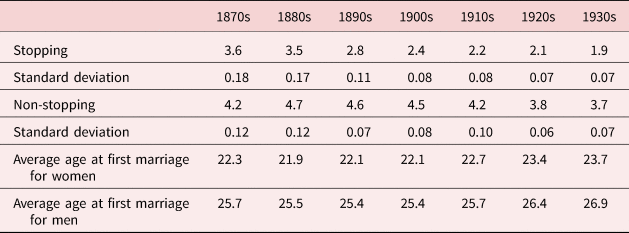
First, we will explore whether the criterion for selecting “controlling” families is really a useful tool and corresponds to families that reduced their fertility. Table 1 shows the average number of living children depending on whether or not the family controlled their fertility. Families that used stopping had, on average, more than one child less than those that did not use it. For example, among parents who had their first child in the 1900s, the controllers had 2.9 living children who survived to age 10, while among the non-controllers that figure rose to four children. This result provides evidence that that our criteria for identifying families that controlled their fertility, although imperfect, is a useful mechanism.
Average number of living children (>10 years) of parents who did and did not control their fertility, by decade of birth of the first child, birth cohorts 1870–1939

Note: Only parents who had at least one child are considered.
Source: Selected sample of Alfamén and Middle Huerva Database (onwards AMHDB). For more information, see (Marco-Gracia & Puche, Reference Marco-Gracia and Puche2021).
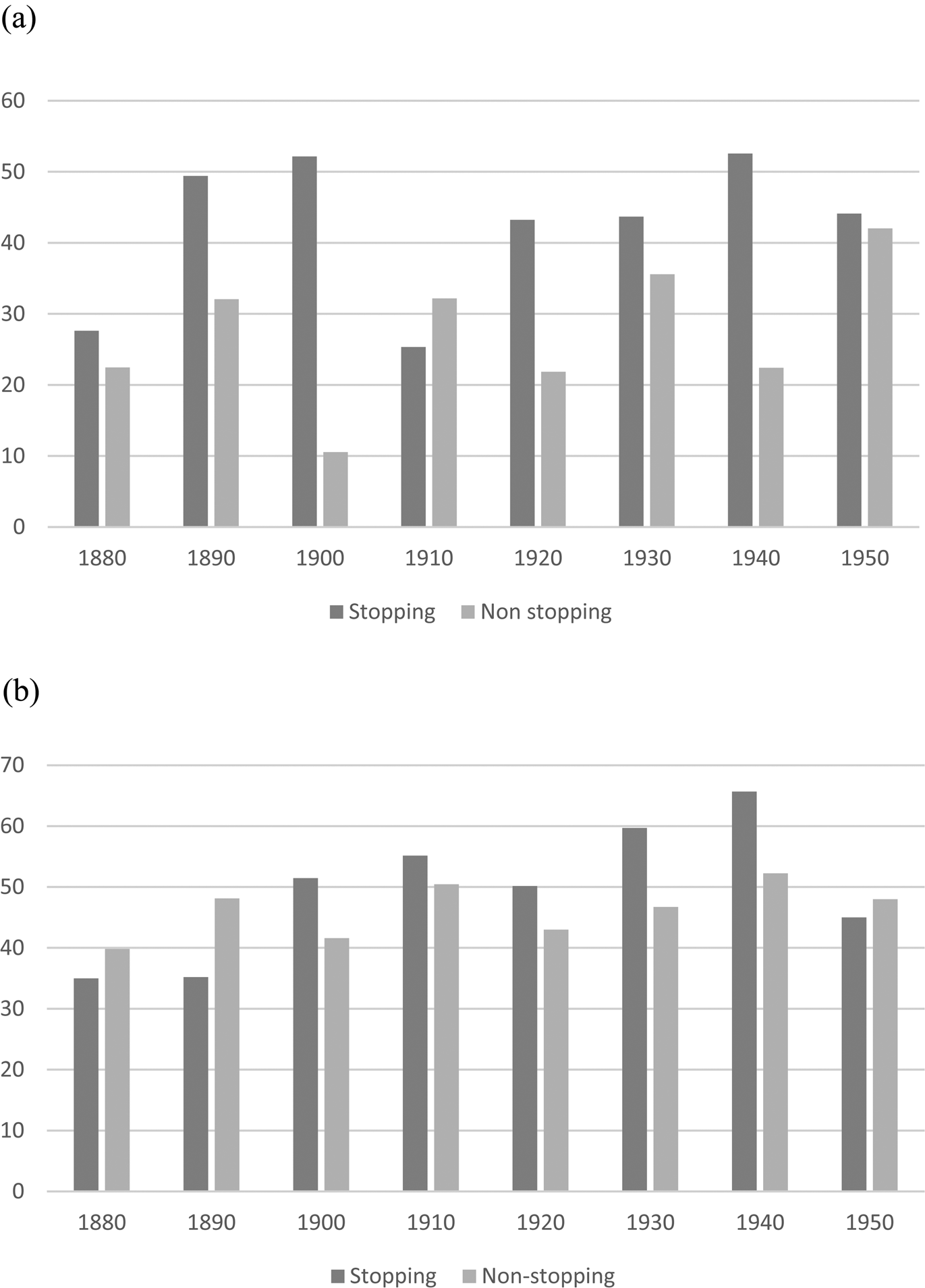
Next, it is also important to check whether there were long-term differences in height gains between grandparents and grandchildren and between parents and children as a function of whether they controlled their fertility by stopping. This is important since it is the starting hypothesis on which this study is based. Figure 2 shows that the average height gains between first and third-generation individuals were, on average, significantly higher if the grandparents controlled their fertility (regardless of what the parents did). Moreover, the average height gains between second and third-generation individuals were even higher. This gives us two fundamental clues for the development of the article. First, having stopped fertility had a clear positive correlation with the improvements in the biological well-being of the offspring. Second, and even more important, it seems that the fathers' fertility control (second generation individuals) probably had a much more direct and intense influence than that of the paternal grandparents (first generation individuals).
Average height gains in centimeters, depending on whether stopping was involved, birth cohorts 1880s–1950s of the third generation. (a) Fathers (2nd Gen) – Sons (3rd Gen) (b) Grandfathers (1st Gen) – Grandsons (3rd Gen).
Note: By taking the third generation as a reference, in the first periods we are analyzing individuals of the first generation born throughout the nineteenth century since the 1830s. Because of this, the first-generation sample of controllers is small, possibly a large part of them did not control voluntarily but because of biological limitations and birth damage. This has an impact on the higher volatility of the results in the first decades of study.
Source: AMHDB. Both graphs have been constructed using the extended databases (1,293 observations).

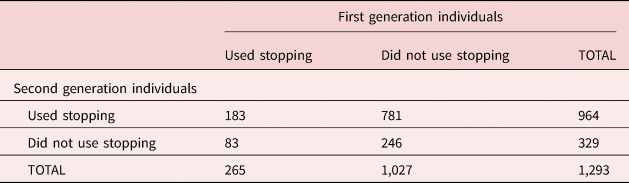
As a result of the previous figure, the question arises as to whether the decision to control the fertility of the individuals of the first generation (in this case the paternal grandfathers) had any consequence on the decision to control the fertility of the second generation (i.e., the parents). To answer this question, in Table 2 we have checked whether the individuals of the first and second generation used stopping (according to our criterion). The results show that approximately 90% of the second-generation individuals whose parents had used stopping also used it. Meanwhile, approximately one third of the second-generation individuals whose parents had not used stopping mutated towards its use. It should be noted, of course, that there is a temporal pattern: stopping gained overall importance with the passage of time.
Intergenerational transmission of fertility control in the study area, 1880s–1950s

Source: AMHDB.
Finally, the question arises of why we chose to use this indicator -despite its limitations- rather than other alternative measures to approximate fertility control. Indeed, many studies tend to approximate fertility control by the final size of offspring (Marco-Gracia, Reference Marco-Gracia2021; Reher & Sanz-Gimeno, Reference Reher and Sanz-Gimeno2007; Van Bavel et al., Reference Van Bavel, Moreels, Van de Putte and Matthijs2011). However, there are several reasons why the final size of children is a highly biased indicator of fertility control. First, the ideal the ideal family size may differ across families and decades (Van de Walle, Reference Van de Walle1992). Second, a higher number of children may simply reflect an earlier age of marriage. Finally, a low number of living children may be related to both early fertility control and high infant mortality. However, the objectives and intentions of these different types of families could be totally different. Most of the families that stopped their fertility (and, it is obvious, most of them did it voluntarily) possibly had economic factors in mind. This is why we try to identify families that controlled for their fertility rather than using the number of surviving children as a key variable (Marco-Gracia, Reference Marco-Gracia2021; Reher & Sanz-Gimeno, Reference Reher and Sanz-Gimeno2007). This is an imperfect procedure, but it is closer to our desired objective, which is to be sure that families that had few children did so voluntarily by applying the new ideas that were being disseminated.
3.4 Selection, endogeneity, and model choice
In the following section we will estimate different models to study the individual determinants of height (section 4.1), and the determinants of intergenerational gains in height between 2nd–3rd Gen individuals (section 4.2) and 1st–3rd Gen individuals (section 4.3). Following this, in section 5 we will analyze the determinants of intergenerational changes in occupation (between 2nd–3rd Gen individuals and 1st Gen-3rd Gen individuals in sections 5.1 and 5.2 respectively).
As we have explained, this model uses population that has remained, at least, until measured in the reference villages. Because of this, the rural-urban migrations that increased strongly in Spain from the 1950s onwards (González-Leonardo & Gay, Reference González-Leonardo and Gay2021) might have partially biased our sample. Individuals with higher levels of education and less property ties to villages could have migrated in higher proportions (Marco-Gracia, Reference Marco-Gracia2017). This would have an impact on the study that we cannot control for given that in their main destination (the city of Zaragoza) we do not have conscription data available for this period (we do for previous decades where the average height among immigrants to Zaragoza from rural Aragon is not significantly higher than among individuals from the study villages). However, we must also bear in mind that migrations tended to occur permanently and not only temporarily in adulthood (after accessing military service), that only the latter part of the generations studied are affected by this large-scale migration phenomenon and that possibly the benefits of the improvement in the socio-economic status of the parents were especially evident in the early stages of life.
With respect to the database, there are additional limitations that condition the study but do not invalidate it. First, we only focused on the case of men, the results for women being unknown. Second, the occupational categories are not perfect given that within each category there may be significant differences in wealth and property. Third, the impact of parents and grandparents can be strongly influenced by their mentality (e.g., savers vs. spenders) and even by their habits (habits such as smoking or drinking alcohol were an expense that was not spent in another direction) that we cannot control for with the available variables. Fourthly, during this period, political transformations (progressive and conservative regimes) took place, which could benefit one or other families according to their ideology and their connections with power. However, we consider that this may have had a minor impact in the case of small villages, so we have left political changes out of the analysis. Finally, by requiring the sample to include families that have remained in the study area for three generations, we do not take into account families with greater migratory tendencies. If these families had differential investment behavior in children and grandchildren, they could mislead our results (although we have no evidence to identify that these families are biasing the results).
In relation to the choice of statistical regression models, this paper uses two types of regression models: (1) ordinary least squares (OLS) linear regressions with heteroskedasticity-robust estimation, and (2) probit regression models. OLS models have been used to study the determinants of biological welfare gains of offspring relative to parents (of course, including fertility control strategies as an independent variable). Probit models allow us to study the impact of birth control on social mobility. While OLS models use the differences in height (measured in millimeters) as a dependent variable, the dependent variable in Probit models is a dichotomous variable which takes the value of zero when there was no social mobility between parents (or grandparents) and children (or grandchildren), and value one when there was social mobility (upward or downward depending on the model).
As mentioned before, one of the most common problems faced by studies on the Q–Q trade-off is the omitted variable bias. This problem arises when factors associated with both the quantity and quality of offspring are not considered. For instance, wealthier parents may be capable of supporting a greater number of offspring and investing in higher-quality care for them. Failure to consider these factors in the analysis can lead to biased conclusions. The specification of our models -and the selection of control variables- is an attempt to minimize these issues. With the exception of the initial models focusing on individual height determinants, in all subsequent models, the dependent variable – our measure of “quality” of offspring – is relative to that of their parents or grandparents (whether it be height gains or social mobility). Given that height is a quantitative variable, constructing an indicator relative to parents or grandparents (i.e., height gain) is much easier than with variables such as education or human capital. This type of specification helps mitigate potential biases, such as genetic influences. Additionally, we have incorporated some control variables to reduce sources of endogeneity. The first one is the socioeconomic status of the father (or the individual, as the case may be), as it is a variable potentially correlated both with the decision to control fertility and, probably, with the “quality” achieved by their children. We believe that the introduction of this variable, along with the “literacy” variable, significantly mitigates endogeneity issues. The mother's age is used to determine whether there was a relationship between the mother's age and the “quality” of her sons. The inclusion of villages as a control variable aims to account for potential variations in environmental and socioeconomic conditions between different residential areas. The birth decade serves as a valuable indicator of the evolving economic, social, and political context, as well as the demographic modernization process, including shifts in attitudes toward fertility control. Furthermore, some models have been estimated for different time periods (given the historical context and the gradual increase in contraceptive techniques throughout the period, we believe that the interpretation of certain coefficients may vary depending on the stage of the demographic transition). Finally, the variable “appeals for exemption” serves, among other things, to control for health issues. Since in the stages preceding the demographic transition, a lower number of children was mainly associated to health problems (as fertility control techniques were not yet widespread), we believe that the inclusion of this variable strengthens our fertility control indicator.
4. Analysis of the determinants of biological well-being
We will begin by looking at the determinants of biological well-being. Before turning to intergenerational analysis (to study the impact of fertility control), we will estimate a set of models to identify the extent to which biological well-being was conditioned by variables such as occupational status.
4.1 The persistence of differences in biological well-being by socioeconomic status. A family-level analysis of the determinants of height
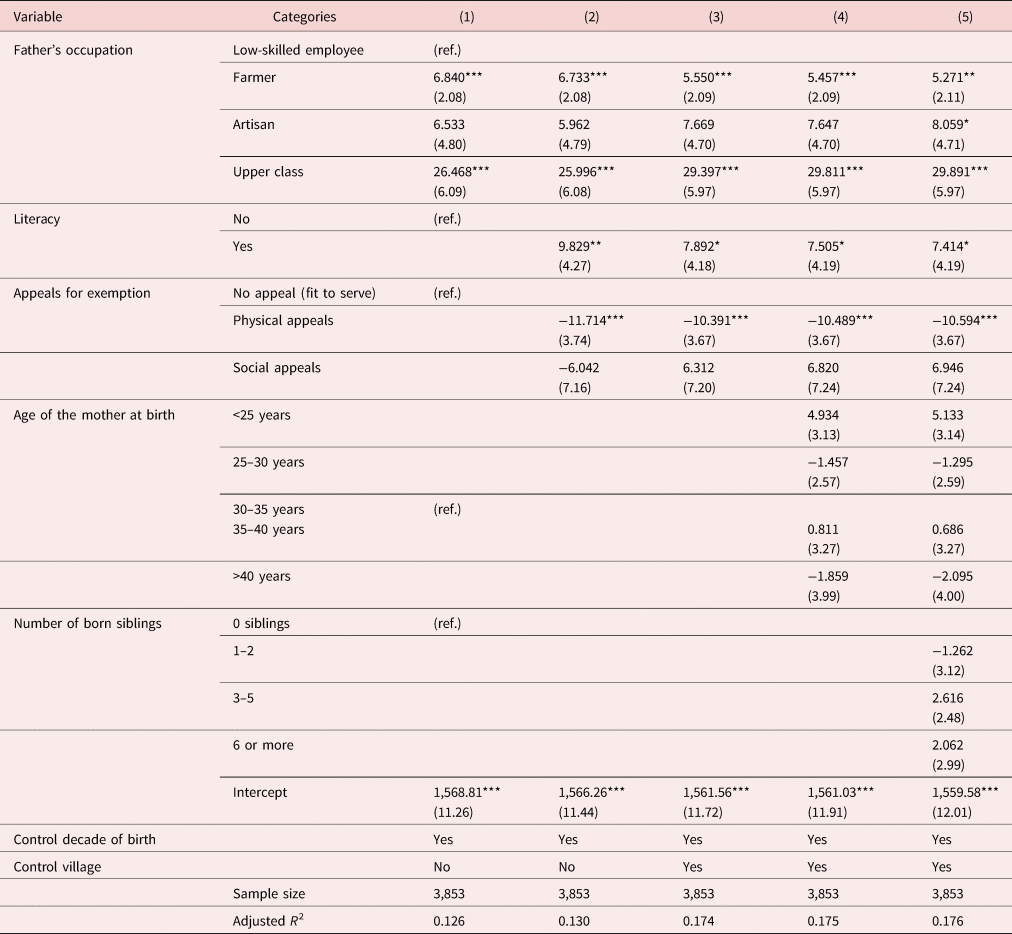
The historical correlation between an individual's height and the occupation of the father (or the individual himself as a proxy) has been demonstrated in numerous studies for many Western countries (Alter et al., Reference Alter, Neven and Oris2004; López-Alonso, Reference López-Alonso2012; Schoch et al., Reference Schoch, Staub and Pfister2012) and also for Spain (Ayuda & Puche-Gil, Reference Ayuda and Puche-Gil2014; Cámara et al., Reference Cámara, Martínez-Carrión, Puche and Ramon-Muñoz2019; Marco-Gracia & Puche, Reference Marco-Gracia and Puche2021). We first wanted to confirm this relationship for our study area. For this purpose, we have used the entire sample of 3,853 individuals with the selected variables for the study area. Table 3 shows the estimation results of five OLS models with hereroskedasticity robust estimation that consider height (measured in millimeters) as the dependent variable. Since the average height increased considerably during the period under study due to the improvements in living standards and the region's modernization process (Marco-Gracia & González-Esteban, Reference Marco-Gracia and González-Esteban2021), all models control for the decade of birth. The first model is quite basic and only analyzes the relationship between the socioeconomic category of the father and the height of the individual. The second model also includes literacy (in order to control for parental investment in their children) and appeals from exemption as explanatory variables. The latter variable indicates whether the individual alleged physical or social problems to avoid military service (primarily family poverty as a result of the death of the father, the father's high age and inability to support the family, and the presence of other brothers in the military). The third model is similar to the second one but also controls for possible village-related influences by including the locality of residence as an explanatory variable. The fourth model also incorporates a variable that considers the mother's age group at the time of the child's birth. Finally, in model five, we have incorporated a variable with the number of born siblings, in order to find out whether this could affect the distribution of family resources due to a dilution process (Blake, Reference Blake2022; Öberg, Reference Öberg2017).
Determinants of individual height, rural Aragon, birth cohorts 1880s–1950s

Notes: OLS estimates; se denotes robust standard error.
Source: AMHDB.
*Statistical significance at 10% level.
**Statistical significance at 5% level.
***Statistical significance at 1% level.
All models in Table 3 confirm that there was a strong positive correlation between the occupational category of the father and the height of the individual. The sons of farmers were between 0.5 and 0.7 cm taller than the sons of low-skilled employees, which reflects the handicaps in terms of biological well-being faced by the children of households belonging to the most deprived occupational category. The sons of artisans were also taller than the sons of low-skilled employees (between 0.6 and 0.8 cm, which is slightly taller than the children of farmers), although this only appears to be significant at 90% in the last model. However, those who really stand out for their much better biological well-being are the children of upper-class individuals. According to our results, they were between 2.5 and 3 cm taller than the offspring of low-skilled employees. We believe that this result strengthens the interest of our study, since it shows that there were powerful mechanisms that allowed, in some way, biological well-being to be inherited (although we have to keep in mind that our sample for craftsmen and upper-class is small and the results have to be taken with great caution). While rural laborers in the study area experienced economic conditions near subsistence levels, farmers had the autonomy to determine the portion of their production allocated to household consumption. On the other hand, artisans and upper class probably had higher incomes, especially doctors or civil servants who had guarantees of being paid by the public administration.
Regarding the rest of the variables included in the models shown in Table 3, we can observe that literacy was associated with height gains of between 0.7 and 1 cm. This could be related to greater parental investment in these individuals (both in their education and in their biological well-being). It may also be observed that claims of physical problems were strongly related to shorter heights, with a penalty of between 1 and 1.2 cm. This would have been associated with to physical problems affecting height and perhaps less investment in the biological well-being of children with severe physical problems. The age of the mother does not seem to affect the height of individuals. Finally, although some studies have noted that statures could be influenced by the number of siblings (Brody, Reference Brody2004; Öberg, Reference Öberg2017; Riswick & Engelen, Reference Riswick and Engelen2018; Sear & Coall, Reference Sear and Coall2011; Sear & Mace, Reference Sear and Mace2008; White & Hughes, Reference White and Hughes2017) model 5 shows no significant influence for our study area.
4.2 Fertility control at the family-level and height gains: a father-son perspective
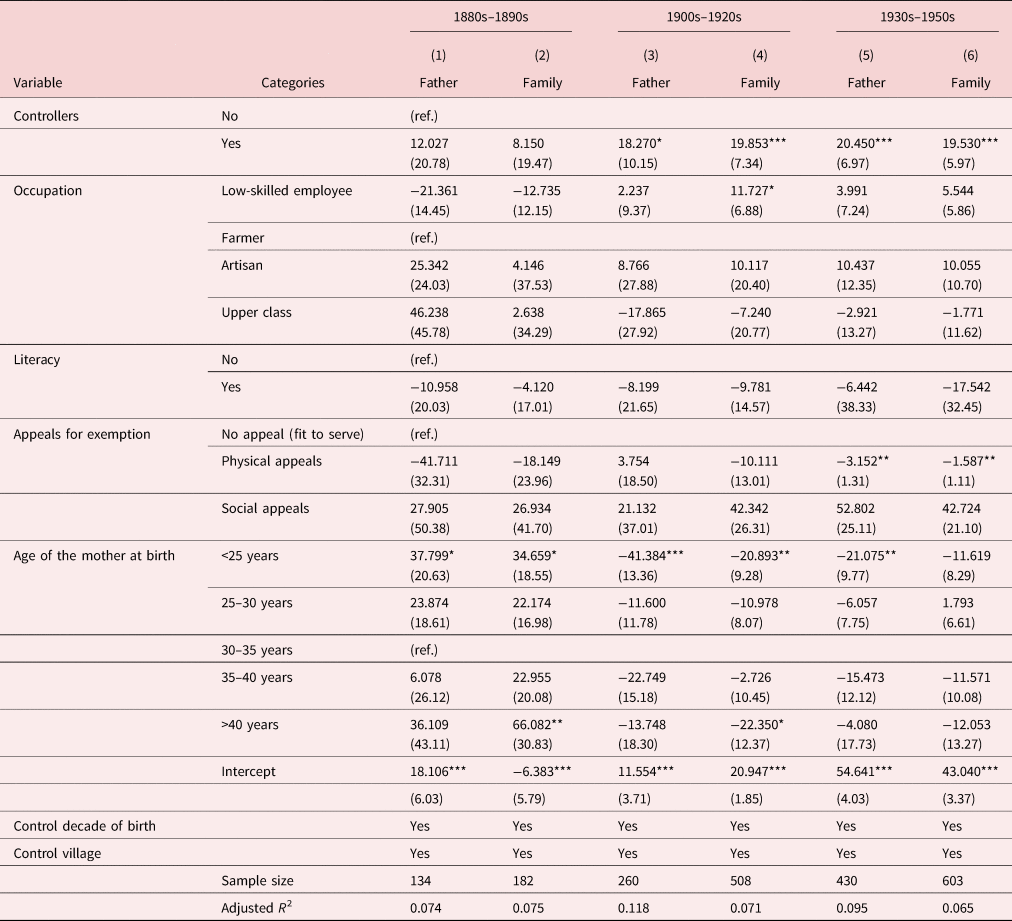
In this section we will study the determinants of height differences between parents and offspring, including the impacts of fertility control by stopping. Table 4 shows the estimation results of six OLS models in which the endogenous variable is the difference in height between father and son (models 1, 3 and 5) or, alternatively, the difference in height between the paternal family and the individual (models 2, 4 and 6). Models 1 and 2 refer to the period prior to the fertility transition in the study area (1880s–1890s).Footnote 11 Models 3 and 4 are related to the early stages of the fertility transition (1900–1920s), a period when mortality had fallen, and when average marital fertility was beginning to decline slowly. Finally, models 5 and 6 correspond to the advanced phases of the fertility transition (1930s–1950s): especially from the 1930s onwards, the average marital fertility in the study area dropped below three children and would not reach figures above that number again. All models contain the same independent variables described in the previous section: occupation (proxy for socioeconomic statusFootnote 12), literacy (proxy for parental investment), appeals for exemption (health status and social problems at age 21), age of the mother at the time of the individual's birth (proxy for the parents' life stage and their ability to invest in their children), and village (control for possible unobserved local geographical and cultural factors). In addition, all of the models also incorporate a variable on whether the individual's parents stopped having children as an identifier of stopping (controllers). In all cases, the sample is composed of complete families (both spouses were over 49 years of age).
OLS models to analyze the relationship between fertility control of the parents and child height (in millimeters), birth cohorts 1880s–1950s

Notes: OLS estimates; se denotes robust standard error.
Source: AMHDB.
*Statistical significance at 10% level.
**Statistical significance at 5% level.
***Statistical significance at 1% level.
The results in Table 4 confirm the existence of a positive relationship between stopping fertility (according to the criterion discussed above) and the increase in the height of children, but it is only significant for the period of the fertility transition. In other words, the results suggest that the decision to control fertility was closely linked to an improvement in feeding and childcare. In this sense, as authors such as Baudin (Reference Baudin2010) have suggested, the decisive factor for this behavior could possibly be found in the mentality of the parents: whether they maintain a traditional view (no stopping) or consider that stopping serves to redistribute family resources and, with them, invest more in their children. Table 4 indicates that, among those born in the early stages of the fertility transition (models 3 and 4), the offspring of controllers gained approximately almost 2 cm in height with respect to their fathers, while in the later stages of the transition (models 5 and 6) this gain was approximately the same (2 cm). Regarding the rest of the results, occupation and literacy do not appear to be significant factors. However, the life stage of the parents (measured through the mother's age) does appear to be significant: being born in the early stages of marriage (associated with greater economic hardship) was penalized by approximately 2 cm in height depending on the model.
4.3 Fertility control at the family-level and height gains: a three-generation perspective
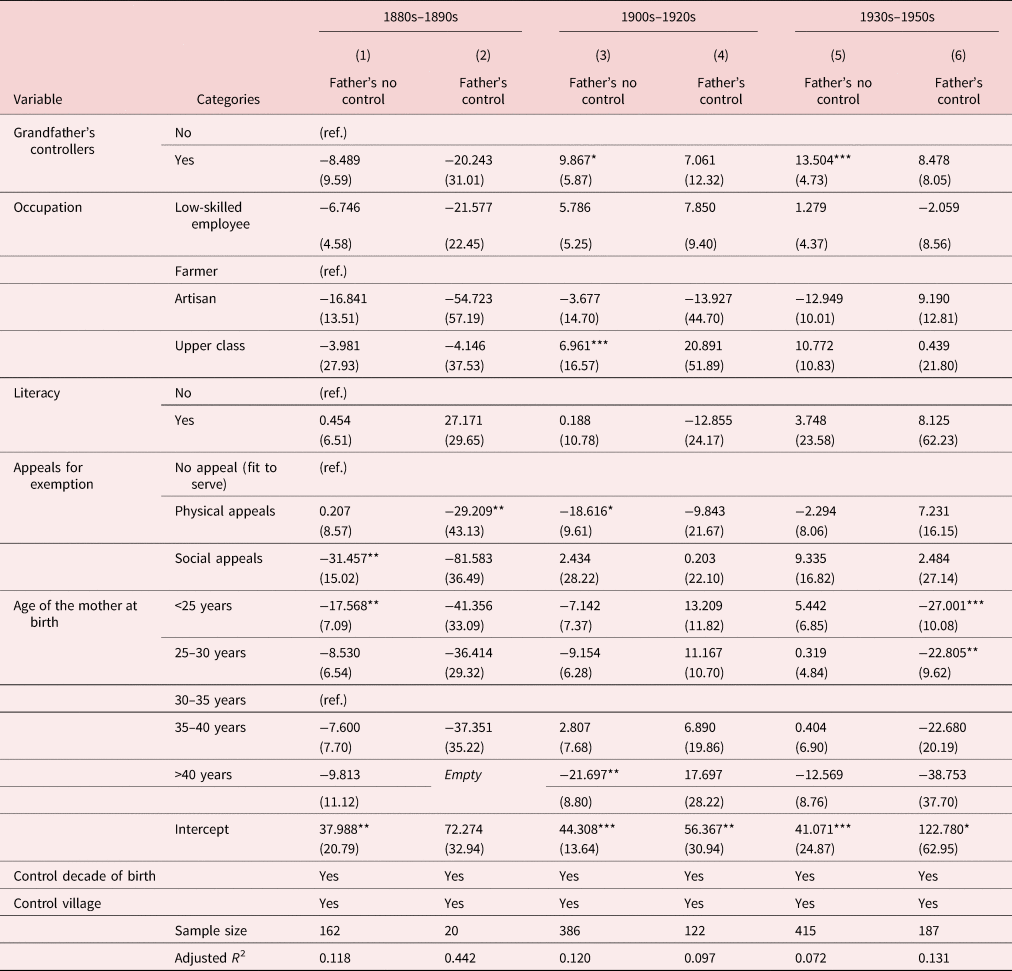
In this section we will go a little further and find out whether the grandparents' fertility control influenced their grandchildren's well-being. Was there a connection with height gains and fertility control benefits over the long term? Did the grandfather's decision to stop having children benefit the third generation? In Table 5 we have replicated the regression models of Table 4, but on this occasion taking as the dependent variable the difference in height between the grandparents' family and the grandsons. Of course, we will consider whether, in addition to grandparents, parents were also exercising fertility control by stopping. We are aware that in some cases the sample we have is very small (especially for controlling parents before the demographic transition).Footnote 13 Therefore, the results should be taken with caution. However, the analyses as a whole provide us with interesting clues about stratification and social mobility as a consequence of the fertility transition.
OLS models to analyze the relationship between fertility control of the grandparents and child height (in millimeters) of grandsons, birth cohorts 1880s–1950s

Notes: OLS estimates; se denotes robust standard error.
Source: AMHDB.
*Statistical significance at 10% level.
**Statistical significance at 5% level.
***Statistical significance at 1% level.
As in Table 4, models 1 and 2 from Table 5 correspond to the period before the fertility transition (1880s–1990s), models 3 and 4 to the early stages (1990s–1920s), and models 5 and 6 to the stages of strong fertility control (1930s–1950s). The independent variable Grandfather's controllers refers to whether or not the first generation (grandfathers) stopped their marital fertility (according to the same criteria used for the second generation).
The results in Table 5 confirm that the role of the grandfather is less important than that of the father in the biological well-being of the third generation. We can observe that the grandfather's decision to stop fertility had a positive impact on the grandchildren only if the intermediate generation (the parents) did not control their fertility by stopping. In fact, this influence is only significant in the central and advanced stages of the fertility transition (with increases of about 1 cm and 1.4 cm in the height of the grandchildren in each of the two periods respectively). Our interpretation of the results is simple: the height gains from fertility control were, of course, limited. If parents controlled their fertility -thus directly and significantly promoting the biological well-being of their children- no additional impacts are observed if grandparents were also controllers. However, if parents did not control their fertility -and therefore children did not benefit directly- there is a long-lasting impact corresponding to the control of fertility by grandparents. This could be explained by the fact that changes in the family fertility attitudes (i.e., start practicing stopping) may have favored an awareness of the importance of investing in the biological well-being of children that was subsequently transmitted intergenerationally. Regarding the other explanatory variables, while higher socioeconomic status is linked to greater heights (more than 1 cm), literacy does not seem to have a significant impact. Physical appeals to evade military service appear to have had a strong negative impact in some models (approximately 2 cm of penalization), coinciding with the available literature (Ayuda & Puche-Gil, Reference Ayuda and Puche-Gil2014; Cámara et al., Reference Cámara, Martínez-Carrión, Puche and Ramon-Muñoz2019; Marco-Gracia & Puche, Reference Marco-Gracia and Puche2021). Finally, the age of the mother does not seem to be a decisive factor in the height of her offspring, although very early and late stages of the reproductive cycle are related to lower levels of biological well-being in several models.
5. Analysis on the determinants of social mobility
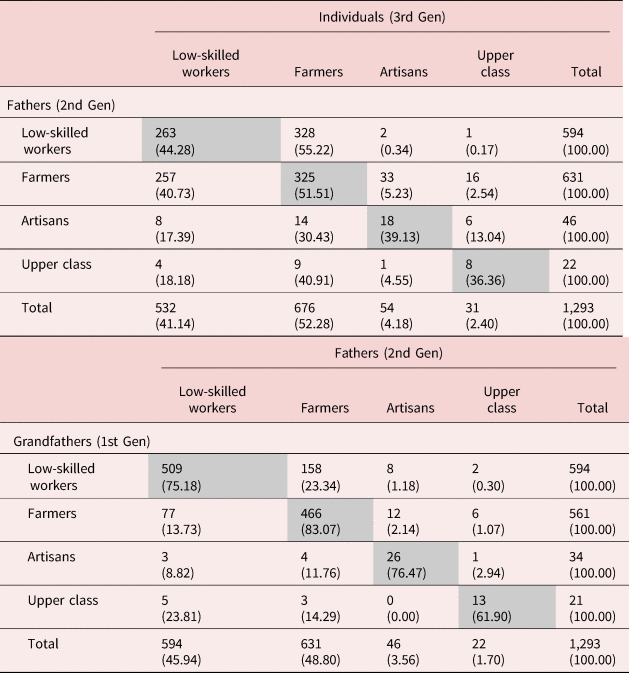
In addition to the biological welfare benefits, we are interested in whether fertility control practices were associated with the social mobility of the offspring. Table 6 illustrates the patterns of social mobility in the study area between the first and second generations and between the second and third generations.
Tables of intergenerational social mobility (second-third generation, and first-second generation) in number of observations and percentage, birth cohorts 1830s–1950s

Source: AMHDB.
As may be observed, most of the individuals belonged to the poorest socioeconomic groups: low-skilled workers and farmers. In fact, there was a strong tendency for socioeconomic group persistence throughout the study period, although there were indeed cases of both upward and downward mobility. The international literature identifies access to land and the division of inheritances as key variables in explaining social mobility in the early decades of the twentieth century (Bielicki & Szklarska, Reference Bielicki and Szklarska2000; Cernerud, Reference Cernerud1995; Hart et al., Reference Hart, McConnachie, Upton and Watt2008; Krzyżanowska & Mascie-Taylor, Reference Krzyżanowska and Mascie-Taylor2011; Mascie-Taylor, Reference Mascie-Taylor and Boyce1984; Peck, Reference Peck1992; Schumacher & Knußmann, Reference Schumacher and Knußmann1979; Thomson, Reference Thomson1959). Some studies have also found a relationship between heights and other individual outcomes such as the educational level (Bielicki & Charzewski, Reference Bielicki and Charzewski1983; Cernerud, Reference Cernerud1995; Olivier, Reference Olivier1977; Schreider, Reference Schreider1967; Tanner, Reference Tanner1966). However, we have little knowledge on whether fertility control during the demographic transition (especially among fertility control pioneers) had a positive impact on upward mobility (Bras et al., Reference Bras, Kok and Mandemakers2010; Van Bavel, Reference Van Bavel2005; Van Bavel et al., Reference Van Bavel, Moreels, Van de Putte and Matthijs2011). Did parents and grandparents who did not control their fertility negatively condition the socio-economic trajectory of their offspring? As in the case of the biological well-being, we will first conduct a two-generation analysis and then incorporate the grandparents' generation.
5.1 Fertility control and social mobility: a two-generation analysis
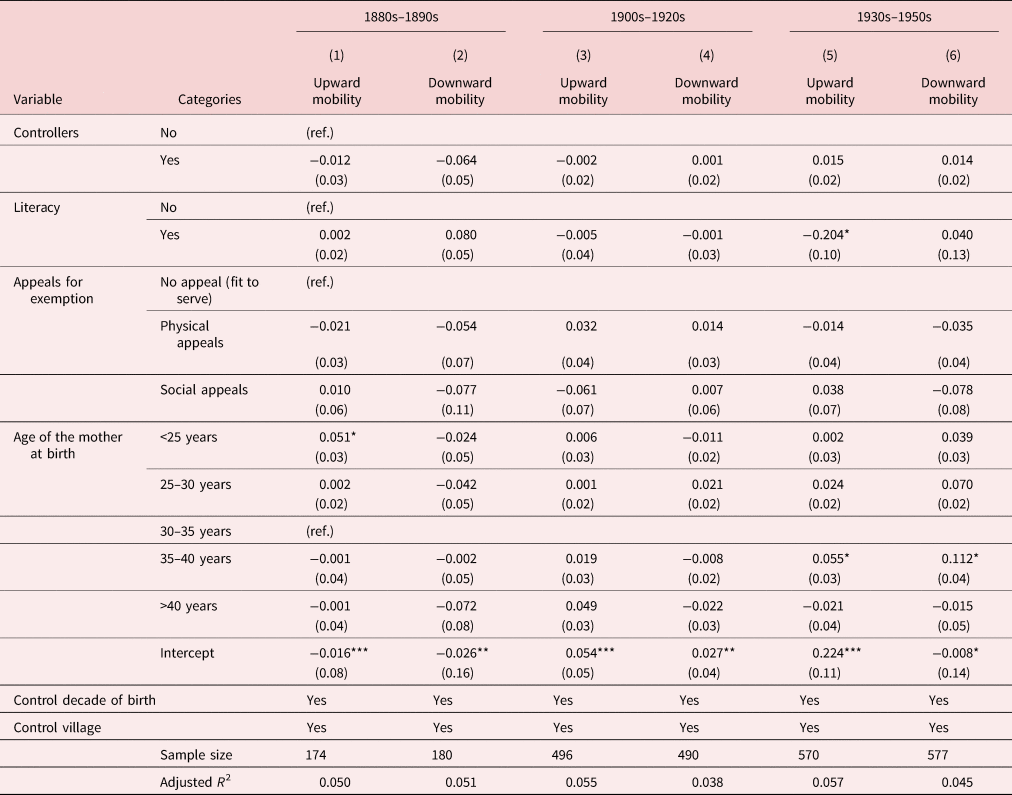
Table 7 shows the estimation results of six probit regression models in which the dependent variable is dichotomous and refers to socio-occupational mobility between parents and children.Footnote 14 This variable takes a value of zero if there was no mobility, and a value of 1 if there was upward socio-occupational mobility (models 1, 3 and 5) or downward socio-occupational mobility (models 2, 4 and 6). Again, models 1 and 2 correspond to individuals born in the 1880s–1890s, models 3 and 4 to those born in the 1900s–1920s, and models 5 and 6 to those born in the 1930s–1950s. The independent variables are the same as in the previous models.
Probability of social ascent or descent in relation to parental fertility control, birth cohorts 1880s–1950s

Notes: OLS estimates; se denotes robust standard error.
Source: AMHDB.
*Statistical significance at 10% level.
**Statistical significance at 5% level.
***Statistical significance at 1% level.
The results in Table 7 suggest that the relationship between social mobility and fertility control was barely significant. Stopping was associated with improved biological well-being for children but did not help them climb the social ladder. Fertility control did not automatically translate into access to land ownership (in the case of the low-skilled employees' children) or into the high educational investment required to access the upper-class occupations. As far as the other independent variables are concerned, they do not seem to have any explanatory potential for social mobility either.
5.2 Fertility control and social mobility: a three-generation analysis
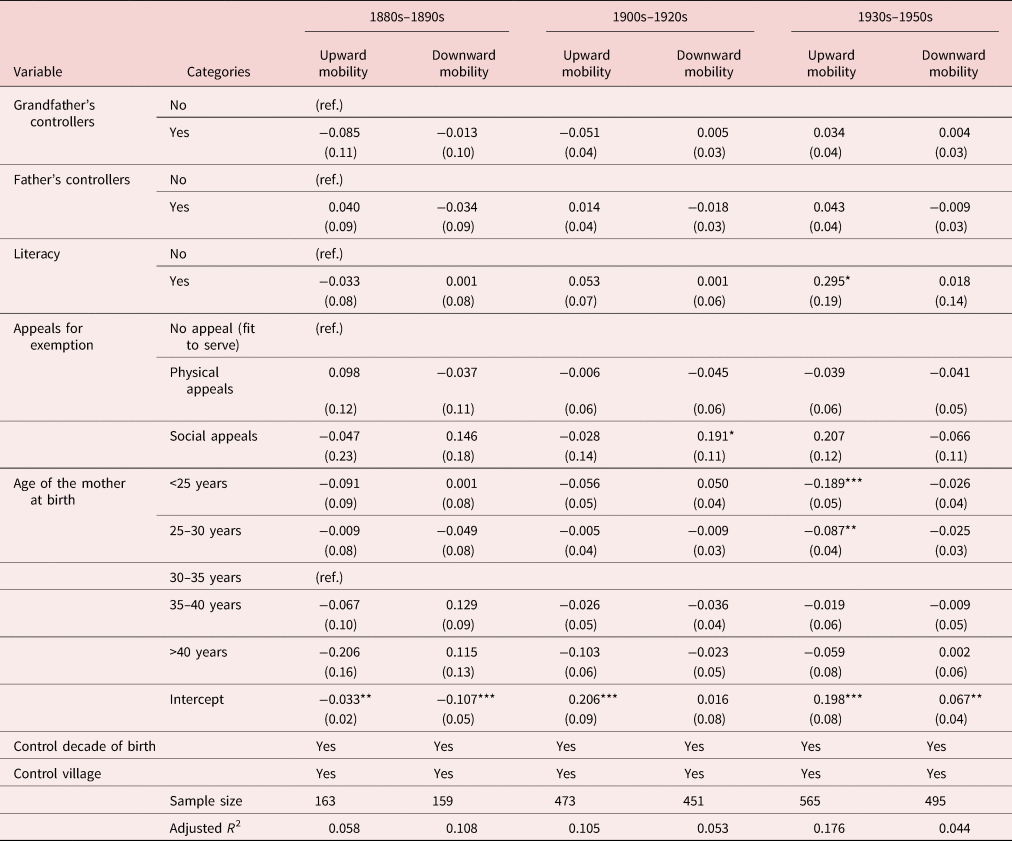
In this section we want to make sure that there is also no long-term relationship between grandparents' fertility control and grandchildren's social mobility. Therefore, in Table 8 we have replicated the analysis using the probit models of Table 7, but this time considering social mobility between the first generation (grandparents) and the third generation (grandchildren) as the dependent variable. The explanatory variable on fertility control practices is now called Grandfather's controllers and refers to what grandparents did, and we also controlled for what the parents did through the variable father's controllers.
Probability of social ascent or descent in relation to parental fertility control, birth cohorts 1880s–1950s

Notes: OLS estimates; se denotes robust standard error.
Source: AMHDB.
*Statistical significance at 10% level.
**Statistical significance at 5% level.
***Statistical significance at 1% level.
The results in Table 8 again illustrate the low correlation between fertility control and the social mobility of the subsequent generations. Regarding the rest of the variables in Table 8, it is worth noting that literacy may have had a strong positive impact of almost 30% on upward social mobility in the birth cohorts between the 1930s and 1950s. However, we must keep in mind that almost 100% of the individuals in this generation were literate. Finally, we do not consider the coefficients -irregular and non-significant depending on the model- estimated for the rest of the independent variables to be relevant either.
6. Conclusions
This study aimed to examine whether the fertility transition could have functioned as a mechanism within traditional societies to eliminate the height gradient (as well as the socioeconomic status) conditioned by the parents' socioeconomic background. In an innovative approach, we have also adopted a three-generation perspective to explore whether there was a persistence of the association in the very long run. This has been tested with microdata of individuals born during the nineteenth and twentieth centuries in 14 Spanish rural villages.
The spread of new ideas about contraceptive practices helped many families decide to control their fertility by stopping, which was the most popular strategy. The children of families that controlled their fertility were the ones that increased their height the most with respect to their parents. Households probably looked for a balance between family size and family budget, at a time when general consumption patterns were shifting towards more expensive products such as meat (Cussó & Garrabou, Reference Cussó and Garrabou2007). Importantly, the fertility transition is not simply a part of the demographic transition, but a process of economic transformation with major social implications (Reher, Reference Reher2004). One of the effects, as studied in this article, was a considerable increase in the biological well-being of children whose parents decided to apply fertility control. However, two questions can be raised in this regard. First, why were the children of controlling parents taller than their peers? Through what mechanisms did fertility control translate into higher levels of biological well-being? And second, was the increased biological well-being of the offspring one of the intended impacts of parents deciding to stop having children?
Regarding the first question, we believe that families who controlled fertility were able to invest more in their offspring. This could be interpreted as empirical evidence in favor of the model proposed by Becker (Reference Becker1960), who suggested the existence of a family trade-off between the “quality” and quantity of children. However, in order to ratify his model, it would also be necessary to give an affirmative answer to the second question: were families really contemplating this trade-off when they choose to apply fertility control? Or, alternatively, did the parents decide to apply fertility control and the subsequent increase in the biological well-being of their children was an unintended outcome? We cannot give a categorical answer to the question of whether or not parents deliberately sought to increase the biological well-being of their children through fertility control. We can state, however, that (1) there was a strong relationship between fertility control and the observed biological well-being of offspring (with a premium of approximately 2 cm) and that (2) no such relationship existed in the case of social mobility. If parents stopped having children with the aim of helping them to obtain a higher occupational status than their own. If there was a trade-off between the quantity and quality of children, “quality” must be understood as biological well-being, not as socio-economic status.
What could account for this result? We must take into account that a decisive factor that we cannot control in this study is the mentality of previous generations. Family preferences and social objectives in the medium and long term could explain some of these behaviors. Our hypothesis is that having fewer children was clearly associated with a larger family budget per household member to cover their basic needs. This allowed families to have access to more food for each of their members and, possibly, to a better quality diet (being able to incorporate more animal protein and vitamins from fruits with less dependence on cereals). However, the leap from one socioeconomic category to another (for example, from day laborer to farmer-owner or from artisan to teacher/doctor) required a much greater economic leap in investment in property or education. Savings from fertility control may not have been enough to make that leap. Another potential explanation is that parents may not have genuinely aimed to facilitate social mobility but rather intended to utilize their resources to provide better nourishment for their children. Thus, while social stratification tended to be maintained, families that controlled their fertility could raise stronger, well-fed, and healthy children who could compete for the highest salaries in their professional category (Lundborg et al., Reference Lundborg, Nystedt and Rooth2014). Even if there was no social mobility, they could possibly improve the living conditions of these children throughout their lives. In any case, further research is needed to confirm our hypothesis.
Finally, the perspective of three generations illustrates the importance of family decisions in the long term (Braun & Stuhler, Reference Braun and Stuhler2018; Chan & Boliver, Reference Chan and Boliver2013; Dribe & Helgertz, Reference Dribe and Helgertz2016; Hertel & Groh-Samberg, Reference Hertel and Groh-Samberg2014; Lindahl et al., Reference Lindahl, Palme, Massih and Sjögren2015; Long & Ferrie, Reference Long and Ferrie2013; Zeng & Xie, Reference Zeng and Xie2014). Families that initiated fertility control earlier and favored the increase of their children's biological well-being also contributed to some positive results on the biological well-being of the third generation (the grandchildren). This positive outcome, however, only occurred in the case of parents (second generation) who did not control their fertility by stopping. This shows that parents were probably the key to the increase in biological well-being and grandparents only had an impact when parents did not act in the same direction. The explanation of the grandparent influence is difficult to interpret but we have some clues. The grandparents who changed their behavior with respect to their marital fertility were probably able to observe the positive effects on the biological well-being of the children, and perhaps they transmitted values related to childcare to their descendants, even if their children (the second generation) applied that knowledge in a way other than controlling fertility by stopping. Hence, the individuals of the first generation may have influenced their children by imparting the significance of fertility control (or, at the very least, the importance of children attaining a high level of biological well-being), fostering this behavior in their offspring to maintain the welfare advantages gained. However, as in the case of the individuals from the second generation, first-generation fertility control was not related to upward social mobility from the first to the third generation. Fertility control did not break the powerful intergenerational mechanisms of inequality transmission in these rural Spanish communities (if they ever intended to do so) but probably helped to narrow the gap in biological well-being and living standards between families that historically belonged to different socio-economic groups.
Supplementary material
The supplementary material for this article can be found at https://doi.org/10.1017/dem.2024.6.
Dataset
Marco-Gracia, F.J. Alfamén and Middle Huerva Database (AMHDB), version 5, 2022.
Acknowledgements
Financial support was provided by the Spanish Ministry of Science, Innovation and Universities (reference: PID2022-138886NB-I00) and consolidated research group of the Government of Aragon S55_23R.
Competing interests
None.


 Open access

