


Introduction
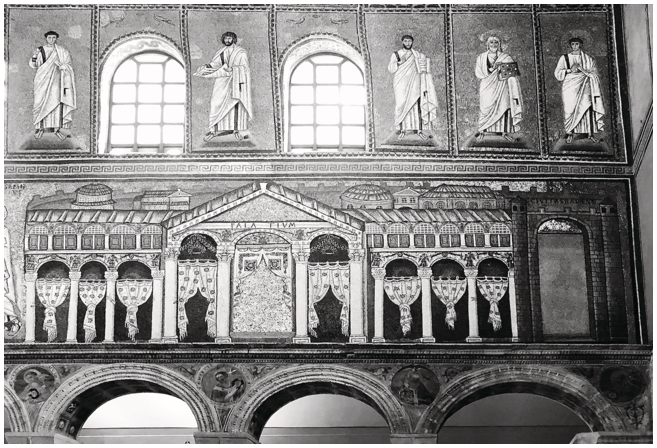
Take a look at these hands (Figures 7.1 and 7.2).
Interior of Sant’Apollinare Nuovo, Ravenna with the ‘Palatium’ mosaic.
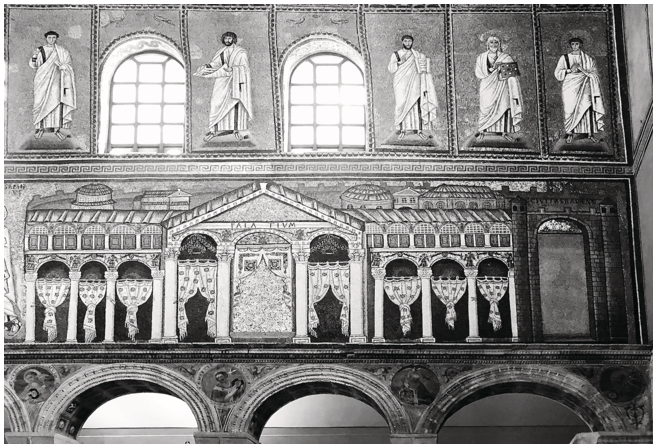
Figure 7.1 Long description
A photograph of mosaic wall decoration in a church arranged in two horizontal registers. The top register shows five saints on a golden background interspersed with two arched windows. Most of the middle register shows an ornate building complex. We see a colonnaded building at the front, with a central pediment and two storey aisles on either side, set on a golden background. We can see the interior of the central pediment building and the lower storeys of the aisles, including curtains hung from marble columns. At the centre of the pedimented building is an empty throne. The pediment is marked with the word Palatium. Behind this building we can see the exterior roofs and upper storeys of five other buildings, including two rotundas. To the right of this complex is a schematic depiction of a fortified city gate, with Civitas Ravenn written at the top. At the bottom, we see the very top of the marble archways of the church, with painted figures in roundels above the capitals.
Detail of ‘Palatium’ mosaic with hands visible across the first, third, fourth, and fifth columns from the left, and the second column from the right.

These are some of the most famous disembodied digits from antiquity (give or take the massive marble hand of Constantine now in the Capitoline Museum in Rome). They can be found in the church of Sant’Apollinare Nuovo in Ravenna. This magnificent basilica almost certainly began life as a church dedicated to Christ by the Ostrogothic king Theoderic; both its location and its mosaic decoration suggest that it acted as the king’s palace church.Footnote 1 The original schema is no longer wholly extant. After Justinian’s reconquest, when the church was rededicated to the stridently anti-Arian Martin of Tours, it was partly redecorated.Footnote 2 Enough of that original design has been preserved for modern scholars to reconstruct a compelling vision of Theoderic’s Christian kingship: one that portrayed his rule as part of God’s good ordering of the cosmos.Footnote 3 The interpretive key is this schematic depiction of the royal palace (on the backdrop of the city of Ravenna) at the west end of the southern wall.Footnote 4 As part of what Arthur Urbano has termed the ‘ritual reidentification’ of the building after Justinian’s reconquest, this section of the mosaic was carefully redone to remove a series of figures from the palace colonnades, while leaving traces of hands superimposed on those columns. These hands almost certainly belonged to images of the king’s attendants before the rest of their bodies were removed so as to efface (but preserve) the memory of Ostrogothic rule.Footnote 5 What exactly these palace attendants were doing with their joyfully upraised hands before they were edited out has been a subject of considerable discussion, with two particularly plausible suggestions raised. It could be that they greeted the (similarly excised) king as he arrived at the gate of the palace. It is also possible that these hands are in the classic orans pose of an individual at prayer and point towards the nave of the church.Footnote 6 On the latter hypothesis, these palace attendants would be taking part in the ritual within this liturgical space. At the very least, it is noteworthy that Theoderic’s household officials were depicted as part of this demonstration of his divinely sanctioned rule, in the very location where the king likely undertook routine Christian observance.
The first post-imperial kings sought to legitimate their power according to late Roman norms. As the decoration of Sant’Apollinare Nuovo suggests, this included appeals to the Christian ideological frameworks that had come to play a significant role in the self-presentation of fifth-century Roman regimes in Ravenna and Rome.Footnote 7 Of course, the problem for Theoderic – as for several of his counterparts across the post-imperial West – was that they were Homoian Christians now ruling largely Nicene provincial Roman populations. On the face of it, the church building that articulated this (widely accepted) understanding of the nature of earthly power was bound up with a form of Christianity perceived by most of those subjects as heretical. It has often been assumed that post-Roman rulers were only able to establish stable relations with those populations – or, in narrower and more justifiable terms, with pre-existing bishops and ecclesiastical institutions – once they had converted to Nicene Christianity.Footnote 8 Recent work (including my own) has shown how Homoian rulers like Theoderic were able to articulate such claims to ideal Christian kingship despite this doctrinal and ecclesiastical difference.Footnote 9 In my previous work, I have explored how regimes and elite subjects (including Nicene bishops) found ways to present these kings as pious Christians and even protectors of true church while glossing their religious affiliation. Moreover, I have argued that the religious (and ethnic) differences between the elites who attended upon or sought out the person of the king were often subsumed in the diplomatic language and polite sociability of post-imperial court societies.Footnote 10 In any case, those doctrinal differences likely mattered much less for the religious identities of provincial aristocrats than it did for their episcopal counterparts.Footnote 11 Considering the problem of official churchgoing has made me return to this picture of doctrinal fluidity and elite Christian consensus.Footnote 12 The negotiation of these differences was not simply a question of careful discursive positioning; it involved ongoing choices about how the king’s appointees would be involved in the Christian liturgical and communal life of these court cities. The routine political life of these courts threw up many occasions on which the specific affiliations of these officials might be activated: going to church with the king, celebrating liturgical festivals in the palace, even receiving petitions from clerics. How regimes, officials, and clerics presented the practical implications of these political and ceremonial acts is critical to our understanding of the interplay of confessional identity and royal service in the first successor kingdoms.
This chapter thus seeks to reconstruct patterns of churchgoing at post-imperial palaces and the character of the relationships between officials and clerics that could result from church membership and political service. Section 7.1 considers when and whether royal officials went to church with post-imperial kings. Routine attendance is easier to reconstruct for Nicene rulers than their Homoian counterparts. Officials and courtiers seem regularly to have gone to church with Burgundian and Merovingian dynasts. Homoian rulers also clearly went to church; whether or not royal officials would go with them is an open question. At the very least, contemporary observers envisaged such attendance as a possibility (while backing away from its potential implications). Whether or not they physically accompanied kings into liturgical spaces, appointees evidently did take part in various forms of Christian observance within royal residences. In this sense, officials and attendants were inevitably embedded within a framework of royal Christianity, albeit one that seems to have prioritised shared faith over requirements of confession or conformity.
Section 7.2 re-evaluates claims on the confessional identities of officials and the pastoral oversight that this entailed. The social realities behind these assertions are difficult to evaluate simply because (unlike in contemporary Constantinople) we cannot get a sense of wider patterns of elite churchgoing in post-imperial political centres. At least from surviving texts, the communal and institutional implications of church membership seem to have been mediated and interrupted by service in the royal palace. Rare cases of ecclesiastical discipline imposed on officials reinforce what we might anyway expect: that judgements on their orthodoxy and morality were, in the final reckoning, a matter for the king. Likewise, claims (by both officials and clerics) regarding the significance of church membership for the most part work to gloss relationships of reciprocal patronage between clerical ‘fathers’ and official ‘sons’. Such contacts may have used the language of Christian community, but they situated royal officials squarely in palace and administration: as individuals well placed to work in the interests of ‘their’ priests and churches. Given the axiomatic necessity for Christians (and even those of ‘the other confession’) to treat priests reverentially and respect their judgements, we should not overrate the affective bonds attached to these rhetorical commonplaces. Distinct Christian loyalties may only have been activated in particular moments such as these (and more neutral frameworks of jurisdiction and protocol were also available through which to understand and present these relationships and processes). These appeals to shared Christian faith and pastoral relationships cannot be used to disentangle royal officials from their overriding corporate identity and institutional location. They remain significant, insofar as they suggest that, when it came to ecclesiastical affairs, appointees at post-imperial palaces could be expected to govern like a member of the church.
7.1 Going to Church with Post-Roman Kings
The palatium mosaic in Sant’Apollinare Nuovo poses an obvious question. Did those who served in Theoderic’s palace in Ravenna accompany him to church in person (as well as pictorial form)?Footnote 13 The public church attendance of the barbarian kings of the post-imperial West is difficult to reconstruct, not least since those Burgundian, Ostrogothic, Vandal, and Visigothic rulers who adhered to Homoian Christianity would not normally turn up to the churches of the (almost exclusively Nicene) bishops whose texts survive.Footnote 14 On those occasions where we do get references to post-imperial kings in Homoian churches, Nicene authors do not care to distinguish too finely between public and domestic forms of observance, whether because of ignorance or a sense that the basic illegitimacy of these churches negated such distinctions. As a result, where we have evidence for patterns of certain public church attendance, it is almost exclusively for Nicene kings. When we see the Burgundian king Sigismund (r. 516–23) in episcopal churches, it is at festivals and dedications (in one case, possibly with his father).Footnote 15 Recorded visits to church from sixth-century Merovingian kings also stem, in the main, from the major liturgical feasts, saints’ days – sometimes moving with their courts to celebrate in a city with a notable shrine to that saint – and other special occasions like episcopal consecrations, baptisms, royal accessions, and funerals.Footnote 16 We can also see more regular public church attendance for the reigns of Theudebert (r. 533–48), Chilperic (r. 561–84), Guntramn (r. 561–92), and Childebert (r. 575–96). Several passages in Gregory of Tours’ Histories and Lives of the Fathers imply that these kings might attend public episcopal mass on ordinary Sundays.Footnote 17 Gregory also twice describes assassination plots against Guntramn in Paris attempted while the king was entering the church for daily matins.Footnote 18 The fundamental premise of these stories is that one of Guntramn’s enemies could expect to find him there, something also suggested (within the logic of Gregory’s history) by Guntramn’s decision to bring an armed guard with him to church in future.Footnote 19 The regular public attendance of these Merovingian kings was not unprecedented; McLynn notes possibilities of more frequent churchgoing on the part of late fourth-century emperors, as well as members of the imperial family in Constantinople.Footnote 20 It nevertheless remains a departure from the broader pattern of imperial and royal churchgoing attested in the fifth and sixth centuries and perhaps an indication of the distinctive relationship between rulers and the church in Merovingian Gaul.Footnote 21
The presence of officials with a ruler in church and their collective implication in his public churchgoing is evident from various post-imperial contexts. Most explicit are the letters of Avitus of Vienne, which eagerly await the arrival of Sigismund with his attendants at Christmas and Easter, as well as conveying acute disappointment when he did not show up. Avitus’ attempts to glean the king’s intentions for Easter from the comes Ansemund assume that the latter would be joining Sigismund in a public episcopal church (in whichever city he had decided upon that year).Footnote 22 Few other contexts provide such clear indications of the ruler’s entourage. Yet even without concrete references to the presence of the court, we would expect rulers to be accompanied to church in this manner, as they were in all public matters. Particularly telling is an incident from late in the Ten Books of Histories of Gregory of Tours, when the Merovingian king Guntramn acceded to the request of his sister-in-law Fredegund that he come to Paris for the baptism of his nephew Chlothar. Guntramn sent ahead several bishops from within his kingdom, as well as a group of key figures from within his court. ‘There would also be at this assembly many from his regime, both bodyguards and counts, to ensure that the necessary preparations were made out of the king’s resources.’Footnote 23 This anecdote makes explicit the role of a ruler’s officials in the stage management of such important ceremonial occasions. Merovingian kings would also have needed their officials to join them in church for the same reasons that Justinian required his quaestor to come with him.Footnote 24 Gregory’s Histories present several scenes where wronged or penitent subjects threw themselves at the king’s feet during mass seeking his judgement or clemency regarding knotty criminal and civil disputes: situations where a ruler might wish to have their advisers on hand.Footnote 25 Rulers were thus likely accompanied by key officials for their public church attendance, even when those handlers staged them – or contemporary authors depicted them – worshipping God in splendid isolation.
Like their Eastern counterparts, post-imperial kings engaged in religious observance within their palace complexes.Footnote 26 As with Sant’Apollinare Nuovo, domestic observance was built into the architectural fabric of post-imperial political centres. Palace churches are attested or plausibly hypothesised at various royal residences. Merovingian kings founded churches attached to various urban residences and rural properties: most notably the dynastic funerary basilicas at Paris and Chalon-sur-Saône.Footnote 27 Members of the Gibichung dynasty dedicated numerous churches in Geneva and Lyon as well as the famous monastery of Saint Maurice at Agaune, although none are obviously connected with their own residences.Footnote 28 A poem preserved in the Latin Anthology describes a church of the Virgin in the palace at Carthage, which may have been used by Vandal kings; it is equally possible that the text post-dates the reconquest and refers to the Justinianic foundation discussed by Procopius in his Buildings.Footnote 29 Possible Visigothic palace churches have been identified in the proximity of the fifth-century royal residence at Toulouse and the late sixth-century new build at Reccopolis; a church of the Holy Apostles and Peter and Paul ‘in the palace’ (praetoriensis) in Toledo is securely attested as the site of church councils from 653 onwards.Footnote 30 Those references are supplemented by repeated discussions of the court bishops and personal priests attached to rulers. In many cases, this was undoubtedly a false accusation designed to cast aspersions on episcopal rivals: general references to coteries of Arian bishops surrounding the king likely flattened the actual institutional profile and religious responsibilities that some of these men undertook. It is also clear that some rulers and members of ruling families did have their own religious attendants whose principal duties were to minister to a ruler’s personal needs.Footnote 31
Our best sighting of a ruler accompanied by his attendants in such routine observance comes from a letter of the mid-fifth-century Gallo-Roman senatorial aristocrat Sidonius Apollinaris. At some point during the reign of the Visigothic king Theoderic II (r. 453–66), Sidonius wrote to his brother-in-law Agricola to give an account of a day in the life of the king’s court at Toulouse.Footnote 32 Sidonius informed this budding courtier to expect Theoderic to attend a matins service with Homoian priests.
If you inquire about his daily routine, which is open to the outside world: before dawn, he attends assemblies of his priests with a minimal retinue (minimo comitatu), and he worships assiduously; although – if we’re talking privately – you might be able to discern that he performs these acts of reverence more out of habit than conviction.Footnote 33
Sidonius presents a small gathering at this early morning ritual. It is difficult to parse exactly how reflective this portrayal was of wider practice in post-imperial palaces. The future bishop of Clermont is doing notable work here to make it seem like this confessional difference would not be a problem for his (presumably Nicene) correspondent, since the king was not overly pious himself. In a similar vein, the reference to a ‘minimal retinue’ could be read as a way of hinting that Agricola might not need to attend himself. Yet the literary conceit of autopsy also assumes Sidonius had been there (to describe the king’s behaviour) and that Agricola would go in future (if he joined the court). Moments of more regular Merovingian royal attendance seem to suggest a similarly small guest list. Gregory implies that Guntramn’s decision to bring an armed guard when he went to church in Paris for daily matins was a new development.Footnote 34 This seems a surprising admission, not least given the security arrangements of eastern emperors;Footnote 35 it is rare to find Merovingian political actors comparatively unconcerned for the possibility of physical violence against their persons. This may indicate that Merovingian kings had a smaller retinue for daily religious observance as against bigger ceremonial occasions. It is certainly plausible that such routine observances might have been the preserve of a select group of attendants, especially when conducted within the palace itself: the king’s family, those whose function was specifically to attend on their persons, and perhaps the closest royal advisers.
Other aspects of religious life at post-Roman courts implicated a much wider group. Christian festivals were accompanied by forms of communal assembly and celebration that brought together the ruler with those who served him at court (and, in some cases, beyond). Easter had long marked a special time in the annual routine of a late ancient palace.Footnote 36 The sense of a self-conscious change in the atmosphere of government is evident from various extant laws from the late 360s onwards, which show late Roman regimes sending out reminders that prisoners should be let out at Easter so long as they had not committed serious crimes. The routine nature of this switch to judicial leniency is apparent, both from contemporary sermons discussing the festival and from the overriding intent of these laws to correct or forestall those judges who might be overly generous in granting amnesty.Footnote 37 A letter of Cassiodorus (from c. 533–38) in his role as praetorian prefect shows that this practice continued in Ostrogothic Italy.Footnote 38 As Ian Wood has noted, Easter also seems to have been an important occasion at the courts of the Gibichung dynasty. Sigismund promulgated a new law code for his kingdom, the Book of Constitutions, at an assembly of Burgundian and Gallo-Roman notables at Easter 517. The judgement in a particularly thorny legal case involving the king’s spatharius was handed down at the court that Easter so as to permit a much more lenient sentence for the offending parties.Footnote 39 The context of this gathering in the royal palace necessarily brought the king’s attendants under the royal aegis at a time when public church attendance was considered especially necessary. The Merovingian king Guntramn likewise scheduled a banquet in the royal residence to follow his presence at an Easter mass in Chalon-sur-Saône in 588 (mentioned by Gregory of Tours because of the episcopal squabbling that broke out during the feast).Footnote 40 Easter was not the only Christian occasion that provoked such assemblies and festivities. When the East Roman army under Belisarius arrived at the (very recently vacated) royal palace in Carthage in September 533 after their victory at Ad Decimum, they discovered the attendants of the Vandal king Gelimer setting up a banquet for the festival of St Cyprian.Footnote 41 The capacity of Nicene and Homoian office-holders to come together for these Christian royal celebrations is plausible given references to the presence of Homoian clerics at other palace banquets.Footnote 42 The fulminations of Nicene clerics against sharing a table with Arian heretics – and occasional punishment miracles that transpired from such commensality – suggest that this was a common occurrence.Footnote 43
Attendants went to church and celebrated festivals with post-imperial kings. It is plausible that their presence stemmed from a similar sense of social obligation to that present in fifth- and sixth-century Constantinople. The same features of collective participation in the ceremonial life of ruler and court were at play; that rulers often seem to have combined public church appearances at major festivals with audiences and assemblies at court might strengthen such a connection.Footnote 44 Once again, the absence of evidence from the capitals of the post-imperial West – and especially regarding regular practice at the courts of barbarian kings who adhered to a Homoian form of Christianity – is an obvious problem. Requirements or expectations of attendance remain unstated, even in the political context where forms of religious compulsion were most readily deployed (and recorded). If palace attendants and key officials had to attend church with the king anywhere in the post-imperial West, it would most likely be Vandal Carthage. That city spent much of the century of Vandal rule in Africa without a Nicene bishop or licit Nicene public church services (c. 440–54, c. 457–78, 483, 484–87, and from the late 490s to 523).Footnote 45 After the appointment of Eugenius to the episcopal see in 478/9 led Nicene Romano-Africans at court to attend the episcopal church, the Vandal king Huneric ordered that anyone going in dressed like a barbarian (in Victor of Vita’s terms) have their hair torn out, with the women then paraded in the streets of the city.Footnote 46 The cause of the king’s order, at least as the Nicene historian reported it, was that many Romano-Africans were dressing like Vandals as part of their service at the royal court; Huneric did not want these courtiers publicly attending a heretical ‘Homoousian’ church. But Victor does not spell out the ideal envisaged in contradistinction to this act of physical punishment and public humiliation. As a result, we cannot know if these courtiers were otherwise supposed to go to church with him or simply to avoid such a public sign of their heterodoxy by (for example) making their own domestic arrangements – nor how such acts and choices were perceived.Footnote 47
The lack of contemporary discourse around royal churchgoing obscures its significance for those who served these rulers: many, if not most, of whom – certainly in Italy, Gaul, and Spain – did not share their precise doctrinal or ecclesiastical affiliations.Footnote 48 It is nevertheless possible to extrapolate from the reports we do have – and the manner in which these confessional differences were otherwise discussed – the ways in which these divisions could have been negotiated. As discussed in Chapter 2, clerics and kings in Burgundian Gaul and Ostrogothic Italy found ways to enter polite dialogue with one another, as well as speaking in neutral terms about the other church whose members met within their respective jurisdictions. When Theoderic could speak of ‘our religion and yours’, and Gelasius of the ‘other communion’ to which the Ostrogothic king and many of his Gothic subordinates adhered, it is possible that attendance with the king was not seen as necessary for those courtiers who did not belong to his ‘religion’ or ‘confession’.Footnote 49 The same could be the case for the palaces of other Homoian kings, especially given the likely predominance of co-religionists amongst the Burgundians, Goths, and Vandals who staffed their bedchambers, commanded their armies, and helped to govern their kingdoms.Footnote 50 In that sense, these palaces would resemble fourth-century contexts where the emperor’s Christian attendants worshipped together (or were imagined to do so), without a necessary implication that all the court were or needed to be present.Footnote 51 Reciprocal recognition of this ongoing and fundamental religious difference may have taken shared churchgoing out of the routine of life at Homoian royal courts.
The recurring tendency of regimes, clerics, and courtiers to play down and obfuscate the character and implications of this disagreement over Christological and Trinitarian doctrine presents alternative possibilities. These efforts could just as easily have determined the forms of religious observance that Homoian rulers and Nicene courtiers and officials shared. It is a necessarily speculative suggestion, but it is easy to see how such qualms might have resulted in the watering down of the sectarian character of a ruler’s occasional ceremonial church attendance. The surviving letters and sermons of the most famous bishops of court cities are often rebarbative and doctrinally exclusionary in their tone and content. But it is easy to forget that the likes of Ambrose, John Chrysostom, and Nestorius were outliers – and, in the case of the latter two, figures whose appointment their imperial backers would come to regret. Many other episcopal appointees seem to have been creatures of the imperial or royal establishment and thus much more willing to pursue and maintain compromise.Footnote 52 It may be that the services that emperors and kings attended were generally conducted in that spirit.Footnote 53 Whatever the tone or content of these assemblies, contemporaries seem to have found ways to compartmentalise attendance at what was (at root) a heretical church. Such possibilities are implied by Gregory of Tours’ account of the visit of a Visigothic envoy named Oppila to his city on Easter Sunday 584.Footnote 54 Given this timing, Gregory posed an obvious question: ‘when this legate arrived in Tours, we asked him whether he was of our religion’. Oppila’s response (in Gregory’s account) is a hedge: ‘he responded that he believed that which Catholics believe’. Leovigild’s envoy then went with the bishop to his church for mass but avoided the kiss of peace and did not take communion. His suspicions aroused, Gregory interrogated his guest over dinner; a stylised dialogue follows in which the bishop reveals and refutes the Arian errors underlying Oppila’s conciliatory claims to shared doctrinal premises. Gregory’s narrative of this episode is obviously structured with polemical intent; the historian used a previous encounter with a Visigothic envoy in 582 similarly to suggest that Homoian Christians under Leovigild took an absurdly laissez-faire approach to questions of religious difference.Footnote 55 This Agila challenged Gregory to a debate over the equality of Father and Son; by the end he was reduced to pleading for mutual respect and toleration.
Do not blaspheme our religion (legem), which you do not worship; for we do not blaspheme what you believe, though we do not believe it, because it is not an offence if both this (religion) and that (religion) are worshipped. For it is a common saying among us that it is not a crime if someone whose affairs take him past the altars of the pagans and the church of God worships both.Footnote 56
To Gregory’s mind, going to a heretical church was a slippery slope that might lead to even more dangerous forms of religious relativism. The historicity of Oppila’s visit to his cathedral for Easter Sunday remains likely; it is the point of departure for the bishop’s detective work (and the foundation of his own claims to heresiological expertise in this encounter).
While Gregory cast aspersions on the cross-confessional attendance of these Visigothic envoys, other contemporary Nicene commentators were less concerned about doctrinal (and potentially heresiological) implications. Our one glimpse of a Nicene courtier in church with a Homoian king specifically waves away such concerns. Sidonius made clear that Theoderic II’s obsequies at matins were ‘more out of habit than conviction’, as part of a letter in which both his correspondent’s and his own daily involvement in this church service is portrayed as entirely unproblematic.Footnote 57 Avitus of Vienne is likewise sanguine when presented with a similar pastoral problem: the attendance of the (now Nicene) prince Sigismund (whom he was seeking to mentor) with his (still Homoian) father Gundobad at a Homoian celebration of Easter in Chalon-sur-Saône. Avitus conveyed his disappointment regarding the prince’s absence at his own Easter service in Vienne but wished to make clear that he understood the reasons for it.
You love your one church equally in both cities, but you cling to your devout father, to the extent that it is expedient, until such a time as he agrees that you may follow whatever church you like. Therefore, as we have been ordered to do, we first discharge our debt to God regarding this feast, and then to Caesar.Footnote 58
Avitus accepted that Sigismund’s loyalty as the son of a king required his presence, even if it meant attending Homoian Easter services – at least until such a time as Gundobad converted or gave his son greater religious freedom.Footnote 59 It is easy to imagine similar explanations being offered by other Nicene Christians attending the same Easter service with Gundobad. Palace attendants, courtiers, and other imperial and royal officials in other contexts across the post-imperial West may have decided that they were simply ‘discharging [their] debt to Caesar’ as his loyal servants when they went to church with him: if, that is, they worried about the theological implications of such an act in the first place.
7.2 Pastoral Politics: Officials between Palaces and Churches
On 1 September 533, Cassiodorus sent a series of letters announcing his appointment by the Ostrogothic king Athalaric as praetorian prefect of Italy.Footnote 60 Amongst the recipients of the prefect’s glad tidings and pronouncements on his fitness for office was the bishop of Rome, John (II). From its first words, the tone of this letter makes a marked contrast to his missive to the Senate as well as the letters from the king himself to Cassiodorus and the Senate.Footnote 61 ‘I must beseech you, most blessed father, that the joy which, by God’s generosity, I have obtained through you, I may know to be preserved for me by your prayers.’Footnote 62 Cassiodorus invited the pastoral oversight of the bishop of Rome: John was to advise him on his conduct and, if necessary, rebuke him. Above all, the prefect signalled the significance of his place in the bishop’s flock for his discharge of political office. ‘I am indeed a palatine judge, but I will not cease to be your disciple.’Footnote 63 Cassiodorus’ letter is a reminder of the alternative hierarchical relationships in which royal officials could be entangled as Christians. Regular public church attendance would place them under the jurisdiction of a bishop. This pastoral figure could feel bound (or entitled) to advise and admonish their elite congregants on a range of moral and doctrinal issues (although recent studies have rightly stressed the care and deference they adopted when so doing).Footnote 64 Certainly, the prefect himself encouraged such episcopal oversight over the provincial governors under his authority in a parallel letter announcing his appointment to a wider group of bishops in the Ostrogothic kingdom.Footnote 65
Cassiodorus’ letter to John gestures towards the practical implications of membership of a Christian community and the pastoral relationship between bishop and official that might ensue. Of course, Cassiodorus was not really in the congregation of his addressee, except insofar as all Christians could be seen as the ‘sons’ of the bishop of Rome in his putative role as head of the church.Footnote 66 The praetorian prefect would not be attending John’s church while serving Athalaric in Ravenna nor would he be directly subject to the bishop of Rome’s disciplinary authority (such as it was). As a Nicene Christian, Cassiodorus theoretically belonged to the public episcopal church of Ravenna under its bishop Urscinus, just as his Homoian counterparts at the royal court would be subject to the bishop who presided at the church of St Theodore (now Santo Spirito).Footnote 67 What sort of relationship he and his fellow officials normally developed with these churches during their time in the royal capital is an open question. The same goes for their colleagues serving in palaces elsewhere in the post-imperial West. The routine attendance of members of palace, consistory, and Senate in the (far better attested) episcopal church of fifth- and sixth-century Constantinople may be a guide.Footnote 68 Victor of Vita’s description of the regular presence of Nicene courtiers at the church of Eugenius of Carthage is also suggestive.Footnote 69 (These ‘men and women in barbarian clothes’ clearly went to his church often enough for Huneric’s agents to know they would be coming on the day appointed for their punishment.) It is plausible that some royal officials were regular attendees at Nicene or Homoian public churches. But we simply do not have the evidence from Burgundian, Merovingian, Ostrogothic, or Visigothic centres to glean a sense of who went to church and how often.
It is also likely that many had their own domestic religious spaces that they might find more amenable than the episcopal cathedral for regular observance. In Chapter 6, we saw how elite men and women in Constantinople were well placed to pursue bespoke arrangements of spiritual and theological guidance through the patronage of favoured clerics and the institution of domestic liturgical arrangements.Footnote 70 It is possible that Cassiodorus did something similar in his private residence at Ravenna, especially in the light of his claims to cultivate an ascetic mindset in office and his later monastic experiment at Vivarium.Footnote 71 In writing to John, Cassiodorus was seeking to establish or maintain just such a relationship of spiritual guidance (if at a distance). There is significant evidence for the construction and use of ‘private’ churches by provincial aristocrats across the fifth- and sixth-century West.Footnote 72 These churches were founded by Homoian as well as Nicene Christian donors, as is evident from the concerns of Nicene bishops in the Burgundian kingdom after the accession of Sigismund. The Council of Épaon (517) bucked wider trends by coming to a strict conclusion preventing the ‘conversion’ of private chapels and oratories for Nicene use in the future.Footnote 73 Again, the problem is the lack of evidence for such foundations – never mind their use by officials – in royal cities themselves. Unlike in contemporary Constantinople, the routine Christian practice of elites during their stays at Carthage, Geneva, Lyon, Paris, Ravenna, Toledo, or Toulouse remains opaque. As a result, we can more easily see rhetorical claims regarding official membership of the church than the practical realities it engendered.
How, when, and where royal officials went to (public or private) church is unclear. A disciplinary episode from Burgundian Gaul nevertheless suggests that those who served in the royal palace could be subject to the pastoral authority of local Christian clerics and communities. This incident from the court of Sigismund in the late 510s, recounted in the canons of the Council of Lyon (c. 518–22) and the much later Life of Apollinaris of Valence, provides a sense of the potential practical implications of notions of episcopal oversight.Footnote 74 The king’s treasurer Stephanus had been accused of incest; after his wife had died, he had married her sister, Palladia. This marriage was a problem because of the strict prohibitions on various incestuous unions issued the previous year, both by Sigismund (in the Book of Constitutions) and by the Nicene bishops of the kingdom (at the Council of Épaon).Footnote 75 A council of Nicene bishops met to discuss the case and handed down a sentence of excommunication; if they followed the precedent of a case decided by Avitus of Vienne the previous year, they will have excluded the pair from the church until they had separated and done penance.Footnote 76 By the time the bishops held a second meeting in Lyon, it seems that the king had not only refused to apply the corresponding secular punishment to the treasurer and his wife but had threatened one or more of the bishops as a result of this disciplinary action.Footnote 77 The collected bishops judged that if Sigismund did not yield, he would thereby effectively excommunicate himself; they signalled their willingness to enter temporary monastic retirement until he changed his mind.Footnote 78 King and bishops eventually came to an agreement by which Stephanus and Palladia could once again attend church until the ‘prayer of the faithful’, which took place after the Gospel reading.Footnote 79 Although the precise church(es) in which this new arrangement was envisaged to hold are not made clear, the location of the synod in a city where Sigismund was often resident, and the threat of a kingdom-wide episcopal ‘strike’, implies that it was public church attendance by the king, the treasurer, and his wife that was at stake.Footnote 80 At the very least, the episode gives a sense of the potential pastoral authority of bishops in royal cities and a concern – both from bishops and court – regarding the membership and standing of royal officials in the public episcopal community.
The disciplinary measures involved in the Stephanus case were those of the church: a sentence of excommunication that was moderated for a compromise agreed with king. They suggest that the Nicene bishop in one of the cities in which Sigismund’s customarily resided saw this key fiscal official as a member of his congregation. At the same time, the ongoing interference of the king – opposing the original judgement, pressuring the bishop(s) concerned, and negotiating an eventual compromise – makes clear that Stephanus was no ordinary congregant. A similar dynamic is apparent in an exemplary story told by Gregory of Tours in his Lives of the Fathers regarding Nicetius, bishop of Trier (c. 525–66).Footnote 81 According to Gregory, Nicetius would regularly admonish ‘those who did not observe the commands of God’, which included the Merovingian King Theudebert. ‘One Sunday the king entered church with people whom the pontiff had excommunicated.’ Nicetius refused to go ahead with mass until these royal attendants left his church. The king demurred until a demonically possessed congregant revealed ‘the virtues of the saint and the crimes of the king’. Nicetius refused a royal order to eject this poor young man until the king directed that the banned courtiers should also be removed. The precise relationship between this stylised confrontation and the actual church visits or political conduct of Theudebert is unknowable.Footnote 82 Gregory used this story for a clear moral purpose: ‘to fortify the censure of priests, either for the instruction of the people or else for the reform of the way of life of kings’. According to Gregory, Theudebert’s conduct improved after this supernatural and intensely public dressing down. Yet it is notable that even in the fabular scenario that Gregory presents, the efficacy of excommunication as an episcopal strategy for dealing with the wrongdoing of royal attendants is reliant on the opinion of the king. Kevin Uhalde has captured the basic dynamic at play. ‘However intrepid he may have been, Nicetius was not powerful enough to excommunicate Theudebert with any real effect …. But he could hold up a mirror for Theudebert, which revealed the king’s own distorted image next to the exemplary one of himself.’Footnote 83 On similar terms, Nicetius had to convince Theudebert to remove the banned courtiers and, in another story told by Gregory, sufficiently to impress the king’s agents with his moral authority for them to take his threats of church sanctions to heart.Footnote 84 As in Constantinople, and indeed in the case of provincial governors in the post-imperial West,Footnote 85 the exercise of episcopal oversight was mediated by the ruler’s authority over his appointees.
Where the disciplinary potential of clerics over palace officials is expressed in other contexts, it is even more directly located within the political spaces of the palace and subordinate to the king’s overall judgement. Victor of Vita’s History include two episodes where Homoian clerics at the royal court are involved in the fall of royal officials accused of (Homoousian) heresy. In the first, from the mid-440s, the comes Sebastian is brought before Geiseric and an assembly of palace officials and Homoian bishops to hear the king’s demand that he convert and undergo a Homoian (re)baptism. According to Victor, after he refused, he was murdered for another reason. This story is almost certainly a fabrication (at least in this presentation): Victor himself backs away from the idea that the murder was result of his non-conversion.Footnote 86 The presence of these bishops on occasions where Vandal kings investigated the orthodoxy of their subordinates remains plausible, not least given the details of the second such narrative. Late in the reign of Geiseric, a Homoian cleric named Marivadus (or possibly Varimadus) brought about the fall of Saturus, the chamberlain of the crown prince Huneric’s household. According to Victor, Saturus had been vocal in his criticisms of Arian heresy and was thus denounced by Marivadus. The latter was well placed to make such an accusation given his position as a favourite of Huneric.Footnote 87 Of course, part of the reason why Saturus suffered royal and not ecclesiastical punishment may be because he was not a member of Marivadus’ church. It is nevertheless striking that, once again, the orthodoxy and good Christian conduct of a royal servant was, in the first place, a matter of the ruler’s jurisdiction.
The Stephanus and Nicetius cases are unusual in granting us glimpses of the relationship between a bishop and a royal official as it was defined in the physical and legal context of the church. Where we can see interactions between officials and clerics in these royal centres, their character is shaped, for the most part, by political spaces and duties. The royal palace was the site of various forms of social interaction between these distinct groups of office-holders. As the History of the Persecution suggests (if in extreme form), those interactions could include deployment of these clerics’ perceived responsibility for the doctrinal and spiritual formation of royal appointees. More often, though, they seem to have been the site of more diplomatic and bureaucratic forms of sociability rooted in the everyday business of royal residences. Palace officials received the petitions and embassies of bishops and clerics, whether they sent one of their agents with a letter or visited themselves.Footnote 88 When bishops came in person, officials played critical roles in the preparation and conduct of such audiences (as they would for any suppliant): conducting them into the royal presence, witnessing and perhaps even acting as intermediaries in the ceremonial dialogue between king and cleric, and dining with them (assuming they were happy to share a table).Footnote 89 Agents were also sent from the palace to inform clerics and churches of particular royal decisions or to investigate ongoing disputes.Footnote 90 Royal officials were critical to the processes by which post-imperial kings and clerics formed and maintained relationships of protection and patronage. This intermediary political role necessarily shapes contemporary discourse around their membership of the church.
The administrative duties of royal officials set them up as patrons of clerics: individuals who could champion their interests, influence the king, and contribute to the formation of royal policy. Both clerics and officials could conceive these patronage relationships in terms of Christian group membership and confessional identities. Cassiodorus’ letter to John (II) on his appointment as praetorian prefect invited precisely such an interpretation of future requests from the bishop of Rome. These dually coded contacts (father/son; client/patron) could result from pre-existing relationships, as with Sidonius Apollinaris and the referendarius Leo at the court of Euric, or Avitus of Vienne and the comes Heraclius at the court of Gundobad.Footnote 91 Less familiar political actors could also be addressed as one’s ‘son’ as a matter of diplomatic protocol; even Homoian Christians could be encouraged to act on that basis.Footnote 92 Such was the case when Gelasius of Rome wrote to a comes named Teia/Zeia seeking his aid to protect two clerics of the church of Grumentium in Lucania against the heir of the dominus who had (apparently) manumitted them. Gelasius’ encouraged his ‘beloved son’ to pursue the case by an appeal to a distinct sense of duty: ‘For Christians, it should always be pleasing to furnish what is asked of their office, since it is right not to deny a favour to the servants of God.’Footnote 93 Such relationships and strategies could allow clerics to gain purchase within the networks of the royal court and pursue their interests: according to Sidonius, Leo helped to bring about his return from exile.Footnote 94 At the same time, it is best not to accord too great a role to these putatively pastoral relationships in shaping the conduct of royal officials. As Gelasius’ letter to Teia/Zeia suggests, political actors were expected to show due deference to reverend bishops and other holy people whatever their previous acquaintance (in contrast to the haughty disdain with which some other petitioners were supposed to be treated).Footnote 95 Above all, just as bishops were just some of the many petitioners who sought the judgement and aid of post-imperial rulers, appeals to Christian (and indeed specifically ‘confessional’) identity were just one of many strategies adopted by those petitioners.
Addresses to post-imperial officials as sons of the church rubbed up against an alternative model of community: as members of palace and administration. The predominance of this communal framework is explicitly recognised by both Sidonius and Avitus when describing their correspondents’ proximity to the king and their involvement in the business of government and life of the court.Footnote 96 This contrast is likewise implicit in the Variae of Cassiodorus, who rarely deploys anything like this model of conduct (‘may public affairs find me such a judge as the Catholic Church sends out as its son’) elsewhere in this collection of administrative letters.Footnote 97 This corporate framework was not simply a ‘secular’ everyday praxis that might be set to one side for occasions that required more overtly pious patronage. A sense of belonging to the palace and loyalty to the king also shaped the dealings of officials with clerics and churches, not least when royal agents received specific instructions or were empowered to facilitate the resolution of disputes on his behalf. As in Constantinople, regular religious observance within the palace and pursuit of particular religious policies may have inculcated a sense of Christian community amongst those who served the king. It could nonetheless be useful for all concerned to characterise these royal interventions and official missions in much more neutral terms. The agents of the Ostrogothic king Theoderic, in particular, characterised the king’s role as that of ensuring the affairs of the (Nicene) church remained matters of ecclesiastical jurisdiction; in part, of course, because of Theoderic’s own doctrinal affiliation.Footnote 98 Particularly telling is a further letter that Gelasius sent Teia/Zeia on a different case: this time, a failed candidate for the episcopacy of Volterra had (rather brazenly) sought a refund from the defensor he had employed to administer a campaign of bribery. Gelasius admonished Teia/Zeia ‘to avoid involving yourself in ecclesiastical cases and affairs, and, ceasing all [your] disturbance, to stop all meddling and permit the rule of religion to be protected – especially since there is no doubt that you are of another communion’; if he did so, he would be acting like Theoderic.Footnote 99 As Sam Cohen has recently argued, it is clear that the bishop of Rome’s concern was less Teia/Zeia’s confessional identity – not a problem when it came to protecting the clerics of Grumentium – than that the comes had questioned Gelasius’ claim to jurisdiction over the case and (to the bishop’s mind) seemed to be showing favour to the wrong side.Footnote 100 Gelasius’ admonition is part of a broader tendency on the part of clerical authors to code representatives of post-imperial regimes as actors external to the church when their interventions were unwelcome.Footnote 101 This sense of a decidedly ‘secular’ jurisdiction of course cut against the reality of overarching royal authority as well as these individuals’ own religious identities as Christians. When construed in more neutral terms, it remained a useful recourse for kings, officials, and clerics alike as they sought safely to delimit the legitimate exercise of authority within the church by Christian officials.
Conclusion
When Victor of Vita discussed the appearance of some of Huneric’s courtiers at the church of Eugenius, he referred to them as ‘people of our religion’. In the terms of his History, the point was clear: these were Nicene Christians and Romans (which amounted to the same thing), not Vandals; their primary loyalty was to their faith, not to the king whom they served. And, to be fair, at the moment at which Victor caught them, these individuals were Nicene Christians first and foremost (at least in retrospect). Attendance on that given day had subjected them to categorisation as heretics and a brutal act of exemplary royal violence, which presumably determined their status and life course from then on.Footnote 102 The church membership of those who served in royal palaces could also be activated through less stark means. Sidonius Apollinaris and Avitus of Vienne appealed to the ecclesiastical affiliation of their men at the Visigothic and Burgundian courts; Cassiodorus indicated a willingness to play a similar dual role as patron and ‘son’ when he wrote to the bishop of Rome. Yet all three wrote in the knowledge that this shared Christian community was a much more consistent point of reference for clerical petitioners than their official contacts. A confessional identity was far from determinative of the conduct of royal officials; in fact, the loyalties it engendered were assumed to represent partial and intermittent considerations even for the (exceptional) Christians who received such missives. This occasional significance was (in part) a matter of a temporary departure from an institutional culture perceived as primarily worldly in its outlook. But the corporate body in which these addressees were embedded was not simply a ‘secular’ administrative framework (even if it sometimes suited both parties to portray it as such).
This chapter has argued that post-imperial palaces were sites of Christian observance and communal formation. The evidence is admittedly lacunose; there are many unanswered questions. These partly result from the ignorance or reluctance of Nicene writers regarding Homoian churches and services. Royal visits to palace chapels and public episcopal basilicas also likely suffer from comparison to the better attested and peculiarly intense Christian political life of Constantinople. As a constant imperial residence, that city was unusual in representing the singular focus of the ecclesiastical benefactions and ceremonial appearances of Christian emperors for two centuries. As the site of palace, prefecture, and Senate, it was likewise the permanent residence of a significant proportion of the Eastern ruling elite and thus represented a uniquely privileged site of elite Christian activity and patronage. The western imperial court of the fifth century represents an instructive point of comparison. Honorius, Valentinian III, and Galla Placidia can be seen in church remarkably rarely; their attendants are almost entirely invisible on such occasions.Footnote 103 As with the innovations of Theodosian dynasts in church ceremonial and patronage at Rome and Ravenna, there is enough to suggest that post-imperial palaces were sites of regular Christian observance in which at least some of the ruler’s appointees were implicated. The evidence is clearest for Nicene Burgundian and Merovingian kings whose regular public and domestic observances involved the accompaniment of key officials. The precise guest list of parallel occasions at the courts of Homoian kings remains an open question. The absence of obvious conflict over (non-)attendance of officials at palace churches suggests that potential doctrinal issues were sidestepped at the courts of Homoian rulers. It is possible that Nicene Christians were not expected to come along; but there are also indications that they did go to church with the king, as well as turning up to less straightforwardly liturgical celebrations that more obviously demanded their presence. The remarkably blasé attitudes of some contemporary Nicene observers imply that the character of these services might be more neutral than the wider heresiological polemic against Arian churches might suggest. Attendance could also be justified as the price of admission to royal service and a routine part of belonging to the palace. Whether they attended with the king, went to the episcopal church, or made their own arrangements, officials came into contact with Christian communities and potential pastors. The evidence is not there to see how these relationships normally worked. The Stephanus case from Burgundian Gaul and Gregory of Tours’ stories about Nicetius of Trier in Merovingian Gaul nevertheless imply that attempts to apply episcopal oversight could be similarly subordinate to royal favour and judgement as they were in other political environments. Royal officials may have developed a similar sense of belonging to a Christian corporate body as their contemporaries in Constantinople. After all, participation at court made them similarly party to (or, to their critics, complicit in) the royal religious policies that they shaped, facilitated, and implemented. Such a perspective can only be glimpsed at the margins of the justifications and representations of contemporaries, for whom the complementary jurisdictions of officials and bishops remained safer territory. Service at these royal courts was also likely less determinative of the religious identities of these men than their Eastern counterparts. The potential implications of that service for those Christian loyalties remain evident.


 Open access