

Introduction and problem setting
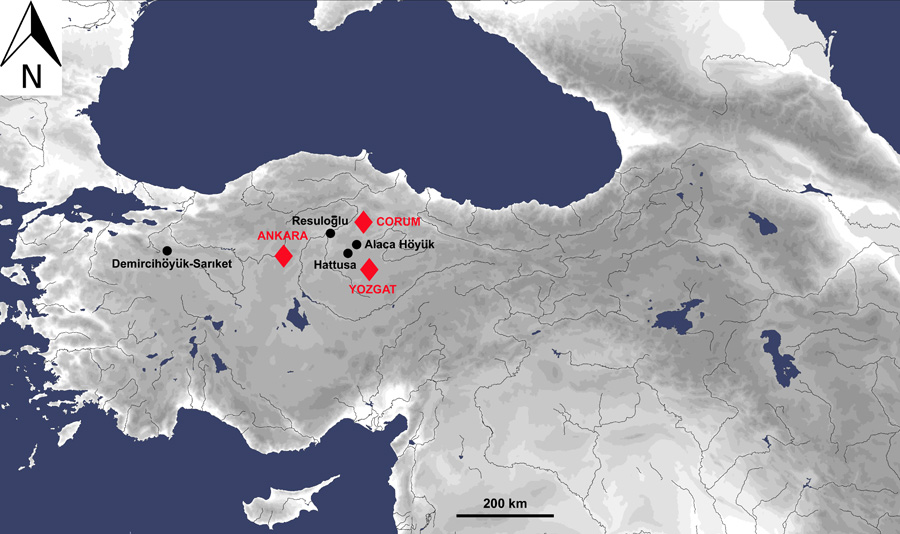
Location of Alaca Höyük and sites mentioned in the text.

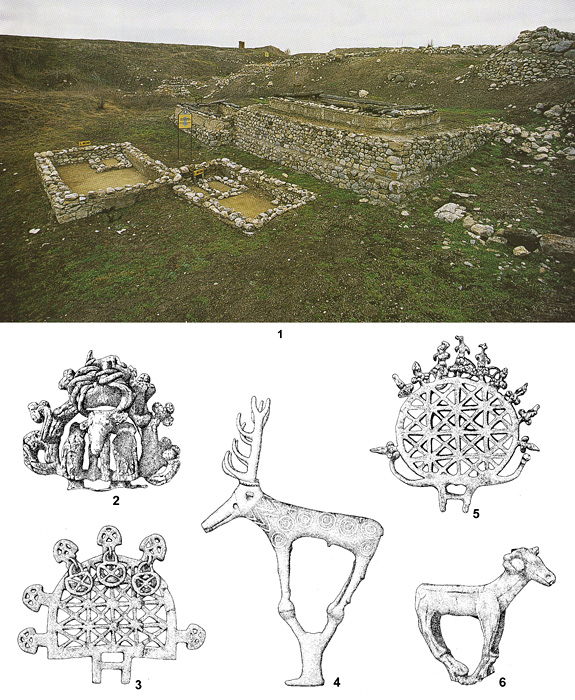
The archaeological exploration of the Central Anatolian plateau, which flourished in the wake of the foundation of the Turkish Republic in 1923, has been largely neglected in the ensuing decades and so overshadowed by the investigation of few central places, or urban centres, in the municipal triangle of Ankara, Çorum and Yozgat (Özdoğan 2005: 349; Reference ErimtanErimtan 2008) (Figure 1). Together with Hattusa, which was, thanks to extensive archaeological and philological research beginning in the late nineteenth century, confirmed as a cultural and political hotspot, the stunning riches retrieved from the elaborate burials at Alaca Höyük (Reference ArikArik 1937; Kosay 1938 & 1951) — conventionally dated to between the middle and end of the third millennium BC (Özyar 1999; Reference Gerber and Erkanal-ÖktüGerber 2006; Zimmermann 2006-2007: 511-12) — propelled this place to the rank of a 'model study' for the evolution of the early (urban?) elite societies that emerged in this region in the later third millennium BC (Figure 2).
Reconstructed Alaca Höyük tombs (1) and selection of 'ceremonial standards' from several Alaca Höyük burials (2-6) (after Müller-Karpe 1974 and Reference EfeEfe 2003, scale not indicated).

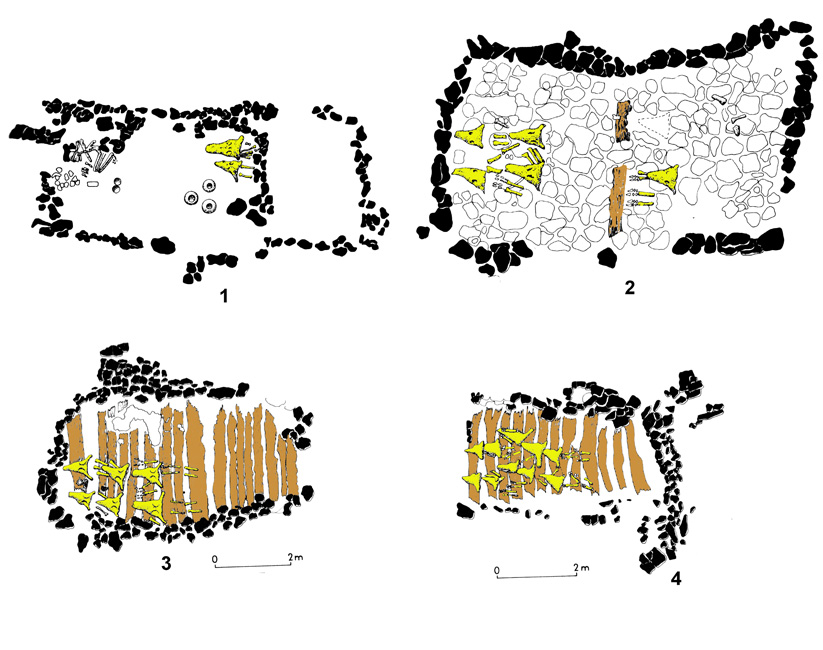
Graves H (1), F (2), E (3) and L (4) with bucrania and long bones placed on top of wooden beams; 1 & 2: scale not indicated (after Müller-Karpe 1974).

However, a recent reappraisal of some less well known and apparently misinterpreted items challenges this traditional view, and may even help rehabilitate a previously offered alternative proposal for the modus vivendi of the Alaca community. A survey of the Early Bronze Age in central-western and central Anatolia reveals that several cemeteries show evidence that points to a recurring preponderance of cattle in funerary contexts (Figure 3). These burial contexts might serve a more specific purpose than merely that of a 'projection surface' for strength and fertility (Reference RiceRice 1998; Reference RelkeRelke 2007; for Demircihöyük Sarıket see Reference SeeherSeeher 2000: 302; for Resuloğlu see Yıldırim 2006: 7).
A cattle-centred reinterpretation
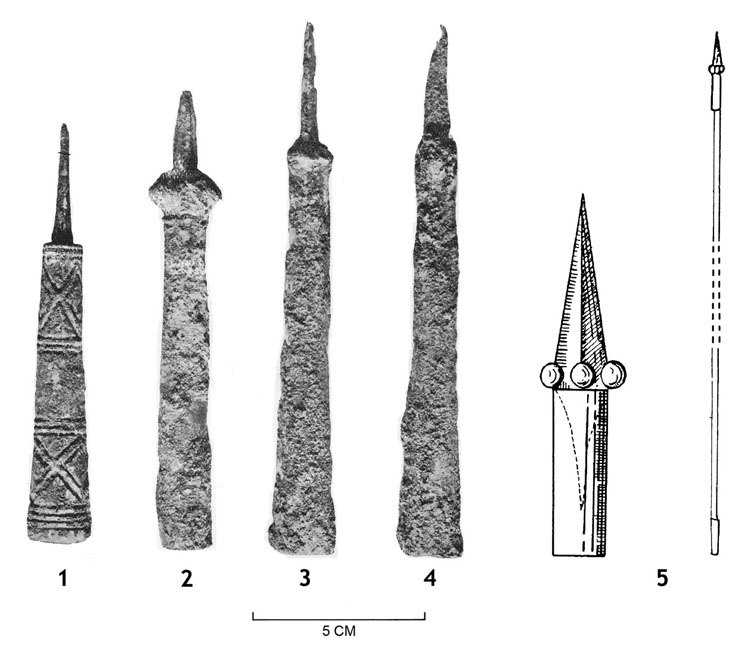
Socketed points, probably cattle-prods from various Alaca Höyük tombs (after Reference ArikArik 1937 and Reference ZimmermannZimmermann 2009).

Pointing to the preponderance of cattle is one thing, but can this be taken further? Can the emphasis on cattle in the Central Anatolian Early Bronze Age, and especially their role in funerary ceremonies, support alternative interpretations and more comprehensive explanations than the much-cited commonplace that the animal bones represent banquet leftovers? A clue for an alternative explanation lies in a recent reappraisal of artefacts from several Alaca tombs first published in the 1930s and originally interpreted as socketed point. These objects may have been misidentified and our re-interpretation reveals a new, exciting facet of the material culture of the Alaca Höyük community. These items, variously labelled 'flagpole or baldachin tips' or 'spearheads' in previous publications (see Reference ZimmermannZimmermann 2009: 145 for a conspectus), bear a striking resemblance to cattle-prods or stimuli, designed to encourage an animal to accelerate its pace — or, in the case of more stubborn artiodactyls, to move at all (Reference ZimmermannZimmermann 2009: 146-9) (Figure 4).
Attached to a wooden shaft, as they obviously were (see Reference ArikArik 1937: pl. CCVII who mentions traces of wood on the inside; Reference ZimmermannZimmermann 2009: 147), they would indeed best serve as cattle prods. Such prods, while well attested in European Iron Age contexts such as elaborate burials containing horse riders' equipment (see Reference KrausseKrausse 1992), are occasionally associated with earlier Eurasian burial assemblages, and are even visible on plates and reliefs depicting cult processions or related activities (Reference ZimmermannZimmermann 2009: 1479).
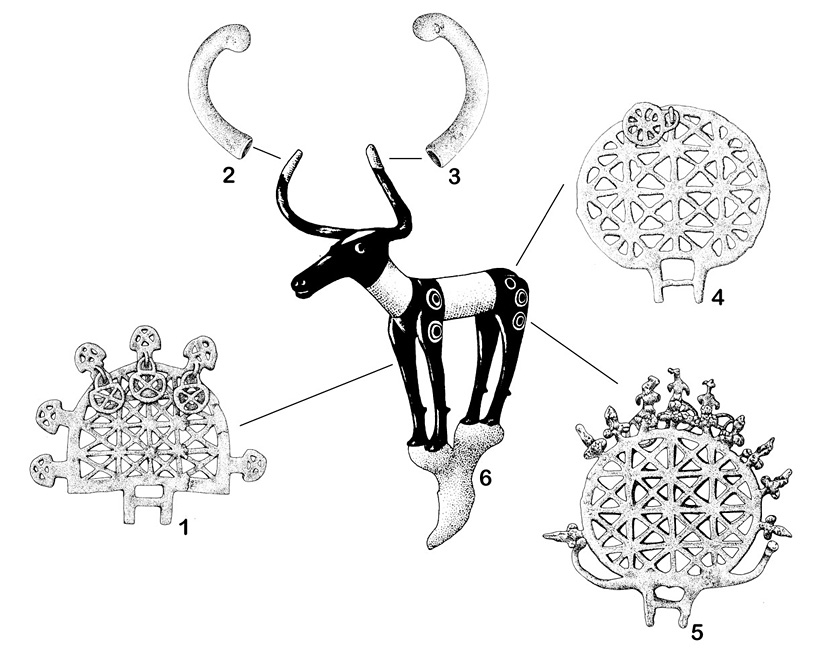
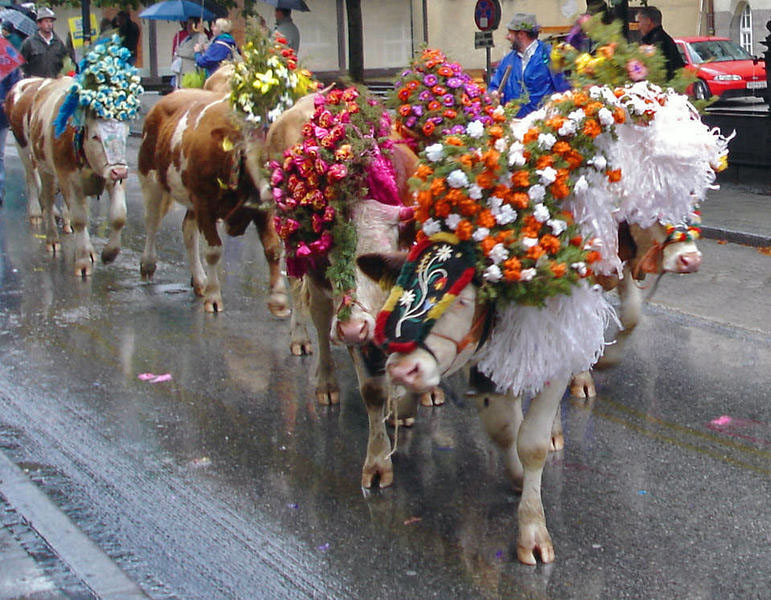
Bearing in mind the specific function of our stimuli, then the many symbolic standards and large bronze 'ferrules' (cf. Figure 5, nos. 2 & 3) from the various graves at Alaca make more sense as special adornments for cattle. These could have been in use at identity-forging festivals, perhaps similar to the Almabtrieb (German for descent from high pastures), a festival celebrated in many Alpine regions (Figure 6). This colourful pageant marks the time when flower-adorned cattle are driven down (with cattle prods!) from their summer pastures to their winter quarters in the valleys. Such a hypothetical festival would tie in with Jak Yakar's assumption of (northern) Central Anatolian inhabitants as pastoralist communities (Reference YakarYakar 2000: 244).
Large bronze 'ferrules' (nos. 2 & 3) from grave C and standards from various burials at Alaca Höyük (nos. 1, 4 & 5), and their possible representation en miniature on a silver-plated bull statuette from burial H (no. 6) (after Müller-Karpe 1974, modified, scale not indicated).

Almabtrieb (descent from high pastures) in Kufstein, Austria. Courtesy http://en.wikipedia.org/wiki/File:Kufstein_Almabtrieb_2005.jpg (GNU Free Documentation License).

By way of a conclusion, the elaboration of cattle-related equipment in elite burials can be seen, not as an unknown and unrelated phenomenon in Anatolian prehistory and early history, but as a manifestation of the adoration of cattle in ritual contexts, reflecting an essential element of wealth and well-being in Western Asia.
Acknowledgements
We are indebted to Christoph Bachhuber, Oxford, for critical and inspiring discussions, Julian Bennett, Bilkent University, for proofreading the manuscript, and the anonymous reviewers for their valuable comments.