





Background
Adult CHD is a rapidly growing population due to advances in catheter and surgical interventions; an estimated 1.4 million adults are living with CHD in the United States in 2010. Reference Gilboa, Devine and Kucik1 Infective endocarditis has an incidence of 1 to 19 cases per 1000-person years. Reference Alonso-Garcia, Fernandez-Hidalgo, Gonzalez-Fernandez, Roque, Pizzi and Pijuan-Domenech2,Reference Moore, Cao, Kotchetkova and Celermajer3 One prospective study showed that >10% of adult patients with infective endocarditis had CHD. Reference Van Melle, Roos-Hesselink and Bansal4 Prosthetic material, conduits, stents and closure devices as well as male age and cyanotic congenital heart disease are pertinent risk factors. Reference Alonso-Garcia, Fernandez-Hidalgo, Gonzalez-Fernandez, Roque, Pizzi and Pijuan-Domenech2 Though left-sided endocarditis is more common, with bicuspid aortic valve being the most commonly associated predisposing factor, right sided endocarditis is more common in series that focus on studies from centres with high volume of CHD. Reference Alonso-Garcia, Fernandez-Hidalgo, Gonzalez-Fernandez, Roque, Pizzi and Pijuan-Domenech2 Native right-sided infective endocarditis is more commonly seen with unrepaired ventricular septal defect or residual patch margin ventricular septal defect. Reference Van Melle, Roos-Hesselink and Bansal4 Staphylococcus lugdunensis (SL), a skin commensal, is a rare cause of native valve endocarditis mainly involving left sided valves with aggressive clinical course. Reference Anguera, Del Río and Miró5 Only a few cases of native tricuspid valve endocarditis have been reported in non-intravenous drug users. Reference Liu, Huang and Tang6 We report a case of right sided endocarditis due to Staphylococcus lugdunensis (SL) in a patient with a residual ventricular septal defect and pulmonary valve stenosis, along with autoimmune hepatitis.
Case
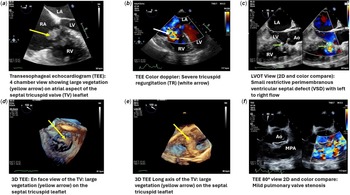
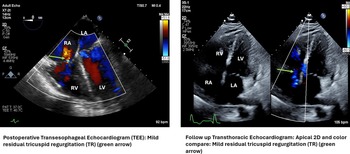
A 44-year-old female was noted to have a murmur at around 2 years of age and diagnosed with a small restrictive perimembranous ventricular septal defect and pulmonary stenosis; she underwent balloon pulmonary valvuloplasty at 42 years of age. She had a history of autoimmune hepatitis diagnosed 2 years prior to presentation and was on therapy with prednisolone and azathioprine. She had noted intermittent malaise and a sensation of feeling unwell for 4 months prior to presentation. She presented to the Emergency Department with a two-week history of low-grade fever followed by increasing bouts of shortness of breath, pleuritic chest pain, fatigue, and malaise. There was no prior history of injury to the chest or preceding viral symptoms. Labs in the Emergency Department were remarkable for an elevated white cell count of 12.09 k/microL with a differential of 77% neutrophils and 10% lymphocytes, anaemia with haemoglobin of 9.3 g/dl and haematocrit of 28.3% and a normal platelet count of 203 k/microL. Chest Computed Tomography revealed multifocal alveolar infiltrates and peripheral cavitation concerning for septic emboli (Figure 1). Given her underlying cardiac history, a transesophageal echocardiogram was performed. This revealed a large mobile echodensity attached to the atrial aspect of the septal tricuspid valve leaflet (measuring 2.3 x 1.6 cm), consistent with the diagnosis of infective endocarditis and resultant severe tricuspid regurgitation (Figure 2). She had a restrictive perimembranous ventricular septal defect with peak velocity of ∼4.0 m/s (Figure 2) and mild pulmonary valve stenosis (Figure 2). She had preserved left ventricular systolic function and mildly decreased right ventricular systolic function. Blood cultures were positive for SL. The patient was treated with IV oxacillin. Staging Computed Tomography brain and abdomen showed no other extracardiac metastatic lesions, and left heart cardiac catheterisation did not show any significant coronary artery disease; dental clearance was obtained prior to surgery. The patient underwent Gore-Tex patch closure of the perimembranous ventricular septal defect. The vegetations were carefully debrided. Intraoperatively, a hole was noted in the septal leaflet of the tricuspid valve, with multiple fenestrations. The tricuspid valve was repaired with papillary muscle mobilisation, annuloplasty sutures, and closure of the defects. Postoperatively, she had only mild residual tricuspid regurgitation and no residual intracardiac shunt (Figure 3). The patient was discharged home to complete a 6-week course of antibiotic therapy with oxacillin and has been doing well since.
CT of the lungs showing peripheral cavitation concerning for septic emboli.

Figure 1. Long description
A CT scan of the lungs showing peripheral cavitation with an arrow indicating a specific area of concern. The scan reveals areas of dark, air-filled spaces in the lung tissue, suggesting the presence of septic emboli. The arrow points to a particular region where the cavitation is prominent, highlighting the area of interest for further medical evaluation.
Transesophageal echocardiographic images showing large vegetation on the atrial aspect of the septal leaflet of the tricuspid valve ( a , d , and e ), severe tricuspid regurgitation ( b ), small restrictive perimembranous ventricular septal defect ( c ) and mild pulmonary valve stenosis ( f ).

Figure 2. Long description
The image contains six transesophageal echocardiographic images. The first image shows a four-chamber view with a large vegetation on the atrial aspect of the septal leaflet of the tricuspid valve. The second image uses color Doppler to highlight severe tricuspid regurgitation. The third image presents an LVOT view comparing 2D and color images, revealing a small restrictive perimembranous ventricular septal defect with left-to-right flow. The fourth image is a 3D TEE en face view of the tricuspid valve, showing a large vegetation on the septal leaflet. The fifth image is a 3D TEE long axis view of the tricuspid valve, again showing a large vegetation on the septal leaflet. The sixth image is a TEE 80-degree view comparing 2D and color images, indicating mild pulmonary valve stenosis.
Postoperative echocardiograms demonstrating mild residual tricuspid regurgitation.

Figure 3. Long description
The image contains two echocardiogram images side by side. The left image is a postoperative transesophageal echocardiogram (TEE) showing mild residual tricuspid regurgitation (TR) indicated by a green arrow. The heart chambers labeled include the left atrium (LA), right atrium (RA), right ventricle (RV), and left ventricle (LV). The right image is a follow-up transthoracic echocardiogram using apical 2D and color compare, also showing mild residual tricuspid regurgitation (TR) indicated by a green arrow. The heart chambers labeled include the right ventricle (RV), left ventricle (LV), right atrium (RA), and left atrium (LA). Both images include various technical details and measurements related to the echocardiogram settings.
Discussion
Infective endocarditis remains an important complication in adults with CHD, with an incidence over 75 times higher than in the general population. Reference Snygg-Martin, Giang, Dellborg, Robertson and Mandalenakis7 It is a leading cause of morbidity and mortality, with a reported mortality rate of 6.9 to 8%. Reference Li and Somerville8,Reference Tutarel, Alonso-Gonzalez and Montanaro9,Reference Arvanitaki, Ibrahim and Shore10 A minority of species of coagulase-negative staphylococci, which are normal flora in humans, cause infection of prosthetic material and endocarditis.
SL is a new genomic species of gram-positive coagulase-negative staphylococcus identified in 1988, and it infects the skin and soft tissue predominantly. It can be differentiated from other coagulase negative species by its ability to produce ornithine decarboxylase and pyrrolidonyl arylamidase which allows it to bind fibrinogen with extracellular proteins causing agglutination. Reference Anguera, Del Río and Miró5,Reference Liu, Huang and Tang6 Staphylococcus lugdunensis (SL) produce extracellular glycocalyx which helps with bacterial colonisation and interferes with neutrophil phagocytic activity. Reference Liu, Huang and Tang6 It is said to account for ∼1.1% of all cases of infective endocarditis in one multicentre study causing ∼0.8% of native valve endocarditis. Reference Anguera, Del Río and Miró5 In contrast to other coagulase-negative staphylococci which have an indolent course, Staphylococcus lugdunensis (SL) is an aggressive pathogen causing valve destruction, myocardial abscess formation, peripheral embolism and multiple complications similar to that seen with Staphylococcus aureus. It often affects native valves as opposed to coagulase-negative staphylococci, which affect prosthetic valves. Reference Anguera, Del Río and Miró5,Reference Liu, Huang and Tang6
Restrictive ventricular septal defects have been associated with a higher risk of infective endocarditis. High velocity turbulent left to right shunt from restrictive ventricular septal defect can affect the tricuspid valve leaflets or subvalvar apparatus and predispose to infective endocarditis. Reference Alonso-Garcia, Fernandez-Hidalgo, Gonzalez-Fernandez, Roque, Pizzi and Pijuan-Domenech2 Therefore, both the 2015 American Heart Association and 2023 European Society of Cardiology guidelines categorise ventricular septal defect as a moderate risk factor for infective endocarditis. Reference Alonso-Garcia, Fernandez-Hidalgo, Gonzalez-Fernandez, Roque, Pizzi and Pijuan-Domenech2 In the study by Anguera et al., only one patient had unrepaired congenital heart disease. Reference Anguera, Del Río and Miró5 In a multicenter study of Staphylococcus lugdunensis (SL) endocarditis, CHD was a predisposing factor in 8.9% of patients with the precise nature of the CHD not elaborated. Reference Lefevre, Habib and Hoen13
While poor dentition and intravenous drug abuse are previously identified risk factors, immunocompromised individuals are a special population of patients at increased risk of infective endocarditis with increased mortality rates. Reference Moore, Cao, Kotchetkova and Celermajer3,Reference Sidik, Chinikov and Korjueva11
Our patient had two risk factors for infective endocarditis, including her underlying unrepaired CHD and being on immunosuppressive medication for autoimmune hepatitis. Despite the low-grade fevers, fatigue and malaise, she remained undiagnosed for a period until her acute onset of shortness of breath and pleuritic chest pain caused her to seek more emergent care. Timely assessment with chest Computed Tomography demonstrated an embolic phenomenon. Due to the chest Computed Tomography findings, she underwent echocardiography, which was crucial in diagnosing the infective endocarditis and the degree of tricuspid valve destruction.
The need for surgical intervention in infective endocarditis varies from 37 to 51% based on various studies. Reference Arvanitaki, Ibrahim and Shore10,Reference Sidik, Chinikov and Korjueva11 Early surgery has been associated with shorter in-hospital stay compared to later surgery during the same hospitalisation or medical management. Reference Sidik, Chinikov and Korjueva11 Both the American Heart Association and European Society of Cardiology recommend surgical intervention for right sided infective endocarditis in the presence of continued positive blood cultures for the causative microorganism despite 5 days of appropriate antibiotic therapy and recurrent emboli (septic pulmonary). The European Society of Cardiology additionally recommends surgical intervention for severe valvar dysfunction leading to recalcitrant heart failure and persistent tricuspid vegetation >20 mm. Reference Wang and Fosbøl12 Persistent bacteraemia, the size of the vegetation and degree of tricuspid regurgitation, as well as the embolic phenomenon, were indications for surgery in our patient in accordance with published guidelines. A thorough and complete workup, along with earlier surgery, led to shorter hospital course and outpatient completion of antibiotic therapy in our patient.
A high index of suspicion should be maintained in patients with immunosuppression and unrepaired CHD for infective endocarditis in the presence of vague symptoms, which can sometimes be attributed to the underlying CHD. Patients with ventricular septal defect and immunosuppression can develop native valve endocarditis with atypical organisms usually infecting left-sided valves.
Acknowledgements
None.
Financial support
This research received no specific grant from any funding agency, commercial, or not-for-profit sectors.
Competing interests
None.
Ethical standards
The authors assert that all procedures contributing to this work comply with the ethical standards of the relevant national guides. This work does not include any experimentation on human or animal subjects.


 Open access

