





1. INTRODUCTION
Among French’s more phonetically variable consonants, one of the most studied is the palatal nasal /ɲ/, the most frequent attested variants being [ɲ] and [nj] (e.g., agneau ‘lamb’ /aɲo/, [anjo]; renseignement ‘information’ /ʁɑ̃sεɲəmɑ̃/, [ʁɑ̃sεɲəmɑ̃]; Walker, Reference Walker2001: 133). Variation is conditioned by a range of both linguistic and speaker variables including position in the word, lexical item, and variety spoken (e.g., Walter, Reference Walter1977; Reference Walter1982; studies in Detey et al., Reference Detey, Durand, Laks and Lyche2016). We focus here on synchronic variation in hexagonal and Quebec French /ɲ/ and provide new articulatory evidence for inter-speaker palatal nasal variation in Quebec French via an electropalatographic (EPG) study. This articulatory study supports the previously reported effects of position in the word and lexical item as well as the presence of a velar variant in Quebec French. The between-variety differences attested demonstrate the different pathways to depalatalization in French.
Our EPG study of /ɲ/ variability in European and Quebec French has two main interrelated contributions. The first is empirical in nature: our study offers a comparative and detailed articulatory description of palatal nasals, nasal+glide sequences, and velar stops in two French varieties. Given the scarcity of published articulatory studies of French, and of Quebec French in particular, this allows us to show how the patterns observed for palatal nasals are consistent with other phonological processes reported in each variety. As we will see, the variable weakening of the palatal nasal to a velar nasal in Quebec French is consistent with other weakening processes that we have previously documented in either European or Quebec French syllable/word-finally including (i) differences in coronal stop lenition (lesser contact in the production of /t/ and, especially, /d/ in Quebec French; Colantoni et al., Reference Colantoni, Kochetov and Steele2022); (ii) greater contact in the production of /n/ before alveolars (e.g., bonne tablette) by the European speakers and speaker-specific differences in the degree of the /n/-velar stop sequences (e.g., bonne casquette) compared to Quebec French (Steele et al., Reference Steele, Colantoni and Kochetov2019); and (iii) reduction in anterior contact in coda versus onset-/l/ in Quebec but not European French (Colantoni et al., Reference Colantoni, Kochetov, Steele, Skarnitzl and Volín2023).
Second, the pathways to depalatalization observed in the two varieties under analysis allow us to connect the processes observed in French with those attested synchronically and diachronically across Romance. In section 1.2, we will see that both alveolar realizations, which may merge with sequences of nasal+glide sequences, and velar variants, which may lead to nasalization of glides, are witnessed in different Romance languages. Thus, expanding the empirical base allows us to better understand not only the place of French within Romance but also the linguistic and speaker variables that shape variation.
1.1 French nasals – An overview
The French nasals /m n ɲ ŋ/ involve a productive three-way contrast between /m n ɲ/ in word-medial (e.g., hameau /amo/ ‘hamlet’, anneau /ano/ ‘ring’, agneau /aɲo/ ‘lamb’) and word-final positions (e.g., sème /sεm/ ‘sow.1/3P.SG’, scène /sεn/ ‘scene/stage’, saigne /sεɲ/ ‘bleed.1/3P.SG’). In both hexagonal and Quebec French, the velar nasal /ŋ/ is restricted to word-final position in borrowings (e.g., English: parking /paʁkiŋ/ ‘parking lot’, slang /slaŋ/ ‘slang’; German: Reisling /ʁizliŋ/ ‘Reisling (wine)’, schilling /ʃiliŋ/ ‘schilling (currency)’; see Walter, Reference Walter1983 for an extensive list of such words). In both varieties, the velar nasal is also an allophone of /g/ before other nasals (e.g., vaguement /vagmɑ̃/, [vaŋmɑ̃]; Picard, Reference Picard1993, Walker, Reference Walker2001). In Quebec French, it is also an allophone of syllable-final /g/ following a nasal vowel (e.g., distinguent [dzistε̃ŋ]; Picard, Reference Picard1993; Walker, Reference Walker2001) and of syllable-final /ɲ/ (e.g., signe /siɲ/, [siŋ]; enseignement /ɑ̃sε̃ɲəmɑ̃/, [ɑ̃sε̃ŋmɑ̃]; Walker, Reference Walker1982).
The distribution of the palatal nasal, although wider than that of /ŋ/, is more limited than that of bilabial /m/ and alveolar /n/. While it may occur in both onsets and codas, word-initially, it is restricted to a small set of informal (e.g., gn(i)ôle /ɲol/ ‘eau-de-vie’, gnognote /ɲɔɲɔt/ ‘rubbish’, gnouf /ɲuf/ ‘clink (jail)’) and borrowed words (gnocchi /ɲɔki/). Like /ŋ/, it cannot occur in consonant clusters (Walker, Reference Walker2001).
As highlighted above, /ɲ/ is one of the most phonetically variable of the French consonants (e.g., Walter, Reference Walter1977; Walker, Reference Walker2001) with both inter- and intra-speaker variation observed (e.g., Walter, Reference Walter1982; studies in Detey et al., Reference Detey, Durand, Laks and Lyche2016). Alongside [ɲ] realizations, variants include [nj] (e.g., Simon, Reference Simon and Straka1970; Walter, Reference Walter1982; Walker, Reference Walker2001), [n] (e.g., Dawson et al., Reference Dawson, Auran, Bouzon, Delrue, Loock, O’Connor, Patin, Detey, Durand, Laks and Lyche2016; Leroy, Reference Leroy, Detey, Durand, Laks and Lyche2016), [ŋ] (e.g., Flikeid, Reference Flikeid, Mougeon and Beniak1988) including the allophonic variants described above, [j] in European (Anères, Perpignan; Walter, Reference Walter1982) and Louisiana French (Dajko, Reference Dajko, Detey, Durand, Laks and Lyche2016), and the nasalized palatal glide [j̃] in Quebec French (Gendron, Reference Gendron1966). Previous studies, primarily on European varieties, have linked phonetic variability to a range of factors including position in the word and the quality of the following vowel (e.g., Walter, Reference Walter1982), the particular lexical item (e.g., Walker, Reference Walker2001; studies in Detey et al., Reference Detey, Durand, Laks and Lyche2016), and the speaker (variety) (e.g., Walter, Reference Walter1982; Detey et al., Reference Detey, Durand, Laks and Lyche2016). For example, Walter (Reference Walter1977) comments that, in hexagonal French, [nj] is preferred intervocalically and word-initially while [ɲ] occurs more often pre-consonantally and word-finally.
1.2 Acoustic and articulatory studies of French and other palatal and alveolar nasals
Other than certain studies summarized in Recasens (Reference Recasens2013) (see below), phonetic studies of the French palatal nasal are rare – indeed, most studies of nasals focus exclusively on /m n/ (e.g., Holbrook and Carmody, Reference Holbrook and Carmody1937; Rossato, Badin and Bouaouni, Reference Rossato, Badin and Bouaouni2003; Basset, Amelot and Crevier-Buchman, Reference Basset, Amelot and Crevier-Buchman2007). Articulatory studies reveal /n/ to be (denti-)alveolar (Holbrook and Carmody, Reference Holbrook and Carmody1937; Haden, Reference Haden1938; Simon, Reference Simon1967).
As concerns /ɲ/ crosslinguistically, Recasens (Reference Recasens2013) conducted a survey of published work on various consonants described as palatal in 29 languages. For /ɲ/, his sample consisted of static palatographic (n=64), EPG (n=28), X-ray (n=12), and MRI (n=2) images from speakers of 20 languages. These were classified in terms of the constriction location along the palate classified as dental, alveolar, postalveolo-prepalatal, prepalato-mediopalatal and/or postpalatal (see Recasens, Reference Recasens2013: 5–8 for details of the classification). He found extensive variation in the realization of the nasal both across and within languages. Overall, /ɲ/ was most commonly produced with a closure spanning the alveolar and postalveolo-prepalatal areas (∼27%) or alveolar, postalveolo-prepalatal, and prepalato-mediopalatal areas (∼25%). A sizable number of samples, however, showed more anterior constrictions: alveolar-only closures (∼15%) or closures beginning in the dental/alveolar regions and extending to the postalveolo-prepalatal or prepalato-mediopalatal region (7-8% each). This led Recasens to propose that /ɲ/ (as well as ‘palatal’ stops and fricatives) with anterior closures should be classified as ‘alveolopalatals’, while only cases with exclusively posterior closures should be referred to as ‘palatals’. /ɲ/ with an anterior-posterior closure was, for example, common in Recasens’ samples from Romance languages such as Italian (see also Recasens et al., Reference Recasens, Farnetani, Fontdevila and Pallarès1993), Occitan, Portuguese, and Spanish.
The variability witnessed in Romance, though, deserves to be highlighted because we will see this mirrored in the present European and Quebec French data. Whereas in languages like Catalan alveolopalatal and palatal realizations alternate, and palatal nasals tend to have a large proportion of posterior closures with central constriction (Recasens and Pallarès, Reference Recasens and Pallarès2001), in Brazilian Portuguese, palatal nasals are realized as nasalized approximants with oral occlusions being extremely rare (Shostead, Hualde and Scarpace, Reference Shosted, Hualde and Scarpace2012). Articulatory studies on Peninsular Spanish (Fernández Planas, 2007; Reference Fernández Planas2009) report no differences in the anteriority/alveolar index between alveolar and palatal nasals but significant differences in the palatality index; palatal nasals are realized distinctively in this variety with a higher degree of contact in the palatal region when compared to alveolar nasals. In Argentine Spanish, though, palatal nasals alternate with purely alveolar realizations (Colantoni and Kochetov, Reference Colantoni and Kochetov2010; Kochetov and Colantoni, Reference Kochetov and Colantoni2011), with some speakers’ production involving a merger between true palatal nasals and sequences of nasals plus glides (Bongiovanni, Reference Bongiovanni2021).
Although our focus is not on diachronic change, it is important to keep in mind that the patterns observed across Romance are not new. Palatal nasals emerged in Romance languages from different Latin sequences (e.g., Straka, Reference Straka and Straka1979; Penny, Reference Penny2002). As concerns the two sequences that are relevant for the present research, the oldest source of palatalization was the nasal+glide sequence (e.g., VINEA > viña, Sp, ‘vine’). Palatal nasals also emerged from Latin GN (<gn> sequences (AGNUS > agneau, Fr, ‘lamb’). As such, fronting and backing are not new processes in the the history of the sounds that concern us.
In the case of European French (evidenced by 16 static palatography and 5 X-ray samples), Recasens observed that more than 20% of closures were produced with a long contact from the alveolar to prepalato-mediopalatal areas. Closures in the more posterior areas – postalveolo-prepalatal, prepalato-mediopalatal or uniquely postpalatal – accounted for over 30% (about 10% each). At the same time, there were occasional cases of closures beginning in a more anterior region yet extending quite far back (alveolar to prepalato-mediopalatal, less than 10%). Recasens’ review highlights the extent to which French /ɲ/ is highly variable (either alveolopalatal or palatal), yet typically shows relatively posterior closures, either extending into or limited to the posterior portion of the palate.
The sole articulatory study of the palatal nasal in Quebec French of which we are aware is Gendron (Reference Gendron1966: 112-115, 224-225) who compared a sample of 17 speakers (9 from Montreal and 8 from Quebec City) to data from two Parisian French speakers. The results, illustrated by static palatographs from three Quebec and one Parisian French speakers, showed that the /ɲ/ in agneau was produced differently in the two varieties. The Quebec French speakers produced a relatively weak anterior closure, occasionally lenited to a nasalized palatal glide [j̃]. The Parisian French speaker for whom palatograms were provided, produced /ɲ/ with a strong posterior closure in the middle of the palate, reminiscent (according to the author) of previous descriptions of this consonant in Parisian French (Rousselot, Reference Rousselot1924–25). Despite the fairly anterior realization, Quebec French /ɲ/ was distinct from the sequence /n+j/ in words such as niaiser and panier. The latter was described as a palatalized [nʲ], a sequence of a strong denti-alveolar closure partly overlapped with a more posterior palatal glide constriction. The contrast between /ɲ/ and /n+j/ was more distinct for the Parisian French speaker, where the latter nasal and the glide were timed more sequentially as well as involving a different closure location compared to /ɲ/.
Table 1 provides a summary of the variants reported in different Romance varieties discussed in this section.
Variants of the palatal nasal reported across Romance varieties

1.3 Current EPG study
While the considerable variability observed in the realization of French /ɲ/ is well documented, there is a need for systematic articulatory descriptions, based on a wider variety of speech contexts. More importantly, in order to determine whether there is an ongoing merger with either an alveolar or a velar nasal, comparative articulatory data are needed. There is also a lack of cross-varietal studies using the same methodology and, with the exception of Gendron (Reference Gendron1966), no published articulatory studies of Quebec French. Furthermore, we wish to expand our understanding of the relevant phonetic factors including position in the syllable/word as well as the potential merger between palatal and other nasals, both to draw parallels with synchronic variation observed across Romance and with weakening patterns (which are position-sensitive) observed in Quebec French.
Based on the literature review presented above, we forward the following hypothesis targeting the effects of linguistic variables on articulatory variability in the production of French /ɲ/:
Hypothesis – Effect of Variety and Position in the Word: following Walter (Reference Walter1977, Reference Walter1982), we expect /ɲ/ to be realized more often as [nj] intervocalically and [ɲ] word-finally in European French. In Quebec French, we predict a similar position-based asymmetry with a proportion of lenited variants word-finally. Our hypothesis for Quebec French is based on our previous EPG studies (see Introduction), where we found greater lenition in Quebec French including in the production of /d/ (Colantoni et al., Reference Colantoni, Kochetov and Steele2022), and in the degree of contact reduction in /l/ (Colantoni et al., Reference Colantoni, Kochetov, Steele, Skarnitzl and Volín2023).
2. METHODOLOGY
2.1 Participants
Our data come from four female speakers, two from France (FE1: Clermont-Ferrand, FE2: Cherbourg) and two from Quebec, Canada (FQ1: Chicoutimi, FQ2: St-Jean-sur-Richelieu). While small, the number of speakers involved in this study is in keeping with previous EPG research, for which the median sample size is four participants per study (Kochetov, Reference Kochetov2020, based on a review of 54 EPG studies published between 2000 and 2019).
As the research was conducted in English-speaking Canada, the participants were chosen to represent the two most relevant varieties – that of Quebec having the greatest number of speakers in the country and that of hexagonal French, which is often considered the international reference variety and to which Quebec French is often compared. The particular speakers were a convenience sample drawn from Francophones known to the researchers with sufficient availability to complete the larger study that included a dentist’s visit for taking the impression for the creation of the palate and 6 one-and-a-half-hour data collection sessions. The participants were of a similar age (26 to 29 years), university educated, and at the time of testing, residing in Toronto, Ontario. All were L2 speakers of English of low intermediate to advanced proficiency but used French in their daily lives at the time of data collection (see Steele et al., Reference Steele, Colantoni and Kochetov2019, for further details).
2.2 Materials
The data were collected as part of a larger articulatory study on consonant production in French and other languages (English, Japanese, Serbian, Spanish), which are available from the Cross-Language Articulatory Database (CLAD: Kochetov et al., Reference Kochetov, Colantoni and Steele2015-21). The French materials analyzed here consist of six target words with the palatal nasal in word-medial (n=4) or -final position (n=2; Table 2). These lexical items came from three separate datasets, being produced either in isolation, in a carrier phrase (Je dis ___ encore une fois ‘I say ___ again’ or Dis nous ___ de nouveau ‘Say ___ again’) or in a passage from Camus’ La peste. In the analysis, these dataset conditions will be referred to as ‘phrase types’. To be able to determine the place of articulation of /ɲ/ more precisely, a number of control items were included involving i) dental /n/ occurring as a single consonant (n=10); ii) the velar nasal /ŋ/ (n=1); iii) the velar stop /k/ (n=5); and iv) the /n/ before /j/ (the /i/ in nier, dernier, il n’y a; n=3), as it was expected to be most similar to /ɲ/. The velars were included given our preliminary observation that certain /ɲ/ tokens were produced by at least some of our speakers in the posterior region of the palate. Given French phonotactic restrictions, /n+j/ was limited to word-medial position, /ŋ/ to word-final position. Since the materials were drawn from existing corpora, it was not possible to control for the vowel context of the examined consonants. For word-medial /ɲ/, in particular, the following vowel was /a/, /ε/ or /ɔ/, which may have potentially resulted in somewhat different realizations of the consonant (Walter, Reference Walter1977). Further, the comparison of /ɲ/ to other consonants is complicated by the fact that the sequence /n+j/ occurs only word-medially in French, while /ŋ/ occurs only word-finally. Additionally, French /k/ is subject to fronting before front vowels and, to a lesser extent, before /a/ (Corneau et al., Reference Corneau, Soquet and Demolin2000).
Nasal consonants (C) with corresponding words elicited in the study by position in the word (medial, final) and phrase type (isolated, phrase, passage)

The numbers of repetitions for the target and control items were the same but varied depending on phrase type, with nine tokens per speaker on average. In total, there were 768 tokens for analysis (225 for /ɲ/, 219 for /n/, 99 for /n+j/, 69 for /ŋ/, 156 for /k/) including 185 for speakers FE1 and FQ2, 201 for FE2, and 197 for FQ1.
2.3 Instrumentation
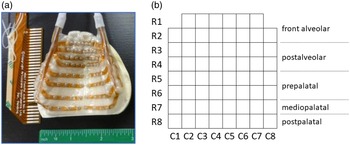
The data were collected via EPG, which uses a custom-made artificial palate with built-in electrodes to track the contact of the tongue and the roof of the mouth. Linguopalatal contact was obtained using the WinEPG system (Wrench et al., Reference Wrench, Gibbon, McNeill, Wood, Hansen and Pellom2002) at a sampling rate of 100 Hz. The acrylic palates, produced by Articulate Instruments (Wrench, Reference Wrench2007), contained 62 electrodes. As shown in Figure 1, the electrodes can be schematically presented as a grid of 8 rows (R1-R8) and 8 columns (C1-C8). Following Recasens and Espinosa (Reference Recasens and Espinosa2006), in terms of place of articulation, the palate was zoned into five regions with the frontmost corresponding to ‘front alveolar’ articulations (such as for the denti-alveolars /t d n/), the backmost corresponding to ‘postpalatal’ articulations (such as for velars /k ŋ/); the latter are expected to have some contact behind the artificial palate as well.
(a) sample EPG palate; (b) schematic grid of the palate electrodes zoned for constriction location (front alveolar, postalveolar, prepalatal, mediopalatal, postpalatal).

2.4 Annotation and Analysis
2.4.1 Annotation
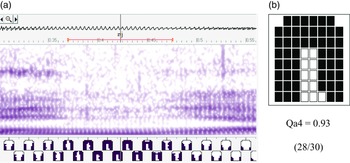
The recordings were annotated using Articulate Assistant (Articulate Instruments Ltd.). As shown in Figure 2, the nasal intervals for target /ɲ/ were labeled from the onset to the offset of the closure, based on the acoustic signal (waveform and spectrogram). The same was done for the control consonants /n/, /n+j/, /k/, and /ŋ/.
A sample annotated token of /ɲ/ including the adjacent vowels /ε/ and /a/ in the word baignade (speaker FQ1): (a) the temporal display including a spectrogram and sequence of palate frames; (b) a palate frame from the midpoint of the nasal interval with mean Qa4 value indicating a front alveolar-postalveolar closure.

2.4.2 Amount of anterior and posterior contact
Measurements of linguopalatal contact were extracted automatically. To quantify the front versus back distinction among the target and control consonants, we calculated the Quotient of activation in the anterior region (Qa4).Footnote 1 This index captures the amount of contact observed in the first four rows (30 electrodes) of the palate (see Fontdevila et al., Reference Fontdevila, Pallarès and Recasens1994). Values are expected to be high for closures made in the dentialveolar and postalveolar regions (as with the /ɲ/ in Figure 2b) but low (or zero) for closures made in the (pre-/medio-/post-)palatal regions. This variable was expected to distinguish fronted /ɲ/ articulations from /n/, with the former typically having more contact (Kochetov and Colantoni, Reference Kochetov and Colantoni2011). Qa4 values were taken at the midpoint of the consonant closure interval. Similarly, values for the amount of contact in the last four rows of the posterior region (Qp4) were extracted to distinguish /ɲ/ from velar /ŋ/ and /k/.
For a subset of the data (the six words mentioned below), we extracted Qa4 and Qp4 values at 20 frames (200 ms) before and after the release of the closure. This was done to examine potential temporal differences between the word-medial /ɲ/, /n/ and /n+j/ in agneau, anneau, and dernier as well as between the word-final /ɲ/, /n/ and /ŋ/ in campagne, aucune, and jogging . Of primary interest was the timing of the palatal gesture for /ɲ/ compared to the sequence /n+j/. For a typical palatal nasal, the timing was expected to be relatively simultaneous with the denti-alveolar gesture for the former while being sequential for /n+j/ (see Recasens and Romero, Reference Recasens and Romero1997). The other consonants were not expected to show timing differences, as they are produced with single gestures – an anterior closure (with simultaneous posterior side contact) for /n/ versus a posterior closure for /ŋ/. Temporal patterns of these consonants were thus used as a baseline for /ɲ/.
2.4.3 Closure location classification
To further refine possible place distinctions within palatal nasal variants as well as to compare the consonant’s articulation to those of control /n/, /n+j/, /k/, and /ŋ/, the midpoint frame of each token of the target and control consonants was classified into general and specific closure location types (see Table 3 for the possible classifications). The general types refer to the region of the frontmost area of the palate that exhibited the closure (see Figure 2). The specific types further refine the distinction by specifying the extent of the closure, namely, whether it was limited to a single area or rather spanned two or more areas (see Recasens and Espinosa, 2006; Reference Recasens and Espinosa2009). The classification was done by manually examining each token for the presence or absence of closure in each row. A closure was defined as the presence of at least three activated electrodes in the four central columns of the palate.Footnote 2 For example, the palate frame in Figure 2b shows four activated central electrodes in rows 1, 2, and 3, and corresponds to sub-type 1.2 ‘front alveolar-postalveolar’. This token is characterized by a fairly fronted realization of /ɲ/ with a closure at least partially spanning two anterior regions. In contrast, sub-type 1.5 would involve a closure beginning in row 1 and ending in row 8, covering the entire palate, while sub-type 5.1 would involve a closure in row 8 alone. All sub-types in the table were present in our data, at least for some consonants and speakers. This includes sub-type 6.1, which consisted of two closures, one in the anterior and one in the posterior region.
Closure location classification categories (‘+’ indicates that the contact can extend to more posterior locations)

2.4.4 Statistical analyses of quantitative data
Extracted Qa4 and Qp4 values at the consonant midpoint (see §2.4.2) were analyzed using linear mixed effects models implemented with the lme4 package (Bates et al., Reference Bates, Mächler, Bolker and Walker2015) using R (R Core Team, 2014). Three separate sets of analyses were performed on both indices including (i) for the palatal nasal across the two positions; (ii) a comparison of the palatal nasal with dental /n/ (in both positions) or /n+j/ (word-medially); and, finally, (iii) a comparison of the palatal nasal with velar /ŋ/ (word-finally) and /k/ (in both positions). For the first analysis, the models included an interaction of fixed effects Variety (European, Quebec) and Position (medial, final); random effects were Phrase Type, Speaker, and Word. The consonant comparison analyses were performed separately for word-medial and word-final position, and included an interaction of fixed effects Variety and Consonant (2 or 3 levels depending on position), and random effects were Phrase Type, Speaker, and Word. (Full models for each analysis are provided in the corresponding subsections of §3.) In each case, likelihood ratio tests were used to compare a full model to a nested model excluding the factor of interest, employing the Anova() function of the lmerTest package (Kuznetsova et al., Reference Kuznetsova, Brockhoff and Christensen2017). Pairwise comparisons and posthoc tests with a Bonferroni correction for multiple comparisons were performed using the phia package (De Rosario-Martinez, Reference De Rosario-Martinez2015). Results were visualized using the ggplot2 package (Wickham, Reference Wickham2009).
3. RESULTS
We present first a qualitative analysis based on closure location classification (§§3.1, 3.2) to provide a general overview of our French participants’ /ɲ/-production patterns. This is followed by a quantitative analysis (§3.2) that focuses on the anteriority and posteriority indices, Qa4 and Qp4.
3.1 Qualitative analysis
3.1.1 Overview
We begin by examining average linguopalatal contact profiles for selected words with /ɲ/. Figure 3 shows such profiles for bai gnade and campa gne, separately for each speaker. Both European French speakers (FE1, FE2) produced the palatal nasal with an anterior closure spanning the front alveolar and postalveolar regions (rows 1-4) as well as with some substantial posterior side contact (as we saw in Figure 2). The Quebec French speakers (FQ1, FQ2) showed some within- and between-speaker variation. FQ1 produced /ɲ/ with an anterior closure (front alveolar-postalveolar, rows 1-3) word-medially, ressembling the production of her European French counterparts, versus a posterior closure (postpalatal, row 8) word-finally. FQ2’s productions differed both from FE1 and FE2 as well as FQ2 word initially, showing a posterior closure (mediopalatal-postpalatal or postpalatal, rows 7-8) in both positions. These results are thus indicative of the considerable inter-speaker variation conditioned by position.
Average linguopalatal contact for /ɲ/ (taken over the entire nasal interval) in bai gnade and campa gne produced in a carrier phrase (four repetitions) by European French speakers FE1 and FE2 and Quebec French speakers FQ1 and FQ2. Note: The greater the mean activation of each of the electrodes, indicated within each cell, the darker the cell.

Turning to the comparison of the palatal nasal to other consonants, Figure 4 compares the realization of /ɲ/ to dental /n/ and the sequence /n+j/ in word-medial position. For the two European French speakers and FQ1, the /ɲ/ in agneau differed from the /n/ of anneau in having a more extensive anterior contact. The profiles of /ɲ/ and /n+j/, however, involve almost no differences: both have extensive anterior closures and increased posterior contact. For these three speakers, word medially, the palatal nasal is essentially identical to the coarticulated /n/, at least in these particular words. The production of /ɲ/ by the last speaker, FQ2, is clearly different from both /n/ and /n+j/, as well as from /ɲ/ produced by the other speakers. Specifically, FQ2’s palatal nasal is produced with a closure in the last two rows of the palate, that is, in the mediopalatal-postpalatal and postpalatal regions.
Average linguopalatal contact (taken over the entire nasal interval) for /ɲ/, singleton /n/ and /n+j/ in agneau /aɲo/, anneau /ano/ and nier /nje/, respectively, produced in a carrier phrase (6-9 repetitions) by European French speakers FE1 and FE2 and Quebec French speakers FQ1 and FQ2.

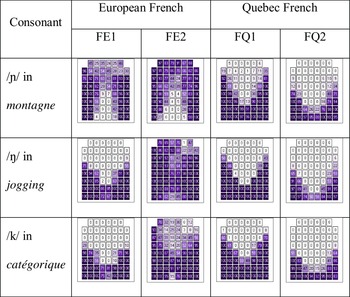
Finally, Figure 5 compares the realization of word-final /ɲ/ with those of word-final velar consonants, /ŋ/ and /k/. For FE1, there is a clear difference between /ɲ/ that involves an anterior closure (front alveolar-postalveolar, rows 1-4) and the velar consonants showing a posterior closure (mediopalatal-postpalatal, rows 7-8). FE2’s /ɲ/ is also produced with an anterior closure, while the velars are strongly fronted, showing extensive contact throughout most of the palate. In contrast, /ɲ/ as produced by both Quebec French speakers involves a posterior closure (mediopalatal-postpalatal, rows 7-8), making it essentially identical to the velars. FQ1’s and FQ2’s realizations of /ɲ/ and /ŋ/ thus involve a (near) lack of contrast, at least in this particular context.
Average linguopalatal contact (taken over the entire closure interval) for /ɲ/, /ŋ/, and /k/ in montagne /mɔ̃taɲ/, jogging /dʒɔgiŋ/ and catégorique /kategɔʁik/ produced in a passage or in isolation (6-9 repetitions) by European French speakers FE1 and FE2 and Quebec French speakers FQ1 and FQ2.

3.1.2 Closure location across consonants
Having reviewed the key patterns in the realization of /ɲ/ and the control consonants across speakers, we are now in a position to provide a qualitative classification of all tokens, following the criteria in Recasens and Espinosa (Reference Recasens and Espinosa2006). Tables 4 and 5 present the proportions of all specific closure location types (see Table 3) for our European and Quebec French speakers, respectively. Consonants are organized by their phonemic place of articulation: dental /n/ and /n/ preceding /j/, palatal /ɲ/, and velar /ŋ/ and /k/.
Proportions of closure types for /n, n+j, ɲ, ŋ, k/ as produced by European French speakers FE1 and FE2; ‘+’ indicates that the contact can extend to more posterior locations (see Table 3); numbers in bold are the most common realizations of consonants

Proportions of closure types for /n, n+j, ɲ, ŋ, k/ as produced by Quebec French speakers FQ1 and FQ2; ‘+’ indicates that the contact can extend to more posterior locations (see Table 3); numbers in bold are the most common realizations of consonants (done by position for FQ1’s /ɲ/)

For our two European French speakers (Table 4), the first three consonants are most commonly realized with an anterior closure spanning the front alveolar and post-alveolar regions (closure type 1.2). Front alveolar-only cases (1.1) were common (more so for FE2); there were also certain instances of more posterior postalveolar closure realizations for FE1’s /n+j/ and /ɲ/. For FE1, /ŋ/ was typically realized with a closure spanning the mediopalatal and postpalatal regions (4.2), occasionally extending into the prepalatal region or being limited to the postpalatal region (3.3 and 5.1). FE2 showed a generally more fronted realization of this consonant, with the closure more often spanning the entire posterior part of the palate (prepalatal-mediopalatal-postpalatal; 3.3). A sizeable portion of tokens were even more fronted, spanning the front alveolar, postalveolar, and prepalatal regions (1.3, 1.4, and 2.4). For both European speakers, particularly FE2, the velar stop showed a more backed articulation than /ŋ/, namely, postpalatal for FE1 (5.1) and mediopalatal-postpalatal for FE2 (4.2), which can be at least partly attributed to the quality of the preceding vowel: whereas /ŋ/ was preceded only by /i/ in camping, /k/ followed both front (/e/ in écarta, /ε/ in bifteck, /i/ in catégorique) and back vowels (/o/ in aucune, /ɔ/ in flocon; see Table 2). Overall, it is clear that the palatal nasal produced by the European French speakers patterns together with dentals and is distinct from velars.
Turning to our Quebec speakers (Table 5), singleton /n/ was most commonly produced by FQ1 as front alveolar (type 1.1), sometimes extending into the postalveolar region (1.2). The same consonant before /j/ was often produced as front alveolar-postalveolar or, less commonly, as front alveolar (1.2 and 1.1, respectively). Note also the considerable number of the ‘other’ type (6.1) of /n+j/ involving simultaneous anterior and posterior closures. For FQ2, the front alveolar-postalveolar realization (1.2) was typical of both variants of /n/ (although singleton /n/ tended to be more fronted). FQ1’s palatal nasal was highly variable, with front alveolar-postalveolar (1.2) realizations being common word-medially, mediopalatal-postpalatal realizations (4.2) common word-finally. Somewhat intermediate realizations (e.g., prepalatal to postpalatal and double closures; 3.3 and 6.1) were observed. While FQ2’s /ɲ/ also showed some variation, closures were always posterior, overwhelmingly spanning the mediopalatal-postpalatal regions or, slightly less commonly, limited to the postpalatal region (4.2 and 5.1). In sum, the realization of the palatal nasal by our Quebec speakers showed individual variation. Depending on position, it patterned either with dentals or velars for FQ1, whereas for FQ2 it patterned with velars (yet often being more fronted). In addition, FQ1 differed from the other speakers in having instances of complex articulations (6.1), in particular, /ɲ/ produced with simultaneous anterior and posterior closures. An example of such a production is the token of grognement shown in Figure 6. Here, the palatal nasal begins with a posterior closure (mediopalatal-postpalatal, rows 7-8) followed by simultaneous closures in the anterior (front alveolar) and posterior (prepalatal-mediopalatal-postpalatal, rows 6-8) regions, ending with a front anterior closure (row 1).
A sample complex closure produced by FQ1: palate frames (every 10 ms) during the nasal closure for grognement.

In sum, the classification results confirm our preliminary observations in the previous section that the palatal nasal was consistently produced by the European French speakers with an anterior closure, being most similar to a coarticulated dental /n/ (/n+j/) and different from the velars. The palatal nasal by the Quebec French speakers was consistently produced with a posterior closure word-finally, thus being similar to velars and different from the dental /n/. The same was observed for the word-medial /ɲ/ produced by FQ1, but not by FQ2 whose pattern in this position was more akin to the European French speakers.
3.2 Quantitative analysis
In the quantitative analysis, we examine statistical differences in the amount of contact in the anterior (Qa4) and posterior regions (Qp4) of the palate first across positions for /ɲ/ (§3.2.1), then compare this consonant to anterior /n/ and /n+j/ (§3.2.2) followed by the velar control consonants (§3.2.3). Finally, we examine temporal differences in amount of contact for selected words with intervocalic /ɲ/ and /n/ (§3.2.4) in order to determine whether the differences observed are maintained when measured beyond the consonant midpoint.
3.2.1 Palatal nasal across positions
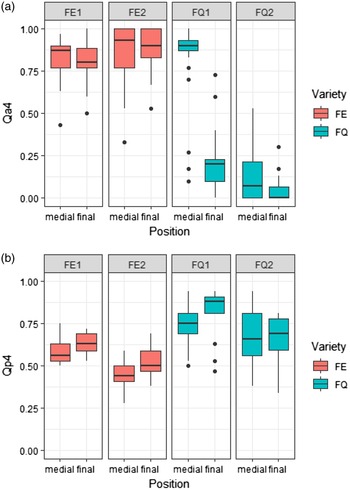
LMER models were performed for both Qa4 and Qp4 with the fixed effects Variety (European, Quebec) and Position (medial, final), and with random effects Phrase Type (isolated, carrier, passage), Word, and Speaker. As shown in Table 6a, the results for Qa4 yielded significant effects of Variety and Position, as well as a significant interaction of the two. This interaction suggested the existence of differences between positions for one of the two varieties and/or varietal differences specific to one of the positions. This was confirmed by the results of posthoc tests: significantly higher values were observed for medial than for final position but only for Quebec French (p < 0.0001). Values were also higher for European than Quebec French but only in final position (p < 0.0001). These differences were due to the fact that /ɲ/ was produced with an anterior closure by European French speakers in contrast to the Quebec French speakers’ either anterior (word-medially by QF1) or posterior closures (across the board by QF2 and word-finally by QF1). These differences are evident in Figure 7a, which shows Qa4 values (medians and 75% confidence intervals) by Position and Variety, separately for each speaker. We can see, in particular, that anterior contact values are high for FE1, FE2, and – medially – FQ1, and are low for FQ2 and – finally – FQ1.
Model comparisons for (a) Qa4 and (b) Qp4 for /ɲ/ by various factors (Analysis of Deviance Table, Type II Wald χ2 tests, significance levels: ‘***’ <.001, ‘**’ <.01, ‘*’ <.05). [Anova() based on the model: lmer(Qa4/Qp4 ∼ Variety * Position + (1|Type) + (1|Speaker) + (1|Word), data, REML = FALSE)]

Boxplots displaying the amount of contact for /ɲ/ in the (a) anterior (Qa4) and (b) posterior (Qp4) regions of the palate by Position and Speaker.

The results for Qp4, summarized in Table 6b, revealed a significant effect of Variety: the posterior contact values were significantly higher for Quebec French speakers compared to the European French speakers (Figure 7b). Position was not significant, nor the interaction of Position and Variety. The effect of Variety is not surprising because, as we have seen, Quebec French /ɲ/ was produced with a posterior rather than anterior closure, exclusively word-finally and variably word-medially.
3.2.2 Palatal nasal versus anterior /n/ and /n+j/
Two LMER models were performed here: one comparing all three consonant conditions (/ɲ/, /n/, /n+j/) in word-medial position, the other comparing /ɲ/ and /n/ in word-final position. The fixed effects were Variety and Consonant, while random effects were Phrase Type, Word, and Speaker.
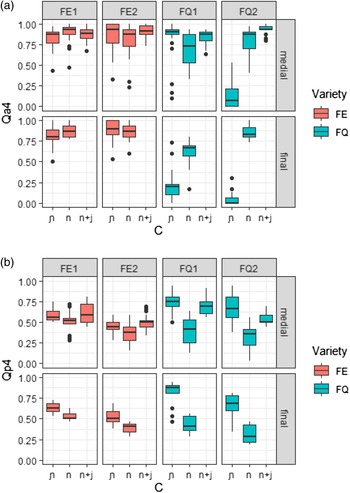
As shown in Table 7a, the results for Qa4 for word-medial position yielded significant effects of Variety and Consonant as well as a significant interaction of the two. The latter interaction suggests that there were differences between consonants for one of the two varieties, and/or varietal differences specific to certain consonants. The top panel in Figure 8a illustrates the different patterns exhibited by the two pairs of European and Quebec French speakers. As was revealed by posthoc tests, consonant differences were limited to the pairs /ɲ/-/n/ and /ɲ/-/n+j/ (both p < 0.001), as produced by the Quebec French speakers. The between-varieties differences were limited to /ɲ/ (p < 0.001). Both effects, however, appear to have been driven by the extremely low values for FQ2’s /ɲ/ (as seen in the top panel of Figure 8a).
Model comparisons for /ɲ/ versus /n/ and/or /n+j/ for Qa4 in (a) word-medial and (b) word-final positions, and for Qp4 in (c) word-medial and (d) word-final positions (Analysis of Deviance Table, Type II Wald χ2 tests, significance levels: ‘***’ <.001, ‘**’ <.01, ‘*’ <.05). [Anova() based on the model: lmer(Qa4/Qp4 ∼ Variety * C + (1|Speaker) + (1|Type) + (1|Word), data_medial/final, REML = FALSE)]. C: Consonant

Boxplots for amount of contact in the (a) anterior (Qa4) and (b) posterior (Qp4) regions of the palate by Consonant (/ɲ/ versus anterior /n/ and /n+j/), Position, and Speaker; note that /n+j/ occurs only word-medially.

The results for final position, shown in Table 7b, also revealed significant effects of Variety and Position, and a significant interaction of the two. As seen in the bottom panel of Figure 8a, the interaction was due to the considerably lower Qa4 values for Quebec French /ɲ/, compared to the same consonant for European French, as well as compared to /n/ for both groups. Posthoc tests confirmed that the observed Consonant (/ɲ/ > /n/ for FQ) and Variety differences (FE > FQ for /ɲ/) were significant (both p < 0.001). The lack of differences between the European French /ɲ/ and the control consonants in both analyses is not surprising, as the former segment showed a consistently anterior closure. The lower values for /ɲ/ for Quebec French compared to the other consonants was also expected given this segment’s posterior or variable closure.
With respect to Qp4 in word-medial position (shown in Table 7c), there was a significant effect of Variety and a significant interaction of Variety and Consonant. Posthoc tests revealed that greater posterior contact was observed for /n+j/ than for /n/ in both varieties (p < 0.05 for FE, p < 0.001 for FQ) as well as for /ɲ/ than /n/ for Quebec French (p < 0.001). The greater posterior contact for /n/ preceding /j/ was clearly due to the anticipatory coarticulation of the nasal. These differences are evident in the top panel of Figure 8b. Of interest to note is that the difference between /ɲ/ versus /n/ was not significant in European French, neither was the difference between /ɲ/ versus /n+j/ in both groups. In addition, the amount of posterior contact was greater for Quebec French than European French (p < 0.01).
The results for Qp4 in word-final position (shown in Table 5d) were similar with a significant effect of Consonant and a significant interaction of Variety and Consonant. Posthoc tests revealed that /ɲ/ was produced with more posterior contact than /n/ by both European (p < 0.05) and Quebec French speakers (p < 0.001). This is evident in the bottom panel of Figure 8b. In addition, /ɲ/ was produced by Quebec French speakers with more posterior contact than the same consonants by European French speakers (p < 0.05). Much more contact for /ɲ/ than /n/ in Quebec French was due to the posterior closure of the former consonant. The same factor explains the varietal difference. It should be noted that while word-final /ɲ/ and /n/ in European French were significantly different in terms of their posterior contact, on average, values were higher than expected for FE2 for the former consonant (as would be expected based on previous work on palatals including Kochetov and Colantoni, Reference Kochetov and Colantoni2011; Recasens, Reference Recasens2013).
In sum, the word-medial /ɲ/ produced by the European French speakers did not differ significantly from their /n/ and /n+j/ in terms of anterior and posterior contact. The word-medial palatal nasal produced by Quebec French speakers, in contrast, did differ from both variants of /n/ in anterior contact, and from singleton /n/ in posterior contact. In word-final position, the European French /ɲ/ showed somewhat higher posterior contact than singleton /n/, while no anterior contact difference was observed. The Quebec French /ɲ/ showed less anterior contact but more posterior contact than /n/, clearly confirming the velar realization of the former consonant.
3.2.3 Palatal nasal versus velars
Two LMER models were performed for the comparison of /ɲ/ with velars: one for word-medial position (/ɲ/ versus /k/), the other for word-final position (/ɲ/ versus /ŋ/ and /k/). Fixed effects were Variety and Consonant, while random effects were Phrase Type, Word, and Speaker. As shown in Table 8a, the results for Qa4 for medial position yielded significant effects of Consonant and a significant interaction of Consonant and Variety. As seen in the top panel of Figure 9a, the interaction was due to the extremely low values for FQ2’s /ɲ/ (given its velar realization). As the other three speakers showed a robust contrast between /ɲ/ and /k/, posthoc tests revealed significant consonant differences for both groups (both p < 0.001).
Model comparisons for /ɲ/ versus /ŋ/ and /k/ for Qa4 in (a) word-medial and (b) word-final positions, and for Qp4 in (c) word-medial and (d) word-final positions (Analysis of Deviance Table, Type II Wald χ2 tests, significance levels: ‘***’ <.001, ‘**’ <.01, ‘*’ <.05). [Anova() based on the model: lmer(Qa4/Qp4 ∼ Variety * C + (1|Speaker) + (1|Type) + (1|Word), data_medial/final, REML = FALSE)]

Boxplots for amount of contact in the (a) anterior (Qa4) and (b) posterior (Qp4) regions of the palate by Consonant (/ɲ/ versus posterior /k/ and /ŋ/), Position, and Speaker; note that /ŋ/ occurs only word-finally.

The results for final position produced significant effects of Variety and Consonant as well as a significant interaction of the two. As seen in the bottom panel of Figure 9a, Qa4 values for the Quebec speakers were very low for all three consonants. In contrast, values for the European French speakers were the highest for /ɲ/ and lowest for /k/, with /ŋ/ being either similar to or more fronted than the latter consonant. Posthoc tests revealed significant 3-way differences for the European French speakers (all p < 0.001) yet no such differences for the Quebec speakers. Not surprisingly, /ɲ/ produced by the European French speakers showed significantly higher values than for the Quebec French speakers (p < 0.001). The difference between the two groups in /ŋ/ (more contact for European French) also reached significance (p < 0.05).
Considering Qp4 differences in word-medial position (Table 8c), there was a significant effect of Variety and a significant interaction of Variety and Consonant. This interaction was due to the overall higher values for Quebec French /ɲ/ than for the same consonant produced by the European French speakers (p < 0.001); no between-group difference was observed for /k/. This can be seen in the top panel of Figure 9b. Of interest is the considerable variation shown in the realization of the velar stop by all speakers. This is likely due to the different vowel contexts for the medial /k/: preceding back /ɔ̃/ (flocon), central /a/ (écarta), and front /y/ (aucune).
For Qp4 in word-final position (Table 8d), there was a significant effect of Consonant and a significant interaction of Variety and Consonant. Posthoc tests revealed that significant consonant differences were exhibited by the European French group only, with /ŋ/ and /k/ having higher posterior contact values than /ɲ/. There were no significant between-group differences. These results can be observed in the bottom panel of Figure 9b.
In sum, these comparisons further confirm that the palatal nasal was produced by the European French speakers very distinctly from the velars, while the same consonant produced by the Quebec French speakers was either different from velars (word-medially, due to FQ1) or not significantly different from those consonants at all (word-finally).
3.2.4 Temporal properties of the palatal nasal
The previous sections have established that our European French speakers produced /ɲ/ very similarly to /n/ before /j/, as did FQ1 in word-medial position. On the other hand, FQ2’s /ɲ/ showed essentially no difference in contact with the velar nasal /ŋ/. The same was observed for FQ1 in word-final position. The measurements we used for those analyses were based on a single time point, the consonant midpoint, as determined via the spectrogram. It may well be, however, that these contrasts are still maintained if differences in contact occur beyond the midpoint. To address this, in this section, we supplement the midpoint data reported previously, with dynamic contact patterns that capture the changes in posterior contact (Qp4) over the entire consonantal interval including the consonant and the preceding/following vowel. Specifically, in the case of speakers who maintain a distinction between the palatal nasal and the sequence /n+j/, we should expect very similar Qp4 trajectories. However, the posterior contact peak should be timed later for those speakers who articulate the sequence as such. Similarly, we might expect that FQ1 and FQ2 should show Qp4 overlapping trajectories, whereas European speakers should have a lower peak for the palatal nasal and a higher peak for the velar nasal.
To examine these possibilities, Figure 10 plots Qp4 values for /ɲ/ and /n+j/ over time, sampled every 10 ms before and after the offset of the closure determined via the spectrogram (indicated as ‘0’). The selected interval begins 8 frames before this offset, which is approximately the duration of an average word-medial nasal closure (80 ms); it ends 15 frames later, which includes the following vowel. For FE1, the palatal gestures for /ɲ/ and /n+j/ are very similar, both in magnitude (amount of contact) and timing with respect to the consonant offset (peaking close to the offset). The timing is also similar for FE2, while the palatal gesture for the sequence is somewhat greater in magnitude throughout. For FQ1, the gestures pattern very differently while being of similar magnitude. Qp4 values for /ɲ/ peak at the midpoint of the consonant closure, whereas values for /n+j/ peak at the offset, as was the case for the European French speakers. FQ2 exhibits essentially the same pattern as FQ1, despite the different realizations of closures (posterior versus anterior) for the two speakers. Overall, the two varieties, as represented by our speakers, differ in the relative timing of the /ɲ/ palatal gesture, which is roughly sequential for European French speakers and simultaneous for Quebec French speakers. This also shows that the similarity between /ɲ/ and /n/ preceding /j/ for European French speakers is not limited to the consonant midpoint: the contrast between the two consonants is largely (if not completely for FE1) neutralized. This is clearly not the case for FQ1 in this position (and obviously for FQ2).
Temporal frame-by-frame trajectories of posterior contact (Qp4) for (a) word-medial /ɲ/ and /n+j/ and (b) word-final /ɲ/ and /ŋ/ by Speaker, based on all tokens for each position; the function geom_smooth() using method = ‘loess’ and formula ‘y ∼ x’.

Turning now to the comparison of /ɲ/ and /ŋ/, temporal patterns for the two consonants are presented in Figure 10b. The selected interval begins here 20 frames before the consonant, which would include a part of the preceding vowel and the consonant closure, which was on average 120 ms. The interval ends one frame after the offset of closure (point ‘0’). The robust differences we see for the European French speakers are not surprising, as these correspond to very different articulations – an anterior closure for /ɲ/ versus a posterior closure for /ŋ/, preceded by a high front vowel /i/. Nevertheless, the peak for /ɲ/ is asynchronous, again timed at the consonant offset. The peak for /ŋ/, in contrast, occurs towards the consonant midpoint. The patterns observed for the Quebec French speakers are the opposite of those observed in European French: the palatal gesture for /ɲ/ peaks towards the consonant midpoint and is overall very similar in magnitude to the gesture of /ŋ/ (albeit somewhat higher for FQ2). The latter gesture begins earlier, which is expected given the preceding high front vowel. Overall, once again, these results demonstrate two distinct timing patterns – sequential for European French versus simultaneous for Quebec French. What is new compared to the findings vis-à-vis /ɲ/ and /n+j/ is the apparent neutralization of /ɲ/ with /ŋ/ for our Quebec French speakers as we observed also at consonant midpoint. This neutralization is possibly incomplete (at least for FQ2), something that cannot be conclusively determined based on the current data given the different vowel contexts for the two consonants.
4. DISCUSSION
Our study provides a detailed qualitative and quantitative analysis of the production of /n ɲ ŋ/ and the sequence /n+j/ in both hexagonal and Quebec French. To our knowledge, this is the sole published articulatory study of the three nasals as produced in either variety. The analysis of our EPG data reveal a number of patterns in the production of the French palatal conditioned by variety, speaker, position in the word, and phrase type. Inter-varietal differences included the more anterior versus more posterior articulations in European and Quebec French, respectively, the latter varying by position and speaker. Specifically, our European French speakers’ production of /ɲ/ and /n+j/ was highly similar both word-medially and word-finally, both having extensive anterior closures and increased posterior contact, as were FQ1’s realizations in word-medial position. In contrast, no difference in contact were observed between the palatal and velar nasals produced by FQ2. For our Quebec French speakers, the degree of posteriorization as measured by Qp4 was also conditioned by Phrase Type (carrier sentences versus passage). When measured with Qp4, there was greater posterior contact in Quebec French except when compared to /n+j/. In this variety, as measured by Qa4, /ɲ/ involves a posterior (mediopalatal-postpalatal) closure, which makes it essentially identical to velar /ŋ/ and /k/ in this respect. There was, however, a slightly greater anterior contact than the phonemic velars, also observed to a greater extent in the European French speakers’ realizations. The temporal analysis comparing /ɲ/ to /n+j/ and /ŋ/ revealed further differences, namely, in terms of the timing of the palatal gesture. Specifically, it is roughly sequential for our European French speakers and simultaneous for the Quebec French speakers. Finally, overall, our European French speakers’ palatal nasal patterns together with dentals and is distinct from velars. In contrast, the Quebec speakers’ production of /ɲ/ showed individual variation conditioned by position: with QF1, it patterned with dentals or velars; with QF2; it patterned with velars although was realized with a more anterior articulation. QF1 differed from the three other speakers, producing /ɲ/ with simultaneous anterior and posterior closures.
4.1 Hypothesis Evaluation
Our hypothesis predicted an interaction of variety and position in the realization of palatal nasals. Following Walter (Reference Walter1977, Reference Walter1982), we predicted /ɲ/ to be realized as [nj] intervocalically and as [ɲ] word finally in European French. This was partially confirmed, since realizations of the palatal nasal as a sequence were frequent in intervocalic position for both speakers. However, contrary to our prediction, fronted sequences were also found word finally. In Quebec French, we also expected to find a position-based asymmetry, with more lenited variants in word-final than in word-medial position. This part of the hypothesis is rejected. Both speakers had velar realizations, which could be interpreted as a form of lenition.Footnote 3 Velar realizations, however, were not more frequent in word-final position, but patterns were speaker-speccific. Indeed, FQ1 velarized word medially, whereas FQ2 had velar realization in both positions.
4.2 Comparison with previous articulatory studies
Our study contributes to previous literature by showing that European French speakers have fronted realizations of the palatal nasal, which are not clearly distinct from a nasal+glide sequence, including in word-final position. This contrasts with both Walter’s (Reference Walter1977: 34) observation and previous articulatory studies using static palatography and X-ray studies (Gendron, Reference Gendron1966; Recasens, Reference Recasens2013), which revealed that Parisian French speakers had mostly palatal realizations. The realizations observed here resemble the patterns reported in articulatory (Kochetov and Colantoni, Reference Kochetov and Colantoni2011) and acoustic studies (Bongiovanni, Reference Bongiovanni2021) of Buenos Aires Spanish, where palatal nasals appear to have merged with sequences of an alveolar nasal+palatal glide.
Our Quebec French speakers showed different patterns. Instead of fronting, we witnessed velarization either generalized (FQ2) or conditioned by position (FQ1). Thus, on the one hand, our results differed from the weak fronting observed by Gendron (Reference Gendron1966). On the other hand, the velarization patterns reported in our study could be interpreted as a path towards the nasalized palatal glide reported by Gendron (Reference Gendron1966) or the nasalized approximant observed in Shosted et al.’s (Reference Shosted, Hualde and Scarpace2012) Brazilian Portuguese study. Our results, however, are not consistent with gliding or approximantization since we observed that the Quebec speakers’ velar realizations of the palatal nasal did not differ from velar nasals or velar stops in the amount of posterior contact. The presence of velar variants in our Quebec but not European speakers’ production might also be related, in part, to the existence of a larger number of velar allophonic variants including of the palatal nasal in the former variety (§1.1). Walker (Reference Walker1982) had already argued that the allophonic variation between syllable-final [ɲ] and [ŋ] in words like signe and enseignement in this variety could be seen as a step toward phonemicization of the latter. In parallel to the possible greater allophonic variation in Quebec French, if we contextualize the results here vis-à-vis those from other studies that we have conducted on various consonantal phenomena using data from the same corpus highlighted in the Introduction, a pattern of possibly greater lenition in Quebec French consonant production begins to emerge. Specifically, we have previously found lesser contact in the production of /t/ and, especially, /d/ word finally in Quebec French (Colantoni et al., Reference Colantoni, Kochetov and Steele2022); in across-word /n/+consonant sequences, lesser contact in the production of /n/ before alveolars by the Quebec French speakers (Steele et al., Reference Steele, Colantoni and Kochetov2019); and with respect to the degree of contact reduction in coda versus onset-/l/, the presence of reduction in anterior contact in Quebec but not European French as well as more consistent reduction of posterior contact in the former variety (Colantoni et al., Reference Colantoni, Kochetov, Steele, Skarnitzl and Volín2023).
4.3 Within-variety variability in Quebec French
In the previous section, we forwarded possible explanations for the between-variety differences. Here, we seek to advance possible explanations for the differences observed between our two Quebec French speakers. The first possibility is that our two speakers are representative of two different sub-varieties. Whereas FQ1 came from the city of St-Jean-sur-Richelieu in the southwest of the province near Montreal, FQ2 was from Chicoutimi (now Saguenay) in the Saguenay-Lac-St-Jean region near Quebec City. These cities belong to distinct dialectal regions within Quebec French, a western region centered on Montreal versus an eastern region located around Quebec City (e.g., Poirier, Reference Poirier and Poirier1994; Bergeron, Reference Bergeron1995; Verreault and Lavoir, Reference Verreault, Lavoie, Mercier and Cajolet-Laganière2004). Differences in phonetic realization between the two zones have been attested including historically with rhotic variants (the apical trill [r] in the West versus the velar/uvular [R] in the East; e.g., Vinay, Reference Vinay1950) and the loss of the pre-rhotic /e/-/ɜ/ contrast (e.g, père /peʁ/, paire /pɜʁ/), maintained to a greater extent in the East (Saint-Amant Lamy, Reference Saint-Amant Lamy2021). A second possibility is that the inter-speaker variation attested is not dialectal but rather sociolectal or even idiolectal. Given the number of participants in this study, in particular, one each of western and eastern Quebec French, it is not possible to determine whether the variability attested between FQ1 and FQ2 represents dialectal or rather idiolectal variation.
4.4 Pathways to depalatalization in Quebec French: Comparison with other Romance varieties
The realizations of the palatal nasal observed in our four speakers mirrors the variability reported in other Romance varieties. The realization of the palatal nasal as an alveolar nasal+glide sequence resembles the patterns reported in Buenos Aires Spanish for some of the participants in Kochetov and Colantoni (Reference Kochetov and Colantoni2011). In contrast to what was observed in Buenos Aires Spanish where the possible merger between /nj/ and /ɲ/ would involve either fronting of the palatal nasal or full palatalization of the sequence, only the former was observed in European French. Quebec French speakers displayed patterns of depalatalization that resembled those reported in Brazilian Portuguese (Hajek, Reference Hajek1997; Shosted et al., Reference Shosted, Hualde and Scarpace2012) in which, instead of fronting, one finds backing that may result in nasalized palatal glides. As we mentioned, the consonant in Quebec has clear constriction in the velar region, and, as such, we did not observe signs of approximantization, in contrast to Gendron’s (Reference Gendron1966) occasional finding of a nasalized palatal glide [j̃] word medially in agneau. Consistent with previous studies on changes affecting the palatal nasal, we see a relatively high degree of variability, particularly in velarization across positions. The individual variation observed here is relatively small compared, for example, with the degree of interspeaker variability reported in Argentine Spanish (Colantoni and Kochetov, Reference Colantoni and Kochetov2010): in this study, one participant maintained the distinction, another speaker had only palatal realizations of underlying palatals and sequences, and the two remaining speakers produced fronted palatals.
4.5 Limitations and future directions
As highlighted earlier, while the size of the dataset analyzed here is not atypical of EPG studies, the findings would benefit from further investigation and replication. This would include a more controlled data set in terms of vocalic context (see e.g., Haden’s (Reference Haden1938: 70–71) articulatory study for the effects of vocalic context on palatal nasal place of articulation) and a more diverse group of speakers, particularly as concerns their age. If the differences between our European and Quebec speakers are indeed related to different pathways towards depalatalization, an apparent-time study of potential change in progress involving speakers of different generations is of interest. Moreover, as discussed in the Introduction, many previous studies have commented on within-variety variation. Having a larger number of speakers per variety would also allow to determine whether the differences observed between our two Quebec French speakers are due to idiolectal variation or rather are more sociolinguistic in nature, conditioned by variables such as regional variety.
Acknowledgments
We thank all of our participants for their participation, Isabel Garriga and Nayoung Ryu for their assistance with the data annotation, the audience at the Montreal-Ottawa-Toronto (MOT) Phonology/Phonetics Workshop 2022, as well as three anonymous reviewers and the editor for their valuable feedback.
Funding
This work was partly funded by an Insight Grant from the Social the Sciences and Humanities Research Council of Canada (#435-2015-2013) to Alexei Kochetov and a University of Toronto Faculty of Arts and Science Advancing Teaching and Learning in Arts and Science (ATLAS) grant to the three authors.
Competing interests
The authors declare none.









 Open access

