

Let’s start with a climate change status check to clarify where matters stand today.
Real, Anthropogenic, and Dangerous
The first three things to understand about climate change are that it is real, anthropogenic, and dangerous. I will review briefly why we are confident that those statements are true, but if you have serious doubts about any of them, this is not (yet) the book for you. I suggest you stop browsing here and consider instead a book that delves more deeply into the basics of climate change, such as The Climate Crisis by Archer and Rahmstorf.
For those of you still with me, let’s start with “real.” There is virtually no remaining scientific debate in peer-reviewed journals on the question of whether climate change is happening, and there has not been for at least a decade. Outside the US, this may seem too obvious a point to belabor, but particularly with the White House so recently occupied by a brazen climate denier, there remain lingering pockets of doubt in America. The lack of continuing debate in the scientific community as to whether this phenomenon is real is not because climate scientists are closed-minded or colluding in a global conspiracy to destroy capitalism and justify their research grants. Instead, it is because, as that debate has run on for decades, the evidence on one side has become overwhelming, while on the other side, it has collapsed. Former climate skeptics have either changed their minds or retired. As is the way with most emerging scientific consensus, graduate students newly entering the field without a dog in the fight listen to both sides and vote overwhelmingly with their research topic choices for one or the other. What was a raging debate in one generation becomes a rout in the next as – paraphrasing Max Planck – “science advances one funeral at a time.” That is where we stand on the basic question of whether climate change is real.
“But wait,” you may think. “I just saw a well-coifed and very excitable talking head on cable news say the opposite.” Generally, that person is not a scientist, or if they are, not with recent peer-reviewed publications on this topic. They are often paid indirectly by fossil fuel interests to cultivate confusion that justifies inaction and are therefore more nearly climate lobbyists than climate researchers. Surveys of relevant peer-reviewed literature regularly conclude that the percent of academic consensus on the man-made climate change phenomenon is in the mid-to-high 90s, which is to say nearly unanimous (more on this in Chapter 19). Not only has the rise in global average surface temperature been measured directly and extensively all over the world by generations of scientists from every inhabited continent, but as we will see in Chapter 2, given the increased concentration of greenhouse gases in the climate system, it would be difficult to explain how it could fail to be happening. Since the beginning of robust and global direct temperature measurements in 1880, the increase has been roughly 1.2°C, with more to come.1 That is also roughly the temperature increase since the more commonly referenced “preindustrial baseline,” so we will consider these two baselines to be the same baseline, in line with data from the US National Oceanic and Atmospheric Administration.2
As for “anthropogenic,” it is equally clear that the cause of this 1.2°C increase (we will deal mostly in metric units herein, but that’s about 2.16°F) has been human activity. This is due mostly to the combustion of fossil fuels to produce energy, but owes also to increased emissions of methane deriving from fossil fuel extraction, animal husbandry, cement production, rice farming, and other economic activity necessary both to accommodate modern industrial life and feed a human population that has increased almost eight-fold since 1800.3 Greenhouse gas (GHG) emissions also occur naturally, but before industrialization natural sources and natural sinks (the opposite of sources, where GHGs are removed from the climate system) had struck a rough balance that contributed to general climate equilibrium. It is the addition of myriad human GHG sources with virtually no new human generated sinks that has thrown the Earth’s climate out of equilibrium and precipitated the general warming.
“Dangerous” is not the same as “definitely really horrible.” Despite all the reasons why I believe we should fear the impacts of climate change, it may turn out all right. We may find low-cost, low-risk solutions. Economic growth may outpace climate damages such that we can adapt easily to a warmer world. Disastrous tipping points may not materialize. Think about it this way – it’s possible that driving at double the speed limit on a foggy night while drunk will turn out just fine. But the whisky, haste, and low visibility greatly enhance risks that would otherwise be quite manageable. Accommodating more than 10 billion people by 2100 on a planet that had just 1 billion 300 years earlier will prove very difficult in any circumstance. Doing so while simultaneously baking the planet with carbon dioxide levels it has not experienced for at least 800,000 to a few million years will substantially increase the risk of things going terribly wrong.4
What Do We Know, and How Do We Know It?
The Intergovernmental Panel on Climate Change (IPCC) is a global group consisting of representatives from nearly 200 governments who work with hundreds of the world’s leading climate researchers to assess the issue of climate change. It was established in 1988, the same year in which American climatologist James Hansen warned the US Senate about the existence and dangers of climate change. If there is a year before which climate change can be seen as accidental and after which it should be considered an act of commission, it is 1988. The IPCC’s task was, and still is, to provide the world with comprehensive and objective assessments of the existence, causes, and impacts of climate change.
The IPCC’s First Assessment Report (FAR) was issued in 1990 to inform the Rio Earth Summit, which was the world’s first major conference bringing together world leaders (rather than merely scientists) to consider the accelerating issue of climate change. The US delegation was led by President George H. W. Bush, who as a transplanted Texan and former oil patch wildcatter was reflexively skeptical of initiatives that might undercut the fossil fuel industry, but as a former CIA Director was also respectful of analysis and open to science. The FAR stated with certainty that “there is a natural greenhouse effect that already keeps the Earth warmer than it would otherwise be” and that “emissions resulting from human activities are substantially increasing the atmospheric concentrations of the greenhouse gases.”5 It observed that global mean surface air temperature had increased by between 0.3 and 0.6°C over the previous hundred years and would keep rising substantially thereafter until and unless humanity eliminated greenhouse gas emissions. Nonetheless, the report was careful to account for uncertainties and did not stretch to infer what had not yet been proven. It noted that the indeterminacies in respect of future temperature increases derive not merely from unresolved questions of physics and chemistry but even more materially from lack of clarity about whether and how quickly humanity may respond to this problem. If humanity continued with “business as usual” emissions, temperatures could increase by 0.3°C per decade, whereas if emissions reductions were undertaken as an urgent priority, that decadal rate could be cut to 0.1°C. It further noted with scrupulous modesty that “while the size of the warming over the last century was broadly consistent with the prediction by climate models, … it is also of the same magnitude as natural climate variability.” In other words, the warming was real, but its cause was at that time uncertain. “The unequivocal detection of the enhanced greenhouse effect from observations is not likely for another decade.”
Since then, the IPCC has issued additional assessments every six or so years, with each one advancing its confidence in attributing the observed warming to human causes. In 1996, the Second Assessment reported that the “balance of evidence suggests discernable human influence on climate.” The Third Assessment in 2001 noted “stronger evidence that observed warming over last 50 years is due to human activities.” The 2007 version stated that it is “more than 90 percent likely that warming since 1950 is due to human activity.”
In the fifth and most recent assessment in 2014 (the “AR5”), the IPCC stopped mincing words on attribution. “Human influence on the climate system is clear, and recent anthropogenic emissions of greenhouse gases are the highest in history.” Note the word “clear,” with no qualifiers – a large departure from the intentionally equivocal First Assessment.
Broadly consistent with its predecessors, the AR5 is the work product of over 800 scientists and climate experts from 80 countries, and quite literally every word, graph, and figure in the document is the product of years of negotiation among the participants.6 In respect of observed changes in the climate system, it states “Warming of the climate system is unequivocal, and since the 1950s, many of the observed changes are unprecedented over decades to millennia. The atmosphere and oceans have warmed, the amounts of snow and ice have diminished, and the sea level has risen.”
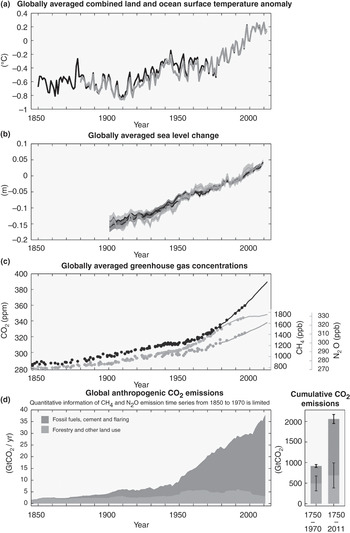
In the preliminary discussions leading to this book, my future editor, in trying to assess the level of academic rigor that I intended, asked, “Do you expect your readers to engage with graphs?” The answer was “yes” (though mercifully, I hope, not with equations). Below from the AR5 is Figure 1.1, consisting of four line graphs. They combine to tell a compelling story, the broad strokes of which are immediately plain; the lines go up and to the right.
Trends in observed indicators of climate change over the past two centuries.
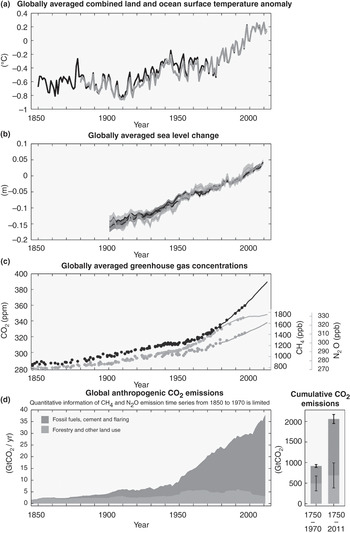
Figure 1.1(a) shows globally averaged land and surface temperature variations from 1850 through 2012. Note that the rise is not steady, with the overall slope essentially flat from 1850 through about 1920. Only thereafter is there a clear upward trend for about 25 years followed by a plateau from about 1945 through about 1970. Then we see another steady march upward through the mid-2000s, bracketed by what appeared to be the beginning of another plateau. Climate skeptics had a field day with that most recent mini-plateau claiming that warming had stopped, only to have that argument crumble as temperatures in the last several years have made their largest annual leaps to date.8
Figure 1.1(b) shows sea level rise, one of the key impacts of climate change. Unlike (a), there is little nuance in (b). Sea levels have been rising steadily since 1900. This is as one would expect, since the enormous thermal inertia of the oceans causes them to respond to longer term trends rather than annual or even decadal variability in air temperatures.
Figure 1.1(c) shows the increased concentration levels of the three most problematical greenhouse gases; from top to bottom carbon dioxide (CO2), methane (CH4), and nitrous oxide (N2O). The concentrations of each in the atmosphere vary substantially, requiring a separate scale for each gas. All three rose slowly before 1950 and more rapidly thereafter, though methane’s trajectory slowed relative to the other two after about 1990. Note that this graph measures concentrations, not emissions, not how much we are newly pumping out each year, but the total stock of these gases in the atmosphere.
Figure 1.1(d) shows the opposite – emissions rather than concentrations – segregated broadly by two sources. The mid-gray layer at the bottom shows emissions deriving from forest clearance, agriculture, and other land management practices. It experienced a modest rise and fall between 1950 and 2000, but by 2012, it is scarcely changed from 1850 levels. On the other hand, emissions from industrial activities went from near zero in 1850 to roughly equal to land management emissions by 1910 to roughly 10 times it by 2012. This is to say that land use changes matter, but the gushing spigot we have turned on since World War II is decidedly from fossil fuel combustion and other industrial processes.
Summarizing the meaning of these figures, the AR5 states
Anthropogenic greenhouse gas emissions have increased since the pre-industrial era … and are now higher than ever. This has led to atmospheric concentrations of carbon dioxide, methane, and nitrous oxide that are unprecedented in at least the last 800,000 years. Their effects … have been detected throughout the climate system and are extremely likely [italics theirs] to have been the dominant cause of the observed warming since the mid-20th century.
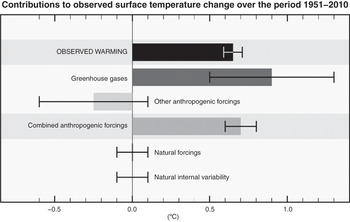
“Extremely likely” in this context requires a confidence interval in excess of 95 percent, the justification of which would have required extensive documentation and analysis. Part of that justification is shown in Figure 1.2, which is a “box and whiskers” chart that quantifies the net contributions to the warming observed since 1950.
Contributions to observed surface temperature change over the period 1951‒2010.
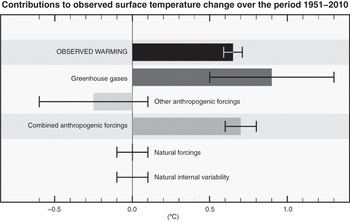
The observed warming (what we have actually measured irrespective of causes) shown in the topmost thick horizontal bar (a “box” in this parlance) is roughly 0.65°C, two thirds of a degree and also roughly two thirds of all the warming that has been observed since the preindustrial baseline. The remaining boxes then seek to determine whether that observed warming can be explained via the causal factors as we understand them. Note that each box is accompanied by a thin horizontal line with brackets (the “whiskers”), which clarifies the level of certainty we have in the quantity expressed by the box. In the case of observed warming, the whiskers are pretty short; we have a high degree of confidence in our data here.
The second box from the top shows the heating our models would predict given the quantity of greenhouse gases we have emitted and notes that these should have caused warming of more nearly 0.9°C – considerably more than the observed warming. That might present a conundrum but for the third box, which illustrates that about 0.25°C of the warming we would expect is being masked by other anthropogenic forcings, primarily the veil of air pollution that shrouds many parts of the Earth and blocks some incoming sunlight. If these two countervailing forcings are netted against each other (fourth box from top), we get almost exactly the warming actually observed – a neat explanation.
However, it should be noted that the whiskers associated with the second and third boxes are quite wide, indicating substantial remaining uncertainty as to exactly how to weigh these two offsetting forcings relative to each other. The final two boxes (not the wider whiskers) are nearly invisible, meaning that the natural contribution to the observed warming is essentially zero. All the observed warming can be attributed to human causes.
The IPCC reports are the most authoritative and influential of global climate assessments, prepared as they are by as broad and diverse a swath of the international climate community as one could hope to assemble. The conclusions they express are widely echoed by national and regional climate assessments around the world. The European Commission reiterates the IPCC’s assessment that the unprecedented rate of global warming is driven by humans and our consumption of fossil fuels.10 Separately, the United Kingdom’s national academy of sciences – the Royal Society – notes that “Human emissions over the last two centuries have altered the composition of the Earth’s atmosphere”11 and are expected to continue to drive further warming. In its Paris Agreement target statement, China acknowledges that human activities have significantly exacerbated climate change due to greenhouse gas generation.12 The Government of Japan’s “Long Term Strategy” under the Paris Agreement similarly recognizes and bases its planning on the assessments of the IPCC. Even two years into the Trump administration, the US Global Change Research Group’s Fourth National Climate Assessment (2018) stated “Earth’s climate is now changing faster than at any point in the history of modern civilization, primarily as a result of human activities.” Other climate action-hesitant nations such as Australia still recognize the threat they confront, with the Australian National Climate Science Advisory Committee noting in 2019 that Australia’s “prosperity and security depends on our ability to anticipate, manage and prevent the economic, social and environmental impacts of climate change and variability in Australia and our region, from the short term and through to the end of the century and beyond.”13
The most fundamental conclusions expressed in the IPCC AR5 are virtually undisputed within the serious science community. To review, those are that the greenhouse effect is real; that human additions to the stock of greenhouse gases in the climate system will warm the planet absent countervailing factors; that warming of approximately 1.2°C has occurred since the preindustrial baseline; and that human activity is responsible for nearly all of that warming. This book will be published to roughly coincide with the release of the next IPCC Assessment Report, the AR6. This sixth assessment will deepen our understanding about a great many things, but will not contradict the consensus on any of these basic points.
What We Don’t Know
Despite the high degree of scientific confidence the world has in the IPCC’s conclusions, the climate story is far from fully understood and many uncertainties remain. The climate experiment upon which we have embarked by dramatically altering the composition of our atmosphere has no analog in human history, or for a very long time before that. The brute force physics of how greenhouse gases will heat the climate system is clear, but how much the shrinking of the polar ice cap will warm the Arctic Ocean, or how much permafrost will be melted by a 2°C warming, or how European weather will change if the Gulf Stream slows – these are all factors characterized by high ranges of uncertainty. In layman’s terms, unfortunately that means we are guessing. Sober and highly informed estimations, rest assured, by some of the most brilliant minds of our era – but guesses all the same. The climate system is an extremely complex mechanism governed by countless highly interdependent variables, and as we simultaneously spin so many of the dials to settings with no precedent in the human era, we simply lack the knowledge to accurately predict the outcomes.
Many of the most frightening unknowns related to our runaway climate experiment entail “tipping points.” Imagine a marble rolling slowly on a perfectly flat surface, but towards a lip beyond which the slope increases to 45 degrees. If the marble is stopped anywhere before the lip, the status remains stable and the marble may remain at rest. However, if the marble passes the lip, the state changes dramatically and inexorably. The marble plunges toward the bottom of the slope to a very different state. Tipping points are most forceful in the presence of some positive feedback mechanism (vicious/virtuous cycles), whereby the more matters progress in a given direction, the more momentum there is to continue in that direction. For example, Arctic sea ice reflects sunlight back out from the Earth, helping to keep the region cool. However, as global temperatures increase and the ice cap shrinks, reflective ice is replaced by dark, heat-absorbing seawater, which results in further warming and more ice melt. Once started, the self-reinforcing trend is very difficult to stop.
What makes such tipping points particularly scary is that we may only recognize them after we have passed them and the marble is hurtling down the ramp, by which time it may be too late to reverse course. We are too new at this climate roulette to know where the thresholds may lie, which constitutes abundant reason for caution.
However, it should be noted that tipping points are also the standard stock of climate scaremongering, where perhaps well-meaning climate activists ring alarms about invisible thresholds that we cannot accurately discern. That doesn’t necessarily mean they are wrong, but rather, that we need to acknowledge the continuing uncertainties. In some cases, we know there is a tipping point, but we don’t know where it is. In other cases, we may not recognize the existence of such a point until we are well past it. To quote Harvard’s Dr. Daniel Schrag, it is as if we are canoeing down an unexplored river on a very dark night with no paddles. “If there are waterfalls ahead, we are going over them.” A profoundly scary thought.
A less dramatic but equally vexing uncertainty is “climate sensitivity,” which seeks to calibrate how much the climate will respond to a given increase in greenhouse gas concentrations. This math was first worked out by one of the early pioneers of climate science before the turn of the century – the twentieth century! In 1896, Swedish scientist Svante Arrhenius calculated that if the concentration of greenhouse gases in the atmosphere were doubled, it would increase global average surface temperatures by 4°C.14 He was unaware of many of the feedback loops involved, but his math wasn’t far off. Furthermore, the “doubling of CO2 concentrations” yardstick that Arrhenius devised by which to estimate climate sensitivity remains the primary convention to this day. By 1979, an ad hoc study group chaired by MIT meteorologist Jule Charney reported to the US National Research Council that the probable global warming for a doubling of atmospheric CO2 would be near 3°C with a likely margin of error plus or minus 1.5°C.15 Charney’s 1.5°C–4.5°C range was repeated in the first IPCC Assessment Report16 and was still unchanged by the fifth17 – a remarkably durable estimate despite all the advances in climate modeling that have obtained over the last four decades.
The reason for trepidation in respect of this number is that while Arrhenius chose a doubling of greenhouse gases as a round but somewhat arbitrary metric, we appear on track to do exactly that, in this century. The preindustrial concentration of CO2 in the atmosphere was roughly 280 parts per million (ppm),18 a number that would have changed little by Arrhenius’ time. Today it stands at over 410 ppm,19 and is increasing by an average 2.5 ppm per year.20 At that rate, we would surpass 560 ppm (double 280) in 2070. There is of course no certainty that we will continue to increase at 2.5 ppm per year, but the arguments for a faster rate are nearly as compelling as those for a slower one.
At the bottom end of the temperature sensitivity range, a 1.5°C response to a doubling of CO2 would be scandalously good news. 1.5°C is the “stretch goal” to which the Paris Agreement urges us to limit climate change, so if we can continue our emissions profligacy through at least 2070 and still adhere to that target, we would have dodged a bullet indeed (or at least arranged that a future generation be shot instead). However, if our current climate sensitivity range is to be believed, then an equally likely temperature outcome in 2070 would be 4.5°C – an amount of change that is widely seen as catastrophic. For context, at the glacial maximum of the last ice age roughly 20,000 years ago, the Earth was just 6°C cooler than the preindustrial baseline,21 so a 4.5°C change would be a big deal indeed. Very recent research has proposed new ranges with center points above 3.0°C,22, 23 suggesting that, if anything, the Charney range was biased low and painted too rosy a picture, but it is not yet clear whether the IPCC will change its assessment in the coming AR6 Report. Nonetheless, the fact that decades of post-Charney research on climate sensitivity have barely clarified whether the path we are on will lead to little noticeable change (1.5°C) or widespread ecosystem collapse and human calamity (4.5°C) is cause for dread indeed.
And yet, for all the scientific unknowns discussed above, the greatest cause of climate uncertainty in the latter half of this century is not tipping points or climate sensitivity, but human action. The reasons why humankind should fear dramatic climate change are numerous and awesome, and while it may turn out just fine, the consequences of the opposite eventuality are so dire that the precautionary principle screams that we should rapidly mitigate emissions and steer onto the safest possible trajectory. That could happen. However, while the collective incentives to reduce emissions are enormous, the individual incentives are nearly non existent. In a variant on the prisoner’s dilemma problem, the individual interest regarding emissions reduction is opposite the collective interest. It is to each person’s selfish advantage to continue to derive the benefits of cheap energy while exhorting their neighbor to mitigate. Perhaps renewable energy sources and net zero pledges will save us, but it is also easy to imagine that we continue for quite a while on the “business as usual” emissions path. The climate trajectory of the only planet we have hangs in the balance as to which path humanity chooses, and the outcome is anyone’s guess.
Which brings us to where we started this chapter, with a twist. I hope you are with me that climate change is real, anthropogenic, and dangerous. But it is also coming. In a big way. More of it than most people realize. We will not entirely avoid it. The available choices on the future climate change menu will range from “a lot” to “way too much,” but one entrée no longer on offer is “none.” I have arrived at my conviction on this topic in part via scientific analysis and in part via social science judgment, but I am clear that substantial climate change is our future. The remainder of the first two sections of this book will be devoted to leading you to the same conclusion.
We must strenuously urge the world to opt for less climate change rather than more, or at minimum, to ensure that if mankind chooses to continue its fossil fuel binge, this is an informed choice with a clear understanding of the odds and likely consequences. But in addition, we need to prepare for such climate change as is inevitably coming. That’s where climate intervention comes in.