





Introduction
Liberal democracies are currently facing a significant challenge due to the emergence of right-wing populist parties and anti-democratic movements. In Germany, this phenomenon is exemplified by the rise of the Alternative für Deutschland (AfD) party, which advocates a nationalist and potentially anti-democratic agenda (Klikauer, Reference Klikauer2020). Comparable developments are evident in other European countries (Halikiopoulou, Reference Halikiopoulou2018). Political science scholars have identified a pervasive anti-democratic, illiberal drift in Europe that exploits xenophobic sentiment and employs anti-European and anti-establishment rhetoric to gain momentum (Dabrowski, Reference Dabrowski2021). These illiberal parties and movements often seek to erode liberal democratic institutions and hamper progressive forces of civil society (Hummel, Reference Hummel2022). Hence, political science scholars associate them with democratic backsliding, which is a subtle and gradual process of centralizing power and weakening democratic institutions, such as independent media or the legal system (Waldner & Lust, Reference Waldner and Lust2018).
In the context of these political conditions, the defense and resilience of democracy have become a pressing issue (Lührmann & Merkel, Reference Lührmann and Merkel2023). In this respect, the question arises which institutions could effectively promote pro-democratic values and attitudes. One potential response to this question pertains to the concept of civil society, which refers to the intermediary domain between the private sphere and the state. Civil society constitutes itself through a multitude of non-governmental voluntary associations (VAs) and grassroots initiatives—from interest groups and organized neighborhood assistance to music, hobby, and sports clubs.
In line with the classical theorizing of Tocqueville (Reference de Tocqueville2001 [1835]) and the research on social capital in modern societies (Putnam, Reference Putnam1993), we subsequently posit that the domain of civic associations may serve as a means of reinforcing pro-democratic attitudes. Ample research has examined the general notion that associations could function as “schools of democracy” (e.g., Dahl & Abdelzadeh, Reference Dahl and Abdelzadeh2017; Lee, Reference Lee2022; McFarland & Thomas, Reference McFarland and Thomas2006; Mutz & Nobis, Reference Mutz and Nobis2012; Nur-tegin, Reference Nur-tegin2021; Quintelier, Reference Quintelier2008; Rasmussen & Reher, Reference Rasmussen and Reher2019; van der Meer & van Ingen, Reference van der Meer and van Ingen2009; van Ingen & van der Meer, Reference van Ingen and van der Meer2016), thereby offering a potential remedy to the crisis of democracy. Our analysis will focus on sports clubs as the most prevalent type of VAs in Germany. Sports clubs are an interesting, yet also unconventional, test case for the “schools of democracy” assumption, because they neither promote a political ideology nor follow a social mission. Hence, they are not inherently political.
Some previous studies have already examined the relation between membership in sports clubs and political attitudes, but with inconclusive findings. A few findings buttress the “schools of democracy” thesis (Ibsen et al., Reference Ibsen, Elmose-Østerlund, Feiler, Breuer, Seippel, van der Roest and Scheerder2019; Nobis, Reference Nobis2011), while a majority of studies do not find a significant relationship (McFarland & Thomas, Reference McFarland and Thomas2006) or come up with mixed results (Lee, Reference Lee2022; Quintelier, Reference Quintelier2008; Rotolo et al., Reference Rotolo, Kirkpatrick Johnson and McCall2020; Seippel, Reference Seippel2006). Therefore, Jaitner (Reference Jaitner2019) rather skeptically concludes that most research presented rather delegitimizing results to the “schools of democracy” framework.
In our view, a key problem with the state of research is that studies usually assume a general effect for sports club members, thereby treating all sports clubs as equal. However, the assumption that all sports clubs produce the same effects for all members is not particularly convincing. In this article, we argue that sports clubs can differ significantly in terms of their club cultures and thus provide very different contexts for shaping political attitudes of members. Likewise, members may be involved in a club in very different ways—or depths—and thus be influenced by the club context to varying degrees. Therefore, in order to estimate whether sports clubs affect political and democratic attitudes, an empirical approach should take into account at least some of the specificities of the club’s culture as well as the degree of involvement of the members. This line of argument leads to the central research question of this article: What influence does the club culture of a sports club have on democracy-related political attitudes of its members? We explore this question based on representative survey data from Germany.
Theoretical framework
The concept of civic associations as “schools of democracy” has a long history in sociological theory. Since Tocqueville’s (Reference de Tocqueville2001 [1835]) seminal essay on American civic and democratic culture, the notion has gained considerable traction that civil self-organization, as manifested in the form of local, decentralized, and pluralistic associations and groupings, constitutes a fundamental pillar of democracy. Building on this theorizing, scholars have emphasized the proposition that a dense network of associations could serve as a prerequisite for a stable and resilient democracy (Hirst, Reference Hirst2002; Putnam, Reference Putnam1993). For instance, Putnam (Reference Putnam1993) posited that membership in civic associations is characterized by regular face-to-face interactions that facilitate the development of solidarity or trust and foster the formation of attitudes that contribute to cooperation, norms of reciprocity, or a concern for the common good. This view of democracy aligns with participatory conceptions of a direct democracy (e.g., Barber, Reference Barber2003) that emphasizes the ideal of citizens who are competent and motivated to engage: such a participation could start within the daily surroundings and in the “small world” of sports clubs but may then spill over to a broader political sphere. Thereby, VAs could serve as a conduit for the transmission of democratic values and behaviors.
Moreover, due to their heterogeneous membership, VAs may establish regular interactions between different social groups, thereby generating “bridging social capital” (Putnam, Reference Putnam2001). This particular form of social capital is considered most important, not only for democratic participation but also for societal cohesion in plural societies, as it generates social trust with a wider radius (Burrmann et al., Reference Burrmann, Braun and Mutz2020). In Putnam’s view, these functions also apply to leisure associations, such as sports clubs and singing groups.
However, the proposition that civic associations, such as sports clubs, could foster democratic attitudes and behaviors is predicated on a number of underlying assumptions. First, there is an assumption that civic associations promote a democratic culture—not only in a formal way, but also as a lived practice in their club activities. Hence, club activities should facilitate engagement, cultivate deliberative practices, and transmit democratic values, so that the association can fully exploit their potential to encourage their members to become actively involved in club life and club politics. Second, there is a socialization assumption, which suggests that members, when participating in club activities, become increasingly acquainted with these democratic values and practices. However, the extent to which a democratic culture is established can vary from club to club, just as the depth of involvement in such a culture can vary from member to member (Ibsen et al., Reference Ibsen, Elmose-Østerlund, Feiler, Breuer, Seippel, van der Roest and Scheerder2019). Third, there is a transfer assumption, which suggests that the lessons learned in the context of an association can be generalized and would then spill over to a broader political and institutional sphere (Suh et al., Reference Suh, Chang and Lim2012). Should these assumptions prove accurate, belonging to VAs could foster citizens who are dedicated to democratic principles, prepared to engage politically, and have a keen interest in the community and its current affairs. However, all these assumptions are far from evident.
Associational culture(s)
Although civic associations are formally organized in a democratic way, this does not necessarily mean that they have established a democratic club culture or foster democratic behaviors (Lundberg, Reference Lundberg2023). It is also possible that some clubs are characterized by asymmetry of power, formation of long-standing loyalties, exclusion of outsiders, practice of nepotism, or negotiation of club policies behind the scenes. Scholars have summarized these practices with concepts such as “unsocial capital” (Levi, Reference Levi1996) or “dark social capital” (Baycan & Öner, Reference Baycan and Öner2023). Particularly, sports federations and sports governance are often accused of being prone to corruption, nepotism, and lack of transparency (Numerato & Baglioni, Reference Numerato and Baglioni2012).
However, the mere absence of corruption or nepotism within a sports club does not necessarily imply that the club promotes and exemplifies democratic principles. Historically, many of the German sports clubs had their origins in the 19th-century gymnastics movement, which promoted a nationalist political agenda of German unity and identity, while other traditions in the German club culture are rooted in the Catholic milieu or in the socialist workers’ culture (Krüger, Reference Krüger2013). Given that neither of these historical traditions was pro-democratic, the notion of sports clubs as “schools for democracy” has a rather short history. More recently, sports clubs have been classified as an inward-oriented, expressive type of organization (Burrmann et al., Reference Burrmann, Braun and Mutz2019; Gordon & Babchuk, Reference Gordon and Babchuk1959) and thus rather apolitical in nature. Consequently, a sense of belonging, solidarity, and gemeinschaft in sports clubs primarily arises from shared sporting practices rather than from shared ideologies or a shared “social mission.” From this viewpoint, sports clubs may be apolitical in nature, thus tending to avoid serious political debates in club life. Under these conditions, the idea of clubs as “schools of democracy” is less convincing, and a more thorough examination of club culture is thus worthwhile.
Defining club culture is a complex and challenging endeavor. We adopt a concept from Schein (Reference Schein1990), where organizational culture is conceptualized as a specific set of collectively shared practices, values, and basic assumptions that influence the thoughts and actions of a group, particularly in shaping its perceptions of what is right and desirable. Certain aspects of organizational culture are evident through observable practices, while attitudes and values can be explored through questionnaires and interviews. Only the deeply ingrained, unquestioned basic assumptions within an association are especially difficult to measure. In order to gradually grasp them, a deeper and longer process of immersion into the organization is often essential (Schein, Reference Schein1990). Our approach is thus concerned with one specific layer of culture—attitudes and values—that has a long-standing tradition in organizational studies (e.g., Hofstede, Reference Hofstede1991).
Previous studies have operationalized different facets of club culture and have shown that cultural variables are relevant for different outcomes. For example, a culture of conviviality is associated with fewer organizational problems (Wicker & Breuer, Reference Wicker and Breuer2013), a culture of sociability could enhance member commitment (Schlesinger & Nagel, Reference Schlesinger and Nagel2015), and a culture of assimilation impedes integration of immigrants (Buser et al., Reference Buser, Adler Zwahlen, Schlesinger and Nagel2022). Similarly, the proposition that sports clubs could serve as incubators of democratic values is more convincing when assumed that the club culture itself is democratic and inclusive, encouraging the discussion of political topics and allowing for member participation (Ibsen et al., Reference Ibsen, Elmose-Østerlund, Feiler, Breuer, Seippel, van der Roest and Scheerder2019).
Depths of involvement
Beyond the association’s culture, any political socialization process also depends on individual characteristics, mainly the degree of individual involvement in the club and its culture (Lee, Reference Lee2022). The nature of an association membership can vary considerably from one individual to another. Involvement may range from brief and superficial encounters, as in the case of a person who simply trains in a sports club a few times a month, to long term and profound, as in the case of a person who spends a significant proportion of time in the club. Conceptions of socialization have emphasized that socialization is a process over time, driven by sequences of events, episodes, and experiences that cumulate in learning and adjustment (Ashforth, Reference Ashforth and Wanberg2012). Hence, long-term and deeper involvement may be a prerequisite for individual change. Hence, we need to distinguish between different depths of involvement. By this, we mean the differences in time investment, long-term commitment, engagement, and active participation that characterize and differentiate individual club memberships (Braun et al., Reference Braun, Hansen, Ritter, Schwalb and Walk2007).
Socialization thus has a temporal and an activity-related dimension and occurs primarily within the context of concrete social relationships, characterized by direct interaction and mutual orientation between individuals (Grundmann, Reference Grundmann2006). The nature of social interactions, however, can vary considerably in terms of depth, frequency, and duration. They may be shallow, infrequent, and brief, or deep, regular, and long term; accordingly, socialization outcomes will markedly differ. In his reflections on moral development, Durkheim (Reference Durkheim2022 [1895]) uses the concept of “moral density” to illustrate how the frequency and proximity of social interactions within a group enable group members to internalize the established moral values of that group more effectively. Applied to the topic of this study, it can be assumed that any socializing influence in sports clubs is also contingent upon the frequency and duration of social interaction within this specific context and that any social influence on the individual is supposedly greater in the case of a deeper level of involvement.
An additional socializing mechanism is reliant upon the existence of social roles. Roles always require that individuals internalize normative and behavioral expectations associated with these roles and engage in tasks or functions that are significant within that context (Newman & Newman, Reference Newman, Newman, Newman and Newman2020). Sports clubs as well as other VAs have often been characterized by the existence of many non-professional volunteer roles and honorary positions that facilitate informal learning (Duguid et al., Reference Duguid, Mündel and Schugurensky2013). Volunteering is thus another path through which members of sports clubs could become influenced. Several studies on political attitudes and behaviors have already provided findings suggesting that volunteers differ from passive VA members in terms of their higher levels of political interest and more active political behaviors (Dahl & Abdelzadeh, Reference Dahl and Abdelzadeh2017; Mutz & Nobis, Reference Mutz and Nobis2012; Quintelier, Reference Quintelier2008).
The present study
These theoretical considerations allow us to derive some hypotheses and address more general research questions that refer to the person, the environment, and the interaction of both.
-
1. We argue that the very nature of the environment is crucial and that particularly the sports club’s culture—in terms of participation and debating opportunities—matters on the side of the club. It is within such an associational culture that members are encouraged to exchange opinions, develop their capacity to engage in political discourse, pursue their own initiatives, and effectively participate in the club’s decision-making processes. Hence, we hypothesize that pro-democratic attitudes are more likely to be found in sports clubs that members perceive as (a) open for political discussions and (b) encouraging for participation and member initiatives.
Club cultures can also emphasize sociability or diversity and inclusion, i.e., the openness toward underrepresented groups. These aspects relate to the interconnectedness and heterogeneity of members and could also be beneficial for democratic attitudes, such as tolerance of differing opinions and worldviews. Hence, we assume that pro-democratic attitudes are more likely found in sports clubs that emphasize (c) sociability and (d) diversity.
-
2. Building on the premise that socialization requires time and engagement (Ashforth, Reference Ashforth and Wanberg2012), we argued that “depth of involvement” matters. Precisely, the time commitment, the duration of club membership, and the willingness to volunteer or take on club functions can be relevant aspects that initiate and promote (political) socialization processes. Therefore, we hypothesize that pro-democratic attitudes are more likely to be found among those sports club members who (a) spend more time in the club, (b) are long-standing club members, (c) regularly take on voluntary tasks, or (d) hold an honorary position.
-
3. Considering both lines of reasoning, it can further be assumed that an influence on political attitudes is stronger when deeper involvement of an individual matches with a pro-democratic club culture. We therefore formulate a general expectation: interaction effects are likely to appear whenever two specific characteristics of variables coincide, namely one variable that captures a greater depth of involvement and one that points to a pro-democratic club culture. In such cases, the outcome could be more than the sum of the main effects.
Methods
Design
The present study was part of the German research project “Socio-political attitudes in sport organizations” that aims to compare a broad range of politics- and society-related attitudes between sports club members and non-members. To achieve this, the project uses cross-sectional, quantitative data from a survey representing the German population aged 13 years and older. The research group conducted this survey in collaboration with Verian, an institute with a strong reputation in the field of political opinion polling. Verian maintains a representative sample of individuals (N ≈ 170.000) who are willing to be interviewed. Due to an “invitation only” policy for recruiting these panelists, the sample largely corresponds to the socio-demographic composition of the German resident population, with regard to the federal states, age, gender, and educational degrees.
The data collection took place from June 11 to June 28, 2024. Participants in the study were invited by email from these panelists. Verian contacted adolescents aged 13 to 17 through their parents, who were already registered in the panel. Participants were informed about the topics of the survey, i.e., civic participation and political attitudes, and could then voluntarily decide to take part in the survey. They could complete the questionnaire anonymously and on a variety of mobile devices. We designed the questionnaire to take 15 minutes to complete, with the option to stop and continue at a later time. The questionnaire covered VA memberships and political and society-related attitudes, such as political interest, satisfaction with democracy, social trust, and various forms of group-focused enmity.
From 3206 interviews that were conducted, a small proportion of 157 interviews showed conspicuous response patterns, including very brief response times or a lack of variance in attitude items (e.g., so-called speeder and straightliner). These cases were excluded from the data set. After data cleansing, the final data set contained N = 3,049 valid cases.
Sample
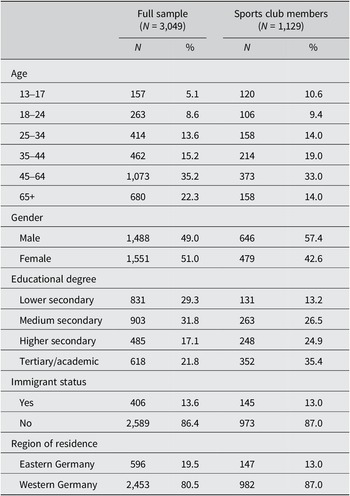
As the overall aim of the study was to compare sports club members and non-members, it was necessary to include an appropriate number of sports club members in the survey that would enable differentiated descriptions of this particular group. This was achieved by intentional “oversampling” of sports club members. Precisely, after surveying a representative sample of 2,744 individuals, we additionally questioned another 305 members of sports clubs. The resulting sample of 3,049 cases included 1,129 sports club members. Hence, analyses that aim to describe the entire German population use the full sample of 3,049 individuals and apply a weighting factor that adjusts the proportion of sports club members to non-members. Analyses that solely focus on sports club members are based on unweighted data of 1,129 individuals. Table 1 describes the full sample and the sample of sports club members according to age, gender, education, immigrant status, and residence in Eastern Germany (incl. Berlin) and Western Germany. The overall distribution according to socio-demographics shows that the sample reflects the German resident population very well. The only difference is that the proportion of individuals with a migration background is slightly lower in the sample than in the population.
Sample characteristics
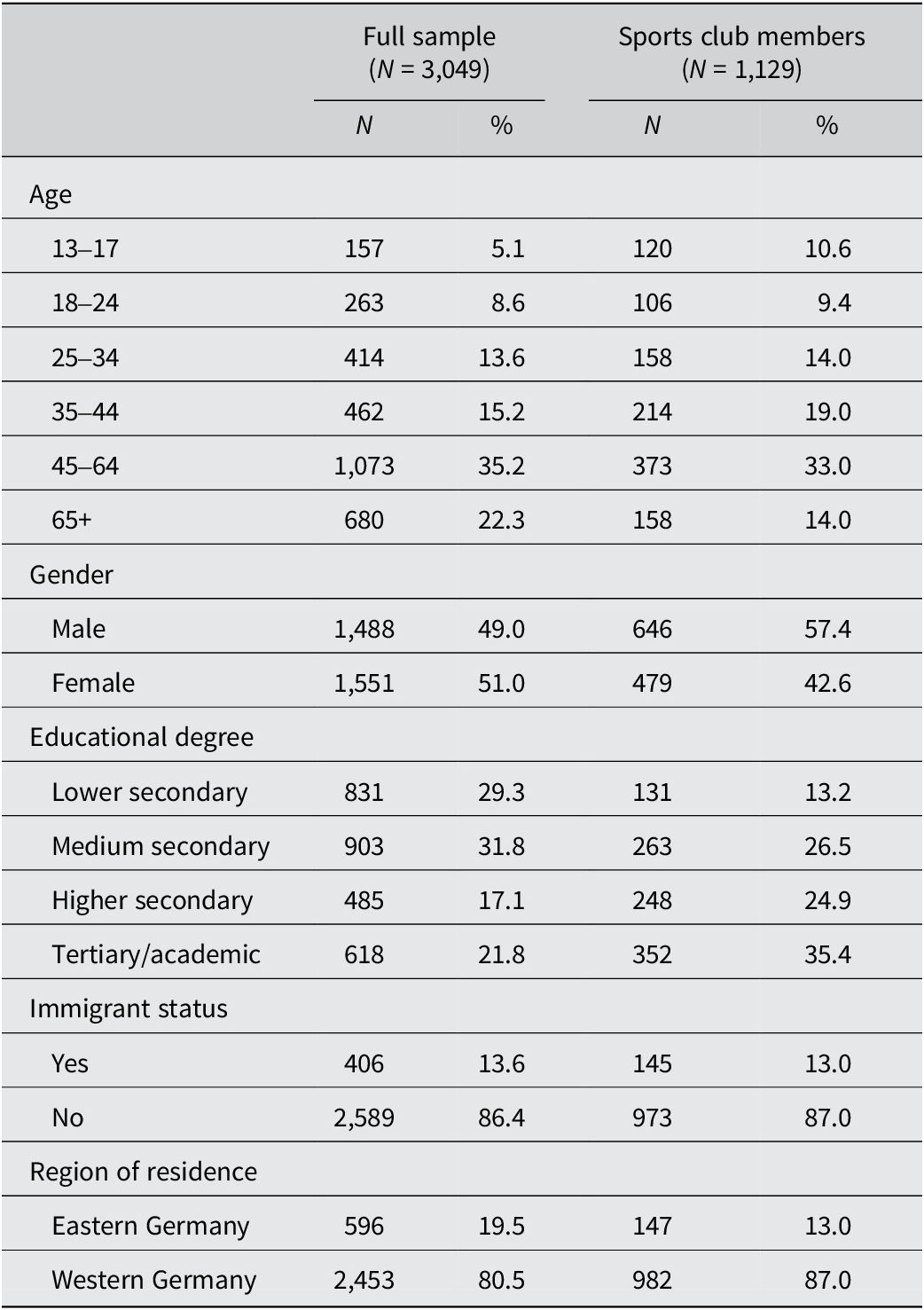
Table 1. Long description
Starting from the top, the table header divides into two main groups: Full sample with N equals 3,049 and Sports club members with N equals 1,129. Each group has columns for N and percent. The first section is Age, with subcategories 13 to 17 years (full sample: 157, 5.1 percent; sports club: 120, 10.6 percent), 18 to 24 (263, 8.6 percent; 106, 9.4 percent), 25 to 34 (414, 13.6 percent; 158, 14.0 percent), 35 to 44 (462, 15.2 percent; 214, 19.0 percent), 45 to 64 (1,073, 35.2 percent; 373, 33.0 percent), and 65 plus (680, 22.3 percent; 158, 14.0 percent). Next is Gender, with Male (1,488, 49.0 percent; 646, 57.4 percent) and Female (1,551, 51.0 percent; 479, 42.6 percent). Educational degree follows: Lower secondary (831, 29.3 percent; 131, 13.2 percent), Medium secondary (903, 31.8 percent; 263, 26.5 percent), Higher secondary (485, 17.1 percent; 248, 24.9 percent), and Tertiary or academic (618, 21.8 percent; 352, 35.4 percent). Immigrant status is Yes (406, 13.6 percent; 145, 13.0 percent) and No (2,589, 86.4 percent; 973, 87.0 percent). Region of residence is Eastern Germany (596, 19.5 percent; 147, 13.0 percent) and Western Germany (2,453, 80.5 percent; 982, 87.0 percent).
Dependent variables
In order to capture a broad range of democracy-related attitudes, we focus in this article on four outcome variables: political interest, political efficacy, cosmopolitan orientations, and satisfaction with democracy (for details, see Appendix, Table A1).
-
• Interest in politics serves as a crucial indicator of the extent to which citizens engage with the political process. It reflects the degree to which they prioritize politics as a subject worthy of their attention. We assess respondents’ interest in politics with the following question: “How much are you interested in politics?” Response categories included (1) not at all, (2) hardly interested, (3) quite interested, and (4) very interested.
-
• Political self-efficacy refers to the individual’s conviction to have the capacity to engage with and influence political processes. This encompasses a range of abilities, including the capacity to comprehend political issues and to participate in political activities effectively (sample item “I understand important political issues very well”). We measure political self-efficacy with a three-item scale (adapted from Beierlein et al., Reference Beierlein, Kemper, Kovaleva and Rammstedt2012). Response categories ranged from (1) strongly disagree, (2) somewhat disagree, (3) somewhat agree, to (4) strongly agree. The scale’s reliability is good (Cronbach’s α = 0.83).
-
• Cosmopolitan orientations refer to a benevolent attitude toward social diversity. It was defined as a willingness to become involved with “the Other,” whereby individuals are seen less as the bearers of a different culture but rather as persons who—detached from cultural particularities—deserve equal respect (Ossewaarde, Reference Ossewaarde2007). Individuals who score higher on cosmopolitanism are more open to differing opinions and perspectives and can more easily tolerate differences in worldviews. We measure cosmopolitanism with three items (adapted from Pietzonka & Kolb, Reference Pietzonka and Kolb2021). A sample item is “I still enjoy being with others, even if they do not share my own views and beliefs.” Response categories included (1) strongly disagree, (2) somewhat disagree, (3) somewhat agree, and (4) strongly agree. The scale has an acceptable reliability (Cronbach’s α = 0.76).
-
• Satisfaction with democracy relates less to the constitutional norm and more to the constitutional reality, i.e., the actual state of democracy in the country. Satisfaction with democracy can be influenced by perceptions of the functioning of democratic institutions and processes, such as fair elections and free media. Additionally, the performance of the government in addressing and solving problems can also influence these ratings. We assess respondents’ rating of democracy with the standard survey question “How satisfied or dissatisfied are you with democracy as it exists in Germany?” Respondents rated their answer from (1) very dissatisfied, (2) rather dissatisfied, (3) rather satisfied, to (4) very satisfied. We want to emphasize that a low level of satisfaction with the state of democracy is a warning sign for the political system, but not evidence of anti-democratic attitudes.
Independent variables
We analyze associations of our four outcome variables with club memberships and, in terms of sports club members, with the individual depth of involvement in the club and the perceived sports club’s culture.
-
• To assess club memberships, participants were asked about existing memberships in VAs (“Are you currently a member of one or more of the following clubs or associations?”). To answer this question, respondents had to select all memberships that applied to them from a list of 15 different types of associations, such as a sports club, cultural association, political party, or charitable association. As our analysis aims to make specific conclusions for the group of sports club members, we compare (1) sports club members, (2) members of any other non-sports civic association, and (3) non-members, i.e., respondents who neither hold a membership in a sporting nor a non-sporting association.
To further explore the potential role of personal involvement, more detailed questions were addressed to all those who reported a current sports club membership.
-
• Participants indicated their duration of membership, i.e., how long they had been a member of the respective sports club. They could choose response options from (1) less than 1 year, (2) up to 3 years, (3) up to 5 years, (4) up to 10 years, to (5) more than 10 years.
-
• Respondents also provided information about their time commitment (“In a typical week, how much time do you spend in the club?”). Response options ranged from (1) less than 1 h/week, (2) about 1 h/week, (3) about 2 h/week, (4) 3 to 5 h/week, to (5) >5 h/week.
-
• Participants should also indicate whether they regularly and actively participate in club activities (“I take part actively in club life”) or engage as volunteer in the club either informally (“I help out regularly”) or formally (“I hold an honorary position”). Although only applying in few cases, respondents could also indicate when they worked as a professional for this club (“I hold a professional position”). If none of these statements applied, participants were asked to indicate this, too. We conceive this latter group as “passive members.” “Active members” take part in club life; “volunteers” additionally either help regularly or hold an honorary position. We also subsumed 12 sports club members holding a professional position in this group.
Perceived club culture was examined with four scales that capture different facets of an association’s culture that could possibly influence members’ democracy-related attitudes (for details, see Appendix, Table A2). Response categories for all items presented below included (1) strongly disagree, (2) somewhat disagree, (3) somewhat agree, and (4) strongly agree. The four scales were calculated as the mean score of the individual items.
-
• Participation and initiative refer to a club culture that provides members with opportunities for participation and co-determination, affords them the chance to assume responsibility, and encourages following initiatives and novel ideas. These are essential qualities for a flourishing democracy, which is why such a club culture should fundamentally promote pro-democratic attitudes. We measure a culture of participation with three items, e.g., “In my club, you can really have a say in decisions” (adapted from Baur and Braun, Reference Baur and Braun2003). The scale has an acceptable reliability (Cronbach’s α = 0.76).
-
• Open debate of politics is another aspect of club culture that seems of relevance for “schools of democracy” claims. Open debate refers to a club culture in which political issues are regularly discussed and where members feel they can express their political opinions, even if others do not necessarily share these. We assess such a culture of open debate with three items (e.g., “In my club, the members are very open in expressing their opinions about politics”). The scale’s reliability is acceptable (Cronbach’s α = 0.73).
-
• A sociability culture refers to the fact that associations can provide numerous opportunities for informal socializing, such as festivities and club events, facilitating that members feel connected and develop a sense of community. A sociability culture is thus a culture that emphasizes prosocial orientations as well as enjoyment derived from interacting with others. Three items measure a culture of sociability (e.g., “My club is actually like a big family for me”). The scale has an acceptable reliability (Cronbach’s α = 0.76).
-
• Diversity and inclusion point to the openness of the VA to all people and particularly social and ethnic groups. Such an openness corresponds with the democratic aspiration not to exclude minorities, but to ensure opportunities for social participation for all. We measure a culture of diversity with three items, e.g., “In my club, diversity is perceived as something positive.” The scale has an acceptable reliability (Cronbach’s α = 0.79).
Socio-demographic variables. Democratic attitudes can vary with socio-economic and socio-demographic factors. We include participants’ age in years; gender with (1) female and (0) male; and highest educational degree measured with (1) lower secondary education, (2) medium secondary education, (3) higher secondary education, and (4) tertiary education. We also include a dummy variable for immigrant status, capturing (1) first- and second-generation immigrants versus (0) non-immigrants. Finally, we include the region of residence, differentiating (1) Eastern Germany from (0) Western Germany.
Analytical approach
Our main analytical approach uses multiple linear regression models with different sets of model specifications. The dependent variables in these analyses are interest in politics, political self-efficacy, cosmopolitan orientation, and satisfaction with democracy. The first set of regression models is based on the full sample and includes club membership as a key predictor. The model estimates the effects for members of sports clubs and members of non-sports civic associations versus non-members. This was done without and then with controls for socio-demographic variables. To estimate these regression models, we use a design weight that corrects for the disproportionate oversampling of sports club members. The second set of regression models uses the subsample of sports club members. These models examine the role of depth of personal involvement in the sports club and of the perceived club culture. These models also test specifically for interaction effects by estimating the effect of different combinations of depth of involvement and perceived club culture on the outcome variables.
We report on four significant interaction terms in the Results section. However, we tested for more than these four. We assumed that political interest, political efficacy, cosmopolitan orientations, and satisfaction with democracy should be higher in case sports club members are more involved (in terms of weekly time, years of membership, active participation, or volunteering) in a club characterized by either an open political culture or a culture of participation and initiative. In addition, we assumed that cosmopolitan orientations might be higher when members are more involved in a club culture that fosters diversity or sociability. In sum, we tested 40 interaction effects, but only report the significant ones.
It needs to be kept in mind that the cross-sectional design of this study allows for detecting correlational rather than causal relationships. For instance, it is plausible that members adapt their values and attitudes when they become more involved in a club’s culture. However, they are also more likely to join and become involved in club contexts that reflect their personal values and attitudes. These two causal interpretations are not mutually exclusive and could apply concurrently. This issue of socialization versus selection has been debated for long (e.g., van Ingen & van der Meer, Reference van Ingen and van der Meer2016), and the present study’s design cannot solve this puzzle.
The application of the linear regression approach is open to question in the case of political interest and satisfaction with democracy. This is because these variables do not represent a metric level of measurement. Although linear regression models can be applied effectively for many ordinal or quasi-metric variables (Harpe, Reference Harpe2015), we repeated the analyses for political interest and satisfaction with democracy using polytomous universal models for ordinal variables (Appendix Tables A3 and A4) to emphasize the robustness of our findings.
Results
Differences between club members and non-members
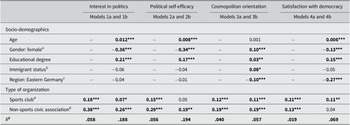
A first set of regression analyses compares attitudes of members of sports clubs, members of non-sports civic associations, and non-members (Table 2). In the absence of controls for the socio-demographic composition of club memberships (models 1a–4a), the results demonstrate significant effects for sports club members and members of non-sports civic associations in comparison to non-members. At first glance, it appears that sports club members exhibit greater approval of democratic attitudes than non-members. They demonstrate a higher level of interest in politics than non-members (b = 0.18, p < 0.001), report higher political self-efficacy (b = 0.15, p < 0.001), express greater support for cosmopolitanism (b = 0.12, p < 0.001), and report higher satisfaction with democracy (b = 0.21, p < 0.001). For members of non-sports civic associations, three of four models reveal associations that are even more pronounced.
Multiple linear regression models indicating correlations of membership in sports clubs and in non-sports civic organizations with democratic attitudes
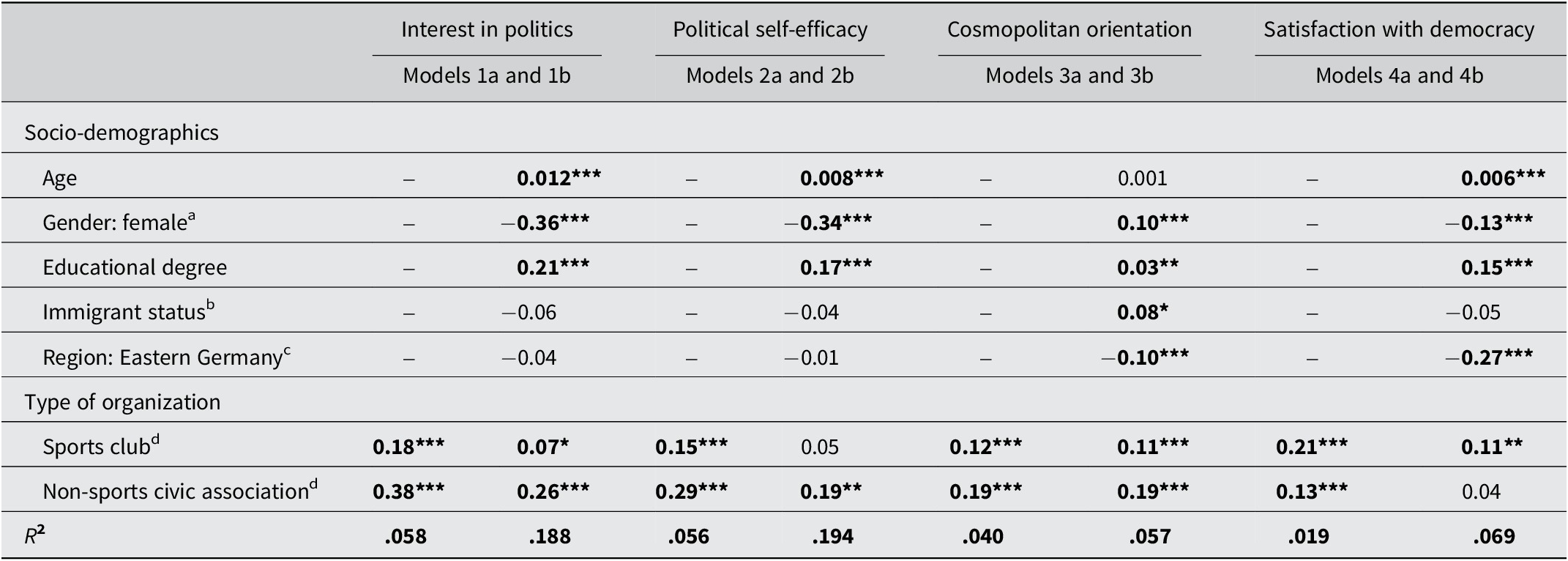
Table 2. Long description
The table presents multiple linear regression coefficients for predictors of democratic attitudes, organized into four main outcome columns: Interest in politics (Models 1a and 1b), Political self-efficacy (Models 2a and 2b), Cosmopolitan orientation (Models 3a and 3b), and Satisfaction with democracy (Models 4a and 4b). Each outcome is split into two models, with coefficients for each predictor listed in order. Socio-demographics include Age (significant positive coefficients for all outcomes except cosmopolitan orientation), Gender: female (significant negative coefficients for all outcomes except cosmopolitan orientation, where it is positive), Educational degree (significant positive coefficients for all outcomes), Immigrant status (significant positive for cosmopolitan orientation only), and Region: Eastern Germany (significant negative for cosmopolitan orientation and satisfaction with democracy). Under Type of organization, Sports club membership shows significant positive coefficients for most outcomes, while Non-sports civic association membership shows the strongest and most consistent significant positive coefficients across all outcomes except satisfaction with democracy. R squared values range from .019 to .194, with the highest for political self-efficacy models. Significance is indicated by asterisks: one for p less than 0.05, two for p less than 0.01, three for p less than 0.001. Reference categories are male, no immigrant status, Western Germany, and no membership in either organization type.
Note: EiS 2024 full sample. N = 3,049. Significance: *p < 0.05; **p < 0.01; ***p < 0.001.
Reference categories: amale; bno immigrant status; cWestern Germany; dno membership in a sports club or in a non-sports civic association.
All significant coefficients (p < .05, at least) are printed in bold.
The regression coefficients for sports club members are less pronounced when socio-demographic variables are taken into account. Models 1b, 2b, 3b, and 4b control for the fact that sports club members in Germany tend to be slightly younger and possess slightly higher levels of education than the general population. Furthermore, there is a greater representation of males among sports club members in comparison to females. Once the socio-demographic composition of the sports club membership is taken into account, a slight difference between sports club members and non-members remains for political interest (b = 0.07, p < 0.05), but not for political self-efficacy (b = 0.05, p > 0.05). The association with cosmopolitan attitudes remains largely unchanged (b = 0.11, p < 0.001); for satisfaction with democracy, it is reduced considerably, although still statistically significant (b = 0.11, p < 0.01).
The results of these analyses demonstrate the existence of modest yet consistent correlations between participation in a sports club and democratic attitudes. These findings align with the “schools of democracy” rationale. However, these models do not account for the heterogeneity within the group of sports club members: they account for neither varying degrees of personal involvement nor the role of club culture. Thus, a second set of regressions only for sports club members engages with personal involvement and club culture (Table 3).
Multiple linear regression models indicating correlations of depth of involvement and club culture with democratic attitudes
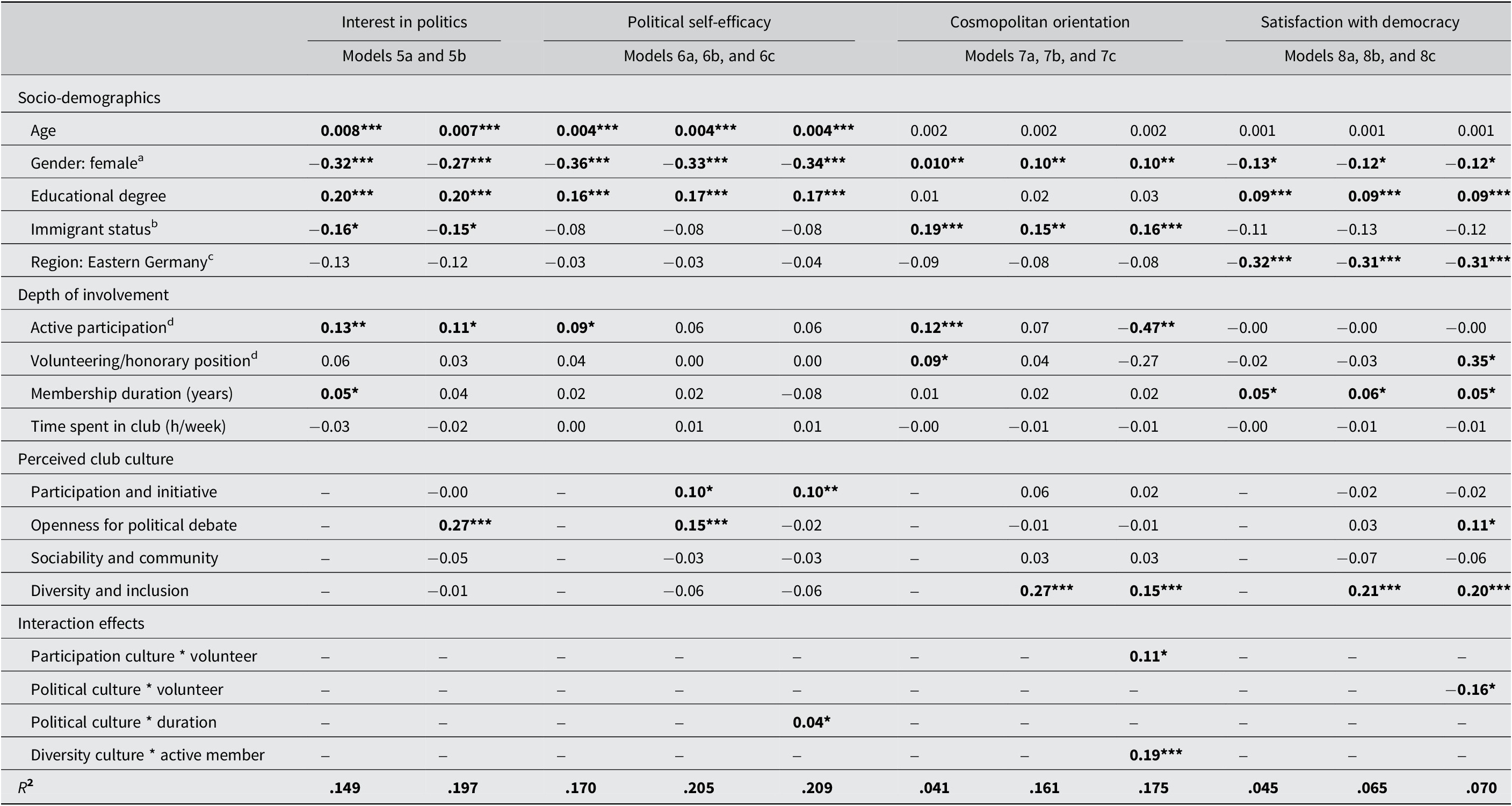
Table 3. Long description
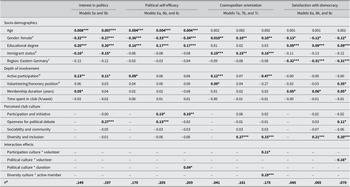
The table is structured with variable groups in the first column and regression coefficients for four democratic attitude outcomes—interest in politics, political self-efficacy, cosmopolitan orientation, and satisfaction with democracy—across twelve models in the remaining columns. Each outcome domain is subdivided into models: interest in politics (Models 5a, 5b), political self-efficacy (6a, 6b, 6c), cosmopolitan orientation (7a, 7b, 7c), and satisfaction with democracy (8a, 8b, 8c). Significant coefficients are bolded, with asterisks denoting significance levels: one for p less than 0.05, two for p less than 0.01, three for p less than 0.001.
Socio-demographics: Age shows small positive significant effects on interest in politics and political self-efficacy (0.008 to 0.004, all p less than 0.001), but not on cosmopolitan orientation or satisfaction with democracy. Female gender is negatively associated with interest in politics and political self-efficacy (coefficients from minus 0.36 to minus 0.27, all p less than 0.001), but positively with cosmopolitan orientation (0.01 to 0.10, p less than 0.01 or 0.05) and negatively with satisfaction with democracy (minus 0.13 to minus 0.12, p less than 0.05). Educational degree is positively associated with all outcomes except cosmopolitan orientation, with strongest effects on interest in politics and satisfaction with democracy (0.20 and 0.09, p less than 0.001). Immigrant status is negatively associated with interest in politics (minus 0.16, minus 0.15, p less than 0.05), but positively with cosmopolitan orientation (0.19, 0.15, 0.16, p less than 0.01 or 0.001). Eastern Germany is negatively associated with satisfaction with democracy (minus 0.32, minus 0.31, p less than 0.001).
Depth of involvement: Active participation is positively associated with interest in politics, political self-efficacy, and cosmopolitan orientation (0.13 to 0.12, p less than 0.01 or 0.001), but negatively with one cosmopolitan orientation model (minus 0.47, p less than 0.01). Volunteering shows a positive effect on satisfaction with democracy (0.35, p less than 0.05). Membership duration is positively associated with interest in politics and satisfaction with democracy (0.05 to 0.06, p less than 0.05). Time spent in club shows no significant effects.
Perceived club culture: Participation and initiative is positively associated with political self-efficacy (0.10, p less than 0.05 or 0.01). Openness for political debate is positively associated with interest in politics and political self-efficacy (0.27, 0.15, p less than 0.001), and with satisfaction with democracy (0.11, p less than 0.05). Diversity and inclusion is positively associated with cosmopolitan orientation (0.27, 0.15, p less than 0.001) and satisfaction with democracy (0.21, 0.20, p less than 0.001).
Interaction effects: Participation culture times volunteer is positively associated with cosmopolitan orientation (0.11, p less than 0.05). Political culture times volunteer is negatively associated with satisfaction with democracy (minus 0.16, p less than 0.05). Political culture times duration is positively associated with political self-efficacy (0.04, p less than 0.05). Diversity culture times active member is positively associated with cosmopolitan orientation (0.19, p less than 0.001).
R squared values range from .041 to .209 across models. Reference categories are male, no immigrant status, Western Germany, and membership without active participation or volunteering. Sample size is 1,129.
Note: EiS 2024 sports club member sample. N = 1,129. Significance: *p < 0.05; **p < 0.01; ***p < 0.001.
Reference categories: amale; bno immigrant status; cWestern Germany; dmembership without active participation in club life or volunteering.
All significant coefficients (p < .05, at least) are printed in bold.
Depth of involvement
Regression models only with variables that measure personal involvement in the club (models 5a–8a) show that some, but not all, measures of a member’s depth of involvement are associated with democratic attitudes. Active participation (compared to passive membership) is a significant predictor for interest in politics (b = 0.13, p < 0.01), political self-efficacy (b = 0.09, p < 0.05), and cosmopolitan orientations (b = 0.12, p < 0.001). Volunteering or holding an honorary position (compared to passive membership) is found to be associated with a higher level of cosmopolitan orientations (b = 0.09, p < 0.05), whereas regression coefficients are insignificant for the other three outcome variables. Duration of club membership (in years) is a significant predictor for political interest (b = 0.05, p < 0.05) and satisfaction with democracy (b = 0.05, p < 0.05). The weekly time that a member spends in the club is not associated with any outcome variable.
Club culture
Included in these regression analyses (models 5b–8b) are also the measures of club culture. Some of these variables of club culture turn out to be highly relevant. However, in contrast to the general expectations formulated above, no aspect of club culture significantly correlates with all of the four outcome measures. A club culture encouraging participation and initiative is associated with higher levels of political self-efficacy among members (b = 0.10, p < 0.05), but is not associated with political interest, cosmopolitanism, or satisfaction with democracy. In sports clubs that foster an environment conducive to open political debate, members report more political interest (b = 0.27, p < 0.001) and more political self-efficacy (b = 0.15, p < 0.001). A club culture in favor of diversity and inclusion is a significant predictor for both cosmopolitanism (b = 0.27, p < 0.001) and satisfaction with democracy (b = 0.21, p < 0.001). A culture of sociability is not associated with any of the outcome variables.
When the variables for club culture are included into the models, some of the associations for the involvement variables are no longer significant. This is an indication for correlations between some of the club culture variables and some of the involvement variables. For instance, including the variable for a culture of participation and initiative into model 6b reduces the regression coefficient for active participation, which thereby turns insignificant.
Interaction effects
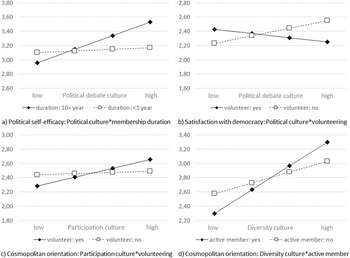
The regression models also reveal that some interaction terms prove relevant, which capture specific combinations of personal depth of involvement and club culture. From all interactions tested (see Methods), four turn out as significant: a longer duration of a sports club membership is positively associated with political self-efficacy, particularly under the condition that the club has a culture of open political debate (b = 0.04, p < 0.05). Cosmopolitan orientations are higher when active membership meets a culture of diversity and inclusion (b = 0.19, p < 0.001) as well as when volunteering occurs within a culture that encourages participation and initiative (b = 0.11, p < 0.05). The aforementioned three interactions lend support to our initial assumptions. However, a fourth interaction presents a contradictory finding: satisfaction with democracy is lower when volunteering coincides with a culture of open political debate (b = −0.16, p < 0.05). We illustrate these four significant interactions in Figure 1 in order to facilitate interpretation.
Illustration of significant interaction effects between club culture and individual involvement.
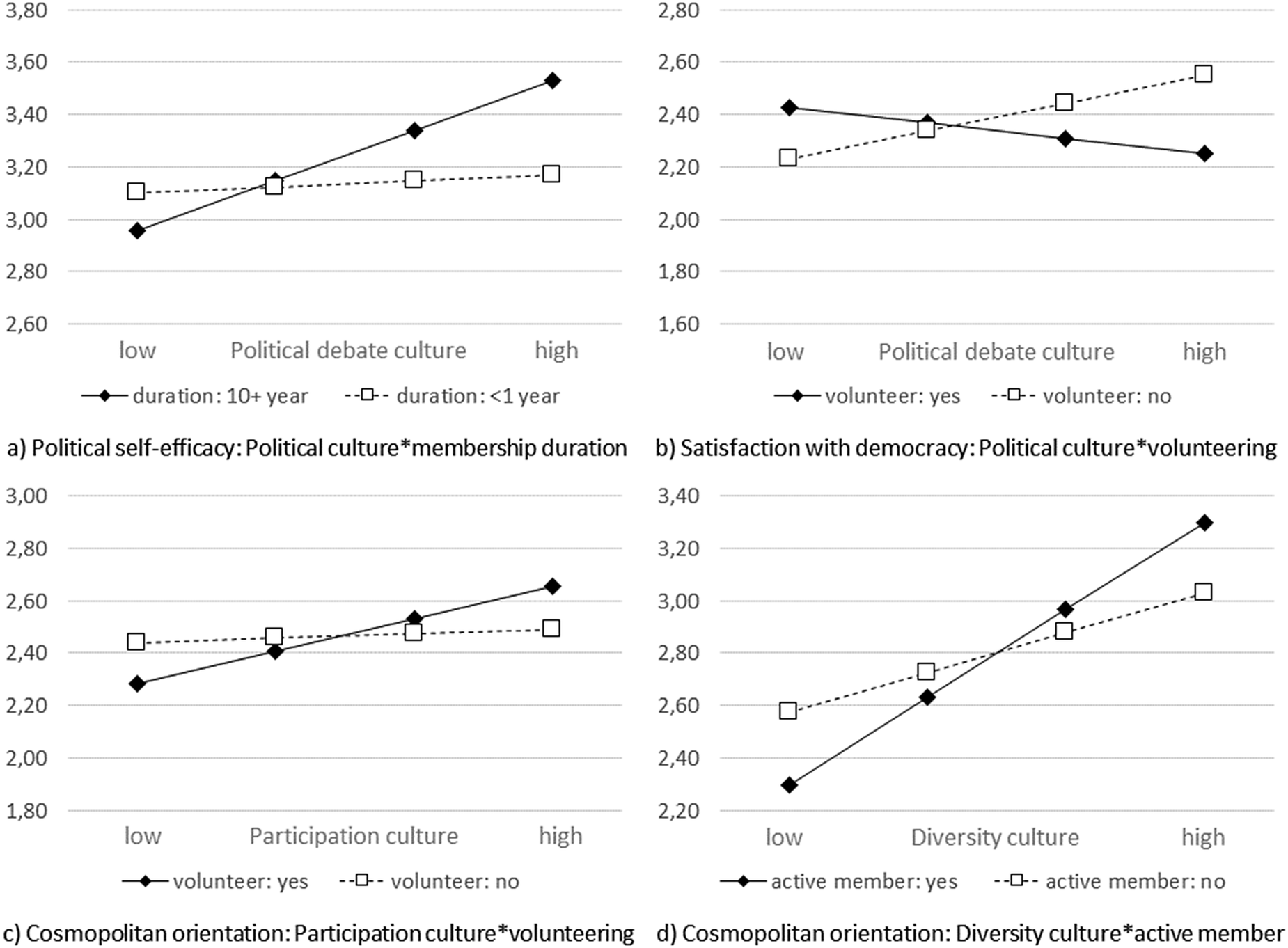
Fig. 1. Long description
Panel a (top-left) plots political self-efficacy (y-axis, 2.60 to 3.80) against political debate culture (x-axis, low to high). Two lines: solid for duration 10+ years, dashed for duration less than 1 year. The solid line rises from about 3.00 to 3.60, while the dashed line remains nearly flat around 3.20. Panel b (top-right) plots satisfaction with democracy (y-axis, 1.60 to 2.80) against political debate culture (x-axis, low to high). Solid line for volunteers shows a slight decline from about 2.40 to 2.20; dashed line for non-volunteers rises from about 2.20 to 2.60. Panel c (bottom-left) plots cosmopolitan orientation (y-axis, 1.80 to 3.00) against participation culture (x-axis, low to high). Solid line for volunteers increases from about 2.20 to 2.60; dashed line for non-volunteers is nearly flat around 2.40. Panel d (bottom-right) plots cosmopolitan orientation (y-axis, 2.20 to 3.40) against diversity culture (x-axis, low to high). Solid line for active members rises from about 2.40 to 3.40; dashed line for non-active members rises from about 2.60 to 3.00. All panels show interaction effects, with involvement amplifying the positive association between club culture and the outcome variable.
Discussion
Key findings
The present study analyzed democracy-related attitudes of sports club members using large-scale German data. Several findings are noteworthy: first, when controlling for the socio-demographic composition of sports club members, the results indicate only minor differences between sports club members and those who do not hold a membership in any civic association. Sports club members are slightly more interested in politics, report higher levels of cosmopolitanism, and are more satisfied with the state of democracy. These findings are mostly in line with previous studies that also reported significant, but similarly small, differences in political or democratic attitudes (Ibsen et al., Reference Ibsen, Elmose-Østerlund, Feiler, Breuer, Seippel, van der Roest and Scheerder2019; Nobis, Reference Nobis2011; Rotolo et al., Reference Rotolo, Kirkpatrick Johnson and McCall2020; Seippel, Reference Seippel2006). We also find differences for members of non-sporting civic associations when compared to individuals who do not take part in any association. These differences are slightly more pronounced than those found for sports club members, indicating that non-sports civic associations also have a potential to influence their members’ attitudes.
Second, the differentiated analysis of sports club members shows that not all sports clubs and memberships are the same, but that recognition of subtle differences is essential for a comprehensive understanding. The regression models for sports club members suggest that the depth of involvement in a sports club is important: whereas active participation in club life and length of membership in years matter for some outcome variables, the number of hours per week spent in the club is hardly relevant. The latter findings align with previous research that also could not find associations between activity hours in sports clubs and political attitudes (Seippel, Reference Seippel2006). Club culture is another potentially important factor. Findings suggest that sports clubs with a culture of open political debate have members that are politically more interested. In addition, in clubs that value member participation and initiative, members report a higher level of political efficacy, i.e., they believe in their own political effectiveness. A club culture that values diversity, in turn, is associated with higher levels of cosmopolitan attitudes and greater satisfaction with democracy. However, it should be kept in mind that no cultural dimension was consistently associated with all four of the political attitudes analyzed here. Hence, the revealed pattern of associations remains collage-like, rather than being as systematic as the initial hypotheses on club culture suggested. These findings suggest that club cultures provide valuable insights into the formation of normative orientations within VAs. This may apply to questions about the development of political and democratic attitudes, as well as questions concerning intercultural openness, cooperation and competition, achievement orientations, and social trust. Such issues lie at the heart of current sports club studies and could benefit from a more serious consideration of a club cultural perspective. However, given the complexity of the concept of “culture,” future studies should carefully select and justify which aspects of club culture they consider relevant.
When highly engaged members and a vibrant club culture come together, these effects can multiply, as demonstrated with some of the interaction terms in the models. In contrast, volunteering in a culture of political openness is not associated with higher but rather with lower satisfaction with democracy. Although this result was not anticipated, it seems that political openness can also be a source of frustration for decision makers, as it forces them to justify and accept criticism of their actions. Dissatisfaction might then result from a mismatch of idealistic expectations and reality, leading to “democratic frustration” (Harrison, Reference Harrison2023).
Sociologists of sports are only beginning to include aspects of club culture in their studies of sports clubs. For example, Buser et al. (Reference Buser, Adler Zwahlen, Schlesinger and Nagel2022) relate successful integration processes of migrants in sports clubs to a less assimilative club culture, and Ibsen et al. (Reference Ibsen, Elmose-Østerlund, Feiler, Breuer, Seippel, van der Roest and Scheerder2019) link a club-level variable (that the club aims to involve members in decision-making) to patterns of individual participation in meetings and individual attempts to influence club policies. Nevertheless, the potential of this core idea of linking club culture to individual attitudes has not yet been fully exploited in empirical sports sociology. We therefore advocate for more studies that aim to analyze aspects of the meso- and micro-levels in their specific interaction.
Implications for research and practice
When placed in research context, these findings add to the current debate about sports clubs as “schools of democracy.” The most recent review concluded that empirical studies have largely “delegitimized” this thesis (Jaitner, Reference Jaitner2019). Similarly, scholars have concluded that selection processes into clubs are more relevant than socialization processes within clubs (Rotolo et al., Reference Rotolo, Kirkpatrick Johnson and McCall2020) and that sports clubs are not “schools” but rather “pools” of democracy (van Ingen & van der Meer, Reference van Ingen and van der Meer2016). These statements imply that clubs are not an instance of political socialization, but instead simply serve to reflect the political attitudes of the people in their surrounding environment. In light of our findings, we believe that these conclusions can be specified in a more nuanced manner: Rather than denying sports clubs any effectiveness in the context of political socialization processes, we believe that the conditions under which sports clubs have the potential to influence their members’ attitudes should be specified more precisely. Findings on club culture presented here suggest that sports clubs resemble small microcosms in their own right, with values and practices that may (or may not) promote politicization and foster democratic attitudes. This argument that socialization in civic associations is contingent on the particularities of each club is not entirely new and has been put forward, for example, in works on the “unsocial” or “dark” side of civic associations (Baycan & Öner, Reference Baycan and Öner2023; Levi, Reference Levi1996) as well as in qualitative studies (Braun et al., Reference Braun, Hansen, Ritter, Schwalb and Walk2007; Dodge & Ospina, Reference Dodge and Ospina2016). However, this contingency has rarely been systematically investigated within the realm of sports clubs.
Taking club culture and associated internal organizational processes seriously could offer concrete starting points for sports clubs wanting to evolve a democratic culture. If the potential of sports clubs as “schools of democracy” is to be exploited, then democratic processes and orientations would have to be lived out in club life and club politics. Findings presented here suggest, for instance, that sports clubs could discuss and formalize their fundamental political beliefs through the formulation of mission statements. They could facilitate online and offline opportunities for debate and encourage members to take own initiatives. Furthermore, they could demonstrate a commitment to intercultural openness and diversity. In doing so, they would model attitudes that could inspire their members and may shape standards of behavior.
Limitations
This study has strengths but also limitations. Most importantly, a shortcoming of the cross-sectional design is that it does not allow for causal inferences. Hence, what we have reported are robust associations; however, the direction of causality is contingent on interpretation. Taking part in open political debates, for instance, can increase political efficacy, but individuals with higher political efficacy may also prefer joining a sports club with a highly political club culture. Whether one or both of these effects exist cannot be determined by the study design. It should also be noted that political socialization does not only take place in associations, but is a complex process shaped by many social contexts (e.g., family, peers, schools, media). The models did not account for all of these factors. Moreover, by explicitly considering the role of club culture in our model, we aimed at expanding the empirical knowledge base. However, club culture may have more than just the four dimensions studied here. Although we believe we have identified some of the most plausible cultural dimensions for our research question, our approach is still selective. There may also be specific cultural dimensions of sports clubs that we have not considered here, such as a leadership focus either on performance and success or on socializing and cooperation (Mitrovic et al., Reference Mitrovic, Simovic and Raicevic2019). Moreover, there are several ways in which data on club culture can be collected, and asking individual members is neither the best nor the only method. In other studies, for instance, board members of the association were asked to evaluate their club’s culture, or club culture is calculated as an aggregate score based on responses from several members of the same club (e.g., Buser et al., Reference Buser, Adler Zwahlen, Schlesinger and Nagel2022; Schlesinger & Nagel, Reference Schlesinger and Nagel2015). The latter approach is likely to produce more robust and valid results than the approach taken here. However, a disadvantage of a multilevel approach is that club data usually stem from a few clubs only, so that achieving representativeness across a whole country would be difficult. Finally, our survey was designed as a panorama study with the aim of capturing many different aspects of political attitudes. Given the limited time available for the survey, brief scales were preferred over longer scales. For the same reason, we were not able to collect variables that measure political behavior. As previous studies (e.g., Lee, Reference Lee2022) have often found no relationship between sports participation and political behavior, a behavior-related outcome variable could be a more rigorous test than attitude-related variables.
Conclusion
Overall, our analysis based on representative data of German sports club members has shown that club memberships are associated with democracy-promoting attitudes among members under certain conditions: members must allow themselves to get involved in the club, and this involvement must have a certain depth and duration for the club to be effective as a socialization context. Sports clubs themselves must have a democratic club culture—not just formally on paper, but as a lived practice. Only if both conditions apply, i.e., if committed members encounter a pro-democratic culture, attitudes in favor of democracy are likely to be nurtured.
Supplementary material
The supplementary material for this article can be found at http://doi.org/10.1017/S0957876526000045.
Data availability statement
The data that support the findings of this study are available on request from the corresponding author. In agreement with the Federal Institute of Sport Science, data will be available as a scientific use file in a data repository in December 2026, at the latest, following a 24-month embargo after the funding period.
Funding statement
This study was funded with a research grant from the German Federal Institute of Sport Science based on a resolution of the German Bundestag [ZMI4–080908/24].
Competing interests
The authors declare no potential conflicts of interest with respect to the research, authorship, and/or publication of this article.
Ethical standard
The study was performed in line with the principles of the Declaration of Helsinki. Ethical approval was obtained from the Ethics Commission of the Faculty of Humanities and Social Sciences of Humboldt-Universität zu Berlin [KSBF-EK_2024_0012].
Consent to participate
Informed consent was obtained from all individual participants included in the study. In case of minors, informed consent was obtained from their parents.


 Open access

