


1. Introduction
‘The world must understand that we need to fumigate in order to save lives’, declared then-President Álvaro Uribe at the height of Colombia’s fumigation campaign in 2006 (El Tiempo 2006). His words encapsulate a conviction still prevalent today: that targeting coca crops – one of the financial lifelines of armed groups – is key to restoring state authority in conflict zones. But is this so?
The logic behind this belief is compelling. In civil conflicts and criminal wars, illicit economies play a pivotal role in sustaining specialists of violence and expanding their operations. These economies provide non-state actors, ranging from insurgent groups, paramilitaries, and criminal organizations, with the financial resources needed to assert territorial control, recruit fighters, and consolidate power (Buhaug et al. Reference Buhaug, Gates and Lujala2009; E Dávalos and LM Dávalos Reference Dávalos and Dávalos2019; Ross Reference Ross2012).
Colombia is a case in point, where coca production has been intimately related to the expansion, multiplication, and strengthening of a range of violent actors of different ideological stances, organizational capacities, and goals. Although the Colombian government has experimented with voluntary crop substitution, alternative development programmes, and manual eradication, its main response until 2015 was forced eradication by aerial spraying. Framed as a rapid and efficient solution for remote areas, aerial spraying is predicated on the idea that disrupting coca cultivation can cripple armed actors and strengthen state control (Clunan and Trinkunas Reference Clunan and Trinkunas2010).
Yet, decades of aerial eradication have consistently failed to achieve its intended goals. Rather than weakening armed groups and stabilizing contested regions, spraying often eroded state legitimacy in areas where institutional presence was most critical. By destroying crops and harming livelihoods (Rincón-Ruiz and Kallis Reference Rincón-Ruiz and Kallis2013), it undermined trust in state institutions (Felbab-Brown Reference Felbab-Brown2010) and disrupted local power dynamics (Calderón et al. Reference Calderón, Robles, Díaz-Cayeros and Magaloni2015; Flores-Macías Reference Flores-Macías2018). Given their inadequacy and the side effects of these policies on the environment (Rincón-Ruiz and Kallis Reference Rincón-Ruiz and Kallis2013) and health (Camacho and Mejia Reference Camacho and Mejia2017), the Colombian government of Juan Manuel Santos suspended fumigation in 2015, an order later upheld by the Constitutional Court in 2017. But record-high coca cultivation has affected global cocaine prices, placing Colombia in the spotlight and prompting renewed consideration of fumigation policies (El Heraldo 2020; UNODC 2023).
This paper investigates how aerial spraying – as a fleeting intervention characterized by its rapid and large-scale implementation – influences violent dynamics in Colombia. Although illicit crops also fund violent actors in countries like Afghanistan, Mali, Mexico, and Peru – making our findings relevant to the outcomes of similar interventions in these contexts – Colombia provides a crucial case study, due to its enduring multi-actor civil conflict and extensive use of aerial spraying.
We argue that aerial eradication not only fails to consolidate state control but actively generates incentives for violence by disrupting the interactions among government authorities, armed actors, and civilians involved in the coca economy. Specifically, we hypothesize three ways in which aerial spraying can exacerbate armed violence.
First, aerial spraying provokes retaliation against the state as armed groups attempt to protect their operations and deter future interventions. Second, aerial spraying may create turf wars by shifting the balance of power among organizations and forcing affected groups to relocate to new areas. Lastly, as aerial spraying temporarily disrupts the coca economy, it may lead to civilian victimization as armed groups enforce compliance, maintain order, and regulate relationships with civilians. We also consider how the effects of spraying vary across different armed actors: while paramilitaries and criminal organizations, often benefiting from state forbearance, respond sharply to state repression, guerrilla groups maintain a consistently adversarial stance and anti-state ideology, using violence more broadly regardless of eradication efforts.
Our analysis leverages municipal-level data on aerial eradication of coca crops and armed conflict violence from 2000 to 2015. Findings indicate that aerial spraying is associated with greater levels of violence in targeted municipalities. When zeroing in on areas of high-intensity eradication – where the density of coca crops is critical – we also find a positive and stronger effect on violence perpetrated by both types of groups.
Our results also show effects on the three types of violence described above. First, we find that spraying does not increase insurgent retaliation against the state in targeted municipalities. This aligns with the broader observation that these groups attack the state when opportunities arise or when they are targeted, regardless of eradication or not. Interestingly, we do observe that paramilitaries retaliate against the state in municipalities targeted by aerial spraying. Lastly, all groups retaliate in neighbouring municipalities, reflecting an offensive response against state fleeting interventions in places where the state is more vulnerable and exposed, or strategic gains can be obtained.
Second, spraying is associated with an increase in violence between non-state armed actors – turf wars – in targeted municipalities, pointing to the destabilizing effects of forced eradication on local power dynamics. This increase in violence reflects intensified turf wars as groups compete for control of contested territories. Unlike retaliation against the state, this type of violence is localized and does not spill over into neighbouring areas, underscoring that turf wars may be rooted in disputes over immediate, local gains. By displacing armed groups or shifting power balances, aerial spraying disrupts previously stable territorial arrangements, fueling conflict between competing factions.
Lastly, we observe a significant rise in massacres against civilians in sprayed areas, reflecting the downstream consequences of eradication for coca farmers and local populations. Civilian victimization often arises from territorial disputes, bargaining with new groups, or violent competition between rivals. By disrupting fragile governance structures, eradication leaves civilians vulnerable as armed groups reassert control through violence to extract information, punish noncompliance, or deter collaboration with rivals or the state.
Our findings remain robust across multiple checks. First, we restrict the sample to municipalities involved in coca production, minimizing potential biases from areas unaffected by coca-related dynamics. Second, we incorporate night-time luminosity into the main model, leveraging this as a key proxy for social development and economic growth. Third, we exclude the lagged outcome variable from the primary specification to address potential endogeneity concerns arising from its correlation with fixed effects. Fourth, to account for the non-random assignment of aerial eradication based on prior levels of violence, we perform a robustness check using propensity score matching. Across all these tests, the results remain consistent with our main findings. Furthermore, as a crucial placebo test, we assess whether manual eradication also leads to increased violence. Our analysis shows that manual eradication does not significantly impact violence, suggesting that the violence associated with forced eradication is specific to aerial spraying, rather than eradication efforts that are usually accompanied by other more permanent elements of state presence.
Our paper investigates how aerial spraying affects the violence perpetrated by non-state armed actors. In so doing, we contribute to two key areas of research. First, we engage with the literature on drugs and violence. Existing studies primarily focus on how exogenous increases in coca prices drive conflict and violence (Angrist and Kugler Reference Angrist and Kugler2008; Mejia and Restrepo Reference Mejia and Restrepo2013), or analyze the effects of other types of state intervention (Dell Reference Dell2015; Phillips Reference Phillips2015; Trejo and Ley Reference Trejo and Ley2018). Recognizing the ample menu of interventions targeting illicit markets, we focus on actions aimed at the origins of the production and trafficking chain, specifically the effects of aerial spraying.
Second, we establish a dialogue with counterinsurgency research (Delgado Reference Delgado2015; Mason and Campany Reference Mason and Campany2007; Weintraub Reference Weintraub2016). Aerial spraying, as a coercive policy, compels governments to weigh a trade-off: disrupting illicit economies that serve as a crucial source of power for armed groups versus alienating the civilian populations in coca-growing areas. Forced eradication of coca crops, rather than unequivocally weakening violent actors, can paradoxically bolster their legitimacy and political support among local communities (Felbab-Brown Reference Felbab-Brown2010). Creating an environment for violence, even if unintendedly, may alienate citizens and undermine state building.
The paper is organized as follows. We begin with a brief overview of the role of coca crops in the Colombian civil conflict. In Section 3 we develop our theoretical framework, focusing on the use of violence in a civil war context where control over illicit markets is pivotal, and derive testable implications from our argument. We then describe our empirical strategy in Section 4 and present our empirical results in Section 6. Finally, we conclude with a discussion of our results and their broader implications in Section 9.
2. Background: Civil War and Coca in Colombia
Coca production has been an important and recurring element in Colombia’s recent history. For decades, coca crops have been an option for thousands of farmers in the country’s most remote areas to sustain their livelihoods, while also providing the financial means for armed groups to strengthen and expand their presence throughout the territory.
The prevalence of coca crops – and cocaine, its main derivative – dates back to the late 1970s, when individuals associated with the Medellín and Cali cartels imported seeds from Bolivia and Peru and distributed them among rural communities in poor and distant regions of the country. While Colombia’s geographic position contributed to the flourishing of the cocaine market, increased eradicating and interdicting efforts by Bolivian and Peruvian authorities also allowed for the relocation of most coca production to Colombia (Thoumi Reference Thoumi1995). As drug production primarily took place in rural territories, armed groups operating in these areas eventually became entangled.
Guerrillas, like the Armed Revolutionary Forces of Colombia (FARC), acted as intermediaries, purchasing cocaine base paste from farmers and selling it directly to drug cartels. This approach aimed to avoid conflicts between the parties and profit from the transactions. However, these groups soon realized the high financial potential of the cocaine market and became more deeply involved in the entire production process of cocaine. In many regions, the coca economy prompted the insurgency to develop a social basis around peasants and coca farmers to actively counter state violence and make claims to the state (Ferro and Uribe Ramón Reference Ferro and Uribe Ramón2002; Ramírez Reference Ramírez2001). At the height of the bonanza coquera (that is, coca boom), coca crops stimulated population growth and the construction of rebel roads, which ultimately allowed insurgents to enhance their political authority and military strategies (Peñaranda Currie et al. Reference Peñaranda Currie, Otero-Bahamon and Uribe2021; Torres Bustamante Reference Torres Bustamante2011).
Coca production significantly favoured the expansion of paramilitary groups as well. Since the 1980s, right-wing paramilitary groups have emerged in different regions as local coalitions of cattle ranchers, landowners, and drug traffickers interested in the defense and accumulation of land. With the creation of the United Self-Defense Forces of Colombia (AUC), a federation of regional groups with national ambitions, paramilitary control quickly spread to different areas of the country. Notably, paramilitaries confronted competing non-state armed actors and displaced farmers from their lands, thereby gaining control over strategic areas for the illegal operations (Comisión de la Verdad 2022). The expansion of the illicit economy was also facilitated by the systematic purchase of land by drug-traffickers throughout the country (Reyes Posada Reference Reyes Posada2009).
Although the origin of the conflict precedes the drug economy, the lucrative nature of coca production became a crucial source of financing for non-state armed actors and a fuel for the armed conflict. The empirical literature on the Colombian conflict has shown that the exogenous upsurge in the global price of coca led to more violence in the rural areas where coca was produced, while urban areas were minimally affected (Angrist and Kugler Reference Angrist and Kugler2008). Additional evidence from Colombia suggests that as the value of coca cultivation goes up, municipalities with the presence of coca crops experience a growth in homicide rates, forced displacement, and explosion of land mines (Mejia and Restrepo Reference Mejia and Restrepo2013). Also in Colombia, Estancona (Reference Estancona2021) finds that increases in violence, derived from positive shocks in coca production, apply to both insurgent groups and right-wing paramilitaries.
By the beginning of the 21st Century, Colombia was the world’s largest coca producer. To face this pressing issue, the Colombian government in cooperation with US authorities, launched Plan Colombia in 1999, a counter-insurgency programme aimed at eradicating drug production and enhancing the country’s military capabilities to confront guerrilla violence. One of its primary strategies was the use of aerial spraying of glyphosate for eradication purposes. According to the Colombian government, this method was designed to swiftly and safely confront and reduce coca crops. Although the National Drug Council had regulated this programme since 1994, Plan Colombia marked a turning point as the US government provided additional resources and equipment, leading to its reinforcement and expansion (Moreno Reference Moreno2016).
Aerial spraying, intended to reduce coca crops quickly, faces challenges in border regions due to geographic and political factors. As Idler (Reference Idler2019) shows, these areas are governed by both state and non-state actors, making them prone to violence. Aerial spraying disrupts local power dynamics, potentially increasing violence and civilian harm.Footnote 1
Despite being a central pillar of Colombia’s anti-drug efforts, aerial spraying was largely criticized for its low cost-effectiveness and potential negative externalities in various areas. Regarding its effectiveness, several studies have concluded that this policy, in addition to being significantly more costly compared to others that do not rely on eradication (Mejía and Restrepo Reference Mejía and Restrepo2016), is ineffective in terms of reducing the area of illicit crops (Moreno-Sanchez et al. Reference Moreno-Sanchez, Kraybill and Thompson2003; Reyes Reference Reyes2014; Rozo Reference Rozo2014; Vargas Manrique Reference Vargas Manrique2004). Glyphosate has been associated with increased medical consultations for dermatological and respiratory diseases (Camacho and Mejia Reference Camacho and Mejia2017) as well as environmental consequences, including deforestation (Rincón-Ruiz and Kallis Reference Rincón-Ruiz and Kallis2013), water resource contamination, and disruption of ecosystems.
The salience of coca as a catalyst of violence has remained despite important transformations in the Colombian conflict. After the paramilitary demobilization between 2003 and 2006, several units remilitarized and morphed into criminal organizations dedicated to drug-trafficking, extortion, and illegal mining. These paramilitary successors, such as Urabeños, Caparros, and Rastrojos, spread throughout the country under a criminal franchise model, whereby local units, many of them absorbed from local gangs and organizations, are accountable to the central command but enjoy important autonomy from it. Crucially, this generation of groups does not have the same anti-subversive identity that defined previous paramilitary groups, and while some of them have established collusive relationships with local officials and security agencies, they lack the same level of connection and cooperation as that enjoyed by paramilitaries.
The 2016 peace agreement, which put an end to the conflict with the FARC, sought to switch from a coercive and counter-insurgent approach to the drug problem to one based on rural development. The agreement stipulated an emphasis on voluntary eradication, crop substitution programmes, and land reform (International Crisis Group 2021). One year earlier, in 2015, the National Drug Council had announced the suspension of aerial spraying. This order was later upheld in 2017 by the Colombian Constitutional Court, which directed authorities to refrain from fumigation until conclusive evidence was presented against the existence of high risks associated with its application.
Despite the suspension of aerial eradication, understanding its consequences for violence is still crucial and timely. With more than 200 thousand hectares, Colombia remains the largest coca producer in the world. This was in part due to the rearrangement of the drug market after the FARC’s demobilization and the untimely announcement of the coca substitution policy (Prem et al. Reference Prem, Vargas and Mejía2023). President Duque government (2018–2022) repeatedly promised to resume aerial spraying, often clashing with the Constitutional Court for its approval. This can set a precedent for future governments to attempt to return to the coercive policy. It is in the spirit of contributing to this debate that we explore here the effect of sprayings on the violent presence of non-state armed actors, an important aspect of the policy that remains so far unexplored.
3. Theory: Fleeting State Interventions and Violence
Our central theoretical argument is that fleeting interventions by the state, such as the aerial spraying of coca crops, often have unintended consequences: rather than consolidate security, they disrupt existing equilibria and can lead to greater incentives and opportunities for the use of violence. The type of fleeting state interventions we are interested in is different from other interventions in their unconditional and unilateral nature, as well as the speed and the scale of their implementation.
First, these interventions are unconditional in nature. As an influential literature has shown, levels of violence are not only shaped by the type of repression (Davenport Reference Davenport1995; Moore Reference Moore1998), but are also likely to vary depending on the level of conditionality used by the state. Instances of low conditionality where authorities crack down regardless of whether non-state violent actors have engaged in violence can be perceived as existential threats and prompt violent outbursts against the state and other actors (Lessing Reference Lessing2020).
Second, fleeting interventions are unilateral and lack sufficient engagement with local communities. Some state interventions, especially those with a more civilian component, usually communicate the state’s rationale better, and try to incorporate the community’s perspectives. Examples include community policing and some counterinsurgency programmes utilizing both security agencies and civilian institutions for infrastructure and land reform, among others (Arias and Ungar Reference Arias and Ungar2009; Delgado Reference Delgado2015; Strauss Reference Strauss2017). In the case of aerial spraying, states act on their own initiative. It is no surprise, then, that the governance of communities dependent on illicit crops will be upset.
Moreover, fleeting interventions are swift and massive. Rapidly implemented interventions leave little time for local actors to adapt or respond strategically, leading to abrupt shifts in the balance of power and control within affected territories. Meanwhile, large-scale interventions exacerbate these disruptions by impacting broader areas simultaneously. Regarding aerial spraying, former antinarcotics officers of the National Police of Colombia have highlighted its significant effectiveness, achieving eradication rates up to ten times higher than manual eradication (El Tiempo 2007). This underscores the rapid pace and large-scale impact of aerial spraying, demonstrating its capacity to affect vast areas in a short period, leading to greater disruptions to existing equilibria compared to slower and smaller-scale interventions.
Since coca crops – very much like other agricultural commodities in contexts of conflict — presuppose the involvement of government authorities, non-state violent actors in control of crops, and civilians responsible for growing and maintaining the crops, aerial spraying of illicit crops generates an increase in types of armed violence involving all three actors and their interactions.
Aerial Spraying and Types of Violence
We expect to see three types of violence in particular: retaliation against the state; turf wars between armed groups; and civilian victimization.
Retaliation against the state
We theorize that one immediate consequence of aerial spraying in a case like Colombia is the violent retaliation against government authorities by non-state armed actors. The literature on political repression and organized crime is particularly instructive in this regard: crackdowns on specialists of violence, especially when they are unconditional and threaten a major source of income, are likely to backfire and generate cycles of violence (Flores-Macías Reference Flores-Macías2018; Heath et al. Reference Heath, Mason, Smith and Weingarten2000; Lessing Reference Lessing2017). Related literature has also found that greater state penetration can lead to more intense civil conflict as local actors resist the reach of state authority (Koss and Sato Reference Koss and Sato2016; Ying Reference Ying2021).
In the case of aerial spraying, a common form of retaliation is direct attacks on the spraying aircraft. Reports of aircraft being shot down by armed actors are not uncommon (El País 1997), as the planes must fly at altitudes no higher than 50 metres to ensure effectiveness and minimize collateral effects (Dirección de Antinarcóticos 2020; Ministerio de Ambiente y Ministerio de Salud 2014). Other forms of retaliatory violence include the use of landmines, ambushes, and hit-and-run tactics targeting police and military units providing security both within and around the intervention grids, as well as in neighbouring municipalities. For example, a car bombing in Puerto Asís, Putumayo – a department where coca crops have been a critical part of the local economy – killed two people and injured ten others in what was widely seen as retaliation for aerial coca crop fumigation efforts (El Tiempo 2000). Indeed, since aerial spraying displaces an important source of financing, non-state armed actors will be tempted to push back against state intervention to protect their economic activities, signal resolve, and deter future interventions.
Beyond immediate retaliation, armed actors may escalate violence in state-controlled regions to deter future aerial interventions and demonstrate their continued strength.
Turf wars between armed groups
In addition to violent retaliation, aerial spraying generates the conditions for turf wars between competing non-state violent actors. Aerial eradication can propitiate turf wars in two ways. First, policies targeting an armed group can shift the balance of power between organizations, creating incentives for others to seize territory (Lessing Reference Lessing2017). By weakening a specific group, the state inadvertently encourages rivals to challenge territorial control (Osorio et al. Reference Osorio, Mohamed, Pavon and Brewer-Osorio2019). Similarly, policies that disrupt profitable economies, such as coca production, can reduce supply, prompting armed groups to fight rather than uphold agreements with other armed organizations.Footnote 2 This reflects a centripetal dynamic, where turf wars arise in targeted areas.
A second way in which eradication can trigger turf wars is by creating incentives to displace to neighbouring areas and relocate their production. Existing research on criminal politics and the war on drugs underscores the balloon effect, where intense campaigns against the drug economy not only displace crops, but also armed actors looking for new territories (Dell Reference Dell2015). Turf wars may emerge immediately in sprayed areas due to abrupt power vacuums or unfold later as groups relocate production, aligning with the short regrowth cycles of coca crops. This attempt, more consistent with a centrifugal effect, can generate conflict with other rival organizations in neighbouring areas.
In sum, crop eradication disrupts relations between non-state actors in both centripetal and centrifugal ways (Osorio et al. Reference Osorio, Mohamed, Pavon and Brewer-Osorio2019), driving armed actors to exploit vulnerabilities and compete for land and crops (Muñiz-Sánchez et al. Reference Muñiz-Sánchez, Fuerte-Celis and Méndez-Ramírez2022).
Civilian victimization
Finally, aerial eradication can unintentionally create more opportunities for civilian victimization due to two primary reasons: competition and enforcement of agreements. First, in the presence of turf wars, triggered by aerial spraying, the logic of territorial competition between armed groups can lead to more indiscriminate violence (Kalyvas Reference Kalyvas2006; Kronick Reference Kronick2020). Moreover, in Colombia, violence perpetrated by one armed actor against the other group’s social base has been used to assert dominance, signal strength, and undermine rivals’ local support (González et al. Reference González, Bolivar and Vázquez2003; Ramírez Reference Ramírez2001). This violence may be punitive, targeting civilians perceived as collaborators, or strategic, aiming to assert dominance over contested territories.
A second reason why aerial eradication can lead to civilian victimization stems from the establishment and enforcement of agreements with locals. Aerial spraying disrupts the equilibrium of armed governance by undermining armed groups’ ability to regulate relationships with civilians involved in the coca economy. The harm done to coca crops diminishes armed groups’ capacity to enforce agreements, collect taxes, and maintain local order. For instance, growers who resist the continuation of coca cultivation, or those perceived as collaborating with rivals, or with the state, may be subject to enforcement.Footnote 3 Violence, in this context, emerges as a fundamental tool for establishing order and enforcing agreements (Aponte González et al. Reference Aponte González, Hirschel-Burns and Uribe2024).
In sum, we hypothesize that:
-
H1: Aerial spraying will lead to an increase in all three forms of violence
Aerial Spraying and Types of Perpetrator
While retaliation, turf wars, and civilian victimization are general forms of violence that arise from aerial spraying, their manifestation differs across armed groups. We identify three key reasons for these differences: organizational structures, resources, and relationships with the state. In Colombia’s multi-party civil conflict, research has shown that insurgencies and paramilitaries influence diverse outcomes, including local state capacity (Ch et al. Reference Ch, Shapiro, Steele and Vargas2018; Nieto-Matiz Reference Nieto-Matiz2023a), electoral behaviour (Gallego Reference Gallego2018), and violence during economic booms (Dube and Vargas Reference Dube and Vargas2013). These factors help explain the distinct ways aerial spraying impacts these groups.
The first factor accounting for differences across groups arises from variations in their organizational structures and characteristics (Staniland Reference Staniland2014; Weinstein Reference Weinstein2006). Research highlights significant differences between guerrilla groups and paramilitary forces in terms of their social composition, recruitment strategies, economic motivations, and command hierarchies. Guerrilla organizations, unlike paramilitaries, are often characterized by a predominantly rural and peasant-based membership, with a strictly hierarchical and ideologically driven framework. These groups are typically marked by more rigorous internal discipline and a lack of direct economic incentives for their members (Ferro and Uribe Ramón Reference Ferro and Uribe Ramón2002; Gutiérrez-Sanín Reference Gutiérrez-Sanín2008). Such factors may lead to lower levels of insurgent violence, as these characteristics can promote greater restraint, longer-term strategic thinking, and enhanced capacity to control the behaviour of rank-and-file members, thereby reducing the likelihood of abusive conduct (Gates Reference Gates2017; Hoover Green Reference Hoover Green2016).
However, while these factors provide valuable insights, some caveats are in order. Both guerrilla and paramilitary forces can quickly shift between long-term and short-term strategies, particularly in contexts where local conditions, such as the degree of territorial control or competition with rival groups, are unfavourable (Arjona Reference Arjona2016; Kalyvas Reference Kalyvas2006). Under such circumstances, even groups typically known for discipline may engage in erratic or predatory behavior. Additionally, both guerrillas and paramilitaries are heavily involved in maximizing profits from coca cultivation, which necessitates a certain degree of cooperation from local civilian populations. Consequently, when these groups are targeted by aerial spraying campaigns, they may resort to violence as a means of protecting their economic interests, maintaining territorial control, and enforcing social contracts.
A second distinction arises from the varying degrees of economic involvement in the coca economy across armed groups. Insurgents, most notably the FARC, historically justified their engagement with coca production as a means to finance their political and ideological objectives. While initially relying on indirect taxation (known as ‘gramaje’), insurgent groups later expanded their participation to include processing, transport, and even limited international trafficking. By contrast, paramilitaries and criminal organizations have consistently pursued profit as a central goal, engaging directly and extensively in coca cultivation, processing, and trafficking. Although this classification simplifies the complex and often overlapping roles these groups play – insurgents are also profit-driven, and paramilitaries and criminals often act as political actors – it nonetheless highlights key differences in how economic and ideological priorities shape their responses to state interventions (Gutiérrez Sanín and Wood Reference Gutiérrez Sanín and Wood2014).
Lastly, a third critical factor is the differential treatment of armed groups by state security forces. Paramilitary organizations frequently receive tacit or overt support from state security agencies, which can manifest in various forms, including the exchange of intelligence, coordinated operations, backing from local political elites, and, ultimately, the transformation of the local state (Carey and Mitchell Reference Carey and Mitchell2017; Gutiérrez Sanín Reference Gutiérrez Sanín2019; Nieto-Matiz Reference Nieto-Matiz2023b). This alignment enables paramilitaries to benefit from a degree of impunity and operational advantage that insurgent groups typically do not enjoy. By contrast, insurgent groups lacking these political connections and facing a more adversarial relationship with state forces encounter more consistent and targeted opposition from law enforcement and the military. This reflects an act of forbearance, the selective and intentional non-enforcement of the law (Holland Reference Holland2016), which benefits some actors more than others. In fact, recent evidence from Colombia shows how areas with a greater presence of these groups experienced less aerial eradication (Gerez Reference Gerez2024).
The disparity in state responses not only influences the operational capacities of these groups but also shapes distinct patterns of violence. Paramilitaries, benefitting from state collusion and relying on territorial control for economic gains and political leverage, are particularly sensitive to threats like aerial eradication campaigns. Such disruptions may prompt them to escalate violence in order to maintain dominance, especially in areas with disrupted coca production. Guerrillas, while also dependent on coca cultivation, approach these disruptions differently. Their responses often reflect longer-term strategic goals tied to broader conflicts with the state (Gutiérrez Sanín and Wood Reference Gutiérrez Sanín and Wood2014), using violence not only as a reaction to state action but also as a deliberate strategy to undermine the state. In summary, while paramilitaries react with intensified violence to targeted state actions, guerrilla violence is driven by long-term strategic objectives and remains less influenced by specific interventions.
This leads us to hypothesize that:
-
H2: Aerial spraying will lead to more violence by paramilitary and criminal groups (relative to insurgencies)
4. Empirical Strategy
To understand the impact of aerial spraying on armed conflict violence, we use a yearly panel spanning from 2000 to 2015. We estimate the following equation:
 $${violence_{it}^j = {\beta _0} + {\beta _1}eradicatio{n_{it}} + \mu {X_{i,t}} + {\alpha _i} + {\rho _t} + {\varepsilon _{it}}}$$
where $violence_{it}^j$
is the outcome variable representing the number of violent events per hundred thousand population associated with armed actor
$violence_{it}^j$
is the outcome variable representing the number of violent events per hundred thousand population associated with armed actor $j$
in municipality
$j$
in municipality $i$
and year
$i$
and year $t$
. Our main outcome is overall levels of violence perpetrated by non-state armed actors. However, we also disaggregate violence into actions perpetrated by insurgent groups and paramilitary/criminal actors.
$t$
. Our main outcome is overall levels of violence perpetrated by non-state armed actors. However, we also disaggregate violence into actions perpetrated by insurgent groups and paramilitary/criminal actors. $eradicatio{n_{it}}$
is a continuous variable that indicates the number of hectares that were eradicated by aerial spraying in municipality
$eradicatio{n_{it}}$
is a continuous variable that indicates the number of hectares that were eradicated by aerial spraying in municipality $i$
and year
$i$
and year $t$
. Equation 1 also includes
$t$
. Equation 1 also includes ${X_{it}}$
, a vector of control variables varying over time and across municipalities. We control for lagged violence per hundred thousand population, average precipitation levels, per capita GDP, fiscal performance index, mean violent events per hundred thousand population in neighbouring municipalities, and distance from the centroid of the municipality to the closest airport used for aerial spraying eradication operations. Lastly,
${X_{it}}$
, a vector of control variables varying over time and across municipalities. We control for lagged violence per hundred thousand population, average precipitation levels, per capita GDP, fiscal performance index, mean violent events per hundred thousand population in neighbouring municipalities, and distance from the centroid of the municipality to the closest airport used for aerial spraying eradication operations. Lastly, ${\alpha _i}$
and
${\alpha _i}$
and ${\rho _t}$
correspond to municipality and year fixed effects, respectively.
${\rho _t}$
correspond to municipality and year fixed effects, respectively.
The parameter of interest in Equation 1 is ${\beta _1}$
, which represents the average marginal effect of aerial spraying eradication on the violent presence of non-state armed actors. The main identification assumption for
${\beta _1}$
, which represents the average marginal effect of aerial spraying eradication on the violent presence of non-state armed actors. The main identification assumption for ${\beta _1}$
is that the occurrence and intensity of aerial spraying eradication are not correlated with non-included factors in the model that might influence the presence of violent non-state armed actors.
${\beta _1}$
is that the occurrence and intensity of aerial spraying eradication are not correlated with non-included factors in the model that might influence the presence of violent non-state armed actors.
A primary concern with the empirical strategy is that eradication occurs in already violent municipalities, potentially confounding the observed relationship. However, while violence is common in coca-growing areas, it is not the main factor guiding aerial eradication. Due to the vast area under coca cultivation, the police must prioritize areas for eradication. The selection process begins with identifying regions with coca cultivation and excluding protected zones such as natural parks, indigenous territories, and strategic buffer areas like border zones, many of which experience high levels of violence. Following these exclusions, areas with dense crop concentrations and proximity to air bases are prioritized to optimize operational reach and efficiency (Department of Justice 2017). Law enforcement also considers ground security to avoid risks during operations, often preferring areas with manageable security levels. Thus, while violence may be present in coca areas, it is not the primary factor driving the choice of locations for aerial eradication (Dirección de Antinarcóticos 2020).
Moreover, we believe our empirical strategy effectively addresses potential confounding issues in several ways. First, by including municipality fixed effects in our model, we account for unobservable time-invariant variables at the municipality level that are related to both the occurrence of violent events perpetrated by non-state actors and the implementation of aerial spraying eradication. This approach helps mitigate potential biases and address endogeneity issues that could affect the estimation of the parameter.
Second, to address other potential omitted variable biases, we broaden our analysis by incorporating a comprehensive set of covariates, denoted by vector ${X_{it}}$
, accounting for socioeconomic and geographical conditions. These covariates – average precipitation levels, per capita GDP, fiscal performance index, mean violent events per hundred thousand population in neighbouring municipalities, and distance to the nearest airport supporting aerial spraying eradication operations – vary both across municipalities and over time. Furthermore, we include the lagged dependent variable in our model. This addition allows us to account for the lasting effects of past violent events. Notably, by including the lagged dependent variable, we are able to incorporate into our model the influence of past occurrences of violent events on the reactions of non-state armed actors to aerial spraying eradication of coca crops.
${X_{it}}$
, accounting for socioeconomic and geographical conditions. These covariates – average precipitation levels, per capita GDP, fiscal performance index, mean violent events per hundred thousand population in neighbouring municipalities, and distance to the nearest airport supporting aerial spraying eradication operations – vary both across municipalities and over time. Furthermore, we include the lagged dependent variable in our model. This addition allows us to account for the lasting effects of past violent events. Notably, by including the lagged dependent variable, we are able to incorporate into our model the influence of past occurrences of violent events on the reactions of non-state armed actors to aerial spraying eradication of coca crops.
Third, the likelihood of aerial spraying largely depends on proximity to airfields, given the limited fuel capacity of the aircraft used for these operations (Reyes Reference Reyes2014). Reports by the Colombian Police confirm that this factor is not necessarily influenced by the dynamics of the Colombian civil war, suggesting that aerial spraying operates independently of the locations where violent events involving non-state armed actors occur (Dirección de Antinarcóticos 2020). To account for this, we include the distance from the centre of each municipality to the nearest airport used for aerial spraying in our analysis, as previously noted.
Fourth, the possibility of aerial spraying is also highly determined by specific characteristics of an area and the suitability of its geographic conditions. For instance, certain areas such as natural national parks, forest reserves, indigenous reservations, and Afro-descendant communities are designated as special management zones and are protected from aerial spraying due to environmental considerations. Additionally, complex terrains like mountainous regions pose challenges for low-altitude spraying operations to avoid potential drift. These characteristics are independent of the violent presence of non-state armed actors, further supporting the exogeneity of aerial spraying occurrence in this context.
By considering these factors, we strengthen the credibility of our identification assumption, enabling us to attribute any disparities in violence to the occurrence and intensity of aerial spraying eradication. By taking these considerations into account, we aim to provide a robust examination of how the state’s response to drug production shapes the location of the violent presence of non-state armed actors.
Finally, we emphasize that, beyond analyzing overall violence, we disaggregate the dependent variable into actions by two types of groups: insurgent actors and paramilitary/criminal organizations. The latter category combines paramilitary groups and criminal organizations due to their significant overlap and intrinsic connections in the Colombian context. This aggregation is justified by two key factors. First, between 2003 and 2006, the Autodefensas Unidas de Colombia (AUC) – Colombia’s largest paramilitary federation – underwent a demobilization process as part of the Ralito agreement with the national government. While over 30,000 AUC combatants formally demobilized, many did so primarily to secure legal benefits, subsequently maintaining existing criminal organizations or forming new ones (Comisión de la Verdad 2022). Second, paramilitary groups and criminal organizations have frequently collaborated in drug trafficking activities, including protecting coca crops, controlling trafficking routes and ports, and distributing illicit substances. These shared objectives and operational synergies further justify their classification as a single group type in our analysis (Echandía Reference Echandía2013).
5. Data
Non-State Armed Actors Violence
Non-state armed actors are motivated to gain control over territories and routes used for illicit activities. To achieve this objective, they often retaliate against the state, confront competing actors and influence the population and other relevant actors, ensuring territorial control and civilian compliance. Therefore, while violence is not the sole indicator of the presence of armed actors as they may also use non-violent means (Arjona Reference Arjona2016), it serves as a crucial strategy for establishing territorial control. Consequently, we use violent actions conducted by armed actors as our main and baseline outcome of interest. Specifically, we look at the number of violent events, including both lethal and non-lethal, perpetrated by armed actors in each municipality of Colombia from 2000 and 2015. These events are categorized based on the type of armed actor involved (guerrilla or insurgent organizations, paramilitary groups, and criminal organizations). Figure 1 (Panel a) displays the geographical distribution of the total number of these violent events per hundred thousand population, depicting the respective areas impacted by non-state armed actors during the specified time frame.Footnote 4
Per capita armed violence, aerial eradication, and coca crops presence between 2000 and 2015.

The information used to calculate these measures comes from the Violent Presence of Armed Actors in Colombia database (ViPAA) (Osorio et al. Reference Osorio, Mohamed, Pavon and Brewer-Osorio2019), which encompasses information on the violent presence of armed actors in municipalities. This dataset specifically includes records of violent incidents in which any of the non-state actors mentioned earlier were participants. The data is generated through computerized identification of actors and locations from a systematic set of narratives on human rights violations provided by the Centro de Investigación y Educación Popular (CINEP), a Colombian research institution and human rights think tank with a longstanding tradition. To compile these narratives, CINEP collects daily reports from numerous national and local newspapers, as well as testimonies of human rights violations from victims, community leaders, and civil society organizations across a wide geographical network. This comprehensive approach allows for access to information even from remote areas of the country.
Other types of violence
Our theoretical discussion leads to a hypothesis based on the exploration of three types of violence. In testing these types of violence we rely on the Colombia’s National Commission of Historic Memory (CNMH) ¡Basta Ya! data sets. The commission’s data project documents different types of violence associated with Colombia’s armed conflict since 1958 by integrating both institutional and civil society information sources and distinguishing between different types of victims and perpetrators.
To shed light on the first two – armed retaliation and turf wars – we use the total number of military actions (for example, acciones bélicas) perpetrated by armed actors. For armed retaliation, we focus on those military actions by non-state actors against the state, and for turf wars, we focus on military actions between non-state armed actors. In both contexts, military actions are defined by the CNMH as those conducted within the legitimate boundaries of warfare and directed at military objectives. This includes shellings, ambushes, road blockings, bombardments, armed skirmishes, and other types of war operations. For both cases, we use absolute rather than per capita values, as they are types of violence not aimed at the general population but at law enforcement and between non-state actors.
To understand civilian victimization, we use the number of massacres per hundred thousand population in a given municipality-year. Massacres are coded by the CNMH as the intentional killing of four or more defenceless citizens, characterized by the public display of violence and an asymmetric relationship between the armed actor and the civilian population. In this case, since massacres are defined by the use of violence against civilians, we use per capita values to adjust for population size.
Aerial spraying eradication
As mentioned in Section 2, aerial spraying played a crucial role in Colombia’s drug control policy until 2015, when it was suspended by the National Drug Council. Notably, aerial spraying eradication accounted for 78 per cent of the total hectares of coca crops eradicated in Colombia between 2000 and 2015.Footnote 5
We have access to data on the hectares of coca crops eradicated through aerial spraying in each municipality of Colombia from 2000 to 2015. Additionally, we obtained information on the total hectares eradicated by any eradication method during the same period. Figure 1 (Panel b) displays the spatial distribution of eradication efforts across Colombian municipalities throughout this designated period.Footnote 6 These variables are sourced from the Anti-Narcotics Colombian Police Directorate and the Drug Observatory of Colombia.
Coca crops presence
To identify the territories affected by coca and cocaine production dynamics, it is crucial to pinpoint the municipalities where coca crops were present. Available data on the presence of coca crops per municipality and year from 2000 to 2016 enables us to identify the territories where non-state armed actors had opportunities to reap profits from drug production. Specifically, we created a dichotomous variable that is assigned a value of 1 if coca crops were confirmed in a given municipality for a particular year, and 0 otherwise. Figure 1 (Panel c) shows the municipal distribution of coca crops presence for the period of interest. Data for this variable comes from the Drug Observatory of Colombia and the Sistema Integrado de Monitoreo de Cultivos Ilícitos, a system that utilizes satellite imagery to identify the presence and extent of coca crops, which is administered by the United Nations Office on Drugs and Crime. This information is systematized and organized by the Centro de Estudios sobre Desarrollo Económico.
Covariates
As described in Equation 1, we include a set of covariates to enhance the robustness of our analysis. Particularly, we use average monthly precipitation per year and per municipality in millimetres, which has proven to be an adequate proxy for economic performance in developing countries where agriculture plays a dominant role (Damania et al. Reference Damania, Desbureaux and Zaveri2020), such as Colombia. This data is sourced from (Goodman et al. Reference Goodman, Lv and Runfola2019), who collected it using geospatial data tools.
We also incorporate per capita total income in Colombian Pesos and a fiscal performance index per municipality and per year. Total income is directly related to legal economic activity, while the fiscal performance index helps control for state capacity. Both data sets are sourced from the National Planning Department of Colombia and organized by the Economic Development Studies Centre of Universidad de los Andes.
Lastly, we include the distance in meters from the municipality’s centroid to the nearest airport used for aerial spraying eradication operations. The data used to construct this variable is sourced from the Anti-Narcotics Colombian Police Directorate. This covariate helps control for the territorial impact of aerial spraying within a municipality, as Colombian state forces primarily conducted aerial eradication near airfields due to the fuel limitations of the aircraft (Reyes Reference Reyes2014).
6. Results
Main Results
Figure 2 plots the coefficients from the main specification with 95 per cent confidence intervals, and Table B.2, in the Online Appendix, presents the numerical results. As suggested by the coefficient plot, there exists a positive and statistically significant relationship between aerial spraying and overall levels of violence: the more hectares of coca crops are sprayed, the greater the levels of armed violence perpetrated by non-state armed actors.
Aerial eradication of non-state armed actors’ violence.
Note: 95% CI.

To understand how aerial spraying affects violence by different types of actors, we disaggregate violent events into those perpetrated by insurgencies and paramilitaries/criminal organizations. Aerial spraying, we find, has a positive and statistically significant effect on violence by both insurgent groups (at 90 per cent) and paramilitary and criminal organizations (at 99 per cent). One SD increase in the eradication area is conducive to 1.5 per cent, a 2.7 per cent increase in insurgent and paramilitary/criminal violence, respectively, and 2.3 per cent for overall levels of violence. Taken together, the results reveal little difference between both types of actors in how they react to aerial spraying.
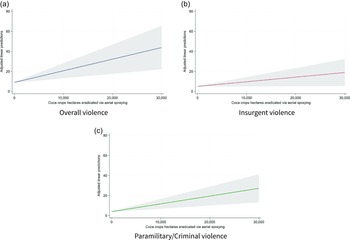
While these average changes may seem modest, it is instructive to appreciate changes from low to high levels of eradication. Figure 3 presents the linear predictions of the marginal effects of aerial spraying – ranging from 0 to 30,000 eradicated hectares – on overall violence, as well as on violence perpetrated by insurgent groups and by paramilitary/criminal organizations. Substantively, a municipality moving from no eradication to a maximum of 33,000 hectares – observed in the municipality of Orito, Putumayo in 2002 – is likely to experience a dramatic upsurge of violence: an increase of 13 and 24 additional events per 100 thousand population perpetrated by guerrillas and paramilitaries and criminal organizations, respectively.
Marginal effects of aerial eradication on non-state armed actors’ violence.
Note: Y-axes display the adjusted linear predictions for the number of violent events per hundred thousand population. 95% CI.

As a robustness check, we subset our sample only to those municipalities engaged in coca crop production. We do this to minimize potential biases that might come from regions unaffected by coca crop dynamics and cocaine production. In a second robustness test, we include night-time luminosity in the main specification, an important confounder and reliable proxy for social development and economic growthFootnote 7 (Henderson et al. Reference Henderson, Storeygard and Weil2012). In a third robustness check, we exclude the lagged outcome variable from our main specification to address potential endogeneity concerns stemming from its correlation with the fixed effects. Finally, to address potential concerns about the non-random assignment of aerial eradication based on prior levels of violence, we conduct a fourth robustness check using propensity score matching. This analysis estimates the Average Treatment Effect (ATE) of exposure to aerial spraying on the average levels of non-state armed actor violence during our study period (2000–2015).
The results for these four tests, presented in the Online Appendix, are consistent with our main findings: aerial spraying is associated with an increase in overall levels of violence, as well as that perpetrated by insurgents and paramilitaries/criminal organizations.
High-Intensity Aerial Eradication
We also investigate how violence unfolds in areas of high-intensity aerial spraying. Because this type of spraying takes place in areas where coca crops are particularly prevalent – and state authorities invest greater resources into eradication – armed violence should be particularly salient. To do so, we modify Equation 1 and use as the main treatment variable a dichotomous variable that takes a value of 1 if eradication in any given municipality falls above the 90th percentile of aerial eradication (between 2000 and 2015), and 0 otherwise.
The results of this analysis, graphically represented in Figure 4, show a positive and statistically significant impact of high-intensity aerial spraying on overall violence. The coefficients are not only significant at conventional levels across all types of actors, but also their magnitudes are larger. Relative to other areas, towns exposed to high-intensity eradication experienced an average increase of 17.74 violent events associated with all non-state actors, 7.33 events related to guerrilla groups, and 11.01 events linked to paramilitary groups and criminal organizations. The findings provide additional evidence in favour of our first hypothesis, suggesting that, regardless of the type of armed actor, aerial spraying is conducive to greater levels of violence in areas exposed to intensive aerial eradication.
High intensity aerial eradication of non-state armed actors’ violence.
Note: 95% CI.

In sum, as our results suggest, aerial eradication efforts are typically more intense in areas where security conditions are already fragile or precarious
Spatial Displacement of Violence to Neighbouring Municipalities
Aerial eradication can trigger the displacement of non-state armed actors to new territories. This displacement might often involve gaining territorial control of nearby areas by wrestling rival actors, coercing civilians into compliance, and confronting state authorities, which can lead to increased violence in neighbouring municipalities. To examine this phenomenon, we modify Equation 1 and use as a dependent variable the average number of violent events per hundred thousand population associated with armed actor $j$
in municipality
$j$
in municipality $i$
’ neighbours.
$i$
’ neighbours.
The results of this specification are presented in Table B.8 in the Online Appendix, and graphically represented in Figure 5. Notably, distinct patterns emerge. First, similar to our previous finding, aerial spraying is associated with an increase in overall levels of violence. However, we find differences across actors: aerial spraying has a positive and significant effect on violence by paramilitary groups and criminal organization but no effect on violent events perpetrated by insurgencies. Concretely, a one SD increase in aerial eradication is associated with a 2.8 per cent standard deviation increase in overall violence. While there is no effect on insurgent violence, we find a 5.4 per cent standard deviation increase in paramilitary/criminal events in neighbouring municipalities – almost twice the magnitude of the effect in targeted areas. Figure B.4 in the Online Appendix presents the linear predictions of the marginal effects associated with these specifications.
Aerial eradication of non-state actors’ violence in neighbouring municipalities.
Note: 95% CI.

7. Effects on different types of violence
As outlined in Section 3, these increases in violence may stem from retaliation against the state, turf wars between armed groups, and civilian victimization. We empirically test these mechanisms using data from Colombia’s National Centre of Historic Memory (CNMH), as detailed in earlier sections.
Retaliation Against the State
One of the primary ways aerial spraying may escalate violence is by provoking a backlash from armed actors against state authorities. We argue that eradication efforts can incite violent actors to target state security forces, such as police and army units, attack eradication teams, or retaliate against the state in various locations.
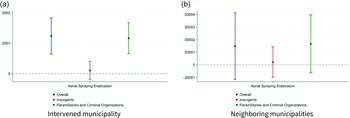
Results are plotted in Figure 6 and displayed in Table B.9 of the Online Appendix. We find that in intervened municipalities, the effects of aerial spraying are positive, but only statistically significant for paramilitary and criminal violence: a one SD increase in aerial eradication is associated with a 4.6 per cent SD increase in violence against the state. This finding reflects not only these groups’ heavy reliance on coca cultivation for financing but also their organizational characteristics, including their adaptability and reactive nature when facing state interventions. Unlike guerrilla groups, paramilitaries and criminal organizations often benefit from tacit state support, which may shape their patterns of retaliation. In neighbouring municipalities, by contrast, aerial spraying is associated with greater violence, overall and across all armed actors: almost 5 per cent and 2.8 per cent SD increases in insurgent and paramilitary/criminal violence, respectively, given one SD increase in eradicated hectares. This spatial spillover aligns with our theoretical argument that armed actors strategically retaliate where state presence is weaker or where strategic gains can be achieved.
Aerial eradication of acts of war against state forces.
Note: 95% CI.

It is worth noting the uneven effects of aerial spraying on different types of groups, in particular, in the intervened municipalities. As suggested in our theoretical discussion, this could be attributed to differences in organizational structures and reactions to state interventions. While guerrillas tend to attack the state regardless of the latter’s actions, paramilitaries and criminals’ actions are more reactive, directly responding to disruptions caused by eradication efforts. The adversarial and ideologically driven nature of guerrilla groups contrasts with the profit-oriented goals of paramilitary and criminal organizations, explaining why the latter groups exhibit more significant spikes in violence following state interventions.
Equally puzzling, however, is the discrepancy in actors’ violence across intervened and neighbouring municipalities. The reason for these findings could lie in the fleeting nature of such state interventions. In such circumstances, retaliation against the state takes place after the intervention, with non-state actors choosing where to retaliate. These results underscore how the short-term and large-scale nature of aerial spraying can displace violence geographically, as actors target regions with reduced state capacity or vulnerability. Overall, it is noteworthy that while the Colombian military may see fleeting interventions as a way to prevent retaliation during the operations, the response still occurs, with retribution targeting more stable and vulnerable areas in neighbouring municipalities.
Turf Wars Between Groups
Aerial spraying, designed as a counter-narcotics strategy to eradicate illicit coca cultivation, paradoxically increases violence by triggering turf wars among non-state armed actors. This escalation occurs as armed groups, including insurgents and criminal organizations, compete for control over territories disrupted by the intervention. The destruction of coca crops destabilizes power dynamics, leading to violent confrontations as groups seek to consolidate control over affected areas or relocate coca production.
The empirical findings supporting this mechanism are visualized in Figure 7 and detailed in Table B.10 in the Online Appendix. We find that aerial spraying increases violence within the municipalities directly targeted by the intervention, concretely, a 4.2 per cent SD increase in inter-group violence given one SD increase in aerial eradication. However, violence does not spill over into neighbouring municipalities. This localized effect suggests that eradication efforts primarily disrupt territorial control in the areas where spraying occurs, rather than prompting broader territorial disputes.
Aerial eradication of acts of war against other non-state armed actors.
Note: 95% CI.

These findings align with the theoretical expectation that eradication efforts create immediate incentives for armed groups to compete over disrupted territories. However, the absence of spillover violence indicates that competition is localized, driven by destabilized power arrangements rather than broader strategic shifts. Aerial spraying thus generates centripetal dynamics, concentrating violent confrontations within directly affected areas.
Violence Against Civilians
Finally, aerial spraying disrupts the equilibrium of armed governance, creating conditions that increase civilian victimization. This disruption occurs in two primary ways: through territorial competition and the breakdown of relationships between armed groups and civilians in the coca economy. The destruction of coca crops undermines the ability of armed groups to enforce agreements, collect taxes, and maintain order, increasing the likelihood of violence against growers and other civilians in targeted areas. Armed groups may use violence to punish civilians perceived as collaborators, enforce compliance with cultivation demands, or assert dominance in contested territories.
We present the coefficients with 95 per cent confidence intervals in Figure 8, with detailed results in Table B.11 of the Online Appendix. In line with expectations, aerial spraying is positively and significantly associated with massacres. Disaggregating the data reveals that this effect is driven entirely by paramilitary and criminal actors, who rely heavily on the coca economy and employ violence to maintain control and enforce agreements. Substantively, the coefficients for paramilitaries and criminal actors suggest that a one SD increase in aerial eradication is associated with a 4 per cent SD increase in massacres against civilians.
Aerial eradication of massacres.
Note: 95% CI.

Although this increase may seem small, the relative change in massacres due to eradication presents a more alarming picture. The incidence of massacres increases significantly with aerial eradication: in municipalities without eradication, the average number of massacres is 0.2, whereas in those experiencing the highest levels of eradication, this figure rises to 3.7 – an increase of over 18 times. Indeed, in the Colombian conflict, paramilitaries’ primary mode of operation often involved targeting civilians rather than engaging directly with insurgent groups. This strategy served multiple purposes: consolidating territorial control, signalling strength, and undermining local support for their rivals. By contrast, aerial spraying has no statistically significant effect on insurgent-led massacres, which aligns with prior findings that most massacres during the period under study were committed by paramilitaries (Restrepo et al. Reference Restrepo, Spagat and Vargas2003).
Instances of violence against civilians in coca-growing regions were not uncommon. For example, in 2005, aerial spraying in Brisas del Güejar, a former FARC stronghold, preceded the arrival of paramilitaries. ‘Paramilitaries dressed in army clothing arrived at the village’, interrogated a worker, and threatened local leaders, all while army helicopters flew overhead (Semanario Voz, 2005). This sequence reflects how aerial spraying, often accompanied by state forces, disrupts local power dynamics and facilitates paramilitary violence. In many cases, law enforcement turned a blind eye, allowing paramilitaries to use violence to expel uncooperative locals, suppress social mobilisation, and punish individuals accused – sometimes without evidence – of collaborating with insurgents (Gutiérrez Sanín Reference Gutiérrez Sanín2019).
8. Placebo Test: Forced Manual Eradication
We have shown that forced eradication via aerial spraying is associated with a spike in armed violence. Aerial spraying is a fleeting strategy (coercive, unilateral, and often unconditional) that disrupts local equilibria and generates incentives and opportunities for the production of violence, given its rapid pace and large-scale impact.
An alternative explanation suggests that the eradication of illicit crops, regardless of the speed of implementation or scale of the method, is the primary driver of violence. If a positive and statistically significant relationship between manual eradication and violence is observed, this would challenge our argument about the uniquely disruptive nature of aerial spraying. Unlike aerial spraying, manual eradication is a slower, smaller-scale intervention, achieving eradication rates ten times lower (El Tiempo 2007), yet it still constitutes a fleeting state presence in affected areas.
Another potential concern is that the rise in violence might be linked to the security measures accompanying aerial spraying rather than the eradication itself. If this were the case, we would expect manual eradication to have a larger impact on violence, since manual eradication typically requires a greater deployment of security forces to protect personnel, given the higher risks for those working on the ground, compared to aerial eradication. Therefore, if we observe a greater effect of manual eradication on violence than that of aerial spraying, the rise in violence can likely be attributed to the security measures accompanying forced eradication rather than the eradication process itself.
We consider this to be a crucial test of our argument. Thus, building on Equation 1, we estimate the effect of manual eradication (in hectares) of coca crops on violence perpetrated by violent actors in the intervened municipalities and their neighbours. The results, presented in Figure 9 and Table B.12 in the Online Appendix, show that manual eradication has no statistically significant impact on violence in either the targeted municipalities or their neighbours. It is important to note that while manual eradication does not reduce violence, it also does not have the escalating effect associated with aerial spraying. Although manual eradication operations may coincide with instances of violence, the results indicate that these operations do not exacerbate violence in the same way that aerial spraying does.
Forced manual eradication of non-state armed actors’ violence.
Note: 95% CI.

Indeed, manual eradication is less likely to disrupt the equilibria in the intervened territories, reducing the likelihood of violent reactions by non-state armed actors, as it involves a slower and more localized approach that limits the immediate shock to power dynamics. This finding reinforces our argument that the specific characteristics of aerial spraying – its rapid implementation, large scale, besides its fleeting nature – are key drivers of the violence observed. Manual eradication, while still a form of fleeting intervention, lacks these disruptive attributes.
Conclusion
This article analyzed how state interventions aimed at targeting the availability of illicit resources affect non-state armed groups’ propensity to resort to violence. We argue that such interventions, rather than improving security, often lead to higher levels of violence. Aerial spraying exemplifies how these actions provoke pushback against the state, fuel turf wars among armed groups, and disrupt their social contracts with local populations. Our study builds on a vast literature on state interventions in criminal wars (Calderón et al. Reference Calderón, Robles, Díaz-Cayeros and Magaloni2015; Dell Reference Dell2015; Flores-Macías Reference Flores-Macías2018; Lessing Reference Lessing2017), but we zero in on those targeted at the most basic and vulnerable link in the drug-trafficking chain.
Our findings confirm that aerial spraying is associated with increased violence in coca-growing municipalities. This effect is driven by the specific characteristics of aerial spraying: its large scale, rapid implementation, and fleeting nature. These features destabilize local power dynamics, disrupt economic arrangements, and trigger violent responses. The results show significant increases in overall violence, with distinct patterns across different armed groups and types of violence. These findings underscore the unintended consequences of coercive state interventions in conflict zones.
When disaggregating the effects by group, we find that paramilitaries and criminal organizations respond more sharply to aerial spraying. This response reflects both their economic reliance on illicit activities and their reactive use of violence, shaped by their distinct relationships with the state. Paramilitary groups, often enjoying tacit or direct state support, are more likely to retaliate against state interventions, such as aerial spraying. Their violence frequently targets civilians and extends into neighbouring municipalities. By contrast, insurgent groups display more consistent patterns of violence, which are influenced by their consistently adversarial relationship with the state.
Our results further demonstrate that the mechanisms driving violence—retaliation, turf wars, and civilian victimization – reflect the disruptions caused by aerial spraying. Retaliation occurs as armed groups attack state forces and eradication teams to deter future interventions. Turf wars arise when disrupted power dynamics create opportunities for competition over territory and resources. Civilian victimization emerges from armed groups’ efforts to enforce agreements, re-establish control, or punish perceived collaborators. These mechanisms align closely with theoretical expectations, illustrating how fleeting state actions destabilize local governance and amplify insecurity.
The localized nature of these effects is particularly noteworthy. While retaliation spreads into neighbouring municipalities, turf wars and civilian victimization are largely concentrated in areas directly affected by aerial spraying. This pattern reflects the centripetal dynamics of territorial competition and enforcement, where armed groups prioritize consolidating control over disrupted areas. The differentiation between mechanisms underscores the complex interplay of strategic motivations, organizational differences, and state interactions in shaping violence dynamics.
Further analyses give us the confidence that our results are not driven by other confounders or approaches to illicit crop eradication. Our results remain consistent when we use a sample restricted to municipalities engaged in coca production, which helps minimize potential biases from regions not impacted by coca-related dynamics. Moreover, we find that manual eradication does not have a significant effect on violence, indicating that the violence linked to forced eradication is specific to aerial spraying rather than eradication efforts typically accompanied by other, more sustained forms of state presence.
Although we have focused on Colombia – where aerial eradication has been a central strategy in the war on drugs – this study has broader implications beyond this particular case. In other conflict zones where illicit economies sustain non-state actors, coercive interventions such as aerial spraying may have similar destabilizing effects. These findings challenge the assumption that eradication efforts inherently reduce violence. Instead, such policies amplify insecurity, prolong cycles of violence, and undermine trust in state institutions. Given that countries like Mexico, currently grappling with internecine disputes involving drug cartels, have recently employed aerial spraying to eradicate poppy crops (Animal Politico 2019), the Colombian case provides a cautionary tale about the harms caused by aerial spraying.
Our work also raises questions about the long-term sustainability of forced eradication strategies. Aerial spraying is often promoted in policy circles as a swift and efficient method for eliminating illicit crops. However, the political consequences of such a strategy are frequently overlooked. By increasing violence and exacerbating humanitarian conditions in already vulnerable communities, spraying can strain state-citizen relationships, undermining efforts by the state to strengthen its authority and legitimacy.
Overall, our work has significant implications for the study of state policies aimed at limiting the availability and profitability of resources that help sustain large-scale violence. Our key takeaway is that any state intervention targeting these markets is likely to escalate violence in the regions where these resources are produced.
Supplementary material
Supplementary material for this article can be found at https://doi.org/10.1017/S000712342500033X.
Data availability statement
Replication data for this article can be found in Harvard Dataverse at: https://doi.org/10.7910/DVN/S2K8HA.
Acknowledgements
We thank Alex Hartman, Zeynep Bulutgil, Kristin Bakke, Marina Duque, Andrea Caflisch, Giovanni Hollenweger, Neil Mitchell, Nils W. Metternich, Finn Klebe, Yilin Su, Manuel Vogt, Johanna Amaya-Panche, Juan Albarracín, Julian Gerez, Maria Lotito, and David Andrés Rodríguez Camacho for their valuable comments. We also benefited from discussions with participants at UCL’s Conflict and Change Workshop, the University of Deusto Workshop, the 2014 Midwest Political Science Association Conference, and the 2024 Latin American Studies Association Conference. Additionally, we are grateful for the constructive feedback from two anonymous reviewers and the BJPS editorial office, which significantly improved this article. Finally, we thank UCL’s Department of Political Science for funding that facilitated fieldwork in Colombia.
Financial support
This research received funding from the Department of Political Science, University College London and from British Academy grant SRG22\220972.
Competing interests
The authors declare none.
Ethical standards
The research meets all ethical guidelines, including adherence to the legal requirements of the study country.
Juan Felipe Campos-Contreras is the Director of the Office of Information Analysis and Strategic Studies at the Secretaría de Seguridad, Convivencia y Justicia in Bogotá. His work focuses on urban and national security, violence prevention, and data-driven public policy. He holds a BA and MSc in Economics from Universidad de Los Andes, as well as a Master of Public Administration from University College London.
Camilo Nieto-Matiz is Assistant Professor of Political Science at the University of Texas at San Antonio and a Research Affiliate at the Violence and Transitional Justice Lab at the University of Notre Dame. His research focuses on political violence, state building, criminal governance, and transitional justice in Latin America.
Luis L. Schenoni is an Associate Professor and the Director of the Security Studies Programme in the Department of Political Science at University College London. His work centers on state building and international conflict with a focus on Latin America. He is the author of the award-winning Bringing War Back In: Victory, Defeat, and the State in Nineteenth Century Latin America (Cambridge University Press, 2024).






 Open access

