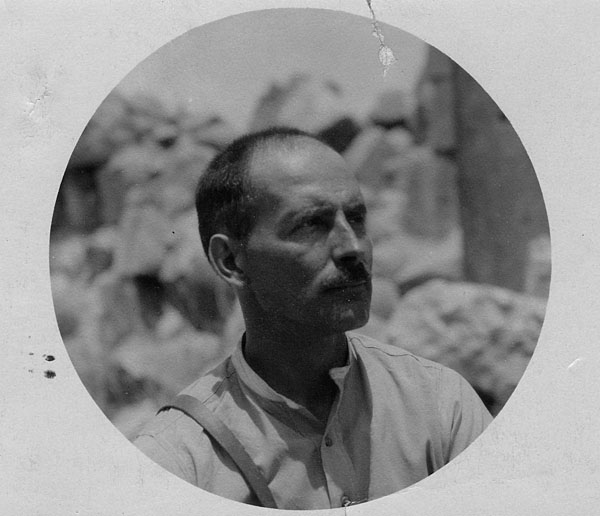


George Horsfield (P2008-790a) ( Institute of Archaeology, UCL).

The American Biblical archaeologist William Foxwell Albright described the inter-war period in British Mandate Palestine as 'the halcyon years' (Reference AlbrightAlbright 1960:35). During the Mandate, archaeologists, free of the constraints of Ottoman Empire officialdom, eagerly explored the lands then administered by Britain. Just a few of these men and even fewer women are remembered today - Flinders Petrie's long shadow overwhelms the lives of countless others.
George Horsfield (1882-1956) is one such archaeologist (Figure 1). A trained architect, Horsfield was admitted to British School of Archaeology in Jerusalem (BSAJ) in 1923, and ultimately became the Chief Inspector of Antiquities in Transjordan during the late 1920s and 30s (BSAJ Minute Book 1 1918-60; Colonial Office Records 1934: CO 831/30/8; Reference ThorntonThornton 2009). He obtained this high-placed Mandate Government position through his architectural ability. Horsfield came to archaeology later in life and from a non-academic background, so his professional experience challenges modern definitions of an archaeologist.
Born in Leeds, George Horsfield cemented his qualifications in the London office of G.F. Bodley and the Manhattan office of Bertram Grosvenor Goodhue (Horsfield c.1923-36). Both these men were major proponents of Gothic Revival architecture, a style popularised during the mid-nineteenth century and based on intricate studies of medieval church buildings (Reference HallHall 2004; Reference OliverOliver 1983). Architects trained in the Gothic Revival tradition developed skills in drawing, measuring and restoration; Horsfield worked under Bodley on the restorations of York Minster and Peterborough Cathedral (Crinson & Lubbock 1994: 40; Horsfield c.1923-36). After seeing action in Gallipoli and on the Somme during the First World War, Horsfield was invalided out of France in 1917 with trench fever. England's damp weather made a full recovery impossible; he applied for garrison duty overseas and was sent to India and worked there until 1920 (War Office Records 1915-22: 374/34788). Rather than return to a post-war England where making a living as an architect was uncertain, Horsfield travelled to Jerusalem to begin a career in archaeology (BSAJ Minute Book 1 1918-60).
Postcard of the Temple of Artemis, Jerash, with annotations made in pencil. This postcard was found in the Horsfield Collection; the annotations are most likely Horsfield's (P2008-100) ( Institute of Archaeology, UCL).

The British School of Archaeology in Jerusalem was founded in 1919. Its first Director, John Garstang, displayed an interest in conservation, and through regular reports on antiquities he set the stage for Horsfield's role as architect-archaeologist. Horsfield's life highlights a particular aspect of archaeology during this period; that of the built environment, its conservation and restoration. At a BSAJ Committee meeting in 1920 Garstang read out a letter from Lord Curzon, the former Viceroy of India who had been responsible for arrangements for the restoration of the Taj Mahal, an Ancient Monuments Bill and the creation of a directorate-general of archaeology in India (Gilmour 2008; BSAJ Minute Book 1 1918-60). Curzon now requested that some of the school's money be set aside for the emergency conservation of monuments in Palestine (BSAJ Minute Book 1 1918-60). This letter shows a conscientious attempt on the part of the school's organising committee, encouraged by Garstang, to support conservation of architectural remains.
Unlike many of the other students accepted to the BSAJ at that time, Horsfield's experience was mainly practical. Garstang urged the committee to accept Horsfield's application and suggested that, in view of his architectural experience, his tuition fees should be waived - an occasional favour the committee granted to students bringing special skills to the school. From this modest beginning as a non-university-educated student, Horsfield rose to a position of power within the school, largely due to his architectural abilities and draughtsmanship (BSAJ Minute Book 1 1918-60). The first mentions of Horsfield's work are in the BSAJ's short-lived Bulletin he provided elegantly rendered plans for the BSAJ's student excavations at Tanturah, then stabilised the robbed Sassinian building in Amman's Acropolis (BSAJ 1924: Pl. IIII, 77).
Undated photograph, probably c.1928, of excavations at the South Theatre, Jerash (P2008-62) ( Institute of Archaeology, UCL).

However, it was Horsfield's work at Jerash that truly launched his archaeological career (Figure 2). He assumed responsibility for conservation there in 1925, and one of his first actions was to cut a road that enabled public access to the site (Reference KraelingKraeling 1938: 3; Reference HorsfieldHorsfield 1926). His knowledge of structures proved invaluable in rendering standing buildings safe for the public. As he worked to clear away rubble and protect stonework, he uncovered statues, inscriptions and other parts of Roman Jerash hidden by fallen columns (Figure 3). One of Horsfield's discoveries, a sculpted head, captured the imagination of the British public; it was touted as a likeness of Christ (The Times 1926). Articles on the Jerash Head appeared in The Times at several points during 1925 and 1926 (The Times 13 July 1925, 14 November 1925, 13 March 1926, 30 July 1926). It was eventually loaned to the British Museum and put on display in London in 1927 (Reference GarstangGarstang 1927). In 1928, Horsfield moved to the Transjordan Department of Antiquities, where his knowledge of buildings and styles, accumulated during his apprenticeship and architectural career, was constantly put to use, until his retirement from the department and departure from the Middle East in 1936 (Horsfield c.1923-36; Reference EvansEvans 1966: 274-90).
Horsfield's life and work may not be remembered outside specialist circles, but perhaps it is time to take a closer look at the lives of some these early twentieth-century archaeologists - the men and women who worked away at ground level, during a period of change and development, while the new world was being shaped in the hands of international politicians rather than local communities. Understanding the early history of the BSAJ and the lives of the students will help us appreciate the complexities of how archaeology developed during this chaotic period. The political intrigues of the inter-war period are hotly debated, demonised and mythologised today, but we can still appreciate the practical efforts of George Horsfield's early work when visiting the Roman ruins he helped conserve.
Acknowledgements
Thanks are due to Drs John Thornton and Linda Heywood; Ian Carroll, Dr Rachael Sparks, Tim Schadla-Hall, Dr Andrew Garrard and Godfrey McFall.