


1. Introduction
Innovations in healthcare design are increasingly prioritizing patient-specific solutions that address the unique needs among patients to improve clinical outcomes This paper presents an approach to personalizing cage design by evaluating clinical requirements, utilizing biomechanical modeling, and identifying potential design improvements. Advanced engineering design strategies are essential to optimize medical implants (Reference Egan, Cagan, Schunn, Chiu, Moore and LeducEgan et al., 2016), especially with complex biomechanical interactions. For instance, spinal surgeries that insert cage implants to fuse vertebra are common yet still retain challenges of subsidence, stress shielding, and material rejection based on biomechanical interactions (Reference Patel, Yoo, Karmarkar, Lamoutte and SinghDil V. Patel et al., 2019). Personalized cages could improve post-operative alignment, reduce mechanical stress and degeneration, and enhance long-term spinal stability (Reference Mullin, Asghar, Patel, Osorio, Smith, Ames and NicolauMullin et al., 2024). Further studies have demonstrated personalized titanium cages can promote bone fusion (Reference Lewandrowski, Vira, Elfar and LorioLewandrowski et al., 2024), 3D printed metamaterials are tunable to different physiological loading cases (Reference Munyensanga and MabroukMunyensanga & El Mabrouk, 2024), and personalization can restore natural spine curvature (Reference Sadrameli, Blaskiewicz, Asghar, Ames, Mundis, Osorio and PatelSadrameli et al., 2024). Collectively, these studies exemplify the transformative potential of personalized health design in advancing patient care across diverse biomedical applications, although highlighted for spinal cages, such strategies could improve outcomes across clinical applications.
A personalized health design process may integrate clinical evaluation, biomechanical analysis, and tailored spinal cage design to address patient-specific problems and deliver optimized biomechanical solutions as shown in Figure 1. The approach considers the unique needs of a patient from a clinical perspective, followed by evaluation biomechanically with modeling approaches to inform design decisions. Such data is used for biomechanical evaluation to understand load distribution, stress points, and the mechanical interaction between implants and the spine. Here, emerging technologies such as 3D printing can offer innovative designs to mimic the mechanical properties of natural bone with optimized porosity, stiffness, and strength. Key steps in the process require a thorough understanding of clinical problems, how to biomechanically model the spine, and identifying effective design approaches for tailoring solutions based on considered information.
Design approach for addressing patient-specific needs for tailored spinal cages

The goal of the paper is to assess recent literature and determine opportunities for designers in personalized health domains, with a focus on interbody spinal cages as a case study. This review adopts a literature-driven methodology to explore how integrating clinical insights, biomechanical simulations, and optimization techniques can improve spinal fusion cage design. These understandings across topic areas help address design decisions that affect implant performance, ensuring better patient recovery and long-term surgical outcomes. Findings are critically assessed and discussed to establish novel insights for supporting design advancements for personalization in the clinic. The significant contributions are an identification and assessment of current clinical issues in medicine and a highlighting of the design approaches that could address them, such as multi-objective heuristic optimization or artificial intelligence. Biomechanical modelling approaches including finite element analysis (FEA) are assessed for evaluating the spinal system to inform cage design. The expected outcome of the work is an enhanced understanding of design approaches in biomechanical applications, where there is a great need to consider personalized cases that benefit from efficient design approaches to improve clinical outcomes.
2. Clinical needs
2.1. Clinical problems
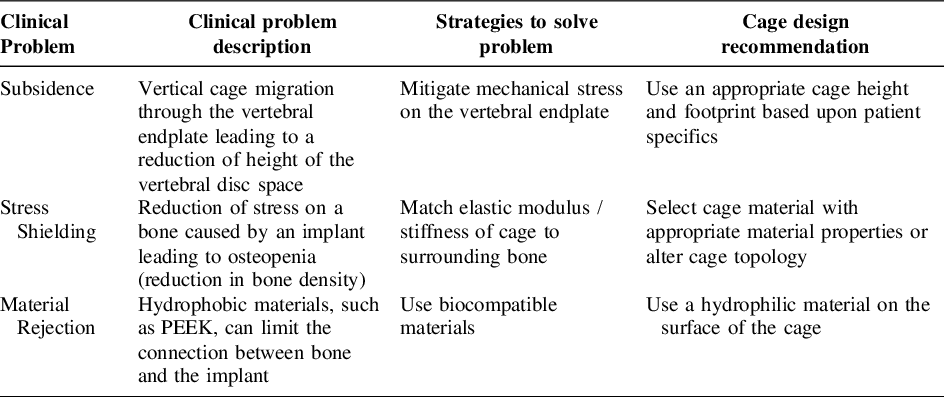
Sub-optimal interbody spinal cages are potentially a contributing factor for many perioperative spinal fusion complications, thereby driving a need for their improved design. Major clinical problems associated with spinal fusion cages are subsidence (Reference Parisien, Wai, Elsayed and FreiParisien et al., 2022), stress shielding (Reference Liverani, Rogati, Pagani, Brogini, Fortunato and CaravaggiLiverani et al., 2021), and material rejection (Reference Veronesi, Sartori, Griffoni, Valacco, Tedesco, Davassi and BrodanoVeronesi et al., 2022) summarized in Table 1. These complications can cause pain and discomfort in a patient, increase risk of reinjury, or even cause procedural failure.
Summary of clinical problems with recommended design strategies

Of these problems in Table 1, the most common perioperative complication in spinal fusion is subsidence. Following oblique lateral interbody fusion procedures, subsidence accounts for approximately 38.7 percent of all complications (Reference Abe, Orita, Mannoji, Motegi, Aramomi, Ishikawa and OhtoriAbe et al., 2017). Subsidence occurs when an implant migrates vertically through the vertebral endplates. This is a significant issue because the development of subsidence can lead to severe pain, abnormal curvature in the spine, instability, and neural compression. Subsidence is also one of the leading causes of pseudoarthrosis, a complication where the two ends of the spine fail to fuse properly, resulting in an unsuccessful fusion (Reference Zhao, Xie, Wang, Yang, Pu, Lu and ZengZhao et al., 2022).
Another complication for spinal cage implants is stress shielding, the process in which mechanical forces are abnormally distributed across the vertebrae due to an overly stiff implant. Stress shielding can lead to periprosthetic bone resorption, where the bone surrounding an implant begins to degrade and become weaker (Reference Liverani, Rogati, Pagani, Brogini, Fortunato and CaravaggiLiverani et al., 2021). Additionally, as degradation progresses spinal cage implants can become loose, eliciting additional complications within a patient. Research shows that reducing the stiffness of a cage can impact stress shielding, however the efficacy of this solution is unclear (Reference Safavi, Yu, Robinson, Gray, Ackland and LeeSafavi et al., 2023). Additional research should be conducted to test whether stress shielding is related more closely to the mechanical stiffness of an implant or to its footprint size.
Finally, when dealing with any interbody implant, clinicians are concerned with the possibility of material rejection. One of the most used cage materials, polyetheretherketone (PEEK), is hydrophobic and therefore resists bonding with water and other biological fluids, hindering the interaction between PEEK and biological elements including osteoblasts. Adhesion between an implant and osteoblasts, known as osseointegration, is critical for bone fusion. However, PEEK’s hydrophobicity limits osseointegration (Reference Veronesi, Sartori, Griffoni, Valacco, Tedesco, Davassi and BrodanoVeronesi et al., 2022). This can lead to an array of problems, such as a fibrous encapsulation of the implant thereby preventing effective fusion, delay of post operative healing, or simply causing pain and discomfort in a patient.
2.2. Cage design strategies
There is extensive research on both the causes of spinal fusion cage complications and methods to mitigate these complications. This research has been implemented by spinal cage designers to create implants with better clinical outcomes, however, they are far from optimal. New cages, especially those that incorporate patient-specific design strategies, require multiple considerations to fully address the biomechanical complexity in surgical treatments which is highlighted in Figure 2.
Structural components and design suggestions to improve spinal cage system

Research shows the use of cages with a height (Reference Kotheeranurak, Jitpakdee, Lin, Mahatthanatrakul, Singhatanadgige, Limthongkul and KimKotheeranurak et al., 2023) and/or footprint (Reference Parisien, Wai, Elsayed and FreiParisien et al., 2022) which is not optimized for a patient can be a cause of subsidence development. Wider implants have been shown to consistently reduce the incidence of subsidence. Furthermore, when lateral lumbar interbody fusion cages extend to bridge both sides of the apophyseal ring, the most lateral portion of the vertebral endplate, they demonstrate even greater resistance to subsidence. Selection of optimal interbody cage height is influenced by disc degeneration, gender, body height, segment location, the intervertebral height of the pathological segment, and lumbar degeneration. With the use of patient specific spinal cages, a cage whose footprint is both large enough to cover both ends of the specific patient’s apophyseal ring and is of a height optimal for a specific patient can be printed, ensuring ideal subsidence mitigation.
Interbody devices have traditionally been made from titanium alloys due to their strength, durability, and biocompatibility, offering high corrosion resistance and optimal osteoconductive potential for fusion rates. However, titanium’s high modulus of elasticity compared to bone can lead to stress shielding, endplate trauma, and subsidence (Reference Patel, Yoo, Karmarkar, Lamoutte and SinghD. V. Patel et al., 2019). Alternatively, PEEK has an elastic modulus similar to bone, resulting in lower subsidence rates, but causes material rejection due to its hydrophobic surface (Reference Veronesi, Sartori, Griffoni, Valacco, Tedesco, Davassi and BrodanoVeronesi et al., 2022). To address this, a composite material cage made from PEEK with titanium coating the surface can be fabricated. This cage would have an elastic modulus closer to that of a patient’s bone, estimated by measuring bone density, without having a hydrophobic surface, mitigating the risk of material rejection and reducing stress shielding. Anisotropic cage matrices also replicate the anisotropic porous structure of trabecular bone, creating a more favourable environment for bone formation and bone integration, thus further reducing the risk of material rejection (Reference Luo, Li, Lin, Cheng, Wang, Wang and HuangLuo et al., 2023). By considering these strategies it is possible to improve spinal cage design, however, it is also necessary to have accurate models to predict how a cage will interact biomechanically with the body. Moreover, advancements in cage design strategies are increasingly incorporating computational optimization, with AI emerging as a powerful tool to refine implant geometry and material properties.
3. Biomechanical evaluation
3.1. Finite element analysis
Lumbar interbody fusion spinal cages have advanced significantly for addressing clinical needs by incorporating advances in materials, design approaches, and surgical placement techniques (Reference Phan and MobbsPhan & Mobbs, 2016). The increasing complexity of modern cage designs, particularly lattice-based structures enabled by 3D printing, benefits from computational methods to evaluate their mechanical performance during design optimization. FEA has emerged as an invaluable tool for the mechanical analysis of cages, by enabling the assessment of design modifications (Reference Calvo-Echenique, Cegoñino, Chueca and Pérez-del PalomarCalvo-Echenique et al., 2018) and material selections for subject-specific cases (Reference Egan, Bauer, Shea and FergusonEgan et al., 2019; Reference Masud, Arefin, Chyu and EganMasud et al., 2021). Computational modelling of spinal cages presents unique challenges due to their intricate geometries, which often include complex structures, curved surfaces, and specialized fastening mechanisms for spinal stability (Reference Elkazaz, Koptan, Alshatoury, Alkosha and Abou-MadawiElkazaz et al., 2020). The computational cost of these analyses is primarily driven by mesh density requirements and material model selection, which are dictated by the smallest geometric features in the design that must be taken into consideration during the FEA modelling process.
Two fundamental approaches have emerged to address these computational challenges: Low and high-fidelity models (Reference DiazDelaO and AdhikariDiazDelaO & Adhikari, 2012). Low-fidelity models are particularly valuable during the design exploration phase, where multiple design iterations must be evaluated. For lattice-based cages, two principal low-fidelity approaches have proven effective. The first approach, solid homogenization modelling (Reference Geers, Kouznetsova, Matouš and YvonnetGeers et al., 2017), treats the lattice structure as a continuous medium with equivalent mechanical properties, dramatically reducing computational cost while capturing bulk mechanical behaviour. The method is particularly effective when the size of individual lattice unit cells is much smaller than the overall cage dimensions. This simplification enables rapid evaluation of different material properties and basic geometric configurations, making it ideal for preliminary design studies and sensitivity analyses. The second approach, beam modelling (Reference Červinek, Pettermann, Todt, Koutný and VaverkaČervinek et al., 2022), leverages one-dimensional finite elements to represent lattice structures, offering an excellent balance between computational efficiency and geometric accuracy. While this approach maintains more geometric fidelity than homogenization, it introduces challenges in defining interactions between beam elements and surrounding solid structures. High-fidelity models, conversely, are essential for final design validation and subject-specific simulations where accurate prediction of local stress states is crucial. These models typically employ detailed solid element meshes that fully resolve the lattice geometry (Reference Chen, Gu, Yuan, Shi, Liu, Sun and LinChen et al., 2024). While computationally intensive, high-fidelity models provide the accuracy needed for critical decisions in patient-specific applications that might be missed in simplified models.
Low and high-fidelity models can also be used in conjunction, leveraging the power of FEA to obtain refined responses while saving computational resources. Such an approach is supported by the Total HUman Model for Safety (THUMS) by Toyota Motor Corporation, a sophisticated open-source computational tool developed to simulate the mechanical and physiological behaviour of the human body, with multiple submodels available for specialized research, like the lumbar spine model. The lumbar spine model uses advanced modelling techniques to provide high fidelity in biomechanical simulations. During development, detailed anatomical data was used with experimental studies on geometric and material definitions (Reference Demetropoulos, Yang, Grimm, Khalil and KingDemetropoulos et al., 1998). Figure 3 depicts the lumbar spine finite element model included in THUMS, along with a cage inserted in L4-L5 vertebrae after intervertebral disc removal.
THUMS model for (A) spine and (B) cage design

3.2. Biomechanical modelling parameters
The lumbar spine is essential for supporting the upper body, allowing for easier movement, and shock absorption in daily life activities. To evaluate the biomechanical response and simulate physiological loads, a thorough FEA model of the lumbar spine such as Thums can be developed with patient relevant attributes. Modelling the lumbar spine requires considerations such as acquiring geometry, material characteristics, boundary conditions, and validation of parts like vertebrae, intervertebral discs, end plates, and ligaments. Such models offer a strong foundation for researching clinical situations such as degenerative disc diseases, spinal injuries, and other surgical procedures.
The complex arrangement of the vertebrae is captured mostly using computed tomography (CT) scans. Each region is given distinct material properties to represent its stiffness and strength in real life, which is typically linear elastic isotropic. For instance, strong and dense cortical bone supports heavy weights, while cancellous bone aids in shock absorption. Bones may also be modelled with more complex anisotropic behaviour in applications involving large deformations (Reference Calvo-Echenique, Cegoñino, Chueca and Pérez-del PalomarCalvo-Echenique et al., 2018). Ligaments are used to limit the model’s range of motion and provide stability by employing tension-only elements, with linear and nonlinear material properties (Reference Sciortino, Pasta, Ingrassia and CernigliaSciortino et al., 2023).
The intervertebral disc, which acts as a stress absorber and provides flexibility between vertebrae is essential to finite element modelling of the lumbar spine. The disc is normally represented using 3 components: The nucleus pulposus, annulus fibrosus, and cartilaginous endplates. The annulus fibrosus is the intervertebral disc outer layer made up of collagen fibers arranged in concentric layers, and the nucleus pulposus, a gel-like core, is located in the middle of the disc. It is commonly modelled as an incompressible, hyper-elastic substance such as Neo-Hookean or Mooney-Rivlin models since they accurately capture the nucleus’s capacity to disperse pressure throughout the disc (Reference JaramilloJaramillo, 2018). Finally, endplates, the thin layers between the disc and vertebrae, are also incorporated using linear elastic or hyper-elastic material properties (Reference Xu, Yang, Lieberman and HaddasXu et al., 2017). All these components work together to produce a realistic, load-bearing disc that effectively mimics the mechanics of the natural spine.
Certain interactions like anatomical contact must be modelled to prevent unrealistic penetration among adjacent surfaces (Reference Chamoret, Bodo and RothChamoret et al., 2016). This is handled computationally through contact algorithms that maintain proper spatial relationships between surfaces in the finite element model. For lumbar spine modelling, penalty-based contact is commonly used, which effectively acts as added springs between surfaces to prevent penetration while allowing natural sliding motion.
The lowest lumbar vertebra (e.g., L5) is fixed in all degrees of freedom to act as a stable reference point in lumbar spine modelling. To avoid stress concentrations, loads are frequently administered to the top vertebra (such as the L1 or T12) using a rigid body or by loading node sets. Compressive forces (100–1000 N) are used to represent body weight and muscular forces, as well as pure moments (e.g., 7.5 Nm) for flexion/extension, lateral bending, and axial rotation (Reference Shirazi-Adl, El-Rich, Pop and ParnianpourShirazi-Adl et al., 2005). Other simulations include follower loads, muscle forces, and more complex dynamic actions.
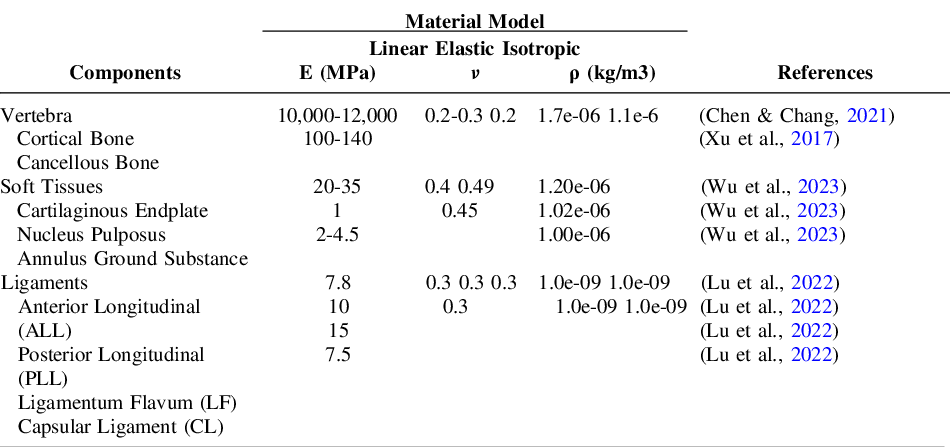
For a spine model to accurately replicate biomechanical behaviour, validation is necessary (Reference Henninger, Reese, Anderson and WeissHenninger et al., 2010). To guarantee accuracy, the model’s range of motion in different directions, load-displacement curves, intradiscal pressure, and facet joint forces are compared to both in vitro and in vivo data (Reference Demetropoulos, Yang, Grimm, Khalil and KingDemetropoulos et al., 1998; Reference Dreischarf, Zander, Shirazi-Adl, Puttlitz, Adam, Chen and SchmidtDreischarf et al., 2014). Confidence in the model’s prediction power is further increased by comparing it to other validated models and using clinical case studies covering damage processes or surgical outcomes. Table 2 provides the material properties of various lumbar spine components that have been obtained through experiments and modelling, including vertebrae, intervertebral discs, and ligaments, used in FEA. These properties—such as Young’s Modulus, Poisson’s Ratio, and Density—are essential for accurately simulating the spine’s biomechanical behaviour. The materials are assumed as linear elastic isotropic. Value ranges are provided for some components to account for patient-specific differences that may be incorporated in the design process.
Elastic biomechanical material properties used for spine FEA models

3.3. Patient-specific modelling
Two types of spine models are relevant to this review: Generic and patient specific. Generic models are developed using a standardized representation of the human spine considering the average anatomical data across a population. Although generic models require fewer computational resources and are suitable for preliminary implant design, they lack the biomechanical accuracy needed for specific patients, as properties like bone density and stiffness vary depending on individual spinal anatomy. Using a generic model-based implant may result in suboptimal fit, instability, and uneven load distribution that can increase the risk of postoperative complications like subsidence, stress shielding, or implant failure. To address those issues, patient-specific models can be developed and used instead of generic ones.
In the context of creating a patient-specific model with detailed anatomical properties, one doesn’t need to build a model from scratch for every patient but can rather customize a generic spine model that will serve as a flexible base (Reference Meszaros-Beller, Hammer, Riede, Pivonka, Little and SchmittMeszaros-Beller et al., 2023). The pre-developed generic model can be carefully morphed to reflect the unique spinal anatomy of an individual by incorporating patient-specific data derived from CT, MRI, or X-ray imaging (Reference Loenen, Noailly, Ito, Willems, Arts and Van RietbergenLoenen et al., 2022). The geometrical adjustments of vertebrae, intervertebral discs, and surrounding soft tissues are performed to match precisely the conditions of the patient, such as disc degeneration, scoliosis, or other spinal deformities. The result is further processed into a finite element mesh to enable detailed simulations, considering the biomechanical performance of the spine under various loading conditions. Patient-specific modelling is invaluable for selecting the optimal cage implant, offering detailed analyses of fit, stability, and spinal alignment (Laynes & Kleck, 2024). Surgeons can simulate surgical approaches and tailor cage designs ensuring accurate sizing, alignment, and load distribution, which reduces implant failure risks and enhances fusion success (Reference Phan and MobbsPhan et al., 2016). Personalized models accommodate anatomical variations and guide material selection, such as titanium alloys for weaker bones and PEEK for stronger ones (Yan et al., 2023). By simulating load distribution and predicting complications, patient-specific models enhance surgical planning, predict postoperative outcomes with higher accuracy, and improve fusion success rates, ultimately leading to better clinical outcomes and reduced need for revision surgeries.
4. Design configuration
4.1. Biomedical design approaches
Biomechanical design is challenging due to the conflicting objectives between mechanical and biological goals when configuring systems. In spinal fusion applications there is a goal to create a mechanically strong cage to stabilize the spine, but biological requirements require removal of material to form pores that promote tissue growth which results in a weaker cage structure. Multi-objective design optimization approaches have been used to navigate the complexity through using heuristic search (Reference Arefin and EganArefin & Egan, 2024). The non-dominated sorting genetic algorithm (NSGA-II) has been used to iteratively improve scaffold designs and create pareto fronts that highlight the trade-offs in conflicting objectives (Fig. 4A). Heuristic search is necessary due to the high evaluation costs of biomechanical systems in terms of computational time and required accuracy of evaluation.
Multi-objective optimization with (A) NSGA-II algorithm for (B) lattice designs

The designs in Figure 4B were previously researched and configured by the NSGA-II algorithm and demonstrated a non-optimized design and an optimized design under combined compression and shear loading (Reference Arefin and EganArefin et al., 2024), which was further validated empirically. Both designs were selected based on equal weighting of compression and shear response objectives, with the non-optimized design selected in the first iteration of the algorithm and the optimized design upon convergence. The optimized design has a superior mechanical response for the combined loading case which is demonstrated by its diagonal displacement bands in Figure 4B that demonstrate a more consistent response to loading. These results highlight the potential for multi-objective search, such as NSGA-II, to effectively and efficiently tune designs for varied biomechanical loading scenarios cages may experience in the body.
Topology optimization techniques are further approaches that can aid in configuring cages for high mechanical efficiency and stiffness for mitigating stress shielding with a specified overall geometry suitable to address clinical needs. Topology optimization relies on finding the optimal distribution of materials for a specified set of constraints and objectives. Topology optimization has shown promise for patient-specific designs to offer significant reductions in subsidence risk, where optimized designs achieved up to a 91% reduction compared to off-the-shelf implants (Reference Smit, Aage, Haschtmann, Ferguson and HelgasonSmit et al., 2024). The design approach involves using high-resolution imaging, such as CT scans, to map bone material properties and structural constraints into the optimization domain. These optimized designs employ constraints on maximum and minimum principal strains in adjacent vertebrae to ensure biomechanical safety under daily and hyper-physiological loading conditions. Stress-driven topology optimization can benefit from high quality FEA data during optimization. Unlike traditional strain energy-based methods, stress-driven topology optimization approaches use von Mises stress as the primary optimization criterion (Reference Wang, Zhang, Meng, Xiao and MeiWang et al., 2024). Such targeted optimization approaches are reliable and can specify fine-tuned solutions for patients by directed design for high performance cages.
4.2. Artificial intelligence approaches
Artificial intelligence (AI) approaches are poised to aid in biomechanical design to overcome challenges in the complexity of the design space and complicated interactions between mechanical and biological components. AI approaches can aid in FEA modelling, cage design, and streamlining surgical procedures. AI-driven machine learning, for instance, has acted as a surrogate for expensive FEA simulations by providing more accurate post operative predictions to aid surgical decision-making (Reference Aro, Hachem, Clin, Mac-Thiong and DuongPhellan Aro et al., 2024). Interpretable machine learning models, particularly the k-nearest neighbours algorithm, can effectively predict changes in range of motion for the spine after fusion surgery and help design appropriate cage sizes to yield optimal post-operative results (Reference Lakomkin, Pennington, Bhandarkar, Mikula, Michalopoulos, Katsos and BydonLakomkin et al., 2024). AI can enhance decision-making efficiency and reduce surgical costs by optimizing cage size predictions, which shortens operation times that directly results in time-savings for surgeons and lowers the risk of complications from long surgeries. AI-guided models can reduce risks of adjacent segment disease by providing support for real-time surgical adjustments, such as rod bending or fixation level determination, to better improve mechanical outcomes of surgeries with design components. These advancements underscore the potential of AI to improve surgical outcomes and operational workflows, emphasizing its critical role in personalized spine surgery (Reference Bui, Le, Hoang, Trinh, Shao, Tsai and WuBui et al., 2024). The AI approaches are also well-suited to patient-specific design approaches since they can efficiently adjust cage designs based on physiological differences among patients, thus creating tailored implants (Reference Sivakumar, Palaniyappan, Bodaghi, Azeem, Nandhakumar, Basavarajappa and HashemSivakumar et al., 2024). AI for spinal cage design may be supported with techniques including linear regression and ensemble learning to better optimize the additive manufacturing process, thereby resulting in cage designs with superior performance when compared to alternate design approaches.
5. Discussion and future work
This review highlights the potential of optimization in patient-specific spinal fusion cage design by integrating clinical insights, biomechanical modeling, and computational aspects. Traditional implants often fail to account for patient-specific anatomical and biomechanical variations. The literature review emphasizes an integrated approach to develop patient-specific cages tailored to individual spinal conditions assisted with multi-objective optimization. The use of multi-fidelity FEA accelerates design evaluation, by balancing computational efficiency and accuracy. A limitation of the review is that although new insights were found, there is still a need for practical validation. Future research should focus on prospective clinical trials, improved regulatory frameworks, and AI model transparency to ensure safe, effective, and widely adopted personalized spinal implants.
6. Conclusions
The paper investigated an approach for personalization in biomechanical cage design with assessment of clinical needs, biomechanical modelling, and design configuration steps. By reviewing relevant literature, it was determined there were numerous opportunities for improving cage design to address clinical problems such as subsidence by altering cage geometry. Biomechanical modelling for personalization cases is possible with finite element analysis using efficient modelling techniques and considering ranges of property values for physiological components. Due to the high computational cost of finite element models for large biomechanical systems such as the spine, it is essential to have efficient design approaches for configuration. Promising techniques for configuring spinal cages include heuristic multi-objective search, topology optimization, and artificial intelligence. The investigated approach is generalizable to further biomechanical systems for designs and is an important step in highlighting efficient means of personalizing designs to better treat patients in the clinic while finding innovative solutions to medical problems.





 Open access

