

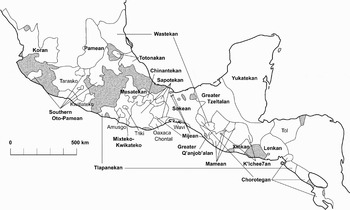
This study addresses a problem in linguistic reconstruction that is relevant to work on lexical diffusion in Mesoamerica, and thereby to work on intercultural interaction that probably dates to Preclassic times. It focuses on the origin and spread of the widely diffused form *kakawaFootnote 1 (and variants) as a word for Theobroma cacao in Mesoamerican languages (Figure 1). Its purpose is to show that Campbell and Kaufman (Reference Campbell and Kaufman1976) are right in claiming a Mije-Sokean origin for this word, and why, and that Dakin and Wichmann (Reference Dakin and Wichmann2000) cannot be right in claiming that it originated in Nawa. In addition, it addresses aspects of the histories of a few other terms in the same semantic field, mainly Nawa chokol=a:-tl for the drink chocolate and a variety of terms for Theobroma bicolor (“Nicaragua chocolate tree” [Kelsey and Dayton Reference Kelsey, Dayton and McFarland1942:621]; in local Spanish, pataxte), and the range of uses of these terms. It discusses hieroglyphic attestations that provide our earliest documentary evidence of the range of applications of the word kakaw.
Languages of Mesoamerica, in their approximate locations as of a.d. 1500 (after Kaufman Reference Kaufman, Moseley and Asher1994). Except for isolates, individual Mesoamerican languages are not represented. Rather, the map groups these languages into the families or major subgroups of which they were members, which were individual languages between about 1200 and 600 b.c. (The locations of many were substantially different in that era from what is depicted here.) Areas of Nawa speech are shaded in gray. Individual languages (isolates) are specified in plain type; language families and subgroups are in bold.
Cacao (cocoa) was a major crop in pre-Columbian Mesoamerica (for a recent synthesis, see McNeil Reference McNeil2006). The kernel was ground and beaten with water, flavorings, and usually maize to make a drink, one version of which we know as chocolate. In historical times, among Mesoamerican Indians the pulp that surrounds the kernels inside the husk/pod has been and often is fermented to produce an alcoholic beverage. Aztecs, and arguably Teotihuacanos and other pre-Columbian societies, made strong efforts to control the production and distribution of cacao. The kernel (cocoa bean) was at some point used as currency. In Xinka, for example, the word /tuwa/ means both ‘cacao’ and ‘money’.
Cacao has long been grown in South America, lower Central America, and Mesoamerica. In Mesoamerica, archaeologically recovered remains of cacao have been dated to as early as 600 b.c. in Belize (Hurst et al. Reference Hurst, Tarka, Powis, Valdez and Hester2002); the earliest dates for the associated vessel types go back to 700–1000 b.c. in the Ulua Valley (Henderson and Joyce Reference Henderson, Joyce and McNeil2006:143). Cultivated and escaped Theobroma cacao is now widely distributed in lowland areas of Mesoamerica, and Theobroma bicolor grows uncultivated in some of these areas.
There is one widely attested term for ‘cacao’ whose distribution is largely the result of diffusion: Sokean *kakawa; Mijean *kakaw; Nawa /kakawa-tl/; Masawa /kakawa/; general Mayan, Totonako, and perhaps Salvador Lenka /kakaw/; Paya [kaku]; and Tarasko /khékua/. Boruka, Tol, and Honduras Lenka have [kaw], and Mobe (also known as Waymí) has [ku]. These, we show, can be traced back to a form like /kakaw/, probably borrowed from Mayan. A proximate antecedent form pronounced something like [kVwa] is also reflected in Amusgo and possibly in Chinantekan. A variety of other terms is found in other languages, none of them widespread.
Throughout Mesoamerica, the peanut (which originates in South America) is named after ‘cacao’. Usually it is called ‘earth-cacao’, just as in British English it is called “ground-nut”. In northern Mesoamerica, where cacao is absent, ‘peanut’ can be called simply ‘cacao’ (e.g., Huasteca Nawa /kakawa-tl/, Totonako /kakaw/).
Nawa /kakawa-tl/ is the source of the Spanish cacao, which is pronounced /kakáwa/ (cacahua) in some regional types of Spanish. (Other pronunciations were current in Spanish in the early colonial period [Steinbrenner Reference Steinbrenner and McNeil2006:253].) The same Nawa form is also the source of Spanish cacahuete (Iberian/Peninsular Spanish cacahuete) ‘peanut’.
DEMONSTRATING BORROWING
The basic topic of much of this paper is the determination of the reason for the similarity of form among words that have the same meaning. There are three possibilities: that the compared words, if part of the same language family, are native to that family, descending by normal transmission from an earlier, ancestral language into the descendant languages; that the word is diffused, with one or more languages that did not have a version of the word having adopted (“borrowed”) it from another language, whether or not in the same language family; or that the resemblances are simply due to chance and that the two words have no historical relationship.
There are standard methods for demonstrating either of the first two possibilities.
Demonstrating that a particular form is inherited within a language family requires strict adherence to the comparative method. The pronunciation of words changes in regular ways, and it must be demonstrated that the word in question conforms to all of the regularities otherwise known to characterize the language of which it is a part. In a small percentage of cases, to be sure, there are isolated departures from what is expected; in these cases, additional linguistic facts may help to show that the form is likely to have been inherited rather than borrowed, and these facts are likely to be peculiar to the languages or families of languages involved.
Demonstrating that a particular form has diffused within a language family depends on showing that the resemblances cannot have been inherited, because their similarities and differences in pronunciation do not conform to the regular sound changes that affected the individual members of the family and cannot be attributed to other known but less regular processes that operate in the individual languages or in ancestral forms of the language.
The presence of forms of closely similar meaning in different language families that cannot be shown to be closely related are generally borrowed, but demonstrating this depends on showing that there was a form of the word at some stage in the history of one of the languages that would descend normally to the attested forms of the word in the descendants of that language and that, on borrowing, it would descend normally to the attested form in the descendants of the language into which it was borrowed.
Words from one language when taken over into another typically undergo adjustments in pronunciation that result from a mismatch between the phonetics and phonologies of the two languages. In well-understood cases, these discrepancies usually follow what in retrospect can be regarded as predictable patterns, but in some cases, especially in early loans in a two-language contact situation, the borrowed forms are mangled. To establish a body of loans from one language into another, it is necessary to be able to demonstrate that there are a number of cases that conform in close detail in pronunciation and meaning. Once this has been accomplished, promising cases that depart in one way or another can be interpreted within the framework established by the clear cases.
The methods are best explained by example. Because of its relevance to the topic of this paper, we do so using examples of borrowings between Nawa and other languages and discuss alternative proposals for the direction of some of these borrowings.
The Nawa language group is the southernmost member of the Yuta-Nawan family. Yuta-Nawan has two branches: Northern and Southern Yuta-Nawan. Southern in turn consists of the Nawa group and the Sonoran languages. The Nawa group itself has two branches, Pochutec and General Nawa. Pochutec, an extinct language, is so scantily documented that the common ancestor of these two languages cannot be reconstructed in any detail. General Nawa consists of a large number of distinct forms, some of which are different enough to be considered different languages but most of which are different dialects of the same language. Because of the large amount of data available on many of these languages, by applying the comparative method, a substantial proto-Nawa vocabulary can be reconstructed, along with many of the structural properties of the language: its phonology (sound system), morphology (word structure), and syntax (phrase, clause, and sentence structure).
Detailed consideration of Yuta-Nawan data shows that Nawa entered Mesoamerica from the north, where other Yuta-Nawan languages are spoken. This is the consensus among historical linguists specializing in Nawa, notwithstanding the recent proposal by Hill (Reference Hill2001) that the family originated in central Mexico. An ancestor of proto-Nawa (pre-Nawa) was specifically influenced by Kora and Wichol, so its speakers must have spent some time in their vicinity.
Nawa differs from its closest relatives, the Sonoran subgroup of Yuta-Nawan languages, in large part by its Mesoamericanization through contact with languages of Mesoamerica. For example, Yuta-Nawan languages generally show object–verb order within the clause and many other features that are grammatically correlated with this, such as the placement of genitive phrases before the nouns they modify. In Nawa, these features have changed to verb–object order and correlated orders such as the placement of genitive phrases after the noun. A relic of the older Yuta-Nawan pattern remains in a genitive–noun order in some lexicalized (frozen) phrases, especially plant and animal names.
By applying the comparative method, a large number of lexical items can be reconstructed for proto-Nawa. Kaufman (Reference Kaufman1994–2004) shows that a large number of them come from other Mesoamerican languages, chiefly from Mije-Sokean, Totonakan, and Wastekan (see Table 1). A number of these items are discussed later to illustrate generally applicable methods.
Proto-Nawa lexical items borrowed from Mije-Sokean, Wasteko, and TotonakanFootnote a
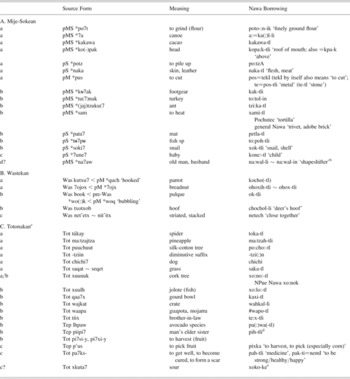
Notes: a = Forms that are effectively identical (given that Nawa has no contrast of [o] and [u]); b = forms with segmental differences that can be explained by the contrastive phonologies of the borrowing and source languages; c = likely borrowings with unsystematic phonological discrepancies or substantial differences in meaning; d = possible borrowings with unsystematic phonological discrepancies or substantial differences in meaning; pMS = proto-Mijean-Sokean; pS = proto-Sokean; pM = proto-Mijean.
aA morphologically complex lexical item, proto-Mije-Sokean *t k.7y ‘to enter’ (< *tk ‘house’), is the model for Nawa kal=akI ‘to enter’ <kal ‘house’ + akI ‘to be able to be inserted, to fit.’
bThe semantics of the comparison between proto-Mije-Sokean *na7aw ‘old man, husband’ and Nawa na:wal- ‘shapeshifter’ is weak.
cOnly four of the Totonako items in question are also found in Tepewa, suggesting that the diffusion from Totonako to Nawa occurred after the split between Totonako and Tepewa. This split took place probably no later than a.d. 300 and probably no earlier than 400 b.c.
dNawa pih-tli ‘man's older sister’ has a proposed Yuta-Nawan etymology, but the putative source means ‘younger sister.’
eThe phonological overlap of Totonakan xkuta7 and Nawa xoko- is not overwhelming, but the Nawa word cannot descend from proto-Yuta-Nawan or proto-Southern Yuta-Nawan.
Several structural features of proto-Nawa can be shown to have come from these same languages.
Common to all forms of Nawa is a set of Mije-Sokean loans, at least one grammatical morpheme, and both morphological and syntactic patterns that result from Mije-Sokean grammatical influence.
In addition, structural patterns were adopted from Mije-Sokean that could not have been based on Wastekan or Totonakan.
Nawa developed morphologically complex verb words from an earlier Yuta-Nawan verb-phrase pattern involving clitics and auxiliary verbs. The only Mesoamerican languages that “could have supplied a clear and full model for the morphologization of the verb word in Nawa” are Mije-Sokean languages (see Kaufman 1994–2004 for details).
The Nawa system of locative relational nouns has close parallels with that of Mije-Sokean. They often occur with a generic locative suffix ({+m 7} in Mije-Sokean, {-k(o)} in Nawa); when they govern pronoun “objects”, they are marked with possessive prefixes; they may be immediately postposed to a noun, forming a compound of which the relational noun is the head, and with the reading of a locative adpositional phrase. No other Mesoamerican language group has such structures.
The Nawa third-person possessive prefix {i(:)-} does not have a satisfactory Yuta-Nawan etymology, and proto-Mije-Sokean *7i+ ‘third person ergative’ may be its source or may have influenced its development; proto-Mije-Sokean *7i+ ‘third person ergative’ has also been borrowed by several Mayan languages.
Totonakan and Wastekan were also sources of structural features of proto-Nawa. For example, pre-Nawa developed a phoneme /tl/. In Mesoamerica, this sound is found only in Totonakan and Nawa.
Several other structural features of proto-Nawa can be traced to these languages, although it cannot always be determined which of them was the source.
The adoption of so many Mesoamerican lexical items and structural features by the proto-Nawa stage shows that the breakup of Nawa into Eastern and Western branches took place in Mesoamerica—contrary to Dakin's view (Dakin and Wichmann Reference Dakin and Wichmann2000:58) that proto-Nawa broke up far to the north, near Kora and Wichol.
Discussion
Some of the forms presented in Table 1 are claimed by Dakin and Wichmann (Reference Dakin and Wichmann2000) to have in fact been native to Nawa and to have been borrowed into the languages that we consider their sources. We discuss those cases in which their data are more or less accurate to help make the inference methods explicit. In no case is there a cogent case for the borrowing having been from Nawa; in most, there is a strong case that the borrowing was into Nawa.
The direction of borrowing of some words can be determined because the borrowed form shows sounds that could not have descended into the language from native resources. For example, there is a proto-Yuta-Nawan diminutive suffix *tsi, but this could not be the source of proto-Nawan *-tzi(:)n, because */tzi/ regularly yields /chi/ in Nawa, and {-ch} is in fact attested (frequently but not productively) as a diminutive suffix on Nawa nouns.
Contrastive phonology plays a major role in determining the direction of borrowing: the phonetics of the word in the source language determines the way the word will be pronounced in the borrowing language. For example, glottalized consonants in Mayan languages are borrowed as unglottalized consonants in languages that lack phonetically glottalized consonants. Thus, a form such as Wasteko net'etx, with glottalized t', is predictably borrowed into Nawa as netech. The reverse direction of borrowing is not feasible, because Mayans do not interpret Nawa plain consonants as glottalized; there is not a single plausible loan-word from Nawa into any Mayan language in which a Nawa plain consonant has been borrowed as a glottalized consonant. Similarly, the q of Totonako saqat would be borrowed into Nawa as k, yielding saka-tl; because Nawa did not have [q] as an allophone of /k/, Nawa saka-tl cannot have been the source of the Totonako word (contrary to Dakin and Wichmann Reference Dakin and Wichmann2000:68).
Wichmann (Reference Wichmann, Blench and Spence1998) and others make the mistake of supposing that (or operating as though) phonemic inventories rather than phonetic interpretation are a reliable basis for establishing directionality. This is illustrated by the example of proto-Mije-Sokean *tu(7)nuk and Nawa to:tol-in. The two can be compared after undoing the effects of Nawa reduplication, with Mije-Sokean n corresponding to Nawa l. Because Mije-Sokean languages have n but not l in native roots in ordinary vocabulary, Wichmann argues that the directionality of the borrowing is from the language that has /l/ (Nawa) to the language that lacks /l/ (Mije-Sokean). On the surface, this parallels the earlier discussion of glottalized versus plain consonants in Mayan versus Nawa. However, it is the phonetic realization of Mije-Sokean n that is at issue, and in many languages that lack phonemic /l/, phonemic /n/ may have a range of pronunciations, including some that more closely approximate the [l] than the [n] of languages in which these are phonemically distinct. Since it is the phonetics of the source sound that is at issue, the n:l correspondence does not provide evidence that the borrowing was from Nawa rather than into Nawa. There is further evidence in other cases involving other languages that Mije-Sokean /n/ was occasionally perceived as [l].
Totonako puuchuut ‘silkcotton tree’ compares closely with proto-Nawa *po:cho:-tl. The vowel difference is not revealing, because both Totonako and Nawa have only one rounded vowel. Totonako u would be borrowed into Nawa as o, and Nawa o would be borrowed into Totonako as u. The linguistic distributions of the words are similar: one is found in Totonako but not in Tepewa and one in Nawa but not in other Yuta-Nawan languages. The internal diversity of Totonako and Nawa are comparable. There is little doubt that borrowing is involved, since the meaning is so narrow, and the agreement in meaning is precise.
To determine the direction of borrowing of this word, the most telling feature is the p that begins it. Any non-verb in Nawa with initial p is a strong candidate for a borrowing, because p regularly disappears in word-initial position, except in some words that habitually occur with prefixes so that the p is not usually initial. Dakin and Wichmann (Reference Dakin and Wichmann2000:59b) attempt to support a Nawa origin by claiming that it is derived from a Nawa verb meaning ‘to card (cotton)’. The verb in question is pochi:na (for ‘to card [cotton]’; Dakin and Wichmann mistakenly give po:chewa, which in fact means ‘to get smoky’). There is no variation in vowel length of a Nawa morpheme when it occurs in different words, so pochi- is not plausibly an etymological source of po:cho:-tl within Nawa. Finally, this direction of borrowing makes sense. Nawas came from an area in which the silkcotton does not grow and only got a word for it on their arrival. Totonakos live in an area where silkcottons are found.
One feature of this word that might suggest borrowing from Nawa is the seeming correspondence of final t in Totonako to final tl in Nawa. Totonako does not allow tl at the end of words, so had it been borrowed from Nawa, the final t of puuchuut is expected. Our account of the borrowing, from Totonako to Nawa, requires that the final t must have been reanalyzed in Nawa. This sort of reanalysis is not uncommon in language-contact situations.
The Nawa borrowing of Totonaka puuchuut illustrates a general regularity that words for local plants, when not expressed by neologisms created out of native resources, are adopted by newcomers to an area from people already living there unless they have previously wiped out the indigenous inhabitants. Dakin and Wichmann cite their misanalyzed example of po:cho:-tl as part of a rationale for their “perception that Nahuatl has received very few loans from other languages but has resorted to resources of the language to produce new descriptive terms.” This is highly unusual as a pervasive pattern in the case of names for new plants, and it is especially unusual that indigenous people would systematically adopt newcomers' invented names for indigenous plants. Methodologically, it is not cogent to build systematically on an “impression” that is so much at variance with established trends. Such a claim requires compelling evidence of several unproblematic and unambiguous borrowings of native Nawa words, derived from Yuta-Nawan sources, for plants that they encountered in Mesoamerica, to provide support for such a borrowing in any ambiguous instance.
Several of the plant names listed in Table 1 show clear evidence that they are not native to Nawa—for example, the initial p of pa(:)wa(-tl) ‘avocado species’ is suggestive of borrowing. The Wasteko term for ‘breadnut’ shows a Wasteko innovation, the shift of proto-Mayan *7ojx to Wasteko 7ojox; this shifted form is the basis for the Nawa loan. The word itself is no longer widely distributed within Nawa. However, it survives in place names from several parts of Mexico—for example, Ojitipa = ohoxih-ti=pan in San Luís Potosí and Ojitlán = ohoxih-tla:n in Oaxaca; it is also reflected by the word ujushte ‘breadnut’ in the local Spanish of southeastern Chiapas and Guatemala—a borrowing from Nawa ohox-tli, a variant of ohoxih-tli. The broad distribution of the word in Nawa shows that it was borrowed by Nawa, probably from Wastekan, at an early stage in its history. The borrowing between Wastekan and Nawa could not have gone the other way. The Mayan form in languages with a contrast between h and j have j in this word; had the word been borrowed from Nawa into Mayan, these languages would show h rather than j. (For conformity with Spanish orthograhy, in Mayan languages without a contrast between h and j, the sound is spelled as j even when, as in Wasteko 7ojox, it is pronounced as [h].) In addition, some Mayan languages develop two syllables, with a repeated vowel, in words whose original shape was *CVjC, while original *CVjVC does not reduce to a single syllable. In summary, proto-Nawa ohox-tli would have been borrowed into Mayan languages as 7ohox, with two syllables and with h rather than j, a contrast not found in Nawa. In terms of the antiquity of the forms, it is widely distributed within Mayan, a very diverse language family. In contrast, ohox(ih)-tli is found only in Nawa, with no other Yuta-Nawan attestation. Nawa is a weakly differentiated language group.
Proto-Nawa wahkal-li ‘crate; gourd bowl’, which Kaufman (Reference Kaufman1994–Reference Kaufman2004) cites as a borrowing from Totonako wajkat, is cited by Dakin and Wichmann (Reference Dakin and Wichmann2000:69a) as, instead, a borrowing from Nawa into Totonako. Their evidence is the incorrect claim that it can be analyzed etymologically as consisting of a putative Nawa root wah meaning ‘plank’ + kal, glossed as ‘box’ (really ‘house’ and, by extension, perhaps ‘container’); but ‘plank’ is not wah but wapal-li.
The Nawa word xikal-li ‘gourd dipper’ has been borrowed into several individual Mesoamerican languages (though not into any ancient ancestral languages) and into Spanish. Contrary to Dakin and Wichmann (Reference Dakin and Wichmann2000:69a), it is not a native Nawa term but a borrowing from a Sapotekan language. For proto-Sapotekan, a root *eka7 can be reconstructed. This root occurs with one of two different classifiers: with *xi prefixed, as *xika7, it refers to a gourd dipper or cup/bowl; with *k prefixed, as *keka7, it refers to a bottle-gourd. This shows that *xika7 ‘gourd dipper’ is a native Sapotekan word for a gourd dipper. This form cannot have arisen by reanalysis of an existing Nawa word xikal-li, since when it appears with the classifier *k, the underlying vowel surfaces as e rather than i. The word is ancient in Sapotekan, which is far more diverse than Nawa, and is found in both branches of the family. Loan-word data correlated with archaeological data, presented later, show that Chatino and Sapoteko separated no later than about 200 b.c.
One anomaly in this borrowing is that, in xikal-li, Nawa has innovated a final l where perhaps final h (“saltillo”), corresponding to Sapotekan *7, might be expected, yielding xikal-li instead of xikah-tli. Possibly, l was substituted for h because most Nawa nouns with a CVCVC shape end in l, x, tz, or ch. Such a consideration may also account for the stem-final l of Nawa wahkal-li borrowed from Totonako wajkat. No more than two nouns (nehmat- ‘right hand’, i:lamat- ‘old woman’) end in t in Nawa, and in both cases some forms of Nawa drop the stem-final t or change it to h.
A more complex example is Totonako saqat ∽ seqet ‘grass’, which compares closely with proto-Nawa * saka-tl ‘grass’. If this is a borrowing rather than a chance resemblance, then the relevant form to compare is saqat, since the seqet variant disagrees with *saka-tl in the vowel quality. There are two differences in the pronunciations involved. Totonako distinguishes between *k and *q in words with no mid vowels, so Nawa saka-tl would have been borrowed into Totonako as sakat, not saqat. This excludes Nawa as a possible source for the Totonako word. The only viable external source of the q in this word is Mijean *sokot, since Mije-Sokean *k is borrowed into Totonako as q in words with e or o. However, apart from this item, the vowel variation found in saqat~ seqet, is found only in native Totonako words. This variation is therefore evidence that the word is in fact native to Totonakan and suggests that the similarity with Mijean is due to chance rather than to borrowing, which is also suggested by the unexplained discrepancy in vowels. In contrast, there is no evidence for any particular antiquity of the form in Nawa, as there is no convincing related form in any other Yuta-Nawan language. Finally, the final t of the Totonako form was reshaped to -tl on borrowing, as in the case of po:cho:-tl.
All of these borrowings occurred by the proto-Nawa stage, since they are widespread in the Nawa group and can be reconstructed to proto-Nawa, and most presumably arose earlier, since proto-Nawa is the earliest we can go on purely distributional grounds. However, some are demonstrably earlier than proto-Nawa, because they underwent changes that took place in pre-Nawa.
Sonoran and Yuta-Nawan *u shifted to  in Kora, Wichol, and pre-Nawa. The vowel is a high back unrounded vowel, structurally but not phonetically equivalent to u. By proto-Nawa times, this * had shifted to i, except in a few words in Central Nawa where it shifted to e. An example is the word for ‘ant’. Two variants can be reconstructed for Mije-Sokean, proto-Sokean *jaj=tzuku(7) and proto-Mijean *tzuku(n). The first element, jaj, in the Sokean compound recalls Mayan (proto-Mayan *ha7h) words meaning ‘fly’ or ‘grub’, so this is probably its relevance here. The element *tzuku(7) ~ *tzukun goes back to proto-Mije-Sokean. Proto-Nawa *tzi:ka- ‘ant’ must have arisen from a pre-Nawa *tz
 :ka or earlier *tzu:ka, since proto-Yuta-Nawan *tsi shifts to chi in Nawa. We have no evidence concerning the difference in the final vowels of pre-Nawa *tz:ka and Mije-Sokean * tzuku(C). The Mije-Sokean term was perhaps more plausibly *tzuku or *tzuku7 than the Mije variant *tzukun.
Similarly, proto-Southern Yuta-Nawan *t became tl before *a; afterward, some instances of Southern Yuta-Nawan short *a became e. Both of these changes occurred before the proto-Nawa stage. These changes occurred after Sokean *pata7 ‘mat’ was borrowed by Nawa, since this word yields proto-Nawa *petla-tl. These pre-Nawa loans from Mije-Sokean suggest that the influence of the Mije-Sokean elite language of the Basin of Mexico spread as far north as, say, Zacatecas by, say, the year a.d. 200. Another possible scenario might have Nawas arriving in the Basin of Mexico by circa a.d. 200 to have direct contact with Mije-Sokean elites in and around Teotihuacan (see “Culture-Historical Inferences”), but not yet to constitute an important presence in this new dwelling place.
THE MIJE-SOKEAN HYPOTHESIS
Campbell and Kaufman (Reference Campbell and Kaufman1976: 84) traced the word *kakaw(a) back to proto-Mije-Sokean and the Olmec diffusion sphere. Justeson, Norman, Campbell and Kaufman (Reference Justeson, Lyle Campbell and Kaufman1985:23, 57–59) agree that this word originated in the Mije-Sokean family and argue that it spread from there to other Mesoamerican languages. In the case of Lowland Mayan languages (Ch'olan and Yukatekan), they suggest that the word spread in association with cultivated cacao or its products and entered Lowland Mayan languages during the Late Preclassic period. The basis for this scenario was as follows.
Using published materials available between 1959 and 1963, Kaufman (Reference Kaufman1963) reconstructed a vocabulary of about 600 proto-Mijean, proto-Sokean, and proto-Mije-Sokean words and affixes. Among them was the reconstruction of *kakawa as the proto-Mije-Sokean word for cacao, along with words for a large number of other lowland cultigens. Work by Kaufman and Campbell in the 1960s and 1970s showed that many of these Mije-Sokean words appeared in other Mesoamerican language families, in which they were not reconstructible to the earliest stages. In fact, Mije-Sokean vocabulary proved to be found in every language family in Mesoamerica, from Tarasko in the north to Xinkan in the south, and much of this influence was early enough that the terms are reconstructible to early stages in the histories of most of those families. *kakawa was among these widely diffused Mije-Sokean words.
The diffused words are found in a variety of semantic domains. They include words for plants, animals, tools, food preparation, the calendar and numerical calculation, and kinship and other social roles. The most numerous of these borrowings are in names for plants and animals, especially of domesticated lowland plants and animals and of those wild plants and animals that are the names of days in the Mesoamerica. 260-day ritual calendar.
It should be noted that in assessing this body of evidence we exclude Wanderwörter, words that are found in similar form throughout Mesoamerican and whose ultimate source is unknown.
No other language families in pre-Columbian Mesoamerica had the impact that Mije-Sokean had, either in the range of languages they affected or in the number of items that were borrowed from them. The next biggest impact came from Nawa, but the number of pre-Columbian Nawa loans does not approach the number of Mije-Sokean loans. Loans from Nawa began to be widely adopted late in pre-Columbian Mesoamerican history and date at least 1,000 years later than the Mije-Sokean loans. Nawa lexical material diffused into Mesoamerican languages even after the arrival of the Spanish as a consequence of their (varying) language policies. After massive borrowing by Spanish of Nawa vocabulary, some Nawa-origin lexical material has entered Mesoamerican languages from Spanish.
Some of the Mije-Sokean loans probably go back to the influence of Olmecs, while others are attributable to a post-Olmec era of Mije-Sokean influence. These results were presented by Campbell and Kaufman (Reference Campbell and Kaufman1976) and, in the case of loans into Lowland Mayan languages, by Justeson et al. (Reference Justeson, Lyle Campbell and Kaufman1985). The Mije-Sokean loans into northern Mesoamerica are discussed by Kaufman (Reference Kaufman2000–Reference Kaufman2007), and the evidence is summarized by Kaufman and Justeson (Reference Justeson, Kaufman, Arnold and Pool2007). (Readers should note that the language labels [proto-Mijean, proto-Sokean, proto-Mije-Sokean] associated with the various reconstructed forms were not correctly copied into the published version from the manuscript form of Campbell and Kaufman's paper and should not be relied on for historical inference; reference should be made to Kaufman [1963] or, now, Wichmann [1995] for the correct historical level of reconstruction.)
Regarding *kakaw(a) in particular, Justeson et al. (Reference Justeson, Lyle Campbell and Kaufman1985) show that this word was diffused in the post-Olmec era. In our own recent work (Kaufman and Justeson Reference Kaufman, Justeson, Arnold and Pool2007) we have been able to narrow the period of this diffusion, in the case of Mayan, to between 200 b.c. and a.d. 400. It must have entered a Lowland Mayan language before a.d. 400, because at that time it is attested in Mayan hieroglyphic texts (Stuart Reference Stuart1988). The evidence that it diffused after 200 b.c. is more elaborate.
It must have diffused after the shift of Western Mayan *k(') to proto-Greater Tzeltalan *ch(') since it would otherwise have shown up as chächäw* in proto-Ch'olan and proto-Tzeltalan. By comparing several independent lines of evidence for the timing of the shift of *k(') to ch('), the date of this change can be shown to have occurred right around 200 b.c.
On epigraphic grounds, the shift of *k > ch must have occurred before a.d. 200. One word that underwent the shift was Greater Tzeltalan *chij < proto-Mayan *kehj ‘deer’, and a word for the day Deer is spelled by the sign for the syllable /chi/ in the Late Preclassic Uaxactun murals. Other epigraphic evidence, perhaps less definitive, suggests that it took place before 100 b.c. Mora-Marín (Reference Mora-Marín2001:276, n. 180) identifies a verb form whose spelling is followed by the sign for /chi/ on the Late Preclassic text of the Dumbarton Oaks pectoral, which on stylistic grounds he dates between 300 and 100 b.c. The only etymologically viable analysis known to us is Kaufman's Reference Kaufman2001 suggestion that it functions as the reflex of the Greater Tzeltalan clitic *+ich ‘already’ (< proto-Mayan *+ik), which survives in Ch'ol as äch and which is attested epigraphically in the spellings <ji-chi> (mostly after words ending in j) and <yi-chi> (mostly after words ending in y).
The change also preceded the diversification of Greater Tzeltalan into Ch'olan and Tzeltalan branches. Greater Tzeltalan most likely broke up when Mayans moved into the highlands of Chiapas, which took place between about 200 and 100 b.c. (Clark Reference Clark2000:54), and in any case, no later than this time. The glottochronological estimate for the diversification of Greater Tzeltalan is a.d. 100 or earlier. (See Mora-Marín [Reference Mora-Marín2001:46–50] for a more complete discussion of the relevance of recent archaeological dates for the entry of Mayans into this part of Chiapas to the timing of the diversification of Greater Tzeltalan.)
The change followed the borrowing of #manik' into Mayan as the name of the day Deer of the ritual calendar. This name shows up in colonial Ch'olan baptismal records as <manich> (Campbell Reference Campbell1988; Fox and Justeson Reference Fox and Justeson1982), so the word had to have been adopted in Greater Tzeltalan before the shift of *k' to ch'. This brings more constraints to bear on the timing of the sound change, because this word is a borrowing from proto-Sapoteko *mma=ni7 ‘animal, large quadruped’. This word itself has a foreign origin, because Sapoteko does not have m in native words. The morpheme *mma was a borrowing of Sokean *m 7a ‘deer’. It did not displace the native Sapoteko word *kwe+tzina7 for deer' but must have maintained some kind of association with ‘deer’ to have been borrowed later for the corresponding day name by Lowland Mayans. Proto-Sapotekan had a word of the approximate shape #nani meaning ‘animal’, which in Oto-Mangean terms can be analyzed as a pre-Sapotekan nominalization (in #na-) of a root #ni ‘alive’—thus, ‘living thing’. The word #nani is reconstructible based on Zenzontepec Chatino nya7nè, Tataltepec Chatino na7ni, Yaitepec and Panixtlahuaca Chatino 7ni, and Lachixío Sapoteko náni.
We suppose that some speakers of the ancestor of Sapoteko created *mma=ni7 by conflating the Sokean borrowing *mma with the pre-existing Sapotekan form #nani ‘animal’. The word #nani survived into Western Sapoteko and was replaced by *mma=ni7 ‘animal’ elsewhere. That #ni ‘alive’ may have still had some kind of independent existence is suggested by the fact that ni+ is a preposed classifier for animals in some forms of Sapoteko.
The development of Greater Tzeltalan #manich' therefore involves five successive developments: the borrowing of *m7a by Sapotekos from Sokean; the addition of =ni within pre-Sapoteko to form *mma=ni7; the borrowing of this word as #manik' into Greater Tzeltalan or Yukatekan; the diffusion of this word between the two of them; and the change of *k' to ch' in Greater Tzeltalan. It is implausible that this series of changes, involving four different languages, would have taken place in less than a century. Accordingly, since the shift of *k' to ch' took place before the diversification of Greater Tzeltalan, which in turn took place before 100 b.c., the first stage in the process took place before about 200 b.c.
The borrowing of *m7a occurred when speakers of Sokean were interacting with speakers of Sapoteko. In fact, this is but one reflection of interaction between Mije-Sokeans and Sapotekos. Sapoteko acquired several Sokean vocabulary items—notably, words for four out of ten animals that are names of days in the Mesoamerican ritual calendar: iguana/lizard, deer, dog, and macaw. In Sapoteko, they are simply the names of animals (the Sokean word for deer became the Sapoteko word for ‘large animal’ generally). Sapoteko also underwent some phonological changes under Sokean influence: a shift of accent from the last to the next-to-last (penult) syllable; a loss of nasality on vowels; and a change of *kw to p. (This last change began in Sapoteko after it had started to diversify, because it did not apply to medial * kw in Western Sapoteko.) These features illustrate a process that occurred repeatedly in Mesoamerica, which Kaufman calls “yokel anxiety”: groups with aspirations to cultural prominence avoid or alter features of their pronunciation that are uncharacteristic of the speech of “civilized” groups. At least one grammatical morpheme was also borrowed, which could have come from either Mijean or Sokean.
With one exception, these items are not found in Chatino and so postdate the breakup of proto-Sapotekan, and they are reconstructible to proto-Sapoteko, so they date to the pre-proto-Sapoteko era of Sapoteko speech. Since the borrowing of *m7a into Sapoteko happened before the diversification of Greater Tzeltalan, the breakup of Sapotekan into Chatino and Sapoteko must have occurred before 200 b.c. Given this, the most plausible population process that might have been associated with this division is a century-long process of cultural consolidation, culminating with the establishment of state control at Monte Alban starting in Monte Alban I (500–200 b.c.), which began between 500 b.c. and 400 b.c. This process entails the creation of cultural boundaries at the limit of the unified territory. Glottochronology is consistent with this date, putting the diversification of Sapotekan at around 500 b.c. The exceptional case, proto-Sapoteko *kwe.7wa and Zenzontepec Chatino kō7mā ‘macaw’, from proto-Mije-Sokean *7owa ‘macaw’, may be an instance of diffusion from Sapoteko to Chatino, because all other forms of Chatino have a different term for ‘macaw’. Less likely is the possibility that proto-Mije-Sokean *7owa was diffused into proto-Sapotekan before the split between proto-Sapoteko and proto-Chatino.
There are several lines of evidence for the timing of Epi-Olmec contact with Sapoteko. The clearest evidence for contact begins during Monte Alban II, which dates from about 200 b.c. to a.d. 250. Hostile interaction between Epi-Olmecs and the Valley of Oaxaca is registered in the “conquest slabs” of Mound J at Monte Alban, which date to Monte Alban II. Caso (Reference Caso1947:23, 27–28) proposed that inverted heads below the “hill” logogram depict conquered persons or peoples, an interpretation that is now generally accepted. He also recognized that several of the inverted heads had Olmec-style facial features and headgear and suggested that they represented people from Chiapas. In further support of this association, what we identify as the personal name of a captive on Monte Alban Tablet 41 is spelled using an Epi-Olmec glyph. Our analysis of the most explicit dates in the Mound J tablets—those with a named year, ritual calendar date, and day of the lunation—show that the recorded captive-taking spans at least 111 years (Justeson and Kaufman Reference Justeson and Kaufman1996–2001; cf. Kaufman and Justeson Reference Kaufman, Justeson and Woodard2004). The earliest of these events therefore dates no later than a century or so before the end of Monte Alban II and potentially to a century or so before it began—between about 300 b.c. and a.d. 150. The linguistic data, however, suggest that some of the interaction between Epi-Olmecs and Sapotekos was not hostile. This is consistent with data on the Sapoteko influence at Epi-Olmec sites. Archaeologically, Monte Alban II pottery was found by Drucker and Stirling at Cerro de las Mesas (Drucker Reference Drucker1942:84), and grayware from the Valley of Oaxaca begins to appear around 200 b.c. in western Chiapas (Evans Reference Evans2004:223–224).
All of this evidence together indicates that the borrowing of Sokean *m7a ‘deer’ did not occur much before 300 b.c., the earliest plausible dating of the evidence for contact between Epi-Olmecs and Sapotekos. With a century or more separating the adoption of *m7a from the shift of #manik' to #manich' in pre-Greater Tzeltalan, the process would have ended between about 200 b.c. and a.d. 150. So the Greater Tzeltalan shift of *k (' ) to ch('), the last step in the process, probably took place no earlier than about 200 b.c. Greater Tzeltalan diversified after the *k(') to ch(') shift. Since it is during the second century b.c. that Greater Tzeltalans began immigrating into the Chiapas highlands and the Grijalva Depression, where they became Tzeltalans, the best chronological estimate is that the *k(') to ch(') shift took place right around 200 b.c.
It should be noted that other, less stringent constraints agree with these results. For example, Greater Tzeltalans and Sapotekans, who were not in direct contact, were not in a position to have significant influence on one another until the development of significant state power in the Valley of Oaxaca after about 500 b.c., so the Mayan adoption of #manik' can be placed after that date.
Since the word *kakaw(a) was adopted by speakers of one or more of the Greater Tzeltalan languages after the *k(') to ch(') shift took place, this word was not borrowed until sometime after 200 b.c.
The evidence from lexical diffusion among Greater Tzeltalan, Yukatekan, Epi-Olmec, and Sapoteko, together with the epigraphic data from Ch'olan texts, therefore show that the word *kakaw entered Greater Tzeltalan languages between 200 b.c. and a.d. 400.
The Lowland Mayan use of cacao as a beverage is attested archaeologically before the borrowing of the word kakaw, going back to at least 600 b.c. (Hurst et al. Reference Hurst, Tarka, Powis, Valdez and Hester2002). A native word for cacao, *pe:q, existed in Mayan languages, including Greater Tzeltalan, before it was largely displaced by the diffused kakaw. The word *pe:q survives in K'ichee7an with the meaning ‘uncultivated cacao’ (Theobroma bicolor), suggesting that the spread of the word kakaw may have been associated with the spread of cacao cultivation, of new practices associated with its cultivation or use (cf. Steinbrenner Reference Steinbrenner and McNeil2006:264–268), or of its rising economic and/or ritual importance. (Justeson et al. [1985:59] cite Miksicek [Reference Miksicek1983, personal communication 1983] as arguing from data on Pulltrouser Swamp that, in the Maya Lowlands, cultivated cacao first shows up in the Late Preclassic period. However, this is not reflected in the full publication [Turner and Harrison Reference Turner and Harrison1983], and means have not yet been found to distinguish pataxte, which is a domesticated cacao that grows untended in the wild, from cultivated cacao.)
Mayan *pe:q evidently survived as *pe:k in proto-Greater Tzeltalan, since it later shifted in Ch'olan to the pronunciation *pi:k and to the meaning ‘8,000’. The change in pronunciation is due to a sound change that affected a common ancestor of the Ch'olan languages after they separated from Tzeltalan, and the semantic association derives from the use of gunny sacks to store large numbers of cacao beans, a practice documented iconographically by the Late Classic period (see Stuart Reference Stuart and McNeil2006:190–191). Words for a gunny sack (of cacao beans) are used for ‘8,000’ in several Mesoamerican languages. Besides Lowland Mayan *pi:k, examples are Sokean tzunu7 ‘sack, bag, pocket, cap, 8,000’ and Nawa xikipi:l-li ‘gunny sack, 8,000’. In Sapoteko, the word *(kwe+) (s)su:7ti ‘bag, 8,000’ comes to mean ‘skirt’, a semantic extension also attested in proto-Yukatekan *pi:k ‘skirt’.
In the Maya Lowlands, evidently, the meaning of this ancient word did not shift to include or become restricted to ‘pataxte’ with the adoption of the word kakaw. Instead, a contrasting Ch'olan term for pataxte, proto-Ch'olan *b'ahläm=te7, appears to have developed—most likely after the adoption of kakaw, for reasons presented later.
At least four modern Sokean languages, belonging both to Soke proper and to Gulf Sokean, have words for at least two types of cacao, and there are at least two other plants that have *kakawa in their names (see Table 2).
Words for pataxte, for varieties of cacao, and for other plants incorporating the word for cacao in Mije-Sokean languages

Notes: Theobroma bicolor, pataxte or cacao blanco in Spanish, is usually labeled by a plant name with the modifier “jaguar.” Soteapan Gulf Sokean kanh.kanh is apparently a reduplicated form of kaanh ‘jaguar.’ Sayula Mije(an) po7p kagaw reflects the label “white”; the Santa María Chimalapa Soke term tapunh does not occur in any other contexts.
At least four Sokean languages have a word for pataxte. In three of them—colonial and modern Tecpatan Soke, Ayapa Gulf Sokean, and Soteapan Gulf Sokean—the word for pataxte contains the word ‘jaguar’ as a modifier of a word for a type of plant. This same practice is found in Lowland Mayan languages and in Q'eqchi7:

The spelling of the Ch'olti7 gloss is presumably a mistake for pataste or pataxte.
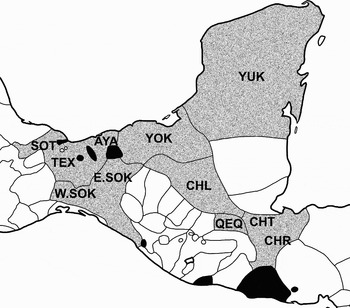
The languages that show this practice—Chiapas and Chimalapa Soke, Ayapa Gulf Sokean, the Ch'olan languages, Yukateko, and Q'eqchi7—form a single, continuous diffusion area (Figure 2), so these formations are clearly related. The Ch'olan form is reconstructible, to proto-Ch'olan *b'ahläm=te7, since it is found in both branches of the subgroup.
Mesoamerican languages with terms for Theobroma bicolor containing a word for jaguar. SOT = Soteapan Gulf Sokean; TEX = Texistepec Gulf Sokean; AYA = Ayapa Gulf Sokean; W. SOK = Western (Chimalapa) Soke; E. SOK = Eastern (Chiapas) Soke; YOK = Yokot'an (Chontal Mayan); CHL = Ch'ol; CHT = Ch'olti7; CHR = Ch'orti7; QEQ = Q'eqchi7; YUK = Yukateko. Areas of Nawa speech are in black.
Ch'orti7, the only other Ch'olan language, has a word b'ajram=te7, the expected form of the descendant of proto-Ch'olan *b'ahläm=te7 ‘pataxte’, but this word is glossed as a bush that is used to cure sprains. This could be a semantic shift or an independent formation.
Pre-proto-Ch'olan *b'ahlam=te7 is also reflected in Yukateko b'aHlam=te7. Whether this term is reconstructible to earlier stages of Yukatekan is unknown, since words for pataxte have not yet been found in Lakantun, Itzaj, or Mopan. The term appears to be a borrowing, since *b'ahläm=te7 ‘pataxte’ is reconstructible for proto-Ch'olan, while =te7 ‘tree’ is not a native element in Yukatekan.
A similar term is Q'eqchi7 b'a:lam kakaw (also kakaw b'a:lam). Q'eqchi7 has borrowed many Ch'olan words, especially for plants and animals, but there are no known early borrowings from Q'eqchi7 into Ch'olan. It is therefore more likely that b'a:lam kakaw was borrowed into Q'eqchi7 from Ch'olan than into Ch'olan from Q'eqchi7. The formation is identical to that of Ayapa Gulf Sokean kanh=kak. Within Sokean, however, the diversity of the forms and the lack of documentation of words for pataxte in some languages leave the details of the historical development across this geographical area unclear.
One of these terms for pataxte may be recorded in Mayan hieroglyphic texts (Figure 3). It is most frequent on a set of “codex-style” vessels (K531, K1197, K1344, K1371, K1560, K4546). They seem to have been produced by a single scribe or scribal school, given the similarities in features of calligraphic style (as pointed out to us by David Stuart, personal communication 2005) and of sign choice (see Figure 4). In these cases, the skullcap of the CACAO sign appears to be marked with two or three jaguar spots in the same way as iconographic depictions of jaguars on the same vessels (Figure 3c). The two clearest instances (Figure 3a–b) are on K1344, in which the CACAO sign has whiskers and other mammalian features, the oval shape and shading of the jaguar spots is most pronounced, and there are three jaguar spots rather than two, and on K1560, in which jaguar spots appear on the cheek as well as the skullcap. Cases with two spots on the skullcap are found among these same vessels (Figure 3d–g). This usage is rare outside the texts by this scribal group, and their interpretation is not as clear. Totally unclear are instances in which a pair of blackened strokes appear together on the CACAO sign's skullcap. They may be an independent feature, but they could be a conventionalized reduction of a pair of jaguar's spots. Intermediate are instances that have two more clearly oval spots on the skullcap.
Proposed JAGUAR × CACAO glyphic conflations, from (a) K1344 and (b) K1182, compared with (c) an iconographic example of a jaguar head from another codex-style vase, K531, and with less definite examples of “jaguar cacao” glyphs from (d) K1371, (e) K4546, (f) K531, and (g) K1560.

Stylistically similar texts from codex-style vases. (a) K1344; (b) K1371; (c) K531; (d) K1560; (e) K1182; (f) 4546. K1197, which is similar, is not illustrated because the sign for cacao seems to have been repainted.

The most straightforward interpretation of these composite signs is as a spelling <JAGUAR×CACAO> , presumably for a Lowland Mayan term b'ahlam kakaw that is our postulated source for Q'eqchi7 b'a:lam kakaw. This Epigraphic Mayan term would appear to have predated Ch'olan + Yukateko *b'ahläm=te7, since only the descendants of the latter term and not of b'ahlam kakaw survive in modern Lowland Mayan languages. The diffusion of *b'ahläm=te7 within Ch'olan can hardly have postdated the Classic Mayan collapse, so the spread of “jaguar cacao” as a term for pataxte must have taken place no later than the Late Classic period. In principle, the spelling could have persisted after *b'ahlam=te7 replaced *b'ahlam kakaw in Ch'olan.
Summation
The widespread and early diffusion of the word *kakaw(a) into a large number of Mesoamerican languages and language families is consistent with what is known about the diffusion of words for other cultigens from Mije-Sokean languages. In contrast, no words for cultigens are known to have diffused so widely at such an early date from any other language family. In addition, one of the prime areas of cacao cultivation, in the lowlands of Tabasco, was part of the (Mije-Sokean-speaking) Olmec heartland, where Gulf Sokean languages are still spoken today. These facts provide strong circumstantial support for the linguistically motivated hypothesis that this word is native to the Mije-Sokean family and diffused into other Mesoamerican languages, ultimately, from speakers of one or more Mije-Sokean languages. In fact, setting aside the recently contested case of *kakawa, no currently reconstructed proto-Mijean, proto-Sokean, or proto-Mije-Sokean term has a demonstrated foreign origin, so any alternative to a Mije-Sokean source requires substantial independent evidence.
EVIDENCE AGAINST A RECENT ALTERNATIVE HYPOTHESIS
In a recent article, Dakin and Wichmann (Reference Dakin and Wichmann2000) claim that the word *kakawa is not original in Mije-Sokean and that, instead, it developed in Yuta-Nawan and diffused into other Mesoamerican languages from the Nawa form. These conclusions are based on linguistic arguments: Wichmann's arguments that a Mije-Sokean origin is inconsistent with internal Mije-Sokean linguistic data, and Dakin's arguments that there is a satisfactory Yuta-Nawan etymology for the Nawa form. From these conclusions, they derive a series of what would, if true, be important culture-historical inferences, culminating in the claim that the term diffused in association with the Teotihuacano diffusion sphere, and thus—based on this single word—that the dominant language of the city of Teotihuacan was Nawa. But they correctly emphasize (Dakin and Wichmann Reference Dakin and Wichmann2000:69) that their hypotheses hinge above all on the linguistic arguments.
We demonstrate in this paper that the linguistic arguments for Dakin and Wichmann's conclusions range from invalid to highly speculative by showing that there is positive evidence for and no difficulty with the hypothesis of a Mije-Sokean origin for the term kakaw(a), and by showing that their proposed Nawa origin for the term is not possible. We further show that there is no alternative to a Mije-Sokean origin that is consistent with what is known about linguistic diffusion in Mesoamerica.
We close with a discussion of the culture-historical culture-historical context of the diffusion of the term. In particular, we summarize arguments presented in more detail elsewhere (Kaufman Reference Kaufman2000–2007; Kaufman and Justeson Reference Kaufman, Justeson, Arnold and Pool2007) that Nawa cannot have had an influential role at Teotihuacan in its heyday, but that it is very likely that Teotihuacan was influential in spreading the word for cacao, and presumably the practices surrounding its use, in and around the Basin of Mexico and perhaps more widely.
The chief linguistic arguments presented by Dakin and Wichmann are (1) a “refutation” of Kaufman's reconstruction of *kakawa as a bona fide Mije-Sokean word, arguing instead that it diffused, separately into Mijean and Sokean, from outside the family; and (2) an attempt to show that the Nawa form of the word was not borrowed but, rather, that it originated within Nawa, descending from native Yuta-Nawan vocabulary. Both of these arguments are fallacious. The authors have treated these words in isolation, making undemonstrated and, it turns out, false assumptions about both Mije-Sokean and Yuta-Nawan language history.
A secondary argument by Dakin and Wichmann is that the word chokol=a:-tl for ‘chocolate (drink)’ is also a native Nawa term. They discuss this word to raise and argue for the possibility that its diffusion throughout Mesoamerica was related to that of kakawa.
General Features of Borrowings into and out of Nawa
Before evaluating Dakin and Wichmann's specific arguments, they can be framed in the context of what is known about lexical diffusion in Mesoamerica more generally. Our view that Nawa kakawa-tl is a borrowing from Mije-Sokean, and not into it, is concordant with a number of facts about linguistic diffusion in Mesoamerica that are set forth in the previous section, while the contrary view is not consistent with what is otherwise known about diffusion from Nawa. Setting aside the contested case of the word for cacao, four empirical observations can be made about cleanly established borrowings between Nawa and other Mesoamerican languages:
(1) Nawa in general is heavily influenced by Mije-Sokean and Totonakan, and to a lesser degree by Wastekan in its pre-Nawa stage (see “Demonstrating Borrowing”). In contrast, neither Mije-Sokean in general nor Totonakan in general is much influenced by Nawa. Even Wasteko (a single language rather than a family of languages), which has had Mesoamericanized Nawa as a neighbor since at least a.d. 900, has relatively few lexical borrowings from Nawa. This makes Nawa look like a relative newcomer to Mesoamerica, not in a position to provide very early loans into languages throughout Mesoamerica.
(2) More specifically, proto-Nawan—the common ancestor of all forms of Nawa—shows substantial borrowing from Mije-Sokean languages in both vocabulary and grammar.
(3) Setting aside the contested case of the word for cacao, proto-Mije-Sokean does not show a single plausible instance of a lexical borrowing from Nawa or Yuta-Nawan, and neither does proto-Mijean or proto-Sokean or any other genetic subgroup of Mijean or Sokean. (Individual Mije-Sokean languages have borrowed some Nawa lexical material.)
(4) Setting aside the contested case of *kakawa, there is no demonstrated instance of a Nawa loan into any Mesoamerican language that clearly predates the Late Classic period. In particular, no loans from Nawa have undergone sound changes characteristic of any genetic group of languages. Rather, Nawa loans in Mesoamerican languages reflect Nawa phonology as we know it from the sixteenth century and therefore cannot go back earlier than about a.d. 1000.
There are proposed counterexamples to these claims, mostly by Dakin, but none is cogent. (See “Demonstrating Borrowing”, earlier, for refutations of a sample of such proposals.)
Given points (2)–(4), compelling evidence is required to make a case for a word of Nawa origin having diffused into Mesoamerican languages at a substantially earlier time period, especially one that was borrowed as widely as *kakawa.
There are two other general problems with the claim of widespread early borrowing of *kakawa from Nawa.
(5) Nawa nouns are almost always borrowed in their unpossessed form and reflect the absolute suffix -tl~-tli~-li when this suffix is present in the Nawa model (Kaufman Reference Kaufman2000–2007). In Mayan and Mije-Sokean languages in particular, then, one would expect to find something like kakawat*, rather than the attested kakaw, if this word were indeed a borrowing from Nawa. By way of illustration, we first discuss a set of borrowings into a single language, and then we discuss borrowings that are widespread in a particular language family.
Table 3 presents all of the Nawa loans in Kaufman's data on Soteapan Gulf Sokean (Kaufman and Himes Reference Kaufman and Himes1993–2005), which can serve as a typical instance of how the Nawa absolute suffixes—in particular, -tl(i)—appear in loans into other languages. In all 15 cases where the Nawa source has a word-final -tl or -tli, Soteapan Gulf Sokean has a straightforward reflex of it. In five cases, Soteapan Gulf Sokean has a reflex of -tl, -tli, or -li where present-day Gulf Nawa lacks the suffix (taanajti, kukujti, lupujti, manteeka7t, xik7ipiili). These borrowings into Soteapan Gulf Sokean presumably reflect an earlier stage of Gulf Nawa, though one that postdates the arrival of Spanish speakers.
Nawa loans into Soteapan Gulf Sokean and the fates of their absolutive suffixes

Note: SOT = Soteapan Gulf Sokean (Kaufman and Himes Reference Kaufman and Himes1993–2005); MEC = Mecayapan Gulf Nawa (Wohlgemuth 2000); COX = Coxcatlan Gulf Nawa (Kaufman 1969/1984–1993/2006); PAJ = Pajapan Gulf Nawa (Peralta Reference Peralta2002–2007).
aThis Nawa form occurs both with and without -tl.
bFrom Spanish via Nawa. The source of these Nawa loans is Gulf Nawa as spoken in Mecayapan (Wolgemuth, et al. Reference Walters, Carl, de Wolgemuth, Hernández Pérez, Ramírez and Hurst Upton2000) and Pajapan (Peralta 2004), Veracruz. The Nawa forms are cited, though, as they occur in the more conservative tl dialects.
There are 13 nouns of Nawa origin that have a fairly wide spread in Mayan languages. In each case, some languages are likely to have adopted the word directly from Nawa, while others probably received it from another Mayan language.
Three of these—#mis ~ #mistuun ‘cat’, #masa:t ‘deer’, and #xunakat ‘onion’—date from after the arrival of the Spanish.
Eight are found in the Guatemala highlands and bear the traits of Gulf Nawa or Pipil: #koht ‘eagle’, #to:ch(in) ‘armadillo’, #karat ‘frog’, #chikiwit ‘basket’, #no:chti7 ‘prickly pear’, #matzahti7 ‘pineapple’, #nakatamal ‘meat tamale’, #nawal ‘shape-shifter’. Whatever absolute suffix was present in Gulf Nawa is also present in the Mayan borrowing. Gulf Nawa /kohti/ ‘eagle’ has been shortened to make it look more Mayan.
Two Nawa loans into Mayan present interesting problems:
Nawa tena:mitl ‘fortified place’ (possessed theme -tena:n) appears in Mayan languages of Huehuetenango and in Wasteko as #tena:m ‘fenced-off area, town’. These forms seem to lack the Nawa absolute suffix. However, the possessed form of tena:mitl is Poss-tena:n, which ends in /n/, not /m/, so the possessed form was not the basis of the borrowing. It is plausible that, if the form #tena:m is borrowed directly from Nawa tena:mitl, it has been shortened by Mayans, and that is why the /m/ was kept. K'ichee7an languages borrow tena:mitl as #tina:mit ‘town’, and the absolute suffix is preserved. However, there is room for doubt as to whether the word is of ultimate Nawa origin, since it is found in only some varieties of Nawa and is not analyzable. While one may start by hypothesizing that the segment /te-/ corresponds to the root {te} ‘stone’, the sequence /-na:m(i)/ is not a known Nawa morpheme. Thus, the word may have originated outside Nawa. While there can be no doubt that #tina:mit comes from Nawa, the form #tena:m is only possibly of Nawa origin, not definitely so.
The last item constitutes an exception to the norm that nouns of Nawa origin are borrowed with a reflex of the Nawa absolute suffix, when one is in fact present in the Nawa original. The word #xa:n ‘adobe brick, wall’ occurs so widely in Mayan that a form *xa:n would be reconstructed for proto-Mayan if the Nawa word xa:mitl, possessed-xa:n ‘adobe’ were not attested. The Mayan word definitely seems to reflect the possessed form of the Nawa noun. It is irrelevant that Nawa xa:mitl is in turn borrowed—from Mije-Sokean. The motive for borrowing ‘adobe’ in its possessed form is not obvious.
Two other proposed borrowings, from Nawa into Mayan, are not demonstrably early loans from Nawa. One is not demonstrably a loan, and one is demonstrably not early.
One word, *ku:m ‘pot’, is reconstructible for proto-Yukatekan, which broke up circa a.d. 1000. This word is likely to share a common history with Nawa ko:mi-tl ‘pot, water jar’. This could conceivably be by borrowing from Nawa, but the word has no Sonoran etymology, and it is equally plausible that it entered both languages from another source. It may be entertained that the word entered Nawa from an ancestor of proto-Yukatekan, but it is not clear where the contact could have occurred that would make this a realistic option.
On the basis of Ch'ol chikib' and Ch'orti7 chiki7, Kaufman and Norman (Reference Kaufman, Norman, Justeson and Campbell1984:118) reconstructed *chiki7 to proto-Ch'olan because it was formally possible to do so. As a historical statement, however, this was misleading in that the form chiki7 reflects a contraction from Nawa chikiwi-tl that is otherwise known only in Gulf Nawa, which probably did not become distinct from other forms of Nawa before a.d. 800, whereas epigraphic evidence and glottochronology both put the breakup of Ch'olan before that date. The Ch'ol and Ch'orti7 forms therefore represent independent borrowings from some kind of Gulf Nawa.
In summary, out of ten pre-Columbian borrowings from Nawa in Mayan languages, only one was borrowed without the absolutive suffix. These data bear on generalizations about tendencies in the process of borrowing Nawa nouns (see “Evidence that *kakaw(a) was not Borrowed from Nawa …”, below).
(6) Cacao does not grow anywhere near the Basin of Mexico, nor farther north in areas from which Nawas entered Mesoamerica. It is completely plausible that Nawa would have borrowed its word for cacao from a language localized in the area in which it grows. This is in fact the norm when newcomers encounter unfamiliar plants and animals, whenever they do not devise neologisms using native resources. Nawa was strongly affected by one or more Mije-Sokean languages in its vocabulary, its morphology, and its syntax. Apart from Mije-Sokean, early forms of Nawa show substantial influence only from Wasteko and Totonakan, and the word kakaw of Wasteko and Totonakan, if borrowed into Nawa, would have been expected to yield kakaw-tli rather than kakawa-tl. On the face of it, Mije-Sokean is the only plausible source for Nawa kakawatl.
Given these characteristics of lexical diffusion from Nawa, any proposal for a widespread lexical borrowing from Nawa in the Preclassic or Early Classic has to be approached with skepticism and requires compelling linguistic evidence to be accepted. We show below (“Refuting the arguments …”) that the evidence presented by Dakin and Wichmann for a Nawa origin of the word for cacao does not meet such a standard. Instead, their proposed Yuta-Nawan etymology is speculative, as is their attempt to deal with the absence of the Nawa absolute suffix—the only one of the linguistic issues that they address—and the supporting arguments for each of these proposals are invalid. In addition, nothing in the evidence provided by Dakin and Wichmann undermines the arguments that Mije-Sokean *kakaw(a) was the source of the word for cacao.
Dakin and Wichmann's proposed scenario for the diffusion of kakawa from Nawa involves the hypothesis that the word for cacao was diffused by Nawa-speaking Teotihuacanos who controlled the Mesoamerican trade in cacao. But Teotihuacan had a massive impact on other Mesoamerican societies. This level of impact would have been accompanied by a substantial impact on at least the vocabularies of many other Mesoamerican languages. Their historical scenario therefore requires a substantial body of early Nawa loans into Mayan, Xincan, Sapoteko, Wastekan, and probably Tarasko and Matlatzinkan languages. So substantial an early impact would be detectable in a large number of obvious and unproblematic candidates for early borrowings.
Dakin and Wichmann's proposal for the diffusion of kakawa from Nawa in association with Teotihuacan's interactions with other Mesoamerican societies raises a further chronological problem. They argue (Dakin and Wichmann Reference Dakin and Wichmann2000:57) that internal evidence within Mije-Sokean shows that “a word kakawa or one close to that in form was borrowed into the [Mije-Sokean] linguistic family, but at a time when it was still at an early stage of differentation.”
The breakup of Mije-Sokean probably took place between about 1200 and 800 b.c. (1) Elsewhere (Kaufman Reference Kaufman2000–2007; Kaufman and Justeson Reference Kaufman, Justeson, Arnold and Pool2007), we provide evidence that the source of Mije-Sokean loans in central Mexican languages was a northern branch of Mije-Sokean that was in the Basin of Mexico. The loans reflect a vocabulary that was not differentiated between Mijean and Sokean, so the speakers of this language probably arrived before or around the time of the breakup of Mije-Sokean proper. Archaeologically, their arrival can be dated to 1200 b.c. or earlier. (2) This constraint agrees with the glottochronological estimate of 1000 b.c. for the breakup of Mije-Sokean. (3) The previous section shows that a body of Sokean loans, including names of four animals associated with day names, entered pre-Sapoteko from Sokean, so Mijean and Sokean must have been well differentiated at that time. One of these borrowings can be dated to before 200 b.c. (4) Epi-Olmec data from the La Mojarra stela (a.d. 157) and the Tuxtla Statuette (a.d. 162) show only two lexical retentions from proto-Mije-Sokean that are now associated with Mijean but 37 words that are now found only in Sokean. This much differentiation is likely to require at least 1,000 years to develop. Certainly, it does not occur within as few as 500 years of differentiation, after which dialects are always close enough to be inter-intelligible. The Epi-Olmec data therefore put the early differentiation of Mije-Sokean well before 300 b.c., and probably back to 800 b.c. or earlier.
Even the latest of these estimates is far too early for the diffusion of anything from Teotihuacan, which was not established until around 150 b.c., and whose non-local impact did not begin until the second century a.d. It is even further out of line with the known timing of lexical diffusion from Nawa.
In the remainder of this paper we show that, contrary to Dakin and Wichmann, the Mije-Sokean data are consistent with a Mije-Sokean origin for kakawa and that their alternative Yuta-Nawan origin in a reduplicated form, descending from a word for egg, is impossible.
Consistency of the Mije-Sokean Evidence
Dakin and Wichmann (Reference Dakin and Wichmann2000:57) claim that their analysis of Mije-Sokean data pertaining to the word for cacao demonstrates that “it is not possible to continue to attribute a Mixe-Zoquean origin to it. Instead we argue that kakawa—most likely pronounced kàkawá by its donors—entered [Mije-Sokean] from the outside …”. They make three claims in favor of the view that kakawa, or something similar, was borrowed into Mije-Sokean languages rather than having descended from a native Mije-Sokean lexical item. One is the claim that “morphemes consisting of three open syllables (CV.CV.CV)” are virtually unknown in Mije-Sokean, while they are common in Nawa.” (Verb roots are either monosyllabic ending in a consonant or disyllabic ending in a consonant, and most affixes are monosyllabic; these and other morpheme-structure constraints in Mije-Sokean languages mean that only noun roots can be at issue.) A second claim is that the stress pattern of proto-Sokean *kakawa was demonstrably in conflict with Sokean stress rules. Both claims are untrue, and the arguments based on them would be invalid even if they had been true. Their third claim is the correct observation that while Sokean languages point to an ancestral *kakawa , Mijean languages point to an ancestral *kakaw; these two forms cannot both descend normally from a single proto-Mije-Sokean form. Evidence cited later shows that there are numerous cases of discrepancies (though they are hardly prevalent) between proto-Sokean and proto-Mijean reconstructions for what are incontrovertibly single etymologies. All three of Dakin and Wichmann's claims are taken by them as evidence that kakawa was not native to the Mije-Sokean family.
This section addresses the reconstructibility of *CVCVCV(C) trisyllabic roots in Mije-Sokean and Gulf Sokean evidence for initial stress in these roots, establishing the regular descent of Sokean forms from proto-Sokean *kakawa. We address the evidence for the regular descent of all pre-Columbian Mijean forms for ‘cacao’ from proto-Mijean *kakaw. This shows that the form was in Sokean before the proto-Sokean era and in Mijean before the proto-Mijean era. Finally, it addresses the nature of the discrepancy between proto-Sokean *kakawa and proto-Mijean *kakaw.
Our discussion is based on Table 4, which presents our Mije-Sokean data on all of the trisyllabic roots that are reconstructible for proto-Mijean, proto-Sokean, or proto-Mije-Sokean. Each reconstructible proto-Sokean trisyllabic form survives as a trisyllable in Soke but is reduced to a disyllable in Gulf Sokean.
Trisyllabic *CVCVCV roots reconstructible to proto-Mijean, proto-Sokean, or proto-Mije-Sokean
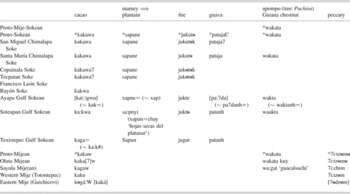
Notes: AYA = Ayapa Gulf Sokean; SOT = Soteapan Gulf Sokean. The data cited here were collected by linguists working on the PDLMA, except data from Rayón Soke (from Harrison and Harrison Reference Harrison and de Harrison1984). The trisyllabic variant of Wichmann's (1995:464) incorrectly reconstructed proto-Mije-Sokean *t jk(ay) ‘yesterday’ would also agree with our rules in having initial stress. However, the correct reconstruction, *tj 7k, is a disyllabic word followed (optionally, in just one descendant) by a clitic {7ay}; as such, stress rules operate on *tj7k alone. This root therefore does not provide data on trisyllabic roots in Mije-Sokean languages and is not included in the table.
Mije-Sokean trisyllabic roots
Dakin and Wichmann state that only two CVCVCV stems are reconstructible within Mije-Sokean, and that this in itself suggests that a word shape kakawa must be foreign. It is true that most Mije-Sokean noun stems are disyllabic, and most of the remainder are monosyllabic, while trisyllabic stems are rare. But this does not constitute evidence that trisyllabic roots in Mije-Sokean languages must have or are likely to have a foreign source. It is a commonplace that languages admit a variety of syllable types as roots or stems, and some are much rarer than others. As Table 4a shows, six trisyllabic roots are reconstructible in proto-Mijean, proto-Sokean, or proto-Mije-Sokean. All of them, including *kakawa, begin with two open (CV or CV7) syllables. Empirically, setting aside the contested case of kakawa, none of these trisyllabic nouns has a recognized foreign source.
Note that CV7 syllables must be treated as open for present purposes. In Mije-Sokean languages, V7 has the same consequences as V for the assignment of stress. In Sokean languages that lengthen stressed short vowels in open syllables, where C  CV > C :CV or C VCV, it is also the case that C 7CV > C :7CV or C 7VCV. Accordingly, V7 behaves as a syllable nucleus, not as a vowel-plus-consonant sequence.
Gulf Sokean reflexes of Mije-Sokean trisyllabic roots
Dakin and Wichmann further claim that the Gulf Sokean words for cacao must be loans into Gulf Sokean. Their reason is that Wichmann reconstructs penult stress for all native words in Sokean. Dakin and Wichmann therefore consider roots with stress on a different syllable to be non-native—hence, borrowed forms.
In 1963, Kaufman offered the following rules for stress in proto-Mije-Sokean (section 2262 of the manuscript, somewhat paraphrased in the interest of updating terminology but not of updating the analysis, which was faulty in one respect):
Rules for stressing polysyllabic stretches excluding clitics in proto-Mije-Sokean:
a. nouns, adjectives, and numerals are stressed on the first syllable and also on the penult syllable if the latter is at least two syllables forward of the first syllable.
b. verbs are stressed on the penult syllable and also on the first syllable if the latter is at least two syllables earlier than the penult syllable.
[These rules are distinct because proto-Mije-Sokean verb words always contain at least two syllables, while non-verbs can be monosyllabic.]
If two or more syllables are stressed by the above rules, the last one is primary and the rest secondary.
The different rules for nonverbs and verbs may reflect their differing positions with respect to sentence stress, but this is pure conjecture.
From the vantage of 2007, these statements are too complicated. There is no need to refer to the lexical class of any word. As for the exclusion of clitics, a clitic is a word or affix distinctively lacking stress. It is by definition not within the scope of stress assignment—unless in the phonology of the language clitics are attached before stress assignment.
In proto-Mije-Sokean, proto-Sokean, and proto-Mijean, finite verbs always occur with one suffix containing a vowel. They follow a rule of penult stress, which in an unenlightened way can be viewed as stem-final stress as long as no non-final inflexional suffixes intervene between the verb stem and the word-final suffix. If they have three or more syllables, the first syllable will also be stressed. Non-verbs follow the same rule: penult stress, and initial stress in phonological words of three or more syllables. The penult stress is stronger than earlier word-initial stresses.
Such is Kaufman's restatement of what he formulated in 1963, and we take this to be the correct formulation.
As for Gulf Sokean, an innovation must be postulated. Trisyllabic words of the shape *CVCVCV(7) are stressed on the initial syllable and not (anymore) on the penult syllable.
The data under discussion are all nouns, but proto-Sokean verbs of the shape CVCV 1C 2 were restructured as CVCV 17 in Soteapan Gulf Sokean and Texistepec Gulf Sokean, but not in Ayapa Gulf Sokean. Proto-Sokean also had verb stems of the shape CVCV 17). Then the pattern CVCV7 underwent in the several Gulf Sokean languages the same innovation in stress assignment before being restructured to the shape CV:C (in Soteapan Gulf Sokean and Texistepec Gulf Sokean) or CV:7C (in Ayapa Gulf Sokean):
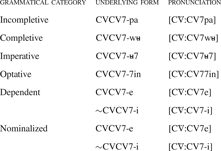
All of these verb forms lost the second syllable (including the glottal stop), and from these contracted forms a new stem shape was generalized.
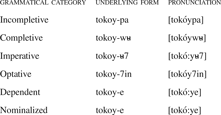
These forms show that in Gulf Sokean trisyllabic words of the shape *CVCV7CV(C) underwent the same innovation in stress placement as *CVCVCV(C) words. In contrast, trisyllabic words of the shape *CVCVCCV(C) show penult stress. In the case of verbs, this can be illustrated by any CVCVC verb stem in which the final consonant is not 7. For example:
Wichmann (Reference Wichmann1995:88–89) outlines his views regarding stress in proto-Mijean, proto-Sokean, and proto-Mije-Sokean. We find these rules to be overly complicated. Wichmann relies on syllable weight and the ability to identify roots, both of which are unnecessary. All that is required to predict stress in any Mije-Sokean language (with the possible exception of Sayula Mijean [Rhodes et al. Reference Rhodes, Kaufman and Holt1994–Reference Rhodes, Kaufman and Holt2005] and Texistepec Gulf Sokean) is knowledge of which morphemes are clitics.
Wichmann (Reference Wichmann1995:68) gives the following rule: “Assign P[rimary] S[tress] to the rightmost heavy syllable in the word string if any such syllables are present. (A heavy syllable contains V:, V:7, V7, or Vh as its nucleus.) Or else assign P[rimary] S[tress] to the rightmost root. If that root is a polysyllabic nonverb, it receives stress on its penultimate syllable; if it is a polysyllabic verb it receives stress on its last syllable.” Leaving aside heavy syllables and roots, Wichmann's rule for the heaviest stress is the same as that of Kaufman (Reference Kaufman1963), although Wichmann does not acknowledge this. (He criticizes other features of Kaufman Reference Kaufman1963). Nor does he notice that Kaufman's (1963) rule could have been formulated more simply, as we have done here. Wichmann does not envision more than one stress in polysyllabic words.
While it is true that penult stress is typical of Mije-Sokean languages, in some languages there are additional wrinkles. In Santa María Chimalapa Soke (see Kaufman and O'Connor Reference Kaufman1994–2005), every word of three or more syllables is stressed on both the initial syllable and the penult syllable. The penult syllable may have a slightly higher prominence than the first syllable. In San Miguel Chimalapa Soke (see Kaufman and Johnson Reference Kaufman and Johnson1994–2005), however, in words of three syllables the penult is stressed, and if the first syllable is heavy, it receives secondary stress. If the word has four or more syllables and the first syllable is open, it is stressed and long and the second vowel is optionally (and usually) dropped. In both Chimalapa Soke dialects, vowels in stressed open syllables are allophonically long.
Dakin and Wichmann's evidence for antepenult (initial) stress on *kakawa is that the original penult syllable is lost in Gulf Sokean. This is cogent evidence for stress, because in roots whose structure and stress pattern can be established on language-internal grounds, it is only syllables known to be unstressed that are lost in Gulf Sokean. (Cross-linguistically, too, it is unstressed syllables that are most likely to be reduced.) They are also correct in limiting attention to the placement of stress in Mije-Sokean roots, not in arbitrary trisyllabic words, because (for a variety of reasons, not the same for each language) stress on words with more than one morpheme is predictable in Mije-Sokean languages.
Where Dakin and Wichmann go wrong is in claiming that trisyllabic roots in Sokean were regularly stressed on the penult syllable. An analogy from the penult stress of disyllabic roots is not valid, because this pattern can equally be treated as one of root-initial stress. What is required to establish the stress pattern on trisyllabic roots are data from trisyllabic roots themselves. Dakin and Wichmann's only evidence of this sort comes from the word for cockroach, reconstructed incorrectly by Wichmann as a root *makoko. This word indeed had stress on the penult syllable, as indicated by the preservation of that syllable in Gulf Sokean, but this is explained by the fact that its root is actually a disyllable *koko7, with a preposed optional proclitic *ma+ (see later), which, as a clitic, is not stressable.
Using a larger set of data, we show here that initial (or antepenult) stress was normal in Gulf Sokean roots of the shape *CVCVCV(C) and thus that the stress pattern of *kakawa is what is to be expected for native Mije-Sokean roots. There is no internal basis within the Mije-Sokean family for interpreting Sokean *kakawa as other than a native lexical item.
The Mije-Sokean data in Table 4 are relevant to words for cacao and to stress patterns in Mije-Sokean trisyllables. All five of the Sokean words in this table have a CVCVCV or CVCVCVC pattern in Soke while having just two syllables in Gulf Sokean. To this extent, at least, these appear to be regular correspondences, pointing to the reconstructibility of these sets to proto-Sokean. The Soke forms are not predictable from the Gulf Sokean forms, while the Gulf Sokean forms are predictable from the Soke forms. It is therefore the latter that preserve the proto-Sokean forms of these words.
There are Mijean forms that are cognate with one of these words, *wakata.
Discussion of Mije-Sokean Forms
This section discusses the details of the Gulf Sokean data.
Cacao, mamey, fire, guava, and Pachira (apompo)
These words show that proto-Sokean had trisyllabic noun stems of shape CVCVCV(C) and that, in proto-Gulf Sokean, these were stressed on the initial syllable. Generally speaking, Soteapan Gulf Sokean and Ayapa Gulf Sokean stress the first syllable and lose the second syllable, while Texistepec Gulf Sokean stresses the first syllable and loses the last syllable. Since Texistepec Gulf Sokean disagrees with Soteapan Gulf Sokean and Ayapa Gulf Sokean on which syllable is lost, this syllable reduction must have taken place after the breakup of proto-Gulf Sokean. In Totontepec Highland Mije (see Suslak Reference Suslak1996–2002), /7i:tzm/ ‘peccary’, from proto-Mijean *7i:tzm, also has initial stress. In Soke proper, all trisyllabic words are stressed on the penult syllable (and, as stated earlier, in Santa María Chimalapa Soke the first syllable is stressed, as well).
In some of these cases, Soteapan Gulf Sokean and Ayapa Gulf Sokean lengthen the stressed syllable, while in others they do not. There is too little data to provide a secure account for the presence or absence of vowel length in these forms. Possibly related is the fact that, in Soteapan Gulf Sokean, disyllabic roots serving as prepounds may lose their second vowel and may lengthen the first, stressed vowel.
Reduction of the second syllable is obvious in the Gulf Sokean words for cacao, mamey, fire, and Pachira, but the case of *patajaC requires more extended explanation. The attested Soteapan Gulf Sokean form, patanh, has a short vowel in the first syllable, which can only result from an underlying synchronic tt. The only possible source for this tt that is consistent with the forms of cognates in Soke would be a cluster tj, resulting from a reduction of the middle syllable of *pataja(C), yielding pre-Soteapan Gulf Sokean *patja(C). In Ayapa Gulf Sokean, roots of the shape CV:7CV regularly arise from proto-Sokean and proto-Gulf Sokean *CVCV7; Ayapa Gulf Sokean [pa:7da] therefore suggests a pre-Ayapa Gulf Sokean *pata7, again presumably from *patja7. Both Soke and Gulf Sokean therefore support reconstruction of word-final 7 in this form, and in particular require the reconstruction of *pataja7 for ‘guava’. Soteapan Gulf Sokean patanh in place of expected pata7* is consistent with a sporadic but fairly common phenomenon in individual Sokean languages whereby word-final 7 or V in one language corresponds to nh or n in another language. If the Texistepec Gulf Sokean form patanh is descended from an antecedent form *patajanh, which may well be the case, we do not know the rules that would yield this form. Alternatively, the form may be a simple borrowing from Soteapan Gulf Sokean.
Ayapa Gulf Sokean has one word, pa7tanh=kuy ‘guava tree’, in which the word for guava is the first element in a compound. This compounding form has nh at the end of the root. In Soteapan Gulf Sokean, patanh occurs both in compounds and as an independent word. Since the internal 7 of Ayapa Gulf Sokean pa7tanh= must originally have been root-final, the current nh at the end of the root must have developed in pa7tanh=kuy after the collapse of the unstressed penult syllable and, therefore, after the breakup of Gulf Sokean. In waktanh= kuy, Ayapa Gulf Sokean has nh at the end of the root in the compounding form of wakta < proto-Sokean *wakata ‘Guiana chestnut’.
The form kakwa of Rayón Soke—a dialect of Chiapas Soke, which generally has kakawa(7)—seems to reflect the Gulf Sokean pronunciation and may be a borrowing from the direct antecedent of Ayapa Gulf Sokean [ka(:)gwa7], although perhaps not from the precise current location of Ayapa Gulf Sokean in Tabasco.
Table 5 provides forms that have the appearance of being trisyllabic roots but are in fact morphologically complex and, correspondingly, show different stress patterns.
Morphologically complex forms that resemble trisyllabic roots in some Mije-Sokean languages

Notes: The data cited here were collected by linguists working on the PDLMA, except data from Francisco León Soke (from Engel and Allhiser Reference Engel and de Engel1987) and Rayón Soke (from Harrison and Harrison Reference Harrison and de Harrison1984).
aThe form [púguyu7] reported by Wichmann (Reference Wichmann1995:428) differs from the form collected by Suslak (Suslak et al. 1997–2007), and, among other problems, has two violations of Ayapa Gulf Sokean phonotactic constraints: the first vowel, which is stressed, should be long, and underlying word-final glottal stops should jump to the penult syllable. We therefore reject this form as inauthentic. The Gulf Sokean form *pukuyyu is not directly cognate with proto-Mije-Sokean *pu7+juyu7, though it is obviously related to it or derived from it—by some irregular process. Because of its form, with a medial closed syllable, it cannot instantiate the Gulf Sokean initial stress on words of original shape *CVCVCV(7).
Cicada
In Mije-Sokean languages (Table 5A), ‘cicada’ differs from the words in Table 4 in that it is a Wanderwort, a word that is widely diffused throughout Mesoamerica, and cannot be confidently attributed to any particular source. Like other such words, it also shows irregular sound correspondences and influence from sound-symbolic factors. In Tecpatan Chiapas Soke (Zavala Reference Zavala Maldonado2000–Reference Zavala Maldonado2003), for example, one variant for cicada occurs as a verb root for the sound the cicada makes (7iskitin=7iskitinapya te7 7iskitinh ‘está cante y cante la chicharra’). The first two forms in Table 5A have analogs in Spanish chiquirín, pichichi, pijiji, and pijija, and in at least some other Mesoamerican languages. They are Wanderwörter. Even though they may be of Mije-Sokean origin, they can have been directly developed free of symbolic considerations only in some Mije-Sokean languages. All these words except for Texistepec Gulf Sokean /pe(:)7xe:xe7/, to the extent they are found in Gulf Sokean, show initial stress, as well.
Tree duck and butterfly
Like ‘cicada’, both ‘tree duck’ and ‘butterfly’ show irregular sound correspondences and influence from sound-symbolic factors. They sometimes show unusual phonology in the language where they are found.
The Soke forms for tree duck can go back to pre-Soke *pisisi7. The Sayula Mijean form /pi:xix/ is compatible with this if they all go back to proto-Mije-Sokean *pi:sisi7. But the Texistepec Gulf Sokean and Oluta Mijean (Zavala Reference Zavala Maldonado1994–Reference Zavala Maldonado2004) forms are not compatible with this or with each other. Oluta Mijean has /i7/ for *i:; Texistepec Gulf Sokean has /e(:)7/ for *i: and lengthens the second vowel, which would have to have been stressed in the antecedent form to be lengthened. If we postulate a proto-Mije-Sokean form *pi:+ sisi7, it would account for all of the forms cited, with the following wrinkles: (1) the proclitic *pi:+ was changed to [pi7] in Oluta Mijean and Texistepec Gulf Sokean; and (2) the proclitic was fused with the root in Sayula Mijean. This is thus not an originally trisyllabic form but a disyllabic “root” with a proclitic “prefix”.
The Sayula Mijean form xu+ pe:p for butterfly goes back to * su+pe:pV(7). The other forms are compatible with being derived from an antecedent form *su+pe:pe7, with some extra “symbolic” modifications. This, again, is not a trisyllabic form but a disyllabic “root” with a proclitic “prefix”.
Cockroach, thunder, whippoorwill, and ant
These words also give the appearance of being trisyllables that show stress on the second syllable in Gulf Sokean but are not relevant to the analysis of Gulf Sokean trisyllabic roots because they are morphologically complex. Their roots are disyllabic. In ‘cockroach’ and ‘thunder’, this is because these words have the proclitic {ma+}, and as a clitic it cannot be stressed. The following root in each of these words is disyllabic, with stress on the first syllable of the root. The following data substantiate this analysis. Soteapan Gulf Sokean /7onhko=nak/~/ma+ 7onhko=nak/ ‘type of frog/toad’, and Soteapan Gulf Sokean /saawa/ ‘wind’ alongside /ma+ saawa/ ‘windstorm’, show that {ma+} is some kind of optional modifier. Copainala Chiapas Soke (see Pye Reference Pye1996–1999) /makoko7/ and Ayapa Gulf Sokean [ko:7go], both ‘cockroach’, show that {ma+} is optional in this cognate set. The word *ma+ jyC ‘thunder’ may include a nominalization of the verb root *j  y ‘to make a loud noise’, thus *ma+ jy.(7); that {ma+} in this set is a separate element is anyway suggested by the differently derived Tecpatan Chiapas Soke 7anh=j y.k 7 ‘trueno’. (The n of the Ayapa Gulf Sokean form /m:nye/ is unexplained, and all forms but that of Soteapan Gulf Sokean show a contraction of ma+ j … to m … .) The San Miguel Chimalapa Soke form mako7 ‘cockroach’ is contracted from *ma+ koko7 in a so far unexplained way.
A Mije-Sokean word for whippoorwill (Spanish tapacamino) can be reconstructed as *pu7+ juyu7 based on forms from Santa María Chimalapa Soke, Oluta Mijean, and Sayula Mijean. The initial syllable in Sayula Mijean is a proclitic; this property is masked in the Santa María Chimalapa Soke and Oluta Mijean reflexes. An innovated Gulf Sokean proximate form *pukuyyu can be set up with this meaning. It, however, has several unique features for a trisyllabic stem: (1) it is stressed on the penult syllable; (2) it loses the medial /k/ in Texistepec Gulf Sokean; (3) the final vowel drops in Ayapa Gulf Sokean; and (4) it is the only apparent trisyllabic noun stem under discussion with a closed medial syllable. Inasmuch as the second/penult syllable is closed in the Gulf Sokean form, that syllable bears the stress.
The case of ‘ant’ is similar. There are three reconstructible forms: Sokean *jajtzuku(7); Soteapan Gulf Sokean and Texistepec Gulf Sokean *jajtzuk; and Mijean *tzukuC. The Mijean form shows that jaj= in Sokean is a preposed element. Forms like [hah], meaning something like ‘fly’ or ‘grub’, are found in Mayan (from *ha7 h). The Ayapa Gulf Sokean form, if not borrowed from Soke, shows the expected Gulf Sokean reflex of a CVC.CVCV form. The Soteapan Gulf Sokean and Texistepec Gulf Sokean forms reflect a common antecedent; that antecedent is phonemically like the Sayula Mijean form. Perhaps the simplest hypothesis to account for these unexpected simlarities is to postulate that pre-Texistepec Gulf Sokean shortened *jajtzuku [jájtzuku] to [jájtzuk], then both Sayula Mijean and Soteapan Gulf Sokean borrowed the Texistepec Gulf Sokean pronunciation. Later pre-Texistepec Gulf Sokean *jajtzuk was mangled to yield jasuk. But *jajtzuku would presumably not have been pronounced [jájtzuku] earlier in pre-Texistepec Gulf Sokean unless no morpheme boundary was perceived between *jaj and *tzuku. Otherwise, it should have patterned like *jun=jy, which (unlike *kakawa, *sapane, *jukut, *patajaC, *wakata) was pronounced [jun :y], not [jú:ny]*, in proto-Gulf Sokean. Note that Ayapa Gulf Sokean jatztzu:ke and jun :ye reflect the same pattern, as if the words were compounds with a proclitic first element. The fact that Texistepec Gulf Sokean jasuk reflects [jájtzuku] while Texistepec Gulf Sokean jun :y reflects [jun:y] remains anomalous. Since a form like [jajtzuk] is otherwise not known in Mijean, Sayula Mijean jajtzuk seems like a loan from Sokean. However, it may be that the Sayula Mijean form is borrowed from proto-Sokean *[jájtzuku(7)], and that the Soteapan Gulf Sokean and Texistepec Gulf Sokean forms are borrowed from Sayula Mijean.
It is not clear whether the common Sokean word for agouti was a trisyllabic root or not. The shape CVCCVCV of *junjy may reflect that /jun/ is either a prepound or a proclitic. Even if this word consists of a single trisyllabic morpheme, the shape alone is enough to account for the different stress, since all of the trisyllabic roots with initial stress begin with an open (CV) syllable.
The data and analysis given in this section has shown that, among the six roots that are reconstructible to proto-Sokean and/or proto-Mijean with a CVCVCV(C) trisyllabic shape, all five that have Gulf Sokean reflexes had stress on their first syllable in these reflexes. Dakin and Wichmann's claim that Sokean trisyllabic roots had stress on the second syllable—a claim that they support with a single, misanalyzed form *ma+ koko7 (spelled *makoko by Wichmann) that does not have a trisyllabic root—is simply false. Rather than violating the regular stress patterns of Sokean trisyllabic roots, the data presented here establish that the stress pattern in the Gulf Sokean reflexes of *kakawa agrees with that of every other reconstructible instance. Rather than casting doubt on the Mije-Sokean pedigree of *kakawa, the evidence for stress on other Sokean trisyllabic roots supports the view that proto-Sokean *kakawa was inherited normally in Gulf Sokean. Apart from the Rayón Soke form, which seems to reflect Ayapa Gulf Sokean developments and might be diffused from an Ayapa Gulf Sokean-like language, there is no evidence for diffusion of this term within Sokean. The data on Mije-Sokean trisyllabic roots and their stress patterns are therefore consistent with Campbell and Kaufman's (1976) arguments for a Mije-Sokean origin of this term and add to the body of evidence brought forward in the section “The Mije-Sokean Hypothesis” in support of that conclusion.
Pre-Columbian Mijean Forms were Inherited from Proto-Mijean
Wichmann (1995:343–344) argues that the proto-Oaxaca Mije form corresponding to proto-Sokean *kakawa is *kakaw. In fact, all Mijean (not just Oaxaca Mije) forms are consistent with a reconstruction of proto-Mijean *kakaw, except for one highland Mije form, Mixistlán [kaká:wa], which derives from regional Spanish cacahua. The highland and lowland Mije forms of approximate shape [kaká:w] cited by Wichmann (Reference Wichmann1995:343–344) are not Spanish borrowings, as he states, but follow regular Mije developments from *kakaw. Wichmann's evidence for borrowing from Spanish is that the final vowel in these forms is long and stressed. In Totontepec Highland Mije, it is true that descendants of proto-Mijean *CVCVC forms received initial stress, as in káku, which Dakin and Wichmann recognize as descending from proto-Mijean *kakaw. However, in other forms of Mije, *CVCVC forms receive final stress. In all Mije, stressed final syllables and monosyllabic stressable words insert [h] before the final C, and this inserted [h] goes to vowel length before resonants. Thus *kakaw ⇒ kakáw ⇒ kakáhw ⇒ kaká:w. Dakin and Wichmann (Reference Dakin and Wichmann2000:57a) go further than Wichmann (Reference Wichmann1995) in erroneously suggesting that the [kaká:w] forms do not develop from the same form as Totontepec Highland Mije /kaku/. Oluta Mijean kakaw [kaka7w] shows that this form also descends from one with a final consonant.
Wichmann (Reference Wichmann1995:343–344) cites the following data (language labels follow his terminology):
North Highland Mije
Totontepec Highland Mije [káku]
South Highland Mije
Tlahuitolpetec [kakó:w]
Midland Mije
Mixistlan [kaká:wa] {< Sp}
Juquila, Jaltepec, Puxmecatan [k
 gá:]
gá:]Matamoros [k
gá:W]Atitlan [kagá:w]
Lowland Mije
Coatlan [k
7ga:]Camotlan and Guichicovi Lowland Mije [k
gá:]Sayula Mijean kágaw
Oluta Mijean kaka7w
The Mijean form *kakaw has nothing to do with the fact that in Mije proper, in Sayula, and in Tapachula word-final proto-Mije-Sokean *V and *V7 are dropped in polysyllables. (The development in Sayula and Mije may be a shared change; that in Tapachula is not.) When these Mijean languages drop a final vowel, the phonological reflexes are different from those in words that never had a final vowel; it is shown here that the surviving Mije forms are consistent with the reconstruction of proto-Mijean *kakaw. Oluta does not drop word-final vowels, and the phonetic [7] before the final consonant of Oluta Mijean kakaw [kaka7w] is regular for Oluta Mijean roots of two or more syllables descending from proto-Mijean and proto-Mije-Sokean consonant-final forms but not for those descending from roots ending in V or V7.
Accordingly, except for one late loan from Spanish, the Mijean forms are consistent with direct inheritance from proto-Mijean *kakaw. They supply no evidence for any pre-Columbian borrowing that postdates the breakup of proto-Mijean.
The Discrepancy between Proto-Sokean *kakawa and Proto-Mijean *kakaw, and Its Source
The only remaining puzzle, then, is that proto-Mijean *kakaw and proto-Sokean *kakawa are not identical. Note that under the model we propose—that *kakaw~*kakawa is native to Mije-Sokean—borrowing between Mijean and Sokean does not account for this difference. Had Mijean *kakaw been borrowed into Sokean, it would be expected to have retained its pronunciation in Sokean, which has a large number of *CVCVC noun roots—far more of them than the number of its *CVCVCV roots. So such a borrowing is implausible. Similarly, although there were few *CVCVCV roots in proto-Mijean, it is unlikely that an ancestor of proto-Mijean would have reduced a trisyllabic noun root *kakawa to two syllables on being borrowed into a form of Mijean predating proto-Mijean. Not only are there at least two solid proto-Mijean *CVCVCV roots—*wakata ‘Guiana chestnut’ and *7i:tzm ‘peccary’—but CVCVCV is within the range of phonotactic shapes of complex words in proto-Mijean.
The remainder of this section explores a viable alternative to borrowing, for which there are numerous parallels: that the differences reflect an ancient heritage of this word within the Mije-Sokean family that dates back to proto-Mije-Sokean.
Very often for a given meaning, Mijean and Sokean have completely different morphemes or combinations of morphemes. Sometimes, though, the forms are clearly related phonologically, but show discrepancies that forestall the reconstruction of a single phonological form to proto-Mije-Sokean. Examples currently known to us are provided in Table 6. Note again that borrowing between an ancestor of proto-Mijean and an ancestor of proto-Sokean, in either direction, cannot account straightforwardly for any of these differences.
Non-identical but phonologically related reconstructions for Sokean and Mijean
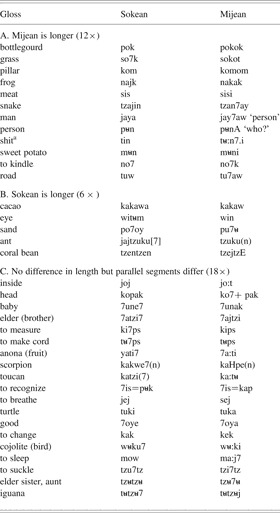
a*tin is the proto-Mije-Sokean word for ‘shit,’ as can be seen in the proto-Mijean *tintzay ‘gut’ (i.e. “shit-vine”); proto-Mijean t:n7.i ‘shit’ is a nominalization of proto-Mije-Sokean *t:n7 ‘to shit’.
Long and short forms of the same root
Both between branches and within the same language, a single root may occur with both a shorter and a longer form, with the longer form having an extra vowel (plus or minus glottal stop) at the end (cf. Wichmann Reference Wichmann1995:80–88). There are more cases than the ones cited here.
Proto-Sokean *k
(7)=tzus ‘digit nail’ [under corner]Copainala Chiapas Soke maks=chus tza7 ‘flint’ [four-cornered stone]
Santa María Chimalapa Oaxaca Soke tzusu ‘corner’
*j
p ‘nose’ (Mi); ‘mouth’ (So)Copainala Chiapas Soke, Tecpatan Chiapas Soke j
p ‘jaw, chin’Proto-Mijean *kakaw ‘cacao’
Proto-Sokean *kakawa ‘cacao’
Whenever there is evidence, the long forms are seen to be derived from the short forms. The short forms are not truncated.
Consider the following set of forms, apparently based on *pok:
Proto-Mije-Sokean *pok7i7 ‘ankle’
San Miguel Chimalapa Soke poki7 ‘ankle’
Santa María Chimalapa Soke poki7 ‘ankle’
Tecpatan Chiapas Soke poki7 ‘ankle’
Oluta Mijean po7ki ‘ankle’
Proto-Sokean *pojk ‘bottle gourd’
Tecpatan Chiapas Soke pok ‘bottle gourd’
San Miguel Chimalapa Soke pojok ‘gourd container for seed (for planting)’
Ayapa Gulf Sokean pok ‘gourd bowl’
Soteapan Gulf Sokean pok ‘bottle gourd’
Proto-Mijean *pokok ‘bottle gourd’
Proto-Sokean *po7k ‘knot’
Tecpatan Chiapas Soke po7k ‘knot (in a rope, on a tree, on your head)’
Santa María Chimalapa Soke po7k ‘knot (in tree or rope)’
San Miguel Chimalapa Soke po7k ‘knot (in a rope or tree), lump’
Soteapan Gulf Sokean po7k ‘trunk (of tree)’
Soke *pok.pok ‘round’
Santa María Chimalapa Soke pok.pok ‘circular’ (like a plate or the rim of a bucket)
San Miguel Chimalapa Soke pok.pok ‘puffed up’
Tecpatan Chiapas Soke pok.pok ‘calf of leg’
cf. Soteapan Gulf Sokean pok.pok ‘oriole’ [probably not connected]
Western Soke *po7ojk
Santa María Chimalapa Soke po7ok ‘egg’
San Miguel Chimalapa Soke pojo7k ‘egg; ballock’
Tecpatan Chiapas Soke pok.a7 ‘egg’
In the case of the word for egg, there is no problem with the fact that Chimalapa Soke has a final consonant and Copainala and Tecpatan Chiapas Soke has a final V7. The problem is why there is extra (laryngeal) material in the middle of the Western Soke forms. Compare also
Tecpatan Chiapas Soke pok.o7 ‘elephant-ear tuber’
Ayapa Gulf Sokean po[g]ok ‘to roll up; to roll’
Soteapan Gulf Sokean pook ‘cornstalk’
Soteapan Gulf Sokean pookon ‘reed’
All of these suggest that they come from a root *pok that meant something round or spherical or cylindrical.
These examples are a few among many illustrating that individual Mije-Sokean languages use a variety of strategies for creating new lexical items by extending an existing stem in some way. This is illustrated in the cases discussed here—Copainala and Tecpatan Chiapas Soke j p ‘jaw, chin’ <proto-Sokean *jp ‘mouth’ <proto-Mije-Sokean ‘nose’; Santa María Chimalapa Soke tzusu ‘corner’ <proto-Sokean *tzus. In each case, the longer form is an expansion of the shorter form; in none of the cases known to us is there evidence for truncation of an originally longer form. Like any natural language, proto-Mije-Sokean would have had some lexical items with more than one pronunciation, distributed by geography, social class, or style; some would have been produced as extensions of existing forms. In addition, the Mijean and the Sokean branch must each have taken some inherited words and extended them to form new words or new variants of old words. Many of the forms presented in Table 6 could have arisen, and likely did arise, in this way.
It is therefore consistent with what we know of variation in Mije-Sokean generally to hypothesize that Sokean *kakawa is an expanded version of an original proto-Mije-Sokean *kakaw, or that *kakaw and kakawa co-existed in proto-Mije-Sokean and that in each branch only one variant survived. (It is not plausible that Mijean *kakaw is truncated.) This being the case, nothing in the Mije-Sokean data requires us to conclude that a word for cacao was borrowed into any Mije-Sokean language in pre-Columbian times.
This kind of variation raises an issue regarding comparative reconstruction within Mije-Sokean that is incorrectly handled by Wichmann (Reference Wichmann1995): only in the rarest cases can there be any doubt about where to reconstruct medial and final vowels in Mijean, Sokean, or Mije-Sokean etymologies. Even if no cognate for a given Mijean etymology is found in Oluta, so that all Mijean cognates of a proto-Mijean form that ended in V or V7 may end in consonants, there is almost always evidence that a vowel had been there. It is also possible to determine whether the vowel was a front vowel (i or e), or some other vowel (, a, u, or o): if it was a front vowel Mije Proper (but not Sayula) palatalizes the consonant that had preceded that vowel, or raises (“umlauts”) the vowel of the original penult syllable; if it was a non-front vowel, the preceding consonant is not palatalized, and there is no “umlaut”. Some languages, such as Soteapan Gulf Sokean and San Miguel Chimalapa Soke, and probably some forms of Mije, drop some unstressed medial vowels, but Sayula Mijean and Oluta Mijean do not. When San Miguel Chimalapa Soke drops a medial vowel, this leaves a trace in the lengthening of the preceding vowel; when Soteapan Gulf Sokean drops a medial vowel, the preceding vowel is often but not always lengthened.
Word-final vowels dropped also in Texistepec Gulf Sokean. This change affects only word-final vowels; word-final /V7/ is not affected, and word-final proto-Mije-Sokean *7 is preserved in Texistepec. The vowel-drop in Texistepec may have diffused from the neighboring town of Sayula. Before about 1,000 years ago, there was no regular phonological process of dropping final vowels in any Mije-Sokean language.
The relevance of this in the current context is that any item that can be reconstructed phonologically is going to point clearly to there having been a final vowel, or to having not ended in a vowel. Often enough to be interesting, it turns out that Sokean has final V and Mijean does not, or vice versa, or even between one language and another that clearly preserve final V, one has it and one does not.
Morphological analyzability
If *kakaw or *kakawa were analyzable as being composed of more than one meaningful unit in one language family but not in another, that would contribute to evidence for the origin of the word in the family in which it is analyzable. However, there is no known possible morphological analysis of *kakaw(a) within Mije-Sokean. The only seemingly obvious possibility would be partial reduplication, with ka preposed to a base form kaw or kawa, but such a hypothesis must be rejected because in Mije-Sokean languages it is the root that comes first and its partial (or complete) replication that follows. The first syllable is not a reduplication of the second.
In Mije-Sokean, generally speaking, -VC and -CVC reduplication is done with CVC roots in the formation of derived verbs. Complete reduplication of CVC, CVCV, and CVCVC shapes is found in derived nouns and adjectives.
Verbal reduplication of a hypothetical root kaw would yield kaw-aw or kaw-kaw, rather than, for example, the Mijean form *kakaw. Reduplication of a hypothetical nonverb root kawa would yield kawa-kawa, rather than, for example, the Sokean form * kakawa. No known reduplication process in any Mije-Sokean language could produce kakaw or kakawa from any hypothetical base form.
We therefore find no obvious way to analyze *kakaw(a) morphologically in Mije-Sokean. Morphemes of the shape CVCVC are fairly common in proto-Mije-Sokean, proto-Sokean, and proto-Mijean, and proto-Sokean has at least five simple roots, excluding *kakawa, that are shaped CVCVCV(C) (see Table 4) and for which no morphological analysis seems possible. The lack of analyzability of *kakaw (a) therefore does not constitute evidence against the Mije-Sokean hypothesis. The occurrence of two ka sequences does not in itself require an interpretation of reduplication as a process. In a language with 66 different CV syllable shapes, a non-negligible proportion of words having two or more syllables will begin with two identical CV sequences, as in the case of proto-Sokean *koko7 ‘cockroach’, cited earlier, in addition to proto-Mije-Sokean *mumu ‘all’, *n:n7 (> proto-Sokean *nn7 ‘atole’, proto-Mijean *n:n ‘tortilla’), and *tujtu “beyond/plus five”; proto-Sokean *toto7 ‘Ficus sp., amate fig’; proto-Soke *tztz ‘younger sister’; proto-Gulf-Sokean *meme ‘butterfly’, *na7na7 ‘gum (tree)’, *nono ‘mushroom; tree ear’, *nunu ‘(woman's) breast’; proto-Mijean *se:se ‘(small) fish’, *sisi ‘meat’, *totok ‘butterfly’. The issue would have been relevant only if *kakaw or *kakawa were analyzable in a language that, on other grounds, had proven to be a viable candidate for the language from which *kakaw(a) spread to other Mesoamerican languages.
Refuting the Arguments for a Nawa Source of *kakawa in Mesoamerican Languages
Dakin and Wichmann's Nawa etymology is invalid
The Nawa and Yuta-Nawan data cited in this section are from Kaufman's field notes (Kaufman Reference Kaufman1981, Reference Kaufman2001).
Forms containing the noun stem /kakawa/ are the following in Huasteca Nawa (other forms of Nawa contain similar items):
kakawa-tl ‘cacao’; ‘peanut’
i-kakawa-h ‘his cacao’; ‘his peanut’
i-kakawa-yo ‘its thick bark’
kakawa.ti.k ‘hollow’
tla:l=kakawa-tl ‘peanut’ (literally, ‘earth-cacao’)
Dakin and Wichmann (Reference Dakin and Wichmann2000) hypothesize that an early Yuta-Nawan word meaning ‘egg’ is the source of Nawa /kakawa-tl/; that [kakawa] arose as a CV- reduplication of a pre-Nawa *kawa ‘egg’; and that [kakawa] would have originally meant ‘egg-like thing’. The semantics of this hypothesis are not implausible, given the shape of the cacao pod, although in Mesoamerica the pod is analogized rather to an ear of maize in its husk (e.g., Molina's <cacahuacentli> ‘maçorca de cacao’). Dakin and Wichmann acknowledge that there is no attested Nawa word kawa(-tl)* and thus no internal Nawa evidence for the analysis, which depends entirely on the plausibility of relating Nawa [kakawa] to Sonoran forms. (Southern Yuta-Nawan is Sonoran plus Nawa.)
The Sonoran data they cite (Dakin and Wichmann Reference Dakin and Wichmann2000:59) are:
Warijiyo ka7wá ‘egg’
Taraumara ka7wá ‘to lay eggs’
Kájita kava ‘egg’
Eudeve aa]kabo[ra'a ‘egg’
These data are sufficient to reconstruct proto-Sonoran *kava. Contrary to Dakin and Wichmann's assumption, however, a Southern Yuta-Nawan form *kava (which would yield Sonoran *kava) cannot be the source of Nawa kakawa-tl. The reason is that their claim that postvocalic Yuta-Nawan single *p becomes w in Nawa is wrong. Instead, postvocalic Yuta-Nawan single *p (like initial *p) changes to [v] in Southern Yuta-Nawan, which shifts to [h] in Koran and Nawa, and this is subsequently lost in Nawa.
YN *s
p.. ‘cold’ [n] ⇒ PSYN *seve-ta ⇒ Nawa se:-tl ‘cold’ [a] PSYN *se-seve-ka [a] ⇒ Nawa se-se:-kYN *napo-ts ‘prickly pear’ ⇒ PSYN *navo-tsi-ta ⇒ Nawa no:ch-tli
YN *tapun-tsi ‘rabbit’ ⇒ PSYN *tavu-tsi-ta ⇒ Nawa to:ch-tli
YN *tsi:puH ‘bitter’ ⇒ PSYN *tsi-tsi:vu-ka ⇒ Nawa chi-chi:-k
YN *pi:pah ‘tobacco’ ⇒ PSYN *vi:va-ta ⇒ Nawa i(:)ya-tl
These data show that postvocalic Yuta-Nawan *p = Son *[v] does not survive as /w/ in Nawa but disappears, and the resulting vowel sequence merges into a single long vowel (except that *iva > *iha > iya, perhaps not passing through the stage *ia). Thus, although there is a Sonoran etymon *kava ‘egg’, a putative Southern Yuta-Nawan form *kava can not yield [kawa] in Nawa, and a hypothetical reduplicated noun deriving from a proto-Southern Yuta-Nawan *kava would have shown up in Nawa as kaka:-tl*, not as kakawa-tl. Dakin and Wichmann's proposed Yuta-Nawan origin for the Nawa word kakawa is simply not possible.
There are two etymologies that might give the false impression that Sonoran medial [v] survives as [w] in Nawa. These are instances in which Sonoran [v] follows a rounded vowel. As usual, Sonoran medial [v] shifted to [h] in Koran and Nawa; subsequently in Nawa, after a rounded vowel this [h] became [w], after which the rounded vowel desyllabified and disappeared (this may have happened especially after /k/):
YN *kopa ‘forehead’ ⇒ pSYN *kova ⇒ Nawa kwa:(yi) ‘head’
pSYN *ma:kova ‘five’ ⇒ Naw ma:kwi:l-li
Unlike postvocalic Yuta-Nawan *p, which disappeared in Nawa (except as noted earlier), Yuta-Nawan (and Southern Yuta-Nawan) medial *w did survive, as w:
YN *konwa ‘snake’ ⇒ Nawa kowa:-tl
YN *sunwa ‘woman’ ⇒ Nawa siwa:-tl~sowa:-tl
YN *t
wa ‘to see’ ⇒ Nawa itwa~itta~itapSYN *ku7awi ‘tree’ ⇒ Nawa kwawi-tl
In sum, Nawa kakawa-tl cannot possibly be derived from an ancestor of proto-Sonoran *kava ‘egg’, as Dakin and Wichmann claim. This leaves no evidence either in Nawa or more broadly in Yuta-Nawan for a Nawa origin of Mesoamerican words for cacao.
Evidence that *kakaw(a) was not borrowed from Nawa into early Mesoamerican languages
The previous section shows that the word *kakaw(a) did not originate in Nawa. This section shows that, once it was adopted by Nawas, it did not pass from them to speakers of any other Mesoamerican language at an early date. The evidence comes from the lack of any trace of the Nawa absolute suffix -tl in the borrowed forms. The section “General Features of Borrowings into and out of Nawa” shows in some detail that Nawa words are almost always borrowed in their absolute form. Dakin and Wichmann (Reference Dakin and Wichmann2000:67b) acknowledge that this is an issue: “kakawa-tl is always borrowed without the so-called absolutive [sic] suffix”. They further acknowledge that it would be a “serious” difficulty, were they unable to provide a viable rationale for the absence of this suffix in the borrowed forms. They seek to overcome this problem by arguing that it could have been borrowed in a possessed form, which would lack the absolute suffix. Their rationale for borrowing the word in a possessed form is a supposition that, in the diffusion of cacao as a commodity, it “would have been an object more likely to have been discussed in possessed form”.
This claim is pure speculation, for which Dakin and Wichmann provide no evidence. Direct linguistic evidence would be a demonstration that other borrowed Nawa words for commodities regularly show up without absolute suffixes. In fact, other Nawa words for commodities are borrowed in the absolute, and not in the possessed, form. For example, mirrors were made from materials that were not found everywhere and were traded to areas that lacked them. Nawa te:ska-tl ‘mirror’ is borrowed as Soteapan Gulf Sokean teeskat.
Dakin and Wichmann's imaginative scenario to account for the borrowing of the word for cacao in an unexpected form is a “just-so” story; and they do not simply propose that one instance of borrowing of the word into some language showed this peculiarity, but that it was “always” borrowed in this form. According to their proposal, then, every language that borrowed the word for cacao from Nawa would have to have borrowed it from the possessed form of the Nawa word. Without serious evidence to support this idea, the uncharacteristic lack of a final t in the postulated repeated borrowings of the word for cacao remains a serious inconsistency of the Nawa hypothesis with the data on the borrowing of this word.
Another problem with this particular speculation is that, although Dakin and Wichmann are not entirely explicit on the point, they clearly mean to contrast the presence of the suffix -tl in the absolute form of kakawa with the absence of any suffix in its possessed form (“Once a noun is possessed in Nahuatl—always by means of a prefix—the absolutive [i.e., absolute] suffix is dropped” [Dakin and Wichmann Reference Dakin and Wichmann2000:68]). But it is not correct that the possessed form of kakawa is unsuffixed. As Canger (personal communication, 2006) points out, the possessed forms—i:-kakawa-w ‘his cacao’, no-kakawa-w ‘my cacao’, mo-kakawa-w ‘your cacao’, to-kakawa-w ‘our cacao’, a:n-kakawa-w ‘y'alls cacao’, i:n-kakawa-w ‘their cacao’—actually end in a consonant, w, which is a suffix marking some nouns as being in the possessed state. Although we might imagine that a final w is phonetically easier to eliminate than a final t or tl, the fact is that there is no form of the Nawa word for cacao that ends in a vowel.
Also unsubstantiated are the nonlinguistic presuppositions of Dakin and Wichmann's scenario that “cacao was a trade item and the word must have been diffused along trade routes in situations of trade negotiation” (Dakin and Wichmann Reference Dakin and Wichmann2000:68). It is not known whether cacao was in fact traded as a commodity at the time its (earlier) borrowing is first documented in Mayan hieroglyphic texts. There are many alternatives to a trading explanation for the earliest diffusion of cultivated cacao. Most generally, the processes that fostered enough of an increase in the demand for cacao—for example, an increase in the use of the beverage made from cacao in elite interactions—would need to have preceded any substantial trade in cacao beans, if any such trade developed as early as Dakin and Wichmann's hypothesis requires. The spread of the word could as easily have accompanied these processes of diffusion rather than the subsequent trade, if any. Or it could have accompanied the spread of the practice of cacao cultivation rather than the distribution—trade-based or otherwise—of the products of cacao cultivation.
SHORTER FORMS DIFFUSED IN MESOAMERICA
[kakaw] outside Mijean
In Mayan, /kakaw/ is the typical form. It is borrowed, not native, because a proto-Mayan *kakaw would not have preserved [k] in all languages. Mayan tolerates disyllabic noun roots (though they are relatively few) but does not have native trisyllabic roots nor roots ending in vowels. The model for the diffused forms could have been either [kakaw] or [kakawa]. The borrowing reached Greater Tzeltalan after the change *k > ch had run its course, so sometime after 200 b.c. Mayan has a reconstructible root *pe:q, now referring to uncultivated cacao (Spanish pataxte); that Greater Lowland /pi:k/ expresses the numerical value of 8,000 (and proto-Yukatekan *pi:k ‘skirt’; cf. “The Mije-Sokean Hypothesis”, above) suggests that the Mayan term *pe:q also referred to cultivated cacao at one time.
Totonako, Tepewa, Salvador Lenka, and Paya all have forms like /kakaw/. The Paya and Salvador Lenka forms plausibly have spread from Mayan, but possibly from Mijean, or even from pre-Sokean if proto-Sokean *kakawa developed after the proto-Mije-Sokean stage. The Totonako and Tepewa forms more likely spread from Mije-Sokean.
Totonako /kakaw/ ‘peanut’ (Kaufman field notes, Reference Kaufman and Justeson2003)
Tepewa /kakaw/ ‘cacao’ (Susan Smythe, personal communication 2005)
Salvador Lenka [k'á:gaw] = /k'akaw/ ‘cacao’ (Lehmann Reference Lehmann1920; the anomalous initial k' may well be an error on Lehmann's part)
Paya [kaku] ‘cacao’ (Holt Reference Holt1999a)
Forms like kaw(a)
Most of the following forms, all from Lower Central America, resemble the Mije-Sokean *kakaw(a); some seem to reflect a model [kaw], which is not known in Mesoamerica proper. These forms are listed in the geographical order in which they occur (Figure 5):
Languages of lower Central America that have words for cacao derived, ultimately, from Mije-Sokean, showing their locations as of about a.d. 1500. To provide a sense of the linguistic geography when the word for cacao was diffusing, intrusive groups that reached their contact-period locations after a.d. 500 have been removed, and their territory has been divided among remaining adjacent groups. We have no data on words for cacao from Misumalpan languages, which divide Paya from the rest of the Chibchan family. Chibchan : BRK = Boruka; DRS = Doraske; MOB = Mobe; PAY = Paya; RAM = Rama; TRB = Terraba; WTS = Watuso. Other: LNKh = Honduras Lenka; LNKs = Salvador Lenka; TOL = Tol; XNK = Xinka. After Kaufman and Justeson (Reference Kaufman, Justeson, Arnold and Pool2006:Figure 6.2).
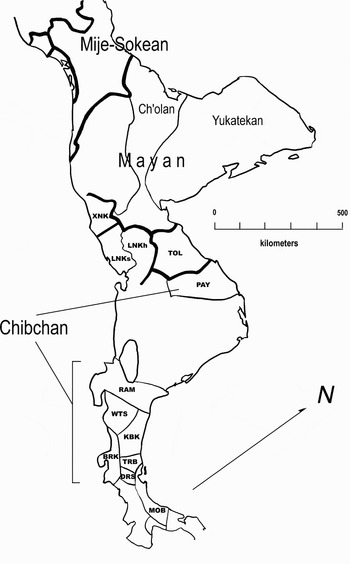
West to East in El Salvador and Honduras
Mayan kakaw
Tol [khaw] (Holt Reference Holt1999b)
Honduras Lenka *[kaγaw] > /kaw/ (Lehmann Reference Lehmann1920)
Pipil kakawa-t (Campbell Reference Campbell1985; inherited from proto-Nawa, which had borrowed *kakawa from Mije-Sokean by about a.d. 500)
Salvador Lenka /k'akaw/ (or /kakaw/) (Lehmann Reference Lehmann1920)
North to South on the Pacific Coast
(Chiapaneko nuusi [Fernández de Miranda and Weitlaner Reference Fernández de Miranda and Weitlaner1961:53])
(Chorotega nyuusi [Fernández de Miranda and Weitlaner Reference Fernández de Miranda and Weitlaner1961:53])
(Sutiaba uusi) (Lehmann Reference Lehmann1920)
North to South on the Atlantic Coast (Paya and Rama are Chibchan)
Paya kaku (Holt Reference Holt1999a)
[Sumu-Ulwa] (forms not found)
[Mískitu] (forms not found)
Rama kuk (Colette Grinevald, personal communication circa 2000)
West to East in Costa Rica (all of these are Chibchan languages)
Proto-Watuso-Boruka *'
hú7 (Constenla Reference Constenla1981:373)Watuso kaju: (Constenla Reference Constenla1981:373)
[Kabékar tsirú] (Dakin and Wichmann Reference Dakin and Wichmann2000:74)
Térraba kó (Dakin and Wichmann Reference Dakin and Wichmann2000:75)
[Bribri sirú] (Dakin and Wichmann Reference Dakin and Wichmann2000:74)
Boruka kaw7 (Constenla Reference Constenla1981:373)
Doraske koa (Dakin and Wichmann Reference Dakin and Wichmann2000:74)
Waymí ku (Dakin and Wichmann Reference Dakin and Wichmann2000:74)
Besides forms like [kaw], Chorotega and Sutiaba, whose speakers probably invaded the region circa a.d. 800-900 (Salgado Reference Salgado González1996:303; Steinbrenner Reference Steinbrenner and McNeil2006:257) and circa a.d. 1200, respectively, share a form like [(ny)uusi]. Tlapanekan (= Tlapaneko + Sutiaba) and Chorotegan form a node on the Oto-Mangean family tree, but since no form for cacao has been identified in Tlapaneko, the Sutiaba form could be a borrowing from Chorotega. Given the Chiapaneko form, *nuusi7 can be reconstructed for proto-Chorotegan and rolled back to central Mexico, where Chorotegan originated.
Kabékar and Bribri share a form like [(t)sirú]. Its further connections are unknown to us.
Salvador Lenka, Paya, and Rama reflect the typical Mayan pronunciation [kakaw], and this is plausibly their immediate source.
Going back to forms like [kaw], the following scenario may be envisioned:
First of all, the Chibchan data are limited geographically to only some of the Chibchan languages in Central America, and they are not found in any of the Chibchan languages of South America. The distribution does not correspond to a genetic subgrouping within Chibchan. Constenla's reconstruction *'
 hú7 may more properly be treated as a formula subsuming the phonological regularities between the Watuso and the Boruka forms as if they were cognate, even though they are due to diffusion. The rest of the Chibchan forms cited represent most of the branches of the stock, but there is no “cacao”-like form in any South American language that is not the result of colonial-period diffusion. Except for the Rama form, which cannot be fully accounted for, we can postulate that the phonological antecedent for all these forms is something like [kahaw]. Central American Chibchan languages show the development [káhaw] (with first syllable “stress”) > [*'hú7] > kaju:, káw7, kó, ku, kuk. Tol may have developed [kaháw] (with second syllable “stress”) to [khaw] or borrowed its word from one of the Chibchan languages with a (possibly intermediate) Boruka-like form [káw7]. Honduras Lenka may have done likewise.
The postulated Central American antecedent [kahaw] would have been borrowed from the general Mayan form /kakaw/. If the first intermediary into Central America from the Mayan area had been Honduras Lenka, there would be an explanation of the shift of medial /k/ to [h], because in Honduras Lenka, single intervocalic /k/ is pronounced [γ], which does not sound like [k] in a language having only [k] and [h] but not [γ] or [g]. If Honduras Lenka is the intermediary, why it should have simplified [kaγaw] to [kaw] is not crystal clear, but it may be observed that Spanish vacas yielded Honduras Lenka /waš/ ‘cattle’ through an intermediate form [waγaš], so this is a plausible internal development in Honduras Lenka.
Salvador Lenka /k'akaw/ (maybe /kakaw/) and Paya /kaku/ could be direct borrowings from Mayan with no Honduras Lenka intermediary, but Mayan languages are quite far away, and there are viable alternative explanations. The [g] of Salvador Lenca [k'á:gaw] could reflect the [γ] of an earlier Honduras Lenka [kaγaw] rather than Mayan [k]. Similarly, since Paya borrows proto-Mije-Sokean *pa:=ju7 ‘coyote’ as /paku/, it is more likely that it borrowed an antecedent Central American form [kahaw] as /kaku/ than that it made a far more distant borrowing from Mayan.
Altogether, the evidence from Central American languages does not clearly support an antecedent form like [kaw]; in fact it more strongly suggests an antecedent form like [kahaw], borrowed from Mayan /kakaw/, maybe specifically via Honduras Lenka.
There are two Oto-Mangean words that resemble [kakawa] or [kawa], both found in Oaxaca: (1) Proto-Chinanteko has *kwá:7 ‘case; peeling; pod; shell’ (Rensch Reference Rensch1989:50, no. 163); cf. also *kwé:7 ‘bark, peeling’ (Rensch Reference Rensch1989:50, no. 160). In no Chinanteko language does a form like [kwa] or [kwe] actually mean ‘cacao’. (2) Amusgo has /tεh šuah/ (literally, “bean cacao”) (tone pattern is low, mid) ‘cocoa bean’, plural /tεh nguah/ (Tapia 1999:216). There is a class of nouns in Amusgo that take the prefix {tz-} in the singular and {n-} in the plural; given this, and the fact that the underlying sequence //tz-k// is realized as š in Amusgo, the underlying form of the word for cacao can be seen to be //-kuah//, with the singular //tz-kuah// realized as /šuah/, and the plural //n-kuah// realized as /nguah/. Both the Chinanteko and the Amusgo forms can derive from an antecedent [kVwa]. The identity of the first vowel cannot be determined.
Dakin and Wichmann (Reference Dakin and Wichmann2000:74) cite Chocho /ka:kaú7/ (from Mock (Reference Mock1977), which could be borrowed from Spanish. No other Oto-Mangean words for cacao reflect [kakawa] or [kawa].
The Chinanteko and Amusgo forms seem as though they could reflect specifically [kawá]. Both of these forms lack the initial syllable [ka] of *kakawa, and an antecedent *kawa could yield both of them. The [kawá] form has stress or prominence on the second vowel. This may reflect habitual accentual patterns: in Oto-Mangean languages (apart from the Mije-Sokean-influenced Sapoteko, Misteko, and Kwikateko), polysyllabic words have highest prominence on the last syllable. In the earliest stages of Oto-Mangean languages, lexical stems had one or two syllables; any lexical material in antepenult position is a clitic or a classifier. Hence, if a form like proto-Sokean *kakawa were taken into an early stage of an Oto-Mangean language (at least 2,000 years ago), something would have to be done with the first /ka/. If it did not correspond in a meaningful way with an existing proclitic or classifier in the target language, it might be eliminated. We suggest that this is indeed what happened to *kakawa in Amusgo and what might have happened in Chinanteko if proto-Chinanteko *kwá:7 ~ *kwé:7 (dating before about 1,500 years ago) is a borrowed word (pre-proto-Chinanteko underwent sound changes whereby antecedent CVCV forms were reduced to CCV, and the initial cluster was subject to simplification in certain cases).
The kaw(a) forms discussed in this section might suggest that there was originally an “unreduplicated” form meaning ‘cacao’ drifting around that was reduplicated to produce the form *kakawa. The discussion here shows that this would be an unnecessary assumption and that these forms provide no viable evidence that *kakaw(a) was a reduplicated form.
THE NAMES FOR THE DRINK CHOCOLATE
In Mesoamerica, there is a related set of words for chocolate, the drink made from ground cacao kernels mixed with water and seasonings, that come from four sources: Nawa chokola:tl, its borrowing into Spanish as chocolate, Nawa chikola:tl, and its borrowing into regional/substandard Spanish as chicolate. The Nawa form is made up of a first element of uncertain origin, “chokol” or “chikol”, plus {a:} ‘water’.
Evidence Concerning the History of Nawa chikola:tl~chokola:tl
All suggestions so far offered for the origin of the first element are unsatisfactory. Nawa ch in native words should occur only before i (Campbell and Langacker Reference Campbell and Langacker1978). If the earliest Nawa form was chikola:tl, the form chokola:tl could have developed from it by assimilation of the first vowel to the second. If the earliest form was chokola:tl, {chokol=} is perhaps borrowed. Evidence for either of these two possibilities is lacking, though the first is more likely, and Dakin and Wichmann argue for it, adding the consideration of additional data that may not be relevant. This is not to say that we (Kaufman and Justeson) have a perfectly obvious derivation for chikola:tl~chokola:tl, because we do not. In any event, from the forms of the borrowings listed here, it appears highly likely that the languages that have it received the loan from Nawa.
Dakin and Wichmann (Reference Dakin and Wichmann2000:62b) cite chikola:tl for the Nawa towns of Ocotepec (Morelos), Ameyaltepec (Guerrero), Cuetzalan (Veracruz), and Rafael Delgado aka San Juan del Río (Veracruz). This form is also found in North Puebla Nawa (Una Canger, personal communication 2005), a type of Central Nawa. In the case of Cuetzalan Nawa, Dakin and Wichmann (Reference Dakin and Wichmann2000:62b) point out that chokola:t is said now, but the older form is said to have been chikola:t. While Dakin and Wichmann cite data from Rafael Delgado, attributed to uncited work by Tuggy, as having chikola:tl, the more recent PDLMA data from Rafael Delgado (Romero Reference Romero1999–2002) has both chokola:tl and xikola:tl (not chikola:tl*). Dakin and Wichmann argue plausibly that chikola:tl was the original pronunciation of this word. The pronunciation xikola:tl and its implications need investigation.
The form chokola:tl was documented by Kaufman in 1978 for Santa María Izhuatlan. Huasteca Nawa, both West and East (Kaufman Reference Kaufman1969/1984–1993), has chokola:tl ‘chocolate’; but in Chontla Huasteca Nawa the word means ‘caldo de tripa de puerco’ (soup/broth made from swine gut). This suggests that a Nawa morpheme {chokol=} (or {chikol=}) combined with {a:} ‘water’ has a generic meaning with at least two applications. Unfortunately, the more generic meaning of {chokol=} is not easy to divine. Pipil, which has been separate from other forms of Nawa since circa a.d. 900, has chukula:t (Campbell Reference Campbell1985:200). (Fowler [Reference Fowler and McNeil2006:310] cites Sampeck Reference Sampeck2005 for an archaeologically based date of circa a.d. 1200 for the arrival of Nawa speakers in the Izalcos region of El Salvador. This does not square with the linguistic data, if we assume that the Pipils arrived in Izalcos about the time when they became linguistically separate from other forms of Nawa—specifically, that of the Southern Gulf coast—which was probably around a.d. 900. If, however, they were in Chiapas or Escuintla for a while before a.d. 1200, the archaeological and linguistic chronologies would not be in conflict.) This raises the possibility that the form chokola:tl is at least 1,000 years old, but it could also be a borrowing from the Central Nawa speakers (“mejicanos”) brought into Guatemala by the Spanish after 1525. In light of the other data discussed in this study (both above and below), the latter possibility seems more likely.
Even if {chokol=} is assimilated from {chikol=}, the closest comparanda in Nawa are chiko ‘bent in a half-circle’ and chihkol-li ‘thing bent in a half-circle’, neither of which is in fact {chikol}. Dakin and Wichmann's (2000:63–66) hypothesis is that chihkol-li meant ‘cacao-beater’ in some kinds of Nawa, but chihkol-li has a preconsonantal /h/, and chikol=a:-tl does not. On the one hand, there is no straightforward evidence for a Nawa word chikol-li*; on the other hand, chiko and chihkol-li must be related, both reflecting the meaning ‘bent, hooked’, and this is not consistent with Dakin and Wichmann's hypothesis, which derives chihkol-li and their hypothetical chikol-li* from a supposed Yuta-Nawan *ci' ‘small/pointed stick’ (Dakin and Wichmann Reference Dakin and Wichmann2000:63–64) plus *ku- ‘tree, pole’ (Dakin and Wichmann Reference Dakin and Wichmann2000:64–65). These difficulties render their proposed etymology unconvincing.
Their proposed Yuta-Nawan etymology in particular is untenable. Dakin and Wichmann (Reference Dakin and Wichmann2000:63–66) argue for a Yuta-Nawan etymology for this word by attempting to analyze between 15 and 20 polysyllabic Yuta-Nawan words into monosyllabic roots, with the aim of providing evidence for putative proto-Yuta-Nawan elements *ci'- ‘pointed stick’, *ku- ‘tree, pole’; and *-ri ‘noun derivational suffix’. This section is of interest mainly as an illustration of Dakin's long-term research program of etymologizing Nawa lexical items of two or more syllables as compounds made up of two or more monosyllabic roots. This type of analysis is not employed by most other Yuta-Nawanists, who recognize a limited number of monosyllabic roots in each language and in proto-Yuta-Nawa itself—the majority of roots being disyllabic. This analysis into monosyllabic roots is not required for the morphological analysis of the lexicon into its constituent morphemes in the individual languages. As is to be expected if these items are not in fact composed of monosyllabic elements, the meanings associated with the parts of Dakin's proposed compound words do not often bear a compositional relationship to the meaning of the hypothesized compound, and the resulting monosyllabic elements typically lack finely focused semantic specificity.
The case at hand illustrates these problems. There is practically no identity of structure or gloss between any two Yuta-Nawan languages in the cited vocabulary, just partial overlap. There is one example only of an apparently plausible cognate—one with a close semantic matching—between two Yuta-Nawan languages:
Kawaiisu či-ku-li ‘stirrer’ (cited from Dakin and Wichmann)
Nawa chikol=a:-tl, which might say literally “stirring stick water”
However, this comparison is not valid, because Kawaiisu /u/ corresponds not to Nawa /o/ but to Nawa /i/. The proposed Yuta-Nawan etymology must be rejected.
If there were a Nawa word chikol-li* ‘stirring stick’, then Dakin and Wichmann's hypothesis that chikol=a:-tl meant ‘stirring stick water’ (their own term is ‘beater-drink’) would be plausible and would have no opposition from us. It would not, however, support their supposition that the diffusion of the word *kakawa and that of the name for chocolate were related in any way.
Further, Dakin and Wichmann's claim that Mayan forms like [chukul] that mean stirring stick are borrowings from Nawa is false. These forms descend from a noun *tuuk.ul ‘stirring stick’ that can be reconstructed for Greater Q'anjob'alan and K'ichee7, at least, and that is derived from a Mayan verb *tuk ‘to mix, stir’ that can be reconstructed from Eastern Mayan and Greater Q'anjob'alan languages (Kaufman with Justeson 2003:395).
In any case, why the above combination in Nawa should mean both ‘powdered roasted cacao whipped/shaken/stirred/frothed with water and seasonings’ and ‘chitterling soup’ is by no means clear. We may remind ourselves of how unexplainable some lexical formations are by considering the name of the storm god Tla:l=o.k, which literally translated is ‘one who lies on the ground’, or the dwelling of the blessed after death Tla:l=o.k.a:n, which literally is ‘place of lying on the ground’.
The Diffusion of *chikol=a:-tl and its Relationship to that of *kakaw(a)
Dakin and Wichmann (Reference Dakin and Wichmann2000:62) argue that the distribution of chikola:-tl and chokola:-tl across Nawa suggests that chikola:-tl originated within Eastern Nawa, and that chokola:-tl developed from it within Western Nawa based on a propensity of the latter for “vowel harmony” (by which they mean assimilation between vowels of adjacent syllables). As stated in the previous section, we agree with them that the form chikola:tl is likely to have been the original pronunciation of this word. Their further conclusions about its dialect history, however, are speculative, not secured by either linguistic or culture-historical data.
1. The assimilation of vowels in adjacent syllables is not a regular process (or rule) in any Nawa dialect. Rather, it is basically sporadic and occurs not only in Western Nawa but also (contrary to Dakin and Wichmann) in Eastern Nawa. (Some forms of Western Nawa have rules for the assimilation of the short vowels in inflexional prefixes, but rules or outcomes of this type are not general in the lexicon.) In addition, chokola:tl is found in Eastern Nawa dialects, including Huasteca Nawa dialects, Santa María Izhuatlan Nawa, and Pipil. While we consider it likely (because of specific, known culture-historical data) that some of the forms with o probably spread into some forms of Nawa and, perhaps, even of Spanish, it is not at all certain that all of this diffusion was due to this influence. The origin chokola:-tl from chikola:-tl therefore cannot be reliably attributed to either the Eastern or the Western branch of Nawa.
2. Even if the assimilated form did happen to originate in one of the Western dialects, this provides no evidence whatsoever that the earliest chikola:-tl originated in an Eastern dialect rather than in a Western dialect, nor that its diffusion into other Mesoamerican languages was from an Eastern dialect. Not only do some modern Western dialects have the chikola:-tl form, as Dakin and Wichmann observe, but since chokola:-tl is a later development, chikola:-tl could have developed in a Western dialect and spread from there to other Nawa dialects and/or to other Mesoamerican languages before changing their own pronunciation of the word to chokola:-tl.
While Dakin and Wichmann raise this Eastern-origin scenario quite tentatively—“Could it be that the čikola:tl form is an Eastern Nahuatl form …?” (Dakin and Wichmann Reference Dakin and Wichmann2000:67)—the status of this speculation is elevated to the status of a fact on its next mention:
The reasons for focusing on the Pipil as the group most likely to have been responsible for the dispersal of the word kakawa-tl are historical as well as linguistic. Pipil descends from the Eastern Nahuatl dialect, whose speakers, as we have seen, also created the word čikola:-tl. It is reasonable to suppose that these two words share their center of dispersal. [Dakin and Wichmann Reference Dakin and Wichmann2000:67b; emphasis added]
They go on to address possible objections to this possibility that involve differences in the grammatical forms and regional distributions of the two words.
Note that the dispersal that they had argued for on page 62—albeit based on the incorrect claim of a restriction of assimilatory processes to Western dialects—had been for dispersal among Nawa dialects. Here, however, Dakin and Wichmann incorrectly present their conjecture as having been a conclusion that it was from Eastern Nawa that chikola:-tl was spread to other Mesoamerican languages. (The first sentence of the quoted passage is also misleading in that they in fact present no linguistic argumentation for the conclusion that Pipils were responsible for the claimed spread of kakawa-tl to other Mesoamerican languages.)
Dakin and Wichmann nowhere explain why they consider it “reasonable to suppose that these two words share their center of dispersal”—here clearly presented as an assumption, not a conclusion. The only answer that we have been able to divine, making full use of the context of this claim, is that they imagine these words to have diffused together—from the same cultural group as part of a single cultural process, if not at the same time.
Nawa chikola:tl yields:
Sayula Mijean chikúla:t
Kora tzikura:
Chayuco Misteko sikula
San Mateo del Mar Wavi chikol
t (perhaps via Spanish)
From Spanish chicolate:
Huichol sikurá:ti
Mitla Sapoteko chikulahd~chigulahd
Besides the forms listed here, Dakin and Wichmann (Reference Dakin and Wichmann2000:62) cite i-forms for San Juan Colorado Misteko, Tlaxiaco Misteko, Warijiyo, Chamorro, Asturian Spanish, Catalan, and Dutch.
Nawa chokola:-tl ‘chocolate’ yields:
Zinacantán Tzotzil chukul 7at ‘chocolate drink’
Oaxaca Chontal -tzugulalh
The incidence of other Mesoamerican languages borrowing the Nawa form chokola:tl is slim, indeed.
From Spanish chocolate:
Juchitán Sapoteko dxuladi/chu+lati!7/ ‘chocolate’ < [chukulá:ti]
Pajapan Gulf Nawa (Peralta Reference Peralta2002–2007) chokola:teh.
Coxcatlan Huasteca Nawa (Kaufman Reference Kaufman1969/1984–1993) chokola:teh
The last two forms suggest that the version of chocolate made and drunk by Spanish speakers tends to get its name adopted even by the people who invented the word and the drink in the first place. It is in fact the case that, at the present time, Nawa speakers often think that a Spanish word of Nawa origin is actually the source of a Nawa word they use natively; following up on this false impression, they often adopt the Spanish pronunciation of a word and forsake the Nawa pronunciation.
It is quite clear that the pre-Columbian diffusion of this Nawa word, in either form, was extremely limited compared with that of kakaw(a) in pre-Columbian times. Certainly, they could not have diffused together. It is also extremely unlikely that the term for chocolate and the term for cacao diffused through Mesoamerica anywhere near the same time period: *kakaw(a) was borrowed into Lowland Mayan languages before a.d. 400 (and not from Nawa) and shows the results of sound changes affecting whole subgroups of Mayan languages. The Nawa word for chocolate was borrowed in diverse forms into a variety of Mesoamerican languages, with no internal evidence in any instance for substantial antiquity. No distributional or linguistic evidence directly suggests that the diffusion of these words was related in any way. It is in fact not reasonable to simply “suppose” that they were.
The Timing of the Origin of *chikol=a:-tl
A further wrinkle is that neither form of the Nawa word is even attested from the first decades of the Spanish colonization. It is not found in Alonso de Molina's Vocabulario en Lengua Castellana y Mexicana and Vocabulario en Lengua Mexicana y Castellana (neither in the 1551 edition nor in the expanded 1571 edition) or Bernardino de Sahagún's Historia general de las Cosas de Nueva España (1577). Given the lateness of its first citations, reasonable doubt may be entertained as to whether the Nawa forms chikola:tl and/or chokola:tl even existed in pre-Columbian times. Indeed, Corominas [1980–1983:2:385–386] and many other students of the history of Spanish do not believe that Nawa chokola:tl existed in the pre-contact period.
The drink made from cacao certainly existed in pre-Columbian times, but, among other things, it may simply have been called by the name of its principal ingredient. In Zinacantán Tzotzil, /kokow/ refers both to the seed and the drink (Laughlin Reference Laughlin1975:176). This is probably true in other forms of Tzotzil and in Tzeltal, in which /kokow/ (Tzotzil) or /kakaw/ (Tzeltal) is translated both as ‘cacao’ and ‘chocolate’. In Q'anjob'al of Santa Eulalia, /kakaw/ means both ‘cacao’ and ‘chocolate’ (Mateo-Toledo, personal communication 2005).
In Nawa itself, the word for cacao could also be used to name drinks that were made from it. In sixteenth-century Nawa, Sahagún (Reference Sahagún and Sullivan1558–1561, 1577) refers to the drink made from cacao as /kakawa-tl/ (“cacao”) (see Anderson and Dibble Reference Anderson and Dibble1951–Reference Anderson and Dibble1982:8.39–40, 11.119-120; Sullivan and Stiles 1988:202). Sahagún (Reference Sahagún and Sullivan1558–Reference Sahagún and Sullivan1561) has the following passage in a section dealing with feasting by nobles:

Sahagún Reference Sahagún, Anderson and Dibble1577 also refers to <quauhnecujo cacaoatl> /kwaw=nekw.yoh kakawa-tl/ ‘honeyed cacao’, <xochiocacaoatl> /xo:chi.yoh kakawa-tl/ ‘flowered cacao’, <chichiltic cacaoatl> /chi:.chi:l.ti.k kakawa-tl/ ‘red cacao’, <vitztecolcacaoatl> /witz=tekol=kakawa-tl/ ‘thorn-charcoal cacao’, <xochipalcacaoatl> /xo:chi=pa.l=kakawa-tl/ ‘flower-painted (i.e. pink or orange-colored) cacao’, <tiltic cacaoatl> [sic] /tli:l.ti.k kakawa-tl/ ‘black cacao’, and <itztac cacaoatl> [sic] /ista:-k kakawa-tl/ ‘white cacao’—all referring to kinds of chocolate (the drink), not kinds of cacao. Molina (Reference Molina1571:Nawa-to-Spanish section 10v, column b) has <cacauaatl> /kakawa=a:-tl/ (“cacao water”) ‘beuida de cacao’ (cited also in Siméon 1885:56b). Molina (Reference Molina1571:161a) lists <xochiayo cacauatl> /xo:chi=a:.yoh kakawa-tl/ (“flowerwater-having cacao”) ‘beuida de cacao con ciertas flores secas y molidas’ (drink made from cacao with certain dried ground up flowers). Molina (Reference Molina1571:Spanish-to-Nawa section 22r, column a) lists ‘cacao, beuida’, meaning by this “cacao—a drink”, “the drink called cacao”, showing that for Molina, chocolate was called simply cacao in his use of Spanish. On page 19r of the Spanish-to-Nawa section, Molina lists ‘beuida de cacao con mayz’ (drink made from cacao with maize): <cacaua atl> /kakawa=a:-tl/ (“cacao water”); ‘beuida de cacao con axi’ (drink made from cacao with chilli pepper): <chillo cacauatl, chilcacauatl> /chi:l.loh kakawa-tl/ (“peppery cacao”), /chi:l=kakawa-tl/ (“pepper cacao'); ‘beuida de cacao ſſolo’ (drink made from cacao alone): <atlanelollo cacauatl> /ah tla-nelo:.l.loh kakawa-tl/ (“unmixed cacao”). All these are cited as well in Molina's 1551 edition (right-hand column on page 34), which also cites ‘beuida de cacao compueſta con flores’ (drink made from cacao put together with flowers): <xochiayo cacauatl >, <xochayo cacauatl> /xo:ch(i)=a:.yoh kakawa-tl/ (“flower-watery cacao”)].
Bierhorst (Reference Bierhorst1985:54) cites <cacahuaoctli> /kakawa=ok-tli/ (“cacao pulque”) from the Cantares Mexicanos, which date from circa 1582 and lack the word <chocolatl> or <chicolatl > . The word /kakawa=oktli/ is probably the same as the /ok.yoh kakawa-tl/ mentioned in Sahagún (Reference Sahagún and Sullivan1558–Reference Sahagún and Sullivan1561).
In the Nawa poems Romances de los Señores de la Nueva España (from 1582) there are two instances of kakawatl naming the drink chocolate:
In the Spanish document Relación de Juan Bautista de Pomar (Tezcoco, 1582) (Garibay 1993:193), the following passage occurs:
Su bebida de los poderosos era cacao
(The drink of the powerful was cacao).
Fray Diego Durán's Historia de las Indias de Nueva España and his Islas de la Tierra Firme, written before his death in 1586, do not use the word chocolate, but they do use the word cacao 16 times in reference to the drink and 27 times for the seeds of or for ground-up cacao (Durán Reference Durán and Kintana1965).
Hernando Ruiz de Alarcón's 1629 Treatise on the Heathen Superstitions that Today Live among the Indians Native to this New Spain (cf. Andrews and Hassig Reference Andrews and Hassig1984:132; Coe and Whittaker Reference Coe and Whittaker1982:188), which reports on magical practices by Nawa speakers in Guerrero, refers to the drink made from cacao by the Spanish word cacao. The kind of Nawa found in Ruiz de Alarcón is from the same general dialect group as the Nawa of the Basin of Mexico, which can be called Central Nawa.
The foregoing is evidence suggesting that, in the Nawa of the Basin of Mexico—and perhaps in Central Nawa generally—no word chikola:tl or chokola:tl existed in the sixteenth century or before and that drinks made from cacao were referred to as kakawatl or by expressions that included it. The words chikola:tl and chokola:tl may have arisen in a peripheral type of Nawa, at an undeterminable date, and only spread later to Central Nawa.
The first known use of the Nawa word chokola:tl is cited in Corominas (Reference Corominas1980–1983:2.385–386) from Francisco Hernández (Reference Hernández1959 [1577]) as <chocollatl>. In Chapter lxxxvii (“cacahoaquáhuitl árbol del cacao”), where Hernández discusses cacao and its varieties (Hernández Reference Hernández1959 [1577]:2:303–305), a good deal of information is presented. On page 304, he names four varieties of what he considers to be the same basic plant, which must be Theobroma cacao: <quauhcacahoatl> /kwaw=kakawa-tl/ “tree cacao”, <mecacacahoatl> /meka=kakawa-tl/ “vine cacao”, <xochicacahoatl> /xo:chi=kakawa-tl/ “flower cacao”, and <tlalcacahoatl> /tla:l=kakawa-tl/ “earth cacao” (not the homophonous ‘peanut’, discussed later). On pages 304–305, he considers adding <quauhpatlachtli> /kwaw=patlach-tli/ “broad/flat tree” to this group. Sahagún Reference Sahagún, Anderson and Dibble1577 distinguishes three types of cacao by the color of the fruits (Anderson and Dibble 1951–1982:8:39). Hernández (Reference Hernández1959 [1577]:2:304 says that “hacen tambien de ella una bebida” (they also make a drink from it [cacao]), but he goes on to describe four different drinks made with maize (maize dough, as Clavijero's description makes clear) and <cacahoatl> /kakawa-tl/, by which term he specifically refers to the kernel:
1. <atextli> /a:=tex-tli/ (“water flour”) ‘pasta aguada’: ground <cacáhoatl> mixed with ‘grano indio’ (maize)—for refreshment and nourishment; also as an aphrodisiac;
2. [unnamed]: made from kernels of <cacahoapatlachtli> /kakawa=patlach-tli/ (“broad/flat cacao”), <cacáhoatl> , and ‘grano indio’ (maize)—for nourishment and refreshment;
3. <chocóllatl> /chokol=a:-tl/: made from an equal number of kernels of <pochotl> /po:cho:-tl/ (Ceiba) and <cacahoatl> , with ‘grano indio’ (maize)—drunk lukewarm as a fattener and as a medicine for tuberculosis;
4. <tzone> /tzon.eh/ (“hairy”, “furry”): equal parts of roasted ‘grano indio’ (maize) and <cacáhoatl>—for refreshment and nourishment, not as medicine.
Before describing these four drinks, he mentions another use: a drink made from the cacao kernel alone that medicinally serves to reduce heat in the body (Hernández Reference Hernández1959 [1577]:2:305).
Other plants reported by Hernández that contain the element {kakawa} include <quauhcacáhoatl> /kwaw=kakawa-tl/ “tree cacao” (Hernández Reference Hernández1959 [1577]:2:305) and <tlalcacáhoatl> /tla:l= kakawa-tl/ (“earth cacao”) ‘peanut’ (Hernández Reference Hernández1959 [1577]:2:306–307; both are apparently different from the terms of identical form listed above); <iztactlalcacáhoatl> /ista:-k tla:l=kakawa-tl/ ‘white peanut’ (Hernández Reference Hernández1959 [1577]:2:307); <cacahoaxóchitl> /kakawa=xo:chi-tl/ “cacao flower” (Hernández Reference Hernández1959 [1577]:2:307–308; in Huasteca Nawa this is Hamelia patens, ‘scarletbush’], <cacahoapatli> /kakawa=pah-tli/ “cacao medicine” (Hernández Reference Hernández1959 [1577]:2:308). None of these is identified as a kind of <cacáhoatl>. (The acute accents on Nawa words cited by Hernández were probably added by the Latin-to-Spanish translator.)
The next known citation of the word chokola:tl in Nawa is from Clavijero (Reference Clavijero1780), who cites Nawa <chocolatl> with the gloss ‘alimento hecho con almendras de cacao y semilla del árbol llamado pochotl, en partes iguales [a food made from cacao kernels (“almonds”) and the seed of a tree called po:cho:tl (Ceiba, silk-cotton tree), in equal parts]’ (Siméon Reference Siméon1977:107).
Clavijero (cited in Santamaría Reference Santamaría1992:412), who was born in Veracruz, writes as follows of drinks made from cacao:
Con el cacao formaban varias bebidas comunes, y entre ellas las que llamaban chocolatl. Molían igual cantidad de cacao y de semilla de pochotl; ponían todo junto en una vasija, con una cantidad proporcionada de agua; allí lo meneaban y agitaban con el instrumento de madera llamado molinillo en español; hecho esto, ponían aparte la porción más oleosa que quedaba encima. En la parte restante mezclaban un puñado de pasta de maíz cocido y lo ponían al fuego hasta darle cierto punto, y después de apartado, le añadían la parte oleosa y esperaban a que se entibiase para tomarlo. … Los mejicanos solían perfumar su chocolate y las otras bebidas de cacao, o para realzar su sabor, o para hacerlas más saludables, con tlilxochitl o vainilla, con flor de xochinacaztli, o con el fruto del mecaxochitl, y las dulcificaban con miel como nosotros hacemos con azúcar.
[From cacao they made several common drinks, among them the ones[!] they called chokol=a:-tl. They ground the same amount of cacao and the seed of po:cho:-tl; they put it all together in a vessel with an appropriate amount of water; there they stirred and shook it with the wooden tool called molinillo in Spanish; having done this, they set aside the oiliest part that came to the top. In the remaining part they mixed a handful of corn dough, and they put it [the preparation] on the fire until it reached a certain point; after taking it off the fire, they added the oily part and waited till it was lukewarm to drink it. … The Mexicans were accustomed to perfume their chocolate and the other drinks made from cacao, either to bring out their flavor, or to make them healthier, with tli:l=xo:chi-tl (“soot flower”) or vanilla, the flower of xo:chi=nakas-tli (“flower ear”), or with the fruit of meka=xo:chi-tl (“vine flower”), and they sweetened it with honey like we do with sugar.) [All of the English past-tense verbs are in the imperfect in Spanish and would more accurately be rendered in English as “used to VERB” or “would VERB”.]
Clavijero's description (from 1780) matches that given by Hernández (from circa 1580) in a great many (not all) of the details. Though Hernández's descriptions of drinks made from cacao do not specify any sweeteners (and this has wrongheadedly been made much of by historians of chocolate), Sahagún (Reference Sahagún, Anderson and Dibble1577) does refer to “honeyed cacao”.
Apparently because it is not attested in the earliest sixteenth-century sources, etymologists of Spanish (see, Corominas Reference Corominas1980–1983:2:385–386) seem universally to agree that chokola:tl is not a genuine Nawa word. Rather, they think chocolate is a Spanish word created by Spanish speakers through the mangling of a Nawa word or expression. As a result, etymologists of Spanish have proposed a great number of hypothetical origins for this word. Not a single one of the etymologies suggested by members of this brotherhood seems to have a chance of being correct. By way of illustration, we discuss proposals by Corominas (Reference Corominas1980–1983:2:385–386). He discusses and discards several proposed etymologies of chokola:tl and chocolate that depend on Spanish speakers' mangling the pronunciation of some no longer extant Nawa expression, and then this mangled word being borrowed into Nawa in the guise of a Nawa word. Then he offers his own suggestion. According to Corominas, since chocolate was made from equal amounts of cacao (Nawa kakawa-tl) and ceiba (Nawa po:cho:-tl) kernels, the Nawas probably called it pocho-kakawá-atl “ceiba cacao drink”. This was contracted to cho(ca)cahuatl, and this, in turn, would have been mangled into chocolatl in the mouths of Spaniards. He also contemplates that a form something like xochayocacahuaatl* (which is a misspelling of Molina's <xochiayo cacauatl>) could be the source of chocolatl, again through mangling in the mouths of Spanish speakers.
This proposal is so fraught with speculation that it hardly merits serious discussion. In the interest of explicitness, we observe the following specific difficulties. First, the premise is incorrect. There were many types of cacao drinks, as discussed above, and not all were made with ceiba seeds. Furthermore, there is no evidence of any such word as po:cho:=kakawa-a:-tl* in Nawa, and deriving chokola:tl from it requires four separate manglings: the loss of two non-adjacent syllables, the initial syllable po and one of the ka syllables; the change of a in the remaining ka to o; and the change of w to l, a substitution not found in established Spanish borrowings from Nawa. Deriving chokola:tl from Molina's <xochiayo cacauatl> requires loss of three syllables (xo, chi, and ya) and the following segment y, along with the changes of a to o and w to l. These are wholly implausible hypotheses.
The fact is that the Nawa forms chokola:tl and chikola:tl are not plausibly the re-Nawatizations of Spanish chocolate and chicolate. There is no evidence that any Spanish word of the shape /.. te#/ was ever borrowed into Nawa ending with /..V:tl/, and it is clear from the discussions of both Hernández and Clavijero that they thought that chocolatl was just as much a Nawa word as all the other Nawa terms they brought under discussion.
The first occurrence of the Spanish word chocolate is found in Book 4, Chapter 22, of Joseph (José) de Acosta's Historia Natural y Moral de las Indias (Reference Acosta1590): “El principal beneficio deſte cacao es, vn breuaje que hazen q <ue> llaman Chocolate, que es coſa loca lo que en aquella tierra le precian, y algunos q <ue> no eſtan hechos a el, les haze aſco [The main benefit of this cacao is a drink that they make that they call chocolate, which in that land they prize like mad: some who are not used to it are disgusted by it].” An English translation of Acosta's work from 1604 provides the first citation of chocolate in the Oxford English Dictionary. The Spanish word chocolate also occurs in the Motul dictionary of Yukateko as the gloss for <chacau haa> ; this work is thought to have been produced around 1590.
This evidence also shows that in the Spanish of central Mexico, chocolate was called cacao until well into the seventeenth century, and we know of no evidence of the word chocolate or chicolate being used there at that time, even though José de Acosta, who lived in both Mexico and Peru, was using the word chocolate by 1590. We must suppose that his usage in Spanish was simply different, for reasons that we are not at the moment able to determine, though his place of writing, his place of origin, and his social-group affiliation are all possibly relevant. Its use in the Motul dictionary suggests that chocolate may have been used by 1590 in Spanish in the Yucatan.
The use by Hernández of Nawa chokola:tl (spelled <chocollatl>) shows that the word existed in Nawa by 1577, but it does not show where in the Nawa-speaking world it was used. Hernández collected information in various parts of Mexico, as well as in Peru and the Philippines. The fact that the next known citation of this Nawa word is in Clavijero (Reference Clavijero1780) shows that there are serious gaps in our documentation of this Nawa word.
Epigraphic Mayan Evidence about Cacao, Pataxte, and Chocolate
As in the case of colonial Nawa, several Mayan languages use their word for cacao as a word for the drinks made of cacao. This is true in Epigraphic Mayan as well. This section explores the linguistic expressions used in Classic Mayan texts to refer to such drinks. Our conclusions are in general agreement with Stuart (Reference Stuart and McNeil2006), in part because both were completed after his 2005 workbook and in part because Justeson and Stuart discussed many of the issues before our respective papers were written. We differ on the interpretation of a few individual terms in the passages to be discussed, but mainly in our grammatical analyses and correlated issues involving relationships among ingredient terms. Our interpretation of elements of the phrase makes use of mostly the same data as that cited by Stuart (Reference Stuart2005) in his workbook, although we originally extracted it from Mora-Marín's (2003) database.Footnote 2
The key sign that represents ‘cacao’ is a depiction of a fish, sometimes rendered as the head of a fish with fins at the back. It has long been known that this sign represents the syllable /ka/ in some contexts, in which it may be transcribed as <ka2> (<ka> is the transcription of a separate syllabogram). Stuart (Reference Stuart1988) demonstrated that this sign is regularly used in spellings of the word for cacao in the Primary Standard Sequence (PSS) on Classic Mayan vases. The attested spellings show the following pattern of variation, ordered by their approximate relative frequencies in Mora-Marín's (2003) database:
80% <ka2-wa>
10% <ka-ka2-wa>
5% <ka2>
5% <2ka2-wa>
The spellings <ka2-wa> and <ka2> show that this sign is generally treated as a logogram for cacao in these contexts; we transcribe it here as <CACAO>. The spelling <ka-ka2-wa> can be treated as a fully phonetic spelling or as a logographic spelling with phonetic complements, <ka-CACAO-wa>. The spelling <2ka2-wa> shows that Mayan scribes made use of the sign in two logically distinct values in this context. Similar variation is found in other logosyllabic writing systems.
These spellings of the word for cacao almost always occur in a noun phrase within the part of the PSS that refers to the drinking vessel of a prominent person, used for some kind of cacao. This phrase usually has the following formulaic structure:

which should be translated as ‘NAME's drinking vessel for (a drink made of) NOUN1 (and NOUN2 …)’.
The word kakaw is usually the head of the noun phrase specifying what the drink was made of. Because Epigraphic Mayan had no regular way to express “and”, this meaning and parsing mostly has to be supplied by the reader. Grammatically, a modifier of an expression parsed as a conjunction of two phrases can apply only to the first of those phrases.
About 10% of these phrases consist of a mere noun phrase rather than a prepositional phrase. About 5% consist of a string of two or more prepositional phrases; each of these prepositional phrases applies to y-uk'-ib' but cannot qualify one another. The word kakaw is to be understood as the head only of the prepositional phrase that it ends and not of any preceding or following prepositional phrase.
We have investigated the structure of references to drinks made from cacao in Mayan hieroglyphic texts, using as our corpus mostly the texts transcribed by Mora-Marín. To anticipate our conclusions, these drinks are referred to by their ingredients. The most commonly mentioned ingredients are (1) cacao (<CACAO-wa>, etc. /kakaw/); (2) “tree cacao” (e.g., <TREE-(7e-)le CACAO-wa> /te7-e:l kakaw/); and (3) maize (<MAIZE>, <7i-MAIZE> /7ixi:m/). In some cases, the drink itself may be referred to as kakaw.
If we restrict our attention to those texts that make explicit reference to cacao, the following observations summarize these occurrences:
(1) In one case (on K2777), the spelling of the word for cacao is used with a final syllabogram <la>, which spells a suffix {-a:l}, seemingly reflecting an adjectival use as a modifier of a subsequent word (Stuart Reference Stuart and McNeil2006:191–192).
(2) In all other PSS texts, the word for cacao, when present, is the final word in the phrase referring to the contents of the vessel. In about 10% of cases, it is not preceded by a modifier but immediately follows the word y-uk'.ib' ‘his drinking vessel’. Typically, it is preceded by one or two modifying nouns or adjectives. In about 8% of cases, three or more modifiers precede it.
(3) With one exception, there is no statistically significant tendency for any pair of modifiers of ‘cacao’ to occur together. The exception is that there is a strong tendency for a word spelled by a sign <MAIZE>, depicting the head of the young maize god, to occur in the same noun phrase as te:7 or te7-e:l (spelled <TREE > , <TREE-le>, or <TREE-7e-le>). In about 80% of the instances in which one of these occurs, the other occurs as well, and the order is always with ‘maize’ before te7-e:l. Often they occur together in the same glyph block. It seems that they are (or might be) part of a single expression.
Martin (Reference Martin and McNeil2006) provides an interpretation of this association in terms of a mythological complex that he identifies and analyzes through its iconography. One key piece of this iconographic complex is a set of depictions of a cacao tree bearing ears of corn. Martin suggests that this tree is named by the glyphic sequence <MAIZE TREE> in the noun phrases referring to the contents of drinking vessels in the PSS. Stuart (Reference Stuart and McNeil2006:197) proposes that <MAIZE> is to be read as ixim (transcribed by us 7ixi:m) based on two cases in which the sign is preceded by <7i> (K791, K8764). Both Martin and Stuart read <MAIZE TREE> literally as <7iximte'> ‘maize tree’. (In our representation, this would be 7ixi:m=te:7.)
In our view, Martin has provided substantial evidence for the existence of an iconographic and mythic complex associating maize with cacao trees. However, he does not provide detailed argumentation for the reading as iximte' of the glyphic phrase discussed above. We show here that this reading is inconsistent with the range of variation in spellings of this phrase, and we provide an alternative interpretation that is consistent with all of the data known to us. Before doing so, however, it is relevant to point out that the expression 7ixi:m=te:7 is widely found in Mayan languages of the highlands, sometimes referring to the breadnut (Spanish ramón)—a fruit that is eaten in times when the maize harvest is poor—and otherwise to a large, very tall tree that grows in the rain forest. (In most Mayan languages the breadnut is called by a form descending from proto-Mayan *7ojx.) Among Lowland languages, it is found only in late colonial Yukateko where it refers to a kind of bush; and in modern Ch'orti7, where it refers to a wild tree, Karwinskia calendroni, whose leaves are used medicinally (Stuart Reference Stuart and McNeil2006:198–199, citing a personal communication from Johanna Kufer). In existing Mayan languages, these terms do not name a mythological “maize tree” or define “maize tree cacao” as a variety of cacao. The most we can squeeze out of all this is that maize is a highly evocative plant and has spawned several plant names that are morphologically the same but do not otherwise refer to biologically related plants.
In spite of their strong statistical association and consistent word order, the two terms ‘maize’ and te7-e:l appear to have separate relevance to the chocolate drink. This is certainly the case in a text in which the two seem to occur separately as modifiers of ‘cacao’ <yu-k'i-b'i MAIZE CACAO-wa TREE-le CACAO-wa> (K5857)—that is, in the expression “his drinking vessel [for] maize (and) [plain/default] cacao (and) tree-type cacao”. Their separate relevance is further suggested by the fact that ‘maize’ and either te:7 or te7-e:l each occurs about 20% of the time without the other when ‘cacao’ follows. These examples do not support an interpretation of <MAIZE TREE> or <MAIZE TREE-le> as spelling a single (compound) lexical item.
(4) In 90% of the texts mentioning cacao, there are noun and/or adjective modifiers before that word. The norm in these cases is for the string of modifiers to begin with a preposition, indicating that the vessel is “for” a drink made with the stated type of cacao. In case there are no modifiers, the norm is for no preposition to occur (the word ‘cacao’ is directly preceded by the preposition in a few cases, although only in a minority of instances in which this word occurs without modifiers).
(5) In a few instances, more than one phrase or term is preceded by a preposition (the word <yu-ta-la> or <yu-ta> is preceded by one of these prepositions in most of these cases, and kakaw is involved in about half of them):
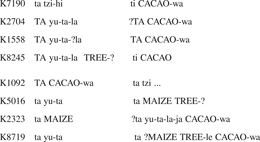
In these situations, the prepositional phrases are separate statements, and cannot be conjoined to modify the word ‘cacao’. The same thing occurs when the word ‘cacao’ does not appear in the text, including cases that are followed by nominal phrases and so do not involve truncation of the portion of the text that names the contents, as in:
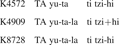
Details of sign execution and text content suggest that these texts, along with K7459, are not independent cases.
(6) With this background, it is possible to arrive at a straightforward interpretation of the meanings of many of these expressions that is also consistent with the detailed accounts of cacao and cacao-based drinks from colonial Nawa sources.
The term kwaw=kakawa-tl “tree cacao” refers to a particular variety of the cacao plant mentioned by Hernández for colonial Nawas (see “The Timing of the Diffusion of chikol=a:-tl”, above). In fact, all of the Nawa terms in which a word for a general class of plants (not specific plants) is used as a modifier of kakawa-tl were used to distinguish varieties of cacao. “Tree cacao” is also known in Sokean: kuy kakawa7 in Tecpatan Soke refers to the cacaté “tipo de fruta como nuez silvestre que es amarga [a kind of fruit like a wild (wal)nut which is bitter]” (the fruit resembles an almond, and it is toasted, salted, and eaten), while in Soteapan Gulf Sokean, it refers to cacao. We take te:7 kakaw and te7-e:l kakaw to have been a variety of cacao plant, “tree cacao”, and we interpret almost all cases of te7-e:l in these texts as meaning “tree-type”, even if the head of the construction has been left out.
A viable alternative interpretation entertained by Mora-Marín (Reference Mora-Marín2003:Figure 1) is that te7-e:l kakaw refers to ‘forest (i.e., uncultivated) cacao’. The comparative support makes “tree cacao” seem to us a more attractive hypothesis, but in either case, the term would designate a kind of cacao plant, not a kind of drink.
Since half of the vessels in which kakaw takes a modifier use the term te7-e:l kakaw to refer to the contents of these vessels, and no frequent modifier of kakaw is in complementary distribution with it, this must have been a common type of cacao for use in these vessels. It could have been the type of cacao that was implicit when the word kakaw was used without te:7 or te7-e:l as a modifier, but it is also possible that kakaw and te7-e:l kakaw labelled contrasting varieties of Theobroma cacao. Further evidence for this interpretation is provided below, under point (7).
It should be noted that the word kakaw may have referred, and probably did refer, to a range of related varieties of T. cacao. It was no doubt possible to make these varieties explicit, but readers would have had the knowledge to infer what varieties were intended as default interpretations of these terms in particular contexts. We today lack this knowledge, so certain types of information will not be readily accessible to us.
Nawa sources have no word that literally translates as “maize cacao” or the like. However, in these sources, all of the terms in which words for foods or food ingredients were used as modifiers of kakawa-tl were used to refer to drinks made of cacao that used those ingredients. We suggest that the use of the word for maize was such a usage. A similar case is nal kakaw, attested in the phrase <yu-k'i-b'i TA-?? na-la CACAO-wa> on an Early Classic vessel (Stuart Reference Stuart and McNeil2006:192; Mora-Marín, personal communication 2005, interprets some of the MAIZE logograms as spelling nal).
As in the case of te7-e:l, half of the vessels in which kakaw takes a modifer have MAIZE in these phrases. This suggests that cacao mixed with maize was a very common type used in these vessels. Most of the drinks made from cacao by the proto-historical Nawas were prepared from ground-up roasted cacao kernels combined either with maize dough or with ground-up roasted maize kernels. This includes most of the cacao-based drinks distinguished terminologically by Nawas that were discussed in the previous section. This practice continues to the present day in indigenous communities in Mesoamerica, including among Mayans, Mije-Sokeans, and Nawas, and was doubtless general in proto-historical Mesoamerica.
It may be noted that 7ixi:m is the only one of the frequent terms in these phrases that precedes kakaw and that does not occur with a -V:l suffix. All of the other terms show variation (although in the case of tzi:h ~ tzih-i:l, the form with a -V:l suffix is rare).
Under the interpretations presented here, the phrase <yu-k'i-b'i ta MAIZE TREE(-le) CACAO(-wa)> can be read y-uk'.ib' ta 7ixi:m [and] te7-e:l kakaw and can be translated, ‘his drinking vessel for [a drink made from] maize [and] tree cacao’.
The order of these terms is consistent in always placing all ingredient terms before the only recognized plant-type modifiers.
Color terms were used among the Nawas in names of types of cacao and in names of other kinds of trees that include the root kakawa. Sahagún mentions that some types of cacao plants were distinguished by the colors of their fruit. On these analogies, <k'an-na CACAO-wa> seems more likely to be spelling k'an kakaw (‘yellow cacao’ or ‘ripe cacao’) and less likely k'a:n kakaw ‘prized cacao’) in <ta yu-ta k'an-na CACAO-wa> (K625), and the expression might refer either to a variety of cacao from which a drink is made, or it could be a general modifier of an ingredient, describing the state (ripe) of the cacao kernel.
(7) Two other words that occur in phrases referring to the contents of the drinking vessels are <tzi>~<tzi-hi>~<tzi-hi-li>, and <yu-tai(-la)>. MacLeod and Reents-Budet (Reference MacLeod and Reents-Budet1994:118) identify this word with pre-Cholan *tzi:h (which, however, means ‘unripe, uncooked/raw’ rather than ‘fresh’, as she translates it). This appears to be a feasible interpretation, and we know of no other root whose distribution in the Mayan family suggests that it could be cognate with a Lowland Mayan form consistent with the phonetic spellings. Unlike the other terms considered so far (with the exception of k'an if for ‘ripe’ rather than ‘yellow’), the word tzi:h refers neither to a variety of the cacao plant nor to an ingredient in the drink. In the frequent phrase tzi:h(-i:l) kakaw ‘raw cacao’, the word kakaw must refer to the cacao kernel or pulp—thus, to cacao as an ingredient and not as the name for a drink.
Stuart (Reference Stuart and McNeil2006:188) notes that <yu-tai(-la)> occurs in a possessed form <7u-yu-ta-la> on a carved vase illustrated by Dütting (Reference Dütting1992:Figure 17); another possible instance is on K8088, which seems to be <7u-yu-ta2-la>. This shows that we are dealing here with a noun yut (presence of vowel length unverifiable). We know of no prior interpretation of this term that is consistent with Stuart's observation. We raise the possibility that <yu-tai(-la)> may imply the ability to confer good fortune. In colonial Yukateko, <yut> or <yutal> (whose possessed form is <u yutal>) names the bezoar, a stone found in the stomachs of some deer when they are butchered. This type of stone is believed to confer good luck on its owner even by present-day Mesoamerican Indians. If this is the correct connection for yut(-a:l), the word may imply either the power of the bezoar or the use of it in the preparation of the cacao drink. From descriptions provided to Kaufman by some present-day Indians, the bezoar is not really a stone but more like a hair ball and is made of organic matter. Others say it is indeed a stone.
Further progress in the interpretation of these words depends on distributional analysis in terms of other words that appear in the same phrases. Such analysis is complicated by the fact that there is a general absence of multiple terms within the phrases under discussion, apart from 7ixi:m and te7-e:l.
In 75–80% of the texts in which two or more terms precede the word for cacao, 7ixi:m and te7-e:l are among them. Only 10% of texts that mention cacao have two or more added terms when 7ixi:m and te7-e:l are not both among them. Since it is rare for more than two added terms to occur together, except in the case of 7ixi:m and te7-e:l with one another, the occurrence of any one term is usually negatively correlated with the occurrence of any other. As a result, most of these terms can tell us little or nothing about any uninterpreted terms in these phrases.
This statistical pattern, however, may explain one seeming anomaly in the data: 80% of references to te:7 kakaw and te7-e:l kakaw are preceded by 7ixi:m as a modifier, but only about 15% of references to kakaw are preceded by it. Apart from 7ixi:m and te:7 ~ te7-e:l, the presence of one modifier reduces the likelihood of the use of any other modifier, so just the opposite effect would be expected. Accordingly, te7-e:l kakaw is more strongly associated with a specification of maize as an ingredient than is kakaw. It is known that maize was typically mixed with kakaw, so this cannot be the reason for the difference; rather, it is presumably due to a far greater susceptibility of kakaw than of te7-e:l kakaw to the use of tzi:h and yut(-a:l). This supports the view that kakaw and te7-e:l kakaw are names for two different varieties of T. cacao.
A more involved set of inferences shows that neither yut(-a:l) kakaw nor tzi:h kakaw refers to a variety of the cacao plant.
In several texts, the word tzi:h alone refers to the contents of the drinking vessel. In many of these texts, a reference to the owner follows, so that these expressions do not involve truncation, which sometimes occurs in the PSS when space is lacking for completing the text.
When tzi:h and yut(-a:l) occur in the same phrase, they can occur in either order. Otherwise, each is usually the first of the modifiers in any phrases in which it occurs that specify the contents of the vessel. The only exception is in K2323, in which ta 7ixi:m is followed by ta yut-a:l kakaw—that is, in which yut-a:l is the first element after the preposition in a prepositional phrase in the content phrase. The order of terms in the phrases specifying contents are therefore largely consistent overall and may be fully consistent within a prepositional phrase.
The order among adjectives is likely to relate to the semantics or relevance of these modifiers; in many languages, semantically defined classes of adjectives occur in a fixed sequence except when departures have a specific contextual motivation. The distributional properties of tzi:h(i:l) and yut(a:l) indicate that these words precede both ingredient and plant-type modifiers of kakaw. If ingredient modifiers precede plant-type modifiers, as suggested above, then tzi:h(-i:l) and yut(-a:l) are not plant-type modifiers. They could both be ingredient modifiers, or they could both be modifiers of a third category that itself precedes both ingredient and plant-type modifiers. Another likely example of such a modifier in the PSS is <7a-ch'a> for proto-Greater Tzeltalan *7ach' ‘new’ or pre-Ch'olan *7a:ch' ‘wet’ in K8713 <ti 7a-ch'a ka2-CACAO-wa> (Zender Reference Zender2002).
As with the other terms in these phrases, when the word tzi:h (-i:l) appears with kakaw, it is most often the only modifier of kakaw. When another modifier appears with tzi:h, it is almost always te7-e:l; yut(-a:l) does not occur in these cases. When tzi:h(-i:l) appears without kakaw, usually none of the other terms occurs with it, but te7(-e:l) or yut(-a:l) appears in about a third of these cases. In about a third of the phrases with te7-e:l but not 7ixi:m, tzi:h occurs before it; tzi:h rarely or never occurs when 7ixi:m appears without te7-e:l (and rarely accompanies the phrase 7ixi:m te7-e:l). One possible interpretation is that cacao was more often uncooked than was maize in these drinks. Another is that the descriptive terms associated with the word kakaw might affect a reader's default interpretation of which particular variety of cacao was being alluded to.
In contrast, yut(-a:l) appears at about the same rate before 7ixi:m kakaw, before te7-e:l kakaw, and before 7ixi:m te7-e:l kakaw—in each case, about once in four instances. This word yut(-a:l) has one somewhat puzzling but potentially revealing association. Sixteen (70%) of the 23 cacao vessels in Mora-Marín's database whose owner is labelled <7i-tz'a-ti> are among the 77 with yut(-a:l) as the first modifier, while only seven are among 124 that lack it. This association is statistically significant (p=0.001). In colonial Yukateko, the adjective <idzat> is attested, with the meanings ‘clever, crafty, wise’. There may be a connection between possession of a lucky charm and cleverness.
(8) Another possible modifier in the phrase specifying contents, each time preceding <CACAO-wa>, is <LORD TREE-le>~<LORD-wa TREE-le>~<LORD TREE>. The first word is most likely 7aja:w ‘lord’. It could form a compound with te7-e:l—thus, 7ajaw=te:7 or 7ajaw=te7-e:l. A Mayan etymon *7a:ja:w=tye:7 ‘white sapote (Casimiroa edulis)’ is known from all Central Mayan branches, but it names a highland fruit tree. The corresponding word in Yukateko has a different referent. We do not know whether white sapote is a plausible ingredient of any cacao drink.
Along with the Central Mayan *7a:ja:w=tye:7 ‘zapote blanco, matasano // white sapote (Casimiroa edulis)’, as attested in Tzeltal 7aja[w]=te7 and Tzotzil 7aj=te7, we have the Ch'ol form käk=te7=pa7 (“cacao tree [of] gully”) ‘zapote de agua (fruta parecida a la del zapote)’. The terminological connection between certain types of sapote with both 7aja:w and kakaw suggests that <LORD TREE> as an ingredient of a cacao drink might reflect the Central Mayan term *7a:ja:w=tye:7, even though it is a highland tree.
In any case, it is feasible to analyze te7-e:l as the same one that specifies a variety of cacao, and to treat <7AJAW-(wa)> as a general modifier meaning ‘lordly’. In all cases, <LORD> is the first element of the sequence, consistent with being a member of the same class as tzi:h(-i:l) and yut(-a:l).
(9) Another possible rare modifier is <k'in>, which appears at most once in the corpus, on K3472. The sign is not entirely clear, and Stuart (personal communication 2005) points out that parts of this vase have been repainted. The sign at issue occurs in a spelling <ta k'i-?k'in>. Repainting seems to have affected parts of the preceding and following glyph blocks, since the ubiquituous fine lines due to root damage do not cross thickly applied black paint outlining parts of some signs, but we see no evidence of repainting of the <ta k'i-?k'in> sign group. The identification of the uncertain sign as <k'in> is due to Mora-Marín (Reference Mora-Marín2003), who marks the transcription as uncertain. However, the surviving details appear to be consistent with <k'in> and not with any other sign that is known to take a <k'i> superfix. If the sign's identification is valid, it seems likely to spell the Lowland Mayan word *k'ihn ‘hot’. This would make it a general modifier appropriate to the drinks made with cacao. It could, however, simply represent the word *k'i:n ‘sun’, which would have to be a once conventional but no longer current usage as the name of a type of cacao plant or drink.
(10) Stuart (Reference Stuart and McNeil2006:194) identifies place names as another class of modifiers for ‘cacao’, suggesting that they indicate cacao from particular locations (so far, all in the eastern Peten). There are two clear examples and one likely example. One of these is the only modifier of kakaw in its phrase, and two of them immediately follow yuta:l and precede kakaw.
In summary, we distinguish three classes of terms that precede kakaw in the phrases describing the contents of the drinking vessels: a class whose members appear immediately before the word kakaw and specify a biological variety of cacao (III); a class of nouns whose members appear before biological variety labels and specify ingredients of the drink made with cacao (II); and a general class consisting of all other terms, all of them seemingly general types of modifiers (I). They can be charted as follows:
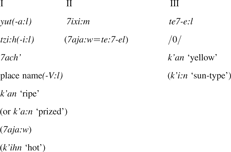
Only one of these modifiers seems to require that the ‘cacao’ referred to in the PSS is the drink itself rather that the ingredients—<k'in> k'ihn (if for ‘hot’ and not ‘sun’)—and this may not be a correct reading of the original text. Certain of these modifiers seem to require that the cacao be an ingredient rather than the drink: <tzi(-hi)> tzi:h ‘raw, uncooked’; probably place names (presuming that they are places where a particular kind of cacao comes from); and <k'an> (if it is not for k'a:n ‘prized’). Other mentions of cacao provide no evidence that shows whether kakaw in those instances refers to an ingredient or to a prepared drink.
Table 7 presents the attested combinations of kakaw with its associated terms.
Epigraphic phrases referring to cacao and cacao drinks
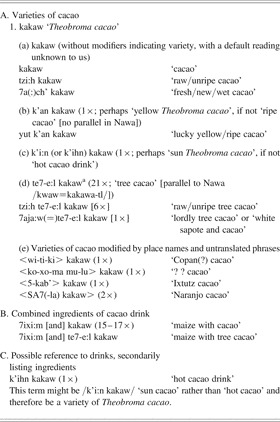
aTo EpM te7-e:l kakaw may be compared: (1) Yokot'an (Chontal Mayan) te7el käkäw ‘guoguo, gogo’=Salacia belizensis ‘spindle tree’ [family]; Fusanus Hippocratacea [family] – an exact match to EpM /te7-e:l kakaw/; (2) Tecpatan Chiapas Soke kuy=kakawa7 ‘cacaté (tipo de fruta como nuez silvestre que es amarga)=Oecopetalum mexicanum; and (3) Soteapan Gulf Sokean kuy kaakwa ‘cacao’, “cacahua”. Salacia belizensis and Oecopetalum mexicanum are different genera, but both bear the name “tree cacao” in some languages.
On a few cacao vessels (/y-uk'.ib'... kakaw/) we find the expression <JAGUAR × CACAO>, a superimposition of jaguar markings on the <CACAO> logogram, which we interpret as b'ahlam kakaw ‘pataxte’ on the basis of forms with this meaning in Q'eqchi7 and in Ayapa Gulf Sokean that literally mean “jaguar cacao”; see “The Mije-Sokean Hypothesis”, above. All examples are of 7ixi:m te7-e:l b'ahlam kakaw. We do not know whether te7-e:l b'ahlam kakaw is the Epigraphic Mayan word for pataxte or for a “tree-type” variety of pataxte. In either case, it may relate to the origin of the later Ch'olan term, *b'ahlam=te:7, for pataxte. All of the examples refer to the drinking vessel being for a mixture of maize with pataxte, but since the few examples known to us seem to come from a single scribe or scribal school, the lack of variation in these rare references to pataxte is probably misleading. Other examples with dark markings on the face or body of the CACAO logogram, which may also be intended to represent a word for pataxte, occur with a broader range of ingredients.
A Proposed Mayan Source for Nawa chokola:tl
Dávila Garibi (Reference Dávila Garibi1939) proposed that the Nawa word chokola:tl for the drink chocolate originated, in part, in a Mayan language. This proposal was accepted and elaborated by Coe and Coe (Reference Coe and Coe1996:118–119) with data from Yukateko and colonial Kaqchikel. It has been uncritically accepted by some scholars—for example, by Tedlock (Reference Tedlock2002:170)—but it is demonstrably false. It depends on a misunderstanding of the Kaqchikel sources and on a lack of understanding of the history of a Yukateko word meaning ‘hot’.
Yukateko ‘chocolate’=“hot water”. Coe and Coe (Reference Coe and Coe1996:118) cite and endorse Dávila Garibi's (1939) suggestion that Spaniards combined a putative “Maya” (Yukateko) <chocol> (meaning ‘hot’) + “Aztec” <atl> (meaning ‘water’) to form a new word for chocolate. The linguistic elements of their argument are (1) the fact that the colonial Yukateko term for the drink chocolate is attested in the earliest sources as <chacau haa>, an expression with the literal content “hot water”; (2) the erroneous belief that there existed a Yukateko form <chocol>* meaning ‘hot;’ (3) the speculation that there might have been a Yukateko expression <chocol haa>* with the same literal content and thus the same application as the attested <chacau haa>; and (4) the speculation that Spaniards who knew enough Yukateko and Nawatl substituted <atl> for <haa> in this hypothetical form to produce a Nawa neologism chokol=a:-tl. Finally (5), Coe and Coe (Reference Coe and Coe1996:118) cite a supposed K'ichee7 chokola'j ‘to drink chocolate together’ as somehow relating to this proposal, while admitting that how the terms could relate is unclear (in fact, this is really a Kaqchikel word, Coe and Coe's phonological representation of it is faulty, and it means ‘to do something in common’).
Coe and Coe (Reference Coe and Coe1996:pp) cite Miguel León-Portilla (personal communication to Coe and Coe) as considering this a “reasonable explanation”. Tedlock (Reference Tedlock2002:170) endorses Coe and Coe's opinion that the word chocolate incorporates a Mayan word chokol meaning ‘hot’. Nonetheless, the only factual element of this proposed etymology is the first point—namely, that there was a Yukateko form <chacau haa> ‘chocolate’ that is literally “hot water”.
There are several difficulties with this proposal, but the most important involves the supposed Mayan word chokol*. (Except as noted, data cited in this section are from Bricker et al. Reference Bricker, Yah and de Po'ot1998, for Yukateko; Ulrich and Ulrich Reference Ulrich and de Ulrich1976, for Mopan, Hofling with Tesucun Reference Hofling and Tesucún1997 for Itzaj; and Canger Reference Canger1969 for Lakantun.) Modern Yukateko has a word chokoh ~ chokow ‘hot’; underlyingly it is /chokow/, as demonstrated by the derived form /chokwil/ ‘heat’. This is in fact the same word as the Motul's <chacau>. Proto-Mayan *tiqaw ‘hot’ is reflected in every branch of the family but Wastekan. Sometime in the ancestry of proto-Yukatekan, the *t shifted to ch; this is a regular change in Yukatekan that occurred whenever *t (or *ty) was followed by *i or *e. It also underwent the Yukatekan shift of *q to k (which is incidentally found in all Mayan languages that migrated into the lowlands out of the Mayan homeland in highland Guatemala). It cannot be determined which change happened first. Sometime after the change of *t to ch, pre-Yukatekan *chiqaw or *chikaw underwent vowel assimilation, leading to proto-Yukatekan *chakaw. Short a before final w sporadically changes to o in some Mayan languages. Yukateko chokow and Itzaj chokoh arose in this way from earlier *chakaw, while the proto-Yukatekan vowels descend normally to Lakantun chäkäw and Mopan chäkäj. (Justeson Reference Justeson1985 notes that the shift of *w to j is also attested in Mopan käkäj from *kakaw. This may be a regular change, as no other disyllabic words surviving in Mopan have word-final w. Final w in this word also shifts to h in Yukateko and Itzaj, although it resurfaces as w in some prevocalic contexts.)
The timing of the development of chokow in Yukateko can be roughly determined through the occurrences of this word in the sources cited in Table 8. These citations suggest that forms like chokow were well established but still in variation with chakaw in the mid- to late eighteenth century, while there is no evidence for any form but chakaw in the seventeenth century. To this extent, then, a suggestion that Yukateko chokow might have had a role in the origin of the Nawa word chokola:tl would be anachronistic. As for chokol*, no such form exists in the meaning ‘hot’ in any Mayan language.
Colonial citations of Yukateko forms descended from chakaw ‘hot’

The Yukatekan historical development behind chokow and chokoh is sufficient to eliminate this proposal, but there are other difficulties with it. One is its consequence that Nawa chokola:tl is a Nawatization of the Spanish word chocolate; we show in “Evidence concerning the History …”, above, that this is implausible. Another difficulty for Dávila Garibi's hypothesis is created by Dakin and Wichmann's (2000:62) plausible argument that the Nawa term was originally chikola:tl, thereby rendering inconsistent the comparison between the Mayan vowels and the Nawa vowels and rendering irrelevant the compared words themselves.
One feature of this proposal—the notion that the word for this Mesoamerican drink came from Spaniards and was then widely adopted by Nawas—is of at most minor concern. Such a process would provide a lexical distinction that did not fully or customarily exist in indigenous languages between cacao as a plant/kernel and the drinks that are made from it. There are many parallels, such as the adoption by English of Old French words for animals as food (beef, pork) in contrast to native words for animals on the hoof (cow, swine). Nonetheless, Coe and Coe (Reference Coe and Coe1996) attempt a rationale for Spaniards' creating a word for this drink, a word that by chance was then widely adopted by Mesoamericans (specifically by Nawas and only occasionally by other Mesoamericans). They note the existence of a Nawa word that could have such a meaning, citing Molina (Reference Molina1571) for Nawa <cacahuaatl> /kakawa=a:tl/ ‘cacao water’ (which they misspell as cacahuatl). They go on to suggest that this word was eliminated because the first two syllables remind one of caca, the Spanish word for ‘poop’ (Coe and Coe Reference Coe and Coe1996:119). This argument is invalid because Spanish borrowed from Nawa the words cacao, cacahuatal ‘cacao plantation’, and cacahuate ‘peanut’ (cited in the same connection in Dakin and Wichmann Reference Dakin and Wichmann2000:62a), all involving the same morpheme /kakawa/, as in /kakawa=a:tl/; and Spanish also borrowed unrelated words containing this sequence, such as cacalote ‘crow’.
Colonial Kaqchikel evidence
In support of a Mayan role in the development of this term, Coe and Coe (Reference Coe and Coe1996:118) also cite a putative K'ichee7 word chokola'j ‘to drink chocolate together’. This is really a Kaqchikel word; it is a misspelling of <chocolaah>, and it means ‘to do something in common’. Tedlock (Reference Tedlock2002:170) also refers to K'ichee7 and Kaqchikel chokola'j ‘drink chocolate together’, citing Ximénez (Reference Ximénez1993), Varea (ca. Reference Varea1600), and Coto (Reference Coto and Acuña1983 [1656]); however, he appears to have gotten his information from Coe and Coe (Reference Coe and Coe1996) and not from the above-cited sources, since the spelling and gloss he uses come from Coe and Coe, who got them wrong. Tedlock also accepts Coe and Coe's incorrect assertion that the chocol of chocolatl comes from a Mayan source (and further claims, without providing supporting evidence or a reference to anyone else who has made such a claim, that Spanish cacao came from a Mayan source rather than from Nawa). Dakin and Wichmann (Reference Dakin and Wichmann2000:74) also cite this form, in the spelling <čokola>, as a borrowing of Nawa chocola:-tl.
The reality is this. Colonial Kaqchikel had a noun <chocola> (pronounced something like /chokola7/) and a denominal transitive verb <chocolaah> (something like /chokola7-a/; /-:j/ is an inflexional suffix). The structure of <chokolaah> is ‘to do <chocola >. Because of the pragmatic applications of these words, as cited in Varea (ca. 1600) and discussed in this section, together no doubt with the shape of the word, some Mesoamericanists have drawn the false conclusion that <chocola> names in some way a drink made from cacao. To make this clear, we need to refer to the meanings of these and all related Kaqchikel words in the colonial sources. To anticipate our basic conclusion, these forms are based on a root {chok} that means ‘gathered together’.
Anonymous (ca. 1578; Smailus Reference Smailus1989:2:166)
<tin choc 3ab ah apon> /ti+ n-chok q'ab' aj 7apo:n/ (I “gather” hand X arrive) [vt] ‘llamar con la mano’ (to wave to someone to come hither)
<tika chocolaah> /ti+ qa-chok-ol-a7-a-:j/ ‘we all do it to her together’ [Kaufman] [vt] ‘a una hazerse todos’
<tika chocolaah ru banic> /ti+ qa-chok-ol-a7-a-:j ru-b'a:n-i:k/ ‘we all do its doing together’ [Kaufman] [vt] ‘hazer alguna cosa todos juntos’ (for everyone all together to do something)
<chocolaam r ahil vay> /chok-ol-a7-a-:m r-aj-il way/ (the reckoning of the tortillas has been done together) [pcp < vt] ‘escote en el comer pagando cada uno su parte’ (contribution to the meal everyone paying his share)
Varea (ca. 1600)
<chocola> ‘es cacao junto q<ue> dan veinte a cada uno, y lo beben entre todos’ (this is jointly shared cacao which is given in the quantity of 20 [kernels] to each, and they all drink it [the chocolate] together).
<tikaban kachocola, tikapopolih rukumic> /ti+ qa-b'an qa-chokola7, ti+ qa-popol.i-:j ru-qu:m-i:k/ ‘we make/do our shared thing [chocolate], we communalize its drinking’ [Kaufman].
<chocolaah> ‘hacer algo de comun, como ir muchos a cavar mi[!] heredad y despues las de los demas compañeros’ (to do something in common, like if many come to till my land and then we go and till everybody else's land). The forms cited are <tu-chocolaah> ‘he works it in common’, and <tika-chocolaah> ‘we work it in common’.
<tika-chocolaah rih hun ixok> /ti+ qa-chokola7-a-:j r-i:j ju:n ixoq/ is glossed ‘hacersele muchos a una’; the Kaqchikel phrase means ‘we all have sex together with one woman’.
This meaning for <chocolaah> ‘to do something in common’ is supported by a further example cited by Varea, who introduces it as follows: “Si uno combida oy a muchos y mañana a otros, o a los mesmos” [If a person invites many people today and tomorrow others, or the same people] <tika-chocolaah he ruvaixic kavay, xaki kalo3obal ki> /ti+ qa-chokola7-a-:j je7 ru-wa7i-x-ik qa-way, xa qi qa-loq'-ob'al qi/ ‘we share thus the eating of our tortillas, as well as our prized/bought things’.
Coto (1983 [ca. 1656]:105, 285–286)
<chocola> /chok.ola7/ (nombre) ‘una bebida q[ue] haçen en común, juntando el cacao para ella, en que da cada uno [veinte] granos. Y, después, lo juntan y muelen, y lo beben en común’ (a drink that they make together, gathering the cacao for it, in which each one gives twenty kernels. After that, they gather it and grind it, and drink it in a group).
<ti ka ban ka chocola> /ti+ qa-b'an qa-chok.ola7/ ‘let us do our group/shared activity’ [Kaufman]; ‘hagamos n[uest]ra junta de cacao’ (let us do our cacao group event).
<ti ka chocolaah> /ti+ qa-chok.ola7.a-:j/ ‘let us do it together’ [Kaufman]; ‘juntar así el cacao y beberlo’ (to gather thus the cacao/chocolate and drink it).
<ti ka chocolaah ru kumic k'uqiya> /ti+ qa-chok.ola7.a-:j ru-qu:m-i:k q-uk'.i=ya7/ (‘let us do together the drinking of our beverage’).
<hun qu'ix moque vi, yx alabon, yx çamahoma, xa ti moçih ri i vay ti chocolaah> /ju:n k+ ix+ mok.e:7 wi, ix+ alab'-o:n, ix+ samaj-om-a:7, xa t+ i-motzi-:j ri+ i-way t+ i-chok.ola7.a-:j/ ‘gather together at once you boys, you workers, just gather y'all's tortillas [and] y'all do it together!’ [Kaufman]. Para deçirles a los trauajadores, o a los muchachos, q[ue] se junten i coman juntos (In order to tell the workers, or the boys, that they should gather together and eat together).
<ti chocolaah> /t+ i-chok.ola7.a-:j/ ‘y'all do it together!’ [Kaufman]; ‘para lleuar entre dos o más vna cosa, carga o vanco’ (to carry/take along a thing, load, or bench with the participation of two or more people).
<ka chocolaam lo3oh> /qa-chok.ola7.a-:m loq'-o:j/ ‘we have done buying in common’ [Kaufman].
<ti ka chocolaah ru lo3ic vleu, vacax ..> (o otra cualquier cosa q[ue] compran de común) /ti+ qa-chok.ola7.a-:j ru-lo:q'-i:k ule:w, wa:kax, … / ‘let us do in common the buying of land, cattle, etc.’ [Kaufman].
<chocolaah> [este verbo] lo vsan, tanbién, para yr de común a haçer algo, como a cabar la millpa de algún amigo, y q[ue] allí los del chinamital an juntado para regresarlos (they use this verb also for going as a group to do something, such as digging up the cornfield of some friend, where those of the community have joined together to repay the favor).
<ti ka chocolaah, ti ka mo[tz]ih (r'ih) ka chenoh> /ti+ qa-chok.ola7.a-:j, ti+ qa-motzi-:j (r-i:j) qa-chen-o:j/ ‘let us do it in common, let us gather (on) our first weeding of the cornfields’ [Kaufman]; ‘juntémonos para labrar n[uest]ras milpas en común, oy la de vno, y otro día de otro’ (let us join together to till our cornfields, today that of one, another day that of another).
<x-qui chocolaah v'ih> /x+ ki-chok.ola7.a-:j w-i:j/ ‘they acted in common against me’ [Kaufman]; ‘se an juntado contra mí para haçerme pleito’ (they have gotten together against me in order to pick a fight with me).
<ti ka chokolaah r'ih hun ixok> /ti+ qa-chok.ola7.a-:j r-i:j ju:n ixoq/ ‘let us do it [have sex] together against/with a woman’ [Kaufman]; ‘[dicen esto] para deçir q[ue] vna muger es común a todos, o q[ue] todos en común la conosçieron’ (they say this in order to say that a woman is shared by all, or that all had sex with her in a group).
<xaki at qui chocolaam achiha, qahola> /xa qi at+ chok.ola7.a-:m achij-a:7, k'ajol-a:7/ ‘the men/boys have simply shared you[r favors]’ [Kaufman]; ‘[dicen esto] para afrentarla’ (they say this in order to insult her).
In Ximénez's (1993) combined vocabulary of Kaqchikel, K'ichee7, and Tz'utujiil (ca. 1700), of the forms cited below, only the first one is conceivably not Kaqchikel:
<chocoh> /chok-o:j/ [sv<vt] ‘bodas o convites’ (wedding or party)
Kaq <chocol> /chok-ol/ [stat<P] ‘estar por orden’ (in order/turn)
Kaq <tin chocola> /ti+ n-chok-ol-a7/ [vt] ‘juntar comida o bebida para comerlo entre muchos’ (to gather food or drink in order to consume it among many)
Kaq <tin chocolaah> /ti+ n-chok-ol-a7-a-:j/ [vt] lo mismo, e.g. ‘juntar comida o bebida para comerlo entre muchos’
Brasseur de Bourbourg (Reference Brasseur de Bourbourg1961 [1862]:200) cites for K'ichee7 the root shape <choc> /chok/ as a verb ‘alquilar’ [to hire]' and also as a (possibly different) verb ‘llamar, convidar’ [to call, invite]'. Brasseur's sources are not identified.
Sáenz de Santamaría (1940:97], whose authority is primarily Varea (ca. 1600) (and whose orthography is often garbled), cites:
<choqola, ru> /chok-ol-a7/ sust. ‘banquete popular a que cada uno contribuye con 20 granos de cacao’ (feast of the people to which each [participant] contributes 20 cacao kernels).
<choqolaaj, tu> /t+ u-chok-ol-a7-a-:j/ v. act. ‘convidar a la gente a un banquete de los llamados choqola; llamar a la gente para algún trabajo de comunidad’ (to invite the people to a banquet called choqola; to call together the people for a communal task).
<choqolaax, ti> /ti+ chok-ol-a7-a-x/ v. pas. ‘ser convidado por el pueblo; ser reprendido por el pueblo’ (to be invited by the [towns]people; to be reprimanded by the [towns]people).
Brinton (Reference Brinton1885), whose authorities are unknown, cites <chocola> /chok-ol-a7/ adj ‘in common, communal’.
Tz'utujiil of San Juan La Laguna has the transitive verb chok ‘encargarlo’ (to commission it, to invite someone to do one a favor) and the corresponding nominalization chook-ooj ‘encargo’ (commission). Tz'utujiil seems to be the only present-day K'ichee7an language to preserve a reflex of the root {chok}.
Pérez and Hernández (Reference Pérez Mendoza, Hernández Mendoza and Dayley1996:77–78) give these examples:
n+ in-b'e na pa chok-oj n-pantaloon
‘tengo que ir a encargar mi pantalón’
‘I have to go to arrange to have some trousers made for me’
ja n-ata7 x+ b'e-r-chok-o7 r-xajajb'
‘mi papá se fue a encargar sus zapatos’
‘my father went to arrange to have some shoes made for him’
chi+ b'an-oj jun chook-ooj x+ in-pi wi7
‘vine a hacer un encargo’
‘I came to make an arrangement to have something done’
Clearly, the noun that lies behind <chocolaah> refers to some sort of shared activity among quite a few people. The noun <chocola> is glossed by Varea as ‘es cacao junto q<ue> dan veinte a cada uno, y lo beben entre todos (this is jointly shared cacao which is given in the quantity of 20 [kernels] to each, and they all drink it [the chocolate] together)’. All that we get from this about chocolate is that Varea called it cacao in Spanish around 1600. The reference to chocolate is simply to provide an instance of what a shared item might be; because chocolate was so important a festive drink for so many kinds of occasions, it was apparently a typical or default application of the term /chokola7/, but this term in no way directly expresses the meaning ‘chocolate’.
Varea (ca. 1600) and Coto (1983 [ca. 1656]) both cite <chocola> as a noun, and inform us that its default application is to the consumption of chocolate in a festive context. They also inform us that the verb <chocolaah> refers to several people acting as a group for a common purpose. Brinton's source for his adjective “communal” has not yet been identified.
We may provide a unitary analysis of all of these forms by starting with a positional root {chok} ‘gathered together’; from this, a transitive verb chok ‘to call over’ or ‘to arrange to have somebody do somthing for one’ is formed, with zero derivation; from the transitive verb chok, a nominalization chok-o:j ‘invitation’ or ‘arrangement’ is formed; from the root {chok}, a stative adjective chok-ol ‘according to turns’ is formed; from the transitive verb chok, a derived transitive verb chok-ola7 ‘to invite to share’ is formed; from the transitive verb chok-ola7, a noun chok-ola7 ‘a sharing’ is formed; from the noun chok-ola7, a transitive verb chok-ola7-a ‘to invite to share’ is formed.
This set of words has only an incidental connection with chocolate, and this is because a drink made from cacao was prized and shared at festive occasions.
As for the real words for “chocolate” in colonial Kaqchikel, we can cite the following from Coto (1983 [ca. 1656]):
<vqiya> /uk'.i=ya7/ (“drink-ing water”): BEBIDA, generalmente. … Tómase por el chocolate batido, PUTZULE, y otras bebidas, aunq[ue] muchas dellas tiene sus nombres particulares. (uk'.i=ya7: Drink in general. It is taken to be whipped chocolate, pozole, and other drinks, although many of them have their special names.)
<hoqham>. Otra q[ue] haçen de cacao molido y hecho masa para lleuar [a] camino o a sus millpas, y después lo deslíen en agua. (Another [drink] that they make from cacao that is ground and made into dough/paste to carry on the road or to their cornfields, and later they dissolve it in water). The analysis of <hoqham> is unclear.
<3utuh> /q'utu:j/. Otra q[ue] haçen del cacao batido, sacando la manteca, q[ue] es lo q[ue] beben. … Ésta sirue a los días de sus fiestas y conbites. (Another [drink] that they make from whipped chocolate, removing the fat, which is what they drink. … This [drink] is used on the days of their festivals and invited gatherings.)
<3utuh> /q'utu:j/ o <3utum ya> /q'utu:m ya7/. La bebida que así haçen de cacao batido. (The drink that they make thus from whipped cacao.)
These words are derived from the verb <tin 3ut> /ti+ n-q'ut/ ‘batir con cuchara o con la mano, como baten ellos su bebida de cacao’ (to beat/whip with a spoon or by hand, like they beat/whip their cacao drink).
<pulim ya> /puli:m ya7/. Otra que haçen de cacao. (Another [drink] that they make from cacao.)
This word is derived from the verb <tin pulih> /ti+ n-puli-:j/ ‘haçer la tal bebida, o lleuar la masa hecha para desleírla en el camino’ (to make such a drink, or to carry the dough/paste along with one in order to dissolve it [in water] on the road).
<pulim ya>, <pu3um ya> /puq'u:m ya7/. Synónomos deste género de bebida. (Synonyms for this type of drink.)
The second word is derived from the verb <tin pu3> /ti+ n-puq'/, which “sig[nifi]ca lo mesmo q[ue] <tin pulih>.”
<aca puzu>. ‘Bebida, otra q[ue] haçen del cacao seco en las mesmas maçorcas, q[ue] para este fin las guardan sin quebrar’. (A drink, another one that they make from dry cacao in its own pods, that they set aside without breaking for this very purpose.) Coto cites the example <aca puzu chic ru na3 cacao, ti ka kum> /<aca puzu> +chik ru-na:q' kakaw, ti+ qa-qum/ ‘ya este cacao está bueno y seco, bebámoslo’. (The cacao kernels are “aca puzu”; let's drink them). The analysis of <aca puzu> is not clear.
From these examples, it is clear that colonial Kaqchikel had several words for drinks made from cacao, all of them transparent as to morphological formation, and none of them similar to words in non-K'ichee7an languages.
CACAO AND PATAXTE
Two different kinds of cacao were used to make drinks in pre-Columbian times: the cultivated Theobroma cacao, called kakawa-tl in Nawa, kakow (earlier) and kakoh (later) in K'ichee7, kakaw in Q'eqchi7 and in Yukateko, and cacao or cacahua in Spanish; and the wild Theobroma bicolor, called kwaw=patlach-tli and/or kakawa=patlach-tli in Nawa, pe:q in K'ichee7, kakaw b'a:lam~b'a:lam kakaw in Q'eqchi7, b'ahlam kakaw in Epigraphic Mayan, b'aHlam=te7 in Yukateko, *b'ahläm=te7 in proto-Ch'olan (with descendants in Yokot'an, Ch'ol and Ch'olti7), and pataxte or pataste in Spanish.
Both Spanish terms come from Nawa. Pataste~pataxte seems as if it would come from a Nawa form patlach-tli, but no such simple form seems to be attested in Nawa. However, Pipil provides pa(:)tach ‘pataxte’ (Campbell Reference Campbell1985:380, 771), and ku:patach (Campbell Reference Campbell1985:297), which is cognate with Hernández's <quauhpatlachtli>.
Given that the Nawa word for Theobroma bicolor, kwaw=patlach-tli, contains the stem {patlach} ‘flat, flattened, wide’, it is worthy of note that the Mayan word *pe:q ‘Theobroma bicolor’ (and possibly also Theobroma cacao) may have as its root a form *peq ‘flat’, as suggested by the Yukateko, Kotoke, and Tzeltal forms cited below. A Mayan etymon *peq ‘flat’ is not in general well supported, but sapo ‘toad’ (in proto-Mayan, *peq) is widely used in Mesoamerican Spanish as a metaphor for squat (low and wide) people.
Yukateko (Ciudad Real Reference Ciudad Real2001 [ca. 1590]:485–486 [Motul Dictionary])
<-pec> cuenta para cosas redondas, circulares, como hostias, panes, tortillas
<peca<a>n> cosa puesta de plano o e llano, y no de lado ni en pie, y lo llano de la espada o cuchillo, etc.
<pec cab>~<pec cabal> cosa puesta de llano
Yukateko (Bricker et al. Reference Bricker, Yah and de Po'ot1998:212)
pek [T] vt to fold, to hem
pek [P] pv to stretch out at full length
Mochó [Kaufman database (1967-1968)]
peq-An ‘no bien plomeado’
Tusanteko (Kaufman 1967–1968)
pe:q ‘hoja para envolver tamalitos’ (such leaves are always flat and broad, like those of banana/plantain or Heliconia)
Tzeltal Copanabastla (Ara Reference Ara and Humberto1620:85v)
<pecan> /pe{h}k.an/ act. ‘poner llano algo’
<pequel> /pek.el/ ‘pueſto assí’
From the descriptions in Nawa and Nawa-oriented sources cited in the previous section, we know that sometimes both types of Theobroma were combined in a single drink. References to pataxte are regularly paired with references to cacao in the colonial poetic and ritual texts in which we have sought this term (Kufer and McNeil Reference Kufer, McNeil and McNeil2006:99). K'ichee7 and Kaqchikel poetic and ritual texts often pair kakow and pe:q (see Table 9). In these passages, pe:q and kakow are always named together, with pe:q coming first. Their uses are not specified (but Tedlock [2002] argues from context and from ethnographic considerations that some such references relate to drinking chocolate at a wedding or betrothal). The only example we have found in such texts in which this is not the case is in a proper name, /(i)x=kaka:w/ ‘Lady (or Small) Cacao’. (The independent noun meaning ‘cacao’ is /kakow/; the form /kaka:w/ corresponds to what would be the possessed form of /kakow/, though here it does not have that function. The Yukateko term for pataxte, b'aHlam=te7, is found [once] in the Book of Chilam Balam of Chumayel (Roys Reference Roys1933:36, 111) paired with kakaw: <cabal chac bolay balam  cacao balamte>, the point of which, however, is obscure.
Cacao-pataxte couplets in colonial K'ichee7an ritual texts.

CULTURE HISTORICAL INFERENCES
A word pronounced something like kakaw or kakawa was borrowed widely, into Mayan languages in southern Mesoamerica, into some languages of lower Central America, and into several languages in and near the Basin of Mexico; and it was borrowed early, probably between 200 b.c. and a.d. 400, into a Lowland Mayan language. Many other words that are reconstructible within Mije-Sokean for culturally important cultigens spread widely in Mesoamerica. A Mije-Sokean origin for the diffusion of this term fits into what is known of the diffusion of such terms in Mesoamerica and is characteristic of no other language family in Preclassic or Classic Mesoamerica.
This study has shown that *kakaw(a) has an unimpeachable pedigree as a native Mije-Sokean word. In particular, Gulf Sokean cognates reflecting initial stress are consistent with the stress patterns on all other trisyllabic roots in all Gulf Sokean languages. Wichmann's arguments against the reconstructibility of this word to proto-Sokean and proto-Mije-Sokean are vitiated by being based on a very incomplete set of data on Sokean trisyllabic roots and by a flawed analysis of the data on stress in Gulf Sokean cognates of proto-Sokean trisyllabic roots. The linguistic evidence is unambiguous: there is no viable alternative to a Mije-Sokean origin for this term.
On the face of it, Dakin's counterproposal that Nawa kakawa-tl is the source of the word kakawa and kakaw in other Mesoamerican languages is implausible. Nawa nouns such as kakawa that take the absolute suffix -tl when unpossessed normally show up, when borrowed into other Mesoamerican languages, with final -t (when the borrowing language tolerates word-final /t/), as in Soteapan Gulf Sokean [7a:ttébet] /7aattep7et/ for ‘town’ from Nawatl a:-l=tepe:-tl. Besides the putative case of kakawa, no individual Nawa loan-word that was widely diffused in Mesoamerica and that takes the -tl(i) suffix in Nawa is characteristically found without a reflex of this suffix in the borrowed form (just one such loan is widely found among Mayan languages), yet this word for cacao was never borrowed with it. In addition, no Nawa loan word clearly predates the end of the Classic period, and clearly there is not an early body of loans of cultigens from Nawa.
Especially strong evidence is needed in such a situation to establish a case for diffusion from Nawatl, but such evidence is not forthcoming. Dakin and Wichmann present an argument that the Nawa term descends by reduplication from a Southern Yuta-Nawan root *kava ‘egg’, reconstructible for the Sonoran, though not for the Nawa, branch of Southern Yuta-Nawan. But there is no Nawa form kawa-tl* to undergo reduplication, and we show that a Southern Yuta-Nawan form *kava cannot possibly have yielded kawa in Nawa (rather, it would have yielded ka:). This Nawa etymology for the term is not simply implausible; it is invalid. Dakin and Wichmann's proposed Nawa origin for this term must be rejected.
What, then, was the cultural context of the spread of the word kakaw(a) in Mesoamerica? Dakin and Wichmann (Reference Dakin and Wichmann2000:67–68) associate it with the Teotihuacan diffusion sphere, but their reasoning is untenable. They begin with the erroneous assumption that it diffused from Nawa, and this assumption vitiates their entire argument. The next two premises are correct. Temporally, the word had certainly entered a Lowland Mayan language before a.d. 400, the time of its first known attestation in hieroglyphic texts. As for geography, Dakin and Wichmann assume that Nawas were in or near the Basin of Mexico during the Early Classic period. We agree with this, but Kaufman (Reference Kaufman1994–2004/2007 and above in the section “Demonstrating Borrowing”) has demonstrated from the impact of Mije-Sokean, Totonakan, and Wastekan on the vocabulary and grammatical structure of proto-Nawa that it was an ancestor of proto-Nawa that first had a homeland in northern Mesoamerica, while Dakin and Wichmann suppose that it was Eastern Nawa that first arrived there. Drawing these three premises together, Dakin and Wichmann seek a cultural origin that was prominent enough before a.d. 400 to be responsible for the diffusion of cacao and its associated vocabulary and that was in the core area of Nawa occupation of Mesoamerica. They see only Teotihuacan as meeting these criteria; based on this, they identify Nawa as the dominant language of Teotihuacan and Teotihuacan influence as the vector for the spread of the word for cacao throughout Mesoamerica.
Without the prop of the demonstrably false premise that the ultimate source of the word kakawa in other Mesoamerican languages was Nawa, Dakin and Wichmann's entire argument fails, because it is the origin of the word among Nawa speakers that provides the geographic localization. But even had their proposed etymology for the origin of kakawa been viable, it would not have been enough to make a case for Nawas being major players at Teotihuacan. It takes a body of evidence, not a single loan-word—even if the arguments for the borrowing were methodologically unproblematic—to provide believable argumentation regarding the linguistic identity of a prehistoric culture. In the case of Teotihuacan, the language or languages of its elite classes must have had a serious impact on the vocabulary, and potentially on the grammar and pronunciation, of many other languages in Mesoamerica during the period from a.d. 100–500. This means that there should be a substantial number of early loan-words into languages in and around the Basin of Mexico and a substantial but smaller number farther afield—in particular, in Mayan languages, around Kaminaljuyu, and along the Pacific coast of Guatemala. As has long been known, Nawa languages had no such impact until several centuries later; the evidence is summarized in the section “Evidence Against a Recent Alternative Hypothesis”. Accordingly, Nawas could not at that time have been culturally influential in Mesoamerica, and whether or not there were Nawas living in and around Teotihuacan, they could not have played a major political, economic, or religious role in the city's public affairs.
Nonetheless, like Dakin and Wichmann but for different reasons, we also associate at least part of this diffusion with the regional influence of Teotihuacan. We now know that the Mayan borrowing of the word cannot be put back as early as the Olmec era, as proposed by Campbell and Kaufman (Reference Campbell and Kaufman1976), but, rather, to the Epi-Olmec era—to the Late Preclassic or the Early Classic period. Given their timing, the loans into Mayan could indeed be associated with Teotihuacanos, and thus with the northern branch of Mije-Sokean, but the Epi-Olmecs are a viable alternative, since they, but not the Teotihuacanos, lived in or near areas where cacao was cultivated.
For the loans in and around the Basin of Mexico, however, a Teotihuacano source is very likely. Kaufman (Reference Kaufman2000–2007, 2001; Kaufman and Justeson Reference Kaufman, Justeson, Arnold and Pool2007) shows that there was a massive diffusion of Mije-Sokean vocabulary into languages in the Basin of Mexico and its immediate surroundings (Figure 6). The borrowing into Totonakan was truly massive, about 50 items. By current count, between eight and 17 Mije-Sokean words were borrowed into each of Nawa, Tarasko, Otomian, Matlatzinkan, and possibly Chorotegan. Farther afield, 11 words were borrowed into Wasteko.
Numbers of Mije-Sokean loan-words into languages of northern Mesoamerica, showing estimated locations of these languages around a.d. 500. The inferred region of Northern Mije-Sokean also included speakers of Totonakan, which surrounds it; the localization of Nawa, which probably arrived in Mesoamerica during the Early Classic period, is less secure than the locations of the other groups. Matlatzinkan becomes Matlatzinka and Tlawika (Ocuilteko); Otomian becomes Otomí and Masawa; Totonakan becomes Totonako and Tepewa. After Kaufman and Justeson (Reference Kaufman, Justeson, Arnold and Pool2007:Figure 3).
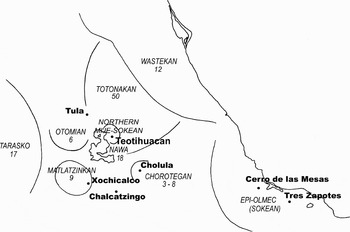
From the locations of the languages with the greatest numbers of loans, the center of this diffusion can be localized among or adjacent to Totonakans and more involved with speakers of Tarasko and Nawa than with speakers of Wasteko. This places them in their greatest concentration in or near the eastern half of the Basin of Mexico—thus, in the vicinity of Teotihuacan—and also, probably, throughout the southern half of the Basin.
This geographic analysis of the northern Mije-Sokean loans leads us to propose that one of the languages of Teotihuacan was a “northern” branch of the Mije-Sokean family. It probably left Olmec country no later than the time of the separation of Mijean and Sokean from one another (ca. 1000 b.c.; see “Evidence Against a Recent Alternative Hypothesis”, point 6), since the loans now unique either to Mijean or to Sokean are proportionally about equal (10–20%). These immigrant populations may be recognized at Early Preclassic sites in the Basin of Mexico, beginning around 1200 b.c. At Coapexco, in the southeast, they occur in all contexts and all functional components of the artifact assemblage, including utilitarian artifacts (Tolstoy Reference Tolstoy, Sharer and Grove1989:98). Tolstoy (Reference Tolstoy, Sharer and Grove1989:98) makes their immigrant status clear, stating that the Olmec features “(1) appear suddenly; (2) appear early; (3) appear together; (4) pervade general refuse, all households, and many sectors of activity; and (5) seem most abundant at the time of their first appearance. Their subsequent history, in fact, is one of fairly rapid fading or transformation and replacement by new elements. …”
In spite of their assimilation to local material-culture practices, these Mije-Sokean speakers evidently remained linguistically and probably socially distinct. Centuries later, at Teotihuacan, the loan-word evidence suggests that they were the elite at the site and probably coexisted there with speakers of a Totonakan language. (Mije-Sokean had a more massive impact on Totonakan than on any other language or language group in Mesoamerica.)
One of the words that was diffused into several of these languages was kakawa. It shows up in Totonakan, Nawa, Tarasko, and Masawa.
The word kakawa, then, is a quintessential representative of the distribution of Mije-Sokean loans into Mesoamerican languages: with substantial borrowing into Mayan languages in the south; few borrowings by Oto-Mangean languages in Oaxaca; and borrowing into several languages in and around the Basin of Mexico. This pattern provides further support for the Mije-Sokean origin of this term. Given the localization of the center of diffusion of northern Mije-Sokean loans, it is quite probable that the word kakawa diffused in this area in association with the regional influence of Teotihuacan. A detailed account is provided elsewhere (see Kaufman 2007; Kaufman and Justeson Reference Kaufman, Justeson, Arnold and Pool2007).
This study has also shown that the same word, in the form *kakaw, diffused from southern Mesoamerica into lower Central America, where it underwent a series of modifications characteristic of the phonologies of the borrowing languages. On geographical grounds, the most likely proximate source of this borrowing was Mayan.
The linguistic data tell us that it was speakers of Mije-Sokean languages who were influential in the diffusion of the word for cacao throughout Mesoamerica, both in the north and in the south. They do not, however, inform us on the nature of the intercultural interaction that was the basis for foreigners' adoption of this word. It is plausible that the term diffused in association with the cultivation of cacao (cf. Justeson et al. Reference Justeson, Lyle Campbell and Kaufman1985:59); in the Mayan case, this would account for the preservation in K'ichee7an of an ancient word *pe:q in reference to uncultivated cacao. However, it is also possible, especially in northern Mesoamerica, that the word diffused in connection with the processing of cacao or, more likely, with a rising importance of its use—perhaps in a ritual context or perhaps through an economic importance, for example, as money.
Linguistic analysis also demonstrates that proposals for a partly Mayan origin of the Nawa word chokola:tl~chikola:tl are untenable, and, in agreement with Dakin and Wichmann (Reference Dakin and Wichmann2000), that the term almost certainly originated within Nawa. It is, however, implausible that it could have diffused along with the word *kakaw(a). Forms based on chokola:tl and chikola:tl are found in few indigenous languages and only in limited dialects of them. In fact, the term may not have existed in pre-Columbian times, as it is unattested in compendious sources, such as Molina's Vocabulario and Sahagún's Primeros Memoriales and Historia general, before 1577. Until this time, and still today in many languages, the word for cacao was also used for drinks made from it.
The uncultivated pataxte (Theobroma bicolor) was on certain occasions used together with cacao (Theobroma cacao)—at least, in proto-historic central Mexico (e.g., Hernández's second drink made from cacao, described above)—and is textually associated with cacao in Highland Mayan literary contexts. Several varieties of cacao proper (Theobroma cacao), distinct from pataxte, were known and distinguished lexically in colonial Nawa sources and probably also in Epigraphic Mayan.
RESUMEN
La palabra *kakaw(a) (‘cacao’, Theobroma cacao) se había difundido ampliamente entre las lenguas mesoamericanas precolombinas, y de Mesoamérica a la Centroamérica inferior.
Este estudio ofrece evidencias que establecen sin duda razonable que esta palabra tiene su origen en la familia lingüística mixe-zoqueana—que de las lenguas mixe-zoqueanas en el hogar de los olmecas se extendió a otras lenguas del sureste de Mesoamérica, y a algunas lenguas mayances entre 200 a.C. y 400 d.C., y que se extendió desde una lengua mixe-zoqueana hablada en la Cuenca de México hasta en otras lengua de esa región.
Este estudio demuestra que cada uno los argumentos ofrecidos por Dakin y Wichmann (2000) en contra de un origen mixe-zoqueana o no funciona, o se basa en conceptos falsos, o le falta relevencia, y que la alternativa que proponen ellos—que originó en el nahua y que del nahua se extendió en otras lenguas mesoamericanas—está en desacuerdo con la preponderancia de las evidencias relevantes al asunto.
Este estudio también discute los detalles lingüísticos de términología relacionada a bedidas hechas de cacao; demuestra que ninguna etimología propuesta para la palabra “chocolate” es correcta, pero está de acuerdo con Dakin y discute la historia de palabras para ‘pataxte’ (Theobroma bicolor) y sus usos.
Los datos lingüísticos son relevantes a cuestiones de interacción entre grupos etnolingüísticos en tiempos precolombinos, pero no revelan la naturaleza del contexto cultural de la difusión del cacao en Mesoamérica ni de sus usos.
ACKNOWLEDGMENTS
We thank the many archaeologists and linguists who asked us to write this paper. Una Canger and Thomas Smith-Stark read an earlier draft and offered helpful comments; Gabriela Pérez Báez read a nearly final version and offered helpful comments; Judie Maxwell provided us with access to a pre-publication draft of her edition of the Annals of the Kaqchikels (Maxwell and Hill Reference Maxwell and Hill II2006). Louise Burkhart helped us in tracking down sixteenth century Nawa references to chocolate drinks. We thank three anonymous reviewers, who took us to task for the lack of detail in some of our argumentation, which we have dutifully attempted to rectify.
We thank William Fowler, Cameron McNeil, and John Byram for permission to publish a summary and extract of this study as chapter 6 of Cacao in Mesoamerica: a Cultural History of Cacao (McNeil Reference McNeil2006).
ABBREVIATIONS
- YN
Yuta-Nawan
- pSYN
proto-Southern Yuta-Nawan
- *ABC
a reconstructed form
- ABC*
a non-occurring incorrect form
- H
a laryngeal (h or 7 )
- +abc, abc+
a clitic (enclitic, proclitic)
- −abc, −abc
an inflexional affix (suffix, prefix)
- .abc, abc.
a derivational affix (suffix, prefix)
- =abc, abc=
a bound root (postpound or prepound)
- {abc}
a morpheme
 / “barred i” is <



