


Introduction
Medical training is physically, emotionally and ethically demanding. (Reference Smith1–Reference Yavari4) Medical students train in a rapidly changing world, and educators constantly face the challenge of adapting training to meet the needs of today’s students and tomorrow’s patients. This means responding to evolving community expectations, expanding population needs, evolving teaching tools and techniques, and diminishing economic resources. Globally, governments are grappling with rapidly rising health care costs, rising demand, increasing inequity and threats to patient and health professional safety. (Reference Gantayet-Mathur, Chan and Kalluri5) There are also global challenges to health, with climate change being the most obvious. (Reference Philipsborn, Sheffield, White, Osta, Anderson and Bernstein6)
Many patients now expect to be treated as partners in care, forming their own ideas of what constitutes good treatment based on their interpretation of available data. (Reference Grover, Fitzpatrick, Azim, Ariza-Vega, Bellwood and Burns7–Reference Elwyn, Frosch and Kobrin10) There are shifts in what constitutes ‘evidence’ in a ‘post-truth’ world, (Reference Brashier and Marsh11, Reference Chinn, Barzilai and Duncan12) an issue that became abundantly clear during the COVID-19 pandemic. (Reference Barzilai and Chinn13) The community want safer care, with more dignity, autonomy and compassion, and this means that consumers and carers are becoming more integral to medical training. (Reference Cochrane, Ritchie, Lockhard, Picciano, King and Nelson14, Reference Singh, King-Shier and Sinclair15) Public expectations of doctors continue to grow. (Reference Grover, Fitzpatrick, Azim, Ariza-Vega, Bellwood and Burns7, Reference Miles, Asbridge and Caballero16)
At the same time, there is diminishing trust in institutions and experts, (Reference Miles, Asbridge and Caballero16) with increasing risk of occupational violence towards professionals like doctors. (Reference Liu, Gan, Jiang, Li, Dwyer and Lu17, Reference Mento, Silvestri, Bruno, Muscatello, Cedro, Pandolfo and Zoccali18) The need to train new health professionals must be balanced with service obligations in health care settings, with doctors in training experiencing increasing levels of burnout as they attempt to meet both training and service obligations. (Reference Dyrbye and Shanafelt19, Reference Galaiya, Kinross and Arulampalam20) Governments are taking a greater role in the regulation and governance of health professionals. In many countries, ideas around professionalism and professional conduct have evolved from systems where the profession itself had significant autonomy to codes of conduct with ‘tightly enforced rules devised in a culture of suspicion about doctors’. (Reference Bernabeo, Holtman, Ginsburg, Rosenbaum and Holmboe21) Around the world, doctors are training in environments where there is diminishing trust.
At the same time, shifts in community expectations have made learning to become a doctor more complex. Curriculums are constantly being rewritten, and trainers need continuous professional development to keep up with the latest requirements and expectations. (Reference Daneman and Benatar22–Reference Odongo and Talbert-Slagle24) Cohorts of senior doctors, who are medicine’s traditional trainers, learned their own skills at times and in places where professional values and competencies were different or less explicit. Interprofessional learning and working is now expected, (Reference Gantayet-Mathur, Chan and Kalluri5) adding additional competencies in team work, communication skills and leadership to an already overcrowded curriculum. (Reference Gantayet-Mathur, Chan and Kalluri5) Worldwide, there are significant variations in medical training. In an increasingly globalised world where medical migration is common, (Reference Botezat and Ramos25, Reference Adovor, Czaika, Docquier and Moullan26) it can be challenging for a country to decide what competencies an immigrant doctor may hold and what training they require to meet the medical needs of their new local context. (Reference Shiffer, Boulet, Cover and Pinsky27, Reference Mohammed Ahmed, Syed Moyn and Kadambari28)
The medical workforce has always faced rapid shifts in knowledge, but the pace of change is increasing. Technological innovations, including Artificial Intelligence (AI), are changing how medical work is learned and enacted. (Reference Zhang, Cai, Lee, Evans, Zhu and Ming29, Reference Chan and Zary30) The COVID-19 pandemic has accelerated pedagogical and clinical change, as clinicians, managers, educators and students found ways to adapt their practice to better meet the needs of their populations during a time of unprecedented demand for health services, coupled with the need to maintain quarantine restrictions. (Reference Daniel, Gordon, Patricio, Hider, Pawlik and Bhagdev31–Reference Binks, LeClair, Willey, Brenner, Pickering and Moore35) These fundamental shifts in medical work have impacted training and altered the ways doctors teach and learn.
In this chapter, we examine medical training in all its complexity, and describe the professional environment that makes doctors in training vulnerable to sexual harassment. In doing so, we recognise different forms of power and privilege, conscious and unconscious, (Reference Walsh36) and present contemporary challenges to the design and implementation of medical education strategies to address the problem.
The Structure of Medical Training
Although the way doctors train varies considerably across the world, medical training generally occurs in three stages.
First, medical student training includes an undergraduate degree, or an undergraduate and postgraduate degree. Training generally occurs in a medical school within a university. These schools can be public or private, and provide on-campus teaching as well as workplace-based learning using a range of hospital and community-based medical teams to supervise and teach. (Reference Wijnen-Meijer, Burdick, Alofs, Burgers and ten Cate37)
The emphasis on workplace-based learning in medical school differs significantly around the world. Many medical schools, like in Argentina, introduce clinical training late in the learning cycle, after biomedical training. (Reference Falasco and Angel Falasco38) Other schools have built their curriculum around early clinical exposure, believing this approach enhances clinical competencies. Countries adopting this approach include Ethiopia, (Reference Wijnen-Meijer, Burdick, Alofs, Burgers and ten Cate37) Indonesia, (Reference Shah39) India, (Reference Rawekar, Jagzape, Srivastava and Gotarkar40) Iran, (Reference Mafinejad, Mirzazadeh, Peiman, Khajavirad, Hazaveh and Edalatifard41) and many countries in Europe. (Reference Simmenroth, Harding, Vallersnes, Dowek, Carelli, Kiknadze and Karppinen42) However training occurs, medical students enter the workforce as doctors at the end of this stage of training. (Reference Wijnen-Meijer, Burdick, Alofs, Burgers and ten Cate37)
Second, an internship and/or residency is undertaken between medical school and speciality training. Doctors at this stage may be called interns (in their first year), house officers, medical officers or residents. During this time, doctors may need to complete a period of mandatory clinical service. Residents usually follow a generalist curriculum, which may or may not include an academic component, such as a Masters or Doctoral degree. (Reference Strout Kemper, Cavallario, Walker and Welch Bacon43, Reference Giesler, Boeker, Fabry and Biller44) At the end of their residency, doctors may apply for specialty training. In some countries, doctors can remain as generalists without further training, and work in hospitals or in the community. (Reference Wijnen-Meijer, Burdick, Alofs, Burgers and ten Cate37)
Third, speciality training is undertaken. This varies between disciplines, medical contexts and countries. (Reference Weggemans, van Dijk, van Dooijeweert, Veenendaal and Ten Cate45) Doctors at this stage of training are called registrars or senior residents and take senior roles in hospitals or community practice. Their supervisors are usually specialists, who are known as attendings, consultants, specialists or physicians, or by their speciality title (e.g. paediatricians, surgeons or general practitioners). Specialists may or may not be employees of health care institutions. Often they will only be available at certain times of the day, leaving the bulk of the decision making to their registrars.
Training, assessment and curriculum vary, but once qualified, registrars become specialists themselves. Most doctors train for at least ten years to gain their specialist qualifications and may train for longer if they enter a particularly challenging specialty. Specialty training may take place in universities, hospital networks and/or specialty colleges. The assessments at this stage are often expensive, arduous and lengthy. Registrars often form deep relationships with their supervisors that are essential to their career progression.
Continued professional development is also a requirement for all health professionals. Part of the role of medical training is to drive a commitment to lifelong learning, but also to normalise lifelong teaching. Every health professional teaches and learns from a range of people, including patients and their families.
Future medical educators are often identified early in training, when they are performing the teaching role appropriate to their own stage of learning. (Reference Gordon and Karle46) Like other roles in medicine, mentorship is critical, and this can be why unconscious bias can mean some doctors have more opportunities for career progression than others in medical education. (Reference Kramer, Heyligers and Könings47) Over time, this may lead to a faculty of teachers that does not reflect the diversity of learners they teach, a common problem in medical training. (Reference Boatright, London, Soriano, Westervelt, Sanchez and Gonzalo48, Reference Verdonk and Janczukowicz49)
The Regulation of Medical Training and the Challenge of Medical Migration
Doctors train to serve the needs of their communities. This means medical schools set different curriculums, accommodating their social, political, cultural, and health contexts. There is significant variation in the way doctors are trained across the world and the variety of workplaces in which they learn (see chapter 5). In an increasingly globalised economy, this can pose some challenges when doctors migrate.
Medical migration is growing. The Organisation for Economic Co-operation and Development (OECD) estimates that one in six doctors in 2016/17 were overseas trained, with many more locally trained but born overseas. This figure has risen by 70% since 2000. (Reference Socha-Dietrich and Dumont50) There have been calls to embed globalised standards in medical education, (Reference Karle51) as qualifications are rarely comparable between countries, meaning doctors who immigrate need to update their qualifications to meet local requirements. Training variations pose a challenge for the educational and regulatory systems of the countries involved.
Over the last twenty years, the International Association of Medical Regulatory Authorities has encouraged sharing of international approaches to training and regulation.(Reference Reid, Leistikow, Paniagua, Udekwu and Letlape52) Those interested in a more global approach to standards of competence argue that this will drive best practice educational design (Reference Tackett, Zhang, Nassery, Caufield-Noll and Van Zanten53) and facilitate medical migration. (Reference Karle51) However, there are concerns that sociocultural differences between countries optimise curriculums and training for their own context. There is some concern that homogenising medical training across the world could lead to imperialist standards that don’t meet the needs of all communities they are meant to serve. (Reference Rashid54) This is not merely an academic concern; it impacts the way international medical graduates (IMGs) from one country are perceived and treated in another. IMGs already experience high levels of discrimination and harassment. (Reference Ulusoy, Swigart and Erdemir55–Reference Fnais, Soobiah, Chen, Lillie, Perrier and Tashkhandi57) Differences in professional culture, expectations and training make IMGs more vulnerable and increase their cognitive and emotional load. (Reference Chen, Curry, Bernheim, Berg, Gozu and Nunez-Smith58, Reference Kehoe, McLachlan, Metcalf, Forrest, Carter and Illing59)
The regulation of medical training varies considerably across the world, and within individual countries. Some countries have consistent standards for specialty training, which are monitored by medical councils or other regulatory bodies, and some seek accreditation through the World Federation of Medical Education (WFME). (Reference Weggemans, van Dijk, van Dooijeweert, Veenendaal and Ten Cate45, Reference Perez and Cuff60, 61) However, there are countries where training is highly variable. Lack of globally consistent training means that IMGs often face a lengthy and expensive assessment and accreditation process in their chosen country before they are able to practice.
China is addressing this challenging by seeking WFME accreditation. China has the world’s largest medical education system with 420 undergraduate institutions graduating over 480,000 doctors in 2019. (Reference Wang62) Achieving consistent educational outcomes across such a broad range of institutional settings is challenging, but China has now achieved accreditation status with WFME. China also sponsors students to undertake their studies abroad, with annual budgets reserved for sustaining students’ mobility. (Reference Jiang, Sun, Yuan, Duan, Wu and Liu63)
Other countries report difficulties maintaining consistent training across their networks, often due to limited resources available for accreditation. Brazil is an example of a country with lower resources, where the rapid expansion of medical education facilities outstrips the resources available to ensure universal quality of training. (Reference Antunes dos Santos and Nunes64) The regulation of learning environments is challenging, and this has an impact on the mastery of curriculum by learners.
Curriculum
There are two types of curriculums, and both are over-crowded. (Reference Slavin and D’Eon65, Reference Slavin and D’Eon66) The formal curriculum is often grounded in national standards, ensuring certain competencies are achieved by all learners. This curriculum is hotly contested, (Reference Wong, Gishen and Lokugamage67) partly because emphasis in the curriculum is associated with academic prestige. (Reference Wong, Gishen and Lokugamage67) More teaching can mean more funding, more status, and attraction of more students to the discipline itself.
The Formal Curriculum
Space in the formal curriculum is at a premium. Most educators bemoan the fact that while it is easy to argue for inclusion of a subject, lecture or experience, it is much more difficult to remove one. (Reference Slavin and D’Eon65, Reference Slavin and D’Eon66) This is not simply an academic problem. The overcrowded curriculum leads to overload in the students and academic staff. Student mental health is clearly declining, a worrying trend which has direct relevance to their risks of bullying and harassment. (Reference Rotenstein, Ramos, Torre, Segal, Peluso and Guille68–Reference Wasson, Cusmano, Meli, Louh, Falzon and Hampsey70) Students who are struggling with their mental health may have difficulty focusing on learning interpersonal skills, including recognising and responding to interpersonal aggression. (Reference Richman, Flaherty and Rospenda71–Reference Tuckey, Chrisopoulos and Dollard74) Overloaded staff may also lack the capacity to respond appropriately to interpersonal issues, ‘turning a blind eye’ to harassment. (Reference Nassar, Waheed and Tuma75)
One challenge with the written curriculum is commonly described in general practice, where ‘the curriculum walks through the door’. (Reference Strasser, Hogenbirk, Minore, Marsh, Berry, Mccready and Graves76, Reference Strasser77) This means that a supervisor has little opportunity to curate the learning experience for a doctor in training, because students’ exposure to different patient demographics and disease presentations may be highly variable across training. For most students, the relative chaos of workplace-based learning is a deep challenge, as they are unable to discern the ‘skeleton’ of their learning. They do not have a matrix on which to ‘hang’ learning experiences, and can feel like they are building this as they go, an experience similar to building a plane while already in flight.
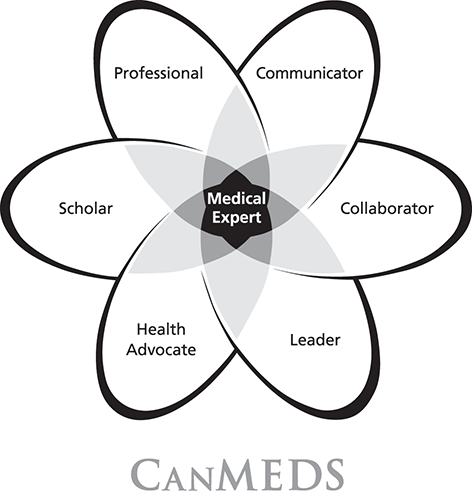
Many medical schools, including in Egypt, (Reference Strasser77) India, (Reference Chacko78) the US, (Reference Albanese, Mejicano, Anderson and Gruppen79; Reference Iobst, Sherbino, Cate, Richardson, Dath and Swing80) Brazil and Germany, (Reference Roland, Hannah, Lilian, Heidrun, Cláudia and Luiz Vianna81) are shifting to a competency-based curriculum, focusing on developing the skills needed to transition from learning to practice. Canada (Reference Nousiainen, Caverzagie, Ferguson, Frank and Collaborators82) has been instrumental in designing a broad curriculum framework that focuses on organising these competencies into a structured curriculum, called the CanMEDS framework. (Reference Frank and Danoff83) CanMEDS introduced curriculum objectives related to the various roles a doctor takes in their professional career: Medical Expert (the integrating role), Communicator, Collaborator, Leader, Health Advocate, Scholar and Professional. (84)
The CanMEDS framework.
The international shift to competency-based curriculum has had significant ramifications for the teaching and assessment of professionalism. There are concerns that by breaking down training into measurable competencies and ‘atomising’ the curriculum (Reference Huddle and Heudebert85), essential and important professional skills that cannot be captured as competencies are being lost. (Reference Frank, Snell, Cate, Holmboe, Carraccio and Swing86) Competencies in professionalism, systems organisation and leadership have been added to various competency frameworks including those of Israel, (Reference Frank, Snell, Cate, Holmboe, Carraccio and Swing86) the US (Reference Frank, Snell, Cate, Holmboe, Carraccio and Swing86; Reference Combes and Arespacochaga87) and Singapore (Reference Frank, Snell, Cate, Holmboe, Carraccio and Swing86). Some countries are introducing individualised learning plans that focus on personal development to capture these professional competencies. (Reference de Heer, Driessen, Teunissen and Scheele88) Nevertheless, there remains concern that competency based medical programmes designed around analysis of tasks and roles may not address tacit knowledge, context specific skills or inter- and intra-personal knowledge, skills and attitudes that support appropriate professional identity formation. (Reference Combes and Arespacochaga87)
Professionalism has been codified in regulatory frameworks. (Reference Bird and Gilligan89) The problem with codes, however, is that it is easy to incorporate aspirational goals that are poorly defined, resulting in standards that are difficult to interpret and impossible to meet. For instance, the Medical Board and Australian Health Professionals Regulatory Agency (AHPRA) provide a code of conduct for all medical doctors and students. (90) This code requires doctors and medical students to provide ‘constructive and respectful feedback to colleagues, trainees, international medical graduates and students, including when their performance does not meet accepted standards’. (Reference MBo91) This statement is almost impossible to operationalise unless there is a recognition of established hierarchies, acceptable modes of communication (including interprofessional communication) and a high degree of existing psychological safety, none of which are likely to be present for junior members of the team.
The Hidden Curriculum
Underneath this overt curriculum is a curriculum that is less well defined but equally powerful, the so-called ‘hidden’ curriculum. The hidden curriculum is built into the training culture and professional relationships they experience. Professional identity is about who they are as doctors, not just what they do. Doctors in training develop their professional identities by absorbing values, norms and behaviours unconsciously through cultural immersion (the hidden curriculum) and consciously (the overt curriculum).
Students need to assume shared professional attitudes, behaviours and values to effectively function in their sociocultural roles as doctors. (Reference Wren92) Unfortunately, this means professionalism training can easily replicate existing ideologies and stratified relationships that further marginalise the most vulnerable members of the profession, worsening unprofessional attitudes and behaviours. (Reference Michalec and Hafferty93–Reference Chuang, Nuthalapaty, Casey, Kaczmarczyk, Cullimore and Dalrymple95)
Although medicine is changing, the professionalism codes present what Michalec and Hafferty see as a ‘nostalgic’ view of professionalism, with doctors expected to deliver highly individualised, bespoke care in resource-poor environments. (Reference Michalec and Hafferty93) The growing distance between what is taught in the formal curriculum and what is learned in the hidden curriculum, what is said and what is done in policy, and what is expected and what is achievable in clinical practice can result in doctors distrusting organisational statements, policies, processes and codes. When there is a gulf between what is expected and what can be delivered, moral distress worsens and the willingness of a doctor to report professional misconduct is significantly reduced, because the survivors lack confidence in the processes of the organisation. (Reference Musto, Rodney, Ulrich and Grady96) The hidden curriculum and its relationship to professionalism and professional identify formation is explored in further depth in chapter 14.
Student-Led Learning and the Role of Technology
Medical students have always undertaken self-directed learning. However, the opportunities to learn outside of a peer- or teacher-led environment means medical schools may be able to make medical learning more efficient and effective. There have been some early attempts to set up virtual medical schools, and China has used Massive Open Online Courses (MOOCs). (Reference Gao, Yang, Zou and Fan97) It seems likely that technology will enable more globalised and efficient training programmes in the future. It is not clear how this will impact the development of interpersonal skills and team-based learning, or the capacity to recognise and respond to conflict.
One interesting question is around equity. While students from less privileged communities may be able to access cheap and accessible learning (like MOOCs), (Reference Bakkum, Hartjes, Piët, Donker, Likic and Sanz98) there is always the risk that students will be offered a ‘colonial’ curriculum that is decontextualised, further moving medical education away from the communities it is meant to serve. (Reference Zou and Schiebinger99, Reference Fosch-Villaronga, Drukarch, Khanna, Verhoef and Custers100) In the interests of efficiency, it may easily become normal to teach using materials that do not meet the needs of diverse communities.
AI systems are already known to be biased towards patients with privilege. (Reference Leslie, Mazumder, Peppin, Wolters and Hagerty101) For diverse medical students, the move to more standardised educational programmes, delivered by a narrower group of professional virtual educators, may mean even less exposure to diversity in training. (Reference Buery-Joyner, Baecher-Lind, Clare, Hampton, Moxley and Ogunyemi102, Reference Porayska-Pomsta, Rajendran, Knox, Wang and Gallagher103) This may mean they lack opportunities to refine their interpersonal skills in complex settings, the most common scenario they will have to manage as qualified doctors.
In the past, doctors in training have learned and practised their skills under supervision with patients, predominantly in public institutions like hospitals. This obviously has implications for patient safety. Immersive technologies like virtual reality enable students to learn procedural skills and complex kinaesthetic tasks safely. (Reference Barteit, Lanfermann, Bärnighausen, Neuhann and Beiersmann104, Reference Zhao, Fan, Yuan, Zhao and Huang105) Simulation is not new, and there is a large body of evidence documenting effectiveness in medical education. (Reference Chernikova, Heitzmann, Stadler, Holzberger, Seidel and Fischer106) Increasingly, sophisticated simulation tools can provide a safe environment to practice complex tasks in teams. Some medical educators use gamified teaching tools, including engaging experiences like escape rooms. (Reference Guckian, Eveson and May107) Singapore has been particularly active in this space, pioneering transformative change in technology enabled learning. (Reference Goh and Sandars34)
However, there is always the question of whether virtual teaching displaces professional identity development, acquisition of advanced interpersonal skills and team interaction that face-to-face learning enables. (Reference Papapanou, Routsi, Tsamakis, Fotis, Marinos and Lidoriki108) Medical educators and academics from Singapore have discussed the transformation that needs to occur to utilise technology safely and effectively in learning, noting that digital technologies need to be integrated into the curriculum and utilised by skilled educators to be effective. (Reference Goh and Sandars34) Given the rate of change of available technologies, this poses a challenge for clinicians, who are also needing to manage the rapid changes in clinical technologies. (Reference Goh and Sandars34)
As doctors undertake more independent learning, the opportunity to evaluate their interpersonal behaviours drops. The question remains whether the shift from the ward to the tutorial space or individual computer reduces the capacity of medical educators to detect and manage the doctor in training who demonstrates poor interpersonal conduct, or the doctor in training who is the target for abuse.
The Art of Medicine and the Role of Reflective Practice
Reflection is a metacognitive process that creates greater understanding of self and situations to inform future action. (Reference Sandars109) Reflective practice has been enshrined in medical training for decades, particularly in disciplines such as general practice and psychiatry, where doctors have prolonged and extensive relationships with their patients. (Reference Akhigbe and Monday110–Reference Thompson and Thompson113) Medical educators use reflective practice to help learners build the values, knowledge and skills necessary for the ethically, socially and cognitively complex situations that characterise clinical practice. Moderated reflection is particularly helpful when learners face situations that are confronting or emotionally charged. (Reference Sandars109) This includes interpersonal harassment, abuse or violence.
Medical practice in hospitals has become increasingly transactional, rather than relational. The language around evidence-based care, outcome measurement and quality improvement encourages a view of medicine that privileges interventions over interactions. The focus on skills and competencies has created a market for simulations in areas such as communication, professionalism and teamwork. However, there is concern that this may create doctors who can simulate empathy but have no authentic connection with their patients. (Reference Dagnone, Takahashi, Whitehead and Spadafora114; Reference Whitehead, Selleger, van de Kreeke and Hodges115) Performative empathy bears a strong resemblance to what the Dutch call ‘monkey tricks’, the capacity to mimic empathy without experiencing an authentic connection with patients. A lack of authenticity can impoverish therapeutic relationships. (Reference Whitehead, Selleger, van de Kreeke and Hodges115)
In order to authentically experience, understand and manage the traumatic and confronting interpersonal experiences that are common in medicine, learners need to be comfortable learning from reflection, alone or with peers or educators. (Reference Sandars109) Without a vocabulary to discuss their discomforts and emotional needs, junior doctors are left isolated and vulnerable, hidden in a culture of silence that protects abusers and suggests that their experience is not valid or not real.
It is difficult to create opportunities for protected time for reflection, and it is equally difficult to incorporate reflection into a curriculum that is competency based. Some Canadian authors, particularly Whitehead, have questioned whether CanMEDS has removed the important role of ‘Doctor as Person’ in creating the existing framework. (Reference Dagnone, Takahashi, Whitehead and Spadafora114; Reference Whitehead, Selleger, van de Kreeke and Hodges115) To be effective, reflective practice needs to be authentic, normalised and safe. With insightful educators, and time to teach and reflect, hidden assumptions can be examined, named and managed. Without reflection the doctor in training may lack the words and concepts to make sense of their experience and cannot question the cultural assumptions they have absorbed, (Reference Schön116; Reference Schön117) including the idea that abuse is an expected part of medical training and practice.
Workplace-Based Learning and Teamwork
Most doctors train in a series of rotations over many years, and may only stay with a team for a few months at a time. During these placements, they are expected to demonstrate applied specialist knowledge, but also to acclimatise and adapt to the specific work culture of each rotation. This model of training is designed to increase patient safety by exposing doctors in training to a ‘generalist’ medical education, preparing them to operate in many different clinical contexts. However, the rapid team shifts it requires creates a high degree of stress and vulnerability. (Reference Bernabeo, Holtman, Ginsburg, Rosenbaum and Holmboe21) Learning in the medical workplace can be chaotic, and opportunities to learn depend on the patients who present while the learner is on the ward or in the clinic. It is not always possible to start with the ‘easy’ cases and work up to the ‘difficult’ ones, and it is impossible to ensure every learner is exposed to all the situations they need to master in a single term. (Reference Strasser77)
Learners may undertake different rotations in a different sequence to their peers, and must seek out their own learning experiences in the workplace. They need to discern which learning experiences matter most, and balance these with their service obligations. This is a relational challenge, convincing supervisors, teams and even patients to allow them to practise a skill, refine a technique or master a clinical reasoning challenge.
Doctors work and learn with and from other professions. (Reference Kururi, Tozato, Lee, Kazama, Katsuyama and Takahashi118–Reference Østergaard, Østergaard and Lippert120) Interprofessional learning is common and effective in embedding a variety of skills, including teamwork. (Reference Mette, Baur, Hinrichs and Narciß119; Reference Reeves, Fletcher, Barr, Birch, Boet and Davies121) However, the structure of training has interpersonal challenges. Doctors in training are ‘itinerant workers’, engaging fleetingly with these nested systems. Short rotations give little opportunity for them to build trust and understanding within a workplace, or to develop a sense of belonging and integration into teams comprised of more permanent members in each clinical placement. (Reference Bernabeo, Holtman, Ginsburg, Rosenbaum and Holmboe21; Reference Gafson, Sharma and Griffin122) These nested systems of team and workplace have more permanence for members like nurses who can expect to ‘outlast’ the doctor in training. Doctors in training are short-term investments: they enter a team which has its pre-existing systems of power and privilege already firmly in place, and then they leave, to become ‘someone else’s problem’. The more permanent team members are fluent in the currencies of informal power that flow in that team and workplace, while doctors in training are necessarily just starting to learn the language. (Reference Nataraj, Tome and Ratelle123; Reference Janss, Rispens, Segers and Jehn124)
The challenge of team learning is that doctors depend on their supervisor and team evaluations and recommendations for career progression. The implications for this form of social power are discussed below.
The Culture of Medical Training
Medical training may vary around the world, but health care workplaces have cultural elements in common. Doctors train in hierarchical organisations with dependent relationships. (Reference Crowe, Clarke and Brugha125; Reference Braithwaite, Clay-Williams, Vecellio, Marks, Hooper and Westbrook126) Medicine is a competitive industry, and training can be brutal, with long hours and high expectations. (Reference Rios127) Doctors tend to be perfectionistic and self-critical, with high rates of anxiety, (Reference Gerada128) and help-seeking tends to be discouraged.
Although there is increasing emphasis on patient-centredness in training, doctors experience declining empathy over the time of their training, partly due to moral distress, burnout and crippling workloads. (Reference Samra129) They also experience increasing levels of occupational violence from patients and their family members. (Reference Vento, Cainelli and Vallone130) In short, there are multiple ways in which doctors in training experience discrimination, harassment and inter- and intra-personal conflict.
The Theory of Beneficial Mistreatment
Like many hierarchical professions, medicine has a long history of requiring unsustainable workloads from their junior doctors. (Reference Ishikawa131–Reference Schaufeli, Bakker, van der Heijden and Prins134) The ‘theory of beneficial mistreatment’ is a construct that appears in many hierarchical organisations where trainees are expected to undergo feats of physical endurance to prove their capacity to survive the profession. In many ways, this forms a rite of passage, and survivors perpetuate the practice, partly to justify their own harms. (Reference Padiyath, Bolin and Daily135; Reference Fothergill, Edwards and Burnard136) Self-sacrifice is a core construct for doctors, and overwork plays into this narrative. (Reference Colenbrander, Causer and Haire137; Reference Picton138)
Proponents of this style of learning genuinely believe that training is a kind of ‘professional warm up’, acclimatising learners to the environment and building their capacity. In this environment, bullying and harassment become yet another test of whether a learner is ‘tough enough to do medicine’. (Reference Vento, Cainelli and Vallone130) The argument is that those who cannot tolerate this form of mistreatment may not be a good ‘fit’ for medicine. (Reference Colenbrander, Causer and Haire137)
One study in Nigeria described the culture of shaming residents. The medical students interviewed in the study described how they avoid eye contact with residents while they are being ‘grilled’ by their senior colleagues so they don’t add to the resident’s shame. In doing so, they also protect themselves from imagining their own future. The students described being at the mercy of their examiners, with one student explaining ‘if they don’t like you, you are done’. (Reference Awire and Okumagba139)
At the moment, there are parallels with the NHS in the UK, where workloads are becoming unmanageable. (Reference Dominic, Gopal and Sidhu140; Reference Florence Katie and Daniele141) Junior doctors do not feel valued or supported by the NHS, and describe a culture of ‘blaming and shaming’. This finding is not new, and authors have been describing the impact of bullying, harassment and exploitation of junior doctors for decades. (Reference Ruth, Marta, Farina, Kevin, Anya and Anna142) Toxic cultures of blame can have the opposite effect as well, with some junior doctors learning to ignore valid feedback on their performance to avoid criticism. (Reference Kroll, Singleton, Collier and Rees Jones143) Both have an impact on patient care.
Competition and Collaboration
Medicine is a prestigious profession, and there has always been competition to secure training places. Argentina is one of the many countries where competition within the medical programme is particularly fierce. There is a law that protects the rights of all Argentinian citizens to have ‘free and unrestricted’ access to university. The consequence of this policy is that the first year of medicine attracts a massive intake, but the numbers are reduced rapidly, with the cohort shrinking after each examination round. (Reference Falasco and Angel Falasco38) A consequence of this policy is an extraordinarily competitive programme, with high stakes examinations. Competition is expressed differently in different contexts. In the US, the financial cost of training makes it unattainable for many students, and the debt that students take on is growing in Canada, Australia and New Zealand. (Reference Asch, Grischkan and Nicholson144–Reference Webster, Ling, Barrow, Poole and Henning147)
Doctors in training also compete for training opportunities. (Reference Kodikara, Seneviratne, Godamunne and Premaratna148) In return for learning and positive formative assessments, some will be expected to donate labour, including the ubiquitous unpaid overtime. (Reference Tallentire, Smith, Facey and Rotstein149; Reference Derrick150) In some cultures, exploitation is formalised as patronage, where a patron may expect their junior colleague to assist with domestic tasks, such as shopping, cooking, or childminding, in return for learning opportunities. Bribery is not uncommon. (Reference Blunt, Turner and Lindroth151) When exploitation is normalised, and hierarchical systems are not clear, junior colleagues are vulnerable to other forms of abuse, including sexual exploitation.
Safety and Trust
Occupational violence against doctors is a growing problem around the world. (Reference Mento, Silvestri, Bruno, Muscatello, Cedro, Pandolfo and Zoccali18; Reference Al-Shaban, Al-Otaibi and Alqahtani152–Reference Cebrino and Portero de la Cruz154) In China, there is a specific form of workplace violence called ‘Yi Nao’, a specific type of violence against health workers aimed at achieving financial benefits. (Reference Jiao, Ning, Li, Gao, Cui and Sun155; Reference Zhang, Stone and Zhang156) This form of violence can be verbal, physical and/or sexual, and is usually perpetrated by the families of patients or criminal gangs hired by them, to force hospital administrators to provide financial compensation for perceived malpractice. (Reference Tang and Thomson157) Most health professionals have experienced this form of violence, and it is becoming more common. (Reference Zhang, Stone and Zhang156) There have been instances of murder, with understandable deterioration in staff–patient relationships, and quality of care. (Reference Tang and Thomson157)
In Afghanistan, women doctors are at high risk of harm. Ongoing conflict has damaged hospitals and medical schools, and the care of Afghan women has been profoundly affected by prohibitions against training women doctors. Female patient examination by a male doctor is also prohibited, and is considered cultural misconduct (Reference Azimi and Balakarzai158; Reference Mannion, Chaloner and Homayoun159) In the last two decades, training programmes have been re-instituted, but the admission of women into medicine has been banned at various times in recent history, meaning Afghan women have had difficulties accessing medical care. (Reference Azimi and Balakarzai158; Reference Stanikzai, Wafa, Akbari, Anwary, Baray, Sayam and Wasiq160; Reference Schexneider161) In a qualitative study of women medical students, isolation from male peers and male attending physicians is seen as a significant impediment to training. Women are reluctant to seek the opinions or advice of men because of the strict laws around male–female interaction. Women doctors are then restricted in their capacity to learn collegially. (Reference Schexneider161)
Occupational aggression can be more subtle. In the UK, there is growing criticism of doctors, particularly GPs, in the mainstream media, (Reference Mroz, Papoutsi and Greenhalgh162) and this has paralleled an increase in abuse in GP surgeries. ‘Negative media coverage matters not just because it is inaccurate and unfair’, write Mroz, Papoutsi and Greenhalgh, ‘It may also reduce patients’ confidence in general practice and prevent or delay them seeking care. There is emerging evidence that it also contributes to workforce stress and the retention crisis.’ (Reference Mroz, Papoutsi and Greenhalgh162)
Justice and Equity
The educational hierarchy is often the place where sexual harassment occurs because learners are vulnerable. However, doctors in training are not equally vulnerable. Systemic injustice is present across all social institutions, and is particularly problematic for First Nations doctors and International Medical Graduates. Lack of representation among leadership can permit the perpetuation of discrimination, racism and microaggressions from patients, colleagues and other staff. (Reference Siad and Rabi163; Reference Olsson, Toropova, Jensen and Björklund164)
There are other ways that discrimination impacts learning. Formative assessment can be challenging if the learning environment is not considered fair. In South Africa, medicine has a strong recent history of discrimination and harassment on racial grounds. (Reference Khine and Hartman165; Reference Bezuidenhout and Cilliers166) It is one reason why students resist the implementation of workplace-based learning, citing the risks of bias, victimisation and favouritism. (Reference Mash and Edwards167; Reference Ras, Stander Jenkins, Lazarus, van Rensburg, Cooke and Senkubuge168) Marginalised doctors in training are often asked to do the work of championing equity, diversity and inclusion. When people who have been harmed by a culture are asked to fix it, they are expected to donate extra cognitive and emotional labour. This work has been termed the ‘minority tax’. (Reference Siad and Rabi163)
One approach to unequal access to learning has been taken in Cuba. Following the 1955 revolution, Cuba reoriented its approach to medical education to focus on primary care, interdisciplinary learning and community participation, focusing on training doctors who could meet the needs of their own populations. (Reference Reed169) By working with poor and disadvantaged communities in primary care teams in other countries, Cuba has had a substantial population health impact in Africa, Asia, South America and the Pacific. (Reference Reed169) Much of the training is in rural polyclinics as part of a primary care team, giving students a community and primary care orientation for a large part of their training. (Reference Cooper, Kennelly and Ordunez-Garcia170).
Compassion and Empathy
The combination of discrimination, harassment, bullying and other forms of interpersonal conflict leads to deterioration in self-compassion and empathy for others, including patients. (Reference Neumann, Edelhäuser, Tauschel, Fischer, Wirtz and Woopen171–Reference Thomas, Dyrbye, Huntington, Lawson, Novotny, Sloan and Shanafelt173) This is an international phenomenon, although the qualitative experience varies by gender and context. (Reference Calzadilla-Núñez, Díaz-Narváez, Dávila-Pontón, Aguilera-Muñoz, Fortich-Mesa, Aparicio-Marenco and Reyes-Reyes174–Reference Okoye, Nwachukwu and Maduka-Okafor176) One concerning aspect of this finding is that doctors in training are both expected to demonstrate high levels of empathy and also manage significant levels of vicarious trauma and occupational violence. For doctors in training, traumas are part of the job. Medical students and doctors in training witness humanity at its most vulnerable and authentic, experiencing suffering, grief, loss and death, perhaps for the first time. The doctor is expected to tolerate this emotional, philosophical and potentially spiritual load, be a stable support for the patient and those around them, and then ‘get on with their job’. (Reference Newell and MacNeil177–Reference Al-Mateen, Linker, Damle, Hupe, Helfer and Jessick179)
Doctors are familiar with the concept of ‘setting yourself on fire to keep others warm’. (Reference Pagel and Palmer180) Self-sacrifice is a common core value health professionals have, but it can easily leach into their perspective of personal trauma. Once it is normal to dehumanise and compartmentalise the accepted horrors of a career in medicine, it is not unusual to do the same with personal trauma. Unfortunately, maladaptive coping strategies like avoidance lead to burnout, which can erode empathy further. (Reference McCain, McKinley, Dempster, Campbell and Kirk181, Reference Bittner, Khan, Babu and Hamed182) One concerning aspect of medical training is the current focus on individual responsibility for wellbeing. Wellness programmes that emphasise resilience without addressing systemic causes can lead to doctors blaming themselves for their own trauma, (Reference Siad and Rabi163) what some call ‘weaponising wellness’. (Reference Kohler183–Reference Stone185)
Another concern is the assumption that increasing empathy will reduce occupational violence. (Reference Hahn, Hantikainen, Needham, Kok, Dassen and Halfens186) In China, one paper calls for health workers exposed to significant occupational violence to ‘respond to emotional labour through deep acting, expressing their true feelings instead of faking the desired emotions required by jobs’. (Reference Tang and Thomson157) The authors assert that patient-centred care with a more empathic approach will enhance understanding between patients and health care workers and ‘further increase staff confidence in managing violence’. (Reference Tang and Thomson157) Genuine emotional connection often requires vulnerability, which can be challenging in threatening situations. Doctors who are under threat may have difficulty managing self-protection and empathy simultaneously.
Conclusion
Doctors in training learn in teams and within medical education systems with hierarchical power dynamics and high stakes assessments. Contexts and roles change throughout training, and doctors in training can be faced with goals that seem to act in opposition.
On the one hand, medical training is trending towards tightly defined competencies that meet well-defined standards. At the same time, communities expect individualised care that requires significant interpersonal skill. Doctors are exposed to discrimination, harassment and occupational violence, but must demonstrate equitable care that is empathic and patient-centred. There is often a discrepancy between encoded policies and enacted behaviours, and despite public commitment to equity, diversity and inclusion, doctors in training frequently experience a highly discriminatory workplace.
In an environment of high workload, resource constraints and escalating regulatory standards, doctors in training can struggle to meet the multiple and often contradictory requirements of their chosen profession. Doctors have high expectations of themselves, and this can affect their confidence. Unfortunately, this makes them vulnerable when they are subject to discrimination, harassment or abuse.

 Open access