

Fifteen-year-old Roberto had been incarcerated in the Ponce district jail for five months before social worker Estela Pérez first interviewed him.Footnote 1 Roberto, a child of African descent, had been left homeless at the age of five when both his parents died.Footnote 2 His three older siblings immediately found work and shelter in private homes, where they were “placed” (colocados) to work in exchange for room and board.Footnote 3 However, no one was willing to take in young Roberto, and he was left to live alone in the house he had shared with his parents and siblings. Periodically, neighbors offered Roberto dishes of food or clothing, but otherwise, he lived alone in the house for six months, until his eldest brother came for him. Luckily, his brother eventually found someone willing to employ Roberto. A family hired him to care for goats and other animals in exchange for food and clothing. He worked there for ten months, but he left the arrangement because the employer was abusive. Over the next nine years, Roberto lived as a homeless child in Humacao. Like other homeless children on city streets, he sold newspapers during the day and found balconies and porches to sleep at night. Eventually, he found community and safety with a small group of homeless boys (which the social worker described as a “pandilla,” or gang). Together, they stole produce (“potatoes, bananas, and other foods”) from the Plaza del Mercado, which they cooked and ate together in the hills, where they also slept. However, in October 1948, Roberto stole a small pig from the yard of a private residence. A police officer arrested him when he tried to sell the pig at the Plaza del Mercado. The officer took him to the local police station, where he was detained in the Humacao municipal jail for two days before being transferred to the district jail in Ponce to await further processing and proceedings in his case. Social worker Pérez first interviewed him in March 1949.
Roberto’s childhood experiences—abusive labor conditions, homelessness, and incarceration—do not align with the type of childhood expected from a society that celebrated the twin myths of la gran familia puertorriqueña and racial harmony. The gran familia myth was born out of the crisis of the hacendado class in the late nineteenth century (Quintero Rivera Reference Quintero Rivera1981). In response to the loss of economic and political authority, the intellectuals of the landed coffee elite created a myth that glorified Puerto Rico’s agricultural past, exalted the unique social and racial harmony of agricultural workers, and centered it all on the white patriarchal family (Moreno Reference Moreno2012). The myth proposed that Puerto Rican society reflected an extension of the family values of the hacendado class, represented by a white patriarch who cared for his wife and children with the same attention as he did the multiracial agricultural workers who depended on him for wages and land. As Puerto Rico shifted from one colonial authority to the other at the turn of the twentieth century—the height of scientific racism—the myth of the gran familia fixed whiteness as a marker of Puerto Rican society. The myth of racial harmony rejected the racial antagonism and violence of the US Jim Crow era and replaced it with the idea that Puerto Rico was racially harmonious. Liberal Puerto Rican elites deployed this vision of whiteness, patriarchy, and racial harmony against conservative Spanish colonial officials in the late nineteenth century, and it has been redeployed throughout the twentieth century against the US colonizers (Moreno Reference Moreno2012, 43).Footnote 4 In Roberto’s case, the protective and benevolent reach of Puerto Rican society, the great patriarch, or, by extension, the paternal state of the 1940s, which cared for all members of its family and society, never materialized.
Roberto provides one example of why the history of childhood is “essential.” Historian Steven Mintz (Reference Mintz2012, 17) proposed that childhood “lies at the heart of many key historical themes, such as the growth of the state’s police and administrative powers, the rise of modern bureaucratic institutions, the development of the welfare state, the triumph of the therapeutic, and the emergence of modern criminal jurisprudence.” Several different types of public and private institutions served children, adults, and the elderly in the first half of the twentieth century. Some focused on the poor, destitute, or homeless, while others provided services for the blind or sick. As the colonial state expanded, so did the number of public institutions.Footnote 5 Public hospitals and clinics opened throughout the island as part of public health initiatives that battled uncinariasis and tuberculosis (Trujillo-Pagán Reference Trujillo-Pagán2013). Yet no social worker or state employee ever investigated Roberto’s case during the nine years he lived homeless in the streets of Humacao. No benevolent private citizen stepped forth to help find him a spot in a private orphanage or asylum. Rather, Roberto’s first encounter with the state was when he was arrested for stealing a pig at the age of fifteen. Roberto’s saviors were his older brother, a child himself, who helped place him in a private home and, we could argue, his friends, a community of homeless children, who helped him feed himself. Roberto was not an exception. Hundreds of children were incarcerated in Puerto Rico’s correctional institutions, and hundreds more were institutionalized in public state homes for children in the first half of the twentieth century. This study of the institutionalization and criminalization of children rejects the myths of the gran familia and racial harmony and instead documents that children experienced structural racism, racial segregation, racial inequality, and the criminalization of blackness in the first half of the twentieth century in Puerto Rico.
Our research examines the 1910, 1920, 1930, and 1940 US censuses to identify demographic characteristics of children who resided in public and private institutions for minors, with special attention to patterns of racial segregation and exclusion.Footnote 6 We focus on public and private institutions founded exclusively to serve children and youth and on correctional institutions for children and adults.Footnote 7 Census records and other historical sources, including the Annual Reports of the governors and attorneys general of Puerto Rico, help us analyze demographic patterns among incarcerated boys in the reformatory, municipal and district jails, and the island’s prison. The questions we seek to answer include the following: What was the racial and gender composition of children in institutions for minors and penal institutions for minors and adults? How did the racial composition in such institutions accord with or depart from the racial proportions of Puerto Rico’s overall population? When we compare the racial and gender makeup of each type of institution, what patterns emerge that might indicate unequal access and admission? Finally, what do these patterns suggest about the disparate racialized and gendered (and to a certain extent classed) experiences of institutionalized children?
Our findings suggest that the world of institutionalized and incarcerated children was not exempt from racial, class, and gender hierarchies. We find racial segregation in private institutions, underrepresentation of children of color in both private and public institutions, and overrepresentation of boys of color in correctional institutions for minors and adults. We also identified a historical pattern of excluding girls of color from all types of public and private institutions, with few exceptions. We define children as persons sixteen years of age or younger, according to the 1915 Ley de Menores of Puerto Rico.Footnote 8 We employ the racial terms used in US federal censuses over different decades (blanco, mulato, negro, and colored), as discussed and defined in the next section. In addition, we use the term African-descended or child of color exclusively to refer to any person who was categorized as mulato, negro, or colored in the census.
While we remain close to the census data in our discussion of the racial demographics of institutionalized and incarcerated children, we suggest that our findings also hold implications for the history of racial inequality in Puerto Rico more broadly. First, scholars have expertly and meticulously researched and debated the history of racial formation in Puerto Rico.Footnote 9 Our findings confirm that white supremacy and antiblackness did not disappear during the late nineteenth-century postemancipation era.Footnote 10 In the first half of the twentieth century, structural racism and antiblackness continued to shape the lives of children. Second, we recognize that the cultural values of honor and respectability may have been extended to and provided some protection for poor white girls in Puerto Rico in the first half of the twentieth century, although the children were never free from the violence of poverty and institutionalization. This is worth mentioning because no such protection seems to have been extended to poor black girls.Footnote 11 Third, our findings confirm what other scholars have documented about antiblackness and punitive policing in twentieth-century Puerto Rico as early as the 1920s and 1930s.Footnote 12 Racism and policing also shaped the lives of poor, African-descended children.
The history of childhood—of Puerto Rican children of different races, colors, genders, and classes—has not been prioritized in Puerto Rico’s historical scholarship.Footnote 13 This study of race, institutionalization, and incarceration offers a historical example of how persistent racial practices shaped (and limited) the lives of working-class and poor children in Puerto Rico. The article begins with a discussion of the use of historical racial census data in Puerto Rico and Latin America, followed by a brief history of institutions for minors. In a third section, we describe the racial patterns of institutionalized children in public and private social welfare-oriented institutions and residential private schools. Finally, we examine racial data on incarcerated boys in correctional institutions.
Race and census data
Census data has been one of the most important sources in documenting racial inequality in Latin American and Caribbean countries. Newly independent Latin American nations collected race data in their national censuses since the nineteenth century. Some countries chose to exclude that variable with the rise of national myths of mestizaje, racial harmony, and racial democracy, which became hegemonic in the post–World War II era. Since the 1980s, Latin American countries have transitioned into democracies and become more responsive to the racial and social justice demands of their multicultural citizens. Racial justice activists and international organizations such as the United Nations demanded that Latin American states collect racial data in national censuses as a way to document inequality across different racial and ethnic groups within their nations. For example, Afro–Latin American activists since the 1970s have advocated for the documentation of racial data in national censuses, “insisting that racial data were absolutely necessary to determine whether Latin American nations had achieved genuine equality, or whether racial differentials persisted in access to health, education, jobs, housing, and other social goods” (Andrews Reference Andrews2016, 27).
Puerto Rico reflects some of these patterns. It did not gain independence along with other Latin American and Caribbean nations in the nineteenth century. Rather, it remained a colonial territory of Spain until 1898, when it became a colonial territory of the United States. Never an independent country, censuses were imperial, not national. The colonial status of the territory, however, did not exempt Puerto Rico’s intellectual and political leaders from engaging the dominant racial theories of the region. The political elite in the mid-twentieth century, led by members of the ruling Popular Democratic Party, also promoted ideas of mestizaje and racial harmony in Puerto Rico. When Puerto Rican politicians gained some autonomy and control over island affairs with the founding of the Estado Libre Asociado in 1952 (a reformed version of the colonial territorial status), like their Latin American neighbors, they stopped collecting race data. Although race data had been collected in Puerto Rican censuses since the Spanish colonial era, the Puerto Rican government chose not to collect the data from 1960 to 1990 (Duany Reference Duany2002, 253). Activists in Puerto Rico, however, challenging the myths of racial harmony and equality, demanded that the state begin again to collect racial data, which it finally did in 2000.
While the collection of racial data on national and imperial censuses is recognized as an important quantitative way of documenting inequalities, it has always been a deeply contested process. As newly independent nations in the nineteenth century, Latin American national leaders continued the tradition of the Spanish colonial censuses by using them as a tool to capture the particularities of their population, including gender, race, age, and occupation, along with other indicators of national development, such as landowning patterns and crop production. Within nations, debates emerged about the limitations of using censuses at midcentury, including whether or not it was possible to reduce the “complex social phenomena” of race, color, and ethnicity to “sets of simplified categories” (Andrews Reference Andrews2016, 21). Indeed, each nation defined race and color categories differently in ways that reflected their own national histories and populations.Footnote 14 Another point of contention that emerged was whether censuses, as a state tool, created identities that were then reproduced in social groups, or whether the identities of social groups shaped census questions (Emigh et al. Reference Emigh, Ahmed and Riley2021, 4).
Puerto Rican scholars are enmeshed in these debates. We recognize that most scholars agree that censuses cannot reflect everyday definitions and meanings of race on the ground. In particular, they note that race is a socially constructed concept and, in Puerto Rico in particular, its uses and definitions have been shaped by Spanish colonialism.Footnote 15 Before the arrival of US Americans and their specific racial ideas, Puerto Rico’s population had been engaged in its own negotiated process of defining race and identity under Spanish colonialism.Footnote 16 Definitions of race and color (white, black, and brown) in Puerto Rico, therefore, are specific to the island’s history; the US occupation did not supplant them, and they cannot be simplified or captured in census forms. The data collected in US colonial censuses can never fully reflect the varied ways in which individuals identify themselves and, therefore, at best, are partial and misleading evidentiary sources.
These reservations notwithstanding, it is worth noting that Puerto Rico is one of the best-documented examples of Spanish colonial censuses in the nineteenth century. Questions about race were always included in Puerto Rico’s Spanish colonial censuses, although definitions and terms varied over time. Casta, raza, calidad, or color were used in different censuses. “Racial markers varied” in the Spanish colonial censuses, “except blanco and negro, which were universally used,” and censuses used both binary and tripartite categories, including white, brown (mulato), and black (Emigh et al. Reference Emigh, Ahmed and Riley2021, 2). Significantly, between 1899 and 1940, US federal authorities used the same racial categories that had been used in nineteenth-century Spanish colonial censuses. When US censuses used the categories of white, black, and colored in Puerto Rico, these were not foreign concepts to the local enumerators but racial terms that had long existed in Spanish government documents.
The difference between the Spanish and US censuses was in the definition of the terms white and black. During the Spanish colonial period, the white category was inclusive and expansive. In the early twentieth century, while the white category continued to be inclusive in everyday practice in Puerto Rico, it became a more restricted category in the US censuses. On the US mainland, in the early twentieth century, any black, Asian, or indigenous heritage excluded a person from the white category. The black, mulato, and colored categories were more inclusive (Duany Reference Duany2002; Loveman Reference Loveman2007; Emigh et al. Reference Emigh, Ahmed and Riley2021). Although the meaning of the terms varied according to who employed them—whether a Spanish or US colonizer, or an elite or plebeian Puerto Rican—the terms always shifted on a spectrum from white to black. White supremacy, whether in its Spanish or its US version, informed the white category.
In Puerto Rico, despite the colonizers’ definitions of race and color for census records, everyday definitions of race persisted. In 2002, Jorge Duany suggested that the early twentieth-century statistical whitening of the Puerto Rican population in US censuses reflected how Puerto Rican census enumerators classified others racially. Enumerators continued to work with an expanded, local definition of whiteness, especially once the intermediate census category of mulatto was dropped from census records: “The official disappearance of racially intermediate types accelerated the movement from nonwhite to white categories on the island” (Duany Reference Duany2002, 250). In 2007, Mara Loveman’s statistical analyses of census data confirmed Duany’s thesis: “Census enumeration was a site of active contestation over the rules of racial classification in US occupied Puerto Rico” (84). Loveman argued that in 1920, when US census officials decided to drop the distinction between mulatto and black and introduced the “colored” category instead, they expected that the Puerto Rico population would blacken. Instead, the white population grew. This was another example of how Puerto Rican census enumerators, themselves invested in whiteness, adapted the census category of white to local definitions and uses. Because white Puerto Rican elites favored a more inclusive definition of whiteness that allowed them to claim whiteness for themselves, the white category was applied more liberally in Puerto Rico, leading to the statistical whitening of the population in US censuses. Emigh et al.’s Reference Emigh, Ahmed and Riley2021 comprehensive historical survey of censuses in Puerto Rico concluded that everyday uses of racial categories and identities have persisted in spite of official census categories, whether colonial Spanish or American ones.
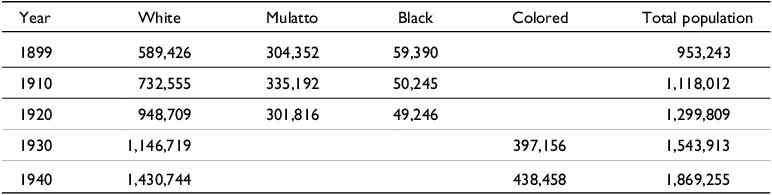
The inclusive and “contested” nature of the white census category in Puerto Rico (despite the top-down definitions imposed by colonial Spanish and US officials) and white Puerto Rican elites’ insistence on their own whiteness in the early twentieth century is well established in the scholarship. However, even an expansive definition of whiteness in Puerto Rico and Latin America has its limits. For all the attention scholars have given to the inclusiveness of whiteness, what can the census data tell us about those who were black, de color, or Afro–Puerto Rican (Table 1)? What about the boundaries of blackness? Census data allow us to shift the focus to those individuals who were labeled and remained categorized in the black category, despite the inclusiveness of the white category and the fact that everyday definitions and uses of race and color have persisted.Footnote 17
Race of Puerto Rico’s population, 1899–1940

Source: Sanger et al. (Reference Sanger, Gannett and Francis Willcox1900); US Census Bureau (1940).
Note: Categories that are blank categories were not used in those years.
Puerto Ricans are a multiracial people. Blackness in Puerto Rico has historically been linked to lower social status. As Duany (Reference Duany2002, 246) observed, “In Puerto Rico, as well as in the United States, an ideology of white supremacy and black inferiority has prevailed since the days of colonial slavery.” In Spanish colonial Puerto Rico, blackness was tied to a history of enslavement and labor (Baralt Reference Baralt1981; Ramos Mattei Reference Ramos Mattei1981; Scarano Reference Scarano1984; Figueroa Reference Figueroa2005). In the early twentieth century, white liberal and conservative elites competed with one another in their claims to whiteness as they negotiated with white colonial Americans. Black artisans, lawyers, journalists, and politicians, meanwhile, acknowledged their own black heritage in a white supremacist society and jockeyed for a space of political influence (Suárez Findlay Reference Suárez Findlay2000; Rodríguez-Silva Reference Rodríguez-Silva2012; Erman Reference Erman2019). Meanwhile, the majority of workers in the expanding sugar industry, both men and women, were African-descended and occupied a range of other occupations in the growing cities and towns.Footnote 18 Race and skin color were two social phenomena that shaped opportunities and access to resources. “Everyday life was full of struggles over racial classification,” but “individuals of African descent asserted their humanity and dignity without rejecting their blackness” (Emigh et al. Reference Emigh, Ahmed and Riley2021, 44).
The fact that racial identity falls on a spectrum in Puerto Rico does not mean that racism and racial inequality are not real. We must not mistake fluid or inclusive racial labels to mean an absence of racism. Loveman (Reference Loveman2014, xii) argues that “the fluidity of racial terminology in everyday language may give the illusion of a fluid social order, but Latin American societies are deeply stratified along socioeconomic and ethnoracial lines.” While “census figures cannot tell us about the lived experiences of race in the everyday … analysis of racial classification on censuses can provide a window into the sociological significance of the social demarcation of racial divides in particular historical settings—even if it is a window with only a partial view” (Loveman Reference Loveman2007, 106). Race may be socially constructed and historically specific, but census data are an important tool for documenting racial inequality. For Puerto Rico, historian Francisco A. Scarano and sociologist Katherine J. Curtis White (2007) “acknowledge certain drawbacks to relying on census-defined race categories” and recognize that race categories in US censuses “may not have accurately reflected Puerto Rican racial categories per se.” Nevertheless, they are “confident … that the categories are useful representations of the island’s social hierarchy; those enumerated as ‘white’ occupy a higher status than those counted as ‘black’” (Scarano and Curtis White Reference Scarano and Curtis White2007, 130). For example, their study of 1910 and 1920 census data concluded that race shaped household types and the spatial distribution of households. “Race correlated more strongly with household type than did any of the primordial agrarian occupations (e.g., laborer in sugar, coffee, or tobacco)…. In Puerto Rico, as elsewhere, color and place of residence had been (and still are today) closely related” (Scarano and Curtis White Reference Scarano and Curtis White2007, 135). They found a “strong association between blackness in the early twentieth century and distinct settlement patterns characteristic of various earlier phases of island history, when enslaved Africans were among the predominant settlers” (Scarano and Curtis White Reference Scarano and Curtis White2007, 115).
In a more recent study, political scientist Carlos Vargas-Ramos (Reference Vargas-Ramos2016, 1) criticizes the “avoidance and neglect among Puerto Ricans” on the subject of race, one that “is generally fraught and uncomfortable, often sidestepped by allusions to color-blindness couched in racial democracy arguments or by claiming that in an extensively miscegenated population not any one person or any one group of people could claim superiority over any other on the basis of physical attributes.” The strategy of avoidance or neglect and the equating of fluid racial labels with the absence of racism cannot erase the reality that, in the case of Puerto Rico, census data clearly documents “social inequalities on the basis of physical differences” (Vargas-Ramos Reference Vargas-Ramos2016, 1). Vargas-Ramos examined the 2014 American Community Survey to document inequalities between white and black Puerto Ricans who reside in the archipelago and on the US mainland. The data show that white Puerto Ricans have higher levels of education, are more likely to be proficient in English, are more likely to hold higher-paying jobs, have higher incomes, have a higher homeownership rate, and own homes with higher values. “In the aggregate, self-identified white Puerto Ricans in Puerto Rico appear to have a material advantage over most nonwhite Puerto Ricans…. White Puerto Ricans, as a group, appear to be in a relatively better material position than other Puerto Ricans, whether in the US or Puerto Rico” (Vargas-Ramos Reference Vargas-Ramos2016, 6).
In the debates over how scholars can use race census data, it is worth making one additional point about the self-identification of respondents versus their classification by census takers. Census enumerators racially classified respondents in the Puerto Rico censuses until 1960. It was not until the 2000 census that Puerto Ricans self-identified their race in the census. Telles (Reference Telles2014, 10) and the Project on Ethnicity and Race in Latin America (PERLA) conducted a comprehensive study of ethnicity, race, and color in Mexico, Brazil, Peru, and Colombia, concluding that “self-identification is especially useful for understanding phenomena such as identity, willingness to join ethnic-social movements, and other social phenomena that tend to involve ethno-racial self-understanding” (10). However, they also found that “self-identification is less adequate for understanding social phenomena like discrimination, where others do the classifying, in ways that may be independent of how the person facing discrimination self-identifies” (Telles Reference Telles2014, 10). In other words, Puerto Rico census data may not tell us very much about an individual’s interpretation of their own racial identity, yet, in the aggregate, it can help us better understand discrimination against racial others and identify patterns of racial inequality.
This study uses census data to identify racial patterns among children who lived in institutions. Significantly, in the period we studied, enumerators and institutional staff racially classified the children. Professional Puerto Rican men and women served as the top administrators in all the different types of institutions. Children were boarded in a range of institutions, some of which reflected class privilege (private educational institutions), some of which served as emergency or long-term social welfare support for the poor (public and private homes for children and orphanages), and others that served correctional and punitive goals for children whose behavior had violated the law (reformatories, jails, and the prison). Census data allow us to identify racial patterns in each type of institution and compare between types of institutions. Other variables, such as age and gender, also allow us to draw conclusions about which types of children (black or white, boys or girls, rich or poor) had the privilege of attending some types of institutions over others.
Census data do not, however, allow us to know how individual children, their parents, or their allies defined their racial identity (“categorization”) (Emigh et al. Reference Emigh, Ahmed and Riley2021). They cannot provide details about a child’s individual story, the goals of individual institutions, the institution’s admissions policies, the state’s access to certain communities and neighborhoods, the public’s trust in state actors (e.g., social workers, police) and child welfare resources, or the varied effects of legislation that criminalized child labor and the presence of children in public spaces in the first half of the twentieth century.Footnote 19 Census data cannot help us address any of these topics, which remain outside of the scope of our study. Future research by childhood studies scholars may allow us to learn more.Footnote 20 What we can do here is to contribute, in a limited way, to the history of race, childhood, and inequality in early twentieth-century Puerto Rico. As Scarano and Curtis White (Reference Scarano and Curtis White2007, 209) have argued, the data available from Puerto Rico’s historical censuses “enable us to gain further insight into the changing meanings and implications of racial constructs and policies aimed to exclude and/or control particular ethnic or racial groups.”
Childhood and institutions
Puerto Rico was an overwhelmingly rural and agricultural country at the turn of the twentieth century. Under Spanish colonial rule in the second half of the nineteenth century, sugar and coffee production for export were the main industries. After sugar and coffee, tobacco was the most important crop. White Creole Puerto Rican elites owned vast sugar and coffee estates and employed the majority of the island’s rural workers on sugar plantations, coffee farms, and, later, in tobacco farms and workshops. The 1898 war and the transition from Spanish to US colonial rule shaped the future of the agricultural industry. US investors came to the new colonial territory and joined elite white Puerto Ricans in the expansion of the sugar industry. Coffee planters and workers suffered in the early twentieth century due to a lack of US interest and investment in the coffee industry, the loss of the traditional market in Spain, and several hurricanes that devastated coffee plants. After the 1930s Great Depression, when all workers and their families suffered with starvation wages, the economy began to recover in the 1940s and post–World War II era with state-sponsored reconstruction programs and state investment in urban manufacturing and industry. By the 1950s, Puerto Rico’s economy transitioned from agriculture to industry, and rural residents were migrating en masse from the countryside to the city. What had not changed since the nineteenth century, however, was that the colonial economy was organized around export production; that its rural and emerging manufacturing industries relied on cheap, low-skilled labor; and that the majority of island residents were workers (whether rural or urban) deeply entrenched in poverty (Dietz Reference Dietz1986).
In this colonial, export-oriented economy dependent on cheap labor, children had an important role to play. They were contributing members of society as workers, whether as laborers on sugar plantations and mills, coffee farms, and tobacco farms and workshops, as domestics in private homes, or as messengers, newspaper boys, salesmen, and apprentices in the cities (Sanger et al. Reference Sanger, Gannett and Francis Willcox1900, 306; US Census Bureau 1930, 193). Even if the children were not “gainfully employed” and earning wages according to Census Bureau standards, they contributed to their families through their labor, completing necessary domestic chores in the home and carrying out whatever duties were required of them (Bary Reference Bary1923; Crumbine Reference Crumbine1930; Ewing Reference Ewing1950).
From 1910 to 1950, however, the idea of a protected childhood emerged in Puerto Rico, one that politicians tried to promote through new legislation on child labor and education.Footnote 21 First, the 1915 Juvenile Court Law (Ley de Menores) defined a child as any person sixteen years of age and younger. Parents were obliged to provide a home and care for their children. Children could be declared dependents of the state or delinquent if they broke any laws, including new labor restrictions. A series of child labor laws were issued in the 1910s and 1920s that excluded children from their traditional occupations, restricted the number of hours children could work outside the home, and monitored the safety of children’s work conditions. Along with new regulations on child labor, compulsory education laws required children to attend newly opened public schools.Footnote 22 By the 1950s, when Puerto Rico’s economy was modernizing, industrializing, and urbanizing, its political leaders were also embracing a more protective middle-class definition of childhood that emphasized safety at home and at school.
Political leaders’ middle-class ideals, however, clashed with the reality of the working class and poor. Regardless of the municipal and state legislation restricting the presence of children in public streets and plazas in the late afternoons and evenings, children ruled the streets. Puerto Rico’s population more than doubled in the first half of the twentieth century, from almost one million people in 1899 to 2,181,128 by 1949.Footnote 23 In 1899, 22.8 percent of the population was between the ages of ten and nineteen (Sanger et al. Reference Sanger, Gannett and Francis Willcox1900). In the first half of the twentieth century, families continued to migrate to cities looking for work, and in turn, cities had a higher number and proportion of children than ever before. By 1950, almost half the urban population in the San Juan–Río Piedras area (47 percent), Ponce (50 percent), and Mayagüez (49.7 percent) was nineteen years of age or younger.Footnote 24 A large number of children became eligible for social welfare services, including institutionalization.Footnote 25
The state’s social services and child welfare apparatus also expanded in the first half of the twentieth century. The Department of Charity, Beneficence, and Corrections (founded in 1897) became the Department of Health (DH) in 1917. The DH’s child-oriented offices included the Bureau of Social Services and the Bureau of Child Welfare. In 1943, the Bureau of Social Services became its own division in the Department of Health and was responsible for all child welfare and public institutions for children, including the reformatories.Footnote 26 These government offices administered two different types of public institutions for minors. “State homes” for children were gender-segregated institutions that served multiple social welfare needs. For example, the Hogar de Niñas was the only public state orphanage for girls, but it functioned largely as an emergency detention center for girls who had to be removed from their homes and as a temporary home for other girls who required a short-term stay. The second type of state institution for minors was the reformatory for boys. The “industrial school” was founded in 1908 to incarcerate boys whom the state had declared delinquent and had until then been locked up in adult jails and adult prison.Footnote 27 Despite the progressive goals that led to the founding of the boys’ reformatory, in practice, it functioned as a warehouse and prison. Once admitted, boys were incarcerated there until they turned nineteen years of age or even, if recommended by the school administrator, until they turned twenty-one. They received little to no educational instruction or rehabilitative services during their stays (Ortiz Reference Ortiz1946).
The state was not the only resource for children in need. Private orphanages, asylums, and schools also provided important services. Smaller than state-run institutions and often run by religious organizations, private orphanages and asylums provided social welfare services to needy families and homeless children. The state did not regulate or inspect private orphanages and institutions until 1955, and without state oversight, they set their own admissions policies and living standards (February 1955). Private boarding schools were an additional and distinct type of institution for minors. These were educational institutions traditionally reserved for the children of elite families who could afford the tuition required for a Catholic education in a gender-segregated residential environment. We include the population of children boarded in private schools in this study because it offers a contrast to those institutionalized in public state homes, private asylums, and the reformatory. Private residential schools are an example of how class, in addition to race and gender, shaped the experiences of children in Puerto Rico.
Boys who were sixteen years of age and younger were incarcerated in the reformatory, the jails, and the prison. Throughout the first half of the twentieth century, and despite efforts by reformers to move children from adult jails and into the reformatory, the state incarcerated hundreds of children in penal institutions for adults. Space was extremely limited in the main island’s only correctional institution for boys. Often, boys who had been sentenced to serve time at the reformatory were instead incarcerated in municipal or district jails as they waited for space to open up at the reformatory.Footnote 28 Most municipal jails had only one large communal holding cell (galera), and all inmates were housed together, regardless of age. Some of the larger district jails in San Juan, Mayagüez, and Ponce had a separate galera for children sixteen years or younger (galeras de menores). Census data on the number of children in correctional institutions for adults can help us better understand the criminalization of children in Puerto Rico in the first half of the twentieth century.
Federal censuses collected information about the staff and residents of each of these four types of institutions—state institutions for children, private social welfare institutions, private boarding schools, and correctional institutions. The data on children in institutions allows us to look at this particular segment of the population and identify demographic patterns by race, gender, age, and, depending on the type of institution, class. As stated earlier, the census data do not allow us to re-create the full experience of children who resided in institutions. They do not explain why children were admitted, their living conditions, or their length of stay. Those aspects are beyond the reach of this study. The data do, however, allow us to learn more about the population of children in different types of institutions and reveal levels of racial segregation or integration. The census data also reflect who had access to these types of public and private resources.
Institutions for minors
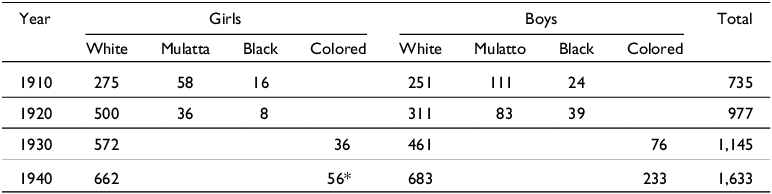
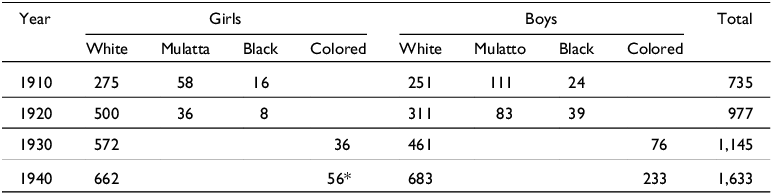
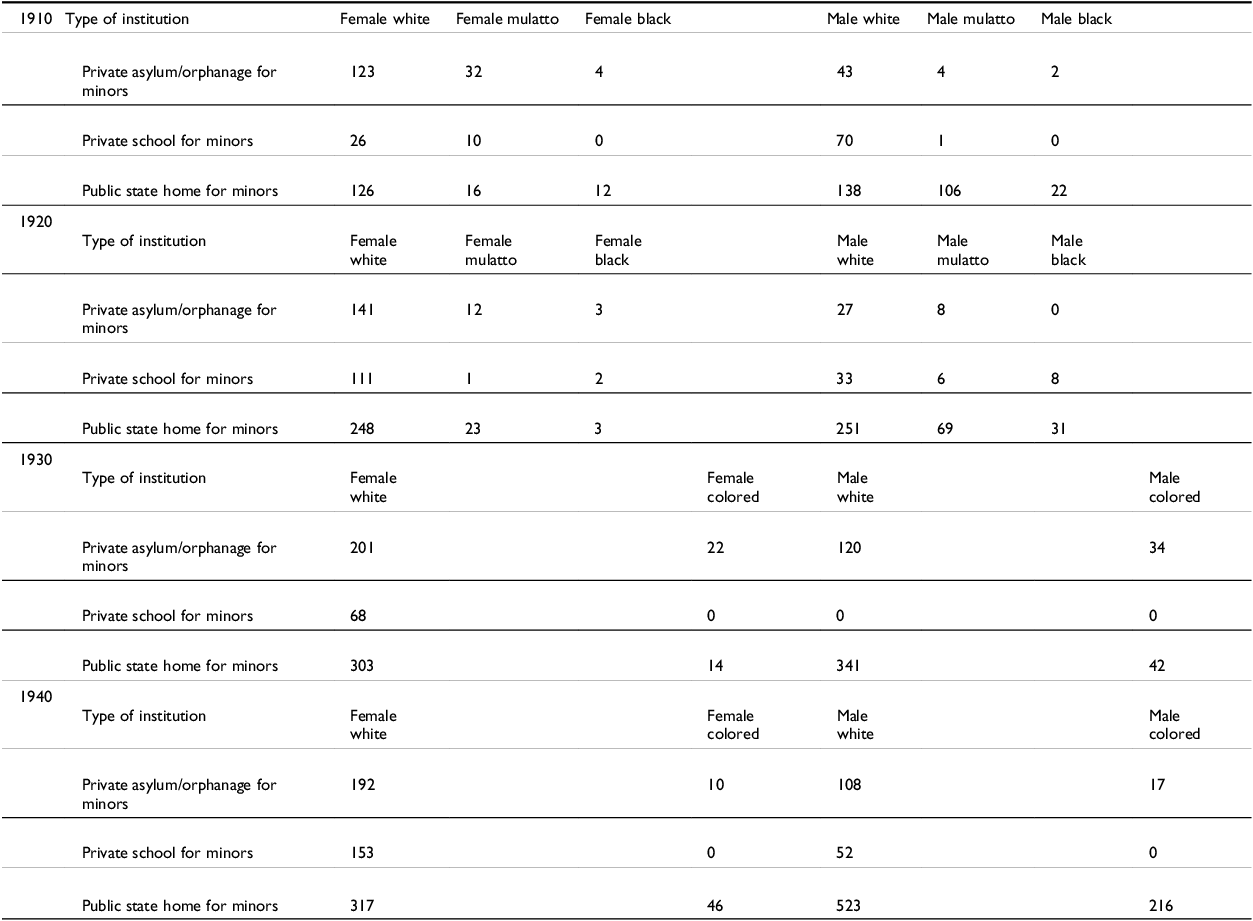
The first four decennial US censuses of the twentieth century (1910, 1920, 1930, and 1940) indicate that institutionalized minors had different experiences and opportunities shaped by gender, race, and class. Table 2 provides the total number of boys and girls institutionalized in three types of institutions explicitly founded for minors: public state homes, private asylums and orphanages, and private residential schools.Footnote 29 In 1940, 1,633 children lived in these three types of institutions, and the majority were between the ages of ten and eighteen.Footnote 30
Number of children in institutions for minors, 1910–1940, by gender and race
Source: US Bureau of the Census, 1920, 1930, 1940.
Note: Categories that are blank categories were not used in those years. In Puerto Rico, the category “Indian” could be interpreted in multiple ways. It may have been a reference to a native American (indigenous) person from the United States, a person of South Asian descent, or a Puerto Rican person of African descent with stereotypically “Indian” features, such as brown skin and straight hair (Duany Reference Duany2002).
*In 1940, one child was enumerated as “Indian.” We have included them in the “colored” category.
In what ways did the racial demographics of children in these institutions differ from those of the total population of Puerto Rico? White boys and girls were more likely to reside in one of these social welfare and education-oriented institutions than children of color. Between 1910 and 1940, as the total number of institutionalized children more than doubled from 735 to 1,634, the majority of all children residing in these institutions designed specifically for children remained white. Initially, this seems to reproduce the racial distribution of the island-wide population, where the majority of the population was enumerated as white, as shown in Table 1. However, a closer look suggests that white children were overrepresented in the population of institutionalized children, while boys and girls who were described as mulatta/o, black, or colored in the censuses were underrepresented in the institutions every census year.
For example, in 1920 and 1930, children of African descent were the most underrepresented. In 1920, while 27 percent of the island-wide population was identified as mulatto and black, only 17 percent of children in these institutions for minors were mulatto or black. In 1930, the gap between the proportion of children of color in the general and institutionalized populations was greater. Children of color represented only 10 percent of all institutionalized children, while 26 percent of the total Puerto Rican population was “colored.” White children were not simply in the majority. Rather, they were overrepresented. A closer look at race and gender by type of institution provides some preliminary explanations.
The social welfare institutions for children with the largest capacity were the public state homes, one for boys and one for girls. State homes remained the largest public institutions for children throughout the first half of the twentieth century, and such institutions received the most funding and attention from legislators. Table 3 shows that between 1910 and 1940, the number of children who entered state homes for minors more than doubled, from 420 to 1,102 asilados/as (institutionalized residents). The second-largest number of children resided in private asylums for minors or private orphanages. There were at least seven of these institutions in 1940. They had smaller occupancy and may not all have been included by enumerators. Not until February 1955, when Law #3 required the Department of Health to visit, inspect, and accredit private institutions for minors, did the full number of private institutions become officially known.

The story of private schools for minors was similar. There were many small ones, not all identified by the census. Over the decades, some closed and others opened. In 1940, there were at least eighteen private schools for children. What the censuses do not show consistently, however, is the total number of children who were boarded at such institutions. For some years, we know the number of children who resided at a private school; in others, we know only about its staff. The number of children boarded at private schools therefore varied greatly by census year. In 1910, at least 107 children were boarded in private schools. However, the census reported only 68 students in 1930 and then 153 in 1940. One of the few conclusions that we can draw with certainty from census records is that the public state homes for boys and girls were the institutions that existed over four census periods, boarded the largest number of institutionalized children on the island, and grew in capacity over time.
As mentioned earlier, any institutionalized minor was more likely to be white than a child of color. Census data allow us to be more specific. Institutionalized minors were also more likely to be white girls rather than white boys. Because the state homes for boys and girls were the largest institutions, capacity growth in those institutions had great influence over the total number of children institutionalized each year. For example, as Table 3 shows, in 1910, white boys and girls were almost equally represented (251 and 275). However, capacity at the girls’ state home doubled in 1920, expanding to 248 asiladas. In turn, the total number of white girls in institutions grew to a total of 500, reflecting the capacity change in the state home for girls, as well as growth in private asylums, orphanages, and schools. By comparison, the number of white boys in institutions in 1920 grew only slightly from the previous decade to 311. The number of white girls in 1920 and 1930 was not only larger than that of white boys; it represented around half of all institutionalized children of any gender or race. In 1940, the state home for boys increased its capacity, and as a result, white boys for the first time outnumbered the total number of institutionalized white girls (though by a mere twenty-one boys). The data suggest that the “typical” institutionalized child in private asylums, private orphanages, private schools, or public state homes was a white girl until 1930 and then a white boy in 1940.
A closer look at private institutions, rather than public state homes, also suggests that the greatest distinction between white girls and all colored children was access to private residential schools. White children, in general, had greater representation in private schools (i.e., they were overrepresented compared to their proportion in the general population), especially white girls. This indicates disparities in access to these institutions. From 1910 to 1930, the percentage of white girls in private schools increased, with 100 percent of private school minors in the 1930 census described as white girls. This figure for 1930 is unusual and might reflect gaps in the data, but the fact that white girls still comprised 74.6 percent of the private school minor population in 1940 suggests that the high representation of white girls in private education was not just a fluke. By 1940, the number of white girls in private schools had more than doubled from their numbers in 1930.
It is likely that a larger number of white girls also attended private schools for minors, even if they were not boarded. There were several segregated private institutions for white girls in 1910, including the Girls’ Christian Orphanage in Bayamón, the Peniel Mission Orphanage in Juana Díaz, and the San Ildefonso College in San Juan, all of which were exclusively white. By 1930 and 1940, private schools for girls were 100 percent segregated, serving whites to the complete exclusion of girls of color. Indeed, new racially segregated institutions for girls emerged by the 1930s, including the Inmaculada Concepción and Sagrado Corazón private schools in Santurce. The private schools may not have had racially exclusive language in their mission statements or their faculty and student handbooks, but in practice, they were for whites only. By comparison, white boys did not attend private schools in the same numbers that white girls did, although the trends of segregation remained similar. Curiously, the 1930 census recorded zero male children in any private school, and there appear to be no entries for private schools housing male children at all for that year.
White boys comprised the second-largest group of all institutionalized children, followed by boys of color. White girls and boys shared some patterns. They were the largest racial groups in the institutions for minors, and most were to be found in public state homes. From 1920 to 1940, 74 percent to 80 percent of all institutionalized white boys were housed in the state home for boys. In addition, like white girls, white boys found a second home in private orphanages and asylums, though to a much lesser extent. This is to be expected, as whites were the majority racial group in Puerto Rico and because public state homes were the institutions with the largest capacity for minors. The proportion of white boys out of all institutionalized boys corresponds to the island-wide proportions, except in 1930. In that year, white boys represented 86 percent of all institutionalized boys in nonpenal institutions for minors, while white people represented only 74 percent of the island population.
This overrepresentation of white boys in 1930 may have been due to a number of factors, including an increased capacity in some institutions, the closing of smaller institutions, and potentially a change in the identification of race/color between census years. First, the total number of white boys in public institutions for minors grew from 1920 to 1930, from 251 to 341 in the public state home for boys. At the same time, the number of boys classified as mulato or negro in the state home dropped from 100 boys to only 42 colored boys in 1930. The number grew to 341 in 1930. Second, there was a disparity in the growth of white and colored boys in private institutions. In 1920, there were only 27 white boys and 8 mulato boys in private asylums or orphanages and no negro boys. By 1930, the number of white boys quadrupled to 120 students, and the number of colored boys also roughly quadrupled from 8 to 34. Although the count of colored boys in private asylums and orphanages for minors experienced a rate of growth from 1920 to 1930 that was roughly similar to the white boys, the proportional representation was still different from Puerto Rico’s general population, indicating that even though the number of colored boys in these institutions grew at a rate similar to white boys, in the end, those boys still did not have equal access to the same institutions that white boys did.
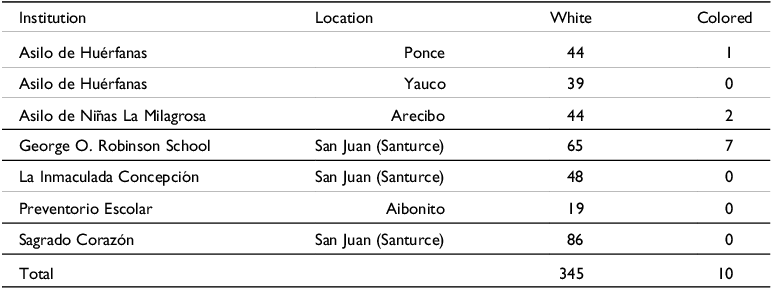
Inequalities in access over time (as roughly measured by the comparative growth of institutionalized populations in each census year) are more clearly reflected when examining individual institutions. For example, the George O. Robinson Institute in Santurce reported only girls in residence in 1920. However, by 1930, the institute had admitted forty-four boys, the great majority of whom (thirty-six) were white. Three additional institutions accounted for the growth in white boys in 1930: the Asilo de Ciegos (thirty-three) and the Asilo de Huérfanos (fifty-one) in Ponce, and the Puerto Rican Institute for Blind Children in Santurce (nineteen). The growth of institutionalized white boys between 1920 and 1930 may reflect the founding of new private institutions that increased capacity, but despite this increased capacity over the span of a decade, the proportion of colored boys in these institutions did not “catch up” to reflect the Puerto Rican population.
An additional explanation for the disproportionate representation of white boys could be the change in census race categories in the 1930 census, which abolished the distinction between mulato and negro. Children were thereafter identified as either white or colored. Comparing the 1920 to 1930 censuses again, we see that the numbers of “colored” males and females in private asylums and orphanages dropped to zero in 1930, while the numbers for the “colored” category rose (Table 3). This trend reflects the administrative abolishment of mulato or negro as categories. In support of Duany’s (Reference Duany2002) and Loveman’s (Reference Loveman2007) theses on the contested nature of the white category in Puerto Rico, enumerators may have categorized children differently than they did in 1920, moving lighter-skinned mulattos into the white category and those who could not “pass” for white into the colored category. Indeed, whereas in 1920, there were a combined 122 mulatto and negro boys in institutions for minors, by 1930, the total number of colored boys had dropped to only 76.
The overrepresentation of white children in these institutions went hand in hand with the underrepresentation of children of color. In contrast to the growth of the total Puerto Rican population, the total number of institutionalized children of color fluctuated widely year after census year. In 1910, almost 28 percent of children in public state homes, private asylums and orphanages, and private residential schools were mulatto or black. The proportion dropped to just 9.8 percent of all institutionalized children in 1930 before rebounding to 17.7 percent in 1940. In addition to the probable reclassification of light-skinned children into the white category, other factors may explain the oddly fluctuating and underrepresented proportion of institutionalized children of color.
First, white boys and girls virtually monopolized available spaces. For example, when the capacity at the girls’ state home increased in 1920, the spaces were filled by more white girls rather than girls of color. Second, the number of girls of color in private schools for minors was almost non-existent by 1920, when only three girls of color attended private schools for minors. By 1930 and 1940, there were no children of color of either gender in private schools. As suggested by the census patterns, private schools were closed to children of color by 1940.
There was a distinct gender pattern in the population of institutionalized minors of color. Boys of color were the third-largest group of institutionalized children, after white girls and boys. Over the four censuses, the gender ratio of boys and girls of color was uneven and reflected the increasing exclusion of girls of color from institutional spaces. In 1910, there were 1.8 boys of color for each girl of color. In 1920, the gender ratio was 2.8:1; in 1930, it was 2.1:1; and by 1940, it was 4.2:1. Colored girls, who were always the smallest group of all institutionalized children, almost disappeared from the records in 1940. Only 56 girls that year (of the 1,634 institutionalized children) were colored, and 46 of them were living in the public state home for girls. This is an especially low number if we consider that 25.7 percent and 23.5 percent of all Puerto Ricans were enumerated as colored in the 1930 and 1940 censuses, respectively (see Table 1).
Although all girls of color, but especially black ones (negras in 1910 and 1920), were severely underrepresented, if not totally excluded, from institutions for minors, there were a couple of exceptions. In 1910, a relatively large number of girls of color could be found in two private institutions: the George O. Robinson Orphanage and the Colegio de San Gabriel, both located in Santurce. The first institution stands out as an anomaly in all census years. In 1910, more than two-thirds of the 44 girls at the Robinson Orphanage were mulatta or black, and less than one-third were white. Although the total number of black girls in institutions for minors was very small that year (16 girls, 12 of whom were in the state home for girls, of 349 total girls), 3 black girls resided in the Robinson Orphanage. Meanwhile, also in 1910, 53 percent of the 17 girls at the Colegio de San Gabriel were mulatto, 47 percent were white, and zero were black. It was exceptional to find this many black and mulatta girls in private orphanages and asylums at all, for the norm was that private institutions for girls, like public ones, served white girls almost exclusively. Spaces for girls of color in private institutions disappeared completely in 1930 and 1940 (Table 4). Thus, while the trends in aggregate (i.e., focusing on the data from census years in general rather than specific institutions as named here) show that children of color were generally underrepresented in institutions for minors, investigation of individual institutions shows that there were some exceptions within this trend.
We can draw some early conclusions about the racial patterns of Puerto Rican children who resided in public and private social welfare and educational institutions. First, white children, but white girls, in particular, were overrepresented in public and private institutions. White boys were the second largest number of residents, and they too were overrepresented as compared to the proportion of all whites in the overall Puerto Rican population. Second, boys of color (mulatto, black, and colored, depending on the census year) were underrepresented in the public and private social welfare institutions. In fact, boys of color almost disappeared from all private schools. Third, it was the girls of color, however, who almost vanished from the institutions, an unexplainable exclusion considering that about one-quarter of the island’s population was of color. Census data does not explain this phenomenon. We do not know how admissions policies and/or biases affected children’s access to social welfare and educational institutions. Likewise, we cannot know if black parents and families preferred not to send their children to public or private institutions, given a choice.Footnote 31 We can conclude, nevertheless, that black boys were underrepresented, and black girls were excluded from those institutions that provided social welfare services to the most vulnerable children in Puerto Rico.
Correctional institutions for minors and adults
Census data show that private and public social welfare institutions for minors served mainly white children. While children of color were present, they were underrepresented, and girls of color were almost entirely excluded by 1940. In what ways were institutional services provided to children of color, if not in the public and private social welfare and educational institutions discussed in the previous section? Children and their family members may have pursued varied types of support that were not captured by census data. What the census does show, however, is that while children of color were underrepresented in private and public social welfare institutions for minors, they were overrepresented in correctional institutions for minors and adults.
Until 1940, there was only one correctional institution for minors on the island, the Mayagüez Industrial School for Boys. The term industrial school was merely aspirational. Founded in 1908, it was a school in name only. Investigations into conditions at the reformatory throughout the first half of the twentieth century documented that the institution provided no academic instruction to its students and was barely able to afford the salary of a handful of teachers. Despite the goal of providing industrial training, its workshops were ill equipped, and inmates (rather than licensed professionals) served as instructors. Indeed, the institution and its staff did not meet minimal rehabilitative or social welfare standards. In the early twentieth century, it lacked running water, its walls were crumbling, electricity was spotty, adult supervision was minimal, and the inmates were routinely locked much of the day in large galeras or sleeping quarters due to lack of staff. It was not a school but a correctional institution for minors, created under the authority and direction of the Puerto Rico Department of Corrections. It was known colloquially as la correccional, for its reputation as a penal institution rather than an educational school (Ortiz Reference Ortiz1946).
The cases of children younger than sixteen who committed crimes would be moved to the juvenile court rather than regular court. If a juvenile court judge found the minor guilty of a crime and chose to send the boy to a penal institution (rather than to release him to parents or other guardians), the boy was sent to the boys’ reformatory. The 1915 Ley de Menores stated that minors could not be sentenced to serve time in any adult correctional institution. Capacity at the reformatory, however, was always limited. In 1910, it could accommodate only seventy-five boys. Capacity grew to about two hundred boys by 1920. One reason for the overcrowding and the long delay for admission to the reformatory was that boys who began serving a penal sentence there were expected to remain incarcerated at the institution until they turned twenty years of age. They were not sent there to serve a six-month or one-year sentence, for example, as were adults sentenced to jails or the island’s prison.
As a result, la correccional was always overcrowded and understaffed. As the population of children on the island grew, the number of children and adolescents convicted of crimes also grew, and more and more boys were sentenced to serve time in la correccional. However, because capacity was limited, judges sometimes sent minors to adult jails to wait “temporarily” for a space to open up at the reformatory, the law notwithstanding. Some of the district jails had galeras de menores, or minors’ wards, where jailers tried to physically segregate children fifteen and younger from the adult general population. In addition to the boys incarcerated at the reformatory, on any day of the year, boys could be found in adult penal institutions while they waited for space to open up at the reformatory or while waiting for their case to come before a juvenile court judge. Children were routinely, if illegally, housed in municipal and district jails for months at a time. Even then, despite the intention to segregate children in the district jails’ galeras de menores, adult prisoners often interacted with minors. The entire jail population shared the rest of the institutions’ facilities, including cafeterias, bathrooms, recreational spaces, and workshops. In addition, children detained in municipal jails rather than district jails were incarcerated in the single common jail cell with adults.Footnote 32
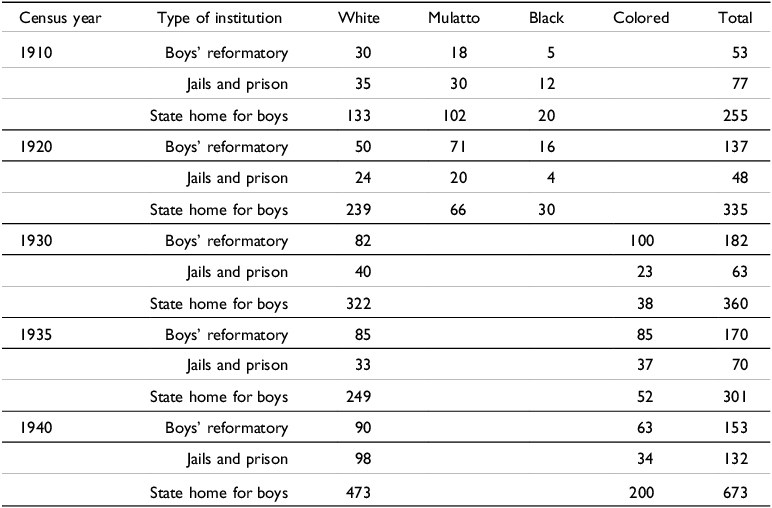
Census data allow us to look more closely at the demographic and regional patterns for boys in all public institutions—not just the public state home for boys but also the boys’ reformatory, jails, and the island’s only prison. Table 5 reports the total number of boys aged sixteen and under in public institutions for minors (the state home for boys and the boys’ reformatory) as well as adult jails and the prison. While the focus of this section is boys in correctional institutions, the table also includes information about the public state home for boys because that institution housed the largest number of boys each census year, allowing for comparison.

Number of boys in public institutions for minors and penal institutions for adults

Source: US Bureau of the Census 1920, 1930, 1940.
Notes: The age range for inmates in the boys’ reformatory and the state home for boys ranges from eight to twenty. However, the data for minors in the jails and prison is restricted to inmates sixteen and younger, because those are the ones defined as children.
As shown earlier, the public state home for boys was the primary institution for white boys. From 1910 to 1940, most institutionalized white boys (between 67.2 percent and 76.4 percent) resided in the public state home for boys. Second to the state home for boys, in 1910 and 1940, there was a higher percentage of white boys in the jails and prison than in the reformatory, though only by 2 percent or 3 percent. In 1920 and 1930, white boys were more common in the reformatory, where their percentage was double that of white boys in jails and prisons.
Boys of color had a very different experience. Relative to the island-wide racial demographics, the patterns that emerge for boys of color suggest a disproportionately higher number in correctional and penal institutions for minors and adults. Conversely, boys of color were underrepresented in nonpenal private institutions for minors and in the state home for boys. Comparing racial groups, the patterns from 1910 to 1940 are somewhat inconsistent, although we can hypothesize about differences in levels of access to social welfare versus punitive institutions.
In each census year, the proportion of white boys was by far the highest in the state home for boys, never falling below the high sixties, while the boys’ reformatory and jails and the prison lagged far behind. Compare this to mulatto and black boys, who were both consolidated into the colored category after 1920. In 1910, mulatto boys had a similar percentage distribution to white boys, where the vast majority (high of 60 percent) were in the state home, followed by jails, and last, the reformatory. By contrast, only 54.1 percent of black boys were in state homes that year. In addition, the proportion of black boys in jails was 32.4 percent, while only 17.7 percent of white boys and 20 percent of mulatto boys were incarcerated. As we do not have data from before 1910, we cannot be sure if this reflected a common trend, particularly because the black boys in 1920 were distributed somewhat similarly to white and mulatto boys.
Clearer racial differences are evident in the 1930, 1935, and 1940 censuses (the 1935 census was a special census that we discuss here to provide an additional data point for a more granular look into the trends). In these years, boys were placed into the less specific categories of white or colored. The patterns in this framework suggest that white boys had more consistent access to state homes and minimal placement in jails and prison: the great majority of white boys (67.8 percent to 72.5 percent) were placed in state homes.
Contrast this to colored boys: The patterns are much less consistent and suggest less reliable access to the state home and more placement in jails and prisons. Although the patterns are similar between white and colored boys in 1910, in 1930 and 1935, the majority of institutionalized colored boys were incarcerated in the reformatory. Unlike the white boys, the percentage of colored boys in jails and prison never dipped below 10 percent in any census year. In general, these trends suggest that boys in the “colored” census categories were more likely to be found in penal institutions (the reformatory or jails) than their white counterparts, particularly in 1930 and 1935, when the number of colored boys in the reformatory and jails outstripped the number of those in the social welfare–oriented public state home for boys.
Another pattern worth noting emerges from the racial distribution of boys in each type of institution. Penal institutions, whether for adults or minors, were the most racially integrated. That is, the number of white boys and boys of color was more equal in penal institutions than in the social welfare or educational institutions discussed earlier. For example, in 1910 and 1920, about half of the boys in adult jails and the prison were of color rather than white. In fact, white boys represented only 45.5 percent of all boys in adult correctional institutions in 1910 and 50 percent in 1920. This balance in white boys and boys of color shifted a bit from 1930 to 1940 as the roughly 1:1 ratio in jails and prison grew more unbalanced, usually with more representation for white boys. The boys’ reformatory also reflected roughly 1:1 ratios of white boys to boys of color, in contrast to the ratio in state homes, where white boys outnumbered boys of color by much larger margins. The ratio of white boys to boys of color in the reformatory hovered around 0.6 to 1.4.
The relative numbers of white boys and boys of color were comparable in the reformatory, jails, and prison. This was different from the general island population, suggesting either that white boys were underrepresented in the jails and prisons or that boys of color were overrepresented in the jails and prisons—or both. Contrast this to the ratios in the state homes: With the exception of 1910, the usual ratio of white to colored was much more lopsided, sometimes by as much as 8.5 to one in 1930. At the opposite end of the spectrum of racial integration and segregation were the private schools for girls, discussed earlier. These were always majority white and, in some years, exclusively white.
The Annual Reports of the governor and attorney general provide additional context for understanding the overrepresentation of boys of color in the reformatory in particular. District court judges sent boys to the reformatory at different rates in different years. In some years, the court of origin was almost evenly distributed between Humacao, Mayagüez, Arecibo, Ponce, and San Juan.Footnote 33 In the 1920s, however, a pattern emerged in which judges from San Juan and Ponce sent the largest number of inmates to the reformatory each year. For example, between 1920 and 1925, almost two-thirds of the inmate population at the boys’ reformatory came from San Juan or Ponce. This pattern only intensified by 1929. In that year, three-quarters of the boys at the institution had been sentenced in those two judicial districts.Footnote 34 In 1921, Attorney General Salvador Mestre suggested that “juvenile delinquency is developing more rapidly in the larger cities, and from our experience … this is not only due to the environment in which they live, which presents more opportunity for evil, but also to the carelessness of parents who fail to provide properly for their children” (Mestre Reference Mestre1922, 426). Although Mestre blamed the urban setting and neglectful parenting for the growing number of children arrested and charged with delinquency, the increase may also reflect the passage of a series of restrictive labor laws that prohibited children from legally pursuing their traditional occupations, such as laborers, servants, messengers and office boys, and traveling salesmen. Any child loitering on city streets was also likely to experience more restrictive policing, as municipalities approved local ordinances criminalizing children’s presence on public streets. What had earlier been a traditional urban recreational space for children, including local residents and runaways, became an increasingly restricted and policed public space.Footnote 35
Census data and the Annual Reports suggest, therefore, that by 1929 the reformatory was an institution dedicated primarily to incarcerating city boys from San Juan and Ponce. The community that formed there may have been one in which its members cultivated a shared identity as urban residents, and more specifically, as boys from San Juan or Ponce. A closer look at the cities of origin in the 1940 census reveals more detail about the racial demographics of the boys at the reformatory. In that year, 59 percent were identified as white and 41 percent as colored. However, when we compare race and municipality of origin, we find that 47 percent of all colored inmates came from the larger San Juan metropolitan area. Significantly, out of that group of colored boys from San Juan, 30 percent were from the municipality of Santurce, a predominantly black, urban, working-class area. Another 9 percent of the boys of color were from Río Piedras, 8 percent from San Juan proper, and 3 percent from Bayamón. Indeed, the largest number of all inmates, both colored and white, came specifically from Santurce. One-third of all white boys at the reformatory also originated from Santurce.Footnote 36 The reformatory, therefore, was not just an institution where city boys from San Juan and Ponce were incarcerated. It was the only penal institution for minors on the island and an institution for minors where African-descended boys from urban areas were overrepresented. The 1940 community of boys in the reformatory reflected the criminalization of poor black boys in the cities, but especially those from largely black working-class areas such as Santurce.Footnote 37
Conclusion
Census data undo cultural historical narratives about the gran familia puertorriqueña and racial harmony, myths that have silenced, minimized, and dismissed the history of unequal racialized childhoods. Census data—at the level of institutions and of individual persons—document the starkly racialized and gendered demographic patterns for institutionalized and incarcerated children from 1910 to 1940.
Censuses show that while some children were able to take advantage of private and public residential social welfare institutions and private boarding schools, others were excluded and criminalized. The majority of institutionalized children in the public state homes for boys and girls as well as private orphanages, shelters, asylums, and residential schools, were white. Compared to the racial distribution in the broader island population, white children were overrepresented in social welfare and residential schools for children. Both genders were almost equally represented in the total number of institutionalized white children. However, differences emerged in the 1940s, when the capacity of the state home for boys increased. While the majority of white boys and girls lived in the public state homes for children, white girls, in particular, had more housing options than white boys, and more of them were likely to live in private social welfare institutions. Indeed, almost half of institutionalized white girls were living in private orphanages, shelters, and asylums for minors. Private social welfare institutions also favored white boys. Colored boys (mulatto and black) rarely found a place in those private institutions.
Class, in addition to race and gender, helps explain the greatest distinctions in the experiences of white and colored children. First, we may assume that the majority of children in public and private social welfare homes for children were located at the bottom of the class hierarchy. It is noteworthy, therefore, that even within the category of “poor children,” we can identify racial differences. Race always mattered, even for poor children. Second, it should come as no surprise that private residential schools, largely the realm of elite white families, served almost exclusively white students. Indeed, many of the private schools for girls were fully segregated, white-only spaces.
The story of children of color, both boys and girls, is one of underrepresentation and exclusion. Boys, in particular, followed a specific pattern. First, they were the third-largest group in nonpenal institutions for minors. The only institution for minors that admitted colored boys was a public one (the state home for boys). Colored boys were completely excluded from private high schools, likely a reflection of the small number of colored families who had the means or cultural capital to send their children to private educational institutions. Just as likely, their exclusion reflects the ways in which staff at those private schools enforced racial segregation and policed white spaces. Third, correctional institutions were the only places where the number of mulatto and black, or colored, children outnumbered whites at any time. Mulatto, black, and colored boys were overrepresented in penal institutions for minors and adults compared to white boys in the same institutions and in the social welfare-oriented state home for boys. These patterns allow us to conclude that racial heterogeneity in the institutionalized population of minors was more common in penal institutions and that poor colored boys were likely to be excluded even from those spaces where the most defenseless could purportedly find refuge.
While colored boys were underrepresented in social welfare institutions and overrepresented in correctional ones, colored girls were increasingly excluded from private institutions in the 1930s and 1940s. In the years in which censuses differentiated between mulatas and negras, we find that black girls represented about two percent of all institutionalized children in 1910. In 1920, they represented only 0.9 percent. To be clear, 4.5 percent and 3.8 percent, respectively, of all Puerto Ricans were identified as black in those two census years. Girls who were part of that minority population rarely found refuge in either public or private institutions for minors. Some black girls might have lived with extended family or found employment as colocadas in private homes or small businesses in return for shelter and food, but direct evidence to support this is lacking. They may simply have been left on their own. We hope that, in the future, scholars prioritize the history of black girls and women in Puerto Rico and help explain our finding that they were excluded from public and private institutions for minors.Footnote 38
In the first half of the twentieth century, racism, racial segregation, and racial inequality thrived in Puerto Rico. This statement should not be controversial. Rather, it should resonate with the history of all other multiracial Latin American and Caribbean countries that share a history of racial slavery. Everyday uses of race may have varied in Puerto Rico and the United States, with the more expansive and inclusive use of the white category throughout the archipelago. That fact does not override or erase the discrimination, inequality, segregation, and limited opportunities that African-descended children like Roberto faced in Puerto Rico, even in comparison to other children who were also poor and in need of private and public social welfare-oriented services and institutions.

 Open access

