





Introduction
In late 2011 and early 2013, the so-called ‘Six-Pack’ and ‘Two-Pack’ – legislative packages on economic and financial governance in the European Union (EU) – entered into force. Concluded in 405 and 545 days, respectively, the two packages were decided more quickly than the average 639 days of law-making. They responded directly to a fast-developing crisis, related to the eurozone and sovereign debt, and were agreed under political pressure, from the European Council and from across the EU’s member states (Bressanelli and Chelotti Reference Bressanelli and Chelotti2016).
We know from case study research that the European Council regularly intervenes in EU law-making. Case studies offer rich qualitative accounts of high-profile and salient cases. By contrast, we ask and analyse under what conditions the European Council can accelerate everyday law-making more generally. Empirically, we look at EU legislative proposals that were concluded or pending between July 1999 and August 2024. Theoretically, we argue that priorities by national heads of state or government carry political authority in the EU’s system of multi-level politics. Authority should translate into limited hierarchical relations between national leaders and the co-legislating Council of the EU (Council) and the European Parliament (EP). Two conditions should particularly strengthen limited hierarchy: the European Council’s formal institutionalisation and crisis politics. Our causal argument builds on the mobilisation and use of political resources in decision-making, on reduced transaction costs, and on the leaders’ leveraging of EU-level authority to the co-legislators and to domestic audiences.
The European Council became an official EU institution in late 2009. Yet, from the 1960s to the present-day, national leaders have shaped the Union’s development – be that through strategic decisions (not) to integrate, crisis management, or enlargement.Footnote 1 The current treaty states that the European Council shall provide ‘necessary impetus’ and ‘define’ the EU’s ‘general political direction and priorities’ (art. 15(1) TEU). The leaders do so in formal and informal summits that produce conclusions. These conclusions present the leaders’ agreed positions on the societal, economic, and policy issues that matter for the EU; the leaders also ‘mandate’ the EU’s institutions and the member states to act on individual pieces of legislation (see Figure 1).
European Council summits and legislation under OLP in the conclusions, over time.
Note: For 2024, the last summit included took place in Brussels on 27 June 2024.

This is puzzling. Law-making is the domain of the European Commission, the Council, and the EP. Nonetheless, summit conclusions explicitly mention legislative initiatives and proposals, proposals under co-decision, and the implementation of adopted laws; routinely, conclusions mandate the EU’s other institutions and the member states to act on these specific pieces. In this study, we focus on mentions of proposed legislation and ask why the priorities, addressed at the co-legislators – the Council and the EP – should ‘speed up’ the legislative process.
Previous studies show us leaders keen to impose their views on legislation, often with wider implications for European integration (e.g., Bressanelli and Chelotti Reference Bressanelli and Chelotti2016; Maricut Reference Maricut2016; Van Middelaar Reference Van Middelaar2019). This may be the case, too, for everyday law-making. But what are the conditions of the European Council’s actual influence over the speed of decision-making?
Our study addresses this question. More specifically, we ask under what conditions the European Council’s priorities, expressed in summit conclusions, affect the duration of the ordinary legislative procedure (OLP, or co-decision). The term ‘priority’ refers to the mention of a specific piece of legislation by the leaders, in their agreed conclusions, often combined with a mandate to the co-legislators. To develop our argument, we use scholarship on institutionalisation and crisis politics in a context of multi-level negotiation. We propose that the conclusions’ priorities translate into collective leadership that works through the European Council’s political authority. We analyse how political authority produces a limited hierarchical relationship between national heads of state or government and the EU’s co-legislators. Two conditions should strengthen such hierarchy: institutionalisation and crisis politics. First, in late 2009, the Lisbon Treaty turned the European Council into an official EU institution. The European Council gained more centralised formal leadership and Brussels-based bureaucratic resources that contribute to translating priorities ‘downstream’ into EU decision-making. Second, even in crisis, responses must operate through established everyday law-making, because the EU lacks crisis-specific procedures and capacities.Footnote 2 Nevertheless, the Union must react quickly as well as adequately, which allows the European Council to leverage leadership and political authority – horizontally to the co-legislators and vertically to domestic audiences.
To test our argument, we built a dataset that includes information on 2,139 pieces of EU legislation, concluded and pending between July 1999 and August 2024. We link these data to newly collected information on the European Council’s legislative priorities as expressed in summit conclusions. To better understand the process behind the drafting of conclusions and their potential downstream effects, we conducted semi-structured elite interviews in Berlin, Brussels, and online, in 2023. Our interviews with 20 current and former (senior) officials, advisers, and politicians across EU institutions, permanent representations, national administrations, and governments give us in-depth insights into the European Council’s priority-setting. We use interviews and policy documents to describe how leaders mention laws and use mandates; doing so also allows us to explore the potential mechanisms behind our argument. Interviews give us diverse long-term bureaucratic, institutional, and political perspectives on how national leaders matter in EU law-making.
Our empirical results suggest that the European Council is able to influence the speed of the EU’s legislative process, but primarily in early parts of the co-legislative stage. Moreover, the effect is most pronounced in the post-Lisbon period. Importantly, proposals related to crisis take significantly less time to be concluded. Yet, the faster pace of crisis laws is not due to the leaders’ political pressure. These findings contribute to the literature in several ways.
First, we develop a theoretical argument about collective leadership, political authority, and limited hierarchy (e.g., Blondel Reference Blondel1987; Tallberg Reference Tallberg2006; Elgie Reference Elgie2015). To do so, we use approaches to institutionalisation and crisis politics in a context of multi-level negotiation (e.g., Putnam Reference Putnam1988; Tallberg Reference Tallberg2006; Schimmelfennig Reference Schimmelfennig2020). Institutionalisation and crisis politics build on the mobilisation and use of political resources in law-making (e.g., Cross and Vaznonytė Reference Cross and Vaznonytė2020) and on the leverage of EU-level authority to the co-legislators and domestic audiences (e.g., Bressanelli, Koop and Reh Reference Bressanelli, Koop and Reh2020). Analytically, we focus on the conditions through which hierarchical relationships emerge and strengthen in multi-level negotiations. As such, our argument will be applicable in other multi-level systems, too, when political leaders intervene in day-to-day decision-making.
Second, we connect the scholarships on the European Council and legislative duration. To do so, we analyse laws adopted and pending under the EU’s co-decision procedure. When co-decision was introduced, scholars (as well as politicians) were concerned about the potential impact on duration: from then on, the EU’s co-legislators had to agree, which risked slowing down law-making (Shackleton Reference Shackleton2000; Golub Reference Golub2007). Against this backdrop, scholars on EU legislative politics frequently use duration to measure efficiency. The debate falls into four camps. One of the earliest systematic studies looked at consultation, co-operation, and co-decision and showed that formal institutions – majority voting and parliamentary powers – played a key role for duration (Schulz and König Reference Schulz and König2000). Subsequent work further analysed the impact of qualified majority voting (e.g., Golub and Steunenberg Reference Golub and Steunenberg2007) and explored the effect of treaty change (Bølstad and Cross Reference Bølstad and Cross2016). In addition, the literature has looked at issue-specific features, such as policy field, complexity, novelty, legislative instruments, and the salience of a bill for the rotating Council presidency (e.g., Schulz and König Reference Schulz and König2000; Cross and Vaznonytė Reference Cross and Vaznonytė2020; Hurka and Haag Reference Hurka and Haag2020). Scholars have also analysed governance and political factors, in particular, the consultation of stakeholders, within decision-making, and assessed the impact on the transaction costs of finding legislative agreement (e.g., Rasmussen and Toshkov Reference Rasmussen and Toshkov2013; Chalmers Reference Chalmers2014). Finally, the debate has discussed ideological preferences within and across the co-legislators (e.g., Klüver and Sagarzazu Reference Klüver and Sagarzazu2013). We add the leaders’ priorities expressed in summit conclusions, and their impact on duration, to the debate about legislative efficiency.
Third, in contrast to the quantitative scholarship on duration, the literature on the European Council itself has focused on long-term development (e.g., de Boissieu et al. Reference De Boissieu, Cloos, Christoffersen, Middelaar, Keller-Noëllet, Milton, Roger, Blanchet, Galloway and Gillissen2015; Wessels Reference Wessels2016; Werts Reference Werts2021); conducted in-depth analysis, thick description, and case studies of specific (salient) issues (e.g., Bressanelli and Chelotti Reference Bressanelli and Chelotti2016; Maricut Reference Maricut2016; Ripoll Servent Reference Ripoll Servent2019; Smeets and Beach Reference Smeets and Beach2023); and analysed the intergovernmental impetus that the leaders’ growing role has brought to the EU’s political system (e.g., Puetter Reference Puetter2014; Puetter and Fabbrini Reference Puetter and Fabbrini2016; Van Middelaar Reference Van Middelaar2019). So far, only a few academic pieces have developed and tested systematic arguments about the European Council’s role in law-making (Alexandrova, Carammia and Timmermans Reference Alexandrova, Carammia and Timmermans2014; Bocquillon and Dobbels Reference Bocquillon and Dobbels2014; Carammia, Princen and Timmermans Reference Carammia, Princen and Timmermans2016) and about the actor’s impact on inter-institutional relations and the EU’s constitutional settlement (e.g., Fabbrini Reference Fabbrini2013; Bickerton, Hodson and Puetter Reference Bickerton, Hodson and Puetter2015; Kassim Reference Kassim2023). Our analysis of the European Council’s collective leadership – that drives a more effective use of resources in law-making and crisis-responses – adds to the debate by theorising and investigating the leaders’ conditional influence on the duration of co-decision.
Our paper proceeds as follows. The next section builds our theoretical argument. The third section introduces our data and mixed-methods design, before the fourth section presents our empirical findings. The final part concludes and discusses our paper’s broader implications.
The argument: the European Council’s influence on law-making
EU law-making – and especially the now dominant bicameral co-decision process – plays out in a complex context. As agenda-setter, the Commission proposes legislation. As co-legislators, the Council and the EP amend and adopt laws. Co-decision is multi-issue, covers most EU policy areas, and tackles key challenges. Co-decision is also multi-level. EU law must be implemented in all member states, and legislation affects almost 450 million citizens in 27 countries, with different socio-economic backgrounds, political interests, and public preferences. According to the EU’s founding treaty, the European Council shall ‘provide the Union with the necessary impetus for its development’ and ‘define the general political directions and priorities’ but ‘shall not exercise legislative functions’ (art. 15(1) TEU). Why, then, should we expect the European Council to impact on everyday law-making?
In a nutshell, we argue that the European Council should speed up law-making through collective leadership. Leadership is conceptualised in different ways, across disciplines. Our definition focuses on influence and power. We follow scholars of (international) negotiation and political leadership who conceptualise leadership as the ‘asymmetrical relationship of influence’ of an individual or an institution on the behaviour of another actor or actors (Underdal Reference Underdal and Zartman1994: 178; see also Young Reference Young1991). At the national level, political leadership is defined as ‘the power exercised by one or a few individuals to direct members of the nation’ (Blondel Reference Blondel1987: 3). The authority of leaders should be particularly strong in complex multi-level settings (Blondel Reference Blondel1987). In complex negotiations, leadership aims to address collective action problems in the search for joint gains (Young Reference Young1991: 285; Tallberg Reference Tallberg2006: 17). Scholars focus on and debate the roles and the interaction of individuals (personality) and the environment (context) in which leadership operates (for an excellent overview, see Elgie Reference Elgie2015, chapters 1–2).
We study how the European Council’s collective leadership affects the behaviour of the EU’s co-legislators, under different contextual conditions. Co-decision is a legislative negotiation in which actors, again and again, search for joint gains. During co-decision, heads of state or government attempt to lead through political authority, channelled via EU-level summits and conclusions. Clearly conveyed through legislative priorities, political authority should translate into limited hierarchical relations between national leaders and EU-level co-legislators. Limited hierarchy should be further strengthened through institutionalisation and political interaction in crisis. Hierarchy works through the mobilisation and use of resources, reduced transaction costs, and leaders’ EU-level authority that impacts on the co-legislators and on domestic audiences. We measure the effectiveness of collective leadership via the duration of co-decision.
Our argument makes four assumptions. First, we study the impact of agreed summit conclusions. We therefore assume that the European Council leads – and, thus, exercises influence over co-decision – as a collective actor. Second, as ‘the most senior political representatives’ of their governments (Fabbrini and Puetter Reference Fabbrini and Puetter2016: 483), national leaders exercise – and have an interest in exercising – political authority (Van Middelaar and Puetter Reference Van Middelaar, Puetter, Hodson, Puetter, Saurugger and Peterson2022: 66–71). Third, member states and their bargaining leaders are largely rational and behave instrumentally. This is also the case for eurocritical leaders, who depend on (market) integration and (fiscal) support for the functioning of their governments (Kelemen Reference Kelemen2020). Finally, in their summits, leaders hold collective responsibility and aim to reconcile non-aligned individual preferences. Their negotiations try to reach compromise and are shaped by enabling and constraining rules (Tallberg Reference Tallberg2006: 17).
The European Council’s priorities
The European Council depends on the European Commission, the Council, the EP, and the member states to turn priorities into policies. When the leaders agree that a specific law should be proposed, acknowledged, decided, or implemented, they mention the law in their agreed conclusions and, often, mandate the EU’s institutions and the member states. In this piece, we look at duration. We therefore focus on legislative decision-making, not on legislative agenda-setting, and we restrict the priorities analysed accordingly.
The term ‘mandate’ is used widely in comparative politics, international relations, and public administration (e.g., Thorvaldsdottir, Patz and Goetz Reference Thorvaldsdottir, Patz and Goetz2022) but is not systematically defined. A mandate can be a statutory set of rules that empower and limit an agency (Cohn Reference Cohn2001: 472); it may also be politically rather than legally binding. Popular mandates are central in democratic politics, as they determine the scope of action of elected politicians, applied to policies, leaders, or political parties (e.g., Hershey Reference Hershey1994). In turn, a ministry can mandate representatives on the international stage, for instance, to conduct a specific mission. A mandate can also formulate loose expectations, for instance, in exploratory diplomatic talks. We define a mandate as the call for action that accompanies the mention of a proposed law in agreed summit conclusions. In combination, a mention and a mandate express the European Council’s legislative priority. Mandates are specified, in writing, in conclusions – official documents published after each formal meeting as ‘instruments for political leadership’ (Wessels Reference Wessels2016: 72–75). Mandates empower actor(s) and give two types of politically – but not legally – binding tasks. First, leaders instruct. Instructions signal the need to work, to work more, or to work faster. Second, leaders give discretion. By showing their own priorities, they signal to the co-legislators that they have the right, the space, and the leaders’ support to work on specific laws.
Why should the Council and the European Parliament follow the European Council?
We propose that the European Council is a collective leader that influences the co-legislators through political authority. Authority, in turn, translates into relationships of limited hierarchy.
First, individual heads of state or government are democratically elected at the national level. They lead the government, and political authority, ultimately, stems from them (Ferrera, Kriesi and Schelkle Reference Ferrera, Kriesi and Schelkle2024: 713). The European Council is a multi-party coalition. In 2025, the institution brought together heads of conservative, socialist, liberal, and right-wing governments. Over the past decades, democracies have ‘presidentialised’ (Poguntke and Webb Reference Poguntke, Webb, Poguntke and Webb2005). Presidentialisation has happened independently of formal regime-type. This means that parliamentary, presidential, and semi-presidential systems are all affected. The leaders’ national autonomy has grown accordingly – within the executive, within political parties, and through demands coming ‘down’ from international negotiations (Poguntke and Webb Reference Poguntke, Webb, Poguntke and Webb2005: 5, 13–14).
Under co-decision, this process should affect ministers, who negotiate legislation – based on national positions – in the Council of the EU. We expect that ministers follow their national heads for several reasons. To begin with, political authority should be particularly effective if the leaders use multi-level negotiations to take political and economic preferences ‘up’ to the EU-level and back ‘home’ (cf Putnam Reference Putnam1988). In addition, to boost domestic political careers, ministers aim to perform well, including in EU-level negotiations. This should be the case in particular when ministers negotiate legislation mentioned by their national heads in the European Council conclusions, even if heads and ministers are from different political parties in a coalition government (see Martin Reference Martin2004: 447–450). We argue that leaders’ authority runs all the way down to the Committee of Permanent Representatives (Coreper) and working groups. EU ambassadors and national officials are seconded, for a specific time, by their countries; they, too, negotiate based on instructions from their home ministries (Naurin Reference Naurin2015). In sum, we expect that EU-level negotiators aim to signal success to their heads of state or government as well as their seconding and instructing ministries. Therefore, the Council should speed up decision-making on laws prioritised by the European Council and should do so across all levels.
We propose that the effectiveness of political authority rests on resource mobilisation and use. The literature argues that issue salience, in general, and policy salience for the rotating Council presidency, in particular, affect legislative power and efficiency (Cross and Vaznonytė Reference Cross and Vaznonytė2020: 661–662; see also Arregui and Thomson Reference Arregui and Thomson2009; Costello and Thomson Reference Costello and Thomson2013). The underlying argument is resource mobilisation (Cross and Vaznonytė Reference Cross and Vaznonytė2020: 661–662; 675). Resources include the time individual legislators need to investigate a proposal, the inter- and intra-institutional meetings required to broker a deal and to reach a compromise, and the availability of rooms, translation, and legal services that facilitate negotiation (see Hartlapp, Metz and Rauh Reference Hartlapp, Metz and Rauh2014: chapters 2, 12; Smeets and Beach Reference Smeets and Beach2023). These limited resources are not allocated on a ‘first come first served’ basis. Instead, allocation depends on political choice, because the co-legislators must prioritise some pieces of legislation over others to reach timely decisions on policy-problems (Schulz and König Reference Schulz and König2000: 656I; Rasmussen and Toshkov Reference Rasmussen and Toshkov2013: 371). We argue that a European Council priority increases the perceived urgency, for negotiators across all Council levels, of the legislative proposals mentioned; this ‘unlocks’ resources required for efficient – speedier – law-making.
The relationship between the European Council and the European Parliament is more complicated and conflictual, especially as both institutions can (and do) claim a popular mandate (Rittberger Reference Rittberger2003; Puetter Reference Puetter2014: chapter 3). The EP’s leadership regularly picks up on and strongly criticises the European Council’s activism during law-making. For instance, a 2019 EP resolution stresses that summit conclusions ‘are political in nature and that Article 15(1) of the TEU prohibits the European Council from exercising legislative functions’; the resolution also ‘calls on the European Council to refrain from adopting detailed and purportedly binding conclusions’ (European Parliament 2019). Yet, heads of state or government are accountable to their national parliaments, not to the EP, and their decisions do not need EP approval (Fabbrini Reference Fabbrini2015).
We argue that the EP follows the European Council for several reasons. First, some specified inter-institutional cooperation exists. During each summit, the European Council hears the views of the EP President as a first agenda point. After each summit, the European Council President attends parliamentary plenaries to explain the summit’s outcome and conclusions (European Council 2009: art. 5). Even though the EP cannot hold the European Council politically accountable, such inter-institutional cooperation increases the information flow from and to the parliament (Akbik and Dawson Reference Akbik and Dawson2025).
Second, national and European political parties cooperate and interact. National heads usually lead parties in their home countries. The same holds true for leaders of the opposition. Pending successful election, they will join the multi-party European Council as a prime minister or president. National parties play a key role in choosing candidates for European elections. Electoral systems and rules of candidate selection differ across member states (Carey and Shugart Reference Carey and Shugart1995). Nevertheless, national parties are crucial for the careers of Members of the European Parliament (MEPs) (Hix Reference Hix2004; Koop, Reh and Bressanelli Reference Koop, Reh and Bressanelli2018). MEPs, in turn, belong to both a national and a transnational political party. This argument links levels of governance in the EU’s multi-level system. But political parties also connect across institutions.
Indeed, like their national heads, negotiating co-legislators are policy-seekers (Hix, Noury and Roland Reference Hix, Noury and Roland2007). They are driven by national and ideological preferences and guided by the need to compromise across issues and across legislative chambers (Obholzer Reference Obholzer2014; Broniecki, Obholzer and Reh Reference Broniecki, Obholzer and Reh2025). Scholars have shown that ideological proximity and distance matter both in the search for legislative compromise (Hagemann and Høyland Reference Hagemann and Høyland2010) and for the duration of law-making (Klüver and Sagarzazu Reference Klüver and Sagarzazu2013). We argue that these preferences are shaped by national parties, which are, in turn, led by the head of state or government or by the head of the opposition. Finally, party networks matter strategically in and around the European Council (Bardi et al. Reference Bardi, Gagatek, Germond, Johansson and Kaiser2020; see also Tallberg and Johansson Reference Tallberg and Johansson2008). Overall, political parties link across the EU’s levels of governance and across the EU’s institutions. They play a key role for supranational careers as well as for preference-building and the search for compromise in bicameral law-making. Therefore, cooperation across political parties should contribute to accelerating the legislative process.
In sum, the European Council holds different relationships with the co-legislators. Yet, both relationships spring from political authority and entail limited hierarchy. We therefore submit:
H1: Legislative proposals that are prioritised by the European Council are concluded more quickly than proposals that are not prioritised.
The effect of H1 is likely to be strengthened under two conditions: the European Council’s formal institutionalisation in late 2009, and decision-making under crisis.
The post-Lisbon period
When the Lisbon Treaty entered into force, the European Council became one of seven official EU institutions. Yet, Europe’s national heads had played on the supranational stage well before. Since 1961, prime ministers and presidents have gained an increasingly important role in integration, and their ever more regular – ordinary, extraordinary, informal – summits have become widely visible (Bickerton, Hodson and Puetter Reference Bickerton, Hodson and Puetter2015; Van Middelaar and Puetter Reference Van Middelaar, Puetter, Hodson, Puetter, Saurugger and Peterson2022: 54–56).Footnote 3 In line with leadership and bargaining theory, we argue that the European Council’s formal institutionalisation increases the possibility of effective collective leadership. Extended resources at the supranational level are the underlying mechanism, because resources reduce the transaction costs of finding agreement on conflictual issues. These resources are not only available to the European Council; they translate ‘down’ into the everyday legislative process.
In December 2009, art. 15 (5)(6) TEU (sitting under Provisions on Institutions), and its Rules of Procedure formally equipped the European Council with a permanent chair and strengthened Brussels-based bureaucratic support. We argue that such a rule change matters, because the agenda, brokerage, and representation functions of the chair and secretarial support (Tallberg Reference Tallberg2006: chapter 2) reduce the transaction costs of reaching compromise and of finding consensus on conflictual policy issues (Rasmussen and Toshkov Reference Rasmussen and Toshkov2013: 373, 382).
First, the European Council now has a permanent chair, elected by heads of state or government via qualified majority for a (renewable) period of 2.5 years. The chair – or president – is a member of the European Council, without a vote, and commands the leadership role previously held by the head of the rotating EU Council presidency (see Cross and Vaznonytė Reference Cross and Vaznonytė2020: 658–661 for an overview). Following Tallberg (Reference Tallberg2006: 19–29), we propose that formal leadership is institutionally designed to address collective action problems in decentralised bargaining.
To begin with, in complex multi-issue negotiations, a formal chair mitigates potential agenda failure in meetings (Tallberg Reference Tallberg2006: 21–24). Since Lisbon, the European Council president – supported by their cabinet – has prepared, tabled, and led on the summit’s agenda, timetable, and conclusions; doing so fulfils the European Council’s ‘process management’ functions (Beach and Smeets Reference Beach and Smeets2020: 840; see also Cloos Reference Cloos2022; Christiansen and Vanhoonacker Reference Christiansen and Vanhoonacker2025). Furthermore, before, during, and after negotiations, formal leadership responds to the functional need for brokerage (Tallberg Reference Tallberg2006: 24–27). Information about national preferences is crucial (Tallberg Reference Tallberg2006: 25). Institutionalised multi-level preparation gains the chair such information. Face-to-face negotiations about laws in conference committees reduce transaction costs (Rasmussen and Toshkov Reference Rasmussen and Toshkov2013: 374). Similarly, the knowledge about national preferences allows the chair to narrow the agenda, propose compromises to accommodate participants, and identify possible zones of agreement as well as persistent conflict (Tallberg Reference Tallberg2006: 24–25). Agenda management and brokerage are relevant in European Council summits that are driven by ‘consensus-seeking and problem-solving’ (European Council 2009: art. 6(1); Van Middelaar and Puetter Reference Van Middelaar, Puetter, Hodson, Puetter, Saurugger and Peterson2022: 56). Finally, the president and their cabinet run the follow-up after summits; they do so across negotiation levels in the Council (Cloos Reference Cloos2022). Such delegation to the president resembles what leadership theory calls ‘representation’, namely the need to deal with ‘multilateral bargaining in one area or body [that] is nested within broader processes of negotiation’ (Tallberg Reference Tallberg2006: 27; 27–29). We argue that nesting, which plays out inter-institutionally in international negotiations, also takes place intra-institutionally, in EU law-making. In this process, the European Council chair holds a key leadership role.
Second, the European Council has become Brussels-based and enjoys greater bureaucratic support. Like international organisations, the European Council has a secretariat (Manulak Reference Manulak2017): the General Secretariat of the Council. The Secretariat supports the European Council, the Council, Coreper, and working group negotiations. In 2003, national heads stopped ‘touring’ cities and regions of the Council presidency country. Brussels became the capital of formal summitry. Post-Lisbon, the president, their cabinet, and the supporting staff from the General Secretariat jointly moved into the Europa building; completed in 2016, the building is located in the midst of the EU headquarter (Christiansen and Vanhoonacker Reference Christiansen and Vanhoonacker2025). The Secretariat assists the European Council President and the leaders themselves. As highest-ranking Council official, the Secretary General attends summits, and the Secretariat supports the European Council President in drafting, tabling, discussing, and revising conclusions. These tasks correspond to the Secretariat’s role in EU decision-making: as a Brussels-based permanent bureaucracy, the Secretariat is designed to provide advice, process experience, legal expertise, knowledge, and institutional memory (Beach and Smeets Reference Beach and Smeets2020: 840; Christiansen and Vanhoonacker Reference Christiansen and Vanhoonacker2025).
Yet, the Secretariat’s dual role – supporting the European Council and the Council of the EU – is even more important for our argument. The Secretariat assists in ‘translating’ the summit conclusions into everyday law-making, across the Council’s hierarchies, to ministers, permanent representatives, and national officials; the Secretariat focuses, in particular, on the rotating presidency at all negotiation levels. Against this backdrop, we argue that the General Secretariat facilitates the European Council’s collective leadership by providing the necessary bureaucratic resources and support – all the way down from summits to working groups.
In sum, the European Council’s formalisation stabilises and strengthens the leaders’ collective political authority. We therefore submit:
H2: The impact of the European Council’s legislative prioritisation on the duration of law-making is particularly strong post-Lisbon.
Crisis
The past decade has turned the European Council into a ‘semi-permanent’ institution for crisis coordination, with leaders as active ‘crisis managers’ (e.g., Fabbrini Reference Fabbrini2015; Van Middelaar Reference Van Middelaar2019).
We define a crisis as the political follow-up to an event that combines three features. First, the regular policy process is interrupted by a shock (Alexander-Shaw, Ganderson and Kyriazi Reference Alexander-Shaw, Ganderson and Kyriazi2023: 5–8). Shocks are related to politics, economics, or security; they can be EU-internal or international. Shocks expose the deficiencies and failures of a policy regime created by earlier EU-level decisions (not) to integrate (Schimmelfennig Reference Schimmelfennig2018: 970–977). Second, decision-making in crisis is open, urgent, exceptional, and uncertain (Schimmelfennig Reference Schimmelfennig2018: 969). In crisis, national heads are particularly visible at the EU-level, through summits, political speeches, and press conferences. They dominate headlines, play symbolic politics, and command media attention (Van Middelaar Reference Van Middelaar2019: 14; Beach and Smeets Reference Beach and Smeets2020: 838; Scotto di Vettimo Reference Scotto di Vettimo2025). Third, across member states, intergovernmental conflict over distributional costs and gains increases with but varies across crises (Schimmelfennig Reference Schimmelfennig2018: 970–978). In a crisis, electorates, the media, and political elites are fully aware of the European Council’s attempt to address urgent policy challenges and see crisis output (or the lack thereof). The European Council’s (attempts at) crisis-response should strengthen the leaders’ political authority and deepen hierarchical relations – horizontally, with the co-legislators and vertically, with domestic audiences.
When the stakes are very high, as they are in crises, only national leaders have the political capital to initiate solutions. As Bocquillon (Reference Bocquillon2024: 568) puts it, the European Council is ‘the only institution with the political clout, resources, and legitimacy to provide solutions to […] urgent challenges’. Crises often feature as ‘focusing events’ on the European Council’s summit agendas and negotiations (Carammia, Princen and Timmermans Reference Carammia, Princen and Timmermans2016; Alexandrova Reference Alexandrova2017; Van Middelaar Reference Van Middelaar2019). In crises, too, the EU co-decides, because the Union lacks crisis-specific procedures and capacity (Van Middelaar Reference Van Middelaar2019: 10–14; 21–63). Instead, political urgency translates into leaders’ priorities, expressed in summit conclusions, on crisis-related proposals. Leaders who attempt to address a crisis will also clearly and directly appeal to the responsibility of EU institutions – the EP in particular – not to challenge policy solutions initially proposed by the European Council and subsequently endorsed by ministers (Bressanelli and Chelotti Reference Bressanelli and Chelotti2016). This process will move the EU institutions ‘under the shadow’ of the European Council; put ministers and MEPs under pressure to follow the leaders’ instructions; and limit the co-legislators’ policy independence. Political speeches and the academic literature show that the European Council’s authority increases in crises, and that hierarchical relationships deepen (e.g., Schulz Reference Schulz2012; Bocquillon and Dobbels Reference Bocquillon and Dobbels2014; Bressanelli and Chelotti Reference Bressanelli and Chelotti2016; Van Middelaar Reference Van Middelaar2019).
In addition, we propose that leaders’ political authority travels ‘down’ to domestic audiences. Electorates are fully aware of the urgent policy challenges that face the EU and their countries, and of the European Council’s collective attempts to address these challenges at the EU-level (for a related argument, see Rauh Reference Rauh2016: 33–40). In line with the literature on political leadership (in particular, Blondel Reference Blondel1987), we expect the power of national heads to be particularly strong in complex, crisis-ridden multi-level settings (see Ganderson, Schelkle and Truchlewski Reference Ganderson, Schelkle and Truchlewski2023).
In sum, EU decision-making in crisis is open, exceptional, and uncertain. Once the European Council, collectively, agrees on legislative priorities in a crisis, both the co-legislators and domestic audiences should follow. They should do so, because they are aware of the urgent policy challenge and are driven by the leaders’ crisis-enhanced authority. We therefore submit:
H3: The impact of the European Council’s prioritisation on duration is particularly strong when legislative proposals are crisis-related.
Research design, data, and operationalisation
To test our hypotheses, we built a new dataset with all OLP legislative files that were either concluded between July 1999 and August 2024 or introduced in that period but still pending by August 2024. In this period, 2,201 legislative files were adopted, while 121 proposals were still pending. We excluded from our data the 260 proposals that were ultimately withdrawn or rejected: the end date for these proposals represents a completely different type of outcome because the co-legislators never reached an agreement.Footnote 4 We kept only substantive files, ie files that introduce new legislation, amend or extend existing legislation, or recast legislation. Files that adapt legislation to institutional developments, codify, or solely repeal existing legislation are excluded; by design, these can be passed quickly, take significantly less time to be agreed, and are not ‘at risk’ of prioritisation. This left us with 2,139 concluded and pending legislative files. To fully appreciate the impact of time-varying covariates like prioritisation by the European Council, we created a monthly time-series dataset. We included every file for every month between the launch of the proposal (the start of the co-legislative process) and either the month of the signing of the legislative act or – for pending files – August 2024.Footnote 5 This resulted in a dataset with 46,113 observations. To analyse duration, and acknowledge the right censoring of pending files, we added the dichotomous variable adoption, which takes the value 1 in the month of adoption and 0 in all other months (including, for pending files, in all months). The adopted files in our data took on average 639 days – or 21 months – to be concluded.
We complemented our quantitative analysis in two ways. First, we drew on policy documents and institutional Rules of Procedure; second, we conducted semi-structured elite interviews, from March to November 2023. This mixed-methods design allows us both to test our argument and to add contextual, descriptive, and micro-level insights to the large-N analysis.
To assess the impact of the European Council’s prioritisation on legislative duration – our first hypothesis – we created the dichotomous variable EUCO priority. This variable is based on our reading of the European Council’s conclusions (see online Appendix A for details). A key question was how long prioritisation affects the legislative process. On the one hand, we may expect the effect to last many months, and longer than just until the next summit: priorities need to translate into resources and legislative action before they can lead to adoption. On the other hand, while files take on average 21 months to be adopted, many files take much longer;Footnote 6 however, the impact of legislative priorities will not last (or be felt) for several years. This is corroborated by the European Council itself, which chooses to re-prioritise some files in later summits.Footnote 7 Therefore, we assume that priorities have a year-long effect. This choice stems from observed empirical patterns in the yearly agendas of the European Council summits. In the context of the European Semester, the annual March summit normally focuses on macroeconomic policy and economic and fiscal coordination. The June meeting endorses the final country-specific recommendations and, building on earlier discussions, tackles competitiveness and industrial policy. Employment is also typically discussed in the Spring summits (Alexandrova Reference Alexandrova2017: 37). In December, leaders often discuss high-level strategic outlooks, including major budget/resource issues. Hence, our 12-month operationalisation assumes that proposals remain prioritised until the next, similarly themed, ordinary summit takes place one year later.
Yet, there is uncertainty about the duration of the effect, and our 12-month measure may be somewhat generous. We therefore operationalised the variable in two alternative ways. First, EUCO priority (summits) takes the value of 1 for the file-month observations in between (and including) the month in which the file was explicitly mentioned, and the month of the next summit. Second, EUCO priority (6 months) is coded like our 12-month operationalisation, but the effect is assumed to last for six months only. Leaders place selective attention on legislative files. Indeed, most files do not feature at all in the conclusions (85.7 percent, corresponding to 1,834 files). 305 files (14.3 percent) are prioritised at least once in our dataset.
We argue that the European Council matters for duration especially after becoming an official institution. Therefore, we created a dichotomous variable. Since the Lisbon Treaty entered into force on 1 December 2009, period takes the value 1 for all months starting from December 2009. The interaction between EUCO priority and period assesses our second hypothesis.
To test our third, conditional hypothesis, we created an interaction variable between EUCO priority and crisis. The latter variable is dichotomous and captures whether legislation was tabled by the Commission as a direct response to a crisis. In line with our conceptualisation, we focused on seven events that are seen as crisis-relevant for the EU (Schimmelfennig Reference Schimmelfennig2018; Dickson and Hobolt Reference Dickson and Hobolt2025): the economic and financial crisis (including the eurozone); the asylum and migration crisis; the Covid-19 pandemic; climate change; Brexit; the energy (supply) crisis; and Russia’s invasion of Ukraine. We analysed explanatory memoranda, which are a part of the Commission’s legislative proposals. We coded files as 1 when a memorandum explicitly referred to the proposal as a response to any of the seven crises (cf Dionigi and Koop Reference Dionigi and Koop2019).Footnote 8 Our crisis measure is based on how the Commission describes the purpose of the law; therefore, crisis files are coded 1 for their full legislative duration. To be coded as a crisis file, the Commission had to explicitly refer to a crisis, indicating that the proposal ‘responds’ to a crisis,Footnote 9 but it did not have to use the term ‘crisis’ itself.Footnote 10 Two coders hand-coded the memoranda; in cases of doubt, the coders discussed the case and decided jointly.
We included several control variables. First, the Commission is well-known for formulating and highlighting its legislative priorities. Building on Koop, Reh and Bressanelli (Reference Koop, Reh and Bressanelli2022), and in line with how we operationalised EUCO priority, we created a time-varying covariate Commission priority. Commission priority is coded 1 for every month in between (and including) the month in which the file is mentioned in a Commission’s annual work programme and the month in which the next work programme is published. Files may be referred to in multiple work programmes, as happens with legislative files in the European Council’s conclusions. To create this variable for the period from July 1999 till August 2024, we relied on the Commission’s work programmes for the years 1999 till 2024. Further details are included in online Appendix A.
Second, the complexity of legislative proposals is likely to drive up the duration of the process. Our variable complexity counts the number of recitals in each proposal (Reh et al. Reference Reh, Héritier, Bressanelli and Koop2013). The underlying assumption is that a higher number of recitals makes the legislative file more complex. To deal with the measure’s skewed distribution, we log-transformed it.
Third, a legislative file that expands the competences of the Commission and/or the EU may be more controversial and, therefore, harder to conclude. Relying on and updating data from Reh, Bressanelli and Koop (Reference Reh, Bressanelli and Koop2020), EU expansion takes the value 1 when a file increases (1) the level, (2) the scope, or (3) the inclusiveness of EU action; otherwise, the law takes the value of 0.
Fourth, media salience measures the attention newspapers pay, in four languages and six countries, to a legislative proposal, in the period between the Commission’s proposal and its adoption (Reh et al. Reference Reh, Héritier, Bressanelli and Koop2013: 1128).Footnote 11 This measure captures salience via media attention (for an overview of salience measures in EU law-making, see Warntjen Reference Warntjen2011). In line with the duration literature, we expect media salient files to stir more controversy at the national level, and to stay longer in the EU’s legislative pipeline (see Toshkov and Rasmussen Reference Toshkov and Rasmussen2012). As the variable is extremely skewed, we log-transformed it.
Fifth, the duration literature argues prevalently that directives take longer to be concluded (e.g., Schulz and König Reference Schulz and König2000; Golub Reference Golub2007; Cross and Vaznonytė Reference Cross and Vaznonytė2020). Therefore, we created a dummy that takes the value 1 for directives and 0 for regulations and decisions.
Sixth, a dummy variable captures the type of legislative file. In line with previous studies of duration (e.g., Cross and Vaznonytė Reference Cross and Vaznonytė2020; Hurka and Haag Reference Hurka and Haag2020), we expect that proposed new legislation is harder – and takes longer – to approve than legislation that amends or recasts.
Finally, as greater ideological distance between veto players may slow down the legislative process (e.g., Golub Reference Golub2007; Toshkov and Rasmussen Reference Toshkov and Rasmussen2012; cf Tsebelis Reference Tsebelis2002), we created a time-varying covariate that captures the Euclidean distance between the (co-legislating) Council and EP. We used data from Broniecki, Obholzer and Reh (Reference Broniecki, Obholzer and Reh2025) on the collective actors’ positions on the left-right and pro-anti integration dimensions, for the period from July 1999 to March 2017, turning the authors’ daily measures into monthly ones for our analysis. Online Appendix B includes a summary of all variables, as well as the correlation matrix.
To complement our quantitative and document analysis, we aimed to better understand the process leading to summit conclusions and their downstream effect on EU law-making. Therefore, we conducted 17 anonymous, semi-structured elite interviews with a total of 20 interviewees, in Berlin, Brussels, and online from March to November 2023 (for details see online Appendix C). The interviews gave us contextual, descriptive, and micro-level knowledge about the aggregate process of EU law-making, conclusions, and duration. More specifically, our interviewees offered insights into (1) how conclusions and priorities are prepared, tabled, discussed, and agreed; (2) how the European Council’s priorities are followed up; and (3) how the European Council matters in EU law-making. Given our analytical interest, we combined purposive and snowball sampling of EU and national officials, advisers, and politicians. To gain a balanced overview, our interviewees have different nationalities, hold (or held) roles at various – but mostly senior – levels of hierarchy in EU or national institutions, and have contextual knowledge and a historical understanding of, and experience with, the European Council in EU law-making. We use interviews in two ways. Descriptively, interviews inform us how the European Council’s legislative priorities are set, and how summit conclusions are prepared and followed up. Analytically, interviews offer us diverse and long-term insights – bureaucratic, institutional, political – on how the European Council matters in EU law-making.
Analysis
We estimate the models using Cox proportional hazard models, a semi-parametric approach commonly applied to time-to-event data. Such models leave the distributional form of the duration times unspecified, which is appropriate for our study, since we do not have clear expectations regarding the form of the duration dependency (cf Golub Reference Golub2007: 162). Indeed, in previous analyses of the duration of EU legislative processes, Cox models have been preferred over (more restrictive) Weibull parametric models (Box-Steffensmeier and Jones Reference Box-Steffensmeier and Jones2004: 61–62). Cox models need to satisfy the assumption of proportional hazards (ie the effect of a covariate on the hazard is constant over time). We conduct Schoenfeld residual tests to identify those covariates whose effect varies over time and then incorporate cubic splines transformations of time into the model for the affected covariates. Thus, we allow the coefficients to vary smoothly over time and relax the proportional hazards assumption.
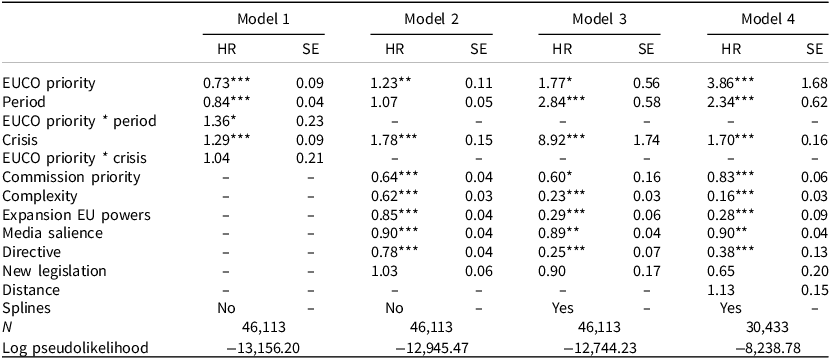
Table 1 presents the results of four models that estimate the impact of the European Council on the hazard rate of adopting legislative files. Model 1 includes only the main effects for the key explanatory variable and its interaction with crisis and period. Model 2 adds all control variables. Model 3 allows for time-varying effects of key covariates through the inclusion of splines.Footnote 12 Model 4 resembles Model 3, but it builds on a more limited dataset to add distance.Footnote 13
Cox proportional hazards models (1999–2024)

Notes: * p < 0.10; ** p < 0.05; *** p < 0.01; robust estimation in Models 1 and 2. Models 2 and 3: The variable Media salience does not violate the proportionality of the hazards assumption; the same applies in Model 4 to Crisis, Commission priority, Media salience, and Distance (see online Appendix D for the full tests).
In contrast to what we expected (H1), the variable EUCO priority does not have a consistent effect on the hazard rate of adopting legislative proposals: the effect is negative and significant in Model 1, but positive and (to varying degrees) significant in Models 2, 3, and 4. The pattern is similar when we replace EUCO priority with the more restrictive summit-based and 6-month operationalisations, though the positive effect is slightly less pronounced (see Tables F1 and F2 in online Appendix F). When interacted with period (for H2) and crisis (for H3), the effect is – as expected – positive but does not reach conventional levels of statistical significance; the interaction with period is just significant at the 10 percent level.
This is notably different for the main effects. Post-Lisbon, proposals are adopted faster than pre-Lisbon. Similarly, crisis has, by itself, a very strong effect on the hazard rate of adopting proposals. When proposals (directly) respond to a crisis, the process is concluded much faster. However, in contrast to the literature and our expectations, we do not find that an institutional ‘push’ by the European Council in the conclusions, and the leaders’ related use of political authority, effectively speeds up crisis responses. This may be because crisis responses are urgent for every actor in the law-making process. Given this shared sense of urgency, leaders will discuss crisis responses in summits even if they do not prioritise crises-related laws in their conclusions. The co-legislators, in turn, are likely to prioritise crisis responses, regardless of whether they are a European Council priority or not.Footnote 14
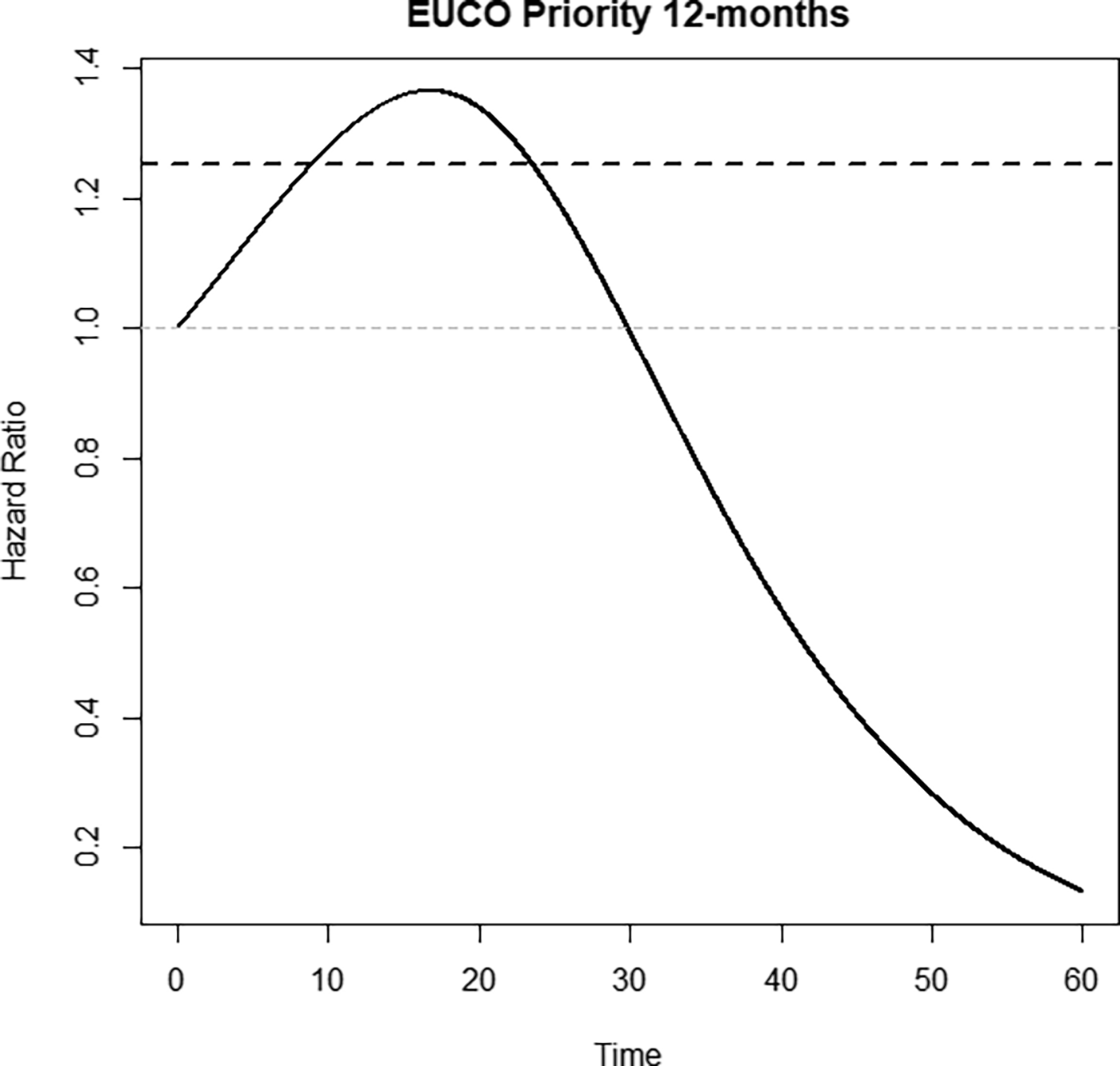
The inclusion of splines in Models 3 and 4 provides a smooth and flexible representation of how the effects of key covariates evolve over time.Footnote 15 This approach improves model fit while allowing for a clear graphical interpretation of time-varying effects, enhancing both statistical and substantive understanding. Figure 2 shows the effect of the variable EUCO priority over sixty months, corresponding to the 95th percentile of the event-time counter variable tracking the duration of legislative proposals until adoption. Early on, shortly after the proposal is introduced, EUCO priority appears to accelerate adoption, as the estimated hazard ratio is greater than 1. Over time, from about 1.5 years into the process, the influence reduces and eventually reverses and crosses the proportional hazards threshold (HR = 1) at around 30 months (2.5 years). This implies that if legislation has not been adopted within that time, mentions by the national leaders may even be associated with delay rather than acceleration.
Time-varying coefficient plot for EUCO priority (from Model 3).
Note: HR = 1, in light grey; constant HR from the baseline model, in black.
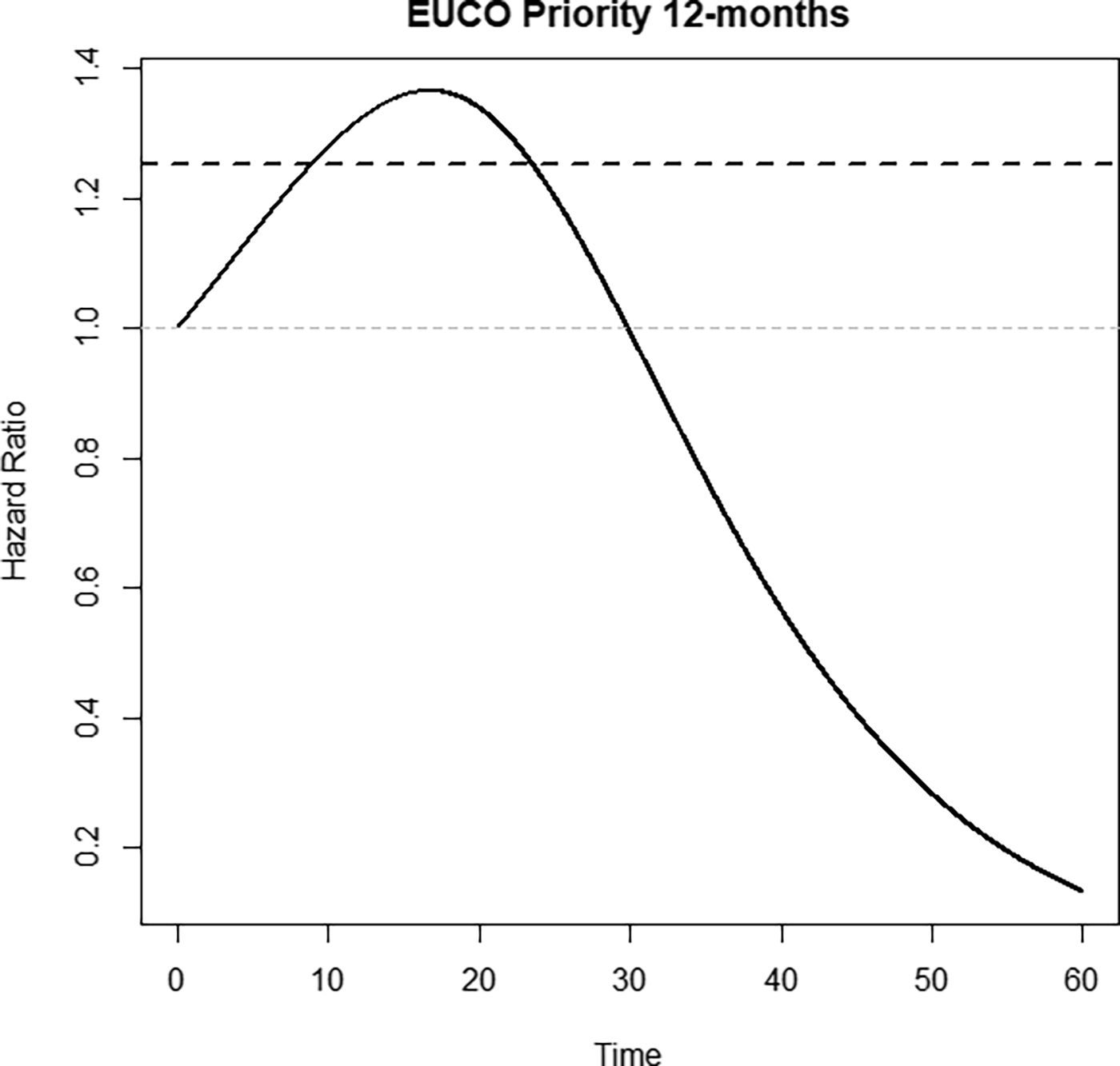
It matters, therefore, when the European Council prioritises legislation. If the leaders do so in an early part of the co-legislative stage, then their ‘pressure’ facilitates earlier conclusion. Later, however, the effect vanishes. To be sure, there are only 379 procedures (17.7 percent of the total) which are still in the legislative pipeline 30 months after being proposed. Yet, the European Council does not help to move these procedures closer to the finishing line.Footnote 16 This finding is interesting given the European Council’s alleged role as an impasse-breaker. Based on our analysis, the leaders’ ability to move legislation seems to be restricted to the early phase of co-legislation. For proposals that are ‘older’ than about 30 months, the European Council is unlikely to break the impasse and to accelerate the legislative process.
Turning to our control variables, most of their effects are in the expected direction and significant. Legislative files take longer to conclude when they are complex; when they are directives rather than regulations or decisions; when they expand competences of the EU; and when they attract more media attention. The effect of new legislation and distance is, however, not significant. A key exception is the European Commission’s legislative priorities. On average, proposals prioritised by the Commission take longer to be concluded, a finding in line with research by Cross and Vaznonytė (Reference Cross and Vaznonytė2020). This may be the case because priorities in the work programmes are more controversial and need a priority ‘boost’ or ‘push’ to reach the finish line (for a similar argument, see Koop, Reh and Bressanelli Reference Koop, Reh and Bressanelli2022).
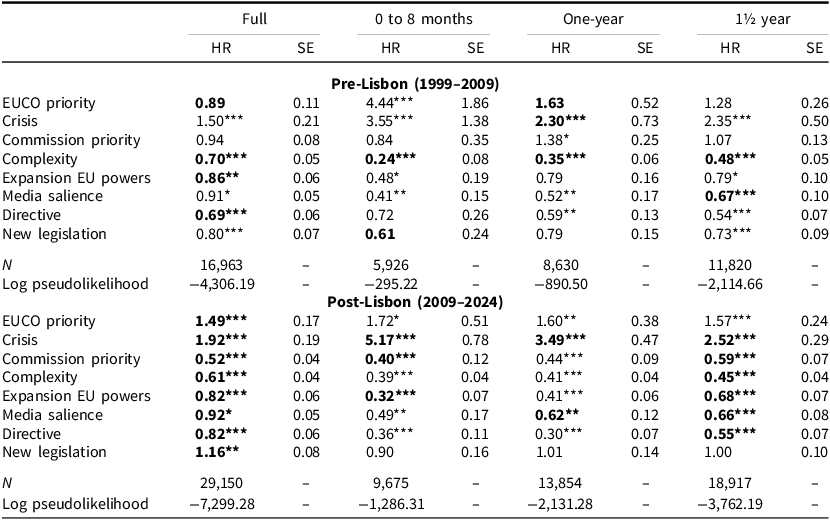
To more thoroughly assess our second hypothesis on the institutionalisation of the European Council, we split the dataset into two different subsets. The first includes co-decision files between June 1999 and November 2009 (before the implementation of the Treaty of Lisbon); the second presents files ongoing or concluded between December 2009 and August 2024 (after the implementation of the Treaty of Lisbon). Table 2 shows the results of two Cox event history models fitted, respectively, for the periods pre- and post-Lisbon. The models use the covariates presented above for the full period and allow us to appreciate the different impact of the European Council in the two periods.
The effect of European Council priorities on duration before and after Lisbon
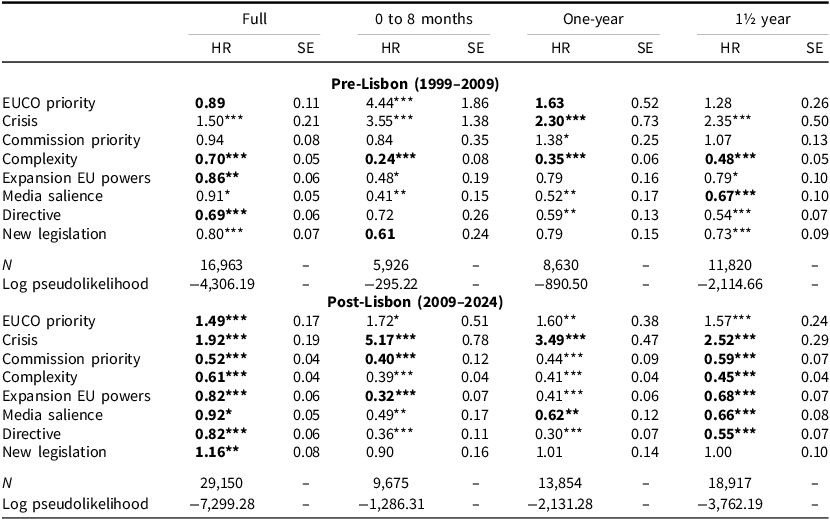
Notes: Models fitted on different temporal subsets, from the Commission’s proposal; variables violating the assumption of proportionality in bold.
The European Council’s (time-varying) impact can best be appreciated in different periods.Footnote 17 Pressure during co-legislation facilitates a quicker conclusion of files early in the process, but these dynamics mostly affect the post-Lisbon period. More specifically, pre-Lisbon, the effect of EUCO priority seems to ‘disappear’ after about a year. The effect of EUCO priority on the full pre-Lisbon dataset is even negative; by contrast, post-Lisbon, the leaders’ impact on duration lasts longer. Across the different model specifications in Table 2, the effect is positive and significant.
Most other variables remain unaffected. Law-making takes longer when proposals are complex, expand the EU’s powers (especially after 2009), are media salient, and are a directive. Crisis files are quicker to be concluded, even in the pre-Lisbon period when fewer crisis files were negotiated. There is overall continuity between the two periods, but there is one important difference: Commission priority is only significant post-Lisbon and extends duration.Footnote 18
Further insights into the results
Our findings suggest that the formal institutionalisation of the European Council in Lisbon matters: the European Council (but also, if differently, the Commission) influences EU law-making particularly after late 2009. Our interviewees, too, emphasise the relevance of institutional rules, rule change, and formal leadership. As put by a former Council official, the newly created European Council President has the experience and status to talk with leaders in the capitals and to prepare the summits with the European Commission President (Interview 15), who is a member of the European Council, if without voting rights. To collect information and to build compromise, the European Council President pre-negotiates summits with the leaders; pre-negotiations happen both bilaterally, in capitals and in Brussels, and in small-group video calls (Interviews 3, 17). In leading, the chair is supported by the General Secretariat. Like the President and their cabinet, Secretariat officials gather information and identify ‘landing zones’ on policy areas; after each summit, they produce a ‘steering note’ for the next summit; and the Secretariat is key in following up on priorities downstream (Interviews 1, 3, 4, 7, 9, 17). These findings support the mechanism we established in our theoretical discussion. The agenda, brokerage, and representation functions by the post-Lisbon European Council President reduce the transaction costs of finding agreement; the bureaucratic support and follow-up by the General Secretariat mobilises and uses resources across levels in the Council – from ministerial meetings to working groups.
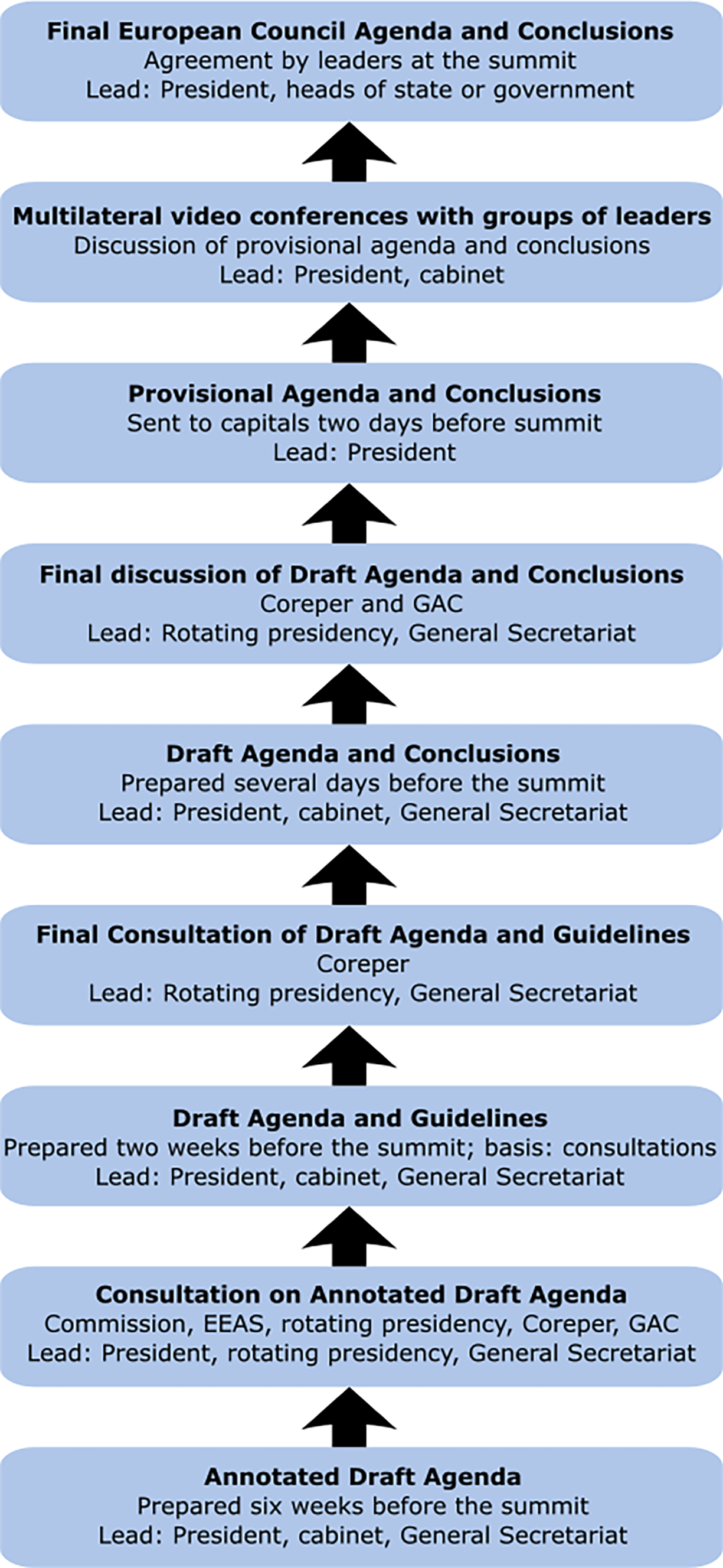
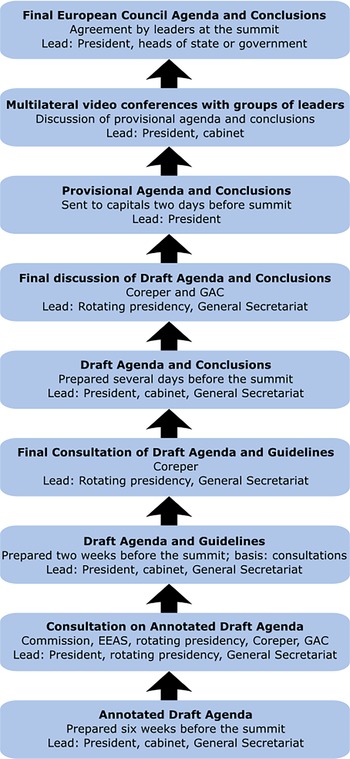
In addition, the Commission is consulted on and asked to discuss the European Council’s draft agenda and draft conclusions and uses the leaders’ guidance downstream in law-making (Interviews 3, 4, 6, 14). The Commission is involved before the summit, via the European Council President and their cabinet, and during the summit, where the European Commission President directly interacts with national leaders (Interviews 3, 5). Resource mobilisation should be particularly relevant: the Commission wants its proposed laws to pass and expects to gain from the importance given to laws that are prioritised by the European Council. ‘Unlocking’ tight legislative resources in response, not least by the Commission itself in downstream legislation, is key for an efficient – that is, a speedier – process. Figure 3 gives a stylised account of how summit conclusions are prepared today.
The current preparation of European Council conclusions.
Source: European Council 2009; Cloos Reference Cloos2022; Interviews 2023.
Note: European External Action Service (EEAS); General Affairs Council (GAC).
We propose that the European Council’s role in the legislative process can be at least partly explained by mandates to the other actors of the EU’s institutional ‘triangle’ and, particularly, to the co-legislators, the Council of the EU and the EP. This finding may surprise. As discussed above, the European Council can ‘instruct’ national ministers but not European parliamentarians. The hierarchical relationship between leaders and ‘their’ ministers clearly works in the follow-up to summit conclusions; if a minister fails to reach an agreement in the Council after the European Council agreed on the issue, the minister suffers reputational costs (Interview 1). Several of our interviewees stress that the heads of state or government cannot pressure the EP as directly as the Council, but that pressure and cooperation are nevertheless both present and effective. Effectiveness is likely to stem from policy seeking MEPs and from a parliament that is more interested in introducing, amending, or changing laws than in blocking legislation prioritised by the European Council (see also Hix, Noury and Roland Reference Hix, Noury and Roland2007).
Recent policy publications, changes to transnational party rules, and our interviews all suggest that the heads’ leadership of – or membership in – national parties is very important for the relationship between the European Council and the EP; the same holds true for the cooperation between national and European parties. These party-political relationships have remained understudied. Europarties are key in ‘transnational policy-making’ (Kinski Reference Kinski and Skrzypek2022: 24; italics in original). Parties run networks as well as thematic and policy-oriented working groups, across levels of governance (Drachenberg Reference Drachenberg2022: 13; Kinski Reference Kinski and Skrzypek2022: 24–25). National and European parties hold ‘pre-summits’ where members socialise, network, coordinate, and occasionally take informal decisions (Drachenberg Reference Drachenberg2022: 22–30). Cooperation and pre-summits happen especially between three parties always represented in the European Council – the European People’s Party (EPP), the Socialists (PES), and the Liberals (ALDE). Here, the national head of state or government will also lead (or be a member of) a constituent party; as such, the head can meet with the EU-level party chair and European parliamentarians of ‘their’ political group before a summit. This type of cooperation has recently found its way into the EPP’s statutes, including a new article (art. 20) on the organisation of EPP summits ahead of each European Council (European People’s Party 2025).
Interviewees, too, mention that political party families interact before European summits and that party interactions and links matter to the European Council; they also stress that not only the Council, but also the EP, can accelerate law-making (Interviews 1, 3, 4, 5, 11, 12). Party linkages work through EU-level and national connections: Permanent Representations and national parliaments have offices in Brussels to liaise with MEPs (Interviews 9, 11). Overall, the authority of the European Council and the visibility of summit conclusions generate pressure that is felt throughout the EU’s institutional system, horizontally and vertically. Such pressure can be difficult to ignore or resist, especially if national leaders’ legislative priorities are about salient issues of ‘constitutional’ importance (Interviews 3, 8, 9, 14).
In sum, our empirical analysis shows that the European Council accelerates law-making, but that its capacity to do so is conditional upon both the timing of the intervention (early in the co-legislative stage) and on its formalisation (in the Lisbon Treaty). We also show that crisis legislation is concluded faster, but not due to pressure by the European Council. Policy documents, Rules of Procedure, Europarty statutes, and our interviews give us in-depth insights into the preparation of summit conclusions and their follow-up. They also offer details on two potential mechanisms behind our argument. First, institutionally designed and administratively supported formal leadership – via the European Council chair and the General Secretariat – plays an important role, as both mobilise and use political resources and reduce the transaction costs of negotiation. Second, the leaders’ priorities, directed at the co-legislators, are effective through limited hierarchy (at all Council levels) and ever stronger transnational partisan cooperation across levels of governance and EU institutions (for the EP).
Conclusions
This study aimed to improve our insight into the European Council’s influence on everyday law-making. To do so, we asked and analysed whether, how, and under what conditions the leaders’ legislative priorities impact on the duration of the co-decision procedure. In contrast to previous treaties, the Lisbon Treaty not only formalises the European Council but explicitly constrains the body’s legislative role. Nevertheless, the heads of state or government use their summit conclusions to prioritise specific legislative proposals. Drawing on debates on leadership, institutionalisation, and crisis politics in multi-level negotiations, we hypothesised that the European Council – through its priorities – speeds up law-making.
In a nutshell, we argued that the conclusions’ priorities translate into collective leadership that works through the European Council’s political authority. Political authority should produce limited hierarchical relations between national leaders and EU-level co-legislators. We argued that two conditions should strengthen hierarchy: formal institutionalisation and crisis politics. In late 2009, the Lisbon Treaty turned the European Council into an official EU institution. The European Council gained centralised formal leadership and Brussels-based secretarial support. Both, we expected, contribute to translating the leaders’ priorities downstream into law-making. In crisis, absent specific procedures and capacities, the EU needs to use co-decision to respond, quickly and adequately, to urgent policy challenges. The European Council (tries to) respond collectively at the EU-level. We argued that these attempts should increase the leaders’ hierarchy vis-a-vis the co-legislators, and the leaders’ political authority vis-a-vis domestic audiences. In sum, the two conditions – institutionalisation, crisis politics – should build on the mobilisation and use of political resources, on reduced transaction costs, and on political authority in multi-level negotiations.
We tested our hypotheses on new data on 2,139 OLP files that were either concluded between July 1999 and August 2024 or pending by August 2024. We built a time-series dataset with 46,113 month-file observations and captured legislative priorities by coding all summit conclusions. Our mixed-methods design complemented the event history analysis with the use of the European Council’s 2009 Rules of Procedure, the EPP’s 2025 statutes, and recent policy publications, in particular on the relationship between the European Council and the EP. We also conducted 17 semi-structured elite interviews, to gain diverse and long-term bureaucratic, institutional, and political perspectives on how national leaders matter in EU law-making.
Our event history analysis showed that the European Council’s priorities shorten the duration of law-making – but only under certain conditions. First, we demonstrated that timing mattered. European Council priorities at an early stage of co-decision speed up negotiations; yet, over time, their influence reduces. If we look at the European Council’s alleged role as impasse-breaker, this is similarly interesting: impasse-breaking seems to work only early on in co-legislation. Second, this early effect of leaders’ priorities is most pronounced post-Lisbon. Furthermore, post-Lisbon law-making is itself ‘speedier’. These findings suggest that the dynamics of co-legislation have changed through the institutionalisation of the European Council and the associated mobilisation and use of resources, and reduced transaction costs. Third, under crisis, law-making did speed up but did so independently of the leaders’ priorities. This runs counter to our expectation. Our assumed mechanism for a priority effect seems to work for crisis responses overall but not for priorities on crisis laws specifically.
Our qualitative analysis and interviews gave us additional and detailed insights into how summit agendas and conclusions come about, how the European Council influences the legislative process, and how the leaders’ priorities are (not) followed up, at the EU-level and domestically. Recent policy publications, amended party rules, and several interviews supported our argument, especially about horizontal and vertical party-political coordination.
The findings of our paper suggest that the European Council is not just a distant supervisor and does not only set the EU’s ‘grand strategy’. Instead, the European Council regularly and directly moves into everyday law-making. National leaders regularly mandate the co-legislators to find agreement on prioritised laws; they allocate tasks, set deadlines, and instruct the EU’s other institutions and member states to comply. Our study suggests that priorities have been effective, if they come early on in co-decision, especially post-Lisbon. This is problematic for the EP in particular, whose institutional relationship with the European Council is less close and less strong than the Council’s. Nevertheless, the EP, too, routinely ‘complies’. Our argument and qualitative empirical analysis suggest tentatively that cooperation across national and European political parties, the role played by national parties for MEPs’ supranational careers, and European Council calls for responsible decision-making could explain why the EP follows the leaders by co-legislating (more quickly) on prioritised laws.
Our study solely focuses on one dimension of the legislative process – the duration of co-legislation – and further research on other dimensions is needed. At the same time, we contribute insights into both EU law-making and the Union’s broader institutional, and increasingly politicised, development. Our systematic empirical analysis on all legislative files, concluded and pending under co-decision between 1999 and 2024, goes beyond the current literature that shows the European Council’s role in the OLP through selected case studies. We demonstrate a broader pattern of influence by the leaders on everyday law-making, especially when laws are prioritised early on in co-decision and post-Lisbon. This influence is not limited to – and not even especially strong in – crisis-related laws. Hence, the results suggest that the traditional focus on the classic institutional ‘triangle’ in current models of EU law-making and duration leaves out the European Council as one more important player.
Supplementary material
The supplementary material for this article can be found at https://doi.org/10.1017/S1475676526101133.
Data availability statement
The replication code and data are available from https://doi.org/10.7910/DVN/T0SRE3.
Acknowledgements
We are grateful to Samuele Bernardi, Aaron Calzadilla Sarmiento, Amanda Kraley, Francesca Minetto, and Matteo Nebbiai for their excellent research assistance. We are particularly grateful to Paolo Frumento for his invaluable advice. We also thank the three anonymous reviewers and the journal editors for their constructive and helpful feedback. Our interviewees generously shared their time and insights with us. We also thank colleagues who commented on earlier versions of this paper presented at the European University Institute in Florence, Ludwig-Maximilians-University Munich, the Vienna School of International Studies, the Hertie School in Berlin, the annual meeting of the Italian Political Science Association in Genoa, the 29th Conference of the Council for European Studies in Reykjavik, the 11th ECPR Standing Group on the European Union biennial conference in Rome (LUISS), and the 17th EUSA biennial conference in Miami.
Funding statement
No funding to declare.
Competing interests
All authors certify that they have no affiliations with or involvement in any organisation or entity with any financial interest or non-financial interest in the subject matter or materials discussed in this manuscript.
Ethical standards
The collection of the interview data was ethically cleared by King’s College London (MRA-22/23-35996) and approved by the Hertie School in Berlin (ID: 20230320-37).



 Open access

