


1. Introduction
Additive Manufacturing (AM) is joining materials to create objects from 3D model data, typically layer by layer, instead of using subtractive manufacturing methods (Reference Vicente, Sardinha, Reis, Ribeiro and LeiteVicente et al., 2023). AM is used in aerospace, automotive, medical, and consumer goods industries, due to its ability to support mass customization, reduce material waste, and enable complex geometries (Reference Kanishka and AcherjeeKanishka & Acherjee, 2023). However, for design students, AM remains conceptually abstract and difficult to master (Reference Borgianni, Pradel, Berni, Obi and BibbBorgianni et al., 2022). Its difference from traditional manufacturing demands not only technical knowledge but also spatial reasoning and an intuitive grasp of digital fabrication principles. These challenges highlight the need for pedagogical strategies that can bridge the gap between abstract technical content and learners’ understanding (Reference Hofmann, Ferchow and MeboldtHofmann et al., 2023). Similar concerns also apply to broader Design for Manufacture and Assembly (DfMA) contexts, where designers must consider manufacturability and assembly constraints during early design. While the specific constraints differ across processes, the underlying need for spatial reasoning and constraint-aware design is comparable.
In parallel, Augmented Reality (AR) overlays virtual content onto the physical environment, which has gained increasing attention in educational contexts, particularly in science, technology, engineering and mathematics (STEM) (Reference AlGerafi, Zhou, Oubibi and WijayaAlGerafi et al., 2023; Reference Ou Yang, Lai and WangOu Yang et al., 2023). The integration of immersive technologies into education has offered promising opportunities to foster deeper engagement and experiential learning. Prior studies have shown that AR can enhance conceptual understanding, engagement, and motivation by providing interactive, visual learning experiences (Reference Cai, Liu, Wang, Liu and LiangCai et al., 2021; Reference Faridi, Tuli, Mantri, Singh and GargrishFaridi et al., 2021). Therefore, AR has the potential to support AM education.
While existing studies have shown that AR can enhance conceptual understanding and learner motivation, we also previously conducted a study comparing mobile AR and paper-based materials for AM learning (Reference Cui, Mantelet, Jean, Lou and SegondsCui et al., 2025). The limited attention has been paid to how different AR platforms—such as smartphones and head-mounted displays (HMD) —differ in their effectiveness. The present study extends this line of inquiry by examining the impact of AR platform differences on design outcomes and student perception. Moreover, few studies have explored how immersive AR environments can be integrated into Design Thinking–oriented educational tasks, which emphasize creative application of knowledge in real-world contexts. This gap is particularly relevant for AM education, where the goal is not only knowledge acquisition, but also creative design application grounded in technological understanding.
To address these gaps, the present study investigates how AR platform differences influence students’ learning experiences, understanding of AM, and creative application in a design-based educational task. In a controlled experiment, design students were assigned to either a smartphone-based or headset-based AR condition. Participants explored virtual AM models and subsequently completed a conceptual design task informed by their learning. Participants’ learning outcomes were assessed via questionnaires and expert evaluations of their design work. The primary objective of this study is to compare two AR platforms (smartphone-based versus head-mounted AR) in supporting learning and design application in an AM-related task. DfAM is used as a demanding case where geometric constraints and creative application must be jointly considered. As participants had prior exposure to AM fundamentals, the task focuses on applying opportunistic DfAM opportunities rather than introductory AM instruction.
The contributions of this study are summarized as follows:
-
• This study fills a gap in the literature by comparing how different AR platforms influence conceptual understanding and creativity in AM education.
-
• We introduced and validated an AR-based educational tool that visualizes AM principles through interactive 3D models, enabling more intuitive and engaging learning.
-
• This study demonstrates the effectiveness of combining immersive AR with design tasks to support not only conceptual comprehension but also creative application, offering practical implications for curriculum design in STEM learning and product design education.
The remainder of this paper is organized as follows. Section 2 provides a review of related work. Section 3 describes the research design, including the development of the AR application and the experimental procedure. Section 4 reports and interprets the empirical findings. Finally, Section 5 concludes the study and outlines implications for future research and educational practice.
2. Related work
2.1. AM education challenges
AM has significantly transformed product design and production processes, with widespread applications in fields such as aerospace, automotive, and healthcare (Reference Kanishka and AcherjeeKanishka & Acherjee, 2023). Its ability to efficiently produce customized components and complex geometries has attracted growing attention in both industry and academia in recent years. While the technical potential of AM is well recognized in industry, its integration into educational settings remains challenging (Reference Pei, Monzón, Bernard and GibsonPei et al., 2026).
A significant challenge in AM education is teaching Design for Additive Manufacturing (DfAM), as students need to understand both the capabilities and limitations of additive processes. One notable pedagogical difficulty lies in conveying the principles of DfAM, a design paradigm that encourages the exploitation of AM’s unique affordances—such as lattice structures, internal channels, overhangs, and topology-optimized forms—rather than simply replicating traditional geometries (Reference Lang, Segonds, Jean, Gazo, Guegan, Buisine and ManteletLang et al., 2021; Reference Valjak, Bojčetić, Nordin and GodecValjak et al., 2020). Although DfAM offers significant opportunities for innovation, students often struggle to grasp these concepts due to the spatial complexity and procedural nature of AM. When such principles are taught using only static 2D images or text-based descriptions, learners may find it difficult to visualize and internalize the implications for real-world design (Reference Hofmann, Ferchow and MeboldtHofmann et al., 2023).
To address these barriers, several studies have proposed pedagogical tools and frameworks aimed at making DfAM concepts more accessible. For instance, Lang et al. identified 14 design opportunities specific to AM and developed a set of physical “inspirational cubes” to support students in recognizing and applying these principles (Reference Lang, Segonds, Jean, Gazo, Guegan, Buisine and ManteletLang et al., 2021). Similarly, research has introduced a digital game-based learning environment designed to help learners discover AM-specific design possibilities through interactive exploration and feedback (Reference Pham Van, Jean, Meyrueis, Gazo, Mantelet, Gueguan, Buisine and SegondsPham Van et al., 2022). Such interventions aim to move beyond traditional instruction by providing more experiential and engaging learning modalities.
However, despite these efforts, the abstract and spatially rich nature of DfAM continues to pose challenges—particularly for learners who have limited experience in 3D reasoning or fabrication—because opportunity recognition still needs to be translated into concrete design features during ideation. This underscores the need for educational strategies that support both (i) intuitive understanding of AM/DfAM opportunities and (ii) their application in open-ended design tasks. In this context, immersive and interactive visualization technologies (e.g., AR) are increasingly explored as a way to bridge opportunity recognition and design application.
2.2. AR in STEM and design education
AR has emerged as a promising tool for enhancing education in STEM. By overlaying digital information onto the physical environment, AR enables learners to engage with abstract or invisible concepts through interactive and spatially embedded visualization (Reference Rauschnabel, Felix, Hinsch, Shahab and AltRauschnabel et al., 2022). Numerous studies have demonstrated that AR can improve conceptual understanding, increase motivation, and foster engagement by transforming learning into an experiential process (Reference Baabdullah, Alsulaimani, Allamnakhrah, Alalwan, Dwivedi and RanaBaabdullah et al., 2022; Reference Buchner and KerresBuchner & Kerres, 2023). For instance, AR applications in physics have been shown to help students visualize phenomena such as magnetic fields and molecular structures that are otherwise difficult to perceive (Reference Faridi, Tuli, Mantri, Singh and GargrishFaridi et al., 2021). Similarly, in engineering education, AR has been used to illustrate structural mechanics and design principles, offering intuitive access to complex three-dimensional information (Reference Balzerkiewitz and StechertBalzerkiewitz & Stechert, 2020; Reference Horvat, Škec, Martinec, Lukačević and PerišićHorvat et al., 2020; Reference Hu, Goh and LinHu et al., 2021).
Beyond visualization, AR learning is often linked to user engagement, including immersion and presence (the sense of “being there” with the augmented content). Importantly, these experiences can vary by platform: handheld versus head-mounted AR may elicit different levels of immersion/presence and support different forms of exploration, which suggests that the AR delivery platform is a meaningful factor when evaluating educational effectiveness.
A growing body of research highlights that AR not only supports knowledge retention but also enhances spatial reasoning and problem-solving skills, both of which are central to STEM learning. Compared to traditional methods such as textbooks or static Computer-Aided Design (CAD) models, AR’s interactive affordances allow learners to manipulate content directly, thereby bridging the gap between theory and practice (Reference Cui, Lou, Mantelet and SegondsCui et al., 2024). These benefits make AR particularly relevant for domains such as AM, where learners must grasp layer-based processes and geometrical intricacies that are difficult to convey through conventional 2D representations.
Despite this potential, the use of AR in design-oriented education remains relatively underexplored compared to its adoption in STEM fields more broadly. While AR has been shown to enhance students’ understanding of scientific concepts, less is known about how it supports higher-order outcomes—such as ideation, creativity, and design reasoning—that are critical in design education (Reference Ariansyah, Erkoyuncu, Eimontaite, Johnson, Oostveen, Fletcher and SharplesAriansyah et al., 2022). Recent studies suggest that AR could facilitate design learning by allowing students to visualize and manipulate virtual prototypes within real-world contexts, thereby supporting iterative exploration and embodied interaction (Reference Hu, Goh and LinHu et al., 2021). However, systematic evaluations of AR’s impact on design-task performance remain limited, particularly when learners must transfer technical principles (e.g., DfAM opportunities) into concrete concept features.
2.3. Research gap and objective
In summary, AR has demonstrated clear benefits for visualization and engagement in STEM learning, yet there is limited empirical evidence on (i) how AR supports the application of technical knowledge in design tasks (rather than only perceived learning benefits), and (ii) how different AR platforms compare in such design-oriented educational settings. This gap is especially relevant for DfAM, where learners must recognize geometry-driven opportunities and apply them during ideation. Therefore, this study conducts a controlled comparison between smartphone-based and head-mounted AR using the same DfAM opportunity content (14 cubes) and a design task, to examine differences in learners’ perceptions and expert-evaluated design outcomes.
3. Research methodology
3.1. Research design
This study employed a controlled comparative experimental design to investigate how different AR platforms (smartphone-based vs. head-mounted display) influence students’ understanding of AM and their creative application of knowledge in a design task.
3.2. Participants
A total of 16 design students (13 male, 3 female; aged 23–25) from Arts et Métiers Institute of Technology (ENSAM), a leading French engineering school specializing in industrial design and innovation, participated in the study. All students possessed basic knowledge of AM acquired through prior coursework, yet none had substantial experience with AR applications. Participants were randomly assigned to one of two groups: the smartphone-based AR group (n=8) or the head-mounted AR group (n=8).
3.3. Materials
Two AR applications were developed to deliver identical educational content across two platforms: a smartphone and a head-mounted display (Quest 3). Both applications were implemented in Unity with OpenXR for Android system to ensure functional equivalence across devices. The core content consisted of 14 virtual cubes, each representing a specific AM opportunity such as lattice structures, internal channels, topology optimization, and consolidated assemblies (Figure 1) (Reference Lang, Segonds, Jean, Gazo, Guegan, Buisine and ManteletLang et al., 2021). These cubes were designed to illustrate abstract AM principles through manipulable 3D visualizations, serving as the learning material for the experimental tasks. Both interfaces supported basic manipulations such as resizing and rotating, ensuring that the educational content and available operations were consistent across platforms. The two applications were designed to deliver identical learning content across platforms, enabling a controlled comparison between a smartphone-based AR platform and a head-mounted AR platform that differ in interaction modality and level of immersion.
The 14 AM cube models

Figure 1 Long description
The image contains 14 separate photos of cube models. Panel A: A black cube with an intricate lattice structure. Panel B: A solid black cube. Panel C: A cube with a complex internal structure. Panel D: A blue cube with a similar lattice structure to Panel A. Panel E: A stack of blue squares. Panel F: A blue cube with a dense internal lattice. Panel G: A cube with a hollow center and a wooden insert. Panel H: A cube with a textured surface. Panel I: A cube with geometric cutouts. Panel J: A cube composed of smaller black cubes. Panel K: A cube with a grid-like pattern. Panel L: A cube with a hammer and other tools. Panel M: A collection of small cubes in various shapes and sizes. Panel N: A cube with a honeycomb-like internal structure.
The smartphone-based application was deployed on Android, allowing participants to interact with the cubes via touchscreen (e.g., rotate, scale). On the smartphone platform, users accessed cube models through a card-based interface (Figure 2.a) in which each card contained both an image and a concise textual description of the corresponding AM opportunity. The card content followed the cube-by-cube explanations of the 14 cubes described in (Reference Lang, Segonds, Jean, Gazo, Guegan, Buisine and ManteletLang et al., 2021). Once a virtual cube was selected it is inserted into the real world (Figure 2.b) and it could be manipulated directly via touchscreen interaction. Specifically, users were able to rotate and reposition the model to inspect its geometry from multiple perspectives (Figure 2.c), as well as resize it to facilitate a more detailed examination of structural features beyond the constraints of physical dimensions. Real-world placement mainly served as a scale and spatial reference (e.g., placing the cube on a nearby surface). The learning activity primarily involved inspecting and manipulating the 3D geometry.
The head-mounted display application was deployed on the Meta Quest 3, enabling immersive, natural interaction through hand-tracking gestures. In the headset-based AR application, interaction was designed to be intuitive and minimally intrusive. When participants opened their palm, a virtual control panel automatically appeared, providing access to the system’s functions (Figure 3.a). Cube models were organized within a card-based interface, each card presenting an image and a concise textual description of the corresponding additive manufacturing feature (Figure 3.b). By selecting a card, the associated 3D cube model was instantiated in the user’s field of view, enabling direct inspection and manipulation (Figure 3.c). This designed interaction allowed users to seamlessly transit from theoretical information to concrete 3D representations while maintaining a hands-free experience.
In addition to card-based selection, the system supported direct natural interaction with the virtual cubes (Figure 4.a). Once instantiated, users could grasp and manipulate the cubes as if handling physical objects, thereby reinforcing the sense of realism and embodiment. Furthermore, when cubes were grasped with both hands, users could dynamically adjust their size through a scaling gesture (Figure 4.b). This functionality enabled participants to explore the models at different levels of detail and provided a more flexible examination of geometric and structural features.
Smartphone interface for cube exploration (a) users can browse cube models in a card-based interface with images and descriptions (b) selected model can be rotated, moved via touch interaction (c) selected model can be resized via touch interaction for detailed exploration beyond physical size limits

Quest 3 interface for AR-based cube interaction (a) opening the palm triggers a button to appear (b) users browse cube models in a card interface (c) users select a card to instantiate a cube

Advanced interactions in the quest 3 application (a) users can grasp and manipulate virtual cubes as if they were real objects (b) two-handed grasping enables resizing of the cubes

Figure 4 Long description
Panel A: A photo showing a user grasping and manipulating a virtual cube in an AR environment. The user is holding the cube with one hand, and the cube appears to be a 3D structure with a grid-like pattern. The environment includes a table with some objects and a lamp. Panel B: A photo showing a user resizing a virtual cube using two-handed grasping. The cube is similar in appearance to the one in Panel A, with a grid-like pattern. The user is adjusting the size of the cube by holding it with both hands. The environment is the same as in Panel A, with a table and lamp visible in the background.
The decision to implement the same application on two platforms was made to isolate the effect of the interaction modality (touch vs. hand-tracking in immersive AR) while keeping all other variables constant. This allowed for a fair comparison of how different AR delivery modes influence students’ understanding of AM concepts and their creative application in design tasks.
3.4. Procedure
Participants were randomly assigned to one of two experimental conditions: a smartphone-based AR application or a head-mounted AR application deployed on the Quest 3. Both applications provided identical 3D content, consisting of 14 virtual cubes illustrating key AM opportunities such as lattice structures, internal channels, and topology-optimized forms. The main distinction lay in the mode of interaction: the smartphone group used touch-based controls, whereas the headset group engaged with the models through hand-tracking in an immersive environment.
The study followed four main stages (Figure 5). First, during a 10-minute introduction, participants received instructions on how to operate their assigned AR system. The smartphone group learned to rotate and scale models via touchscreen, while the headset group was introduced to gesture-based manipulation. Second, in the 20-minute exploration phase, participants individually inspected the cube models to familiarize themselves with AM principles. Third, participants engaged in a 60-minute design task, where they were asked to conceptualize kitchen utensils that leveraged AM opportunities. In this study, ‘using AM opportunities’ refers to explicitly translating at least one cube’s AM opportunity into a concrete functional or structural feature in the concept (e.g., internal channels, lattice structures, topology-driven material reduction, or part consolidation). Participants were instructed to consult the cubes freely during ideation and to indicate, in their brief written description, which cube(s) inspired their concept. They recorded their ideas through hand-drawn sketches and short written descriptions, with continuous access to the AR application to support reference and inspiration. Finally, in the 10-minute post-task phase, participants completed a questionnaire evaluating their learning experience, perceived system qualities, and understanding of AM.
Experimental procedure

To validate the experimental design, a pilot study was conducted with volunteers prior to the formal study. Feedback confirmed that the allocated time was sufficient for both smartphone and headset conditions to explore the virtual cubes, complete the design task, and respond to the questionnaire. All design sheets were collected at the end of the session for subsequent expert evaluation of creativity and AM integration.
3.5. Measures
Participants’ experiences were assessed using a structured questionnaire adapted from our prior study (Reference Cui, Mantelet, Jean, Lou and SegondsCui et al., 2025) and related instruments on AR-based learning and technology acceptance (Reference Kowalczuk, Siepmann (Née Scheiben) and AdlerKowalczuk et al., 2021; Reference Pham Van, Jean, Meyrueis, Gazo, Mantelet, Gueguan, Buisine and SegondsPham Van et al., 2022). The instrument captured perceptions of interactivity, system performance, informativeness of the materials, realism of the representations, and overall usefulness. In addition, items addressing perceptions of AM were included to reflect participants’ self-reported understanding of AM concepts. To ensure comparability across conditions, the questionnaire wording was adapted with minor adjustments to match the two platforms (e.g., “smartphone app” vs. “AR app on Quest 3”), while preserving the intended meaning of each item. All responses were recorded on a 7-point Likert scale (1 = strongly disagree, 7 = strongly agree).
To evaluate the quality of ideas generated, we focused on the creative outcomes documented in participants’ design sheets. Consistent with frameworks developed for design research (Reference Dean, Hender, Rodgers and SantanenBrigham Young University et al., 2006; Reference Gong, Gonçalves, Nanjappan and GeorgievGong et al., 2024; Reference Shah, Smith and Vargas-HernandezShah et al., 2003), creativity was defined along two overarching dimensions: novelty and quality. Novelty captured originality and paradigm-relatedness, while quality was operationalized through three aspects: workability (acceptability and implementability), relevance (applicability and effectiveness), and specificity (completeness and explicitness). A standardized rubric was prepared and discussed with the evaluation panel prior to scoring. The panel consisted of five experts in product design and AM (three faculty members and two doctoral researchers). To balance inter-rater reliability and sensitivity, different scale lengths were applied: dimensions requiring broad categorization were rated on a 3-point scale, while those demanding finer distinctions used a 4-point scale. Design sheets were anonymized prior to scoring to minimize potential bias. Experts rated each sheet independently, and scores were aggregated by averaging across raters for each dimension. Inter-rater consistency was examined to ensure the stability of the ratings. Data from both the questionnaire and creativity evaluation were analyzed using the Mann–Whitney U test to examine differences between the Quest 3 and smartphone conditions. This non-parametric approach was selected given the ordinal nature of the measures and the relatively small sample size.
4. Results and discussion
To analyze differences between the two AR conditions, we employed the non-parametric Mann–Whitney U test, which is suitable for small sample sizes and does not assume normality of distributions. Results are visualized using box plots, which provide an intuitive representation of central tendency and variability. Asterisks indicate statistically significant group differences.
Compared with the smartphone application, the Quest 3 version yielded significantly higher ratings in Product Informativeness, Reality Congruence, Immersion, Media Usefulness, and Perceptions of AM. These results suggest that the immersive headset environment provided richer and more reliable cues for understanding the geometry, structure, and functionality of AM models, which in turn fostered a stronger sense of realism and engagement during interaction. The superior ratings for Media Usefulness and Perceptions of AM further indicate that the headset platform was perceived as a more effective learning tool and was associated with higher self-reported understanding of AM principles.
By contrast, no statistically significant differences were observed for Interactivity, System Quality, Cube Liking, or Reuse Intention. This indicates that both platforms offered comparable levels of system responsiveness, usability, and general appeal, and that students were equally open to reusing either tool in future learning scenarios.
Figure 6 presents box plots for all dimensions, with asterisks indicating significant differences between groups. As shown, the Quest 3 condition consistently outperformed the smartphone condition on the dimensions where differences were statistically significant, underscoring the added pedagogical value of immersive AR for supporting AM-related learning and design activities.
Box plots of questionnaire dimensions comparing Quest 3 and smartphone applications. Abbreviations: INT = Interactivity; SQ = System Quality; PI = Product Informativeness; RC = Reality Congruence; IM = Immersion; CL = Cube Liking; MU = Media Usefulness; RI = Reuse Intention; PAM = Perceptions of AM. Asterisks indicate statistically significant differences (Mann–Whitney U test, p < 0.05)

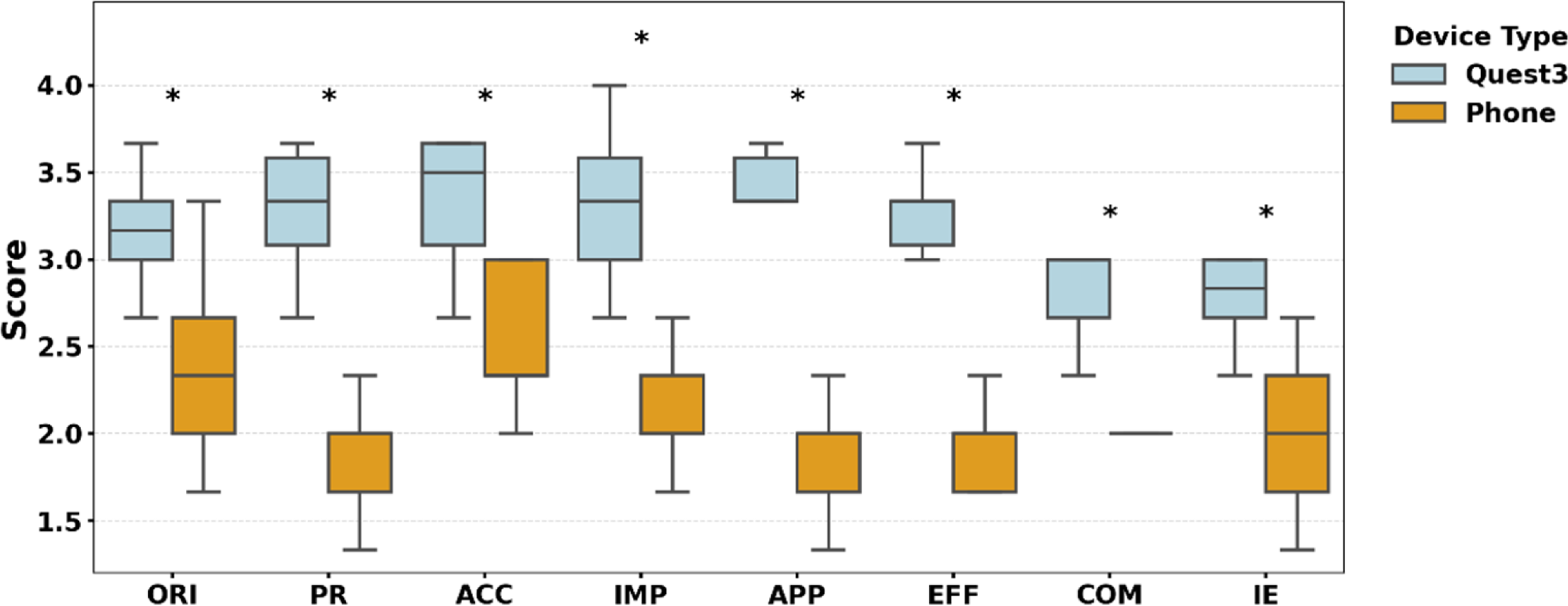
Expert assessments of the design outputs revealed significant differences across all eight creativity dimensions (Figure 7). Compared with the smartphone condition, the Quest 3 condition consistently yielded higher scores in Originality and Paradigm Relatedness, indicating that participants generated ideas that were both more innovative and more distinct from conventional solutions. Similarly, ratings of Acceptability and Implement Ability showed that Quest 3 designs were judged to be more feasible within realistic constraints. The Quest 3 group also achieved significantly higher ratings in Applicability and Effectiveness, suggesting stronger alignment of ideas with the design objectives. Finally, the Quest 3 condition outperformed the smartphone condition in Completeness and Implicational Explicitness, reflecting a higher degree of detail and clarity in the proposed solutions.
Box plots of expert evaluations of creativity dimensions across AR conditions Abbreviations: ORI = Originality; PR = Paradigm Relatedness; ACC = Acceptability; IMP = Implement Ability; APP = Applicability; EFF = Effectiveness; COM = Completeness; IE = Implicational Explicitness

Taken together, these findings demonstrate that the application on Quest3 fostered not only more original and unconventional ideas but also more practically viable and well-structured design outcomes. The consistent advantage across all dimensions suggests that the immersive qualities of the headset environment—such as enhanced spatial visualization and sustained engagement—may have enabled participants to integrate AM principles more effectively into their creative work. Because immersion, field of view, and hands-free interaction co-vary with platform, the present design does not isolate a single factor, results are therefore interpreted as platform-level differences.
5. Conclusion and perspective
This study has provided empirical evidence for the value of AR in supporting the comprehension of AM concepts and the generation of creative design outputs. By systematically comparing smartphone-based and headset-based AR, the findings indicate that the headset condition produced consistently higher evaluations, both in user perceptions of informativeness, congruence, immersion, and usefulness, and in expert assessments of the creativity of design outcomes. With a limited sample size, this study provides initial evidence and should be complemented by future work with larger samples. Usage telemetry was not collected and should be incorporated in future work to complement questionnaire measures. Moreover, because immersion and interaction modality co-vary with platform, AM task-specific effects cannot be fully separated from general medium effects in the current design. Designs generated under the headset condition were rated as more original, feasible, and complete, suggesting that a higher level of immersion can support both divergent and convergent aspects of the design process. These results contribute to the growing body of research demonstrating the potential of AR technologies to bridge the gap between abstract technical principles and their application in design-oriented tasks.
While these contributions are noteworthy, the study also highlights directions for further development. A key perspective concerns the scope of AM models embedded within AR systems. The present work employed simplified models tailored to educational exploration, which proved effective for evaluating baseline differences across AR modalities. However, such models cannot fully represent the breadth of AM practices encountered in professional contexts. Future research should therefore seek to incorporate a broader range of authentic AM cases, including functionally complex parts, multi-material structures, and industry-oriented prototypes. Doing so would increase the ecological validity of AR-based interventions and allow learners and designers to engage more directly with the technical, functional, and contextual challenges characteristic of real-world AM. Because learning outcomes were assessed primarily through self-report, conclusions regarding AM learning are framed as improvements in perceived understanding (perceptions of AM). Future work should incorporate objective learning checks (e.g., short quizzes, pre/post tests, or transfer tasks) to validate these effects.
Expanding the repertoire of AM models also carries important implications for both education and practice. For learners, exposure to realistic and functionally constrained AM cases may enhance the transfer of conceptual understanding to applied problem solving. For professional designers, interaction with more complex AM artifacts in AR could support more rigorous evaluation of ideas, thereby strengthening the alignment between creative exploration and practical implementation. In this way, AR has the potential to evolve from a didactic tool toward a platform that meaningfully integrates AM knowledge into design practice.
In conclusion, the findings underscore the capacity of AR, and particularly headset-based AR, to enrich understanding and foster creativity in AM-related tasks. At the same time, they point to the need for future work to ground AR applications in authentic AM scenarios, thereby reinforcing their relevance and impact within both educational and industrial contexts.



 Open access

