

Introduction
Brading Roman villa lies towards the east end of the Isle of Wight, about one kilometre west of the Eastern River Yare which now flows northwards into the Solent (Fig. 1). The villa was extensively excavated in 1880–81 and some of its remains, particularly the west range with its outstanding mosaic pavements, were protected by cover buildings.Footnote 1 Damage to the structures from flooding in the late twentieth century led to a number of evaluations in 1995–96,Footnote 2 and excavations in advance of the construction of a new cover building in 2003–05.Footnote 3 Further excavations to resolve questions concerning the development of the villa over time were undertaken 2008–10.Footnote 4
Location of Brading Roman Villa. (Adapted from Cunliffe Reference Cunliffe2013, fig. 1.1).

An outstanding discovery of the initial excavations was that ‘several fragments of human bones’ were found at depth of 14 feet in a well beneath the northern range (Building 2) along with the remains of three young dogs.Footnote 5 In addition, disarticulated human remains were reported by the first excavators and, subsequently, were recovered from the work carried out in 1995–96 and 2003. Rebecca Redfern reported on all the surviving human bone with a complete catalogue listing in the early 2000s.Footnote 6 The great majority of the collection cannot be closely provenanced but, in addition to the early report of finds from rooms within the villa buildings,Footnote 7 the subsequent excavations have produced a scatter of findspots from outside the buildings.
The human remains
The human remains from the well have been identified by Redfern as those of an adolescent, while the collection of disarticulated bone comprises 13 catalogued adult pieces, two of probable males, and fairly evenly divided between cranial, arm and leg fragments, a single adult molar, and two neonate bones. An adult femur has animal gnawing on the femoral head as well as fine cut marks on the anterior aspect of the surgical neck (Table 1, no. 2). A cut mark was also observed on one of the upper ribs of the adolescent. Based upon the long bones, Redfern estimated a MNI of four adults.
Brading Roman villa: radiocarbon-dated human bone

Table 1 Long description
The table lists four radiocarbon measurements from human bones, giving find location, skeletal element, museum and lab identifiers, radiocarbon age, stable carbon and nitrogen isotope values, a carbon to nitrogen ratio, and a calibrated calendar range. All four results fall in a narrow time span, from about 1730 to 1779 years before present, with calibrated ranges between about AD 220 and AD 410. The earliest calibrated range is AD 220 to 360 from a femur recovered in the north range well. The other three samples, from left femur and two humeri, calibrate to AD 240 to 400 or AD 250 to 410, indicating broadly similar late Roman dates. Carbon isotope values are tightly grouped from about minus 20.2 to minus 19.5, while nitrogen isotope values range from about 9.4 to 11.3, with the humerus samples showing the higher nitrogen values. Carbon to nitrogen ratios are consistent at about 3.3 to 3.4, suggesting comparable collagen quality across samples. Calibrated ranges overlap substantially, so the table supports a general late Roman timeframe rather than precise ordering between individuals.
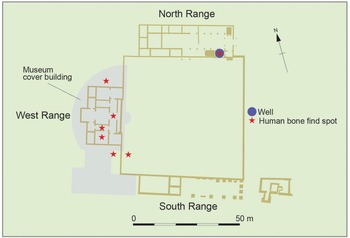
In addition to the adolescent from the well in the north range (the aisled hall: Building 2), seven adult bones from the fieldwork of the 1990s and early 2000s can be provenanced to contexts around the west range of the villa (Fig. 2). The Victorian excavators also reported finds of human bone from within that range of the villa: ‘a portion of human skull’ from Room 2 and ‘fragments of human bones’ from Room 5 and ‘small portions of a human skull … a portion of human fibula, part of a human jaw bone’ from Room 6.Footnote 8 While the latter is the corridor on the east side, Rooms 2 and 5 are both at the south end of the building. These finds cannot now be securely correlated with any of the surviving pieces from the Victorian excavations.
Distribution of human remains around and within Brading Roman Villa. (Adapted from Cunliffe Reference Cunliffe2013, fig. 10.16).

Conventional dating
There is no helpful contextual information to help us date the deposition of the disarticulated human bone, except for the adolescent found in the upper fills of the well at a depth of 14 feet (Table 1, no. 1). While no record was made of potentially datable finds found associated with him, it seems clear that he was deposited at some point between the filling of the well with rubble prior to the construction of the north range (aisled hall: Building 2) in the ?early? third century and the subsequent consolidation of fills during the life of the building, and the later construction over the further consolidated fill of the well, of the bath suite. For the latter, as a ‘best guess’ Cunliffe suggested a late third- or early fourth-century date.Footnote 9
Radiocarbon dating
With advice from Prof Mary Lewis to minimise the possibility of selecting bones from the same individual, five bones, including from the adolescent from the well, were chosen for radiocarbon dating (Table 1). The samples were submitted to SUERC-University of Glasgow and processed following the methods described in Dunbar et al.Footnote 10 One of the samples (femur) failed to provide sufficient material to date. The radiocarbon results are provided in Table 1, where they are given as conventional radiocarbon ages following the Trondheim conventionFootnote 11 and calibrated using the internationally agreed calibration curve for the northern hemisphere (IntCal20)Footnote 12 and the computer software OxCal v. 4.4.Footnote 13 The calibrations are provided in the table as single ranges with the endpoints rounded outward to the nearest 10 years. The stable carbon and nitrogen isotopes on the bones suggest little to no marine protein consumption that could otherwise affect the interpretation of the radiocarbon measurement. The four results were compared using the test of Ward and Wilson,Footnote 14 as implemented in OxCal, and found to have no statistical difference (T’=1.8; df=3; T’(5%)=7.8). Therefore, the four measurements could be the same the age and thus represent either a single event or multiple events with a short duration.
Discussion
Perhaps the most important conclusion of the dating programme is that all the sampled bones probably derive from a single event or multiple events of short duration dated to between c. 250 and c. 400 within the period of the Roman occupation of Britain, as is the case with five of the nine modelled ‘late’ dates for disarticulated human bone from Silchester.Footnote 15 Disarticulated human bone, but not yet subjected to a programme of radiocarbon dating, has also been found widely in rural settlements across south-east Britain in the later Roman period.Footnote 16 In the case of Brading, the late third and fourth century are seen to be the time when the villa reaches its greatest period of prosperity associated with the decoration of the west range with mosaic pavements of outstanding quality. Two important questions need to be addressed: can we refine the date when these bones were deposited more closely, and what circumstances might have led to human bone being deposited across a wide area outside the villa buildings as well as within them?
Given its location close to the estuary of the Eastern Yare and what is now Bembridge harbour, the villa would be vulnerable to a seaborne attack. Piracy had become a major problem in the Channel in the later third century and Carausius was appointed c. 285 to deal with the problem.Footnote 17 The villa could well have fallen victim to a raid by Frankish or Saxon pirates. Another possibility is that the villa got caught up in the events surrounding the re-capture of Britain from Allectus in 296, when the Roman fleet under the command of Asclepiodotus escaped detection by Allectus’ fleet off the Isle of Wight before the troops it was carrying were landed nearby on the mainland.Footnote 18 However, while there is no further archaeological evidence to support either of these possibilities, there is a case to be made from the villa’s coins for one of two possible incidents in the fourth century.
In her analysis of all the Roman coins, some 90 in total, recorded from the villa since 1881, Walton uses Reece’s coin periods to compare the Brading assemblage with other collections from the Isle of Wight and Hampshire as well as against a profile for the whole province.Footnote 19 She concluded that the coin profile was unusual in the context of the Isle of Wight, but had more in common with profiles from Hampshire and the wider province based on the coins reported to the Portable Antiquities Scheme (PAS). However, she observes that there are three values which diverge from the latter’s mean: ‘there is no peak in the values for Period 17 (a.d. 330–48). As this peak is a feature of nearly all coin profiles from Romano-British rural sites, its absence from the Brading profile may be significant and point to an unusual function for the site.’Footnote 20 The other periods of divergence from the PAS mean are Periods 19 (a.d. 364–78), where the Brading profile peaks with a value above the PAS mean, and 21 (a.d. 388–402), where the coin loss is above average.Footnote 21
On the basis of Walton’s analysis, we may point to the period during or shortly after a.d. 330–48 as one when an unusual event or events might have occurred at the villa which also fits with the radiocarbon dating. Two possibilities present themselves: first, there appears to have been some kind of crisis in Britain in 342 which prompted a hurried visit by the emperor Constans in early 343, followed by the posting to Britain, probably around this time, of the elder Gratian with a detachment of the field army.Footnote 22 It is conceivable that the villa was caught up in the circumstances surrounding these events.
Second, acknowledging that the coins produced in Period 17 would have been lost over a longer time span, at least into the 350s, a second context, also potentially involving violence at the villa, needs to be considered. Following the suicide in 353 of the usurper Magnentius after military defeats by Constantius Caesar, the latter began to take revenge on all those who had supported his enemy, including from Britain, which seems to have suffered particularly badly at the hands of Constantius’ agent, Paulus. These events of c. 354/55 are recorded by Ammianus Marcellinus, who describes how many in Britain, including innocents, were tortured, imprisoned, executed and their wealth and property confiscated.Footnote 23 Webster believed the purge effected by Paulus represented a turning point in the fortunes of many villa estates and Brading might well have been one of them.Footnote 24 Among the modifications to its original west range, which Cunliffe assigns to his Period 2, he describes a far-reaching change which involved the abandonment of the grand reception suite.Footnote 25 These changes are undated, but Cunliffe’s ‘best guess is that they were undertaken in the second half of the fourth century’.Footnote 26 They might well be associated with a significant change in status of the villa, its owner killed or dispossessed and the management of the estate put in the hands of a bailiff.
This still leaves the major problem of accounting for the dispersal of human bones around the villa buildings as well as within them, and how they entered the archaeological record. Burial practice in the fourth century was normally by inhumation and it is quite possible that the individuals represented by the remains which we now have were, if they were buried at all, buried in this way, but in shallow graves. These could be disturbed by scavenging animals like dogs and foxes. It is hard to account for the remains of the adolescent, of whom less than half of the skeleton now survives, unless (s)he was deposited at least partly articulated in the first instance, and their bones subsequently removed by scavengers. Indeed, as we have seen, one of the disarticulated bones has marks caused by animal gnawing. We can only speculate how the individuals died, whether by violent means or by sudden illness or disease. Neither need leave traces on the skeleton, though Redfern has noted knife marks on a rib from the partial skeleton from the well and on one other bone. The Brading coin profile, different as it is from those from other sites on the Isle of Wight, as well as from the Isle of Wight mean coin profile, suggests an event or events which were specific to Brading. This points more to death by violent means than by disease. The countryside of fourth-century Britain was no stranger to violence, as the burials at the farming settlement at Knobb’s Farm, Cambridgeshire, attest.Footnote 27
Whatever happened at the villa in the 340s, or, perhaps more probably, the 350s, appears to have led to a period of probable abandonment reflected in the pattern of coin loss during which the remains of at least four individuals were disarticulated, their bones scattered around the villa. Only the adolescent was deliberately placed in the well. While the depth at the time of the excavation was recorded as 14 feet, at the time of deposition it would have been shallower as the fills continued to subside, even during the Roman period. Hard to explain are the finds from within the west range which continued to be occupied into the early fifth century. Since we can no longer reconcile individual bones recovered by the Victorian excavators with the published record, it is possible that these remains either belong to a separate event or events, or they were introduced by the inhabitants as found items to be incorporated in the deposits which accumulated during the latest period of occupation, Cunliffe’s Period 3.Footnote 28 These deposits also contained a wide range of miscellaneous finds, such as pottery sherds, including samian, animal bones (including antler), fragments of glass, iron nails, and a single coin of Constans from the floor of Room 6.Footnote 29 In terms of their distribution, they are concentrated among the rooms in the centre and south of the range and those most affected by the changes assigned to Period 2, i.e. Rooms 1–7 and 9.Footnote 30 In Rooms 10, 11 and 12, however, at the north end of the west range, with its fine mosaic pavements (Room 12), there were few finds.Footnote 31 Perhaps we are looking at two very different kinds of occupation in the west range in the second half of the fourth century.
To conclude, if we are right in suggesting an event in the mid-350s, which led to a short period of abandonment of the villa followed by a different kind of occupation as suggested by the rearrangement of space and distribution of finds within the west range, the later fourth century saw a partial recovery of the villa. Coin loss reached its peak in coin period 19 (a.d. 364–78) and was above average in period 21 (388–402). Sufficient wealth might have been generated to build the bath suite in the north range, Building 2, as it would appear to post-date the deposition of the adolescent. On the other hand, all the mosaics, including those in Room 12, none independently dated, would look to date before the 350s.Footnote 32
Acknowledgements
We thank Jasmine Wroath, Chief Executive Officer of Brading Roman Villa, for permission to sample the human bone and for her general support for the project, Professor Mary Lewis for advice on sampling, and Nicholas Pankhurst, University of Reading, for preparing the illustrations.



 Open access

