




Introduction
Beethoven exhibited a sharply honed sensitivity to tempo. This parameter was a permanent feature of his musical horizon, and he evinced a painstaking approach to it. Apprehensive that performers might get it wrong, he configured his tempo markings most punctiliously, where necessary going to the bother of appending modifiers and refinements, such as poco, molto, più, assai, mosso, ma non troppo, con brio, etcetera. Not surprisingly, he showed a sustained interest in the metronome, from its invention, for this was a perfect steering mechanism for wielding control. Beethoven's tempo markings, then, bespeak consummate craftmanship, systematic thinking, and inner logic. They are sufficiently differentiated and only in rare cases are there internal inconsistencies or ambiguities.
In 1811, Beethoven settled upon ‘Allegretto’ as the indication for the second movement of his seventh symphony, to which he later appended crotchet = MM76. These indications articulated pace and character, insofar as ‘Allegretto’ meant ‘a trifle lively’, as captured by Beethoven's own bilingual instruction to the opening movement of the Piano Sonata Op. 101: ‘Etwas lebhaft’. However, what he characterized explicitly, fluidity and drive, imposed discomfort on performers and recipients. Almost from the very moment when the seventh symphony was first published, in 1816, the designation ‘Allegretto’ was regarded as unfortunate, arbitrary, and inessential. It was put into the shade of singularity and failed to gain foothold. What took precedence over it was a less precipitate pace, which amounted to the claim that the ‘Allegretto’ was an ‘Andante’-in-disguise. In that capacity the movement passed through the centuries, without much counterbalance of critical remark. Today, this ‘Andante’ approach is still dominant, both in concert life, as coyly summarized by Charles Rosen (‘Many conductors prefer a heavier and more portentous tempo’),Footnote 1 and in academic discourse, as articulated by, for example, Lewis Lockwood (‘the famous Andante’).Footnote 2 Hardly ever a subject of dispute among scholars, this tempo managed to establish itself as a hypostatized fixity.
Obviously, interpretations of tempo are always to some degree flexible. Being overscrupulous seems pedantic – a text is not a monument carved in stone. But the seventh symphony's ‘Allegretto’ has a more fundamental story to tell, one that transcends hairsplitting. What is at stake here is the departure from a performative instruction issued by one of the world's greatest composers, for a work ensconced in the classical canon. The downplaying has profound implications, which render it a matter of significant intrigue. Because the topic has accorded relatively little discussion in the literature and remained under argued – for some reason incentives for restraint are great – it warrants critical examination, exegesis, and judgement.
This article takes up the challenge of figuring out what caused the distrust of the validity and significance of Beethoven's tempo, and why this was almost invariably perceived as out of touch with taste and standards of performance. It confronts the issue by investigating and elaborating, as proximate causes, three partly intertwined historical processes: (i) performances of the symphony during Beethoven's lifetime; (ii) the activities by Beethoven's one-time companion Anton Schindler in the 1830s and 40s; and (iii) hermeneutic exercise (narrative-based and/or psychological) from the early nineteenth century to this day. The impact and legacy of these combined processes, it is argued, entailed that ‘Allegretto’ straddled the epochs virtually without acknowledgement, while a reduced speed, purportedly grounded in historical information, gained the upper hand. Knowledge of the conditions and circumstances out of which the latter has grown may call into question the value of current beliefs and help to stand back from them.
Following the historical contextualization, the article addresses the topic of Beethoven's choice of ‘Allegretto’, in an attempt to elucidate its role and to offer suggestions as to what impelled him toward opting for it. It is argued that in 1811, when positioned at the crossroads of concurrently flourishing styles, he, subliminally or otherwise, was drawing attention to the intrinsically musical, protecting the recipient against the romantic cry of pathos. If his interests resonate meaningfully in the ‘Allegretto’, this tempo qualifies as crucial and normative, and makes a claim to being honoured. The case is made, then, with an eye to academic mindset rather than to (historical) performance – which has only a peripheral role – that disregarding the proper tempo's roots and remit comes down to ignoring a thumbprint of style.
Contemporary Sources
Beethoven completed the seventh symphony in the spring of 1812, about seven months after having been busily engaged on it. Progress on composing can be gleaned from the first half of the Petter sketchbookFootnote 3 and a few loose leaves, discussed by Sieghard Brandenburg (1977)Footnote 4 and John K. Knowles (1984),Footnote 5 who both mentioned Gustav Nottebohm's discovery that the theme of the second movement was retained from sketches entered in 1806 for the String Quartet Op. 59 No. 3.Footnote 6 In Petter, Beethoven unrolled a variation series on this tune. The sketches do not transmit a tempo indication.
The autograph is dated ‘1812. 13ten A’ (the ‘A’ due to a bookbinder's cut, likely standing for April).Footnote 7 The orthography of the second movement's tempo indication does not betray signs of indecision or a revising pen (see Fig. 1). An Abschrift of Beethoven's score (Vienna, Gesellschaft der Musikfreunde, XIII 1399), together with performance material, was produced in the summer of 1812 for a possible rehearsal concert, but it took until 21 April 1813 before a run-through could be organized.Footnote 8 The work was first introduced to a larger audience on 8 and 12 December 1813, at Wohltätigkeitsakademien in the Vienna Universitätssaal which included the crowd pleaser Wellingtons Sieg. These concerts were conducted by Beethoven himself, and according to newspapers and magazines they were unqualified successes.
Autograph of the seventh symphony, second movement, p. 89 (fragment), inscribed ‘Allegretto’ and ‘2 = tes Stück’ (from Korte and Zagrosek, Sinfonie Nr. 7, A-Dur, op. 92).

Pertinent to present inquiries is what the press remarked about the ‘Allegretto’. The Leipzig Allgemeine musikalische Zeitung (AMZ) noticed that ‘In both cases, the Andante (A minor) was called out da capo and delighted both connoisseurs and aficionados’.Footnote 9 A performance of the symphony in the Redoutensaal on 2 January 1814, again under Beethoven's direction, was reviewed in the Dramaturgischer Beobachter: ‘The great heroic Allegro, the enthralling Andante, the playful Presto, and the beautiful Finale – everything carried the stamp of originality of the composer. But what surpassed all was the beauty and tantalizing imagination of the Andante, which elicited such tumultuous applause that it had to be encored’.Footnote 10 These successes called for another repeat on 27 February, of which the AMZ once more recorded that, ‘the Andante (A minor), the crown of contemporary instrumental music, had to be encored, as always’.Footnote 11 Hence, the second movement, which gained superlatives from audiences and commentators from the outset, was conspicuously referred to by reviewers as ‘Andante’ at three different occasions. Since it was Beethoven himself who supervised these concerts, and thus determined the tempos, it very much looks as though the ‘Allegretto’ sounded like ‘Andante’. As the year drew to a close, this association was even pushed to its limits, for it escalated into ‘Adagio’: the reviewer of the Vienna Friedensblätter, present at the benefit concert of 29 November 1814 in the Redoutensaal (featuring the seventh symphony, Wellingtons Sieg, and the Cantata Der glorreiche Augenblick) mentioned ‘an easy Adagio in A minor (in which notably the cellos have a galvanizing effect) was received with loud applause’.Footnote 12
On first blush, one is inclined to infer that the ‘Allegretto’ was played ‘Andante’ or ‘Adagio’. Although superficially plausible, this may be a premature conclusion. Caution is needed because Beethoven himself was involved in these concerts. Why would he choose a stodgy tempo while his dominating concern was ‘Allegretto’? The answer to this calls for a consideration of the context of the phrases used by the reviewers: were these meant to express explicit musical pace, or perhaps something else? There are indications that they indeed served an additional purpose. In Beethoven's time it was common to draw upon ‘Andante’ as a catchall for the second movement of a multi-sectional work, such as a sonata or a symphony – a movement not ‘slow’ per se, though certainly ‘slower’ than the preceding movement. This generic term was a shared language concept. In 1805, for example, the AMZ wrote of the ‘Eroica’ symphony: ‘Instead of the Andante there is a funeral march’Footnote 13 – ‘Andante’ covering the relatively tranquil movement that traditionally followed an exuberant ‘Allegro’ opening. Strikingly, and revealingly, Beethoven himself employed ‘Andante’ as a reference to the Seventh's ‘Allegretto’ once: when apprising his publisher Steiner of mistakes in the print of the seventh symphony, in 1816, he specified what had to be corrected ‘im Andante’ – meaning ‘in the ‘Allegretto’’.Footnote 14 In the spur of the moment, worried and excited, he conflated the sweeping term with the strictly musical. His friend Karl Holz harnessed the same term in 1826,Footnote 15 but by that time, as will be seen, ‘Andante’ had acquired a somewhat different connotation.
Proceeding on this, it seems prudent to draw a distinction between ‘colloquial speech Andante’, the conventional communicative concept employed by journals and newspapers (reviewers relying on expectations and/or aural impressions),Footnote 16 and ‘musical-technical Andante’, the musical jargon harnessed by professionals and connoisseurs. Friedensblätter is a slightly different case, for this was not a musical journal but a general cultural magazine; its commentator was most likely a layperson who used ‘Adagio’ along similar lines as the others used ‘Andante’ – it should therefore not be accorded undue weight. These designations cannot be taken to mean that ‘Allegretto’ was not adhered to musically.
By the end of 1816, score and parts of the symphony were released, concomitant with adaptations for piano solo, piano four-hands, string quintet, and some other media. Once disseminated, the music could be examined more closely and – indeed – before long the proper tempo was officially noted:
An Allegretto in A minor, two-four metre, which since the premiere in Vienna is a favourite of all connoisseurs and aficionados, and which is immensely appealing to the musically uneducated as well, is irresistibly enchanting on account of its naiveté and a certain secret spell; thus far, its repetition was enthusiastically enforced at every performance.Footnote 17
By dint of the transcriptions, the correct indication gained wider currency. Still, this proved only temporary, for it did not eliminate the by-now-routine use of ‘Andante’. When Beethoven conducted the seventh symphony for the Bürgerspital in Vienna, on 25 December 1816, the Allgemeine musikalische Zeitung, mit besonderer Rücksicht auf den österreichischen Kaiserstaat (AMZÖ) pointed out that the audience was not lost in admiration, and that at this occasion it did not request for the ‘otherwise customary repeat of the cherished Andante’ (sonst gewöhnlichen Wiederholung des geliebten Andante).Footnote 18 ‘Andante’ thus persisted, and with time it was even reinstated by the AMZ. In a report about musical life in Bonn, a music lover perceived ‘In the Andante … voices of the spirits, as if in a dream’ (Im Andante … Geisterstimmen, wie im Traume),Footnote 19 and a spokesman in Frankfurt related that during a concert ‘only the Andante’ was given for a rant audience.Footnote 20 By this time, it would seem, the colloquialism had blurred into the musical-technical term. Both were implicated in one another and were almost impossible to keep separate by cognescenti of musical society. The result was that unwary listeners were presented with a distorted view of the official tempo.
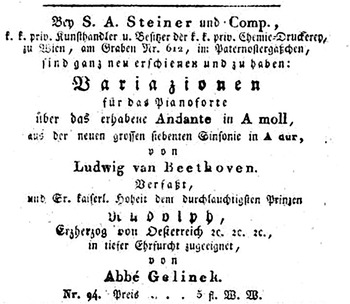
What spoke to the early resistance to ‘Allegretto’, and was perhaps constitutive of the growing intolerance to it, was an initiative by the elderly Vienna composer Joseph Gelinek, well-known at the time for his keyboard variations on popular ditties. Although disgusted by the many novelties in Beethoven's new symphony,Footnote 21 Gelinek composed and issued a variation set on the vexatious work's ‘Allegretto’. His set was advertised in the Wiener Zeitung of 16 December 1816, under the lavish title, ‘Variationen für das Pianoforte über das erhabene Andante in A moll, aus der neuen grossen Sinfonie in A dur von Ludwig van Beethoven’ (see Fig. 2).
Advertisement in the Wiener Zeitung from 16 December 1816.

There is regretfully no record of Beethoven's response to the inauspicious phrase ‘lofty Andante in A minor’ (erhabene Andante in A moll), which more than anything else put the mainstream public on the wrong track. It may have displeased Beethoven that a colleague well-acquainted with the proper tempo had no compunction in compromising the integrity of his music by means of a faulty reference. It may also have irked him that this was accepted and disseminated by Gelinek's publisher, Steiner, who had shortly earlier issued the seventh symphony and was thus well acquainted with the ‘Allegretto’. But Steiner's primary objective was profit, and an easy-going ‘Andante’ carried weight in marketing terms: it made better business sense than a somewhat less facile ‘Allegretto’.Footnote 22
In 1817, Beethoven retrospectively metronomized his first eight symphonies, by means of a pamphlet published in the AMZ.Footnote 23 Pegged to the ‘Allegretto’ was crotchet = MM 76, which we may assume constituted approximately the speed employed by him at the 1813–14 concerts. What Beethoven intended to articulate, it may be hazarded, was a less than fast tempo, though not one with brakes on. But the sustained flow and measured gait which he suggested raised little awareness. What continued to appease audiences was ‘Andante’, and in that fashion the movement enjoyed a vogue, not seldom as a separate concert piece.Footnote 24 Occasionally, the theme (again ‘Andante’) was selected by virtuoso pianists for fantasies and improvisations.Footnote 25
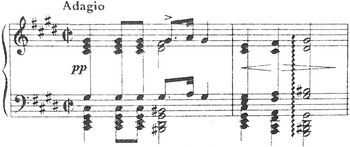
Beethoven's younger colleague Franz Schubert unwittingly participated in the disregard of ‘Allegretto’. In February 1823, the Wiener Zeitung announced Cappi & Diabelli's issuance of his Fantaisie pour le Pianoforte (Op. 15), touted as ‘a worthy counterpart of comparable works by the number-one composer [Beethoven]’.Footnote 26 This celebrated work, later named Wandererfantasie, was cyclically organized around a theme derived from the song ‘Der Wanderer’ (published by Diabelli as Op. 4 No. 1), with variations in the second movement. What resonated through in this self-quotation was the constitutive feature of Beethoven's ‘Allegretto’, the dactyl motive. Schubert utilized this as a topos, to engender an aura of doom and death, which he made highly dramatic by virtue of a hushed pianissimo and a paralysing stillness, in ‘Adagio’ tempo (see Ex. 1).
Franz Schubert, Wandererfantasie, bars 189–91.

The work soon grew into one of Schubert's most played works, made known in Vienna by the pianist Carl Maria von Bocklet.Footnote 27 The young Robert Schumann, enraptured by it, heard ‘a seraphic hymn as a praise to the Godhead; one sees the angels praying’.Footnote 28 Such was the Wandererfantasie's popularity that in the 1850s Franz Liszt transcribed it for piano and orchestra. The upshot is that Schubert's affectionate ‘Adagio’, the ruminative melodic line of which was manifestly not allowed to flow, may have contaminated the musical interpretation of Beethoven's ‘Allegretto’ – it was at least not conducive to its correct implementation. Needless to say, the works were not in any way related. More generally, Schubert and Beethoven had psychologically and artistically only little in common.Footnote 29
Anton Schindler's ‘Pious Andante’
After Beethoven's death, the composer's erstwhile helper Anton Schindler felt strongly about the manner in which his master's symphonies were performed. He delivered an admonition of disapproval to conductors who cultivated precipitate tempos, by which in his view they misrepresented especially the Fourth, Seventh and Ninth Symphonies, as well as the Missa solemnis. What loomed large on Schindler's agenda was the seventh symphony's ‘Allegretto’, for the ‘spiritual content’ of this music, he contended, called for a sphere of contemplating serenity, which was best achieved by means of a reduced speed.
When the symphony was played at the Aachener Musikfeste, on 7–9 June 1840 in Aix-la-Chapelle under the baton of Louis Spohr, Schindler was truly annoyed. He went to seek Spohr out afterwards to voice his qualms about the tempos, which in his view had been way too fast. The ensuing quarrel between the two was noted by a journalist who memorialized the sordid incident in a journal,Footnote 30 which in turn struck a responsive note from Schindler:
But it is undeniable … that tempo allots a piece of music its relevance, or withholds this, I permit myself to bring forward that Mr Spohr commenced the second movement of the A major Symphony at a pace of minim = 94, but that it became ever faster, until the precipitation drifted into an ongoing Allegro by the end of the final section (in A minor) – there where the phrases are divided between winds and strings and seem to whisper to each other, pain-relievingly, ‘Peace be with you, calm now, calm’ – which was maintained until the end. I leave it to the sensibility and insight of connoisseurs to decide as to whether this was a mistake – a minor or a major one – or perhaps appropriate.Footnote 31
Schindler added that Beethoven himself had substituted ‘Allegretto’ in 1823, when he had instructed the organizers of the Concerts spirituels (Piringer and Gebauer) to take it slower.Footnote 32 Schindler's own view was that a hurried and unstable tempo was detrimental to the movement's ‘sense of the sublime’ (Sinne für das Erhabene), and that the fluency of Spohr's ‘Allegro’, near the end, was a menace to the religious connotations of the music – ethereal voices whispering, in an aura of epiphany, ‘Peace be with you, calm now’. Spohr, who had a sterling reputation and was distressed to be put to the indignity of having to defend himself publicly, offered a balancing response. He furnished the reminder that as a member of the orchestra he had enjoyed the privilege of playing in 1813 at the premiere of the seventh symphony under Beethoven's own direction, and that he had memorized MM = 72 for the ‘Allegretto’, with no fluctuations or instability.Footnote 33 The claim by Schindler that Beethoven had altered ‘Allegretto’ in later years did not impress him, for a composer suffering from a loss of auditory sensations, like Beethoven, should not abjure earlier views.
Spohr was unaware that Schindler had objected to ‘mad chasing’ by conductors (tolles Abjagen) in his recently published Beethoven biography, with the ‘Allegretto’ as a case in point.Footnote 34 Nor did he know that Schindler's passionate railing against ‘Allegretto’ actually went back to 1831, when he had initiated a campaign about ‘poetic ideas’ in Beethoven's music. The seventh symphony's opening movement, Schindler contended, played out the dramatic narrative of a ‘moral hero who succeeds in conquering fate’ (moralischen Helden, der den Kampf mit dem Schicksal besteht), with the serene second movement as a fitting follow-up:
Now the mourning soul throws himself down for God and sends a prayer in the Andante quasi Allegretto*, which is expressed in an incomparably beautiful manner in the violins and cellos.Footnote 35
The ‘Andante quasi Allegretto’ expressed the penitent hero's supplication to the Godhead, while, as was added, the major mode section, ‘a star in the darkness of night’ (ein Stern in finsterer Nacht), portrayed his new-found belief in ‘an afterlife, an immortality’ (ein Jenseits, eine Unsterblichkeit). His (Christian) faith strengthened, the hero found himself transformed from penitent to adherent initiate. The music that followed represented churchgoers still anxious about faith, as well as those already enjoying a beatific vision of unearthly and perdurable peace under the spell of a theophanic ‘Peace be with you’ (Friede sey mit euch). The ambiance of transcendence and moral edification led Schindler to employ the term ‘pious Andante’ (religiöse Andante),Footnote 36 which he vindicated in a footnote appended to the asterisk of the above citation, running as follows:
* At a performance of this symphony in his later years Beethoven noticed, much to his dismay, that this movement was played outrageously fast, what worked to the detriment of its character. He thought to remedy this wrongdoing of tempo by indicating it in future with Andante quasi Allegretto, together with MM crotchet = 80, as recorded in a notebook which I have in my possession. As is generally known, Beethoven made plans to characterize all his works – especially the grander ones – more distinctly by means of metronome marks, on behalf of conductors.Footnote 37
Schindler was apparently unwilling to reveal that the official tempo was ‘Allegretto’ – at least he kept quiet about this.Footnote 38 Proceeding from the argument that his master's instrumental works were predicated on ‘visions and pictures drawn from literature, or from his [Beethoven's] own lively imagination’, as he formulated it later,Footnote 39 he felt free to promote ‘Andante quasi Allegretto’, which Beethoven had purportedly decided on later. This effort to blur the distinction between the two tempos was but a conduit for the devitalized ‘pious Andante’ which dovetailed with a hero kneeling down and praying. Schindler thus respectively impaired, invalidated, sublated, and pretended away ‘Allegretto’. Such were his interventions that he ultimately managed to discard it altogether. By this stage (1831) he had no knowledge yet of Beethoven's 1817 metronome marks, which made him invent MM = 80 for the seventh's second movement.Footnote 40
To convince those who were not receptive to his ‘Peace be with you’ story, Schindler claimed in his 1840 Biographie that it had been Beethoven himself who had revealed this programme to him during ‘vivid educational sessions’ (lebendiger Unterricht).Footnote 41 This met with scepticism – as practically his entire book provoked opposition. Such was Schindler's determination to get accepted that the second movement was suffused with the supernatural, that in the revised edition of his book (1845) he took the matter to a next level. Caught on the back foot, he furnished as evidence entries from conversation books, allegedly dating from 1823:
– As far as I'm concerned, I would now champion the Symphony in A major, specifically on account of the second movement, of which not all your intentions are yet clear to me.
– Thus, Andante crotchet = 80, no longer ‘quasi allegretto’.
– So 72 = crotchet will be better.
– Thus, I must mark the second movement of the A major Symphony with crotchet = 80?Footnote 42
As is well known, Schindler added these remarks in the conversation books long after Beethoven's death, probably between 1840 and 1845 (the fourth items perhaps a little earlier). Other fake comments addressed religious connotations, or were meant to settle score with Spohr's wretched acceleration of tempo:
– In the second movement the hero finds himself at the ultimate bliss.
– For me, the Andante is the optimum ideal of sacredness and divinity.
– I could never be satisfied with the major mode section, for it always degenerated into an Allegro – the entire movement.Footnote 43
These entries sounded the death knell for ‘Allegretto’, for allusions to ‘hero’, ‘Andante’ and ‘sacredness’, in direct conversation with Beethoven, were all but indisputable arguments. It was by this stage that Beethoven's metronome marks from 1817 came to Schindler's attention. These posed a problem, for MM = 76 was even slightly slower than MM = 80.Footnote 44 Schindler wriggled himself out of this by contending that MM = 76 was ‘early’ and that it had been slowed down later, with only the A major section ‘somewhat more pacy’ (etwas bewegter).Footnote 45
When by 1860 Schindler published the revised and enlarged edition of his Biographie, matters of tempo still held his fascination. He exhibited a moral outrage towards ‘exaggerations of tempos in the symphony, which often degenerate into wildness’, wagging a remonstrative finger at conductors.Footnote 46 As regards the seventh symphony, the ‘Andante’ in the AMZ review of 26 January 1814 had come to his attention. He tried to capitalize on this by asserting that this had originated with Beethoven in a primordial stage.Footnote 47 Having claimed earlier that Beethoven had decided on ‘Andante’ only relatively late, in the 1820s, he was impelled to conjure up Beethoven's successive use of ‘Andante’, ‘Allegretto’, and once again ‘Andante’ – the intermittent ‘Allegretto’ given up on because it was detrimental to the movement's ‘character’.Footnote 48
Authorities like Ludwig Nohl and Alexander Wheelock Thayer did not bother to comment on these unsubstantiated assertions, which they ostensibly endorsed begrudgingly. But the many inconsistencies and contradictions were not lost on the indefatigable searcher Gustav Nottebohm, who looked askance at Beethoven wavering from an original idea.Footnote 49 Even he did not penetrate Schindler's conversation book deception, though. These feigned entries by Schindler had long shadows, for they were brought to light only after a full century, during which many observers succumbed to the unexamined presumption that ‘pious Andante’ was authentic. Axiomatically assimilated as correct, this consolidated into a sturdy tradition and it led to a die-hard myth.Footnote 50
Poetic Interpretations
When Schindler argued for a silent programme, in 1831, sidelining ‘Allegretto’, he contributed to a vogue which had already been under way for some time. When he first engaged in association with Beethoven, in 1822, the debate about ‘meaning’ in instrumental music was in full swing. External stimuli were believed to stand in correspondence with emotional states evoked by high-standard music.Footnote 51 The Berlin Allgemeine musikalische Zeitung, for instance, disputed that symphonies were autonomous products consisting of ‘meaningless’ sound, a mere ‘tickling of the senses’ (Sinnenspiel). The connoisseur's emerging aesthetic was that they were predicated on some narrative or ‘idea’.Footnote 52 Because Beethoven himself was not very communicative on this front, commentators attempted to unlock the inner secrets of his works themselves, in an effort to raise them from entertainment to edification.
Pertinent to present investigations, Adolf Bernard Marx (1824) heard in the seventh symphony's ‘Allegretto’ the dramatic narrative of a ‘lofty mourning procession’ (erhabnen Trauergange), a cinematic scene of captured soldiers plodding through the streets, bemoaning their state and hoping to be pardoned by their victors (‘their entreaties moving the hearts of other warriors’).Footnote 53 Their tired dragging implicated a slow and withheld pace. For Carl Friedrich Ebers (1825), writing for Cäcilia, the music featured a marriage ceremony, a theme in the cello representing the poignant speech held for the bridal couple, and another passage depicting congratulations by attendants.Footnote 54
In France, associative meaning mushroomed profusely. The Paris conductor François-Antoine Habeneck,Footnote 55 widely known for his hyper-sentimental approaches, put a personal stamp on Beethoven's symphonies, and when in 1821 he substituted the slow movement of the second symphony by the seventh's ‘Allegretto’, this deeply impressed the young Hector Berlioz. Berlioz grew up absorbing Habeneck's performances and he related to the seventh symphony as a work ‘célèbre par son adagio’; for him, the movement was a ‘miraculeuse élégie’ inaugurated by a ‘douloureux soupir’, unfolding into a ‘sublime plainte’ that brought about a ‘vallée de larmes’ – a valley of tears.Footnote 56 He reiterated ‘Adagio’ five times and perceived the music as an admixture of dirge and prayer. Its sadness and sorrow, the ‘souffrance immense’, incited him to make comparisons with the biblical Lamentations of Jeremiah.Footnote 57 Freed from juvenile levity, Berlioz became somewhat more cautious. ‘Adagio’ was upgraded into ‘Andante’, but he still experienced an ‘exclamation plaintive’, the music symbolizing a ‘souffrance dévorante’, by virtue of which it brought about ‘des pleurs, des sanglots, des supplications’, with only the major mode section (a ‘patience souriant à la douleur’) as a momentary point of repose and a spiritual oasis. The movement had a rescinding end, followed by an asphyxiating ‘voix mourante’.Footnote 58 As a seasoned musician Berlioz was not oblivious of the original tempo. This should have alerted him to its potential significance, but it was apparently antipathetic to his sensibilities and he gave in to his proclivity for a more expressive valence of sentiment – the primary romantic pursuit. Tempo was, in general, for the romantics a negotiable commodity and not for a composer to dictate; it could be ignored, marginalized, or even dismissed. Consequently, the ‘Allegretto’ could sound leaden-footedly slow. When performed at the École royale in Paris in 1829, the reviewer Édouard Fétis noted, ‘What is more captivating and touching than this Adagio?’Footnote 59
In Germany, Robert Schumann made himself heard on the subject. For the Neue Zeitschrift für Musik (1835) he harnessed the Cäcilia narrative from 1825 about a farmer's wedding and had his alter ego Florestan muse:
At the front, choir boys hold burning candles and holy water fonts; they are followed by friends who throw a glance at the couple, while accompanying the priest; the parents are present, female friends, and further back a lot of young village inhabitants. Now all take their place and the priest, having climbed to the altar, addresses successively the bride and the happy groom about the holy obligations of the covenant and its purposes and that they may find happiness in their heartfelt harmony and mutual love. She is implored to answer ‘yes’ – such determining a word for all eternity, articulated by her in a firmly and composed manner.Footnote 60
It would seem that the 25-year-old was daydreaming about his secret wish to marry his sweetheart Clara Wieck, a plan frustrated by her father. Schumann had no aesthetic qualms about mapping subjective experiences onto music and letting himself be inhabited by it. Accordingly, he considered it worthy to speculate that the ‘Allegretto’ was about a hushed and solemn parade in a churchy surrounding, with poignant moments of blessing and taking vows. His wisps of fantasy, based on the perfumed languor of slowness, had staying power, for they flared up when Heinrich Robert Stoeckhardt, in the Neue Zeitschrift für Musik in 1844, perceived in the ‘beautiful A-minor Andante’ a representation of ‘the most profoundly experienced wistfulness of pure natural souls’.Footnote 61 Ernst von Elterlein (1858) likened the music to a ‘subdued love complaint’.Footnote 62 Such imaginative flights, sometimes offered as fulsome assertions, were consequent upon Carl Czerny's weighty comment, published in 1842, that Beethoven had been continually drawing a creative stimulus from the non-musical world and that many of his works were predicated on ‘ideas and pictures’ from literature or other sources.Footnote 63 This, lodged in the historiographical imagination, made Beethoven's output hospitable to the most variegated subjective readings.
Alexandre Oulibicheff (1857) dubbed the ‘Allegretto’ a ‘chant élégiaque’ and a ‘grande voix du mausolée’, couched in an atmosphere of desolation. He did not dodge the bullet of ‘Allegretto’, which he duly noted, but constraints of playability made him express scepticism towards its applicability, so he faulted Beethoven and latched on to ‘Andante’ (‘on ne saurait le prendre autrement’).Footnote 64 ‘Allegretto’ was also disavowed by Adolf Bernard Marx (1859), who clung to his story about grief-stricken prisoners-of-war, a scenography of ‘lamenting shroud-covered figures’ (in Trauerschleier gehüllter Gestalten).Footnote 65 Wilhelm von Lenz (1860), who openly queried whether Schindler's ‘Peace be with you’ narrative had originated with Beethoven, was inclined to hear, like Marx, a ‘sombre parade of armed forces’ – this time not prisoners of war but native soldiers who, in the major mode section, bade farewell to the home front.Footnote 66
The period that ensued was largely dominated by the authoritative personality of Richard Wagner, whose own performances of Beethoven's symphonies were accompanied with ‘programmes’, written by himself and meant to ‘summon up feelings in the listeners’ (um damit rein auf das Gefühl der Zuhörer zu wirken).Footnote 67 Wagner was adamant that the symphonies were ‘genuine poems’ (wirkliche Dichtungen), in which ‘concrete things’ (wirkliche Gegenstände) were portrayed.Footnote 68 As regards the ‘Allegretto’, he mocked the identification with a ‘church procession and blessings’,Footnote 69 availing himself instead of ‘Gegenstände’ to describe the music's longing character. He rhapsodized:
Against the ceremonial striding rhythm of the second movement a secondary theme raises a song of plaintive yearning. This longing melody entwines around the rhythm, of which the secure pace can be persistently recognized throughout the entire movement, just like an oak is entwined by ivy, which, if it would not wind its way up around the mighty trunk, would rampantly and wildly tousle and tangle on the earth. Now it obtains a regular and steady shape around the pithy form of the tree, constituting an effusive decoration of the raw oak-bark. How mindlessly present-day composers of instrumental music, who so much like to work with second themes, have failed to capitalize on this profoundly significant invention by Beethoven!Footnote 70
Contemplations like these prompted ridicule by Schindler, who – rather curious in light of his own imaginative flights – exerted critical judgment on Wagner's ‘exaggeratingly subjective discharges’ (überschwänglichen Subjectivitäts-Expectorationen), his metaphorical or allegorical comparisons.Footnote 71 To lend force to this, he resorted to Beethoven, who had once warned against subjective explanations of his music. When in 1819 a devoted Beethovenian in Bremen, Christian Wilhelm Müller, had compared the seventh symphony with a ‘political uprising’ (Volks-Aufstande), Beethoven had discouraged this association on the ground that it could lead to grave misunderstandings. Any characterization, if necessary, he added, should be in very general terms.Footnote 72 This story by Schindler finds corroboration in external sources: there indeed existed correspondence between Beethoven and Müller, who took a symphony as ‘a characteristic musical image of a romantic story’ (ein characteristisches Tongemälde einer romantischen Geschichte).Footnote 73 Moreover, Müller's ‘explanation’ of the seventh symphony is captured in an extant manuscript.Footnote 74 Schindler's efforts to discredit Wagner, however, were of no avail and the latter's hints of association continued to gain currency.
Meanwhile in France, ‘Adagio’ crystalized into a custom. The music was not seldom harnessed for requiem concerts. It added wrenching poignance to services held for Antonin Reicha (1836), Hyppolyte Flandrin (1864), and Berlioz (1869).Footnote 75 Without much reservation the slow tempo was regularly assigned to Beethoven himself, for example in programme notes attendant on concerts in Paris on 26 January 1862 and 23 December 1866, when the second movement was once more introduced as featuring a ‘Noce villageoise’, more specifically a ‘Marche nuptiale’.Footnote 76 Sometimes programmes consisted of bizarre tales suffused with the religious and mystical. One dating from 1893 had a singularly haunting story about skeletons pottering around:
The souls of the dead leave their sepulchers. They whisper, and their doleful sounds become more and more distinct as they advance toward the nave. Continuing their funeral procession, they rise and unfurl into the higher galleries. Slowly, life returns into them. Then, suddenly, a fortissimo outburst – pizzicato fugues mark the irregular and urgent steps of the phantom people that have regained life through the tender invocation of harmony.Footnote 77
This extravaganza of speculation was presented in the form of information – textually and musically. In virtue of the uncanny grisliness of the scene, a foray into the realm of the dead, the ‘curtain’ opening chord must have sounded like a turgid yearning and the inaugurating theme like a cavernous growling. By implication, tempo plumbed new depths: a syrupy, lethargic slowness, no doubt adorned with elongated stillnesses.
England saw similar approaches to the music. Some commentators there stressed the delightful horror of the sublime. In 1879, a British analyst perceived in the ‘Allegretto’ a Shakespearean gloom, the ‘fate-and-madness-haunted world of Juliet in the tomb’, with the closing measures evoking an ‘incurable, illimitable woe’.Footnote 78 His countryman George Grove (1896), who echoed Schindler, advanced that ‘we now often play his [Beethoven's] music faster than he intended’ and that the composer, ‘most anxious that this movement should not be taken too fast’, had wished ‘Allegretto’ to be changed.Footnote 79 In decades straddling 1900, Wagner's ex cathedra recommendation that the second movements of both the Seventh and Eighth Symphonies were ‘Andantes’ more or less mortgaged musical performance. Wagner had little respect for Beethoven's instructions and he seemed more than content to show this.Footnote 80 His unequivocal claims were persuasive enough for a critical conductor like Felix Weingartner (1906) to make peace with them – although he also warned against undue tardiness.Footnote 81 At this juncture of reception history, metronome numbers were airily waved aside and considered untrustworthy.Footnote 82
As the new century unfolded, the auratic haze of the processional, seen as an outward manifestation of the funereal, became the enthusiastic subject of tertiary literature – programme notes and the like. The sesquicentennial monograph by Gustav Ernest, for example (21 editions published between 1920 and 2012), reflected that ‘although signified as Allegretto, the cautiously striding rhythm … gives [the movement] something of a funeral march’.Footnote 83 The wave of formalism of the 1920s and 30s, an age not very interested in music's ethical gestures, did not offer a shift in attitude or alternative readings. The music still displayed a ‘haunting sadness’ and ‘something strangely mournful’, and the ‘sombre slow movement’ was even produced as a ballet.Footnote 84 Marion Scott (1934) conceived it as obscure and enigmatic, inclining to the view that this was music meant ‘to direct our thoughts down into the open earth as into a grave’.Footnote 85 Arnold Schering (1936) stipulated, without qualification, that the ‘Allegretto’ was a ‘Requiem for Mignon’, Goethe's Knabenchor slowly disappearing into the distance and leaving a ‘motionless mourning of those staying behind’ (starrer Trauer der Zurückbleibenden).Footnote 86 Theodor Adorno, between 1934 and 1969, contemplated that ‘The [Allegretto] theme is … extremely subjective, in the sense of the uncanny. It ranks among Beethoven's romantic features, and is reminiscent of Schubert’.Footnote 87 Wolfgang Osthoff (1977) was led to surmise that the ‘Allegretto's main melody was a conscious allusion to the Litany of ‘Sancta Maria, ora pro nobis’, a theme governed by similar repeated dactyls.Footnote 88
A reduced pace remained the norm, especially for those who read the music as speaking covertly of the oracular and otherworldly. ‘Andante’ continued to be the most apparent point of equivocality among commentators. One of the few who addressed the heretical question of ‘Allegretto’, denying the indulgencies of a slower tempo, was conductor Arturo Toscanini, in the 1930s. In bold defiance of prevalent trends, Toscanini did not consider it as an outrage or daunting requirement: unalienated by difficulties of performance (decoration becomes more opulent and agitated as the music unfolds) he attempted to inaugurate Allegretto's revival, prevailing upon musicians and audiences to invigorate their jaded ears. But his ‘historical performance’ effort failed to resonate sympathetically, it did not win much approval.Footnote 89 Later in the century, when similar attempts were made, the response was more promising. In the 1980s the deprecation of ‘Allegretto’ withered, and especially in smaller concert halls the proper tempo was regularly taken on board – although somewhat faint-heartedly. But, as Rosen confirmed, in the echelons of conventional music-making a relative slowness was repeated unremittingly; an allround renewed artistic appreciation was not within reach.Footnote 90 Slowness also continued to govern analytical and reflective writing. Today's secondary literature still entertains the view that the music expresses sorrow. So much, at least is suggested by comments that it ‘carries associations with death and graveyard’,Footnote 91 that ‘Andante’ might after all have been Beethoven's final choice,Footnote 92 and that the movement might, for early recipients, ‘have conjured up reminiscences of the slow march tempo that Beethoven had used to such powerful effect in the Funeral March in the Eroica’.Footnote 93
This survey should suffice to illustrate the diversity of interpretative appraisal and to outline the status of ‘Allegretto’. Today, the original tempo still excites variegated opinion, even in contemporary academic scholarship. Controversy has sometimes risen with respect to three separate topics related to it. One mainstay of critical engagement is the extent to which significance should be imposed on the dactyl motive – whether or not this can be construed as a universal, archetypal pattern laid down in the auditor's productive imagination as a ‘referential signifier’, a coded symbol which conjures up collective fantastic projections.Footnote 94 Another, perhaps of more relevance, is the debate about ‘Allegretto’ as a tempo designator: whether or not this should be yoked under the same category as ‘Andante’. Already in the nineteenth century Wilhelm von Lenz revisited its meaning, arguing that it was slippery and beset with ambivalence. ‘Allegretto’ was seen as a pluralistic concept which transcended the temporal, elastic enough to embrace a range of speeds, with the ‘slow’ movements of the seventh and eighth symphonies as outliers,Footnote 95 hence more a genre (Gattungsbegriff) than a tempo. Similar thoughts were later adopted by Charles Rosen, who held (somewhat tentatively) that ‘Allegretto’ sat comfortably among the ‘slow’ tempos, and that its speed had metamorphosed over time (it had been ‘much slower’ in the Mozart era).Footnote 96 Contesting a derivation of ‘Allegretto’ from ‘Allegro’, Rosen concluded, ‘this will never do given Beethoven's use of the term for the slow movement of the Seventh Symphony’ (emphasis added).Footnote 97
Finally, what has provoked disagreement is the manner in which ‘tempo and character’ are bound up with one another. This presumed chicken-and-egg conundrum stoked up controversy, though as of late it gravitates to the view that the former is a critical constituent of the latter: tempo defines character, not vice versa.Footnote 98 Beethoven endorsed this himself, for he intimated in a letter that the two were the ‘body’ and ‘soul’ of a work and that tempo (transmitted by metronome marks or Italian words – the latter ‘already’ expressing the spirit of the music) eclipsed character.Footnote 99 Music's aesthetic content, he suggested, depended on the correct application of speed, which was an integral part of a work.Footnote 100
Beethoven's Perspective
Each of the three above discussed historical processes had its own motivational dynamic and legacy. But the point is strictly moot whether any of them provides a justifiable ground to disregard or disdain ‘Allegretto’, and to saddle Beethoven with an inconsistency. After mining the pertinent information, the overall picture is rather disillusioning. To sum up the arguments:
(i) the ascription to Beethoven of contemporary ‘Andante’, ‘Adagio’, or otherwise, is vitiated by errors of assessment. These terms were transposed from a communicative to an explanatory level, which led to miscommunication and misapprehension;
(ii) the ‘pious Andante’ drawn into focus by Schindler can be exposed as the result of falsification, error, and conscious deception. These confusing deliberations were a singularly blatant way of evoking dubiety about the well-foundedness of ‘Allegretto’;
(iii) the predilection for a stodgy tempo is liable to be traced to the cumulative effect of poor philology (the first necessity to the tradition of culture), entrenched prejudices, an interpretive overreach, claims to have a better taste than the composer by influential figures purporting to be experts, and misguided piety and diplomacy.
Taken together, these conclusions allow us to trace back to its roots the causal chain that generated the valuation of a slow approach: it was the toxic manner in which a cluster of errors interpenetrated which created a barrier on the road to insight and correct judgment. The ‘Andante’ hypothesis, meant to overturn ‘Allegretto’, was based on judgements in hindsight, encouraged by the ideal of a sustained espressivo and of ‘higher spiritual values’. It gathered weight by being repeated and became etched in the collective consciousness. Continually inherited through habit, education, and moral suasion, it deferred to convention and public opinion, and it infected the psyche until it became an a priori truth. This imputed a slur on ‘Allegretto’, which was shrugged off as an erraticism or a heretical compositional gaucherie. Because of its demerits it was cast into a limbo, where it is still found today.
The framework of the problematic reception history in hand, the matter allows for an examination of the ‘Allegretto’ under the aspect of the values which shaped it. While by dearth of concrete data the question of what impelled Beethoven to opt for it is difficult to answer, his motivating drives are not completely beyond fathoming. Imperative in discerning his professional incentives is, first of all, factoring out completely the three aforementioned historical developments, for the chequered history of the movement had no relation to the creative process. Furthermore, four points deserve notice.
First, Beethoven's indication ‘Allegretto’ is an historical fact, a piece of codified knowledge. It cannot be set aside or explained away, and it is not open to challenge. This tempo was decided on at the outset, and there is no warrant for supposing that it was at any stage amended, ameliorated, or repealed. It cannot be set aside or explained away, and is not open to challenge. Schindler's ‘Andante-Allegretto-Andante’ deliberations, meant to overturn ‘Allegretto’ out of resentment against it, have no evidentiary basis. Since these do not receive support from any angle and falter under the weight of false surmises and deception, not withstanding scrutiny, building on them is dubious and dangerous.
Second, it is not a viable explanatory strategy to assume that for Beethoven ‘Allegretto’ was ambiguous. To the contrary, for him this was sufficiently profiled, certainly by 1811. Rather than random, haphazard, or careless he employed it in a strikingly nuanced and coherent manner. It stood outside the limits of a standard ‘Andante’, with which it showed a marked disparity. Not even a fast running ‘Andante’ quite matched it, as can be gauged against the second movement of the sixth symphony, originally designed as ‘Andante molto moto, quasi Allegretto’, from the ‘Andante con moto quasi Allegretto’ of the second movement of the String Quartet Op. 59 No. 3, or from the curious ‘Andante con moto assai vivace quasi Allegretto ma non troppo’ of the Kyrie of the Mass Op.86. ‘Allegretto’ was sometimes tempered, like in the third movement of the Piano Trio Op. 70 No. 2 (‘Allegretto ma non troppo’). Or it was reinforced, like in the second movement of the String Quartet Op. 59 No. 1 (‘Allegretto vivace e sempre scherzando’) and in the finale of the String Quartet Op. 95 (‘Allegretto agitato’). Beethoven did not relent until he had found the perfect expression for the pace he envisaged. The tweaks and fine-tunings of ‘Allegretto’, then, are a testament to this tempo's precision and integrity. The operative words here are pace and vitality, which precludes the possibility that the Seventh's ‘Allegretto’ was an ‘Andante’-in-disguise. Moreover, serious questions can be raised as to the cogency of the claim that the dactyl motive features semantic content: this motive is most pertinently viewed as a constitutive agent, a shaping force of referential purity resisting interpretational appropriation.Footnote 101
Third, in compliance with the aforesaid, the ‘Allegretto’ movement rests on a prosaic and pedestrian theme, imparted with the jaunty tinge and grazioso Schwung of a Ländler or Allemande. The potential of such frugal themes remained a concern for Beethoven throughout his oeuvre, and the ‘Allegretto’ exhibits links to quite a few other works.Footnote 102 As regards symphonies, one afflicts the ‘Eroica’ finale (there it is a Contratanz). Another ‘dance’ theme was planned for the projected ninth symphony (1822), for which a preparatory verbal plan ran ‘Sinfonie allemand entweder mit Variation …’ (‘Symphony[.] Allemand[e,] either with variation[s] …’).Footnote 103 The capacity to spread suspense over variational music was central to Beethoven's greatness.
Finally, it merits consideration that Beethoven insisted that executants adhere to his performative instructions.Footnote 104 In this respect he did justice to his nickname Generalissimo, imposed on him by friends, because he assumed a role as a creator of values. As is amply chronicled by external account, he proactively held out his ordinances to musicians, who he expected to negotiate their task without stint or condition. He seldom granted them free rein, not even a proxy for interpreting instrumental recitatives. Given his tendency to limit performative choices (a pushing through of something ‘whether or not that has been [his] intention’,Footnote 105 would surely have enraged him) it strains credulity that he would have relented to opposition to ‘Allegretto’ put up by recalcitrant musicians, for he regarded disregarding tempo as tantamount to playing wrong notes.Footnote 106
This set of caveats renders implausible the supposition that Beethoven had anything else in mind than ‘a trifle lively’, an unmitigated scherzando. What seems to have been at the forefront in 1811, or was presented with unconscious intentionality, was a gently animated variation theme of diaphanous delicacy, which inhered within it an immediacy of performance and avoided a maudlin tone. This terpsichorean light-heartedness suggests that its remit was to prevent a romantic stance and to protect the recipient against the cry of pathos. By reinforcing the intrinsically musical, Beethoven also declined a pictorial explanation or aesthetic apology: a measured restraint and disciplined sensuality prevented the focus to wander off into undesired directions.
This automatically brings into relief E.T.A. Hoffmann's celebrated exposé of the fifth symphony, published (anonymously) in 1810 in the AMZ, not very long before Beethoven commenced at his seventh symphony. This was famously about opening up ‘the realm of the unimaginable and unfathomable’ and controlling the buttons of ‘anguish, awe, perplexity, and pain’ – in short, about experiences aroused in the listener by what the intellect was unable to conceptualize, such as the overwhelming mighty and infinitely great which, in the author's view, admitted the sense of ‘eternal yearning which is the essence of romanticism’.Footnote 107 The question is, whether Beethoven was amenable to this kind of quasi-religious imagining.Footnote 108 His negative response to Christian Müller, mentioned above, suggests that interpretational conjecture was not much to his taste. More generally, he may have worried about being enlisted in the ideological service of a burgeoning movement to which he was not especially committed and from which he carefully distanced and distinguished himself. There are no indications that he consented being stereotyped as a romantic artist, and neither as a Hoffmannesque oracle or priest. It is true that at this juncture of his career (1811) proto-romantic tastes and aesthetics began to prevail, but the halcyon days of classicism were not over. The triumvirate Haydn–Mozart–Beethoven stood firmly for an international brand, epitomizing neoclassical aesthetic tastes.Footnote 109 If the surmise be correct that with ‘Allegretto’ it was Beethoven's creative impulse to opt for a classical reserve (again, whether within rational control or surreptitiously is impossible to tell), than this was indigenous and intrinsic to his musical idiom, hence an exigency of style. Conscious of his position at the crossroads of concurrently flourishing styles he may have chosen it as an antidote to utilitarian romantic ethics centring around sentiment, to which Hoffmann's essay was implicated. In either event, he declined to submit to a sustained espressivo and shrank from, at least spurned, the affective orientation generated by a slow tempo.
However, he did not accomplish his goal by a long chalk. While accepted as authentic, ‘Allegretto’ was widely perceived as eccentric and suspect, and posterity neither apprehended nor comprehended it. It was made palatable to fit the Zeitgeist. Divested of its quintessence – vitality – and a reduced speed was constructed to satisfy era-specific tastes and standards of performance. This sanatizing of Allegretto's potential's became custom and usage, hostility towards it being motivated by the pronounced degree of value set on interpretive reading, with Schindler's ‘Peace be with you’ beautifying pretext as a heavy burden of precedent.
The cultural inheritance of making ‘Allegretto’ acceptable to aesthetic sensibilities and preferences, a trend away from established fact, is vulnerable to criticism. The allegiance to ‘Andante’, the tempo which is still donning Allegretto's mantle today, is problematic at best, for it is verifiably unwarranted, created out of the desire to contribute to the myth of the ‘heroic’ Beethoven. For all its ubiquity, and despite the weight assigned it, reception history exposes it as a psychological palliative, a comfortable illusion grounded in ideology. Given its questionable side-effects, like artistic adaptation, mythologization, and media exploitation,Footnote 110 the standardization of ‘Andante’ seems in need of a reorientation.
Reception history impacts the manner in which music is approached. Modern recipients still carry around valuations that originated in the passions and loves of former centuries. As regards ‘Allegretto’, the challenge is – unless a self-effacing approach is objected to on principle – to free oneself from a dominant value perspective and to become master over what has so far been scrawled and painted over it. It stakes a claim to being observed and implemented as a factuality of the composer's stylistic trajectory.


 Open access

