




Introduction
Preclinical models of pathogen-induced maternofetal immune activation (MIA) uncovered its role in the induction of perinatal brain injuries leading to autism spectrum disorder (ASD)-like manifestations. For instance, Group B Streptococcus (GBS) chorioamnionitis during the third tier of gestation generated autistic manifestations in the progeny characterized by forebrain dysmaturation as well as impaired social interactions, decreased ultrasonic vocalization, weak maternal attachment, and sensorimotor dysfunctions as loss of prepulse inhibition. Reference Bergeron, Deslauriers and Grignon1–Reference Allard, Brochu, Bergeron and Sebire4 Such ASD-traits were more prominent in male than female offspring and persist from juvenile up to adult age. Reference Bergeron, Deslauriers and Grignon1–Reference Allard, Brochu, Bergeron and Sebire4 In such MIA models, anti-inflammatory interventions using interleukin-1 (IL-1) blockade administered to the dam exerted placento- and neuro-protective effects alleviating forebrain anomalies as well as ASD manifestations. Reference Girard, Tremblay, Lepage and Sébire5,Reference Ayash, Vancolen, Segura, Allard and Sebire6 However, the precise way(s) how chorioamnionitis exerts its deleterious effect on the brain remained to be defined.
Given that dysfunctions of several key cells and molecules involved in the blood brain barrier (BBB) development are implicated in the pathogenesis of ASD from genetic and/or environmental origins, Reference Zhao, Nelson, Betsholtz and Zlokovic7–Reference Obermeier, Daneman and Ransohoff9 we hypothesized that pathogen-driven MIA affects structural and functional components of the fetal BBB exposed to chorioamnionitis. To test this hypothesis, we used our well-established preclinical model of GBS chorioamnionitis leading to various neurodevelopmental diseases including ASD-traits. Reference Allard, Bergeron and Baharnoori2–Reference Allard, Brochu, Bergeron and Sebire4,Reference Vancolen, Ayash, Allard and Sébire10
Methods
Animal model
All experiments were approved by the Institutional Animal Care and Use Committee of the McGill University in accordance with the Canadian Council on Animal Care guidelines (protocol #MUHC-7675). Eleven pregnant primiparous Lewis rats were obtained from Charles River Laboratories (Kingston, NY, US) at gestational day 13 (G13). Dams were individually housed and maintained on a controlled environment (12-hour light/dark cycle) with food and water ad libitum. After arriving at the local animal facilities, animals were allowed to habituate to their new environment for 6 days.
Our established protocol was used to model chorioamnionitis triggered by GBS, as previously described. Reference Allard, Bergeron and Baharnoori2,Reference Allard, Brochu, Bergeron and Sebire4,Reference Ayash, Vancolen, Segura, Allard and Sebire6,Reference Allard, Giraud, Segura and Sebire11 At G19, dams were randomized into two groups as follows: dams (n = 6) from the GBS group were given intraperitoneal injections of GBS serotype Ia strain #16955, (1.108 CFU of GBS suspended in 100 μl of sterile saline) and dams (n = 5) from the control (CTL) group were given intraperitoneal injections of 100 μl of saline solution. Cesarean sections (C-sections) were performed at 72 h post-inoculation to collect fetal brains, as described. Reference Allard, Bergeron and Baharnoori2,Reference Ayash, Vancolen, Segura, Allard and Sebire6,Reference Allard, Giraud, Segura and Sebire11
Tissue preparation, immunohistochemistry and immunofluorescence
Brains were fixed and paraffin-embedded, as described. Reference Allard, Bergeron and Baharnoori2,Reference Savard, Brochu, Chevin, Guiraut, Grbic and Sébire12 Measures of albumin into the brain is a classic method to analyze BBB permeability. Reference Saunders, Dziegielewska, Møllgård and Habgood13 Permeability of BBB was determined by albumin staining performed on Ventana Discovery Ultra (Roche Diagnostics, IN, USA) in the Histopathology platform at the Research institute of the Montreal University Health Center (RI-MUHC), as described. Reference Savard, Brochu, Chevin, Guiraut, Grbic and Sébire12 Other immunohistochemical (IHC) and immunofluorescence (IF) experiments were performed as described Reference Allard, Bergeron and Baharnoori2,Reference Allard, Giraud, Segura and Sebire11,Reference Savard, Brochu, Chevin, Guiraut, Grbic and Sébire12 using relevant antibodies (Table 1).
List and features of antibodies

Image analysis and quantification
For each staining, the following regions of interest (ROIs) were studied, namely the hippocampus (fields CA1 and CA3), corpus callosum (CC), primary motor cortex, primary and secondary somatosensory cortex (Fig. 1). Anatomical landmarks were identified using the Developing Rat Nervous System rat brain atlas (Ashwell and Paxinos, 2008).
Coronal section of the fetal brain at 72 h post infection. The illustration presents regions of interest that were used in our analyses, namely the hippocampal region (CA1 and CA3), corpus callosum (CC), external capsule (EC), fimbria (fi), motor cortex (M), primary and secondary somatosensory cortex (S1 and S2 respectively). Bregma: −0.20 mm; scale bar = 1 mm.

IHC slides were scanned with a NanoZoomer Digital Pathology Scanner (NanoZoomer 2.0-RS, Hamamatsu Photonics, Japan) and the colorimetric analysis was performed using Extract Brown plugin from ImageJ software, as previously described. Reference Allard, Bergeron and Baharnoori2,Reference Allard, Giraud, Segura and Sebire11,Reference Savard, Brochu, Chevin, Guiraut, Grbic and Sébire12 To measure the labeling intensity, we multiplied the mean labeling intensity by the percentage of staining pixels with a threshold of 1-18000. Results from each ROIs were normalized using a CTL sample. Except for CA3 and CC, two fields per ROIs were counted (Bregma: −0.20 – −0.40 mm). As no difference were found between left and right hemispheres, we calculated the mean of labeling intensity for each ROIs.
Fluorescent images were captured using AxioScan.Z1 (Carl Zeiss, Jena, Germany). The image was processing with a deblurring (Strength: 0,9; Blur Radius: 15) on ZEN 3.7 (ZEN lite, Carl Zeiss Microscopy, Germany). To validate Claudin-5 staining, a double immunostaining of Claudin-5 with von Willebrand Factor (vWF) was performed and analyzed using the co-localization Colormap plugin on ImageJ software, as described. Reference Savard, Brochu, Chevin, Guiraut, Grbic and Sébire12 Labeling intensity of Claudin-5 was obtained by the same process used for albumin staining, i.e. multiplying the mean labeling intensity by the percentage of staining pixels using a threshold (96-255), and normalizing with the staining of the CTL sample. All the analyses were performed by an investigator blinded to the experimental conditions.
Statistical analyses
Statistical analyses and figure representation were done using Graph Pad Prism software version 8.0.2 (San Diego, CA, USA), as described. Reference Allard, Bergeron and Baharnoori2,Reference Allard, Giraud, Segura and Sebire11,Reference Savard, Brochu, Chevin, Guiraut, Grbic and Sébire12 Normality and homogeneity of data set were validated by a Shapiro-Wilk normality test. The Grubbs’ test was used to remove outliers. T-tests with Welch’s correction or Mann-Whitney tests were performed depending on the normality of the data set, and a False Discovery Rate of q = 0.05 was applied in order to correct for multiple comparisons. Two-way Analysis of Variance (ANOVA) was performed using Sex (Female, Male) and Treatment (CTL, GBS) as fixed effects. Sidak pairwise comparisons were applied when there was a significant interaction between Sex and Treatment at the level of p < 0.05. Data are presented as the mean ± SEM with p ≤ 0.05 considered as statistically significant.
Results
Prenatal exposure to GBS chorioamnionitis reduced fetal BBB permeability to albumin
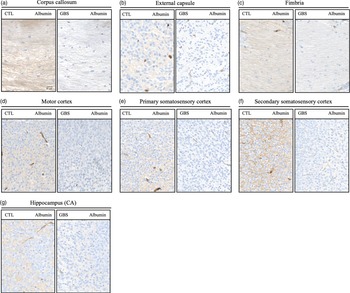
Albumin staining was reduced in the GBS-exposed brains (Fig. 2A) as compared to CTL at 72 h (Fig. 2B). Our study documented a significant decrease of albumin diffusion through the BBB from 2.4 to 14.9-fold decrease in the white matter and from 3.5 to 8.2-fold decrease in the gray matter structures exposed to GBS chorioamnionitis versus CTL (see Table 2): namely, CC (Fig. 3A), external capsule (Fig. 3B), fimbria (Fig 3C), primary motor cortex (Fig. 3D), primary and secondary somatosensory cortex (Fig. 3E-F), and hippocampus (Fig. 3G).
Representative images of IHC detection of albumin in fetal rat brain at 72 h post infection. Global anatomical view and regions of interest in a CTL forebrain (A) compared to B) the GBS-exposed forebrain (B). Bregma: −0.40 mm; scale bar = 0.2 mm. abbreviations: CC: corpus callosum, CTL: control, EC: external capsule, GBS: group B streptococcus, V: ventricle.

Representative images of IHC detection of albumin in the ROIs of the fetal brain at 72 h post-GBS exposure compared to CTL. Representative albumin-stained white matter (namely, the corpus callosum, external capsule, and fimbria) and gray matter areas (i.e., the motor cortex, primary and secondary somatosensory cortex, and hippocampus) areas. Bregma: −0.20, −0.40 mm; scale bar = 20 µm.

Intensity of albumin labeling measured in fetal rat brain at 72 h after GBS exposure

A significant interaction between sex and treatment was detected in the primary somatosensory cortex and the hippocampus: male but not female fetal brains exposed to GBS chorioamnionitis showed a decreased intensity of albumin staining compared to CTL (data not shown).
Effect of prenatal exposure to GBS chorioamnionitis on fetal brain endothelial cells
IF double staining showed the co-localization of claudin-5 and vWF expressions at 72 h post-GBS exposure (Fig. 4). We observed a significant increase of claudin-5 staining intensity in the CC, fimbria and secondary somatosensory cortex exposed to GBS chorioamnionitis versus CTL (Table 3), suggesting a decrease in the junctional permeability of fetal brain endothelium. No significant difference was found in the vWF staining from GBS-exposed versus unexposed fetal brains (data not shown).
Representative images of double IF detection of claudin-5 and vWF in fetal rat brain at 72 h post-GBS exposure compared to CTL. IF images are representative of the blood vessels in gray matter areas. Bregma: −0.20, −0.40 mm; scale bar = 20 µm.

Intensity of Claudin-5 labeling measured in fetal rat brain at 72 h after GBS exposure

Discussion
This study explores the effect of GBS-induced placental inflammation on the BBB of rat fetuses at G22, a well-established model of ASD due to one of the most common antenatal infection of the placenta, namely GBS-induced chorioamnionitis. Reference Ayash, Vancolen, Segura, Allard and Sebire6,Reference Vancolen, Ayash, Allard and Sébire10,Reference Allard, Giraud, Segura and Sebire11,Reference Raia-Barjat, Digonnet and Giraud14 Short and long-term ASD traits – such as impaired social interaction and processing of sensory information – observed in this model support the involvement of GBS-induced chorioamnionitis in the fetal programming of ASD. In our model, GBS chorioamnionitis is self-limited and activates fetal innate immune response through the release of inflammatory mediators – such as IL-1β – which affects directly or indirectly the development of the brain. Reference Allard, Bergeron and Baharnoori2,Reference Ayash, Vancolen, Segura, Allard and Sebire6,Reference Allard, Giraud, Segura and Sebire11,Reference Bergeron, Gerges and Guiraut15,Reference Vancolen, Ayash, Segura, Allard, Robaire and Sébire16 To our knowledge, the impact of MIA on the prenatal BBB has not been studied yet.
We show that GBS chorioamnionitis provokes a decrease of fetal permeability of the BBB to albumin within the male and female forebrains. This drop of permeability of the BBB affects both gray and white matters from the motor, sensory, and limbic areas as well as their main associative tracts. This decreased albumin diffusion through the brain was more prominent in male than female in the primary somatosensory cortex and hippocampus, which belong to critical brain circuits, whose disruptions are involved in ASD.
In the mature brain, systemic inflammatory responses provoke BBB disruption and molecular leakages between blood and brain. Reference Banks17 However, no study dealt with the effect of remote bacterial infection, such as chorioamnionitis, on the fetal BBB, and none to our knowledge focused specifically on GBS at the fetal stage. During its formation, the fetal BBB is known to be permeable as shown in rodents at the end of gestation, Reference Zhao, Nelson, Betsholtz and Zlokovic7 which is confirmed by our results documenting the efflux of albumin from the blood through the BBB within the brain of CTL fetuses. In contrast with expectations based on the above-mentioned data, GBS-induced chorioamnionitis triggers a major and diffuse drop of permeability of the fetal BBB to albumin. Such loss of permeability might be due to a developmental effect of MIA accelerating BBB maturation through the overexpression of claudin-5 and the resulting increase of tight junctions between endothelial cells documented in our model. Such process would be in line with the dual role of cytokines shifting from trophic functions in the developing brain to a more complex balance of mixed toxic and trophic effects in the mature brain. Reference Lu-Culligan and Iwasaki18 Interestingly, human ASD results in part from defective molecular pathways involved in BBB regulation due to gene mutations such as those affecting the vascular signaling and BBB integrity, Reference Gozal, Jagadapillai, Cai and Barnes19,Reference Jagadapillai, Qiu and Ojha20 including for instance the increase of claudin-5 expression detected in post-mortem brain of patients with ASD. Reference Fiorentino, Sapone and Senger21 Such drop of permeability of BBB might interfere with the systemic transfer from the placenta to the brain of key neurotrophic factors – such as the insulin-like growth factor 1 – involved in the development of the brain connectome whose defects are present in ASD. Reference Steinman22 Altogether, as shown by our results and others, beyond genetic factors, environmental factors such as bacterial maternofetal infections and consequent inflammation affecting the integrity of the BBB might be involved in the fetal programming of ASD.
The GBS chorioamnionitis-induced intracerebral decrease of albumin concentration we report is in keeping with an early sealing of the BBB but is unlikely to be attributed to an infection-related decrease of blood albumin Reference Banks17 titer due to: (i) the parallel increase of claudin-5 within endothelial cells of the BBB reflecting the strengthening of endothelial tight junctions in GBS compared to CTL conditions; (ii) the magnitude of the fold decrease (ranging from 2 to 14-fold) of albumin in the fetal brain from GBS dams, which is way beyond the fold decrease of blood albumin expected from perinatal remote infections; and (iii) the dyscoordinated level of albumin passage through the BBB depending on the regions of the brain suggestive of well-described various topographic effects of neuroinflammation.
Our work has several limitations: Firstly, it is an observational study without mechanistic experiments studying the cause-effect link and inflammatory pathway(s) at play between the decreased permeability to albumin of the BBB and neurodevelopmental injuries leading to ASD. Secondly, our analyses are based on only one time point of brain development, which do not enable us to conclude about the transient versus permanent GBS chorioamnionitis-induced disruption of BBB.
Thirdly, we focus on the effect of GBS serotype Ia infection, which is one of the most common bacteria involved in chorioamnionitis, but we cannot without additional researches generalized our BBB results to the effect of other pathogens – other GBS serotypes or Escherichia coli – involved in chorioamnionitis or sterile inflammation associated with MIA and ASD. Reference Boksa23,Reference Limperopoulos, Bassan and Sullivan24
Our findings open several avenues for future research. A comprehensive analysis of other tight junction proteins - such as occludin, and zonula occludens-1- could provide deeper insights into the regional heterogeneity of BBB properties across the brain. Investigating the differential expression of these proteins during critical periods of neurodevelopment, in both classical BBB regions and specialized interfaces such as the circumventricular organs and the blood-cerebrospinal fluid barriers would significantly enhance our understanding of barrier integrity and permeability under perinatal inflammation, and its impact on fetal brain development.
Acknowledgements
We thank Dr Marie-Julie Allard for her excellent advice and Seline Vancolen for editing the manuscript. We are very grateful to Dr Pierre Lachapelle for his outstanding support to our laboratory.
Financial support
We are very grateful to the funding agencies which supported this work: the Canadian Institute of Health Research (CIHR, grant number #165948), Heart and Stroke foundation, France Canada Research Fund (FFCR), La Région Auvergne-Rhône-Alpes, and Université Jean Monnet at Saint-Étienne, France.
Competing interests
None.
Ethical standard
All experiments were approved by the Institutional Animal Care and Use Committee of the McGill University in accordance with the Canadian Council on Animal Care guidelines (protocol #MUHC-7675).




 Open access

