



 Open access

Crossref Citations

This article has been cited by the following publications. This list is generated based on data provided by Crossref.
Fanning, Andrew L.
O'Neill, Daniel W.
and
Büchs, Milena
2020.
Provisioning systems for a good life within planetary boundaries.
Global Environmental Change,
Vol. 64,
Issue. ,
p.
102135.
De Neve, Jan-Emmanuel
and
Sachs, Jeffrey D.
2020.
The SDGs and human well-being: a global analysis of synergies, trade-offs, and regional differences.
Scientific Reports,
Vol. 10,
Issue. 1,
Ivanova, Diana
and
Wood, Richard
2020.
The unequal distribution of household carbon footprints in Europe and its link to sustainability.
Global Sustainability,
Vol. 3,
Issue. ,
Vogel, Jefim
Steinberger, Julia K.
O'Neill, Daniel W.
Lamb, William F.
and
Krishnakumar, Jaya
2021.
Socio-economic conditions for satisfying human needs at low energy use: An international analysis of social provisioning.
Global Environmental Change,
Vol. 69,
Issue. ,
p.
102287.
Caniglia, Beth Schaefer
Jorgenson, Andrew
Malin, Stephanie A.
Peek, Lori
and
Pellow, David N.
2021.
Handbook of Environmental Sociology.
p.
1.
Kelly, Orla
Thombs, Ryan P.
and
Jorgenson, Andrew
2021.
The Unsustainable State: Greenhouse Gas Emissions, Inequality, and Human Well-Being in the United States, 1913 to 2017.
Socius: Sociological Research for a Dynamic World,
Vol. 7,
Issue. ,
Thombs, Ryan P.
Huang, Xiaorui
and
Jorgenson, Andrew K.
2021.
It’s about time: How recent advances in time series analysis techniques can enhance energy and climate research.
Energy Research & Social Science,
Vol. 72,
Issue. ,
p.
101882.
Fisch-Romito, Vivien
2021.
Embodied carbon dioxide emissions to provide high access levels to basic infrastructure around the world.
Global Environmental Change,
Vol. 70,
Issue. ,
p.
102362.
Briscoe, Michael D.
Givens, Jennifer E.
and
Alder, Madeleine
2021.
Intersectional Indicators: A Race and Sex-Specific Analysis of the Carbon Intensity of Well-Being in the United States, 1998–2009.
Social Indicators Research,
Vol. 155,
Issue. 1,
p.
97.
Nalewaik, Alexia
and
Williams, Nigel
2021.
Emergent and Unexpected Sources of Value from Radio Astronomy Projects.
p.
59.
Fanning, Andrew L.
O’Neill, Daniel W.
Hickel, Jason
and
Roux, Nicolas
2021.
The social shortfall and ecological overshoot of nations.
Nature Sustainability,
Vol. 5,
Issue. 1,
p.
26.
Dillman, Kevin Joseph
Czepkiewicz, Michał
Heinonen, Jukka
and
Davíðsdóttir, Brynhildur
2023.
Ecological intensity of social provisioning in mobility systems: A global analysis.
Energy Research & Social Science,
Vol. 104,
Issue. ,
p.
103242.
Ivanova, Diana
and
Wieland, Hanspeter
2023.
Tracing carbon footprints to intermediate industries in the United Kingdom.
Ecological Economics,
Vol. 214,
Issue. ,
p.
107996.
Fanning, Andrew L.
and
Hickel, Jason
2023.
Compensation for atmospheric appropriation.
Nature Sustainability,
Vol. 6,
Issue. 9,
p.
1077.
Sultana, Farhana
2023.
Whose growth in whose planetary boundaries? Decolonising planetary justice in the Anthropocene.
Geo: Geography and Environment,
Vol. 10,
Issue. 2,
Marino, Elizabeth K.
Maxwell, Keely
Eisenhauer, Emily
Zycherman, Ariela
Fussell, Elizabeth
Hendricks, Marccus D.
Jacobs, Fayola H.
Jerolleman, Alessandra
Jorgenson, Andrew K.
Markowitz, Ezra M.
Marquart-Pyatt, Sandra T.
Schutten, Melissa
Shwom, Rachael L.
Whyte, Kyle
Crimmins, Allison R.
Avery, Christopher W.
Easterling, David R.
Kunkel, Kenneth E.
Stewart, Brooke C.
and
Maycock, Thomas K.
2023.
Wang, Shaojian
Wang, Jieyu
Chen, Xiangjie
Fang, Chuanglin
Hubacek, Klaus
Liu, Xiaoping
Zhou, Chunshan
Feng, Kuishuang
and
Liu, Zhu
2023.
Impact of International Trade on the Carbon Intensity of Human Well-Being.
Environmental Science & Technology,
Vol. 57,
Issue. 17,
p.
6898.
Dillman, Kevin Joseph
Heinonen, Jukka
and
Davíðsdóttir, Brynhildur
2023.
A development of intergenerational sustainability indicators and thresholds for mobility system provisioning: A socio-ecological framework in the context of strong sustainability.
Environmental and Sustainability Indicators,
Vol. 18,
Issue. ,
p.
100240.
Bohnenberger, Katharina
2023.
Peaks and gaps in eco-social policy and sustainable welfare: A systematic literature map of the research landscape.
European Journal of Social Security,
Vol. 25,
Issue. 4,
p.
328.
Suchyta, Mark
Dietz, Thomas
and
Frank, Kenneth A
2024.
Cross-National Social and Environmental Influences on Life Satisfaction.
Social Forces,
Vol. 103,
Issue. 1,
p.
66.
Social media summary
New piece lays out research agenda for national development that advances human well-being while deeply cutting emissions.
1. Introduction
A key challenge of climate change is that past economic expansion has been fuelled by relatively cheap and abundant fossil energy. Some countries, however, have achieved high levels of well-being at relatively low levels of carbon emissions; learning from these countries may enable us to understand key features of feasible and desirable development pathways for different groups of countries.
These countries show that it is possible to achieve human well-being (as measured by both objective indicators such as high life expectancy and literacy rates and subjective measures such as life satisfaction) with rather moderate national levels of carbon emissions or other stressors on the environment (Dietz et al., Reference Dietz, Rosa and York2009, Reference Dietz, Rosa and York2012; Jorgenson, Reference Jorgenson2014; Knight & Rosa, Reference Knight and Rosa2011; Mazur & Rosa, Reference Mazur and Rosa1974; Steinberger et al., Reference Steinberger, Roberts, Peters and Baiocchi2012). Nations vary dramatically from one another in how effective they are at converting resources into well-being, and a diverse group of nations with moderate levels of resource consumption have relatively high objective and subjective well-being, whether measured by direct or trade-adjusted emissions at the national level (Dietz et al., Reference Dietz, Rosa and York2009, Reference Dietz, Rosa and York2012; Givens, Reference Givens2017, Reference Givens2018; Jorgenson, Reference Jorgenson2014; Jorgenson et al., Reference Jorgenson, Dietz and Kelly2018; Knight & Rosa, Reference Knight and Rosa2011; Lamb et al., Reference Lamb, Steinberger, Bows-Larkin, Peters, Roberts and Wood2014; Mazur & Rosa, Reference Mazur and Rosa1974; O'Neill et al., Reference O'Neill, Fanning, Lamb and Steinberger2018; Steinberger & Roberts, Reference Steinberger and Roberts2010; Steinberger et al., Reference Steinberger, Roberts, Peters and Baiocchi2012). Though there are important caveats in transferring lessons across nations and variations in efficiency of delivering well-being even within nations (Geronimus et al., Reference Geronimus, Bound, Waidmann, Colen and Steffick2001; Otto et al., Reference Otto, Kim, Dubrovsky and Lucht2019), these findings suggest that there are routes to improving well-being that do not rely on expanding emissions beyond a modest threshold, and hence could be consistent with the rapid decarbonization required for avoiding dangerous warming levels (Grubler et al., Reference Grubler, Wilson, Bento, Boza-Kiss, Krey, McCollum, Rao, Riahi, Rogelj, De Stercke and Cullen2018; IPCC, Reference Masson-Delmotte, Zhai, Pörtner, Roberts, Skea, Shukla, Pirani, Moufouma-Okia, Péan, Pidcock, Connors, Matthews, Chen, Zhou, Gomis, Lonnoy, Maycock, Tignor and Waterfi2018). The urgency of this work is clear from recent studies confirming that even moderate emissions create stresses that are already sufficient to breach planetary boundaries (IPCC, Reference Masson-Delmotte, Zhai, Pörtner, Roberts, Skea, Shukla, Pirani, Moufouma-Okia, Péan, Pidcock, Connors, Matthews, Chen, Zhou, Gomis, Lonnoy, Maycock, Tignor and Waterfi2018; O'Neill et al., Reference O'Neill, Fanning, Lamb and Steinberger2018),
In 2015 nearly all of the world's nations developed and submitted pledged actions on climate change (‘Intended Nationally-Determined Contributions' – INDCs) for the Paris round of negotiations of the UNFCCC (UNFCCC, 2015), and these are due to be updated in 2020. Analyses suggest these pledges will fail to meet the 2°C and 1.5°C limits set out in the agreement (Rogelj et al., Reference Rogelj, Den Elzen, Höhne, Fransen, Fekete, Winkler, Schaeffer, Sha, Riahi and Meinshausen2016; UNEP, 2018). Nor do the INDCs refer substantively to human well-being in their content (Atteridge et al., Reference Atteridge, Verkuijl and Dzebo2019). The task going forward is to convert these pledges into national development plans that rapidly phase out greenhouse gas emissions and build climate resilience, while maintaining or improving human well-being in equitable ways (Lamb & Steinberger, Reference Lamb and Steinberger2017; McCollum et al., Reference McCollum, Zhou, Bertram, De Boer, Bosetti, Busch and Riahi2018; Rao & Min, Reference Rao and Min2017). This suggests to us four logical and urgent research and policy agendas on climate and development that we lay out here, for countries with (1) high emissions, (2) lower well-being, (3) both high emissions and low well-being, (4) and also countries with higher well-being and lower emissions. Little research has proposed decarbonization pathways for the smaller set of nations who have achieved neither economic prosperity nor high well-being, in spite of relatively high emissions; these nations should be a natural focus for research and international private and public cooperation.
2. Carbon emissions and human well-being
The relatively cheap and abundant energy that fuelled past economic expansions created a common belief that expanding energy consumption and carbon emissions was necessary to improve people's lives (Stiglitz et al., Reference Stiglitz, Sen and Fitoussi2010, Reference Stiglitz, Sen and Fitoussi2017). This belief is actively reinforced by millions of dollars spent in public relations campaigns funded by the fossil fuel industry (e.g. Brulle, Reference Brulle2019; Sheehan, Reference Sheehan and Rimmer2018). In reality, however, the relationships among human well-being, economic activity and energy and carbon emissions are complex, varied and dynamic (Smil, Reference Smil2008). At least since the 1970s it has been clear that there is no lockstep relationship between energy consumption and well-being (Mazur & Rosa, Reference Mazur and Rosa1974).
A new understanding of these relationships, one that acknowledges that human well-being is not identical with economic purchasing power, is essential to addressing the climate crisis (Gough, Reference Gough2015; Stiglitz et al., Reference Stiglitz, Sen and Fitoussi2017). Many metrics for well-being, based on both objective and subjective measures, have been proposed and examined (Lamb & Steinberger, Reference Lamb and Steinberger2017). What is common among them is that they draw a distinction between well-being on the one hand, and affluence measured via consumption and economic production, on the other. Here we use the widely available indicator of life expectancy at birth to represent the overarching outcome of multiple well-being dimensions, including health care provision, sanitation, gender equality, poverty alleviation, social inclusiveness and education. While a single indicator can never represent the full range of human well-being, life expectancy encapsulates the ability of a society to provide multiple dimensions of well-being for its population (see Steinberger & Roberts, Reference Steinberger and Roberts2010). Life expectancy measures also tend to be relatively valid and reliable for comparisons between nations and through time. Other indicators, including well-developed measures of subjective well-being (OECD, Reference OECD2013), categorize countries in nearly the same way (Fanning & O'Neill, Reference Fanning and O'Neill2019; Knight & Rosa, Reference Knight and Rosa2011).
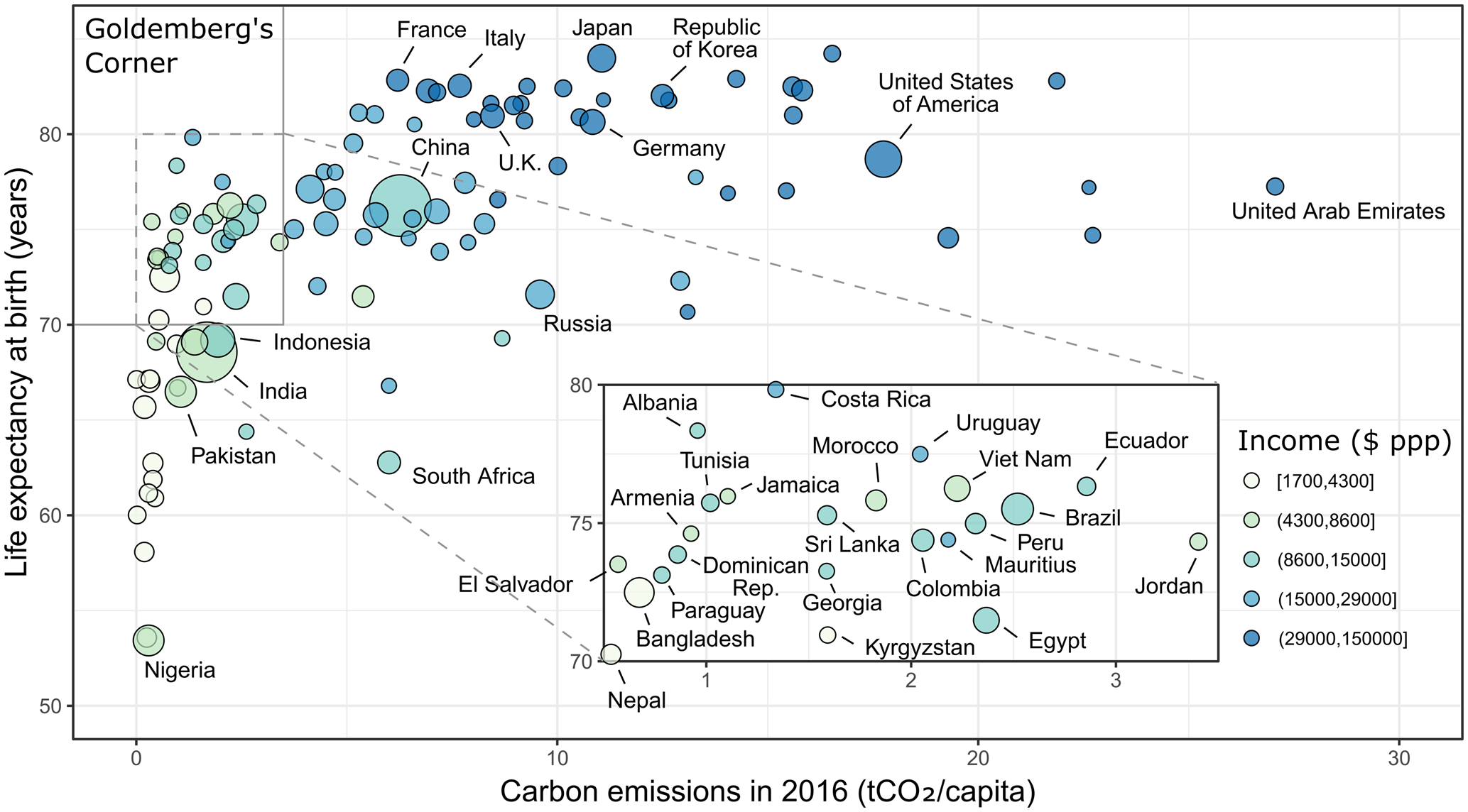
The complexity of the relationship between human well-being and emissions can be seen through the vast diversity in national locations on a plot of per capita emissions and average life expectancy at birth (Figure 1). A number of factors interact to create this variation,Footnote i which is substantial. The overall picture in 2016 was that the countries with the highest life expectancies, above 75 years, had trade-adjusted emissions ranging from under one ton of carbon dioxide per capita to as much as 27 tons (Albania & UAE respectively). Countries with very modest levels of emissions, below 1.5 tons of carbon dioxide per capita, achieved average life expectancies ranging between 53 and 77 years (Swaziland and Albania). This suggests there is no simple relationship between these two variables. A diverse group of countries is situated within what we have termed ‘Goldemberg's Corner’ (Steinberger & Roberts, Reference Steinberger and Roberts2010) of high life expectancy (above 70 years) with moderate carbon dioxide emissions (below 3.5 tons CO2 per capita).Footnote ii This desirable location includes countries in South America, North Africa, Asia and the Reforming Economies in Eastern Europe, with diverse climates, economic structures, histories and political regimes (Lamb et al., Reference Lamb, Steinberger, Bows-Larkin, Peters, Roberts and Wood2014; Steinberger & Roberts, Reference Steinberger and Roberts2010).
Trade-adjusted CO2 emissions per capita vs. life expectancy, with Goldemberg's Corner (with high life expectancy with low carbon emissions) expanded. Dot size is proportional to population; colour shading by quintiles of income (purchasing power parity 2005 constant dollars). Updated to latest data (2016) using the same sources as Steinberger et al. (Reference Steinberger, Roberts, Peters and Baiocchi2012).
While historical patterns do not foreclose future options opened by the plunging price of renewables such as wind, solar, geothermal, wave and tidal energy, understanding the approaches and performance of countries that have achieved high human well-being outcomes with low carbon emissions in the past may help reveal important development pathways compatible with a stable climate system. Studies have found the geographic diversity of such countries to be matched by their diversity in economies and carbon emissions (Lamb et al., Reference Lamb, Steinberger, Bows-Larkin, Peters, Roberts and Wood2014). For instance, Costa Rica, Peru and Brazil have warmer climates, a lower propensity to engage in international trade, and higher rates of population growth, compared to a quite different group of countries in Goldemberg's Corner: Albania, Armenia and Georgia (Lamb et al., Reference Lamb, Steinberger, Bows-Larkin, Peters, Roberts and Wood2014). Warm, international trade-intensive nations such as Thailand and Vietnam are also present in this desirable space of high well-being with moderate emissions.
Even more impressive than the current situation are the dynamics implied by the change in the relationship between emissions and life expectancy over time (Givens, Reference Givens2017, Reference Givens2018; Jorgenson, Reference Jorgenson2014). Far from remaining static, the emissions levels in relation to high life expectancy outcomes have been decreasing steadily, and rapidly. In 1975, a life expectancy of 70 years was associated with, on average, over 7 tons of carbon dioxide emissions per capita, and was only within the reach of the most industrialized countries. Thirty years later, the average level of emissions associated with a 70-year life expectancy had decreased by more than a factor of 3, and was only slightly above 2 tons of carbon dioxide per capita (Steinberger et al., Reference Steinberger, Roberts, Peters and Baiocchi2012), bringing this life expectancy level within the reach of emerging and developing countries.
In contrast, the relation between income and emissions has not been as dynamic. On average, in 1975, an annual national income of US$10,000 was associated with close to 8 tons of carbon dioxide per capita; and this had halved to four tons by 2005. Emissions and income have historically been much more closely coupled when we consider the critical issue of international trade in products with high levels of ‘embedded emissions’ (Steinberger et al., Reference Steinberger, Roberts, Peters and Baiocchi2012). Countries have been able to achieve much greater gains in the carbon efficiency of well-being than in the climate efficiency of economic activity (Jorgenson & Clark, Reference Jorgenson and Clark2012). This is a crucial point, and we expect that with attention to equitable well-being, further gains are possible at low costs to the climate.
It is important to note that the results described here are for carbon emissions from fossil fuel use; taking into account the totality of greenhouse gases, including methane and nitrous oxides from agricultural processes, requires further research. Hertwich & Peters (Reference Hertwich and Peters2009) showed that the lowest trade-adjusted non-CO2 greenhouse gases are about 1 ton of CO2e per person, even in the poorest countries, and this level may constitute a hard limit to emission reductions while maintaining sufficient agricultural production using current methods (Bajželj et al., Reference Bajželj, Richards, Allwood, Smith, Dennis, Curmi and Gilligan2014). This suggests critical future lines of research, both on low-emissions pathways and on how to drive down the floor of ‘Goldemberg's Corner’ for different types of economies and emissions while raising life expectancy. Similar analyses of anthropogenic environmental stressors beyond greenhouse gas emissions (to issues like desertification, biodiversity, toxins and other local pollution) are also needed.
3. Research gaps and complexities of pathway-switching
The diversity and dynamics of international performance in achieving well-being at various levels of carbon emissions thus suggest new research and policy directions. The research we have discussed indicates that increasing human well-being is compatible with significant decreases in carbon emissions; the challenge is to explore low-carbon development paths, appropriate or adaptable to many situations, that prioritize equitable improvements in human well-being while delivering radical emissions reductions at the level needed (IPCC, Reference Masson-Delmotte, Zhai, Pörtner, Roberts, Skea, Shukla, Pirani, Moufouma-Okia, Péan, Pidcock, Connors, Matthews, Chen, Zhou, Gomis, Lonnoy, Maycock, Tignor and Waterfi2018; Lamb & Rao, Reference Lamb and Rao2015; Meinshausen et al., Reference Meinshausen, Meinshausen, Hare, Raper, Frieler, Knutti and Allen2009). It should be possible to restructure our economic systems so that human needs and quality of life are provided without undermining planetary life support systems (O'Neill et al., Reference O'Neill, Fanning, Lamb and Steinberger2018; Pirgmaier & Steinberger, Reference Pirgmaier and Steinberger2019), but this will require facing the powerful forces of highly profitable industries – especially those dependent upon the extraction and processing of fossil fuels (Frumhoff et al., Reference Frumhoff, Heede and Oreskes2015; Klein, Reference Klein2014). At issue are both the ways societies develop and control technology to meet human needs, and how they manage markets, other regulation and distribution systems, and private actors to deliver these benefits at low environmental cost.
4. Four research agendas
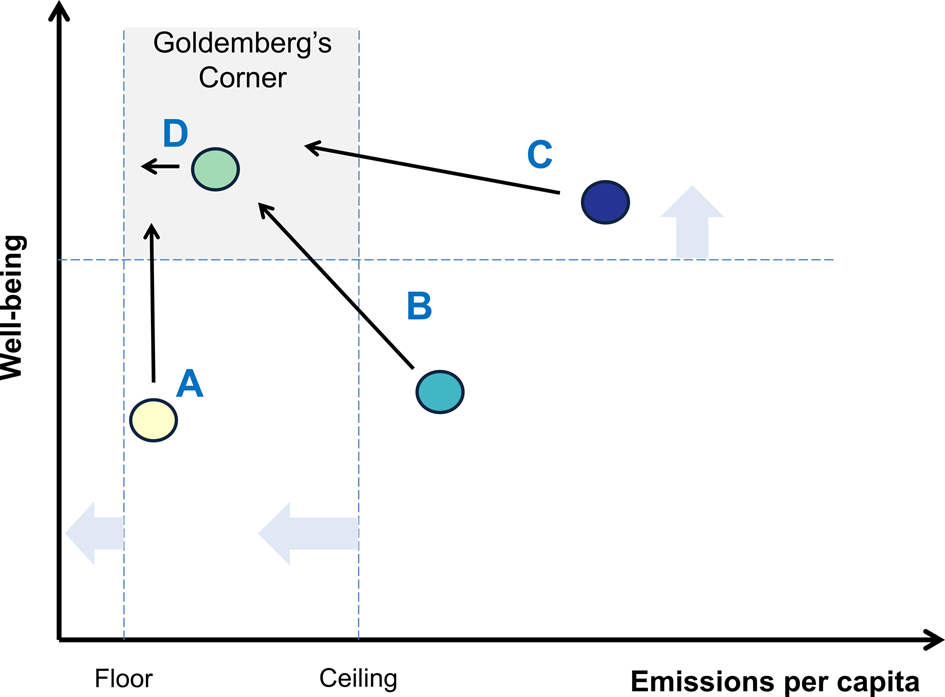
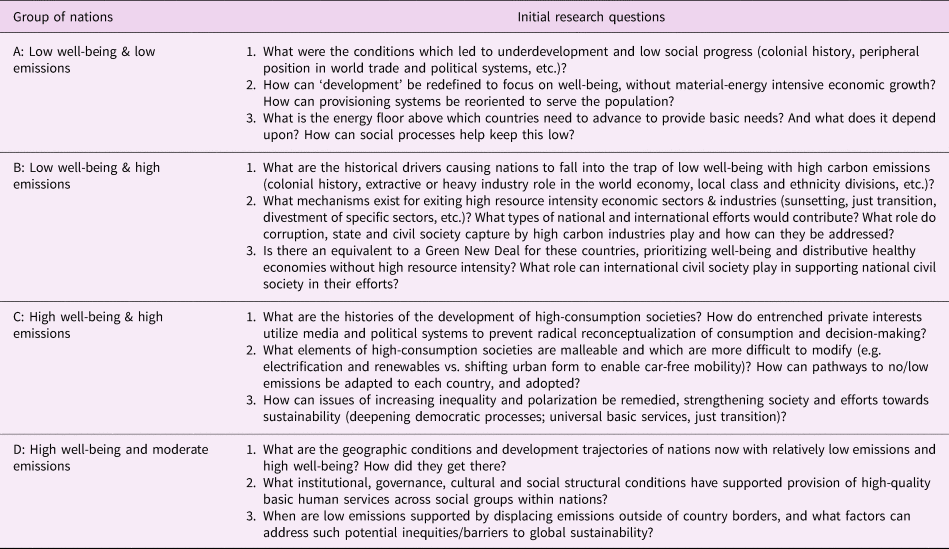
The task at hand may be broken down into studying the pathways by which nations have and might in the future improve well-being while reducing emissions. Table 1 identifies some key research questions we believe are relevant for each of four groups of nations. The observed decrease in the emissions required to achieve high life expectancy is shown schematically in Figure 2 as a ‘floor’ of emissions which declines over time. Given the plunging costs of new renewables, it should thus be possible for countries with very low carbon emissions and low life expectancies, labelled A in the lower left hand corner of Figure 2, to raise living standards and life expectancies at fairly low carbon costs, and develop their way into Goldemberg's Corner, following the trajectory schematized. These nations now face the potential option to rapidly alter their energy systems and to avoid exploiting fossil fuels in constructing new infrastructure and provisioning systems. India's INDC from the Paris Agreement explicitly raised this choice and the need for foreign assistance and investment to avoid a great upsurge in coal consumption (UNFCCC 2015). There are emergent and off-the-shelf technologies and social arrangements that provide energy and especially energy services that enhance well-being with low climate impact, but many require substantial upfront investments.
Conceptual diagram of pathways required to bring four types of countries into Goldemberg's Corner (with high life expectancy with low carbon emissions). (A) Low emission (largely low-income) nations with low life-expectancy work to improve human well-being, even though this will likely increase emissions due to the greater energy consumption required to get past the floor. (B) High emitting (mostly middle income) resource extracting countries focus on improving life expectancy while sharply reducing emissions through pathway switching to lower carbon and more diversified economies. (C) (Mostly wealthy) high emitters sharply improve energy efficiency of well-being and decarbonize, while restraining excessive consumption through market or regulatory means. (D) Countries already achieving high well-being at low emissions stabilize, and ultimately decarbonize to net-zero emissions. Faint arrows on emissions per capita floor and ceiling of Goldemberg's Corner indicate changing technology and national focus on well-being could lead those to decline. Vertical arrow on rising well-being from a high baseline indicates rising technical capabilities and social expectations for ‘well-being’.
Some initial research questions for four groups of nations by well-being and carbon emissions. For each, we suggest three types of initial questions to guide research agendas. Type 1: Drivers and histories of development, including structural obstacles, and how to overcome them given the current political economy. Type 2: industrial, social and structural opportunities for lowering emissions, and the policy packages that would enable them. Type 3: improving well-being where needed, including strengthening public and political support for the systems that maintain well-being.
Group B represents a smaller set of nations who have achieved neither economic prosperity nor high well-being, in spite of relatively high emissions. These nations have the most to gain in shifting to low-carbon pathways of development that prioritize human well-being, but often have the most difficult time doing so, since often their economies are dominated by natural resource extraction and the early stages of materials processing. Because there is a confluence of substantial global benefit (from greenhouse gas emissions reductions) and local benefit (from improvements in well-being and reducing local pollution), these nations should be a natural focus for international private and public cooperation. Addressing the interests of ‘polluting elites’, with compensation or assistance in transition to new sectors, may be most important in this group of countries (Roberts, Reference Roberts2001).
Group C represents countries with high well-being and high emissions (the ‘developed’ nations), which can still improve their overall well-being while making radical reductions in greenhouse gas emissions. Much research is ongoing on this transition, but shifting from a focus on high economic growth to prioritizing human well-being will open new opportunities for emissions reductions. There is ample evidence that increased affluence is not much coupled with well-being: beyond a rather low threshold economic growth yields sharply diminishing returns in well-being (Fanning & O'Neill, Reference Fanning and O'Neill2019; Stone & Krueger, Reference Stone, Krueger, Stiglitz, Fitoussi and Durand2018).
Group D consists of the diverse countries in Goldemberg's Corner, which have achieved high well-being at relatively moderate levels of emissions and energy use. These countries are not exempt from the need to decarbonize their economies, and thus their emissions can decrease modestly. However, their current achievement may help guide and inspire the countries from the three other groups in setting their pathways. Overall, research should be directed towards examining successful pathways of low-carbon/high well-being development, assessing the requirements, conditions and benefits of following such pathways, and suggesting the technologies, policies and institutional changes that can assist countries in achieving the overarching goal of improving human well-being (Rao & Baer, Reference Rao and Baer2012). Comparative cases can be informed by ‘archetype analysis’ for each group of nations (Oberlack et al., Reference Oberlack, Sietz, Bürgi, Brémond, Dell'Angelo, Eisenack and Kimmich2019). Research needs to include the difficult political, judicial, cultural and institutional changes required to support these transitions (e.g. Newell Reference Newell2018; Newell & Mulvaney Reference Newell and Mulvaney2013; Scoones et al., Reference Scoones, Leach and Newell2015). Again, much of this work will be nation-specific, informed by national political, economic and social structures.
5. Future steps
The research effort proposed here requires new kinds of modelling: combining decarbonization of energy and other production processes with sustainable energy access and goals (Pachauri, Reference Pachauri2014). Within affluent nations, special consideration for regions and groups adversely affected by emissions reduction policies may also be warranted, for example as proposed in the USA Green New Deal resolution (Ocasio-Cortez, Reference Ocasio-Cortez2019). Understanding the social and political barriers to switching from high-carbon to lower-carbon modes of production and consumption, and ways to overcome them, will be fundamental. Existing technology now makes it feasible to achieve low carbon emissions and high human well-being for all nations (Grubler et al., Reference Grubler, Wilson, Bento, Boza-Kiss, Krey, McCollum, Rao, Riahi, Rogelj, De Stercke and Cullen2018). But the barriers are substantial, and include active lobbying against regulation by vested interests (InfluenceMap 2019; Moe Reference Moe2015), technological and social lock-in (Ivanova et al., Reference Ivanova, Vita, Wood, Lausselet, Dumitru, Krause, Macsinga and Hertwich2018), and, despite growing awareness, a fragile public discourse on appropriate responses to climate change (Drews & van den Bergh, Reference Drews and van den Bergh2016; Fairbrother, Reference Fairbrother2017). Such barriers are differentiated by country and world region, and even within nations. Research has mapped out organized networks of climate denial in the USA (Farrell et al., Reference Farrell, McConnell and Brulle2019). The international spread of this counter-movement remains underexplored; as are the links between institutional capabilities, corruption and climate policy failure in developing and middle-income countries (Lockwood, Reference Lockwood2015). Unfortunately, these areas are currently the weakest link in the existing research and policy chain (Pirgmaier & Steinberger, Reference Pirgmaier and Steinberger2019).
The Intended Nationally-Determined Contributions (INDCs) submitted in the 2015 Paris round of negotiations must be connected to national development planning, beginning the difficult steps to switch from high-carbon pathways to lower carbon ones. Eventually, scientific evidence of planetary boundaries and emissions pathways needs to be the basis of adequate national and global emission limits. ‘Just transitions’ for high-carbon industry workers, communities and nations, incentives for sector and technology switching, compensation for some stranded assets, and dematerialization strategies will all be important elements of pathway switching (Wilson et al., Reference Wilson, Grubler, Gallagher and Nemet2012). Harnessing productivity growth to reduce working hours rather than merely expanding output is a potent approach to reducing emissions (Fitzgerald et al., Reference Fitzgerald, Schor and Jorgenson2018; Knight et al., Reference Knight, Rosa and Schor2013). And policies for moving resource-rich middle-income countries to lower emissions with higher human well-being remain underexplored.
There is much to be done in both research and policy experimentation (Table 1), and given the sharp reductions in global emissions needed to remain below 1.5 or even 2 °C warming, the time is short (IPCC, Reference Masson-Delmotte, Zhai, Pörtner, Roberts, Skea, Shukla, Pirani, Moufouma-Okia, Péan, Pidcock, Connors, Matthews, Chen, Zhou, Gomis, Lonnoy, Maycock, Tignor and Waterfi2018). Shifting away from a singular focus on increased gross domestic product per capita towards advancing human well-being with low stress on the environment would focus attention on forms of development that provide human benefits. This revised framing may open paths to a future that is more sustainable, healthier and more equitable (Jorgenson et al., Reference Jorgenson, Schor and Huang2017, Reference Jorgenson, Dietz and Kelly2018).
Acknowledgements
This analysis was initiated during discussions at the 20th Meeting of the Society for Human Ecology, Bar Harbor, Maine, USA. William Clark and several anonymous reviewers have provided useful feedback on an earlier version.
Author contributions
All authors participated in a workshop at the Meeting of the Society for Human Ecology where the article was conceived. JS proposed the conceptual framework, JR led drafting and revisions, and all contributed to writing and editing. WL and JS conducted data gathering, WL produced the figures.
Financial support
This research received no specific grant from any funding agency, commercial or not-for-profit sectors.
Conflicts of interest
None.